In this article
You are standing in front of a rack where one rain jacket costs twenty dollars and the one next to it costs five hundred, and nothing on either hang tag tells you what that difference actually buys. The same three questions come up in every rain gear thread ever posted: what separates waterproof from water-resistant, why am I soaking wet inside a jacket that isn’t leaking, and is the cheap stuff genuinely waterproof or just cheap. All three have clean answers, and two of them will save you money. This guide walks the whole category, jacket to pants to poncho to gaiters, translates the vocabulary into plain language, and ends with an honest read on which tier your kind of hiking actually needs.
What Actually Counts as Rain Gear
Say “rain gear” to most hikers and they picture exactly one thing: a jacket. That instinct is half right. The jacket earns its slot first, but the other four pieces each answer a different failure, and a hiker who solves only the first one still ends up at a trailhead with a wet sleeping bag.
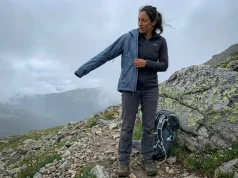
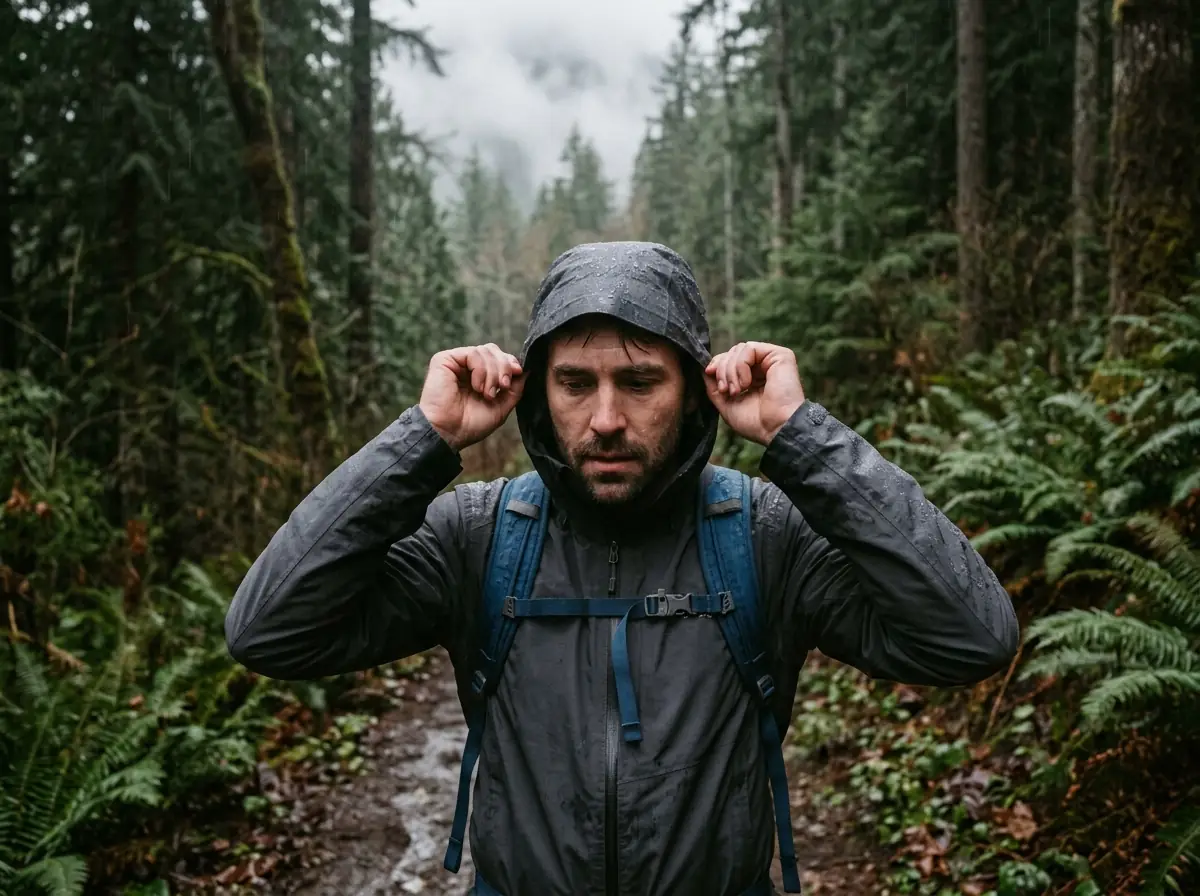
The rain jacket, or hardshell, is the non-negotiable piece. It covers the torso, where the most heat is generated and lost, and doubles as a windproof layer on exposed ridges, which is why a shell that is only wind-resistant leaves you colder than the temperature suggests. The mid-tier benchmark most people already know by name is The North Face Venture 2, a seam-sealed 2.5-layer shell that has been the default “solid, unexciting, works” jacket in this segment for years.
Rain pants are the conditional piece. Brush-heavy trail, sustained cold rain, wind that turns wet legs into a heat leak: those are the conditions where pants stop being optional. Plenty of hikers skip them in warm summer rain and are right to. A rain skirt or rain kilt is the ventilation-first compromise, cheap enough that the Washington Trails Association’s homemade trash-bag version is something people genuinely make and use. If you’re weighing those two, how rain pants and a rain skirt actually compare on the trail settles it.
On the budget end, a FROGG TOGGS Ultra-Lite2 Rain Suit (men’s · women’s) gets you jacket and pants together, which is how most people should buy their first full setup.
A rain poncho covers you and your pack in one piece and breathes better than anything else here, because air moves freely underneath. It also catches wind like a sail and leaves your legs bare. Good on a gentle approach trail, bad on an exposed ridge in a squall.
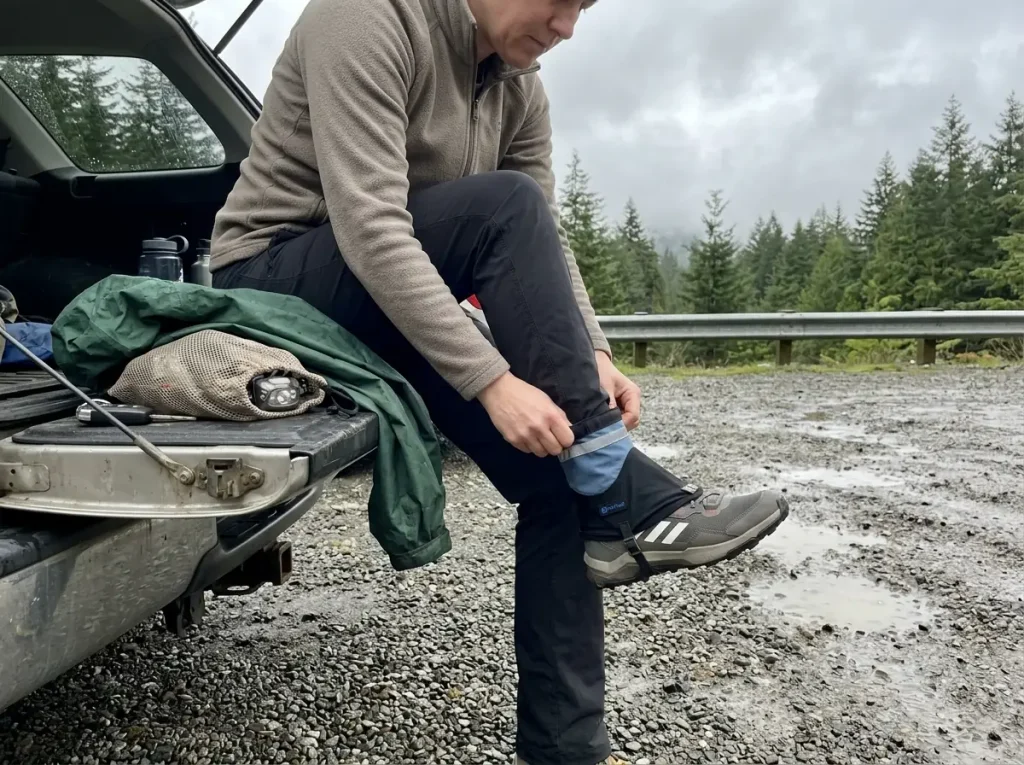
Gaiters get dismissed as fussy right up until the first mile of wet grass sends a steady trickle down your shins into your socks. Wet feet lose heat roughly 25 times faster than dry feet, which is why extremities are where cold-weather trouble starts. Some hikers pair them with waterproof socks for the same reason. A low-cut pair like the Pike Trail Ankle Gaiters handles trail water, mud and grit for very little weight, and the full breakdown on choosing gaiters covers heights and boot compatibility.
Then there’s the pack. Protecting your gear and protecting yourself are separate jobs, and the pack rain cover that came with your pack only does part of the first one. Water runs down your back, past the cover, into the panel it doesn’t reach.
Ask any backpacker who has pulled a damp sleeping bag out at dusk: a rain cover alone won’t keep your pack dry. Line the pack, or dry-bag what must stay dry.
Stop treating rain gear as one purchase decision. Buy the jacket first and hike in it for a season. The trail will tell you which of the other four pieces you actually need, and it’s rarely the ones you’d have guessed in the store.
Waterproof vs. Water-Resistant vs. Water-Repellent — What the Labels Actually Mean
These three words sit side by side on a rack looking like synonyms and mean three completely different things once it starts raining sideways. There’s a number that cuts through all of it, and when a jacket doesn’t print that number anywhere, the silence is the answer.
Waterproof, Water-Resistant, and Water-Repellent Aren’t the Same Word
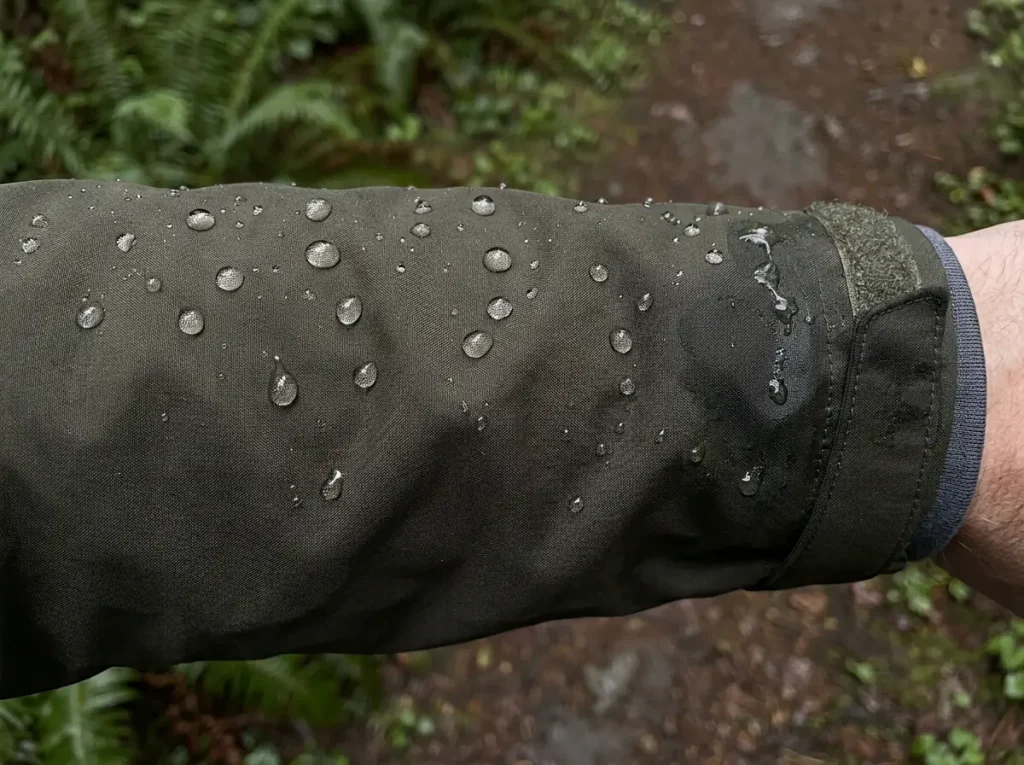
Water-repellent describes a surface treatment: the durable water repellent (DWR) finish on the outside of the face fabric that makes water bead up and roll off. It wears away, and by itself it stops nothing.
Water-resistant means the garment handles light drizzle and gives up under sustained rain. Wind shells, most softshells, and a lot of “rain jackets” on department-store racks live here. They’re not lying, exactly. They’re answering a much easier question than the one you’re asking.
Waterproof means a membrane or coating inside the garment blocks liquid water under pressure and holds up when rain drives into you at an angle for two hours. One layer down your outfit, the same labels cause the same confusion on hiking pants.
Hydrostatic Head — The Number That Tells You the Truth
Hydrostatic head is measured in millimeters: how tall a column of water the fabric holds back before it starts leaking. It’s the closest thing this category has to an honest spec. Roughly 5,000mm is where a fabric earns the word waterproof at all. 10,000mm and up is the accepted floor for a trail-worthy rain jacket. 15,000 to 20,000mm and beyond is heavy-rain and wet-snow territory. If you want the other half of that equation, what hydrostatic head ratings cost you in pack weight covers the grams you pay for each step up the ladder.
No hydrostatic head number printed anywhere on the tag, the listing, or the brand’s spec page? That’s your answer. Brands print the number when the number helps them. Silence means water-resistant marketing copy wearing a rain jacket’s haircut.
Why the Lab Number Is Always a Little Optimistic
Here’s what the spec sheet leaves out. Hydrostatic head is a static test: a tube of water pressing straight down on flat, unstressed fabric in a room with no wind. Your hike is none of those things. Rain arrives at an angle, a loaded pack drives the shoulder straps into the fabric, and every time you kneel on wet ground you push a small puddle through the knee panel with your full weight behind it.
Real-world performance runs a notch below the number, always. Which is why buying on hydrostatic head alone is the mistake that shows up over and over in gear threads. A 20,000mm shell with unsealed seams, no pit zips and a floppy hood leaves you wetter than a properly built 10,000mm one. The number is a filter, not a verdict.
How Rain Gear Technology Works
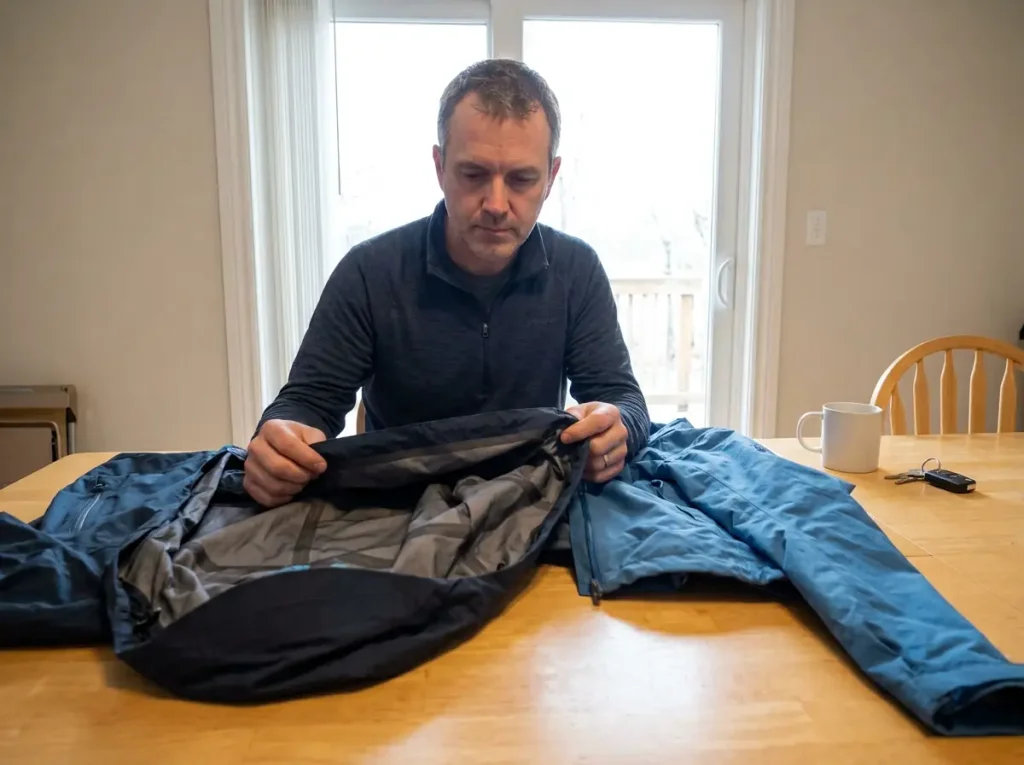
You don’t need a materials-science degree to buy a rain jacket. You do need one fact: a 2.5-layer shell and a 3-layer shell will both keep the rain off you on day one. The difference isn’t how they perform new. It’s how they die.
2-Layer, 2.5-Layer, and 3-Layer Construction
2-layer is face fabric bonded to a membrane, with a separate mesh liner hanging loose inside to protect it. Bulkier, packs bigger, usually the cheapest true hardshell you can buy. The loose liner is what makes it feel like a jacket from 1998.
2.5-layer replaces that liner with a thin pattern printed directly onto the inside of the membrane. It’s the lightest and cheapest of the real shells, which is why it dominates the packable end of the market. It also wears out fastest: that printed layer abrades away against pack straps and shoulder seams, and once it’s gone the membrane starts delaminating from the inside. Two seasons of hard use is a normal life. Five is lucky.
3-layer bonds face fabric, membrane and liner into one sandwich. Most durable, most breathable, heaviest, priciest. Nothing rubs off it because there’s nothing loose to rub. This is the construction that survives a decade of Cascades winters if you wash it, which is a big if we’ll come back to.
That failure-mode framing is what to carry out of this section. You aren’t choosing between good and better performance. You’re choosing how many seasons you get before the jacket quietly stops being one, and which construction fails first out on the trail goes deeper into what that costs per year of ownership.
Laminates vs. Coatings
A laminate is a separate membrane film bonded to the fabric. Gore-Tex, eVent and Pertex Shield are laminates. A coating is a polyurethane coating applied to the back of the face fabric as a liquid and cured in place. Coatings hit a lower price and weight; laminates generally breathe better and last longer.
Between laminates the differences are smaller than the marketing suggests but not zero, and how Gore-Tex and eVent actually compare on performance data is worth reading before paying a premium for a membrane name on the chest.
What DWR Actually Does (and Doesn’t)
This is the distinction most hikers never get told, and it explains more gear frustration than anything else in this guide. DWR is not what makes your jacket waterproof. It’s a treatment on the outer surface of the face fabric, sitting on top of and entirely separate from the membrane underneath. Its only job is keeping the outer fabric from soaking up water like a sponge.
The membrane does the waterproofing. The DWR keeps the membrane free to do its other job, letting your sweat vapor out. When the DWR wears off, the membrane is still perfectly waterproof and you will still get wet. That sounds like a contradiction, and untangling it is the entire next section.
Breathability and the Condensation Problem Nobody Warns You About
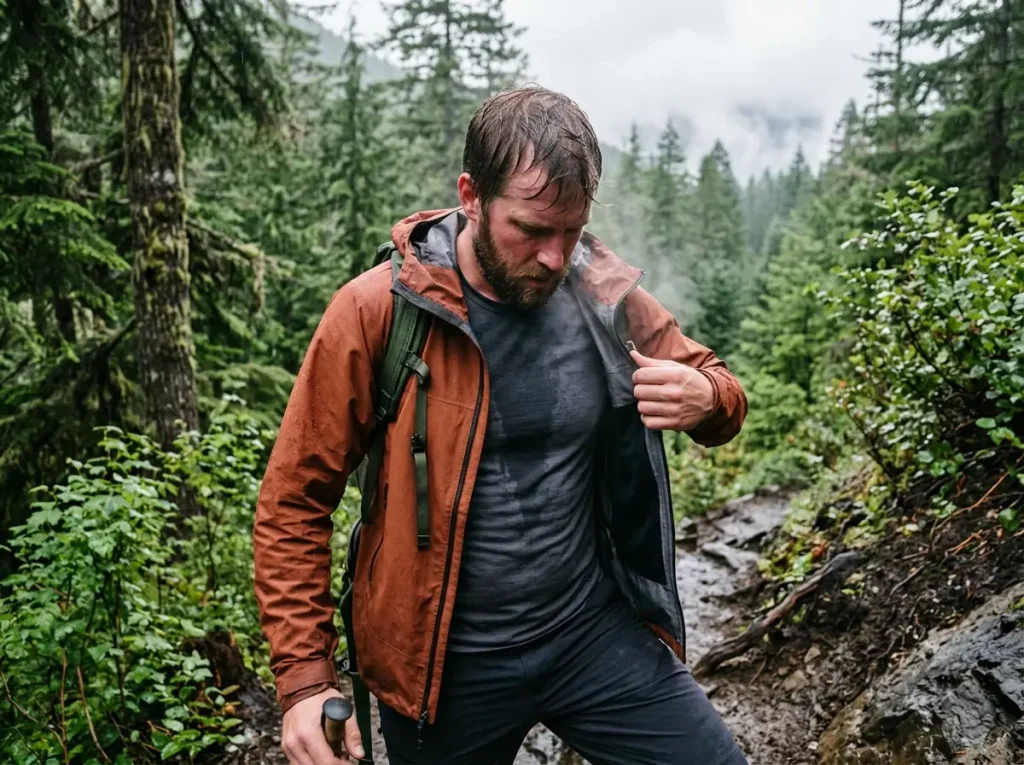
An hour into a steady climb in steady rain, you unzip at a switchback and your base layer is soaked through. The instinct is immediate and almost always wrong: this jacket failed. It usually didn’t. There are three mechanically different ways to end up wet inside a rain shell, hikers lump all three together as “the jacket got wet,” and the fix for each one is completely different.
Three Different Ways You Get Wet Inside a Rain Jacket
A leak is the only one that’s actually a defect. Water enters through a specific place: an unsealed seam, an abrasion hole, a zipper without a storm flap. You can usually find it, because the wetness is localized and doesn’t match where you were working hardest.
Wetting out is the DWR failure described above. The face fabric saturates, the membrane gets buried under a film of liquid water, and vapor can no longer pass outward. The membrane isn’t leaking. It’s suffocated. From the inside this feels exactly like a leak, and it’s a maintenance problem.
Condensation is warm, moisture-laden air off your working torso hitting the cooler inner surface of the shell and turning back into liquid on it. Same physics as a cold glass in August. Nothing failed, nothing is worn out. It’s you.
Condensation Isn’t a Leak — It’s You
Here’s the ceiling nobody puts on a hang tag: breathable membranes handle moisture vapor transfer only, moving water as vapor and never as bulk liquid. A hiker working hard up a grade produces vapor faster than any membrane on the market can pass it, on a factory-fresh jacket, at any price. That limit is physical and no amount of money gets you past it.
That reframes everything. A soaked base layer on a hard climb isn’t evidence of a bad purchase. It’s evidence you were climbing hard. Sustained wet exposure is a planning factor rather than a comfort factor, which is how NOAA’s outdoor weather safety guidance treats it, and that planning happens before you’re an hour up the trail deciding whether to be angry at your jacket.
The identical tradeoff shows up on your feet, where the same breathability tradeoff shows up in waterproof footwear with a smaller vent budget and worse consequences.
The community name for the worst version is the trash bag effect: technically dry from rain, thoroughly soaked in your own sweat, sealed inside a garment doing exactly what you asked. Which leads to the mistake almost everyone makes once. Feeling damp, you cinch the hood, zip the collar to your chin and close the cuffs, trying to seal your way to dry. You’ve just removed every escape route the vapor had.
Wetting Out, and Why a Working Jacket Suddenly Stops Working
Telling wet-out apart from condensation takes about four seconds and one look at the outside of your sleeve.
If water is still beading and rolling off the outer fabric, and you’re damp specifically where you were working hardest, that’s condensation. Back, chest, underarms. Vent and slow down.
If the beads have stopped forming, the fabric looks dark and saturated, and the dampness inside is spread evenly across the whole garment including the parts of you doing nothing, that’s wetting out. The jacket isn’t finished. It’s dirty. Section 8 has the fix and it costs less than a tank of gas.
Open the pit zips at the bottom of the climb, not partway up it. Once you’re already producing vapor faster than the membrane can move it, venting stops being prevention and starts being damage control. Every guide gives some version of this advice and almost nobody takes it.
The Feature Checklist That Actually Matters
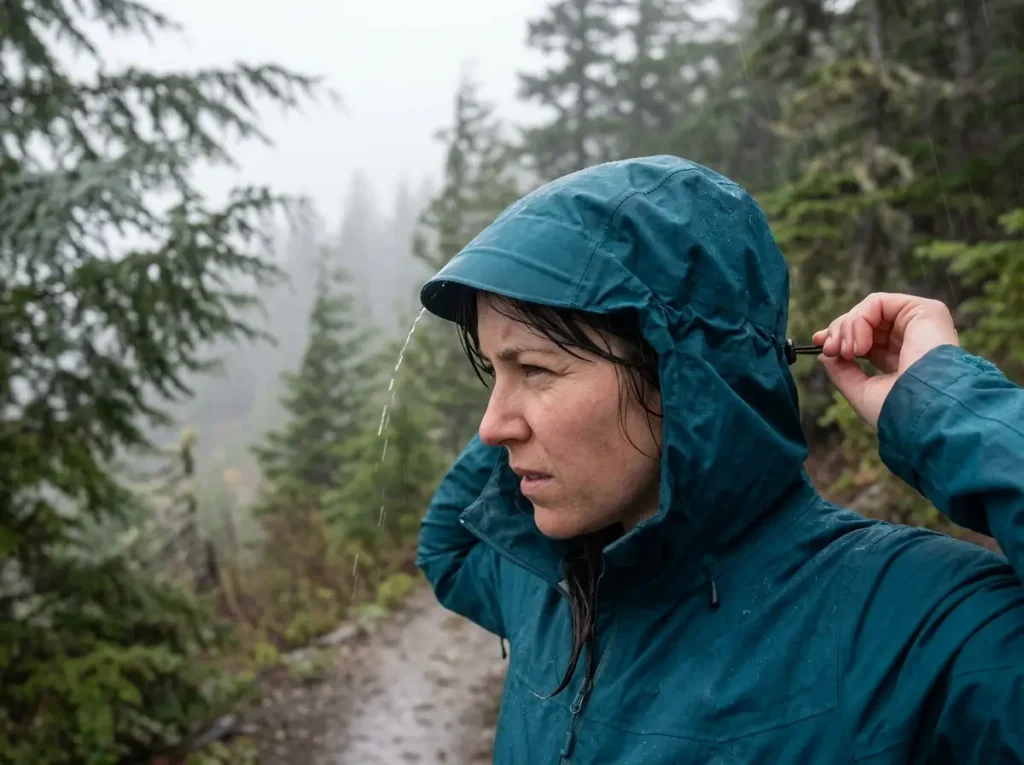
This is where you put the hang tag down and start checking the garment with your hands. Five things, roughly in the order a veteran checks them, and the first one is invisible from the outside.
Sealed Seams and Ventilation
A needle makes a hole. Every stitch line is a row of holes punched through waterproof fabric, and without seam taping the garment leaks at every one of them, which is why a properly seam sealed shell is the baseline regardless of its hydrostatic head number. Turn the jacket inside out and look for narrow tape strips along the shoulder and sleeve seams. No tape, no purchase.
Pit zips are the only real answer to the vapor ceiling from the last section. Dumping heat without stopping, without taking the pack off, without taking the jacket off in the rain, is what separates a shell you’ll wear from a portable sauna you’ll carry and resent. Some jackets vent through mesh-backed pockets instead. That works, right up until you put a hipbelt over them.
The Hood Is the Part Most People Ignore
Hood design gets skipped in every spec comparison and it’s what you’ll notice most in real rain. You want three-point hood adjustment, a volume adjuster at the back plus drawcords at the sides, so the hood turns when your head turns instead of you rotating inside a fabric tube. You want a stiffened brim, sometimes called a visor, that holds its shape.
A floppy hood blinds you the first time you look sideways in wind, roughly the moment you most need to see where your foot is going. Put the hood up in the store and look hard left. If it doesn’t come with you, put it back on the rack.
Pockets, Cuffs, and Packability
Pocket placement stops being a detail the moment you put a pack on. Hand pockets sit exactly where a hipbelt lands, which makes them decorative on anything longer than a parking-lot walk. Chest pockets stay reachable loaded, and that’s where your map or phone should live.
Cuffs and hem drawcords, the wrist closures at the end of each sleeve, decide whether wind-driven rain runs up your forearms and pools at your waist. Velcro wrist tabs are worth more than they look if you use trekking poles and spend the day with your arms raised. Fit matters too, since a shell that’s snug over a t-shirt is a straitjacket over a fleece, and sizing a shell so it still fits over your layers is a more common regret than any fabric choice.
Packability decides everything else. If it doesn’t compress into its stuff sack small enough to live in your pack on clear days, you’ll leave it in the car on the one day the forecast is wrong. That’s the real failure mode, and no membrane fixes it. When you’re ready to go from what to check to which one to buy, our full breakdown of what makes the best rain jacket for hiking takes it from here.
Choosing Rain Gear for Your Kind of Hiking
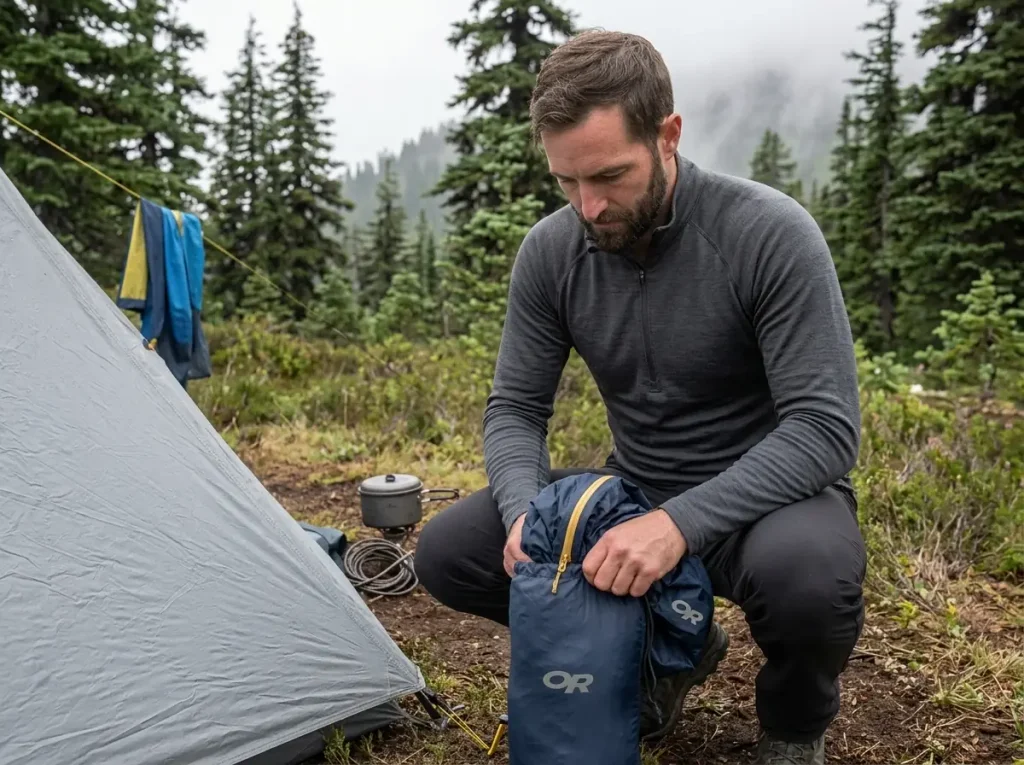
Four hikers, four completely different right answers, and not one of them is “buy the most expensive one.” Gear sites don’t say this out loud because there’s no commission in it, but most people reading this do not need a premium shell, and a couple of them genuinely do. Find yourself below.
The Fair-Weather Day Hiker
You hike a few hours at a time, mostly in decent weather, back at the car before dark. Rain is an occasional inconvenience rather than a season, and you can usually pick a weather window and go.
A packable budget shell is genuinely enough for you. Your failure mode isn’t the jacket underperforming in a storm, it’s the jacket sitting in a closet because it’s bulky and you didn’t feel like carrying it. Buy something light and small that lives in your daypack year-round. Money spent past that point buys performance in conditions you won’t be out in.
The Year-Round Wet-Climate Hiker
Pacific Northwest, coastal ranges, anywhere rain is a season rather than an event. You’re out in sustained rain for hours, repeatedly, for months.
You’re the reader who actually earns a 3-layer shell with real pit zips, and the durability math works in your favor: a 2.5-layer shell at your mileage is a consumable. Rain pants stop being optional here too, because cold rain plus wind on wet legs is a heat leak you can’t out-hike. Pants are one slice of a larger question, and choosing hiking pants by the kind of hiking you do covers the rest.
The Weight-Counting Backpacker
Multi-day trips, a scale in the kitchen, a spreadsheet with a base-weight column. Your trade is grams against lifespan, and it’s a real trade, not a marketing one.
An ultralight shell like the Outdoor Research Helium (men’s · women’s) runs Pertex Shield with taped seams at around six and a half ounces, and what you’re buying is packed weight. Not durability, not lifespan, not breathability. Grams. Know that going in and you’ll be happy with it.
Worth noting that thru-hikers, the most weight-obsessed people in this sport, often go the opposite way: cheap non-laminate rain gear replaced when it shreds, because at trail mileage everything is a consumable. Some skip the shell debate entirely, since a trekking umbrella instead of a shell trades one occupied hand for a lot less sweat. In a summer downpour on low-angle trail, that isn’t a silly trade at all.
The Budget-First Hiker
You want to be dry, you don’t want to spend three figures, and you’d rather use gear than baby it.
A FROGG TOGGS Ultra-Lite2 Rain Jacket (men’s · women’s) is genuinely waterproof by the numbers, around 8,000mm hydrostatic head on non-woven polypropylene. Anyone calling it fake rain gear hasn’t checked the spec.
What it trades away is durability: it tears on brush and thorns, and breathability drops as the material ages. Real limits, worth knowing. Not reasons to call it a toy.
The honest version of this section is that a $500 Gore-Tex Pro shell is overkill for most people reading this page, and the money goes further on a shell that fits well plus a bottle of technical wash. For specific picks, our picks for men’s waterproof rain jackets and the women’s rain jacket picks and fit guide go product by product.
Budget vs. Premium — What You’re Really Paying For
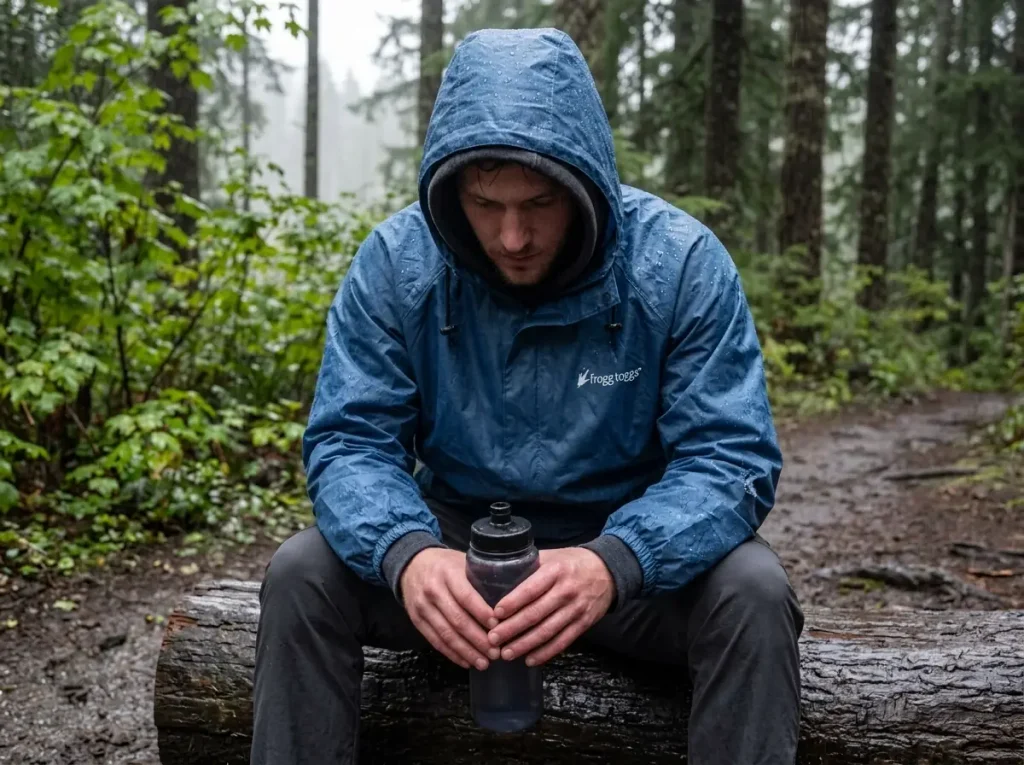
The honest answer is boring, which is probably why nobody leads with it. Extra money buys durability, breathability, and comfort. It does not buy waterproofness.
A budget rain suit and a premium shell will both keep rain off you on day one. The gap opens up somewhere around month eighteen.
What More Money Actually Buys
Four things, in descending order of how much you’ll notice them. Durability: heavier denier ripstop nylon face fabrics, reinforced shoulders, 3-layer construction with nothing loose to abrade. Breathability: better laminates with higher vapor transfer rates. Fit and articulation: sleeves that don’t ride up when you reach overhead, an articulated fit that clears a pack without bunching.
Features: pit zips, three-point hoods, hipbelt-compatible pockets.
Notice what isn’t on that list. No premium shell has a meaningfully higher initial waterproof rating than a competent budget one, because past a certain hydrostatic head number more is just more. That’s the mid-tier’s whole argument, and the jacket most readers already know in that segment is The North Face Venture 2: seam-sealed, pit-zipped, unglamorous, fine. Most hikers who land there are correctly served.
When Cheap Rain Gear Is the Right Call
Budget rain gear earns its place with occasional rain, short outings, and any hiker who’d rather use gear hard than protect an investment. Frogg Toggs’ non-woven polypropylene runs roughly 8,000mm and does the job. It’s fragile against thorns, so it’s the wrong pick for bushwhacking, and it doesn’t age gracefully. Fair trades at that price.
There’s also a hiker nobody writes for: the one whose rain gear stays in a closet because it was expensive enough to feel precious. Cheap gear gets used, and used gear keeps you dry.
Where Spending More Genuinely Pays Off
Premium rain gear pays for itself in three situations. Sustained wet-climate use, where the durability difference compounds week after week. Multi-day trips where a shell failure has real consequences and no car to walk back to. And hikers who are simply hard on gear, scrambling through brush and dragging shoulders on rock, for whom a fragile face fabric is a two-month proposition.
Then the twist that reframes the whole tier question. An unwashed premium shell performs worse than a maintained budget one. The story that comes up constantly in gear forums runs the same way every time.
A hiker buys a premium Gore-Tex shell, treats it as buy-it-and-forget-it, and never washes it once. Three years later it soaks through in a storm a cheap rain suit would have shrugged off, and they are genuinely shocked. That jacket wasn’t dead. It was filthy.
Before replacing anything, three tests that tell you whether your rain jacket is actually done tells you which of the two you have.
Keeping Your Rain Gear Working
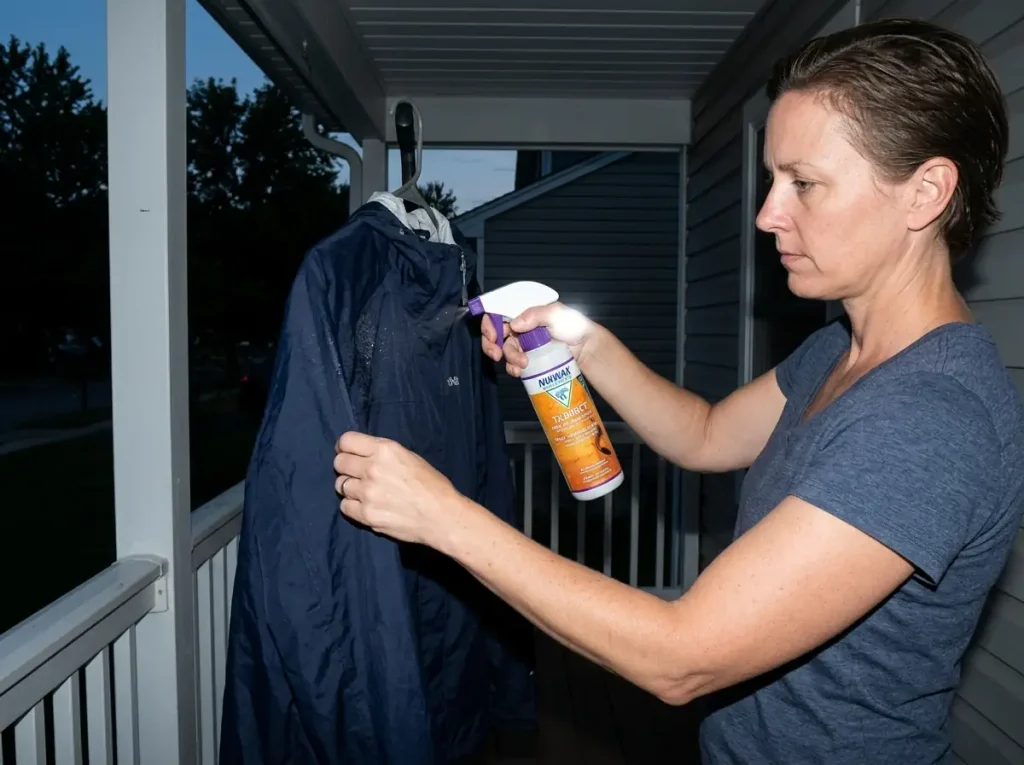
Rain gear is the one category of hiking equipment that needs maintenance to keep doing its job, and almost nobody does it. That’s the whole reason the previous section’s punchline lands. The good news is the diagnostic takes ten seconds and the fix costs a fraction of a replacement.
The Ten-Second Test That Tells You Everything
Take the jacket outside. Run water over the shoulders, where pack straps do the most damage to the DWR. Watch what happens.
Beads form and roll off: the DWR is working, and if you’re still wet inside, it’s condensation and the answer is ventilation, not shopping. Fabric darkens and the water soaks in: the DWR is gone, the shell is wetting out, the membrane is suffocating under a film of water. No equipment, no guesswork, no gear-shop opinion required.
Wash It Before You Re-Treat It
Here’s the part almost everyone gets backwards. When beading stops, the first move is not a can of spray. It’s a wash.
Regular laundry detergent leaves a surfactant residue that attracts water and blocks the membrane, and if you’ve been washing your shell with the rest of your laundry, that residue is a large part of your problem. A technical wash strips it off, and washing alone restores a surprising amount of beading before any re-treatment is needed. Heat helps too, since a warm tumble reactivates DWR that’s still present but lying flat. The procedure varies by membrane, and how to wash a Gore-Tex jacket without wrecking it walks it through.
For cadence, figure every 20 to 30 wears or once a season, and a full washing and reproofing schedule has the version you can put on a calendar.
When washing alone doesn’t bring beading back, re-treat. A spray-on like Nikwax TX.Direct goes onto a clean, damp garment and restores the finish for another season. Most current treatments are PFAS-free, which beads a little less aggressively than the old chemistry and needs reapplying more often. Order matters more than product choice, and the heat-first protocol for restoring DWR covers why so many re-treatments fail: people spray a dirty jacket and wonder why nothing changed.
Wash the shell at the end of the wet season, not the start of it. A jacket stored dirty all summer bakes its contamination in, and the residue that was easy to strip in October takes two cycles to remove in April.
Staying Dry Without Cooking Yourself
Maintenance solves half the problem. The other half is how you hike in the thing.
Start slightly cold, on purpose. Underdress at the trailhead so the first five minutes are mildly uncomfortable, and you’ve bought thermal headroom before sweat production reaches the membrane’s ceiling. Start warm and you’re playing catch-up before you’ve gained a hundred feet. Open the vents before the climb, not during it.
When the grade steepens, slow down instead of fighting the jacket. You can’t out-vent a hard effort in a shell, and trying is how the trash bag effect happens.
That matters more than comfort, because this is where rain gear stops being a convenience item. Hypothermia sets in at temperatures as mild as 30 to 60°F when wind and rain are present and clothing is wet. It doesn’t require freezing conditions, which is exactly why it catches people out: the CDC’s guidance on hypothermia prevention in wet, windy conditions puts the risk squarely in the range most of us call a normal shoulder-season day. Cotton is the specific hazard, and the National Park Service’s warning about wet cotton clothing on trail makes it official guidance rather than hiker folklore.
Cotton holds water, loses essentially all insulating value once soaked, and stays wet for hours. A working shell over a wet cotton t-shirt at 45°F in wind is a serious risk, not an uncomfortable afternoon.
Conclusion
Rain gear is a system, and the jacket is the only piece that’s truly non-negotiable. Everything else answers a specific problem you may or may not have, and buying all five at once is how people end up with a closet full of gear they never carry.
Most of what feels like jacket failure is either your own sweat or a DWR finish that needs a wash. Learn to tell condensation, wetting out and an actual leak apart, and you’ll stop replacing gear that was never broken.
The tier you need is set by your kind of hiking, not by the price ladder. Plenty of hikers are correctly served by the cheap stuff, and a few genuinely need the expensive stuff, and knowing which one you are is worth more than any spec on any hang tag.
Before the next rainy forecast, go take the shell you already own outside, run water over the shoulders, and watch what it does. Ten seconds tells you whether you need a new jacket or a bottle of tech wash.
Frequently Asked Questions
01Is Frogg Toggs actually waterproof?
Yes. Frogg Toggs’ non-woven polypropylene carries roughly an 8,000mm hydrostatic head rating, well above the threshold where a fabric counts as genuinely waterproof rather than water-resistant. What it trades away is durability, not waterproofness: the material tears easily on brush, so thru-hikers treat it as a replaceable item.
02Which is better for hiking, a poncho or a rain jacket?
A rain jacket for most hiking, a poncho when ventilation matters more than coverage. A poncho covers you and your pack at once and breathes far better, but it catches wind badly and leaves your legs bare on brushy trail. A jacket seals better and moves with you, at the cost of trapping more sweat.
03What should I wear when hiking in the rain?
A waterproof shell over a synthetic or wool base layer, and no cotton anywhere. Cotton loses nearly all its insulating value once wet, which is why the National Park Service flags it as a hypothermia hazard. Add rain pants if the rain is cold or sustained, and gaiters if the ground runs water into your boot tops.
04What is the 3 layer rule for hiking?
It refers to the three-part layeringsystem: a base layer to move moisture off your skin, a midlayer to insulate, and a shell to block rain and wind. Note that 3-layer also describes a rain jacket construction where face fabric, membrane and liner are bonded together. One is what you wear, the other is how a garment is built.
05How often do you need to reproof a rain jacket?
Roughly every 20 to 30 wears, or about once a season for regular hikers, but test before you treat. Run water over the shoulders: if it still beads and rolls off, the finish is fine. If it darkens and soaks in, wash with a technical detergent first, since that alone restores beading more often than hikers expect.
Risk Disclaimer: Hiking, trekking, backpacking, and all related outdoor activities involve inherent
risks which may result in serious injury, illness, or death. The information provided on The Hiking Tribe is for
educational and informational purposes only. While we strive for accuracy, information on trails, gear, techniques,
and safety is not a substitute for your own best judgment and thorough preparation. Trail conditions, weather, and
other environmental factors change rapidly and may differ from what is described on this site. Always check with
official sources like park services for the most current alerts and conditions. Never undertake a hike beyond your
abilities and always be prepared for the unexpected. By using this website, you agree that you are solely
responsible for your own safety. Any reliance you place on our content is strictly at your own risk, and you assume
all liability for your actions and decisions in the outdoors. The Hiking Tribe and its authors will not be held
liable for any injury, damage, or loss sustained in connection with the use of the information herein.
Affiliate Disclosure: We are a participant in the Amazon Services LLC Associates Program, an
affiliate advertising program designed to provide a means for us to earn advertising fees by advertising and linking
to Amazon.com. As an Amazon Associate, we earn from qualifying purchases. We are also an official affiliate partner
of Black Diamond Equipment via the AvantLink network. If you click on a Black Diamond affiliate link and make a
purchase, we may earn a commission at no additional cost to you. We also participate in other affiliate programs and
may receive a commission on products purchased through our links. Additional terms are found in the terms of
service.