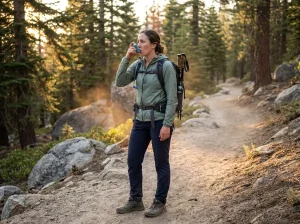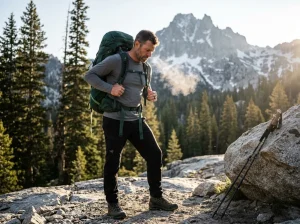
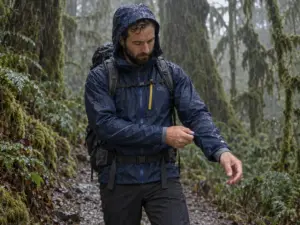
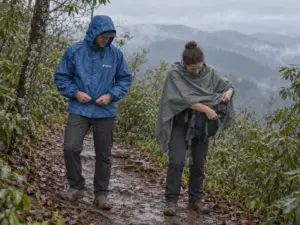
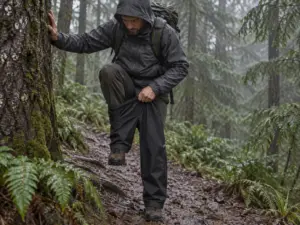
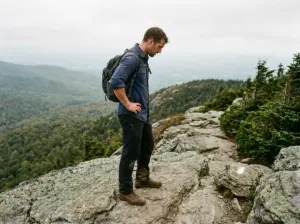
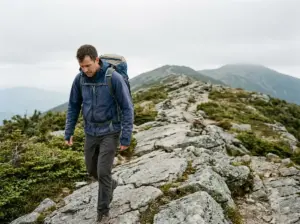
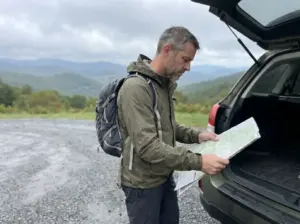
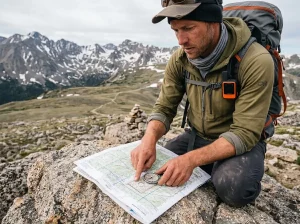
At 45 I could push 15-mile days with 3,000 feet of gain and feel sore but functional the next morning. At 53, the same route left me wrecked for three days. Nothing changed about my motivation — my body just stopped recovering at the same rate. If that sounds familiar, you are not broken. You are dealing with physiology, and physiology responds to the right inputs.
I spent two years figuring out what actually works after 50 — not gym-bro programs or generic “stay active” advice, but a system built around the specific ways an aging body loses and rebuilds trail fitness. Here is that system.
Quick Answer: The key factors for building hiking endurance after 50:
- Prioritize leg and core strength training over pure cardio
- Use low-impact cross-training to build aerobic base without joint wear
- Extend recovery windows — the 9-day training week works better than 7
- Fuel more aggressively than you did at 30 (under-eating wrecks endurance)
- Cut pack weight strategically — every pound off your back adds trail miles
- Train on terrain that mimics your target hikes, not flat treadmills
Why Hiking Gets Harder After 50 (And Why It Doesn’t Have To)
The Physiology No One Talks About at the Trailhead
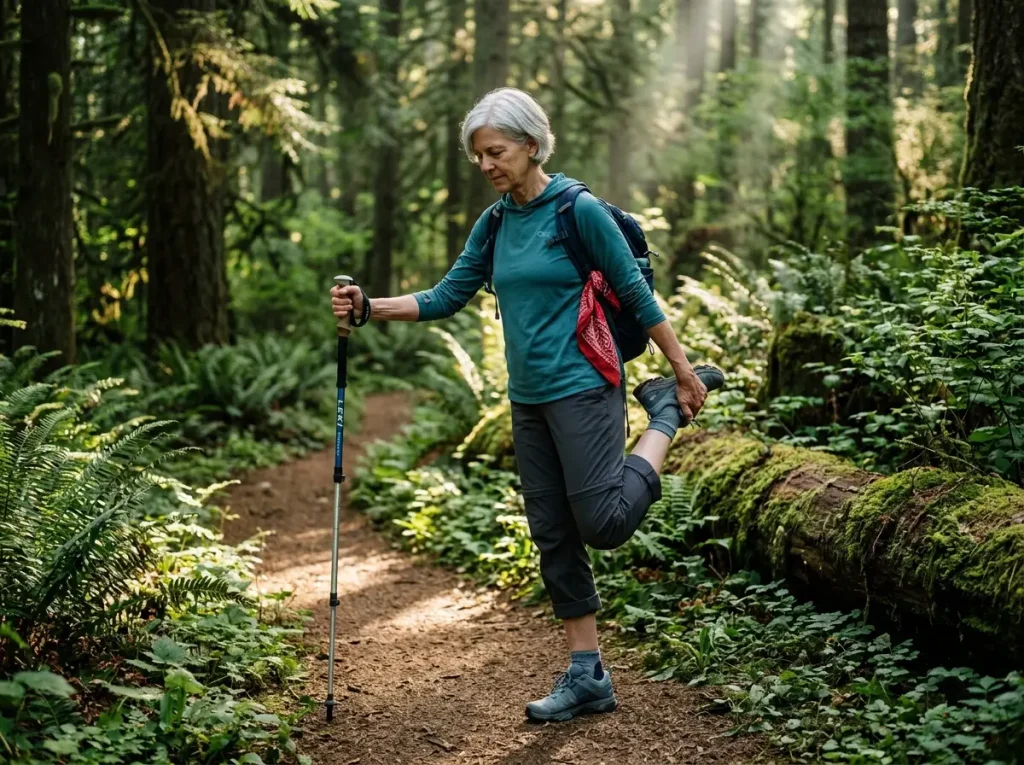
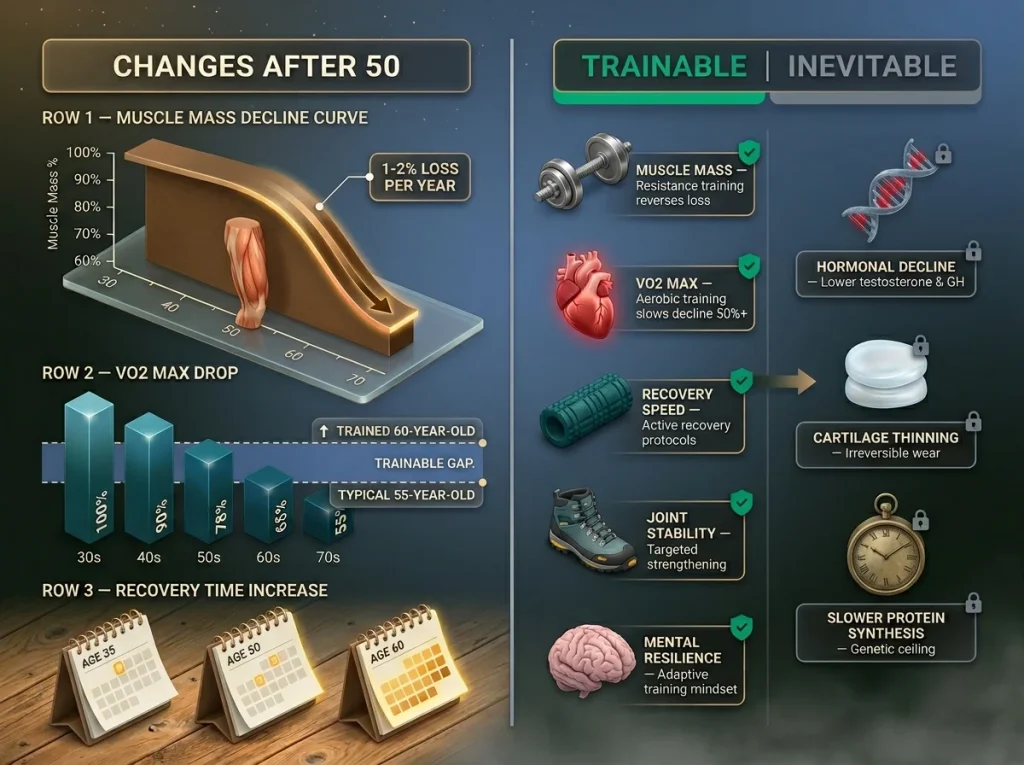
Starting around age 50, your body loses skeletal muscle mass at a rate of 1–2% per year. The clinical term is sarcopenia, and it does not care how many trails you hiked in your 40s. A 2018 review in Ageing Research Reviews confirmed that this loss accelerates without targeted resistance training — cardio alone will not stop it.
What you feel on trail is the downstream effect. Less quad strength means your knees absorb more impact on descents. Less core stability means your pack feels heavier by mile six. Less calf power means steep sections gas you faster than they used to.
VO2 Max Decline and What It Means on the Mountain
Your VO2 max — the ceiling on how much oxygen your body can use — drops roughly 10% per decade after 30. By 55, most people have lost a third of their peak aerobic capacity. That is why the same switchback that felt moderate at 40 now forces you to stop and catch your breath.
The good news: trained athletes in their 60s maintain VO2 max levels comparable to untrained 30-year-olds. The gap between “aging” and “aging without training” is enormous. You cannot stop the clock, but you can slow it to a crawl.
The Mental Shift That Makes Everything Else Work
The biggest mistake hikers over 50 make is training the way they did at 35. Same weekly schedule, same intensity, same recovery timeline. That approach stops working because your hormonal profile has changed — lower testosterone, lower growth hormone, slower protein synthesis.
Accept that your training week is no longer seven days. It might be nine. It might be ten. That is not weakness — that is smart programming. The hikers who stay on trail into their 70s figured this out early.
The Strength Work That Actually Helps on Trail
Why the Gym Matters More Than the Trail Now
Here is something counterintuitive: after 50, the most effective thing you can do for your hiking is not hike more. It is lift weights. Specifically, it is build the eccentric leg strength that controls your descent and the core stability that keeps your pelvis level under a loaded pack.
Trail miles build aerobic endurance, but they do not reverse sarcopenia. Only progressive resistance training does that. Two sessions per week — that is the minimum that research supports for maintaining muscle mass past 50.
The Four Movements That Transfer to Trail
Forget leg press machines and Smith squats. These four exercises translate directly to what your body does on a mountain:
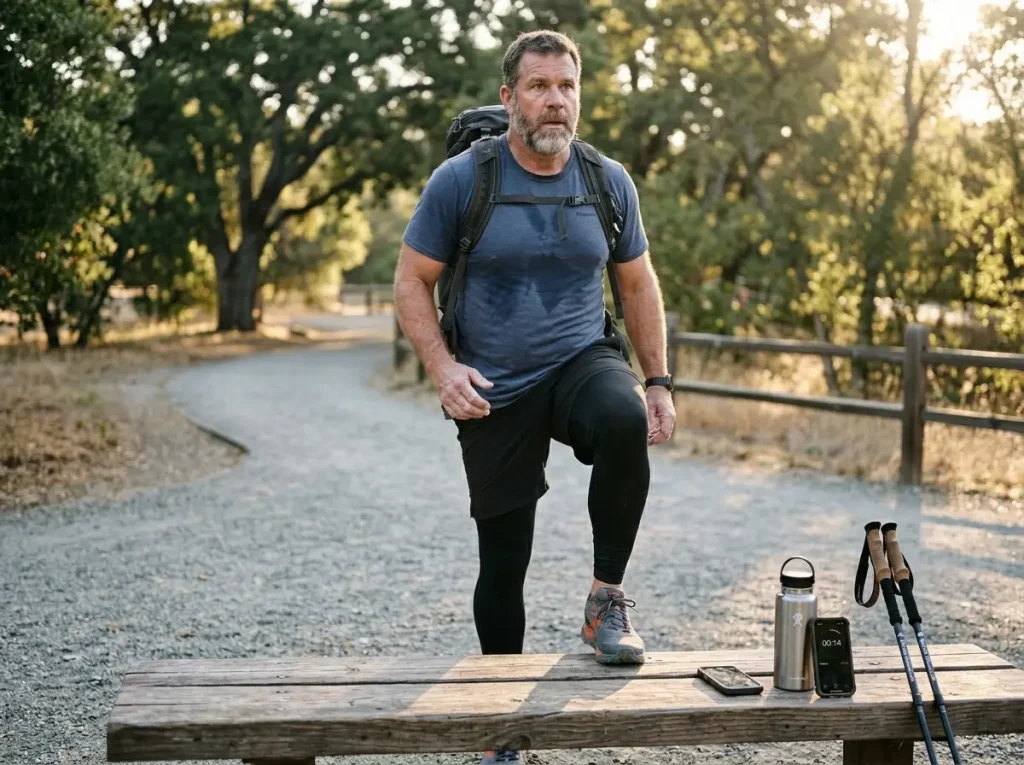
Step-ups with a loaded pack. Strap on your daypack with 20 pounds. Find a bench or box at knee height. Step up, drive through the heel, control the descent. Three sets of 10 per leg. This is the single best exercise for uphill power after 50.
Bulgarian split squats. Rear foot elevated on a bench, front foot forward. Drop the back knee toward the ground. This builds the single-leg stability you need on uneven terrain and stretches your hip flexors at the same time.
Dead hangs progressing to farmer carries. Grip strength declines faster than leg strength after 50, and you need it for trekking poles, scrambling, and hauling a pack. Hang from a pull-up bar for 30 seconds, then progress to walking with heavy dumbbells.
Lateral band walks. Your glute medius — the muscle that keeps your hips from dropping sideways on uneven ground — weakens fast with age. A $10 resistance band fixes this in five minutes per session.
Pro tip: Do your step-ups on an actual outdoor bench with your actual hiking pack. Gym benches are padded and stable. Trail terrain is neither. Train the instability, not just the muscles.
How Heavy, How Often
Twice per week is the floor. Three times is better if your joints cooperate. Go heavy enough that the last two reps of each set feel genuinely hard — not impossible, but hard. Light weights with high reps build muscular endurance, but they will not reverse the strength losses that matter most on trail.
If you are new to strength training after 50, start with bodyweight movements for the first month. Your connective tissue needs time to adapt even if your muscles feel ready. Tendons take three times longer than muscles to strengthen. Rush this and you will end up with a knee or shoulder that sidelines you for months.
If you already have a hiking fitness baseline, add weight in 5-pound increments every two weeks. If not, start there first.
Cardio Training Without Trashing Your Joints

The Low-Impact Aerobic Base
Running built your aerobic fitness in your 30s. After 50, it might also shred your knees. The impact forces in running are 2.5 times your body weight per stride. Hiking is lower — about 1.5 times — but pounding pavement five days a week adds up fast on joints that have 50 years of mileage.
Cycling is the gold standard for hikers over 50. It builds the same quad and cardiovascular endurance as running with near-zero impact. Stationary bikes count. Mountain bikes are even better because they train balance and reaction time on uneven surfaces.
Swimming and pool walking work for hikers dealing with active joint pain. The buoyancy eliminates impact entirely while still challenging your cardiovascular system. Not glamorous. Very effective.
Elliptical trainers split the difference — weight-bearing enough to maintain bone density (which also declines after 50) without the joint-pounding of running. Set the incline high and the resistance moderate to mimic uphill hiking.
Zone 2 Training — The Boring Secret That Works
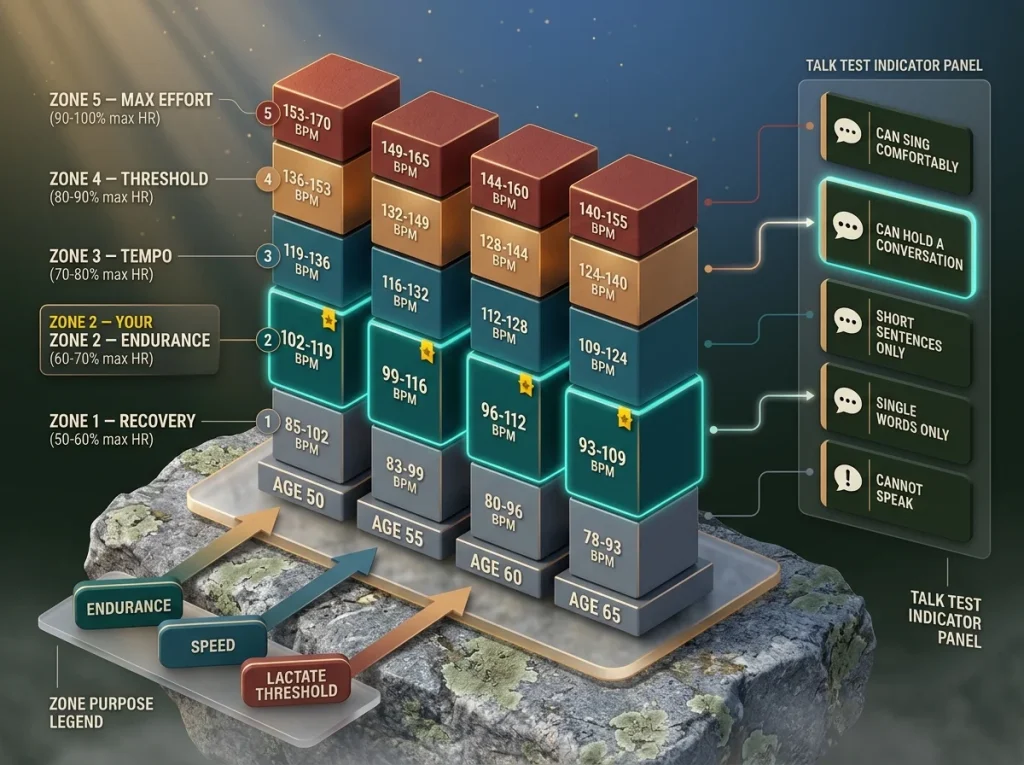
Most of your cardio should happen at a pace where you can hold a conversation. This is Zone 2 heart rate training — roughly 60–70% of your max heart rate. It feels too easy. That is the point.
Zone 2 builds your aerobic base — the engine that powers sustained effort on long trail days. Higher intensities train different systems. The hikers who can push 12-mile days at 55 are not the ones doing HIIT classes. They are the ones putting in steady, boring, conversational-pace hours on the bike or trail.
Pro tip: If you do not own a heart rate monitor, use the talk test. If you cannot say a full sentence without gasping, slow down. If you can sing, speed up slightly. That middle zone is where endurance lives.
Stair Workouts for Specificity
Nothing replicates the sustained uphill grind of hiking better than stairs. Find a building with 10+ floors or an outdoor stadium. Walk up at a steady pace, elevator down. Thirty minutes twice per week. Wear your hiking boots if you can — the weight and ankle mechanics transfer directly.
Recovery Is Where the Gains Happen
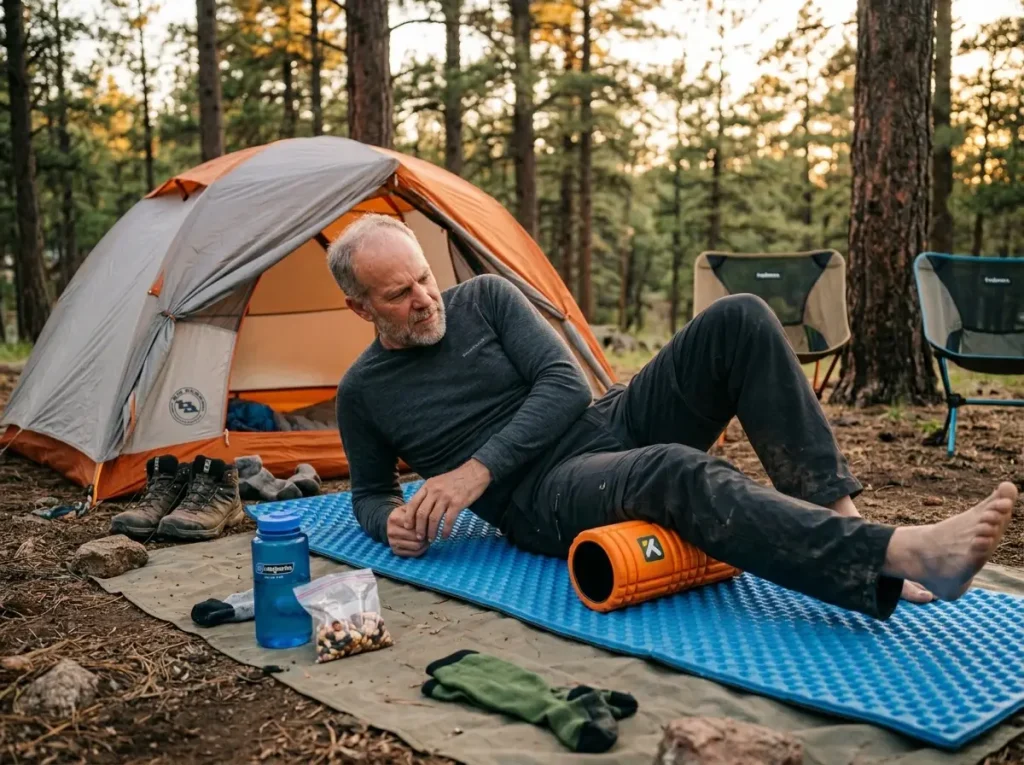
The 9-Day Training Week
This concept changed everything for me. Instead of cramming training into a standard Monday-to-Sunday cycle, stretch it to nine or ten days. You fit in the same number of hard sessions — two strength, two or three cardio — but with more rest between them.
A typical 9-day cycle looks like this: strength on day 1, cardio on day 3, rest on day 4, strength on day 5, cardio on day 7, rest on days 8 and 9. Then repeat. Your body gets the stimulus it needs and the recovery time it demands. After 50, recovery is not optional downtime — it is when adaptation actually happens.
Sleep, Inflammation, and the Under-Recovery Epidemic
Most hikers over 50 who plateau are not under-training. They are under-recovering. Sleep is where your body repairs muscle tissue, consolidates motor patterns, and clears metabolic waste. Seven hours minimum. Eight is better. If you are training hard and sleeping six hours, you are actively working against yourself.
Foam rolling and mobility work earn their reputation after 50. Your fascia gets stiffer, your joints lose range of motion, and the compensations pile up. Ten minutes of foam rolling after every training session — quads, IT band, calves, thoracic spine — pays off in fewer aches and better movement quality on trail.
Anti-inflammatory nutrition matters too. Omega-3 fatty acids from fish or supplements, tart cherry juice, turmeric — these are not miracle cures, but chronic low-grade inflammation accelerates muscle loss and joint degradation. Reducing it gives your body a better environment for repair.
Pro tip: Compression socks after hard training days are not a gimmick. The mild pressure improves venous return and reduces swelling in your lower legs. Wear them for 2–3 hours post-workout, or sleep in them after big trail days. Your calves will feel noticeably different the next morning.
Active Recovery vs. Doing Nothing
Rest days do not mean lying on the couch. A 20-minute walk, gentle yoga, or easy swimming keeps blood flowing to damaged muscle tissue without adding training stress. The goal is movement without load. Your body recovers faster with light activity than with total inactivity.
Building a Weekly Training Plan That Sticks
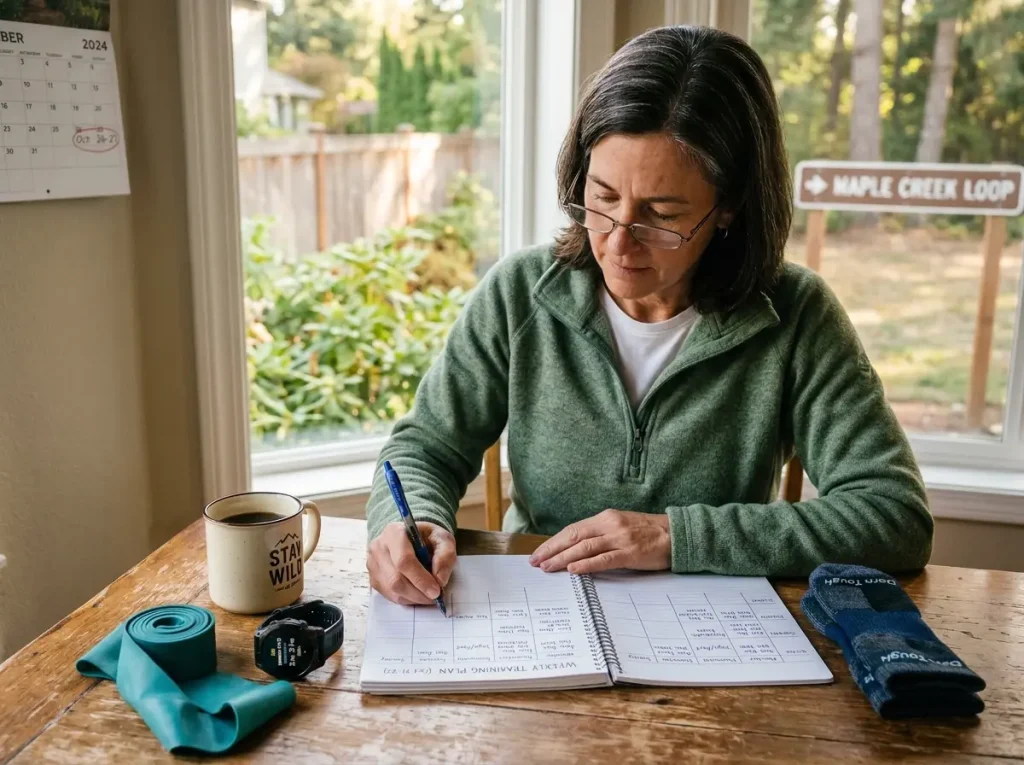
The Template That Works for Real Life
Consistency beats perfection. A plan you follow 80% of the time beats a perfect plan you abandon in three weeks. Start with the minimum effective dose and add from there.
Minimum viable plan (3 sessions per week): One strength day, one cardio day, one trail day. This maintains existing fitness and slowly builds capacity. Good for someone returning to training after a break.
Moderate plan (4–5 sessions per week): Two strength days, two cardio days, one trail day. This builds real fitness gains. The 9-day cycle fits well here — you hit all five sessions with adequate rest between them.
Pre-trip ramp-up (6–8 weeks before a big hike): Add a second trail day, increase elevation gain and pack weight progressively, and add one interval session per week (stair repeats or hill sprints). This is where you peak. Do not maintain this intensity year-round.
Periodization — Training in Blocks
The concept is simple: alternate between building phases and recovery phases. Train hard for 3 weeks, then drop volume by 40% for 1 week. This deload week prevents overtraining and lets your body consolidate gains.
Before a big trip, reverse the taper — build volume for 6 weeks, then cut it sharply in the final 7–10 days. You want to arrive at the trailhead rested but trained, not exhausted from last-minute cramming.
Tracking What Matters
Track three things: resting heart rate (take it first thing in the morning — a spike of 5+ BPM means you need more recovery), perceived exertion on a familiar route (the same 3-mile loop should feel progressively easier over 8 weeks), and how you feel at mile eight on trail days.
Forget tracking calories burned or steps taken. Those metrics do not correlate with trail readiness. What correlates is how your legs feel in the final third of a long day. That is the only metric that matters.
Gear Adjustments That Buy You More Miles
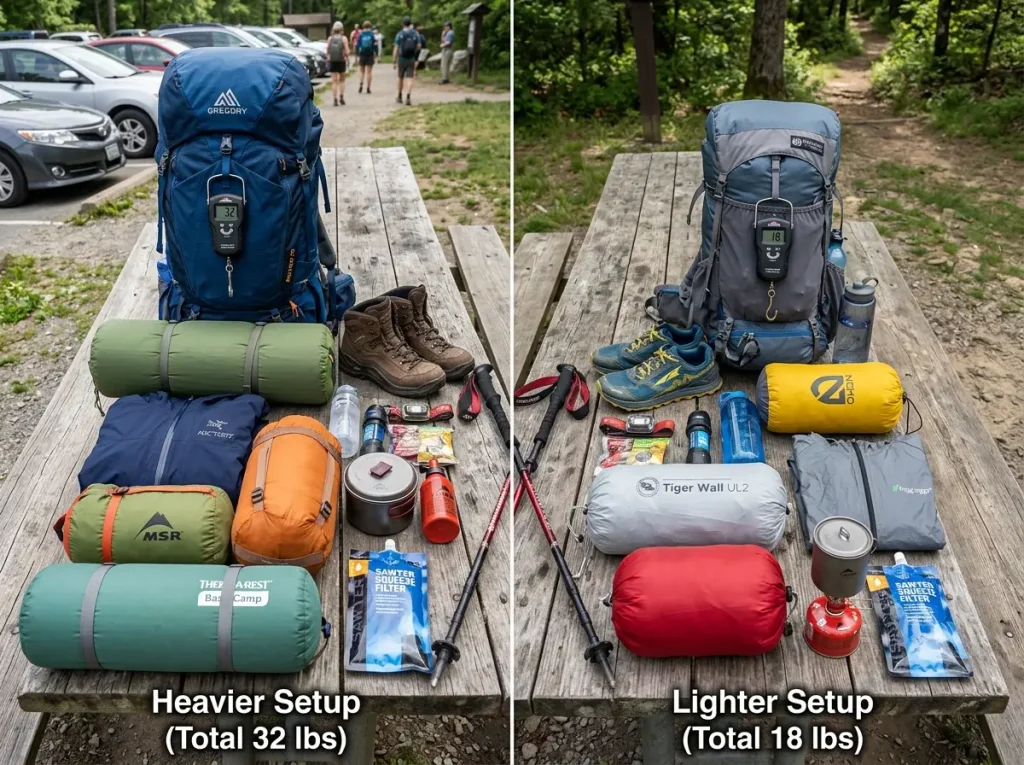
The Weight Multiplier Effect
Every pound you remove from your pack translates directly to endurance on trail. This is not opinion — it is physics. At 50+, the effect is amplified because your strength-to-weight ratio is already declining. A 30-pound pack at 35 feels like a 30-pound pack. A 30-pound pack at 55 feels like 38.
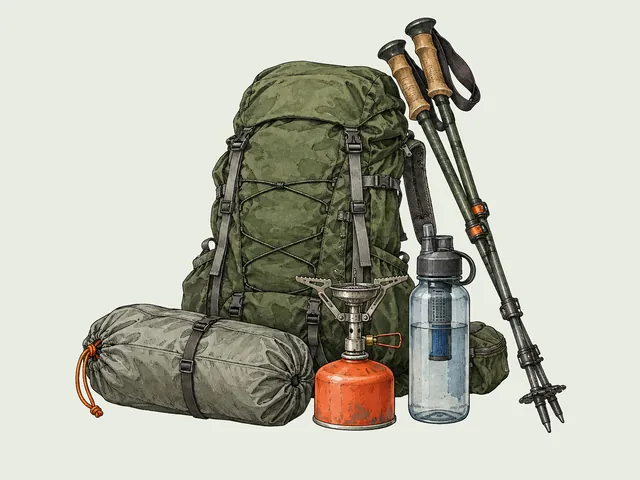
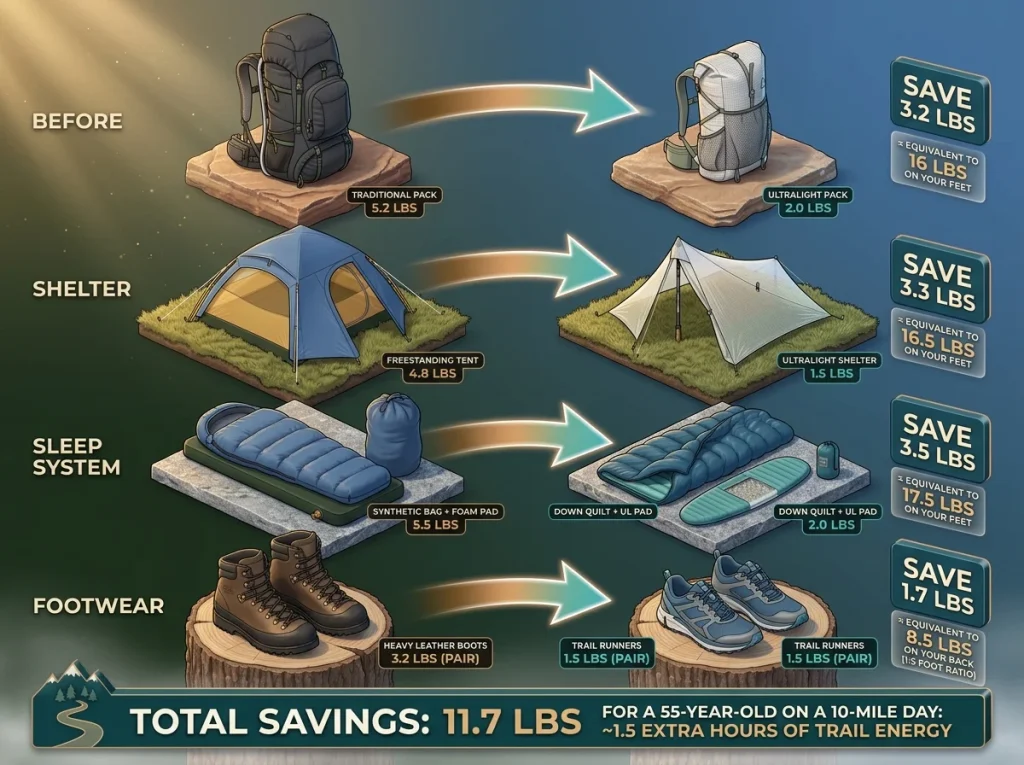
The easiest wins are the big three: pack, shelter, and sleep system. Switching from a traditional 5-pound pack to a 2-pound ultralight pack saves 3 pounds before you put anything in it. A modern ultralight tent saves another 2 pounds over a heavy freestanding shelter. That is 5 pounds gone — the equivalent of gaining years of leg strength back.
Trekking Poles as Endurance Tools
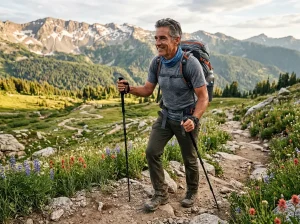
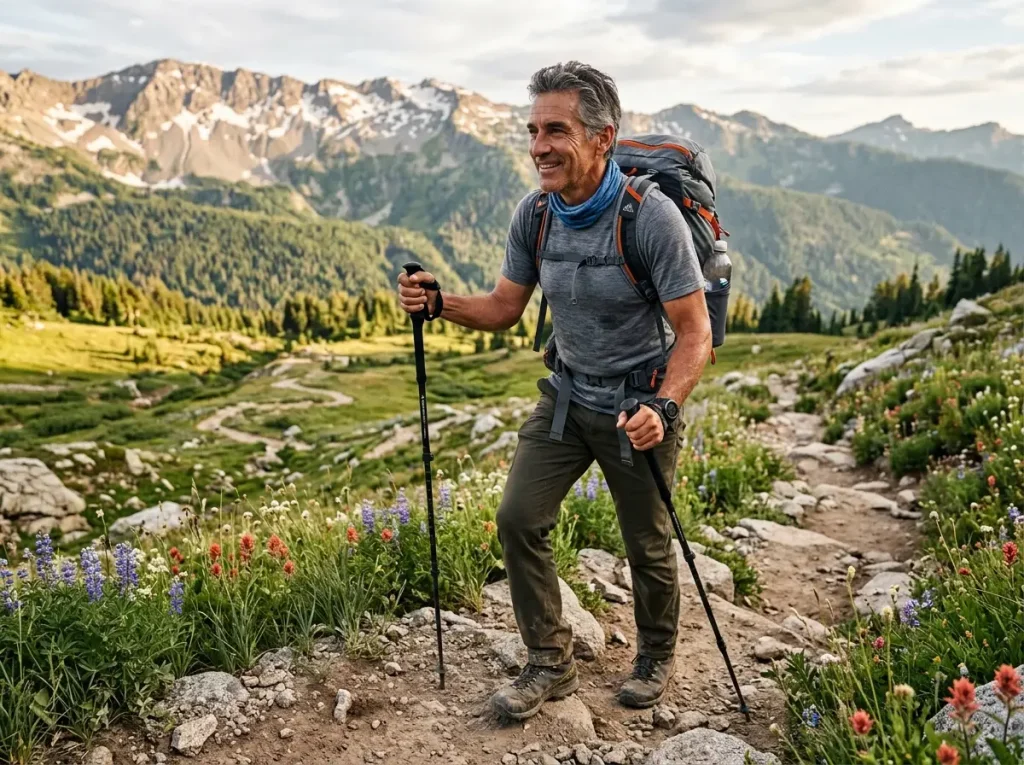
If you are over 50 and not using trekking poles, you are making every hike harder than it needs to be. Poles redistribute 20–25% of your body weight from your legs to your arms and core. On a 10-mile day with 2,000 feet of elevation gain, that is the difference between finishing strong and limping to the car.
Poles also reduce knee impact on descents by roughly 25%. After 50, your cartilage is thinner and your menisci are less resilient. Protecting them is not cautious — it is strategic. Learn the proper pole technique before your next big trip.
Pro tip: Set your poles 5 cm longer for descents and 5 cm shorter for sustained climbs. Most hikers set them once and leave them. The height adjustment exists for a reason — use it, and your shoulders and knees will thank you at the end of the day.
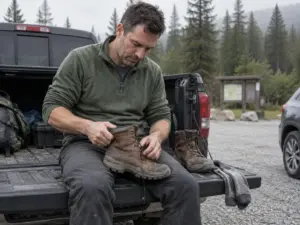
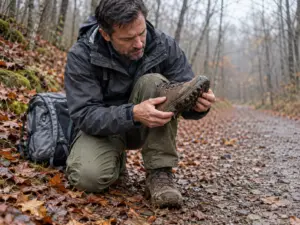
Footwear and the Ankle Myth
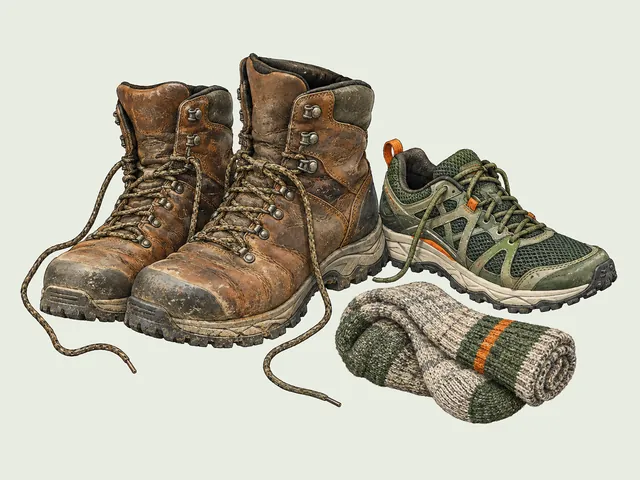
Many hikers over 50 believe they need stiff, heavy boots for ankle support. The research says otherwise — ankle support from high-top boots is largely a myth. What protects your ankles is strength in your peroneal muscles, not rigidity in your footwear.
Switching to lighter trail runners can save 1–2 pounds of rotational weight on your feet. Studies show that one pound on your feet equals roughly five pounds on your back in terms of energy expenditure. That is a 5–10 pound equivalent savings from a shoe swap alone.
If you have flat feet or arch issues, pair lighter shoes with quality hiking orthotics instead of heavy boots. You get the support where you actually need it without the weight penalty everywhere else.
Fueling Right After 50
Under-eating on trail is the most common endurance mistake hikers over 50 make. Your appetite decreases with age, but your caloric needs on a hard hiking day do not. A 160-pound hiker burning 400 calories per hour on moderate terrain needs 2,400–3,200 calories for a 6–8 hour day. Most 50+ hikers eat half that and wonder why they bonk at mile 10.
Eat before you feel hungry. Aim for 200–300 calories per hour of hiking, starting within the first hour. Salty snacks, nut butters, dried fruit, and real food bars work better than gels and candy. Your digestive system also slows with age — eating smaller amounts more frequently is easier on your gut than big trailside meals.
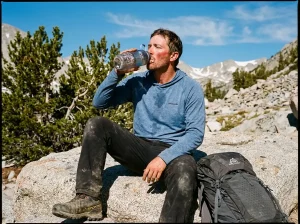
Stay ahead on hydration too. Your thirst mechanism becomes less reliable after 50. By the time you feel thirsty, you are already 1–2% dehydrated, which translates to a measurable drop in endurance and cognitive function.
Conclusion
Building hiking endurance after 50 comes down to three things: train the strength your body is losing, recover like it matters (because it does), and reduce the external load your body has to carry. The hikers who stay strong on trail into their 60s and 70s are not genetic outliers — they are the ones who adjusted their approach when the old one stopped working.
Start with two strength sessions and two cardio sessions per week. Stretch your training cycle to nine days instead of seven. Cut 5 pounds from your pack. Eat more on trail than you think you need. These are not dramatic changes, but they compound. In eight weeks, the same trail that buried you will feel manageable. In six months, it will feel easy.
The trail does not care how old you are. It only cares whether you showed up ready.
Q1 How long does it take to build hiking endurance after 50?
Most hikers notice measurable improvement within 6–8 weeks of consistent training that combines strength work and cardio. Full adaptation for multi-day trips typically takes 12–16 weeks. Starting earlier gives you a bigger fitness buffer for your target hike.
Q2 Is walking enough exercise to prepare for hiking?
Walking builds a baseline aerobic foundation but does not address the strength losses that limit endurance after 50. You need targeted resistance training for legs and core plus incline-specific cardio like stairs or cycling to prepare for sustained trail effort.
Q3 Should hikers over 50 use trekking poles?
Trekking poles reduce knee impact by roughly 25% and redistribute body weight to your upper body, extending your endurance on long days. For hikers over 50 with any joint concerns, poles are one of the highest-return gear investments available.
Q4 What is the best cross-training for hiking after 50?
Cycling is the top choice — it builds quad strength and cardiovascular endurance with minimal joint impact. Swimming works for hikers managing active joint pain. Stair climbing offers the most hiking-specific transfer for uphill endurance.
Q5 How much water should a hiker over 50 drink per day on the trail?
A general guideline is 0.5 to 1 liter per hour of moderate hiking, adjusted upward for heat, altitude, and exertion level. Thirst signals become less reliable with age, so drink on a schedule rather than waiting until you feel thirsty.

I've spent more than a decade researching hiking gear and trail technique. I read the specs, the forum threads and the long-term reviews, and every pick here comes with what it gets wrong.
End of the trail
You read every mile of this one. Here's where the trail goes next.