











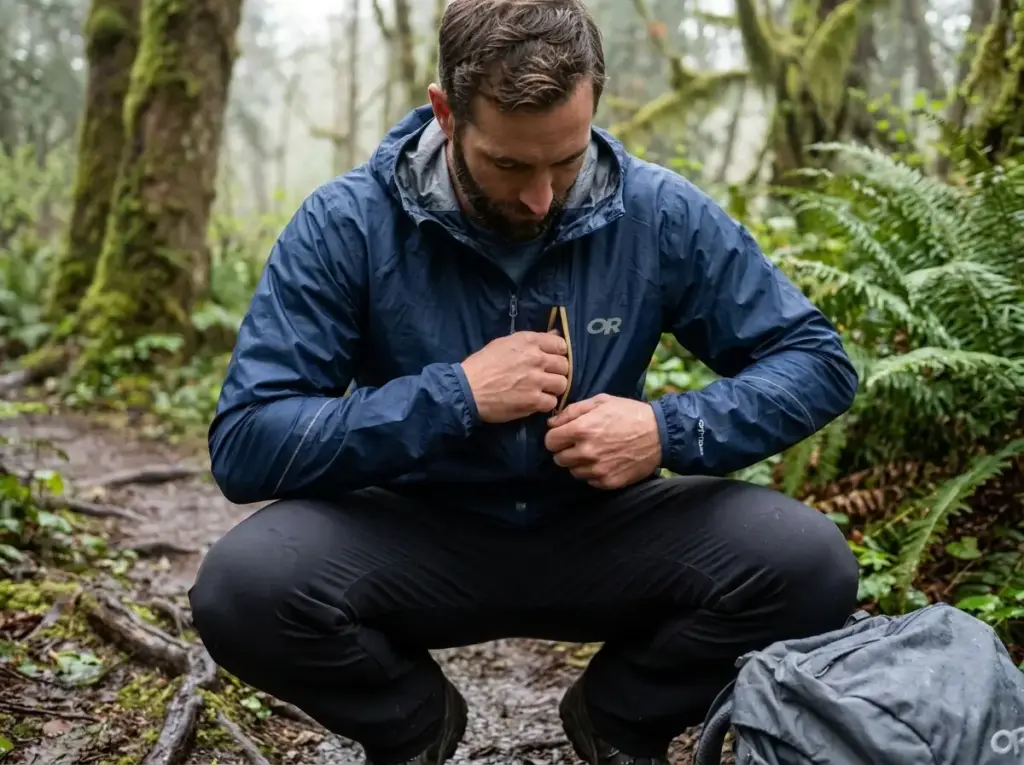
The jacket that finally gets thrown out is almost never the one that failed in a storm. It is the one you pull out of the pack on a bluebird morning, hold up to the light, and find speckled with pinholes it earned riding in an external pocket for two seasons.
Walk into any gear forum asking for your first lightweight shell and you get a wall of “it depends on your climate, your sweat rate, your trip length” before anyone answers the actual question, which is whether a packable rain jacket and an ultralight rain jacket are even the same purchase. They are not. This breaks the two specs apart, gives you a rule of thumb for how small packable actually means, and ties the decision to the kind of trip you are packing for instead of to the smallest number on a spec sheet.
Here is the short version before we get into why it matters.
| What it measures | Packable | Ultralight |
|---|---|---|
| The actual spec | Compressed volume in your pack | Weight on the scale |
| Typical weight | 7–16 oz (a wide band) | Under 8 oz; extreme tier 3.7–5.0 oz |
| Compressed size | Roughly a 1-liter water bottle | Tennis ball to softball, often its own chest pocket |
| Usual construction | 2L or 2.5L, sometimes 3L | Almost always 2.5L, thin face fabric |
| Best at | Freeing pack space when your kit is already bulky | Saving shoulder weight on gram-counting trips |
| Fails first at | All-day sustained rain, where it wets out | Abrasion, pinholes and delamination from being carried |
Packable and Ultralight Are Not the Same Spec
You have two browser tabs open. One has a filter checkbox labeled “packable.” The other has one labeled “ultralight.” Somewhere in the back of your head you have already decided those are the same checkbox with different marketing departments behind them.
They measure two different things. Packable describes compressed volume, the amount of space the jacket occupies once you have squeezed the air out of it and jammed it somewhere. Ultralight describes mass, what the jacket does to your shoulders and your base weight.
Most of the time those two move together, because thin fabric is both light and compressible. The interesting cases are the ones where they do not, and nobody selling you a jacket is going to point those out. If you want the wider view of where the shell sits relative to pants, pack covers and the rest, it is worth seeing how rain gear fits together as a system before you obsess over one garment.
Start with how wide the packable band really is. A jacket marketed as packable for adults typically weighs anywhere from 7 to 16 ounces.
That is more than a 2x spread inside a single word. A 16-ounce shell and a 7-ounce shell can both wear the packable label honestly, because both of them do compress into a reasonable lump, and neither manufacturer is lying to you. But one of those two is nearly a pound on your shoulders and the other is about the weight of a deck of cards plus change.
Ultralight is a much tighter band. Under 8 ounces is the working threshold, and the genuinely extreme tier lives at 3.7 to 5.0 ounces. Once a jacket climbs past 13 to 16 ounces you are in lightweight rain jacket territory, which is a fine place to be, but it is not ultralight and calling it that muddies the decision. The vocabulary problem is real: “lightweight” has no enforced meaning, so brands use it to describe anything that is not an insulated parka.
Where the Two Axes Actually Conflict
Here is the part the roundups skip. Face fabric stiffness and face fabric weight are not the same property. A tightly woven, slightly heavier nylon with a soft hand will collapse into a smaller ball than a stiffer, crinklier, technically lighter fabric that fights you the whole way down. The lighter jacket can genuinely be the bulkier one in your pack.
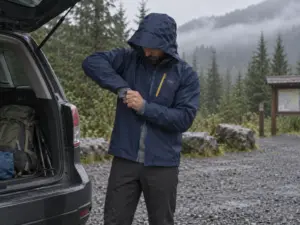
That sounds like a technicality until you are standing at a trailhead trying to fit a shell into the last gap in a full pack. Weight you notice over eleven miles. Volume you notice in the ninety seconds you are repacking in a parking lot with the tailgate open. Both are real costs, and they bill you at different times of day.
There is a simple version of this you can run in a store without buying anything. Put two jackets on the counter, feel which one is lighter in your hands, then stuff both back into their own pockets. Often enough, the lighter one is the one that will not go back in without a fight, the one where you are folding the sleeves three times and wrestling the zipper closed with your thumb. That resistance is the packability axis telling you it disagrees with the scale.
Before you compare two shells online, weigh the one hanging in your closet on a kitchen scale and stuff it into a quart freezer bag. Now you have a personal reference point instead of an abstract ounce figure, and every listed weight after that means something. Most hikers are shocked to find the jacket they have been calling lightweight for three years is a 14-ounce shell.
So which axis you care about is not a matter of taste. It comes down to which resource is scarce in your kit.
If you are carrying a bear canister, four days of food and a puffy, pack volume is your bottleneck and the compressed size wins. If you have optimized your base weight down to single digits and you are counting grams on tent stakes, total pack weight is the number you are defending and the scale wins, even if the stuff sack is a little fatter. Nobody is wrong here. They are solving different problems with the same word.
One more wrinkle worth naming early, because it colors everything that follows: the lighter you go on the weight axis, the thinner the face fabric has to be, and thin face fabric is where delamination and abrasion start. Packability by itself does not cost you durability. Weight reduction almost always does. That asymmetry is the whole reason these two specs deserve separate treatment.
How Small Is Packable, Actually
Every product page on earth says “packs down small.” Not one of them tells you what small means, and you cannot hold a listing photo in your hand. So here is the rule of thumb, calibrated against objects you already own.
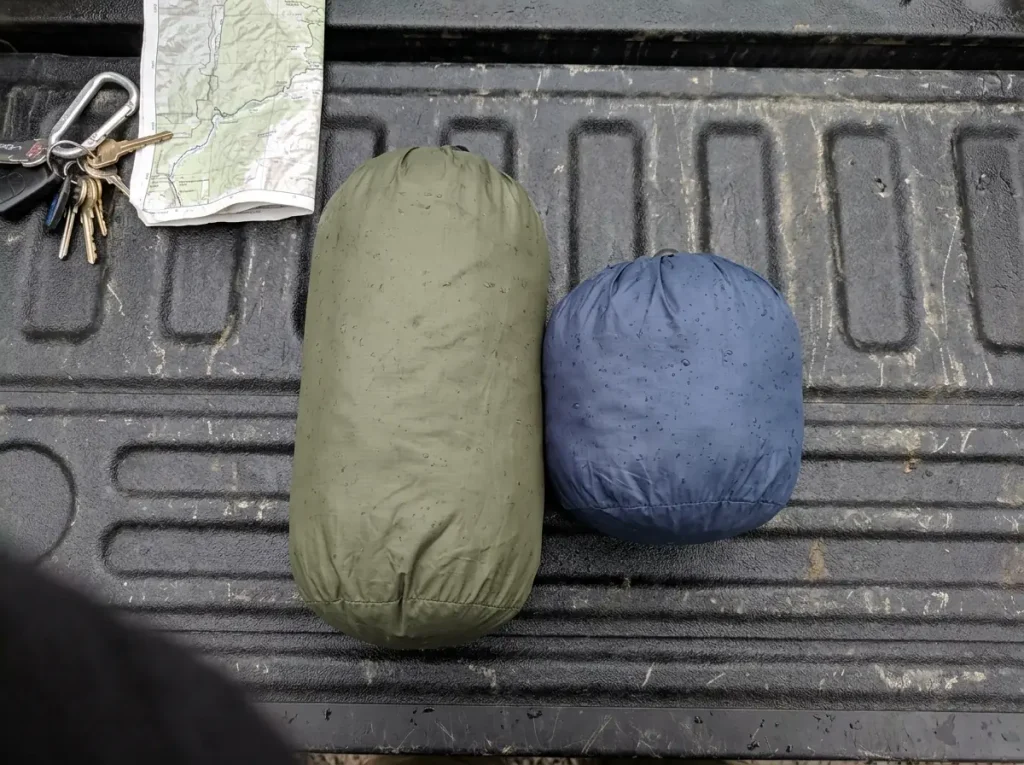
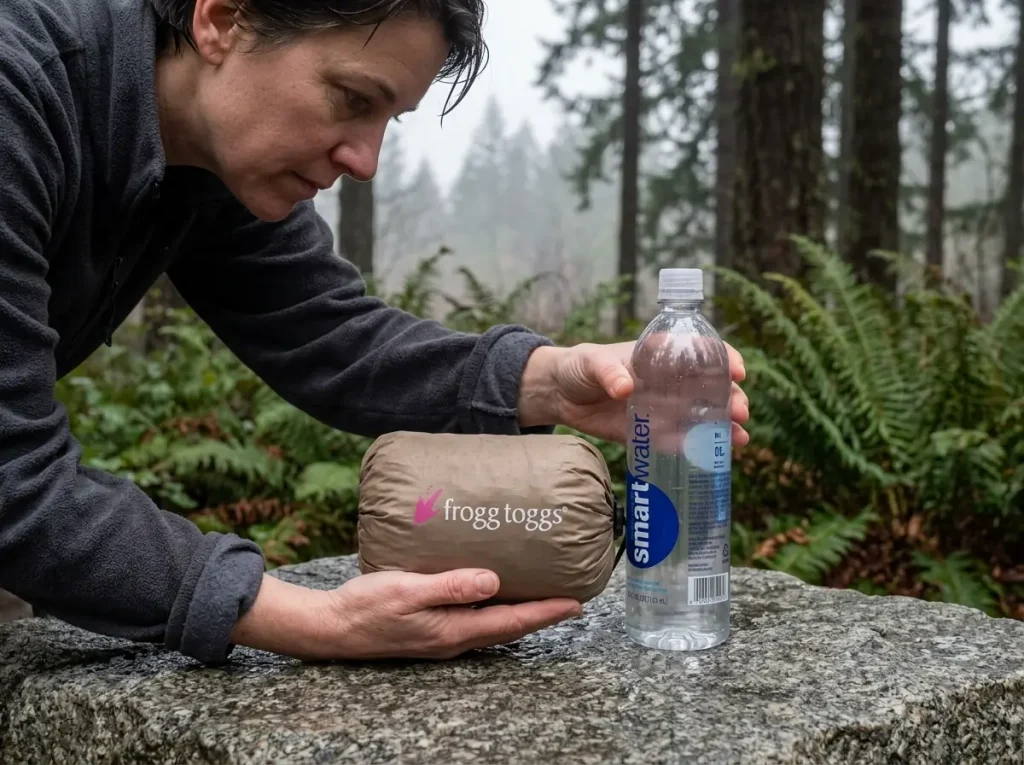
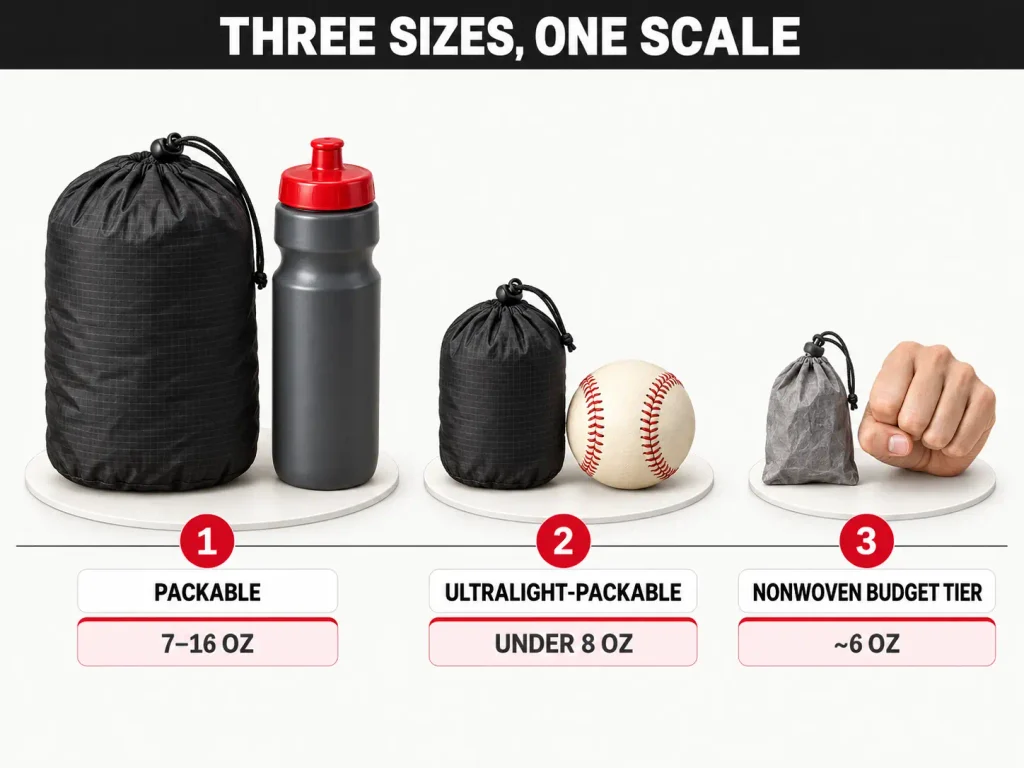
A true packable rain jacket compresses to roughly the size of a 1-liter water bottle. That is the baseline. If it does that, it has earned the word, and it will slot into a pack side pocket or sit on top of your food bag without reorganizing anything.
An ultralight-packable jacket compresses to tennis ball or softball size, and it usually stuffs into its own chest pocket rather than needing a separate sack. Below that you are into the nonwoven budget tier, which packs to a fist-sized pouch but is playing a different game entirely, as we will get to.
Water bottle equals packable. Tennis ball equals ultralight-packable. That is the whole rule, and it survives contact with any spec sheet you throw at it.
Why “Packs Into Its Own Pocket” Tells You Almost Nothing
That phrase appears on nearly every lightweight shell sold, and it is a claim about the pocket, not about the jacket. A generously cut chest pocket can swallow a mediocre packer and make it sound impressive. A small pocket on a genuinely compressible shell makes the same jacket look worse on paper.
Read it as a hint rather than a spec. What you actually want to know is the volume of the resulting lump, and the only honest way to get that is to compare it to something physical. If a review says “packs into its own pocket” and the accompanying photo shows something the size of a paperback novel, that is a water-bottle-tier jacket with a big pocket, not an ultralight one.
Stuff sacks muddy this further. A jacket shipped with a snug, well-cut sack will show a tidy compressed size in every photo. The identical fabric with no sack compresses to whatever you can wrestle it into and hold there while you cram it under a pack lid, which is usually noticeably bigger.
Some manufacturers publish packed size with the sack and some publish it without, and almost nobody says which. When two jackets list suspiciously different packed sizes at nearly identical weights, the sack is usually the explanation.
Pack Space Is a Fixed Budget
Your pack has a number on it. Fifty liters, sixty-five, whatever it is, that number does not flex when you buy a bigger jacket. Every cubic inch the shell takes is an inch that food, water, insulation or a bear canister does not get.
That is why a shell that compresses to water-bottle size and one that compresses to softball size are not a trivial distinction on a five-day trip. The difference is roughly the volume of a day’s food. On a day hike it does not matter at all. On a resupply-day carry out of town with the pack stuffed to the collar, it is the difference between the lid closing and the lid not closing.
Worth asking at this stage, too, whether an umbrella earns its place instead of a second layer of shell fabric, because the pack-space math changes completely when the rain protection is riding on the outside of your pack rather than inside it.
The real test, though, is not how small the jacket goes in a showroom. It is how small it goes at the trailhead, one-handed, in the rain, with cold fingers, while you are trying to keep the inside dry and the wind is turning the whole thing into a sail. That fold is never the one from the product video. Budget for the trailhead fold, not the showroom fold, and you will never be surprised by a jacket that suddenly does not fit.
Stop rolling the jacket. Rolling makes a neat cylinder that wastes the corners of your pack. Stuff it loose into a soft sack or straight into a gap instead, and it fills the dead space around your other gear. A stuffed shell takes measurably less usable volume than a rolled one, which is why sleeping bags ship with stuff sacks and not with straps.
What You Give Up to Get the Weight Down
There is no free lunch in shell fabric. Every ounce that came off the jacket came off something specific, and the something is usually the part that determines how long the jacket lasts.
The governing constraint is simple enough to say in one line: pick two of light, packable, and durable-breathable. No fabric on the market wins all three at once, and the long-form gear testers who have run these shells through full seasons keep arriving at the same conclusion about the tradeoff between breathability, weight, and packed size that every hardshell has to make. Anyone promising you all three is either quoting lab numbers or has not worn the jacket long enough to see it fail.
What 2.5L Actually Means for Service Life
The layer count is the single most useful spec on the tag, and it is the one most shoppers skip past on the way to the weight.
A 3-layer construction bonds three materials into one laminate: face fabric, membrane, and a knit or woven backer, all fused. A 2.5-layer construction uses the face fabric and membrane, then sprays or prints a protective coating on the inside instead of bonding a real third layer. That half-layer is why it is called 2.5L, and it is the source of both the weight savings and the shorter life. A 2-layer construction skips the interior protection entirely and hangs a loose mesh liner instead, which is why 2L shells are usually cheaper and bulkier rather than lighter.
The sprayed interior coating on a 2.5L jacket is in direct contact with your sweat, your sunscreen, and the salt in both. Over time it abrades and separates, which is what people mean when they say a shell has delaminated. Community consensus among backpackers who put real seasons on their gear is consistent on this: 2.5L shells delaminate sooner than true 3L builds.
That is not a defect and it is not a brand failure. It is the construction working as designed, with a shorter design life. If you want the deeper version of why membranes behave differently once you start comparing them, how the membranes themselves differ is the piece that unpacks it properly.
“Wets Out” in Plain Language
You will see this phrase everywhere and it is rarely explained, usually written as wetting out. Here is what is happening.
The outermost surface of your jacket has a DWR treatment, a durable water repellent finish, which is what makes water bead up and roll off. That finish wears away from abrasion, dirt, skin oils and washing. Once it is gone, water stops beading and the face fabric soaks through and saturates. The jacket is now wet all the way to the membrane.
The membrane underneath is still waterproof. You are not getting rained on through it.
But a saturated face fabric has no air gaps left, so the water vapor you are producing cannot escape through it, and you get clammy and cold from the inside. That is why a jacket that has wetted out feels like it is leaking when it technically is not. The failure is in the finish, not the waterproofing.
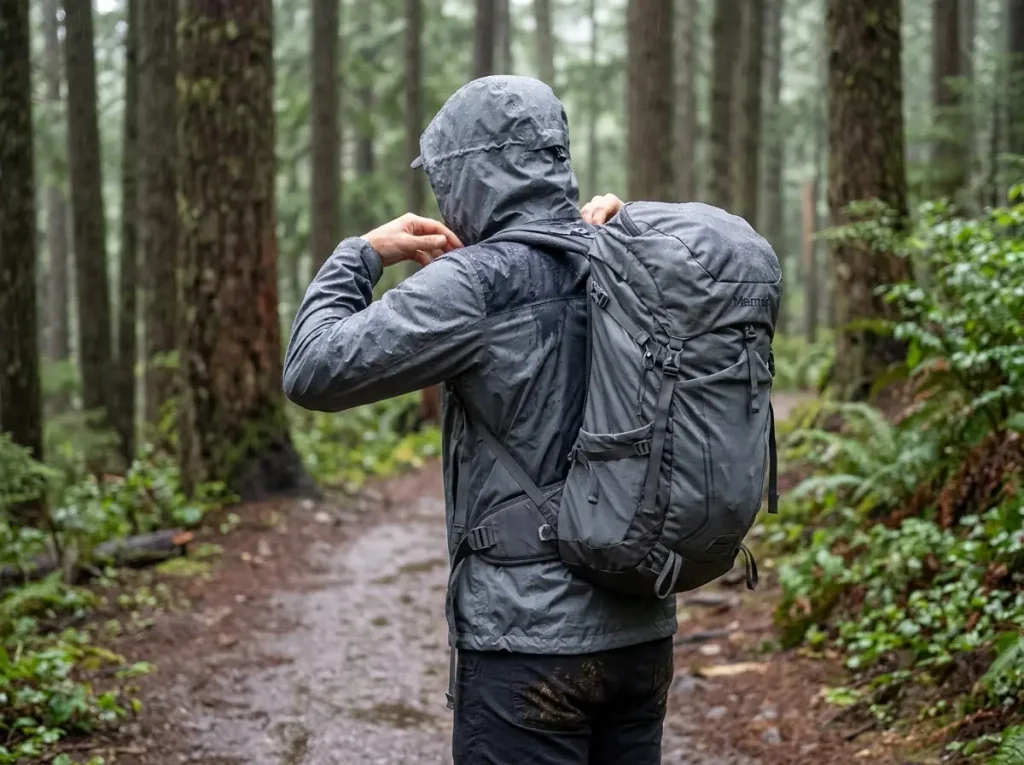
This matters more for the lightweight tiers because there is less fabric mass to hold the treatment. Thin face fabrics wet out sooner and dry slower relative to their thermal mass. A 2L or 2.5L shell in all-day sustained rain will typically saturate; a 3L build with pit zips holds up considerably better, which is exactly the tradeoff, because that 3L build does not pack down anywhere near as small.
Reading the Spec Sheet Without Getting Played
Every listing throws numbers at you, and two of them decide almost everything. The waterproof rating is the hydrostatic head figure, written in millimeters, and it measures how tall a column of water the fabric holds back before it pushes through. The breathability rating is the MVTR, the moisture vapor transmission rate, which measures how much of your sweat escapes in a day.
Both matter, and here is the part nobody says out loud: for the packable-versus-ultralight decision they matter far less than construction does. A 2.5L shell and a 3L shell can post nearly identical numbers on both and still have wildly different service lives, because the lab test measures brand-new fabric lying flat, not fabric that has spent a season under a strap. The membrane brand name on the tag tells you less than you would hope, too. Gore-Tex ePE, Gore-Tex Paclite, Pertex Shield, Patagonia’s H2No, Toray’s Dermizax, The North Face’s DryVent and FUTURELIGHT, and Black Diamond’s BD.dry are all competent waterproof-breathable systems, and which one a jacket uses matters far less than whether it was built as 2L, 2.5L or 3L.
The number actually worth finding is the face fabric denier, which is the thread weight of the outer surface. It is the honest proxy for how the shell survives being carried. Low denier is how a jacket gets to 5 ounces, and it is the same reason that jacket pinholes in a pack pocket.
Then check the features, because this is where the weight quietly went. Seam taping comes in two grades: fully taped means every seam is sealed, while critically taped seams means only the shoulders and hood got treatment and the rest are raw. Fully taped is heavier and it is the honest choice for sustained rain.
After that, look for pit zips, then the adjustments, because hood adjustment, cuff adjusters and a hem cinch are the first things stripped off an ultralight build. Each is worth a fraction of an ounce and each is what stops wind-driven rain entering at the wrists and the waist. Hand pockets go the same way, and a jacket without them is not defective, it just decided those ounces were better spent elsewhere.
The Shoulders Go First, and It Is Not the Jacket’s Fault
Look at any shell with a season on it and the wear pattern tells the story. The DWR is gone across the tops of the shoulders and along the hipbelt line, and still fine everywhere else.
New hikers read that as a manufacturing defect. It is not. Pack straps under load are grinding the treatment off exactly where the weight sits, and load plus motion plus a few hundred miles removes a surface finish the way a sanding block removes paint.
Which is why two hikers can buy the identical jacket, and the one who wears it under a heavy pack every weekend watches the shoulders wet out in a single season while the one who day hikes with a small daypack gets years out of it. Same jacket, same fabric, wildly different service life, and nothing wrong with either.
And then there is the tier below all of this, where the tradeoff stops being subtle and becomes the entire product. The FROGG TOGGS Ultra-Lite2 (men’s · women’s) is the textbook case: about 5.9 ounces, packs into a fist-sized pouch, and genuinely waterproof.
On the two numbers that define this article, it beats jackets costing many times more. But the fabric is a nonwoven polyethylene, not a woven face fabric over a membrane, so it tears where a woven shell would abrade, and it does not belong in the durable ultralight-performance conversation at all. It is the clearest proof that packable and ultralight are specs a product can win while losing everything else. Plenty of hikers carry one anyway as a deliberate emergency-only layer, which is the honest use case for it.
Check the shoulders and the hipbelt line with a spray bottle before a big trip, not the chest. Water still beading on the chest tells you nothing, because the chest never sees a strap. If the shoulders soak in and darken while the chest beads, the DWR is spent in the only place that matters and the jacket needs a wash and heat cycle before you leave.
The Failure Nobody Plans For
You bought the shell for the storm. Statistically, it will die on a sunny day, riding in an external pocket, rubbing against pack fabric for three hundred miles.
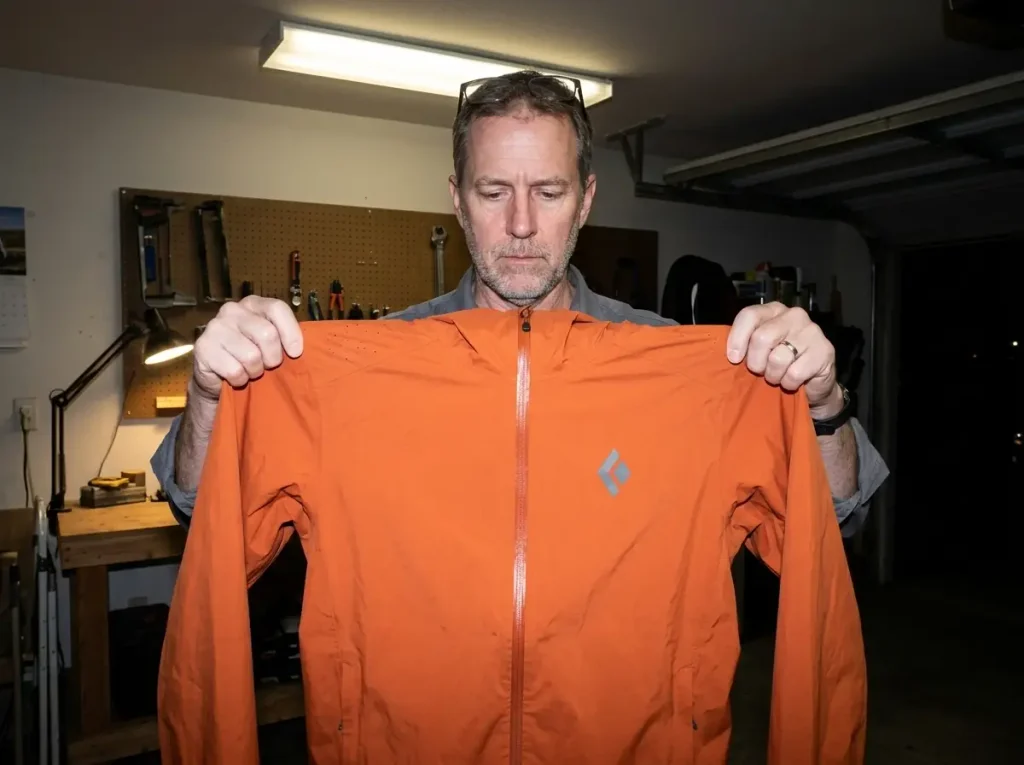
This is the failure mode that gets named in forum threads and almost never in reviews. A hiker pulls out a two-year-old jacket, holds it up, and finds it peppered with pinholes. Not a tear from a branch. Not a seam that let go.
A constellation of tiny perforations along the fold lines and the contact points, produced by trail bounce grinding the fabric against nylon with every single step, for weeks of cumulative walking. The jacket never failed in weather. It never got the chance.
Why the Lightest Fabrics Are the Worst at Being Carried
The thing that makes a jacket ultralight is the thinness of the face fabric, measured in denier. Lower denier means less material between the outside world and the membrane, which means less weight and better compressibility. It also means less material standing between the membrane and whatever the jacket is rubbing against.
So the exact property you paid a premium for is the property that makes the jacket poor at surviving being carried. There is no way around this with materials science; it is arithmetic. A 7-denier face fabric cannot abrade like a 40-denier one because there is not enough of it.
That inverts the usual buying logic in a way worth sitting with. Count the hours honestly. A shell on a typical backpacking season might be worn for a handful of hours and carried for hundreds.
The jacket spends far more hours in your pack than on your back. Carry-durability is the dominant wear factor for most hikers, and nearly every review evaluates storm-durability instead, because storm-durability is what you can test in an afternoon.
The Fix Is Free
Where you stow the shell changes its lifespan more than what you paid for it, and this costs nothing.
Stop putting it in an external stretch pocket where it rides against the pack for every step. Stop cinching it under compression straps on the outside, where the strap edge saws one line into it for the length of the trip. Put it inside the pack, ideally against something soft, or inside its own stuff sack so the sack takes the abrasion instead of the shell. If you need it accessible, the top lid pocket is the compromise, because it moves with the pack body rather than swinging against it.
The counterargument is real: a jacket buried in the pack is a jacket you will not put on when the first drops hit, and a shell you do not wear is worth nothing. So the honest version is the lid pocket, or the very top of the main compartment, not the deepest corner. Accessible enough to actually use, protected enough to survive the miles between uses.
Once the pinholes are there, the question becomes whether it is worth saving. Pinholes are not the same problem as a failed DWR or a delaminated backer, and they call for different responses. How to tell a jacket is actually finished is the diagnostic worth running before you spend money, because two of the three common failure modes are fixable and one is not. If your issue is that water stopped beading rather than that light shines through the fabric, bringing the DWR back usually buys you another season for the price of a wash cycle and a low-heat tumble.
The DWR-Free Shortcut and Why It Is Not One
There is a chemistry shift running underneath all of this. The old C8 chemistry DWR treatments were the durable ones, and they are being phased out on health and environmental grounds in favor of C0 chemistry, the PFAS-free replacements.
The honest summary is that the new treatments are better for the world and wear off faster, which means reproofing has become a normal part of owning a shell rather than a repair. Once you understand that DWR wear is the weak point, the constructions that eliminate DWR entirely start to look like the answer. Gore’s Shake-Dry and Columbia’s OutDry both flip the standard build by putting the membrane on the outside, so there is no face fabric to saturate and nothing for a treatment to wear off of. Water beads on the membrane itself, permanently, and the breathability numbers are genuinely excellent.
The catch is the same catch as always. With the membrane on the outside, there is no sacrificial layer at all.
Shake-Dry specifically is not rated for backpacking abrasion, and the community verdict is consistent: treat it as a running and cycling construction. A pack strap is precisely the load case it is not built for. Wearing one under a loaded pack is a fast way to convert an expensive jacket into an expensive windbreaker.
Hold a suspect shell up to a bright window with the sleeves pulled flat and look through the shoulders and the fold lines. Pinholes show as points of light before they ever show as leaks in the field. Finding them in your living room is a much better experience than finding them at 5,000 feet with the temperature dropping.
Which Axis Should Win on Your Trip

Everything up to here has been definition and mechanism. Here is the decision.
The governing rule, and it comes from people who have replaced a lot of shells: match the construction to expected wear time, not to the lowest number on the shelf. That sentence does more work than any spec comparison. If you are going to wear the jacket a lot, in sustained rain, for hours at a stretch, a heavier 3L with pit zips genuinely performs better and lasts longer, and the weight penalty buys you something real. If the jacket is going to live in your pack “just in case” and come out four times a year for twenty minutes, go minimal and do not apologize for it.
Most hikers get this backwards because they shop for the worst day they can imagine rather than the days they actually have. The honest question is not which jacket is better. It is how many hours you will really wear it, and most of us overestimate that number badly.
Your Layering System Decides This, Not the Jacket
Nobody else connects the shell choice back to the rest of the kit, which is strange, because the rest of the kit is what makes the choice.
If you run cold and carry more insulation, a heavier midlayer and a real puffy, then pack volume is your scarce resource. You have already spent your cubic inches on down. In that case packability wins, and you should accept a slightly heavier shell that compresses smaller over a lighter one that does not. If you run warm and carry very little, weight-on-body is your constraint and the scale wins, because you have pack space to spare and nothing left to trim except grams.
It also matters what else in your kit is already doing this job. A rain shell is the outer piece of a layering system that starts with a base layer and a midlayer, and if you also carry a softshell or a wind shirt, some of what you were asking the rain jacket to do is already covered.
A wind shirt weighs a couple of ounces and handles the cold-and-breezy-but-not-raining hours that people reach for a hardshell to solve, which means the rain jacket only has to handle actual rain and can go more minimal. Carry neither, and the shell becomes your wind layer too, which argues for the more substantial build. Shoulder season is where this bites hardest, because that is when you get all four conditions in one afternoon.
There is a fit consequence to this too. A shell that has to go over a puffy is not the same size as a shell that goes over a sun hoody, and buying the ultralight cut in your street size is how people end up with a jacket they cannot layer under. Getting sizing it for what goes underneath right is worth more than two ounces of fabric savings, because a shell that binds at the shoulders when you reach for a hold or a trekking pole is a shell you will stop wearing.
There is a safety floor underneath all of this that deserves stating flatly, because no competitor states it. Hypothermia is a cold-and-wet problem far more than a cold problem, and it can set in at temperatures as high as 50°F once your clothing is soaked, because water pulls heat away from you roughly 25 times faster than air does. Research from the USDA Forest Service puts the insulation loss from wet clothing at about 90 percent.
A 40°F day of steady rain is a more serious proposition than a 20°F dry night, and the shell is not there for comfort. It is there so your insulation stays functional. That is the real reason the wet-out question matters.
Trip Type, Honestly Assessed
Four buckets cover most of what people actually do. Be honest about which one you are in, and about the trail conditions you genuinely hike in rather than the ones you imagine yourself in when you are standing in the shop.
- Day hikes and fast trips. Minimal wins. The shell lives in the pack, you might wear it twenty minutes, and every ounce and cubic inch you save is free. A 2.5L ultralight or even a nonwoven emergency layer is a rational choice here, and the same logic covers trail running, where you are moving hard enough that a heavier shell becomes a sweat problem rather than a rain solution.
- Shoulder-season backpacking. The middle tier. You will wear it, sometimes for a couple of hours, in conditions that are cold enough to matter. A good 2.5L in the 8 to 11 ounce range with a decent hood is the sweet spot, and pit zips start earning their weight.
- Thru-hiking and long carries. Carry-durability wins. The jacket is in the pack for months, and the abrasion failure mode from the last section is the one that will retire it. At genuine thru-hike mileage the shell spends more hours pinned under backpack straps than it does shedding rain, and that constant pack pressure is what finishes it. Pick something that survives being carried, and stow it inside the pack.
- Alpine and technical days. A 3L with a helmet-compatible hood, and stop optimizing for weight. On alpine terrain you will be wearing it, in wind, possibly for the whole day, and a shell that wets out at hour three on an exposed ridge is a problem you cannot solve by walking faster. This is the bucket where storm protection is the entire specification and packed size stops being a consideration at all.
For that last category, the hood is the spec that separates real technical shells from lightweight ones with a drawcord. The Black Diamond Fineline Stretch Rain Shell (men’s · women’s) is built for this row: a BD.dry 2.5L with 10,000mm of hydrostatic head, a hood cut to go over a climbing or bike helmet rather than fight it, and a stretch face fabric that does not bind when you reach overhead. The stretch is the mid-tier differentiator worth understanding, because a non-stretch shell resists every big movement you make, and over a long technical day that resistance is fatigue you did not need.
Speaking of that 10,000mm figure, the numbers on the tag are less absolute than they look. Pressure from a pack strap or a knee on wet rock defeats ratings that pass a lab test easily, and the coating type often matters more than the printed number does. If you are now comparing spec sheets seriously, what the waterproof numbers on the tag are actually measuring will change how you read every listing in this category.
Try the hood on before anything else, with the hat you actually hike in, and turn your head all the way left and right. If the hood stays put and you can still see down the trail, the jacket is a candidate. If it swings and blinds you, nothing else on the spec sheet will save it, because a hood you cannot see out of is a hood you will pull down in the rain.
One last reframe. Think in ounces per use-year rather than ounces alone, and in cost per use-year rather than cost per ounce. A 6-ounce shell that retires after two seasons and a 12-ounce shell that runs six are not the same purchase, even before you count what you paid. That calculation flips the answer for a lot of people who thought they wanted the lightest thing on the wall, and it flips it back for anyone who genuinely only hikes in the dry season.
Four Jackets That Show Where Each Axis Wins
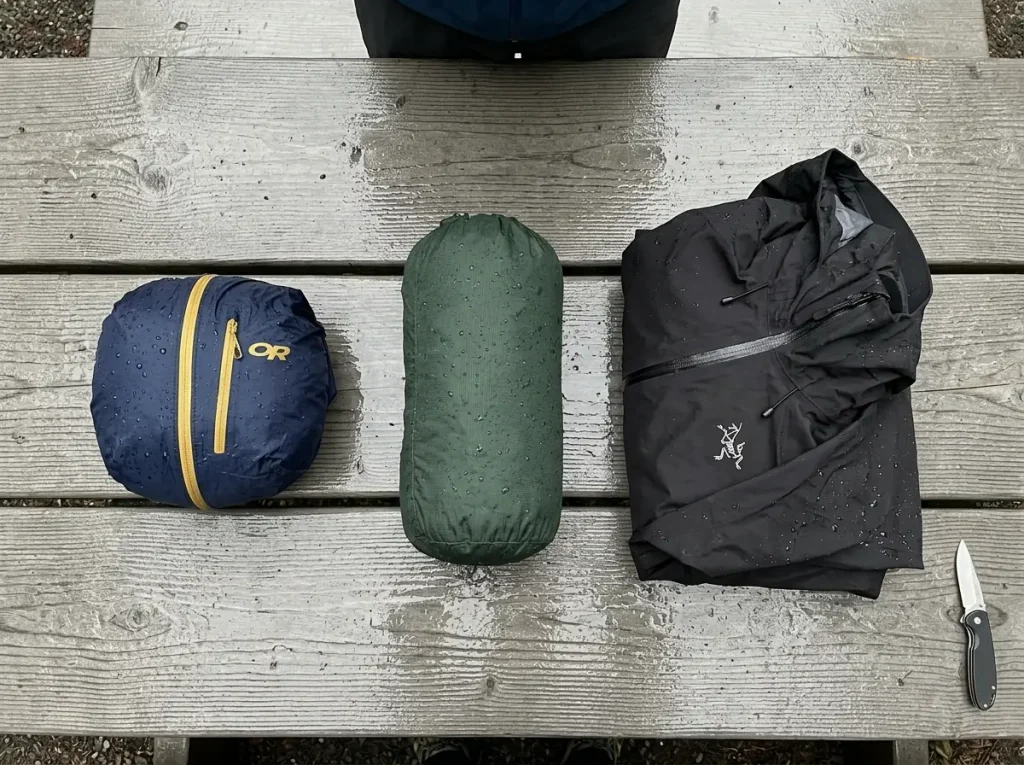
The tiers stop being theoretical when you put real shells next to each other and watch the weight climb while the durability climbs alongside it. That is the weight vs durability tradeoff in its plainest form, running from a budget rain jacket you carry and forget to a premium rain jacket you wear all day. These are picked to show the axes, not to crown a winner.
The Ultralight Benchmark
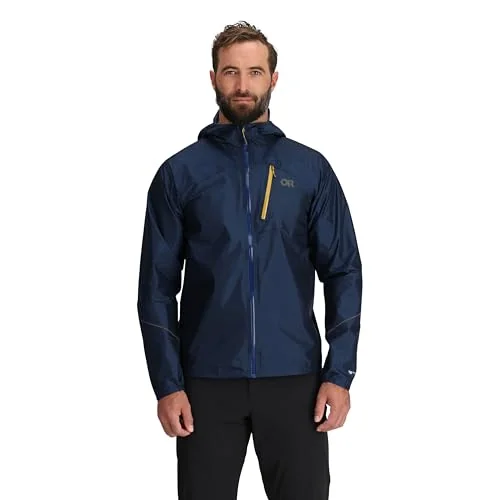
At 6.4 ounces it sits comfortably inside the ultralight band, and the fact that it stuffs into its own chest pocket puts it in the tennis-ball tier on the packability axis. It wins both, which is rare and is why it keeps getting named.
What you are buying alongside that is a 2.5L construction with a thin face fabric, which is the tier we spent an entire section on. Expect a service life measured in seasons rather than decades, expect the shoulders to wet out first, and stow it inside the pack rather than lashed to the outside. There are no pit zips, so your ventilation options are the front zipper and the cuffs, which is fine on a cool day and limiting on a warm one.
Used the way it is designed to be used, as a shell that comes out when the weather turns and goes away when it passes, it is the cleanest expression of what ultralight means. Used as an all-day rain layer on a wet thru-hike, it will disappoint you, and that will not be the jacket’s fault.
The Budget Packable
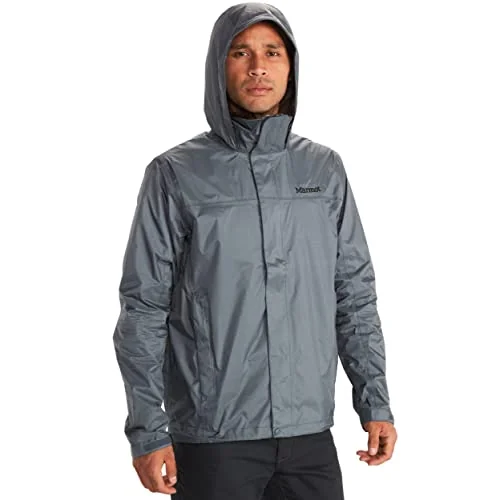
Ten ounces is not ultralight and the PreCip Eco has never pretended otherwise. What it is, is properly packable, compressing to about the water-bottle tier, with the extra fabric mass that comes from those additional three and a half ounces doing real work: better abrasion tolerance, better DWR retention, and a build that puts up with being carried badly.
The pit zips are the underrated feature here. Ventilation is the other half of staying dry, and a shell you can dump heat from is a shell you will actually keep zipped in drizzle instead of taking off and getting soaked anyway. The PFC-free DWR is worth calling out too, both because the regulatory direction is one-way and because PFAS-free treatments need washing and reproofing noticeably sooner than the old chemistry did. That is a maintenance schedule, not a downgrade, but it is one you have to actually follow.
For a first real shell, or for anyone who wants one jacket that handles day hikes and shoulder-season trips without a second thought, this is the tier that makes sense. It loses the weight contest on purpose and wins almost everything else.
The Premium 3L Counterpoint
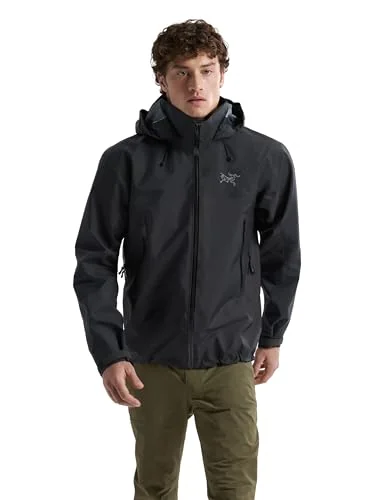
Around a pound, and it does not compress to anything resembling a water bottle. On both of this article’s axes it loses, decisively, and it does not care.
What the Beta AR buys you is the thing 2.5L cannot: a bonded third layer protecting the membrane from your sweat and the inside of your pack, a face fabric with enough denier to survive rock and brush, and a build that keeps shedding in the sixth hour of a storm when lighter shells have long since saturated. Backpackers who have run both constructions in sustained rain land on the same verdict, which is that the 3L Gore-Tex Pro keeps working where the 2L and 2.5L shells stop. The hood goes over a helmet, the pit zips are real ones, and everything is fully taped.
This is a splurge, and it is the correct purchase for a narrow group: alpine days, wet-climate hiking where rain is the default rather than the exception, and anyone whose shell is a working garment rather than an emergency layer. If you hike in the dry season and carry a shell out of prudence, buying this is buying a pound of insurance you will never cash in.
The Tier Below the Tiers
Worth naming for completeness, because it anchors the low end: the nonwoven emergency layer, of which the Frogg Toggs discussed earlier is the obvious example. About six ounces, a fist-sized pouch, genuinely waterproof, and built from a material that is closer to a technical fabric wrap than to a woven shell.
It beats everything above it on both axes and loses on every other measure, which makes it a perfect illustration and a perfectly reasonable purchase for the right person. Put one in a daypack for a region where rain is rare and you have solved the problem for the cost of a takeout dinner. Take one on a wet thru-hike and you will be buying another one in a month.
Four shells, four different answers, and the weight climbs in lockstep with how long each one keeps working. That is the whole tradeoff in a paragraph. If you want the field widened past these four and sorted by job rather than by axis, the wider roundup of hiking rain jackets covers the rest of the category.
Conclusion
Packable measures pack space. Ultralight measures shoulder weight. Check both, because a jacket can win one and lose the other, and the filter checkbox on a retail site will never tell you which.
Water bottle equals packable. Tennis ball equals ultralight-packable. That is the entire rule, and it works on any jacket in any store without you owning it first.
Match the construction to how many hours you will genuinely wear the thing, not to the lightest number on the shelf. Twenty hours of wear a year says go minimal. Two hundred says buy the 3L and stop counting ounces.
Before your next trip, take the shell already hanging in your closet, stuff it as small as it will go with one hand, and see which tier it lands in. Then weigh it. That two-minute test tells you more about what you own, and what you actually need next, than any spec sheet will.
Frequently Asked Questions
01Which rain jacket is the lightest and most packable?
The lightest true shells land between 3.7 and 5.0 ounces, and the most packable stuff to tennis-ball size inside their own chest pocket. Those are usually the same jackets, but not always, since a stiffer ultralight face fabric can compress worse than a softer heavier one.
02What is a good lightweight, packable rain jacket?
A good one weighs 7 to 11 ounces, uses 2.5-layer construction, compresses to about water-bottle size, and has pit zips. That band covers most hikers without paying the durability penalty of the sub-8-ounce tier or the weight penalty of a full 3-layer hardshell.
03What is the best packable rain jacket for travel?
For travel, prioritize compressed size and a plain cut over technical specs, since the jacket spends most of its life in a bag and gets worn in town. A water-bottle-sized 2.5-layer shell with a hood that stows flat covers rain without looking like expedition gear.
04Is a 2.5-layer rain jacket worth it?
Yes, if you wear the shell occasionally rather than all day. The 2.5-layer build trades service life for weight and packed size, so it is the right call for a jacket that lives in your pack and the wrong call for sustained all-day rain.

I've spent more than a decade researching hiking gear and trail technique. I read the specs, the forum threads and the long-term reviews, and every pick here comes with what it gets wrong.
End of the trail
You read every mile of this one. Here's where the trail goes next.