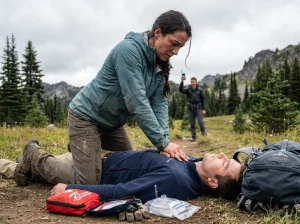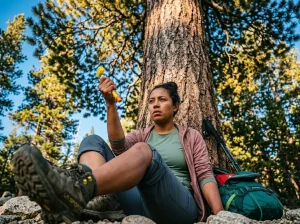


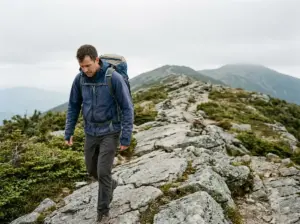
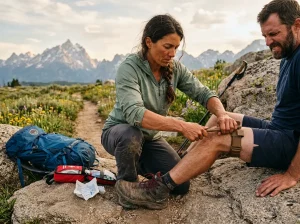

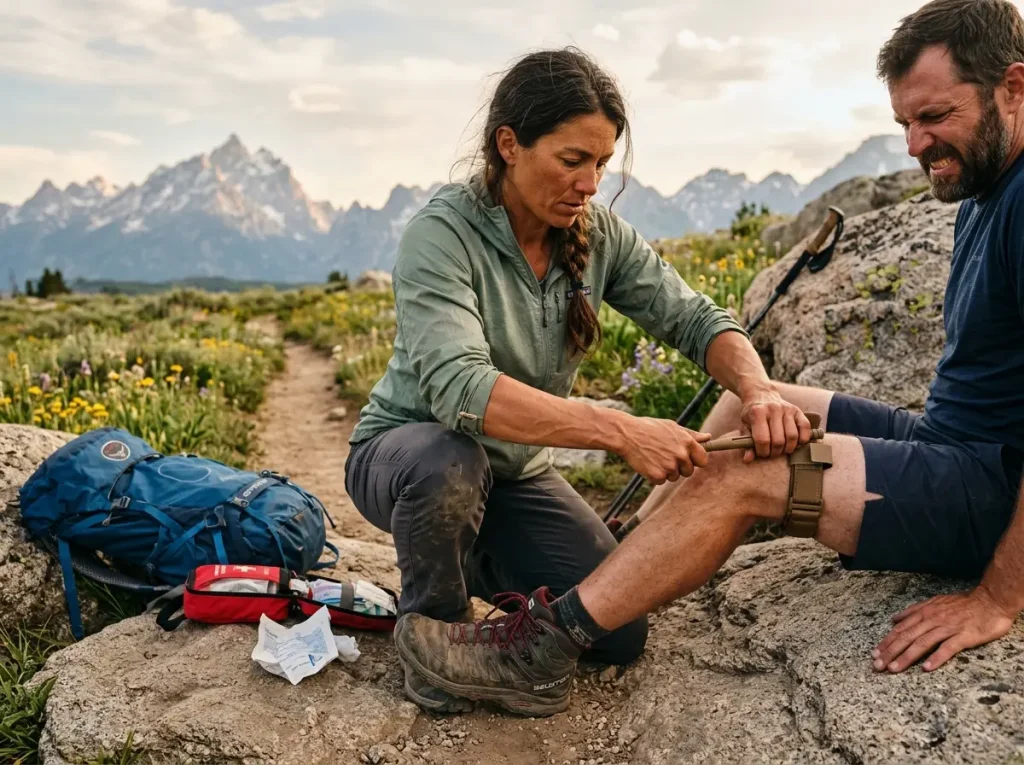
Your hiking partner catches a shin on a jagged rock edge during a steep descent, and bright red blood starts pulsing from the gash. You’re six hours from the nearest trailhead. Direct pressure isn’t slowing it down, and the gauze pad is already soaked through. What you do in the next 90 seconds matters more than anything else on this trip.
I’ve carried a tourniquet in my hip belt pocket for the last four years of backcountry hiking, and I’ve practiced applying one hundreds of times — on myself, on friends, with gloves, in the rain, one-handed. Here’s the step-by-step system for using a tourniquet when you’re far from help, including what changes when a hospital is half a day away instead of 20 minutes.
Quick Answer: Here are the core steps to apply a tourniquet in the backcountry:
- Confirm arterial bleeding — bright red blood spurting in pulses
- Place the tourniquet 2–3 inches above the wound, not over a joint
- Hand-tighten the strap to remove all slack first
- Twist the windlass until bleeding stops completely
- Secure with both the C-clamp and triangle backup
- Write the application time on the patient’s skin or tourniquet tag
- Activate your satellite messenger and begin evacuation immediately
When a Tourniquet Is the Right Call
Recognizing Arterial Bleeding
Not every cut needs a tourniquet. Most trail wounds are capillary bleeds — the kind that ooze slowly and stop with a little pressure and a clean bandage. That scrape from a branch or the small cut from a tent stake? Gauze and pressure. You’re fine.
Arterial bleeding looks different, and once you’ve seen it, you won’t confuse the two. The blood is bright red — almost unnervingly so — and it spurts in rhythmic pulses that match the heartbeat. Arteries carry oxygen-rich blood away from the heart under high pressure. A single cut artery can dump a lethal amount of blood in just a few minutes.
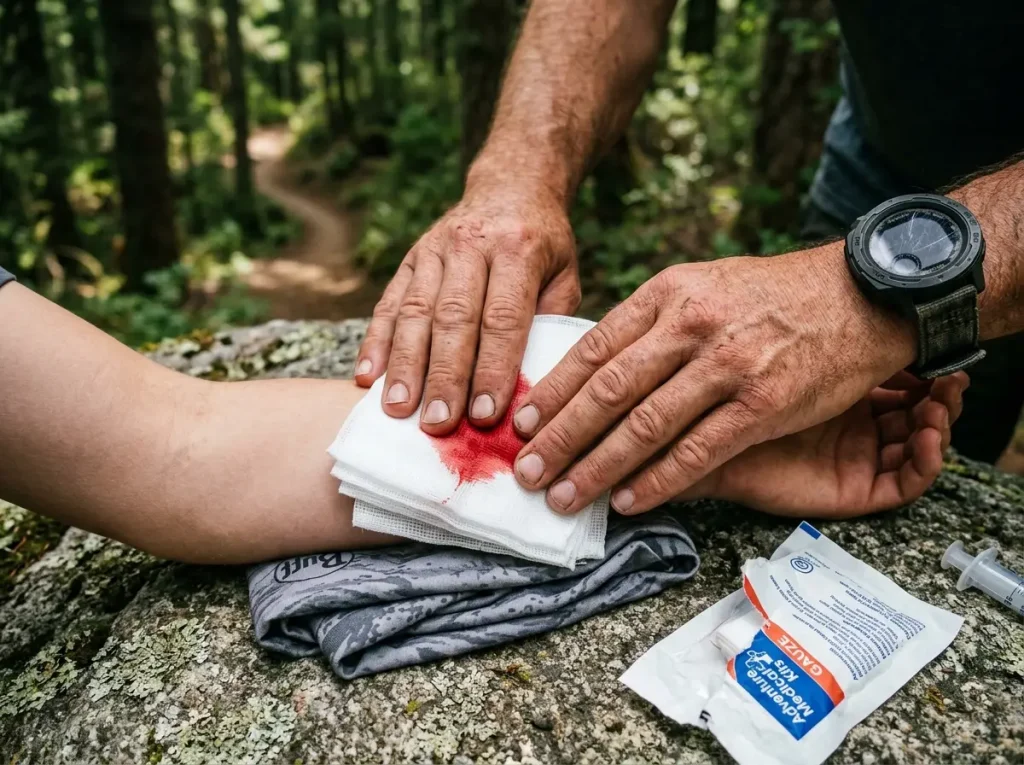
Pro tip: If you’re not sure whether it’s arterial, apply firm direct pressure with sterile gauze for 60 seconds. If the blood soaks through immediately and keeps coming, you’re likely dealing with an arterial bleed. That’s your signal.
Venous bleeding is darker red and flows steadily without the rhythmic spurting. It’s still serious, but direct pressure handles it in most cases. A tourniquet won’t help much for venous bleeds because it targets the arterial supply upstream.
When Direct Pressure Isn’t Enough
The standard backcountry first aid approach is direct pressure first. Stack sterile gauze, press hard, hold. For most wounds, this works. The problem comes when the wound is large enough or the artery is severed enough that pressure alone can’t keep up with the blood loss.
Research published in the civilian prehospital tourniquet research literature shows that when civilians used a tourniquet for life-threatening extremity hemorrhage, the odds of survival increased nearly sixfold. That’s not a marginal improvement. That’s the difference between walking out and not walking out at all.
The decision point is straightforward: if direct pressure soaks through the gauze and bleeding continues after a solid 60 seconds of firm compression, it’s tourniquet time. Don’t second-guess yourself. You can always remove a tourniquet later if it turns out you didn’t need it. You can’t un-bleed.
When NOT to Use a Tourniquet
Tourniquets only work on extremities — arms and legs. They won’t help with torso wounds, neck injuries, or head trauma. For those, wound packing and direct pressure are your options.
Junctional wounds at the groin or armpit are also off-limits for standard tourniquets. The anatomy at those intersections makes it nearly impossible to compress the artery effectively with a limb tourniquet. Wound packing with hemostatic gauze is the right call for junctional hemorrhage.
And here’s the one that surprises people: never use a tourniquet for a snake bite. The venom needs to dilute by spreading through the body — concentrating it in one limb causes far worse tissue destruction and increases the risk of compartment syndrome. Medics use the phrase “the solution to pollution is dilution” for exactly this reason.
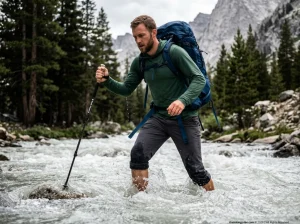
The same logic applies to river crossing mistakes that can end your trip — knowing which tool matches which situation is half the skill.
Choosing the Right Tourniquet for Your Pack
CAT, SOFTT-W, and SAM XT Compared
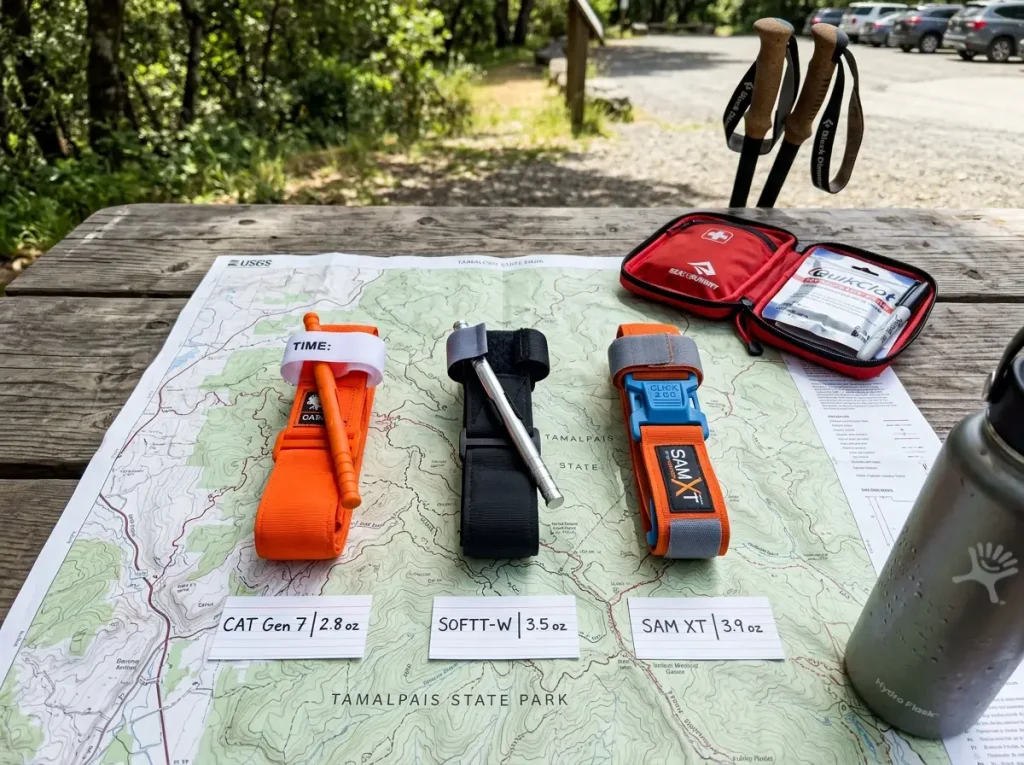
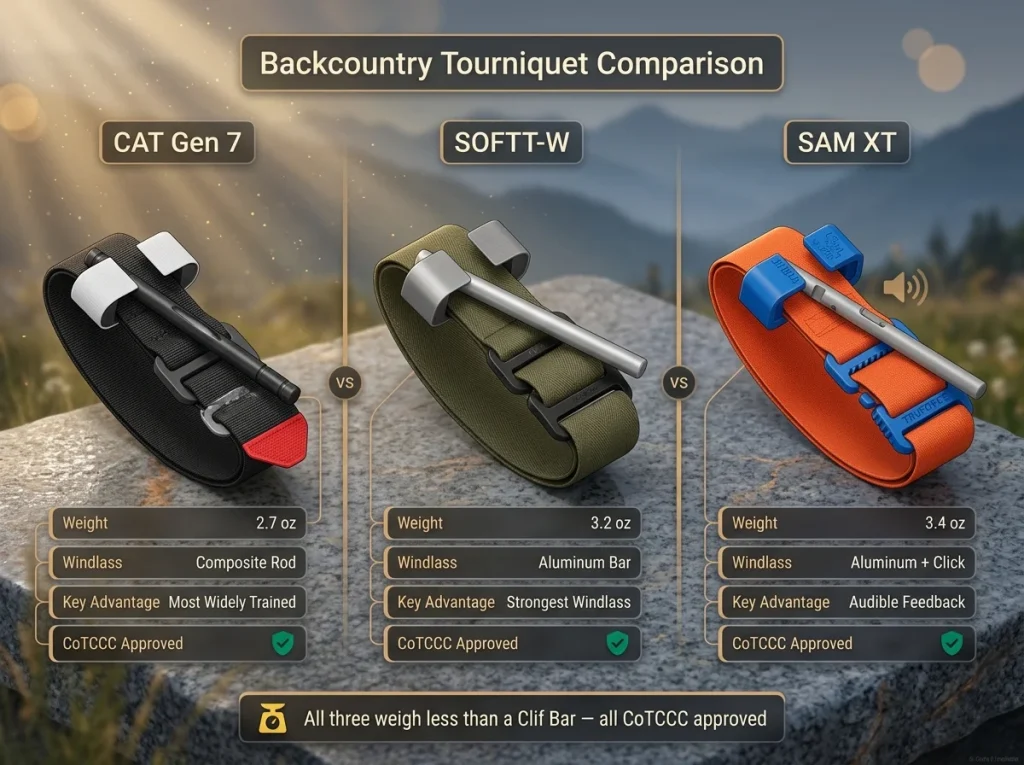
Three tourniquets dominate the backcountry and tactical markets, and all three are approved by the Committee on Tactical Combat Casualty Care (CoTCCC). That approval matters — it means the design has been tested under real conditions and meets the mechanical standards for reliable hemorrhage control.
The CAT (Combat Application Tourniquet) is the most widely used and most widely trained on. If you’ve ever taken a Stop the Bleed class, you almost certainly practiced on a CAT. The Gen 7 version addressed earlier issues with the windlass clip, and its single-routing buckle system makes one-handed application more intuitive than older designs.
The SOFTT-W (SOF Tactical Tourniquet Wide) uses a single-piece aluminum windlass bar instead of a composite rod. That matters because the bar won’t snap under extreme torque — a failure mode that has been documented in cheaper tourniquet knockoffs. The wider strap distributes pressure more evenly, which reduces nerve damage risk during extended application.
The SAM XT has a feature that no other tourniquet offers: an audible click when all the slack has been removed and the windlass is ready to tighten. In a high-stress moment when your hands are shaking and your brain is running on adrenaline, that click tells you “you’re doing this right.” One of the biggest mistakes people make is not tightening enough, and the SAM XT’s feedback mechanism addresses that directly.
Weight and Pack-Friendliness
The weight argument against carrying a tourniquet doesn’t hold up. The CAT weighs 2.7 ounces. The SOFTT-W comes in at 3.2 ounces. The SAM XT is 3.4 ounces. All three weigh less than a Clif Bar.
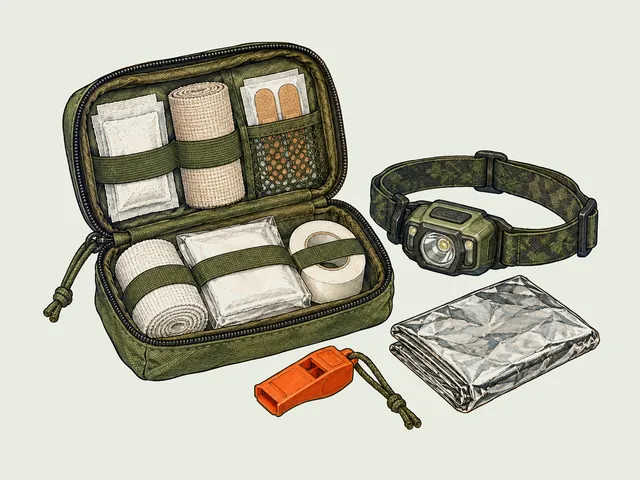
Rubber-band a tourniquet to a flat pack of z-fold hemostatic gauze and a Sharpie marker, and you’ve got a complete blow-out kit that weighs under 5 ounces and approximates the size of a deck of cards. That’s less than most hikers’ luxury items — the camp chair, the Kindle, the second pair of socks they’ll never wear.
Pro tip: Pair your tourniquet with hemostatic gauze, not regular gauze. Hemostatic gauze contains a clotting agent (usually kaolin) that accelerates coagulation at the wound site. It’s the bridge between “tourniquet on” and “wound packed for evacuation.” Regular gauze absorbs blood. Hemostatic gauze stops it.
Step-by-Step Tourniquet Application
Placement and Positioning
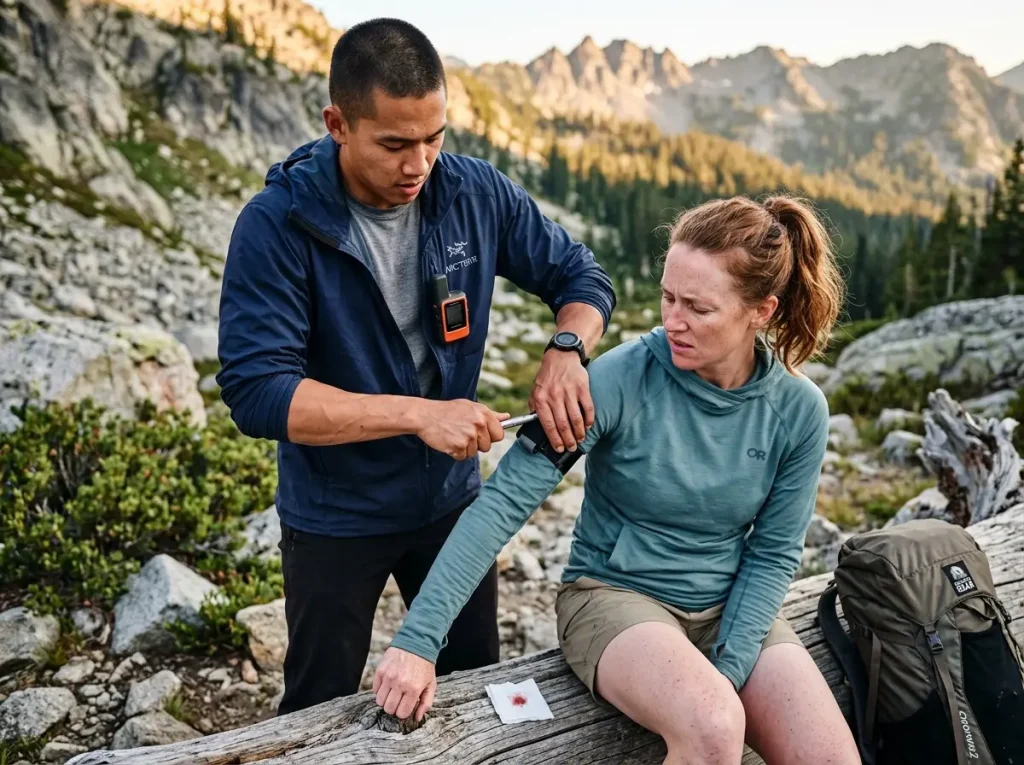
Place the tourniquet 2–3 inches above the wound — between the wound and the heart. If you can’t tell exactly where the bleeding is coming from (common with messy, blood-covered limbs), go high and tight: as far up on the limb as you can.
Never place it directly over a joint. Knees and elbows flex, which loosens the tourniquet over time and can dislodge it entirely. The anatomy at joints also makes it harder to compress the artery against bone, which is the whole point.
If you can, remove clothing from the area. Tourniquets work over fabric, but bunched-up clothing can compromise the seal. In a true emergency with arterial blood everywhere, don’t waste minutes carefully rolling up a pant leg — but if you have 30 seconds and a knife, cutting the fabric away gives you a better application.
Tightening the Windlass
This is where most people fail, and the reason is simple: they stop too soon.
Pull the strap tight by hand first — get all the slack out before you touch the windlass. Think of it like using your fingers to start a screw before switching to a screwdriver. The hand-tightening phase does 70% of the work.
Then grab the windlass bar and twist. Twist until the bleeding stops. Not until it slows down. Not until it “seems better.” Until it stops.
Pro tip: If you can slide a fingertip between the strap and the skin, it’s not tight enough. This is the single most common mistake — civilians stop half a turn too loose because the patient is in pain and the tightening feels extreme. It’s supposed to feel extreme. A properly applied tourniquet is more painful than most injuries it treats. That pain means it’s working.
Check for a distal pulse — the pulse you’d feel at the wrist or ankle below the tourniquet. If you can still feel a pulse, arterial blood is getting through. Tighten more.
Securing and Time-Stamping
Once the bleeding has stopped and you’ve confirmed no distal pulse, secure the windlass using both the C-clamp and the triangle backup. Not one or the other — both. If you’re moving through dense brush during evacuation and the windlass catches on a branch, the C-clamp alone might not hold. The triangle backup is your insurance.
Write the application time somewhere visible. The tourniquet’s built-in time tag is the obvious choice, but if you can’t find the tag in the chaos, write it on the patient’s forehead with a Sharpie. That sounds dramatic, but medical responders at the hospital need to know how long the tissue has been without blood flow. If you don’t have a marker, use whatever works — mud on the skin, a note in your phone, a voice memo.
Never remove the tourniquet in the field unless you’ve been trained in tourniquet conversion and you’re confident the bleeding can be controlled with direct pressure and wound packing. For most hikers without medical training, the rule is: put it on, lock it down, and evacuate.
Internal link to how to splint a leg injury on the trail — splinting is often the next step after hemorrhage control for limb injuries, and the skills complement each other in a backcountry emergency.
Applying a Tourniquet on Yourself
One-Handed Technique
Here’s the scenario nobody wants to think about: you’re hiking solo, you slip on a wet root, and a sharp rock opens up your thigh. Blood is pulsing. There’s nobody else around.
Everything about self-application is harder. You’re working against pain, adrenaline, and the mechanical challenge of doing a two-handed task with one hand. This is the situation where prior practice separates people who survive from people who fumble until they pass out.
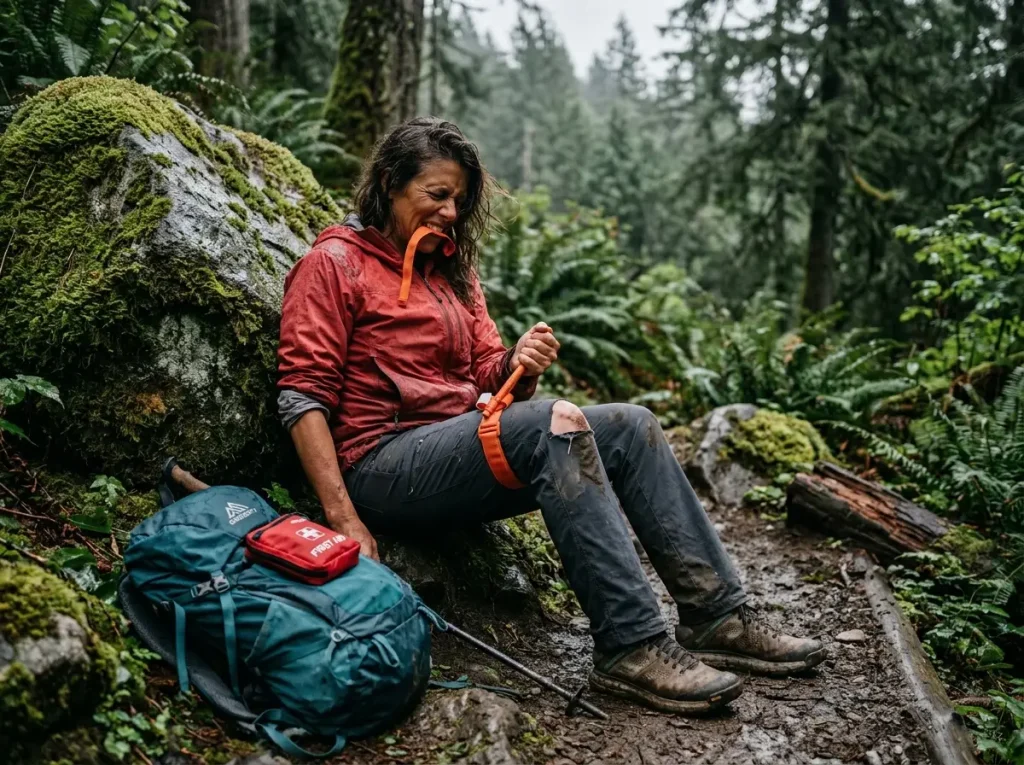
Pre-stage the tourniquet loop whenever possible. If you carry it in a hip belt pocket with the loop already formed, you can slide it over a foot and up the leg to the application point without needing a second hand to thread the buckle.
Use your teeth to hold the strap end while you tighten the windlass with your free hand. It’s not elegant. It works. The SAM XT’s click feedback matters most during self-application — when you can’t see the wound clearly and you’re working by feel, that audible confirmation tells you the slack is out and you’re ready to twist.
Pro tip: The first time you try one-handed application, it takes most people about 90 seconds. After five or six practice sessions, you can get it under 30. That time difference is not academic — it’s the difference between applying the tourniquet while you’re still thinking clearly and applying it after hemorrhage starts affecting your cognition. Practice until the motion is muscle memory.
Managing Pain and Staying Focused
A tourniquet on your own leg is going to hurt. A lot. Many patients report the tourniquet pain is worse than the injury itself, and when you’re applying it to yourself, there’s no one else to tell you “keep tightening, it’s supposed to feel like that.”
Expect the pain. Accept it. The tourniquet is compressing tissue, muscle, and nerves to collapse the artery — that’s the mechanism that saves your life. If it doesn’t hurt significantly, it probably isn’t tight enough.
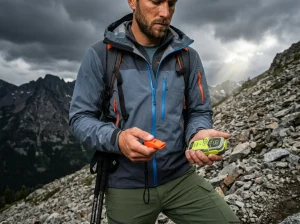
After application, your job shifts to communication and self-preservation. Activate your personal locator beacon for backcountry emergencies or satellite messenger. If you don’t have one, blow your emergency whistle in sets of three — the universal distress signal. Stay warm. Stay hydrated if you can reach your water. Stay still. Movement increases heart rate, which increases blood pressure, which increases the risk of the bleeding restarting.
What Changes When Help Is Hours Away
The Two-Hour Rule and Backcountry Reality
Every tourniquet class teaches the two-hour rule: get the patient to definitive medical care within 120 minutes. Under two hours, the risk of permanent tissue damage is close to zero. Studies show that in typical civilian emergencies, the average patient reaches a hospital in 77 minutes.
In the backcountry, that timeline is fiction.
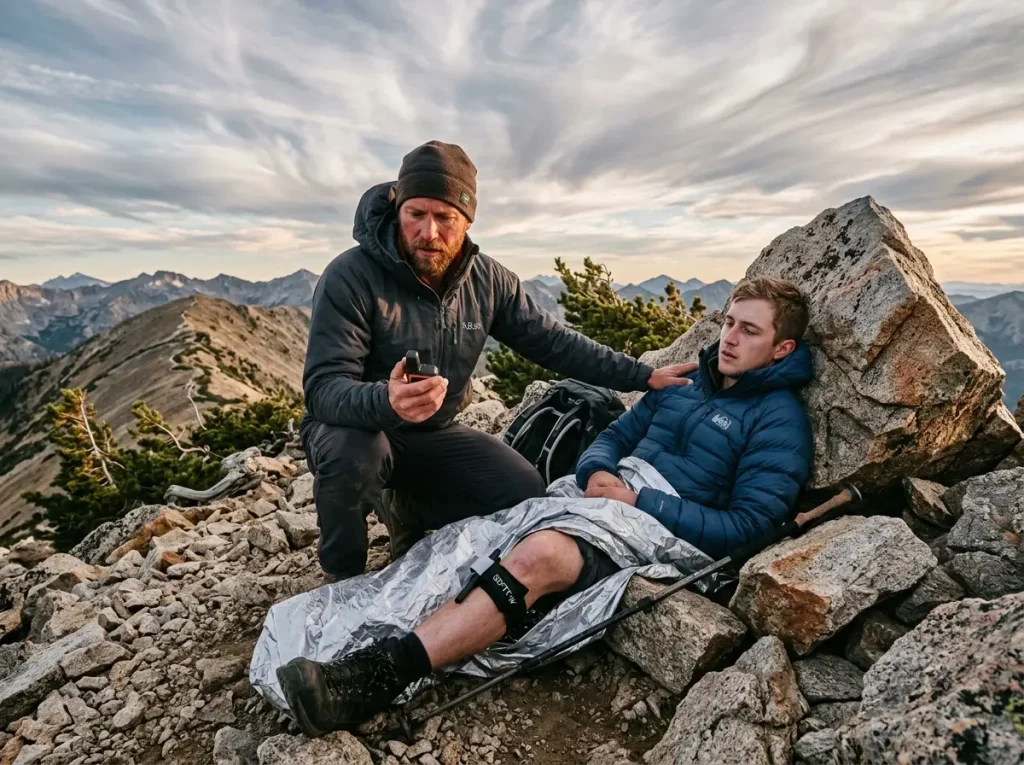
If you’re four miles into a trail with 2,000 feet of elevation gain, you’re looking at 3–4 hours to the trailhead even if you can walk. If the injured person can’t walk, you’re looking at a litter carry — which means 8–12 hours, or waiting for search and rescue. If there’s no cell signal, add the time it takes for a satellite message to reach dispatchers and a helicopter to launch.
The two-hour rule was designed for urban and suburban settings where an ambulance is 15 minutes away. It does not account for backcountry reality. And this is the gap that most tourniquet guides completely ignore.
Tourniquet Conversion Basics
Between 2 and 6 hours, the risk of tissue damage increases but remains manageable if the tourniquet is converted properly. Conversion means carefully loosening the tourniquet while simultaneously applying direct pressure and wound packing to see if bleeding can be controlled without the tourniquet.
Here’s the basic conversion sequence:
- Prepare wound packing materials (hemostatic gauze, pressure bandage)
- Have one person ready to re-tighten the windlass immediately
- Slowly loosen the tourniquet by one-quarter turn
- Watch the wound — if arterial bleeding restarts, re-tighten immediately
- If bleeding stays controlled, continue loosening in small increments
- Pack the wound tightly and apply a pressure bandage
- Monitor continuously — if bleeding breaks through, the tourniquet goes back on
The Wilderness Medical Society recommends that anyone who carries a tourniquet into the backcountry should learn conversion technique. A free Stop the Bleed training course covers the basics of hemorrhage control, and a 16-hour Wilderness First Aid course includes hands-on tourniquet conversion practice.
Evacuation Planning With an Active Tourniquet
Beyond 6 hours, medical research documents cases of tourniquet application lasting up to 16 hours without permanent limb loss. That’s not a recommendation — it’s a data point that matters when you’re weighing “keep the tourniquet on” versus “remove it and risk uncontrolled hemorrhage.”
The risk calculus in the backcountry is simple: keeping the tourniquet on too long is almost always better than removing it and losing control of the bleeding. A limb with temporary tissue damage can be treated at the hospital. Hemorrhagic shock on a mountainside cannot.
Your evacuation checklist with an active tourniquet:
- Activate PLB or satellite messenger with your exact coordinates
- Insulate the patient against hypothermia (hemorrhage drops core temperature fast)
- Note and communicate the tourniquet application time
- Monitor the patient’s alertness and skin color continuously
- If you must move, stabilize the tourniqueted limb to prevent the device from shifting
- Do NOT attempt conversion unless you have been trained and have the materials
Improvising a Tourniquet From Trail Gear
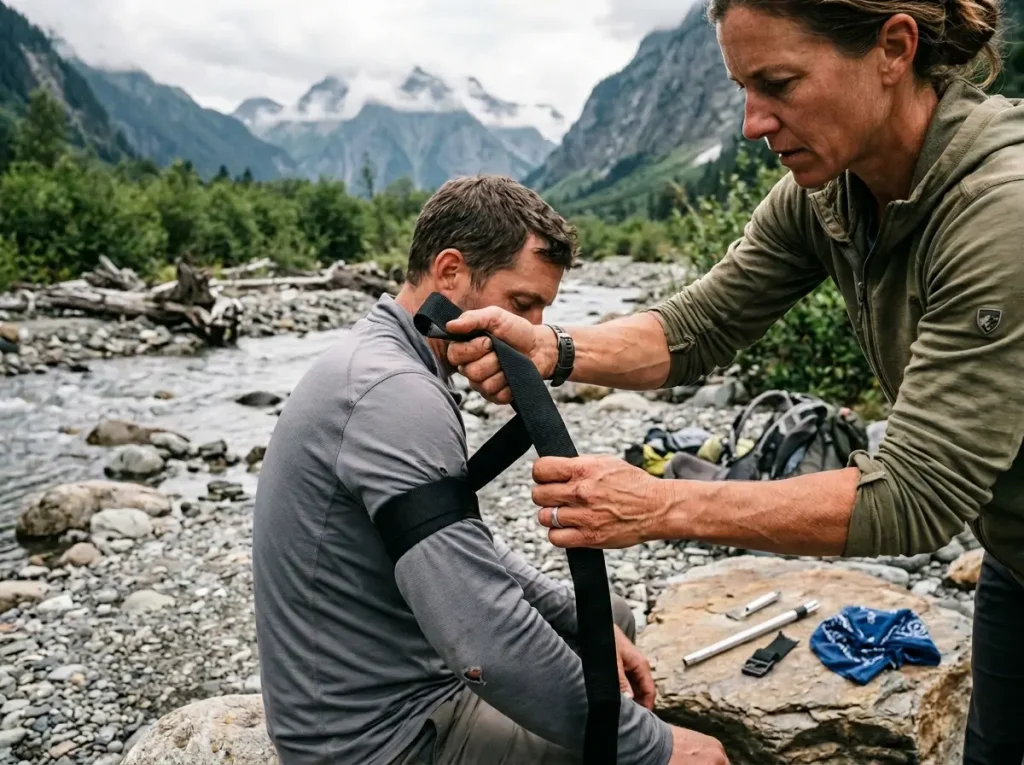
What Works and What Doesn’t
You forgot your tourniquet. Or you need a second one. Your pack has the raw materials — but only if you know what to grab and what to leave alone.
Width is everything. The material wrapping the limb needs to be at least 1 inch wide, ideally 2 inches or more. Wider material distributes pressure across more tissue, which reduces nerve damage and increases the chance of actually compressing the artery flat.
What works:
- Pack strap webbing — cut a section from your hipbelt or shoulder strap. Most pack webbing is 1–2 inches wide and strong enough to handle the torque. Yes, you’re sacrificing your pack. Your life is worth more.
- Folded bandana — fold a cotton bandana lengthwise until it’s 2+ inches wide. This is why experienced backcountry hikers carry a bandana even in the ultralight era.
- Buff or neck gaiter folded double — provides decent width and enough friction to hold a knot
What does NOT work:
- Paracord — too narrow. It concentrates pressure into a thin line that damages nerves and tissue without effectively compressing the artery
- Shoelaces — same problem. Thin material acts more like a cutting wire than a tourniquet
- A belt — you can’t tighten a belt enough. There’s no windlass mechanism, and the buckle doesn’t provide the continuous incremental tightening a tourniquet requires
Pro tip: An improvised tourniquet is better than no tourniquet, but it’s significantly less effective than a commercial one. The real takeaway here isn’t “learn to improvise” — it’s “carry the real thing so you never have to.” A CAT tourniquet weighs 2.7 ounces. That’s the weight of this argument.
Building an Improvised Windlass
The windlass is what gives a tourniquet its mechanical advantage — the ability to tighten past what your hands alone can achieve. Without a windlass, you’re just tying a tight bandage, which isn’t enough for arterial bleeding.
Good improvised windlass materials from your pack:
- Trekking pole section — if you have a collapsible pole, the middle section is about the right length (8–10 inches) and rigid enough to handle the torque
- Thick branch — grab something roughly the diameter of a thumb and at least 8 inches long. Green wood is better than dry — it flexes without snapping
- Tent stake — aluminum V-stakes or shepherd’s hook stakes work in a pinch, though they’re shorter than ideal
Tie the wide material (webbing, folded bandana) around the limb in a loose loop. Insert the windlass through the loop. Twist until the bleeding stops, then secure the windlass against the limb using whatever you have — a second piece of cord, the tail of the bandana, duct tape from your repair kit.
This approach connects to the broader principle of adapting emergency skills for the backcountry — standard techniques often need field modification when you’re far from a hospital and a gear closet.
Where to Carry It and How to Practice
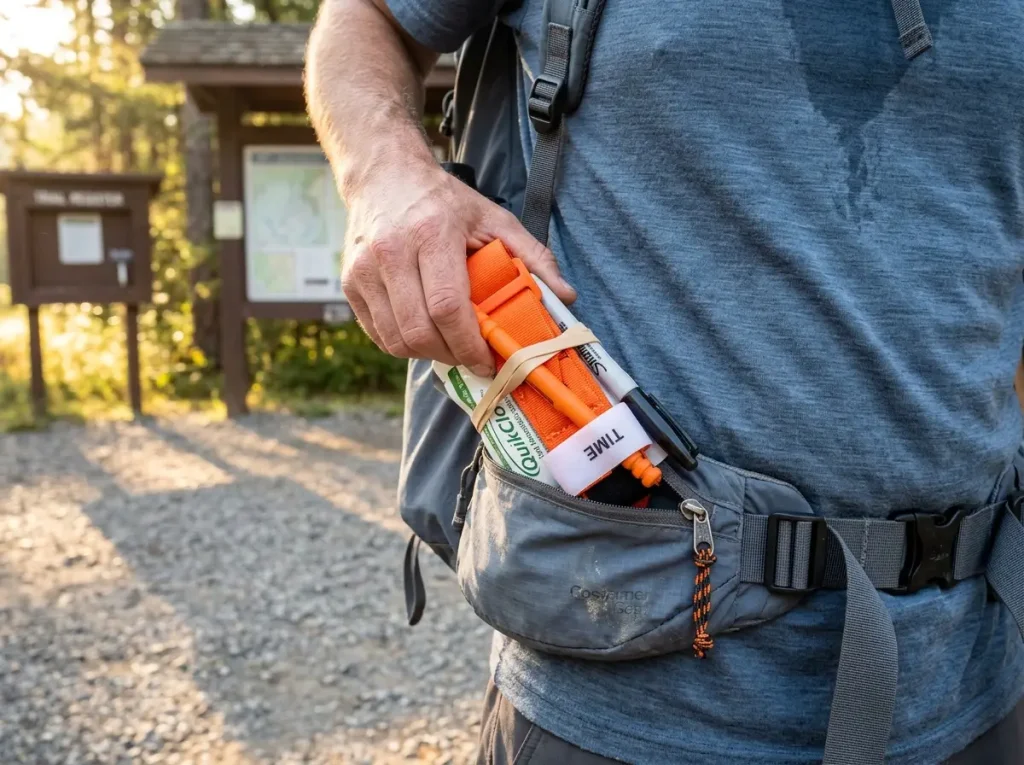
Pack Placement for Fast Access
A tourniquet buried in the bottom of your pack is the same as no tourniquet at all. When you need it, you need it in under 10 seconds — not after 2 minutes of dumping gear on the ground.
The best carry locations for fast access:
- Hip belt pocket — the winner for most hikers. You can reach it with either hand while wearing the pack, and the zippered pocket protects it from snagging on brush.
- Shoulder strap pouch — especially good if your pack has add-on attachment points. Keeps the tourniquet at chest level where it’s visible and grabable.
- Cargo pants pocket — if you wear hiking pants with thigh pockets, this puts the tourniquet on your body rather than your pack. If you drop your pack during an emergency, you still have it.
Bundle it. Rubber-band your tourniquet to a flat pack of z-fold hemostatic gauze and a Sharpie marker. The three items together weigh under 5 ounces and fit in any of the carry locations above. That’s your blow-out kit — everything you need for a major limb hemorrhage in one grab.
If you’re the group leader on a trip, carry two tourniquets. One in your hip belt for yourself. One in an outer pack pocket for your group. Leading a group into the backcountry means you’re responsible for everyone’s emergency signaling tools tested in the field and hemorrhage control, not just your own.
Practice Drills That Actually Prepare You
Owning a tourniquet you’ve never practiced with is like carrying a map you’ve never unfolded. The skill is perishable but easy to refresh — 10 minutes twice a year is enough to keep the muscle memory sharp.
Effective practice drills:
- Apply to your own thigh with both hands. Then your upper arm. Get the mechanics smooth.
- Switch to one hand only — dominant first, then non-dominant. Your dominant hand might be the injured one.
- Practice with gloves on. Cold weather means gloves, and buckles are harder to manipulate with insulated fingers.
- Practice extracting the tourniquet from your actual carry location (hip belt, shoulder strap). Include the extraction in your drill — don’t start with the tourniquet already in your hands.
- Time yourself. First time will be 60–90 seconds. Goal is under 30 seconds with both hands, under 45 seconds one-handed.
The ACS Stop the Bleed program offers a free 25-minute online course that covers direct pressure, wound packing, and tourniquet application. It’s the best zero-cost starting point. For hands-on training, a Wilderness First Aid (WFA) course is 16 hours — a single weekend — and includes real tourniquet practice with feedback from an instructor.
Don’t forget maintenance. UV exposure and heat degrade the rubber and elastic components. Inspect your tourniquet annually. If the strap has lost its elasticity or the windlass feels loose, replace it. A tourniquet costs $25–35. That’s cheap insurance.
Conclusion
A commercial tourniquet weighs under 3.5 ounces and multiplies your odds of surviving a major limb bleed by nearly six times. That’s less than a Clif Bar for a tool that changes the math on your most serious backcountry risk.
The standard two-hour time limit assumes a hospital is close. In the backcountry, it often isn’t — and keeping the tourniquet on is almost always safer than removing it without conversion training. Know the extended timeline. Plan your evacuation before you need one.
Practice one-handed, from your actual carry location, with gloves, at least twice a year. The skill fades, but 10 minutes of refresher brings it right back. Take the free 25-minute Stop the Bleed online course before your next trip and practice on yourself until the steps feel automatic. The time to learn this is not when your hands are covered in blood.
Q1 How long can you leave a tourniquet on in the backcountry?
Under two hours carries nearly zero risk of permanent limb damage. Between two and six hours, tissue damage risk increases but remains manageable with conversion by a trained person. Cases of 16-hour application without permanent damage are documented. In the backcountry, keeping it on is almost always safer than removing it.
Q2 Can you use a tourniquet on yourself?
Yes. Pre-stage the loop, slide it up the limb, use your teeth to hold the strap end, and twist the windlass with your free hand. Practice one-handed at home until you can apply it in under 45 seconds. The SAM XT's audible click is particularly helpful during self-application because it confirms slack removal by feel.
Q3 What can I use as a tourniquet in the wilderness?
Wide material plus a rigid windlass. Pack strap webbing folded to 1–2 inches wide, a folded bandana, or a doubled Buff can serve as the band. A trekking pole section, sturdy stick, or tent stake works as a windlass. Never use paracord or shoelaces — too narrow, too much tissue damage.
Q4 Should hikers carry a tourniquet?
Yes. A CAT tourniquet weighs 2.7 ounces, costs under $35, and increases survival odds nearly sixfold for life-threatening limb hemorrhage. Carry it in a hip belt pocket for quick access and pair it with a 25-minute online Stop the Bleed course. The weight-to-lifesaving ratio is unmatched by any other item in your pack.
Q5 Do tourniquets cause nerve damage or amputation?
Rarely. Civilian data shows a 0.4% amputation rate and 1.5% nerve damage rate from prehospital tourniquet use — and many of those cases involved injuries severe enough to require amputation regardless. The outdated fear of losing the limb is not supported by modern research. Properly applied, the benefit far outweighs the risk.

I've spent more than a decade researching hiking gear and trail technique. I read the specs, the forum threads and the long-term reviews, and every pick here comes with what it gets wrong.
End of the trail
You read every mile of this one. Here's where the trail goes next.