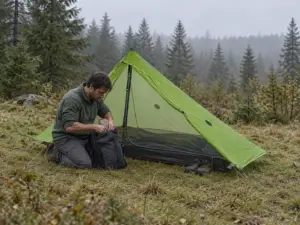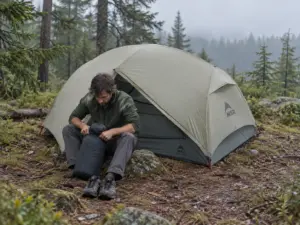
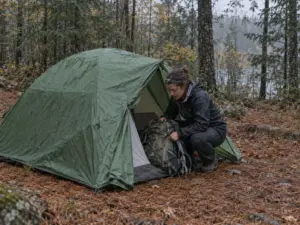
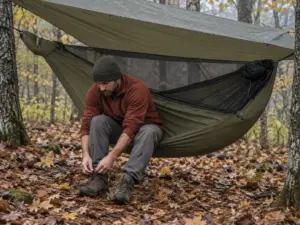









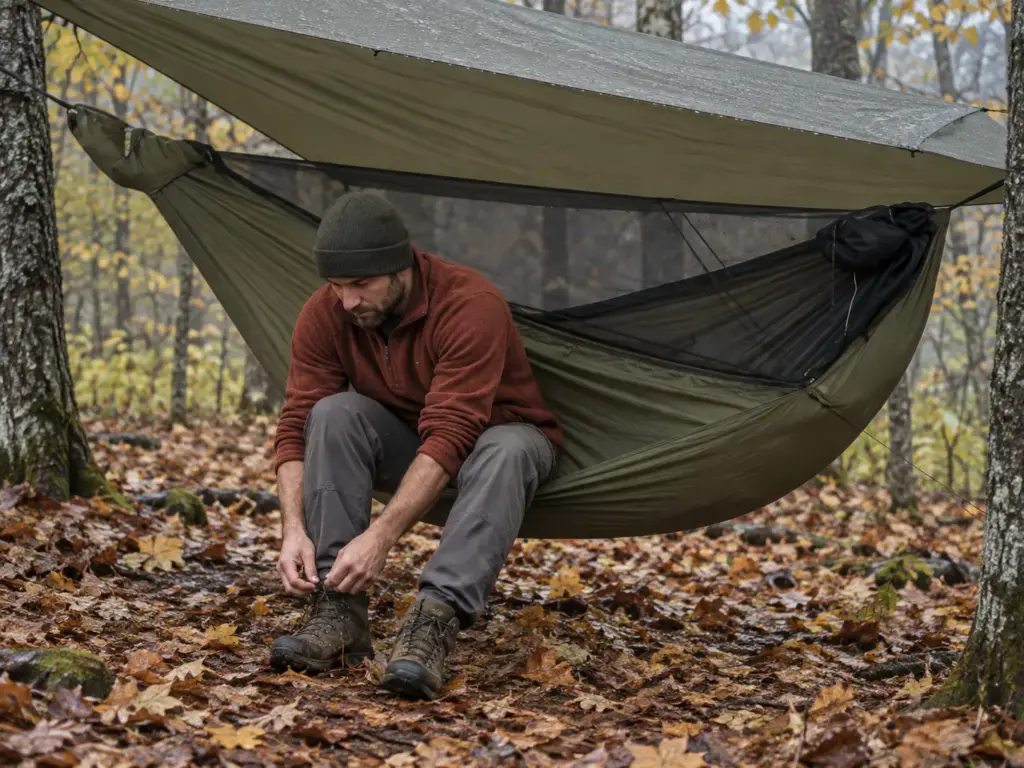
A first-time hammocker gets handed an 11-foot hammock, has never slept in one, and asks the question that keeps showing up in beginner threads: is an 11-foot tarp enough for an 11-foot hammock? That one question hides the whole buying decision for tarps and hammocks for backpacking, because the number printed on a tarp’s listing is rarely the number that keeps rain off your sleeping bag. Hammock forums repeat the same lesson season after season: size, shape and fabric get decided by the trees you actually sleep under, and the tarp and hammock are only part of what ends up in your pack. This guide covers which size, shape and fabric fit, what fails first, what to do when the trees run out and what the full kit really adds up to, and if you are still deciding whether a hammock suits you at all, start with the pros and cons there.
Here are the five decisions in one place, each with its short answer.
| What to decide | The short answer | Why it matters |
|---|---|---|
| Tarp length | At least 6 in past each end of the hammock; a 12 ft ridgeline covers most hammocks | A short tarp leaves the ends exposed |
| Shape | Hex or diamond for side panels, asym for the least fabric | Sideways rain finds the gaps |
| Fabric | Dyneema lightest and priciest, silpoly a middle ground, silnylon the budget route | Fabric is a cost decision first |
| Tree straps | 1 in wide or wider, per Leave No Trace | Narrow cord cuts bark |
| What else you buy | Underquilt, stakes, guylines | The tarp and hammock are not the whole kit |
Tarps and Hammocks for Backpacking Start With Tarp Size
The gifted-hammock question has a flat answer. The tarp has to clear the hammock’s ends, and the length on the listing is not the length that counts.
Cover the Hammock’s Ends, Not Just Its Middle
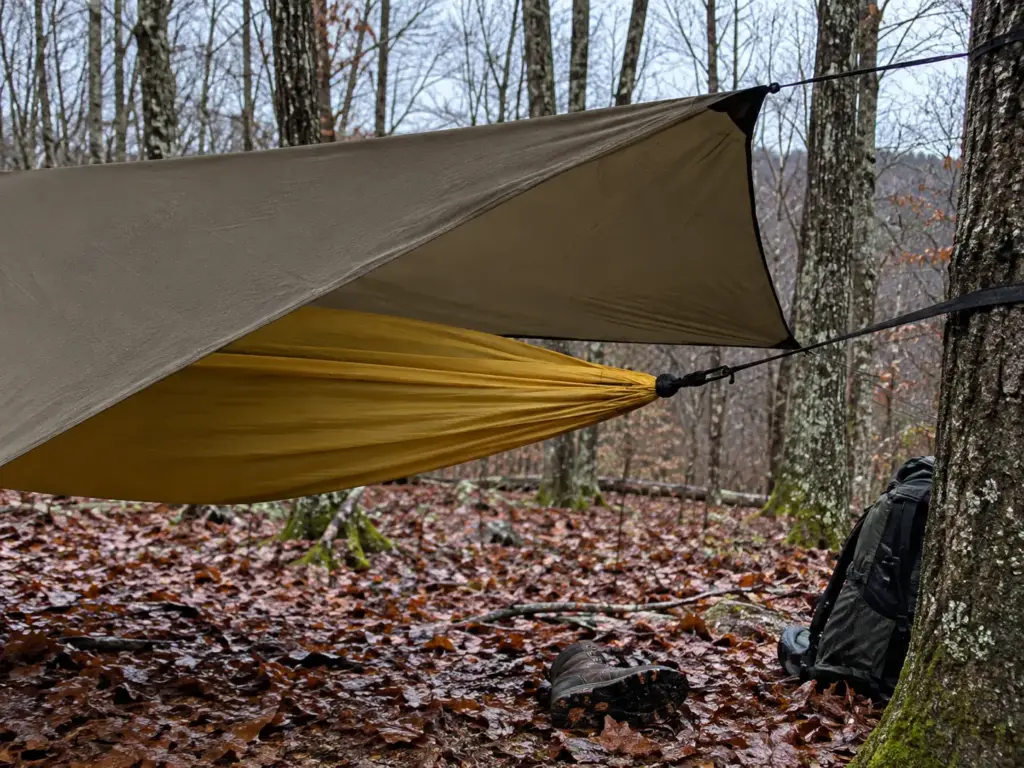
Most beginners check tarp width and stop there. The ends are where it goes wrong. Rain rarely falls straight down, and the head and foot of the hammock are exactly where a short tarp leaves a gap.
The Ultimate Hang, a long-running hammock-camping blog, gives the rule that keeps getting repeated in size debates: a tarp should reach at least 6 inches past each end of the hammock, and a 12 ft ridgeline is more than enough for most hammocks. Read that as a floor for the ends, not a target for the middle.
Two voices show up in beginner threads, and they are asking the same question in different clothes. One has been gifted an 11 ft hammock and has never slept in one. The other owns an 11 ft Warbonnet and wants no new knots to learn. Both are really asking how long the tarp has to be.
Compare ridgeline to ridgeline. Take the length of your hammock, add a foot for the two 6-inch margins, and set that number against the ridgeline figure on the listing, not the overall tarp length. If the listing never gives a ridgeline, that is your first red flag.
Why an 11 Foot Tarp on an 11 Foot Hammock Is a Tight Fit
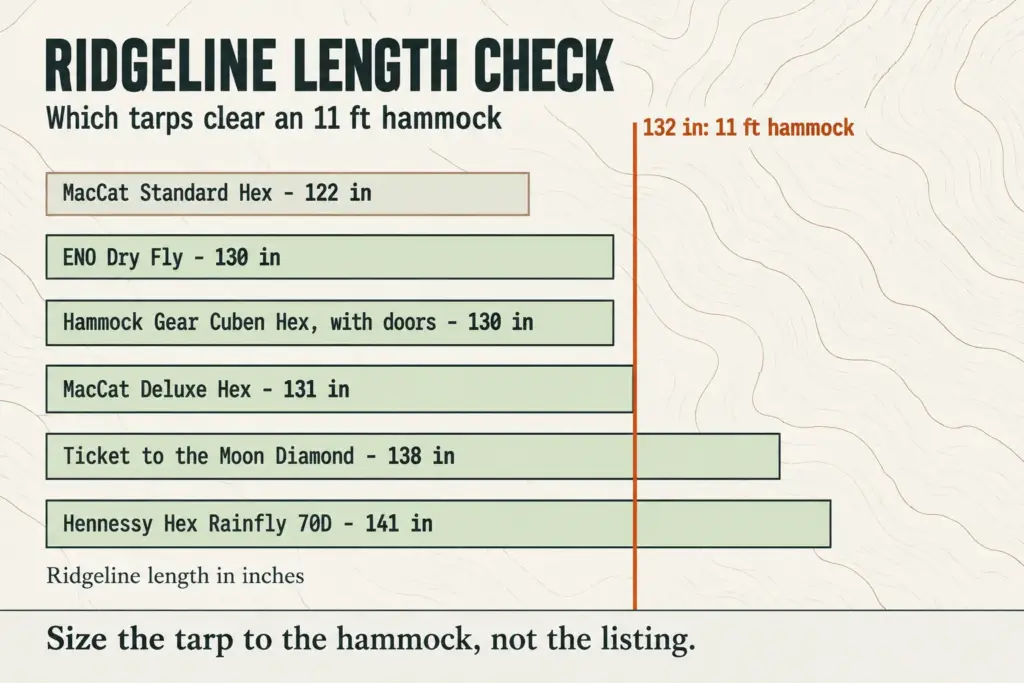
The same Ultimate Hang comparison lists the ridgeline length of common hex and diamond tarps, and the numbers are tighter than the product photos suggest. The MacCat Standard Hex measures 122 in, the MacCat Deluxe Hex 131 in, the ENO Dry Fly 130 in, the Hammock Gear Cuben Hex with doors 130 in, the Ticket to the Moon Diamond 138 in and the Hennessy Hex Rainfly 70D 141 in.
An 11 ft hammock is about 132 in. A 10 ft hex, at 120 in, is short before it leaves the stuff sack, and the tarps sitting at 130 in are roughly the same length as the hammock, which leaves no margin at all. A 12 ft hex is the size that clears it.
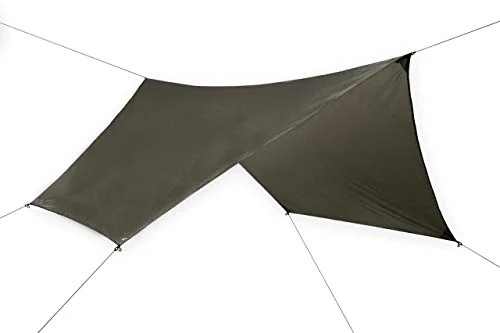
The Hennessy Hammock Hex Rainfly is the answer to the gifted-hammock question: a 12 x 10 ft hex, so the 11 ft hammock gets its margin instead of a prayer. That is also why 12 ft keeps coming up as the safe number.
An 11 ft tarp works on an 11 ft hammock only if you hang the tarp close, and even then the margin disappears. It can work. It just forgives nothing, and the first night with a crosswind is the wrong time to find out. Size the tarp to the hammock, not to the sticker on the listing.
Hex, Diamond or Asym: How Tarp Shape Sets Your Coverage
Listings throw three words at you: hex, diamond, asym. They decide how much rain reaches your sleeping bag once the wind turns.
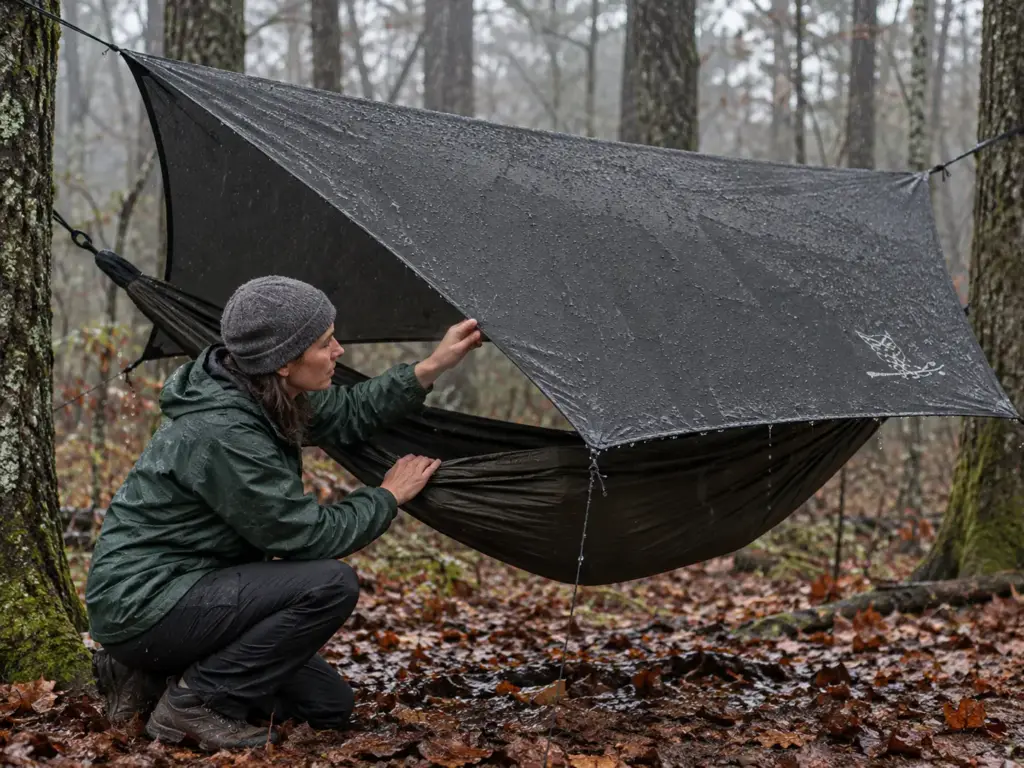
Hex and Diamond: Side Panels for the Weight
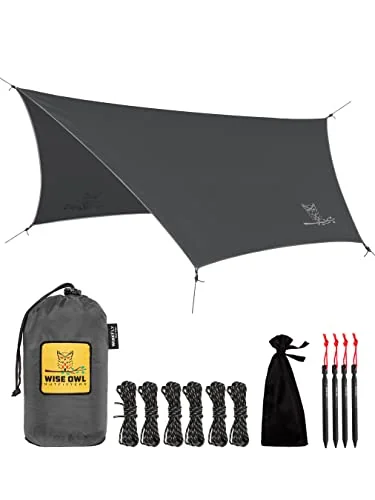
Start with the slang, because every listing assumes you know it. A hex is a six-sided tarp with the side panels cut away to save weight. A diamond is four-sided. An asym is asymmetric, built for the diagonal lay, where you sleep canted off the centerline instead of straight down it.
Hex and diamond tarps trade extra weight for side panels. Those panels matter when rain stops falling and starts traveling sideways. A commenter in the Pacific Northwest on r/ULHammocking says their hex holds wind and rain through a season with no doors, which is the kind of report worth weighing against your own trees before you copy it.
The Wise Owl Outfitters Hammock Rain Fly is the budget hammock tarp route into a hex: 11 x 9 ft with taped seams. At 11 ft long it sits in the tight-fit class from the last section, so pair it with a hammock you can hang close and low, or with a shorter one. Do not ask more of it than that.
Whatever shape you buy, the advice from The Ultimate Hang is to pitch it low and tight to the hammock. It is less convenient to get in and out, and it protects better. There is a counter-view from the wind-heavy camp, and it gets a fair hearing in the failure section below.
Asym: The Least Fabric for the Most Protection on the Diagonal
The asym gives the least fabric for the most protection when you lie on the diagonal. The Ultimate Hang’s author calls its side coverage “bikini,” which is fair and also a warning. In sideways rain an asym covers less of you than a hex or diamond does, because the fabric it saved is exactly the side panels.
If your trips are summer weekends under sheltered trees, that trade is easy to make and your pack is lighter for it. If storms in shoulder season are on the table, the fabric you saved is the fabric you will wish you had been carrying at 2 a.m. The closed-system example of an asym comes up in the kit section near the end.
Dyneema, Silpoly or Silnylon: Fabric Is a Cost Decision First
On hammock forums the fabric question gets answered with a price before a weight. That is a better starting point than a spec sheet, because the fabric changes what you pay far more than it changes how comfortable a weekend feels.
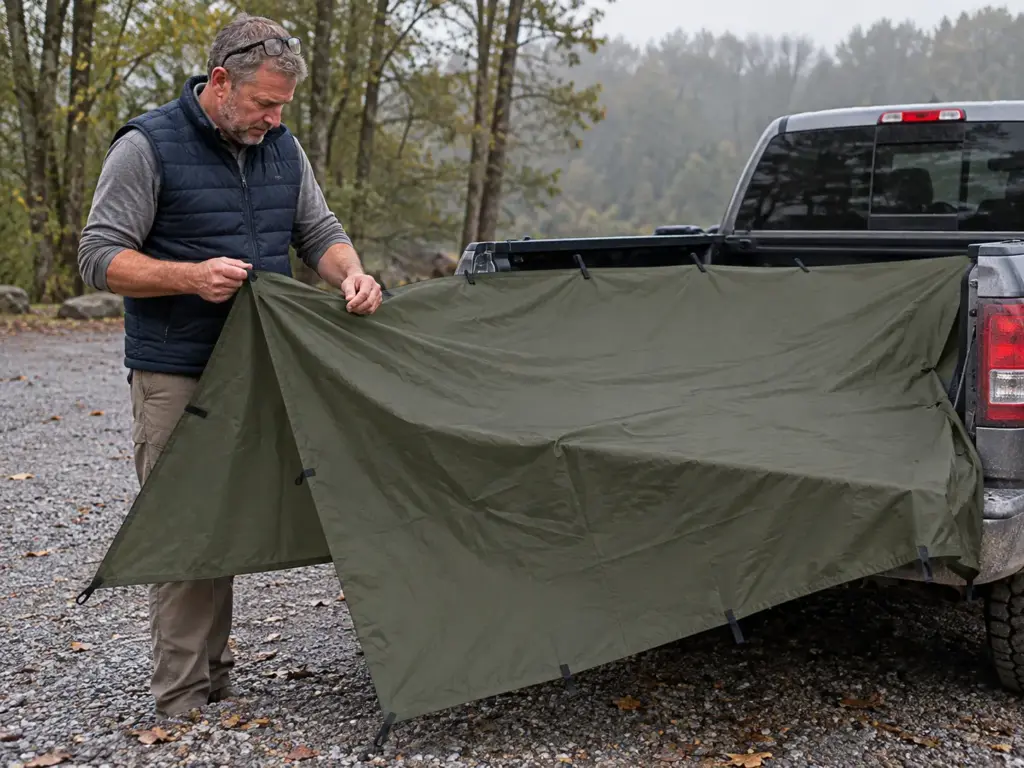
What Hikers Say You Pay for Dyneema
A commenter on r/ULHammocking, buying a silpoly tarp, put the choice in two lines: dyneema is “very expensive,” silpoly is “a good middle ground.” That is opinion, not a spec, but it matches how the question usually gets settled.
Dyneema (Dyneema Composite Fabric, also written DCF or cuben fiber) is the lightest option, the ultralight hammock tarp choice, and the priciest. Paying for it makes sense when you count every ounce across weeks on trail. On a three-night trip you will not feel the weight you saved, and your wallet will feel the cost.
The weight numbers floating around should be read the same way. One user on that thread put a silpoly Thunderfly on a scale at 15 oz, with a 35 ft ridgeline and four guylines attached. It is one person’s scale, so treat it as community data, not a manufacturer spec. For the full breakdown of how the two fabrics hold up in the field, see how silnylon and Dyneema compare on trail.
Silpoly as the Middle Ground, Silnylon as the Budget Route
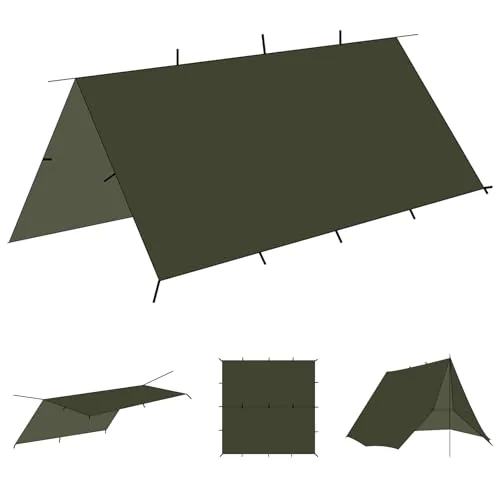
Silpoly is polyester with a silicone coat, and it is the fabric the middle-ground comment points to. Silnylon is the same idea on nylon, and it is the budget route. The Onewind 10×10 ft Ultralight Silnylon Camping Tarp is the example here: a 10 x 10 ft silnylon tarp at a budget-friendly price. A square 10 x 10 is a flexible shelter and a fair hammock cover for a shorter hammock, though at 10 ft it falls under the size rule from the first section, so check it against your hammock before you commit.
Fabric also decides how a tarp behaves overnight, and that varies by fabric and by tarp. If a particular tarp loosens up in damp air, the maker’s care notes for that tarp are the source to trust, not a forum generalization.
One more pattern from the community: the Warbonnet 11 ft owner who wanted no new knots was told that any silpoly tarp with quick tensioners would do. That is the honest buying rule in a sentence. Fabric changes cost far more than it changes weekend comfort, so buy the cheapest fabric whose weight you will not resent on your longest trip.
Do You Need Doors on a Hammock Tarp?
“Not UL” is the usual verdict on forums, and it is fair. A tarp with doors is extra fabric and extra pack weight, and one r/ULHammocking commenter says they never used doors and never got wet. The voices that skip doors also tend to hang in sheltered woods, which is the part that gets left out of the verdict.
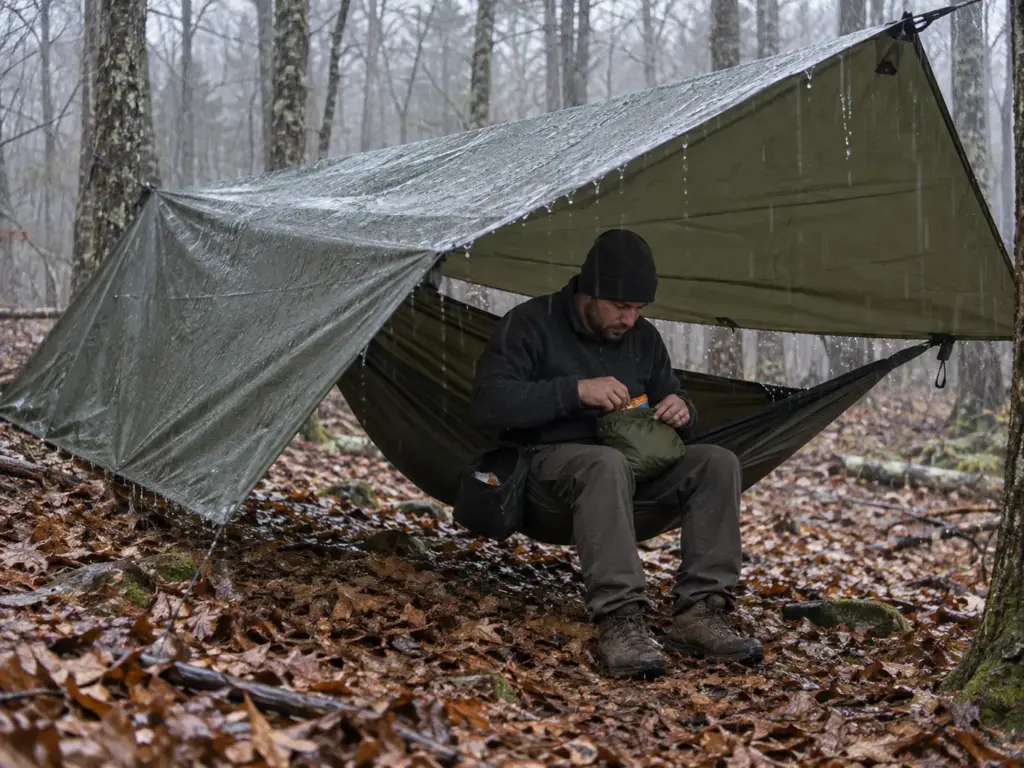
What doors buy is storm protection against sideways rain and wind protection at the ends, and that is as much a function of the site as of the tarp. The Ultimate Hang’s advice is to hang on the lee side of a hill or behind rock or foliage, so the gust has something to hit before it hits you. Picking a spot like that works the same way whether or not the tarp has doors, so read choosing a campsite that blocks the wind and rain before you pay for fabric to do the job a hillside can do for free.
Try porch mode before you buy doors. As one r/ULHammocking commenter puts it, any tarp can do porch mode, even an 11 ft hex, by opening one end. It is the cheap middle road between a fully closed pitch and paying for door panels.
Here is the decision rule. If your trees sit in a sheltered stand and you pitch low, skip doors. If you hang on exposed ridges or in storms during shoulder season, they earn their grams. That is judgment, not a spec, and no season makes doors mandatory on its own.
Tree Straps, Tie-Outs and Guylines: Pitching Without Hurting the Trees
The kit that ships with a cheap tarp has a few stakes and short guylines. The trees take the real wear, and so does the hardware you add.
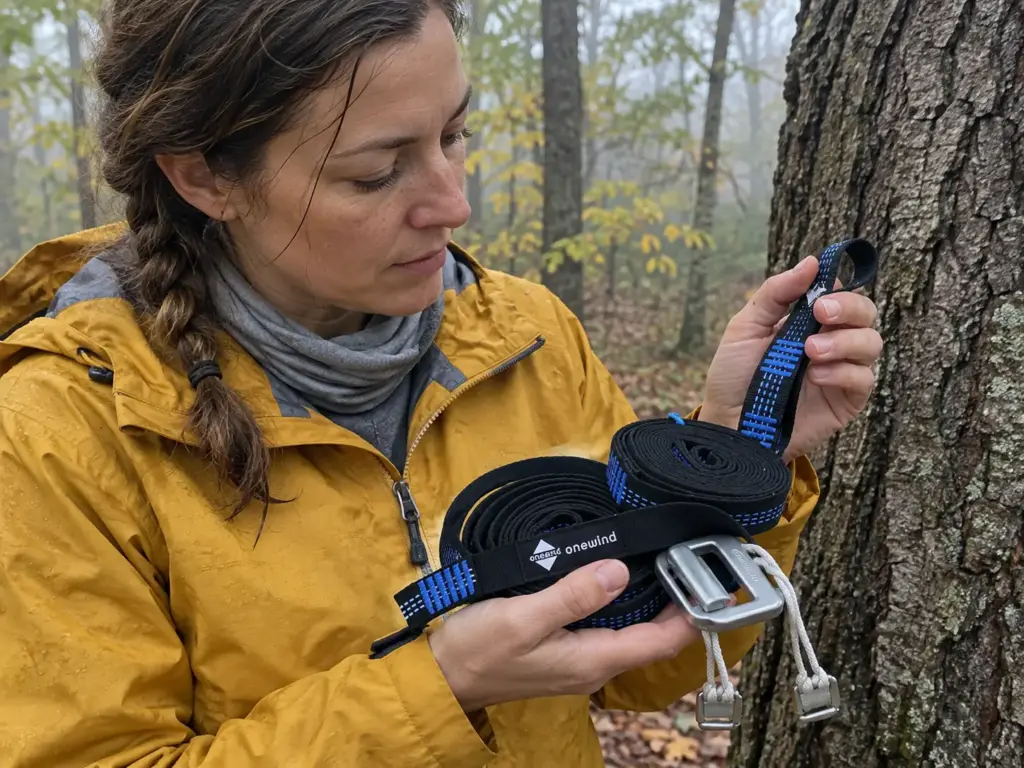
Straps at Least 1 Inch Wide Protect the Bark
Narrow cord around a trunk is where beginners go wrong, and tree-friendly straps are the fix. Leave No Trace’s hammock guidance calls for straps at least 1 inch wide, made of webbing, wrapped on the thickest part of a live, sturdy trunk, so the load spreads and the strap does not cause tree girdling. Cord that feels harmless on a short hang is the exact thing the guidance is written against.
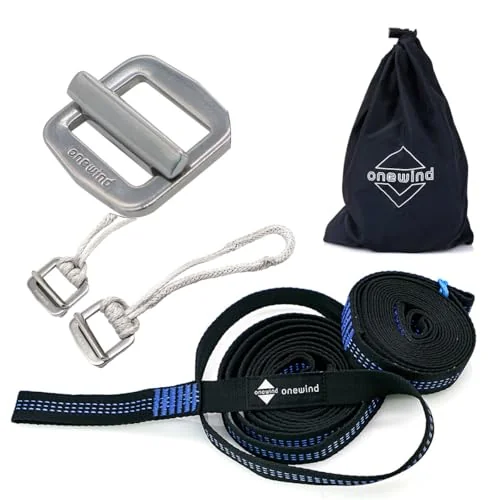
The Onewind 10ft Tree-Friendly Hammock Straps are 1 inch wide and come as a pair of 10 ft straps, which meets that floor. If your hammock already ships with straps, check their width against the 1 inch line instead of assuming they pass.
Tie-Outs, Tensioners and Guylines You Will Actually Use
The tie-out is where a tarp stops being fabric and starts being a shelter. Cheap tarps come with LineLoc-style clones on the tie-out: the line runs through the tensioner and you tighten it by pulling on it from behind.
The community craft knowledge goes one step further. A tensioner can be sewn by hand from a loop of webbing, and one r/ULHammocking commenter prices that at a few dollars per dozen. Skip the fancy hardware if you like, but have something on each tie-out that adjusts without a knot.
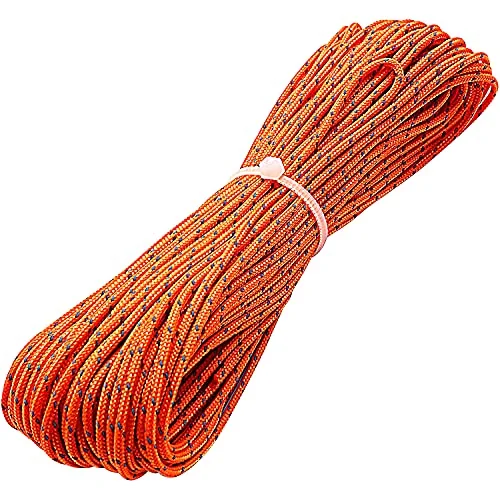
Reflective cord like the ThreeBulls 1.8mm Fluorescent Reflective Guyline earns its place in the dark, when the line you cannot see is the one you trip on. Whatever you buy, expect to buy more of it: the guylines and stakes that ship with a tarp are usually a minimum, not a kit.
Add a drip break to the suspension line. The r/ULHammocking crowd uses one so water running down the line from the tree drops off before it reaches the hammock. Sleeping under a dry tarp does not help if a wet rope is feeding the bag.
Where You Hang Matters as Much as What You Hang
Leave No Trace gives three numbers you can use without a calculator. Camp at least 200 ft from water, trails and other campsites, use established sites, and hang no higher than 18 in off the ground. The 18 in figure comes from the LNT web page, and it is the one to follow. Check the ground for vegetation before you tie off, because a low hang over a patch of fragile plants hurts more than a high one over bare dirt.
Then comes the rule that overrides the numbers. Some land managers do not allow tying to trees at all, and local rules differ. Rock Creek Park asks hammockers to use a free-standing stand instead of tying to trees, because ropes tied to trees cut into the bark and can expose it to bacteria and fungi. If you plan a trip through a park or a regulated area, read that land manager’s hammock rule before you pack straps.
Why Your Hammock Tarp Leaks, Sags or Pops Stakes (and the Fix)
Tarp failures read the same on every forum: it held fine for weeks, then one night it didn’t. Sorting that into three named failure modes, each with its own fix, turns a vague “my tarp failed” into something you can repair before the next storm.
The Ridge Seam Drips First
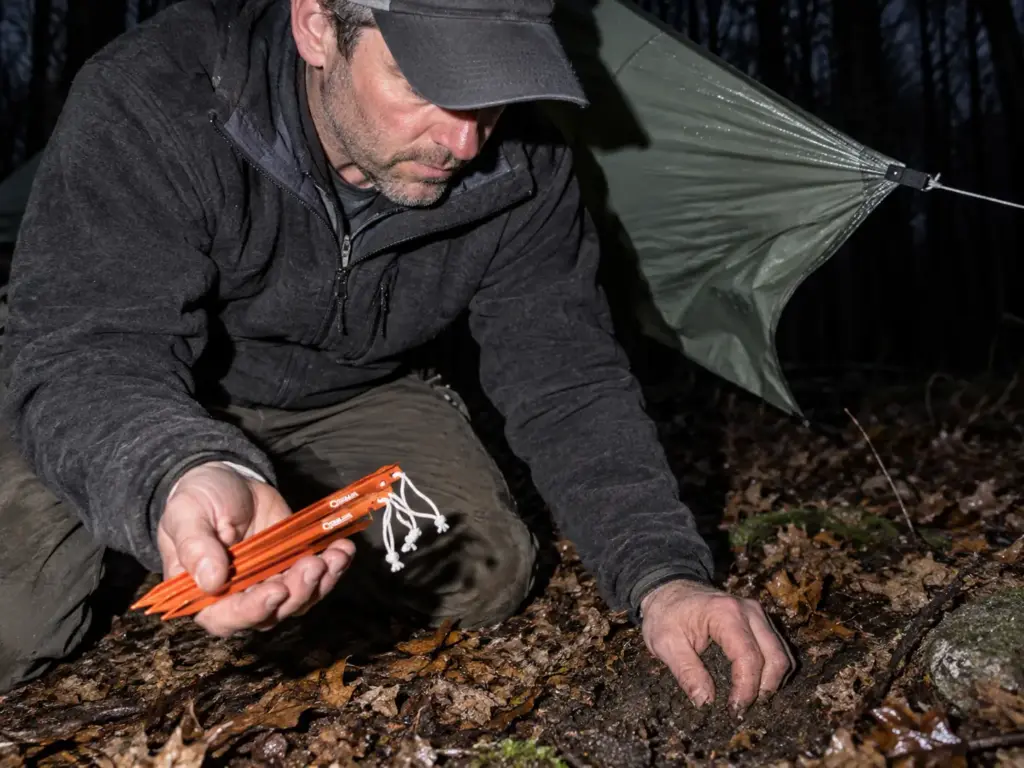
A Reddit user on r/hammockcamping kept a hex tarp up for about two months through wind, rain, sun and cold. Then it started to drip through the ridge seam, and their plan was to seam-seal it. Nothing about that is dramatic, and that is why it is useful. A stitched seam is a line of needle holes, which is why sealer exists, and the ridge seam is the one community reports name first.
The fix is seam sealer, and the timing matters more than the product. Plan it before the first storm, not after the first drip at 2 a.m. when the only option is to move your sleeping bag to the dry half of the hammock. A tarp with taped seams, like the budget hex earlier, has had part of that work done at the factory, but a taped seam still wears.
Spray the new tarp with a hose in the yard before the trip and watch the ridge from inside. A drip you find at home costs ten minutes and a bottle of sealer. The same drip found at camp costs the night.
Seam sealer is a chemistry choice as much as a chore, and the wrong product on the wrong fabric makes a mess. That is the ground covered in the seam sealing mistakes that leave gear leaking, and it is worth a read before you open the tube.
Low and Tight or Corners Up: Two Camps, One Real Disagreement
Here is a real disagreement, and you will not find it settled with a single source. The Ultimate Hang says to pitch low and tight to the hammock: less convenient to get in and out, more protective, and the lower the edge, the less wind lifts it and the less rain gets under it. An r/ULHammocking commenter does the opposite in strong wind. They lift the corners so air can pass underneath and the tarp does not strain against the stakes.
Both camps are describing a real problem. A tight low pitch seals out sideways rain, but it turns the tarp into a sail if a gust gets a grip on the edge, and all that load goes straight into the stakes.
Lifted corners let the wind through, which saves the stakes, but they leave gaps where driven rain gets in. Neither camp is wrong about its own conditions. They disagree because they are camping in different weather.
The pattern most storm stories share is a mistake first: a tarp strung high and tight on a calm afternoon, then caught by a gust that was always going to come. The fix is not to pick a camp and defend it. It is to read the site.
In a sheltered stand, on the lee side of a hill or behind foliage, pitch low and tight and enjoy the protection. On an exposed bench with real gusts in the forecast, lift the corners and give the wind a way through, then check that the rain still can’t reach you. If you can’t tell which of the two your site is, assume the more exposed one and lift the corners.
Pitch technique is the next layer, from ridgeline setup to an A-frame pitch and how the edges meet the ground. That is covered in how to set up a tarp shelter so rain runs off.
Stakes That Pull Out and the Longer Fix
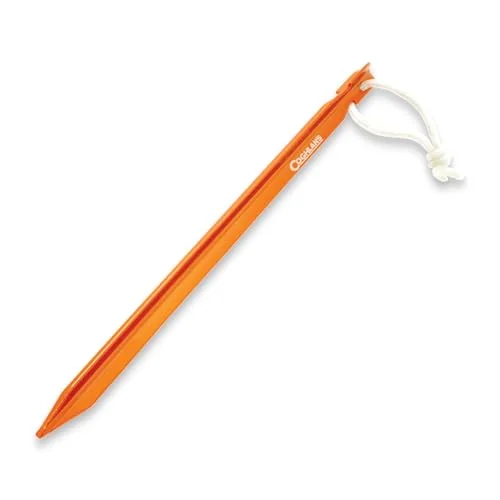
The stake is the usual point of failure, and a kit’s minimal stakes are the reason. Most tarps ship with a handful of short stakes, and a short stake in soft ground is a lever, not an anchor.
When the wind leans on the tarp, the load goes down the guyline and into whatever is holding it, and the weakest link lets go first. At 3 a.m. that is a flapping sound you cannot ignore.
Longer aluminum stakes are part of the fix, which is the case for the Coghlan’s Ultralight Tent Stakes 9 inch 4 Pack. Four of them cover the corners, and the length is the point. They bite deeper than the stakes in a minimal kit, which matters most in the kind of soft, loose ground where a hammock tarp usually ends up over its own roots and duff.
A tarp that sags overnight gets blamed on its fabric a lot, and fabrics do differ in how they behave in damp air. But the cause of a sag has several candidates, and none of them is pinned down well enough here to name a single culprit, so treat a nightly retension as a habit rather than a diagnosis. Check the tie-outs when you wake, tighten what has gone slack, and pull any stake that has crept out. If it keeps happening on the same tarp, the maker’s care notes are where to look next.
When the Trees Run Out: Going to Ground With the Same Tarp
The desert, a beach, a treeless alpine bench: the hammock is the first thing that stops working. A hammock needs two trees. Leave No Trace’s own framing is that a hammock camper can camp essentially anywhere there are trees, which is also the limit of the system.
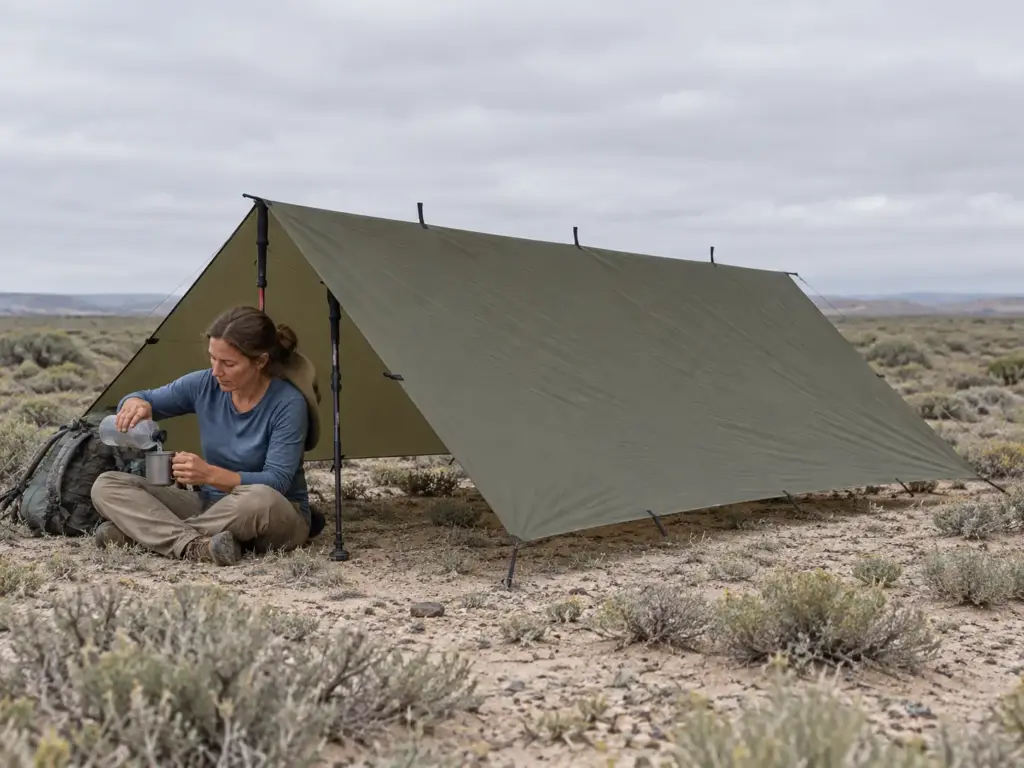
Your tarp keeps working after the trees stop. Pitched low on the ground, the same tarp stops being a hammock shelter and becomes a ground shelter, and the pitch itself is the tarp-shelter setup linked in the failure section above. A silnylon tarp like the Onewind 10 x 10 from the fabric section is the obvious example, since a square sheet pitches on the ground more easily than a hex cut for a hanging hammock.
A ground-pitched hammock tent exists for treeless sites. The Lit Outdoors Tammock, per a 2019 New Atlas article, is built for sandy beaches, desert sandstone and treeless alpine rock. Treat it as the exception, not a recommendation, since it is a different system with its own pieces to carry and learn.
Other plan B options are simple. A bivy covers the sleeping bag, a footprint-sized ground sheet keeps you off the dirt, and cowboy camping works where the air is dry. Treat all of this as plan B, not a proven setup. A tarp on the ground gives you cover, but it does not give you the comfort of a hang.
What the Whole Hammock System Really Adds Up To
The listing that says “complete hammock” is rarely a complete hammock system. Before you decide what to buy, write down the whole list, because the tarp and hammock are only the two items you can see in the photos:
- Tarp: sized to the hammock, plus its 6-inch margins
- Hammock: the 11 ft class this article has assumed
- Tree straps: 1 inch wide or wider
- Ridgeline: the line that sets the tarp’s height
- Tensioners or guylines: the adjustable ties at each corner
- Stakes: longer than the ones in the box
- Underquilt or sleeping pad: for any night that is not warm
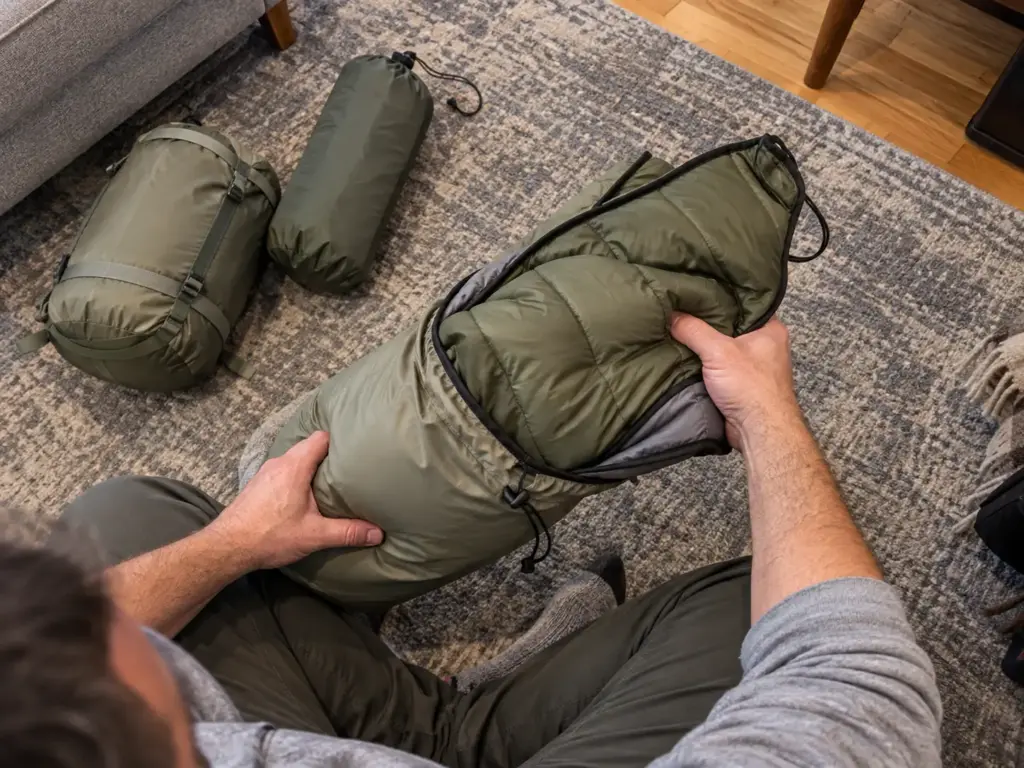
None of these items is exotic. The surprise is how many of them are separate purchases.
The Pieces Nobody Lists Next to the Hammock
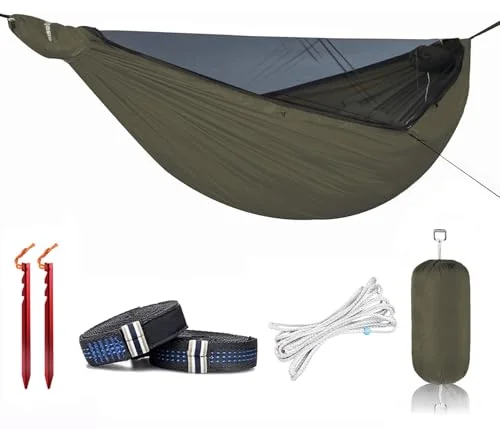
The mid-range path starts with the Onewind 11 ft Ultralight Camping Hammock with Mosquito Net and Ridgeline. It carries the 11 ft hammock the tarp advice has assumed from the start, and it brings its own bug netting and ridgeline, which are two items off your list.
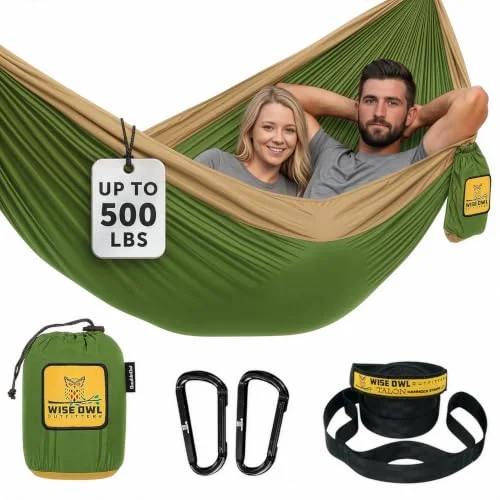
The budget path is the Wise Owl Outfitters Camping Hammock, which includes tree straps, plus the Wise Owl rain fly from the shape section. It is the lowest-friction route into the system. It is also the one where the pieces are most likely to be a close fit, so check the tarp length against the hammock before you order.
Underquilt: The Cold Comes From Below
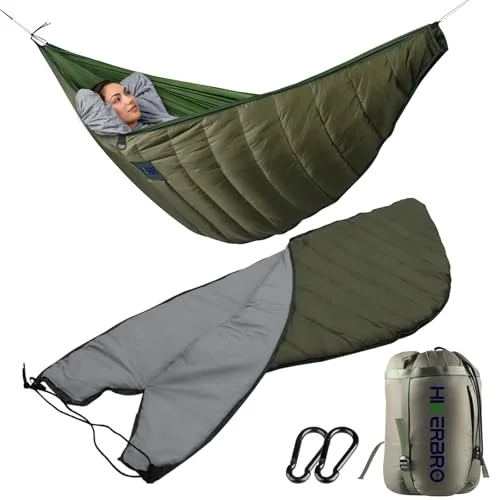
Without insulation underneath, the cold comes up through the hammock. A sleeping bag’s fill compresses under your weight (a top quilt does the same), so it does little where you need it most, and that is the whole reason underquilts exist. The HIKERBRO 4-Season Hammock Underquilt is the example in this guide.
Count it in the budget if you expect any night that isn’t warm, because it is the line item that turns a cheap hammock into a bigger purchase. A sleeping pad is the other route, and one worth weighing for trips in shoulder season.
One Closed System vs Buying the Pieces Separately
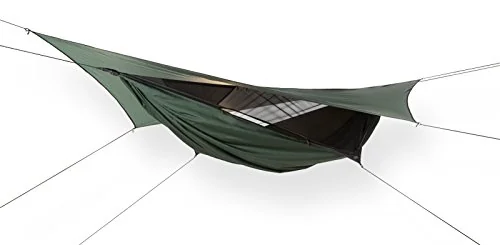
The Hennessy Hammock Jungle Expedition Zip (Asym) is the closed-system example, with an asymmetric tarp and a zip arrangement built in. That sounds simpler, but it comes with more pieces to set up, and it is not a first-timer’s system. It makes sense once you know you like sleeping in a hammock, not before.
A hammock system is not automatically lighter or cheaper than a tent once you count the underquilt and the tarp. If you want the tent side of that comparison, a two-person backpacking tent shows what you give up and what you get for sharing a shelter. On weight, what each pound of tent costs by category gives you the categories to hold your kit weight against, without anyone inventing ounces.
One honest note: no current prices are quoted here because they change. The Check Price on Amazon buttons show the live ones.
Pitch It in the Yard and Watch Where the Rain Lands
Three things carry this guide. Size the tarp to the hammock plus 6 inches at each end, because the ends are where a short tarp fails. Count the straps, stakes, guylines and underquilt as part of the price, because they are the pieces the listing leaves out. And when the trees run out, the tarp goes to ground, so a square silnylon sheet is worth knowing how to pitch on bare dirt.
Before any of that goes into the woods, hang the setup in the yard once. Wet it down with a hose, lie in it, and watch where the rain lands. A leaking ridge seam, a slack tie-out or a tarp that is a foot short is easy to find in the yard and miserable to find at camp.
Frequently Asked Questions
01Is it okay to sleep in a hammock while backpacking?
Yes, it is okay wherever the land manager allows hammocks and sturdy live trees are available to hang from. Use straps at least 1 inch wide, camp 200 feet from water, trails and other campsites, and check local rules, since some parks ban tying to trees.
02What is the best tarp for hammock camping?
The best hammock tarp is the one sized to your hammock plus 6 inches at each end, and a 12 ft ridgeline covers most hammocks. Choose a hex or diamond for side panels, or an asym for the least fabric. The Wise Owl hex is the budget route; the Hennessy 12 ft hex gives the most room.
03What is the best hammock for taking into the backcountry?
The best backcountry hammock is the one that fits your length and the kit you already carry, not the one with the longest spec sheet. The Onewind 11 ft, with mosquito net and ridgeline, is the mid route, and the Wise Owl is the entry route.
04What is the best tarp for backpacking?
If the tarp is your only shelter instead of a roof over a hammock, a silnylon 10 x 10 ft tarp like the Onewind is the budget pick. Over a hammock, size the tarp to the hammock instead, using the 6-inch rule at each end.
05Will an 11 ft tarp cover an 11 ft hammock?
Only if the tarp is hung close to the hammock, because an 11 ft tarp leaves almost no margin at the ends. A 12 ft ridgeline is the safer choice, with about 6 inches of cover past each end.

I've spent more than a decade researching hiking gear and trail technique. I read the specs, the forum threads and the long-term reviews, and every pick here comes with what it gets wrong.
End of the trail
You read every mile of this one. Here's where the trail goes next.