
In this article
You just finished an incredible 15-mile ridge walk, you’re standing at the ending trailhead grinning — and then you remember your car is 40 minutes away at the other end. That moment when the hike ends and the logistics begin is the part nobody talks about when they recommend point-to-point hikes.
I’ve burned entire mornings shuffling cars between trailheads, missed golden-hour starts because the shuttle math didn’t work, and once stood at a trailhead with no cell service and a shuttle that never showed. This is the car shuttle logistics guide I wish someone had handed me before my first one-way hike — covering every method from two-car setups to solo bike drops, what shuttles actually cost, and what to do when your plan falls apart at a remote trailhead.
Quick Answer: Here are the main methods for handling car shuttle logistics on point-to-point hikes:
- Two-car shuttle — park one car at the finish, drive together to the start
- Professional shuttle service — book a driver to move you or your car ($1-2 per mile typical)
- Bike drop — stash a bike at the end, ride back to your car after the hike
- Key pass — two groups start at opposite ends, exchange keys on trail
- Ride-share or hitchhike — works near populated areas, unreliable at remote trailheads
- Park at the finish, shuttle to start — eliminates time pressure on the hike itself
The Two-Car Shuttle (and Why the Timing Kills You)
The Basic Setup
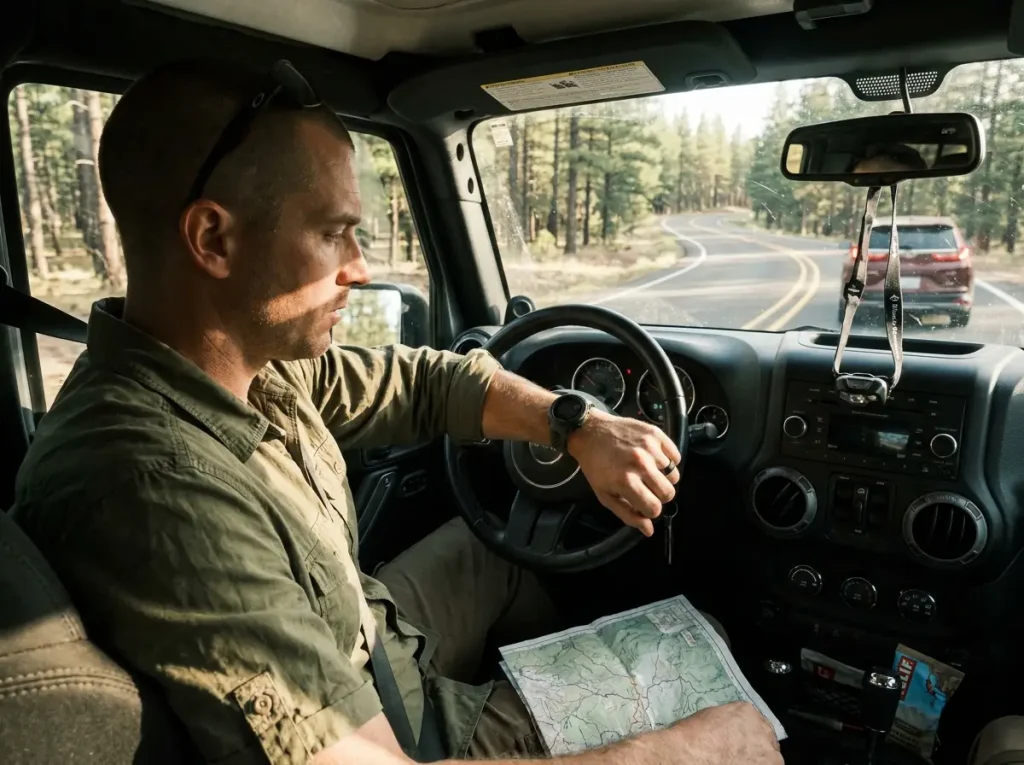
The two-car shuttle is the default method: drive both cars to the ending trailhead, drop one, then drive together in the second car to the starting trailhead. Hike point-to-point, and the first car is waiting when you finish. Then one driver goes back to retrieve the second car.
Simple in theory. In practice, it eats more of your day than most people expect.
The Time Math Nobody Does
For a day hike with trailheads 30 minutes apart by road, here’s what the car shuttle actually costs you in time. Drive both cars to the endpoint: 30 minutes. Drive together to the start: 30 minutes.
After the hike, drive back to pick up the second car: 30 minutes. Return drive: 30 minutes. That’s two full hours of driving added to your hiking day — and that’s with trailheads that are close together.
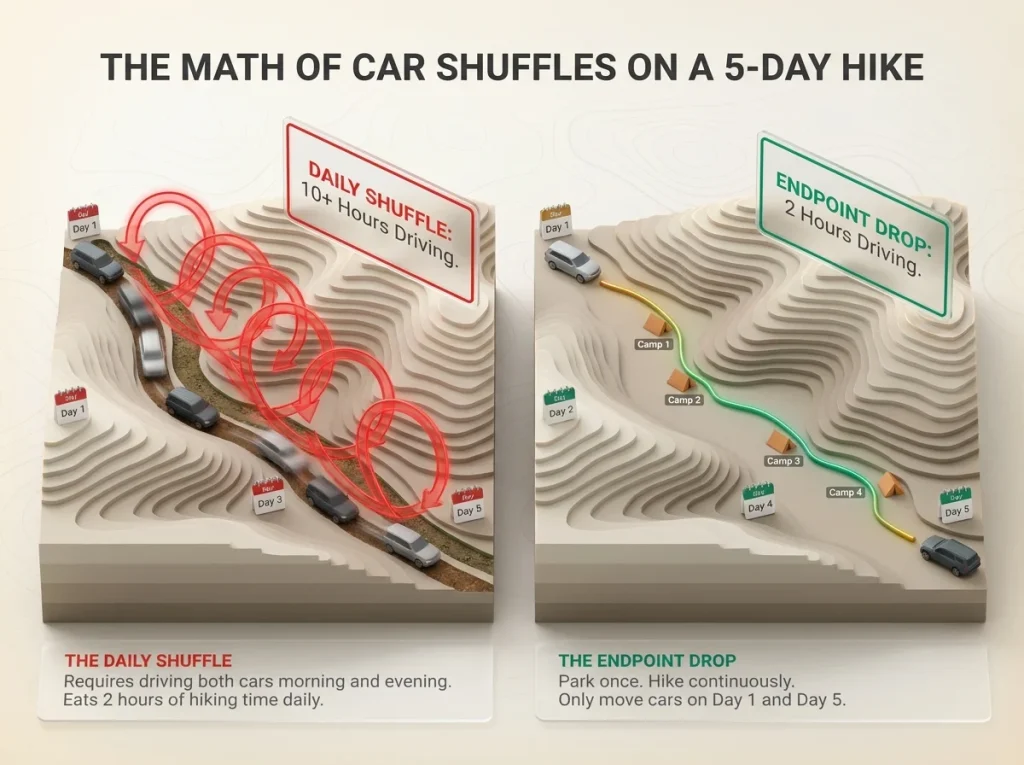
For section hikers doing multi-day trips, the math gets worse. Moving cars every single day can add 90 minutes to 2 hours of logistics on top of your hiking time. Over a five-day section, that’s 7-10 hours behind the wheel instead of on trail.
Pro tip: If you have two cars and will be hiking multiple days, consider a leap-frog approach: drop one car several days ahead on the trail instead of shuffling daily. You hike to that car, then drive both vehicles forward to the next multi-day endpoint. One big shuffle beats five small ones.
Making It Work for Multi-Day Trips
The smartest two-car setup parks the vehicles once at the beginning and end of your entire multi-day section, not at each day’s start and finish. You plan your route to camp on trail and only touch cars on day one and the final day.
This only works when the trail has backcountry camping or established sites between the trailheads. Check permit requirements before committing — some areas require reservations months in advance.
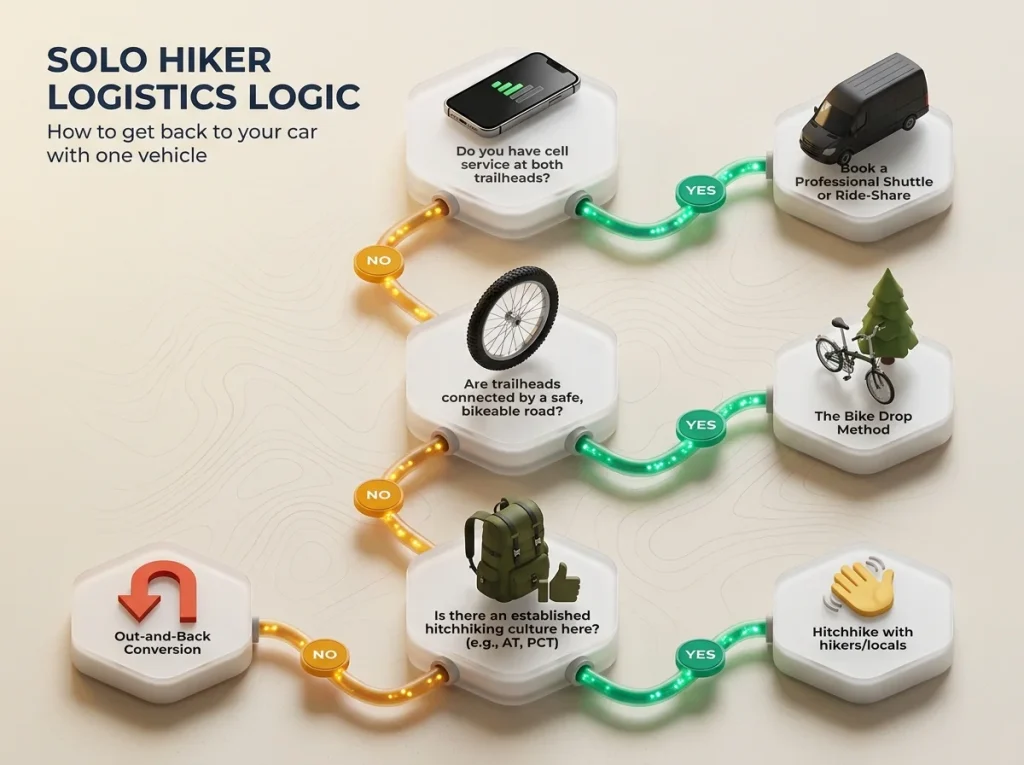
Solo Hiker, One Car — Your Real Options
The Bike Drop Method
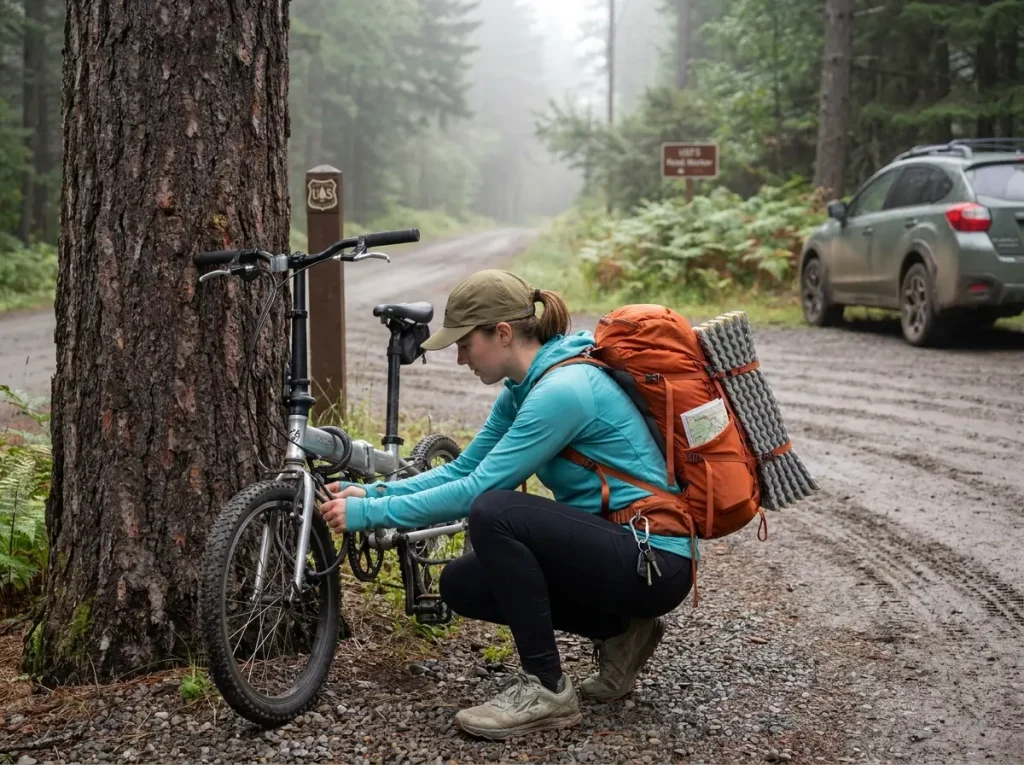
You drive to your ending trailhead, lock a bike to a tree or post (hidden from the road), then drive to your start and hike the trail. When you finish, you ride the bike back to your car.
It works well for day hikes where trailheads are connected by roads. It works badly when the road between trailheads involves major climbs, heavy traffic, or 25 miles of gravel.
One hiker on the Ice Age Trail found out the hard way that his assumed 8-mile bike ride was actually a 16-mile detour on the only available road. He barely made it back before dark.
Match the bike to the road: a folding bike fits in your trunk and handles pavement fine. A mountain bike handles Forest Service roads but takes up more space. Either way, lock it properly — a cable lock and a spot out of sight from the road.
Hitchhiking Culture on Hiking Trails
Near popular trails like the AT, PCT, and CDT, hitchhiking is a normal and accepted part of hiking culture. Trail towns and trailheads see enough hikers that getting a ride is usually straightforward during hiking season. Outside that bubble — at lesser-known trailheads or in areas without a hiking community — it ranges from difficult to impractical.
Stand at the trailhead sign, not on the road. Hold your pack visibly. Trail magic culture means many locals will stop for someone who looks like a hiker. A friendly wave goes further than a stuck-out thumb.
Creative Workarounds That Actually Work
Out-and-back conversion: Some point-to-point trails connect to side trails or forest roads that create a rough loop. It adds miles, but it eliminates the shuttle entirely. Check your mapping app for connector trails before assuming a shuttle is your only option.
Trailhead ride boards: Some popular trailheads and hiker hostels have bulletin boards where hikers post ride requests and offers. These are common along the AT corridor and in trail towns.
Slackpacking with a base: If you’re staying at a trail town lodge, some accommodations will shuttle you to and from trailheads as part of the stay. It’s worth asking — many places don’t advertise this but will do it for guests.
Professional Shuttle Services Worth the Money
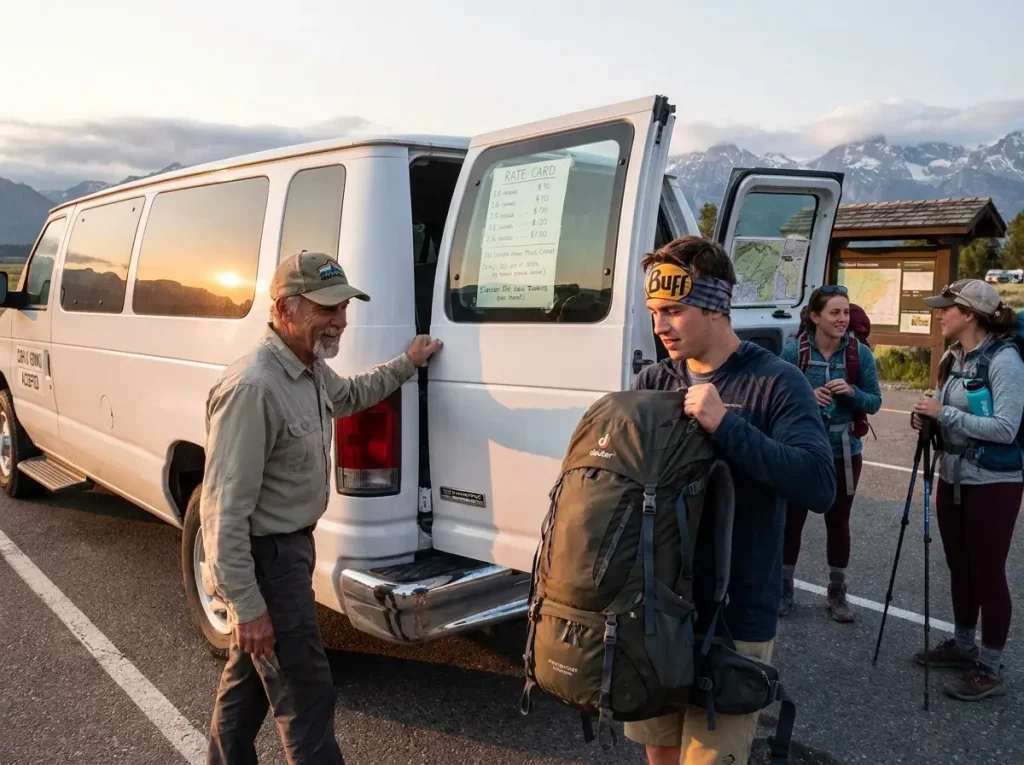
How to Find a Reliable Shuttle
Google the trail name plus “shuttle” or “trailhead transportation.” Check recent reviews — shuttle operators in small mountain towns come and go. The Appalachian Trail Conservancy maintains a shuttle driver list that’s a good model for what exists on the AT, and similar lists exist for the PCT and CDT.
Contact local outfitters, hostels, and visitor centers near your trailhead. Many know independent drivers who shuttle hikers but don’t advertise online. Hiker-friendly hotels sometimes offer free shuttle service if you stay the night before or after your trip.
What Shuttles Actually Cost
Expect $1-2 per mile as a baseline. A 30-mile shuttle runs $30-60. Organized services like the AMC hiker shuttle in New Hampshire charge $20-24 one-way.
Independent operators in trail towns may charge a flat rate or per-person. Some drivers charge per road mile, others per trail mile, and some charge double the mileage because they have to drive back empty. Clarify the pricing before you book — a $40 shuttle that saves you 2 hours of car shuffling is almost always worth it.
Pro tip: Park your car at the ending trailhead and get shuttled to the start. This way you hike back to your car at your own pace. No fixed pickup time, no rushing to meet a shuttle, no stress about finishing late.
Booking Smart for Remote Trailheads
Book 1-2 weeks in advance for popular trails. For remote areas, book even earlier — the driver pool shrinks dramatically outside trail corridors. Confirm the day before your hike with a phone call or text.
Get the driver’s cell number and give them yours. If you’re heading somewhere without cell service, establish a clear meeting time and location with zero ambiguity. “The parking lot at the green gate on Forest Road 42 at 7:00 AM” is better than “the trailhead.”
The Key Pass and Other Group Hacks
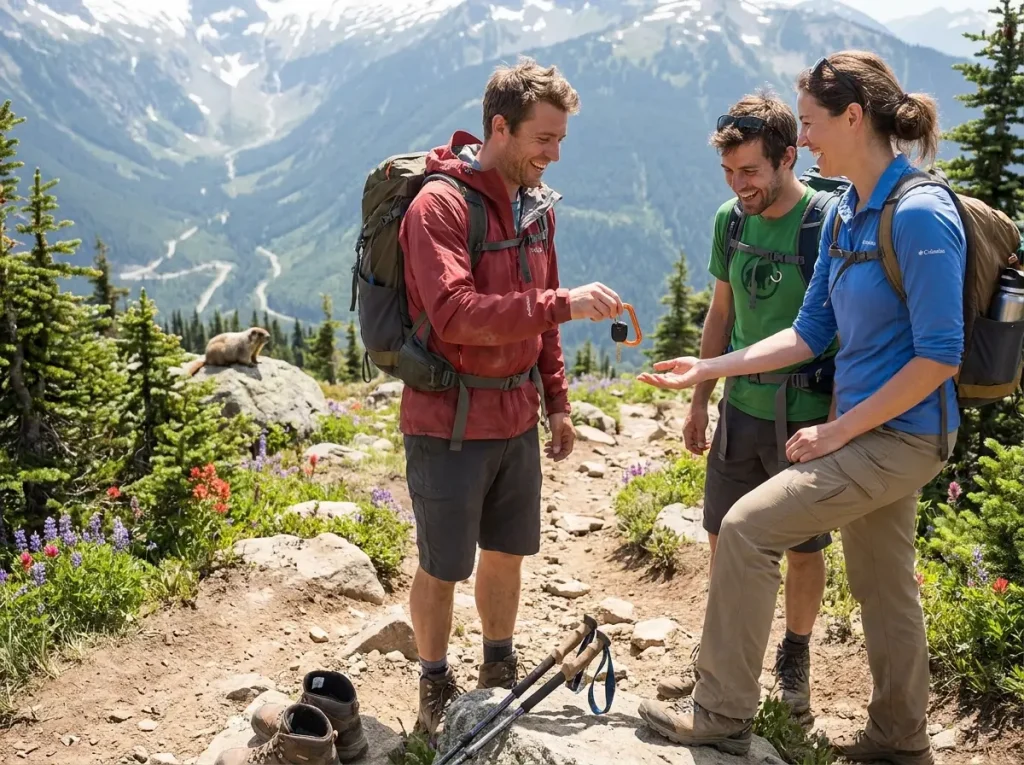
How the Key Pass Works
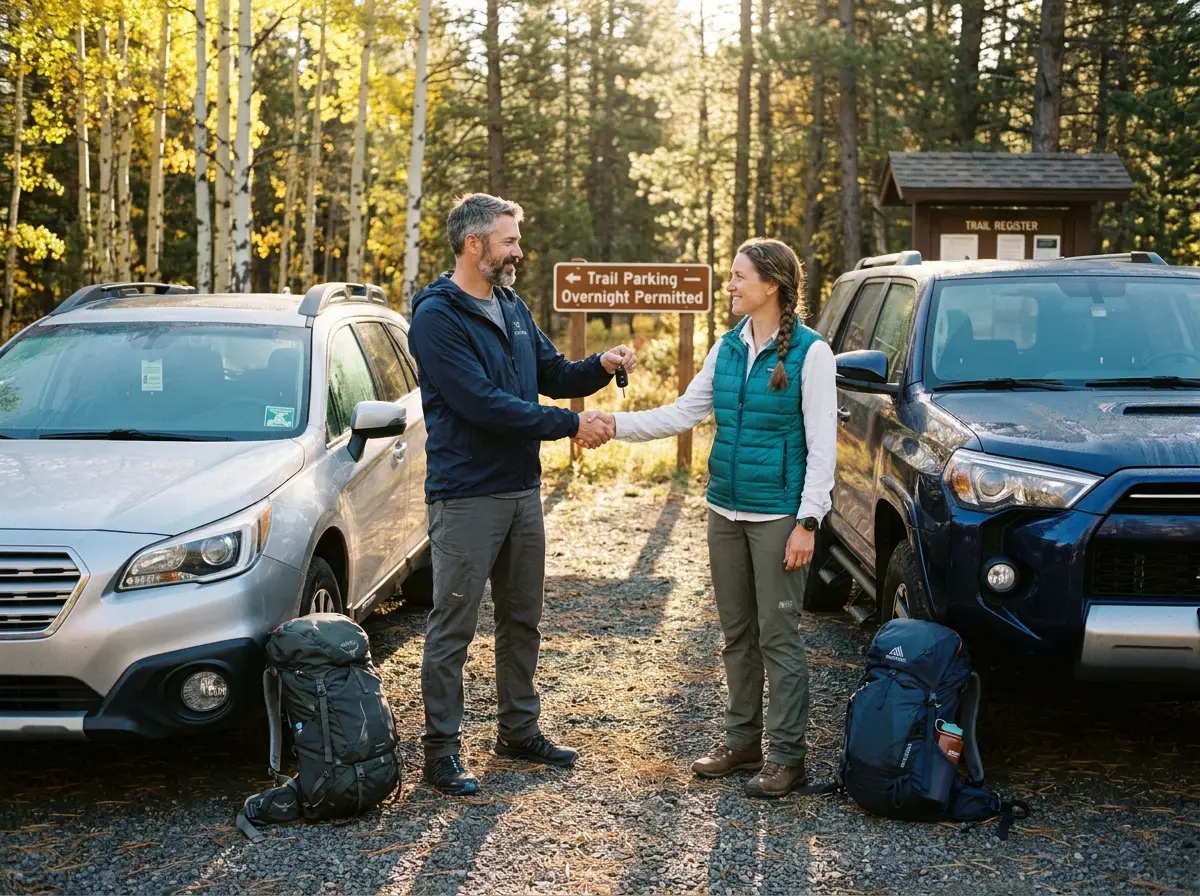
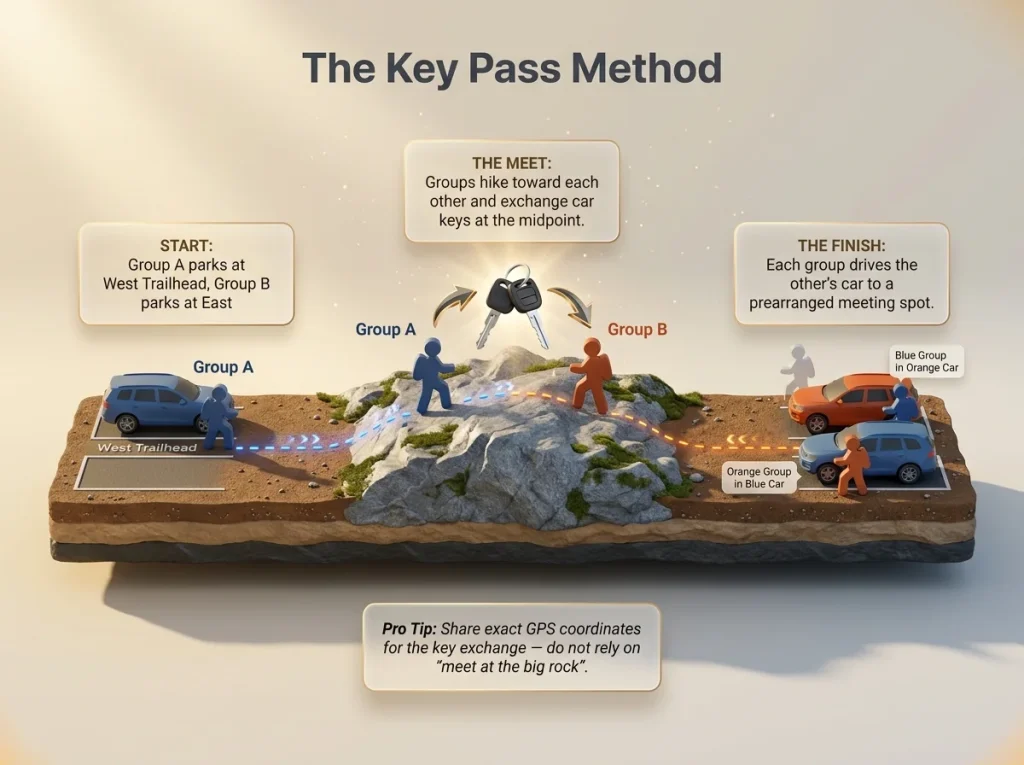
Two groups start at opposite ends of the same trail. Each group parks their car at their starting trailhead. They hike toward each other, meet somewhere in the middle, and exchange car keys.
Each group continues to the opposite end and drives the other group’s car to a prearranged meeting point. It’s elegant when it works. The catch is coordination: both groups need to hike at roughly the same pace, be comfortable driving each other’s vehicles, and agree on the key exchange point. A GPS coordinate shared in advance beats “meet at the big rock.”
The Leapfrog Method for Section Hikers
If your group has two cars and plans to hike a long trail over several weekends, the leapfrog saves cumulative hours. Weekend 1: park Car A at mile 30 and Car B at mile 0. Hike miles 0-30.
Weekend 2: drive Car B to mile 60 (Car A is already at mile 30). Hike miles 30-60. Each weekend, you only move one car forward instead of doing a full two-car shuffle. Over a summer of section hiking, the time savings add up.
When to Split the Group
If your hiking group has different pace preferences, consider splitting intentionally. The faster group parks at the far end and hikes toward the slower group’s starting point.
They meet on trail, pass keys, and each finishes at a car. Everyone hikes at their natural pace and nobody waits at a trailhead.
Vehicle Security at Remote Trailheads
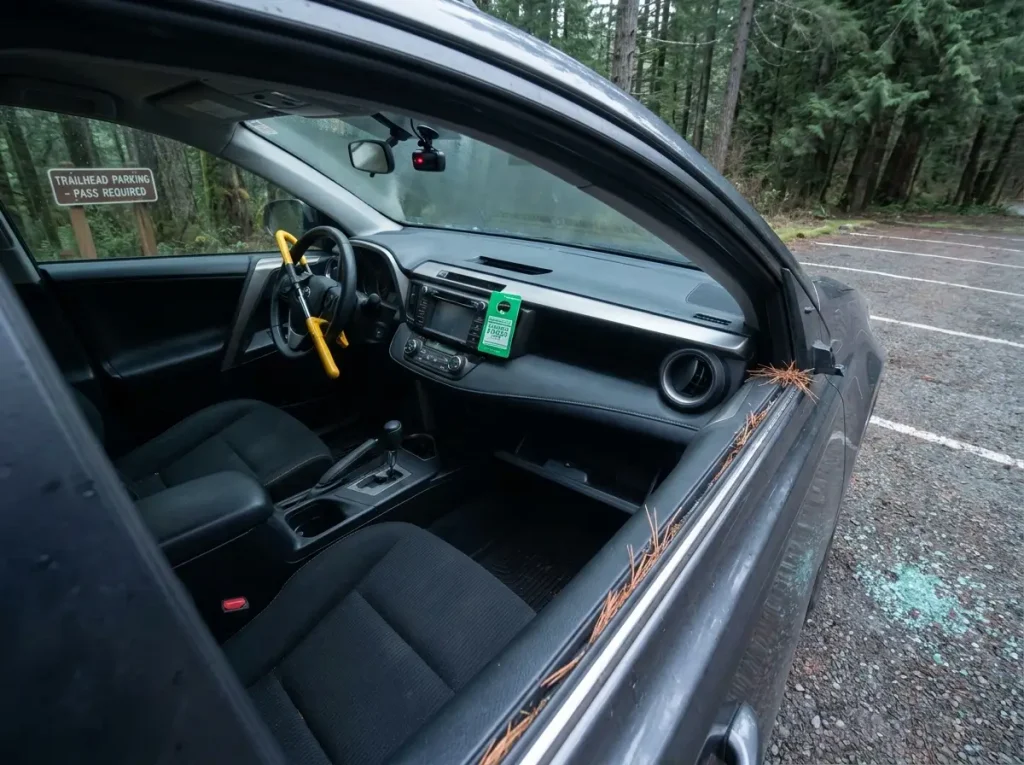
What Thieves Target (and How They Find It)
Trailhead break-ins follow a pattern. Thieves know hikers leave for hours — sometimes days. They scan for visible valuables, electronics left charging, and bags that might contain wallets or cameras.
Some even scan for Bluetooth signals from devices left in sleep mode. The U.S. Forest Service recommends keeping all valuables out of sight and locked in the trunk at minimum — but even that isn’t enough at high-theft trailheads.
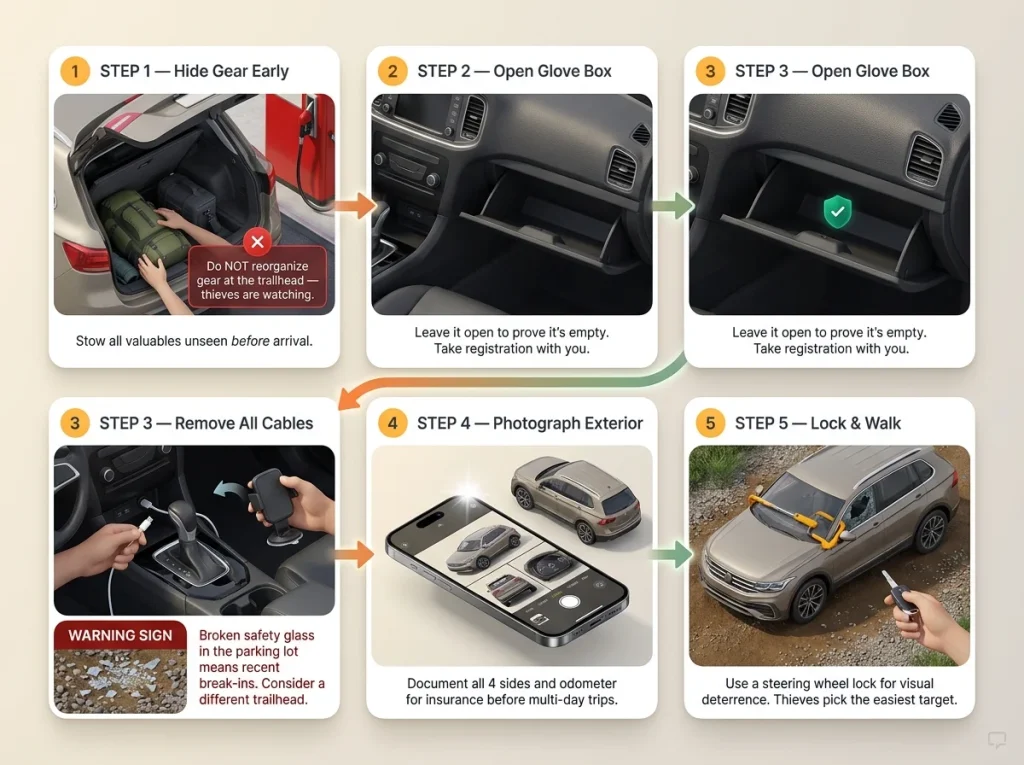
The clearest warning sign at any trailhead is broken auto glass in the gravel. Those small cubes of tempered glass mean someone’s window was smashed recently. If you see broken glass at a parking area, consider using a different trailhead.
The Pre-Arrival Routine
Hide everything before you reach the trailhead — not in the parking lot where someone might watch you move gear to the trunk. Do your stashing at a gas station or rest stop.
Leave the glove box open and visibly empty. Take your registration and insurance card with you or hide them well. Remove GPS units, phone mounts, and charging cables.
Close all visors so nothing falls out. Take your car key (just the key — leave the bulky keychain in the car) and stash a spare key in a magnetic box under the frame.
Pro tip: Consider a steering wheel lock for multi-day trips at remote trailheads. It’s visible through the window and makes your car look like more work than the one parked next to it. Thieves pick the easiest target.
Insurance and Documentation
Before any overnight trailhead parking, photograph your car’s exterior from all four angles. Note the odometer reading.
Check your auto insurance policy — some don’t cover theft from vehicles left at trailheads for extended periods. If your trail requires a satellite messenger, consider an Apple AirTag or Tile tracker tucked in your car as an extra layer.
When Your Shuttle Plan Falls Apart
No Cell Service at the Trailhead
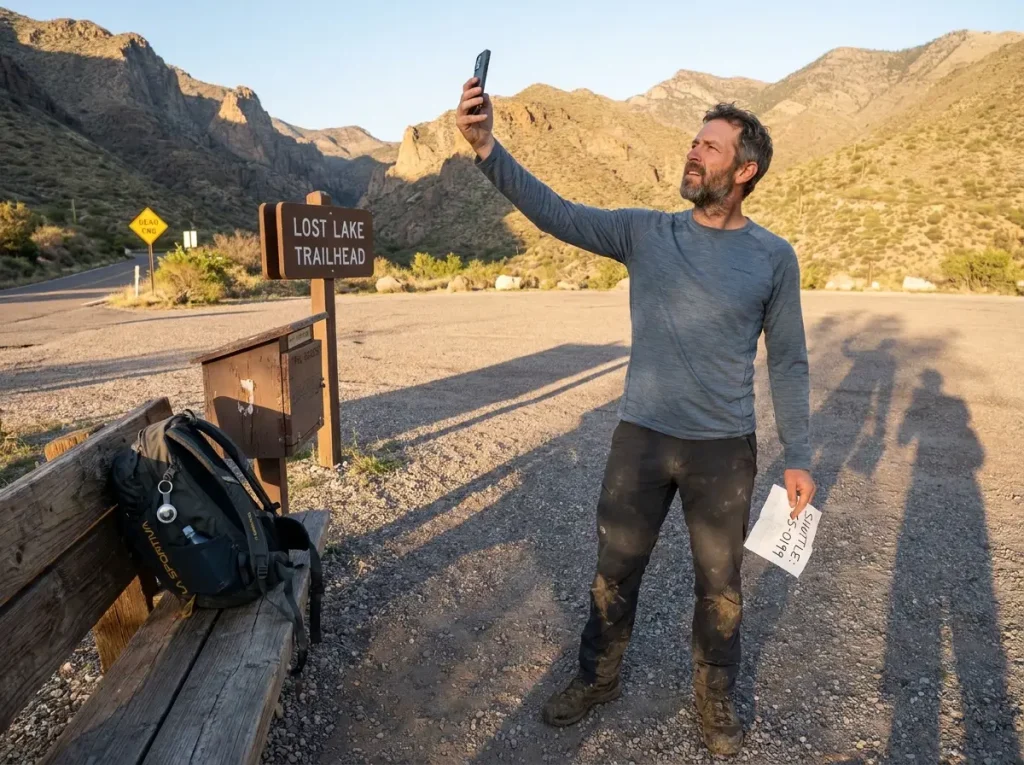
This is the scenario most articles ignore. You’re at a trailhead in a National Forest with zero bars, your ride-share app is useless, and the shuttle driver you were going to call isn’t callable. This happens regularly in the Cascades, the Sierras, and most of the Appalachian backcountry.
Prevention: download offline maps before you leave home. Save your shuttle driver’s contact info and a backup number. Tell someone your plan and expected return time. If you’re relying on any digital-only service at a trailhead, assume it won’t work until proven otherwise.
The Shuttle No-Show Protocol
Your shuttle was supposed to be at the trailhead at 4:00 PM. It’s 4:45. Now what?
Walk to the nearest point of cell service if you know where it is — often that’s the nearest paved road or ridge. Try flagging down another hiker.
Check for a landline at a nearby campground host station or ranger office. If none of that works and you have a satellite messenger, send a non-emergency message to your emergency contact with your location and situation.
Do not start walking 20 miles down a forest road in the dark. If it’s getting late and you’re stuck, set up camp and figure it out in the morning.
Building Redundancy Into Every Plan
The best shuttle plan has a backup that doesn’t require cell service. That means: someone at home knows your itinerary, you have a physical paper map showing the nearest town and road route, and you’ve identified at least one alternative — a second shuttle driver, a nearby campground with a phone, or a road where hitchhiking is feasible.
Pro tip: Carry a written note with your shuttle driver’s name, number, your car’s location, and your expected schedule. If a stranger gives you a ride, you can hand them the note and ask them to make a call for you when they reach service.
Prepare for your thru-hike logistics the same way you prepare for the trail itself — with redundancy for every system that can fail.
Conclusion
Three things fix most car shuttle headaches for point-to-point hikes.
Park at the finish and get shuttled to the start — it eliminates the time pressure that ruins the end of your hike. If you’re solo with one car, don’t default to expensive shuttles until you’ve checked the bike drop option and the local hitchhiking culture. And build a plan B that works without cell service, because the trailheads where your phone works are not the trailheads where you’ll need help.
Map your next point-to-point hike on paper tonight. Draw the road between trailheads, check the distance, and decide which method actually saves you the most time on trail — not which one sounds easiest in an article.
Q1 How do you shuttle cars for a point-to-point hike?
Drive both vehicles to your ending trailhead, drop one car, then drive together to the start. Hike to the finish, then one driver retrieves the second car. The whole process adds 1-2 hours of driving depending on the distance between trailheads.
Q2 How much does a hiking shuttle service cost?
Most shuttle services charge $1-2 per road mile. A 30-mile shuttle typically runs $30-60. Organized services like the AMC hiker shuttle charge around $20-24 one-way — always confirm pricing before booking.
Q3 Is it safe to leave your car at a trailhead overnight?
It depends on the trailhead. Check for broken auto glass in the parking area — a clear warning sign. Hide all valuables before arriving, leave the glove box open and empty, and consider a steering wheel lock for multi-day trips.
Q4 Can you use Uber to get to trailheads?
In populated areas near trail towns, yes. At remote trailheads without cell service, no. Most Forest Service and BLM trailheads are well outside ride-share coverage zones — confirm service exists at that specific location before planning around it.
Q5 What is the key pass method for hiking?
Two groups start at opposite ends of the same trail, each parking at their starting trailhead. They hike toward each other, meet on trail, exchange car keys, then continue to the opposite end and drive the other group’s car to a meeting point.
Risk Disclaimer: Hiking, trekking, backpacking, and all related outdoor activities involve inherent
risks which may result in serious injury, illness, or death. The information provided on The Hiking Tribe is for
educational and informational purposes only. While we strive for accuracy, information on trails, gear, techniques,
and safety is not a substitute for your own best judgment and thorough preparation. Trail conditions, weather, and
other environmental factors change rapidly and may differ from what is described on this site. Always check with
official sources like park services for the most current alerts and conditions. Never undertake a hike beyond your
abilities and always be prepared for the unexpected. By using this website, you agree that you are solely
responsible for your own safety. Any reliance you place on our content is strictly at your own risk, and you assume
all liability for your actions and decisions in the outdoors. The Hiking Tribe and its authors will not be held
liable for any injury, damage, or loss sustained in connection with the use of the information herein.
Affiliate Disclosure: We are a participant in the Amazon Services LLC Associates Program, an
affiliate advertising program designed to provide a means for us to earn advertising fees by advertising and linking
to Amazon.com. As an Amazon Associate, we earn from qualifying purchases. We are also an official affiliate partner
of Black Diamond Equipment via the AvantLink network. If you click on a Black Diamond affiliate link and make a
purchase, we may earn a commission at no additional cost to you. We also participate in other affiliate programs and
may receive a commission on products purchased through our links. Additional terms are found in the terms of
service.