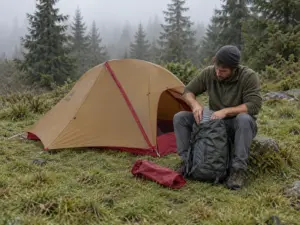
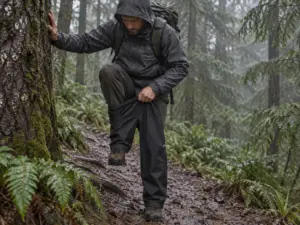

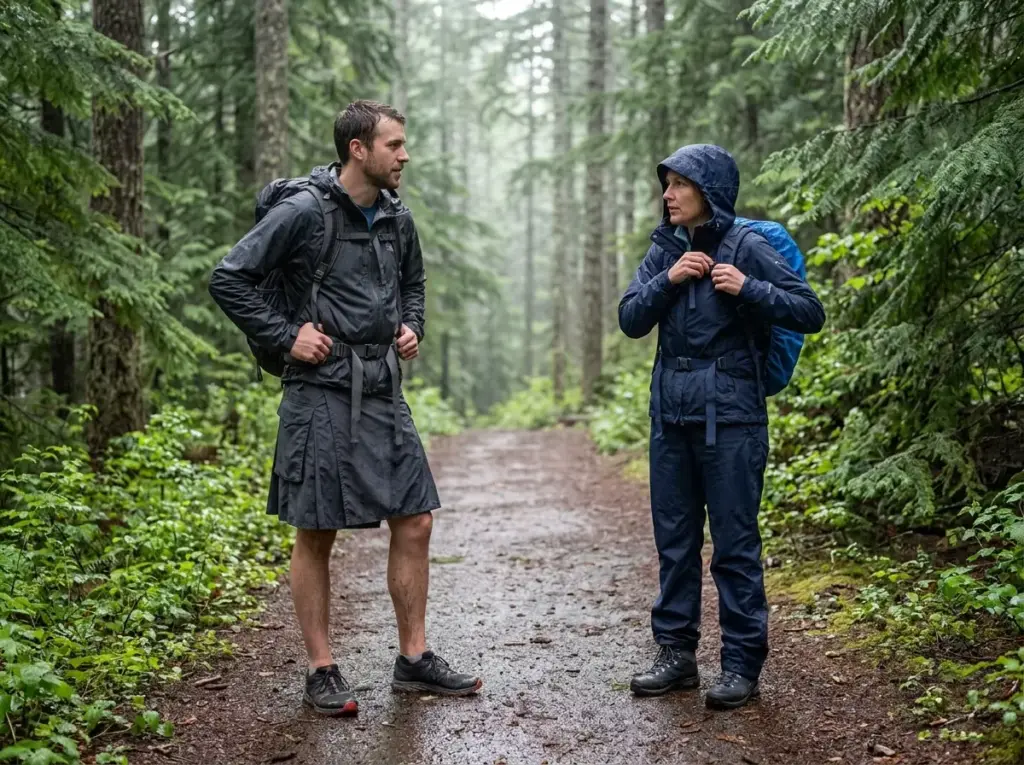
You’re packing for three days of forecast rain, the pack is already heavier than you wanted, and the rain pants at the bottom of the pile weigh more than everything else you’re still deciding about. The hikers who’ve settled this argument, the ones filling forty-reply threads on Backpacking Light and the thru-hiker forums, keep landing on the same rule, and it isn’t “it depends.” A rain skirt and a pair of rain pants solve the same problem in opposite ways, and one of them is wrong for the trip in front of you.
Your rain jacket handles everything above the waist. Here’s how the two options for everything below it stack up across the attributes that actually change the decision.
| Attribute | Rain Skirt (Kilt) | Rain Pants |
|---|---|---|
| Weight | 1.7–3.5 oz | 5.75–12+ oz |
| Ventilation | Vents from the bottom, can’t trap sweat | Closed tube, traps condensation in warm air |
| On and off | Standing, over pack and boots, seconds | Sit down and unlace, unless full side zips |
| Lower-leg coverage | Bare below the hem | Full, ankle to waist |
| Wind and cold | Poor, bare wet legs lose heat fast | Good, this is what they’re for |
| Cost tier | Budget across the whole category | Mid to premium |
| Best trip type | On-trail, below treeline, moderate temps | Above treeline, wind, off-trail brush |
The One Rule That Settles This Argument
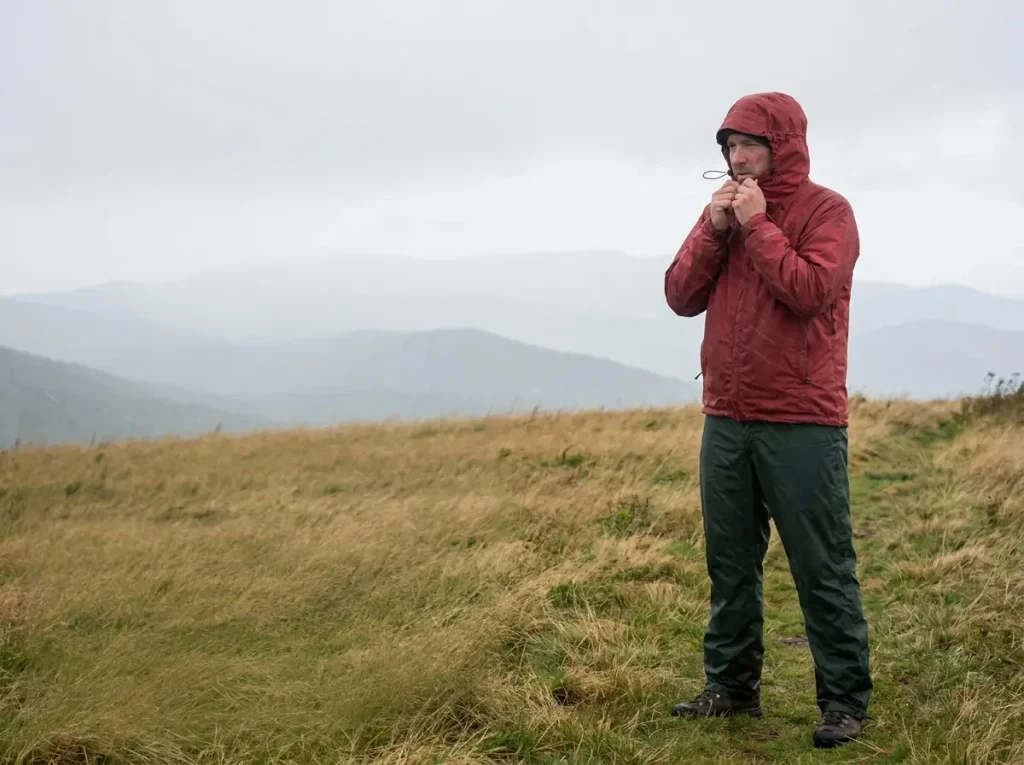
Every forum thread on this question runs forty replies deep and ends in “it depends.” It doesn’t. The people who hike the most have a one-liner for it, and everything below is the work behind it.
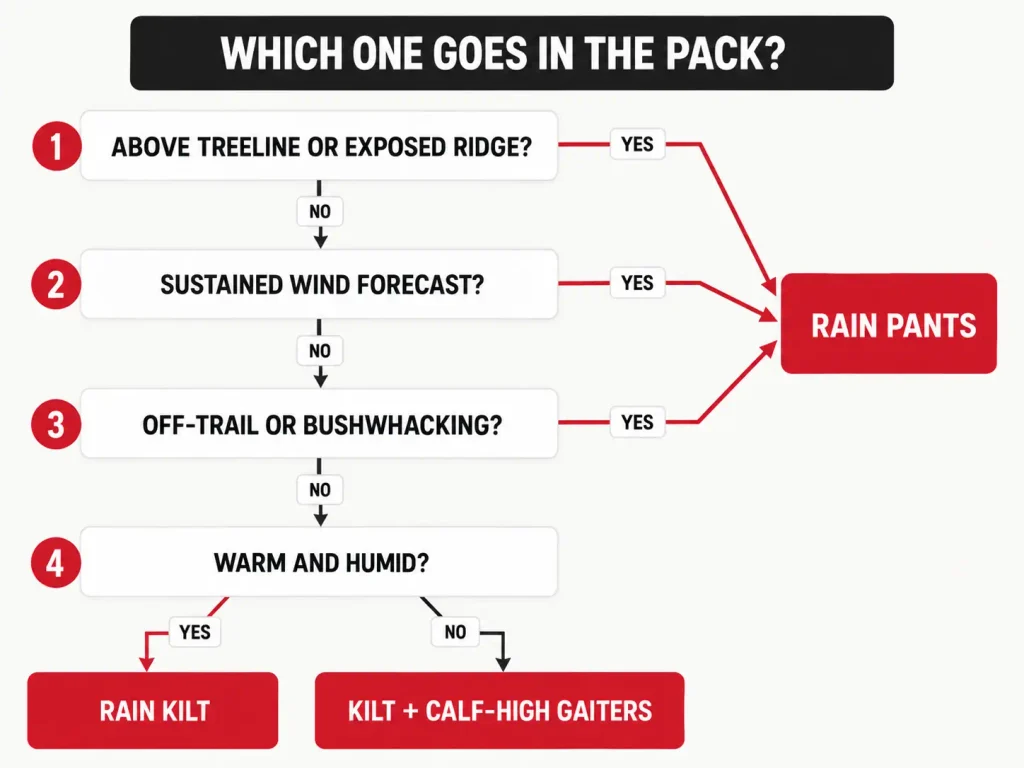
The rule, as an experienced Backpacking Light member puts it: kilt below treeline, pants above. It sounds like geography but it isn’t, because treeline is a proxy for sustained wind. A 30 mph wind at 40°F produces an effective wind chill around 13°F, the number that turns this from a style preference into a decision with a consequence attached. NOAA’s guidance on hypothermia risk in wet, windy outdoor conditions puts it from the other direction: the trigger is wet clothing plus moving air, not the thermometer.
There’s a second half almost nobody states. Off-trail travel flips the answer to pants regardless of elevation, because bushwhacking in a kilt means bare thighs meeting every thorn and soaked branch.
Two conditions, then: sustained wind, and brush. Everything else is kilt country.
What makes that thread worth trusting isn’t one confident poster. Nine experienced backpackers converged independently on the same two failure conditions, and that convergence is the evidence. For where lower-body rain gear sits in the rest of your kit, we’ve covered how the whole rain system fits together separately.
Why Rain Pants Leave You Wet Anyway
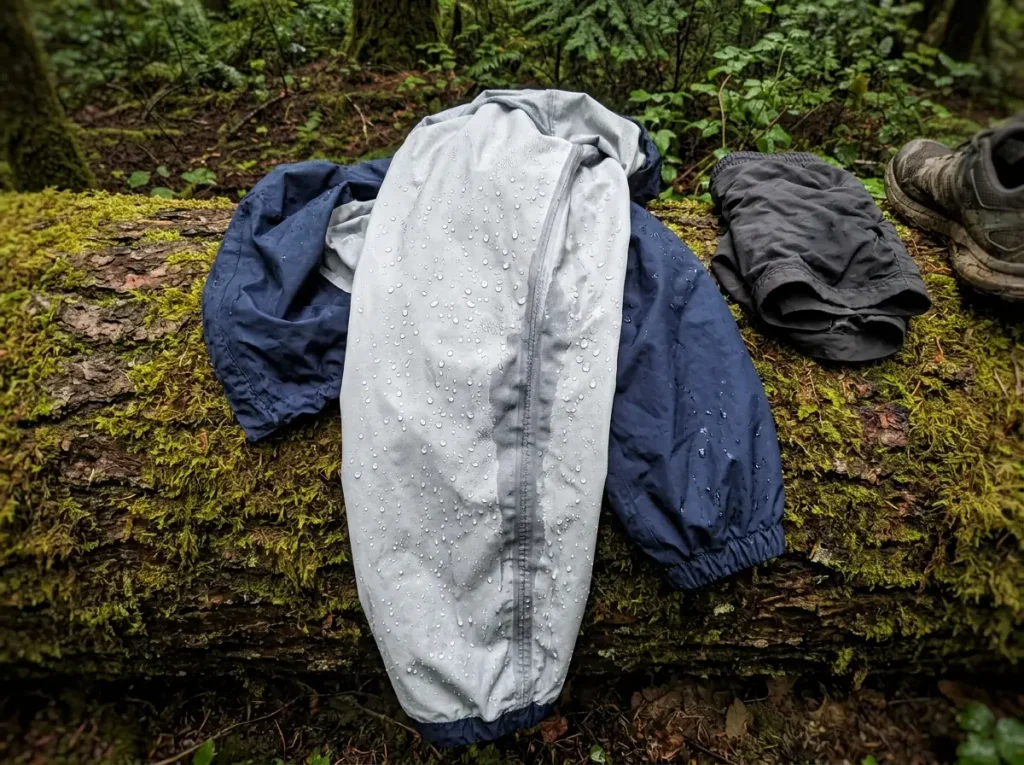
Anyone who’s worn rain pants up a climb in July knows the feeling: you peel them off at the top and your legs are soaked anyway. Most people assume the pants failed. They didn’t. They worked as designed, and that’s the problem.
A shell’s job is stopping liquid water from getting in. Your legs produce water vapor from the inside, a lot of it going uphill. When the fabric can’t move that vapor out as fast as your legs make it, the vapor hits the cooler inner face, condensation forms, and it runs down the inside of your leg. Same wet, different source.
The spec sheet won’t save you either. A 20,000g breathability rating comes off a lab bench, measured on fabric that isn’t attached to a sweating human in humid air. Breathability is a rate, not a switch.
That matters beyond comfort. Wet clothing loses up to 90% of its insulating value, and the National Weather Service’s cold-water and wind chill safety guidance is blunt about what that does to your heat budget. You can’t tell the difference either, and neither can your core temperature: water from the sky and water from you cost you the same heat.
Which turns this into a sweat management problem rather than a waterproofing one. Experienced hikers land somewhere counterintuitive and repeat it in every thread: wet from rain is more comfortable than wet from sweat. Plenty deliberately leave the pants in the pack during warm rain, holding them in reserve for genuine hypothermia conditions. Which gives you the ventilation from the bottom argument in one sentence: a kilt can’t trap vapor, because it isn’t a closed tube.
What “waterproof-breathable” actually promises
Two numbers go on the hangtag and neither means what shoppers think. The hydrostatic head rating measures how tall a column of water the fabric holds back before leaking; breathability measures vapor passing through in a day. Neither accounts for a pack hip belt compressing fabric against your body, which is where most real leaks start, so it’s worth knowing what a hydrostatic head number is really telling you before paying for a bigger one.
Then there’s the failure that ends the conversation: wetting out. Once the face fabric saturates, vapor has nowhere to go and breathability drops to roughly nothing regardless of the tag. Membranes handle that differently, which is why how different membranes handle vapor explains two pants with identical ratings feeling different on the same climb.
The humidity threshold where pants stop being worth it
Warm rain plus climbing effort is where the trade goes negative. High humidity means the air outside the membrane is already nearly saturated, so your vapor has no gradient to move along, and hard effort means you’re making it faster than any fabric passes it.
No source puts a number on that line. Not the buyer’s guides, not the forum threads, not the manufacturers, and anyone handing you a specific figure invented it. You get a feel instead: if you’re sweating through your shirt on the approach and the rain is warm enough that bare arms are fine, the pants cost more than they return.
Put the pants on before you start sweating, not after. Once your base layer is damp and your skin is warm, sealing that in is how you end up soaked inside gear that’s working perfectly. Pull over at the first steady rain, not twenty minutes into it.
The Weight Difference Is Bigger Than It Sounds
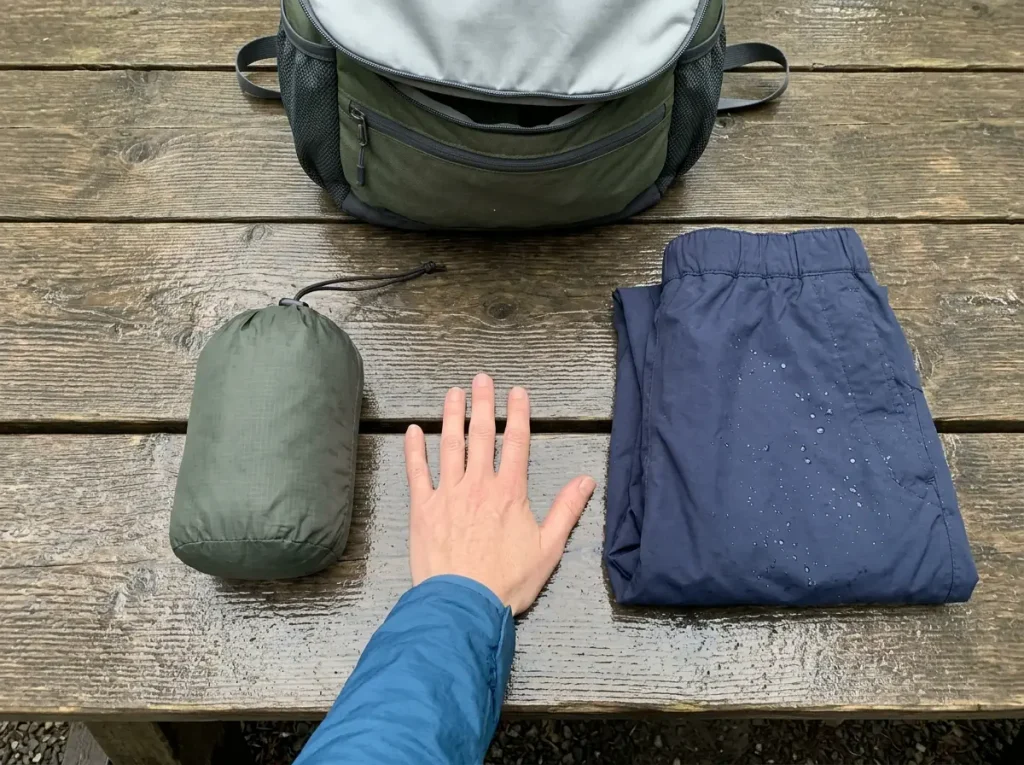
Half a pound sounds like nothing until you’ve carried it up 3,000 feet for a garment you might never take out of the pack. The real calculation isn’t weight. It’s weight per probability of use.
Rain kilts run 1.7 to 3.5 oz across the category: Zpacks builds a DCF version at 1.8 oz, Enlightened Equipment’s wrap hits 1.9, the ULA Rain Kilt sits at 2.9 in medium. A kilt weighs about as much as an energy bar and two spoons. Rain pants start at 5.75 oz for an Outdoor Research Helium UL and run past 12 for a Patagonia Torrentshell 3L.
Rain gear is insurance you carry and hope never to use, so the lower the premium, the easier it is to always carry. Nobody leaves a 2 oz kilt at home to save weight. Plenty of people leave 11 oz pants at home, and then it rains. Packed size follows weight too, and a kilt that stuffs into a jacket pocket is one you’ll actually reach for when the sky goes gray.
It isn’t always either/or. Some thru-hikers carry both on shoulder season trips where the forecast swings: a kilt for daily showers plus a 3 oz pant for the one cold night above treeline, still lighter than most single pairs of name-brand rain pants. On a day hike with a stable forecast it’s just redundant base weight.
Where the weight actually comes from
Most kilts use sil-nylon or sil-poly, the same silicone-impregnated fabric as a tent fly: cheap, fully waterproof, not breathable at all, which matters less than you’d think in a garment open at the bottom. This is ultralight gear logic applied to rain protection, where a few ounces justify a compromise most hikers wouldn’t otherwise accept.
Dyneema Composite Fabric, the DCF the ultralight world calls cuben fiber, goes lighter and less breathable still. Rain pants are almost all genuine WPB laminates, which is why they cost and weigh what they do. It’s the same packable-versus-ultralight trade on the jacket side, one garment lower.
The On-and-Off Test Is Where Skirts Win Outright
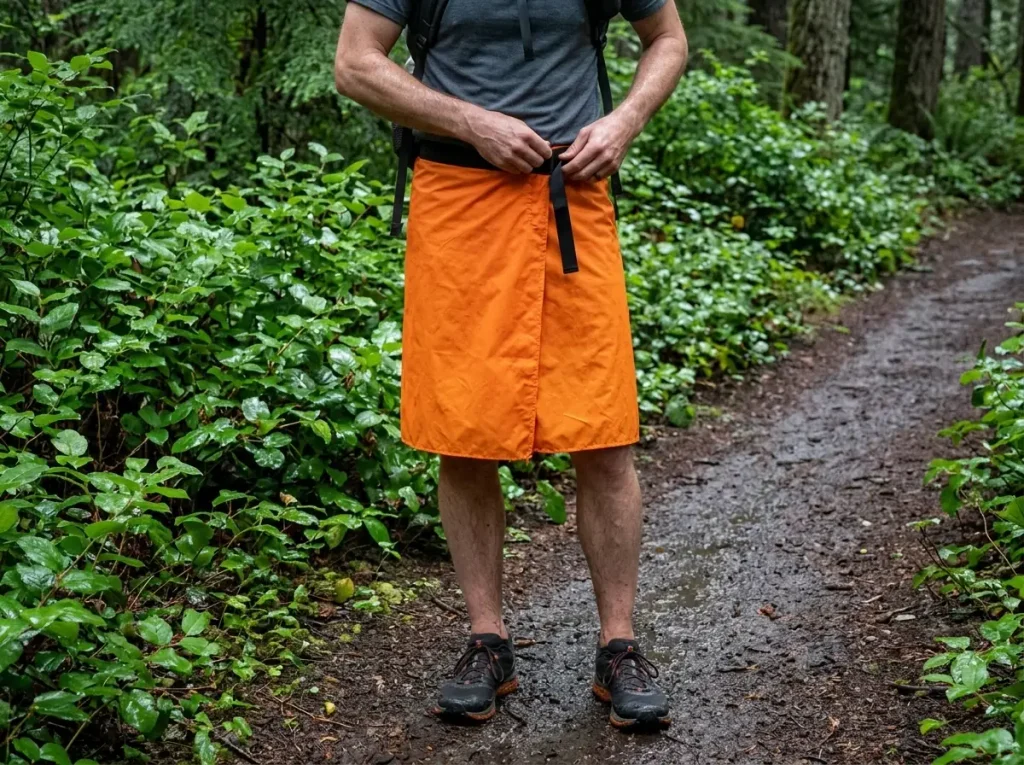
Rain starts. You have maybe ninety seconds before it matters. A kilt goes on standing up, over your pack hip belt, over your shorts, without breaking stride: velcro tabs or snaps, one motion, done.
Rain pants without full-length side zips mean dropping the pack, sitting on something wet, unlacing boots, and balancing on one leg in the mud. Which is precisely why a lot of hikers don’t bother and hike wet instead.
That isn’t convenience dressed up as a gear argument, because ease of use decides whether protection reaches your legs at all. Gear you deploy in seconds is gear you actually deploy, and a rain pant sitting dry in your pack while you get soaked protects nothing. One forum member put it concretely: size 12.5 boots that don’t fit through the leg openings of most rain pants, so he switched to a kilt purely for quick don and doff.
The counter that keeps pants in the game is a zipper. Full-length side zips let you step into pants over boots without touching your laces, and it’s the one feature worth paying up for if pants are your answer.
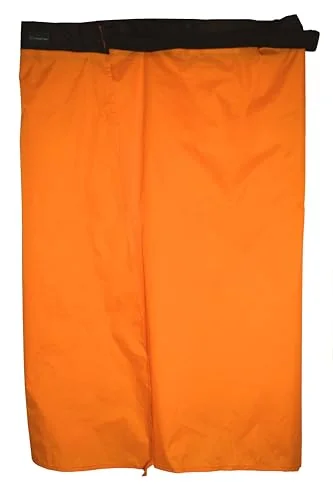
Being straight about that pick: the kilts named in every ultralight thread come from ULA, Zpacks, Mountain Laurel Designs, Lightheart Gear, Enlightened Equipment and Dutchware, and not one sells through Amazon or REI. The Amazon-available kilt above is the low-cost way to test the concept before committing to one.
One search note while you shop: rain kilt, rain wrap and rain skirt all name the same garment, and some sellers list the same thing as a modesty kilt. Kilt dominates ultralight circles for reasons covered further down, and searching only one term hides most of what’s out there.
Sizing a wrap you can’t try on
One-size-fits-most is mostly true for the waist and mostly false for length. The ULA’s elastic waistband adjusts from 24 to 54 inches, so the waist rarely causes trouble, while length runs from 25.5 inches at Lightheart Gear to 32 at Dutchware.
The mistake is sizing by hip measurement and never checking length against height: a 6’2″ forum member found nearly every off-the-shelf kilt too short and had to special-order. Check length first, because a short kilt on a tall hiker leaves the exact band of bare shin the gaiter trick further down is designed to close.
What You Wear Underneath Decides Whether It Works
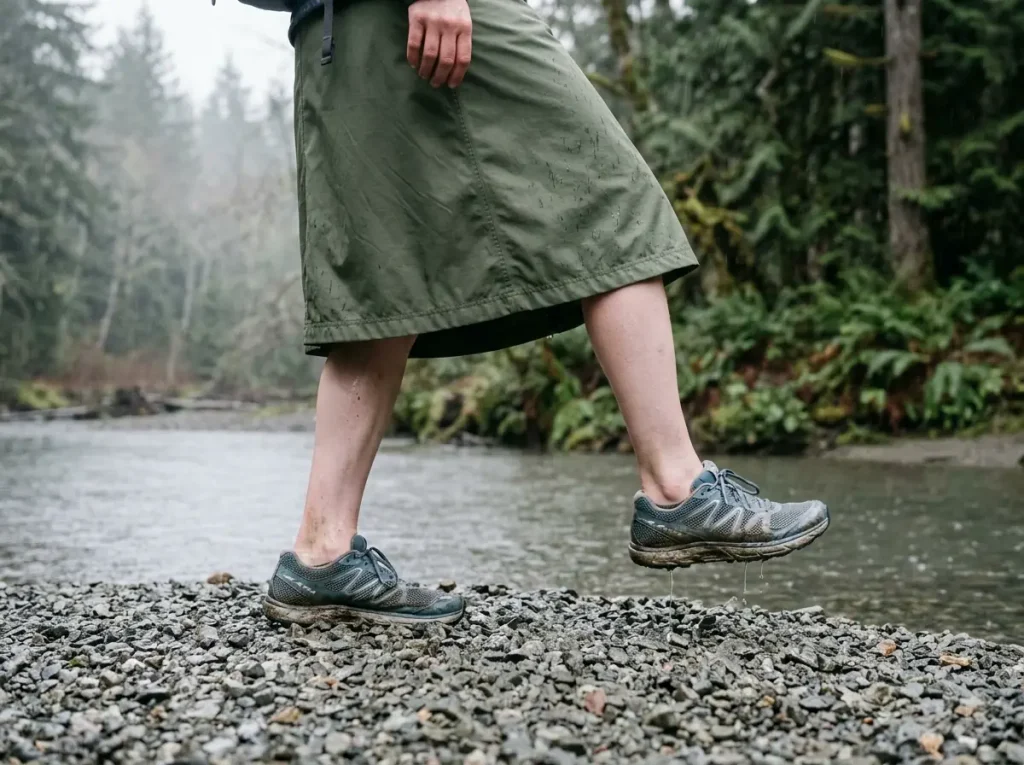
People buy a kilt, wear it over hiking pants and boots exactly the way they’d wear rain pants, get soaked, and conclude kilts don’t work. The kilt worked fine. The system around it didn’t.
The rule, flat: a kilt goes over shorts and trail runners. Never over long pants, never over boots. This is the most common setup mistake in the category, and every reviewer ends up explaining it again in every comments section.
Pants defeat a kilt through capillary action. Fabric hanging below the hem catches falling water and wicks it upward into the zone the kilt was protecting, and now that water sits against your skin in something that won’t dry while you’re moving. Same principle as the same layering question on the jacket side, where what’s underneath decides whether the shell does its job.
Boots defeat it differently. Water runs down bare shins into the ankle opening regardless of kilt length, and hiking boots are buckets: they hold what gets in. Trail runners drain. A wet boot stays wet until you stop for the night.
Rain pants have no equivalent requirement. They go over anything, with any footwear, which is an underrated advantage and a large part of why pants stay the default even for hikers a kilt would serve better.
If you hike in boots, this decision is already made
The rain kilt was designed inside ultralight backpacking culture, where trail runners are the default and long pants are unusual, and the garment quietly inherits both assumptions. Buyer’s guides describe its advantages as inherent to the design when a good chunk of them only hold inside that footwear system, which is why the same complaint keeps coming from hikers who did nothing wrong except wear boots.
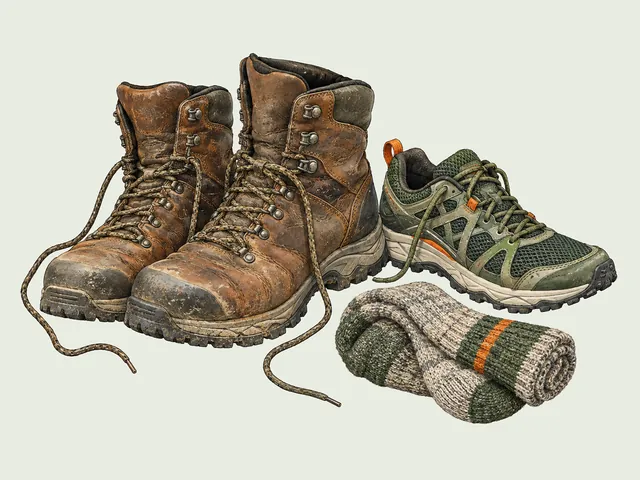
So if you hike in boots and you’re not switching, you get less from a kilt than the weight savings suggest. The gap in ankle coverage is a permanent leak. Full-zip rain pants are the better tool for boot wearers, and not every reader should buy the lighter thing.
Running a kilt over shorts, skip the cotton underwear. The kilt keeps rain off but it doesn’t stop splash-back from your own legs and wet brush, and cotton holds that against skin for the rest of the day. Synthetic or merino and the problem disappears.
What Each One Actually Costs You
This is the one comparison where the answer is boringly clear, and worth saying in round numbers because the gap changes what people buy.
The entire rain kilt category, premium end included, tops out under eighty dollars. That’s a ceiling on a category of garments made from a few ounces of coated fabric and a strip of Velcro, not a listing price that goes stale next quarter. Name-brand rain pants start roughly where kilts end and climb from there, and the same four-price-tier breakdown on the jacket side maps that logic onto shells.
One caveat complicates the math. Most good kilts are cottage-brand direct order, so cheaper also means waiting weeks for a two-person shop to sew yours. Rain pants are at your door in two days, so if you need protection for next Saturday the price advantage turns into a scheduling problem.
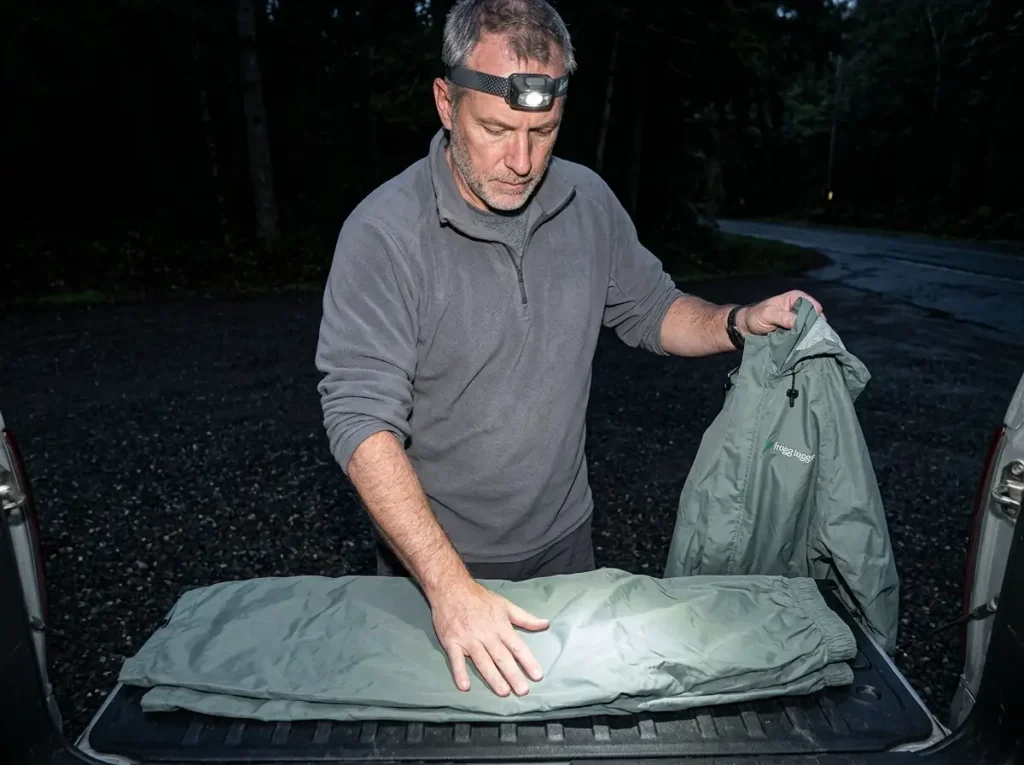
The cheapest genuinely complete answer sits in neither category. A two-piece rain suit gets you jacket and pants together for less than most standalone pants, and the FROGG TOGGS Ultra-Lite2 Rain Suit is the long-running example: nonwoven two-layer fabric, waterproof, light enough to live in a day pack.
It isn’t refined gear and it tears if you drag it through brush, but for one purchase covering both halves it’s hard to argue with. Stock runs thin.
Cost per use beats the sticker every time. A kilt you deploy beats pants that stay buried because you can’t face unlacing boots in the mud. Worth flagging before you buy: women’s rain shells are their own sizing problem, and that applies to lower-body gear too.
Wind and Cold Are Where Pants Stop Being Optional
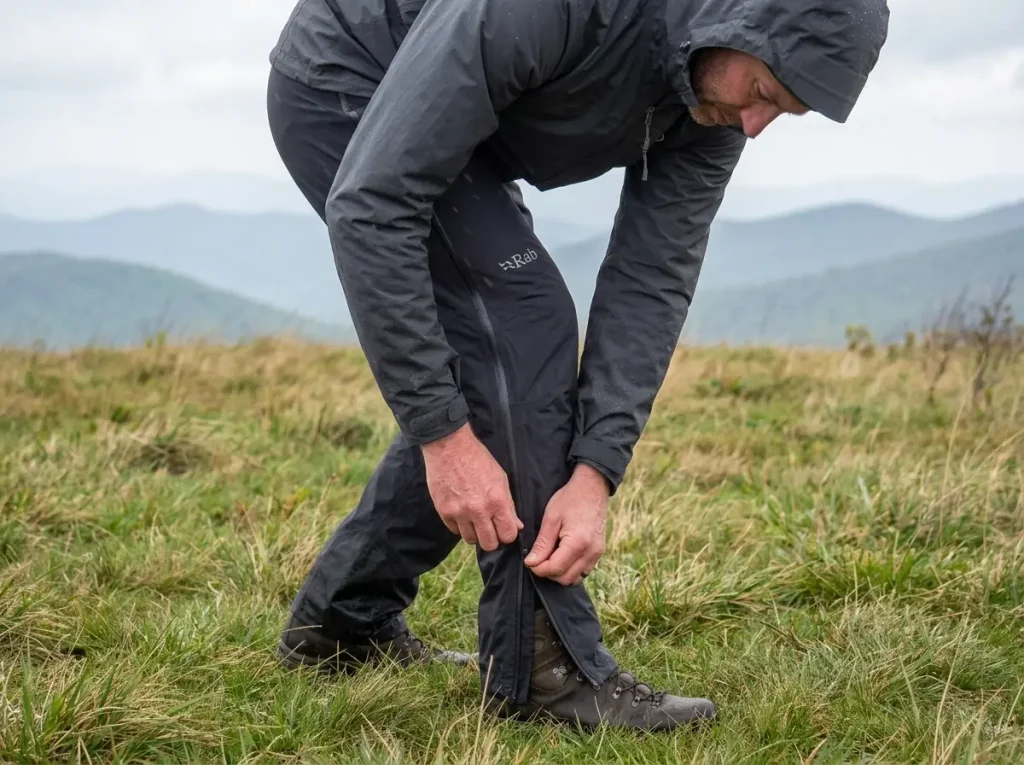
A kilt is a fair-weather tool and every honest source says so. The moment wind picks up on an exposed ridge, bare wet legs stop being a comfort question and become a heat-loss question.
Wind chill is the mechanism and the arithmetic is unkind: 30 mph at 40°F gives you an effective 13°F. Hypothermia develops at ambient temperatures as high as 50°F when wind and wet clothing combine, which the National Park Service’s hypothermia prevention page spells out plainly. It isn’t a below-freezing risk, and the reasonable-looking thermometer is exactly what makes hikers complacent.
Pants win here by covering the surface losing the heat. It’s geometry: a kilt ends at the knee. Multiple forum members flagged wind speed rather than temperature as the real switch point, which is the number to read when a weather window looks borderline.
If this is your use case, three features earn their cost: full-length side zips so you can get them on over boots, fully taped seams, and a genuine waterproof-breathable membrane rather than a coating that quits the moment it wets out.
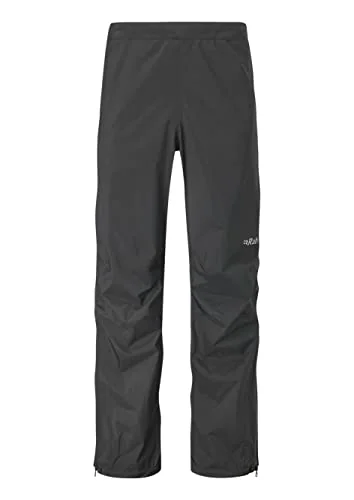
One honest note on that pick: only the men’s cut survived availability checking. No women’s listing of the Downpour Plus 2.0 was live when this was written.
If the premium tier is more pant than your hiking calls for, the Marmot PreCip Eco Rain Pant (men’s · women’s) covers the same job a tier down: NanoPro recycled ripstop fabric, PFC-free DWR, and ankle side-zips with snap tabs instead of full-length ones, which is the compromise you accept for the price. Both cuts are available, more than most gendered pairs manage.
What wind actually does to a wet leg
Water on skin evaporates, and evaporation pulls heat out of whatever it’s sitting on. Still air lets a thin humid layer build against your skin and slows that down; wind strips it away continuously, which is why the same 45°F feels survivable in a sheltered valley and awful on a ridge.
The part that surprises people: a soaked pant leg still beats a bare wet leg, even though both are wet. The fabric traps a thin layer of water you warm and mostly keep, and it blocks the air that would carry that heat away. Same reason a wetsuit works, and the one attribute where the kilt has no answer.
The winter answer is not on this page
Below-freezing hiking is a different garment system, not a heavier version of this one. If that’s where your question is headed, a head-to-toe layering plan for below-freezing days is the starting point.
The Gaiter Trick That Closes the Kilt’s Only Real Gap
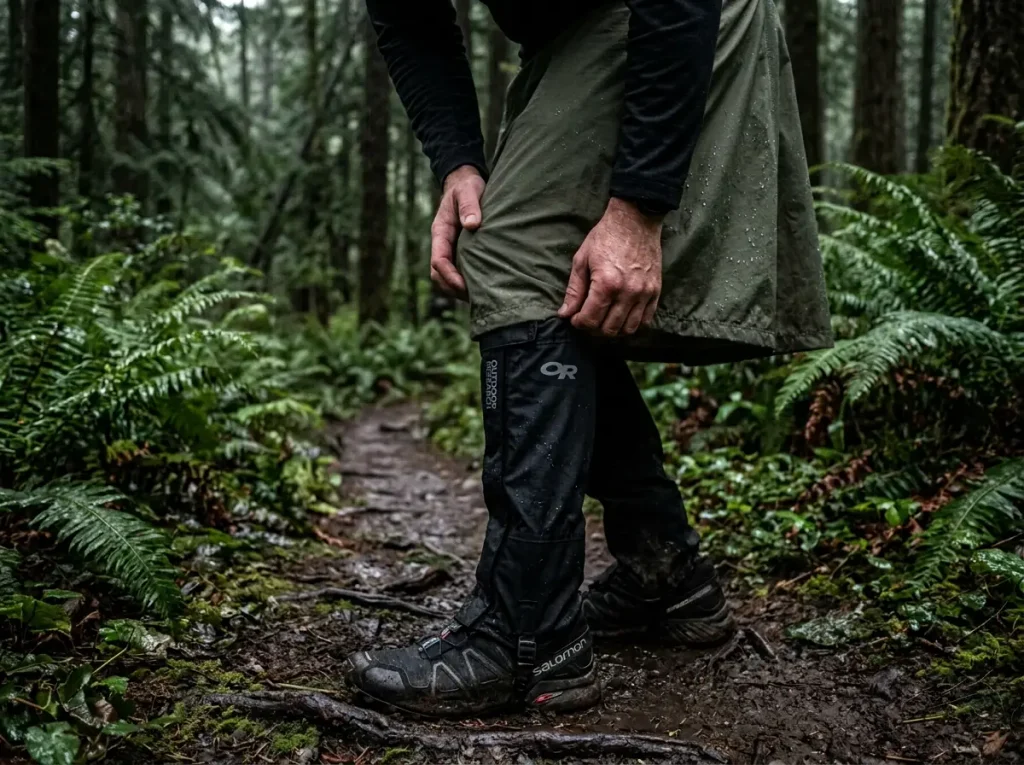
The standard objection to a kilt is that it leaves your lower legs exposed. True, and it’s the strongest argument against the format. It’s also solvable with a piece of gear plenty of hikers already carry for unrelated reasons.
Name the gap precisely first. A kilt covers hip to somewhere between knee and mid-calf. Below that: bare skin, and at the bottom of it an ankle opening water runs directly into. That’s the entire lower leg protection deficit: a band of shin roughly the height of a tall gaiter, which is exactly why the fix below works.
Calf-high gaiters cover exactly that band. Kilt on top, gaiters below, and the overlap closes nearly the whole lower body. WTA’s reviewer confirmed it from the other end, noting the ULA kilt runs long enough that paired with tall gaiters you get effectively full leg coverage. If you need to know which ones, choosing gaiters that actually fit the job sorts the calf-high rain models from the ankle-height debris versions that won’t help here.
What makes this more than theory is that the gaiters usually aren’t a purchase. One Backpacking Light member hikes with gaiters regardless of his rain gear, purely to keep boots and lower legs dry. They’re already in the kit for mud and scree, and gaiters earn their place for brush and ticks too. Adding a 2 oz kilt to gaiters you already carry is a different proposition than adding 10 oz of pants.
Length governs whether this works. A 30-inch kilt overlaps a calf-high gaiter with room to spare; a 25.5-inch one leaves a band of bare shin, and water finds it immediately. Measure from your waist to the top of your gaiters and buy longer than that number.
The honest limit: this fixes wetness, not brush. Gaiters plus kilt still leaves thighs and knees bare, so off-trail travel through wet vegetation still says pants. Worth being precise about what the combination actually buys you, because it isn’t universal coverage. It closes the wet-shin problem completely and does nothing at all for brush protection, and those are two different objections that get argued as one.
Put the gaiters on at the trailhead, not when the rain starts. They take a minute each in dry conditions and about five in wet ones with cold hands, and the whole appeal of this setup is that only one of the two pieces needs deploying mid-hike.
Why this combination beats rain pants on a warm wet day
It keeps the bottom-venting advantage while closing the coverage gap, the only configuration that wins most of both arguments at once. Air still moves up under the hem and carries your vapor out, and shins and ankles stay dry. Total weight lands around 6 to 8 oz depending on the gaiters, the same range as ultralight pants, but the ventilation behavior is completely different. On a 70°F day with steady rain and 2,000 feet of climbing this is genuinely the correct answer, and how gaiters are meant to be worn covers the fit details that decide whether they stay put all day.
What it still doesn’t fix is bushwhacking, sustained wind, and scrambling on brushy off-trail terrain. In all three the bare thigh and knee zone is the problem and gaiters are irrelevant to it. Wind is the worst, because the exposed skin sits above the gaiter line and that’s precisely the surface losing heat.
Why Most Hikers Still Won’t Buy a Rain Skirt
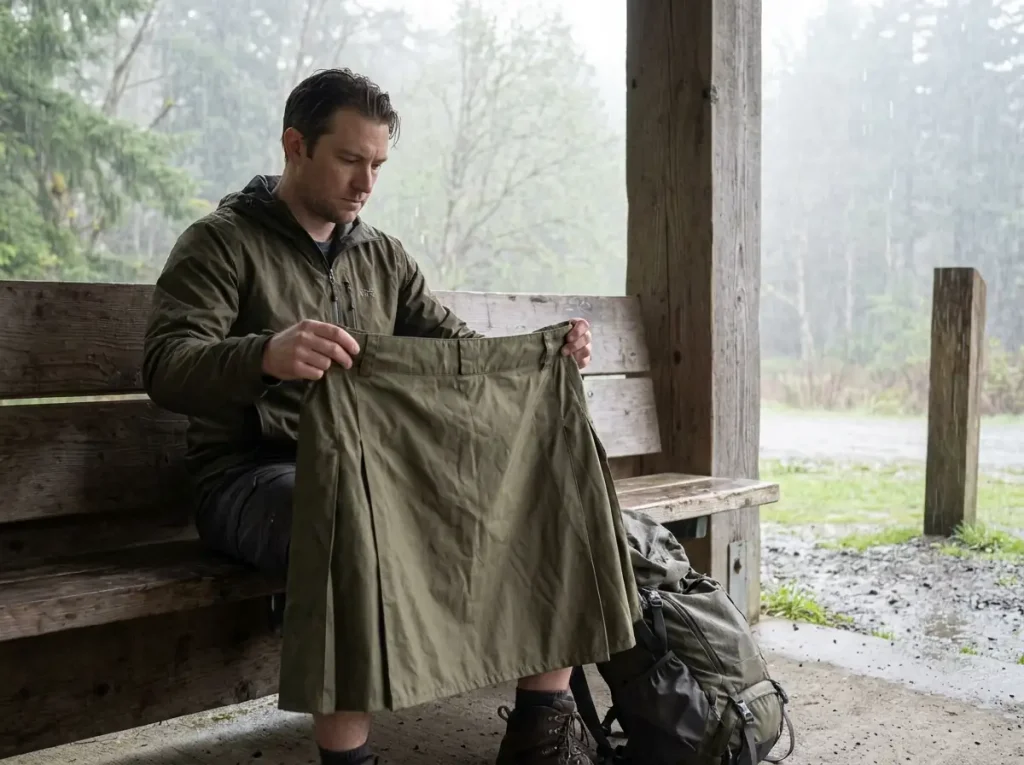
Almost every argument above favors a kilt for three-season hiking below treeline. Most hikers still carry pants or just hike wet. That isn’t an information problem, which means no amount of physics changes it. It’s two other problems nobody writes about.
Barrier one, said out loud: it’s a skirt, and a lot of hikers, men especially, don’t want to wear one. The community’s own slang gives the game away. Pull a Marilyn is what they call it flipping up in the wind, coined half-jokingly by a male forum member who was clearly thinking about it.
That’s not a joke about the garment, it’s an admission about how it feels to walk past other people wearing one. Which is exactly why kilt became the dominant term in ultralight circles: the word does work the garment can’t do for itself.
Barrier two is practical and probably bigger. The good kilts come from cottage gear brands selling direct: ULA Equipment, Zpacks, Mountain Laurel Designs, Lightheart Gear, Enlightened Equipment, Dutchware. Not on Amazon, not at REI, not at your local shop.
Order from the maker’s site, wait, and hope you sized it right. For a hiker who needs rain gear before next weekend, that’s a real reason to end up with pants, and it has nothing to do with performance.
Rain shorts come up as a third option and deserve honest handling. The concept solves the modesty problem cleanly: waterproof shorts over hiking shorts, no flipping, no skirt. The category is essentially European cottage-only right now, with Swallow and Tidygear the names that surface, and no meaningful US retail availability. Worth knowing it exists, not worth recommending a purchase nobody can conveniently make.
So, the verdict. If the social thing bothers you, that’s a real reason and this article isn’t going to argue you out of it. Buy pants that vent well, get the full-length side zips, and put them on before you’re already sweating.
That’s defensible. Hiking wet in cold conditions because you couldn’t decide is not.
The cottage-brand problem
Direct order means lead times of one to three weeks, because the person sewing your kilt is also answering the emails. No store to exchange a size at. Sizing from a chart rather than a fitting room, in a garment where length is the number that matters.
The upside is that cottage gear is often better made than the mass-market equivalent and repairable by the person who built it, which makes keeping technical fabrics working worth the effort. On anything with a DWR finish the water repellency fails first, and restoring the DWR that’s already wearing off is a twenty-minute job that undoes most of what people mistake for a worn-out garment.
Rain shorts, and why you probably can’t buy them
Rain shorts sit exactly where the US market has a hole. They’d keep the on-and-off speed of a kilt, close the modesty objection entirely, and keep a good chunk of the ventilation, since the leg openings are wide and short. On paper the format wins.
In practice the only makers producing them are small European operations, and importing a 3 oz garment from a two-person shop in Austria isn’t a recommendation anyone should make with a straight face. If the category ever crosses the Atlantic properly, it’s the version most likely to convert the holdouts.
Conclusion
Below treeline, on trail, in moderate temperatures: a kilt is lighter, vents better, and goes on fast enough that you’ll actually use it instead of talking yourself out of it. That last part is the one that matters.
Above treeline, in sustained wind, or off-trail in brush: pants, and it isn’t close. Wind chill on bare wet legs is a heat-loss problem with a clock on it, not a comfort preference, and there’s no accessory that patches it.
Pair a kilt with calf-high gaiters and you close most of the coverage gap without giving up the bottom-venting advantage, for roughly the weight of a single ultralight pant.
Pull up the forecast for the trip actually in front of you and look at the wind column, not the temperature. That one number decides this, and the rule handles the rest.
Frequently Asked Questions
01Do you wear anything under rain pants?
Yes, rain pants go over whatever you are already hiking in, usually hiking pants or a base layer. The one thing to avoid is cotton underneath, since it soaks up any condensation forming on the inside and stays wet against your skin.
02Do I really need rain pants?
Not for most three-season day hiking below treeline, where a rain kilt or simply hiking wet in warm rain is defensible. You need them when wind, cold, or off-trail brush are in the forecast, because that is where lightly covered legs become a heat-loss problem.
03Are rain pants worn over regular pants?
Yes, that is the normal way to wear them, since they are an outer shell rather than a replacement layer. Rain kilts are the opposite: they go over shorts and trail runners, never over long pants, because pant fabric wicks water upward and defeats the setup.
04What are rain pants called?
Rain pants, waterproof pants, and shell pants all describe the same garment. The skirt version answers to rain skirt, rain kilt, or rain wrap interchangeably, and kilt is the term you will hear most in ultralight and thru-hiking circles.
05Is a rain skirt as effective as rain pants in a real downpour?
For keeping your core and thighs dry, yes. For your lower legs, no. No source quantifies the rainfall rate where a kilt stops being enough, so anyone giving you a number is guessing, and what actually decides it is wind rather than rain intensity.

I've spent more than a decade researching hiking gear and trail technique. I read the specs, the forum threads and the long-term reviews, and every pick here comes with what it gets wrong.
End of the trail
You read every mile of this one. Here's where the trail goes next.