In this article
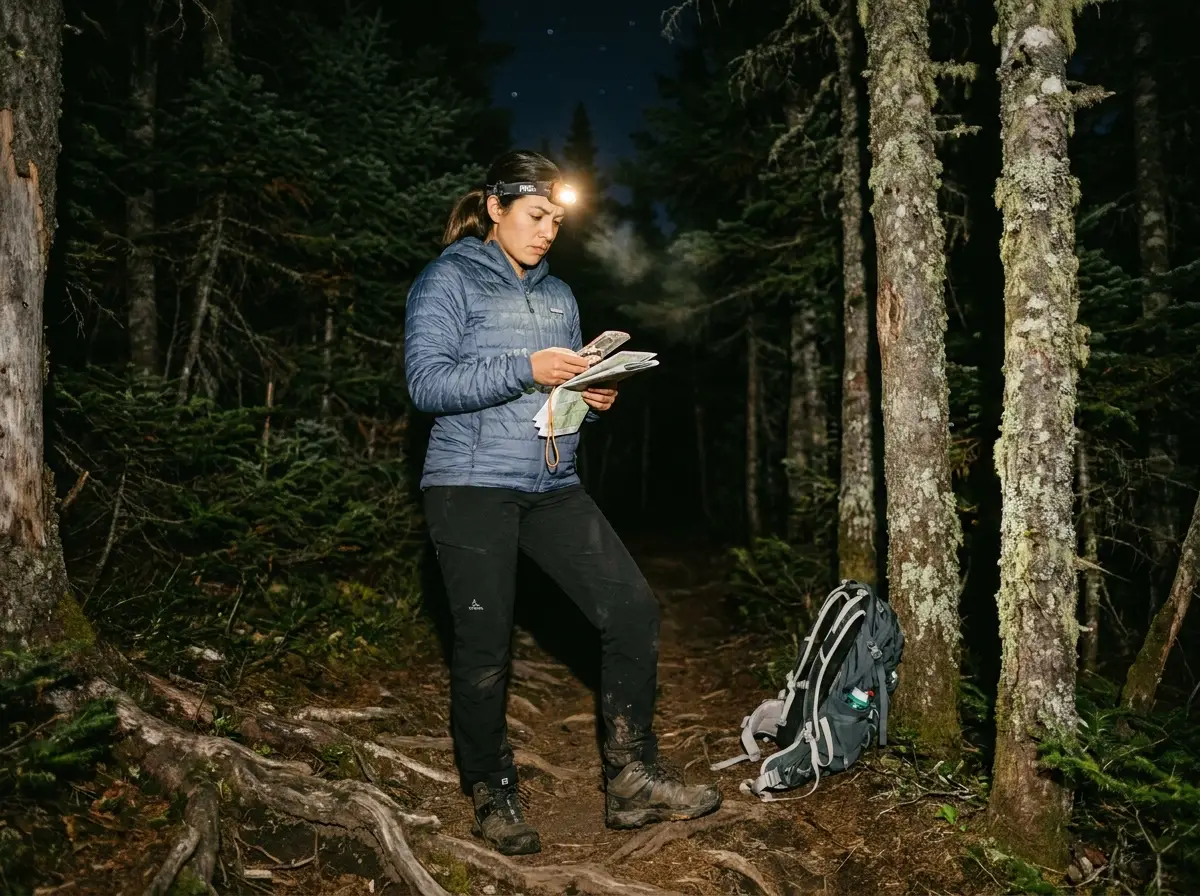
You checked the time and realized sunset was 40 minutes ago. The trail junction you needed was supposed to be half a mile back. Your headlamp turns the forest into a tunnel of shadows, and every tree looks the same.
I’ve been there — more than once. After enough after-dark scrambles on trails I thought I knew, I’ve learned that night navigation isn’t just daytime navigation with a headlamp strapped on. Your brain works differently in the dark. Your tools work differently. And the mistakes that get hikers lost aren’t the ones you’d expect.
Here’s what actually goes wrong after dark, and the field-tested fixes for each one.
Quick Answer: The most common night navigation mistakes and how to fix them:
- Trusting your brain over your instruments — darkness distorts slope, distance, and time perception
- Blasting your headlamp on full white and destroying your night vision
- Taking long compass legs instead of breaking navigation into short 50-100m segments
- Ignoring non-visual terrain cues — your feet and ears navigate better than your eyes at night
- Failing to distinguish between planned night hikes and being caught out after dark
Why Your Brain Fails at Night Navigation
Everyone talks about gear for night hiking. Nobody talks about the fact that your brain is actively working against you the moment the sun drops.
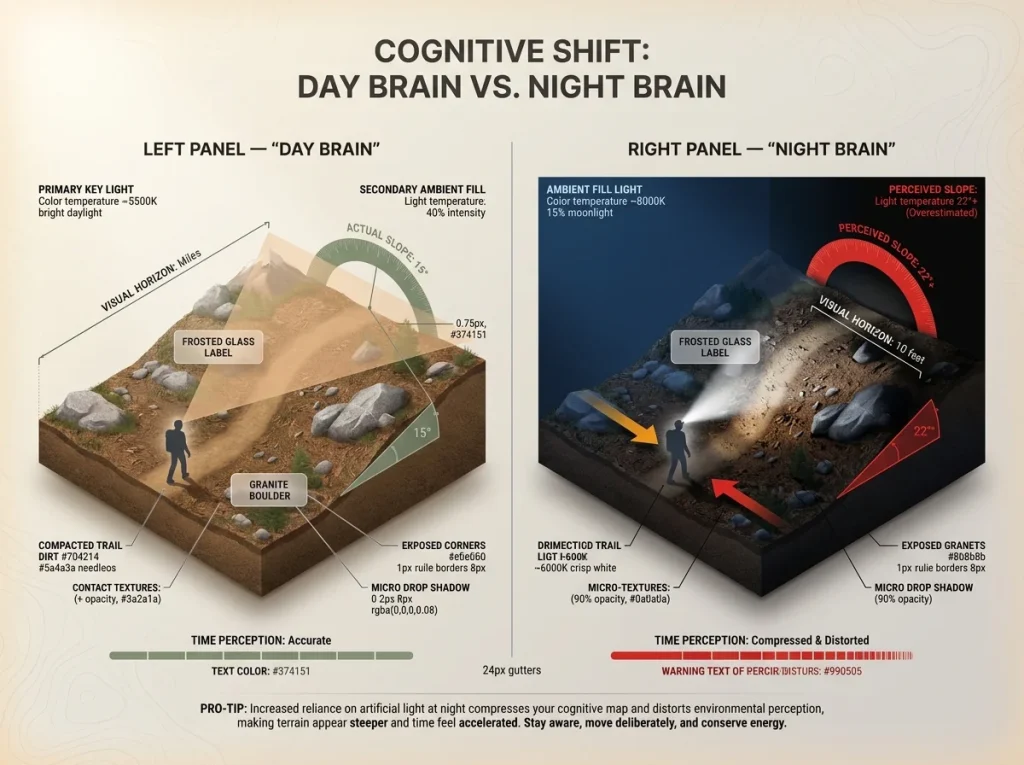
Three specific perceptual distortions kick in after dark, and they compound each other. Understanding them is the difference between a confident night hike and a panicked wrong turn.
Slope Angles Feel Steeper Than They Are
Research on spatial perception in reduced visibility shows that perceived slope angles are overestimated by a factor of 1.5 or more in darkness. That moderate 15-degree descent you’d barely notice during the day? At night it feels like a 22-degree drop — steep enough to make you second-guess your position on the map.
I’ve stood on a trail I knew well and been absolutely convinced I’d dropped into the wrong drainage because the slope felt far too steep. The topo map said otherwise. The topo map was right.
This distortion happens because your vestibular system (inner ear balance) takes over when visual references disappear. Without a horizon line or distant landmarks to calibrate against, your brain defaults to the worst-case interpretation.
Pro tip: When a slope feels wrong at night, stop. Pull out the map and check the contour spacing for your expected position. If the contours say gentle, trust the contours — not your legs.
Distance Perception Shrinks to Your Light Bubble
During the day, you navigate by scanning distant features — a ridgeline, a saddle, a creek crossing a quarter mile ahead. Your headlamp eliminates all of that. You’re navigating inside a 10-foot bubble of light, and everything beyond it is gone.
The result: your brain fills the void with guesses. And those guesses are consistently wrong. Hikers at night routinely believe they’ve traveled farther than they actually have. According to research on navigation in darkness from Springer Nature, nighttime navigation depends on three systems simultaneously — recent visual memory, locomotor (walking) memory, and inertia-based processing from your inner ear. When the visual system gets cut off by darkness, the other two pick up the slack. But they’re less accurate, and the errors accumulate over distance.
I was once 100% sure I’d overshot a junction by a quarter mile. My pace count said I was 200 meters short. I trusted my brain over my count. I was wrong. The junction was exactly where the pacing predicted.
Time Moves Differently After Dark
Most hikers feel like more time has passed than actually has when they’re navigating at night. The concentration required — watching every footstep, checking the compass, counting paces — makes 20 minutes feel like 40.
The problem is that this perception drives premature decisions. You think you’ve been walking long enough to reach the next feature. You haven’t. So you turn, or you stop looking for the landmark, and you miss it.
Your watch is the fix. Check it obsessively. Set a timer for your estimated leg duration and don’t make any navigation decisions until it goes off. Your gut says “we’ve been walking forever.” Your watch says 8 minutes. Trust the watch.
The combined effect of these three distortions — steeper slopes, shorter distances, longer time — creates a feedback loop. Each wrong perception reinforces the others. The antidote is the same for all three: instruments over instinct. If your compass, your pace count, and your watch all agree and your gut disagrees, your gut is wrong. This is the hardest lesson in night navigation, and the common navigation mistakes that compound in low light get worse when you don’t know they’re happening.
Headlamp Discipline: Light Is a Tool, Not a Crutch
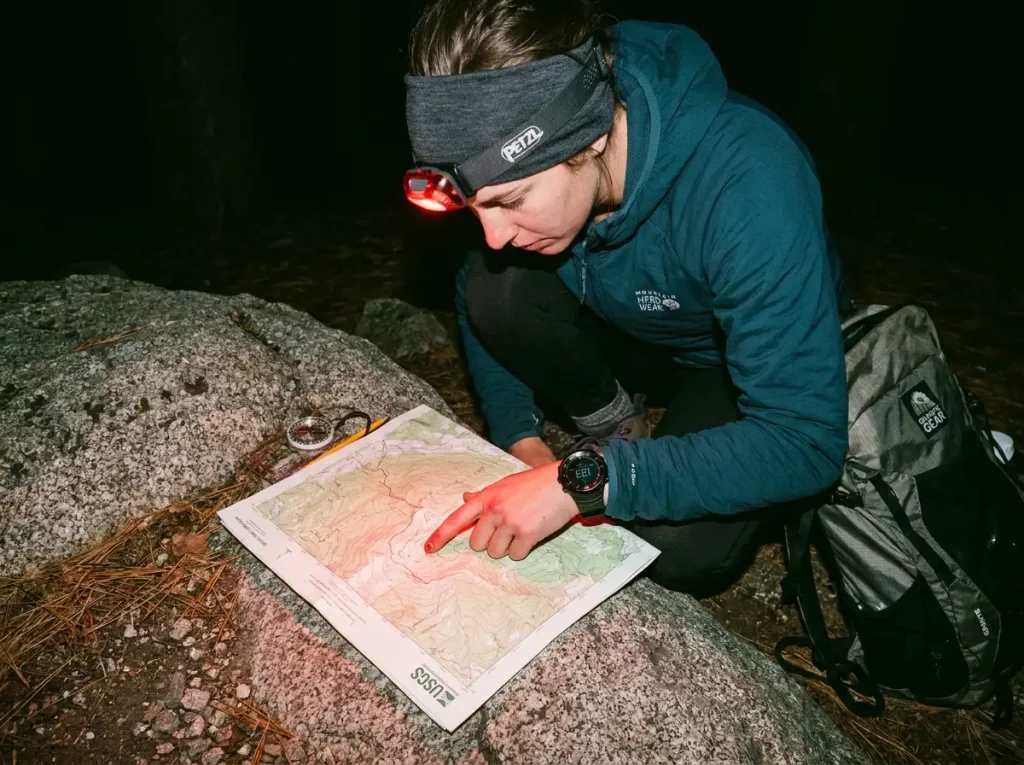
Most hikers treat their headlamp like a light switch — on or off, full blast. That approach creates more problems than it solves.
Your headlamp is a precision instrument with modes that serve different purposes. Using the wrong mode at the wrong time is the second most common night navigation mistake I see.
The 300-Lumen Minimum and When You Need More
For established, well-marked trails, 300 lumens gives you enough light to see the path, spot obstacles, and read trail markers. But if you’re on technical terrain, navigating off-trail, or dealing with rock fields, you need 500 lumens or more to pick out the surface detail that keeps you from twisting an ankle.
Beam type matters as much as brightness. A spot beam helps you pick out a distant trail marker or cairn. A flood beam lights the ground directly in front of your feet. Most modern headlamps let you toggle between both — learn which mode to use when before you need it.
Battery management is the unsexy part that saves trips. Cold temperatures drain lithium batteries about 40% faster than room temp. Keep your spare set in an inside jacket pocket where your warmth protects them. And your backup light goes in a different pocket or compartment than your primary — if your pack takes a swim, you don’t lose both. For more on understanding how lumens and candela actually affect what you see on trail, the physics matter more than the marketing claims.
Red Mode Is Not Optional
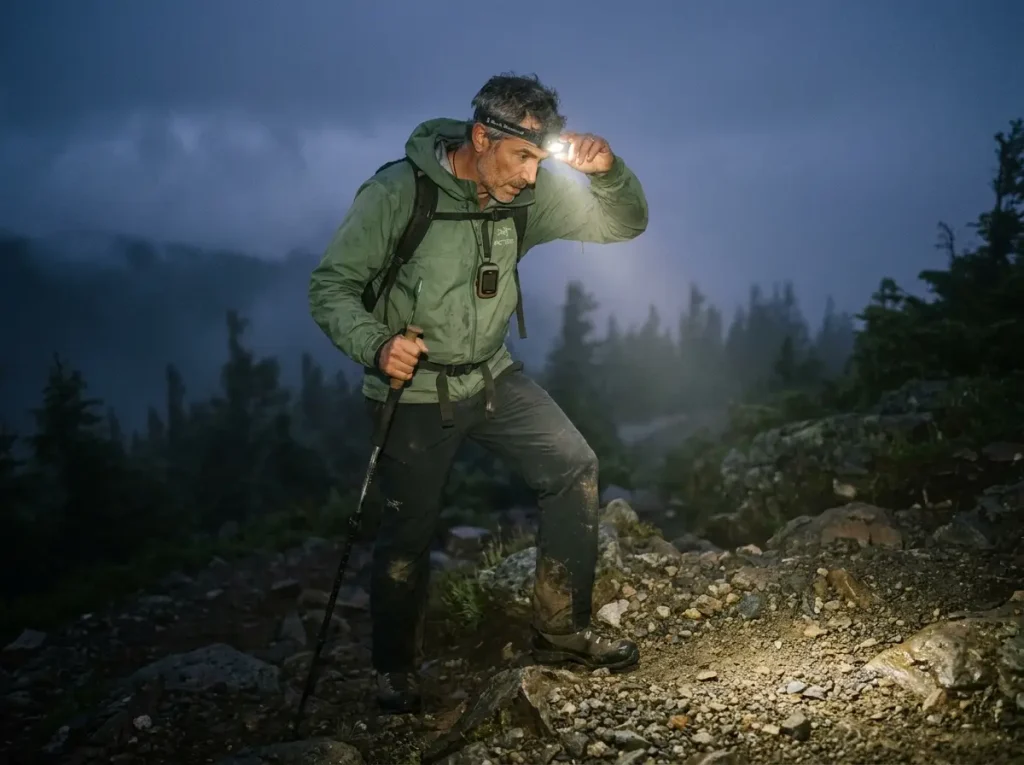
Here’s the part most hikers skip. Rhodopsin — the chemical your rod cells produce to see in low light — takes 20 to 40 minutes to fully activate in darkness. One flash of full-power white light bleaches it, and the clock resets to zero. As the National Park Service explains dark adaptation and red light, your rod cells essentially ignore red wavelengths. Red light lets you read a map, check your compass, and dig through your pack without destroying the night vision you spent half an hour building.
Use white light for walking. Switch to red for any close-up task — map reading, gear management, checking your watch. Every time you blast white light at your map, you’re trading 20-40 minutes of visual acuity for 10 seconds of convenience.
Pro tip: One thing nobody warns you about — red light makes brown contour lines on topo maps nearly invisible. Shine the light from the side of the map, not straight down. The angle catches the printed line relief and makes contours readable even under red.
When to Switch Off the Light Entirely
This sounds counterintuitive, but it’s the single most useful night navigation technique I’ve learned. On clear or even partly cloudy nights, turning off your headlamp lets you see terrain features you literally cannot see with it on.
A headlamp creates tunnel vision. You see 10 feet of bright trail and a wall of darkness beyond. Turn it off, wait 2-3 minutes for your eyes to start adjusting, and suddenly the ridgeline appears. Tree canopy gaps show you which direction the slope falls. Mountain silhouettes against the sky tell you exactly where you are on the map.
The first time you switch off your headlamp on a moonlit ridge and realize you can see the entire valley below you — terrain that was completely invisible 30 seconds earlier — it changes how you think about light.
Compass Bearings After Dark: Precision Over Speed
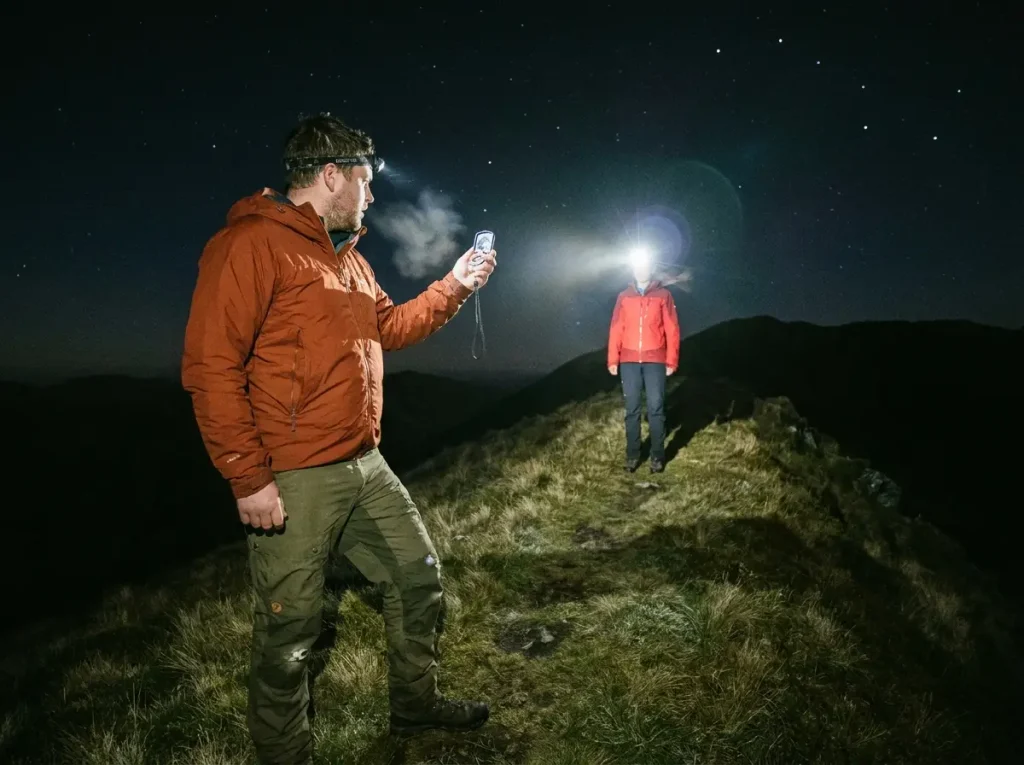
Daytime compass navigation is straightforward: take a bearing, sight a landmark on that bearing, walk to it. Repeat.
At night, there’s nothing to sight. The landmark you’d normally walk toward is swallowed by darkness. This changes everything about how you use a compass after dark.
Taking a Bearing You Can’t See the End Of
The fix is to shorten your legs. Instead of taking one bearing and walking 800 meters to a distant feature, break it into 50 to 100 meter micro-segments. Take the bearing, walk 50 paces, stop, recheck the bearing, walk another 50. It’s slower. It’s also dramatically more accurate.
Use attack points — obvious features near your target that are easier to find than the target itself. A trail junction at the base of a prominent knoll is easier to locate at night than a flat junction in featureless forest. Navigate to the knoll first, then re-orient for the short final leg.
When you reach each attack point, take a full position fix: compass bearing to at least one known feature, altimeter reading, pace count confirmation. The 30 seconds this takes saves the 30 minutes you’d spend relocating if you’d blown past your target.
The Leapfrog Technique for Two-Person Teams
If you’re hiking with a partner, leapfrogging is the most accurate method for maintaining a bearing in darkness. Person A stands still, takes the bearing, and directs Person B to walk ahead on that line. B turns on their headlamp as a beacon. A sights the compass against B’s light — if B has drifted left or right, A calls a correction.
The communication protocol matters. Agree on signals before you start: whistle for stop, voice for direction corrections (“left five,” “right three”), two whistles for “come back to me.” Practice on a known trail before you need it on an unknown one.
This technique works because a stationary reference point plus a moving beacon is far more accurate than two people walking together and hoping they’re both on line. The same leapfrog technique works in dense fog — reduced visibility is reduced visibility regardless of the cause.
Map Glare and Compass Interference
Two small things that trip up experienced hikers after dark. Laminated maps and map cases with glossy plastic reflect headlamp light directly back into your eyes. Shine the beam from the side, not straight down. Better yet, find map cases with a matte finish — the slight cost is worth the readability.
And keep your headlamp away from your compass when you’re taking a bearing. The magnets in LED headlamps can deflect the needle by several degrees — enough to send you off line over a 200-meter leg. Hold the compass at arm’s length, or better, take the headlamp off entirely and hold it in your other hand.
A compass with luminous markings — like the Suunto MC-2 or Silva Ranger — lets you read the needle and orienting arrow without using your headlamp at all. That’s a real advantage when you need to check your bearing frequently without burning battery. For features that actually matter in a baseplate compass, luminous markings rank higher at night than any other spec.
Reading Terrain by Feel When You Can’t See It
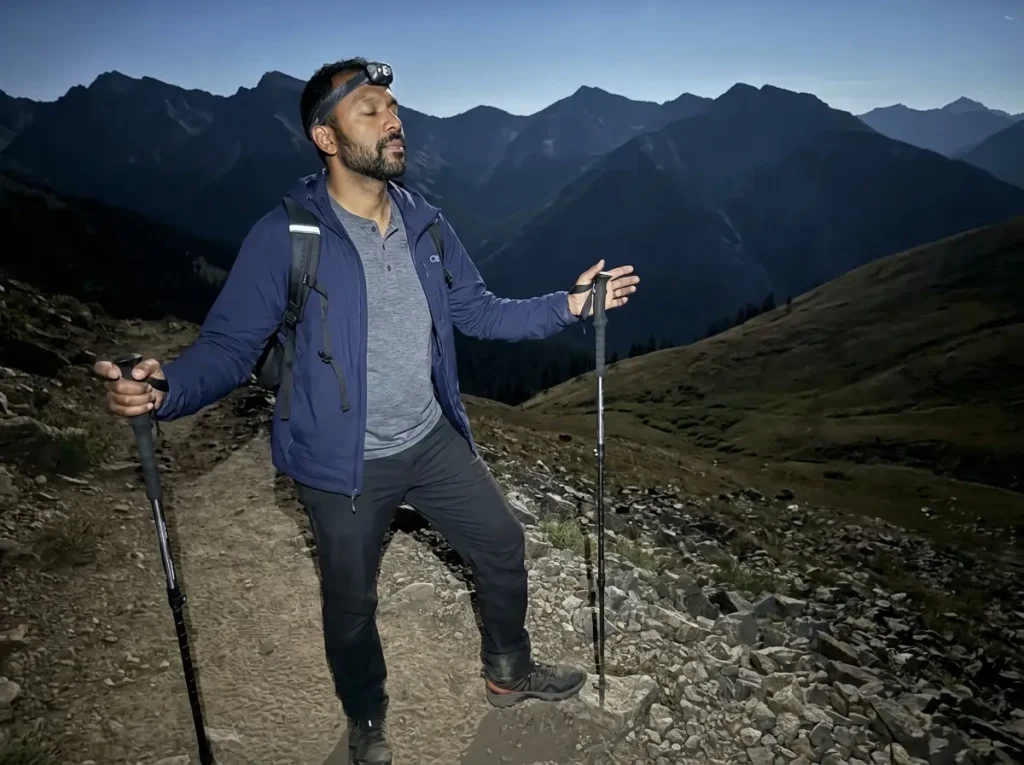
This is the technique gap nobody fills. Every night navigation article tells you to “pay attention to the terrain.” None of them explain how to do that when you can’t see past your boots.
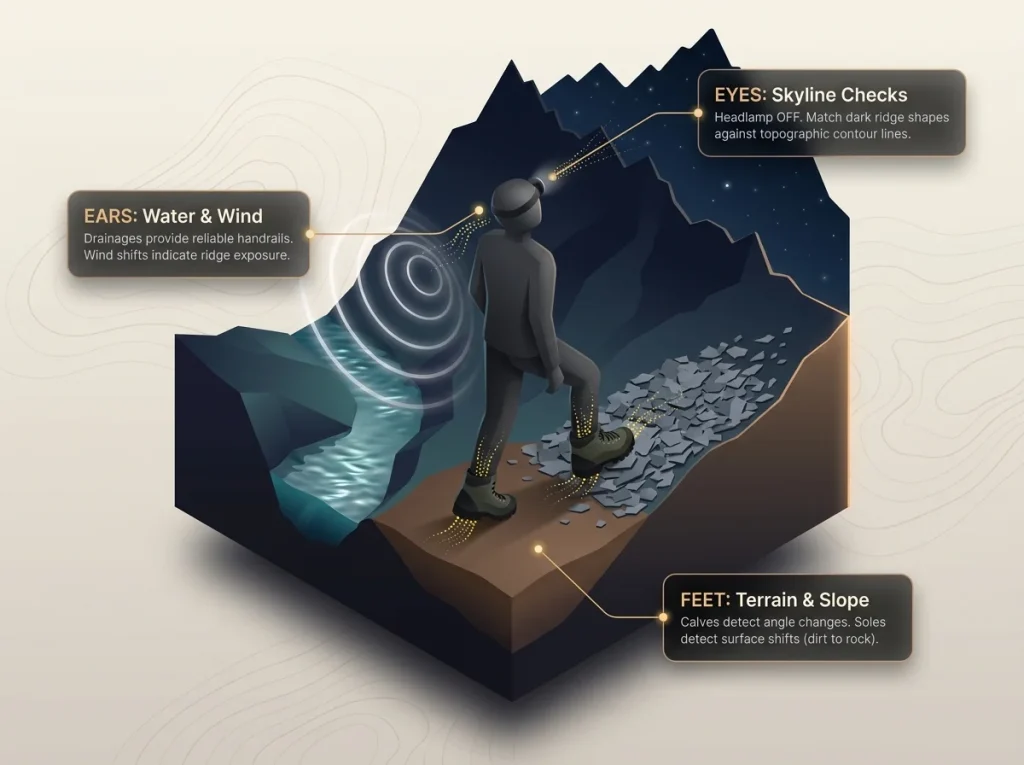
Experienced night hikers develop a multi-sensory approach that treats feet, ears, and occasional headlamp-off sky checks as a navigation system. It takes practice, but once you calibrate it, you’re navigating with information that most hikers walk right past.
Your Feet Read Slope Before Your Eyes Do
Your boots are in constant contact with the ground. A shift from flat to a 10-degree uphill grade registers in your calves and ankle joints before your headlamp has any chance of showing the grade change. Pay attention to it.
When the surface under your feet transitions — packed dirt to loose scree, firm trail to soft pine needles — that’s information. Trail surfaces have a signature that off-trail surfaces don’t. If you suddenly feel your boots sinking into soft ground or skidding on loose rock, stop immediately. You may have stepped off the trail or entered a drainage.
Pro tip: Your dominant foot is less sensitive to terrain changes than your non-dominant foot. If you’re right-footed, your left foot will pick up a grade shift first. Once you know this, you’ll start trusting it.
Sound as a Navigation Tool
Night is quieter than day. The creek you couldn’t hear at noon is a clear marker at midnight. Use it.
Water sounds locate drainages and creek crossings — reliable handrails you can follow without looking at a map. If your route crosses a drainage and you hear water ahead and to the left, you have a confirmed position fix before you even pull out the compass.
Wind patterns carry terrain data too. Wind accelerates on exposed ridges and dies in sheltered valleys. If you’re walking and the wind suddenly picks up, you may be approaching an exposed section — cross-reference with the map.
The Skyline Silhouette Check
This is the headlamp-off technique applied specifically to position fixing. Stop, switch off the light, wait a couple minutes, and look up. Ridgelines, saddles, and prominent peaks show as dark shapes against the sky — even on overcast nights with no stars. That faint glow above the clouds provides enough contrast.
Compare the silhouette profile to the contour profile on your topo map for your expected position. Does the ridgeline rise to the right the way the contours suggest? Is the saddle where you’d expect it? This cross-check takes 2 minutes and confirms or corrects your position without using any battery power.
Combining feet (slope and surface), ears (water and wind), and skyline silhouettes gives you three independent data streams that don’t need light, batteries, or satellites. Every veteran night hiker I know uses all three. If you want to sharpen the daytime version of this approach, terrain association techniques that work even without a compass are the foundation to build on.
Celestial Navigation: The Backup That Never Needs Batteries
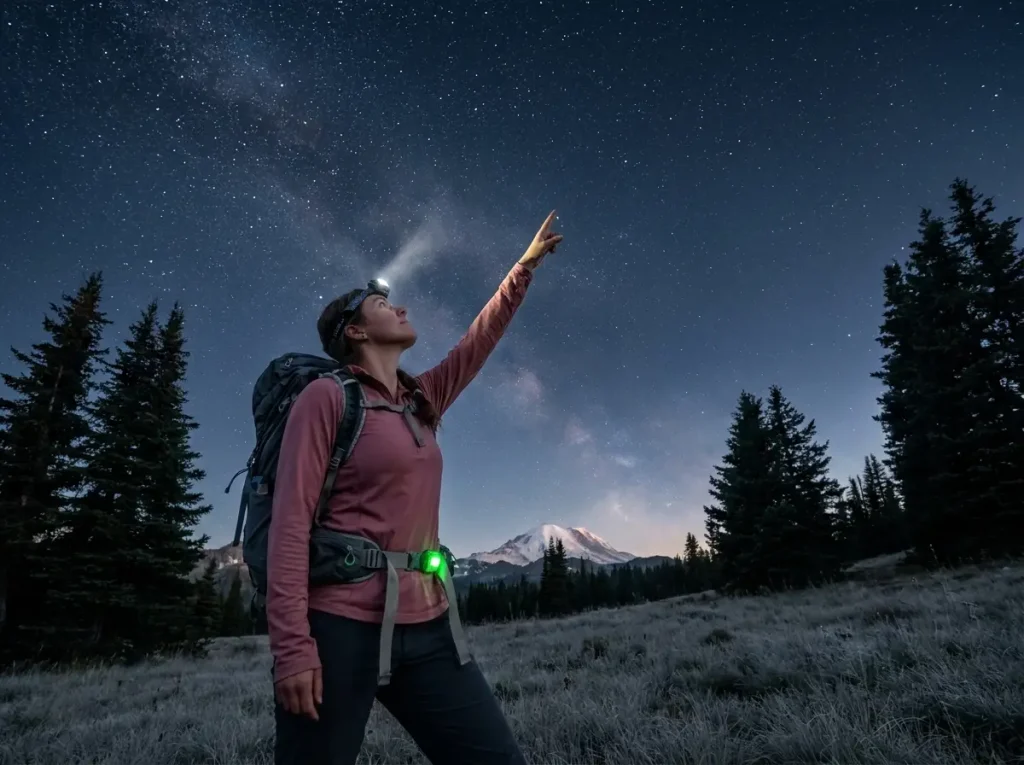
Stars don’t run out of battery. They don’t lose satellite signal in canyons. And on a clear night, they’re the most reliable direction indicator you have.
You don’t need to memorize the entire night sky. Two techniques cover 90% of what a hiker needs for gross direction checks.
Finding North Star in 30 Seconds
Locate the Big Dipper. Find the two stars that form the outer edge of the “cup” — these are the pointer stars (Dubhe and Merak). Draw an imaginary line through them and extend it roughly five times the distance between them. That line hits Polaris, the North Star.
Polaris sits within one degree of true north. It doesn’t move. Every other star rotates around it over the course of the night. Once you’ve found it, you have a permanent compass that requires no calibration and no declination adjustment.
On partly cloudy nights when the Big Dipper is hidden, look for Cassiopeia — the W-shaped constellation on the opposite side of Polaris. If you can see either one, you can find north.
Moon as a Rough East-West Indicator
The moon isn’t precise enough for bearings, but it confirms gross direction when you’re disoriented.
A rising moon is roughly east. A setting moon is roughly west. A first-quarter moon (right half illuminated) is due south at sunset. These rules get you back in the right quadrant — not the right degree, but often that’s enough.
For a deeper look at wayfinding without instruments, our full guide to natural navigation beyond the compass covers sun position, wind patterns, vegetation indicators, and more techniques that work in both daylight and darkness.
The Planned vs. Caught-Out Distinction
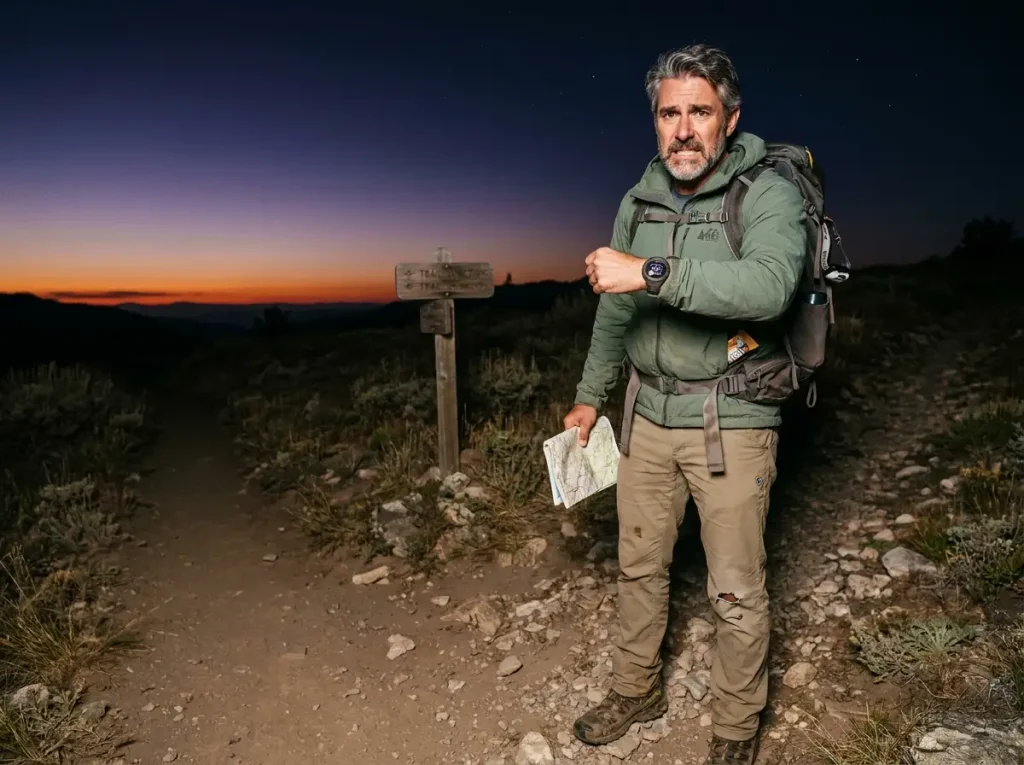
This is the mistake nobody writes about: treating every night hiking situation the same way. A planned night hike and getting caught out after dark are fundamentally different scenarios with different priorities, different gear requirements, and different mental frameworks.
Planned Night Hike Priorities
If you’re choosing to hike at night, preparation is everything. Pre-hike the route during the day. Memorize junctions, water crossings, and exposed sections. Note which sections have good landmarks and which are featureless — the featureless sections are where you’ll need compass and pacing.
Start timing matters. Leave about 30 minutes before full dark. This gives your eyes time to adapt gradually while you can still see enough trail to get your bearings. The transition from twilight to headlamp is smoother than going from full daylight to full darkness.
Gear: primary headlamp and a backup in a separate pocket. Charged GPS with offline maps downloaded. Reflective tape on your pack straps so group members can track each other without constantly shining lights around. For our field-tested headlamp recommendations, the key specs for night navigation are red mode, adjustable beam, and genuine weather resistance.
Caught-Out After Dark Priorities
Being caught out changes the calculus entirely. The first decision isn’t which direction to walk — it’s whether to keep moving at all.
If you’re confident in your position and the terrain is manageable, continue at half your daytime pace. Shorten your navigation legs to 100 meters maximum. Use attack points at every opportunity.
If you’re unsure of your position or the terrain ahead includes exposure, water crossings, or steep descents — stop. Find a sheltered spot and wait. A cold uncomfortable night is a story. Walking off a ledge in the dark is not.
The biggest mistake caught-out hikers make is rushing because anxiety is screaming at them to move. Speed is the enemy of night navigation. Every wrong turn takes twice as long to correct in the dark.
Pro tip: Call for help before you need help. A phone call from a known position — “I’m at the junction of trails X and Y, I’m going to bivouac here until daylight” — is infinitely easier for search and rescue than a call from an unknown position at 2 AM after three hours of wrong turns.
The Shoulder Season Trap
Most unplanned night hikes happen in spring and fall. Not winter, when hikers expect short days. Spring and fall, when sunset arrives 30 to 60 minutes earlier than your mental model says it should.
The fix is simple. Plan your turnaround time based on sunset minus one hour, not sunset. That buffer accounts for the slower pace of the return leg (always slower — you’re tired) and gives you a cushion of twilight if things take longer than expected.
For precise timing strategies, calculating your actual start time with a safety margin works in both directions — sunrise approaches and sunset returns.
Building a Night Navigation Kit That Actually Works
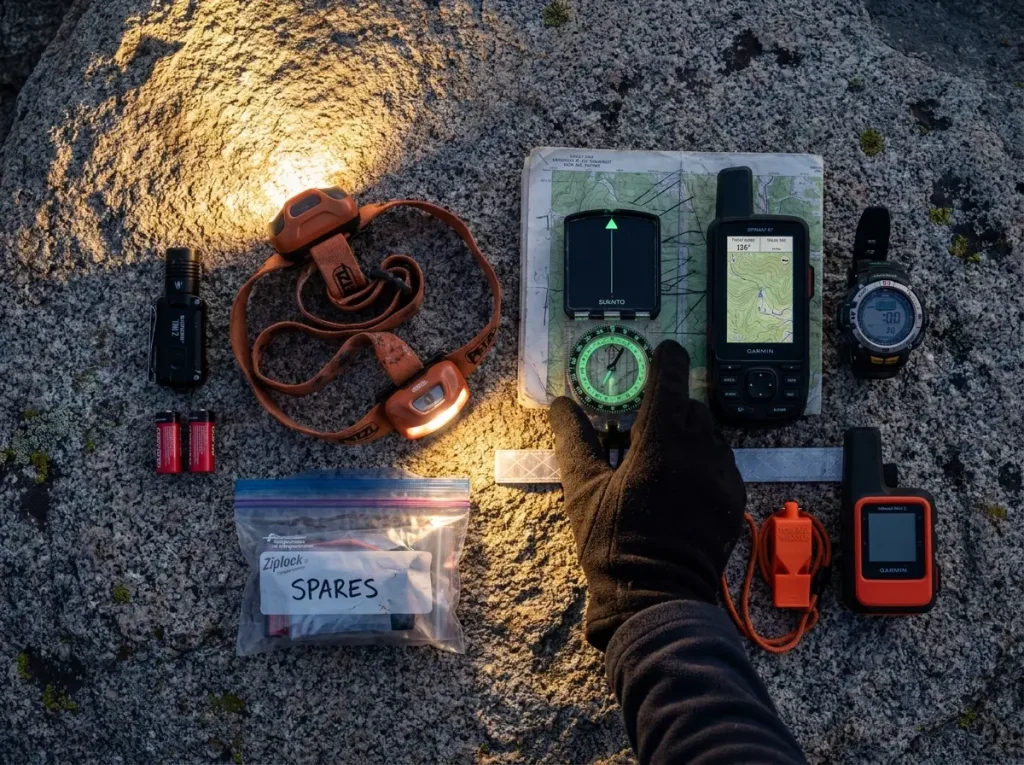
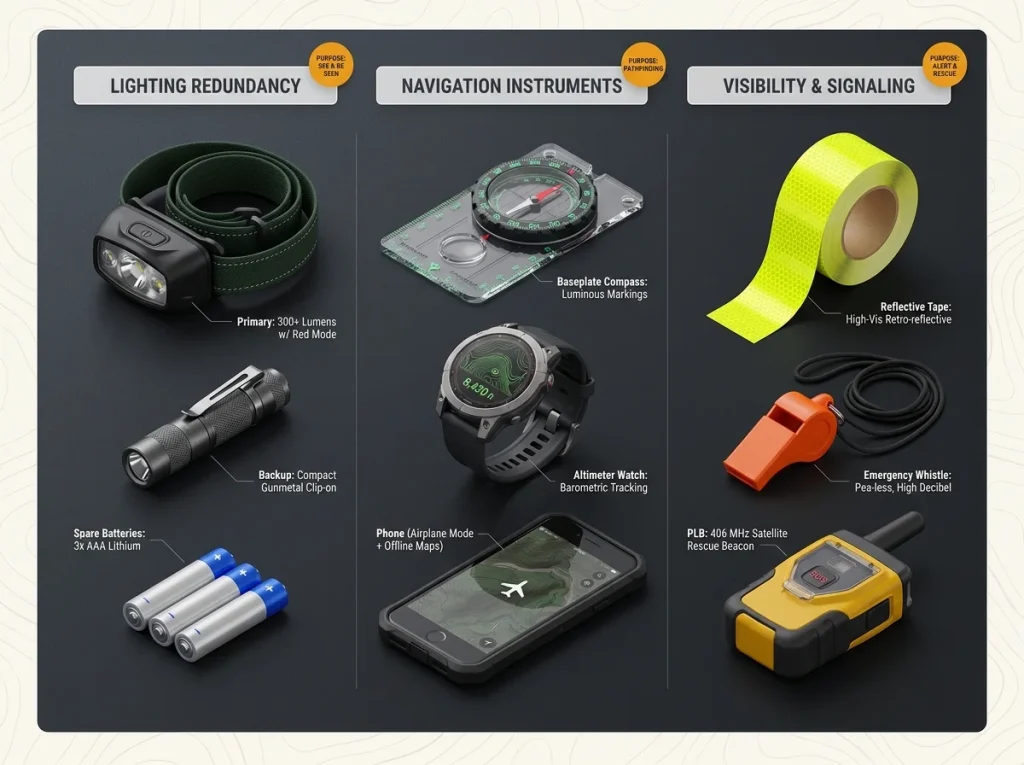
This isn’t a gear list. It’s a redundancy system. Every item exists because a specific failure mode exists, and each piece covers a gap the others can’t.
Primary and Backup Lighting
Your primary headlamp should hit 300 lumens minimum with red mode, adjustable beam pattern (spot and flood), and genuine weather resistance — not “water-resistant” marketing, but a real IPX4 or higher rating.
Your backup light goes in a different compartment. Not the same pocket, not the same stuff sack. If your pack gets soaked or you drop it, both lights shouldn’t go down together. A small clip-on light weighing an ounce is enough.
Spare batteries live in your inside jacket pocket. Your warmth keeps them charged. Cold lithium batteries can lose 40% of their charge in sub-freezing temps, and the moment you need them is always the coldest moment of the night.
Navigation Tools for Dark Conditions
A compass with luminous markings is a significant upgrade for night work. The Suunto MC-2 and Silva Ranger both have glow-in-the-dark components that stay visible for hours after a brief light charge. You can check your bearing without touching your headlamp.
An altimeter watch narrows your position to a specific contour line — on a ridge or slope, that often pins your location within 50 meters. Combined with a compass bearing, it’s a two-point fix without needing to see any landmarks.
Your phone GPS goes in airplane mode with offline maps downloaded before you hit the trailhead. Airplane mode extends battery life 3 to 4 times versus cellular searching, and offline maps work without signal. But screen brightness destroys night vision — dim to minimum and use it briefly. Never rely on a phone as your only navigation tool. For more on keeping your phone useful all day, how to keep your phone GPS running all day without draining the battery covers the settings that actually matter.
Visibility and Emergency Signaling
Stick reflective tape on your pack straps. In a group, it lets the person behind track your position without either of you shouting or shining headlamps around. Simple, weighs nothing, solves a real problem.
An emergency whistle — three blasts is the universal distress signal — carries farther and louder than your voice, especially when you’re tired and cold. A pea-less design (like the Fox 40) works in all temperatures and won’t freeze up.
If you carry a PLB or satellite messenger, nighttime navigation problems are exactly the scenario they exist for. A satellite SOS from a known position gets a response hours faster than a cell call from a dead zone.
Conclusion
Night navigation goes wrong when hikers trust perception over instruments. Your brain overestimates slopes, underestimates remaining distance, and distorts time — three failures that compound each other and get worse with fatigue and cold.
Your headlamp is a precision tool with modes, not an on/off switch. Red light for close work, white for walking, and off entirely for the skyline silhouette checks that show you more terrain than any beam ever will. And the distinction between a planned night hike and getting caught out after dark changes every decision — from pace to gear to whether moving at all is the right call.
Go practice on a trail you know well. An hour after sunset, in good weather, with a backup plan. Build the muscle memory of pacing, compass micro-legs, and headlamp-off terrain reading before you need it for real.
Q1 How do you navigate a trail at night?
Use compass bearings broken into short 50-100 meter legs, pace counting for distance verification, and attack points at key junctions. A headlamp with red mode preserves night vision while allowing map checks between legs.
Q2 What equipment do you need for night hiking navigation?
A 300+ lumen headlamp with red mode, a backup light stored separately, a compass with luminous markings, an altimeter watch, and a phone with offline maps in airplane mode. Spare batteries go in an inside jacket pocket to prevent cold drain.
Q3 Is it safe to hike at night alone?
Solo night hiking increases risk because you can’t leapfrog compass bearings, cross-check navigation decisions, or call for help if you’re injured and immobile. Carry a satellite messenger and leave a detailed trip plan with someone who will act on it if you’re overdue.
Q4 How long does it take for eyes to adjust to darkness?
Functional dark adaptation kicks in after 20-30 minutes as rhodopsin builds in your rod cells. Full sensitivity takes up to 2 hours. One flash of bright white light resets the process — switch to red mode to preserve what you’ve built.
Q5 Can you use a phone GPS for night hiking?
Yes, with limits. Switch to airplane mode with offline maps to extend battery 3-4x. Dim the screen to minimum and check briefly — screen brightness wrecks night vision for 20+ minutes. Never rely on a phone as your only navigation tool.
Risk Disclaimer: Hiking, trekking, backpacking, and all related outdoor activities involve inherent
risks which may result in serious injury, illness, or death. The information provided on The Hiking Tribe is for
educational and informational purposes only. While we strive for accuracy, information on trails, gear, techniques,
and safety is not a substitute for your own best judgment and thorough preparation. Trail conditions, weather, and
other environmental factors change rapidly and may differ from what is described on this site. Always check with
official sources like park services for the most current alerts and conditions. Never undertake a hike beyond your
abilities and always be prepared for the unexpected. By using this website, you agree that you are solely
responsible for your own safety. Any reliance you place on our content is strictly at your own risk, and you assume
all liability for your actions and decisions in the outdoors. The Hiking Tribe and its authors will not be held
liable for any injury, damage, or loss sustained in connection with the use of the information herein.
Affiliate Disclosure: We are a participant in the Amazon Services LLC Associates Program, an
affiliate advertising program designed to provide a means for us to earn advertising fees by advertising and linking
to Amazon.com. As an Amazon Associate, we earn from qualifying purchases. We are also an official affiliate partner
of Black Diamond Equipment via the AvantLink network. If you click on a Black Diamond affiliate link and make a
purchase, we may earn a commission at no additional cost to you. We also participate in other affiliate programs and
may receive a commission on products purchased through our links. Additional terms are found in the terms of
service.