In this article
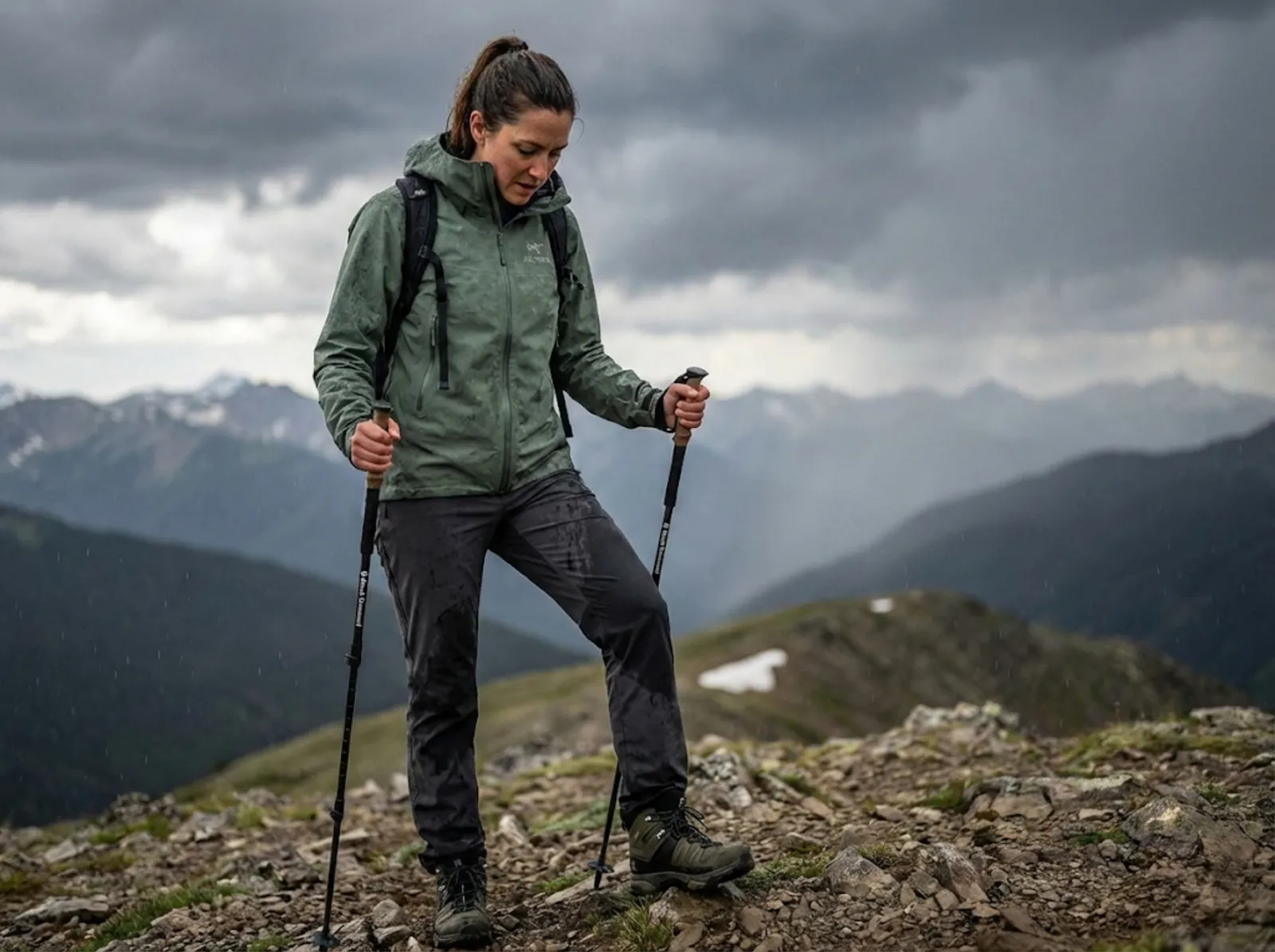
Rain hit the ridge sideways—40 mph gusts slamming water into my thighs like a garden hose. My “water-resistant” hiking pants held for exactly twelve minutes before the fabric went dark, heavy, and cold. Three hours from the trailhead, soaked from hip to ankle, I started doing the math on hypothermia.
After fifteen years of testing gear across the Cascades, the Canadian Rockies, and Iceland‘s wind-hammered highlands, I’ve watched dozens of hikers make the same mistake I did that day. They grab water-resistant pants when they need waterproof, or they buy $300 hardshell rain pants and wonder why they’re drowning in their own sweat on a steep climb. The difference between these two categories isn’t marketing—it’s physics, and the consequences show up fast when conditions turn ugly.
This is the breakdown I wish someone had handed me before that ridge walk. Real ratings, real failures, and a dead-simple framework for picking right every time.
⚡ Quick Answer: Water-resistant pants use a DWR surface coating that sheds light drizzle but saturates in sustained rain. Waterproof pants add a physical membrane barrier (ePTFE, ePE, or PU) plus taped seams to block water under pressure—but they trap more body heat. Match your choice to rain duration, exertion level, and safety stakes. Most hikers need both: water-resistant softshell pants for daily wear and lightweight waterproof rain pants in the pack for when conditions turn serious.
What “Water-Resistant” and “Waterproof” Actually Mean (And Where the Line Blurs)
Hydrostatic Head Ratings Decoded
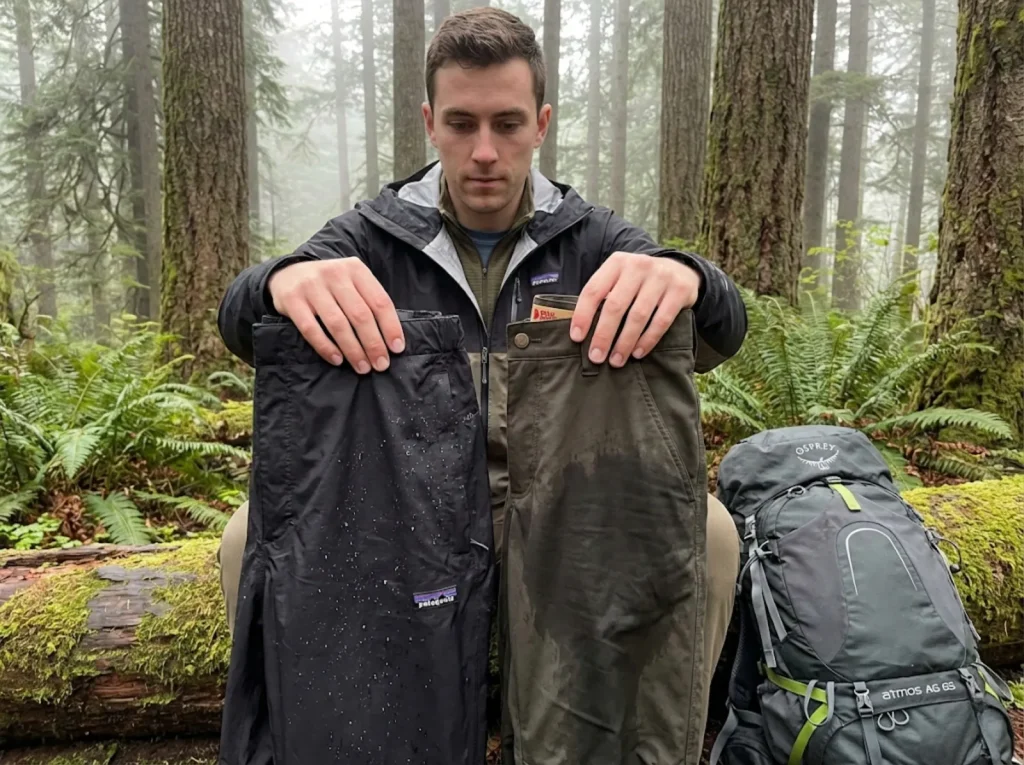
The number that separates water-resistant from waterproof is called the hydrostatic head (HH)—the height of a water column a fabric can hold back before a single drop pushes through, measured in millimeters. Water-resistant pants typically sit between 0 and 1,500mm. Waterproof pants start at 5,000mm and run all the way to 20,000mm or higher for extreme alpine use.
Those numbers sound abstract until you put them in real-world context. Just walking in rain generates minimal pressure on the fabric. But sit down on wet granite, and you’re pushing roughly 2,000mm of pressure into your backside. Kneel with a 40-lb pack pressing down on your thighs? That can spike to 10,000mm or more. The EN 343 standard—the European classification for protective clothing—requires Class 3 garments to withstand a minimum of 13,000mm for a reason.
Pro tip: A 10,000mm rating sounds bombproof until you kneel on wet ground with a heavy pack. That’s when pressure leaks teach you the hard way. If you’re carrying more than 30 lbs, look for 15,000mm minimum.
If you want to understand our full breakdown of waterproof ratings and what the numbers actually mean, those details will give you the complete picture of how testing works and what the mm scale means in practice.
DWR Coatings vs. Membrane Barriers
Here’s the distinction most hikers miss: DWR (Durable Water Repellent) is a chemical surface treatment that makes water bead and roll off the face fabric. It does NOT make a garment waterproof. Water-resistant pants rely on DWR combined with tightly woven nylon or polyester fibers. Waterproof pants add a physical membrane layer underneath—a microscopically porous barrier that blocks liquid water while allowing vapor molecules to escape.
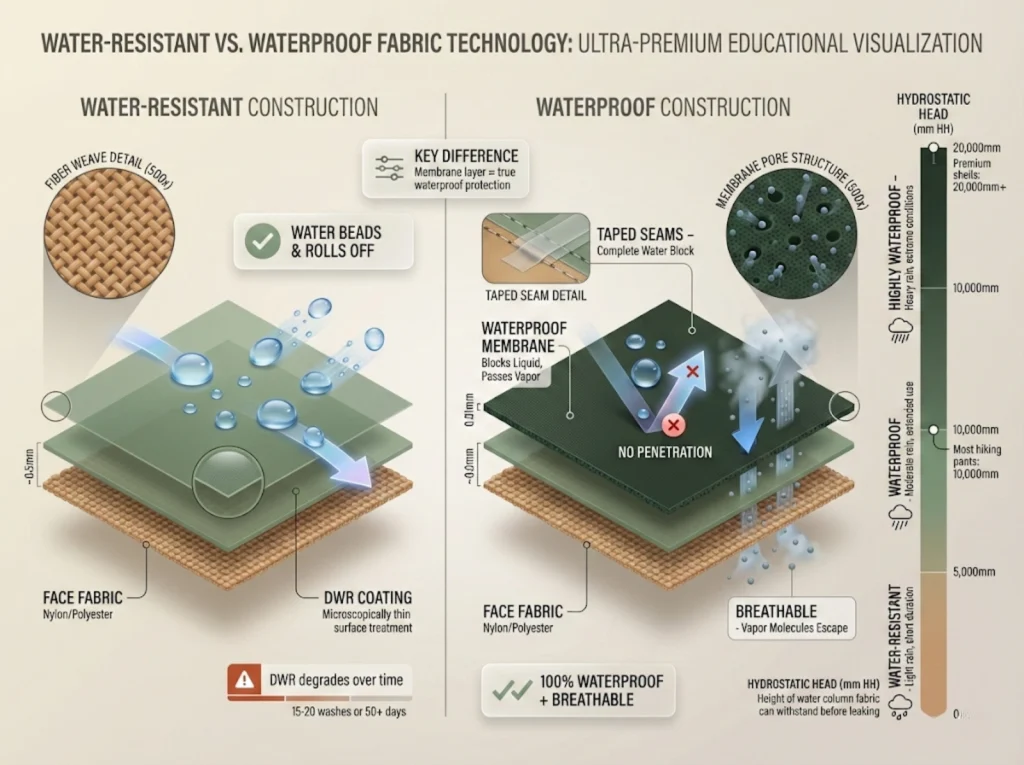
The catch? DWR degrades with wear, body oils, dirt, and UV exposure. After about 15–20 washes or 50+ days of trail use, that beading action fades. Your face fabric starts absorbing water instead of shedding it—and that creates a cascading problem even on gear with a perfectly intact membrane underneath.
Seam Construction—The Weak Link Nobody Checks
Every needle puncture in a pair of hiking pants creates a potential leak point, and a single pant may have hundreds of them. Taped seams use heat-activated adhesive strips to seal those punctures. Welded seams skip stitching entirely, bonding fabric with ultrasonic or RF energy. Without one of these, a garment is NOT functionally waterproof—no matter what the tag says about its membrane.
Budget rain pants often feature “critical seam taping,” which covers only the high-stress areas like the inner thigh and seat. Premium models offer fully taped construction from waistband to hem. Check your seam tape condition at least once a year—delamination is the most common failure point on gear older than three seasons.
Why Breathability Is the Trade-Off That Ruins Good Intentions
How Waterproof Membranes Actually Breathe
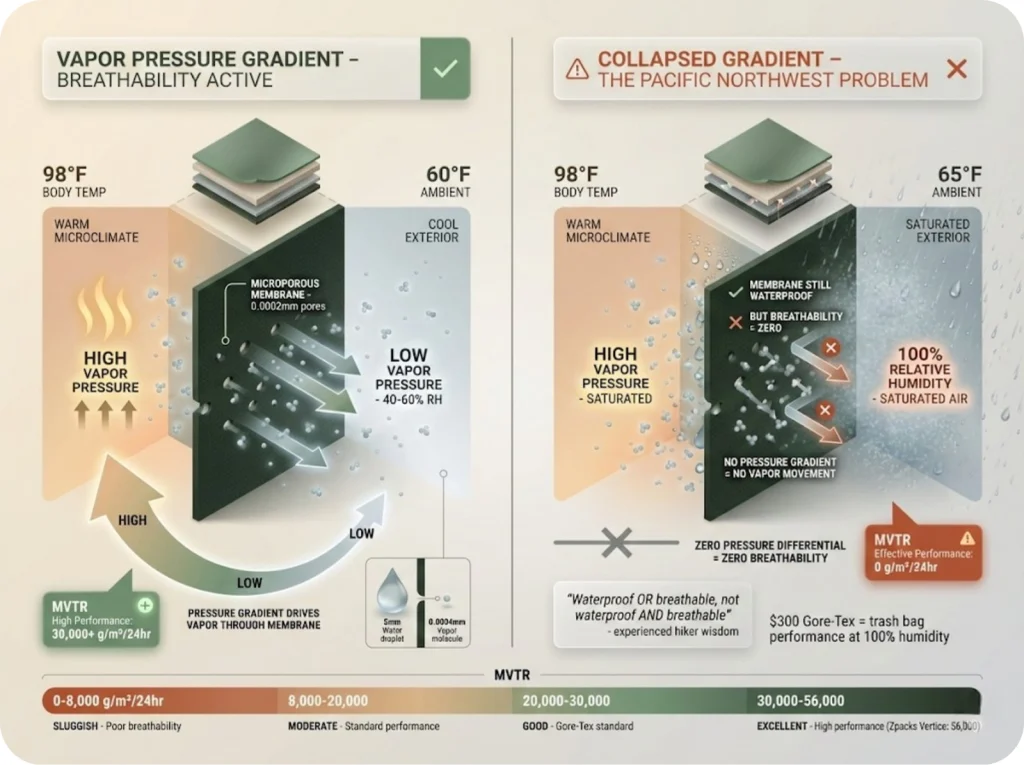
Waterproof-breathable membranes work because your body heat creates higher vapor pressure inside the garment than outside. That pressure difference pushes moisture vapor through microscopic pores or across a molecular diffusion barrier. The measurement for this is MVTR (Moisture Vapor Transmission Rate)—anything under 8,000 g/m²/24hr is sluggish, while values over 30,000 represent high-performance gear. The Zpacks Vertice hits a staggering 56,000—more than triple standard Gore-Tex.
But here’s the reality check that expensive marketing materials won’t tell you. When external humidity hits 100%—common in Pacific Northwest rainforests or Scotland’s Highlands—the vapor pressure gradient collapses entirely. Your $300 Gore-Tex rain pants perform no better than a trash bag because the moisture inside has nowhere to go. As one experienced hiker put it: “Waterproof-breathable is better described as waterproof or breathable, not waterproof and breathable.”
The “Wetting Out” Problem That Kills Expensive Gear
“Wetting out” happens when the DWR on your face fabric fails and the outer layer saturates with water. Even with a fully functional membrane underneath, a wetted-out pant feels clammy, heavy, and miserable—the dreaded “sauna effect.” The membrane might still block rain from coming in, but trapped sweat can’t get out because the saturated face fabric kills the vapor pressure differential.
Body oils, sunscreen residue, and trail dirt all accelerate DWR failure. In the post-PFAS era of 2025-2026, this problem is worse than ever. New PFAS-free DWR treatments can’t repel body oils the way the old fluorocarbon-based C6 and C8 treatments could. Your brand-new gear wets out faster from skin contact than gear from five years ago. The EPA’s strategic roadmap on PFAS confirms these “forever chemicals” persist in the environment indefinitely, which is why the outdoor industry is racing to eliminate them—even at the cost of DWR longevity.
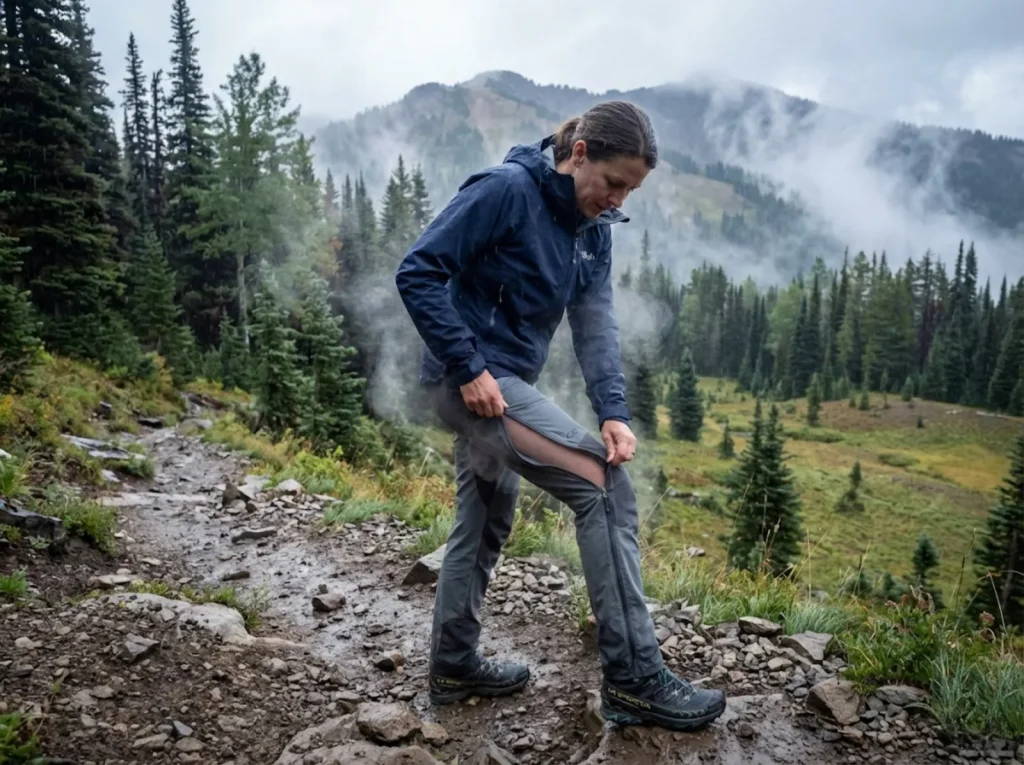
Pro tip: Don’t rely solely on the membrane. Open your thigh zips before you start sweating, not after. Proactive mechanical venting beats membrane breathability in every humidity condition.
When Water-Resistant Pants Actually Win
Water-resistant softshell pants offer dramatically higher breathability and comfort during high-output activities—trail running, fast-paced day hikes, scrambling on exposed rock. In warm conditions above 60°F with intermittent drizzle, water-resistant pants actually keep you drier overall because you’re not trapping sweat against your skin.
The honest math? Water-resistant wins in roughly 70% of typical hiking conditions. Waterproof wins in the 30% that can turn dangerous. For anyone weighing the hardshell vs softshell decision most hikers blow, the same logic applies to pants: softshell breathes better, hardshell protects better, and knowing when each matters is the whole game.
The Membrane Technology Showdown—ePTFE, ePE, and PU Explained
Gore-Tex and the ePTFE Legacy
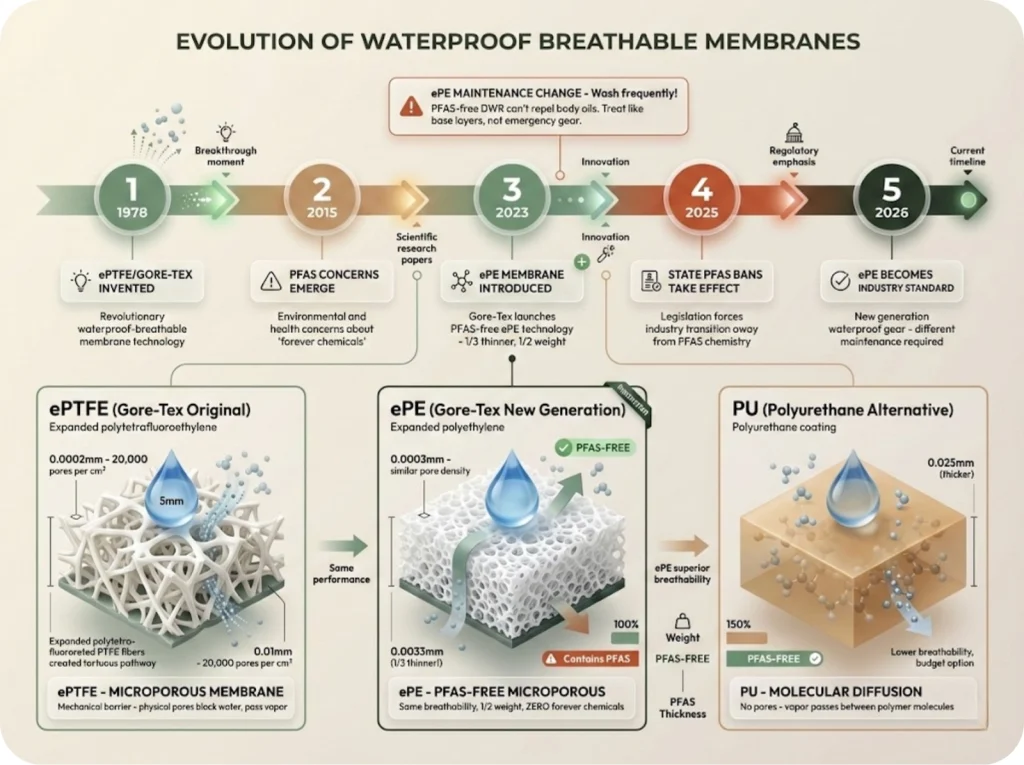
ePTFE (expanded Polytetrafluoroethylene) has been the gold standard waterproof membrane since 1978. Billions of micropores per square inch—each 20,000 times smaller than a water droplet but 700 times larger than a vapor molecule. Gore-Tex Pro, Active, and standard tiers offer different breathability-to-durability ratios depending on the face fabric weight and backing construction.
The problem? ePTFE is built on PFAS chemicals—”forever chemicals” that persist in the environment indefinitely. Legislative bans in California, New York, and Vermont are forcing the entire industry to pivot. For more context on PFAS chemicals in outdoor gear, the Green Science Policy Institute tracks this transition closely.
The ePE Revolution (2025-2026)
The replacement is ePE (expanded Polyethylene)—Gore-Tex’s next-generation membrane. One-third the thickness and half the weight of ePTFE, and completely PFAS-free. Jon Doran captured the shift perfectly: switching from ePTFE to ePE is like “Cadburys suddenly switching from dairy to oat milk”—a fundamental chemical change that shouldn’t affect performance but absolutely changes maintenance requirements.
Here’s the critical buyer warning that nobody is talking about: PFAS-free DWR on ePE garments requires more frequent washing, not less. The new coatings lack oleophobic properties, which means they can’t repel body oils the way the old chemistry could. If you treat your new technical pants like an “emergency layer” that sits in your pack for months, oils build up and the face fabric wets out prematurely. Wash your shells as often as your base layers. For our deep dive comparing Gore-Tex and eVent membrane performance, those test results show how these membranes behave under real trail conditions.
Budget Alternatives—PU Membranes and When They’re Enough
PU (Polyurethane) membranes are the budget-tier waterproof option. They’re hydrophilic, meaning they move moisture through molecular diffusion rather than physical pores. Typical performance sits around 10,000–15,000mm HH at a fraction of Gore-Tex pricing. Patagonia’s H2No and Outdoor Research’s AscentShell both use PU-based technology.
The trade-offs are real: PU membranes tend to be heavier, less breathable, and more vulnerable to hydrolysis—chemical breakdown from long-term moisture exposure. But for hikers who pull out rain pants 5–10 times per year in moderate conditions, PU delivers 90% of the protection at about 30% of the cost. That’s a solid deal for most day hikers.
Matching Pants to Your Trail—The Climate and Activity Matrix
Southwest Day Hikes vs. Pacific Northwest Winters
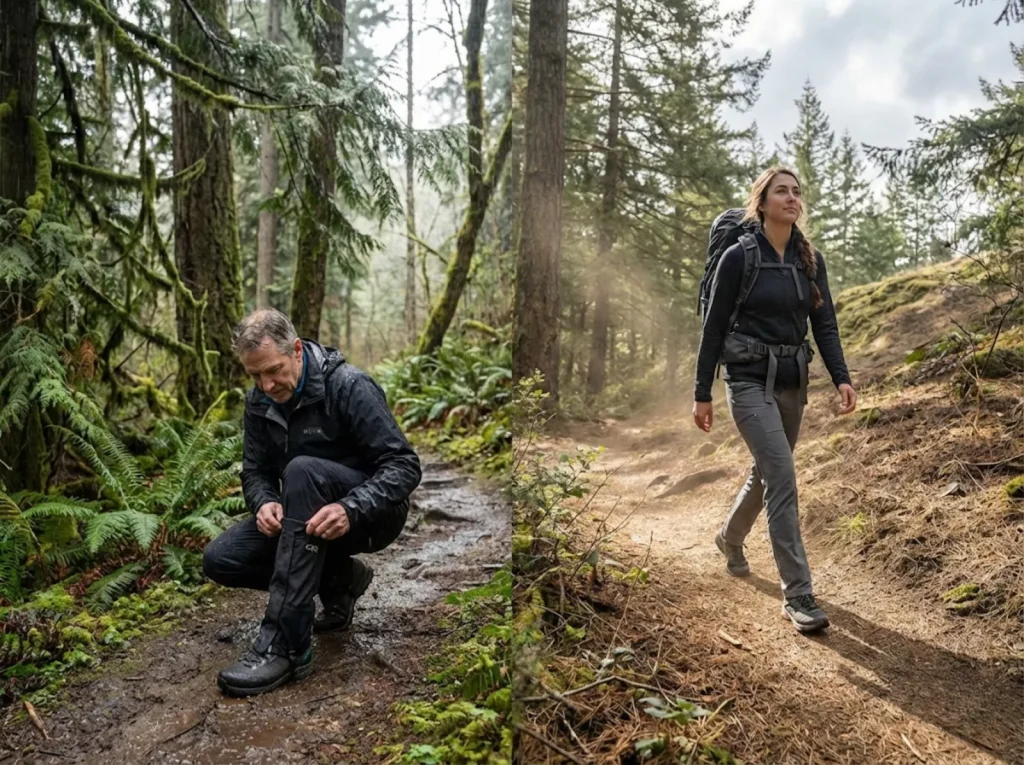
Desert hiking in the American Southwest favors water-resistant pants with high breathability and UV protection. Afternoon monsoon showers are brief and intense—drying speed matters more than waterproofing. A pair of quick-dry nylon hiking pants handles this environment perfectly.
The Pacific Northwest is a different animal entirely. Multiday rain, near-freezing temps, and humidity levels that kill membrane breathability demand 20,000mm+ HH with 3-layer construction and full thigh vents. Appalachian Trail thru-hikers split the difference with packable 2.5-layer rain pants rated at 10,000mm or higher—you’ll get wet anyway, so prioritize fast drying between cycles.
The Iceland sanity check is worth noting: community consensus says water-resistant pants are fine for exploring Reykjavik, but you’ll “regret not having waterproof pants” the moment you’re near waterfalls or caught in sideways rain. Professional guides there warn that “hypothermia starts happening at surprisingly high temps, especially if you’re soaked by cold rain.”
High-Output Activities vs. Low-Output Protection
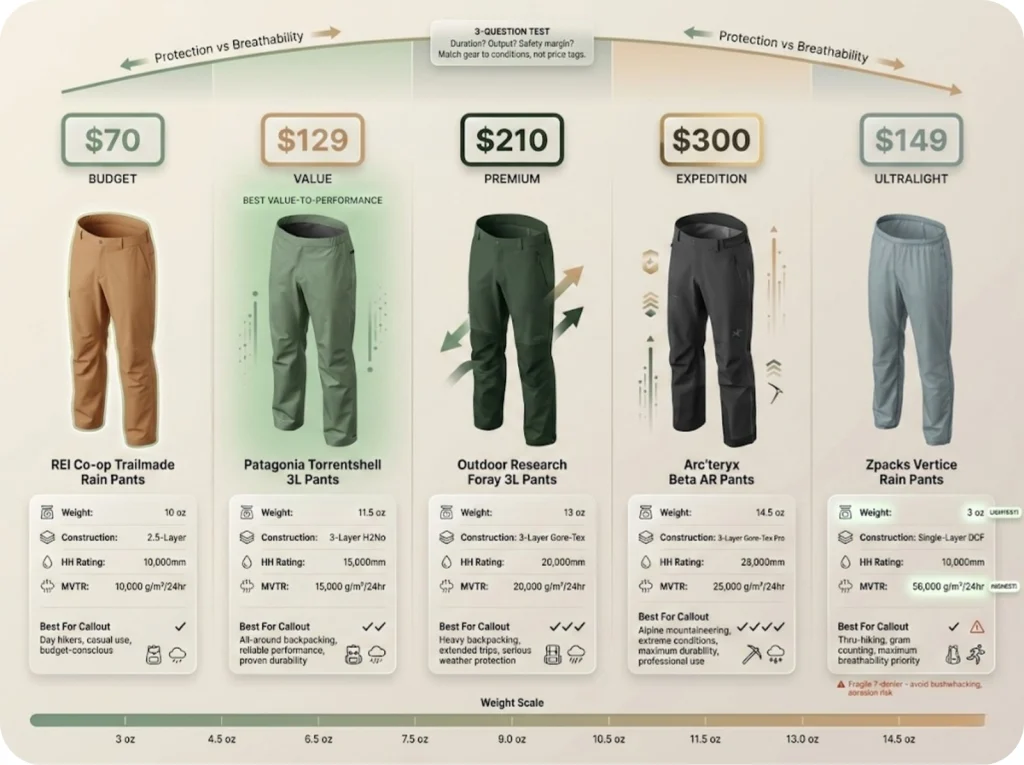
Trail running and fast-paced hiking put a premium on MVTR over HH—you’re generating maximum sweat, and trapping it will make you miserable regardless of what the rain is doing. The Zpacks Vertice, at 3 oz with 56,000 MVTR, targets gram-counting thru-hikers who prioritize breathability over everything else.
Backpacking with a 40-lb pack flips the equation. You need 15,000mm minimum because pack strap pressure can exceed a 10,000mm fabric’s resistance threshold. If you’re curious about how your pack weight affects waterproof ratings under pressure, those numbers explain exactly why “pressure leaks” happen along shoulder and hip belt contact points.
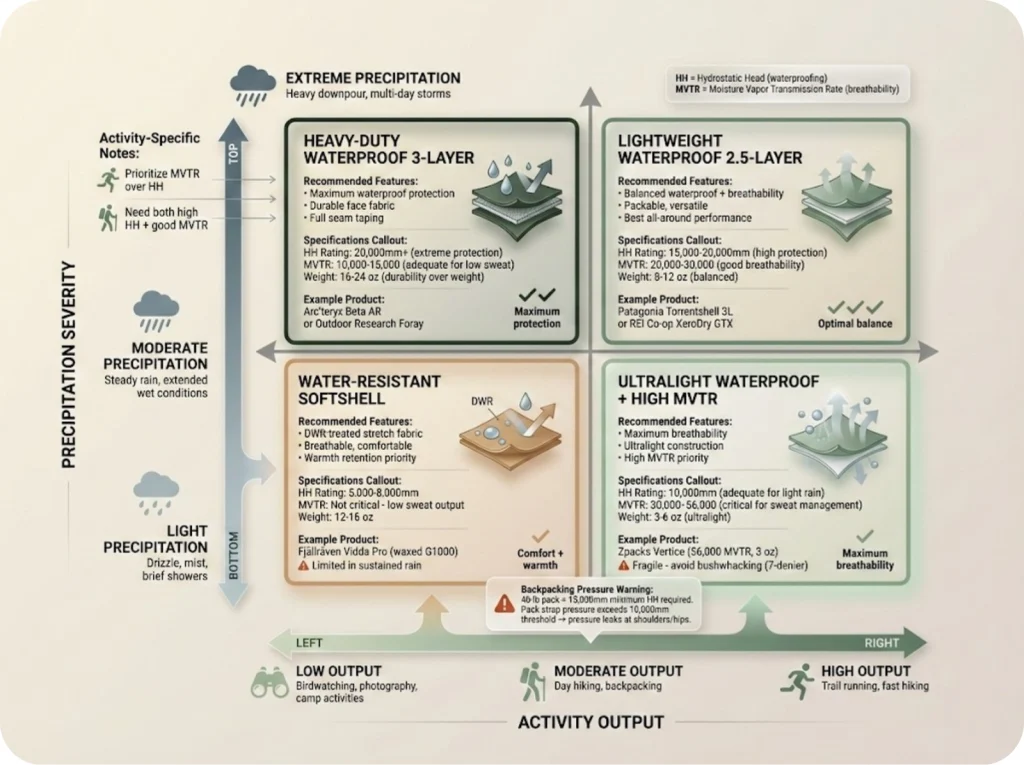
Low-output activities like birdwatching and photography shift priorities again—warmth retention and water penetration resistance matter most because you aren’t generating enough body heat to drive meaningful vapor transfer through any membrane. The hiker who chose the Fjällräven Vidda Pro (waxed G1000 fabric) for a rainy week in Iceland learned this the hard way—it’s nearly indestructible against thorns, but community reports confirm it’s “close to useless in sustained rain” despite double waxing. And the ultralight hiker who picked the Zpacks Vertice for off-trail bushwhacking? That 7-denier fabric shredded on the first bramble patch.
Construction Details That Separate Good Gear from Garbage
2-Layer, 2.5-Layer, and 3-Layer—What the Numbers Mean
2-layer construction bonds the membrane to the face fabric only, with a separate hanging liner protecting the membrane from body contact. It’s typically the heaviest and cheapest option. 2.5-layer bonds the membrane to the face fabric and prints a protective pattern—the “half layer”—directly onto the membrane’s interior. It’s the lightest and most packable, but that printed interior feels “plasti-y” against bare skin.
Three-layer construction sandwiches the membrane between a face fabric and a full micro-grid backer, creating one cohesive textile that’s the most durable, most comfortable against skin, and heaviest of the three. The REI Trailmade Rain ($70, 7.8 oz) represents entry-level 2.5L. The Patagonia Torrentshell 3L ($129, 11.8 oz) is the current “best overall” balance. The Arc’teryx Beta Pant ($300, 10.9 oz) is premium 3L Gore-Tex ePE for hikers who want the lightest possible three-layer laminate option.
For anyone weighing the durability trade-offs alongside their rain jacket choice, which rain jacket fails first on the trail covers the same 2.5L vs 3L reliability question for upper-body rain gear.
Ventilation Engineering—Why Zips Beat Membranes
Mechanical venting—full-length thigh zips, mesh-lined pockets, side-leg openings—provides immediate, reliable airflow that works in every humidity condition. Unlike membrane breathability, which collapses at 100% humidity, a zip is a zip. It works.
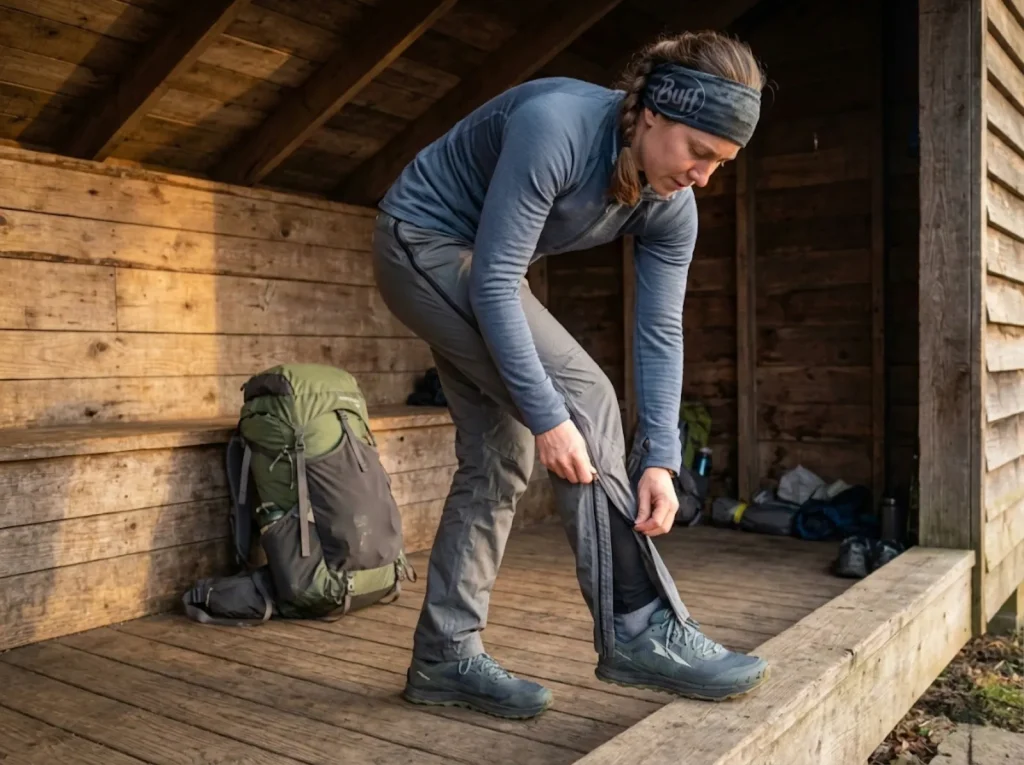
Full-zip side legs also let you pull rain pants on and off over boots without removing footwear—critical when you’re already standing in rain. Thigh vents dump heat directly from the femoral artery zone, the most efficient body-cooling area for lower-body garments.
Fit and Mobility—Articulated Knees, Gusseted Crotch
Articulated knees use pre-shaped panels that follow your leg’s natural bend, eliminating bunching on steep climbs. A gusseted crotch adds a diamond-shaped panel that dramatically increases range of motion without adding bulk. Rain pants should fit over your hiking pants—size up if you plan to layer. Boot-compatible hems with snap adjustments keep the cuffs from riding up into crampons or snagging on rocks.
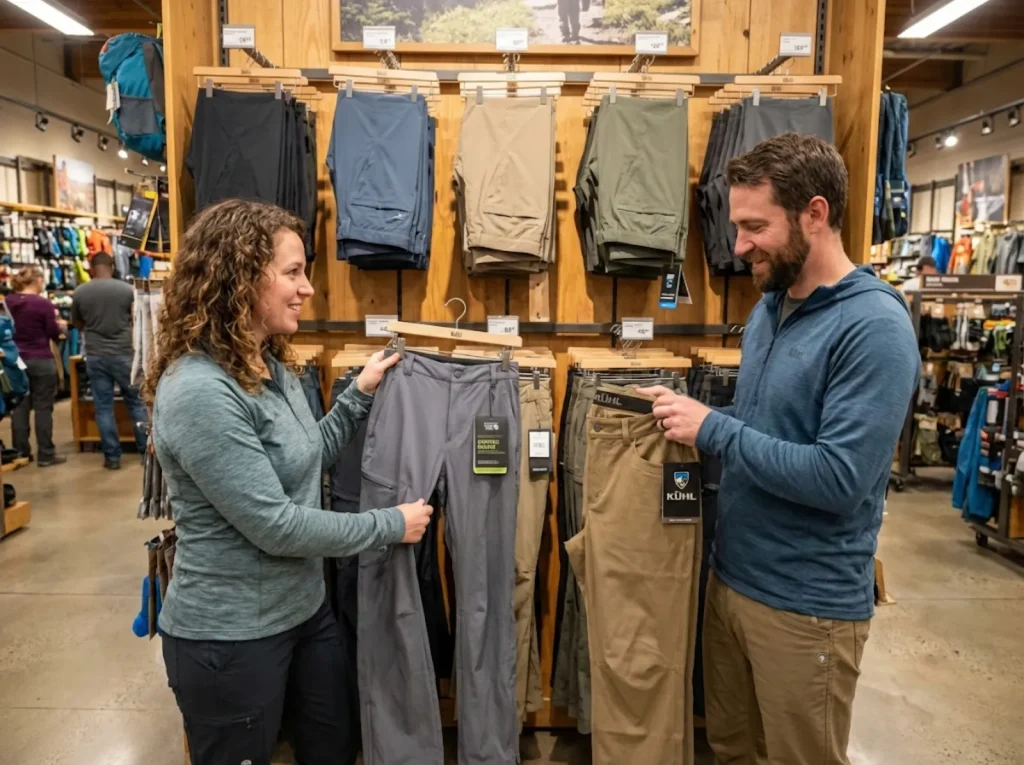
Pro tip: Try on rain pants over your heaviest hiking pants and boots before buying. Walk up stairs, do a deep squat, and kneel. If anything binds, go up a size. You’ll never regret having room to move.
Maintenance That Extends the Life of Every Pant You Own
The PFAS-Free Maintenance Shift—Wash More, Not Less
The old wisdom was “don’t wash technical gear too often—you’ll wear out the DWR.” That advice is dead. In the PFAS-free era, body oils, sunscreen residue, and environmental contamination are the primary killers of membrane performance. GORE-TEX experts now recommend that “any wash is better than no wash.”
Wash cycle protocol: cold or warm water, liquid detergent (never fabric softener), gentle cycle. Rinse twice to flush all soap residue. Your waterproof pants should be washed after every 3–5 outings, not twice a year.
Heat Reactivation and DWR Retreatment
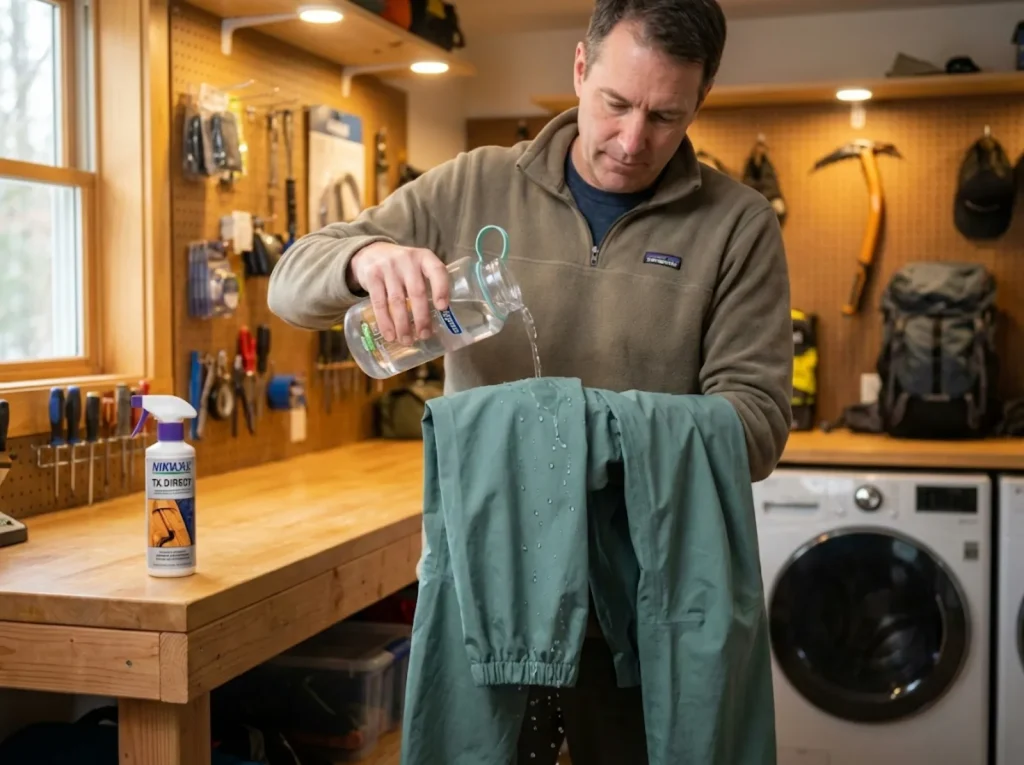
After washing, tumble dry on low heat for 20 minutes. The heat reactivates your DWR coating by realigning the chemical molecules on the fabric surface. If heat alone doesn’t restore the water beading, apply an aftermarket spray like Nikwax TX.Direct or Grangers Performance Repel Plus to the clean, damp garment.
Test your DWR condition with a simple splash: pour water on the surface. If it beads and rolls off, your DWR is still active. If the water soaks in and darkens the fabric, it’s time to wash, heat, and retreat. For our step-by-step DWR restoration protocol, that guide walks through the complete process with photos.
Storage Mistakes That Kill Waterproof Gear
Never store rain pants compressed in a stuff sack long-term. Constant compression degrades the membrane and accelerates seam sealing failure through delamination. Hang them loose in a cool, dry closet. Avoid garages, attics, and damp basements where humidity promotes hydrolysis of PU components.
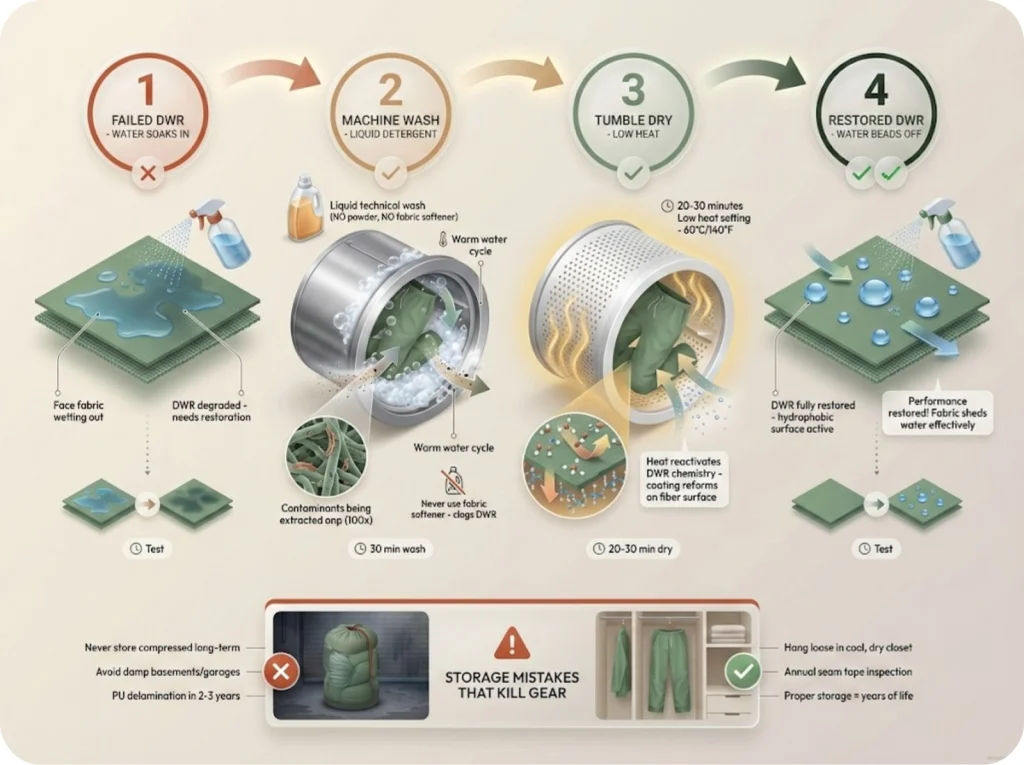
PU-coated membranes are especially vulnerable—a $200 pant stored in a damp garage can delaminate in just 2–3 years. Inspect seam tape annually by running a fingernail along the taped seams. If the tape lifts or peels, re-seal with Seam Grip+WP or retire the garment before it fails on a ridgeline.
The Decision Framework—Pick Right This Time
The 3-Question Test
Before you buy—or before you pack for any trip—run three questions:
Question 1: “How long will I be in rain?” Under 30 minutes of light rain? Water-resistant pants handle that fine. Over an hour of sustained precipitation? You need waterproof.
Question 2: “How hard will I be working?” High-output trail running or steep uphill grinds? Prioritize MVTR and breathability. Standing, photographing, or low-output walking? Prioritize HH rating and weather protection.
Question 3: “What’s my safety margin?” If getting soaked means mild discomfort on a warm summer day, water-resistant is fine. If getting soaked means hypothermia risk in cold, exposed conditions, waterproof is non-negotiable.
This framework eliminates the “I picked wrong” moment by forcing you to match gear to conditions—not to price tags or brand names.
The “Both” Strategy for Serious Hikers
The most experienced hikers I know don’t choose between water-resistant and waterproof. They carry both: lightweight softshell pants for daily wear and ultralight rain pants in the pack for when conditions turn. The combined weight of a softshell plus a 2.5L rain pant is often less than a single pair of heavy hardshell pants—with dramatically more versatility across changing weather.
Pack the rain pants in an outside pocket for quick access, not buried at the bottom where you’ll avoid putting them on because it’s too much hassle. The best weather protection in the world doesn’t help if it stays in the pack. That said, the bombproof protection of a 3L hardshell is guaranteed to keep you dry in conditions where failing means a genuine safety emergency—and no layering system replaces it.
Conclusion
Three things to carry out of this guide. First, water-resistant pants handle drizzle and sweat well, but they fail when rain gets serious—waterproof pants block rain completely but trap heat when you’re working hard. Neither is universally “right.” Second, the 2025 PFAS-free transition means your new gear needs more washing, not less. Body oils kill PFAS-free DWR faster than any rainstorm. Third, use the 3-Question Test—rain duration, output level, safety margin—to match pants to trail conditions every single time.
Next time you’re packing for a trip, lay both options on the bed and run those three questions. The answer takes ten seconds. That’s the difference between hiking through the storm and cursing through it.
FAQ
Are waterproof pants worth it for day hiking?
Only if your day hikes include sustained rain or cold-weather exposure where getting soaked creates a real safety risk. For summer day hikes with brief showers, water-resistant pants with a packable rain layer is lighter and more comfortable. Waterproof pants become essential when temperatures drop below 50°F and rain lasts more than an hour.
How do I know when my DWR coating needs retreating?
Splash water on the surface of your clean pants. If that water beads up and rolls off, the DWR is still active. If the water soaks in and darkens the fabric, wash the garment first and tumble dry on low heat—this often reactivates the coating. If water still soaks in after that heat treatment, apply a spray-on DWR product like Nikwax TX.Direct.
Can I hike in water-resistant pants in heavy rain?
Not safely for extended periods. Water-resistant pants typically withstand 1,000–1,500mm of hydrostatic pressure—enough for light drizzle. Heavy rain, sitting on wet surfaces, or pack strap pressure can push past that threshold within minutes and the fabric will saturate. Heavy rain calls for waterproof pants with a minimum 10,000mm rating.
What’s the difference between 2.5-layer and 3-layer rain pants?
A 2.5-layer pant bonds the waterproof membrane to the face fabric and adds a printed protective pattern on the membrane interior. A 3-layer pant sandwiches the membrane between a face fabric and a full textile backer. Three-layer is more durable, more comfortable against skin, and heavier. Two-and-a-half-layer is lighter and more packable but feels plasticky and wears out faster.
Do PFAS-free waterproof pants work as well as older PFAS-based gear?
The waterproof membrane performs comparably. The difference is in the DWR surface treatment—PFAS-free DWR can’t repel oils as effectively, meaning the face fabric wets out faster when contaminated by body oils or sunscreen. The fix is counter-intuitive: wash your gear more frequently—after every 3–5 outings—and heat-dry to reactivate the coating.
Risk Disclaimer: Hiking, trekking, backpacking, and all related outdoor activities involve inherent
risks which may result in serious injury, illness, or death. The information provided on The Hiking Tribe is for
educational and informational purposes only. While we strive for accuracy, information on trails, gear, techniques,
and safety is not a substitute for your own best judgment and thorough preparation. Trail conditions, weather, and
other environmental factors change rapidly and may differ from what is described on this site. Always check with
official sources like park services for the most current alerts and conditions. Never undertake a hike beyond your
abilities and always be prepared for the unexpected. By using this website, you agree that you are solely
responsible for your own safety. Any reliance you place on our content is strictly at your own risk, and you assume
all liability for your actions and decisions in the outdoors. The Hiking Tribe and its authors will not be held
liable for any injury, damage, or loss sustained in connection with the use of the information herein.
Affiliate Disclosure: We are a participant in the Amazon Services LLC Associates Program, an
affiliate advertising program designed to provide a means for us to earn advertising fees by advertising and linking
to Amazon.com. As an Amazon Associate, we earn from qualifying purchases. We are also an official affiliate partner
of Black Diamond Equipment via the AvantLink network. If you click on a Black Diamond affiliate link and make a
purchase, we may earn a commission at no additional cost to you. We also participate in other affiliate programs and
may receive a commission on products purchased through our links. Additional terms are found in the terms of
service.