In this article
I was standing at the Gertrude Saddle trailhead at 5:47am, watching a tour bus unload forty people in white sneakers onto a glacial granite slab that was still wet from overnight rain. One guy had a rolling carry-on. A woman in sandals was photographing the warning sign. The DOC ranger on duty had the expression of a man who has long since made his peace with the situation.
I turned left toward the Dusky. No queue. No rolling luggage. Just the smell of manuka, the grinding sound of river rocks moving somewhere below the mist, and the weight of eleven days of food on my back. That was the moment I understood what New Zealand’s trail system actually is: an enormous DOC network where around ninety percent of international visitors walk the same five routes, photograph the same viewpoints, and leave having missed the other ninety percent entirely.
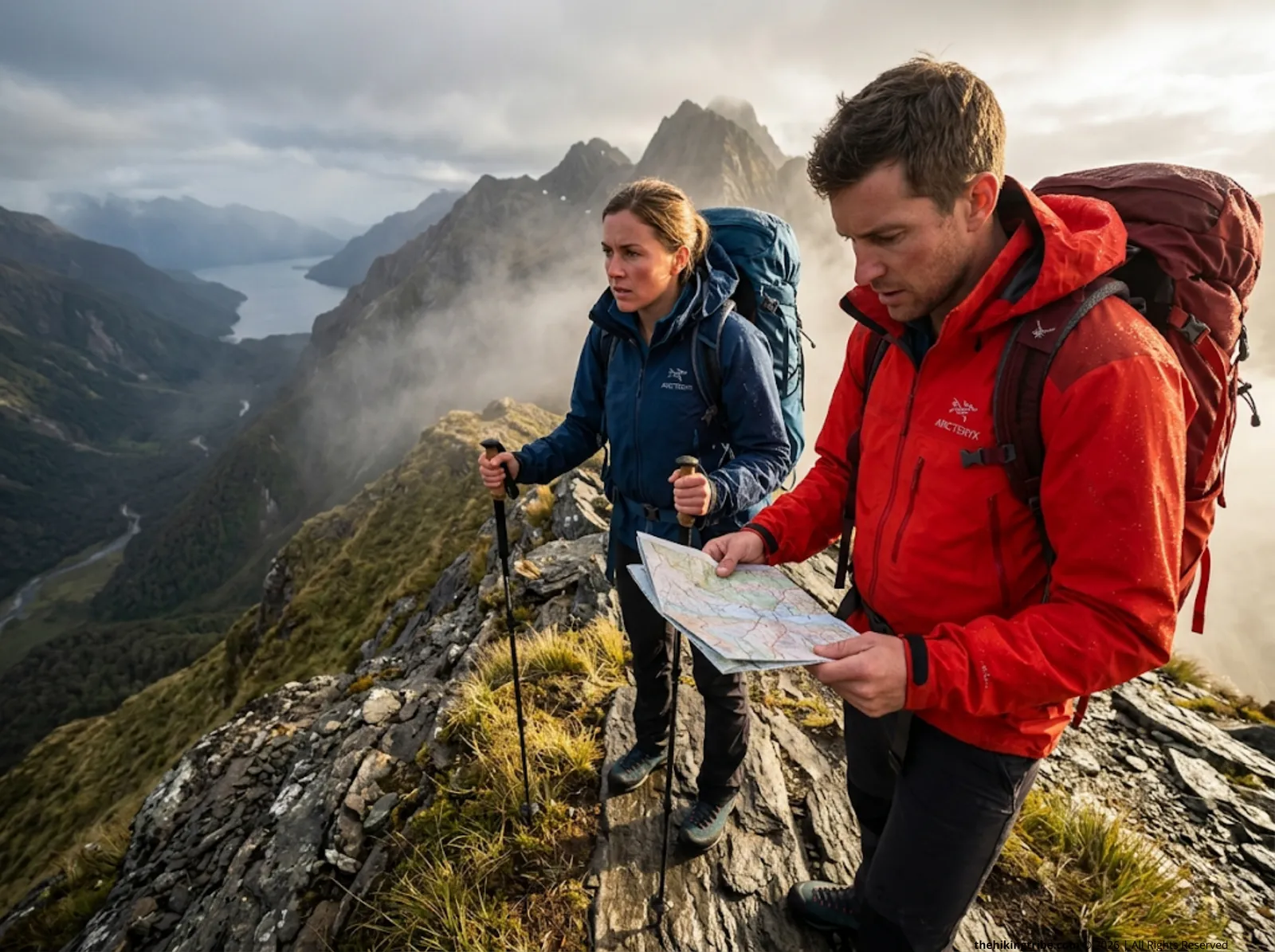
This guide is not about the Milford Track. It covers seven to ten of the technically superior alternatives using terrain classification, gear failure data, and safety protocols built on Mountain Safety Council field research — so you can make an informed decision, not just a popular one.
| New Zealand Hiking Trails Overview | ||||||
|---|---|---|---|---|---|---|
| Trail | Duration | Distance | DOC Category | Scrambling Class | UV Exposure | Notes |
| Milford Track | 4 days | 53.5km | Great Walk | Class 1 | Moderate (valley) | Sold out 24hrs after booking opens |
| Dusky Track | 8–10 days | 84km | Extra Difficult | Class 1–2 | Low (Fiordland canopy) | No pre-booking; experience mandatory |
| Gertrude Saddle | Day hike | 7km return | Expert | Class 2–3 | High (exposed granite) | Steel cables; start before 7am |
| Cascade Saddle | Day hike / 2-day | Varies | Expert | Class 2–3 | Very High (schist slabs) | Historic slips on snow-grass spurs |
| Brewster Hut | Day hike / overnight | 2.5km one-way | Advanced | Class 2 | High (alpine ridge) | 40% grade; unbridged Haast crossing |
| Gillespie Pass | 3 days | 58km loop | Advanced | Class 1–2 | High (1,600m pass) | Counter-clockwise mandatory |
| Isthmus Peak | Day hike | 16km return | Moderate-Advanced | Class 2 | High (exposed summit) | Roy’s Peak alternative; 10% of the crowd |
| Mueller Hut | Day hike / overnight | Varies | Advanced | Class 2+ | Extreme (Aoraki zone) | Kea Zone; leave boots inside |
⚡ Quick Answer: New Zealand’s most rewarding hikes for serious visitors are not the Great Walks. Routes like the Dusky Track (84km, 8–10 days), Gertrude Saddle (7km Expert day hike), and Cascade Saddle (schist, Class 2–3 scrambling) offer dramatically superior terrain and solitude. These trails demand technical preparation: 20,000mm+ hydrostatic head shells, 5mm+ lug boots, a PLB, and knowledge of the Mutual Support river crossing method. Book Great Walk huts 6–12 months in advance via DOC’s BookIt system; Expert routes require no pre-booking but need filed trip intentions before departure.
Why New Zealand’s Geology Decides Your Footwear Before Your Itinerary
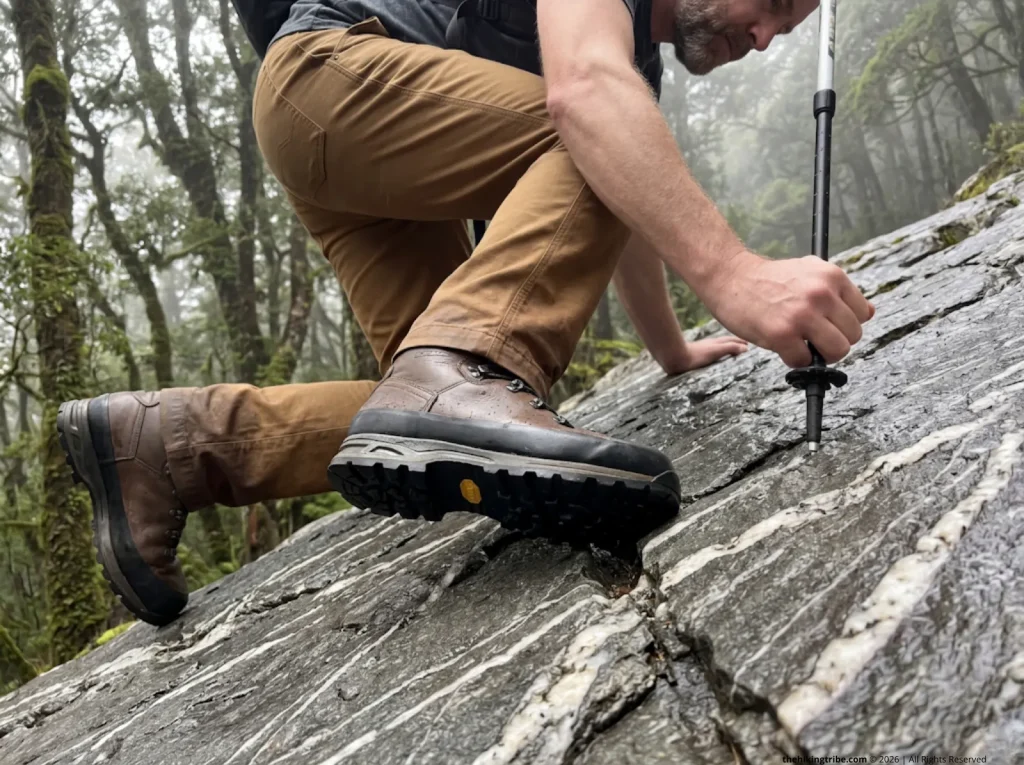
Here’s where most international visitors get it wrong before they even land: they pack boots based on the trail description, not the rock type. In New Zealand, the rock type is the trail description.
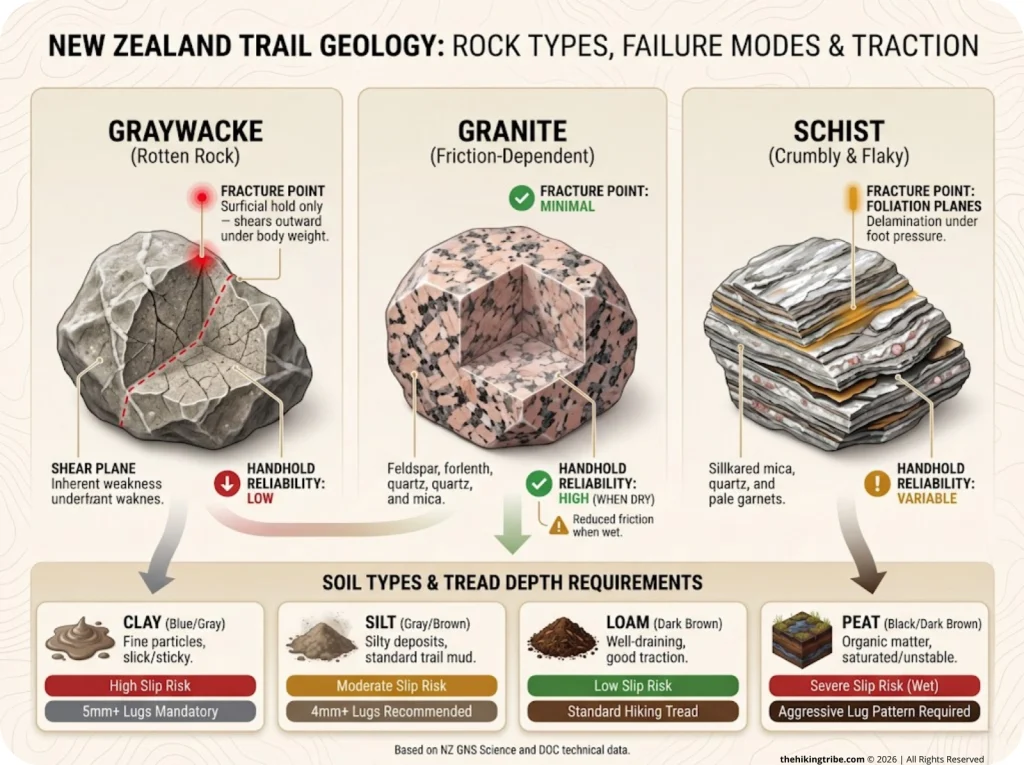
The predominant rock across the Southern Alps is graywacke, a highly indurated, quartz-veined sandstone that behaves nothing like granite. Graywacke’s mechanical properties on New Zealand tracks include frequent fracturing and crumbling in the Southern Alps — what trampers call “rotten rock.” On routes like Gertrude Saddle and Brewster Hut, a handhold that looks absolutely solid can be surficial only. It shears outward the moment you weight it. The test: tug inward and downward before committing. If it moves at all, find another hold.
The other thing graywacke does is destroy outsoles. The sandpaper effect of fractured quartz on rubber eats lug pattern at a rate 30–40% faster than granite or schist terrain. Boots that come back from a single Dusky Track looking like they’ve been dragged through a quarry are not unusual. This is not a marketing exaggeration.
Soil matters equally. Clay stays greasy when wet and turns to concrete when dry — dominant on the Kepler ridgeline and lower Dusky sections, both steep descents. Silt creates the deep, suction-inducing bogs of Fiordland valleys that reach knee depth on the Dusky. To get mechanical grip through saturated peat, you need 5mm+ lug depth minimum. Not 3mm. Not trail runners with 2.5mm grooves. Five. The lugs create mechanical engagement with the substrate; the rubber compound determines whether that engagement holds or slides on a wet clay surface. Find the rubber compound that actually grips wet schist before you commit to any Expert route in the Southern Alps.
Fiordland receives up to 9,000mm of annual rainfall. That single number drives every gear decision you’ll make on the Dusky Track or Gertrude Saddle.
The Graywacke Problem — Why “Rotten Rock” Costs You Handholds
On the granite slabs at Gertrude Saddle, grip is friction-dependent — your rubber either holds or it doesn’t. On graywacke scrambling sections like the approach to Brewster Hut or certain sections of the Dusky, grip is secondary to stability. The rock itself moves.
Graywacke is visually distinctive: highly indurated sandstone with quartz veining, often with a “sugary” flaky surface texture. When you see that texture on a scrambling section, assume every hold needs to be tested before you put any weight on it. Three-point contact with a downward pressure test before weighting each new hold is non-negotiable. Never trust a hold that looks solid — test inward pressure first, then weight gradually. Always test every handhold before committing weight.
Soil Particle Science — What “Mud” Actually Means on Technical Routes
Most hiking guides describe New Zealand trails as “muddy” and leave it there. That description is functionally useless for gear selection.
Clay soil, dominant on the Kepler ridgeline and lower Dusky sections, behaves like wet glass on steep descents. It doesn’t just make you slip — it makes you slide continuously until you hit something that stops you. Silt is different: it creates the deep, spongy bogs in Fiordland valleys where a high-lug boot can sink to the knee and come back up without the boot. High-volume lugs without adequate compound hardness will slide on wet clay the way a bald tire planes on wet asphalt. The high-acid soil environment of Fiordland also accelerates adhesive breakdown between midsoles and outsoles — which is why delamination after a single multi-day route is reported so consistently by Dusky Track veterans.
Boot Selection by Route Classification — The Pre-Trip Spec Check
Great Walk routes (Milford, Kepler): minimum 3mm lug, 10,000mm hydrostatic head boots, moderate ankle support. Advanced and Expert routes (Dusky, Brewster, Gillespie): 5mm+ lug, 20,000mm+ hydrostatic head shell on your body, full rubber rand on the boot. Ultralight trail runners fail on the Dusky Track within three days in field conditions — the greasy root systems on vertical root-climbing sections require soft-compound rubber, and the graywacke edges shred anything without a full rand.
On schist routes like Cascade Saddle, prioritize high-friction soft rubber compound over aggressive lug patterns. Aggressive lugs tend to shear on schist slabs, exactly the opposite of what you want on a 24-degree gradient. When you’re matching boot stiffness to Fiordland’s variable terrain, the key variable isn’t the trail rating — it’s the specific rock type on each section.
Pro tip: Dry your boots with newspaper after each day on multi-day routes, not campfire heat. The adhesive holding the rand to the upper starts to fail at temperatures you’d consider mildly warm.
The Underrated Eight — Technical Trail Profiles for Serious Visitors
Before the individual trail breakdowns, one note on the rating system: the DOC track classification system uses different language than most international systems. “Tramping Track” is roughly equivalent to AllTrails “Hard.” “Route” means there may be no marked track at all. And how DOC difficulty ratings compare to systems you might already know matters — “Route” and “Expert” are categories where the assumption of searcher competence is genuine, not liability-driven.
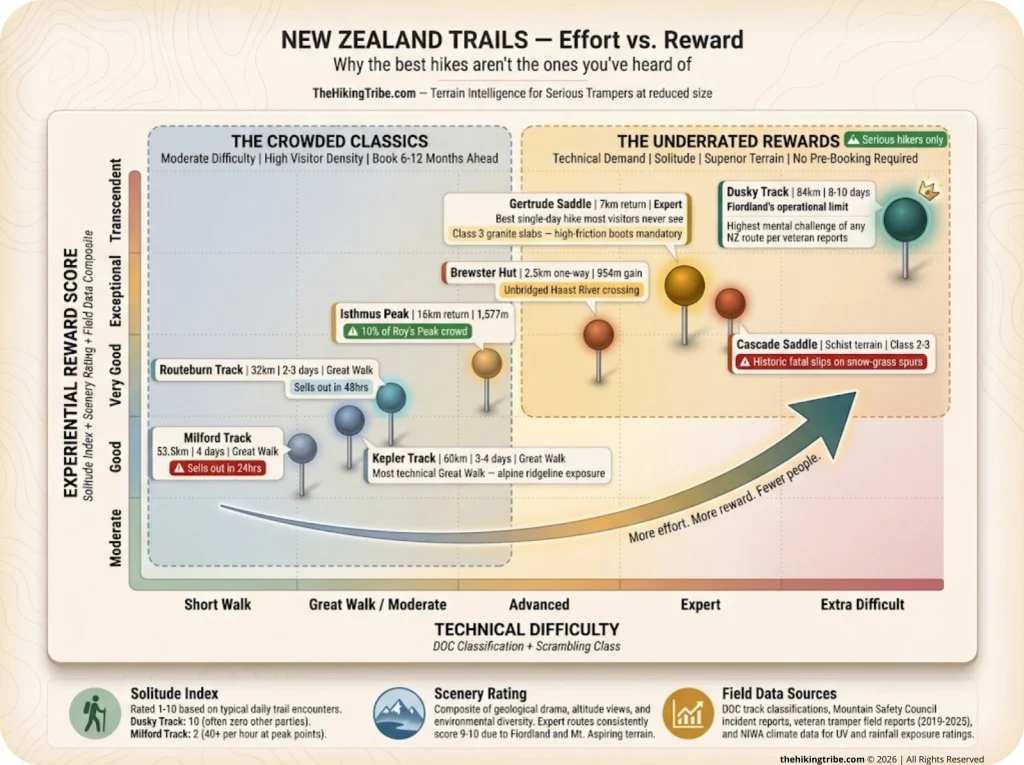
Dusky Track — Fiordland’s Operational Limit
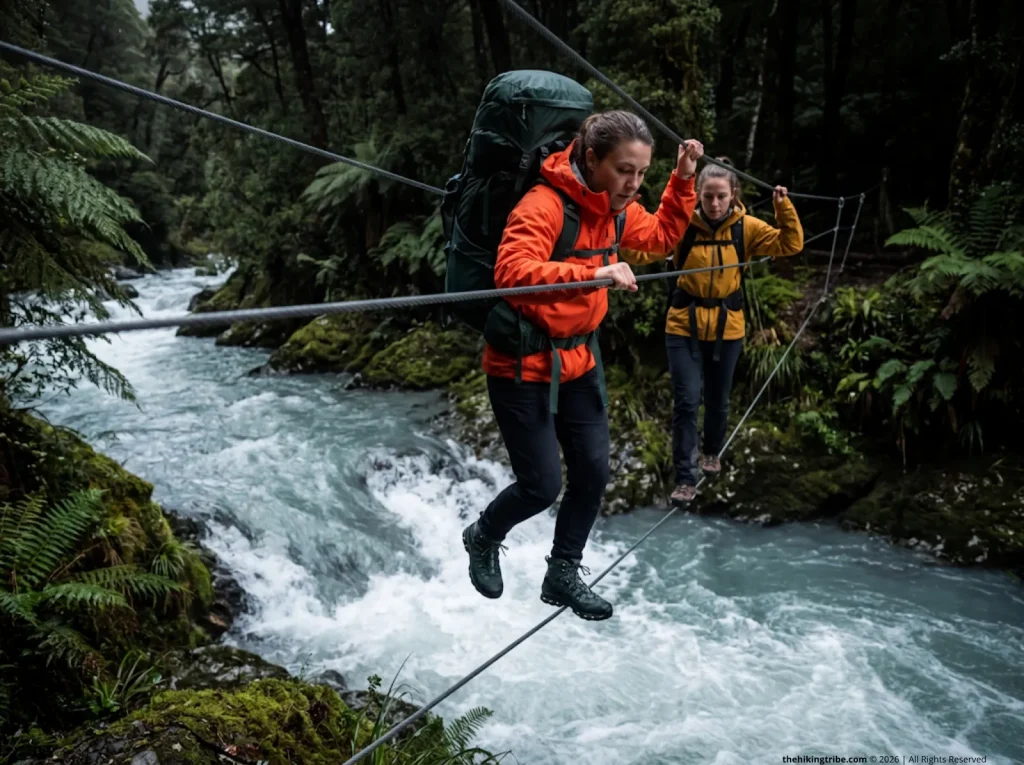
The Dusky Track is 84km over 8–10 days through the heart of Fiordland National Park — three major valley systems, two mountain ranges, 21 three-wire bridges, and annual rainfall of up to 9,000mm. DOC rates it Extra Difficult. Experienced forum users who’ve finished it consistently rate the mental challenge as the highest of any NZ route, higher than the physical one.
Two specific failure modes recur in every Dusky post-trip report. First, food weight. Packing tinned tuna adds 2kg of dead weight that costs you exactly when you need energy most — during the near-vertical root-climbing sections where you’re pulling yourself up using tree roots as handholds. Dehydrated meals only. Maximum total pack weight around 12–13kg. Second, the expectation of staying dry. You won’t. The Dusky philosophy is “warm-wet”: merino base layers maintain thermal properties when saturated; cotton does not. Plan to be wet. Plan to stay warm anyway.
Three-wire bridges require both hands and one foot in contact at all times. Don’t rush them. The ground in Fiordland is permanently moist, and sandflies make tent life genuinely miserable — DOC huts provide structural morale support that matters on day six when everything hurts.
Gertrude Saddle — Granite Friction and the Waterfall Trap
Seven kilometers return. 600 meters of gain. DOC Expert. This is the best single-day hike in Fiordland that most international visitors never see.
The scrambling classification by section: Valley Floor is Class 1. The Waterfall Area is Class 2–3. The Granite Slabs above Black Lake are Class 3. The Saddle itself is Class 2–3 with a 700m sheer drop and wind speeds that can exceed 30 knots — windchill creates hypothermia risk within 15 minutes of exposure in inadequate layers.
The trap most hikers fall into is on the descent through the Waterfall Area. When you’re tired and moving fast, it’s easy to miss the orange triangle crossing point and drift onto steep unsupported slopes that terminate in cliffs. That’s where rescue callouts cluster. Follow the markers with the same intensity on the way down as on the way up. The steel cables on the granite slabs are required in wet conditions — high-friction footwear is non-negotiable.
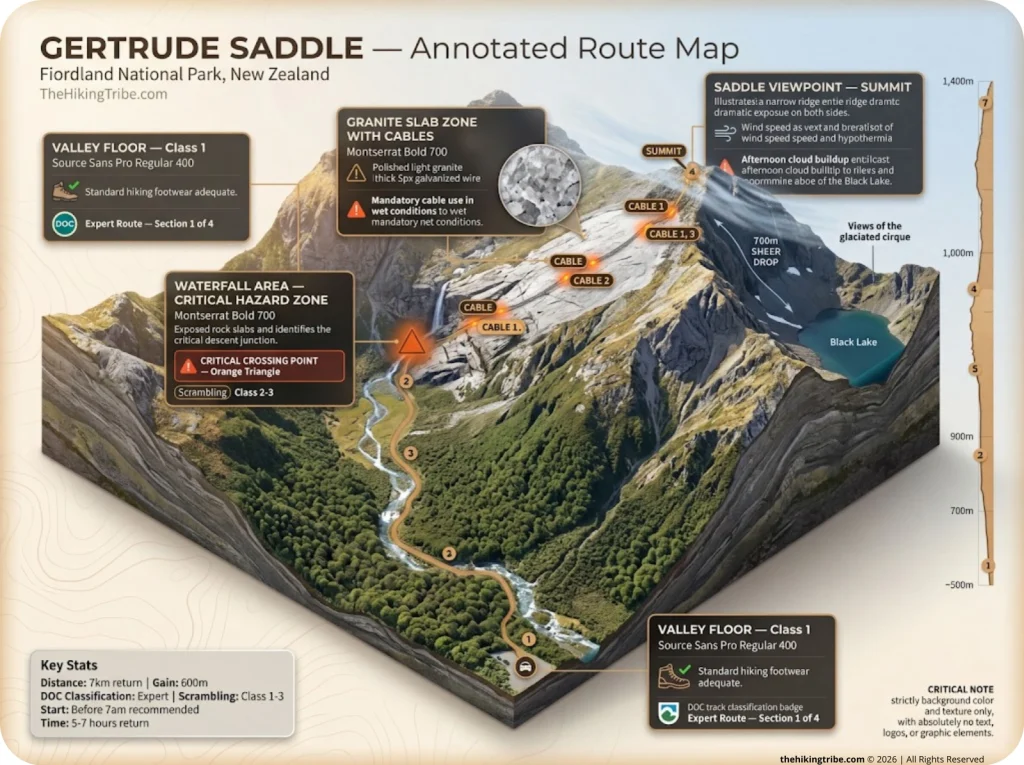
Pro tip: Start Gertrude Saddle before 7am. Early afternoon cloud buildup dramatically reduces friction on wet granite. The summit window is a morning event, not an all-day one.
Cascade Saddle — Schist, Slips, and the Point of No Return
Cascade Saddle connects the West Matukituki Valley with the Dart Valley, with views of the Dart Glacier and Mt. Aspiring (Tititea). The rock is schist — crumbly, flaky, and prone to shearing under foot pressure in a fundamentally different way than the granite at Gertrude. Same visual drama, completely different technical risk profile.
There are four decision points, each with a hard action threshold. At the Bush Line (roughly 700m vertical gain), assess weather and decide: this is your last shelter point. At the Pylon (1,780m), evaluate remaining energy knowing that six hours of technical descent still waits below. The Waterfall Traverse above the Pylon is extreme exposure with no margin for route error. The Dart Glacier Descent requires active navigation through landslides and avalanche debris — this is not trail following.
The fatal slips on Cascade Saddle historically happen on the upper snow-grass spurs, not on the technical rock. That’s the part that catches people. The scary-looking granite is where they’re careful. The easy-looking snow-grass is where complacency takes over. A 24-degree gradient on sustained descent puts enormous strain on your legs — the moment your legs start shaking, your decision-making is next.
Gillespie Pass and Brewster Hut — The Hidden Gems
Gillespie Pass Circuit is 58km through Mt. Aspiring National Park, with roughly 10% of the traffic of Milford Track on any given day. The direction mandate is counter-clockwise: climb the steeper northeast side of the pass first, descend the more gradual southwest side to Siberia Hut. If you do it clockwise, you spend the last day climbing the hard way when you’re already depleted.
The Crucible Lake side trip requires a 600m vertical push from the main circuit plus river crossings that become hazardous after rain. It is non-negotiable for anyone who wants to understand why serious hikers prioritize this route. The optional jetboat pick-up from Siberia to Makarora saves a full day of flat walking — book it early, it’s seasonal.
Brewster Hut is a nearly 40% grade: 954m gain over 2.5km. The Haast River crossing is unbridged. Assess depth against your trekking pole before you commit. Never cross if the water is moving faster than walking pace and if you can hear rocks grinding on the riverbed, you’re hearing a flash flood condition — wait. The red toilet at Brewster Hut is the first landmark you’ll see once the ridge flattens. I’ve never been so relieved to see an outhouse.
The NZ Safety Matrix — When Physics Overrules Optimism
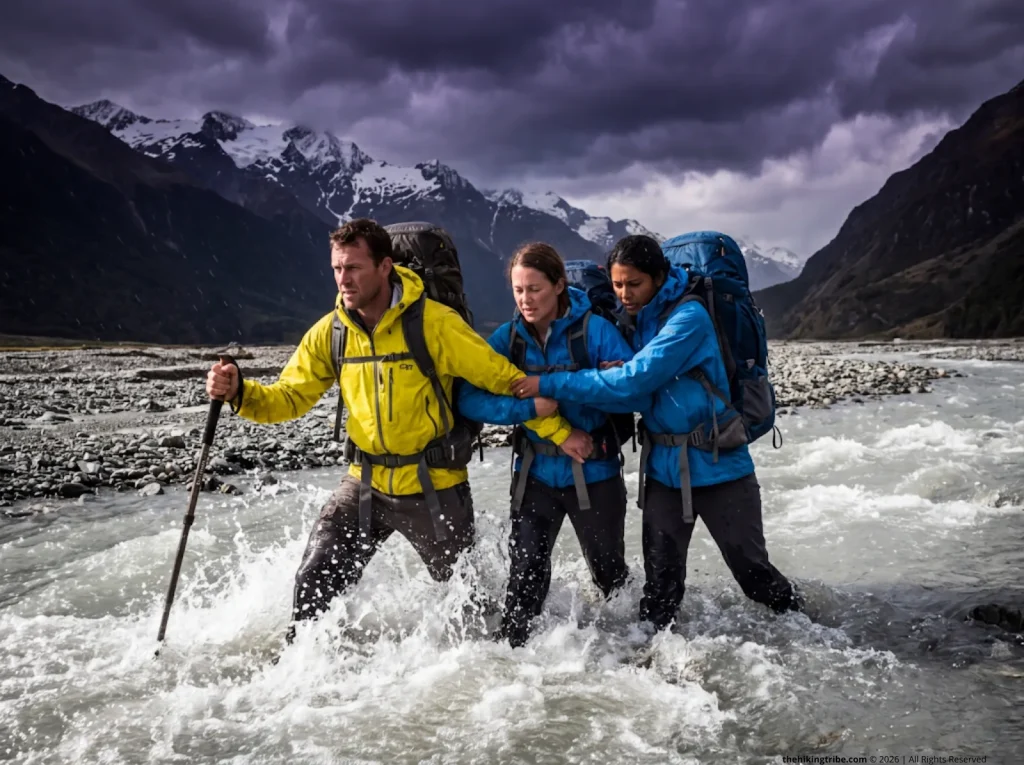
Rivers account for one-third of all NZ water-related fatalities. Read that number twice. Then consider that the most common river crossing technique international hikers use is also the least effective one: the solo wade with a pole planted upstream.
The NZ Mountain Safety Council developed the Mutual Support river crossing method in the 1990s through field testing. It replaced arm-linking and the horizontal pole method, both of which fail when a single person loses footing. The Mutual Support Method doesn’t. Combined with trekking poles and river crossing stability technique for solo situations, this is the field-validated standard for NZ backcountry.
Four signs of an unsafe river: discolored water (flood sediment), debris moving through the current, the acoustic “grinding” of rocks rolling on the riverbed, and water moving faster than walking pace. Any one of these is a turn-back signal. All four together means you wait until it changes, regardless of your itinerary.
River Crossings — The Mutual Support Method Step-by-Step
Form a tight side-by-side group of three to five people. Place your arm between your neighbor’s back and their pack, grasping their hip belt — not their arm, not their shoulder. The strongest member goes at the upstream end to break the current for everyone behind them. Angle the line slightly downstream so the current helps push the group toward the far bank rather than fighting it directly.
If the crossing needs to be abandoned partway through, the group pivots as a single unit toward the nearest bank — the “folding-snake” abort. Nobody backs out individually. Individual backing in moving water generates the kind of rotational force that takes people off their feet. The acoustic roar of moving rocks on the riverbed means flash flood conditions are either present or arriving. Get out immediately.
Hypothermia Physics and the Turn-Back Threshold
At 1,650m (Angelus Hut elevation), hypothermia becomes a real hazard within 45 minutes of rain exposure in cotton. Maritime environments strip warmth faster than dry-cold environments because moisture — whether from rain or sweat — is the actual mechanism of heat loss, not air temperature alone.
The DOC environmental cooling calculation: take your valley temperature baseline, subtract roughly 6–7°C per 1,000m of altitude gain, then subtract additional degrees for wind speed. At 1,500m altitude with 50km/h wind from a 10°C valley baseline, your effective temperature approaches -20°C. Most international visitors don’t run this calculation before starting. Some of them need helicopter extraction as a result.
The symptom sequence is: shivering → clumsiness → confusion → slurred speech. Decision-making impairment happens between stages two and three. The turn-back threshold for NZ alpine routes: if any group member reaches stage-one shivering AND wind is increasing, turn back immediately. The “umbles” — stumbling, mumbling, grumbling, fumbling — are the pre-clinical signs. Any one of them activates the turn-back protocol. Know what to do if hypothermia sets in before you reach the hut.
PLBs and the NZ Land Safety Code
There is no cell service in most Fiordland and Mt. Aspiring NP valleys. Zero. A PLB (Personal Locator Beacon) activates on the Cospas-Sarsat satellite system; NZ SAR response times are typically 1–4 hours depending on weather. PLBs are available for rental from DOC visitor centers and outdoor stores in Queenstown, Te Anau, and Wanaka for roughly NZD $25–50 per week. For any Expert route, this is not optional equipment.
The NZ Land Safety Code’s five steps: choose the right trip, understand the weather, pack warm clothes with extra food, share your plans, and take care of each other. “Share your plans” means filing the DOC Outdoors Intentions form or using the “Plan My Walk” app — this is the specific information SAR teams need to locate you efficiently. Whether to rent a PLB or invest in a satellite messenger for NZ comes down to one question: do you need two-way communication or just emergency signaling? Both have their place. Neither is a substitute for filing your intentions before you leave.
Gear That Survives New Zealand — The Field-Test Specification Guide
I used a 15,000mm hydrostatic head shell on the Kepler Track. By mid-day two, I was wet. Not because the membrane failed — because the face fabric had wet-out and I was cooking myself from condensation. My body heat had nowhere to go. I was wet from the inside out. This is one of the most common gear failures in Fiordland and it’s almost always misdiagnosed as a membrane problem.
Wet-out happens when the face fabric saturates. Once it saturates, the membrane’s breathability drops to near-zero — vapor from perspiration can’t escape, and you get wet from sweat. 20,000mm hydrostatic head is the Fiordland minimum for sustained storm coverage. DWR treatment must be refreshed at trail start if it hasn’t been reapplied within six months. For the hardshell vs softshell decision for Fiordland weather, the rain volume makes it a straightforward call: hardshell, 3-layer construction, 20,000mm+ HH, 75D face fabric minimum.
According to NIWA’s UV Index data for New Zealand’s alpine zones, NZ receives higher peak UV levels than comparable latitudes in the Northern Hemisphere due to Earth’s elliptical orbit, clean air, and seasonal ozone variation. UV increases 10–15% per 1,000m of altitude. At UVI 12 — which is standard at altitude on a clear NZ summer day — fair-skinned individuals can get a serious burn in 12 minutes. Snow and granite reflection can add 30% on top of direct radiation. Most visitors don’t account for reflected UV at all.
Shell Ratings That Actually Work in Fiordland
Three-layer construction outperforms 2.5-layer on high-exertion multi-day routes. 2.5-layer shells clog with body oils under extended use, reducing breathability further. Face fabric weight matters on scrambling sections: heavier face fabrics (75D+) resist abrasion from graywacke edges; ultralight 20D shells tear on contact with fractured rock. “Breathable” ratings mean nothing in static rain — breathability requires temperature differential AND body movement to function.
Kea-Proofing — The Alpine Parrot Defense
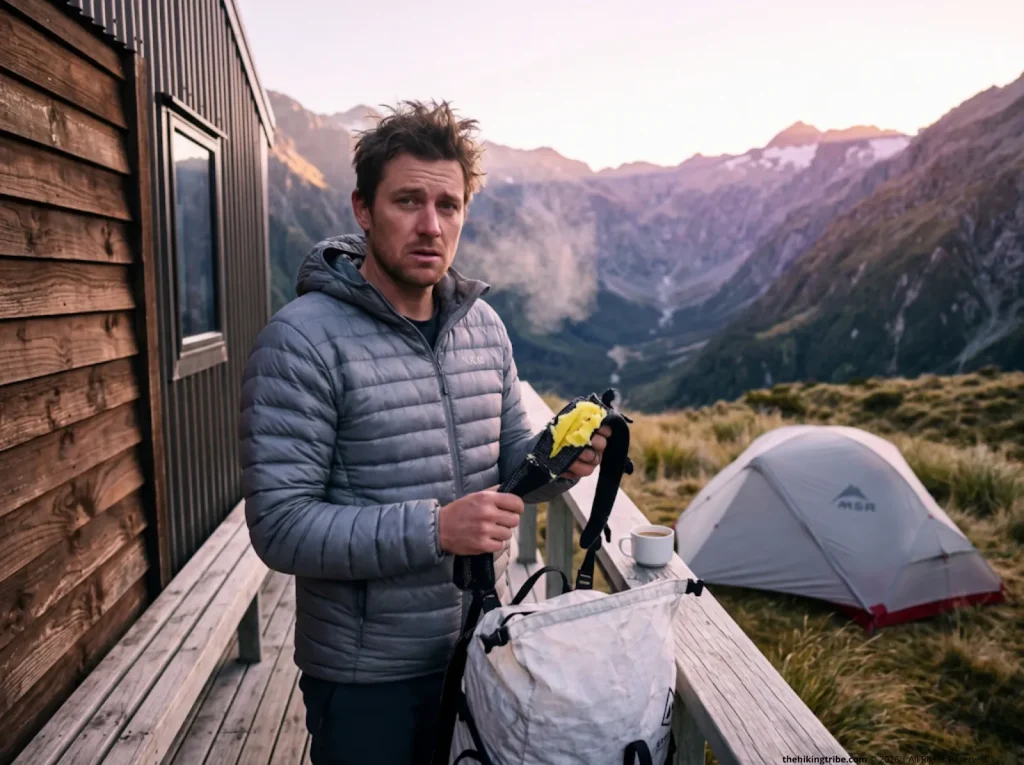
The kea is a highly intelligent alpine parrot that operates primarily at night and in the early morning. Left outside a DOC hut overnight, your boots will lose their laces and possibly their rubber rands by morning. This is not a cautionary anecdote — it’s documented behavior. Keas target rubber components, backpack straps, tent fly gaskets, and anything with synthetic fill they can access.
Protocol: boots come inside the hut or you sleep with them. Tent fly stays inside the hut vestibule. Backpack straps and hip belt padding get tucked inside the pack shell. Rubbish bins at alpine huts require 2kg steel plate lids to prevent keas from lifting them in wind. A distraction strategy — tennis balls or bells in a separate bag left outside — can sometimes redirect kea behavior. Sometimes.
UV Defense Above 1,000m — The Numbers International Visitors Miss
At Gertrude Saddle’s summit (1,400m), UV exposure is 14–21% higher than at sea level — before accounting for granite reflection. Apply SPF 50+ physical barrier sunscreen before you start, not twenty minutes into the hike. Absorption requires time, and sweating immediately after application cuts effective SPF significantly. A UPF 50+ sun hoodie plus a buff and hat gives you UPF clothing as a physical UV barrier at altitude — physical barrier protection that doesn’t wash off with sweat.
Pro tip: Apply sunscreen the night before for high-altitude starts. It absorbs overnight and provides full-barrier protection from the first minute on exposed terrain.
The DOC Booking System — Operational Intelligence Most Guides Skip
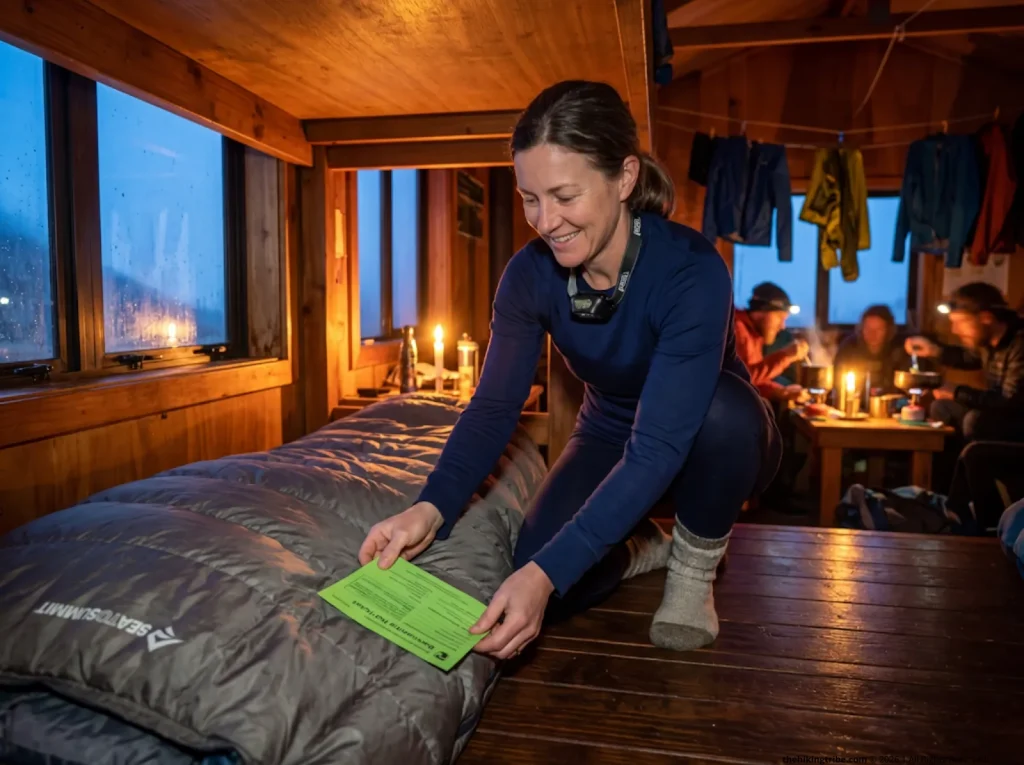
Great Walk bookings open via DOC’s BookIt system on a specific date each season — typically in July for the following Southern Hemisphere summer (October–April). Milford Track sells out within 24 hours. Routeburn Track is gone in 48 hours. International visitors who miss the opening date by even a few days find routes completely sold out with no official waitlist — cancellations appear randomly in the system and require checking multiple times per day to catch.
There is no waitlist. This is not a complaint about the system; it’s information you need to act on 12 months before your trip. Set up your DOC account weeks before the booking opening date and have your party’s details ready. Group bookings require all members to be confirmed before submission — split groups across booking windows are stranded.
Great Walk hut passes and backcountry hut passes are completely different permit systems. The DOC Annual Backcountry Hut Pass (roughly NZD $120) covers unlimited access to Tier 1–2 backcountry huts for the season — no pre-booking required for individual huts on Expert routes like the Dusky Track. First-come, first-served. Capacity at Supper Cove Hut runs 10–12 bunks. Arriving late means the floor or your bivy. Carry bivy capability on the Dusky.
Before and after DOC’s Land Safety Code and pre-trip intentions filing is complete, read the hut etiquette protocols that apply across global alpine systems, including DOC huts. Lights out is typically agreed communally. Pack out all waste. These are remote facilities maintained by people, not infrastructure.
Great Walks Booking System — Seasons, Dates, and Waitlists
Sell-out timelines by track: Milford — within 24 hours. Kepler — 48–72 hours. Routeburn — 48 hours. Lesser-known Great Walks (Abel Tasman, Heaphy) — sometimes days or weeks. The off-season versions of some routes exist at reduced cost. If your dates are flexible, off-season tramping on the Kepler or Routeburn can mean empty huts and significantly better solitude. Apply the global park permit booking strategies that apply to the DOC system — the permit-lottery logic transfers directly.
Backcountry Hut Pass Logistics for Expert Routes
On the Dusky Track, hut capacity is real. Arriving at Supper Cove Hut — the most remote DOC hut in the Fiordland system — and finding it full means sleeping on the floor or in a bivy in rain. Always carry a lightweight bivy shelter on Expert routes. Water in backcountry huts typically comes from tank collection; treat in high-use periods. The effort-to-reward ratio on Expert routes is high precisely because the infrastructure is minimal — that’s the point.
Shuttle and Water Taxi Logistics — The Transport Layer Most Visitors Forget
Milford Track transport to the trailhead requires a coach plus water taxi from Te Anau — these are separate bookings from your hut passes and both sell out independently. Routeburn shuttles from Queenstown are commercial and frequently sold out two months in advance. For the Gillespie Pass Circuit, the optional jetboat from Siberia to Makarora is seasonal and books early. Dusky Track entry at the most remote points requires floatplane charter from Lake Manapouri; minimum two passengers for economic viability.
Missing a water taxi means missing your downstream hut booking. Build a one-day buffer into every NZ tramping logistics plan. This is not pessimism — it’s the operational reality of transport-dependent multi-day routes.
The “Anti-Bucket List” Case — What Serious Hikers Should Actually Do Instead
Roy’s Peak is the most-photographed hike in the South Island. On a summer Saturday, queue times at the main viewpoint can exceed 45 minutes. The trail sees 200,000+ annual visitors. At that foot traffic volume, clay-dominant trail substrate compacts to hardpan — zero infiltration, all runoff, deepening erosion channels that branch into braided scars visible from the lake. The trail erosion physics driving Roy’s Peak’s degradation are straightforward. The physics of soil erosion at that scale are irreversible on any human timescale.
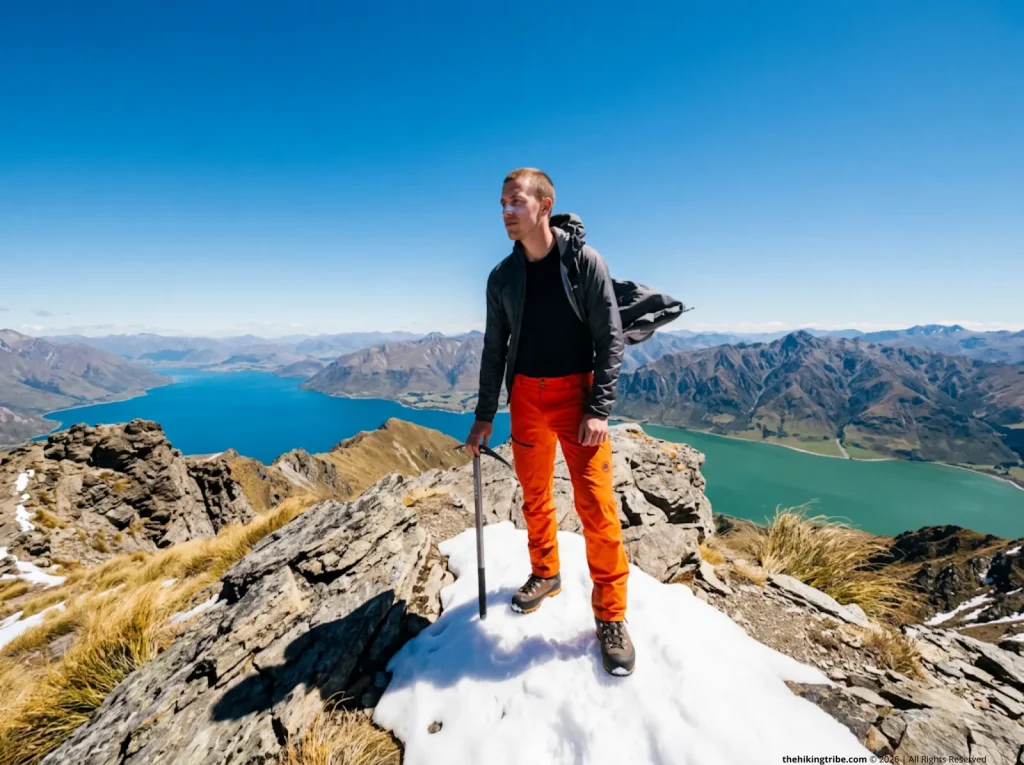
Isthmus Peak is 1,577m, 16km return, with comparable elevation gain to Roy’s Peak. The views take in both Lakes Wānaka (blue) and Hāwea (green — distinctly different water chemistry, visible to the naked eye). On any given day, you’ll share it with perhaps fifteen other people. There’s a scrambling section near the summit, schist outcroppings, and a terminus that rewards hikers who earned it. The only barrier to choosing Isthmus Peak over Roy’s Peak is not knowing it exists. I’ve done both. Roy’s Peak gave me a photo. Isthmus Peak gave me four hours alone with a kea that tried to eat my trekking pole grip.
Roy’s Peak vs. Isthmus Peak — The Technical Hiker’s Decision
Roy’s Peak: 1,578m summit, 16km return, DOC Moderate. The main viewpoint at roughly 1,400m is reachable by nearly anyone fit enough for a long day hike. The trail braiding within 50m of the summit viewpoint tells you everything about the foot traffic.
Isthmus Peak: 1,577m summit, 16km return. Trail quality, solitude, and terrain variation are categorically different. The summit scramble and schist outcroppings near the top require the same fitness as Roy’s Peak with slightly more technical engagement. The only thing Isthmus Peak lacks is the Instagram queue.
Mueller Hut Route — Mt. Cook’s Honest Challenge
Mueller Hut route starts from White Horse Hill Campground: 1,000m gain with 310m of technical terrain requiring Class 2+ scrambling on the final ridge. Most visitors at Aoraki/Mt. Cook do the Hooker Valley Track (Grade 1, three hours, no technical demands). Mueller Hut requires both fitness and technical nerve. These are not the same experience.
The kea zone begins at the hut. Boots stay inside, mandatory. Aoraki generates its own weather patterns — 30-hour weather windows are real, not theoretical. Plan for two nights in the area minimum. Hooker Valley Track looks up at the Southern Alps. Mueller Hut ridge looks across them. Leave Hooker Valley for your last day; it requires no fitness and takes three hours. Do Mueller first, while you have legs.
Pro tip: At Mueller Hut, the north-facing rooms get morning sun. Get there early enough to claim a bunk on the uphill side — the views straight across to Aoraki are the reason you climbed 1,000m.
Tongariro Alpine Crossing — When to Go and When to Turn Back
The Tongariro Alpine Crossing is 19.4km point-to-point, 765m of total gain, over UNESCO volcanic terrain. It is genuinely excellent — when conditions are right. It generates 20–50 rescue callouts per season because visitors don’t understand “right conditions.”
Weather window: start before 8am, off the summit by 1pm. Afternoon thunderstorm formation over the volcanic terrain is predictable and documented. If the summit is hidden in cloud at start and the forecast is deteriorating, apply the 50% rule: the decision to turn back at the halfway point is a technical decision, not a failure. Shuttle logistics require pre-arranged transport from National Park Village or Tūrangi for both ends of the crossing. Miss your shuttle window and you’re adding kilometers to an already long day in deteriorating weather.
The International Visitor’s Pre-Trip Intelligence Protocol
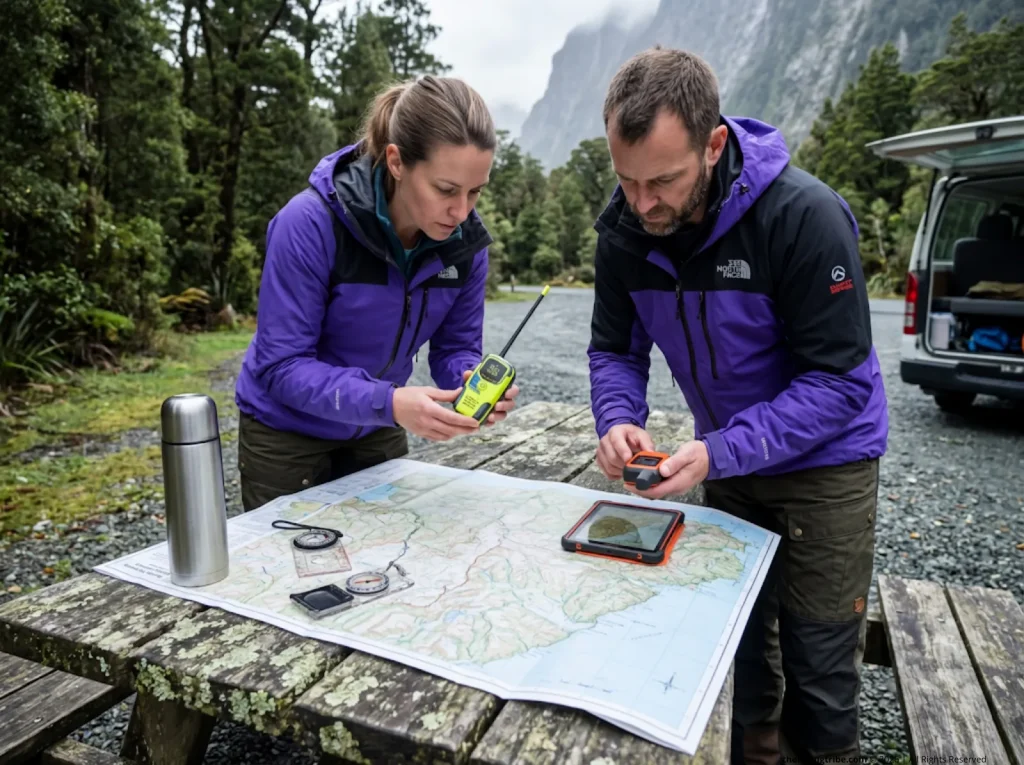
Before anything else, run the 3-step pre-trip trail research protocol against every NZ route you’re considering. Then layer NZ-specific intelligence on top.
NZ tramping culture is distinct from any other national hiking culture: DOC huts instead of established campsites, direct-line ascents without switchbacks, extreme mud as a baseline condition, and three-wire bridges as standard infrastructure on Expert routes. International hikers who pack for US or European conditions will be underprepared on approximately every Expert route in the system.
MetService.com is the primary NZ weather service. Mountain forecasts are separate from regional forecasts — always use the specific mountain zone forecast, not the nearest town. NIWA provides long-range climate modeling useful for multi-week trip planning. Forecast accuracy in Fiordland drops sharply beyond 36 hours; build a decision tree before you leave: if weather condition X on morning of Day 1, execute Plan A. If weather condition Y, execute Plan B. “She’ll be right” has cost international visitors their lives in NZ. Optimism is not a safety strategy.
A DOC ranger I asked about common failures among international visitors answered without hesitating: “A rain jacket rated above 10,000mm. Every single time.” Before you depart, read DOC’s river crossing safety guidelines for international visitors — that one gear gap costs more trips than any other single factor.
MetService and NIWA — Reading NZ Mountain Forecasts
MetService mountain zone forecasts are specific to elevation bands. “Fine in Te Anau” means nothing for conditions at 1,400m on the Gertrude Saddle. The Fiordland system can deliver 200mm of rain over the Kepler ridgeline in 24 hours when a low-pressure system enters from the Tasman. The difference between a “fine day” and an “approaching front” is typically visible on the MetService synoptic chart 24–36 hours out. Beyond 36 hours in Fiordland, forecast confidence drops sharply. Build your decisions around the 36-hour window, not the seven-day outlook. Know how to read mountain weather signs when cell service drops out — once you’re in the Fiordland backcountry, the forecast is academic.
Visa, Insurance, and Entry Requirements for Serious Trekkers
NZ eTA (Electronic Travel Authority) is required for visa-waiver countries including the US, UK, Canada, and EU. Apply minimum 72 hours before travel. Standard travel insurance frequently excludes “adventure activities” — confirm NZ multi-day tramping coverage explicitly before departure. WorldNomads and Battleface explicitly cover NZ multi-day tramping; most standard travel policies do not.
Boot cleaning at NZ customs entry is enforced. NZ biosecurity is stringent — don’t test it. PLBs, crampons, ice axes, and map compasses are all available for rental from outdoor stores in Queenstown, Wanaka, Te Anau, and Christchurch. SAR in NZ is free to the public; helicopter rescue costs may be invoiced to insurance. Check your visa and entry requirements for international trekkers before booking flights.
Building the NZ Emergency Protocol Before You Leave Home
File your trip intentions via the “Plan My Walk” app before every multi-day route. Leave a full itinerary with a home contact who knows to call 111 (NZ emergency) if you miss your check-in time by a specified number of hours. In NZ, 111 connects to Police who coordinate with LandSAR and DOC. SAR response times vary: 1–6 hours for helicopter depending on weather conditions.
Any PLB used in NZ must be registered with the NZ Rescue Coordination Centre before departure — not after arrival, before. A satellite messenger (Garmin inReach) provides two-way communication capability, which matters most in near-miss situations where the emergency is developing rather than complete. For anything rated Expert by DOC, bring both the PLB and the filed intentions. Redundancy is the protocol.
Three Things to Take From This
The geology decides before you do. Graywacke and schist shred marketing-grade boots and punish anyone who trusts visual rock stability. Know your terrain classification before you select footwear — not after you’ve bought it.
The crowd isn’t always wrong, but they’re almost never where the best tramping is. Roy’s Peak photographs well. Isthmus Peak is technically superior. Milford Track sells permits; the Dusky Track builds trampers.
NZ’s backcountry rewards operational intelligence, not optimism. PLBs, MetService forecasts, and DOC trip intentions aren’t box-ticking — they’re how experienced hikers stay out of rescue statistics. Before you book your flight, download the “Plan My Walk” app and file a test intention for your first planned route. Pull the DOC track conditions report. Cross-reference the DOC trail classification against your actual scrambling experience. If that exercise produces uncertainty, build fitness and skills for six months and come back better prepared. The Dusky Track will still be there.
FAQ
What is the hardest Great Walk in New Zealand?
The Kepler Track is the most technically demanding Great Walk, with exposed alpine ridgeline and rapid elevation change. However, the Kepler is a Great Walk (Well-Formed Track) — if the question is about hardest tramping overall, the Dusky Track (Extra Difficult or Expert) is a different category entirely. Eight to ten days, advanced river crossing skills, and a mental challenge that experienced trampers consistently rate above any Great Walk.
Do I need to book New Zealand hikes in advance?
For Great Walks (Milford, Routeburn, Kepler, Abel Tasman): yes — 6–12 months in advance via the DOC BookIt system. Milford sells out within 24 hours of opening. For Advanced and Expert routes like the Dusky Track or Gillespie Pass Circuit, no advance hut booking is required. Transport (water taxis, shuttles, floatplane) is almost always separate from hut passes and requires its own advance booking regardless of the route category.
Is Roy’s Peak harder than Ben Lomond?
They’re similar in distance (16km vs. 18km) but different in technical gradient. Ben Lomond has a more sustained climb and is significantly harder overall — roughly 1,400m gain versus Roy’s Peak at 870m. Roy’s Peak sees 200,000+ annual visitors; Ben Lomond sees roughly 20% of that. If Roy’s Peak felt comfortable, Ben Lomond is the logical progression with a more demanding final ridge. It also sees dramatically fewer sandflies, which is a meaningful upgrade.
What should I wear hiking in New Zealand?
In Fiordland and the Southern Alps: a shell rated at 20,000mm hydrostatic head minimum, merino base layer, mid-layer insulation, and boots with 5mm+ lug depth and a full rubber rand. For Great Walk day routes: 3mm lug minimum, 10,000mm HH shell. In all conditions: UPF 50+ sun protection is non-negotiable at altitude. The UV exposure index in NZ regularly exceeds UVI 12 above 1,000m. Most visitors under-pack for rain and under-protect from sun. Both gaps have consequences.
Can you hike in New Zealand without a guide?
Yes — most NZ trails are designed for self-guided tramping, and DOC infrastructure (huts, trail markers, safety signage) assumes independent travelers. Routes classified as Advanced or Expert (Gertrude Saddle, Cascade Saddle, Dusky Track, Brewster Hut) require genuine technical hiking competency: river crossing technique, alpine navigation, and self-rescue awareness. Without a guide on Expert routes is only appropriate for trampers with documented backcountry experience. The DOC classification is not a suggestion.
Risk Disclaimer: Hiking, trekking, backpacking, and all related outdoor activities involve inherent
risks which may result in serious injury, illness, or death. The information provided on The Hiking Tribe is for
educational and informational purposes only. While we strive for accuracy, information on trails, gear, techniques,
and safety is not a substitute for your own best judgment and thorough preparation. Trail conditions, weather, and
other environmental factors change rapidly and may differ from what is described on this site. Always check with
official sources like park services for the most current alerts and conditions. Never undertake a hike beyond your
abilities and always be prepared for the unexpected. By using this website, you agree that you are solely
responsible for your own safety. Any reliance you place on our content is strictly at your own risk, and you assume
all liability for your actions and decisions in the outdoors. The Hiking Tribe and its authors will not be held
liable for any injury, damage, or loss sustained in connection with the use of the information herein.
Affiliate Disclosure: We are a participant in the Amazon Services LLC Associates Program, an
affiliate advertising program designed to provide a means for us to earn advertising fees by advertising and linking
to Amazon.com. As an Amazon Associate, we earn from qualifying purchases. We are also an official affiliate partner
of Black Diamond Equipment via the AvantLink network. If you click on a Black Diamond affiliate link and make a
purchase, we may earn a commission at no additional cost to you. We also participate in other affiliate programs and
may receive a commission on products purchased through our links. Additional terms are found in the terms of
service.