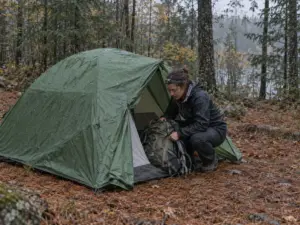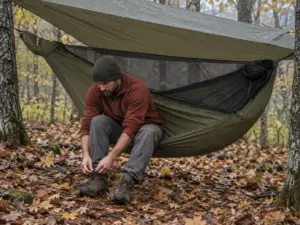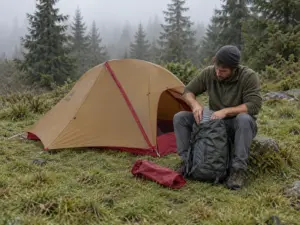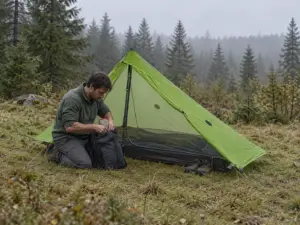



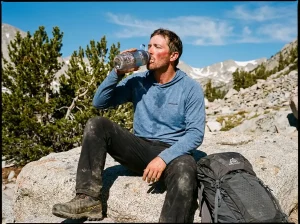
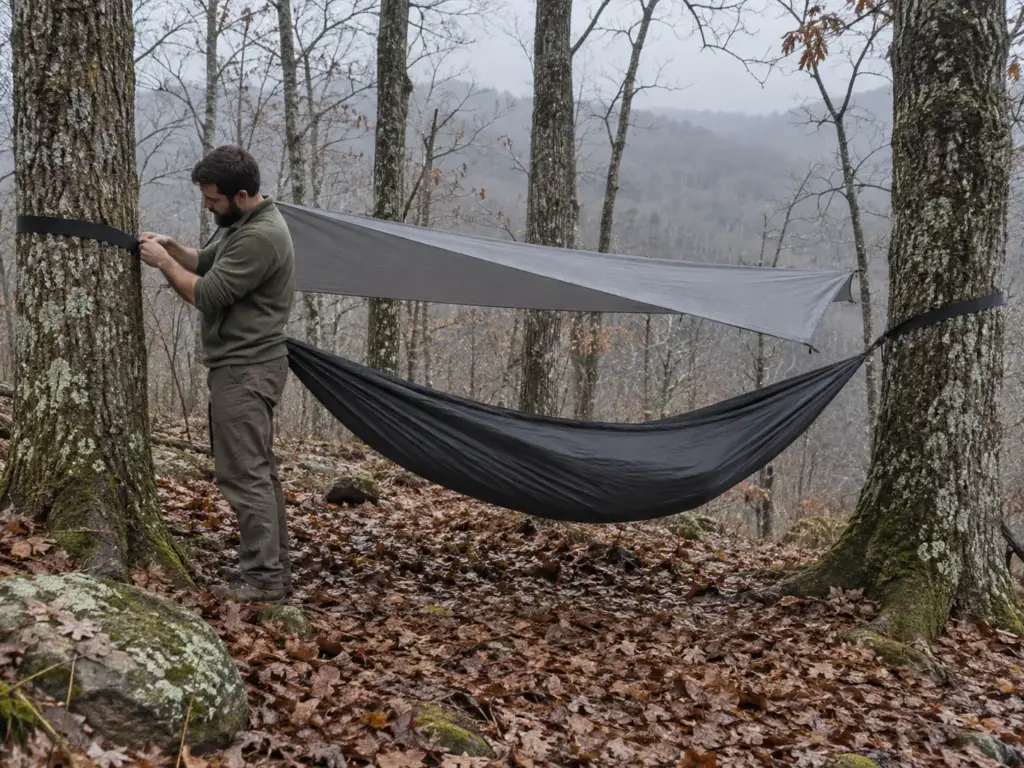
Every hammock camping pitch is the same photograph: two perfect trees, flat water behind them, somebody asleep in a gentle curve. Your first night rarely looks like that. It looks like you folded at the hips at 2 a.m. with a cold stripe across your lower back, wondering what everyone else knows that you don’t.
The same handful of complaints come up over and over among hammock campers, and every one has a mechanical cause and a fix. This article answers the decision question first, honestly, then the mechanics: why the diagonal lay works, why you wake up cold, and what the trees require of you.
What Hammock Camping Actually Is (and What It Replaces)
You buy a hammock. What you actually need is a system. That gap between the object in the box and the shelter you have to sleep under is where most bad first nights come from, and it catches almost everyone who starts here.
The four parts of a hang
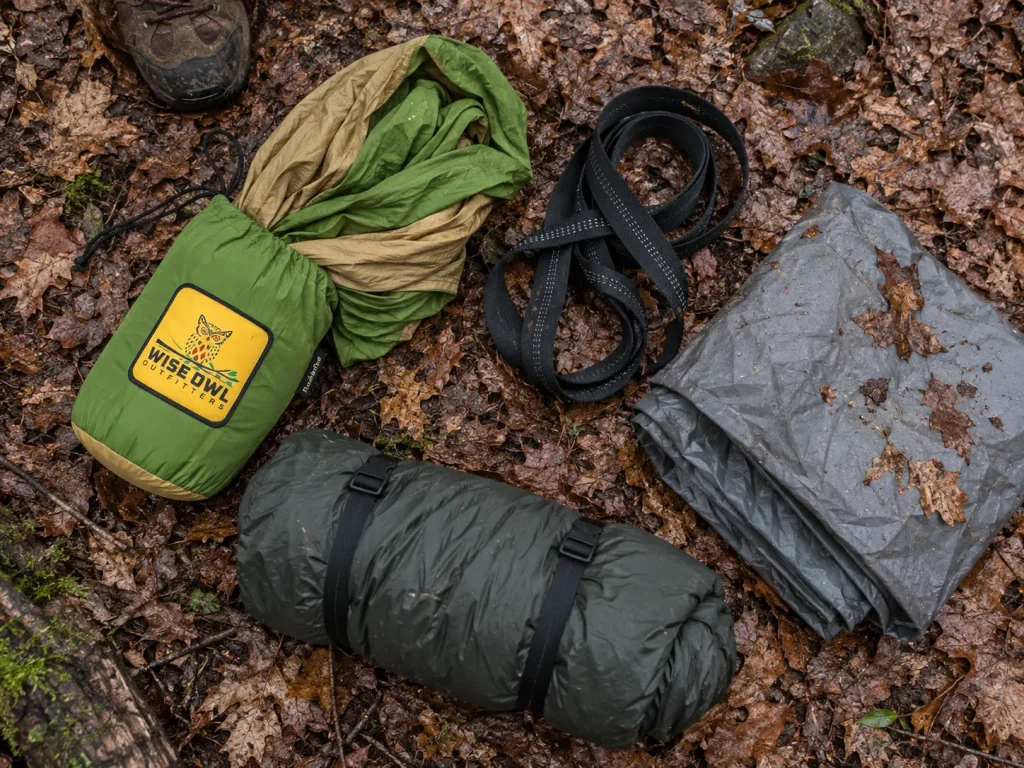
A camping hammock is four things working together: the body you lie in, the suspension system that connects it to the trees, a rain tarp overhead, and insulation underneath. Drop any one and the night goes sideways predictably.
No tarp means watching the sky and hoping. No insulation means cold by 2 a.m. regardless of your sleeping bag. Cold-weather hangers swap the bag for a top quilt, which drops the crushed-flat underside a bag wastes anyway, and most hammocks sold for camping build the bug netting straight into the body.
The framing error most beginners make is treating the hammock itself as the whole purchase. Suspension and insulation are separate decisions with separate costs, and nobody tells you that on the product page.
Gathered-end vs bridge
A gathered-end hammock is the common one: ripstop nylon cinched to a point at each end, which is why it hangs in a curve. A bridge hammock uses spreader bars to hold the fabric flat, like a stretcher. Bridge hammocks lie flatter, weigh more, and add parts to lose. Everything from here assumes gathered-end.
What you leave at home
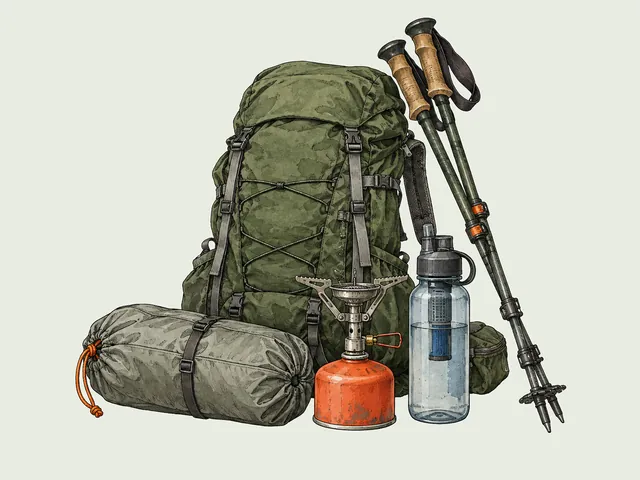
The trade is trees for ground. Out goes the tent body, poles, stakes, footprint, and ground pad. That’s a real pile of gear, and it’s why the weight pitch sounds so good before you check the numbers. A single-person gathered-end hammock typically holds around 400 pounds and packs to roughly a pound, genuinely lighter than the two-person backpacking tent it’s replacing, right up until you add the tarp and insulation back in.
Ground sleeping keeps one advantage a hammock never matches: it works anywhere flat enough to lie down.
Who Hammock Camping Is Actually Good For (and Who Should Skip It)
Most gear writing assumes you’ve already decided. This section assumes you haven’t. Hammock camping is excellent for a specific kind of trip and genuinely worse than a tent for another kind, and the thing that decides which one you’re on is almost never comfort.
The terrain question comes first
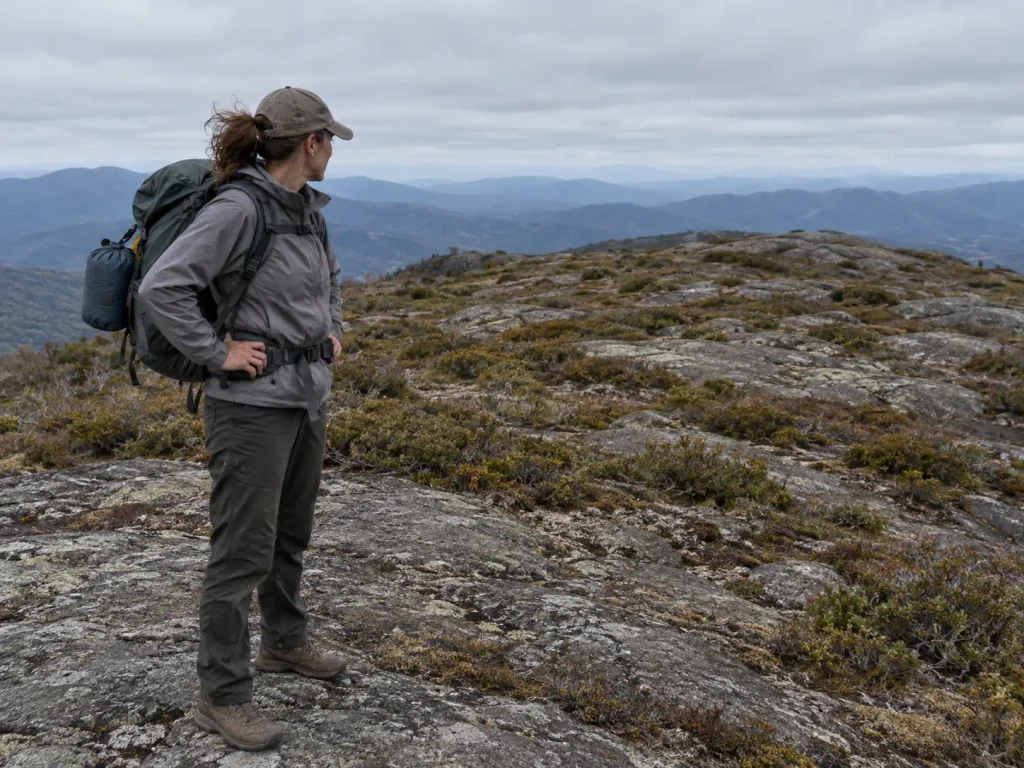
Before you think about how it sleeps, answer one question: will there be two live trees, roughly dinner-plate thickness, about twelve feet apart, where you intend to sleep? If you can’t answer yes with confidence, nothing else here matters. A hammock in the wrong place isn’t uncomfortable. It’s a stuff sack full of nylon and a night on the dirt.
Campsite flexibility is the hammock’s best argument and its hardest limit at the same time.
Where a hammock beats a tent outright
Wooded terrain, first. The eastern United States is hammock country, and thru-hikers on the Appalachian Trail hang for a reason: trees everywhere, flat ground almost nowhere. Sloped sites, root-choked sites, rocky sites where you’d hunt forty minutes for a tent pad and still sleep on a rock. The hammock doesn’t care.
Side sleepers who never made peace with a sleeping pad often do well here, since the diagonal lay lands somewhere between flat and cradled. Hot, humid nights are the other clear win: air moving under you is a feature in July, the same way it’s a problem in October.
Check the campground rules before you drive out, not after. The scenario long-time hangers trade stories about isn’t a bad night’s sleep, it’s pulling into a site, finding two perfect trees, and being told by the host that hammocks have to go on a stand. Your entire shelter system becomes decoration in about four seconds.
Where you’ll wish you brought the tent
Above treeline. In the desert. On an exposed alpine ridge. Anywhere the trees are thin, protected, or absent.
If your route crosses any of that, you’re carrying a shelter you can’t pitch, and you’d be better served pitching a tarp without trees or going to ground.
Then the deal-breaker almost nobody writes down: two people who want to sleep next to each other. Two hammocks are two separate hangs, in two spots, needing two sets of trees and two tarps. Double hammocks exist and are rated for the weight, but sharing one overnight puts both of you in the same sagging pocket, and somebody always ends up underneath. If your camping is a couple thing, a tent wins and it isn’t close.
Cold weather is the third filter. Below roughly 45°F you need insulation you don’t already own, which is real money on top of the hammock. That’s the same weight-versus-protection math a bivy forces on you, applied to a different shelter.
Why the Diagonal Lay Changes Everything
Almost everyone who says they tried a hammock once and hated it made exactly one mistake: they lay straight down the middle. That’s it. That’s the whole thing. The fix costs nothing and takes a single night to learn.
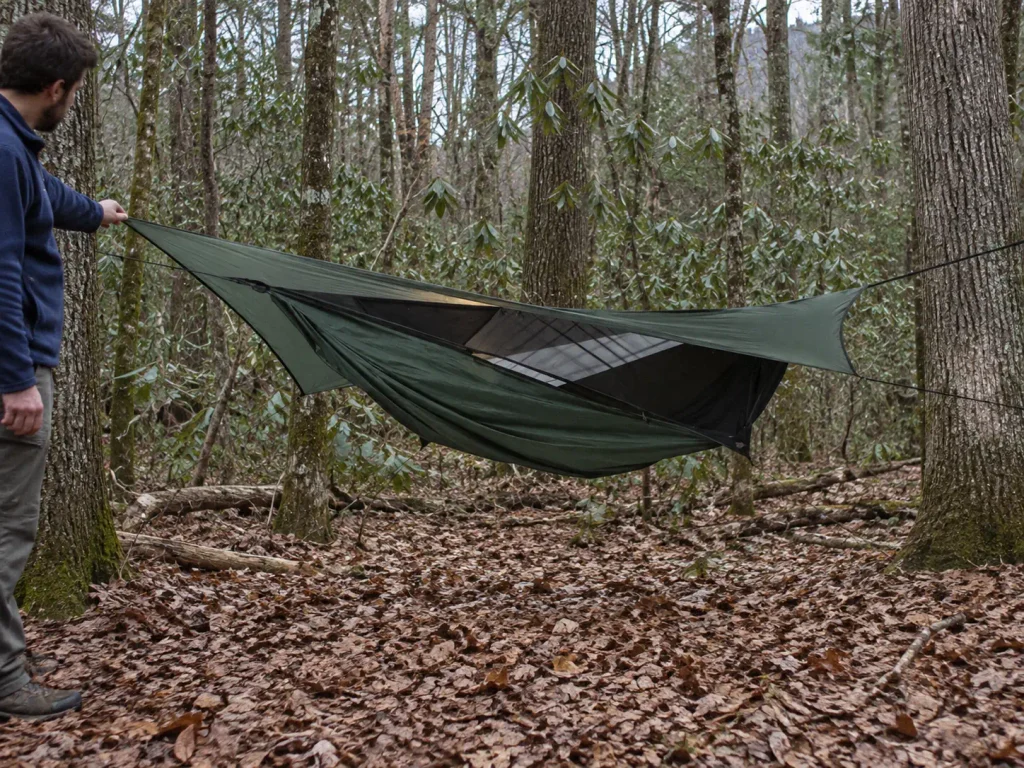
The banana curve, and why it happens
Because a gathered-end hammock is cinched to a point at both ends, the fabric collapses toward its own centerline under load. Lie along that line and it forces your body into the same shape it’s making: hips down in the low point, shoulders and feet riding up. It is known as the banana curve, and it’s exactly as pleasant as sleeping folded into a taco shell. Your lower back takes all of it.
People blame the hammock. The hammock is doing precisely what the geometry says it should.
Lying off-axis
Shift about 10 to 15 degrees off the centerline, head toward one side and feet toward the other. Cutting diagonally across the curve uses the fabric’s full width instead of its narrowest line, and the surface under you flattens out. The difference is immediate and slightly absurd the first time, because nothing about the hammock changed.
Asymmetrical hammocks are built around this, with the cut biased so the diagonal is the default rather than something you hunt for in the dark.
Finding your hang angle
Around 30 degrees from the ridgeline is where most riggers land. That’s enough sag to let the fabric flatten diagonally, and not so much that suspension tension spikes and the sides start swallowing you. Treat it as a starting point, not a law.
The failure mode runs the other direction. A hang pulled near flat feels like it should be better and reliably isn’t: a tight hammock squeezes the fabric inward and folds you into what hangers call the taco. Tight is the instinct. Tight is wrong.
What a structural ridgeline actually buys you
A structural ridgeline is a fixed-length line along the top of the hammock, and it removes the one variable that makes hangs inconsistent. Set it once and the sag is identical every night, regardless of tree spacing or how hard you cinched the straps. It ends the “why does tonight feel different” problem.
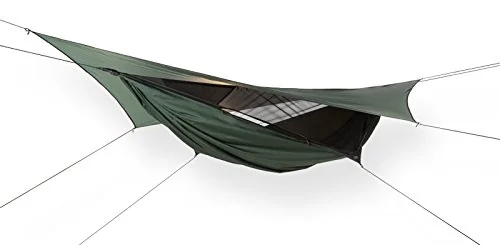
The trade with an integrated system is that you’re buying somebody else’s opinion about tarp and net geometry along with the hammock. Exactly what you want if you’re tired of compatibility questions, and exactly what you don’t if you like tuning every piece yourself.
Cold Butt Syndrome and the Insulation Problem
The 3 a.m. version of this is specific and memorable. You fall asleep warm, wake up with a cold band across your back and hips, and assume the fabric is too thin. The fabric has nothing to do with it.
Why you wake up cold from below
Two mechanisms, working together. First, convective heat loss: air moves freely under a suspended hammock and strips heat off your underside all night, which is exactly the feature you wanted in July. Second, compression. Your body weight crushes the loft out of anything insulating beneath you, and loft is the only thing doing the insulating.
The community named this Cold Butt Syndrome, and the fact that it has a name tells you how universal it is.
Why a sleeping pad underneath doesn’t fix it
Stuffing a sleeping bag or pad under yourself puts the insulation exactly where your weight flattens it. A bag rated comfortably for the ground can leave you shivering in a hammock at a far milder temperature, because on the ground a pad stays put under a broad flat surface, while in a hammock the fabric shifts and the pad squirts sideways every time you move.
Most hammock campers need real insulation below roughly 45 to 50°F. That’s the threshold where this stops being optional.
Underquilts, and why the position matters
An underquilt solves it by refusing to be underneath you. It hangs outside the hammock body, below the fabric, so your weight never touches it and the loft stays intact all night. That single positional difference is the whole trick, and it’s why an underquilt beats a pad of similar R-value in a hammock every time.
For the reader past the testing stage, the HIKERBRO 4-Season Hammock Underquilt is a full-length, budget-friendly way into the correct fix without stepping straight to a premium down quilt.
The cheap way to test it first
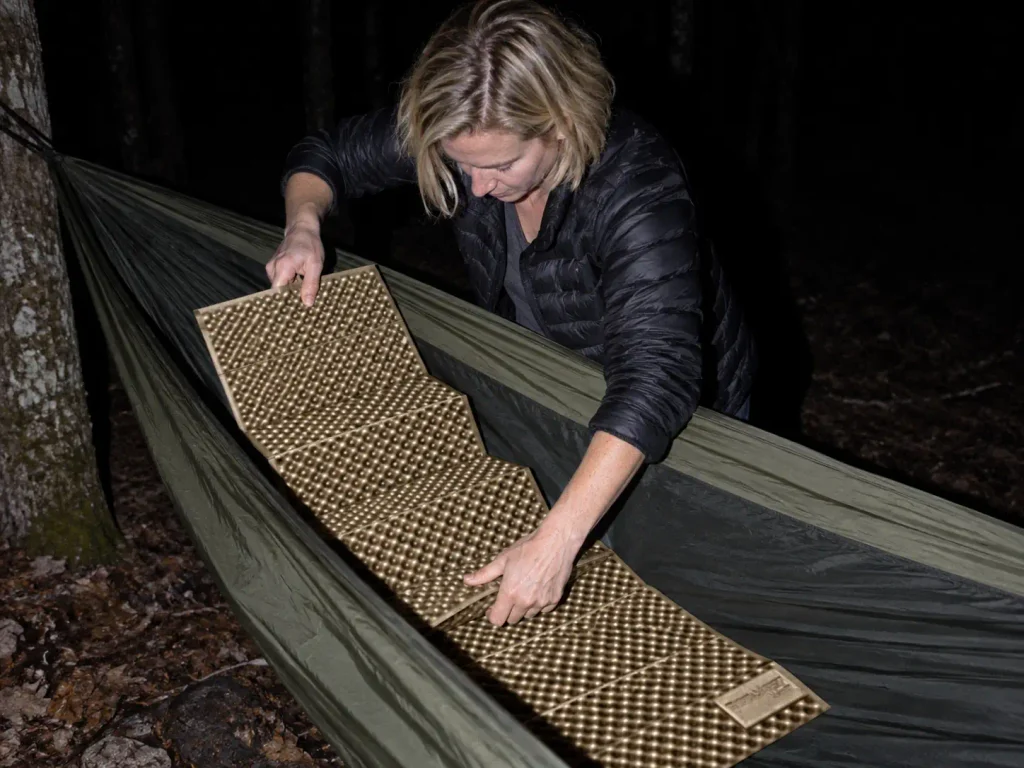
Before you spend underquilt money, find out whether you actually like hanging. A closed-cell foam pad inside the hammock is the honest budget path: worse than an underquilt because it still compresses, clearly better than nothing. The Therm-a-Rest Z Lite Original is the standard choice at around 14 ounces, and it doubles as a sit pad and a ground backup on the trip where the trees don’t materialize and you end up cowboy camping instead.
A foam pad slides out from under you all night unless you stop it. Put it inside the sleeping bag rather than under it, or fold the long edges up so the pad makes a shallow trough around your hips. You’ll still get a cold seam somewhere, but you’ll get it in one place instead of a new place every hour.
Trees, Straps, and the Rules You Didn’t Know Existed
Everyone repeats the one-inch strap rule. Almost nobody explains what that inch is protecting, and almost nobody mentions that plenty of places want two.
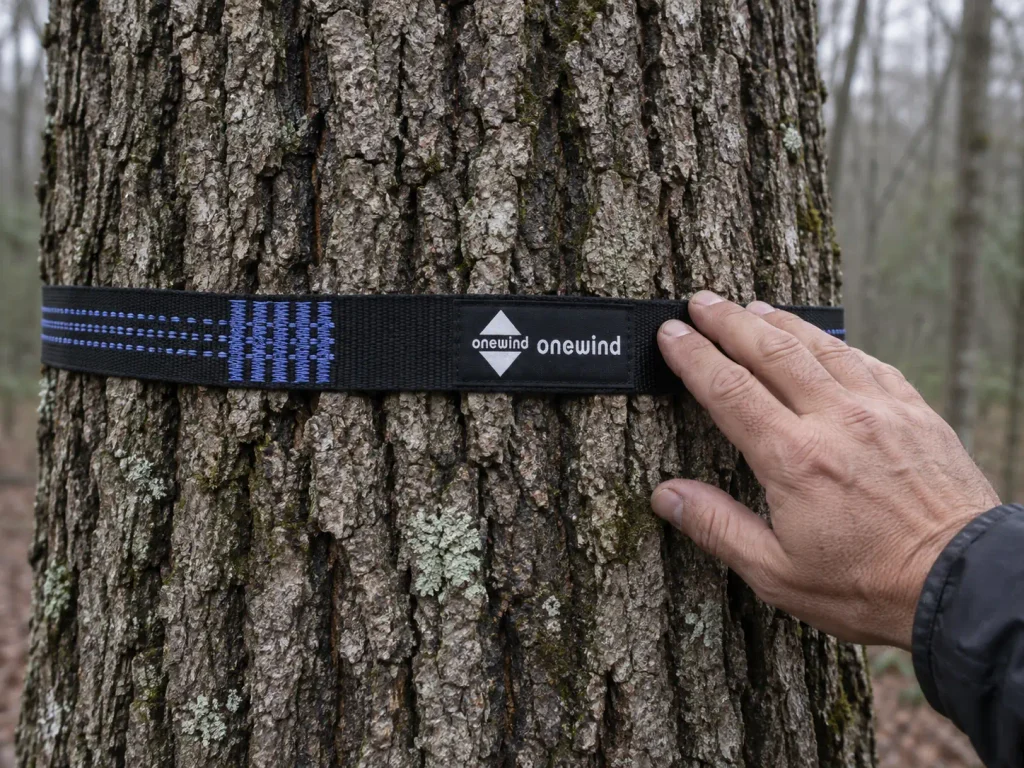
What the one-inch rule is actually protecting
It isn’t about the strap breaking. Any decent webbing is rated far beyond what you weigh. The inch protects the cambium, the thin layer of living tissue under the bark that moves water and nutrients up the trunk.
Concentrate your weight into a narrow line of rope or paracord and you crush that tissue where it sits. Do it enough times in one season at the same popular site and you can girdle the tree.
That’s the mechanism long-time hangers point to, and why the rule survives where nobody enforces it. Leave No Trace’s own hammock-camping guidelines put the recommendation at one to one and a half inches, along with the 200-foot placement buffer. The Leave No Trace principles you already apply to a tent site apply here unchanged; what varies is what each land manager adds on top. Wide tree straps like the Onewind 10ft Tree-Friendly Hammock Straps clear that floor at one inch wide and cost less than a tank of gas.
Why the rules are inconsistent
The floor is an inch. The ceiling moves. Long-time hangers report running into 1.5-inch, 2-inch, and even 3-inch requirements in different places, Florida comes up repeatedly as a two-inch state, and a great many agencies still just say “straps” with no width attached at all because hammock-specific language is only now working its way into the rulebooks. Meanwhile Minnesota’s state park system, for instance, requires trees at least twelve inches in diameter at the hang point.
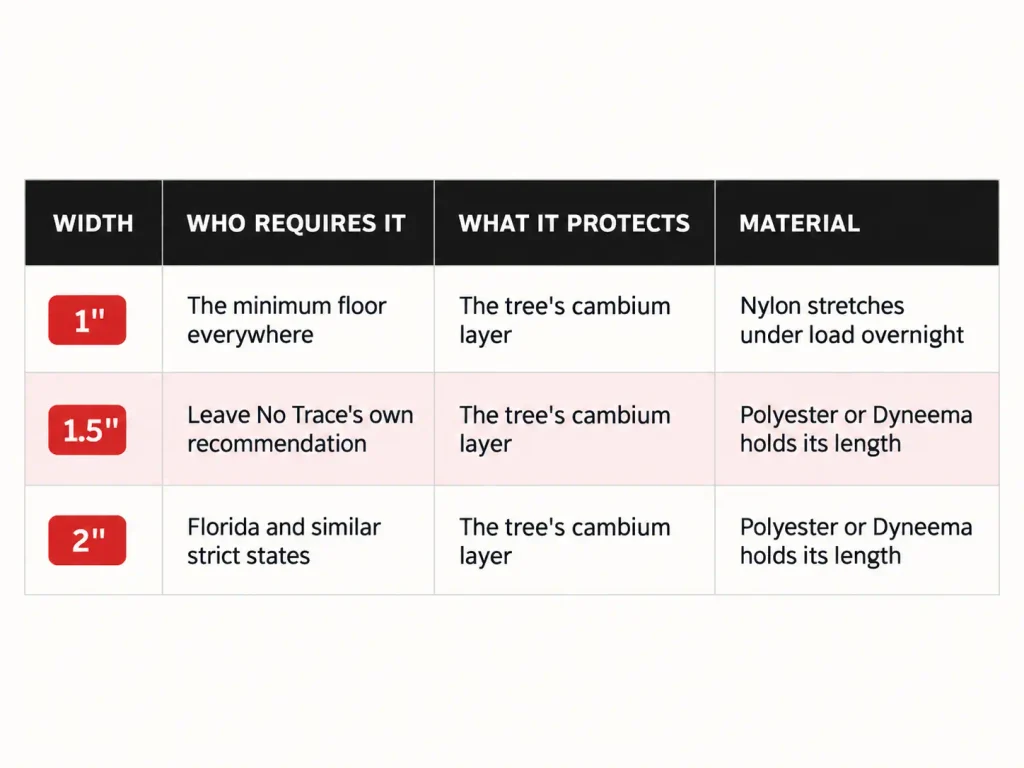
One more catches people flat: some units prohibit tree-hanging entirely and require a freestanding stand. Check the specific unit before you drive out, the same way you’d check the same 200-foot rule you already use for everything else.
Strap material, the spec nobody mentions
Width protects the tree. Material protects your sleep.
Nylon stretches under sustained load, so a nylon strap creeps all night and your carefully tuned hang sags toward the ground by morning. Polyester, polypropylene and Dyneema hold their length, which is why tree-friendly straps sold for hammocks are rarely plain nylon. It’s the most useful spec in this section and it appears on almost no competitor page.
If you wake up lower than you went to sleep, stop blaming the knot. Check the webbing first. A hang that drops an inch or two overnight is almost always nylon doing what nylon does, and no amount of re-tensioning at bedtime fixes a material problem.
Picking the tree, and how low to hang
Live, sturdy, thick. Roughly dinner-plate tree diameter at the hang point is the fast field check, and a dead tree is off the table no matter how solid it looks. Keep the low point no higher than knee height, which limits leverage on the trunk and turns a slipped strap into a bruise instead of a hospital trip. If the bark already shows bark damage from earlier hangs, move to another pair of trunks rather than adding padding and hoping.
Experienced hangers carry one extra piece of wider webbing for younger or soft-barked trees, because the best hang spots have an annoying habit of landing on exactly those.
Picking Your First Hammock Setup
At this point you either want in or you’ve already decided this isn’t your shelter. This section is for the first group, organized by how committed you are rather than by price.
The try-it-first kit
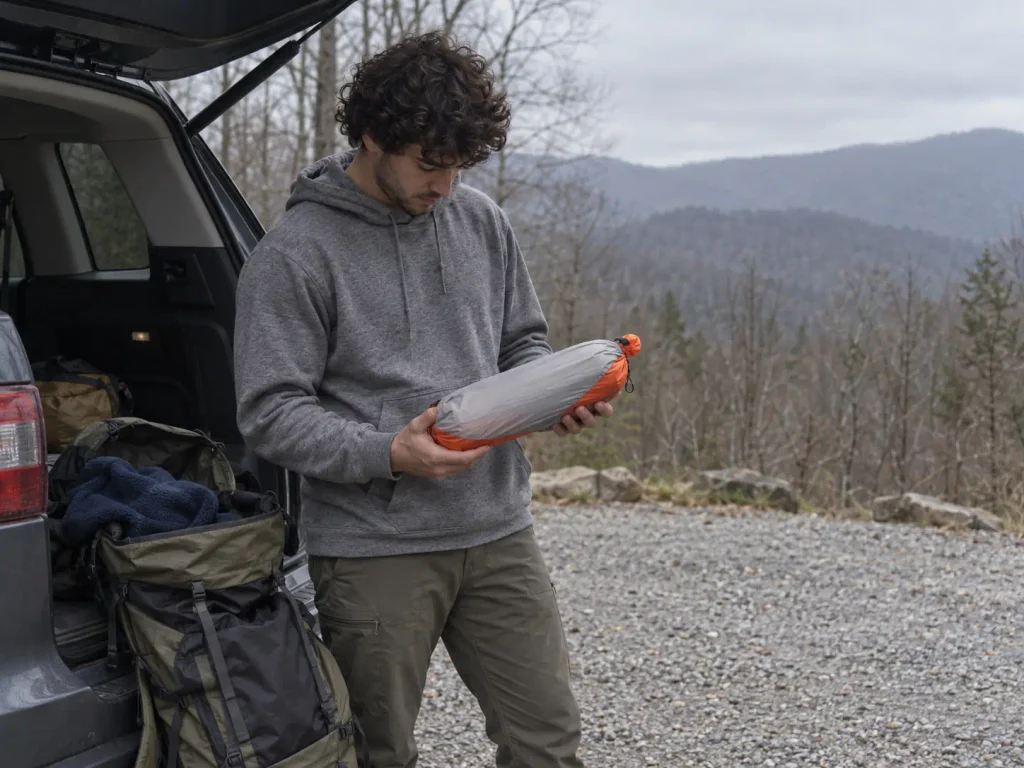
One hammock, one set of straps, one foam pad you probably already own. That’s the whole entry point, and it answers the only question that matters: do you actually sleep in this thing? The Wise Owl Outfitters Camping Hammock is the low-friction version, a gathered-end double rated around 500 pounds with tree straps in the bag.
Buy the suspension with the hammock or you’ll buy it twice. That’s the most common first-purchase gap there is.
Building it piece by piece
The à-la-carte route means choosing your own tarp, suspension, and bug net, and it’s how you end up with a system that fits your trips instead of someone else’s. Every piece becomes a compatibility decision, and total weight is yours to track, the same way you’d track it when trimming weight everywhere else in the kit.
What not to buy first: the underquilt. Test with a foam pad, learn your temperature threshold, then spend. A three-season setup is most of what anyone needs; cold weather camping in a hammock is a separate, more expensive problem.
All-in-one systems
The opposite approach is buying the whole thing as one object and never thinking about compatibility again. You pay more and give up tuning. For someone already committed, that’s a fair trade.
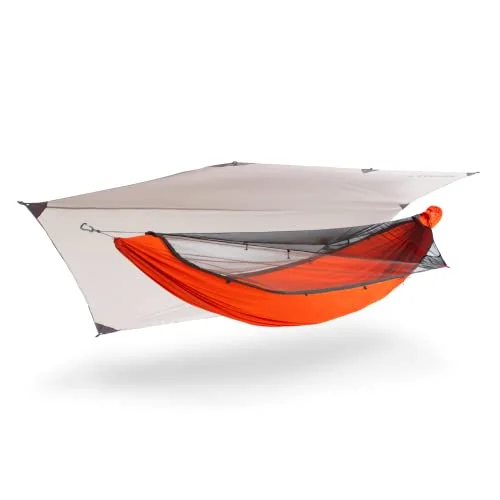
Whichever path you pick, hang it in the backyard before you hang it on a trip. Every problem in this article is easier to solve a hundred feet from your kitchen, the same logic you’d use to shake it down before the trip that matters.
How a Hammock System Compares on Weight
The last objection is the practical one. Is this actually lighter, or does it just feel lighter because the hammock alone weighs nothing?
Weigh the whole system
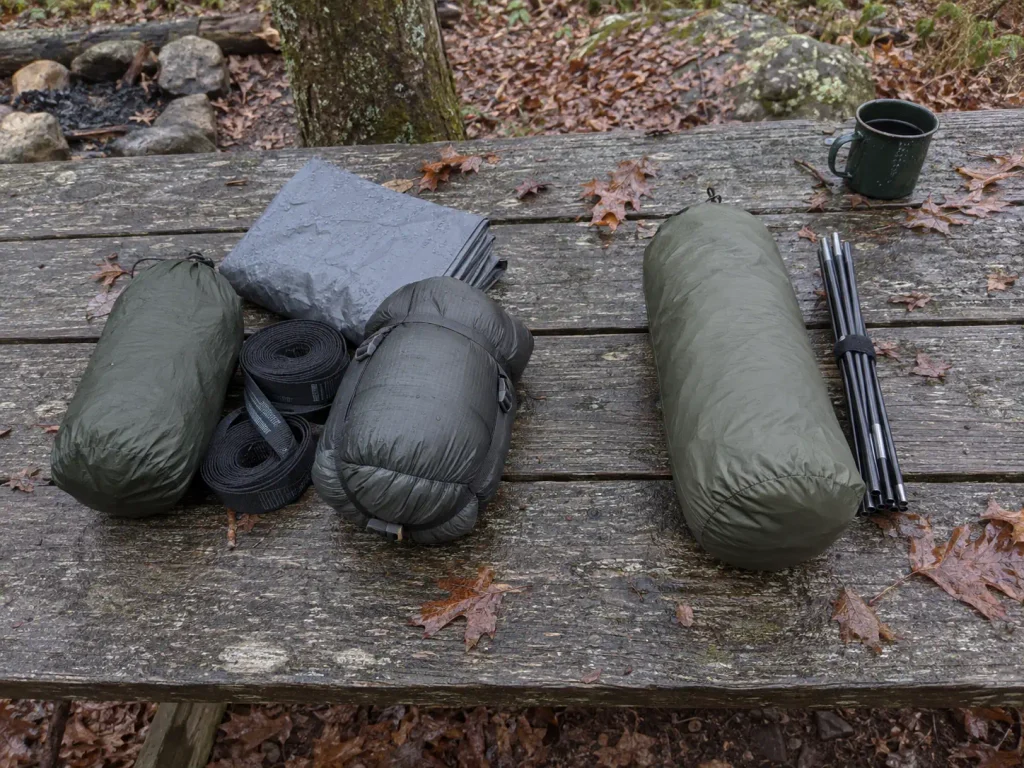
Hammock alone against tent alone is the comparison the marketing makes, and it’s the wrong one. The honest number is your true trail weight: all four parts on the scale together. People underestimate this constantly, because the pieces get bought separately over months and never end up in the same weigh-in. Compare that pile against how tent weight actually breaks down by category.
When the hammock is genuinely lighter
Warm-weather trips, where insulation drops out of the system entirely. Solo trips, where a tent loses its best argument: no partner to split the poles with, so it carries full weight on your back alone. Whether you run silnylon or Dyneema for the tarp moves more weight than most people expect, guylines and stakes included.
When it isn’t
Cold trips, where the underquilt is substantial gear and the tent only needs the pad you’re already carrying. Any trip for two, where tent camping beats two of anything. And once you compare against the single-person shelter it replaces, what a one-person ultralight tent actually weighs, the margin narrows fast enough that weight stops being the reason to hang at all.
Which is fine. Weight was never the real argument. Sleeping well on ground you couldn’t have pitched a tent on is.
The One Night That Decides It
Terrain decides this, not comfort. Trees or no trees is the entire question, and everything else is a detail you can fix.
The two problems that make people quit are both mechanical. The banana curve comes from lying along a line the fabric is already curving, and 15 degrees off-axis fixes it. The cold underside comes from moving air and crushed loft, and insulation hanging outside the hammock fixes that.
Straps protect the tree’s cambium, not your weight rating. One inch is the floor, plenty of places want more, and material matters as much as width.
Then go hang it in the backyard. One night twenty feet from your door teaches you more about whether this is your shelter than any article, including this one.
Frequently Asked Questions
01What are the downsides of hammock camping?
The three real downsides are terrain dependency, the two-person problem, and cold from underneath. You need two live trees, couples cannot share one comfortably, and moving air strips heat from below any time the temperature drops under about 50°F.
02What is the 200 rule for camping?
Camp at least 200 feet from water, trails and other campsites. It applies to a hammock exactly as it does to a tent. In the field, 200 feet is roughly 70 adult paces, which is the version you can actually use without a tape measure.
03Is it safe to sleep in a hammock while camping?
Yes, under two conditions: hang low and hang on live, thick trees. Keep the low point around knee height so a slipped strap is a short drop, and use trunks at least dinner-plate diameter. A dead or thin tree is the main hazard here, not the hammock.
04Are camping hammocks any good?
Excellent for solo sleepers in wooded terrain, and genuinely worse than a tent above treeline or for couples. Learn the diagonal lay and solve the insulation question and they sleep beautifully. Skip them entirely if your trips run through desert or alpine country.

I've spent more than a decade researching hiking gear and trail technique. I read the specs, the forum threads and the long-term reviews, and every pick here comes with what it gets wrong.
End of the trail
You read every mile of this one. Here's where the trail goes next.