In this article
Forty-three miles into a ridge traverse, I felt it — the slow, insidious southward march of my waistband. Not a dramatic collapse, just the quiet creep that turns a great day into a grinding one. Every mile, I was pulling them up. Every uphill step, the hip belt pressed harder against the belt hardware. By camp, I had a bruise on my left iliac crest the size of a silver dollar. I’d been wearing the wrong waist system, and I’d paid for it in skin.
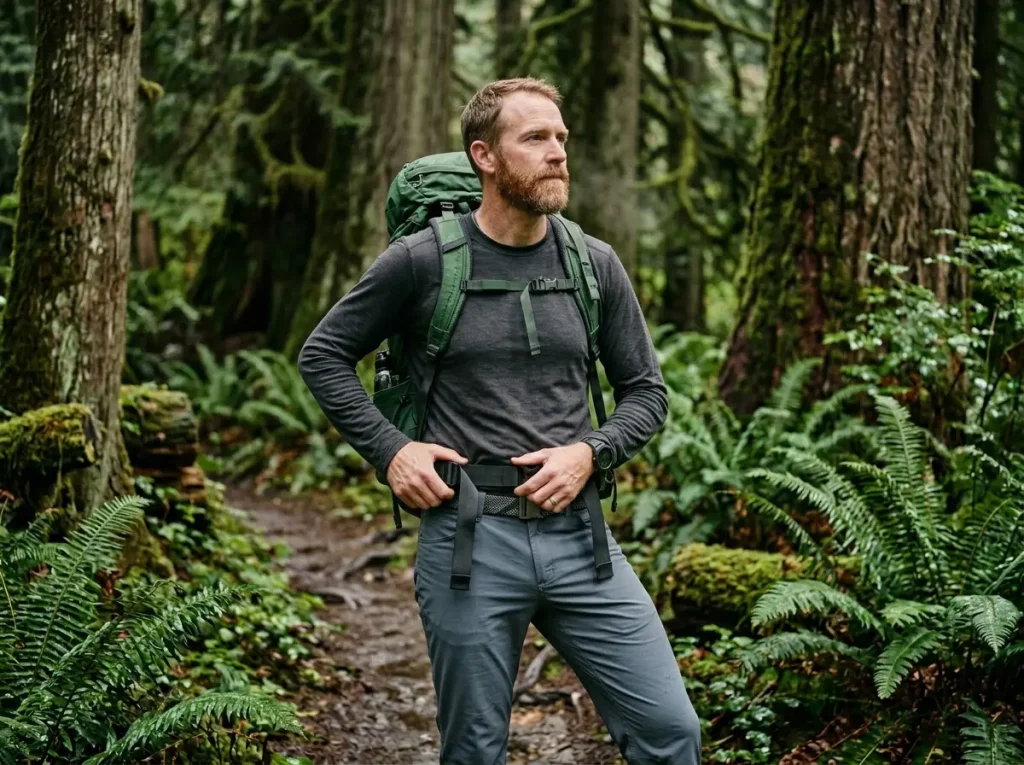
I’ve guided in the Whites long enough to spot this problem at the trailhead. You can see it in the gear before the first mile — traditional jeans-style belt buckle, thick leather strap, a loaded hip belt cinched directly on top. That’s not bad fashion. That’s a friction conflict waiting to become a medical situation.
This guide breaks down exactly why hiking pants falling down under a pack happens, what it costs you physiologically, and how to fix it — before your next trip turns into a grinding lesson in pelvic anatomy.
⚡ Quick Answer: Hiking pants fall down under a backpack because the hip belt’s tension creates a compression zone over the iliac crest — any belt hardware (buckle, thick waistband) under the hip belt gets forced down, dragging your pants with it. This is called the Sandwich Effect. Fix it by switching to an integrated or elastic low-profile belt (under 5mm stack height), cinching your hip belt using the Shrug-and-Cinch technique, and leaving your shirt untucked to decouple pack movement from pant movement.
Why Your Pants Fall Under a Pack — The Physics of the Pelvic Interface
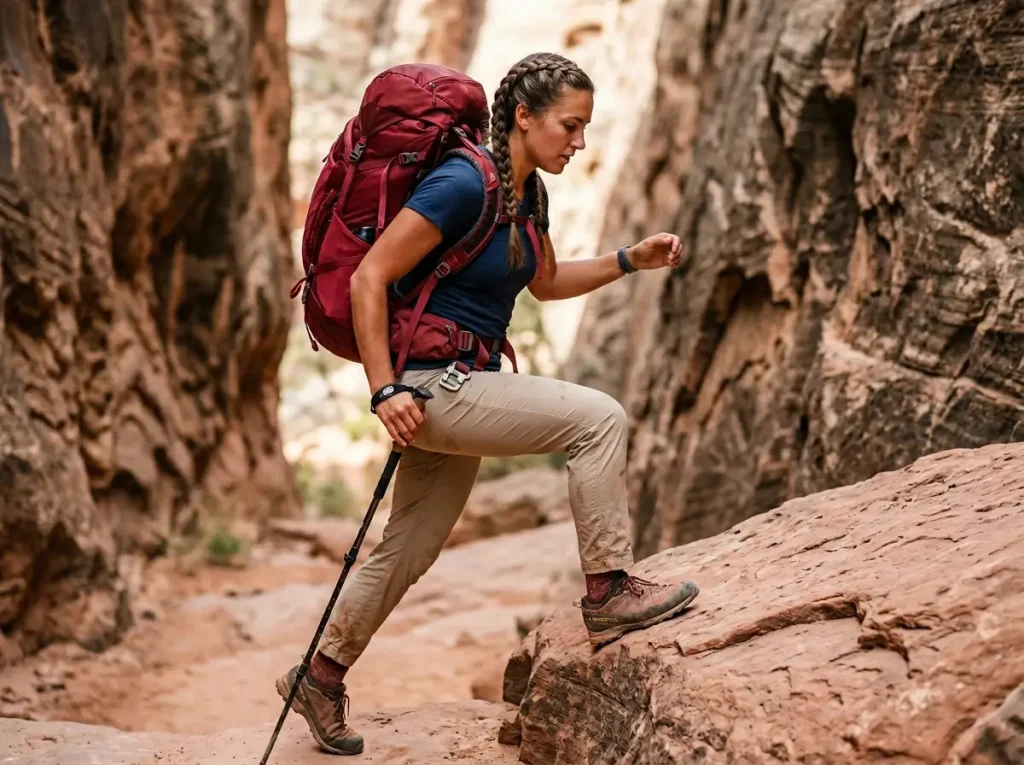
A properly fitted pack transfers 70–90% of its total weight to the pelvic girdle through the hip belt. For a 40-lb load, that’s 28–36 lbs of constant downward force pressing onto the iliac crest — the bony shelf at the top of your hip bones. The hip belt has to be cinched hard to do its job. That’s not optional.
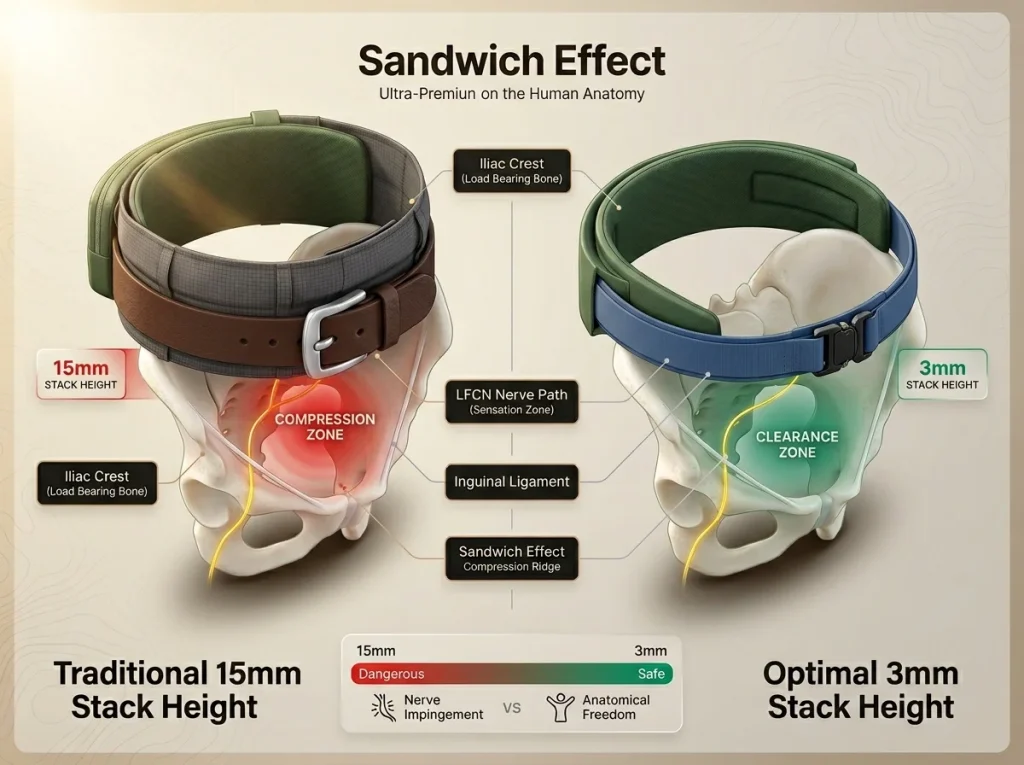
The problem is what’s underneath it. When a pant waistband, belt buckle, and backpack hip belt all overlap at the iliac crest, you’ve created what I call the Sandwich Effect — a focal compression ridge where three layers stack under high tension. Research using digital pressure mapping shows that static peak pressure as the primary predictor of load carriage discomfort is the reliable metric here, not subjective soreness. Pressures above 30 kPa at the hip joint cause tissue damage starting around 20 minutes of walking.
The buckle geometry makes it worse. Traditional belts — the kind you’d wear to the office — sit at roughly 15mm stack height when buckle and webbing are combined. Your hip belt has to physically climb that ridge every time you cinch it. Under load, it slides down the ramp and takes your pants along for the ride.
You can also understand how your pack’s suspension system distributes load to the hip belt — which makes the Sandwich Effect physics click immediately.
After a full week in the Whites with a 45-lb expedition pack, I could predict exactly which hikers in our group were running traditional belts by mid-afternoon. They were the ones adjusting their pants on every climb.
The Iliac Crest — Your Body’s Load-Bearing Shelf
The iliac crest is the only anatomical structure that can sustain pack loads without joint damage. The hip belt has to sit directly on top of it — not below. When it drops even 1–2 inches low, load transfers from bone to soft tissue and nerve pathways, and the tension required to maintain the same support multiplies with every centimeter.
Pant waistbands that sit higher than the iliac crest act as a fabric ramp. The hip belt slides down that ramp under load, carrying the pants in its wake. This isn’t a pant quality issue. It’s a fit geometry failure.
The Sandwich Effect — Measured, Not Just Felt
The stack height gap is where the damage happens. A 1.5-inch elastic belt comes in around 3mm of stack height. A traditional nylon or leather belt with a pin buckle runs 15mm or more. That 12mm differential creates a pressure ridge directly under the hip belt webbing during steep ascents, where you’re leaning forward and loading the anterior iliac spine.
Pro tip: Offset your pant belt buckle 2–3 inches to the left or right of center. This prevents direct stacking between the pant buckle and the pack buckle — the alignment that causes the deepest bruising.
Wet Creep — Why Your Belt Loosens Mid-Day
Nylon webbing absorbs moisture from sweat and rain and measurably stretches under tension. A belt that feels snug at the trailhead will be noticeably looser after 4–6 hours in wet conditions. This is material behavior, not fit failure.
The “one notch tighter at the trailhead” trick only delays the problem. Nylon stretches into the hike, not against it. Polyester webbing absorbs significantly less moisture and holds tension better in wet-weather applications. Leather is the worst: it softens under moisture, loses structural tension, and carries the full 15mm-plus profile thickness penalty.
The Neurological Cost — When Pant Creep Becomes a Medical Issue
Here’s the part most gear articles skip. The Sandwich Effect isn’t just about discomfort. Belt hardware stacked against the iliac crest can compress the lateral femoral cutaneous nerve (LFCN) as it passes under the inguinal ligament near the anterior superior iliac spine — a condition called meralgia paresthetica (MP).
MP presents as burning pain, tingling, and numbness on the outer thigh. It is frequently misdiagnosed as quad strain or sciatica. Key differentiator: pure sensory loss with no motor weakness. Sciatica radiates below the knee. MP does not. You can use this in the field.
The mechanism of lateral femoral cutaneous nerve entrapment is well-documented: clinical incidence runs 3.2–4.3 cases per 10,000 patient-years in the general population, but in long-distance backpackers the picture changes sharply. A study of Appalachian Trail hikers found 34% reported nerve-related symptoms consistent with MP. Packs exceeding 31 lbs correlate with a 70% prevalence of those symptoms in long-carry situations. That’s not a fringe case. That’s the statistical norm for loaded carries.
The good news: 91% of MP cases respond to conservative management — which in hiking context means eliminating the pressure source. Fix the gear, fix the nerve.
I’ve seen hikers chalk up two weeks of outer thigh numbness to tired legs. That’s not fatigue — that’s nerve compression with a clear anatomical cause. One hiker in our group on a week-long traverse kept stopping to “stretch her quads.” She wasn’t cramping. Her hip belt had been sitting a full inch below the crest for three days.
Pro tip: If your outer thigh symptoms resolve within 30 minutes of loosening the hip belt, the gear is the culprit — not an underlying condition. Tighten the belt again and the symptoms should return. That’s your field diagnostic.
Recognizing Meralgia Paresthetica in the Field
Onset typically happens 3–5 miles into a loaded carry. The burning or tingling appears on the anterolateral thigh — not below the knee. Uphill sections and tight hip belts both aggravate it. If you press gently on the anterior iliac spine with your thumb while lying on your back and it reproduces the thigh symptoms, MP is the likely cause. This is called the Pelvic Compression Test, and it takes about 10 seconds.
Combine proper hip belt placement over the iliac crest with a lower-profile waistband system, and most cases resolve without stopping the trip.
Numbness that persists more than 1–2 months post-trip needs medical evaluation. Chronic nerve compression can progress to permanent damage. This is not a “wait and see” situation.
The Anatomical Lottery — Why Some Hikers Never Feel It
The LFCN’s path under the inguinal ligament varies considerably between individuals. Some people’s nerve routes farther from the ASIS — compression is far less likely even with thick belt hardware. Lower body fat means the nerve sits closer to the surface with less cushioning. Pronounced iliac crests create a deeper ridge for the hip belt to anchor, but also compress the nerve more forcefully.
Two hikers, identical gear, same trail — wildly different comfort outcomes. This is anatomy, not toughness.
Integrated Belt vs. Belt Loops — The Technical Breakdown
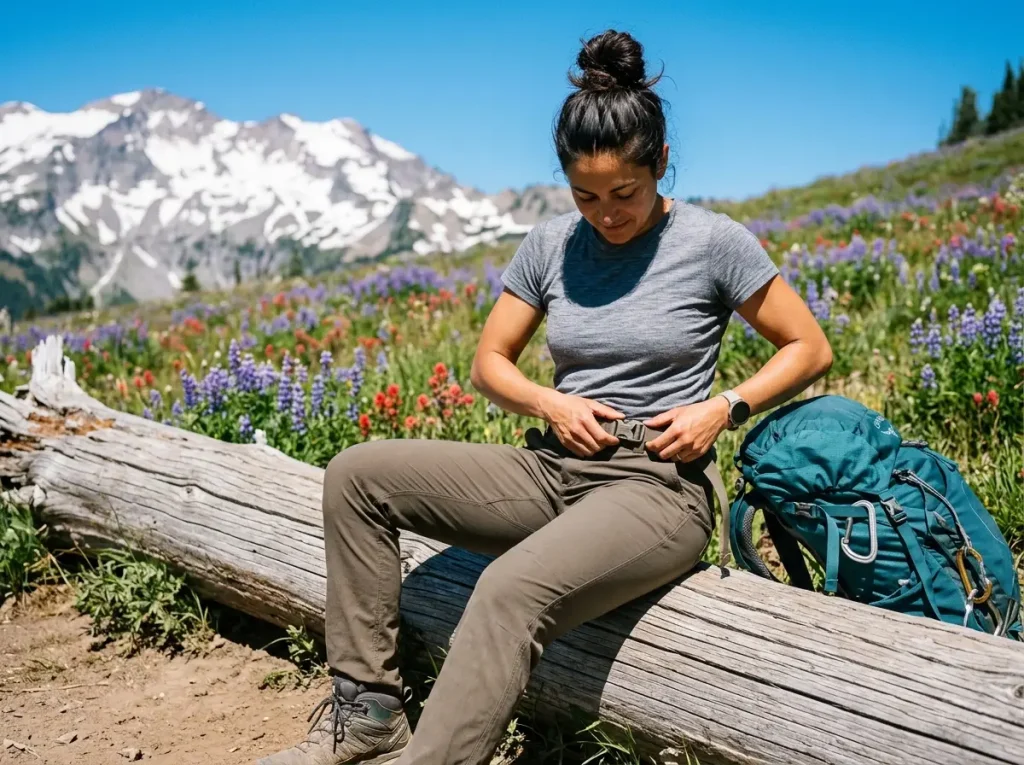
This is the core decision. Most people make it based on how the pants look at the trailhead, not how they behave at mile 15 with 40 lbs on their back.
Integrated systems sew the belt directly into the waistband — no separate hardware, no variable positioning. Stack height drops to under 3mm with a tension-lock or G-hook closure. The Prana Stretch Zion II uses a friction-lock closure. The Arc’teryx Gamma runs a low-profile metal buckle. The Black Diamond Alpine Light uses a G-hook system — a flat aluminum hook with zero protrusion above the waistband. No belt buckle to clash with. No Sandwich Effect.
Belt loop systems let you customize tension, belt material, and buckle type. They’re your town-to-trail versatility option. The risk is that a standard belt adds 12–15mm of stack height and is subject to wet creep. The Outdoor Research Ferrosi uses an internal drawstring plus loops. The Kuhl Radikl runs a hybrid waistband. Both become functional load-carry systems when you pair them with the right aftermarket belt.
One finding most reviews miss: aluminum G-hooks are superior to plastic friction-locks for long-distance carries. Plastic friction-locks lose their grip as webbing frays over hundreds of miles. An aluminum G-hook cannot slip once hooked. At mile 400 of a thru-hike, a climber I know had lost 18 lbs. The Black Diamond’s G-hook had three extra inches of webbing slack to work with. He was still dialing in his fit. The guy with integrated-only European-style pants was held together with a bungee cord.
Research confirms that hip belt tensioning and its influence on pelvic range of motion under load is measurable — 120 N of hip belt tension visibly affects pelvic kinematics. The waist system you run under that tension matters.
Learn how to match pant construction to your specific terrain demands before you buy — especially if you’re moving between scrambling and trail hiking in the same day.
Integrated Systems — Strengths, Limits, and Who They’re For
Integrated systems eliminate wet creep risk, deliver faster cinching, and prevent buckle clash entirely. Ladder-lock webbing gives you micro-adjustability in roughly 5mm increments. Standard hole-punch belts give you 1-inch jumps. That matters when body weight shifts over a long trip.
The limit: you can’t swap belt type. As the waistband stretches with use or body weight changes, your adjustment range is finite. Integrated systems are best for day hikers and multi-day trekkers carrying 25–55 lb packs who prioritize pack interface performance over fashion versatility.
Belt Loop Systems — Maximizing Versatility with the Right Aftermarket Belt
Belt loops unlock the Arcade Belt upgrade path: a 1.5-inch elastic polyester-rubber blend with roughly a 3mm flat buckle — nearly equal to integrated performance. The elastic maintains constant tension through high-step maneuvers. A static nylon belt “pumps” loose with hip flexion cycles. An Arcade Adventure Belt doesn’t pump. It absorbs. That difference matters on log crossings and scree scrambles.
If you need harness compatibility — alpinism, via ferrata — loop systems let you run a G-hook aftermarket belt with zero profile above the waistband. Plastic buckles can snap under combined harness plus pack harness tension. G-hooks don’t.
Sizing is critical: a belt that’s too long leaves 2–4 inches of excess webbing bunched near the buckle. That bunched webbing sits directly under the hip belt — you’ve recreated the Sandwich Effect with your solution.
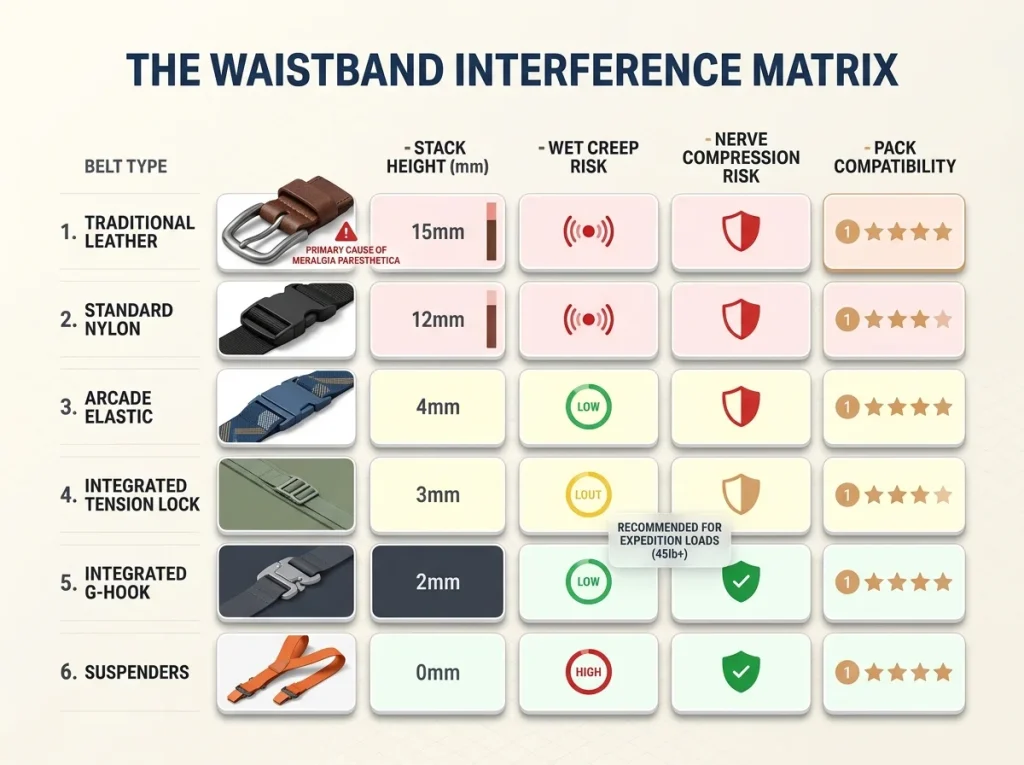
The Waistband Interference Matrix — Matching System to Pack Type
Day pack users carrying 10–25 lbs can run almost any system — hip belt tension is low enough that traditional belt interference is manageable. Multi-day technical packs in the 25–45 lb range demand an integrated tension-lock or elastic belt. At this weight, the Sandwich Effect becomes a clinical nerve compression risk over an 8-hour day. Expedition loads above 45 lbs: integrated G-hook or suspenders only. Hip belt tension at this range can exceed 120 N. Any protrusion above 5mm becomes a pressure event over a full day’s carry.
For harness-compatible setups — alpinism, via ferrata, technical scrambling — G-hook only. Plastic buckles are a liability under combined harness and pack harness tension.
The Fitting Protocol — How to Eliminate Pant Creep at the Source
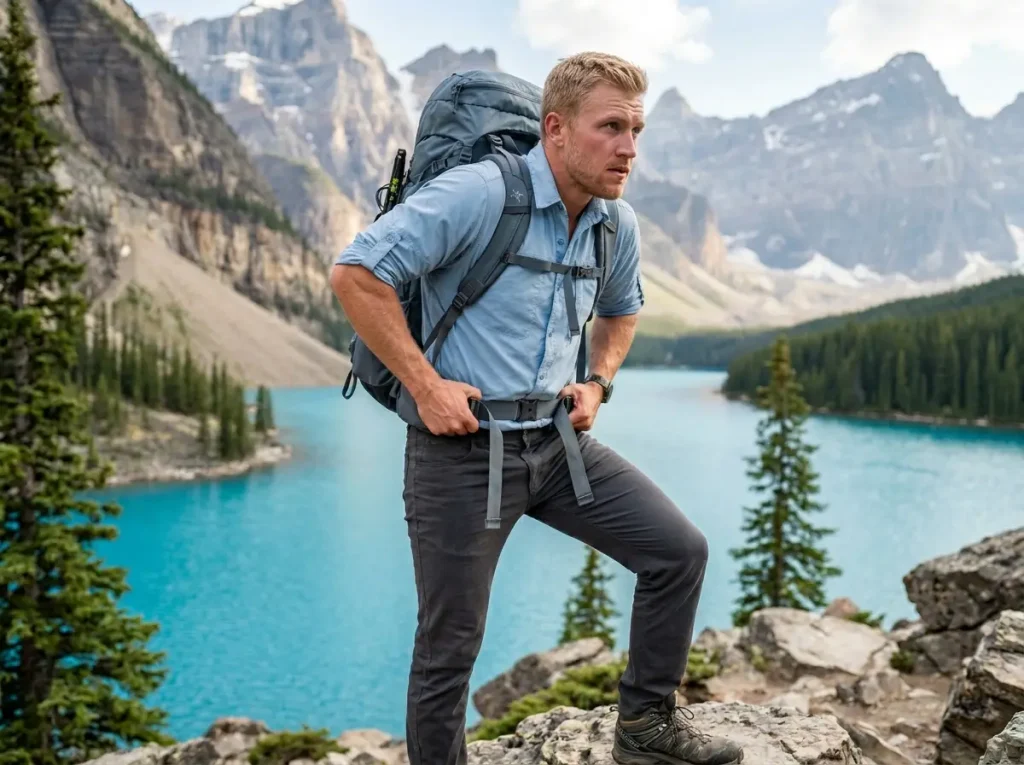
Most pant creep doesn’t start with the pants. It starts with the hip belt fitting sequence. A correctly positioned hip belt locks the pant waistband in place. A misplaced one drags it down with every stride.
Every guiding course I’ve taken includes a belt check at mile one. You’d be stunned how many experienced hikers are carrying 40 lbs on their shoulders because the hip belt slid two inches low before they hit the switchbacks.
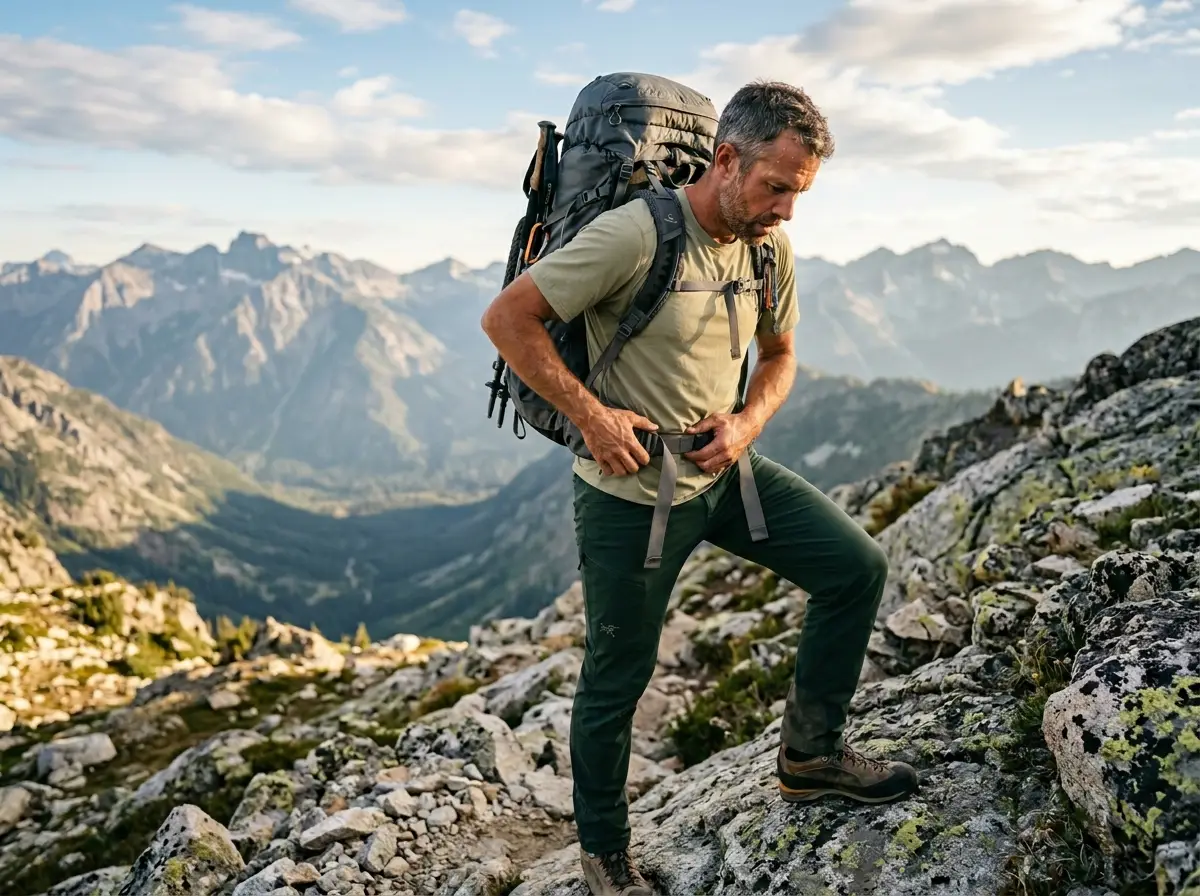
The fix is the Shrug-and-Cinch Protocol. Shoulder the pack and loosen the hip belt completely. Tighten the shoulder straps just enough to keep the pack against your back — not load-bearing. Lean forward 10–15 degrees at the waist. Shrug your shoulders firmly to temporarily lift the load off the pelvis. While shrugging, cinch the hip belt over the iliac crest. Lower your shoulders — you should feel the weight drop onto your hips. If the hip belt migrates down in the first 10 minutes, you cinched it below the crest. Stop and redo.
The influence of hip belt tension on pelvic movement during load carriage is documented — overtightening at 120 N measurably impairs gait efficiency. Snug-but-breathable is the target. You should feel the load, not cut off circulation.
For ongoing pressure hot spots after proper placement, consider heat-molding your hip belt for a custom fit to your iliac crest geometry.
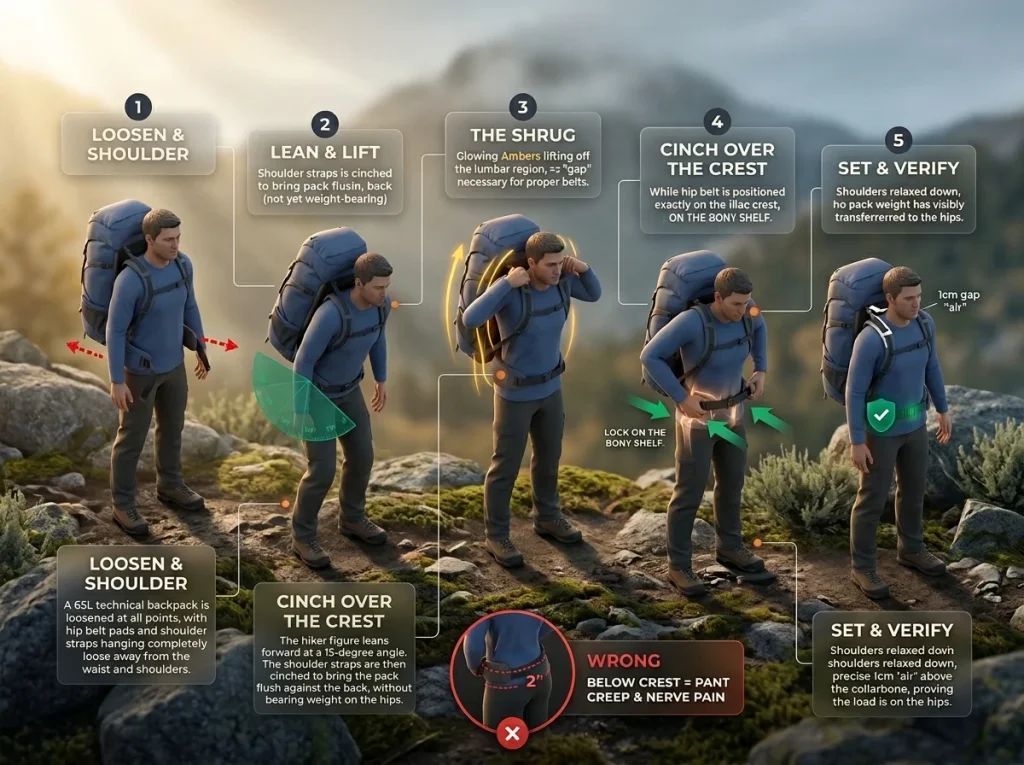
Pro tip: Press your hip bones through the hip belt after cinching. You should feel padding over bone — not soft tissue. If you feel no bone, the hip belt is too low. This takes about four seconds and tells you everything.
The Shrug-and-Cinch — Step-by-Step
- Put on the pack. Loosen the hip belt completely.
- Tighten shoulder straps just enough to hold the pack against your back.
- Lean forward 10–15 degrees at the waist.
- Shrug your shoulders upward firmly — this lifts the pack weight off the pelvis.
- While shrugging, cinch the hip belt firmly over the iliac crest.
- Lower your shoulders and verify: the weight should drop onto your hips.
If it doesn’t feel right at step 6, the belt is below the crest. Start over. It takes 90 seconds when you know what you’re doing.
Base Layer Interface — The Silent Variable
The fabric between skin and waistband is part of the retention system. Snug merino wool or nylon-elastane base layers create friction that holds the waistband in place. Loose, silky polyester base layers act like a conveyor belt — the pants glide downward regardless of your belt tension. Understanding how base layer fit affects hip belt retention and chafing under load is the hidden variable most hikers never consider.
The untucked shirt rule works because an untucked shirt decouples pack movement from pant movement. The pack slides against the shirt fabric. The pants stay independent. Tuck your shirt and you physically connect the hip belt’s downward movement to the pant waistband.
I started testing this on group trips by explicitly telling half the group to tuck, half to leave it out. By mile 8, the pattern was clear every time — not a single outlier. The tucked-shirt group was adjusting pants. The untucked group wasn’t thinking about their pants at all.
Load Distribution Adjustments That Eliminate Downward Pull
Top-heavy packs shift center of gravity high and rearward. To compensate, hikers lean forward — which increases shear force on the rear waistband and accelerates pant creep. Pack your heaviest items close to your back and at hip height: bear canister, water, tent body. This shifts the center of gravity forward and reduces rearward pull.
Load lifter straps should run at a 30–45° angle from the top of the shoulder straps to the pack frame. Flat straps fold the pack backward, compounding downward pant pull. Setting your load lifter straps to the correct 30–45° angle is a 30-second adjustment that affects your waistband retention all day. And the right weight distribution approach changes the whole body mechanics — your waistband retention is downstream of how well your CoG is centered.
Fabric, Construction, and the Retention Physics of Technical Pants
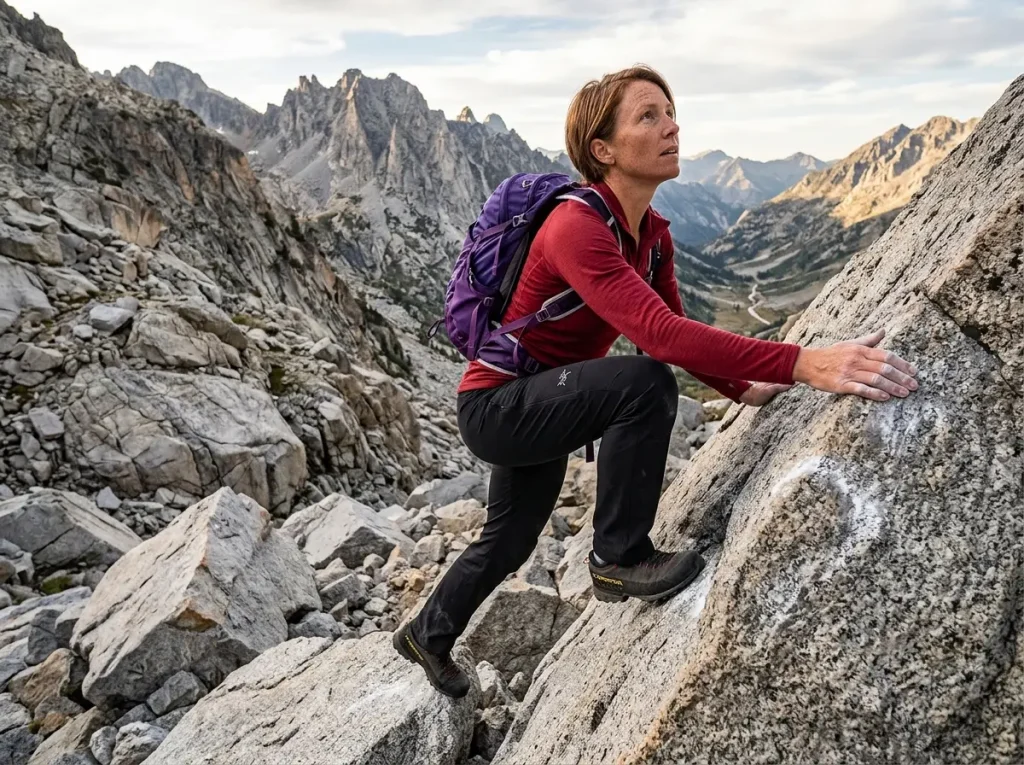
Beyond the belt system, the pant itself either helps or fights you. Not all hiking pants are built for loaded carries.
Fabric composition matters. A 97% nylon / 3% spandex blend like the Prana construction grips skin better than 100% polyester. Sweat reduces friction across all fabrics — which shifts the retention burden onto mechanical tension (the belt). Understanding how four-way stretch construction affects waistband stability and gait mechanics gives you the framework for evaluating any pant’s load-carry performance.
Four-way stretch fabric maintains waistband position under dynamic load by absorbing flex rather than transferring it to the waistband. A rigid fabric pant pulls the waistband down on every high step. A stretch pant flexes below the waist and leaves the waistband stationary.
Wide waistbands — 2.5–3 inches — distribute hip belt pressure across 40–60% more contact area than standard 1.5-inch bands. Wider contact area means lower peak pressure per square centimeter. High-rise rear waistband construction keeps waistband contact with the lumbar region even when the hip belt pulls forward and down.
Waistband Width and Pressure Distribution
A 2.5–3 inch waistband is anatomically aligned with the iliac crest width. This prevents the hip belt from “tipping over” a narrow band and sliding. Look for non-folded waistband construction — a doubled-over waistband creates a hard seam edge that acts as its own pressure ridge. Internal elastic with an external nylon facing is the optimal build: hip belt grips the nylon face, inner surface flexes with the body.
The Gusset’s Role in Preventing Pant Migration
During high-step moves — rock scrambling, log crossings — inner thigh fabric pulls upward. Without a gusset, this tension transfers directly to the waistband, creating a cyclical up-then-snap-down motion that progressively loosens retention. A diamond gusset absorbs that tension at the crotch seam. The waistband stays stationary while the pants flex below it.
Field-testing pant gusset performance through the Sit-Squat-Climb protocol is the best way to evaluate whether a pant’s gusset actually protects waistband retention under high-movement scrambling. Do it in the store before you buy. And if you’re not sure what a gusseted crotch even means in construction terms, here’s exactly what the gusset does and why hikers need it broken down in plain language.
When to Replace Technical Pants — The Retention Failure Indicators
Waistband elastic stretch-out feels like a 20–30% reduction in closure tension at the same buckle position. Fabric pilling at the hip belt contact zone is a friction surface indicator — that’s a replacement signal, not a cosmetic one. Belt loop stitching failure shifts full tension onto adjacent loops, creating asymmetric pull that no amount of belt adjustment fixes. Field repair: Tenacious Tape on pilling zones can temporarily restore friction surface for one more trip.
Conclusion
Three things to carry off this trail:
The Sandwich Effect is physics, not personal weakness. Stack height drives the problem. Fix the stack height and you fix the creep. Integrated belts are the permanent solution; an Arcade Belt at 3mm is the closest you get to integrated performance without replacing your pants.
The Shrug-and-Cinch is non-negotiable. No waistband system compensates for a hip belt cinched two inches below the iliac crest. Fit the pack first, then evaluate the pants.
And take meralgia paresthetica seriously. Outer thigh numbness on a long carry is not tired legs. It’s nerve compression with a clear anatomical cause. The fix is the same as the fix for pant creep — remove the pressure, rebuild the system. Most cases resolve within days. Ignored for months, some don’t.
Take your current pants and hip belt out before your next trip. Measure the stack height of your closure system. If it’s over 5mm, you’re one heavy carry away from a problem. Run the Shrug-and-Cinch on your next day hike with a full load and check the hip belt position at mile one.
FAQ
Do hiking pants need a belt?
It depends on your pack weight and waist retention system. If your pants have a secure integrated webbing belt and your pack hip belt is properly placed, you don’t need an additional belt. If your pants use belt loops and you’re carrying more than 25 lbs, a low-profile elastic belt at 3mm stack height is the difference between the Sandwich Effect and a functional system.
How do I keep hiking pants from falling down with a heavy pack?
The primary fix is the Shrug-and-Cinch — cinch the hip belt while shrugging your shoulders to capture the iliac crest. Pair that with an integrated or elastic belt under 5mm stack height. Secondary fix: leave your shirt untucked to decouple pack movement from pant movement.
Why do some hiking pants have a built-in belt?
Built-in belts reduce stack height — the total vertical thickness of the waistband assembly. Traditional belt buckles run 15mm or more, creating a pressure ridge under the pack’s hip belt that causes pant creep, focal bruising, and in severe cases, nerve compression. Integrated systems using tension locks or G-hooks come in under 3mm.
What is the best belt for hiking with a heavy backpack?
For hikers using belt-loop pants, the Arcade Adventure Belt — elastic, 3mm flat buckle, 1.5-inch width — is the closest functional equivalent to an integrated system at low cost. Avoid leather, thick nylon, or any metal pin buckle above 5mm for carries over 25 lbs. The set-and-forget adjustment system on elastic belts also means it compensates automatically for gait-driven tension changes.
Can wearing the wrong belt cause numbness in my thigh?
Yes. This is meralgia paresthetica, caused by compression of the lateral femoral cutaneous nerve (LFCN) against the anterior iliac spine by overlapping belt hardware and hip belt tension. It presents as burning, tingling, or numbness on the outer thigh — not below the knee. It is not sciatica. 91% of cases resolve when the pressure source is removed. Symptoms persisting more than 4–6 weeks post-trip require medical evaluation.
Risk Disclaimer: Hiking, trekking, backpacking, and all related outdoor activities involve inherent
risks which may result in serious injury, illness, or death. The information provided on The Hiking Tribe is for
educational and informational purposes only. While we strive for accuracy, information on trails, gear, techniques,
and safety is not a substitute for your own best judgment and thorough preparation. Trail conditions, weather, and
other environmental factors change rapidly and may differ from what is described on this site. Always check with
official sources like park services for the most current alerts and conditions. Never undertake a hike beyond your
abilities and always be prepared for the unexpected. By using this website, you agree that you are solely
responsible for your own safety. Any reliance you place on our content is strictly at your own risk, and you assume
all liability for your actions and decisions in the outdoors. The Hiking Tribe and its authors will not be held
liable for any injury, damage, or loss sustained in connection with the use of the information herein.
Affiliate Disclosure: We are a participant in the Amazon Services LLC Associates Program, an
affiliate advertising program designed to provide a means for us to earn advertising fees by advertising and linking
to Amazon.com. As an Amazon Associate, we earn from qualifying purchases. We are also an official affiliate partner
of Black Diamond Equipment via the AvantLink network. If you click on a Black Diamond affiliate link and make a
purchase, we may earn a commission at no additional cost to you. We also participate in other affiliate programs and
may receive a commission on products purchased through our links. Additional terms are found in the terms of
service.