The lightest tent on paper is a Dyneema shelter you can only order straight from the maker, and you were planning a handful of weekends, not the Pacific Crest Trail. The best ultralight tents for that kind of hiker are a different list from the thru-hiking tent roundups: shelters you can actually buy, pitch properly on the second try, and understand before you carry them up a hill. This guide draws on the 2026 reviews at OutdoorGearLab and CleverHiker, our own tent guides, and what r/Ultralight commenters argue about, so every weight below names its source. Here is the short version, one pick per format:
| Format | Who it fits | Pick | Weight (source) |
|---|---|---|---|
| One-person, trekking-pole | Solo weekend hikers who already carry poles | 3F UL Gear Lanshan 1 Pro | About 24 oz (our one-person guide) |
| Budget two-person | Pairs who want a dual-wall tent at a modest tier | 3F UL Gear Lanshan 2 Pro | 2 lb 0.3 oz (CleverHiker) to 2.45 lb (OutdoorGearLab) |
| Semi-freestanding two-person | Sheltered forest camps, weight first | NEMO Hornet Elite OSMO 2P | 1 lb 11 oz minimum (one listing) |
| Two-person with its own frame | Pairs who want a frame and a low carry weight | MSR FreeLite 2 | 2 lb minimum (our weight chart) |
| Freestanding two-person | Rock, sand and hard ground | Big Agnes Copper Spur HV UL2 mtnGLO | About 3 lb (spec tables, UL2 family) |
| Tarp | Dry-weather hikers who trade bugs and a floor for weight | Onewind 10×10 ft silnylon tarp | Tarp only, no floor; weight varies by size |
How the Best Ultralight Tents Pitch: Poles, Frames or Neither
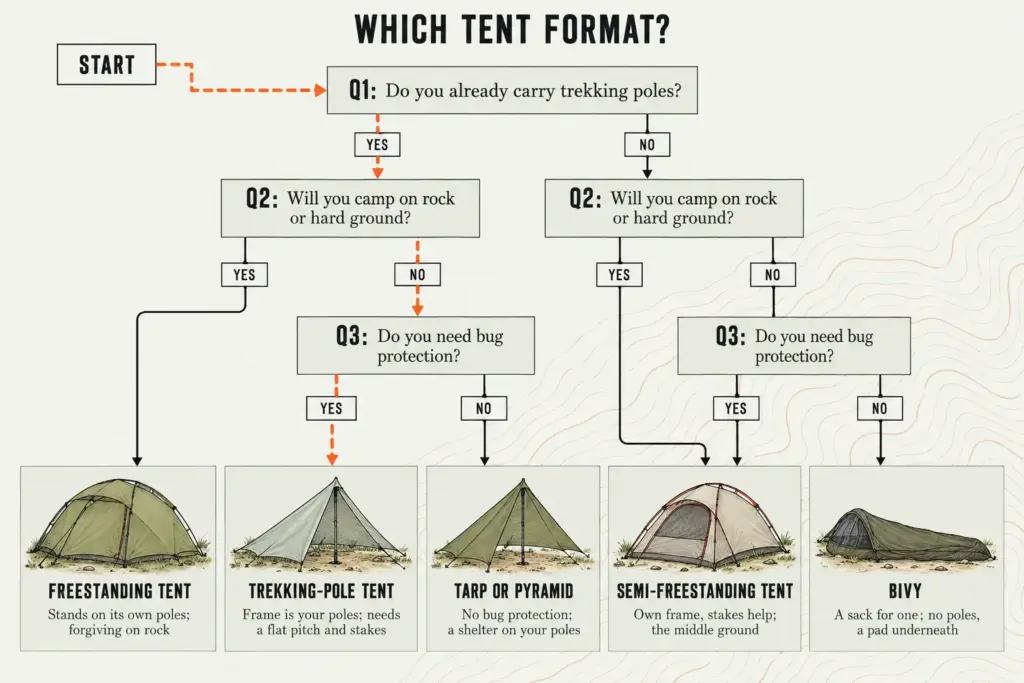
The first night a trekking-pole tent goes up at a campsite you have never seen, the stakes and the ground are all that stand between the shelter and the wind. That is the real difference between the three ways an ultralight shelter stands up: your poles, its own frame, or nothing at all. Each one decides how much the tent forgives you, and how much weight you carry for the privilege.
Trekking-Pole Tents
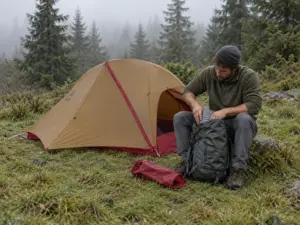
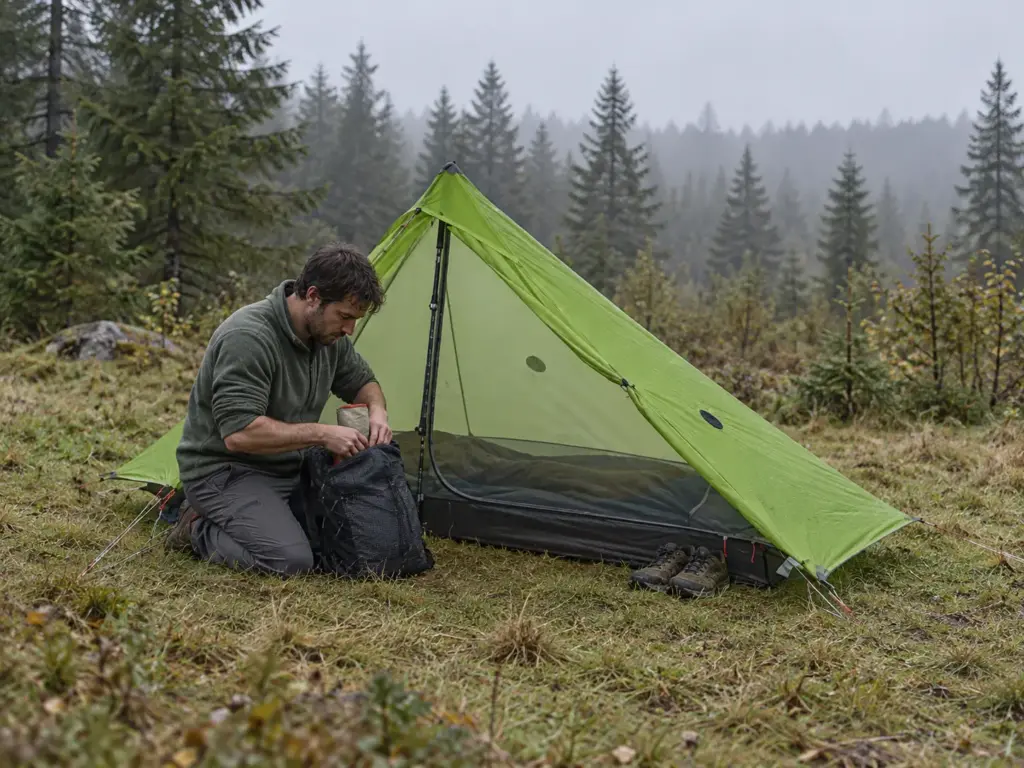
A trekking pole tent uses the poles you already hike with as its frame. That makes it the lightest route, because the heaviest part of a conventional tent never leaves the closet. The catch is that a good pitch comes from stakes and a flat site, not from the tent itself.
If you already walk with poles, the whole idea rests on using trekking poles as tent support, and the tension in the guylines, not the fabric, holds the shape. Pitch it once in the yard before the trailhead. Finding out how the door zips while you are losing light is a bad way to meet a tent.
Whatever the pitch, the walls matter too. A single wall tent is one layer of fabric, which saves weight and puts the night’s condensation inside with you. A double wall tent adds a mesh inner under the fly, so the moisture stays on the outer layer, as it does on the dual-wall Lanshan 2 Pro below.
Freestanding and Semi-Freestanding Tents
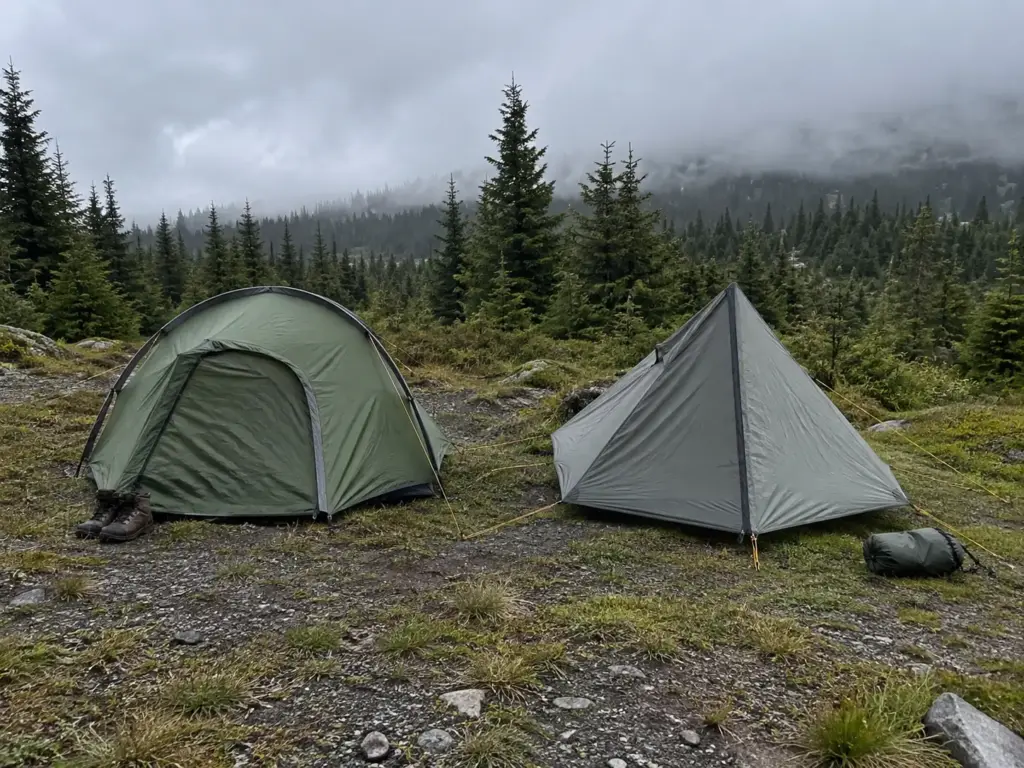
A freestanding tent stands on its own poles. You can lift it, shake it out and move it, which matters on rock and hard ground, and it sits at the heavy end of this list. A semi-freestanding tent splits the job: a frame holds most of the shape, and a few points still need stakes. Section six settles where we land on that split.
The trade shows up fastest on bad ground. One r/Ultralight original poster wanted a one-person tent for rock and concrete, where stakes will not bite, and still wanted to survive a full day of rain inside it. A trekking-pole tent cannot answer that question, because it falls over without anchors. A freestanding tent can stand there on its own poles, though it still needs weight or anchors once the wind picks up, and the pound or so it costs you is exactly what you are paying for.
Tarps, Pyramids and Bivies
Tarps, pyramids and bivy sacks are lighter still, and they get there by taking things away: the floor, the bug mesh, and a good share of your elbow room. A flat tarp is a sheet you shape with poles and guy lines, a shaped tarp arrives cut to a pitch, and a pyramid tent is a single-pole shelter, usually floorless. A bug nest or a bivy goes under any of them to keep insects off.
The r/Ultralight thread shows how split this gets. One commenter says a sleeping pad and a bivy is all you need, “assuming there’s a roof”. The original poster answers that they would not want to be stuck in a “coffin sized tent” for 24 hours. Both are right for their own trip, which is the point.
A shelter that suits a dry overnight can be miserable on a rain day. The author of the 2021 flooded-Duplex thread, covered below, says they cowboy camp almost all the time and carry a shelter only as a backup for wind and rain.
Silnylon, Silpoly or Dyneema: What the Fabric Changes
You pitch the fly tight at dusk, and by morning it hangs loose. That sag is the fabric talking, and it is the fastest way to learn what you bought.
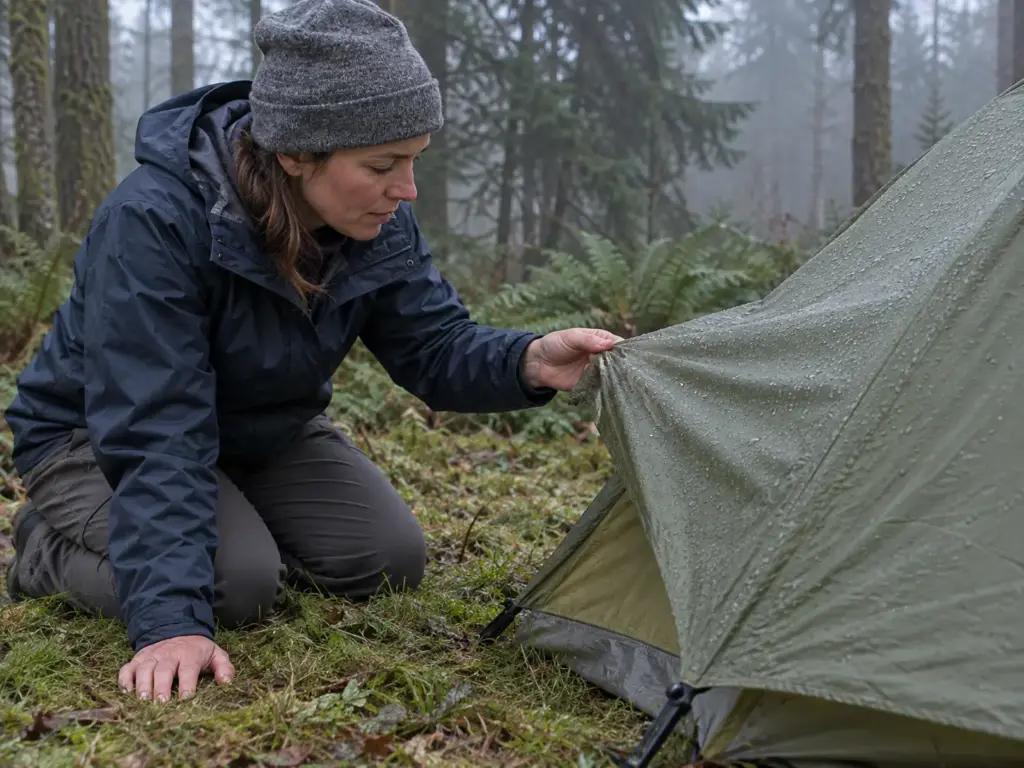
Silnylon (sil-nylon) is a thin ripstop nylon with a silicone coating. It is light and forgiving on the budget, but it will sag when wet and needs a re-tighten, a habit Pie on the Trail described back in 2019. Silpoly (sil-polyester) is the same idea in polyester and is the usual fix: it stays tighter when wet, so there is less midnight adjusting. The denier number, such as the 20D on the Lanshan 1 Pro, tells you how thin the cloth is.
Dyneema Composite Fabric (DCF) does not stretch and sits at the top of the weight charts, which is why the lightest shelters named in the reviews, such as the Zpacks Duplex, are Dyneema.
Whether it earns its place is a fair argument. One r/Ultralight commenter says Dyneema is “basically same weight as silpoly/silnylon but like 2x the price”. Another says the thick DCF on one brand’s tents “might as well be some sort of ripstop, won’t matter weight wise.” Those are two user opinions, not lab data, but they match a pattern you will see again: past a certain point, you are paying for a different fabric more than for fewer ounces.
One practical note applies to the cheap end. A silnylon tent such as the Lanshan 1 Pro needs its seams sealed before the first trip, as our one-person guide points out.
Seal a silnylon tent at the kitchen table, on a dry day, and give the sealer a full night to cure before it goes into the stuff sack. Doing it at a campsite, with the first drizzle on the way, is how seam sealer ends up on the inside of the floor.
The deep comparison lives in its own guide, and it is worth a read before you spend real money: what fails first, silnylon or Dyneema.
Reading an Ultralight Spec Sheet: Why Published Weights Disagree
Two respected reviews list the Lanshan 2 Pro at 2.45 lb and at 2 lb 0.3 oz. That gap is about 7 oz (39.2 oz against 32.3 oz), a bigger swing than most of the weight differences these lists argue over. Before you compare any two tents, you need to know which number you are looking at.
Minimum, Packed and Carried Weight
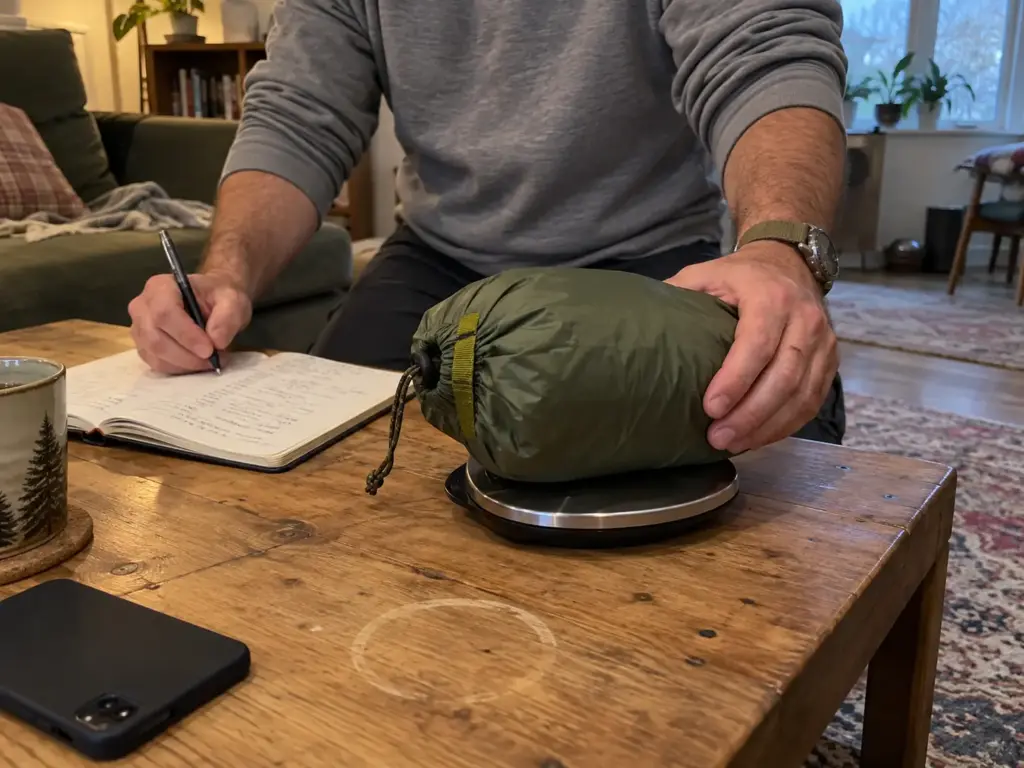
One spec sheet usually holds three different weights. Minimum trail weight counts the tent body, the fly and the poles, and it is the number the lightest-tent headlines use. Packed weight is everything that comes in the bag, including stakes, guylines, stuff sacks and repair parts. The weight you carry is whatever you actually put in the pack, and it moves with every extra you add, such as a footprint or a pair of heavier stakes.
Weight is only one line on the sheet. Packed size decides whether the tent fits the pack you own. Floor area, interior area, vestibule area and peak height decide livability: whether two people can sit up, and where the wet boots go.
A low weight says nothing about any of them, and the tent is only one line in your base weight. For the weight math category by category, see what each pound costs by tent category.
When Two Reviews Disagree on One Tent
The Lanshan 2 Pro is the clean example. OutdoorGearLab (June 2026) lists 2.45 lb, CleverHiker (May 2026) lists 2 lb 0.3 oz, and our weight chart lists about 915 g with the fly, inner and stakes, which lands in the same place as CleverHiker’s figure. The sources do not say why, so quote one number and name its source, never a bare average.
The Zpacks Duplex Classic shows a smaller version of the same pattern: 1.19 lb (about 19 oz) at OutdoorGearLab against 18.5 oz at CleverHiker, roughly half an ounce apart. Check which configuration a listing is describing before you trust the number. CleverHiker also calls the Duplex roughly 9.25 oz per person when two people share it, which is a fair way to think about any two-person tent.
When you put two tents side by side, line them up on the same configuration: with or without stakes, with or without the inner, with or without the stuff sack. A tent that looks 5 oz lighter on paper can simply have left its stakes off the list.
Where Ultralight Tents Fail: Wind, Water and Stakes
The 2 a.m. discovery goes the same way every time. The ground got wet, the stakes pulled, and the fly that was drum-tight at dusk is slapping your face. Ultralight tents fail in a small number of predictable places, and nearly all of them are about the site and the anchors, not the fabric.
Water Gets In Where the Floor Meets the Fly
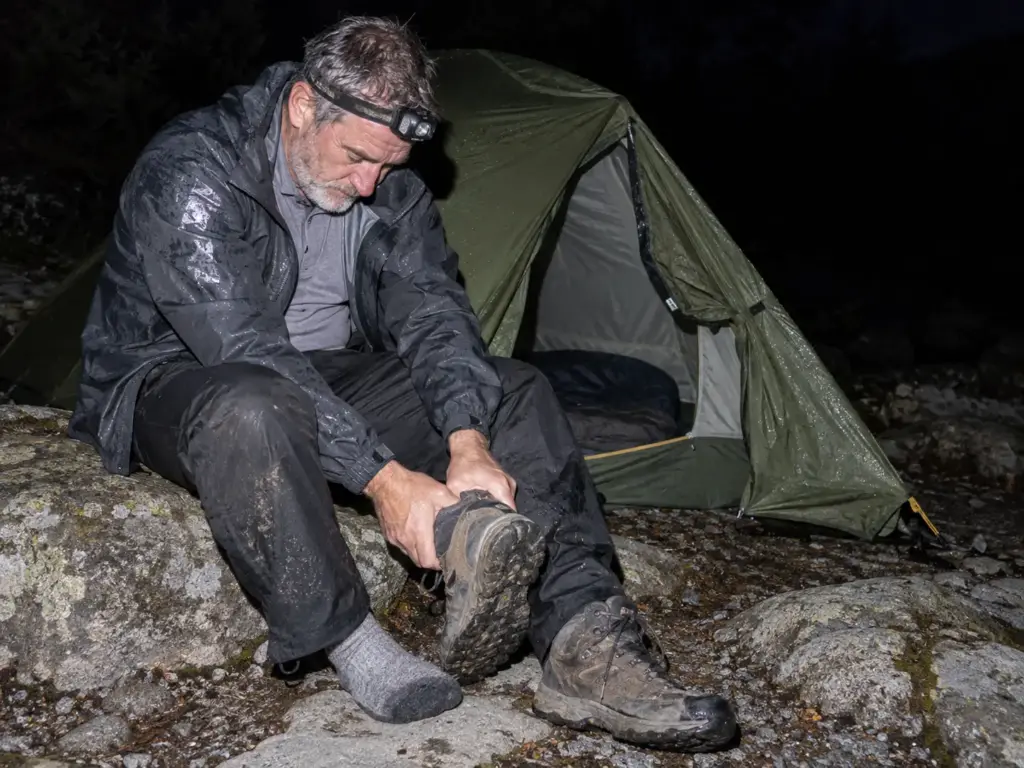
The best-known cautionary story in the r/Ultralight community is a 2021 thread about a flooded Zpacks Duplex. Its author lists three causes and calls them their own: packs pressed against the bathtub wall, so rain running down the fly landed inside; stakes that loosened in wet sand and rock; and trekking poles set too high. Asked directly whether the tent failed, the author confirms: “This is correct – it was all user error.”
It is an old thread, and its author blames their own setup, though one commenter argues that the Dyneema should overhang the mesh perimeter by an inch or two so rain drops to the ground. Treat it as a field guide to mistakes and not as a verdict on the Duplex.
The thread has useful fixes. One commenter says the grosgrain tabs at the four corners must slope outward from the floor, because if they slope the wrong way they carry water in. The same commenter added cords from the center of the long floor edges up to the tent peaks to keep the floor lifted.
Keep packs off the walls and the corners clear, and you remove the first of that thread’s three causes.
Not every commenter agrees on what a floor can do. One relays Cliff Jacobsen’s view, second-hand, that no tent’s bathtub floor prevents a flood and that a groundsheet or footprint inside the tent helps. Another says they and a partner stayed dry in a flooded camp in a Triplex because the bathtub did its job. Both can be true: a bathtub floor is a margin, not a guarantee, and your site choice sets how much margin you start with.
Leave No Trace’s guidance on durable surfaces points you to established campsites, rock, gravel or dry grasses, at least 200 feet from lakes and streams. Its line is that “good campsites are found, not made”, and a found site is usually one that has already shown where it sits relative to the water.
Stakes That Will Not Hold
Stakes fail first, and they fail on ground that looks fine at dusk. In the same thread, one commenter puts it bluntly: “Stakes—sounds like a ground failure, not a stake failure.” Wet sand and wet rock soil let go of a tent stake that would have held in dry dirt, so stake holding power depends on the ground at least as much as on the stake. Check what comes in the bag before you trust it with a night of wind.
The fix is to change how you anchor, not just which stake you carry. On sand, how to bury a deadman in sand turns a stake that slides out into a buried anchor that does not. On rock, use rocks in place of stakes at the guy lines. Guy out every point the tent gives you, and use stakes or rocks at each one.
And keep a stove out of a closed tent, because fire and carbon monoxide are hazards you cannot see coming.
The r/Ultralight original poster’s problem was the extreme case: stakes will not bite in rock or concrete. Commenters pointed to a tarp or a bivy with a pad, and one noted that you can take the poles out of a trekking-pole tent while leaving gear inside. That is one user’s practice, not a measured method, and it is a useful reminder that on hard ground the shelter you choose matters more than the stakes you bring.
Pole Height and the Sag You Fix at 2 A.M.
Pole height sets the tension of the whole pitch. The author of the flooded-Duplex thread says the poles were set too high, which “compromised the integrity of the structure”, and gives 120 cm as the optimum “from what I’ve found”.
That is one hiker’s number for one tent, not a rule, but the idea transfers. Too high and the fabric is stressed at the corners. Too low and the walls sag onto you and the water pools.
Carbon fiber tent poles are light, but adventurealan notes that carbon poles break rather than bend, so a stressed corner is worth catching early.
Silnylon adds a second problem, because it stretches as it gets wet. A pitch that was right at dusk can need retensioning at midnight. Learn the adjustment in the yard, by headlamp, so that doing it in the dark is a thirty-second job.
One more night-time failure has nothing to do with rain: condensation. A single wall shelter collects moisture inside, and even a double wall tent needs ventilation. Open the peak vents and the mesh doors when the weather allows, and keep the fly off the mesh canopy underneath.
Once the pole length is right in your yard, wrap a strip of tape around each pole at that mark. At a dark campsite you set the height by touch and skip the guessing, which is where most sagging pitches start.
Best Ultralight Tents by Format: One Person, Budget Two Person and Tarp
With the trade-offs on the table, here is a short list of ultralight backpacking tent options, one pick per format. Each one comes with a plain reason, one honest limit, and who should skip it.
The One-Person Pick
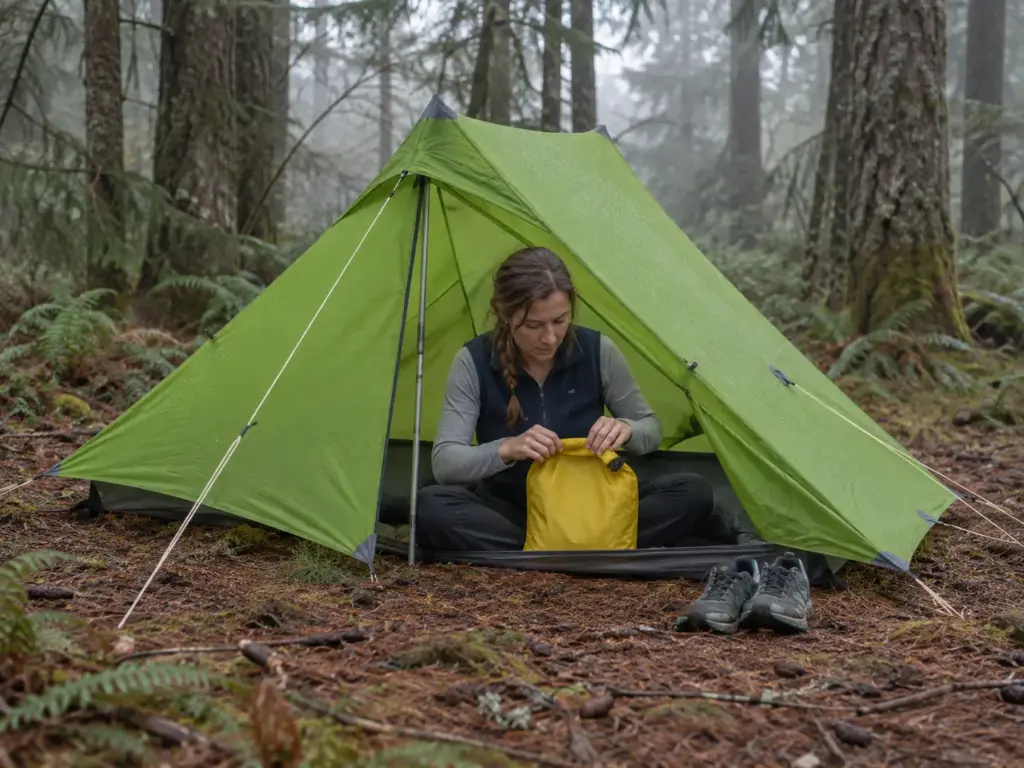
The 3F UL Gear Lanshan 1 Pro is about 24 oz according to our one-person guide, and it is a 20D silnylon trekking-pole tent. That makes it the lightest one-person pick of the tents we checked on Amazon, with no direct order from a cottage maker. It carries every rule from the sections above: you need poles, you need stakes, and you seal the seams before the first trip.
Skip it if you want a tent that stands without anchors, or if you rarely carry trekking poles. The one-person depth lives in its own guide: a one-person tent matched to your height and budget.
The Budget Two-Person Pick
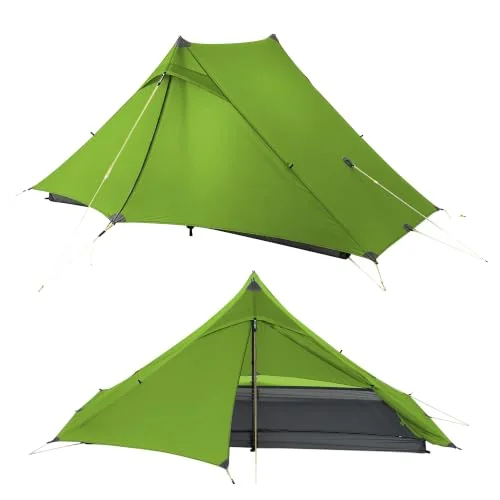
The 3F UL Gear Lanshan 2 Pro is the budget ultralight tent route into a real two-person setup. OutdoorGearLab (June 2026) lists it at 2.45 lb and CleverHiker (May 2026) at 2 lb 0.3 oz, so quote the range and not a single figure. OutdoorGearLab places it among the heavier tents in its lineup, so it earns its spot on budget tier and roominess, not on grams.
Two honest limits apply. Amazon showed only a few units left when this was written, and the weight depends on which source you trust. Skip it if you want a freestanding frame that stands without poles from your pack.
The Tarp Route
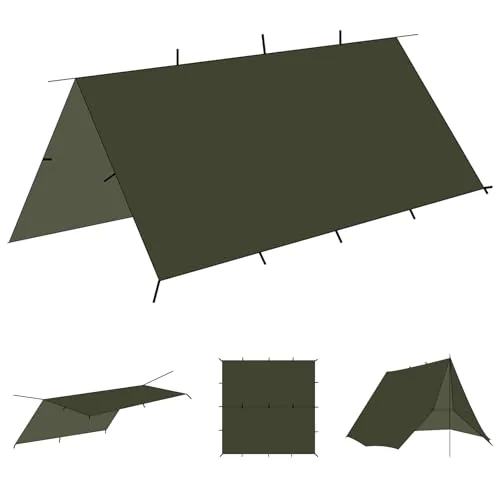
The Onewind 10×10 ft silnylon tarp is not a tent, and we give no weight for it because we found no sourced figure for this exact model. What it trades is clear: you give up the floor, the bug mesh and an easy pitch, and in return you save weight and, according to r/Ultralight commenters, gain more room than a small tent gives. Pair it with a pad and a bivy, as those commenters suggest, and you have a rig they say works on rock where stakes will not bite.
Skip it if you need bug protection or you have never pitched a tarp. When you are ready to try, set up a tarp shelter so rain runs off, not in.
The Names Every Review Site Picks
Two tents come up in nearly every 2026 review, and neither is linked here. The Durston X-Mid Pro 1 is the one-person standard: 1.30 lb at OutdoorGearLab and 1 lb 1.4 oz at CleverHiker. The Zpacks Duplex is the two-person standard: 1.19 lb and 18.5 oz from those same two sites.
Both sell straight from the maker. This list links only tents confirmed in stock on Amazon when it was written, so neither is a pick here.
Semi-Freestanding Tents: Weight Saver or Wind Problem?
Read three 2026 reviews and you get three answers about semi-freestanding tents. That is not a small difference of taste. It decides whether a whole category of two-person ultralight tents stays on your shopping list.
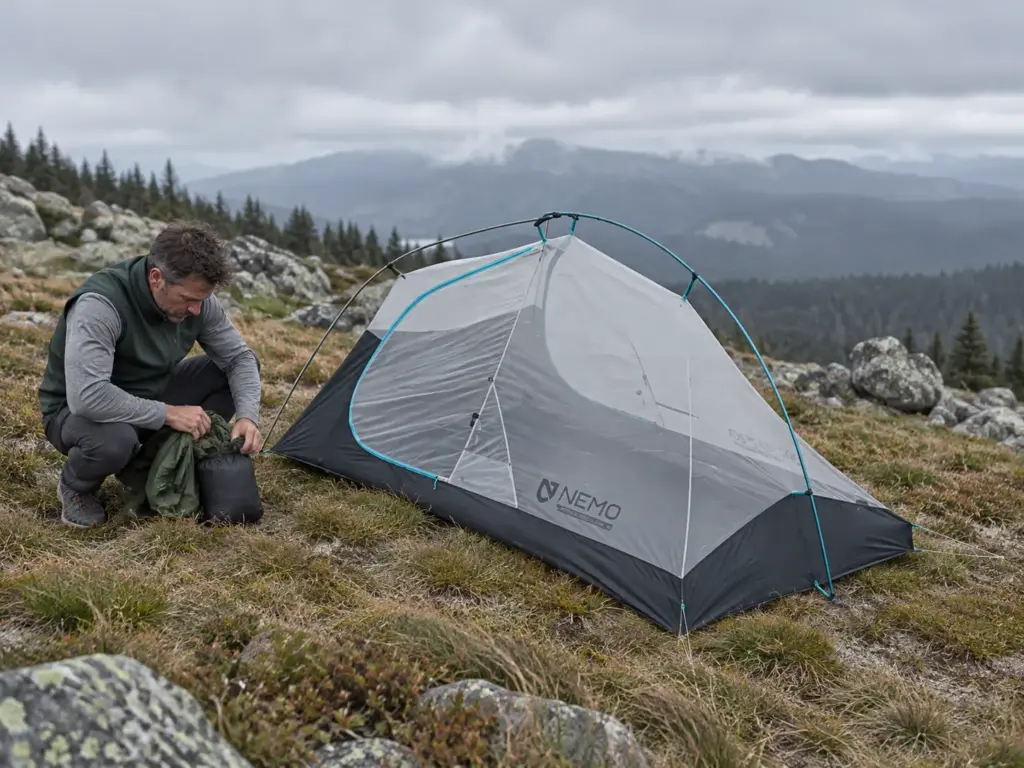
What the 2026 Reviews Disagree On
Adventurealan (updated August 13, 2026) says “Semi-freestanding tents no longer recommended” and drops the Big Agnes Tiger Wall and the NEMO Hornet from its picks. Its reason is wind: the semi-freestanding frame gives up stability in gusts to save weight.
CleverHiker (May 2026) goes the other way and names the Big Agnes Tiger Wall UL2 the best semi-freestanding tent. OutdoorGearLab (June 2026) calls the NEMO Hornet Osmo 2P its first ultralight tent pick. The Hornet Elite OSMO 2P linked below is the closest version we can confirm in stock, not necessarily the exact model they tested.
The three sources are reading the same tents and reaching different verdicts, and the disagreement is genuine. Nobody in this argument is wrong about the weight. They are weighing the weight against the wind differently.
Our Call: Weight, Not Wind
This is our position, an editorial opinion and not a test result: a semi-freestanding tent wins on weight, not on wind. We have not run wind tests, and we are not claiming to have. The reasoning is simple. A semi-freestanding frame leaves more of the pitch to stakes and guylines than a fully freestanding one, and the weight you save is paid for in how the tent behaves when a gust hits.
So buy one for sheltered forest camps, where trees break the wind and the ground takes a stake. Skip it for exposed ridges and open sand, where nothing stops the gusts and the stakes are working hardest. I would skip a semi-freestanding tent on an exposed ridge, full stop.
If your trips mix both, the question is which camp you will be in when it matters, not the average. The MSR FreeLite 2 in section seven shares this frame family, so the same caveat travels with it.
The wind case has another side. One r/Ultralight commenter points to SlingFin or Hilleberg when alpine wind is the real concern, and the price of that stability is more weight, which is the same trade seen from the other end. A simple test of your own trips helps: if most nights you can hide behind trees, buy for weight, and if you often pitch above treeline, buy for the wind.
Guy out every point the tent offers and use stakes or rocks at each one, whichever side of the argument you land on. The terrain decides the rest, and our guide to freestanding vs non-freestanding tents and the terrain that decides it walks through it.
The Semi-Freestanding Pick
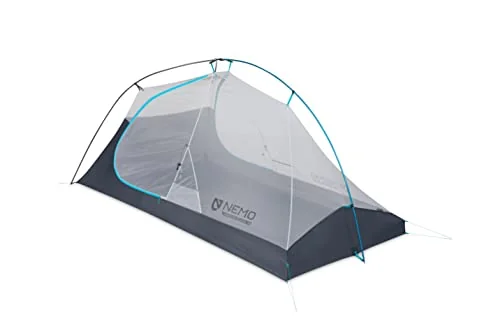
The NEMO Hornet Elite OSMO 2P weighs 1 lb 11 oz at its minimum, but that number comes from a single listing, so treat it as a starting point and not a measured fact. Our guide to freestanding tents cites the Big Agnes Tiger Wall UL2 at 2 lb 3 oz (REI), which is the closest alternative in this format and the tent CleverHiker prefers. We do not link the Tiger Wall, because we could not confirm it in stock.
The honest limit is the one from the last section: the weight is real and the wind margin is smaller. Skip it for exposed camps. If you do buy one, practice the pitch at home first, because the margin for a loose anchor is thinner than it is on a freestanding tent.
The Two-Person Ultralight Shortlist: Who Shares, Who Goes Solo
The r/Ultralight thread has a split of its own on two-person tents. One commenter says the Durston X-Dome 2 is “categorically not an ultralight tent” for a solo hiker. Another argues the penalty for a 2P is small. The shortlist below sorts the picks by who actually shares the tent, because the same tent can be a smart choice for two and a poor one for a solo backpacking tent buyer.
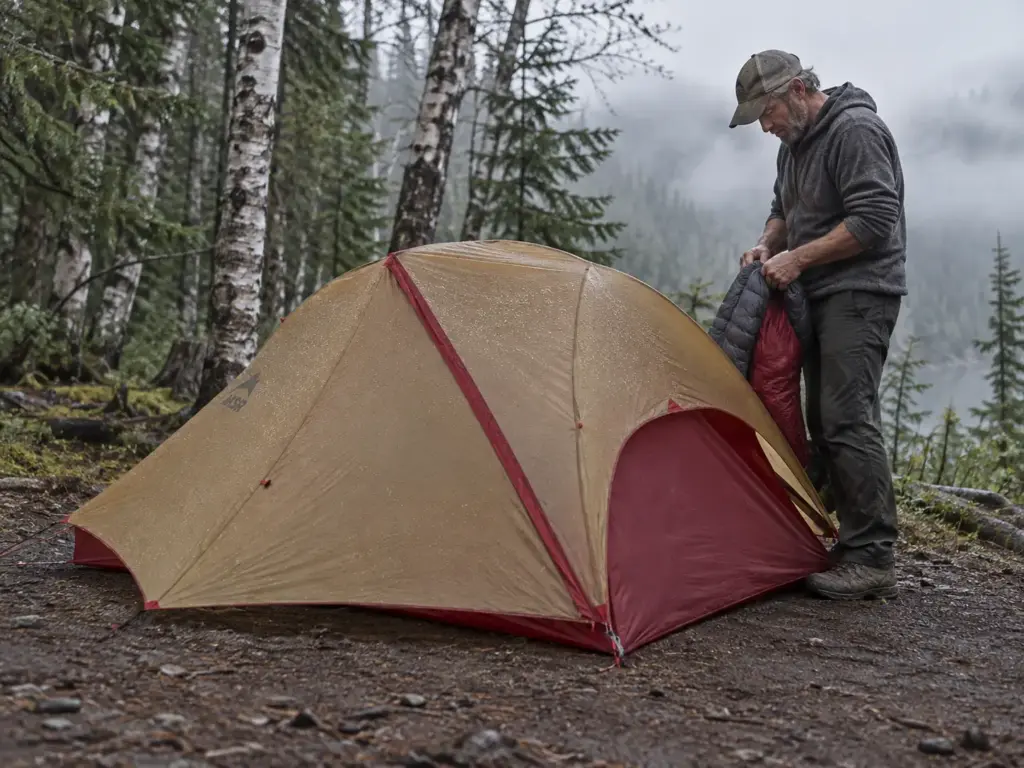
When a Two-Person Tent Is Really a Solo Tent
The numbers behind that argument are modest. One commenter says that in one brand the 2P tent models run 15 to 20 percent heavier than the 1P tent, which they compare to carrying an extra pint of water. The same commenter adds that a 1P can be too small for winter gear. Those are two user opinions about one brand, not a rule, and the thread does not settle them.
Commenters who go solo in a bigger tent mostly give the same reason: room for the pack. One says the Durston X-Dome 1+ is much larger than a normal one-person tent and lets them keep the pack inside.
The honest middle is arithmetic. A two-person tent split between two people drops the per-person weight fast, which is why CleverHiker calls the Zpacks Duplex roughly 9.25 oz per person when two share it. The same tent carried alone is a luxury you are hauling by yourself.
If you hike with a partner most weekends, the 2P is the lighter choice. If you go solo and want room for gear, you are paying a real but small penalty for space. For the full picture on sharing, see a 2-person backpacking tent built for sharing every night.
The Two-Person Tent With Its Own Frame
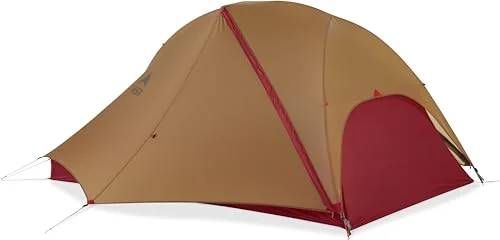
The MSR FreeLite 2 is the tent for two people who want a frame to do the pitching work. It weighs 2 lb at its minimum according to our weight chart, and it gives 39 in of headroom, enough to sit up and move around. The corners need stakes to give you the full floor, so the stake rules from section four apply here.
It sits in the same semi-freestanding family as the NEMO, so the wind caveat from section six applies too. Skip it if you camp on sand or exposed ridges and want a tent that stands on its own poles.
The Freestanding Trade
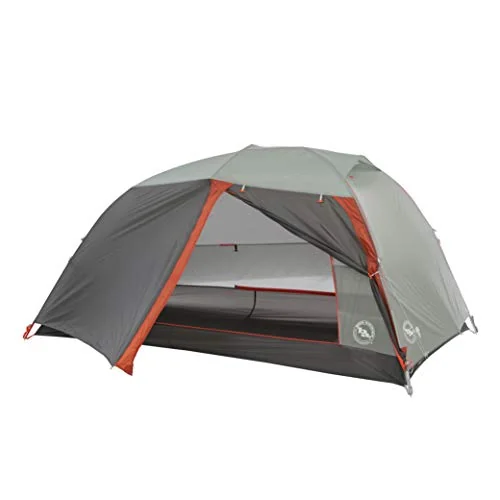
The Big Agnes Copper Spur HV UL2 mtnGLO is the freestanding trade: about 3 lb in spec tables for the UL2 family, which is roughly a pound more than the semi-freestanding option. One r/Ultralight commenter calls the Copper Spur 2 “well regarded”. Adventurealan, for its part, does not count the Copper Spur as ultralight at all, and that is a fair read of the weight.
Pay the pound if your trips involve rock, sand or hard ground, or if you want a tent that goes up on its own poles. Skip it if grams decide your shopping, because the pound is the whole cost of the format.
Pitch It in the Backyard Before You Trust It
Three things carry the guide. Ultralight is a trade, so pick the format that fits your ground and your trips, not the one that tops a chart. Read every weight with its source, because two good reviews can disagree on the same tent by about 7 oz. And a semi-freestanding tent wins on weight, not on wind, so match it to the camp you will actually be in.
The next move is practical. Before the trailhead, pitch the tent once in a backyard or a park, with the poles and stakes you plan to carry, and tighten the fly the way you would at midnight. If something about the pitch bothers you at home, it will bother you more at 2 a.m. on a ridge.
Frequently Asked Questions
01Which ultralight tent is the lightest?
Dyneema shelters sold straight from the maker, such as the Durston X-Mid Pro 1 at 1 lb 1.4 oz per CleverHiker, are the lightest the 2026 reviews recommend. The lightest Amazon pick in this guide is the 3F UL Gear Lanshan 1 Pro at about 24 oz.
02Which brand is considered the best for lightweight tents?
No single brand owns the title, because the top picks split by format and the best-known names sell only direct from the maker. Durston appears as a top pick at OutdoorGearLab, CleverHiker and adventurealan, and in the r/Ultralight thread.
03What is the best freestanding ultralight tent?
Adventurealan picks the Durston X-Dome Pro 1+ as its best ultralight freestanding tent, and it sells direct from the maker. The freestanding option linked here is the Big Agnes Copper Spur HV UL2 mtnGLO at about 3 lb, which adventurealan does not count as ultralight.
04What is the ideal weight for an ultralight tent?
There is no official cutoff, and the tents in this guide run from about 24 oz for one person to about 3 lb for a freestanding two-person. The right number depends on how much space and wind stability you are willing to give up.
05Is a two-person tent too heavy for one person?
A two-person tent costs a solo hiker some extra weight, and r/Ultralight is split on whether that is a lot. One commenter puts it at 15 to 20 percent within one brand, like an extra pint of water, and adds that a 1P can be too small for winter gear.

I've spent more than a decade researching hiking gear and trail technique. I read the specs, the forum threads and the long-term reviews, and every pick here comes with what it gets wrong.
End of the trail
You read every mile of this one. Here's where the trail goes next.