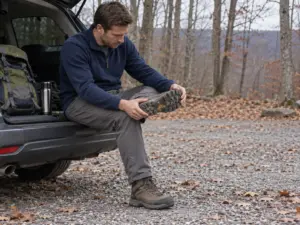
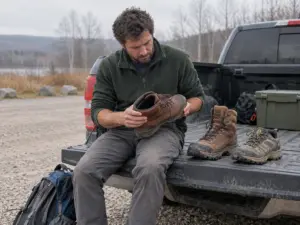
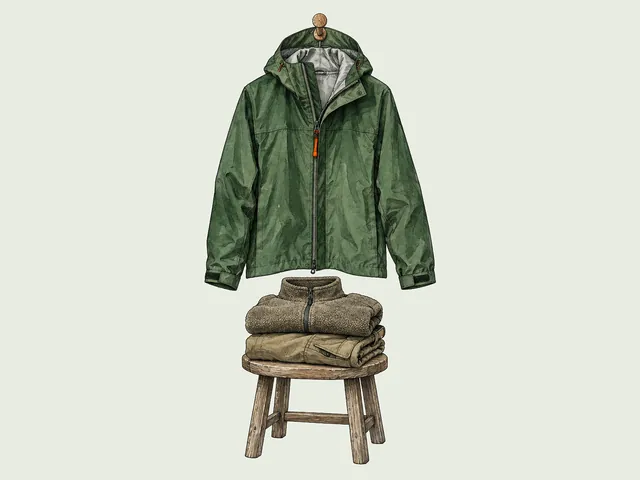
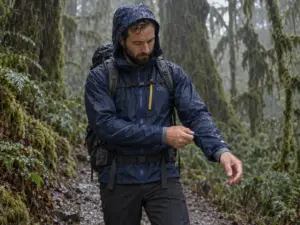
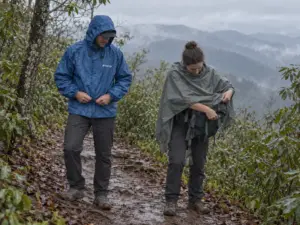
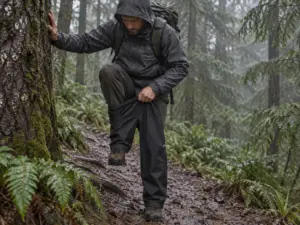

It’s hour three of steady rain, the boots on your feet say waterproof on the box, and your left sock is already cold and heavy. Nothing leaked through the leather. The water came down your pant leg and over the cuff, or it never left in the first place, because your own sweat had nowhere to go.
The best waterproof hiking boots keep out puddles, wet grass and snow, but the membrane is only one of three ways water reaches your sock. This guide sorts six boots by what each does best, says plainly what none of them can do, and covers the cheap gear around the boot that decides whether your feet stay comfortable. Here is the short list, with a men’s and a women’s version of every boot.
| Boot | Best for | Membrane | Fit note |
|---|---|---|---|
| Oboz Bridger Mid B-DRY | Trips where you want a non-GORE-TEX membrane | B-DRY | Mid-cut; stock on some sizes can run thin |
| Salomon X Ultra 5 Mid GTX | Weekend trips and everyday wet weather | GORE-TEX | Mid-cut; check the tongue gusset height when you try them on |
| Merrell Moab 3 Mid GTX | Waterproof on a budget-friendly build | GTX (women’s); confirm on the men’s listing | Entry-level; confirm your size is in stock |
| Salomon Quest 4 GTX | Multi-day trips with a loaded pack | GORE-TEX | High-cut leather; slower to dry |
| Lowa Renegade EVO GTX Mid | Narrow feet | GORE-TEX | Narrower fit; confirm the model name on the women’s listing |
| KEEN Targhee IV Mid | Wide feet | Waterproof membrane | Wider toe box; some men’s sizes can run low |
Waterproof Hiking Boots: What the Label Really Promises
Picture the conversation at any trailhead on a wet morning. “Are those waterproof?” “Yeah.” “Like, waterproof waterproof?”
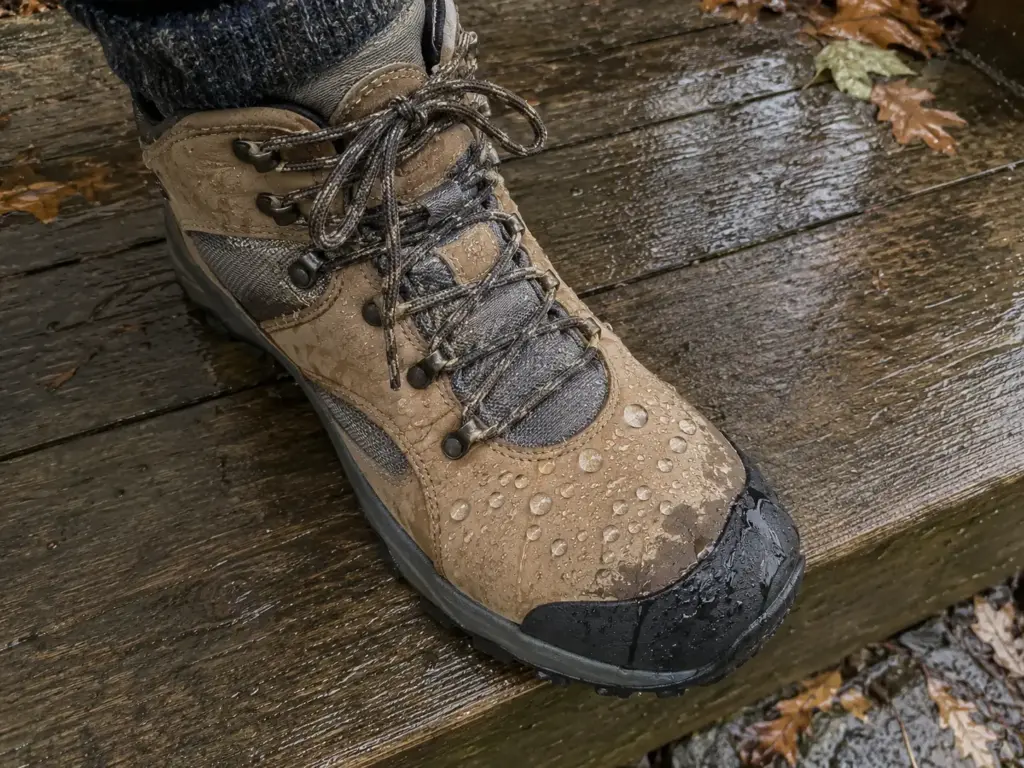
The honest answer is a pause, because the label means one specific thing: a membrane sits between the outside world and your sock. It does not mean the boot is a bucket. One commenter in an r/hiking thread described the result most owners eventually meet, boots sold as waterproof that “still let water in once in a while and take days to dry.” That complaint is worth keeping in your head through the rest of this guide, because the fix is rarely a different boot.
Waterproof vs Water-Resistant on a Boot Label
A waterproof boot has a membrane liner sewn inside the upper. You will see it called GORE-TEX, B-DRY, KEEN.DRY, eVent and a handful of other names, but the job is the same: block liquid water from the outside while letting a little moisture vapor out.
Water-resistant is a weaker promise. It means a coating or a tight weave that sheds light moisture, and it gives up in sustained rain. If you want the full label decoder, the breakdown of water-resistant versus waterproof labels walks through what each claim actually covers.
This guide only sorts out the waterproof question. The bigger decision, which boot height, stiffness and last fit your trips, lives in the pillar on how to choose a hiking boot by terrain, height and fit, and it is worth reading before you commit to any pair below.
What a Membrane Does and What It Can’t Do
The membrane is a thin layer with pores small enough to stop liquid water and large enough to pass water vapor. That second half is the weak point. The Appalachian Mountain Club points out that a membrane like GORE-TEX moves vapor out slowly, no faster than you produce sweat on a working climb, and that once the outer fabric of the boot is saturated, the boot stops breathing altogether.
Read that again, because it explains most wet-feet stories. The membrane can be perfectly intact and your foot can still end up damp, because the outside of the boot is a wet sponge and the sweat has nowhere to travel. Nothing is broken. The boot is doing exactly what it was built to do, and the design has limits.
Why a “Waterproof” Boot Still Feels Wet Inside
Hikers have a name for the first failure: the boot wets out. The outer fabric soaks through, breathability drops to nothing, and the inside feels wet even though not one drop got past the membrane. The same r/hiking thread splits boot trouble into two kinds: some boots fail outright, while others “wet out and feel wet inside.”
The second failure is the one nobody budgets for. Water runs down your leg, reaches the opening of the boot and soaks into the sock, and the sock pulls it the rest of the way in.
The third is simply sweat, which a waterproof boot traps by design. Hot feet in a sealed boot make their own puddle. There is a real breathability cost of a Gore-Tex shoe, and you pay it every time the temperature climbs.
The rule of thumb that holds up: a waterproof boot handles puddles, wet grass, snow and short creek splashes. It does not handle hours of heavy rain plus your own sweat. Knowing that line is most of what separates a good wet-weather day from a long, cold walk back to the car.
Learn to read your own sock. If the boot feels fine and the sock is cold only around the ankle, the water came in at the cuff, not through the membrane. A damp toe with a dry ankle points to sweat. It takes five seconds at a rest stop and tells you which fix to reach for.
Gore-Tex, B-DRY and Other Membranes That Keep Water Out
The box says GORE-TEX, so most people assume nothing else works. Plenty of excellent boots use the maker’s own membrane, and the differences you will feel on trail come from the boot built around it, not from the logo stitched on the tongue.
The Membranes You’ll See on Boot Labels
Here are the names you will run into: GORE-TEX (including GORE-TEX Extended Comfort and GORE-TEX Invisible Fit), B-DRY on Oboz boots, KEEN.DRY, eVent, Omni-Tech and Powertex. Ranking them tells you little, because the membrane brand alone says very little about how dry a given boot stays. What decides that is the construction: a gusseted tongue, sealed seams and taped construction, how high the cuff sits and how well the collar hugs your ankle.
One filter is worth knowing about. Some membranes are built PFAS-free, including GORE-TEX ePE and Powertex. If that matters to you, it is a legitimate way to narrow your list, and the label or the maker’s page will tell you which membrane is inside. If you are curious how two of the big names compare on breathability, there is a good side-by-side on how GORE-TEX and eVent compare on breathability.
The mistake the community keeps repeating is paying extra for a famous membrane and then ignoring the cuff and the tongue gusset. Those two spots decide whether rain finds a way in, and a membrane can’t help with water that never meets it.
Oboz Bridger Mid B-DRY, the Non-GORE-TEX Option
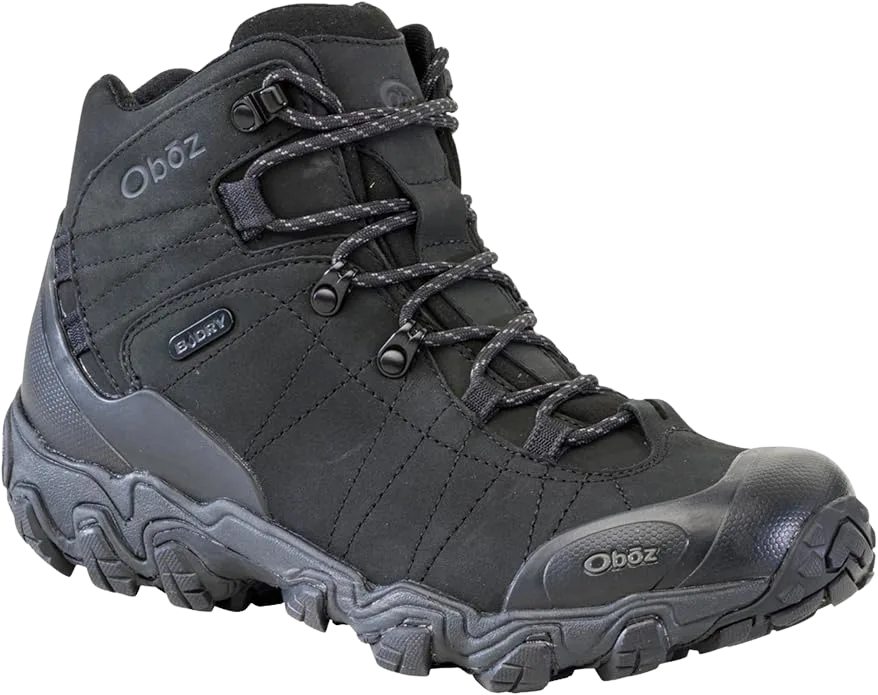
The Oboz Bridger Mid B-DRY (men’s · women’s) is the useful example of a boot that does not rely on the famous name. Oboz builds its own B-DRY membrane into a mid-cut hiker, which tells you the waterproof promise can come from somewhere other than a GORE-TEX tag.
What that means for you is simple. If a boot you like carries a maker’s own membrane, don’t cross it off the list on principle. Judge it the way you would judge any other pair: tongue gusset, cuff height, fit through the heel and toes. One practical note: stock on a few Bridger sizes can run thin, so the buy button is where you confirm that your size is actually available.
Best Waterproof Hiking Boots for Most Trails
Most readers are weekend hikers who want one pair that handles wet grass, muddy approaches and the odd creek splash. For that job you want a balanced boot first, then one of the budget waterproof boots for the person who wants to stay dry without paying for the premium build. Both picks below come in men’s and women’s versions, and each card carries a button for each.
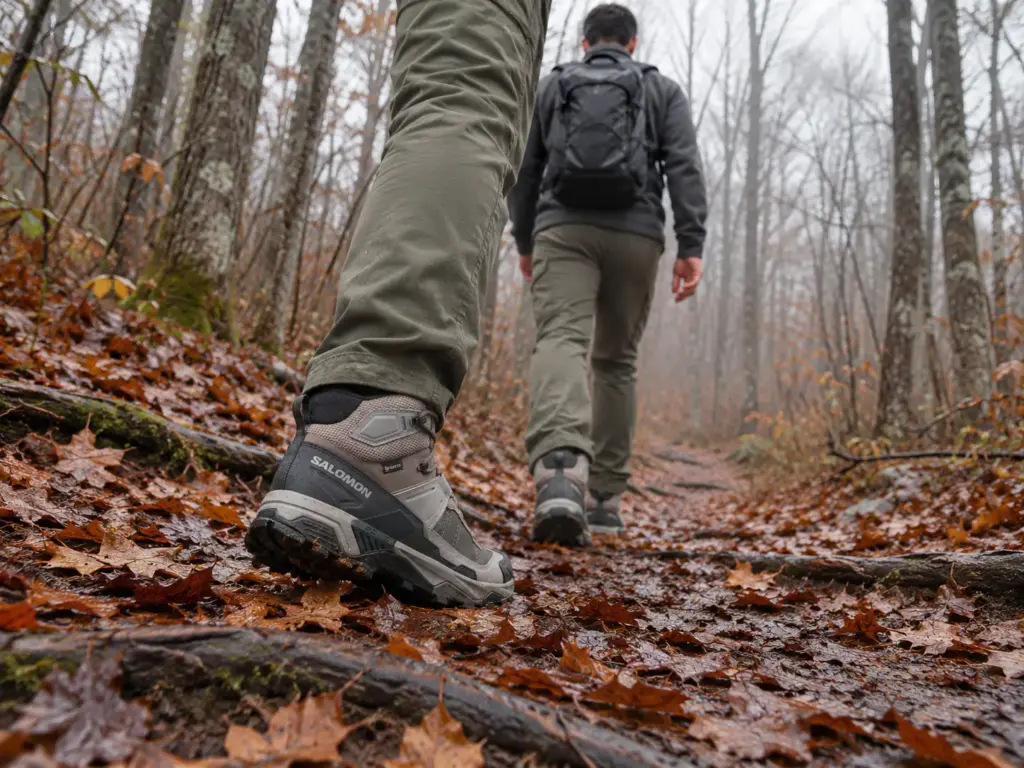
Salomon X Ultra 5 Mid GTX, the Balanced Pick
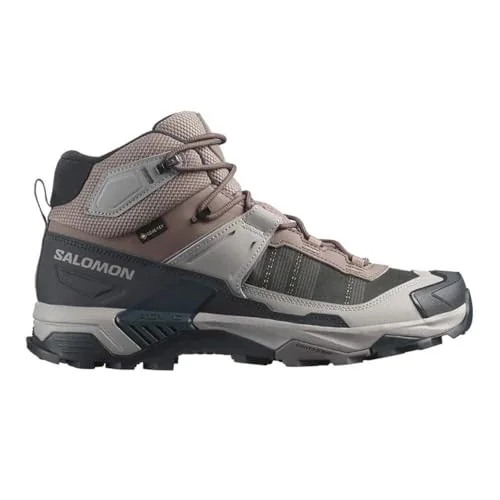
The Salomon X Ultra 5 Mid GTX (men’s · women’s) is the balanced all-rounder of this set. It is a mid-cut boot with a GORE-TEX membrane, which is the combination most wet-weather day hikes and weekend trips ask for: ankle coverage that keeps splashes and trail debris out, and a membrane that handles puddles and wet brush. That is an editorial judgment from the spec sheet and the way the boot is built, not a claim of personal testing.
There is one flag to carry with you. A commenter in the r/hiking thread said boots like the X Ultra have a very low gusset that lets water in easily. That comment was about an earlier generation of the line, and nobody has confirmed it for the Ultra 5, so it is not a verdict on this boot. It is, though, exactly the right thing to check on any pair: when you try them on, look at how far up the tongue is attached to the upper and decide for yourself.
Check the tongue gusset in the store, not on the trail. Press the tongue down and see how far up it is stitched to the sides of the upper. The higher the attachment, the less open space there is for water to run in beside the laces. Do it on every pair you try, whatever the label says.
Merrell Moab 3 Mid GTX, the Budget Pick
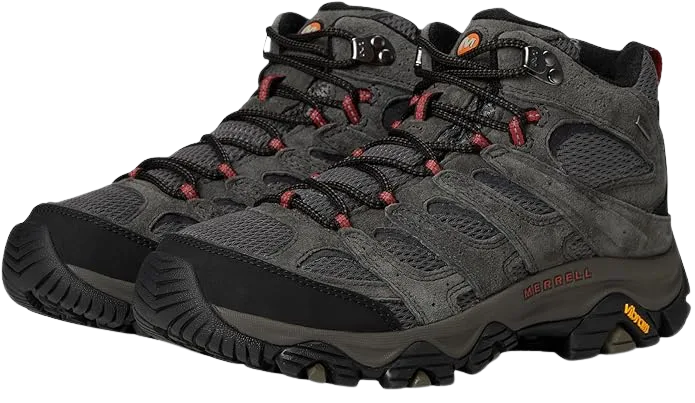
The Merrell Moab 3 Mid GTX (men’s · women’s) is the one you buy if you want waterproof without paying for the premium build. It is the entry-level choice in this set and the most budget-friendly boot here, which makes it the natural starting point for someone who has never owned a waterproof pair and isn’t sure how often they will wear it.
Two checks before you order. Sizes on both versions can run low, so confirm yours is in stock. And the men’s Amazon listing is titled “Waterproof” rather than “GTX,” so read the listing and confirm the membrane before you buy. A listing that quietly says something different from the spec sheet is easy to miss, and checking takes about ten seconds.
Who should skip both of these? Anyone with a very wide or very narrow foot. Neither boot is built for an outlier last, and the fit section below covers better starting points.
Best Waterproof Hiking Boots for Multi-Day Rain
Day-hike boots are fine until you add a loaded pack and three days of drizzle. Stiffer, leather-based boots earn their extra weight there, because a heavy pack flexes a soft boot in ways that bring on foot fatigue long before the trail does. The honest cost is drying time. A leather boot that gets soaked takes a long while to dry out, and on a multi-day trip you may not get that chance.
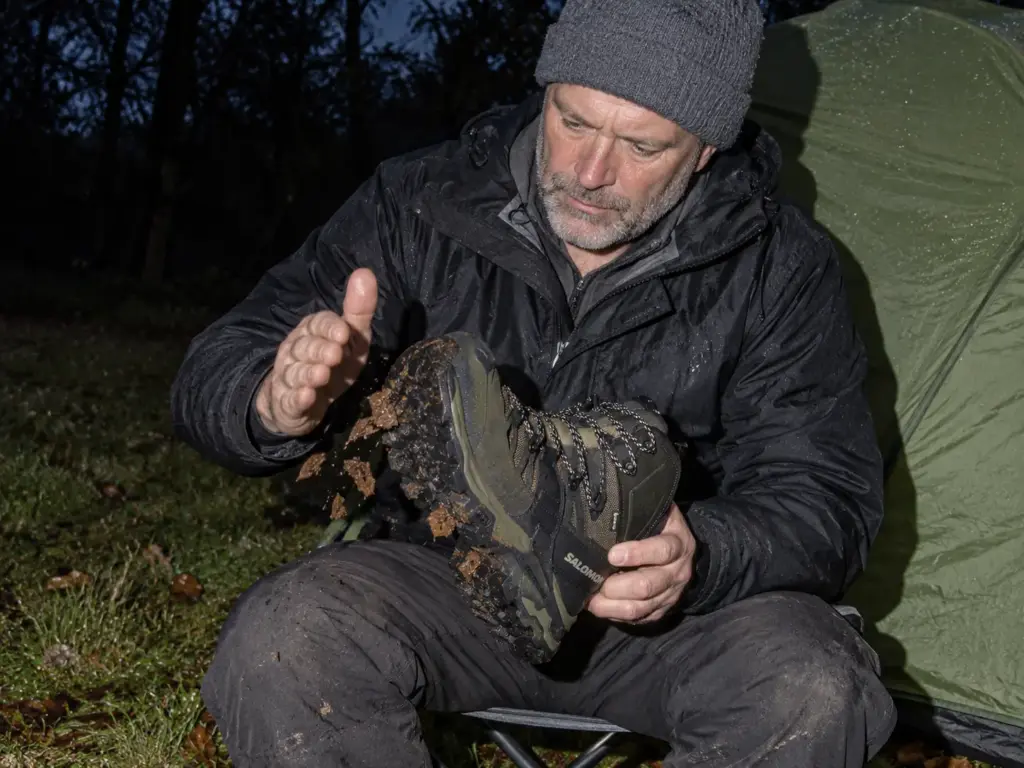
Salomon Quest 4 GTX, Built for Loaded Packs
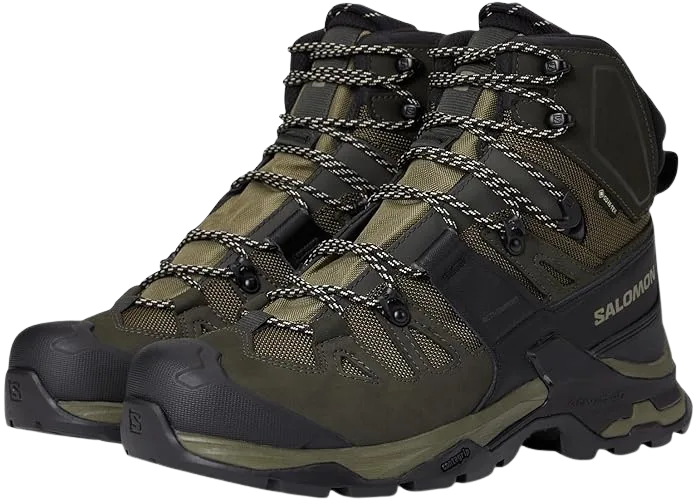
The Salomon Quest 4 GTX (men’s · women’s) is a high-cut GORE-TEX backpacking boot with a leather upper, built for the person carrying real weight. The Quest 5 is the newer name you’ll see in reviews; the Quest 4 is the one this guide can point you to in both sizes right now.
That is a trade, not an upgrade. If your trips are short day hikes with a light pack, a stiff high-cut leather boot is more boot than you need, and you will notice the extra weight at the end of a long day. If you are carrying a full load for two or three nights in wet country, the structure and the high cuff are what you are paying for.
Leather in the Rain: What You Gain and What You Dry Longer
Leather, especially full-grain leather, sheds water well and resists abrasion from rock and roots, which matters when you spend days scraping through wet brush. Nubuck leather, sanded for a velvety surface, takes the same care. Leather also takes longer to dry once it is soaked through, and it needs care: cleaning off mud and refreshing the finish so the surface keeps beading water instead of soaking it up. Synthetic uppers dry faster but give up some of that toughness.
There is no single winner. The comparison of leather versus synthetic boots and where each one gets wet goes through the trade-offs in more detail. For this article, the point is narrower: pick leather when abrasion and structure matter more than drying time, and accept that a soaked pair is a multi-day project to dry.
Dry Socks Are Part of the Kit on Multi-Day Trips
The sweat problem scales with the number of days. A waterproof boot holds sweat in all day, every day, and by the second evening your socks are damp whether it rained or not. One multi-day commenter in the r/hiking thread carried a second pair of socks purely for sleeping, kept dry in the pack and never worn on trail. The pair you walk in lives in the boots; the pair you sleep in lives in your sleeping bag, and you never mix them.
It costs almost nothing and weighs almost nothing. It is also the single cheapest way to make a wet multi-day trip feel like something other than a punishment.
How to Get the Right Fit With a Membrane in the Boot
Fit is where waterproof boots go wrong more often than in the rain. The membrane adds a little bulk, changes how the boot flexes, and tends to make the boot a touch stiffer out of the box. The wrong-fit story the whole community tells is the same one every time: you buy the dry boot, then limp home because the toe box was too tight with a thick wet sock on.
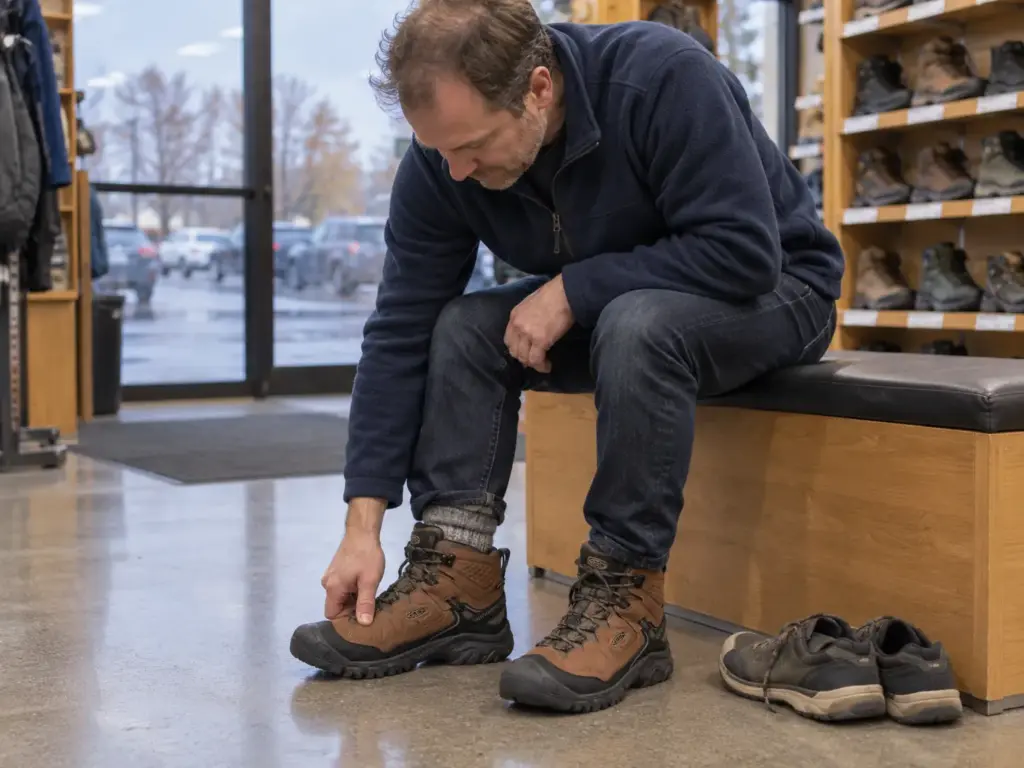
Skip the sizing rule like “go up a half size,” because it fails for plenty of people who try it. Boots don’t always run true to size from one brand to the next, so check three things instead: a thumb’s width of space past your longest toe, measured with the sock you will actually wear on trail, and a good heel lock, meaning a heel that stays put when you walk downhill. If the toe space is short, sizing up is the fix. If it is fine, sizing up just gives your heel room to slide and blister.
Lowa Renegade EVO GTX Mid for Narrow Feet
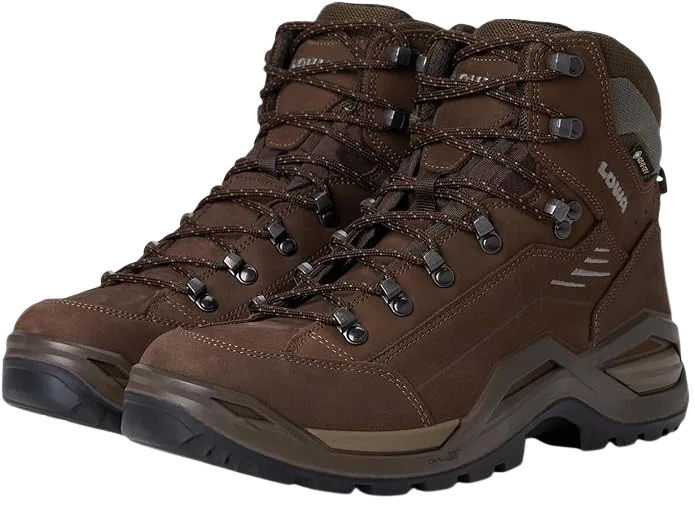
The Lowa Renegade EVO GTX Mid (men’s · women’s) has a reputation for a narrower, more precise fit through the heel and midfoot, which is why it is the pick here for narrow feet. A GORE-TEX mid-cut with that fit is hard to find in a mainstream boot.
Two flags. Stock can run thin on both versions, so confirm your size is available. And the women’s Amazon listing is titled “RENEGATE GTX MI,” not “Renegade EVO GTX Mid,” so confirm the model name on the listing before you buy. If you aren’t sure where your foot runs narrow, the guide on how to fit a narrow foot by heel, midfoot or toe will tell you which part of the boot to test first.
KEEN Targhee IV Mid for Wide Feet
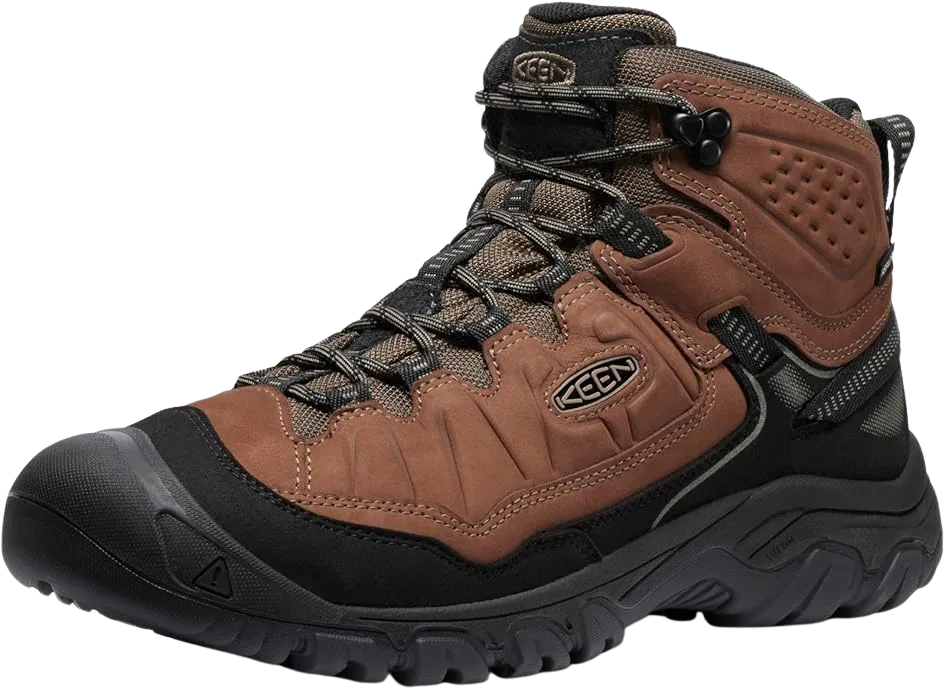
The KEEN Targhee IV Mid (men’s · women’s) is known for a wider toe box, and a waterproof mid-cut with room for the toes is exactly the wide fit a wide foot needs in a wet boot. Toes that can spread keep the foot more stable on descents and less likely to blister, and that matters more when a membrane has already made the boot stiffer.
Availability is the one flag: some men’s sizes can run low, so confirm yours before you commit. If your foot is wide and you are not sure where it hurts first, work out the pattern before you shop with the advice on how to find the hot spot on a wide foot.
Sock Thickness, Break-In and Checking the Fit Before You Commit
A membrane doesn’t excuse a bad fit, and a waterproof boot needs a break-in period just like any other. Wear the pair at home, indoors, with the real socks you will use, for an evening or two before you take them on trail. Walk up and down stairs, because that is where a loose heel announces itself. For the full routine, including how to tell when a pair should go back, see how to break in a new pair and know when to return it.
One more thing the community brings up often: wet socks change fit. A boot that feels perfect with a dry sock can rub when the sock goes damp and bunches. If you will be hiking in rain, test the fit with a slightly damp sock, because that is the condition you will actually be in.
Try boots on at the end of the day, when your feet are at their biggest, with the exact sock you will hike in. Then walk a flight of stairs down slowly. If your toes hit the front or your heel lifts, no membrane will fix that, and you will feel it by mile three.
Ankle Support, Traction and Men’s vs Women’s Fit
Waterproof means wet terrain, and wet terrain means slick roots and rock. The sole matters as much as the membrane, and the cuff matters less than most people think.
Cuff Height: Mid-Cut or High-Cut
Mid boots, the mid-cut height, keep debris and splashes out better than a low hiking shoe, and a high-cut adds more ankle protection and more weight.
The cuff gets the credit for ankle support, but stiffness through the sole and a heel that doesn’t lift do more of the work. A tall floppy boot still lets your ankle roll. A stiffer, well-fitted mid-cut often doesn’t. For more on this trade, the comparison of where cuff height counts goes through the details.
A mid-cut waterproof boot is also rarely a lightweight choice, and weight shows at the end of a long day in a way it never does in the first mile. Weigh that against the splash protection before you decide.
Outsoles for Wet Roots and Rock
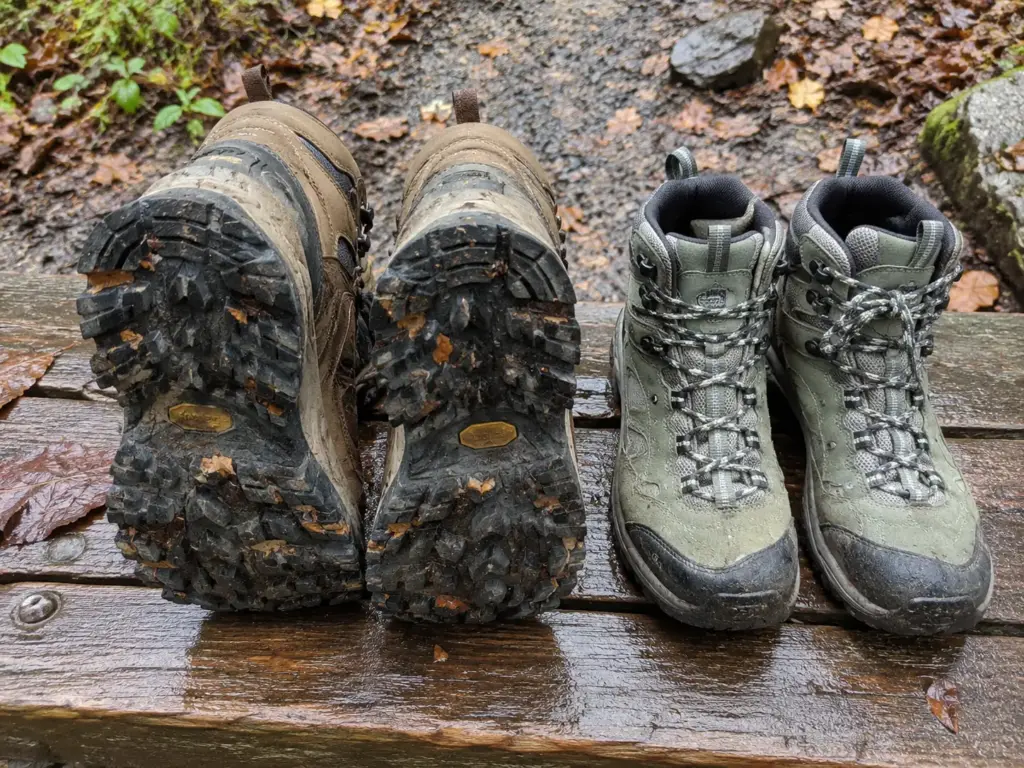
You will see outsoles named on the box: Vibram Megagrip, Vibram Ecostep, Contagrip, Omni-Grip. The names matter less than the lug pattern under them. Deep, widely spaced lugs shed mud and bite into wet roots and soft ground. The cost is on dry rock, where a deep lug has less rubber touching the stone and can feel vague on a slab.
Wet roots and wet rock are the real hazard on a rainy day, not the water in your boot. Match the sole to the trail you will actually walk. If your wet-weather hike is a muddy forest path, deep lugs are the right call. If it is smooth granite in the drizzle, you want more contact area and a stiffer sole.
Men’s vs Women’s Versions of the Same Boot
Men’s boots and women’s boots are not just a color swap. The lasts differ, which means the volume, the heel and the width are shaped differently, and a woman with a narrow heel can get a better fit from the women’s version than from the same model in men’s sizes. The reverse can be true too, and plenty of people cross over successfully.
That is why every card above carries two buttons, one for each version. Use the one that matches the last you want to try, and check the listing before you click buy.
Gaiters and Socks: The Boot Is Only Half the System
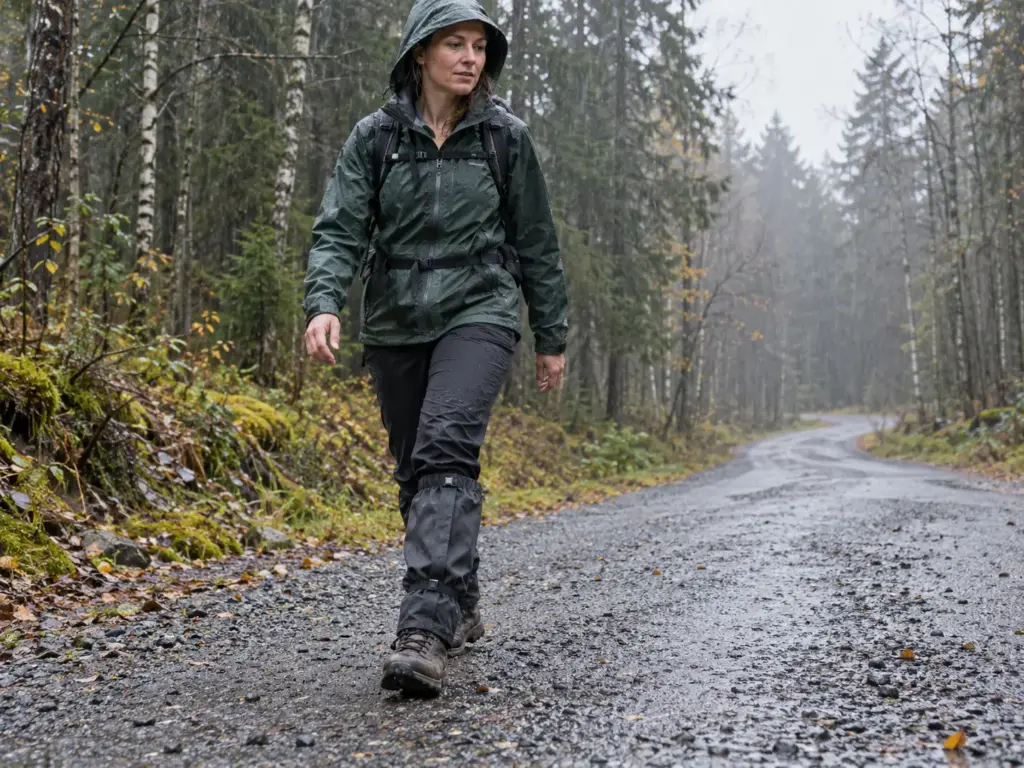
Everyone buys the boot and ignores the entry points. In sustained rain, water runs down your leg, reaches the cuff and soaks into the sock, and the sock drags it the rest of the way in. This is the section where most wet-feet problems get solved, and it costs less than any pair of boots above.
Where Water Really Gets In
The Appalachian Mountain Club describes the sock as a moisture-sucking conduit: in long rain, wet snow or tall wet grass, a sock that touches wet fabric at the top of the boot pulls water in like a wick. Rain pants alone let water run down inside the boot. Gaiters alone let it find the closures. Wear both at once and you get what the club calls a sweat box, because your legs can’t breathe, so you get wetter from the inside while the water still creeps in.
Here is the detail you only learn the hard way. When the boot feels fine and the sock is cold only at the ankle, it is the sock, not the membrane. The wet line on the sock tells you where the water came from: a cold ring at the ankle points to the cuff, a damp toe points to sweat or a crease, and a soaked sock all the way around means water came in over the top.
Follow a single raindrop and the pattern is easy to see. Rain lands on your shoulders and runs down your jacket onto your pants. It follows the fabric down your leg, reaches the top of the boot and meets a sock.
If the pant leg is tucked into the boot, it acts like a funnel and hands the water straight to the sock. If the pant leg hangs outside the cuff, the water has a better chance of running down and off. That one change in how you wear the pants can matter more than the price difference between two pairs of boots.
Gaiters: What They Block and What They Don’t
A gaiter covers the cuff of the boot and keeps the water from your pant leg from running into your sock. In an r/hiking thread, a commenter said that is exactly what they were for. AMC’s point is just as useful: gaiters slow water, they don’t stop it. The water keeps coming in slowly, and in warm weather the gaiter adds heat on top of it.
A gaiter also does jobs that have nothing to do with rain. It keeps mud splash off the cuff, stops snow from tumbling in at the lace hooks, and keeps grit and small stones out of the top of the boot, which is a quiet cause of blisters on wet descents. Worn over the pant leg with the hem sitting down over the cuff, it sends water down the outside of the boot, which is the direction you want it going. Worn under the pant leg, it can do the opposite.
So think of a gaiter as a delay, not a seal. It buys you time and keeps debris and snow out. It doesn’t make the boot waterproof to the top, and no gear does. The rundown on how to choose and use gaiters covers fit, height and when to leave them in the pack.
Sock Strategy for Wet Days
Socks are the cheapest upgrade in this entire guide. One approach, from an experienced Colorado hiker in the same thread, is a two sock system, a form of sock layering: a thin synthetic liner against the foot that moves moisture away, and a thicker sock over it that holds warmth. The liner keeps the sweat off your skin, and the outer sock takes the rubbing.
Cotton is the sock to leave at home. It holds water and loses its warmth when it is wet, and a wet cotton sock is the worst version of the conduit the club describes. Wool and synthetic socks keep more of their warmth when damp, which is why wool comes up in the thread.
The tip that matters most is timing. Change the sock when it gets damp, not when it is soaked, because a soaked sock wets the inside of the boot, and then you are fighting the whole boot, not one sock. Carry a spare pair for exactly that moment.
There is also a camp that accepts wet feet on purpose. The thread’s own slang for it is to go full wet feet: let the feet get wet, keep moving, and change into a dry sock at the stop.
One commenter said they walked days with half-wet feet and finished 16 to 20 mile stages without a blister. That is one hiker’s report and not a promise, and it works best in mild weather. But it shows what the sock strategy is really about. Keeping a wet foot warm and moving is a skill, and a fresh sock is the tool.
Some hikers skip the waterproof boot and wear waterproof hiking socks in a breathable shoe. One commenter went that way after repeated boot failures. The trade is sweat: a sock that keeps water out also keeps it in, which is the reason waterproof socks trap sweat inside your boots just like a membrane does.
Keep the sleeping socks sacred. Dry socks go on at camp and never come out on the trail, even when the day’s pair is clammy and the dry pair is right there. The first time you break that rule, the dry pair becomes the damp one, and the whole point is gone.
Why Waterproof Boots Fail and How to Make Them Last
People assume a leak means the membrane died. Usually it didn’t. Before you replace a pair, work through the order of likely causes, because the cheapest explanation is also the most common one.
The Three Ways a Waterproof Boot Lets You Down
The Appalachian Mountain Club lays out three failure points. The first is lost breathability when the outer surface saturates. The second is water entering through the cuff and the sock. The third is a damaged membrane, and the club calls it the least likely cause.
The order matters: check the cuff and the sock before you blame the membrane.
That checklist has a physical side. Water gets into a boot at specific places: the tongue gusset, the eyelets and lace hooks, and the flex creases across the toe where the upper bends with every step.
One commenter in the r/hiking thread blamed a low gusset on a popular line of boots. Whatever the truth for any given model, it is the right thing to look at. The write-up on how each part of a hiking boot fails names the other trouble spots.
A simple way to sort the three causes at home is to work through them in the order the club gives.
Is the outside of the boot dark and heavy after a wet day, with water no longer beading on it? That is the outer surface, and it points to the finish.
Is the sock wet at the ankle first, with the toe box still dry? That is the cuff. Does the same spot on the foot turn damp every time, while the rest stays dry, even when the cuff is covered? Only then are you looking at a seam or a membrane problem.
As a rough submersion test, you can stand the boot in about an inch of water for a few minutes with a paper towel stuffed inside and see where the paper goes dark. A dark spot at one seam or crease is a different problem from a boot that is wet all over.
Refreshing the Water Repellent Finish
Most boots have a durable water repellent finish, or DWR coating, on the outer fabric. It is the coating that makes water bead and roll off.
It wears off with abrasion, dirt and time, and when it goes the outer fabric soaks up water and the boot wets out. The membrane is untouched. You just stopped getting the beading.
You can read the finish with your eyes. On a healthy boot, water forms beads and rolls off. On a worn one, it darkens the fabric and spreads. That darkening is the early warning that the boot is about to wet out, and it shows up long before any water reaches the sock.
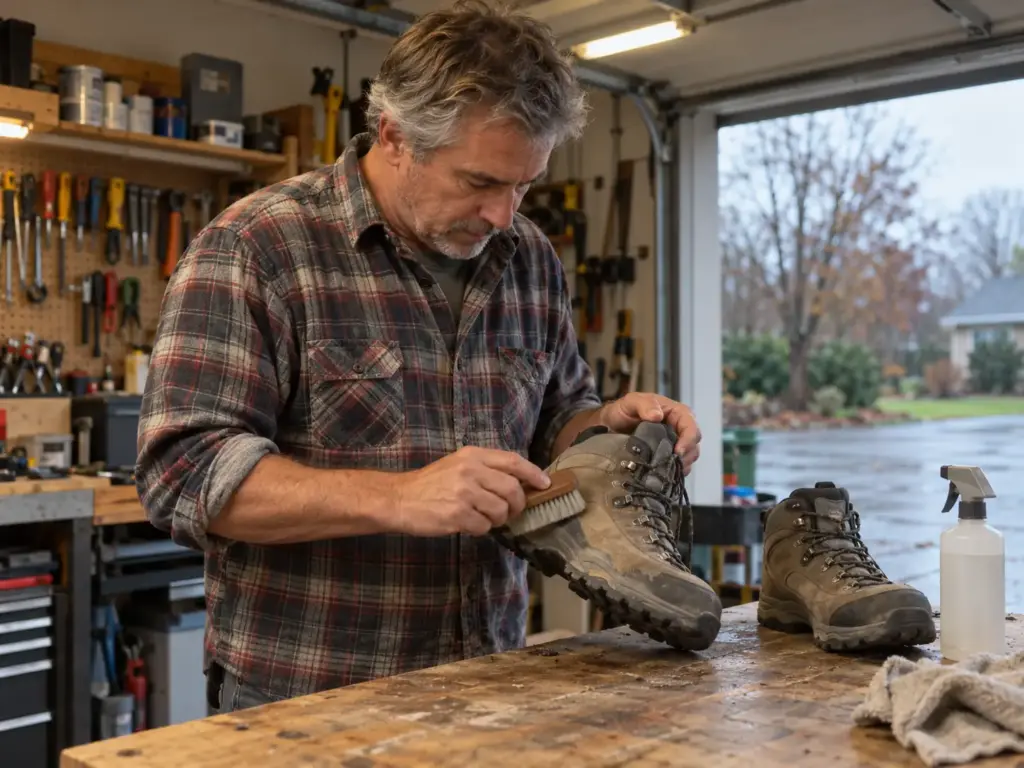
Refreshing the finish is the fix, not a new boot. Clean the boot first, because dirt blocks the treatment, then reapply. The comparison of wax versus spray waterproofing explains which method suits leather and which suits fabric, and it is the one maintenance habit that pays back most. Follow the care label on your pair, because leather, nubuck and fabric uppers do not all take the same treatment, and a heavy hand with the wrong product can clog the surface you are trying to keep breathing.
Drying Boots Without Wrecking Them
Dry boots slowly and away from direct heat. A radiator, a campfire or a hair dryer can damage the glue that holds the sole to the upper and can stiffen or crack leather. Drying time varies too much by pair, upper and weather to put a number on it.
Pull the insoles, loosen the laces, open the tongue and let air do the work. Stuffing the boot loosely with paper towel helps pull moisture out of the lining, as long as you replace it once it is damp. A fan across the room helps more than a heater does. Two pairs on rotation helps most of all, because a boot that gets a full day to dry between trips lasts longer than one that is packed away damp.
Treat the socks the same way. A damp sock pushed back into a boot that has just dried carries the moisture straight back to the lining, so the pair you walked in gets rinsed and dried before it goes into the boots again. The trail rule from the r/hiking thread holds at home too: a soaked sock wets the boot from the inside.
The method for drying wet boots overnight without melting the glue covers the safe shortcuts for when you can’t wait. If you routinely start the day in damp boots, the problem is not the boots. It is that you are not drying them between trips.
When a Waterproof Boot Is the Wrong Choice
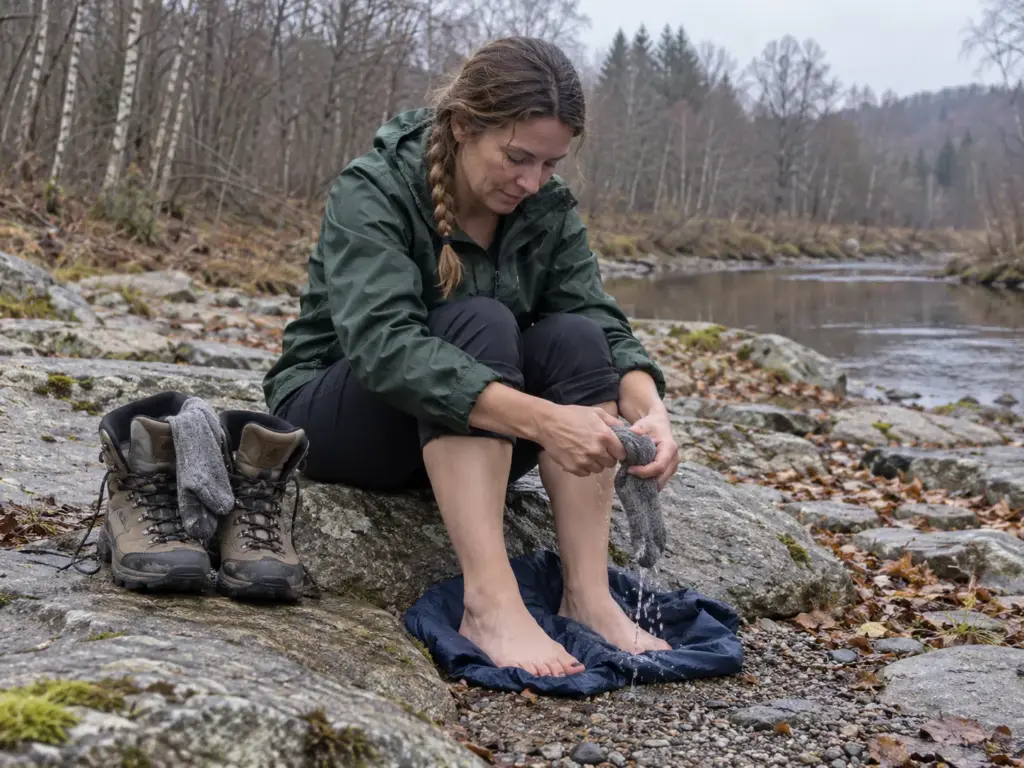
The most honest line in the whole r/hiking thread is about heat. One commenter said that when it is warm, waterproof boots “just make you sweat,” and you end up wet inside all day anyway. That is the question this section answers: when does the membrane make things worse?
Hot Trails: When Sweat Beats Rain
On hot, dry or humid trails, a membrane holds sweat in, and your feet get wetter from the inside than any puddle would manage. A breathable shoe or trail runner is the better call there. The commenter who walked days with half-wet feet makes the same point. Treat that as one hiker’s report, but the idea behind it is sound: feet can handle being damp better than they handle being hot, blistered and trapped.
Warm rain is the cruelest case. The boot is soaked on the outside, so it can’t breathe, and your feet are warm, so they sweat. You get wet from both directions with no way out. A breathable shoe gets just as wet, but it dries while you keep moving, and a damp foot that stays warm is less of a problem than a damp foot sealed in a boot that never dries.
If rain is a possibility but not a certainty and the day is warm, a breathable shoe with a spare pair of socks beats a sealed boot on most trails.
Cold and Soaked: The Foot Risk That Counts
Cold changes the math. According to the CDC’s NIOSH guidance on cold-related illness, trench foot can develop at temperatures up to 60°F when feet stay wet, and wet feet lose heat about 25 times faster than dry ones. You don’t need winter for this. A day of rain, creeks and soaked socks in the shoulder season is enough.
Think about why that second number matters. A foot that stays wet in cool air is constantly losing heat, and your system responds by cutting circulation to the feet to protect the core. That is why cold feet and numbness show up before the rest of you feels cold, and why a long lunch stop in soaked socks can chill you faster than the wind.
The fix is not complicated. Stop moving for a long break only after you have changed into dry socks, and keep a dry pair in a bag that stays out of the rain.
If it starts, the first move is to take off the wet boots and socks, dry the feet and avoid walking on them. Ohio State University Extension’s trench foot fact sheet lists the early symptoms, and they are not dramatic: tingling or itching, not pain. The hiker who crosses a creek with a boot full of water and ignores a tingle is the hiker this section is for.
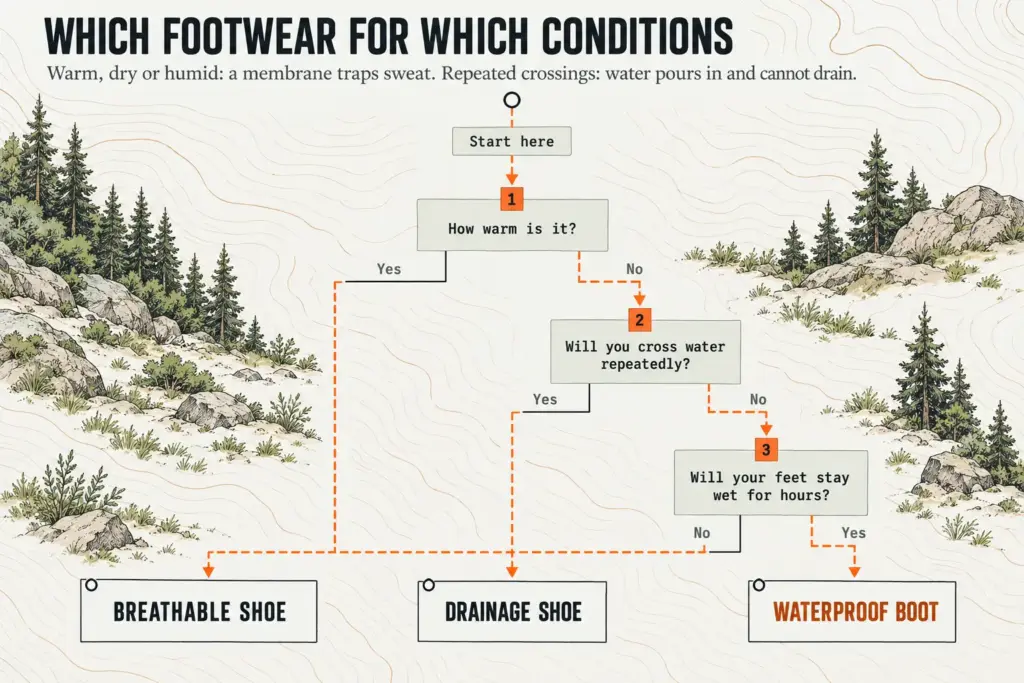
The case where a waterproof boot clearly earns its keep is cool, wet and snowy weather. A commenter in the thread made the point about winter: with snow, a waterproof boot and a gaiter make sense, because the water that gets in from above is the water you were trying to keep out.
Wet Crossings: Boots That Drain Beat Boots That Seal
If your route has a stream crossing every mile or two, a sealed boot is the wrong tool. Water pours in over the cuff, and then it can’t get out. You hike all afternoon with a boot full of water that a membrane is working to keep in. That is why drainage-hole shoes beat waterproof boots at wet crossings: they let water in and let it back out, and their dry time after a soaking is usually shorter than a sealed boot’s.
If a creek crossing is unavoidable in a sealed boot, you have two honest options. You can take the boots off for the crossing and carry them, ideally with a light camp shoe on your feet. Or you can accept that the boots will fill and that you will be walking in a bucket until the next stop.
Neither is pleasant. Both are better than pretending a membrane will rescue you.
Put it all in one rule you can remember on a trailhead: waterproof for cool, wet and snowy; breathable for warm; drainage for repeated crossings.
Put Them On at Home Before the Rain Finds You
Three things to take with you.
- A waterproof boot is a good tool and a poor promise. It keeps puddles out. It does not stop the cuff, the sock or your own sweat.
- Pick the boot for your foot and your trip. The six here cover balanced, budget, multi-day, B-DRY, narrow and wide, and each one comes in a men’s and a women’s version.
- The cheap fixes are the real system: dry socks, gaiters when it counts, and a refreshed finish on the outer fabric.
Before your next wet hike, put your boots on at home with the socks you will actually wear, check that thumb’s width at the toe, and walk the stairs a few times. Then pack a dry pair of socks. It takes ten minutes and it fixes more than any pair of boots can.
Frequently Asked Questions
01Are there any truly waterproof walking boots?
No hiking boot is waterproof all the way to the top, because the opening at the cuff stays open and water can pour in over it. A membrane keeps water out through the upper, so waterproof walking boots handle puddles and wet grass but not deep water. Rubber boots are the exception.
02What is better, Gore-Tex or waterproof?
GORE-TEX is one brand of waterproof membrane, and waterproof is the category it belongs to, so the real choice is the boot built around the membrane. Other membranes such as B-DRY, KEEN.DRY and eVent also work. The tongue gusset and the cuff matter more than the logo.
03Is Salomon or Merrell better?
It depends on the job, because in this guide Salomon covers the balanced pick (X Ultra 5 Mid GTX) and the multi-day pick (Quest 4 GTX), while Merrell covers the budget-friendly option (Moab 3 Mid GTX). Choose by fit and trip length, not by the logo.
04Should I size up in waterproof hiking boots?
Only if the toe space is short, because sizing up in a boot that already fits just gives your heel room to slide and blister. Check for a thumb’s width past your longest toe with the sock you will actually wear, and a heel that stays put downhill.
05Do I need gaiters with waterproof boots?
Not always, because gaiters only slow water at the cuff and keep debris out, and in warm weather they add heat on top of everything else. In sustained rain or snow they earn their place, and on mild days many hikers leave them at home.
I've spent more than a decade researching hiking gear and trail technique. I read the specs, the forum threads and the long-term reviews, and every pick here comes with what it gets wrong.
End of the trail
You read every mile of this one. Here's where the trail goes next.