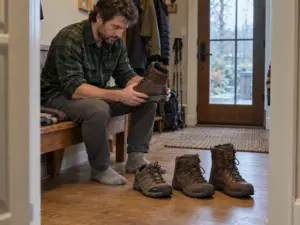
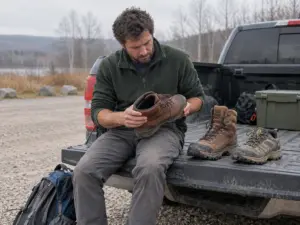










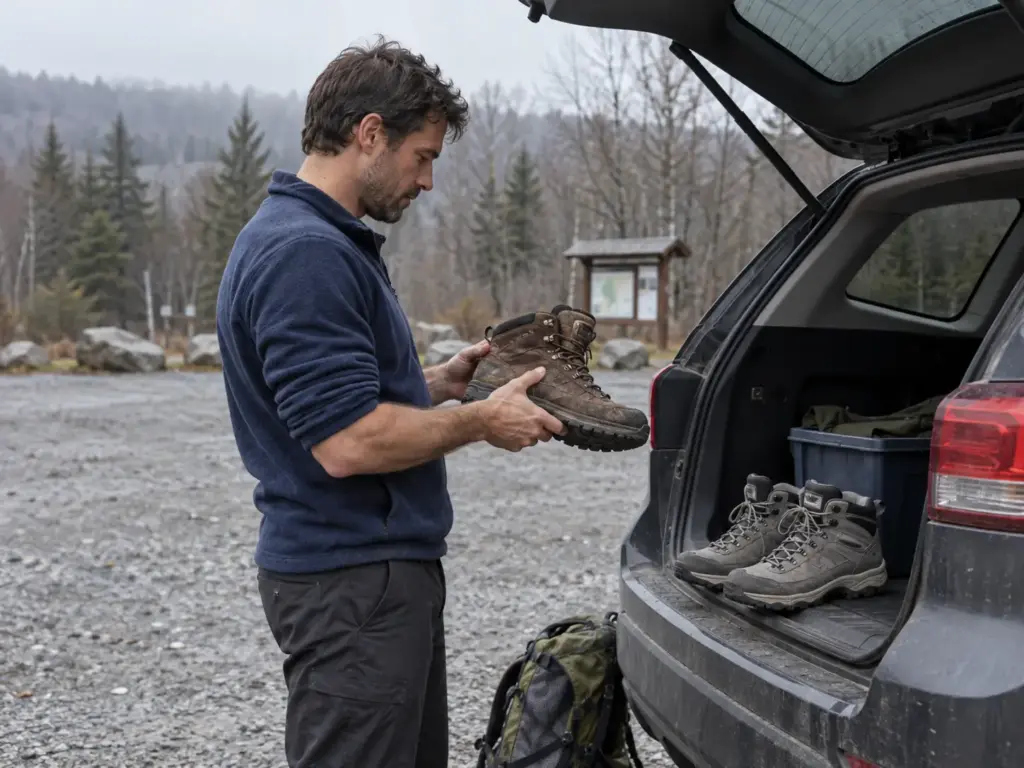
You are standing in a shop with one boot in each hand, and the assistant tells you synthetic is “just as good” at keeping water out. Walk into a UK hillwalking forum thread on the same question and the first reply says synthetic “will always leak.” Both are half right, and neither tells you which pair to buy.
This breakdown of leather vs synthetic hiking boots pulls together the long Reddit, Stack Exchange and hiking-forum arguments on the question, plus what a resole really costs. It sorts the two by what separates them, what ends each one, and a simple rule for picking by where your boots will get wet and how long they have to last. The short version fits in one table.
| What you care about | Leather | Synthetic |
|---|---|---|
| Years of use | Lasts longer when the sole can be replaced | Often retired when the sole or glue goes |
| Weight on your feet | Heavier | Lighter |
| Break-in | Weeks of wearing in | Comfortable from day one |
| Drying after a soaking | Slow | Faster |
| Resoling | Possible on a welted build | Rarely worth it |
| Wet feet | Decided by the lining and seams as much as the leather | Decided by the lining and seams too |
Leather vs Synthetic Hiking Boots: What Actually Separates Them
Two boots can look alike from three feet away and be built nothing alike once you pick them up. The material of the upper is one choice among several, and the wider frame for all of them lives in our guide on how to choose a hiking boot by terrain, height and fit. Think of this article as the material chapter of that decision.
What the Upper Is Made Of
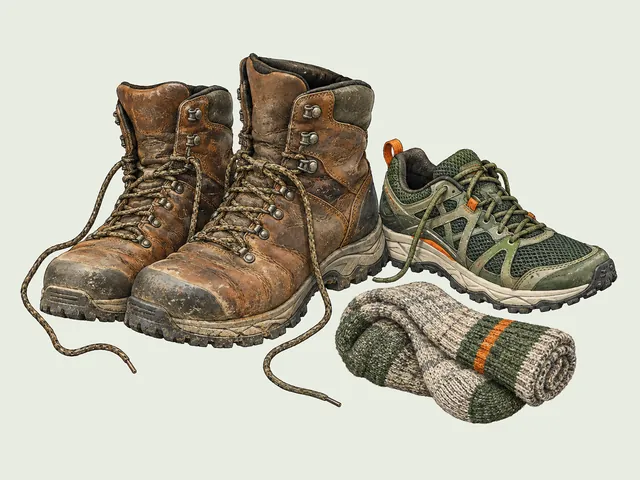
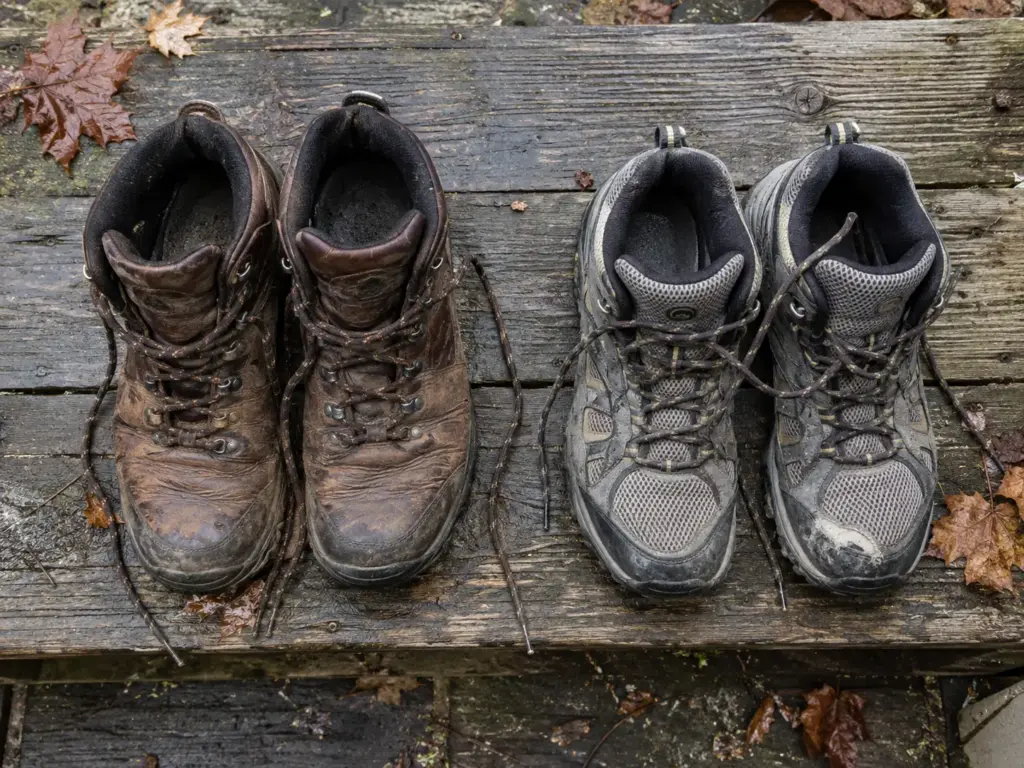
When a boot maker says leather, they almost always mean full-grain leather or nubuck. When they say synthetic, they mean a nylon or polyester upper, or a faux hide sold as synthetic leather, with overlays stitched or bonded on top, nearly always paired with a waterproof membrane inside.
If nubuck is on your shortlist, keep one line in mind: nubuck is a brushed leather that loves mud and hates sharp rock. The soft surface that feels great in a shop is the same surface that scuffs on granite.
Lining and Membrane: The Layers Nobody Mentions
The upper is only one of three layers. Under it sits a lining, and somewhere in the sandwich there may be a waterproof membrane. Hanwag, a boot maker, spells the difference out on its own site: a leather lining (the “LL” in a model name) is there for fit and breathability, while a membrane lining (GTX for Gore-Tex, ES for EcoShell) is there for wet regions.
Those two-letter codes tell you more about how a boot will behave in rain than the word “leather” on the box. It is also why the shop assistant’s line about synthetic being “just as good” at keeping water out is not an answer. Good at what, and in which layer? The honest version arrives in the waterproofing section below.
Where Hybrid Boots Fit
A hybrid mixes the two: a leather upper with synthetic panels, or a synthetic upper with a leather lining. Most boots on a shop wall sit somewhere along that spectrum, so leather vs synthetic is less a coin flip than a slider. One veteran on Rokslide, a hunting forum, wrote in 2020 that hybrids are the best choice for him, and that view gets its own section near the end.
A plain rule of thumb until then: leather costs more to get into, and synthetic costs less and wears out sooner.
What Kills Each Boot: Durability and How Boots Actually Fail
Ask which material lasts longer and you get a slogan. Ask what actually ends a pair of boots and the answer gets specific: a seam that opens, a hide that dried out, or a sole that lets go while the top still looks fine.
Where Synthetic Boots Wear Out First
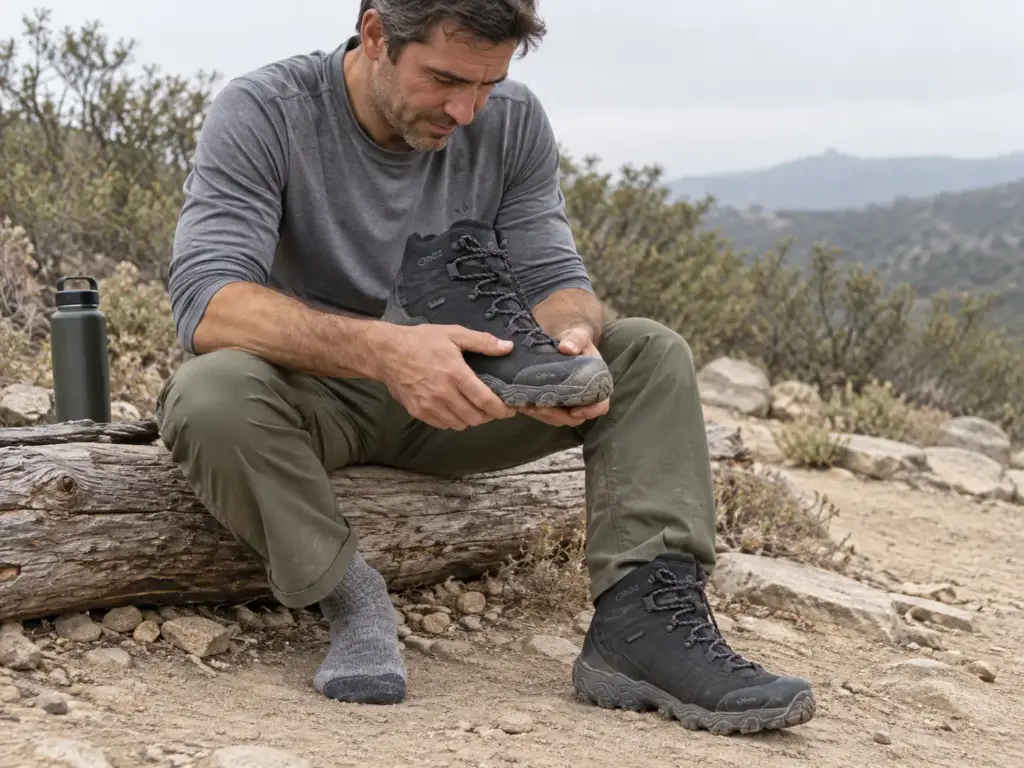
Synthetic uppers fail at the seams and at the overlays stitched or bonded onto them. The other weak point is the rand, the rubber strip where the upper meets the sole. A veteran on Rokslide, a hunting forum, listed his boot failures from over the years in a 2020 post, and most were soles and rands coming unglued (the boot-shop word is delamination), whatever the upper was made of.
That is a weakness independent of the material, and it matters more than the label on the tag. Knowing how each part of a hiking boot fails gets you further than knowing whether the upper is leather.
Before any trip, run a thumbnail along the join between the sole and the upper and look for a lifted edge. A bit of glue creep at the rand is the early warning, and it tells you more about the boot’s remaining life than the condition of the upper does.
Where Leather Boots Wear Out First
Leather fails when it is ignored: it dries out, grows mould, or cracks where it flexes. The counter-anecdote is real, though. A poster on a UK hillwalking forum admitted he went about five years without cleaning his leather boots, watched them grow mould, and still called them “reasonably waterproof.” Neglect shortens a leather boot’s life, but the material forgives more than the care instructions suggest.
The Oboz Bridger Mid B-DRY (men’s · women’s) is a good example of a leather mid-cut: a leather upper with a B-DRY waterproof membrane inside. Whether a given pair can take a new sole depends on how it is built, which is the next section’s whole subject.
Terrain That Punishes Each One
Hunters on that same Rokslide thread are blunt about thorns and abrasion. Around cactus, one wrote, it is leather every time, because the needles go through synthetic “like butter.” Another said synthetics never held up as long as a good leather pair in thorns and abrasive rock. A third added that leather would probably hold up better in loose rock and shale, while the mountaineering-style boots hunters use for sheep and goat are mostly synthetic or hybrid and less likely to stretch.
Treat that as a hunters’ view, not a hikers’ one, but the pattern is clear. Leather has the edge on rocky terrain and anything that cuts or scrapes, and synthetic gives ground there. Put it together and leather usually outlasts synthetic when the sole can be replaced and the boot gets basic care. Synthetic often dies earlier, but cheaply.
Repair and Resoling: Welted vs Cemented Decides the Boot’s Second Life
Walk a boot into a cobbler and you hear one of two sentences: “I can resole that,” or “that sole is glued, it won’t hold a second one.” The difference is how the sole is attached, and Goodyear welt versus cemented construction and which survives mud goes deep on it. Here is the short version as it applies to leather vs synthetic.
Welted Boots Can Be Rebuilt
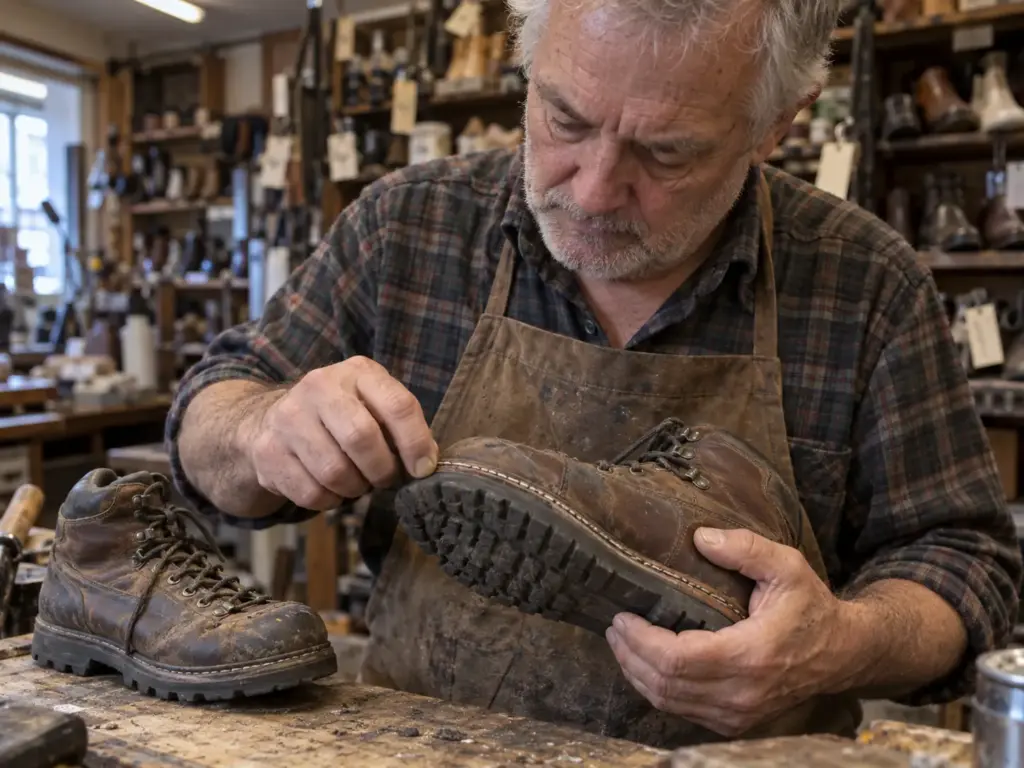
A welted boot, built Goodyear-style or stitch-down, has its sole stitched on, which means a cobbler can take the old sole off and put a new one on. In boot-talk the word is “rebuilt.” A commenter on r/hikinggear describes a pair of leather ankle boots that were rebuilt and resoled and kept going.
This is where leather’s lifespan advantage is earned. The hide itself can outlast several soles, but only if the sole is allowed to be replaced.
Cemented Soles and the End of the Road
Most synthetic boots are cemented, with the sole glued rather than stitched. When that glue gives up, repair usually means replace, because a cemented boot is rarely redone well.
Cheaper leather boots can hit the same wall. A cobbler’s blog, Stitchdown, notes that a boot bought for under a few hundred dollars may take one resole, maybe two. A leather upper on a cemented, budget build is leather in name and a throwaway in practice.
Ask the Cobbler Before You Wax
Care can block a repair. One Reddit thread warns that some waterproofing wax and polish treatments make a later resole harder, and the sensible reading is to ask your cobbler before you wax a boot you plan to rebuild. It costs one question and might save the boot.
Weight, Stiffness and Break-In: What You Feel Every Step
Hour six of a hike is when weight stops being a number on a spec sheet. The heavy boot starts to feel like carrying a brick, or the light boot starts to feel like walking on a flat sheet of card.

How Much Weight Are You Carrying on Your Feet
Leather boots are heavier, and in the retailer Inspiration Outdoors’ own comparison, the author’s leather pair weighed roughly double his synthetic one. That is one pair, not a study, but the direction is not in dispute. Every step lifts that weight, so over a long day it adds up in your hips and shins.
The Salomon X Ultra 5 Mid GTX (men’s · women’s) shows the lighter end of the mid-cut range: a lighter Gore-Tex mid that makes sense when your pack is small and the miles are long.
Stiffness and Support Under a Pack
Leather boots tend to be stiffer and steadier under a heavy load, which many hikers read as better ankle support, and it is why plenty of heavier backpacking boots stay leather. Lighter synthetics suit light loads and day hikes, where flexing with your foot feels better than being held in place. If you want the terrain match, here is what boot stiffness you need for your terrain.
Let the load decide. With a heavy pack, support beats weight savings every time. On a groomed day-hike trail, weight wins and a stiff boot just feels like overkill.
Break-In: Weeks for Leather, Days for Synthetic
Leather needs weeks of wearing in before it stops fighting you, and then it moulds to your foot in a way synthetic never does. Synthetics win on first-day comfort, and hunters on Rokslide point out they have little to no stretch when wet and do not stretch out or crack the way leather can.
That cuts both ways. No stretch means a boot that is slightly small on day one stays slightly small, so fit matters more with synthetic than the easy first mile suggests.
Waterproofing, Breathability and Wet Feet: The Membrane Decides More Than the Label
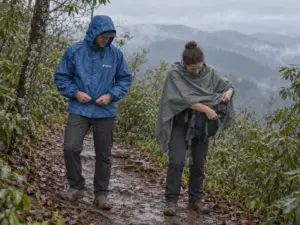
Three hours into the rain, socks soaked, nobody in the group can say whether the boot leaked or the sweat did. That uncertainty is the whole problem with “leather is waterproof, synthetic leaks.” Water-resistant and waterproof are different promises too: the first buys you a shower, the second is meant to survive a soaking.
Why a Membrane Can Matter More Than the Upper
A commenter on the Stack Exchange question about this put it plainly: it is “more like leather versus goretex” than leather versus synthetic. Wet feet come from the membrane, the seams and the socks as much as from the name of the upper. A 2015 answer on the same thread adds that a synthetic boot is waterproof only for as long as the coating lasts.
On the leather side, a UK hillwalking forum thread is full of opinions: leather will keep the water out for longer, and synthetic “will always leak, sometimes sooner rather than later.” Those are opinions, not tests, and I would treat them as such. One poster there added a useful warning about warranties: a membrane’s guarantee covers “the reasonable lifetime of a product,” which is subjective. A well-kept pair gets assessed fairly, and a battered one does not.
Neither material stays dry forever. Check the seams and the lining before you fall for the upper.
When you try boots on, ignore the label and look at the seams: where the panels meet, where the tongue joins the upper, where the sole wraps. Water gets in through badly built seams long before it gets through good material.
Breathability and Drying: Where Synthetic Wins
Synthetics breathe better and have a shorter drying time. Leather holds moisture and dries slowly, and when your own sweat is the thing you are trying to get rid of, that is a real drawback. A Gore-Tex-lined boot of either material also runs warm in summer, because the membrane that keeps rain out slows the sweat getting out.
Re-Proofing and Dry Socks
Damp socks raise friction inside the boot, and friction is how a hot spot becomes a blister. The American Hiking Society advises carrying a dry pair of socks and changing at the first hot spot, not after the blister forms. That is cheap, light and works on any boot.
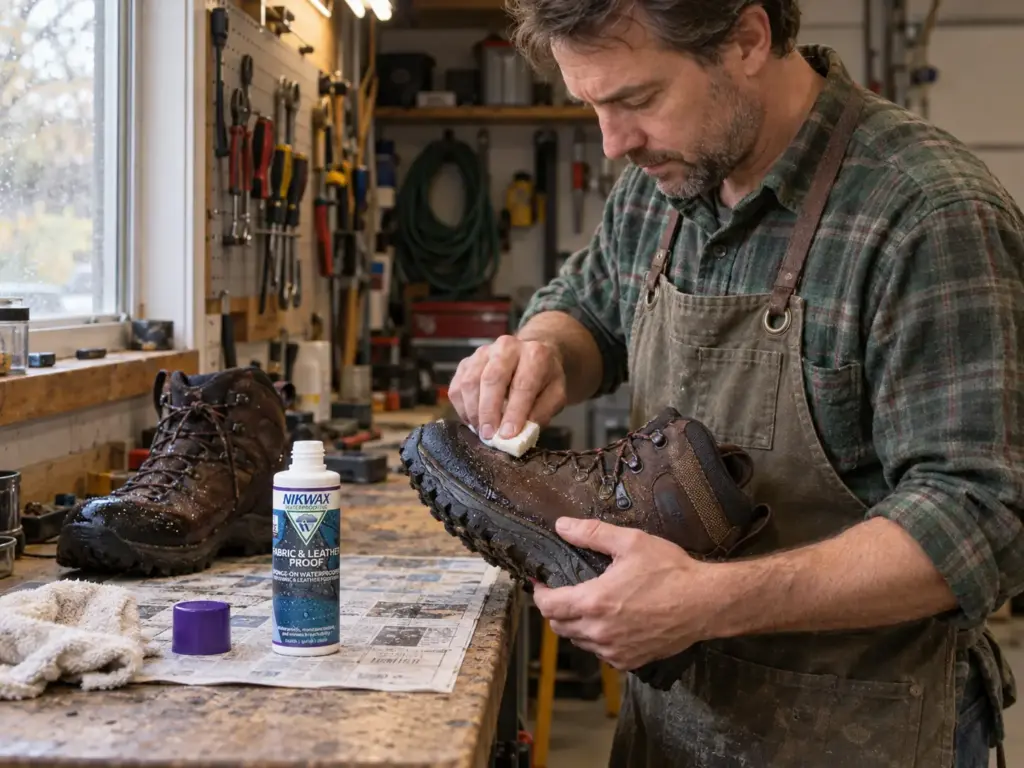
Sprays and waxes wear off, so a boot that was waterproof in spring may not be by autumn. A water-based proofer like Nikwax Fabric and Leather Proof restores the surface on leather and fabric boots, though it is a refresh, not a permanent fix. For the wax versus spray choice, see waterproofing methods compared, wax versus spray.
Pick by Trip Type: Dry Day Hikes vs Wet Multi-Day Trips
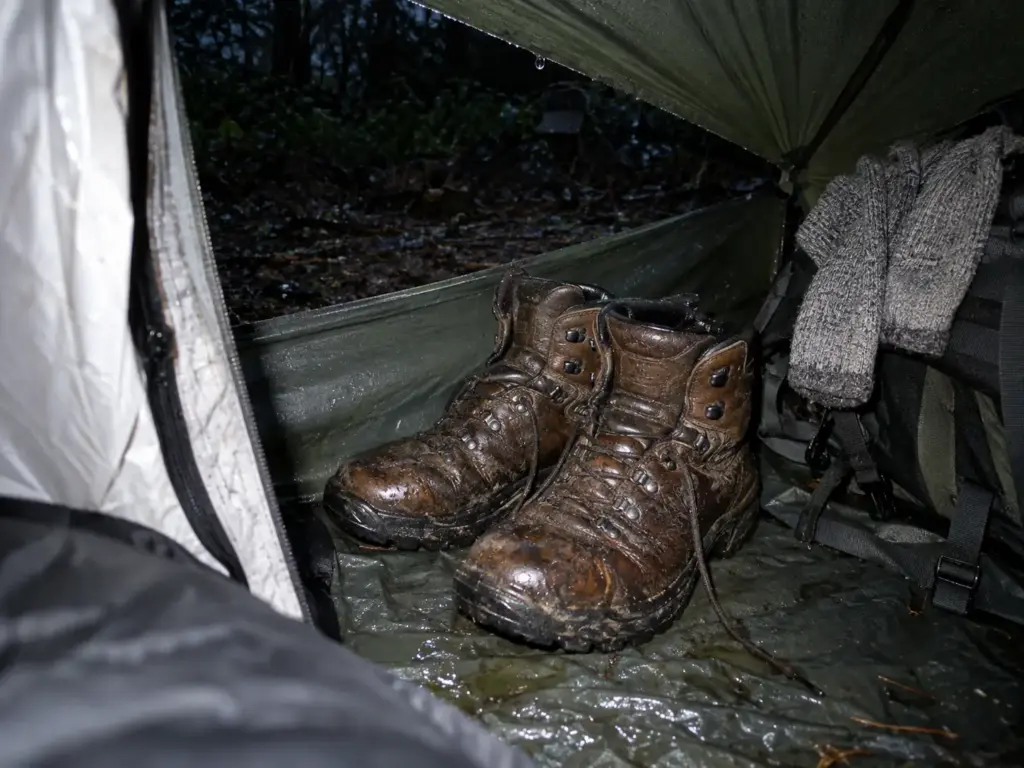
Day two of a wet trip is where the choice shows. The leather boots left in the vestibule overnight are cold and stiff, and the synthetic pair that dried in the night is already on someone’s feet.
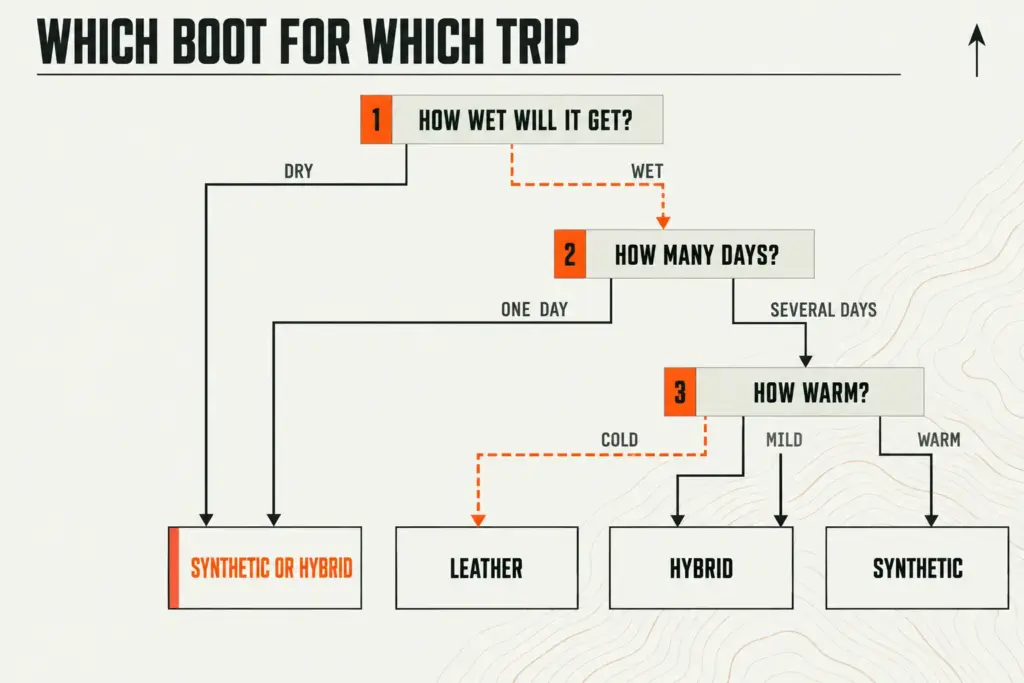
The rule has three questions, and you can answer them before you open a shop tab: how wet will it get, how many days will you be out, and how warm will it be. Wet and long, like a week of multi-day backpacking in rain, points toward whichever boot you can dry overnight. Dry and short points toward the lighter boot. Cold and heavy points toward leather.
Dry Day Hikes: Weight and Comfort Win
On a dry day hike, a synthetic or hybrid boot is hard to argue against. It is lighter, comfortable from the first mile, and nobody is asking it to survive a week of weather. Leather is overkill unless you are carrying a heavy pack or crossing rough ground, and the weeks of break-in are a cost you pay for a benefit you will not use.
Wet Multi-Day Trips: Can You Dry the Boots Overnight?
On a multi-day wet trip, the material matters less than whether you can dry the boots every night. A commenter on r/hiking describes the failure mode: a leather boot left wet overnight is cold and stiff by morning, and a fire does not fix it. Heat damages the boot, so never dry leather near a fire. For a safer method, here is how to dry hiking boots overnight without damaging them.
If you cannot dry anything, the faster-drying boot wins whatever the label says. If you have a stove, a tent and a spare day, leather is fine. Wet terrain with repeated water crossings is where this matters most, because boots soaked at noon have to be dry by morning. Either way, wool socks and gaiters are the cheap half of a wet-boot plan, and Yellowstone’s winter safety guidance lists wool socks, gaiters and insulated boots as the way to keep feet dry.
Cold, Mid-Range and Warm: The Temperature Rule of Thumb
One commenter on r/hikinggear offered a temperature split: leather for about 50 °F and below, synthetic for 70 °F and up, and either one in between. That is one person’s rule of thumb, not a standard, but it matches the instinct most people already have. Heavy leather in hot weather feels wrong, and thin synthetic on frozen ground means cold feet by lunch.
Hunters on Rokslide land in a similar place with a different cut: warm-weather boots synthetic, cold weather with snow leather. Two groups, same rough line. Where you live on the temperature scale decides where your answer sits.
Cost Per Season: What Each Boot Really Costs You
Stand at the till with a cheaper pair in one hand and a dearer pair in the other and you are about to do arithmetic nobody does. The sticker price is the wrong number. The right number is the price divided by the seasons the boot gives you.
Sticker Price vs Cost Over Years
Two category ranges are enough to start. Inspiration Outdoors, an Australian retailer’s blog, puts quality leather boots from around $250 and plenty of synthetic boots under $150, so treat those as a rough guide rather than US shelf prices. A cobbler resole commonly runs somewhere in the $100–$200 range, depending on the build and the shop.
So the leather boot costs roughly $100 more to enter, and one resole costs about what a budget synthetic costs new. Keep both facts in mind as you do the sums.
The resole count is the number that moves everything. Bootcraft, a boot-repair service, says a well-built boot can be resoled three to five times over its life, while the Stitchdown figure above says a boot bought for under a few hundred dollars may only take one or two. Same material, very different totals. A hiker who plans to resole should check the construction before buying, and a hiker who does not should price the boot like a consumable.
A Ten-Year Estimate, Worked Out
Here is a rough estimate built from those ranges, not a measurement. Say you hike hard for ten years. A leather boot with one or two resoles lands in the few-hundred-dollar range once you add the purchase and the cobbler. A synthetic pair at the upper end of that “under $150” range, replaced every three to five years, means two to four pairs, and that also lands in the few-hundred-dollar range.
So at mid price the totals overlap. Leather’s cost case depends on the boot actually getting its resoles, and a cheap leather boot that gets one resole does not beat a synthetic on cost. A Reddit commenter reports a synthetic lasting one or two seasons, which is one person’s experience and would push the synthetic total up fast, so the replacement interval you assume changes the answer. For the repair side of the math, see what resoling a hiking boot costs and when it is worth it.
When the Cheaper Boot Is the Smarter Buy
A cheaper synthetic is the smarter buy more often than leather fans admit. It fits the low-mileage hiker who gets out a dozen times a year, and it suits kids who outgrow boots before the boots wear out. It also suits anyone who wants to try mid-cut Gore-Tex before committing to something heavier.
The Merrell Moab 3 Mid GTX (men’s · women’s) sits at that lightweight, budget end of the mid-cut range. It has a Gore-Tex membrane and a mid-height cut, and it is the kind of boot where replacing it is part of the plan.
Cost per season, or cost per year if you hike year-round, depends on how many resoles a boot takes. The price gap alone does not decide it.
Hybrids and Linings: The Third Option Most Hikers Actually Buy
If you have read this far and still cannot choose, the honest answer may be “neither, a mix.” The binary is a false choice, and the boots most people end up with are hybrids.
What Makes a Boot a Hybrid
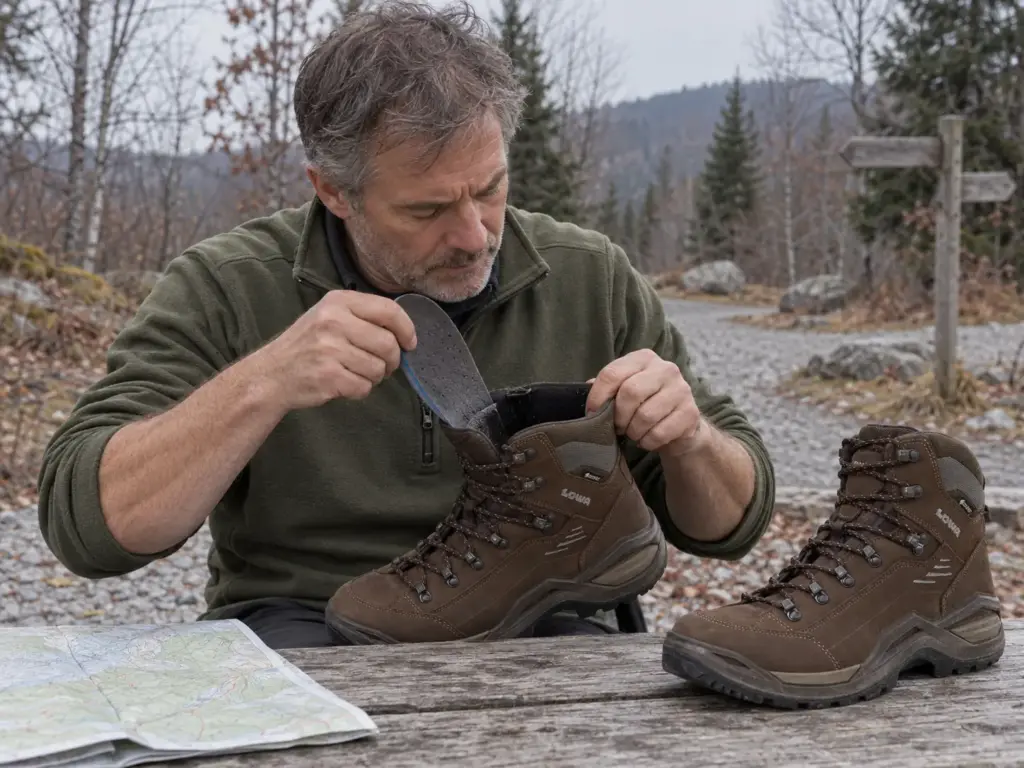
A hybrid is built from upper, lining and membrane combinations: leather outside with synthetic panels, synthetic outside with a leather lining, or leather with a membrane behind it. Hanwag explains the lining choice on its own site: a leather lining for fit and breathability, a membrane for wet regions. That is a third design, not a halfway compromise.
It helps to buy by layer instead of by the word on the tag. The upper decides weight and how well the boot shrugs off rock and thorns, the lining decides how the inside feels against a sweaty foot, and the membrane decides how long rain stays out. Ask three questions in the shop: what is the upper, what is the lining, and is there a membrane at all? Three answers tell you more than the word leather ever will.
A veteran on Rokslide wrote in 2020 that top-end synthetic construction “has caught up,” and that a hybrid is his pick, while admitting there is “still some nostalgic appeal to a finely made leather boot.” That is one person’s view from 2020. A small poll on the same hunting forum split eight to four for leather among 12 voters, which says more about hunters than about the right boot for a trail.
Membrane Choice: Gore-Tex or eVent
In a hybrid, the membrane matters. It is the layer between you and a wet week, and a bad choice cancels out the leather around it. If you are comparing, Gore-Tex versus eVent and which membrane breathes better is the place to start.
Remember the Stack Exchange framing from earlier: leather versus Gore-Tex is a more useful comparison than leather versus synthetic. A membrane stays waterproof only as long as it and the seams hold, so even a hybrid with a good membrane deserves the seam check from the waterproofing section and an occasional re-proof.
Two Ends of the Slider
One Reddit commenter treats synthetic boots as a consumable, buying a discounted pair every couple of years on a retailer’s member sale. Another thread tells of a pair of leather ankle boots kept going through a rebuild and a resole. Both approaches are rational, and they are the two ends of the slider you are picking a point on. The hybrid sits in the middle for people who want some of each: a bit more durability than a pure synthetic, and a bit less break-in than a pure leather boot.
The Plain Recommendation
Here is the rule, stated plainly. Hybrid for most day hikers and light backpackers. Leather for a heavy pack, rough terrain and years of use. Synthetic for light, fast, warm-weather trips and tight budgets.
I’d skip full leather for a first pair unless you know you will carry weight, because the break-in is a cost, not a feature.
The Lowa Renegade EVO GTX Mid (men’s · women’s) is a membrane-lined mid-cut, the kind of boot most readers end up buying. If you want lighter than any boot, trail runners versus hiking boots and what pack weight decides is the question to settle first.
Check the Sole and Rand Before You Pick a Material
Three things to carry out of this article.
Pick by where your boots will get wet and how many days they have to last, not by the name on the tag. Leather’s edge is the second life a resole gives it, synthetic’s edge is weight and day-one comfort, and the membrane decides wet feet more than either. A hybrid is the honest answer for many day hikers and light backpackers.
Before you buy anything, press the midsole of the boots you already own and check the sole and rand for loose glue. Here is the press test for telling when hiking shoes are worn out. You may find the boots you have are fine, or that the real decision was never leather vs synthetic but whether the sole can be saved.
Frequently Asked Questions
01Are leather or synthetic hiking boots better?
Neither material wins everywhere: leather is better for durability and rebuilding, and synthetic is better for weight, drying speed and comfort from the first day. Pick by trip type, meaning how wet, how long and how warm.
02What is the best material for hiking boots?
For many hikers a hybrid is the best choice: a leather-lined or leather-trimmed boot with a waterproof membrane. Leather suits heavy loads and years of use, while synthetic suits light trips and tighter budgets.
03Are synthetic hiking boots really waterproof?
Synthetic hiking boots stay waterproof only as long as the membrane, the seams and the outer coating hold up, and none of those lasts forever.
They tend to leak at the seams or once the coating wears, and a re-proofer helps restore the surface.
04Do leather hiking boots breathe better than synthetic ones?
Not usually, because synthetic uppers breathe and dry faster than leather, which holds moisture longer and dries slowly after a soaking.
A Gore-Tex-lined boot of either type runs warm in summer.
05Is a Gore-Tex boot better than a leather boot?
Gore-Tex and leather are not opposites, because Gore-Tex is a waterproof membrane that sits inside a boot made of either material.
The membrane and the seams decide wet feet more than the name of the upper does.

I've spent more than a decade researching hiking gear and trail technique. I read the specs, the forum threads and the long-term reviews, and every pick here comes with what it gets wrong.
End of the trail
You read every mile of this one. Here's where the trail goes next.