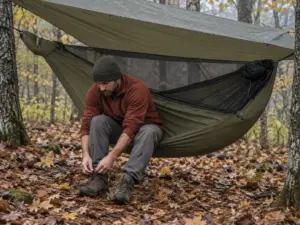
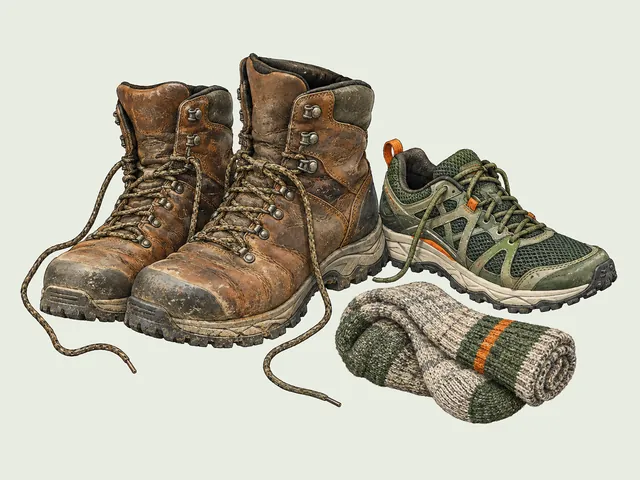
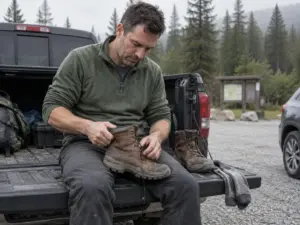

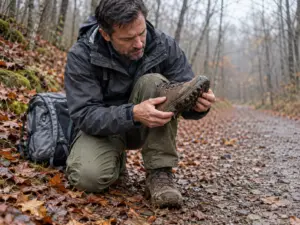
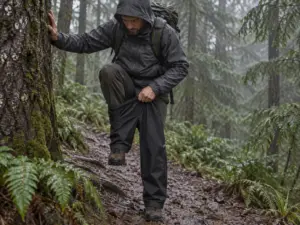


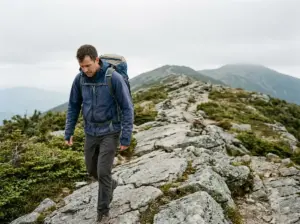



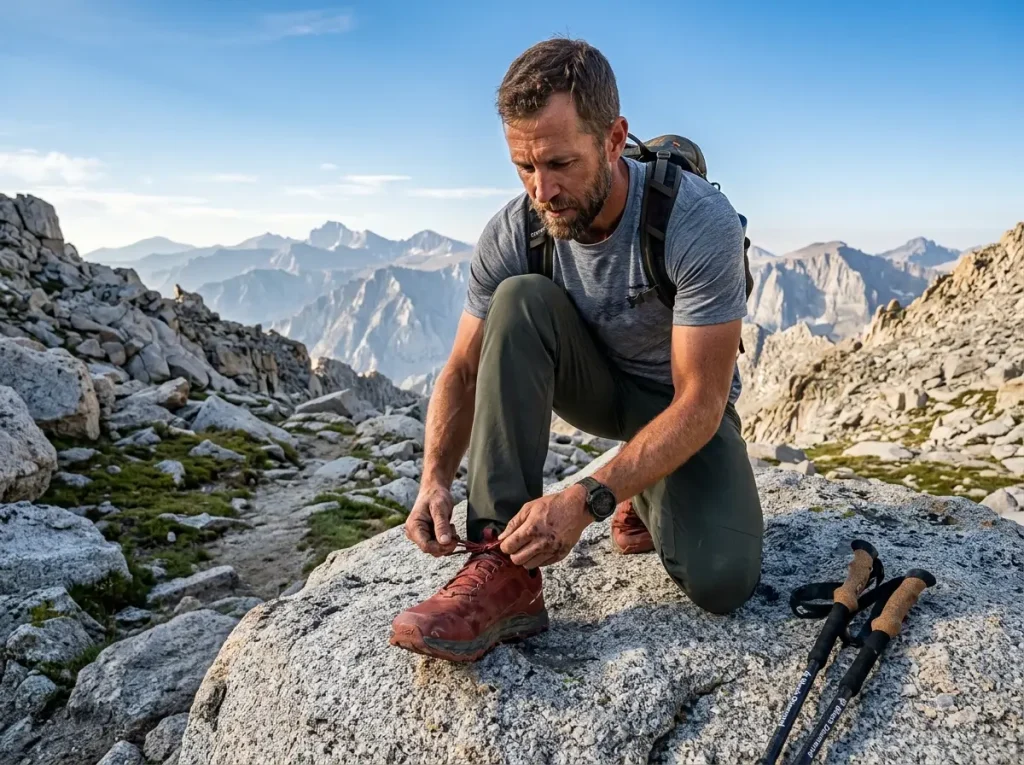
He was wearing a pair of $280 leather boots — the stiff, bombproof kind — and he still rolled his ankle clean off a ledge on the descent. The boot didn’t stop the inversion. According to the ER doc, the rigid shaft may have made it worse, acting as a fulcrum that torqued the ligament further than a flexible shoe would have.
I’ve guided hikers through technical terrain long enough to have watched this exact scenario repeat. Different boots, different people, same outcome. Every time, the hiker says the same thing: “But I thought the high tops were supposed to protect me.” That’s the myth.
The belief that a tall leather collar prevents ankle sprains is a marketing story built on intuition, not field data. Here’s what the clinical evidence says — and what you should be doing instead.
⚡ Quick Answer: High-top hiking boots reduce ankle range of motion by only about 4.5° in controlled lab conditions — not nearly enough to stop a real lateral sprain, which happens in 60–80 milliseconds. A study of 622 basketball players found no meaningful difference in sprain rates between high-top and low-top footwear. The combination that actually works: laced ankle stabilizers worn with low-cut shoes. The collar is not the controlling variable. Your peroneal muscle strength and torsional rigidity of the midsole are.
The Biomechanics of “Support” — What’s Actually Happening at Your Ankle

Here’s where most hikers get it wrong: they assume that because a boot feels supportive, it is supportive. The feel and the physics are two different things.
High-top footwear does reduce inversion kinematics — the foot rolling inward — by roughly 4.5° and slows the rate of that inversion by about 100°/s in controlled settings. That sounds meaningful until you account for what a real trail ankle roll looks like. A lateral ankle sprain — the actual failure of the anterior talofibular ligament — happens in 60–80 milliseconds. Your neuromuscular reaction time is 120–180ms. The ligament has already torn before your central nervous system has even registered the event. A leather collar cannot intercept what the nervous system cannot catch.
A study of 622 basketball players confirmed this. Researchers found no statistically significant difference in sprain rates between players wearing high-top and low-top shoes. When clinical trials comparing taping and bracing for ankle sprains examined the full protocol range, the clearest result was this: low-top shoes combined with laced ankle stabilizers produced the fewest injuries of any configuration studied. That combination beat high-top boots.
What a boot collar does provide is a proprioceptive sensation — the ankle feels held. That feeling is real. The mechanical protection against an explosive roll is not. As McKeon & Hertel wrote in the Journal of Athletic Training: “True ankle stability comes from within. Training your body, not just relying on your boots, is key to injury prevention.”
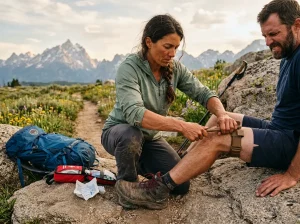
If you want the actual protection, ankle taping with Leukotape is where the evidence points.
Pro-Tip: Tight lacing on a mid-cut boot will not mechanically stop a 200lb person’s ankle from rolling at trail speed. Save that confidence for the gear closet.
Inversion Kinematics — The Physics of a Roll
The subtalar joint is the joint responsible for inversion and eversion — the hinge that governs the roll. It sits below the ankle collar’s contact zone. The collar doesn’t touch this joint. When your foot supinates on a misplaced footfall on talus, the subtalar joint torques and loads the ATFL and calcaneofibular ligament independently of whatever is wrapped around your lower calf.
The collar provides leverage over the tibia and fibula. The roll happens at the subtalar joint. These are not the same structure. This is why tight lacing on a high boot feels reassuring but doesn’t change the physics — you’re strapping a collar around the wrong part of the anatomy.
The Kinetic Chain Penalty — What Boots Protect By Destroying
This is the part nobody in the boot industry wants to talk about.
When you restrict ankle mobility with a stiff high boot, the ankle can’t absorb and dissipate energy normally during impact. That energy doesn’t disappear — it transfers up the kinetic chain to the knee. Biomechanical alterations in lower limb joints while running with boots confirm this: high-shaft boots measurably increase eccentric knee joint work compared to low-cut shoes.
Over a 20-mile day with 40,000 footfalls, that’s thousands of additional eccentric loads at the knee. Over a 10-day trip, it accumulates into IT band syndrome, patellofemoral pain, and the kind of chronic knee degeneration that ends hiking careers.
For hikers dealing with the downstream knee load, managing knee joint compression on technical terrain covers the mechanical countermeasures.
I’ve watched thru-hikers bail on their boots at mile 300 and switch to trail runners. Almost without exception, they report months of knee pain clearing up over the following weeks as ankle mobility returns. The knee was paying the tax the boots were collecting.
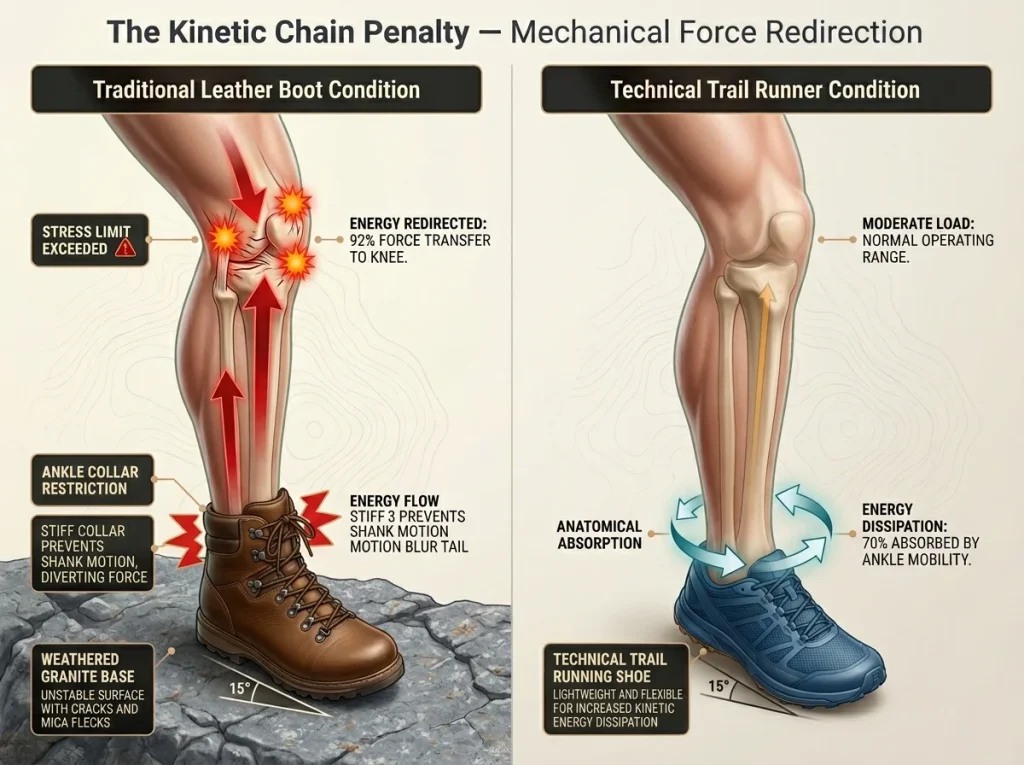
Pro-Tip: This is the gram-weenie version of injury risk — obsessing over ankle support while your knees are logging tens of thousands of eccentric reps per day. Watch the knees, not the collar.
Proprioception — Your Brain’s Real Ankle Defense System
Your brain doesn’t just react to a fall. It prevents most of them — constantly, automatically, through a proprioceptive feedback loop that runs from mechanoreceptors in your foot’s skin and soft tissue straight to the motor cortex. When you step on an uneven rock, that signal fires, your peroneals engage, and the ankle corrects. You never consciously noticed any of it.
Thick boot midsoles dampen this signal. The sensory insulation created by a high stack height means the brain gets a delayed, muffled update about what’s happening underfoot. By the time the signal arrives, a misplaced footfall on scree has already launched the inversion sequence. Trail runners with lower stack heights preserve more ground feel. The foot reads the terrain faster. This is why experienced barefoot walkers navigate rocky ground better than people in maximalist shoes — their proprioceptive feedback loop is intact.
How trekking poles extend your proprioceptive field completes the picture for hikers who want to stack every neurological advantage available on trail.
The True Stability Variable — Torsional Rigidity, Not Collar Height
Here’s what actually keeps you stable on uneven terrain: the shoe’s resistance to twisting along its longitudinal axis. That’s torsional rigidity of the midsole. When you step on a rock at an angle, a high-rigidity shoe keeps the platform flat. A low-rigidity shoe twists under your foot and lets the ankle tip into the roll.
The leather collar provides abrasion protection and warmth. It contributes almost nothing to torsional rigidity. A boot with a high collar and a floppy midsole is less stable on exposed talus than a trail runner with a solid TPU chassis and a lower profile. This is the variable boot marketing systematically avoids.
Research on authoritative studies on lateral shoe surface friction and injury supports the finding that lateral stability mechanisms go well beyond collar height. As Dr. Mark Ricard’s research concluded: “footwear without additional support from taping and bracing does not appear to have a strong influence on the risk of ankle sprain” — even among high-top designs.
For a terrain-specific breakdown of stiffness ratings, matching boot stiffness rating to terrain type has the decision matrix.
Stack Height as a Liability — The Lever Arm Problem
When a lateral roll begins, your body weight and pack weight become a force acting through the height of the midsole. A higher stack means a longer lever arm — and more torque applied to the ankle at the moment of inversion. A 40mm stack shoe dramatically increases that torque compared to a 15mm shoe, making the resulting sprain worse if it does occur. The Hoka Speedgoat 6 runs a 38mm stack with a torsional rigidity of 3/5 — workable on groomed running trails, potentially hazardous on exposed rocky terrain.
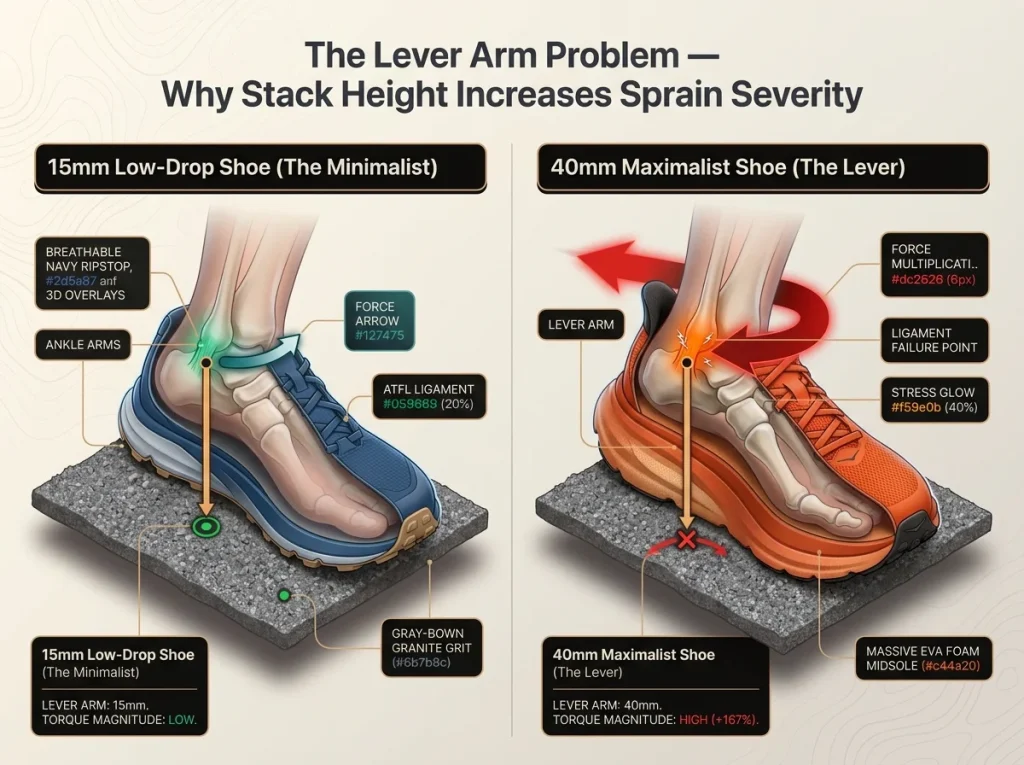
Pro-Tip: Carrying a heavy pack on steep sidehill terrain? A lower-stack trail runner or mid-cut with high torsional rigidity will often outperform the maximalist boot. Stack height shifts your center of gravity upward, narrowing your balance envelope on anything that isn’t flat.
The Gear Comparison Matrix — 5 Models Decoded
These five shoes represent the real spectrum, mapped against what actually matters.
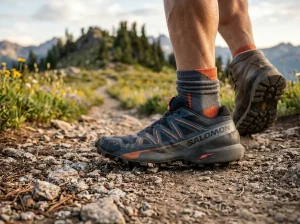
The Salomon X Ultra 5 Mid (1lb 15oz, 32.5mm stack, rigidity 4/5) is the honest mid-cut: TPU chassis, genuine rigidity. The Altra Lone Peak 8 (1lb 5oz, 25mm, rigidity 1/5) is a thru-hiking machine for conditioned ankles only. The Hoka Speedgoat 6 (1lb 3.6oz, 38mm, rigidity 3/5) excels on predictable terrain; that lever arm demands respect on technical ground. The La Sportiva Spire GTX (1lb 15oz, 39mm, rigidity 4/5) pairs high stack with genuine rigidity — acceptable for heavy loads. The Vivobarefoot Magna (1lb 0oz, 4mm, rigidity 1/5) is a training tool, not a transition shoe.
The right shoe is the intersection of your ankle strength, torsional rigidity, and stack height. If the matrix raises more questions, our field-tested footwear selection framework maps the full decision tree.
Gore-Tex and Waterproofing — What Boots Actually Do Well
Here’s the honest part: boots do things trail runners often can’t. In cold, sustained-wet conditions, creek crossings, and scrambling on sharp limestone, a full leather upper with a Gore-Tex membrane is the right call. The protection is abrasion resistance and thermal insulation — not sprain prevention. Gore-Tex ePE, the PFAS-free version now rolling through the industry, handles this well.
Where the common mistake happens is relying on that liner to manage full submersion without gaiters. Even a perfect Gore-Tex boot wet through the collar is just a very warm wet shoe. If you want waterproofing and trail runner agility together, lightweight gaiters paired with a trail runner on a Vibram Megagrip outsole is a real system.
The Metabolic Tax — What Heavy Footwear Costs You Over 20 Miles

Every 100g of shoe mass increases aerobic demand by approximately 1%. The shoe sits at the distal end of your leg, requiring significant energy to accelerate and decelerate with every stride. One pound on your feet is metabolically equivalent to five pounds in your pack.
Real comparison: the Salomon X Ultra 5 Mid (1lb 15oz) vs. the Altra Lone Peak 8 (1lb 5oz). That’s 567 grams of difference between both feet. At 1% per 100g, that’s approximately 5.7% higher aerobic cost per mile for the heavier boot. Across a 10-day trek, that tax shows up as earlier fatigue onset in the second half of long days.
Fatigued hikers make worse footfalls. Worse footfalls are when ankle rolls actually happen. The long-distance hiker footwear injury and illness data makes this connection explicit: the real injury risk factor isn’t shoe type — it’s neuromuscular fatigue at mile 15 combined with proprioceptive latency from a thick midsole.
For the full weight tradeoff across your entire kit, the 5:1 foot weight rule in practice puts footwear mass in context.
Paresthesia and Nerve Compression — The Clinical Data Nobody Shares
This one doesn’t show up in boot reviews because it’s bad for sales.
Long-distance hikers wearing boots reported a 68% prevalence of paresthesias — numbness and tingling — compared to 36% in running shoes. The Odds Ratio for paresthesia in boots versus sandals is 3.9. Boot wearers are nearly four times more likely to experience nerve compression symptoms over long miles.
The mechanism: walk 15 miles and your foot swells. Peripheral edema is normal and predictable on long days. A mesh trail runner expands with it. A rigid leather upper with a Gore-Tex liner has no expansion capacity. Pressure builds on the dorsal nerves. That tingling you dismissed as “boot break-in” at mile 10 is active nerve compression — neurological, not friction-based.
The first line of defense is sizing up for foot swell on long miles. If you experience recurring foot numbness after mile 10, it’s not your socks.
The Fatigue Multiplier — When Your Brain Stops Catching Rolls
The peroneal muscles — peroneus longus and peroneus brevis — are the active evertors of the foot. When they fire fast enough, they catch an incipient roll before the ligament loads. When they’re fatigued, they don’t. Neuromuscular fatigue, not terrain type, is the proximate cause of most late-day ankle sprains. Thick midsoles mask this — the dampened ground feel means you don’t feel how tired your ankle stabilizers are until the roll is already in motion. Boots compound this by inhibiting foot moisture evaporation, accelerating fatigue in warm conditions. Zero-drop footwear like Altra strengthens intrinsic foot muscles with consistent use, building the neuromuscular reserve that actually prevents sprains.
Ankle Strengthening — The Protocol That Actually Works

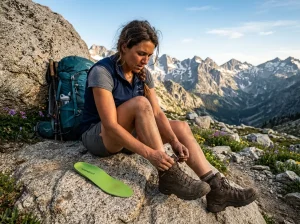
The prevention of lateral ankle sprains — clinical evidence is consistent: laced ankle stabilizers in combination with low-cut shoes outperform high-top boots alone. But the foundation under all of it is conditioning. Six to eight weeks of targeted peroneal conditioning measurably improves reaction time in the stabilizers. That’s a training block, not a gear purchase — and it’s the one intervention that transfers across footwear regardless of what you’re wearing on the day you step wrong on talus.
If you’re heading into Class 3 terrain, ankle stabilization drills for technical terrain adds the eccentric loading component that trail hiking alone won’t build.
The Peroneal Training Protocol
Three exercises. Three sessions a week. Fifteen minutes.
Exercise 1: Single-leg balance on an uneven surface — Bosu ball or gravel road. Three sets, 45 seconds per leg. Replicates the neuromuscular firing pattern of a misplaced footfall better than any machine exercise.
Exercise 2: Banded lateral ankle resistance. Loop a theraband around your foot, anchor the other end, resist external rotation — 3 sets of 15 reps each side. Isolates the peroneus brevis, the primary resistance muscle in a lateral roll.
Exercise 3: Single-leg eccentric calf lowers off a step edge — 3 sets of 12 reps at a controlled 4-second descent. Builds eccentric capacity to catch a fast inversion event.
I added this protocol to my pre-season training after my third guided client rolled an ankle in terrain I’d walked without incident. Six weeks in, I could feel the difference in correction speed on loose scree. Not dramatic — just faster. That half-second is the whole game.
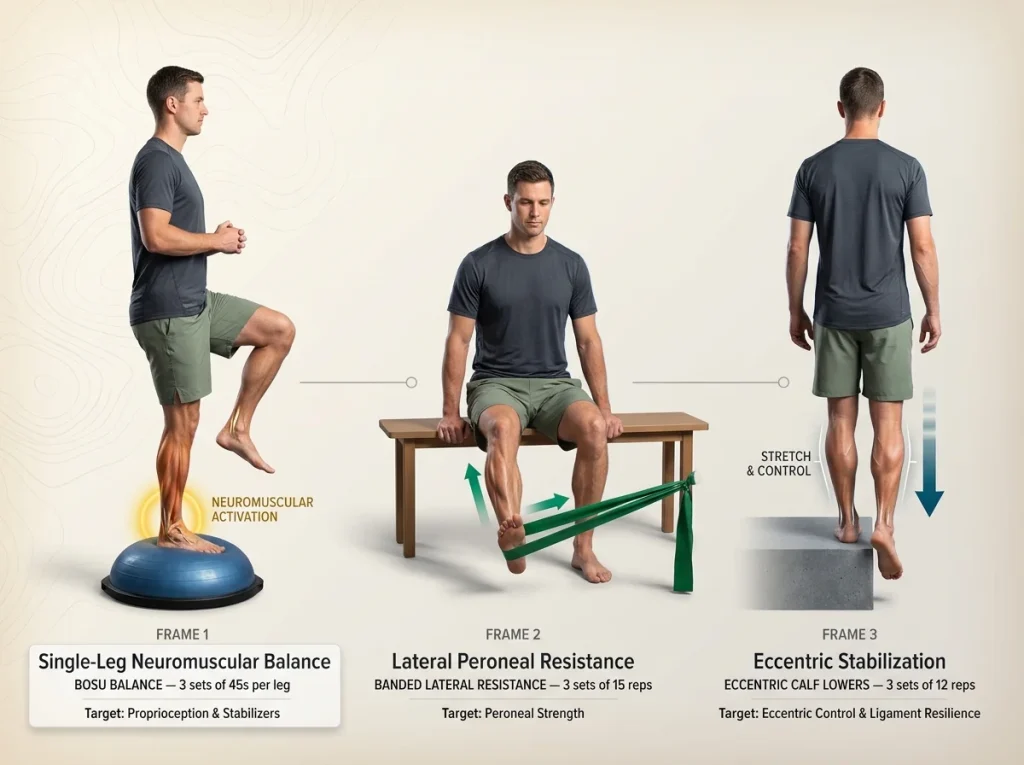
Pro-Tip: Add the protocol to your training block 6–8 weeks before a multi-day route. Don’t wait until you’re on trail. The adaptation happens in the weeks before, not the days during.
The Transition Timeline — From Boots to Trail Runners Without Getting Hurt
Moving from stiff boots to low-stack trail runners too quickly causes predictable problems: Achilles tendonitis, arch strain, calf overload. The intrinsic foot muscles and Achilles are deconditioned from years of support.
Weeks 1–4: flat trails, 5–8 miles per session. Weeks 5–8: moderate terrain, up to 12–15 miles. Weeks 9–16: technical terrain permitted; monitor Achilles carefully. Months 6–12: full terrain transition. The Vivobarefoot Magna’s 4mm stack is not a Day 1 shoe — start with the Altra Lone Peak or a low-stack Salomon before going near-zero drop.
When Boots Still Make Sense
Winter hiking with sustained snow, terrain requiring crampon compatibility, alpine talus approaches — boots remain the right answer. Pack loads above 35–40 lbs also shift the equation. Post-acute Grade 2–3 sprain rehab and aggressive river crossings on slippery boulders are legitimate use cases. They’re narrower than the marketing suggests — not the default conditions of the day hiker buying their first pair of boots.
The Hybrid Solution — Technical Mid-Cuts and the Case for Neither/Both
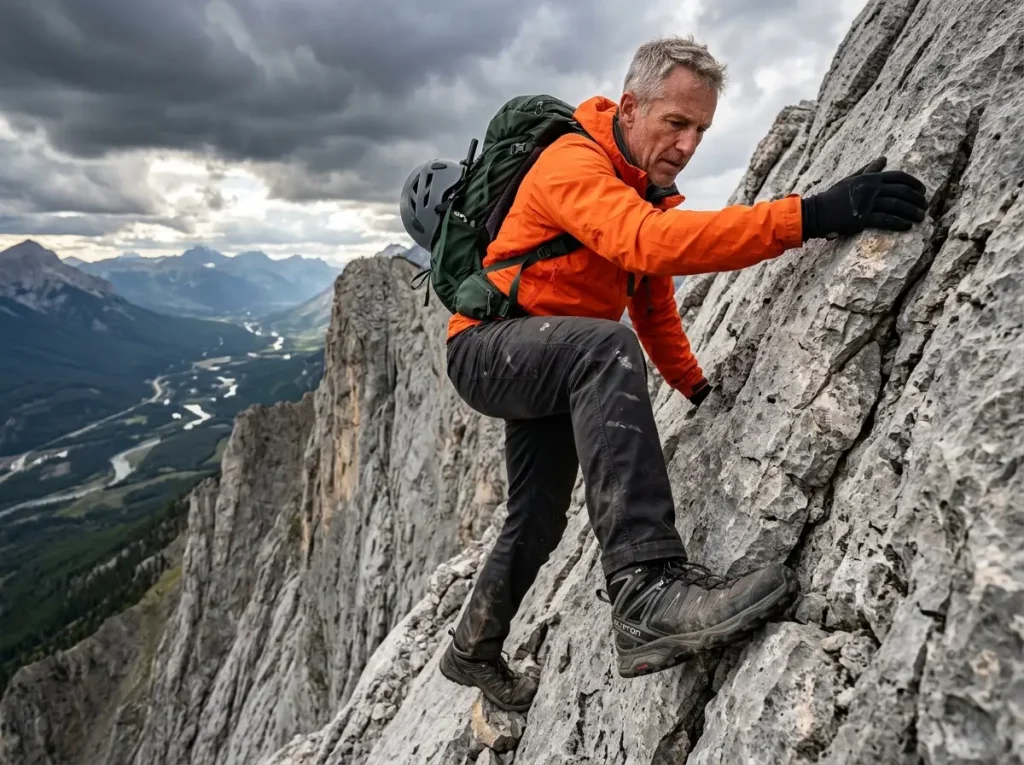
The boot-versus-runner debate is the wrong question. The right question: what is the torsional rigidity of this shoe, and does it match the inversion forces I’ll encounter on my specific terrain?
Technical mid-cuts answer this correctly. The La Sportiva TX Hike Mid GTX, Salomon X Ultra 5 Mid, and Lowa Renegade GTX all deliver 4/5 torsional rigidity alongside a 30–35mm stack height. The collar height on these is secondary to how a boot shank actually generates torsional rigidity — that’s the construction variable worth understanding. The Vibram Megagrip outsole is the traction variable that matters on wet rock, not boot height.
A practical system for serious hikers: technical mid-cut for multi-day backpacking with loads above 30 lbs; lightweight trail runner for day hikes and fast-packing. Match the torsional rigidity to the terrain. Ignore the collar.
Reading the Shoe Spec Sheet Like a Field Engineer
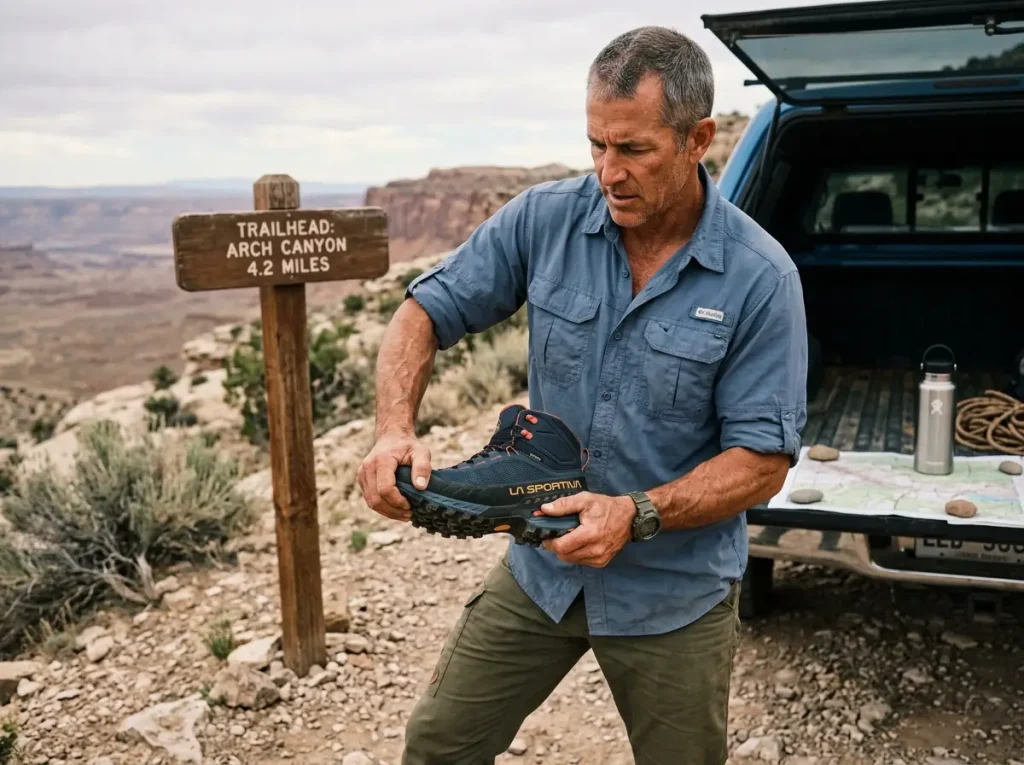
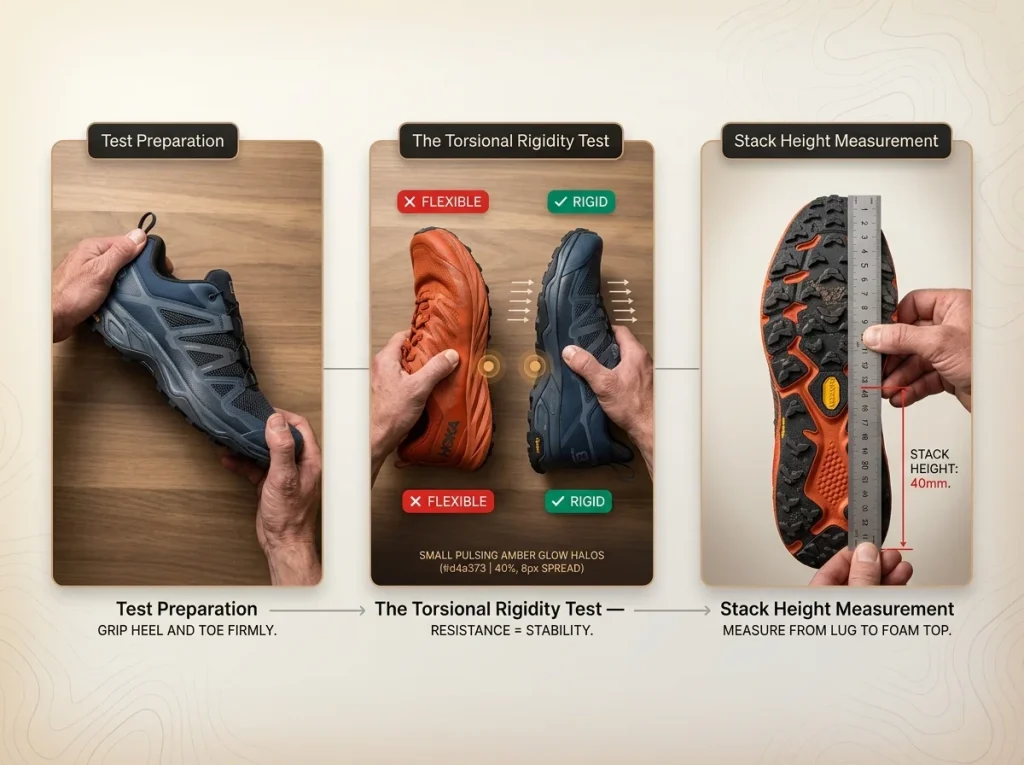
Before you buy, run this test in the store. Grip the heel and toe and try to twist the shoe. If it flops in your hands, that shoe has low torsional rigidity — regardless of collar height, regardless of what the label says. A shoe with real rigidity resists. You’ll feel the difference immediately.
Evaluate in this order: torsional rigidity first, then stack height, then shank material (carbon fiber and TPU beat fiberglass and nothing), then outsole compound, then collar height last. Manufacturer ankle support claims are not measurable in the store. The twist test is.
The tested grip comparison across 12 outsole rubber compounds has the wet rock data on outsole compounds when you’re ready to go that deep.
The Rock Plate Variable — Underfoot Protection vs. Platform Stability
Rock plates — typically carbon fiber or nylon inserts — protect the plantar fascia from sharp rock puncture. They’re a different mechanism from torsional rigidity, and conflating them is a common mistake. A rock plate adds fore-aft rigidity, not lateral rigidity. The Hoka Mafate X and La Sportiva Prodigio Max use rock plates — good for puncture protection, irrelevant for ankle roll prevention.
Whether you need a rock plate depends on terrain: granite slabs and rooted forest trails don’t require them the way rocky scree and talus fields do. For the full breakdown of materials and terrain matching, rock plate mechanics and when they actually matter has the data.
Conclusion
Three things to take off this trail.
The collar is cosmetic. A high ankle collar slows inversion by about 4.5° in a controlled lab. On actual talus at the end of a long day, that’s nothing. Torsional rigidity of the midsole — tested with a store twist test — is the actual stability variable.
The kinetic chain doesn’t forgive the math. Every joule a stiff boot blocks at the ankle goes to your knee. Over 40,000 steps a day, that’s an expensive trade that shows up in your knees, not your ankles.
Train your ankles, then choose your shoe. Six to eight weeks of peroneal conditioning changes your protection profile more than any boot upgrade. Build the neuromuscular base first. Pick your footwear afterward — low stack, high torsional rigidity, terrain-matched outsole.
Next time you’re in a gear shop, skip the collar height. Grab the heel and toe and try to twist the shoe. If it flops in your hands, the support isn’t there — regardless of what the label says.
FAQ
Is ankle support in hiking boots a myth?
Largely, yes. The high collar does not mechanically prevent lateral ankle sprains, which occur in 60–80 milliseconds — faster than any leather shaft can respond. Clinical data consistently shows that taped or braced ankles in low-cut shoes outperform high-top boots for sprain prevention.
Are trail runners better for bad ankles?
They can be, but only if your ankle musculature is conditioned. Low stack heights preserve proprioceptive feedback for faster neuromuscular correction. A maximalist trail runner with a 40mm+ stack height actually increases the lever arm for inversion — potentially riskier than a stiff boot for some profiles.
Why do thru-hikers wear trail runners instead of boots?
Metabolic math: every 100g of shoe mass increases aerobic cost by roughly 1%. Over a 2,650-mile PCT thru-hike, that compounds hard. Thru-hikers also adapt over weeks of use — their ankle musculature trains into the footwear in ways a weekend hiker’s doesn’t.
Can you wear trail runners with a heavy pack?
Yes — choose a trail runner with high torsional rigidity (4/5) and a moderate stack height (30mm or less), and consider ankle taping on technical sections. Inversion torque increases with both pack weight and stack height.
What is the best footwear for hikers with a history of ankle sprains?
A completed peroneal conditioning program, a laced ankle stabilizer or Leukotape protocol, and a technical mid-cut or trail runner with high torsional rigidity. The boot’s collar is not the controlling variable. Your peroneal reaction time is.
I've spent more than a decade researching hiking gear and trail technique. I read the specs, the forum threads and the long-term reviews, and every pick here comes with what it gets wrong.
End of the trail
You read every mile of this one. Here's where the trail goes next.