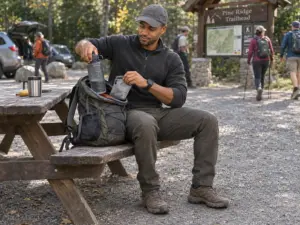
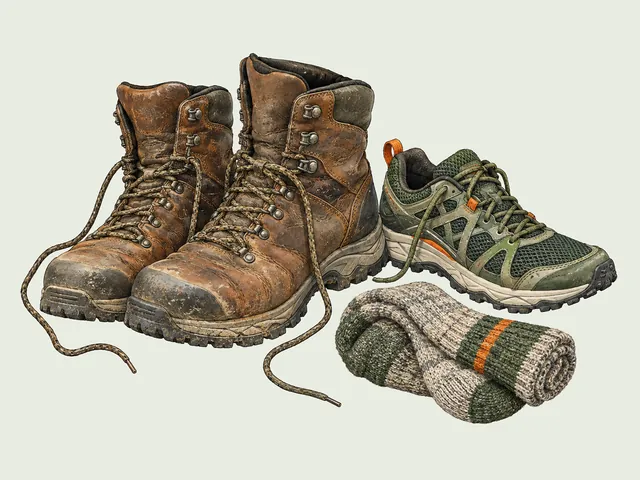
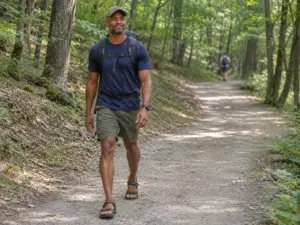
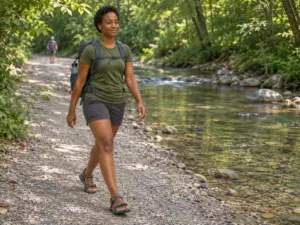
The creek is ankle-deep and clear, the day is hot, and your first step lands on a smooth, algae-polished stone that gives under your foot like wet soap. That is the moment you find out which kind of hiking water shoes you put on, because the label covers four very different shoes and the trail decides which one survives it. This guide sorts the styles, explains why soles slide on wet rock, names the closed-toe sandals and budget aqua socks worth considering, and marks the line where a trail runner and dry socks do the job better.
What Hiking Water Shoes Actually Do (and What They Don’t)
Hiking water shoes are built to get wet and stay useful. Water flows in, drains out in seconds, the upper dries fast and the sole keeps some grip on wet stone. That is the whole design, and it explains both what they do well and why they fall apart outside that job.
The test case the whole category is built around is The Narrows at Zion, a gorge with 1,000-foot walls where the Virgin River is sometimes only 20 to 30 feet wide. You walk in the river for most of the day. People who have never seen it picture a stroll, and it is a day of wet rock, current and cold.
Water Shoes vs Waterproof Shoes
A waterproof boot keeps water out until it pours in over the cuff, and then it holds all of it for the rest of the day. A water shoe makes the opposite deal: it accepts the water and gets rid of it. On a trail with one stream crossing, the boot is fine. On a trail where your feet are wet for hours, the boot becomes a bucket, and a shoe that drains wins every time.
The waterproof vs water shoes choice comes down to one question: do you want water kept out for a few minutes or let out for a few hours? Drainage ports, mesh and an open build matter more here than any membrane, which is the argument laid out in full in why drainage holes beat waterproof boots at a wet crossing.
Where They Work: Creeks, Crossings and Beaches
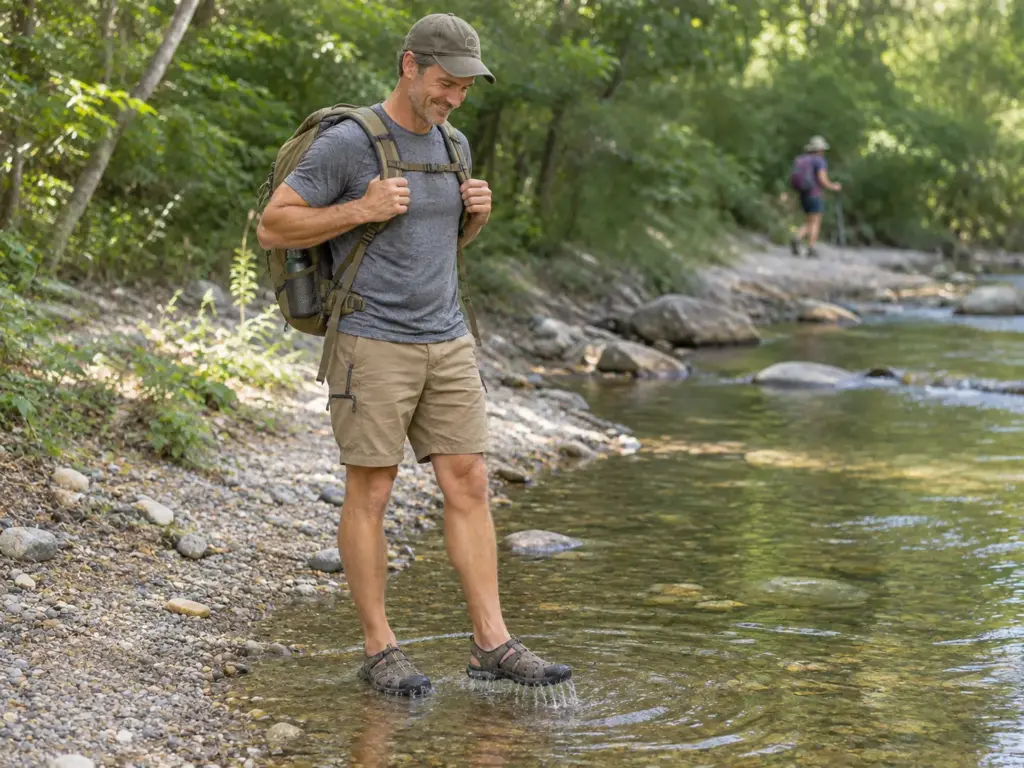
Water hiking shoes earn their place on creek walks, repeated crossings, rocky beaches, lake shores and short riverbed trails, which is the home ground of river hiking shoes. They also suit paddling days, from kayaking to paddleboarding, where you step in and out of the boat all afternoon. A rocky shoreline is slippery rock the moment it is wet, so the footwear has to grip as well as drain.
The one rule that holds everywhere is covered toes: the park service’s own guidance for The Narrows tells every hiker to wear closed-toe shoes (regular hiking boots count) and to carry a walking stick. You do not need a special water shoe to start. You need covered toes and a third point of contact with the riverbed.
The same page sets the mileage this category was designed for. The bottom-up route to Big Spring is a 10-mile round trip, and the full through-hike from Chamberlain’s Ranch is 16 miles and needs a wilderness permit. Both are day-scale wet hikes. Neither is a thru-hike, and a shoe that handles ten wet miles is not automatically a shoe for fifty.
What the Flow Number Changes
The river’s flow is measured in CFS, cubic feet per second, and it decides the hike as much as the shoe does. Below 70 CFS the crossings are knee-deep and moderate. Between 70 and 150 CFS they are thigh-deep and a fight against the current. Above 150 CFS the park closes The Narrows to all travel.
The identical shoe on the identical route is a pleasant wade one week and the wrong tool the next, so check the gauge before you drive to the trailhead, not after you have laced up.
Most rivers are not gauged by a park service with a published rule, which makes the same habit more important elsewhere: find the flow, find the temperature, and decide the footwear from those two numbers. Everything in the rest of this guide assumes warm, low, slow water. Where it does not, the answer changes, and the last sections say how.
What to Look For in a Water Shoe and How It Should Fit
Two pairs can look identical on a shelf and behave nothing alike on a riverbed. Four things tell them apart: how fast they drain and dry, whether the toe is protected, how much the pair weighs and what the sole is made of. Fit decides whether you can still walk in them at the end of the day.
Drainage, Uppers and Dry Time
Look for drainage ports or an open build that empties the shoe in seconds. Good water drainage is the first thing to check, because a shoe that holds a pint of river on every step wears you out before the day is half done. A synthetic upper in mesh or polyester webbing will quick dry far faster than a leather upper or a foam lining, and a foam-lined shoe that holds water will feel like a sponge on the second crossing.
Drying time depends on the climate as much as on the shoe. A shoe that drains but stays damp for six hours is better than one that stays soaked, though neither dries overnight in a humid forest. Anything that stays damp also starts to smell, and rinsing it clean and airing it out keeps odor from settling into the footbed.
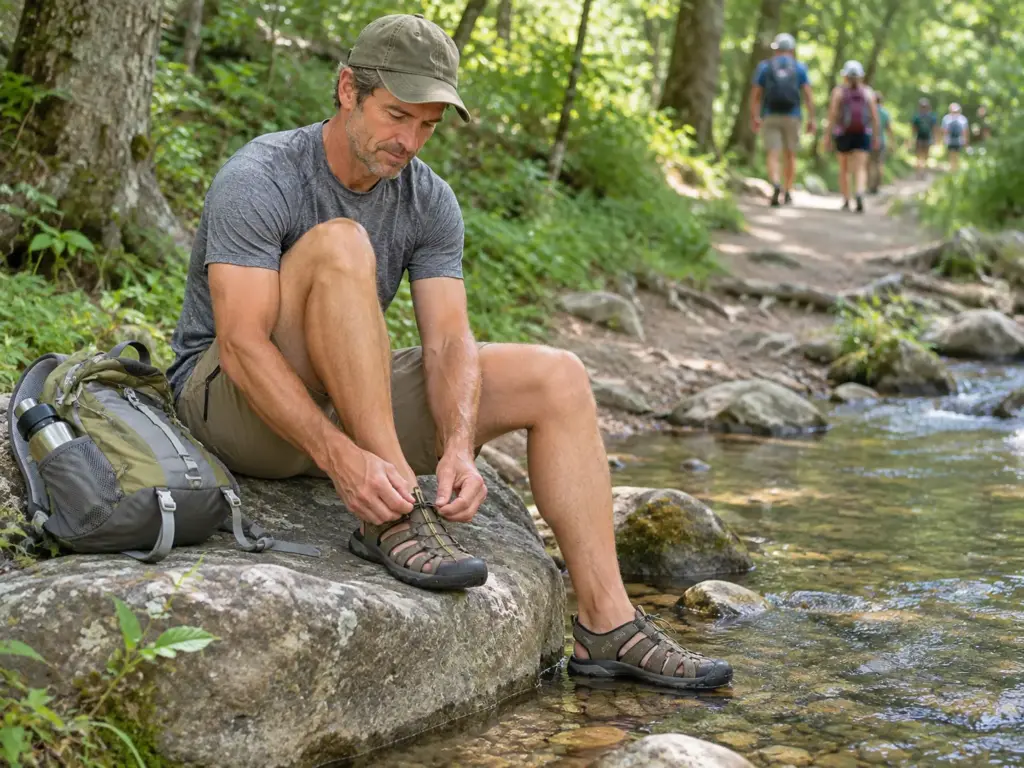
Closures matter for drainage in a quiet way. A shoe that stays on your foot while full of water has to hold the heel without any help from a dry, grippy sock. Bungee lacing, with a single bungee lace and a toggle, cinches in one pull. A quick lace tab does the same job without cold fingers, and hook and loop straps open wide enough to rinse the shoe out at a break.
Footbeds, Midsoles and Insoles
What sits under the foot decides whether a long day on cobbles feels fine or flat. An EVA footbed or an EVA midsole is the usual answer in this category, because the foam does not behave like a sponge. Teva, for example, lists a soft, compression molded EVA midsole and a nylon shank on its Omnium sandal, which is the kind of build that stiffens the platform without a heavy rubber slab. A cushioned insole helps on long wet miles, and a removable insole is the feature to look for: it comes out to be rinsed, dried or replaced with your own.
Toe Protection and Weight
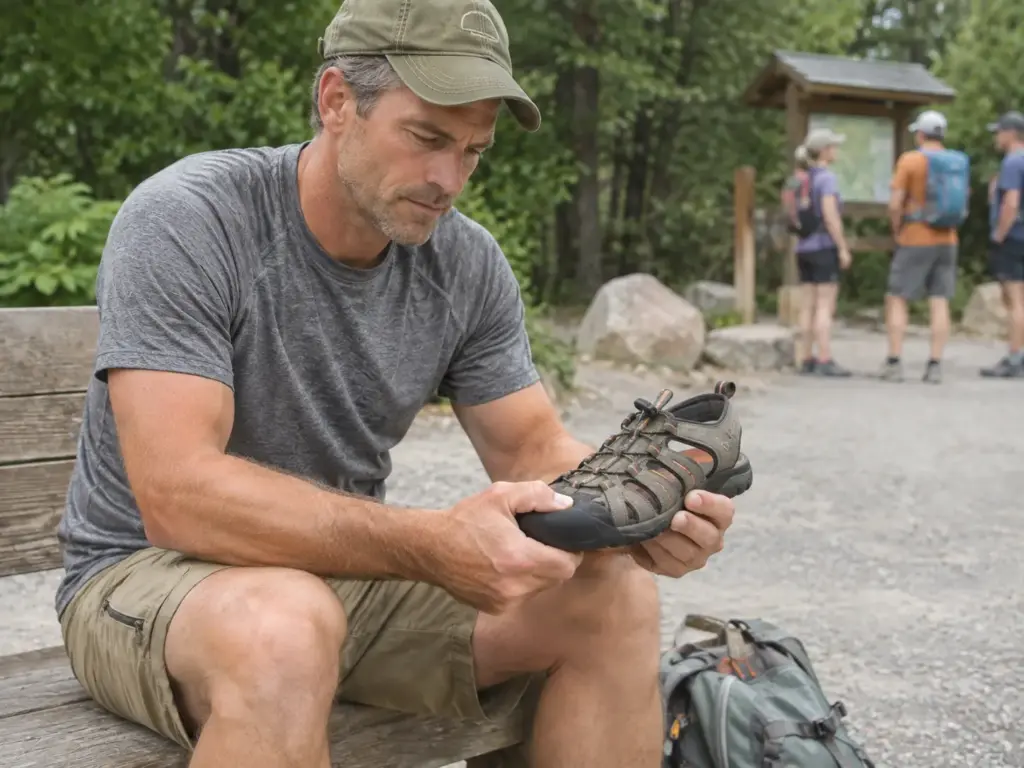
A rubber toe bumper is what separates a hiking water shoe from a beach shoe. Rocks hit toes in a riverbed, and a bare toe loses that argument every time. KEEN’s bumper is the reference most closed sandals are measured against, and what a good toe bumper should feel like is worth knowing before you test any pair by hand.
Protection costs weight. KEEN lists the Newport H2 at 14.2 oz (402 g) per sandal and the women’s Whisper at 8.7 oz (247 g) per sandal.
A mesh aqua sock weighs roughly half of the Newport and feels every cobble through the sole. Neither number is good or bad. The question is whether your route punishes thin soles or heavy feet, and a rocky bed punishes the thin sole first.
Fit, Sizing and Socks
A wet foot slides forward in the shoe, so a snug dry fit becomes a loose wet one. Go half size up if you plan to wear socks with the shoe, which is the same logic described in when to size up hiking footwear. Lace-up and bungee systems lock the heel better than a slip-on, and a wide foot needs a wide toe box rather than a bigger size, because extra length only gives the toe room to hit the bumper.
Most water shoes have little arch support. A removable footbed lets you swap in your own if you need it.
Expect a short break-in period too. Wear the pair on a few dry walks first, so the strap, the bumper and the heel cup meet your skin at home and not on the river.
Try any pair on with the exact sock you will wear, then walk downhill in it. A toe that taps the front on the way down is a toe you will lose on a long descent through wet gravel.
Why Your Soles Slide on Wet Rock
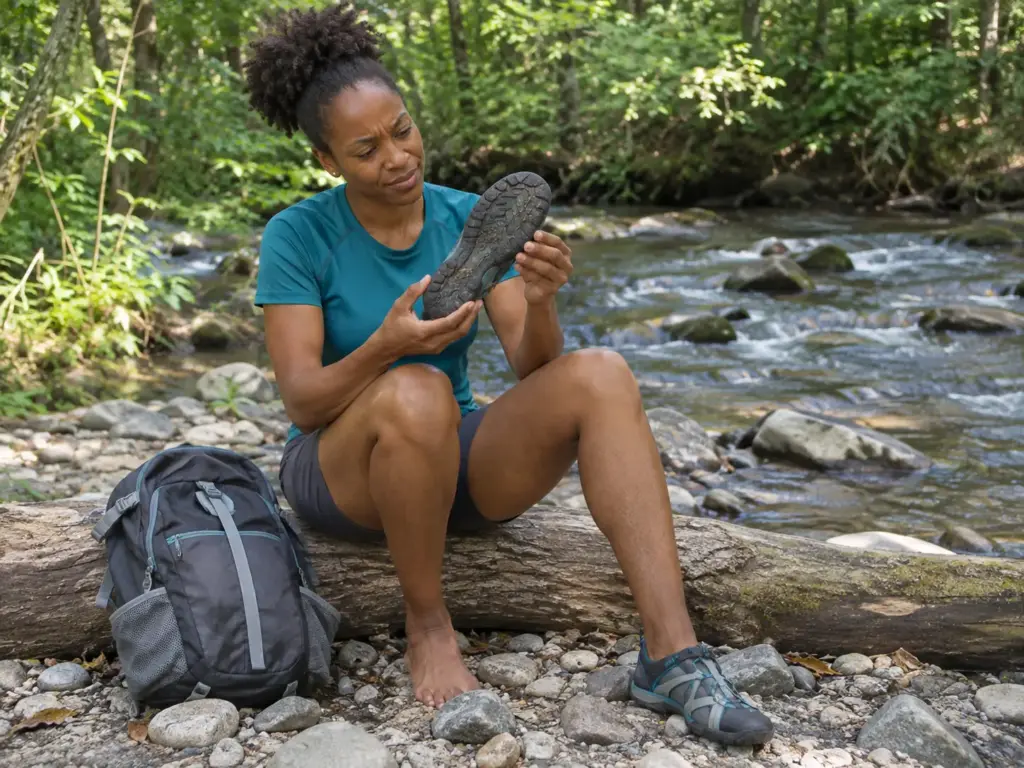
The submerged stones in a creek bed behave like slippery bowling balls: rounded, algae-polished, with no edge to stand on. The slip rarely happens on the landing. It happens on the push-off, when your weight rolls to the toe and the sole has to grip while the foot is moving forward.
Water Is a Film, Not a Barrier
Water acts as a lubricating film between the rubber and the stone. Friction only comes back when the sole can push that film out of the contact patch.
A 2026 Sports Engineering study of sole friction on alpine surfaces tested six commercial outdoor soles on ice, snow and granite and found that sole hardness, contact pressure and microroughness were each tied to static friction, and that the link changed with the surface.
“Grippy” is not one property. The rubber that bites dry granite can skate on algae.
On water-lubricated surfaces, the same paper reports that the surface roughness of the rubber decides the friction. A smooth, hard, worn sole hydroplanes. A softer, textured or siped one breaks the film and holds.
Siping Beats Lugs on Smooth Stone
Deep lugs are built for mud and loose dirt. On smooth stone they shrink the contact area, so a lugged boot can grip worse on algae than a flat sole with fine cuts in the rubber. Those cuts, called siping, give water somewhere to go, and a siped outsole is the first thing to look for when traction on a wet bed matters most. KEEN describes the Newport H2 sole as multi-directional lugs with siping, which is the maker’s own claim and the right combination for a mixed bed of sand, gravel and stone.
The practical rule is to check the sole for textured, soft-looking rubber with fine cuts or ridges. A smooth hard sole belongs on a boat.
Rubber names on the box help only a little, because each maker tunes its own compound. Teva lists a spider rubber outsole on its Omnium sandal, and Astral lists G.15 rubber on its water shoes. Merrell’s All Out Blaze hybrid carries a Vibram outsole. They are all answers to the same wet-stone problem, and none of them replaces the standing test at the end of this guide.
For a closer look at the compounds themselves, see which outsole rubbers actually grip wet rock.
The Push-Off Is Where You Slip
Friction changes through the gait. The sole measures differently at heel strike than at toe-off, and the slip usually comes at toe-off, exactly when a thin aqua sock folds and the contact patch collapses. A stiffer sole keeps the patch flat through the push. That is the mechanical reason a heavier shoe often feels better on wet rock than a light one, even when the light one has a better-sounding grip rating.
The second half of the system is the stick. A walking stick matters as much as the shoe, and a wooden one holds up in a riverbed where expandable poles tend to bend or snap. It is your third point of contact, and how poles steady a river crossing shows the stance that makes it work.
Water Shoe Styles Matched to Terrain
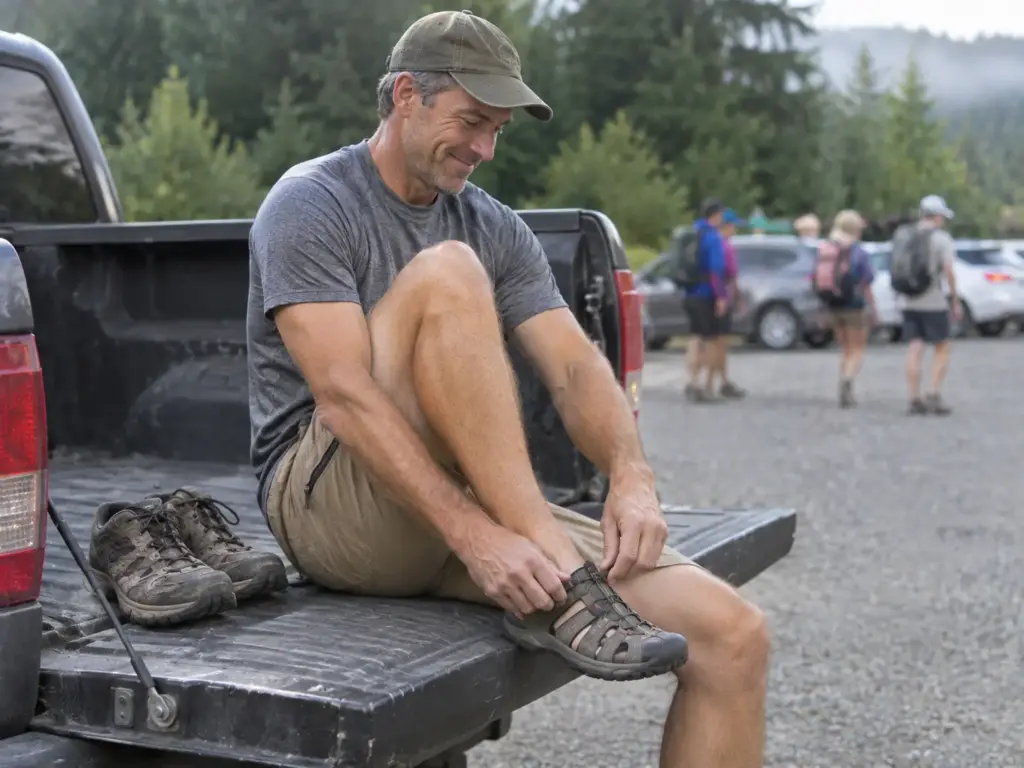
Picture the trailhead where four people in four different water shoes are about to walk the same creek. Two will still like their feet at the end of it. The difference is the style, and each style has one job.
Mesh Hybrid Shoes
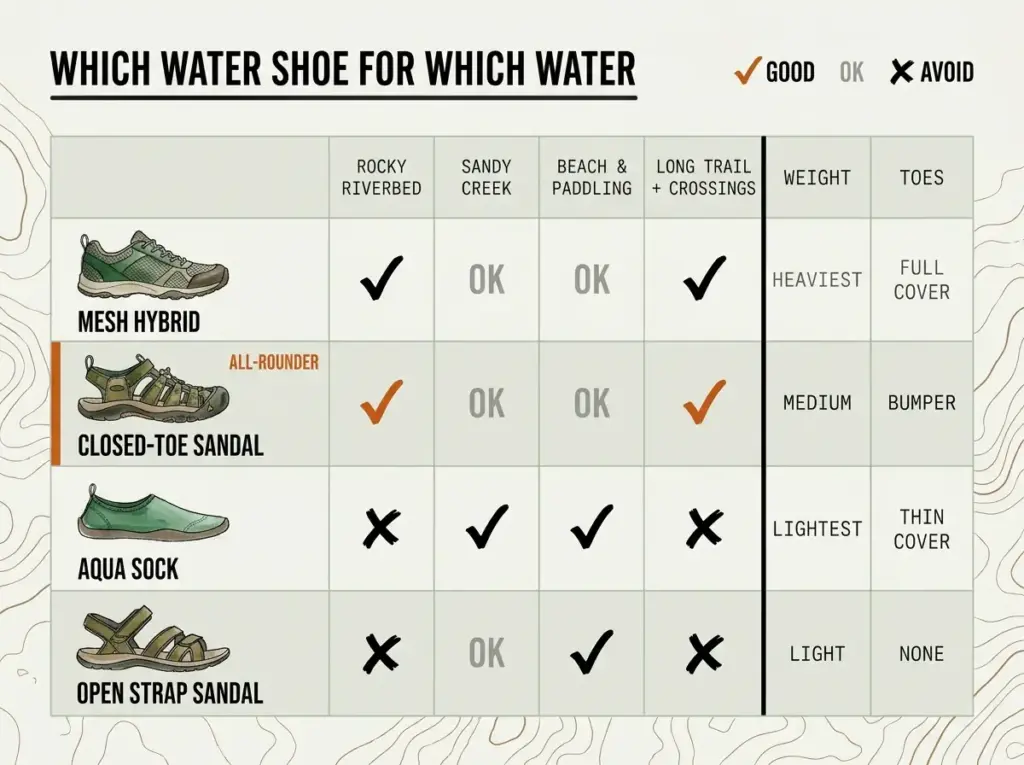
The mesh hybrid, which some makers sell as an amphibious shoe, is a trail-shoe shape with a drainage-friendly upper. It offers the most protection of the four styles, weighs the most and dries the slowest. Salomon’s Techamphibian 5 is built around a sticky wet-grip outsole and a reinforced toe, and the Merrell All Out Blaze is the other hybrid built on the same idea of a mesh upper over a protected toe. They are the choice when the day is hike first, with crossings along the way.
Closed-Toe Water Sandals
The closed-toe sandal, written on some listings as a closed toe sandal, is the all-rounder. Toes covered, drains instantly, the pick for rocky beds and mixed trail. Its honest weak point is on dry sections, where sand and grit get in through the open sides and rub. The picks for this style are in the next section.
Aqua Socks
The aqua sock, or barefoot style, is the lightest and thinnest option. It packs to nothing and suits beach walking, paddling and shallow, sandy creeks. It has no ankle support and almost no sole, so every stone shows through. On a long walk, the thin sole is where it stops being fine, and the minimalist end of this category behaves like the shoes covered in how barefoot-style hiking shoes behave on real trail.
Open Strap Sandals
Open sandals drain best of all, and they still lose on a rocky bed. Stones get crammed between the foot and the strap, and the pattern is cut and bruised feet after about seven miles of riverbed. An open sandal is a good camp shoe and a decent choice on a sandy beach, and a poor one on cobbles. For the full comparison, see how open-toe and closed-toe hiking sandals differ.
One pair or two? A closed-toe sandal or a hybrid can carry a day with crossings. For mixed hiking and water, one closed-toe pair plus dry socks beats two pairs of shoes.
Closed-Toe Water Sandals Worth Buying
If one pair has to cover a river day, a creek walk and the walk back to the car, a closed-toe sandal is the starting point. Each pick below is a different answer to the same trade: how much toe protection and sole you want, and how many ounces you will carry for it. The best water shoes for a given trip are the ones matched to the bed, not the ones with the longest spec list. Durability is worth a thought too, because the heavier sandals tend to outlast the thin ones.
KEEN Newport H2 (Men’s and Women’s)
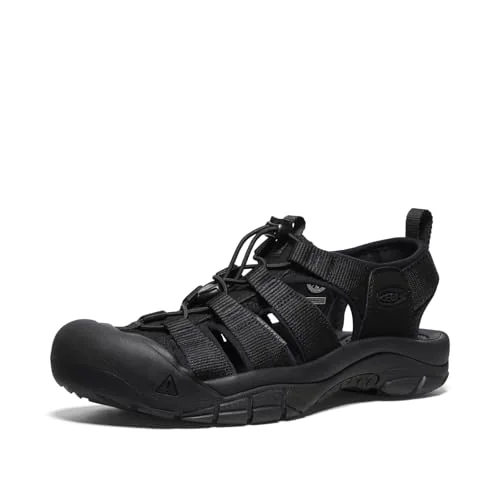
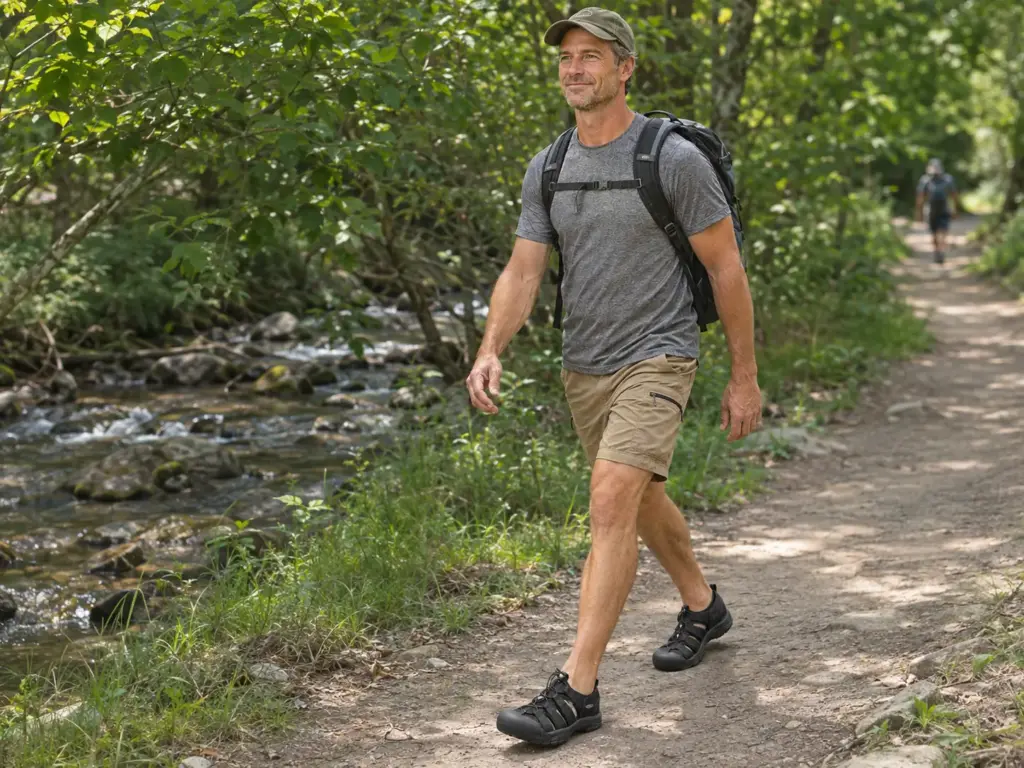
The Newport H2 is the closed sandal the whole field points to. KEEN describes multi-directional lugs with siping, a toe bumper and quick-dry polyester webbing, and lists the men’s at 14.2 oz (402 g) per sandal. That weight is the honest cost. Over ten wet miles you feel it in the hip flexors, and over a short creek day you do not notice it at all.
The Newport is the pick when the bed is rocky and the route mixes water and trail. It is less suited to a fast, dry approach where grit works into the open sides, so shake it out at breaks.
KEEN Hyperport H2 (Men’s)
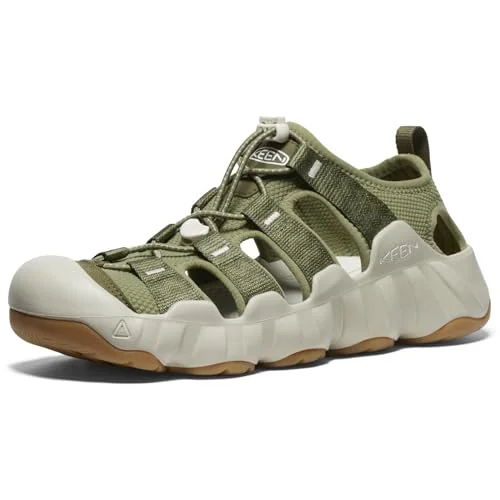
The Hyperport H2 keeps the toe protection idea of the Newport and loses some of the fuss. If your day is made of repeated crossings where the shoes come off on the bank, the easier entry saves minutes and cold fingers. This model is cut for men only, so women should look at the Newport H2 above or the Whisper below.
KEEN Whisper (Women’s)
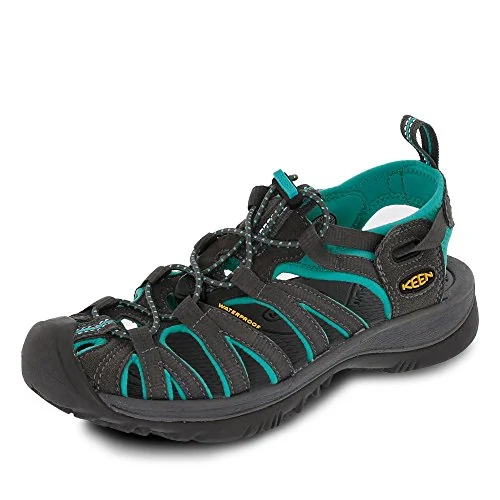
KEEN lists the Whisper at 8.7 oz (247 g) per sandal, noticeably lighter than the men’s Newport, with a women’s-specific last. It is the choice when pack weight matters more than a thick sole. A closed sandal beats a sock on a rocky bed because it protects the toes and stiffens the sole, and the Whisper keeps most of that for fewer ounces.
HUMTTO Women’s Amphibious
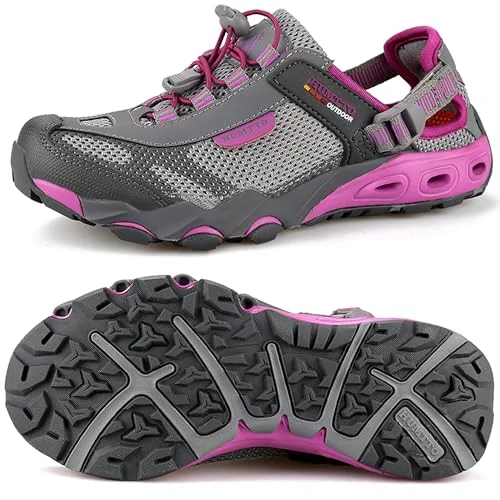
The HUMTTO is the honest budget door to toe protection for women who want a closed sandal without stepping up to the KEEN tier. Expect fewer published specs and less proof over many seasons. If your trips are short creek days, that is a fair trade. If you are heading for a long rocky bed, the KEEN pairs have the sole to match it.
Budget Aqua Socks for Beaches and Shallow Crossings
The traveller with one beach, one creek and no wish to spend much needs to know exactly where the cheap sock ends. Budget water shoes cost a fraction of a KEEN, and they end sooner than most buyers expect.
What an Aqua Sock Does Well
Aqua socks weigh almost nothing, fold into a jacket pocket and drain and dry in minutes. The lightest end of the category is Astral’s Loyak AC, which the maker lists at 6.9 oz with a 0 mm drop. For a beach, paddling, a sandy creek or a lake shore, that is enough, and nothing heavier makes the day better. They also work as a camp shoe on a trip where you already carry a protective pair for the wet miles.
Where the Thin Sole Gives Out
A thin sole means every cobble is felt, there is no ankle support, and a hard push-off folds the shoe. On a rocky riverbed, the thin sole is the wrong tool: it feels like walking on tent stakes by mile three, and a heavier shoe with a stiffer sole feels better than the one that looked right on the shelf. I’d skip a sock-style shoe on a rocky riverbed and take the closed sandal.
This is the anti-sell the category needs. The cheapest pairs are beach shoes, whatever the product title says about hiking. They are good beach shoes.
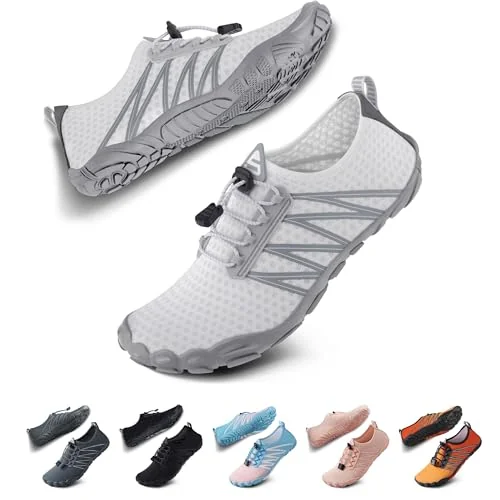
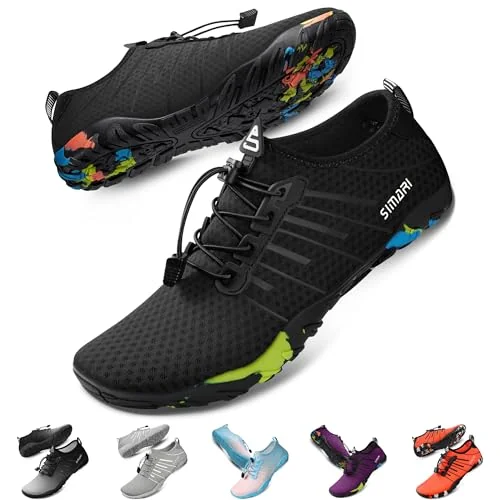
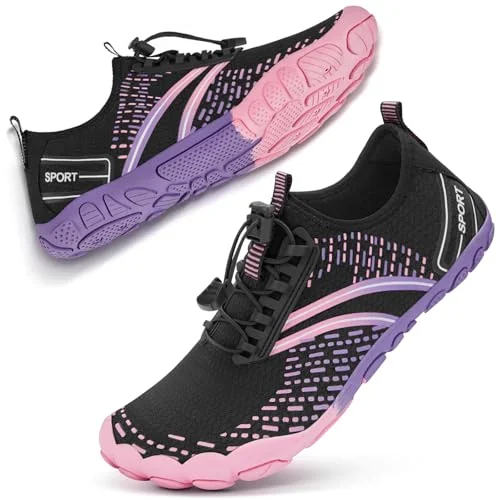
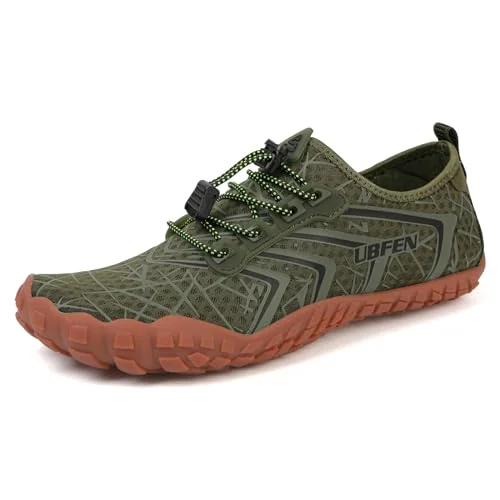
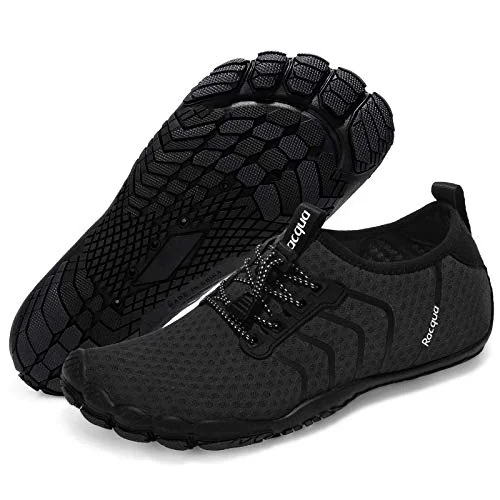
SEEKWAY, SIMARI, ATHMILE, UBFEN and Racqua
SEEKWAY and SIMARI do the same job on different lasts, so if one fits badly, try the other. ATHMILE is the wide-foot pick and the only one at this tier that names a wide toe box; if a wide foot needs more than room in the toe box, what roomy footwear does when a wide foot needs more than a wide toe box goes further. UBFEN and Racqua round out the range, and the differences are the last and the tie, not a different class of shoe. Durability is the open question at this tier, because few of these pairs have a long public track record.
Keeping Your Feet in Shape on a Wet Trip
The end of a long wet day looks the same everywhere: feet like prunes, a numb heel and another river ahead. The shoe is only half the system. What you carry, when you decide the water is too cold and how you treat the skin decide how the last mile feels.
The Second Pair Is Dry Socks
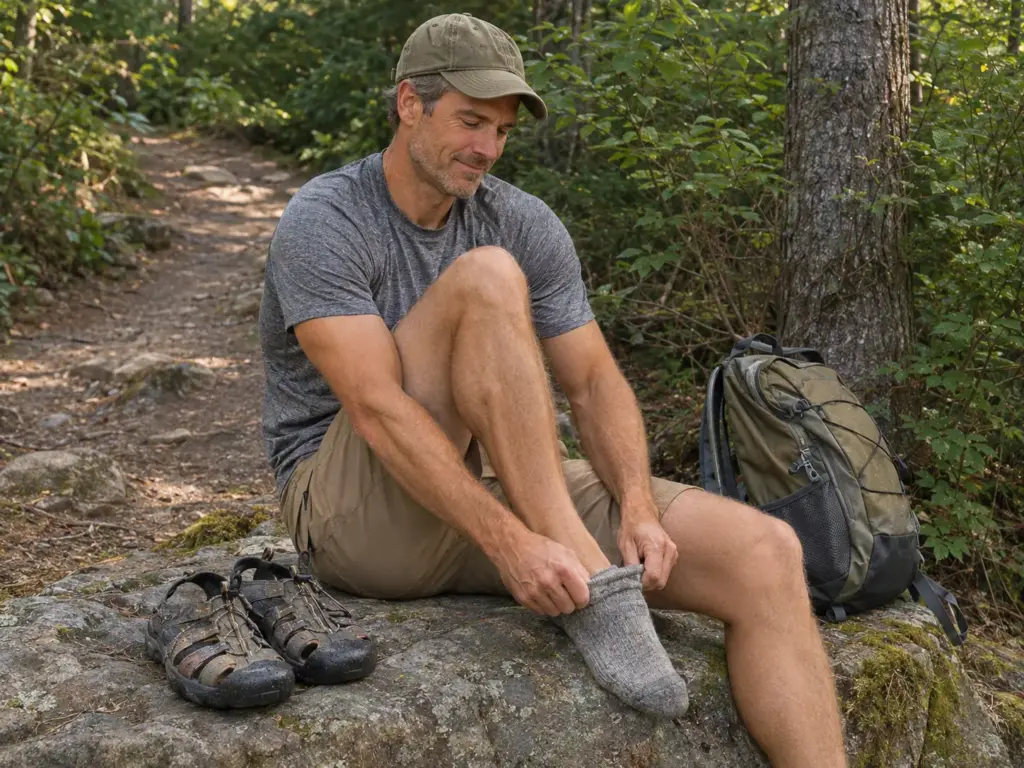
For a day trip, the second pair is not a second hiking shoe. It is dry socks and a light camp shoe.
In a dry canyon like Zion in the warm season, shoes and socks left in the sun dry in about two hours. In a humid forest the same shoes are still wet the next morning, which is the reason to carry dry socks rather than hope for sun.
When you do have to dry footwear overnight, how to dry footwear overnight without damaging it covers the methods that do not cook the glue.
The weight math, qualitatively: a mesh sock-shoe of about 7 oz plus a light camp shoe beats a 14 oz closed sandal plus soaked socks on a multi-day trip, but it gives up toe protection. That is a real trade, not a free win. If you are heading out for several days, a sock rotation that keeps blisters away on multi-day trips is the cheapest improvement in the whole system.
When the Water Is Too Cold
Water shoes are a warm-water tool. Immersion foot, also called trench foot, can develop at temperatures up to 60 °F (16 °C). Most cases need one to three days of cold, wet exposure, but it can start in as little as 10 to 14 hours.
The clinical picture of immersion foot starts as tingling and itching and moves on to numbness. The warning sign is not pain. It is losing feeling in the foot, and numb feet on wet rock are how people fall.
The seasons matter. Fall brings stable weather and colder water, and winter and early spring bring high, cold water and closures in The Narrows.
Below roughly 60 °F water, a mesh shoe and wet feet stop being fun. Wool socks and trail runners, or neoprene socks, work better. Neoprene socks are comfort in warm water and a real tool in cold water.
Renting is a real option where an outfitter offers it. At Zion the rental package is boots, neoprene socks and a stick, and the boot works like a water shoe on steroids with ankle support.
Blisters, Sand and Soaked Skin
Wet skin softens, and soft skin blisters. Skin that stays soaked turns white and fragile, which is maceration, and sand and gravel in the shoe act like sandpaper on it. That is chafing at its worst.
A thin synthetic sock under the water shoe cuts the rub, and drying the feet at breaks keeps the skin from breaking down over ten miles. The advice from the same clinical source for wet feet is to change out of wet socks and shoes as soon as possible, air-dry the feet and keep them warm and dry. The cheapest upgrade in this entire article is a dry pair of socks and ten minutes at a break.
When a hot spot starts, deal with it early, not at the end of the day. That warm spot on your heel is a 10-minute warning, and tape or a sock change then saves the whole next day.
When Trail Runners Beat Water Shoes
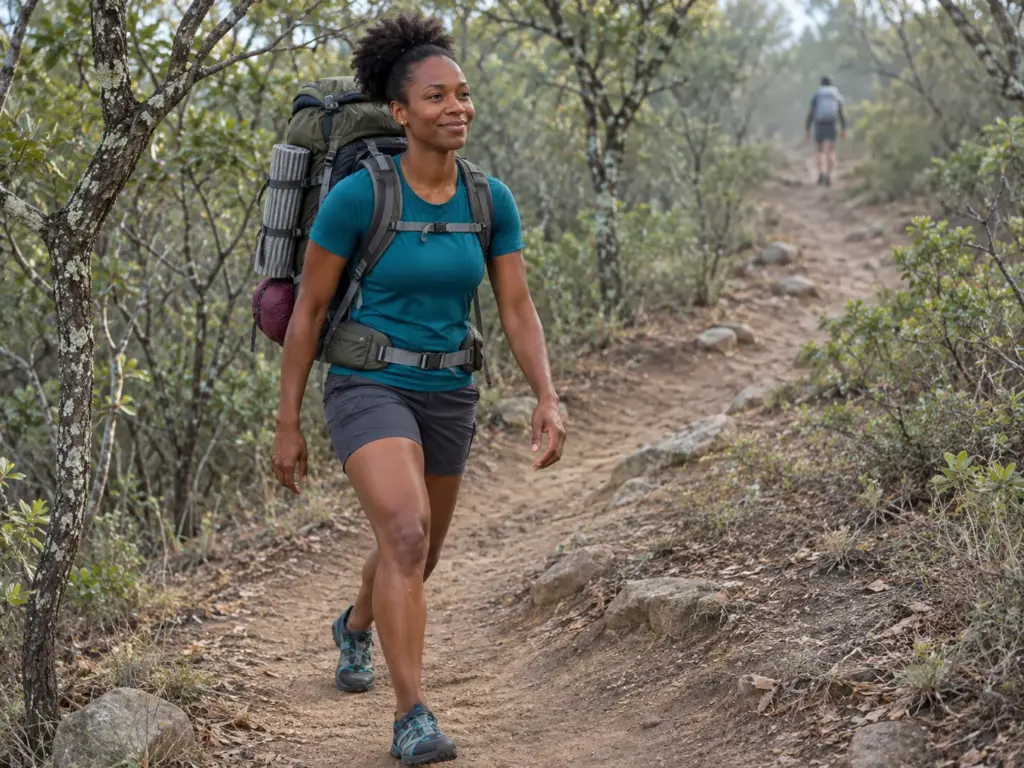
The reader with a 30-pound pack and a stream crossing ahead needs a rule, not a product. Here it is: if the trip carries load, risks the ankle, runs long or runs cold, a trail runner or a boot with dry socks wins. If it is short, warm and wet, a water shoe wins.
Heavy Packs, Long Miles and Bad Ankles
Trail runners are a legitimate answer at low flow. They grip rocky ground well and keep decent grip under water, and at low flow they work like a charm. Load carrying is where a water shoe punishes you: a thin sole under a loaded pack gets driven into every stone by the pack weight.
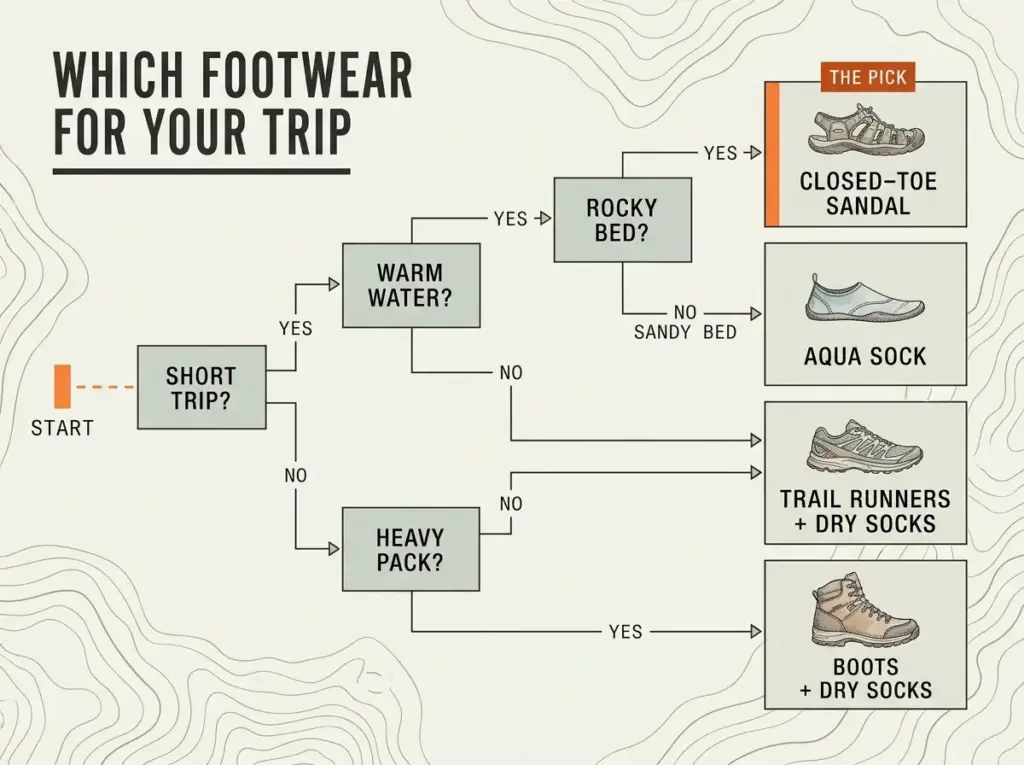
Ankle support is the other gap. Most water shoes have none, and an uneven riverbed is an ankle-roll risk. A boot or a canyoneering boot gives support at a weight cost, and do you need ankle support when hiking is worth a read if your ankles have history.
About ten wet miles is the design case. Past that, soaked feet plus a thin sole plus pack weight is a blister and softened-skin problem, not a shoe problem.
Cold, Fast or Deep Water
Nothing in this article makes a fast, deep or cold crossing safe. At high flow, no shoe is the problem. Check the flow, unbuckle the pack’s hip belt if you must cross, use a stick as the third point of contact, and turn around when in doubt. The river crossing mistakes that prove fatal are almost never about footwear.
The One-Line Decision
Warm and short, a closed sandal. Beach and paddling, an aqua sock. Heavy, long or cold, trail runners and dry socks. Fast, deep or cold water, do not ford it at all.
If the footwear question is bigger than water, how to choose between boots, shoes and sandals widens the decision to the whole trip.
Rinse a closed sandal at the first break after a sandy stretch and shake it out while it is still wet. Dried-on grit is what rubs the skin raw on the walk out.
Stand on One Smooth Stone Before the Trip
The toe and the bed decide the style, the sole decides the grip, the weather decides whether a water shoe belongs in the pack at all, and dry socks are the cheapest upgrade of the lot.
Before the next wet trip, put the shoes on with your trip socks and walk down a short hill. Then stand on one foot on a smooth stone in a shallow, calm stream. If your toe taps the front or your heel lifts, you already know what to change, and you learned it on a Tuesday evening and not three miles up a canyon.
Pick the stick before you pick the shoe. A real wooden stick holds up in a riverbed where expandable poles tend to bend or snap, and it is the cheapest safety upgrade you can make.
Frequently Asked Questions
01Can water shoes be used for hiking?
Yes, on short, warm, wet routes up to about ten miles, in a closed-toe sandal or a mesh hybrid. They fail with a heavy pack, long miles, cold water or weak ankles, where a trail runner and dry socks do better.
02Do you need two pairs of shoes for a hike with water?
Usually no. One closed-toe pair plus dry socks covers a day trip. On a multi-day trip, a light camp shoe is the second pair.
03What should you look for in water shoes for hiking?
Fast drainage, a quick-dry upper, a toe bumper, soft siped rubber and a fit that locks the heel. Check the weight too, because protection costs ounces.
04Should you wear socks with water shoes?
A thin synthetic or wool sock cuts rubbing from sand and gravel and keeps feet warmer in cool water. Go up a half size if you do.
05Are water shoes good in cold water?
Not below about 60 °F for a long day. Wet feet in cold water can lead to immersion foot in as little as 10 to 14 hours. Wool socks, neoprene socks or trail runners work better.
I've spent more than a decade researching hiking gear and trail technique. I read the specs, the forum threads and the long-term reviews, and every pick here comes with what it gets wrong.
End of the trail
You read every mile of this one. Here's where the trail goes next.