

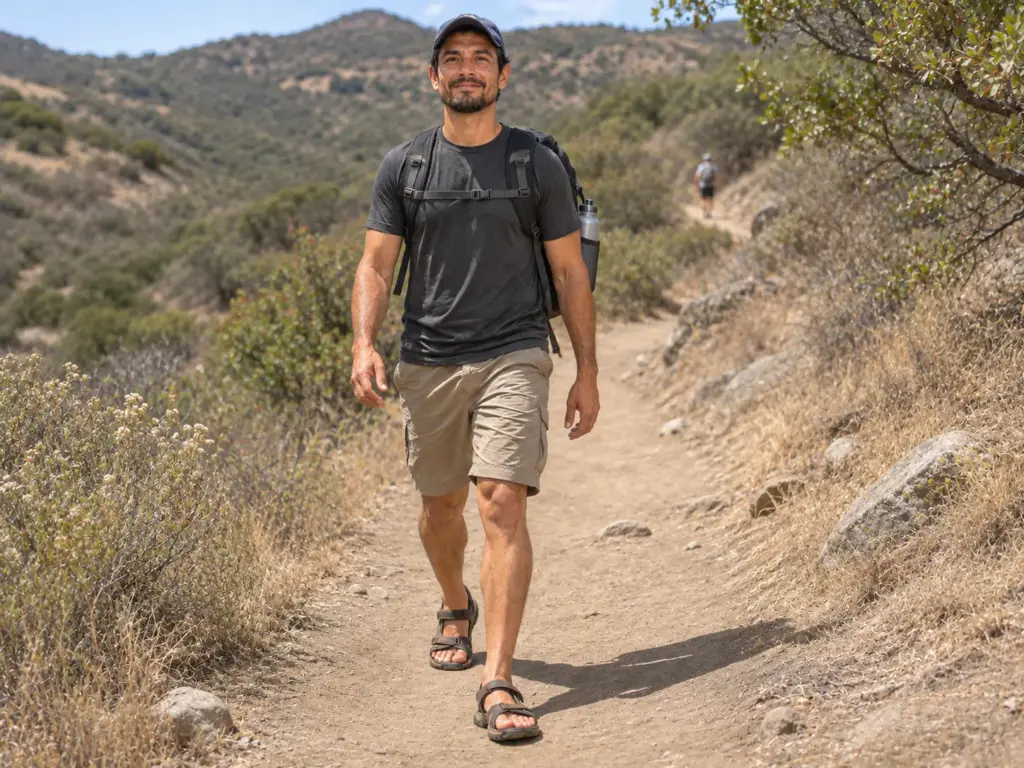
Six miles up a hot trail in the sandals you wore to the beach last week, a pebble has worked under the strap for the third time. The sole is as flat as a cutting board, the footbed is slick with sweat, and every rock you step on arrives straight at your heel. The best hiking sandals are picked by foot and by trail, not by brand, and the pair that carries you through a hot day hike will punish you on cold scree. Here are the best hiking sandals at a glance, each matched to the foot and the trail it suits, with the days a sandal is the wrong call spelled out below the table.
| Model | Best for | Key spec | Who it suits |
|---|---|---|---|
| KEEN Newport H2 | Rocky ground and water crossings with the toes covered | Rubber toe bumper, siped lugs, lace-lock bungee; about 14 oz per men’s sandal | Day hikers who cross creeks and kick rocks |
| KEEN Hyperport H2 | A closed-toe you can actually pack | Closed toe, siped sole, bungee lacing, lighter than the Newport | Backpackers who want toe cover at camp and crossings |
| Chaco Z/1 Classic | A rigid, planted base | LUVSEAT PU midsole, ChacoGrip rubber, 3.0 mm lugs | High arches that want a firm platform, not flat feet |
| ECCO Yucatan | Leather comfort for travel and easy trails | Nubuck upper, three-point adjustment, molded EVA footbed | Trail-to-town days, not wading |
| Teva Hurricane XLT2 | The value all-rounder | Quick-dry webbing, EVA footbed, nylon shank; about 11 oz per men’s sandal | First-time sandal hikers and travelers |
| Bedrock Cairn Evo 3D PRO | The zero-drop reference | Vibram Megagrip outsole, 16 mm stack, resoleable | Runners in minimalist shoes who already love a flat base |
| UBFEN, Dannto, Dockers Newpage | Light paths and travel on a tight budget | Rubber outsoles with real compromises | Easy ground, not rough trail |
What Makes the Best Hiking Sandals Different From Beach Sandals
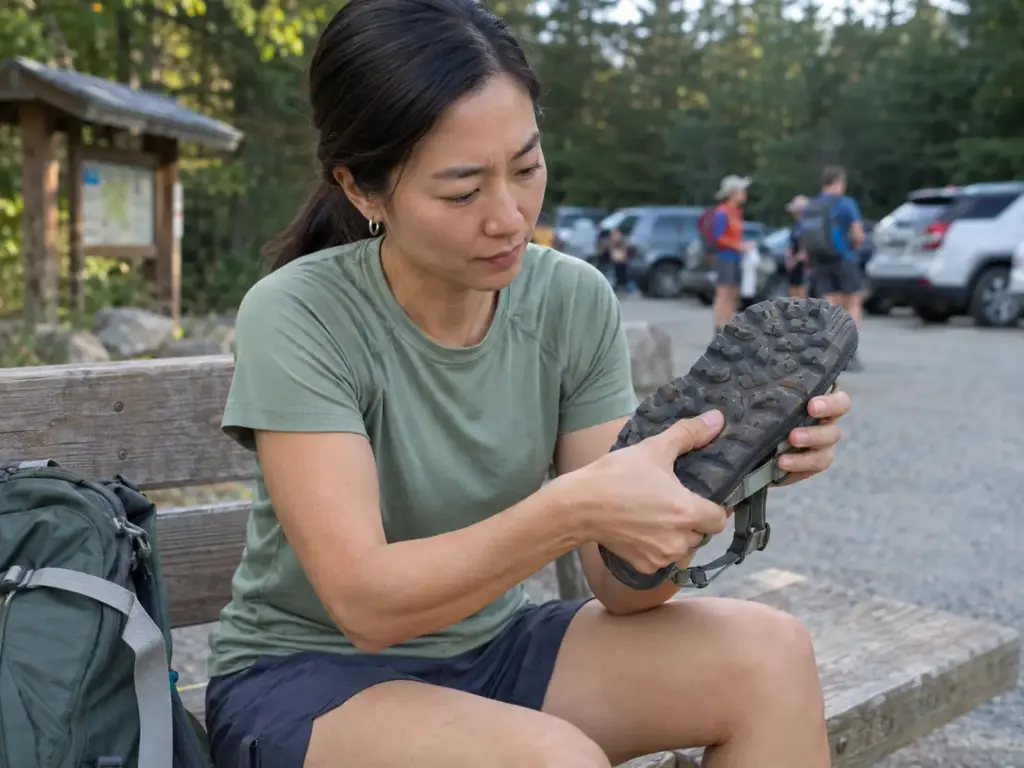
The best hiking sandals have a rubber outsole with lugs or siping, a shank or stiff midsole that resists twisting on rock, a footbed with real shape, and straps that hold the heel. A beach sandal has none of them, which is what separates it from the adventure sandals and sport sandals built for trail. A flat foam sole feels fine on a smooth path and turns into a stone bruise on a rocky one, and the shank, the one part you feel underfoot and never see on a label, is what you were missing by mile three.
Grip Comes From the Rubber
The tread pattern matters less than the compound it is cut into. Bedrock builds the Cairn Evo 3D PRO on a Vibram Megagrip outsole, the sticky-rubber benchmark, while KEEN says the Newport H2 uses multi-directional lugs with siping channels and does not use Vibram. Both hold on wet and dry ground, but they are two different answers: a sticky compound that clings to slick rock, and a siped outsole that clears water and bites on mixed trail.
Choose the sticky rubber for wet slab and the siped drainage sole for creeks and gravel. Wet-rock traction by compound is its own subject, and which outsole rubbers actually grip wet rock sorts them by how they behave, not by what the logo promises.
Footbed, Shank and Weight
Flex a sandal in your hands. If it folds in the middle like a towel, it will fold around a stone. The shank, a stiff insert between the midsole and the outsole, is what keeps a point from pushing up through the sole: the Teva Hurricane XLT2 carries a nylon shank, and the Chaco Z/1 Classic gets the same job done through a rigid PU midsole.
Protection and rigidity cost ounces. Teva lists the Hurricane XLT2 at about 11 oz per men’s sandal and Chaco lists the Z/1 Classic women’s at an average of 10.65 oz, while KEEN’s Newport H2 closed-toe weighs about 14 oz in the men’s. Read that as a spread, not a verdict: a few ounces per foot are nothing on a day hike and a lot in a pack.
Quick-Dry Is Not the Same as Waterproof
Webbing and synthetic uppers take on water, drain and dry in minutes, which is the whole appeal at a creek. Leather behaves the other way. The ECCO Yucatan’s soft nubuck upper is comfortable on a dry day and slow to recover after a soaking, so it stays out of repeated crossings. No hiking sandal is waterproof, and none should be: the point is to let the water leave.
Zero-Drop or a Supported Footbed: Choosing by Your Arch
Read arch support on four listings and two of the sandals will feel like a plank while one feels like a cloud. The label is the same, and the footbeds are opposites. The real dividing line in trail sandals is a flat zero-drop base against a cushioned or rigid supported one, and each side punishes a different kind of foot.
What Zero-Drop Really Means
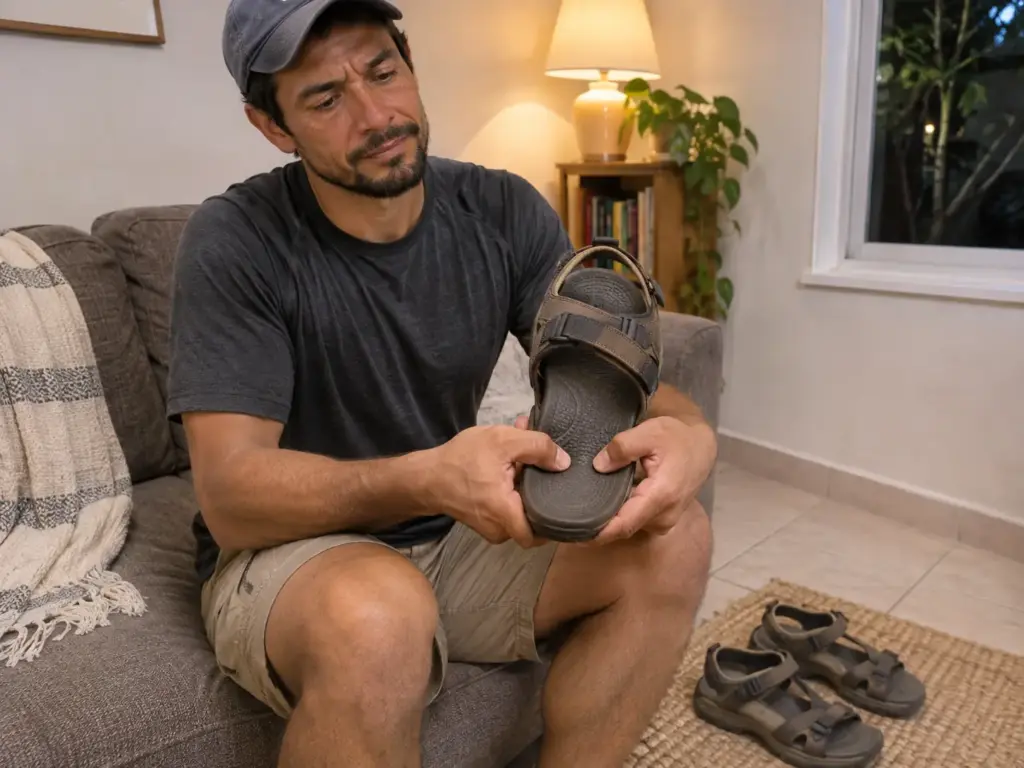
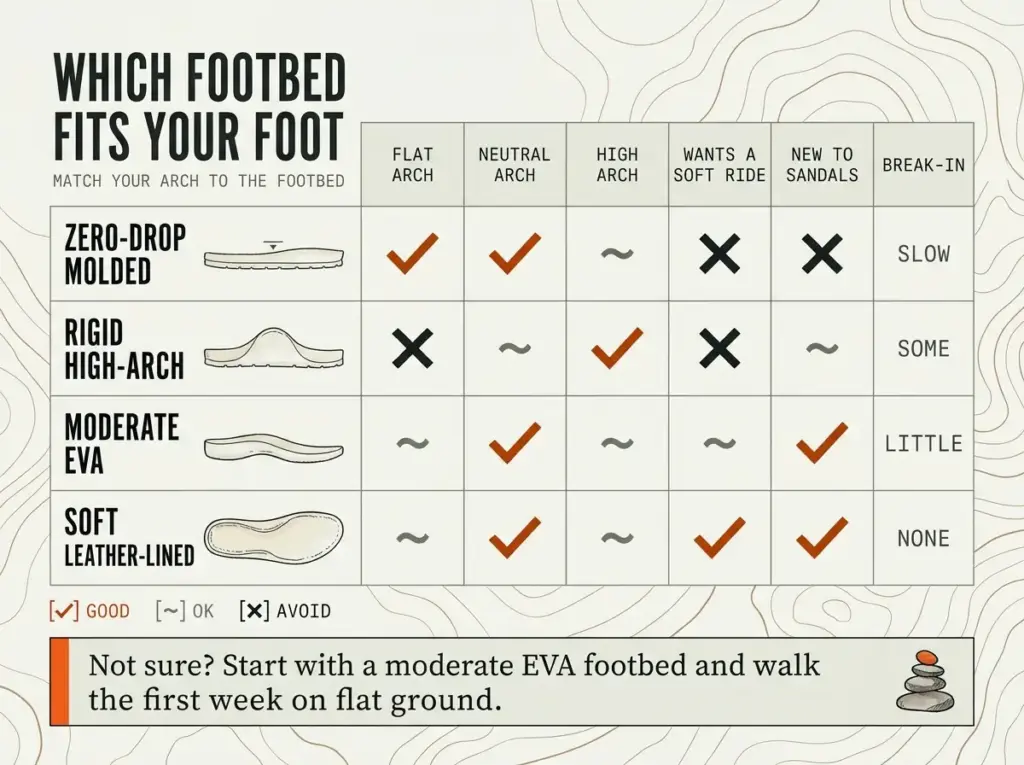
Zero-drop means the heel and the forefoot sit at the same height, so the foot lies level instead of tipping toward the toes. The reference pair is the Bedrock Cairn Evo 3D PRO, a minimalist sandal with a Vibram Megagrip outsole, a 16 mm stack and an anatomically molded zero-drop footbed, according to Bedrock. The flat base is the point of the design, and the firmness is its cost. Bedrock itself describes the molded EVA footbed as “firm, durable, and may require some break-in time.”
Zero-drop encourages a more natural foot strike, but a level heel asks more of the calf and the Achilles on every step, so a first week in zero-drop belongs on short, flat walks. The people who get hurt in this style jump from a cushioned shoe straight into a long day. Anyone already walking in flat, minimalist shoes arrives with the legs for it. If your calves are not used to a flat heel, who should skip zero-drop shoes covers the cases where the flat base backfires.
The Rigid High-Arch Platform
The opposite pole is the rigid arch. The Chaco Z/1 Classic uses a LUVSEAT PU midsole and a ChacoGrip rubber compound with 3.0 mm lugs, per Chaco, and it holds the foot on a firm, planted platform under a single continuous strap. That is support through stiffness, not through cushion, and it feels nothing like a pillowy EVA sole.
Rigid suits high arches, which want a firm shelf to sit on. It punishes low or flat arches and anyone who wants a soft ride, because a firm arch that sits where a low arch does not meets the foot in the wrong place. Heel pain that starts in a stiff sandal, plantar fasciitis included, is a pattern worth knowing, and how toe drop changes a sore heel in a sandal goes into the footbed side of it. I’d skip a stiff high-arch sandal if your arches are low, however good the grip is.
The Middle Ground That Fits Most Feet
Between the two poles sit most feet. The Teva Hurricane XLT2 carries an EVA footbed that runs soft to firm, and the ECCO Yucatan pairs a molded EVA footbed with a PU midsole. Neither tries to hold your arch up like a shelf and neither leaves it flat on the ground, which is why they suit most feet on most days. An EVA midsole compresses and rebounds, which is why it feels softer than the PU platform of the Chaco.
Use this as the working rule.
High arches that want a firm base take the Chaco-style platform. A foot that likes the ground and has time to adapt takes zero-drop with a slow first week. Everyone else takes a moderate EVA footbed. Support on a listing is not a spec, so ask how firm the footbed is and how high it rises under the arch.
Walk a new pair on flat ground for the first week and cut the first real hike short. Stiff footbeds are friendly to feet that adapt gradually, and the day-one miles are where a firm arch or a flat heel does its damage.
When a Sandal Beats a Boot and When to Leave It at Home
The pack is loaded, the morning is cold, and the sandals are clipped to the outside of the bag, swinging against your hip. Whether they stay clipped or go on your feet is the whole question here, and the answer is set by heat, load, ground and what lives in it.
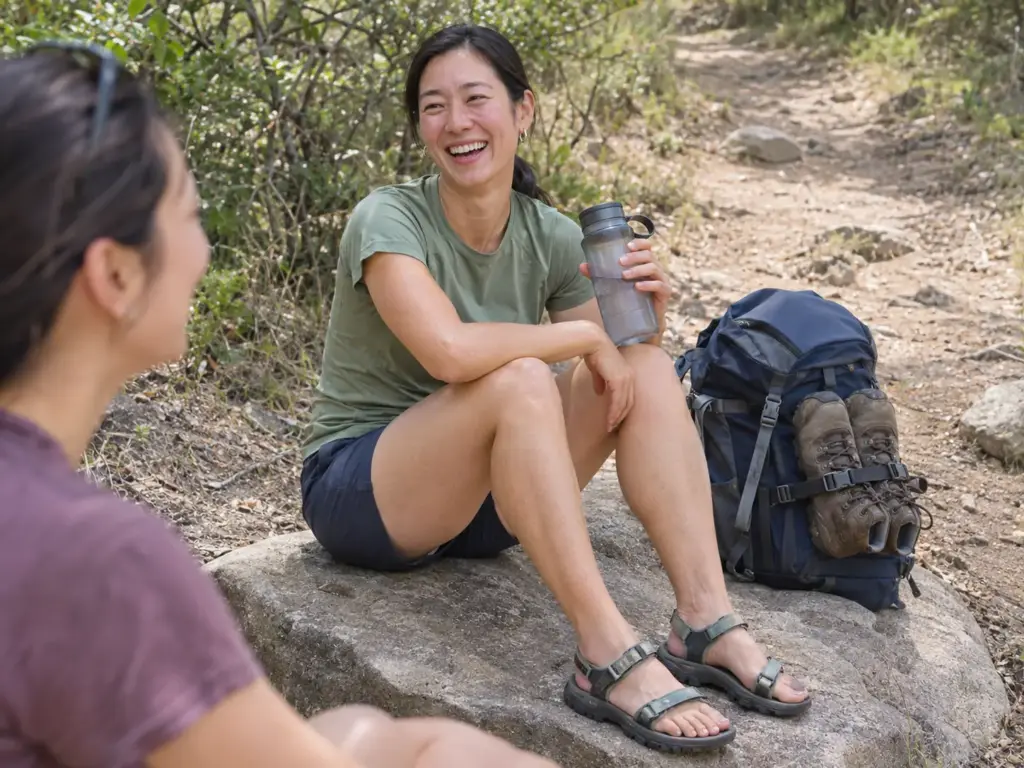
The Hot, Wet, Short Hikes Where Sandals Win
Heat and wet feet are what a sandal is for. On a hot day hike the foot sheds heat through an open upper, and at a creek crossing a sandal drains in seconds while a soaked shoe squelches and rubs for miles. A sandal also earns its pack space as a camp or crossing shoe on a backpacking trip, and as the all-day shoe on a travel day with light walking.
The pattern repeats: warm air, short to moderate mileage, ground that runs from smooth to moderately rough, and water somewhere in the plan. Match all four and a sandal is not a compromise. It is the better tool.
Where They Punish You
A sandal fails in a short, predictable list of ways. Open pairs stub toes, grit works under the straps, ankles stay bare in brush, and a footbed warps when the pair is left in a hot car. A pair that felt perfect at the trailhead feels different two hours in, once the feet swell and the heat builds, and the sandal that fit in the parking lot is not always the one that fits at mile eight.
Footwear is one line in a plan, not a substitute for one, and the National Park Service’s hiking-safety guidance is built on planning ahead and its Hike Smart habits: a trip plan, essential gear and bear awareness. A sandal that suits the route belongs in that plan. A sandal picked for how it looks at the car does not.
Sandy desert washes are a trap for the open style. Dry sand migrates under the straps and between the foot and the footbed, and a multi-mile day on sand ends in blisters. Add brush against bare ankles and snake country, and an open sandal is the wrong call. Grit, more than grip, is where this style actually fails.
Cold mornings, loose scree, heavy loads and long rough descents are the other side of the line. Cold feet in shoulder season slow your hands and your judgment. A loaded pack drives the foot down into the footbed and raises the stakes of every stumble, and loose rock on scrambles and long descents finds an open toe long before it finds a shoe.
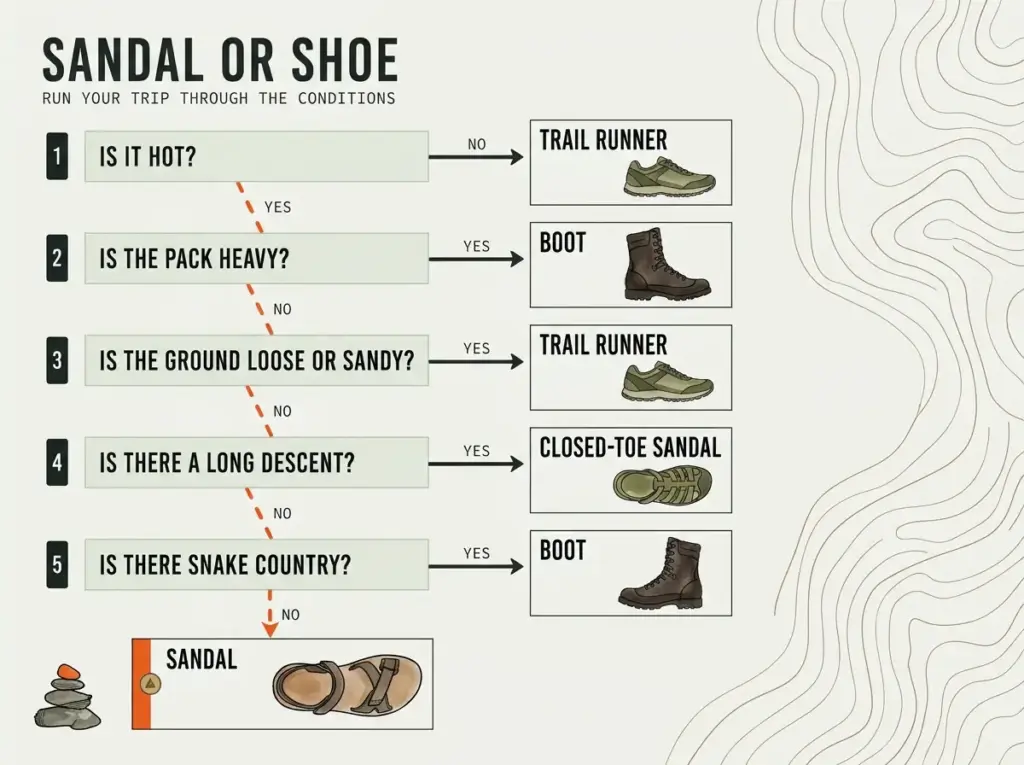
The One-Line Rule
If the trip is hot, short, wet-footed or a camp-shoe job, wear a sandal. If it is cold, loaded, a rocky descent or snake country, wear a shoe or a boot.
Redundancy is the habit behind it. The American Hiking Society’s 10 Essentials lists two navigation methods, one of which does not need to be charged, and the same logic puts a sandal in the pack next to a trail shoe: the shoe for the ground, the sandal for the creek and camp. For the full footwear decision, how to choose between boots, shoes and sandals runs the same call across every style.
Open-Toe or Closed-Toe Hiking Sandals
One toe finds the half-buried root. The other never gets the chance, because it was behind a bumper. That is the open-toe or closed-toe decision in two steps, and your trail makes it for you.
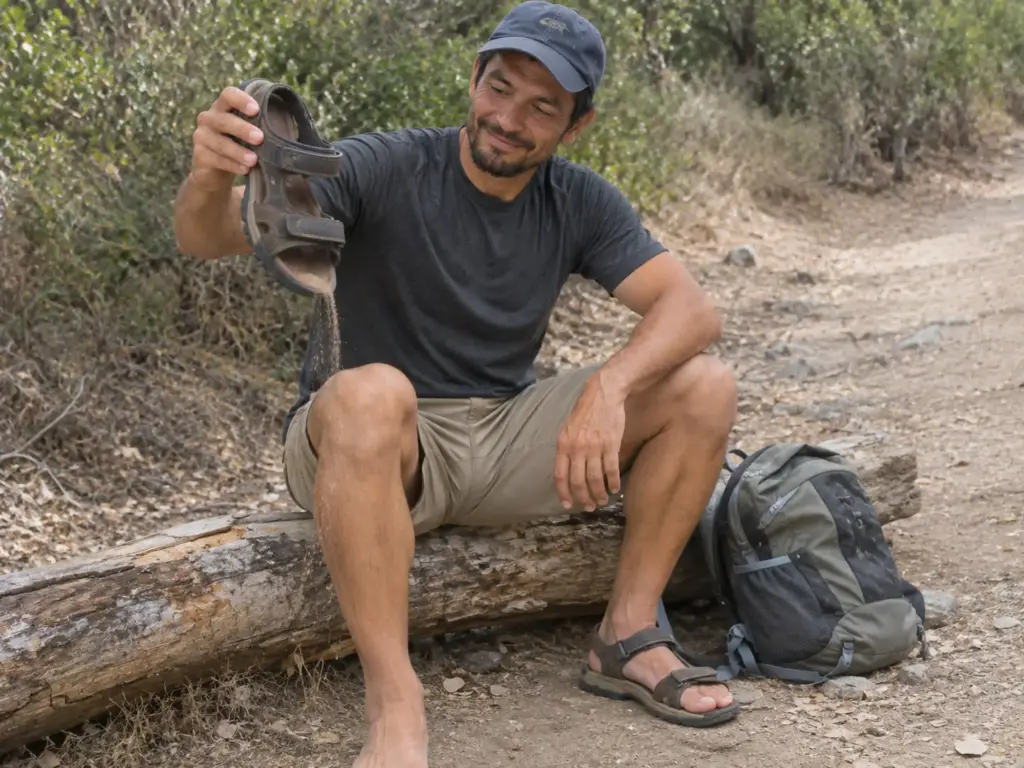
Open-Toe: Light, Cool and Exposed
Open-toe sandals are the lightest, coolest and fastest-drying option. The cost is stubbed toes, bruised nails and grit, which keeps open pairs on flat, groomed paths and water-edge walking. On a hot, smooth trail or a travel day, nothing beats the way a strap sandal dries and how little it weighs. The full set of styles, from strap sandals to closed-toe pairs, is mapped in how open-toe and closed-toe hiking sandals compare.
Closed-Toe: The Bumper Is the Point
A closed-toe with a rubber toe bumper protects the toes from rocks and roots and still drains fast. The cost is weight and heat, and grit still gets in through the open sides, so shake it out at a break before it starts to rub. A bumper earns its keep the first time a foot meets a half-buried rock mid-stride, and the same step in an open sandal is how toenails go black.
The honest middle has three parts.
A closed-toe with a bumper, with the KEEN Newport H2 as the reference, covers rocky and mixed trail. A lighter closed-toe, the KEEN Hyperport H2, covers camp and crossings. A strap sandal covers dry, groomed ground.
Open wins on hot, smooth ground; closed wins on rock, roots and repeated crossings. Before the picks below, what a good toe bumper should feel like gives you the in-hand test.
Best Closed-Toe Hiking Sandals
These are the two pairs for the hiker who wants one sandal for the creek, the rocky trail and the walk back to the car.
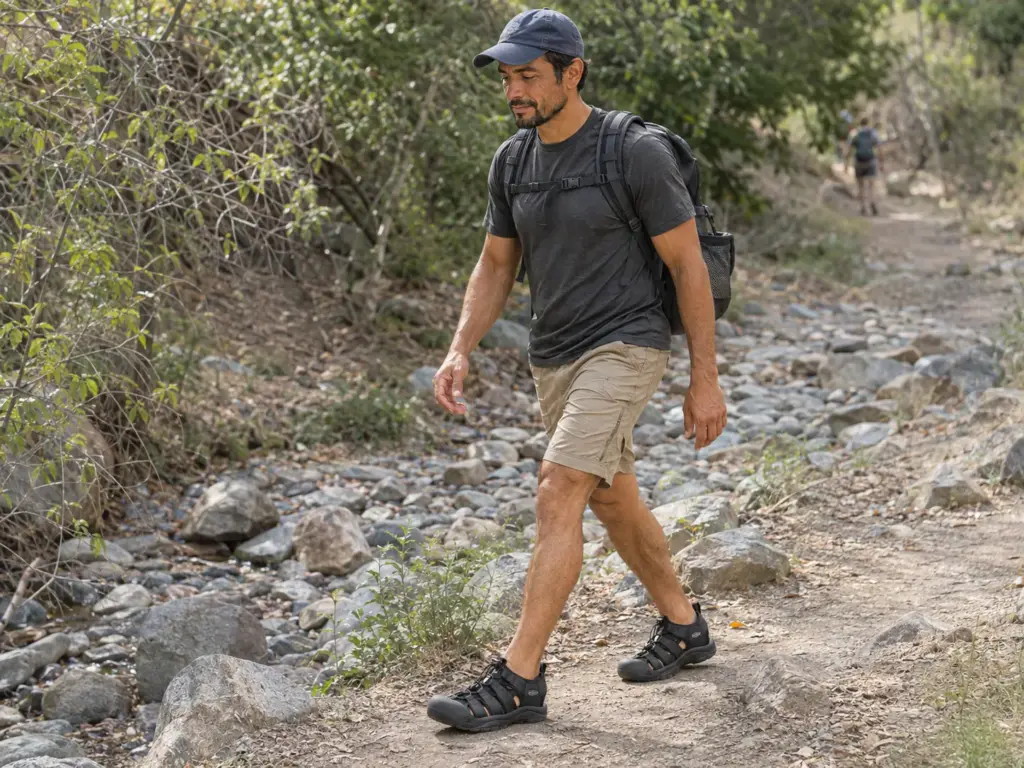
KEEN Newport H2 (men’s and women’s)
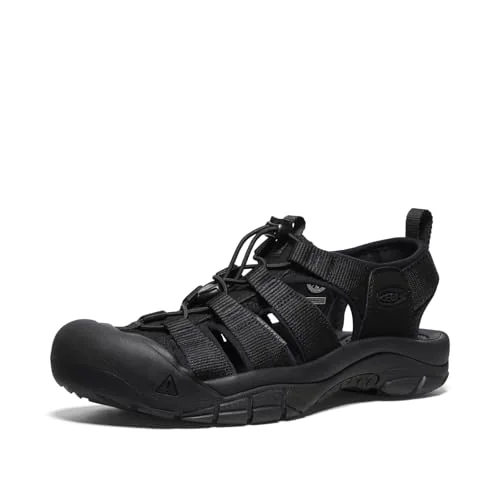
The KEEN Newport H2 (men’s · women’s) is the closed-toe everything else gets measured against. KEEN lists a rubber toe bumper, multi-directional lugs with siping channels, a lace-lock bungee and a non-removable footbed with arch support, and the men’s pair weighs about 14 oz per KEEN’s listing. That is a sensible weight for a day hike with creek crossings and a lot for a backpacking camp shoe.
Grip is good, not exceptional. The Newport does not use Vibram, so on wet slab it sits a step below the sticky-rubber benchmark, and on gravel and mixed trail it does the job without drama. A day that walks in and out of cool water, a Havasupai-style day, is where the bumper and the draining sole earn their keep.
KEEN Hyperport H2 (men’s)
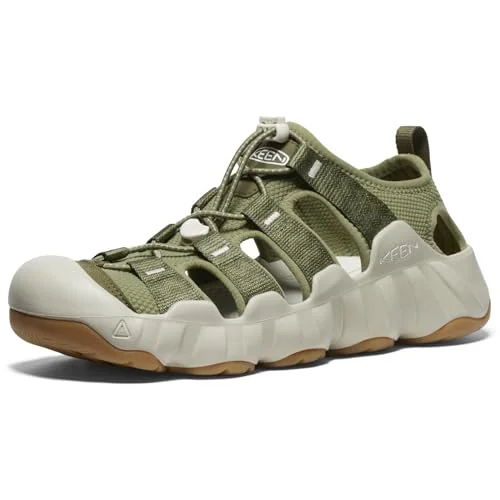
The KEEN Hyperport H2 keeps the toe cover and drops weight: it is lighter than the Newport by several ounces per sandal, with a siped sole and bungee lacing. For someone carrying the sandals rather than wearing them all day, that difference is the whole point. It is the realistic camp and crossing shoe for a backpacker who wants a bumper without the heft.
Newport or Hyperport?
Pick the Newport for protection and rough ground, and the Hyperport when the sandal has to ride in a pack. The Newport is the day-hike pair; the Hyperport is the backpacking pair. Women who want a closed-toe have the Newport above and the Dannto in the entry tier further down.
Both share the weak point of the style: sand and gravel get in through the open sides on dry sections, so shake them out at a break.
With a lace-lock bungee, tighten the heel first and the forefoot second. It is the easiest of the common strap systems to adjust with wet hands, and a snug heel is what keeps the foot from sliding into the bumper on a descent.
Best Hiking Sandals for Support and All-Day Comfort
Between the plank and the pillow, two pairs stand out for a long day on a firm path: one holds the foot rigidly, the other wraps it in leather.
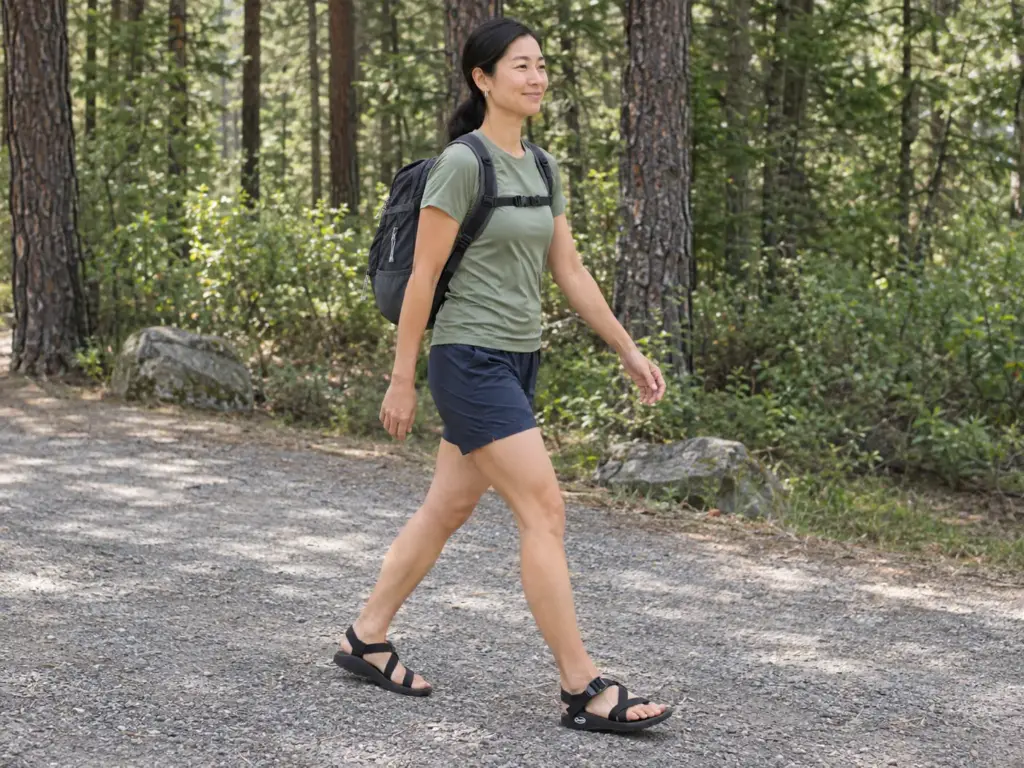
Chaco Z/1 Classic (men’s and women’s)
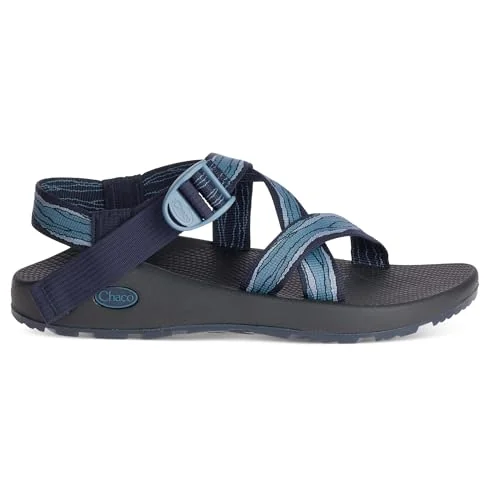
The Chaco Z/1 Classic (men’s · women’s) pairs a LUVSEAT PU midsole with a ChacoGrip rubber compound, 3.0 mm lugs and jacquard webbing, and Chaco lists the women’s version at an average of 10.65 oz. Durability is its strength: it is planted and the opposite of a soft ride. Expect a break-in: the strap that molds to your foot is the same strap that rubs a raw spot while it learns your shape, so a continuous-strap sandal needs a slow first week.
ECCO Yucatan (men’s and women’s)
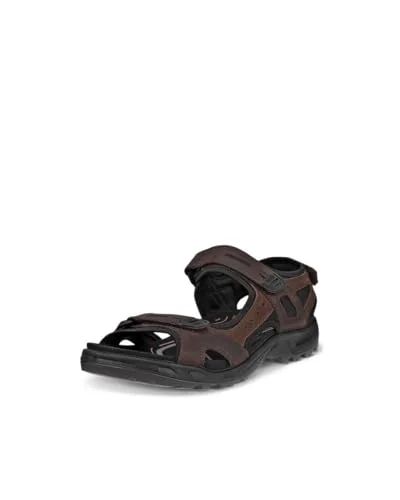
The ECCO Yucatan (men’s · women’s) is built around a soft nubuck upper with three-point adjustment, a molded EVA footbed, a FLUIDFORM PU midsole and the RECEPTOR system, per ECCO. That adds up to leather support and all-day comfort for travel, easy trails and the walk from trail to town. It is not a throw-in-the-pack water sandal, so keep it out of repeated crossings.
Leather also holds heat. On a hot day the right sock does more for a leather sandal than any strap tweak, and which hiking socks suit sweaty feet in hot weather sorts the options.
Chaco or ECCO?
The Chaco is a firm base for rough ground and wet weather. The ECCO is the trail-to-town comfort pair for dry days. Each one punishes someone: the Chaco punishes low arches and anyone who wants cushion, and the ECCO punishes anyone who wades.
Best Value Hiking Sandals
A budget-friendly sandal can be an honest trail shoe or a travel shoe with a trail label. The difference is a shank and real rubber, and the pairs below show where each one lands.
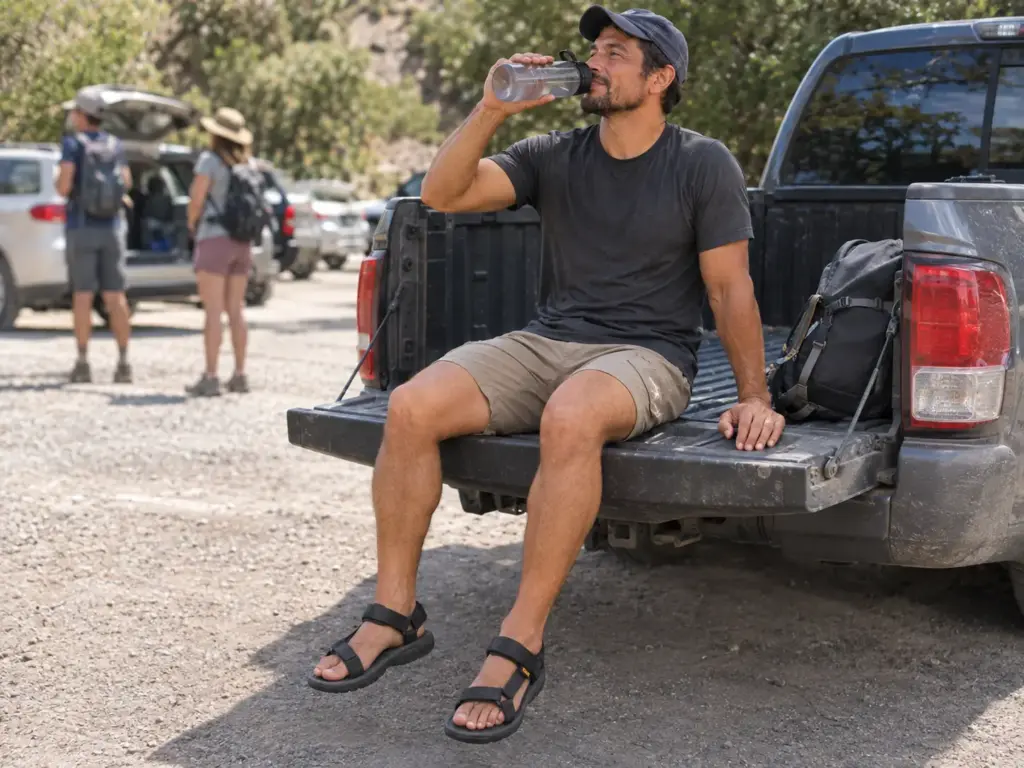
Teva Hurricane XLT2 (men’s and women’s)
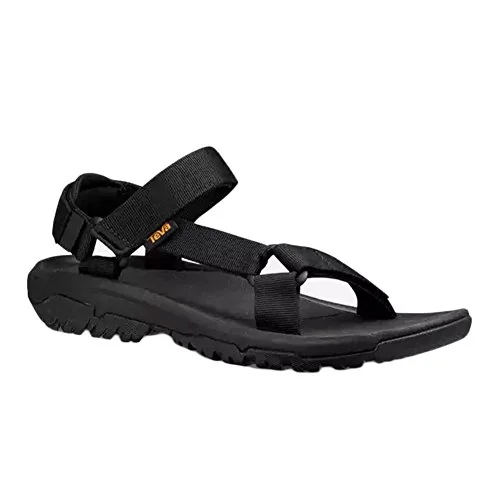
The Teva Hurricane XLT2 (men’s · women’s) uses quick-dry REPREVE recycled-polyester webbing, an EVA footbed, a nylon shank and Durabrasion rubber, and Teva lists the men’s at about 11 oz per sandal. It is the budget-friendly classic that still resists twisting on uneven ground. Its versatility is the pitch: light hikes, travel and a first sandal are its territory; steep, loose or heavily loaded days are not.
The Entry Tier: UBFEN, Dannto and Dockers
Below the Teva sits a tier of low-cost pairs, each with a clear job and a clear limit. The UBFEN Hiking Sandals for women list about 175 g per shoe, an arch-support footbed, adjustable hook-and-loop straps and a rubber outsole. They are a good value with tempered expectations on the rubber.
The Dannto Closed Toe Hiking Sandals for women add a protective toe cap, a quick-dry mesh upper, adjustable laces, a heel strap and an anti-slip rubber sole. They are a low-cost way into toe protection for light trails and water, and they do not replace the Newport on rough ground. The Dockers Newpage for men has a memory-foam footbed, hook-and-loop straps and a synthetic water-friendly upper. It is a casual trail-to-town sandal, fine for flat paths and travel and not for real trail traction.
Where the Cheap Pair Stops Being a Trail Sandal
The lowest-cost pairs sold as hiking sandals are often travel shoes with a trail label. A cushy footbed on a foam outsole feels great in the store and gives out the first time the ground turns uneven, because nothing underfoot resists a rock.
On uneven ground, a budget sandal with a real shank and a rubber sole beats a budget sandal with a nicer footbed and a foam outsole every time. Flex it in the store: if it folds in the middle, it stays on the pavement.
Fit, Break-In and Making Hiking Sandals Last
By the end of the first hot day, the heel strap has loosened, the forefoot has swollen and the pair has started to tell you what the shop never did.
Heel First, Forefoot Second
Feet swell on the trail, so the fit you set at the car is not the fit you have at mile six. Set the heel strap first, the heel lock, so the foot cannot slide forward, then snug the forefoot. When the foot swells, loosen the forefoot before the heel.
Strap adjustment is the cheapest fit fix on a sandal. KEEN’s lace-lock bungee, Chaco’s continuous strap with a ladder-lock buckle and Bedrock’s Y-strap with a heel hook are three different mechanisms with one job, and a heel that slides is where blisters start. How to catch a hot spot before it becomes a blister covers what to do the moment a strap starts to rub.
Break-In and Sizing
Break-in is real on stiff footbeds, as Bedrock says of its own, and socks change the fit, so try a pair with and without. When you are between sizes, go up for a closed-toe that will swell, and go down only when the strap system can take up a lot of slack. When to size up hiking footwear walks through the swelling logic in more detail.
What Wears Out First and How to Slow It
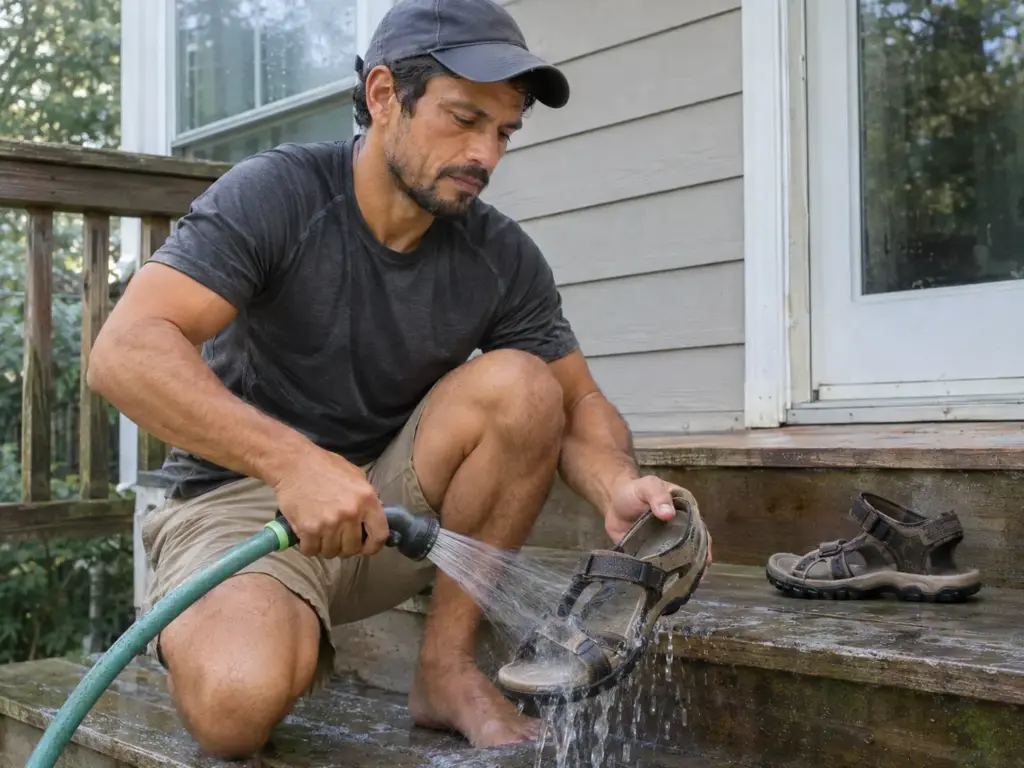
Outsole rubber goes first, then the strap and glue joints, then the footbed foam. Heat is the silent killer: Bedrock warns that its EVA and PU footbeds can warp if left in extreme heat or direct sun, so a pair does not belong on a dashboard. Rinse grit out of the footbed and straps, then dry the pair in the shade, because grit left in wears the strap from the inside.
Resoleable construction turns the outsole into a wear part. Bedrock resoles worn Cairn sandals at its Missoula shop, replacing the Vibram outsole, so a sandal can be a long-term purchase. The cheapest footwear to own over a long run is a resoleable pair, because the maker replaces the outsole and not the whole shoe.
After a creek day, shake out the sand, rinse the footbed and straps, and dry the pair in the shade. A hot trunk or a sunny dashboard does more damage to the foam than a hundred miles of trail.
Carrying sandals as a camp or crossing shoe costs weight and pack space. The lighter closed-toe is the packable one, so the KEEN Hyperport H2 is the camp pick, and the heavier pairs belong on your feet, not in your pack.
Walk a Flat Mile in Them With Your Trail Socks On
Your arch and your terrain pick the footbed: a firm platform for high arches, zero-drop with a slow start for feet that like the ground, a moderate EVA base for everyone else. Your toes and the ground pick open or closed. The weather decides whether a sandal comes along at all.
Put the pair on with the socks you will hike in, walk a flat mile and tighten the heel first. When the foot swells, loosen the forefoot. If a strap bites or the heel slides, you already know what to change, and the sidewalk is a better place to learn it than a ridge.
Frequently Asked Questions
01Why wear hiking sandals?
Hiking sandals keep feet cooler and drain water faster than any shoe, so they suit hot day hikes, stream crossings and camp shoe duty. They are the wrong call on cold, loaded or rocky-descent days, where a shoe or boot protects better.
02Which brand of sandals is most comfortable for walking?
No single brand wins, because comfort depends on how firm the footbed is for your arch, not on the logo. Chaco-style rigid platforms suit high arches, the ECCO Yucatan suits leather comfort on dry days, and the Teva Hurricane XLT2 is the easy middle.
03What are comfortable sandals for wide feet?
Sandals with adjustable straps suit wide feet best, because the forefoot can spread instead of being squeezed by a fixed upper. The ECCO Yucatan’s three-point adjustment is one example. Try pairs with your trail socks, and size up if your feet swell.
04Do stiff Chaco-style sandals work on uneven terrain?
Yes, a rigid platform holds up on rough ground and in wet weather because the rubber and the footbed stay planted underfoot. They are heavy, need a slow break-in and punish low arches, so they feel like a lot to carry as a camp shoe.
05Can you backpack in hiking sandals?
Only on warm, groomed routes with a light pack, or as a camp and crossing shoe carried alongside your main footwear. A lighter closed-toe like the KEEN Hyperport H2 is the packable pick. On loose, cold or heavy-load routes, wear shoes or boots.
I've spent more than a decade researching hiking gear and trail technique. I read the specs, the forum threads and the long-term reviews, and every pick here comes with what it gets wrong.
End of the trail
You read every mile of this one. Here's where the trail goes next.