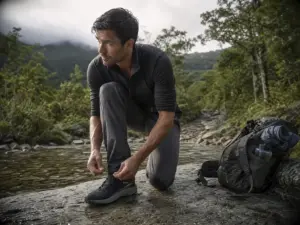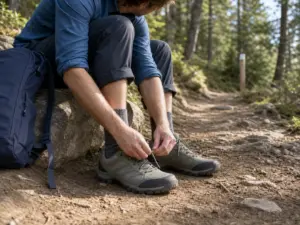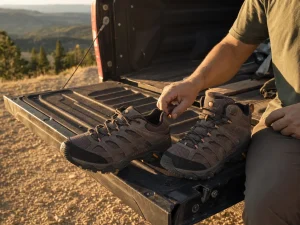
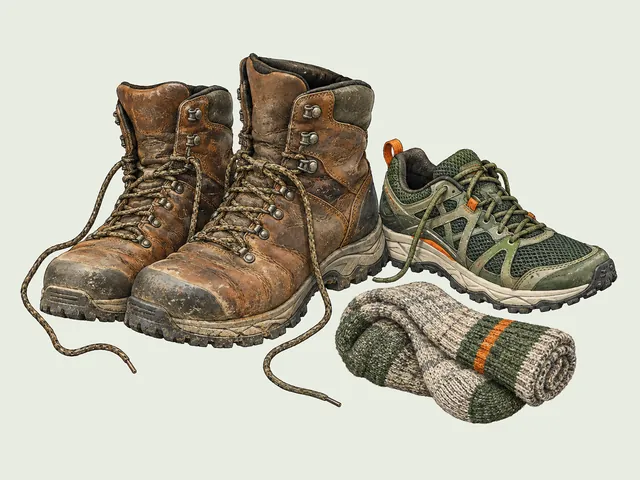

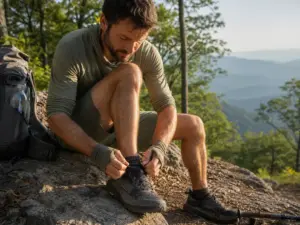


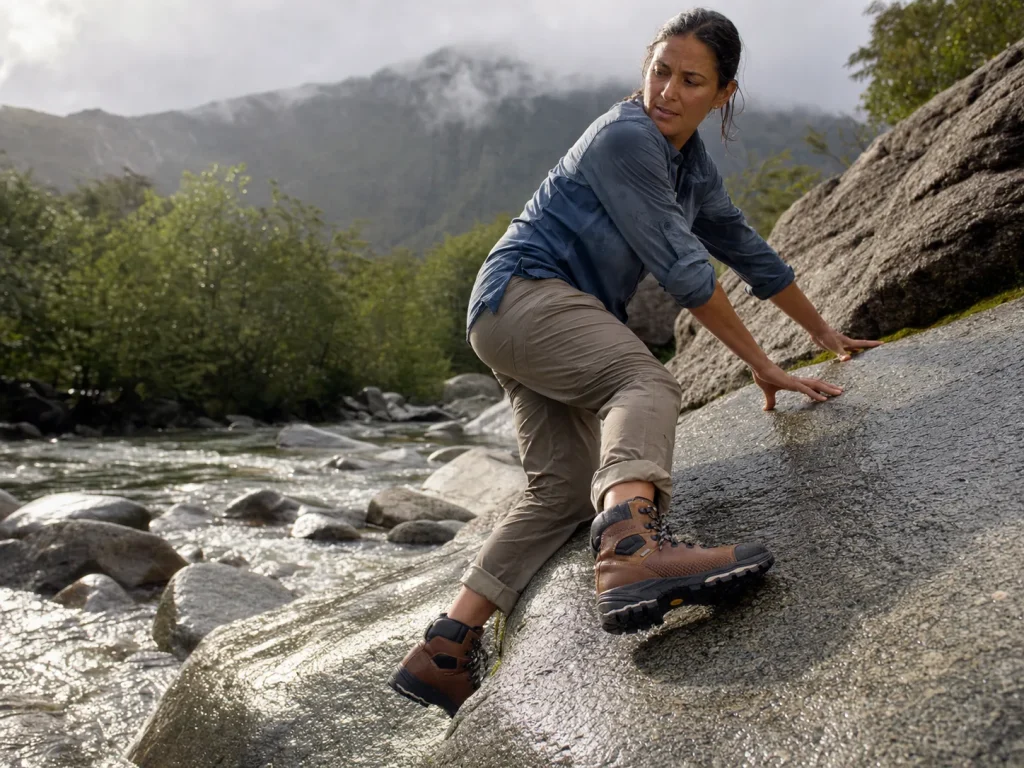
Two hiking shoes sit on the shelf in front of you. Both have Vibram stamped into the sole, so you assume they grip about the same. They don’t, and they might not even be close.
The most repeated mistake in footwear threads is treating Vibram as a compound when it’s a brand that licenses dozens of them, spanning roughly 65 to 80 on the Shore hardness scale. Here’s what an outsole rubber compound actually is, why soft rubber bites on wet stone, which compound each brand really makes, and how to pick by terrain instead of by logo.
What the Logo on Your Outsole Rubber Doesn’t Tell You
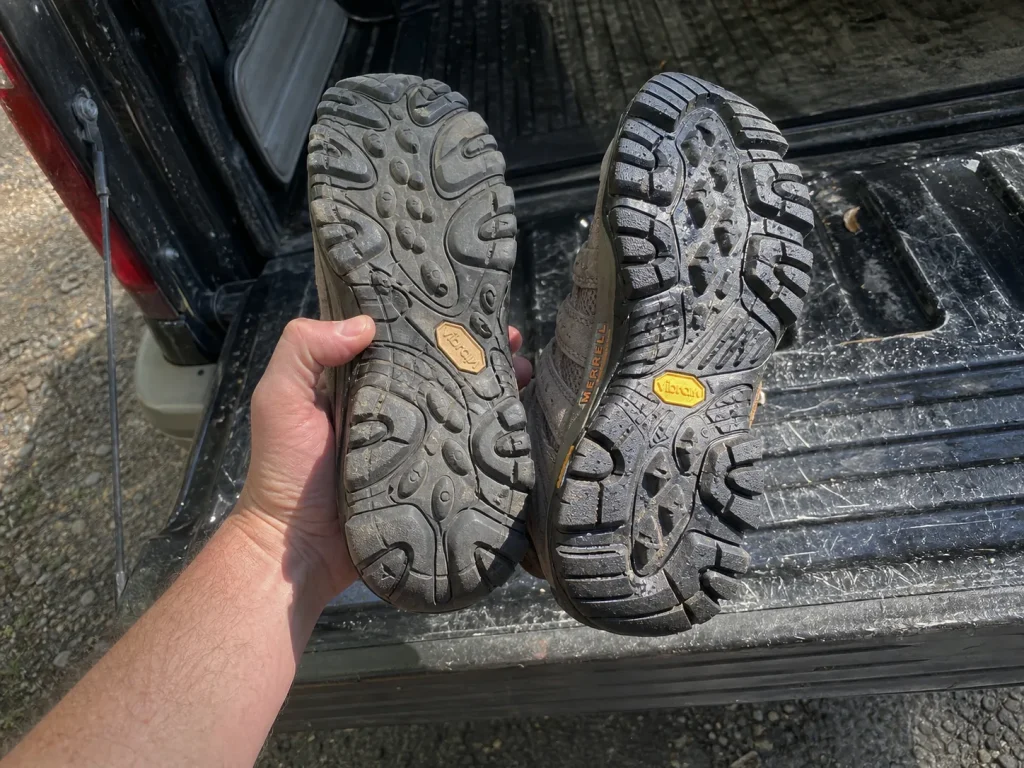
Walk into any shop and someone will tell you a shoe “has Vibram” like that settles the question. It settles nothing. Vibram is a licensor, not a recipe. The company sells dozens of separate formulas under one brandmark, and the sole of your shoe carries the logo whether the rubber underneath was built to stick to wet granite or to survive a thousand miles of gravel.
The number that matters almost never makes the marketing copy. Every one of these formulas is vulcanized rubber, cured and loaded with different fillers to land somewhere on a scale, and rubber compound hardness gets measured on that scale with a durometer, in Shore A units.
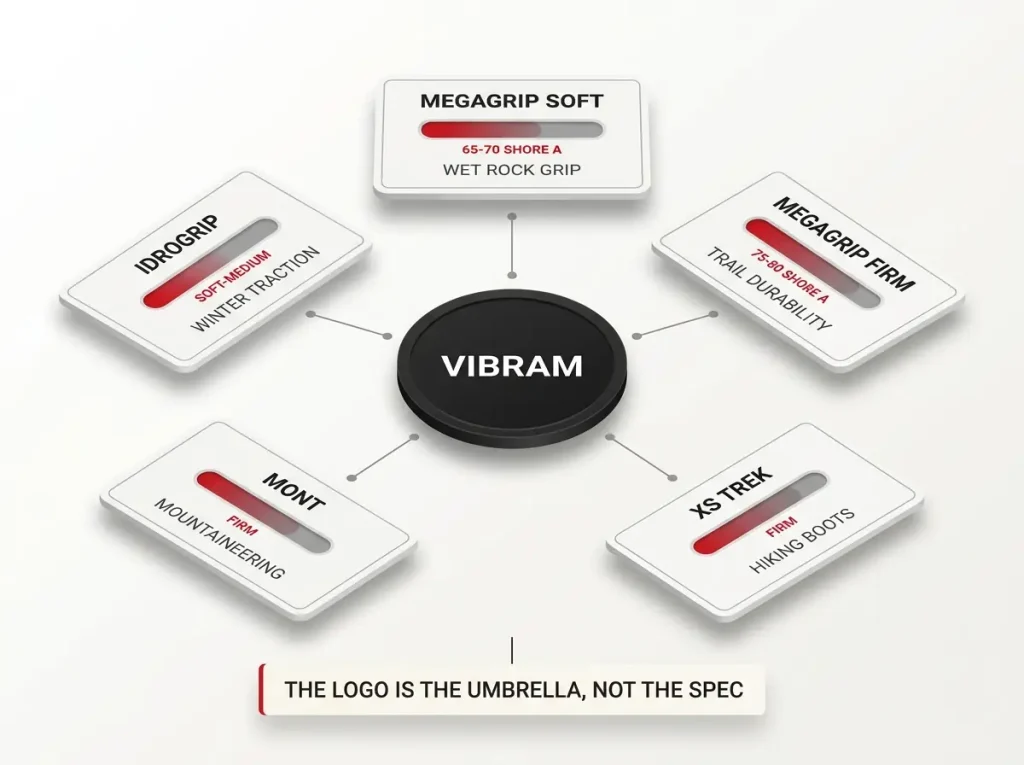
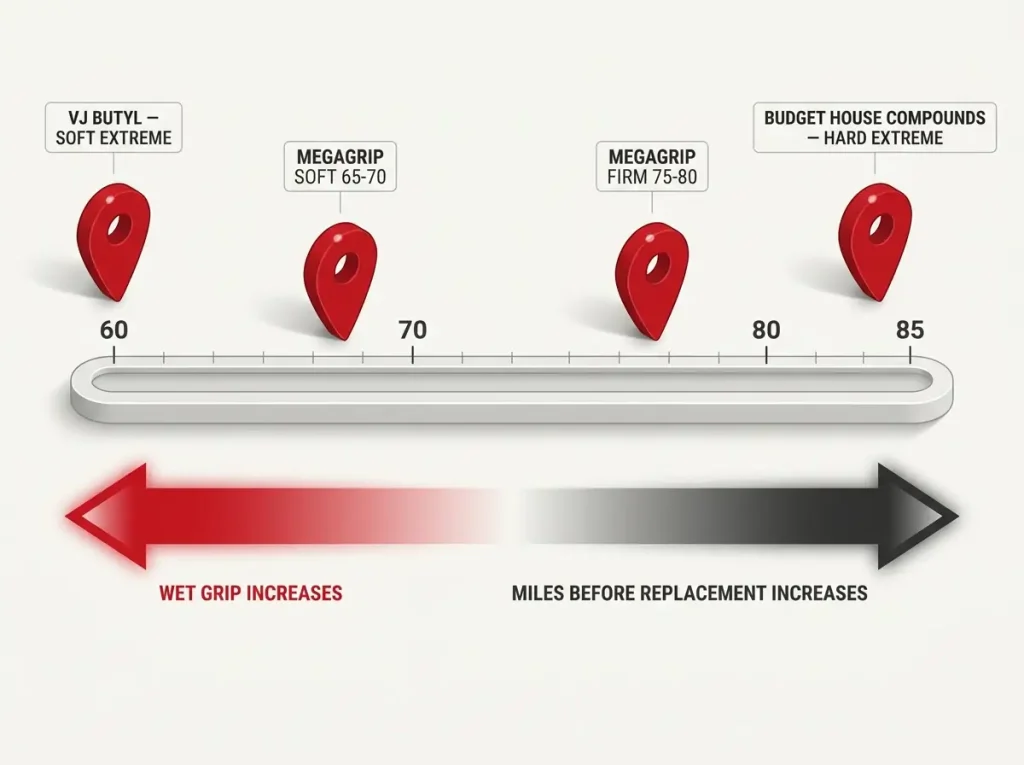
The spread inside a single product name is wider than most hikers expect. Vibram Megagrip ships in a soft formula around 65 to 70 Shore A and a firm formula around 75 to 80. Same name on the sole. Two genuinely different rubbers under your foot.
House compounds work the same way. Salomon Contagrip, Columbia Omni-Grip, Merrell M Select Grip and La Sportiva’s grip lineup are families of formulas, not single recipes, tuned differently depending on which shoe in the range they land on. Reading “Contagrip” off a spec sheet tells you which company made the rubber. It tells you nothing about how hard it is or what it was tuned to hold.
So what should you actually ask? Three things: the hardness, the specific formula name rather than the umbrella brand, and the terrain the maker says it was built for. Those three tell you more than any logo will.
And keep the whole thing in proportion. Rubber is one decision inside the larger one of picking the low-cut shoe itself, which sets your weight, fit and protection long before the sole gets a vote.
Soft vs Hard Rubber and the Trade-off You’re Actually Making
Hikers borrowed the shorthand from cars, and it’s the cleanest way to think about this: the tire trade-off. Nobody is surprised that a sticky performance tire wears out faster than a touring tire. Put the same physics on your feet and people act betrayed.
Soft rubber, roughly 65 to 70 Shore A, grips better on wet rock and gives up miles. Hard rubber, roughly 75 to 80, survives the miles and slides on wet slab. That’s the entire trade. There is no formula that wins both, and any marketing copy suggesting otherwise is selling you the middle of the range without saying so.
The expensive version of this mistake goes like this: a hiker buys the harder, longer-wearing compound before a scrambling trip because it “lasts longer,” then meets a wet slab and finds out what that choice actually bought. Durability is the right priority on maintained trail where wear is the real threat. On wet rock, the threat is your foot leaving the stone, and no amount of tread life helps with that.
One more piece of vocabulary, because you’ll see it everywhere: sticky rubber. The term came over from climbing shoes and it’s a statement about hardness, not about a brand. When someone in a thread says a shoe has sticky rubber, they mean soft. Approach shoes live at the far soft end of this spectrum, and the full comparison of sticky rubber versus deep lugs is worth reading before you assume you need one.
Pick the compound for the hardest ten percent of your route, not the easy ninety. You don’t get to renegotiate rubber halfway across a wet slab, and the miles you lose to a softer sole are miles you were going to walk anyway.
The Pair That Splits the Difference
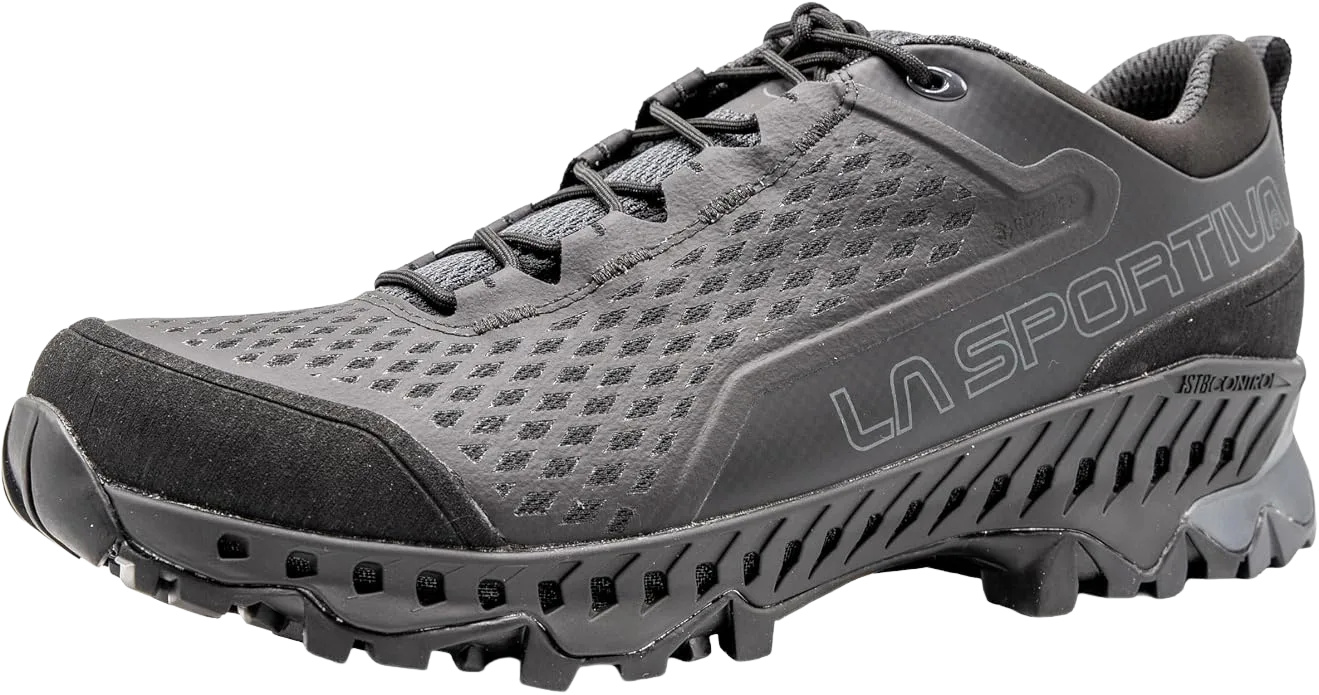
Splitting the difference is a real strategy, not a cop-out, and it’s the right one for most people. Hikers who genuinely need a specialist compound usually know it, because their terrain tells them every weekend. If you’re picking one pair to cover a season of mixed ground, the middle of the hardness range fails you less often than either edge does. The La Sportiva Spire GTX (men’s · women’s) is built on exactly that logic.
What you give up is honest and worth saying out loud. It won’t hold a wet slab like a dedicated soft compound, and it won’t outlast a hard-rubber trail shoe on high mileage. It just refuses to be badly wrong anywhere, which is a different and often better thing to buy.
Why Rubber Grips Wet Rock (the Science Nobody Explains)
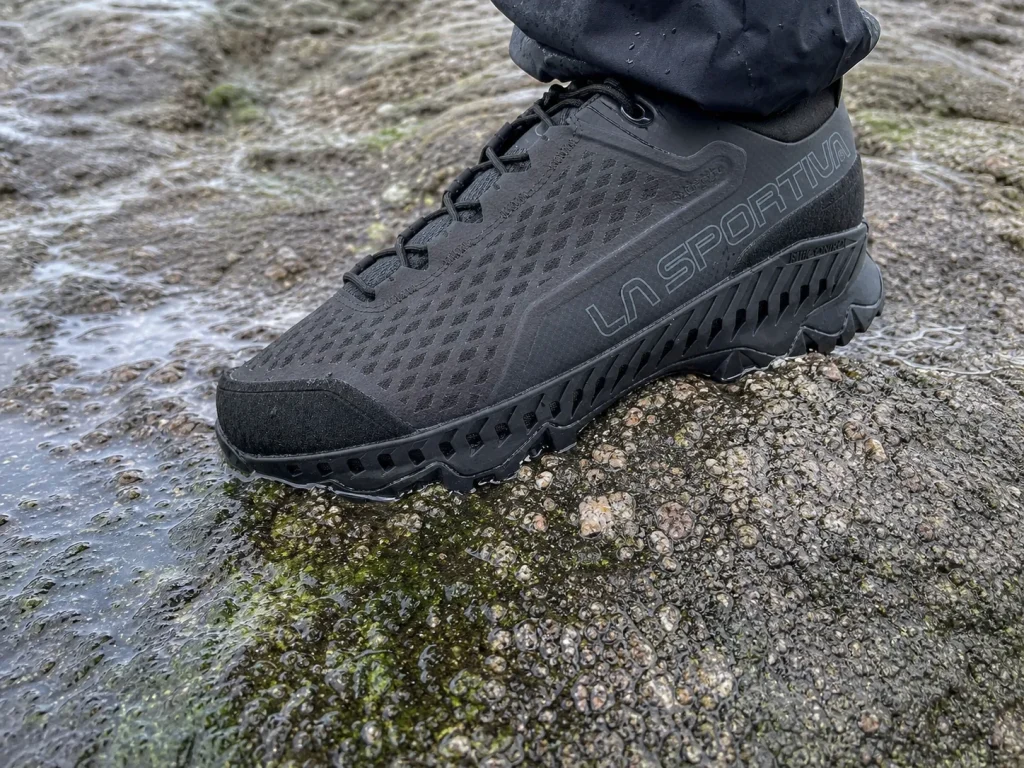
Every article on this topic tells you soft rubber sticks more. None of them tell you why, which is a shame, because the mechanism is the part that makes the rest of your decisions obvious.
The Half-Second Your Foot Doesn’t Slide
You know the moment. Your foot starts to go on a wet slab, and then at the last instant the sole grabs and you stay upright. That isn’t luck. It’s hysteresis friction, and it’s doing measurable physical work in that half-second.
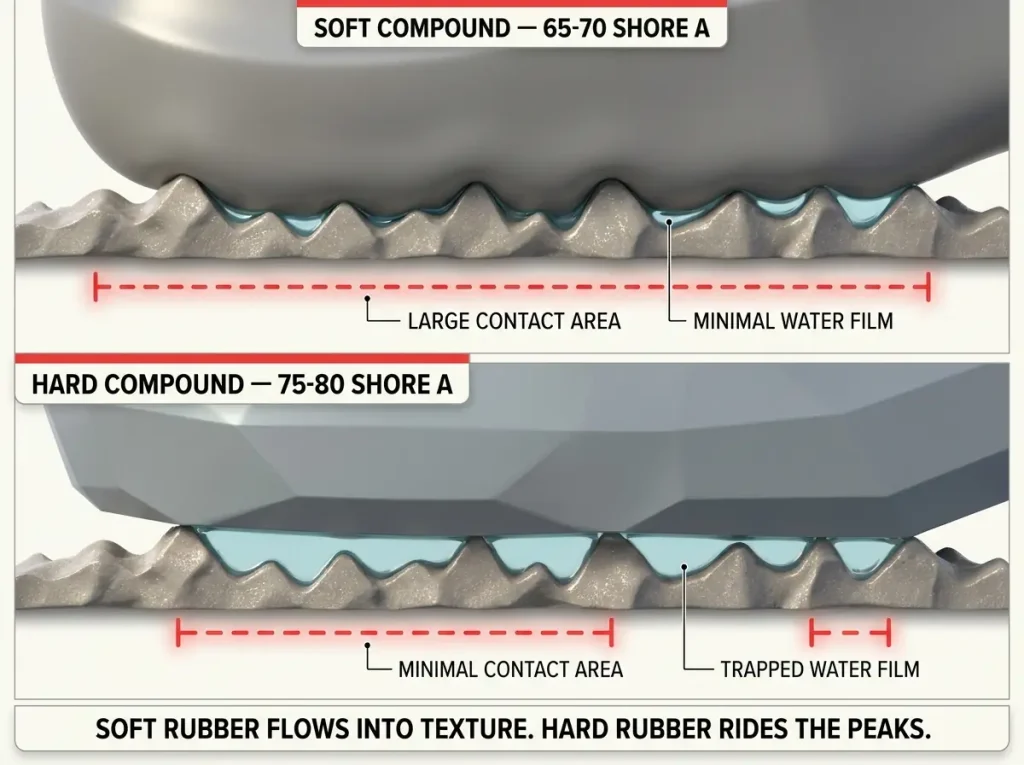
Rock isn’t smooth. Even polished-looking granite is a field of microscopic peaks and valleys. Soft rubber presses down and flows into that micro-texture, wrapping around the high points and filling the low ones, which multiplies the real contact area between shoe and stone.
Hard rubber resists that deformation and ends up perched on the tips of the peaks, touching far less rock than it looks like it’s touching. A peer-reviewed materials study traced wet-rock grip directly to a compound’s Shore hardness and its hysteresis response, which is the actual reason “soft sticks, hard lasts” isn’t just shop-floor folklore.
The timing detail is the useful one. Research archived through the National Institutes of Health found that low-Shore-hardness rubber shows higher adhesion and hysteresis friction specifically under slipping conditions.
Read that again, because it’s the whole argument for soft rubber: the advantage shows up exactly in the moment your foot has already started to move. Not in the marketing. In the save.
Why Cold Turns Sticky Rubber Into Plastic
Here’s the one almost nobody explains, and it catches good hikers every shoulder season. Rubber has a glass transition temperature, its Tg.
Above it, the compound behaves like rubber: flexible, deforming into texture, doing the hysteresis work described above. Below it, the same material turns stiff and brittle. Not colder rubber. Different rubber, physically speaking.
Maximum grip happens close to and just above that Tg. So the shoe that felt planted on wet rock at 60°F can feel like walking on hard plastic at 25°F, and nothing about it is worn out or dirty. The compound changed state under your foot.
This is also why cold-rated footwear isn’t just insulation with a different label. Some of it uses a genuinely different recipe: a styrene-butadiene compound with a Tg near -10°C measurably raises elastic modulus and ground-gripping force at -10°C compared to higher-Tg formulas. The rubber was engineered to still be rubber when it’s freezing. Once the temperature drops far enough that no compound stays compliant, you’ve reached the point when the rubber stops being enough and the answer becomes metal, not chemistry.
The Grip That Isn’t the Compound at All
Siping deserves a mention here because it quietly ruins the tidy story. Those thin wave or zigzag cuts across the lug faces open slightly as the sole flexes, and the sharp edges they create slice through the film of water sitting on the rock. That’s grip generated by geometry, not chemistry.
Surface geometry can be engineered the same way. The NIH-archived work found that a hybrid outsole mixing rough and smooth rubber zones on a single sole produced higher static and dynamic friction coefficients on a wet test floor than standard soles, with zero recorded falls across the trials. Mixing texture zones, not just picking a compound, is a real design lever.
The practical consequence is worth holding onto: two shoes with identical rubber can perform differently on wet stone purely because one has siped lugs and the other doesn’t. Compound is the biggest lever. It isn’t the only one.
If a shoulder-season hike starts below freezing and warms through the morning, your grip improves as the day goes on and your rubber crosses back above its Tg. Plan the sketchy wet-rock section for the afternoon, not the frozen first hour.
Compound by Compound, What Each Brand Actually Makes
This is the translation table between the logo on your sole and the thing under your foot.
Vibram Puts One Name on Many Rubbers
Vibram is the licensor everyone knows and almost nobody reads correctly. The catalog includes Megagrip (the wet-traction line, soft and firm formulas), XS Trek, Mont, IDROGRIP and TC5+, among others. These are different rubbers with different jobs, sharing one logo.
Megagrip is the one to know for wet rock, with the caveat already covered: the soft formula near 65 to 70 Shore A is the grippy one, and the firm formula near 75 to 80 is tuned toward wear.
The Vasque St. Elias GTX is the boot competitors reach for when the subject is wet-rock traction, and its Vibram Megagrip outsole is the reason. The women’s version is the one currently worth chasing, since the men’s has gone scarce on Amazon. Approach shoes lean on Megagrip harder than anything else, which is a useful signal about what the compound is genuinely good at.
For a mainstream reference point with real numbers attached, the Merrell Moab 3 (men’s · women’s) runs a Vibram TC5+ outsole with 5mm lugs and an 11.5mm heel-to-toe drop. Those figures are worth memorizing as a yardstick. Next time a listing promises deep lugs, you have something to measure the claim against.
The House Compounds and the Budget End
Most brands formulate their own. Salomon has Contagrip, Columbia has Omni-Grip, Merrell has M Select Grip alongside its Vibram work, La Sportiva runs Frixion, AT-Grip and the Impact Brake System, Scarpa has Presa Super Gum, Lowa has Elika, and Michelin puts tire-brand rubber on hiking soles. None of these names tell you a hardness either. They tell you a supplier.
Here’s the gap nobody covers: what you actually sacrifice at the budget end. Entry-tier house rubber isn’t scam rubber. It’s rubber formulated with cost and wear weighted above wet-surface performance, which is a legitimate engineering choice for a shoe that will mostly walk dry, maintained trail.
The Columbia Newton Ridge Plus (men’s · women’s) sits right there with Omni-Grip, and it’s an honest budget-friendly pick for exactly that use. Take it onto wet slab and you’ll feel precisely which corner got cut.
Premium compounds buy you a narrower, sharper capability, not general superiority. That’s the reframe: you’re not buying better rubber, you’re buying rubber tuned for a specific problem. If your problem is dry miles, the budget compound isn’t a compromise at all.
The Outsiders, Continental and Butyl
Two compounds sit outside the usual conversation, and both earned their reputation somewhere other than a marketing department.
Continental rubber is the interesting one. The tire company supplies the compound on Adidas Terrex outsoles, which means traction specialists formulated the rubber on your shoe. That’s a genuinely different pedigree from a footwear brand naming its own house mix, and it mostly lands on a trail running shoe outsole rather than a stiff hiker, which tells you who it was tuned for.
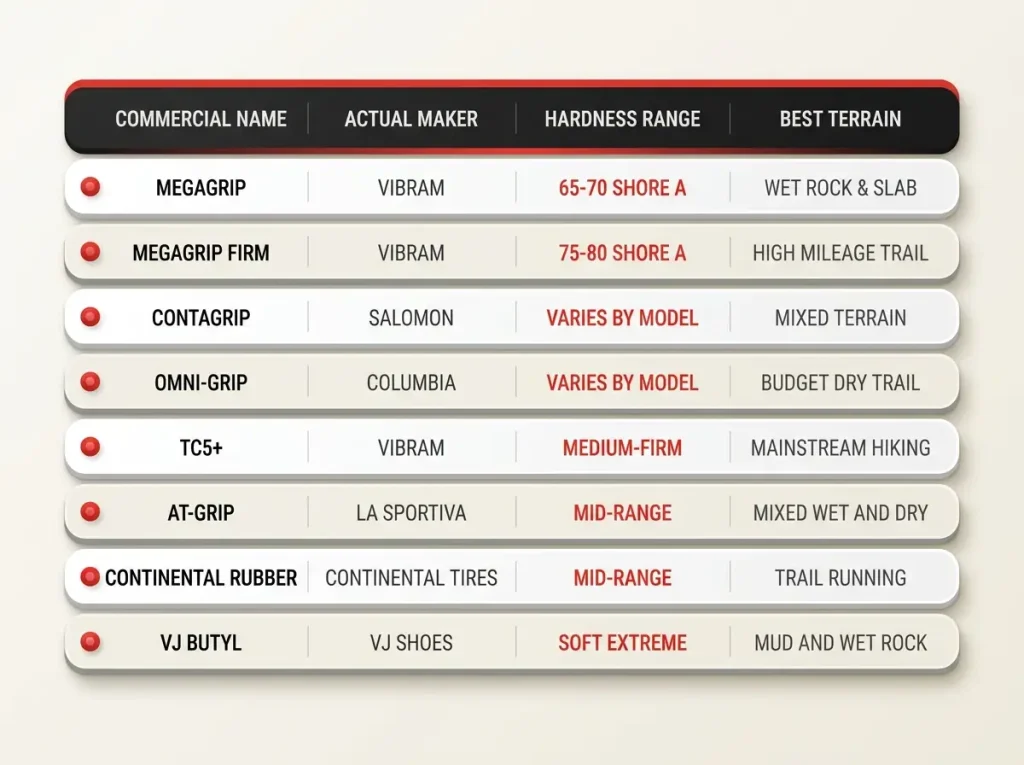
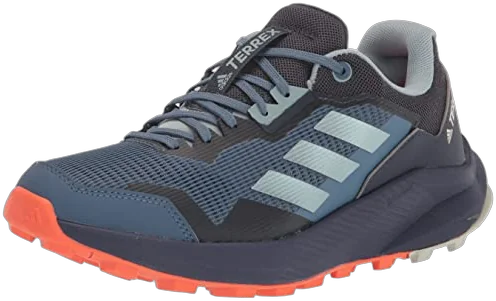
Then there’s VJ butyl rubber. VJ Shoes builds outsoles from butyl rubber and has a cult following that started in obstacle course racing and spread into technical mountain running, which is about as community-earned as a gear reputation gets. Athletes who run VJ’s butyl on wet rock and mud report the advantage is real rather than hype, and the brand got there without much of a marketing budget at all.
Worth knowing the name if you keep hearing it from serious mountain runners and can’t place it. It’s currently hard to find through the usual channels, so if wet-rock grip is your whole problem, the Megagrip options above are the ones you can actually put on your feet this month.
Matching Rubber Compound to Your Terrain
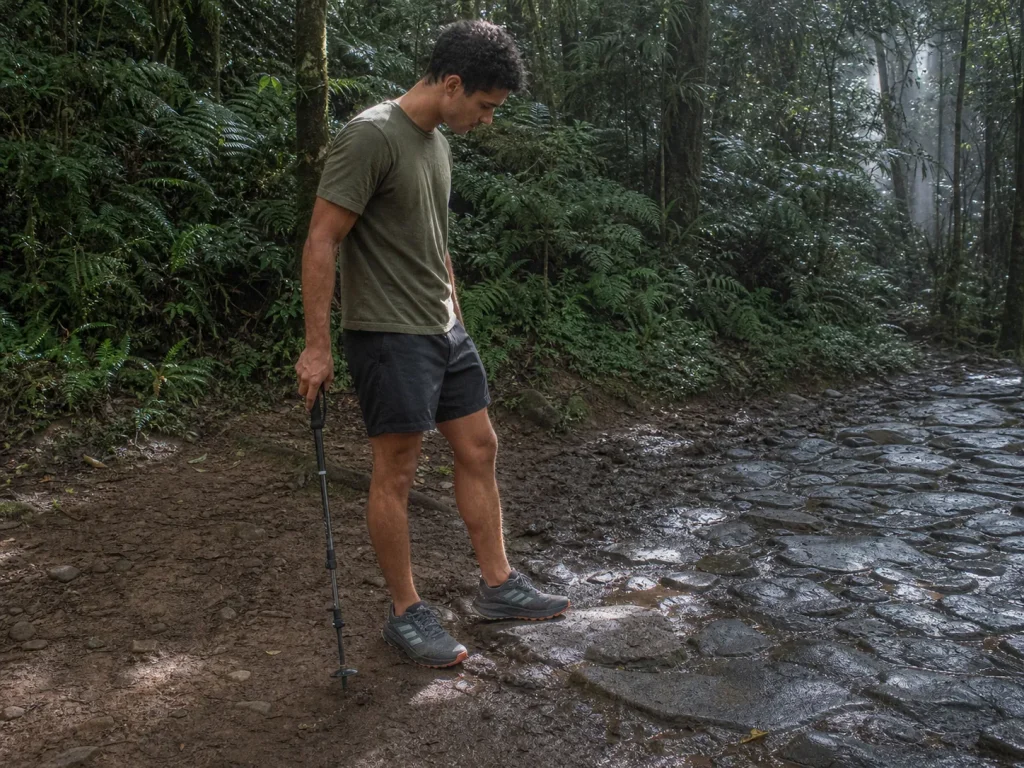
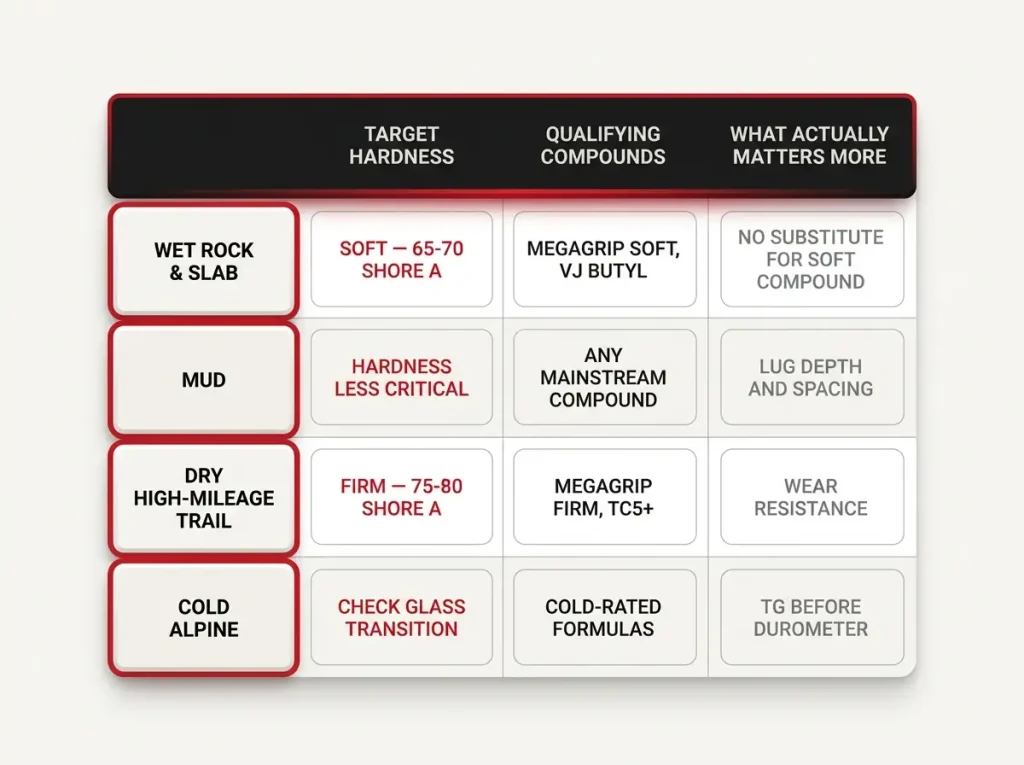
Nobody hikes “outdoors.” You hike wet granite, or mud, or dry packed trail, and the right compound is different for each. The most common way people buy wrong is choosing rubber for the terrain they dream about instead of the terrain they actually walk most weekends.
This isn’t a small-stakes call, either. A NIOSH field study of nearly 17,000 workers found that free, highly-rated slip-resistant shoes measurably cut fall-injury claims, which is one of the largest real-world tests ever run on whether sole choice changes outcomes. Different setting, same friction science.
Wet rock, slab and scrambling. Soft compound, no argument. This is the terrain where the trade-off pays for itself, and where the harder compound’s extra tread life buys you nothing you want. If your route involves creek crossings, it’s also worth knowing what happens once the water’s inside the shoe, because wet feet and wet rock usually arrive together.
Mud and soft slopes. Here’s where the compound matters less than you’d think, and this article stops being the right one for the job. Soft rubber can’t save a tread pattern that won’t bite, and it can’t clear a packed sole either, since shedding mud is the work of self-cleaning lugs and the channels between them rather than the rubber itself. Geometry runs the show once the surface stops being solid, so read up on how lug depth and spacing take over and buy for that instead.
Dry, maintained trail with high mileage. Hard compound. Dry rock grip asks far less of a sole than wet rock does, so the threat out here is outsole wear rather than slipping, and a soft sole is one you’ll replace early for no benefit.
Cold and alpine. Check the Tg before the nominal hardness, per the section above. A soft compound that goes glassy at 20°F is a hard compound in practice, whatever the durometer said in the shop.
Read the rock before you trust the shoe. Moss, algae and creek slime defeat nearly any compound, and hikers report mainstream soles turning extra slippery on specific wet rock types rather than universally. The pair that grips fine on wet granite can betray you on a slimed-over creek cobble.
How Outsole Rubber Ages and Loses Its Grip
There’s a pair in your closet that still looks fine. Tread depth is there, uppers are intact, and the first wet stone of the season feels like glass anyway.
Why Tread Depth Lies About Grip
Rubber oxidizes and hardens as it ages, and it does this whether you’re hiking on it or not. The compound slowly stiffens, drifting up the Shore scale, losing the compliance that made it grip in the first place. Tread depth measures how much rubber is left. It says nothing about whether that rubber still behaves like rubber.
Hikers call the result hardened or chalky soles, and the name is a good description of both the look and the feel. The unsettling math: a soft compound that’s aged badly can end up harder than a firm compound that’s new. The clock runs even on the shoes living in the closet, which is why a “barely used” pair from four seasons ago is not the bargain it appears to be.
The field check takes five seconds. Press your thumb hard into the lug area near the ball of the foot. Fresh soft rubber gives a little and springs back.
Aged rubber feels dead and glassy and doesn’t move. That’s your answer, and it’s more honest than measuring tread.
When the Rubber Is Fine But the Shoe Isn’t
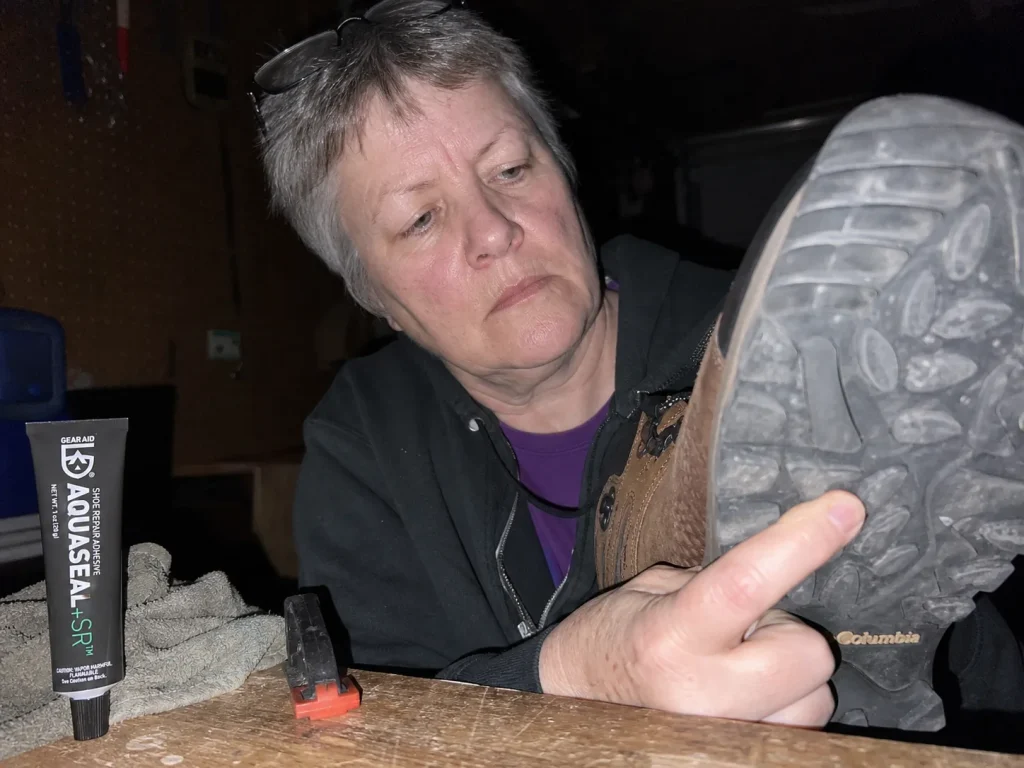
Sometimes the compound is still healthy and something else failed: the outsole is peeling at the bond line, or a lug tore off, or the toe rand lifted. That’s a repair, not a replacement, and the anti-sell answer applies. Full resoling is a cobbler’s job on a boot built for it, but most low-cut shoes never get there, and the small stuff you can handle yourself. A tube of GEAR AID Aquaseal SR re-bonds a sole you already trust and extends a compound you already know, which beats gambling on a new pair whose rubber you haven’t met.
Know where the line sits, though. Adhesive fixes bonds and fills gaps. It does not un-harden oxidized rubber, and nothing else does either.
If your thumb test says the compound is dead, the shoe is done regardless of how good the tread looks. The rest of the replace-or-repair call comes down to whether the part that failed is the part you can glue.
Conclusion
The logo is the umbrella, not the spec. Ask for the hardness and the specific formula, because “Vibram” spans roughly 65 to 80 Shore A and answers nothing on its own.
Buy the hardness for the ground you actually walk. Soft for wet rock and scrambling, hard for dry miles, the middle when your terrain won’t commit. And check the Tg instead of the durometer if your season starts below freezing.
Rubber ages even when tread doesn’t. The compound hardens on its own schedule, so inspect what the rubber does, not how much of it is left.
Before your next wet-rock day, press your thumb into the sole of the shoes you already own. If it feels glassy and dead instead of giving slightly, you just found out why you slipped last time, and you now know exactly what to look for in the replacement.
Frequently Asked Questions
01Does Vibram always mean good grip?
No. Vibram licenses dozens of compounds spanning roughly 65 to 80 Shore hardness under one name. Two Vibram shoes can grip completely differently, and even Megagrip exists in both a soft and a firm formula.
02Does softer rubber wear out faster than harder rubber?
Yes, and that is exactly the deal. Soft outsole rubber compound wins on wet rock and gives up miles; hard rubber does the reverse. It is the same logic as a sticky tire versus a touring tire.
03Why do my hiking shoes slip more in cold weather?
The rubber dropped below its glass transition temperature and turned stiff. Nothing wore out and nothing is dirty, the material changed state. Peak grip happens just above that Tg, so the same sole grips better once the day warms.
04Why do my shoes grip on some wet rock but slip on other wet rock?
Moss, algae and slime defeat almost any compound. Hikers report mainstream soles going extra slippery on specific wet rock types rather than universally, so reading the surface matters as much as picking the sole.
05Can you fix an outsole that has hardened with age?
The hardening itself cannot be reversed, since oxidized rubber does not come back. What repairs well is the bond: if the compound still gives under your thumb but the sole is peeling, a repair adhesive extends a shoe you already trust.

I've spent more than a decade researching hiking gear and trail technique. I read the specs, the forum threads and the long-term reviews, and every pick here comes with what it gets wrong.
End of the trail
You read every mile of this one. Here's where the trail goes next.