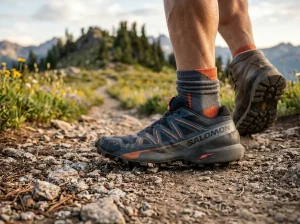
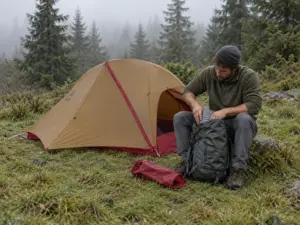
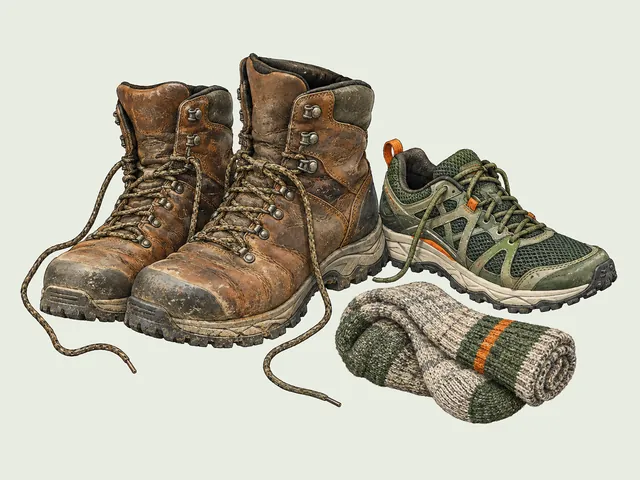
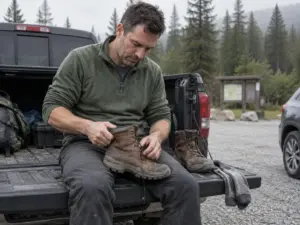








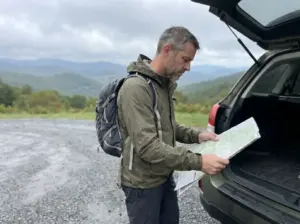







The descent off the summit was hour four when the toenail on my right big toe started throbbing — not discomfort, actual throbbing, like a drumbeat inside the nail bed. I’d bought those boots six weeks earlier in a store. They felt great. I could flex them, spin my heel. “Perfect fit,” the salesperson said. By the time I hit the trailhead parking lot, I couldn’t drive home barefoot. That toenail came off nine days later.
I’ve seen this happen enough times to know the problem wasn’t the brand, the terrain, or my socks. It was a sizing decision made in a climate-controlled store at 10 AM, with my feet at their smallest, their most rested, and wearing the wrong socks. The store test is physiologically irrelevant to what happens on trail.
Sizing up hiking footwear isn’t a preference — it’s a calculated response to what your foot actually does over eight hours on a loaded descent. This guide gives you the exact field protocol: when to go up half a size, when to go up a full size, and why your street shoe size is the wrong starting point inside a hiking boot.
⚡ Quick Answer: Size up 0.5 to 1 full size from your street shoe for trail footwear. Your foot swells up to 8% in volume over a long hiking day due to peripheral edema, and downhill descents drive your foot forward into the toe box with significant force. You need a 10–15mm toe gap between your longest toe and the toecap — checked with the Index Finger Rule while standing and weight-bearing. Bring your actual trail socks to any fitting, and test at the end of the day, not in the morning.
The Biology of Why Your Foot Grows on the Trail

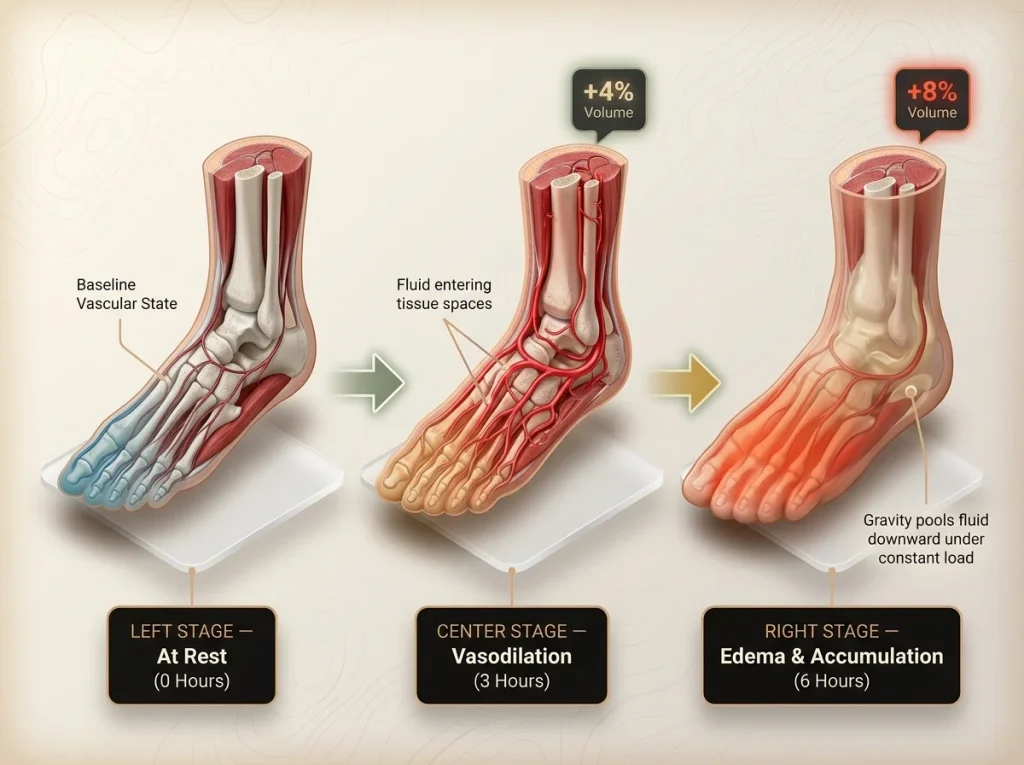
Your foot has 26 bones, more than 100 tendons and ligaments, and a dense network of blood vessels that respond dynamically to heat and sustained load. In a retail store at rest, none of that matters. On a trail at hour three, all of it does.
When you start hiking, blood vessels in your feet and lower legs enlarge to deliver oxygen to working muscles — that’s vasodilation. The increased pressure inside the capillaries pushes fluid into the surrounding tissue spaces. That’s peripheral edema: your foot is literally filling up with fluid. Gravity compounds it. Unlike the upper body, your feet bear your full loaded weight for consecutive hours, and fluid pools downward whether you want it to or not.
That process begins within the first hour. By hour two, there’s measurable volume change. Most hikers still have detectable puffiness at day’s end. Field data suggests that brief rest periods — your 20-minute lunch break — aren’t enough to reverse it. If you want to understand why your boots feel fine in the store but wreck you on the trail, this physiology is the whole explanation.
Pro tip: Fit your boots at the end of the day, when your feet are already slightly swollen. If the fit holds at 5 PM, it will survive the trail.
Here’s the angle most fitting guides miss completely: research on ultra-endurance foot volume and fluid intake shows that hikers consuming large amounts of water without adequate sodium can actually worsen foot swelling. Plasma aldosterone — the hormone regulating sodium and water balance — increases during endurance exercise. When you dilute your sodium levels by drinking too much plain water, your body retains even more water in tissue. A pinch of salt in your mid-hike bottle isn’t folklore. It has a direct physiological reason.
Gore-Tex adds another layer to this. Waterproof-breathable membranes trap humidity inside the boot, which raises skin temperature and amplifies vasodilation at the foot’s surface. In hot, dry conditions above 75°F, a Gore-Tex boot can measurably increase swelling compared to an equivalent mesh upper. In cold wet conditions it’s worth the tradeoff. In a July desert canyon, mesh trail runners may be the more physiologically intelligent choice — even if they sacrifice waterproofing.
The bottom line on biology: a boot that fits perfectly at rest will become a constriction device by mile eight. Size for the foot you’ll have at the end of the day, not the foot you had at the trailhead.
The Physics of the Descent — Why Climbing Up Is the Easy Part
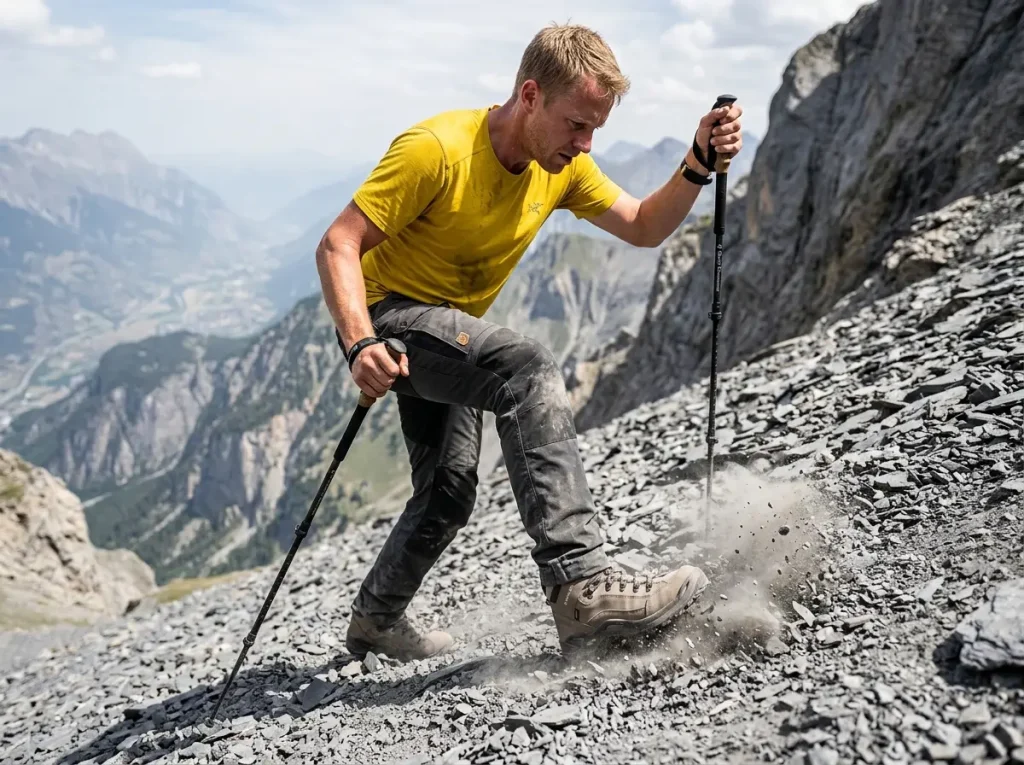
Uphill is hard on your lungs and calves. Downhill is hard on your toes. This is the part hiking boot marketing rarely explains clearly.
On a downward gradient, gravity pulls your center of mass forward and downward with every step. Your foot slides toward the front of the boot. Research measuring plantar biomechanical pressure during downhill descent shows that ground reaction forces during descending are significantly higher than on flat terrain — the leading foot absorbs a disproportionate forefoot load just before each step. Without adequate linear space in the toe box, toenails become the primary contact point for those braking forces. Not the soft pad tissue. Not the fat cushioning. The hard nail plate meeting the hard toe cap.
That’s the mechanism of subungual hematoma: blood pools under the nail plate because the nail can’t expand, creating pressure and intense throbbing pain. The medical treatment is trephination — drilling the nail to release the pressure. That’s not a field procedure. Prevention is the only viable field strategy.
The 15mm toe gap rule — confirmed by the Appalachian Mountain Club’s boot fit verification guide as the technical standard — exists specifically for this descent physics scenario. It gives your foot room to slide forward during braking without the toenail becoming a shock absorber.
Toenail trauma is also cumulative. A boot that “almost fits” won’t destroy your nails on a single day hike. Over a season of serious descents it will. If you’re thinking of how to stop the toenail tax once and for all, the answer starts with sizing, not toe protection accessories.
Pro tip: Before every summit descent, do the kick test. Lace up tight at the ankle, slide your foot forward into the boot, and kick your heel back hard against the ground. If your toes contact the front — stop. Your lacing needs to lock the heel before you go down, not after your toes start hurting.
The 3-Point Field Test Protocol — Beyond the Brannock Device
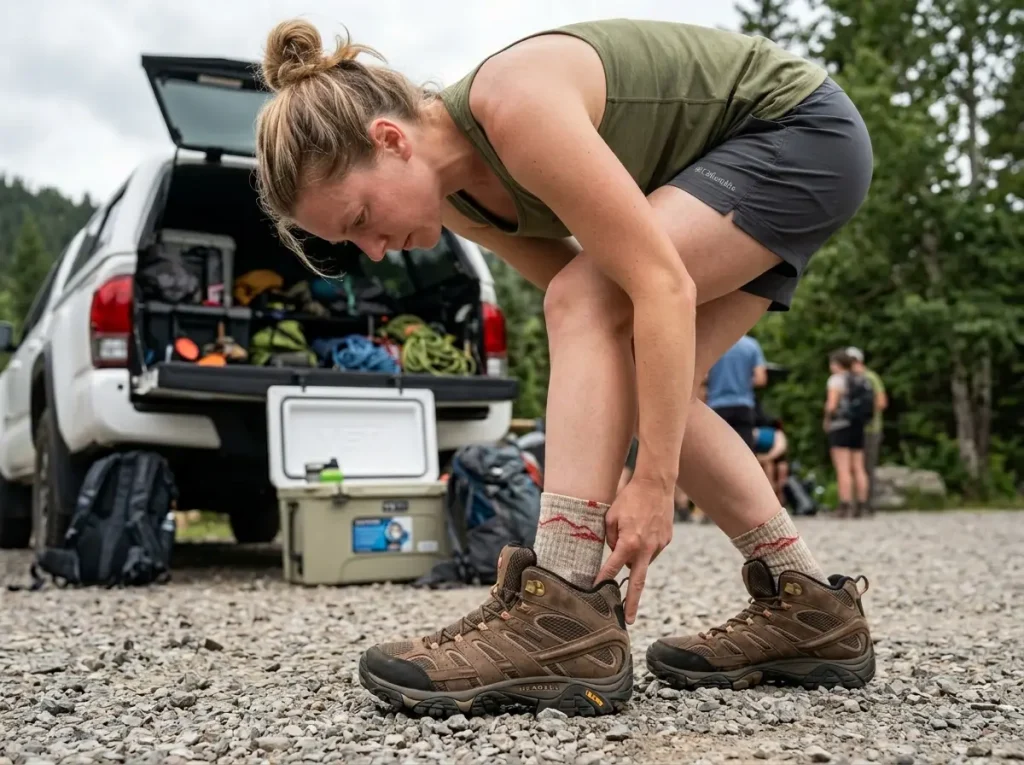
A Brannock device measures your foot length and width at rest. It tells you nothing about the last shape of the boot, the volume distribution, or how the flex point aligns with your anatomy. It’s a starting point, not a diagnosis.
Here’s a replicable three-test protocol that actually tells you whether your size-up decision is correct.
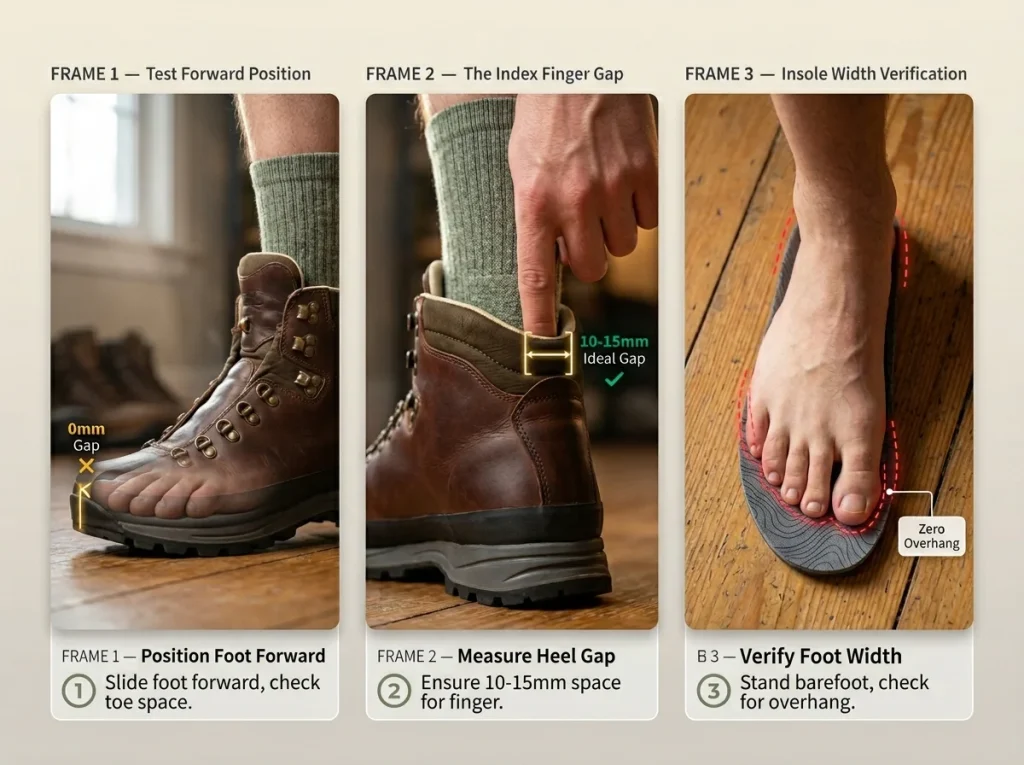
The Shell Fit — Index Finger Rule Step-by-Step
- Unlace the boot completely and pull the tongue fully forward.
- Slide your foot forward until your toes barely contact the front of the toe box.
- Stand upright — weight-bearing changes your heel position, so this step matters.
- Insert your index finger between your heel and the boot collar at the back.
- If your finger slides in snugly and completely: correct size-up. If two fingers fit: the boot is too large and will cause heel slip and instability. If your finger won’t fit: the boot is too small and will cost you toenails on the first real descent.
Conduct this test at the end of the day, or after 15 minutes of walking in-store, not cold off your car seat. Your foot needs to be in motion before the test means anything.
The Insole Stand Test — Volume and Width Verification
Remove the factory insole and stand on it barefoot on a hard floor, fully weighted. Check two things: does the ball of your foot overhang the edge? Does the big toe or the little toe hang off? If anything overhangs — the last is too narrow for your foot’s volume, regardless of whether the length works.
Pro tip: If the insole test reveals foot overhang but you love the boot’s other qualities, switch to a wide-width version of the same model before accepting a bad volume fit you can’t fix with lacing.
Also check where the insole’s arch peak sits relative to your foot’s natural arch. That’s a preliminary read on flex point alignment before you even lace up.
The Flex Point Alignment — The Most Ignored Sizing Variable
The flex point is where the outsole and midsole are engineered to bend. It’s designed for an “average” foot geometry. When you size up for length without checking this, the boot can end up bending at your arch instead of at the ball of your foot — which creates progressive arch fatigue and eventual hyperpronation.
To check: with the boot laced and on your foot, bend your foot naturally and observe where the crease forms in the boot’s outsole. It should align with the widest part of your foot — the first metatarsophalangeal joint, the ball of your foot. If the crease sits forward or behind that point, you have a flex point mismatch that you cannot fix with lacing. You need a different model.
For which sock system you use during fitting radically changes the result: a technical Merino wool sock adds 2–3mm of circumference to the entire foot. Conduct all three tests with the exact trail socks you’ll actually use on trail.
Brand Last Geometry — The Dirty Secret Manufacturers Won’t Publish
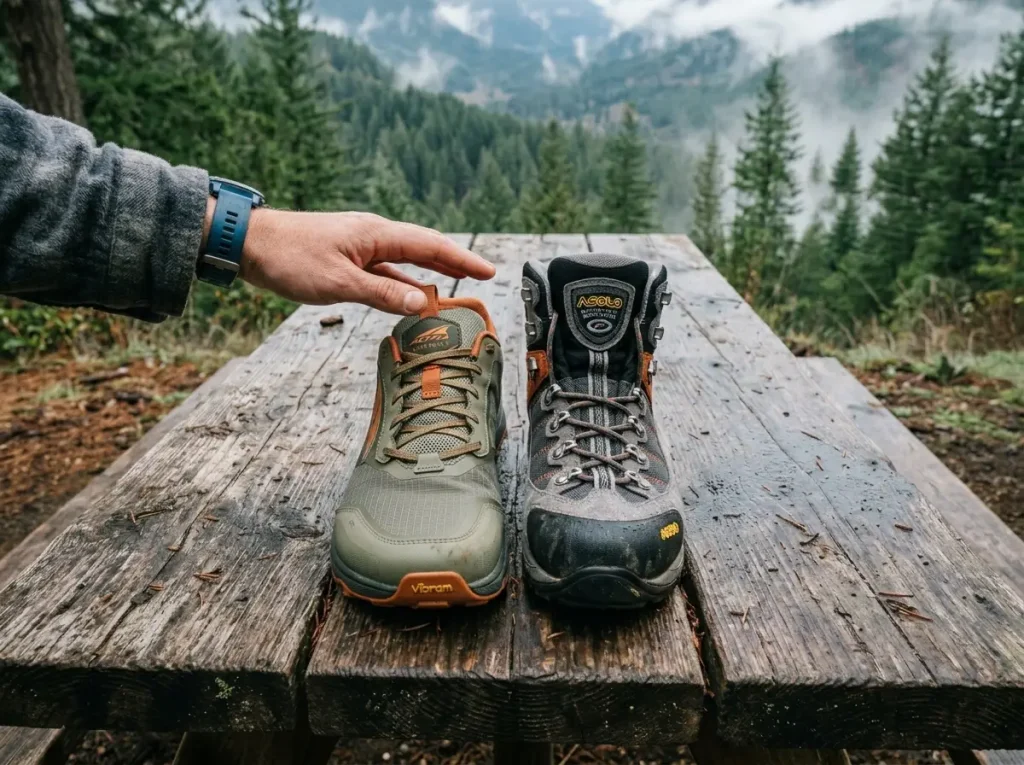
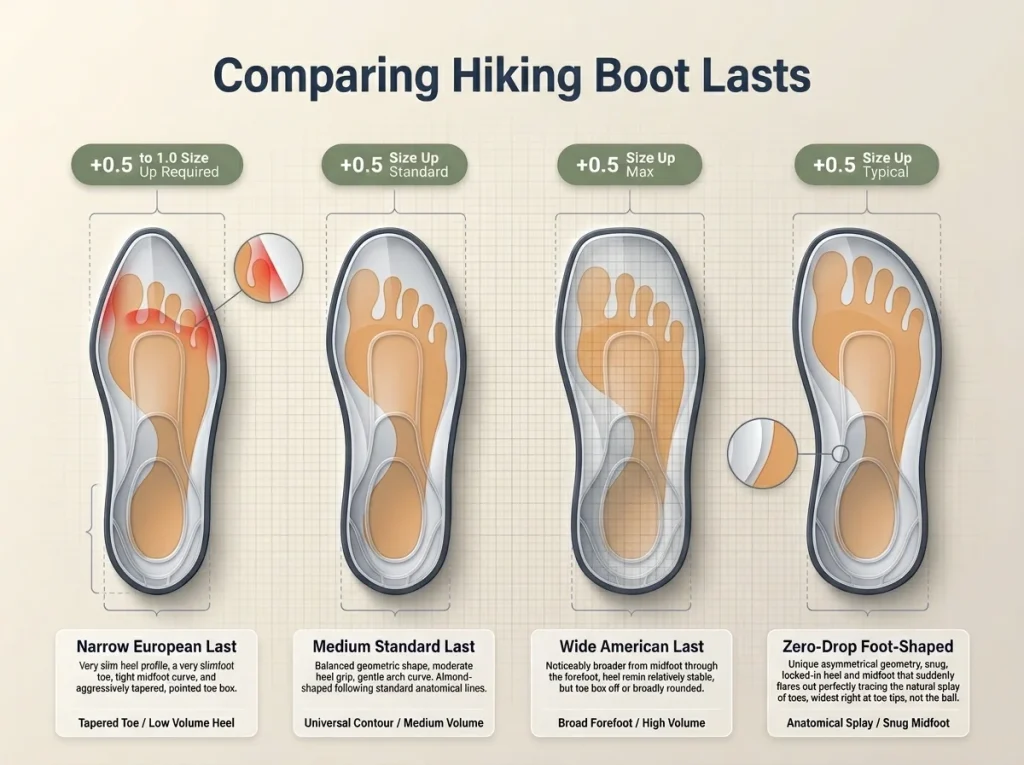
Every boot is built around a “last” — the physical form that determines the boot’s internal volume, heel width, midfoot shape, and toe box geometry. A EU Size 42 from Salomon is a fundamentally different volume than a US Size 9 from Merrell. Generic “go up half a size” advice ignores this entirely.
Narrow lasts (La Sportiva, Salomon, Asolo): Built on European lasts that are narrower in the heel and midfoot. Hikers with standard American or wide feet often need to size up a full size — not just for length, but to get adequate volume through the midfoot. Red flag in the fitting room: if the smallest toe gets compressed against the side of the boot in both your street size and one size up, the problem is width, not length. A different brand is the fix.
Wide lasts (Keen, Merrell): Higher volume and wider toe box by design. Most hikers only need half a size up to achieve the 15mm toe gap. Going a full size up in these brands creates so much extra heel space that even the Surgeon’s Knot struggles to compensate.
Zero-drop lasts (Altra, Topo Athletic): Foot-shaped toe boxes prioritize splay. Their length often runs short — you’ll typically need a half-size up — but don’t confuse the roomy toe box for a loose fit. The midfoot should still be snug.
Traditional leather (Lowa, Meindl): Generally true to size, but width options are the critical variable. These boots size laterally — leather molds to the width of your foot — but they won’t give you length you don’t have at purchase. The first time you pack a heavy load into a mountain hut, you’ll feel every millimeter of a short leather boot.
For mountaineering boots, the stakes change. Above 8,000 feet, altitude-induced edema compounds trail edema. Most mountain guides recommend sizing up a full size for single mountaineering boots, up to 1.5 sizes for double expedition boots. Mountain guide James Ed put it directly: “The wrong fitment will see your feet blistering and give you an unhappy mountain experience. I recommend a half to one whole size up from your normal street shoe.” At altitude with thick socks and cold-induced circulation restriction, conservative sizing becomes a frostbite prevention decision.
Switching between brand categories also means resetting your sizing expectations entirely. Your “size” is a brand-specific number, not a universal foot measurement — and ignoring this is one of the most expensive mistakes in hiking boot shopping.
For specific product options, the best wide toe-box boots we actually hiked in translates this brand geometry data into tested recommendations.
The Volume System — Socks, Insoles, and Lacing as Sizing Variables
Here’s where most hikers oversimplify: sizing up is not just about adding length. A hiking boot is a complete system. The internal fit is determined by four variables simultaneously — the boot shell, your sock thickness, your insole volume, and your lacing tension. Change one and you change all the others.
Sock-to-Shell Ratio — The Variable Most Guides Ignore
The sock-to-shell ratio describes how much internal volume your sock occupies relative to the boot’s designed capacity. A technical Merino wool hiking sock adds 2–3mm of circumference to the entire foot. That’s enough to effectively cancel the space gained by sizing up half a size. If you fitted the boot in lifestyle socks and then switched to thick trail socks, you didn’t size up — you stayed the same.
Liner sock systems — a thin liner sock under a Merino crew — can add another 1–2mm of circumference on top of that. Pick your sock system first. Then size the boot to match. How aftermarket insoles change the internal volume equation is the other half of this calculation.
Technical Insoles — Volume, Arch Collapse, and the Sequencing Problem
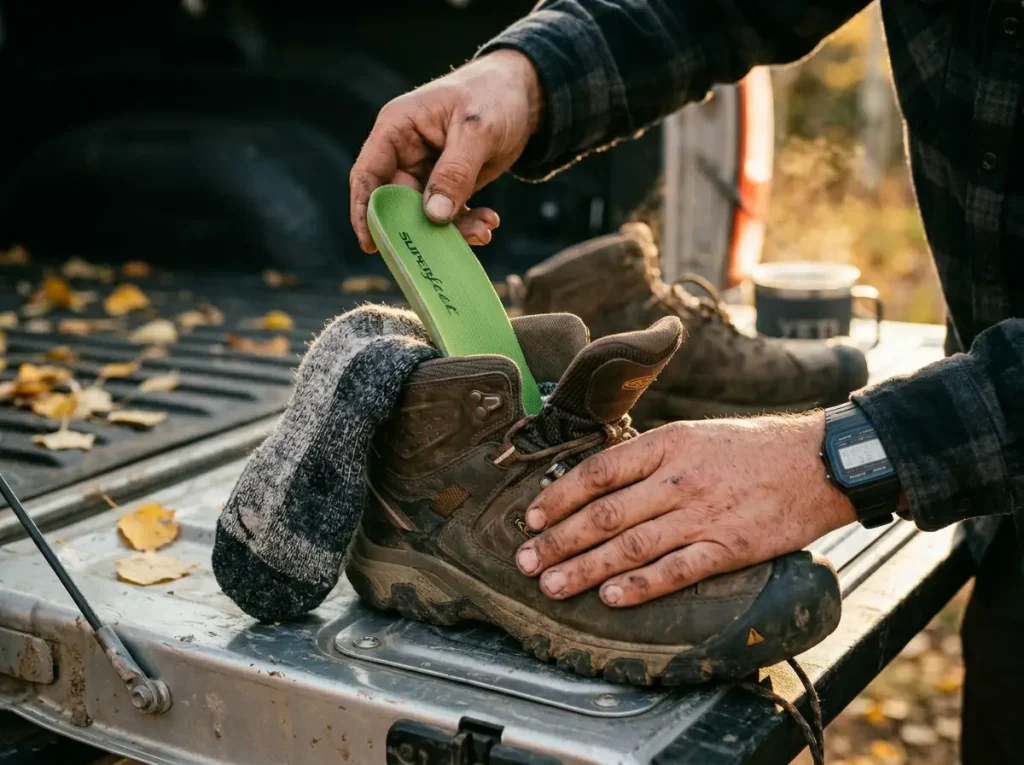
Factory insoles are flat foam. Under pack weight — especially above 20 lbs — your arch naturally collapses, elongating and widening your foot over time. Factory insoles allow this collapse. Technical insoles like Superfeet Green or Currex HikeXTR prevent it with a rigid arch cup. But they’re also 3–6mm thicker than the factory version, which means they take up internal volume.
If you plan to use a high-volume technical insole AND technical socks, you may need to test those combinations in the boot before deciding on final size. Hikers who switch to technical insoles mid-season often find their boots suddenly feel tight — because they added volume to a shell that was fitted with a flat foam insert. Test the full system together, not one piece at a time.
The Surgeon’s Knot and Lacing for Volume Control
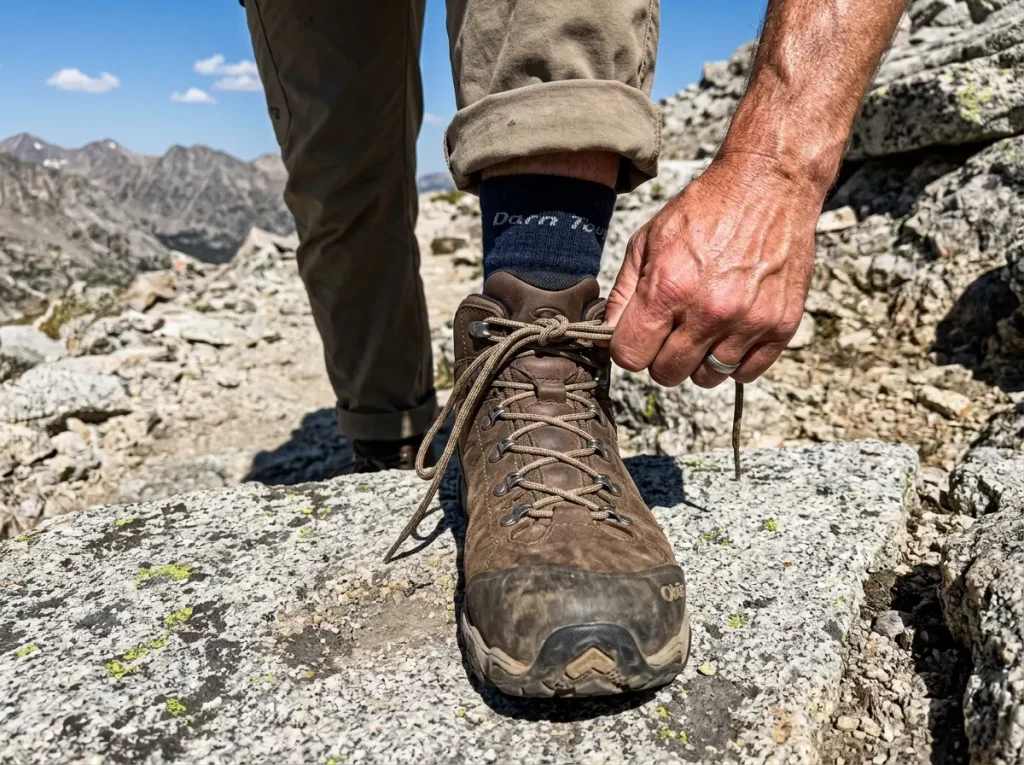
Sizing up often introduces heel slip — the heel lifting fractionally with each step. Acceptable initial slip is 3–4mm, less than a finger’s width. More than that leads to Achilles blisters. The solution is lacing technique, not a smaller boot.
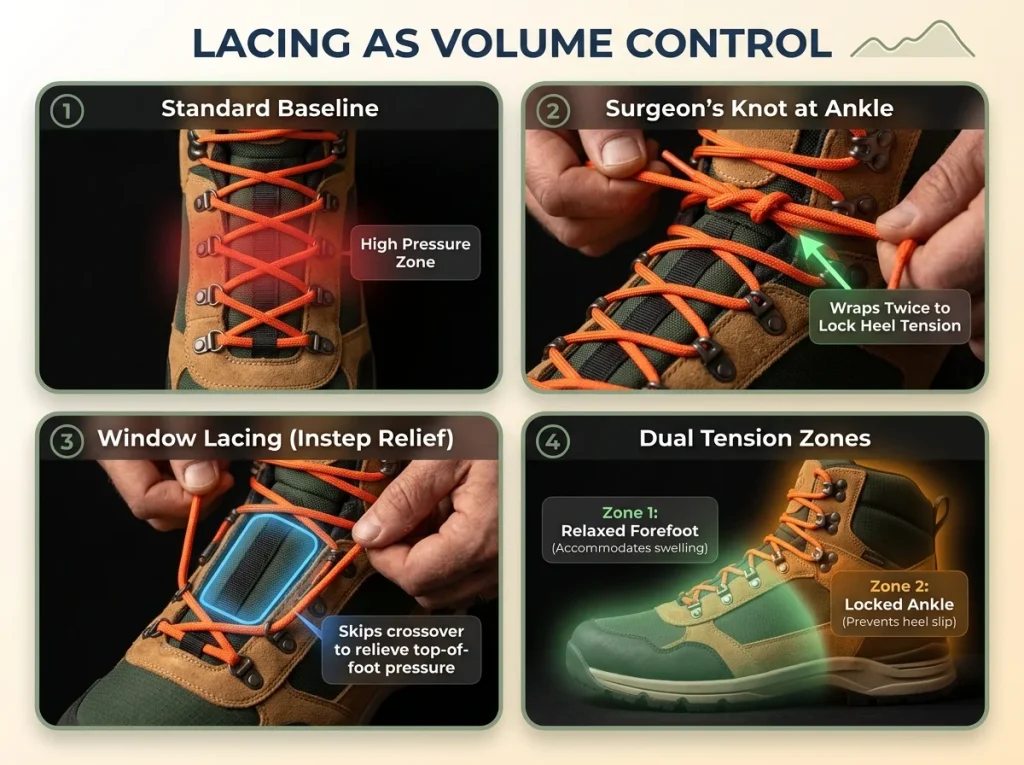
The Surgeon’s Knot wraps the laces around each other twice at the ankle hook, creating a tension lock. The forefoot stays looser — accommodating foot swelling during the day — while the heel is clamped firmly into the heel counter. This is the heel lock lacing system that solves the downhill slip problem.
Window lacing skips the crossover at the high-pressure point over your instep and runs the laces vertically instead. This relieves compression on the dorsal nerves and blood vessels — eliminating numbness on top of the foot — without sacrificing overall boot security.
Toe-relief lacing involves unlacing the first set of eyelets entirely on thru-hike days with extreme swelling. It allows the front of the boot to expand to its physical maximum width. These are precision volume management tools, not workarounds for a bad fit.
Common Sizing Mistakes That Send Hikers Back to the Trailhead
Three mistakes account for the majority of boot-ruined hikes in long-distance hiking communities. These aren’t edge cases. They’re standard.
The Static Fit Trap — Why Store Comfort Is a Bad Proxy
A boot that feels snug and perfect in the store at 10 AM with lifestyle socks will become a tourniquet by 3 PM on a descent. Your feet expand 6–8% in volume over a full hiking day with heat, gravity, and load. The retail fit protocol — walk 30 feet, assess comfort — is testing a static structure. Your foot on trail is not static.
Field standard: boots should feel slightly generous in the store with your trail socks. Index finger fits in the heel. If it feels “perfect,” it’s going to feel tight on a real descent, and you’ll lose toenails before the season is over.
The Flex Point Alignment Failure — The Expensive Silent Mistake
Sizing up for length without checking flex point alignment is the most costly mistake in boot fitting because the symptoms take weeks to appear. The boot bends at the wrong point. Your arch compensates. The abnormal outsole wear pattern appears under the arch instead of the ball. Eventually: arch pain on extended days, progressive hyperpronation, and in bad cases, plantar fasciitis.
Fix: at purchase, in the store, bend the boot sharply. Look where the fold forms. If sizing up in a specific model creates a flex point mismatch that sizing down corrects, choose a different brand rather than accepting a mismatch you’ll live with for 500 miles.
The Break-In Myth — Leather Molds, Length Never Changes
Per Hospital for Special Surgery guidance on footwear fit, Dr. Rock Positano of the Hospital for Special Surgery puts it plainly: “There is no such thing as breaking in a shoe — it either fits or it doesn’t.”
Full-grain leather molds laterally. Over 40–80 hours of use, it adapts to the width contour of your foot. Leather never stretches in length. If the toes are compressed at purchase, they will be compressed at mile 500. Synthetics — nylon, polyester, TPU — provide zero stretch in any direction. They are dimensionally stable from day one. The most predictable consequence of the break-in myth: hikers accept toe compression, head into the backcountry, and develop subungual hematoma on the first serious descent. That’s the pattern. It’s consistent and completely preventable.
Conclusion
Three things:
Your foot is not a static object. It expands up to 8% in volume during a long hiking day, and any boot that “fits perfectly” at rest will fail mechanically on a significant descent. Size for the foot you have at mile 12, not the foot you had at the trailhead.
The 3-Point Test Protocol is non-negotiable. Shell Fit, Insole Stand Test, and Flex Point Alignment — all three, with your actual trail socks. One test alone tells you only one dimension of a three-dimensional problem.
Lacing is a volume management system. The Surgeon’s Knot, Window Lacing, and Toe-Relief Lacing are precision calibration tools for a correctly sized boot — not workarounds for a bad purchase. Guides use these techniques to extend a season without buying new boots. You can too.
On your next trail day, pull the insole out of your current boots and stand on it barefoot and fully weighted. If your foot overhangs the edge at the ball or anywhere at the front — you just diagnosed your fit problem in 30 seconds. Bring that insole to your next boot purchase.
FAQ
Should I always size up hiking boots from my regular shoe size?
For most hikers, yes — by 0.5 to 1 full size. Your street shoe size fits a static foot in a climate-controlled environment. Hiking boots need to accommodate foot volume expansion of up to 8% over a long day, plus biomechanical toe-room during steep descents. On flat, short hikes with light loads, half a size up is typically enough. For multi-day trips, technical descents, or high-altitude trekking, the full size-up is the safer standard.
How much room should be in the toe of a hiking boot?
The technical standard is 10–15mm — roughly the Index Finger Rule result. Slide your foot forward until your toes barely contact the front of the unlaced boot, then stand and insert your index finger between your heel and the boot collar. It should fit snugly but completely. This gap exists specifically to prevent toe bang during downhill braking forces, not for general foot comfort.
Why do my toes hurt going downhill even in boots that seemed to fit?
Forward foot migration. On descents, gravity and momentum drive your foot toward the front of the boot with each braking step. Ground reaction forces are significantly higher than on flat terrain. If the static toe-room is less than 10–15mm, the toenail absorbs repeated mechanical impact — and subungual hematoma follows. Solutions: confirm proper toe clearance before any technical descent, use the Surgeon’s Knot to lock the heel, and consider sizing up an additional half-size.
Do hiking boots stretch or break in?
Leather boots mold laterally — adapting to width contours and foot shape at the midfoot and forefoot over time. Leather does NOT stretch in length, ever. Synthetic boots provide virtually zero stretch in any direction; they are dimensionally stable from day one. If the boot is too short in the store, it is too short forever. No material stretch creates the 10–15mm toe gap that a correct sizing decision should have provided at purchase.
What does insole volume have to do with sizing up?
Most factory insoles are flat foam that allow the arch to collapse under load, elongating and widening your foot. Technical insoles — like Superfeet Green or Currex HikeXTR — stabilize the arch but are 3–6mm thicker than factory versions. If you plan to use volume reducers like aftermarket insoles with technical socks, you may need to size up enough to accommodate both without compressing the instep. Always fit boots with your insole choice AND your sock system in place simultaneously.

I've spent more than a decade researching hiking gear and trail technique. I read the specs, the forum threads and the long-term reviews, and every pick here comes with what it gets wrong.
End of the trail
You read every mile of this one. Here's where the trail goes next.