In this article
The water only came up to her thigh. That’s what the group said afterward — knee-to-thigh deep, moving fast but nothing unusual for a Sierra snowmelt afternoon. She was the third person across when the current caught her left foot under a submerged ledge. The pole went sideways. The pack held her down. By the time the others reached her, it was already too late to guess whether the crossing or the moment she buckled that hip belt had sealed the outcome.
After years of guiding on high-route terrain, I’ve watched hikers read rivers the way they read skies — by feel and intuition. That works fine in calm weather. It fails catastrophically in moving water, where the physics are exponential and the margin for error is calculated in seconds, not minutes.
River crossing fatalities are almost universally the result of a chain of avoidable technical failures, not freak accidents. Here’s exactly how that chain forms — and how to break it before you ever step into the current.
⚡ Quick Answer: The five most lethal river crossing mistakes are: (1) leaving your pack buckled, which creates a hydrostatic anchor if you fall; (2) crossing barefoot or in sandals, which eliminates your friction on wet rock; (3) picking the trail-marked crossing without scouting for a safer profile; (4) ignoring cold-water immersion physics — you have 1 minute of cold shock, 10 minutes of swim function, and 1 hour before hypothermia sets in; and (5) trying to stand up after a fall, which causes foot entrapment. Address all five before you wade.
The Physics They Don’t Teach You — Why River Force Is Exponential
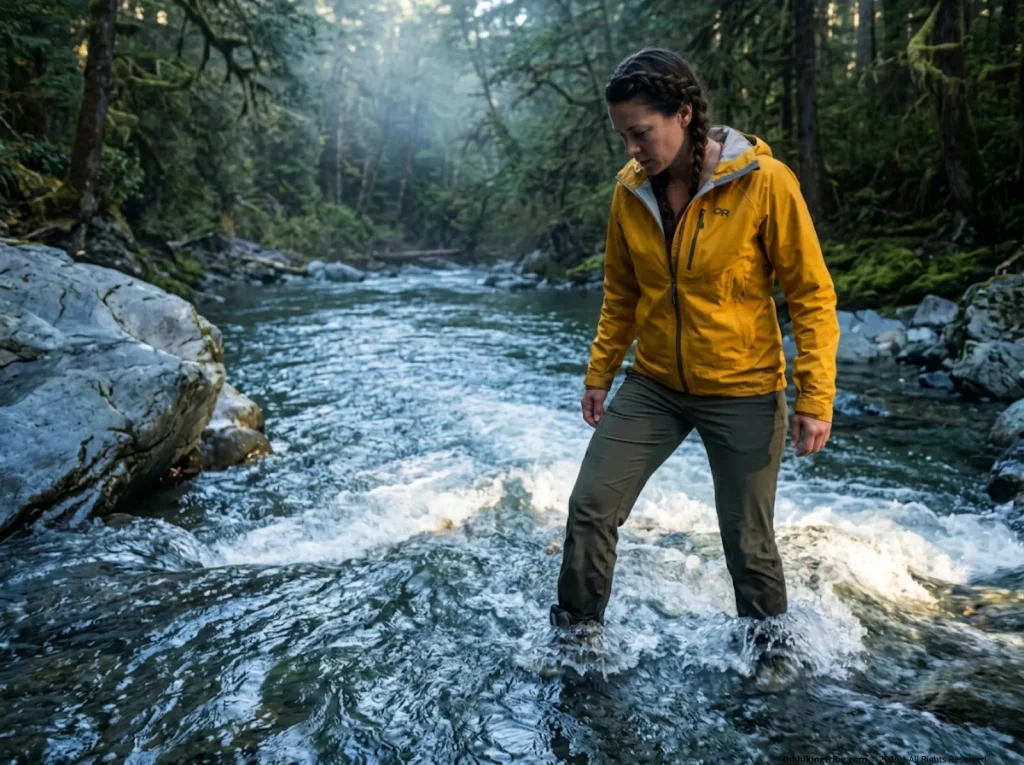
Water weighs roughly 62 pounds per cubic foot. It’s dense, non-compressible, and completely indifferent to your fitness level or your confidence. What most hikers don’t understand — what the NPS bullet points fail to communicate — is how quickly the force compounds as speed increases.
The key phrase is the square of velocity. When a river’s surface speed doubles, the drag force pressing on your body doesn’t double — it quadruples. If the speed triples, that force is nine times what you felt at the starting speed. And the muscular output required to stay stationary against that current increases as the cube of velocity, meaning a current twice as fast demands eight times the energy to resist. Your legs have no frame of reference for that difference. You feel slightly wobbly, and then you’re gone.
The physics of moving water explained by the Pacific Crest Trail Association validates this velocity-squared principle in the context of hiker safety. What the PCTA doesn’t spell out is how quickly it matters on trail-width crossings.
Turbulent flow compounds this further. Most wilderness rivers flow turbulently — boulders, uneven beds, and submerged logs create swirling eddies and vertical lift components that can actually pull your feet off the substrate. Crystal-clear, “glass-smooth” water at a river constriction can be laminar only at the surface. The turbulence underneath is invisible and pulling.
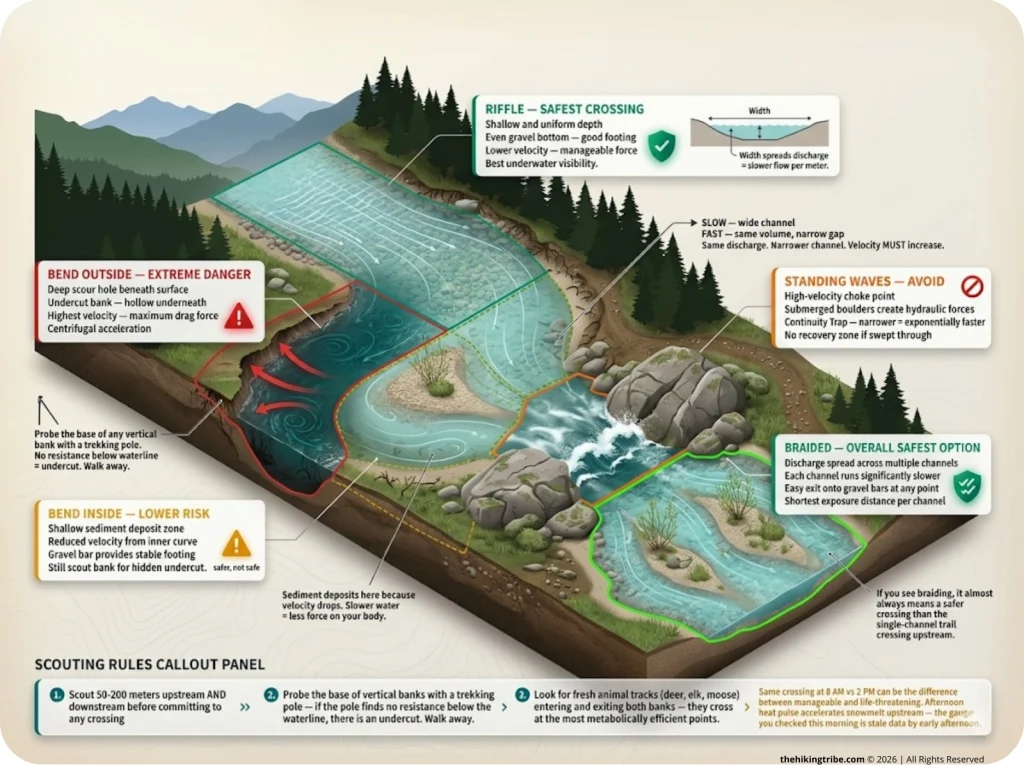
The other factor hikers miss is channel geometry and the Continuity Trap. Total river discharge stays constant. Narrow the channel, and velocity must rise. A wide, braided crossing isn’t prettier — it’s fundamentally safer because that same volume of water is spread across a larger area, so each channel runs slower. Trail markers don’t follow hydrology. The designated crossing is often at a bend or narrows placed there decades ago for convenience, not safety. Always scout 50–200 meters upstream and downstream before you commit to the marked spot.
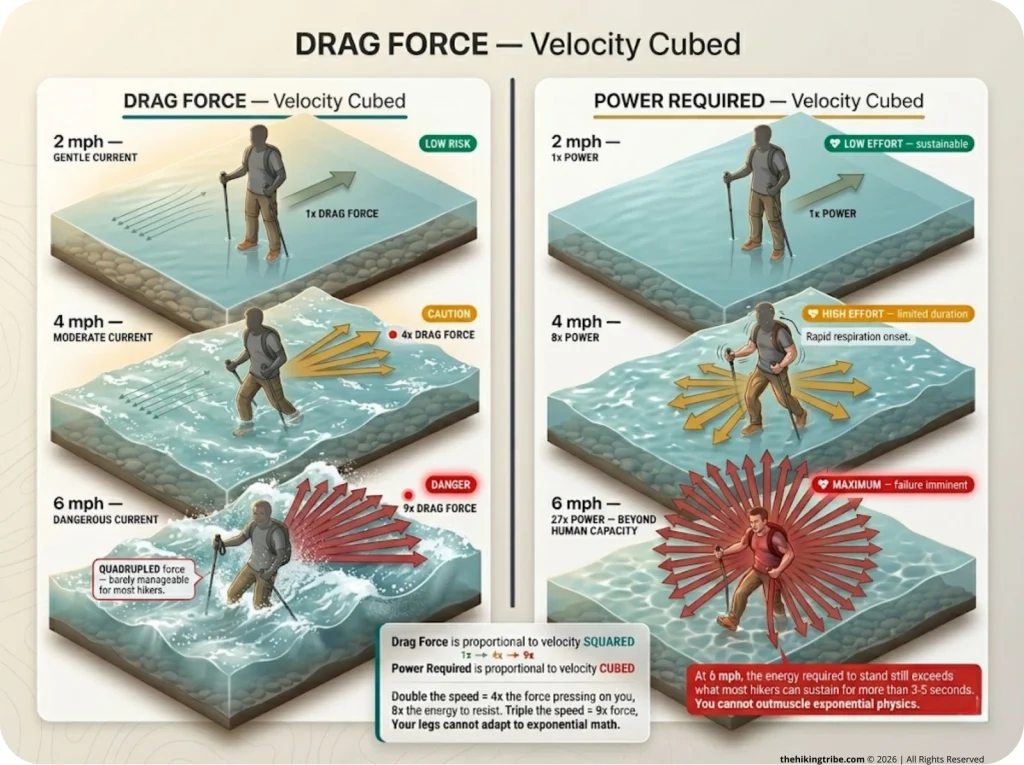
Pro tip: USGS stream gauges at waterdata.usgs.gov report flow in cubic feet per second (CFS). On most trail-width crossings, a reading above roughly 150 CFS is a meaningful alarm threshold — that’s the point where the gap between what a crossing looks like and what it feels like begins to matter.
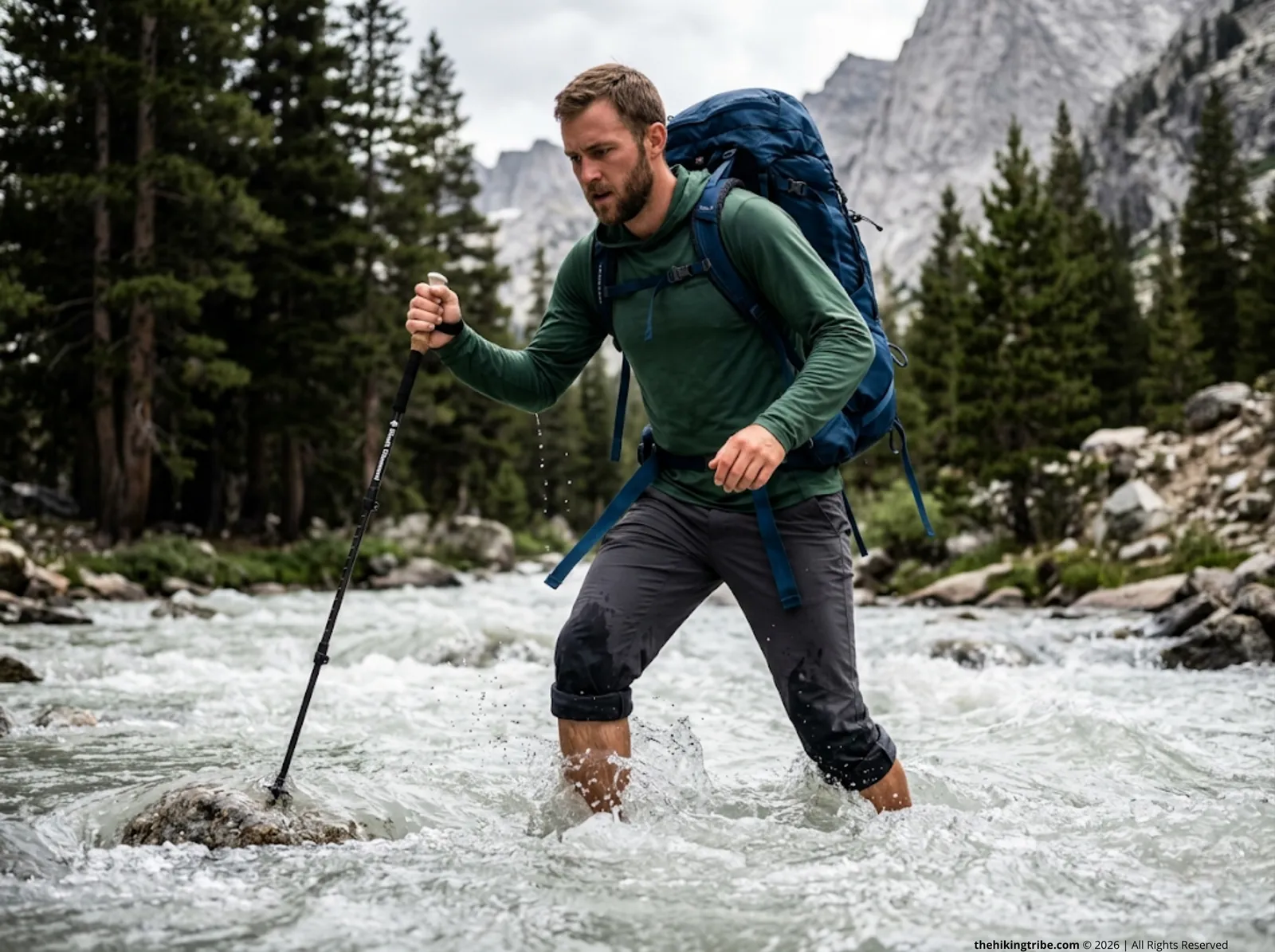
Understanding how trekking poles function within this force equation is the next piece. Poles don’t fight the current — they create a third point of contact that keeps you stable long enough to manage each shuffle-step.
Mistake #1 — The Undone Buckle
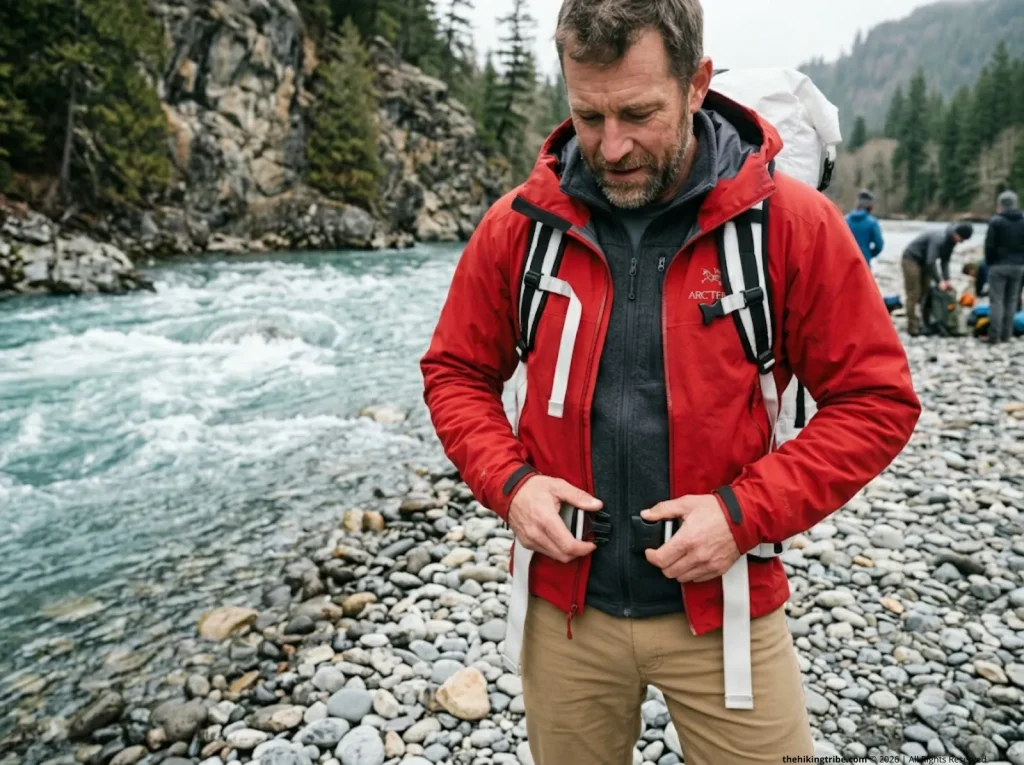
This one is documented in multiple fatalities on the Appalachian Trail, and it’s still the most common mistake on backcountry fords. Hikers skip unbuckling because they’re worried about losing their pack. That calculation is backwards.
Modern backpacks — especially those with closed-cell foam padding or gear packed in dry bags — have real buoyancy. When you fall face-forward in swift current, the buoyant pack rises while your torso sinks. If the sternum strap and hip belt are clipped, they form a cage: you can’t rotate, can’t surface, can’t shrug it off. If that pack then snags on a submerged root or rock, it becomes a fixed anchor while the current continues to rotate your body downstream.
The NPS river crossing safety protocol for pack release makes unbuckling mandatory before entry — and this is precisely why. It’s not bureaucratic caution. It’s mechanical reality. Eighteen inches of water and a buckled pack can prove fatal for a fit adult.
The correct pre-entry sequence: hip belt first (the heaviest anchor point, and freeing it also opens up your swimming kick), sternum strap second (chest compression makes it harder to breathe through cold shock hyperventilation), shoulder straps loosened but not removed — a shed pack can still function as makeshift flotation if you grip one strap with the pack held in front of your body.
One more thing worth knowing: understanding which gear actually floats when your pack hits water matters here. A Nylofume liner that traps air dramatically increases your pack’s buoyancy — which is exactly the air-trap lever mechanic that pins a buckled hiker face-down.
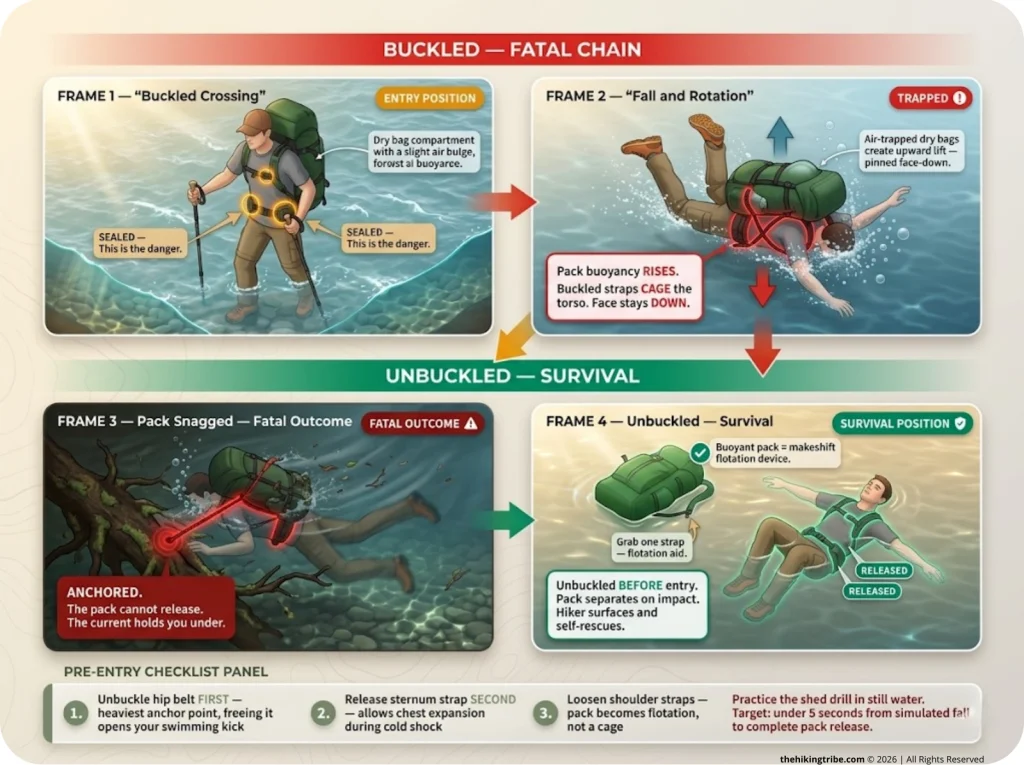
Pro tip: Practice the pack-shed drill in still water before any high-flow season. Time yourself from simulated fall to complete shed. Under five seconds is the target. Most people need three or four attempts before the muscle memory is there.
Mistake #2 — Crossing Barefoot

The logic sounds reasonable: keep your boots dry, cross barefoot, change back on the other side. The problem is that bare skin on algae-covered, silt-coated rock has near-zero grip. You are not skating on that substrate — you are sliding on it. The fall probability isn’t slightly higher. It’s substantially higher.
Beyond raw grip, there’s impact protection. When your bare foot lands on a sharp rock mid-crossing — or you feel unexpected pain from a submerged edge — the reflexive flinch causes a momentary balance break. In a current with enough velocity to matter, that lapse is all it takes for drag to take over.
The footwear choice for technical crossings comes down to three real options. Felt soles provide superior grip on algae-covered stone because the individual fibers conform to microscopic surface irregularities — but felt transports invasive aquatic species (specifically Didymosphenia geminata, or “Didymo”), and many Western states have banned felt soles outright. Check local regulations before you bring them.
Modern sticky rubber — Vibram Megagrip or Idrogrip — closes most of that gap. The softer compound deforms around the rock surface rather than just resting on top of it. In cool, fast water, Megagrip can actually outperform felt on mixed wet-to-dry terrain. For which rubber compounds actually grip wet rock, field test data on Shore hardness and wet-surface traction breaks down exactly where each compound performs and fails.
Studded rubber — aluminum or carbide cleats over rubber — bridges the remaining performance gap on the worst round, moss-covered cobbles. For heavily forded routes in places like Wrangell-St. Elias or New Zealand tramping circuits, carrying dedicated studded wading boots is weight justified by the risk environment.
The principle underneath all of it: never sacrifice traction for dry feet. A wet boot dries in an hour of walking. A swept hiker in Class III water does not self-rescue reliably, even with everything else going right.
Mistake #3 — Picking the Wrong Spot
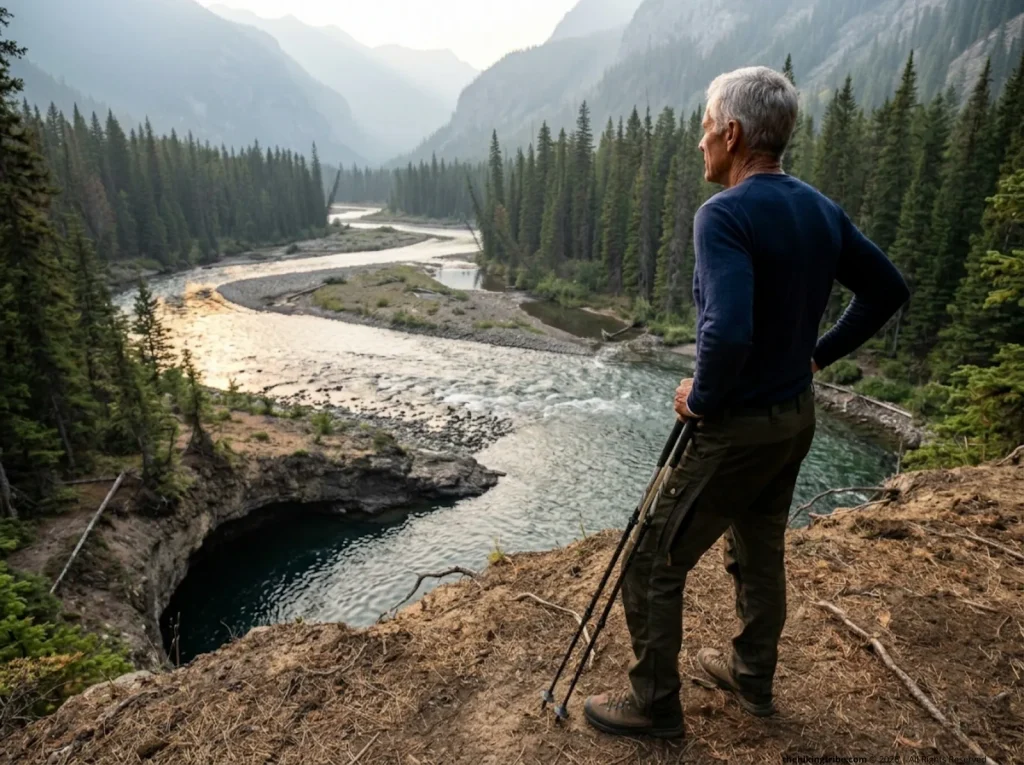
Trail markers at river crossings are chosen for proximity to the trail, not hydrology. The designated crossing may sit at a bend, a narrows, or directly upstream of a strainer — and no one put a sign on the map explaining why that’s hazardous.
The outside of every river bend is a high-energy zone. Centrifugal force accelerates water into the bank, scouring a deep hole at the base. The bank then erodes from below — creating undercut banks that are invisible from the surface and nearly impossible to self-rescue from once a hiker is pressed against one. They look like flat-topped ledges from above. They’re hollow underneath.
Probe the base of any vertical bank section with a trekking pole before you step near it. If the pole finds no resistance below the waterline, there’s an undercut. Walk away.
The scouting target profile is wide, straight, and shallow — a riffle zone. Small, closely-spaced ripples mean you’re looking at a flat, sandy or gravel bottom with uniform depth and lower velocity. Large standing waves mean submerged boulders or a high-velocity chute. Braided channels — where the river has split its discharge across multiple gravel-bar corridors — are almost always the safer option on the same river stretch.
One legitimate backcountry scouting resource that rarely gets mentioned: animal tracks. Deer, elk, and moose cross rivers at the most metabolically efficient points. Fresh tracks entering and exiting on both banks are worth following.
Before you enter any crossing, identify the downstream hazard zone within 100 meters. Strainers — fallen logs, root balls, boulder piles — allow water through but trap solid objects. A strainer spanning more than a third of the channel width is a significant hazard. Plan your route with a rigorous pre-trip planning protocol that includes river hazard assessment — USGS gauge data, topo reading for canyon pinch points, and a confirmed bailout plan downstream.
The afternoon timing piece is worth stating clearly: in Sierra Nevada snowmelt rivers, the same crossing that felt manageable at 8 AM can be genuinely life-threatening by 2 PM. Heat pulse from the afternoon sun accelerates melt upstream. The gauge reading you checked in the morning is not current data by early afternoon.
Mistake #4 — Ignoring Cold Water
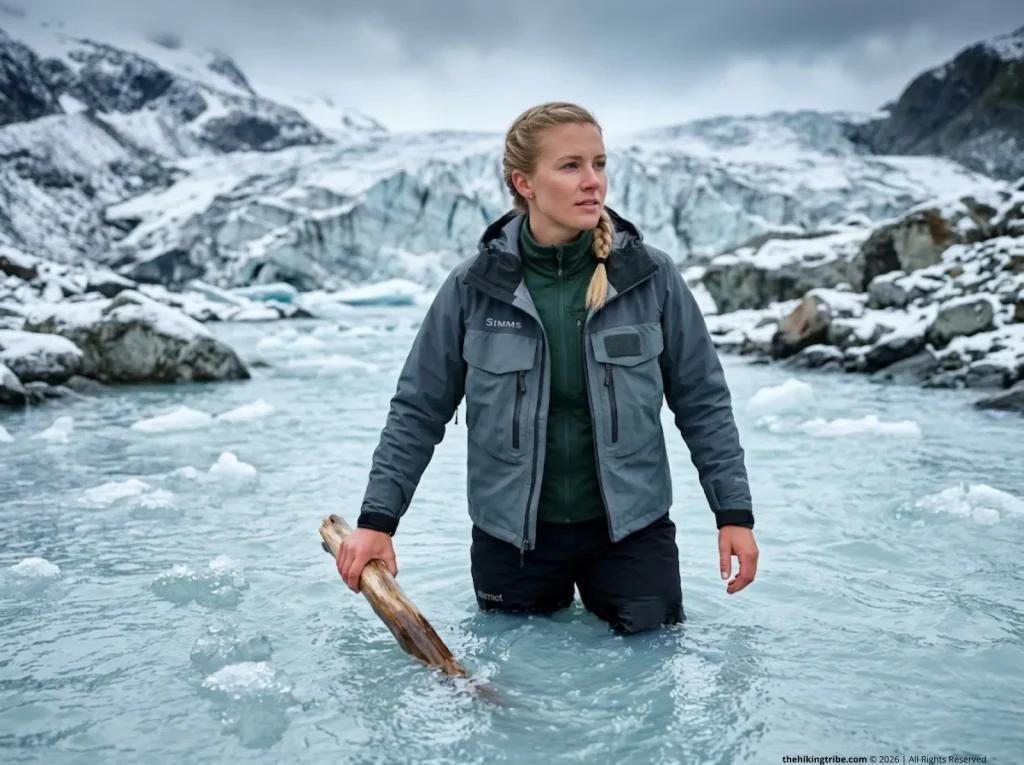
Most people who fall into cold wilderness rivers don’t succumb to hypothermia. They go under in the first ten minutes — before their core temperature has barely moved. This distinction is the most important thing you can take away from this article.
The framework that explains it is the 1-10-1 Rule, developed by Dr. Gordon Giesbrecht — known in cold-water research circles as “Professor Popsicle.” The rule describes three phases of cold water survival, and it reframes every decision you make near a cold river.
Phase 1 — Cold Shock (0–1 minute). The moment you hit water below 59°F (15°C), the gasp reflex fires involuntarily. You cannot suppress it with willpower or training. In that first breath, if your head is underwater, you can inhale one to three liters of water — enough to cause laryngospasm or immediate respiratory failure. Breathing rates spike 600–1,000% above normal. You can’t coordinate swim strokes. You can’t hold your breath. The only survival priority in this phase: keep your head above water. Don’t try to swim yet. Let the gasp complete.
Phase 2 — Swim Failure (1–10 minutes). Your body constricts blood flow to your limbs to protect core temperature — peripheral vasoconstriction. Cold water strips heat from peripheral muscle tissue 25–30 times faster than cold air does. The muscles in your hands and arms don’t stop working all at once — they fade. The grip that was adequate at minute one is unreliable by minute four. Any self-rescue action: rope grab, bank pull, unbuckling gear — must happen in this window. Wait too long and the window closes.
Phase 3 — Hypothermia (toward 1 hour). Clinical hypothermia doesn’t produce unconsciousness in most adults for 30–60 minutes in near-freezing water. That’s the final stage, not the first hazard. Cold-water physiology as documented by the Wilderness Medical Society confirms that 60% of cold-water fatalities occur within the first 15 minutes — before true hypothermia is physiologically possible.
The layering choice for high-risk crossings matters. Wool and synthetic base layers retain some thermal function when wet — they reduce the heat transfer rate to the swimming muscles and buy additional minutes of function. Cotton loses all insulating value at saturation and accelerates heat loss. Gore-Tex hardshells create a survival paradox: they trap heat for the first 30 seconds, but once water enters at the collar, they form a sealed pool that accelerates core cooling. For crossings with serious fall risk, remove the hardshell before entry.
For what happens after a cold-water rescue — once the victim is on the bank and heat replacement begins — the full hypothermia treatment protocol for backcountry responders is the complete reference.
Pro tip: In water below 50°F (10°C), you have roughly 3–7 minutes of meaningful self-rescue function after immersion. That window starts the moment you hit the water, not when you decide to try. If you know you’re crossing cold water with real fall risk, your rescue plan needs to be already mapped before you step in.
Mistake #5 — Wrong Body Position After a Fall
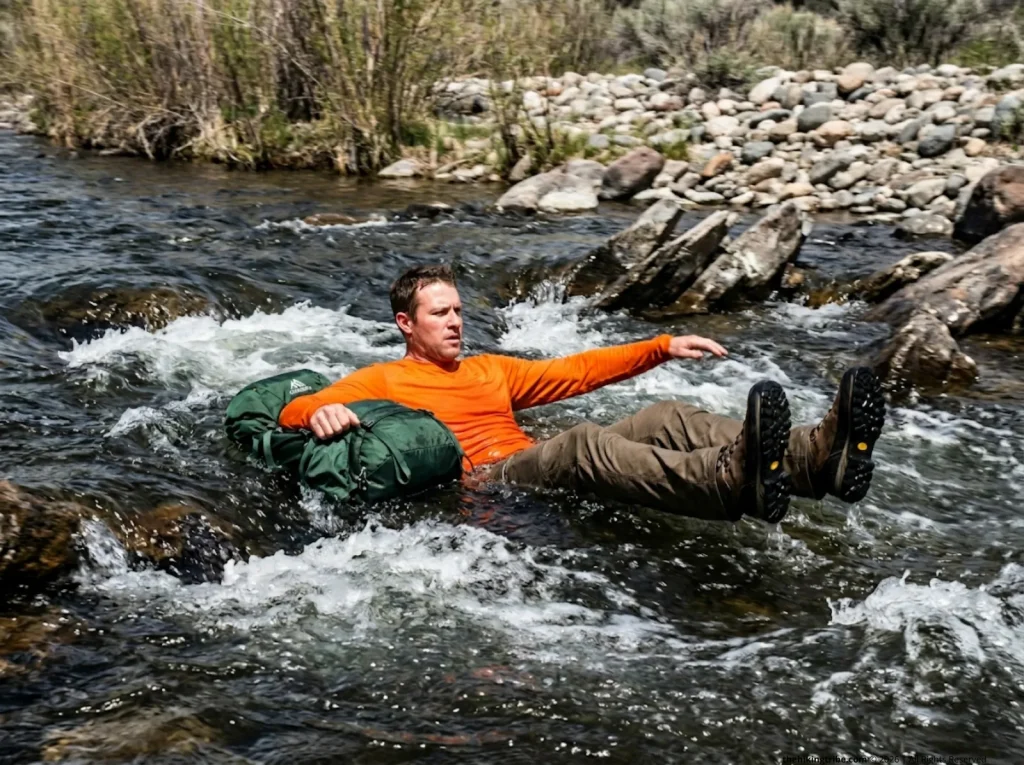
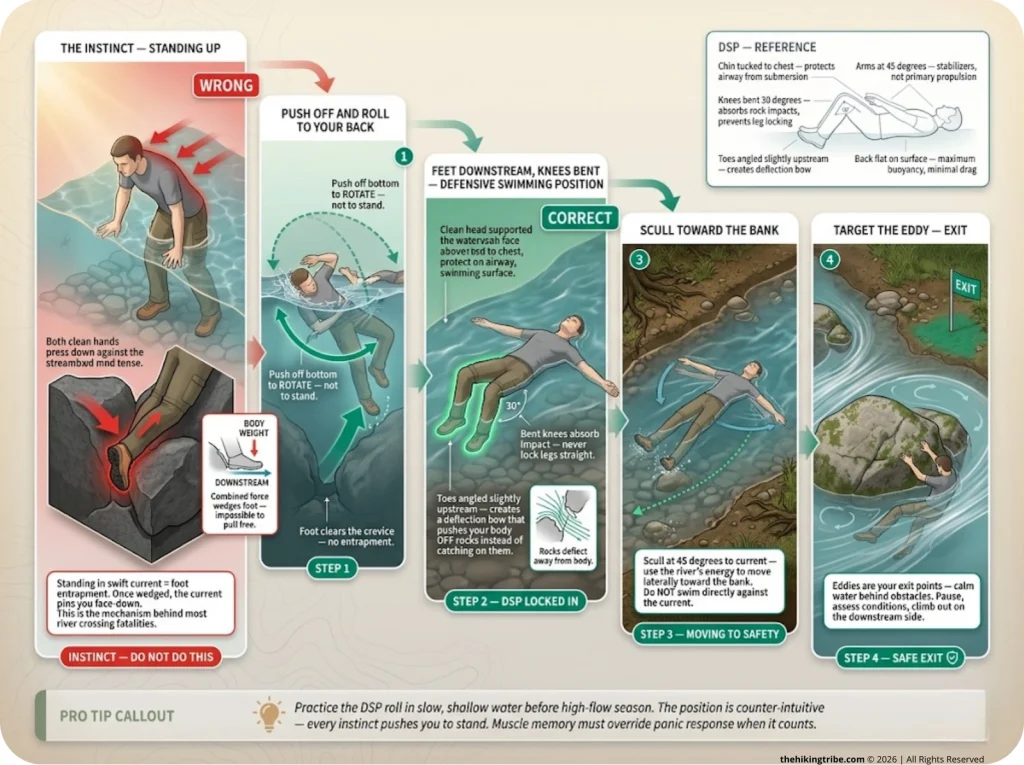
When you fall in moving water, every reflex in your body tells you to stand up. Both hands go to the streambed, you push up, you try to plant your feet. This is the reflex that gets people into fatal trouble.
In a swift current, trying to stand creates foot entrapment. The drag force on your upper body — greater surface area, carried by the current — exceeds the grip of your feet on the substrate. The current folds you forward over the planted foot, driving your face downstream and under. The foot jams into a crevice under combined body weight and current force. At that point, it is physically impossible to pull free. The Appalachian Trail Conservancy river crossing safety protocols identify foot entrapment as a leading mechanism in river crossing fatalities — distinct from cold shock or hypothermia.
The correct response to a fall is the Defensive Swimming Position (DSP): on your back, feet pointed downstream, knees bent roughly 30 degrees, chin tucked, arms out from your body at 45 degrees as stabilizers. Push off the streambed if you have any footing — not to stand, but to rotate into that horizontal, face-up position.
From the DSP, toes angled slightly upstream create a deflection bow that pushes you off rocks rather than catching on them. Gentle sculling strokes at 45 degrees to the current — angling toward the bank — use the river’s own energy to help move you laterally. Target eddies: the calm water on the downstream side of boulders or bank protrusions. That’s where you can pause, assess, and exit.
For groups, two formations boost survival odds significantly. The V-Wedge (five or more people): the heaviest and strongest member at the apex, facing upstream. The apex member breaks the current and creates a reduced-pressure eddy directly behind them — subsequent members experience measurably less drag. The Line Astern (two to four people): arms linked around waists, creating a merged mass that resists drag force. Strongest member anchors the upstream end.
Pro tip: The DSP body position is counter-intuitive. Every instinct pushes against it. Before a high-flow crossing season, practice the roll in slow, shallow water so that the muscle memory overrides the panic response when it counts.
If the DSP fails and you wash up injured on a bank, the next phase is the wilderness first aid protocol for a hiker who has been swept downstream — patient assessment, evacuation triggers, and the post-rescue collapse risk that can produce cardiac arrest after cold-water extraction.
Conclusion
Three things worth anchoring before your next high-flow season:
Physics doesn’t negotiate. When water speed doubles, drag force quadruples and your ability to stay upright changes faster than your nervous system can register the difference. The survival matrix number that matters most is velocity — and it compounds everything else.
The Mistake Chain is predictable and preventable. Buckled pack plus bare feet plus wrong crossing point plus wrong body position after a fall equals a foreseeable outcome. Remove one link and the chain breaks. The protocols aren’t excessive caution — they’re load-bearing structure.
The 1-10-1 Rule is the most important three numbers you’ll carry this season. One minute of cold shock, ten minutes of meaningful swim function, one hour before hypothermia takes over. The window for self-rescue is shorter than most hikers believe — and it starts at the moment of immersion, not when you decide to act.
This season, before any significant crossing, run two criteria: check the USGS gauge for your planned route, and make the unbuckle drill automatic. Then find the riffle, read the downstream hazard zone, and cross in the morning before the heat pulse hits. The river will still be there at 2 PM. You want to be on the other side before then.
FAQ
How deep of a river can you cross safely?
Depth without velocity data is meaningless as a safety measure. Knee-deep water moving at 3 mph generates enough drag force to destabilize most adult hikers. The functional threshold most experienced guides use: if water reaches your thigh and you feel unstable with a pole anchored on the upstream side, do not proceed. Cross only where you could brace one arm free and maintain three points of contact.
Should you wear your hiking shoes when crossing a river?
Yes — always. Bare skin on algae-covered, submerged rock has near-zero friction. A quality rubber-compound or felt-soled boot worn through the crossing and dried afterward is the standard protocol used by PCT thru-hikers and professional guides alike. The cost is wet feet for an hour. The alternative cost is a fall in swift current.
What do you do if you get swept away in a river?
Roll immediately onto your back, feet pointed downstream, knees slightly bent — the Defensive Swimming Position. Do not try to stand. Foot entrapment in swift current is often unsurvivable. Scull with both hands toward the nearest bank or downstream eddy. Your first priority in the initial 60 seconds is keeping your head above water through the cold shock gasp reflex phase.
What is the best technique for crossing a river solo?
The Tripod Method. Face upstream, lean slightly into the current at roughly 45 degrees, and plant a trekking pole on the upstream side as your third point of contact. Use a shuffle-step — slide feet sideways along the bottom rather than lifting them. Lifting a foot increases your submerged profile area and reduces you to two contact points. Angle your exit trajectory 30–45 degrees downstream, not perpendicular to the current.
Is it better to cross a river upstream or downstream of obstacles?
Always upstream of strainers, logjams, or rapids. Crossing downstream places you directly in the evacuation zone if you fall and removes your ability to abort into calmer water above the obstacle. The exception: if a large stable boulder creates an eddy on its downstream side wide enough to stand in, staging to that eddy mid-crossing can be tactically sound. But the default rule — cross upstream or downstream of anything hazardous — holds in almost every scenario.
Risk Disclaimer: Hiking, trekking, backpacking, and all related outdoor activities involve inherent
risks which may result in serious injury, illness, or death. The information provided on The Hiking Tribe is for
educational and informational purposes only. While we strive for accuracy, information on trails, gear, techniques,
and safety is not a substitute for your own best judgment and thorough preparation. Trail conditions, weather, and
other environmental factors change rapidly and may differ from what is described on this site. Always check with
official sources like park services for the most current alerts and conditions. Never undertake a hike beyond your
abilities and always be prepared for the unexpected. By using this website, you agree that you are solely
responsible for your own safety. Any reliance you place on our content is strictly at your own risk, and you assume
all liability for your actions and decisions in the outdoors. The Hiking Tribe and its authors will not be held
liable for any injury, damage, or loss sustained in connection with the use of the information herein.
Affiliate Disclosure: We are a participant in the Amazon Services LLC Associates Program, an
affiliate advertising program designed to provide a means for us to earn advertising fees by advertising and linking
to Amazon.com. As an Amazon Associate, we earn from qualifying purchases. We are also an official affiliate partner
of Black Diamond Equipment via the AvantLink network. If you click on a Black Diamond affiliate link and make a
purchase, we may earn a commission at no additional cost to you. We also participate in other affiliate programs and
may receive a commission on products purchased through our links. Additional terms are found in the terms of
service.