









The first twenty steps out of the tent set the tone for the day: the heel feels like a bruise, and the sandal that was so comfortable at home turns out to be the reason. Or it is two miles later and your toes catch a root, because the front of your foot will not lift. Those are two different feet with one shopping list that suits neither well, and the medical guidance draws the line between them more cleanly than any gear page does.
This guide to hiking sandals for foot conditions covers what each problem needs underfoot, what “drop” means (it means two different things), the pairs that cover both halves, why descents are where a sandal fails, and how to prove a pair before the trail does it for you. Whether you call them hiking sandals or walking sandals, the same construction rules apply. Here is the short list by condition.
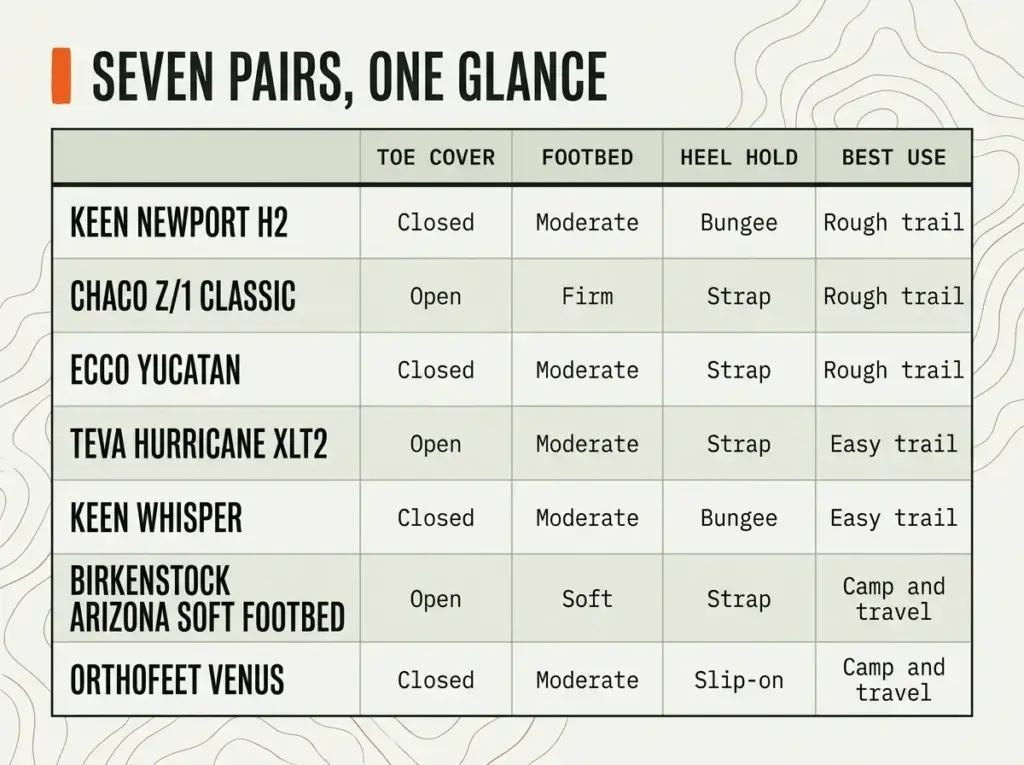
| What you are dealing with | What the sandal must do | A pick that does it |
|---|---|---|
| Plantar fasciitis | A firm, shaped arch and a deep heel cup | Chaco Z/1 Classic |
| Plantar fasciitis, with an orthotic already in the shoe | A closed toe and arch support built into the included insole | Orthofeet Venus (women’s) |
| Toe drag or a trip-prone front foot | A closed front with a toe bumper and a heel the strap locks | KEEN Newport H2 |
| The same need in a lighter women’s last | A covered toe without the bulk | KEEN Whisper |
| Both problems at once | A closed toe plus a shaped footbed | KEEN Newport H2 or ECCO Yucatan |
| Smooth paths, camp and travel | A contoured, firm footbed (not for wet roots) | Birkenstock Arizona Soft Footbed |
| A first supportive pair on a small budget | A shank and a molded footbed | Teva Hurricane XLT2 |
| Significant foot drop | A brace or orthosis first, per Mayo Clinic; no sandal replaces it | None. See a healthcare professional |
Hiking Sandals for Foot Conditions: Two Problems, Not One
Plantar fasciitis and a dragging toe get lumped together because both show up as “my feet hurt on the trail” and both send people shopping for sandals. They are different failures. One is a load problem in the tissue under the heel and arch. The other is a lift problem at the front of the foot.
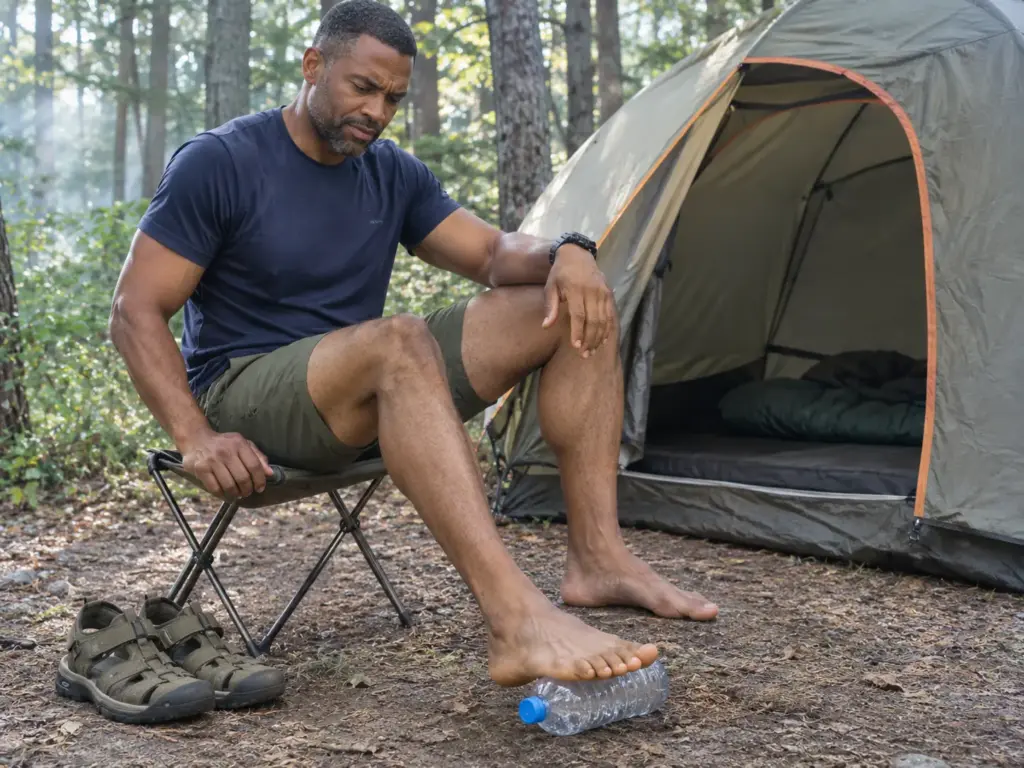
The word “drop” muddies it further, since sandal shopping uses it for two unrelated things: foot drop, also written drop foot or toe drop (the toe that will not lift) and heel-to-toe drop (the height difference between heel and forefoot on the footbed). This guide says which one it means every time.
Plantar Fasciitis: A Heel and Arch Loading Problem
Plantar fasciitis is irritation of the band of tissue that runs under the foot, and it hurts most where that band pulls on the heel. The classic pattern is stabbing pain on the first steps after a night’s sleep or a long sit, easing as the foot warms up and returning after long standing, as laid out in Mayo Clinic’s overview of plantar fasciitis.
That is why the diagnostic moment is the walk from the tent to the stove, not mile ten. Flat feet and high arches both sit on the list of risk factors, along with an unusual walking pattern and old shoes that have lost their support.
It is not a rare complaint. The American Academy of Orthopaedic Surgeons’ guidance on plantar fasciitis puts treatment at about 2 million patients a year in the United States, and more than 90 percent improve within 10 months of simple treatment. A supportive shoe is a reasonable first move, not a last resort.
The same guidance says a cushioned shoe or insert reduces the tension that spikes at heel strike, and it tells patients to avoid shoes that do not provide support or are worn out. The camp sandal you have owned for six summers fits that last description, however good it feels on the couch.
Toe Drop and Foot Drop: The Front of the Foot That Will Not Lift
Foot drop is another animal. It is difficulty lifting the front part of the foot, so the toes can drag on the ground and the walk turns into a steppage gait, with the thigh lifting higher to clear the foot, according to Mayo Clinic’s explanation of foot drop. On a trail, every root and rock lip becomes a trip hazard, and the tripping risk climbs once a loaded pack is on, because a stumble is harder to catch.
Mayo also states the limit plainly: a person with foot drop might need a brace on the ankle and foot to hold the foot in position, and dragging toes are a reason to consult a healthcare professional.
That brace is often called an ankle-foot orthosis, or AFO, and a physical therapist or doctor is who decides whether one is needed. A sandal protects the toes and holds the heel. It does not lift the foot. Diagnose first, shop second.
Why “Support” Means Different Things for Each
Both feet share one enemy, the floppy, unsupportive sole. After that they split.
A sore heel wants shape and firmness underfoot: a footbed that cradles the arch and a deep heel cup that spreads the load. A dragging toe wants cover and a locked heel: a closed front and a strap that stops the foot sliding forward.
Some of the “soft and squishy” advice that circulates for plantar fasciitis works against the toe that catches. A memory foam footbed feels kind to a sore heel, but a loose, squashy sandal is the one that lets the foot slide until the toes find the root. The logic is the same one behind why flat feet need a stiff, shaped base and not a soft one, which the page on why flat feet need a stiff, shaped base and not a soft one works through for shoes.
What a Plantar Fasciitis Sandal Needs Under the Arch
Open any sandal listing and “arch support” appears four times, yet two of those pairs feel like a plank and one feels like a cloud. The words on the box tell you nothing; the construction does.
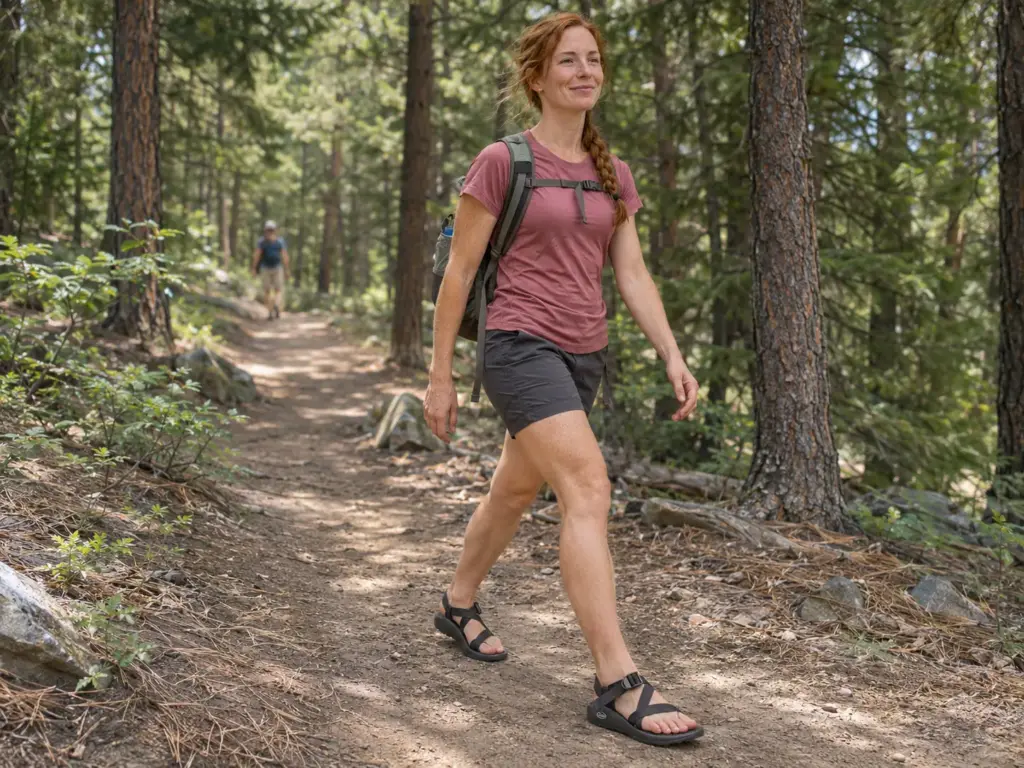
The Feature Checklist
A sandal that will carry a sore heel through a day on the trail has these:
- A firm, contoured footbed that shapes itself under the arch
- A deep heel cup that holds the heel pad in place
- Real heel cushioning, springy and not mushy
- A sole that does not fold in half under a load
- Straps that lock the heel so the toes never have to claw to keep the sandal on
The last item is the quiet one. Toe clawing is the all-day load that thin flip-flops put on the fascia: the toes grip to hold the sandal on, and the tissue under the arch pays for it with every step.
Shape matters more than softness, and there is evidence for it.
In a 2001 cadaver study on heel elevation and plantar-fascia strain, published in the Journal of the American Podiatric Medical Association, raising the heel on a platform that simulated a shoe’s contoured arch profile reduced strain on the plantar aponeurosis at the loads tested, while the same elevation on plain blocks did not change it. A wedge with a flat deck buys nothing. The study also reports contrasting results across individual specimens, so a sandal that fixed one person’s heel may do nothing for the next foot, and that variation is in the data rather than in any marketing copy.
If the heel is already sore enough that a boot is on the table too, here is how the same sore heel is handled in a boot, with an insole test.
Chaco Z/1 Classic (men’s and women’s)
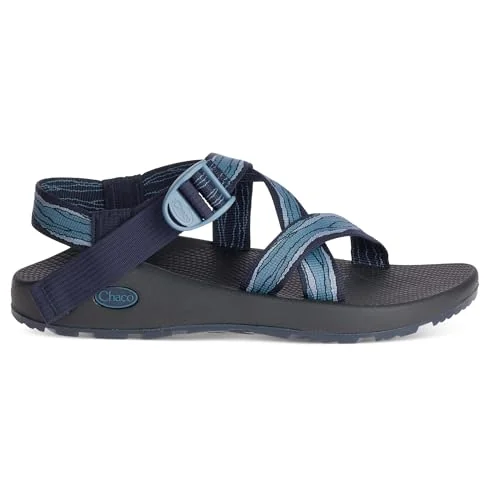
The Chaco Z/1 Classic (men’s · women’s) is the closest thing in a sandal to the contoured platform that study used. Chaco lists a PU midsole called LUVSEAT, one continuous strap through the footbed and 3 mm ChacoGrip lugs, with the women’s pair at 10.65 ounces. The strap does the second job quietly: it wraps the foot from heel to instep, so the heel stays seated instead of drifting toward the front.
The honest weak point is the arch. It is high and firm, which is the whole point for some feet and a problem for others. The same Chaco arch is the hero for one flat-footed walker and unbearable for the next, so put it on in the house and give it a lap before you trust it with a trail. Open toe is the other limit: if the front of your foot drags, read the toe-guard section below before you click anything here.
When You Want the Insole Built In: Orthofeet Venus
Some readers want the orthotic already inside the shoe and a covered toe in the same package. The Orthofeet Venus is built for that: Orthofeet describes a closed-toe, stretchy, hands-free slip-on with arch support in the included orthotic insole, padded cushioning, a wide toe box and a grippy sole. The closed toe and the arch arrive together instead of one being traded for the other. It is women’s only.
Treat it as a travel-and-easy-trail sandal, not a rock-scrambling one. A slip-on also gives up the strap that locks the heel, so run the heel-hold check described later in this guide before it goes on a descent.
The Toe Guard: What a Dragging Toe Needs in a Sandal
A toe that drags will find the one root on the trail. The other toe never gets the chance, because a bumper took the hit. Everything in this section follows from that difference.
Why a Covered Front Is the Feature
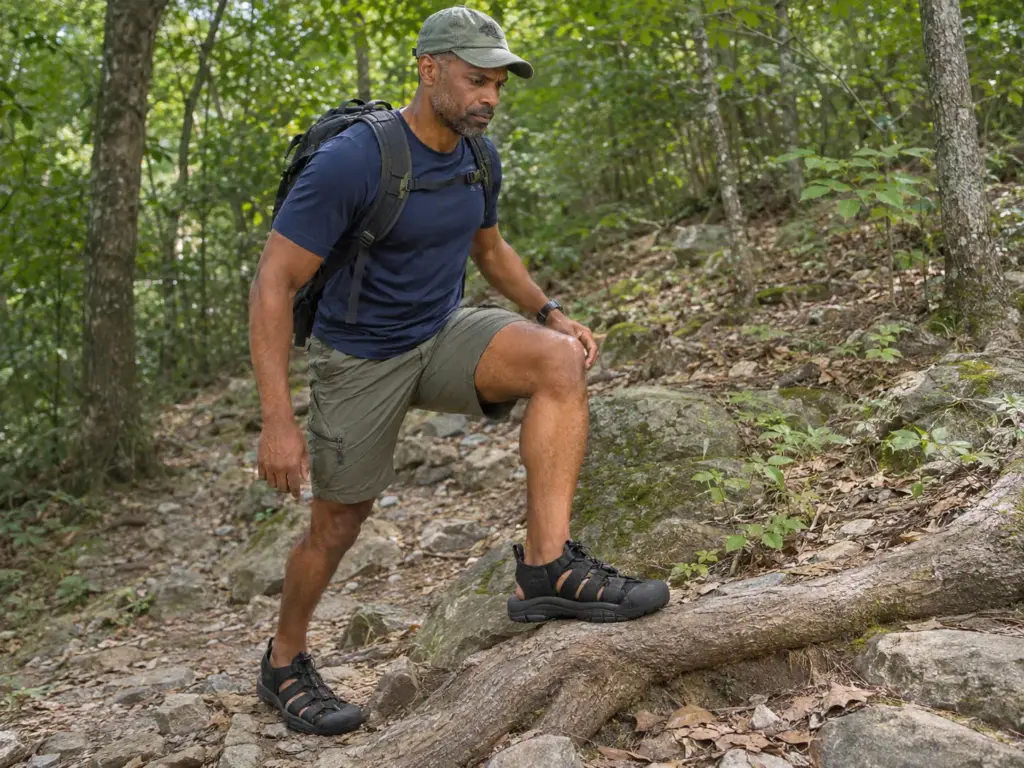
Open-toe straps leave the toes in the path of every rock lip and root. For a foot that drags, the cover is the feature, not a style choice. A closed-toe sandal with a protective toe bumper takes the impact instead of the toenail.
Closed toes cost some weight and let grit in through the open sides, while open toes are lighter and cooler and wrong for a toe that catches, so the trade is easy to make once you know which problem you have. The water-shoe middle ground exists too, and for the general picture there is a full breakdown of how open-toe and closed-toe hiking sandals compare in general.
A Heel That Cannot Lift
The second need is a heel that stays put. A foot that cannot lift its front will also slide forward in a loose sandal, and then the toes are no longer behind the bumper, they are against it. Good strap security, meaning a secured heel strap and instep strap, keeps the foot in the back of the sandal, where the cover can do its job. If the heel pops up when you try to lift it, the strap is not locking it, and nothing in the front of the sandal can make up for that.
KEEN Newport H2 (men’s and women’s)
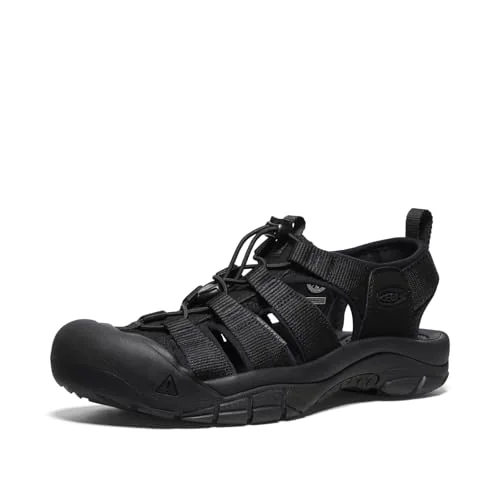
The KEEN Newport H2 (men’s · women’s) is where the two halves of this article meet. KEEN describes a closed toe with its toe bumper, a lace-lock bungee capture system and a non-removable footbed with added arch support. A bumper like that is only as good as the material and the shape of the part, and the page on what a good toe bumper should feel like in the hand explains what to press and bend when the pair arrives.
What the bumper does not do is lift the foot. KEEN states the mechanism and no official source measures a drop in trips, so treat the toe bumper as protection for the toes and the bungee as a way to hold the heel, nothing more. That is still a lot more than an open strap offers a foot that catches.
A Lighter Closed Toe for Women: KEEN Whisper
The KEEN Whisper is the lighter women’s route to the same idea. KEEN lists a women’s-specific last, a closed toe with an abrasion-resistant rubber tip, a bungee lace lock and a non-removable footbed with added arch support. It gives you toe protection without the Newport’s bulk, which matters on a warm day when a heavier sandal starts to feel like a boot.
Heel-to-Toe Drop: How to Read the Number on a Sandal
Picture a sandal in each hand, one listed as “zero drop” and the other as “supportive,” and no idea which number to look for. This section is the answer to that, and it starts with what the number measures.
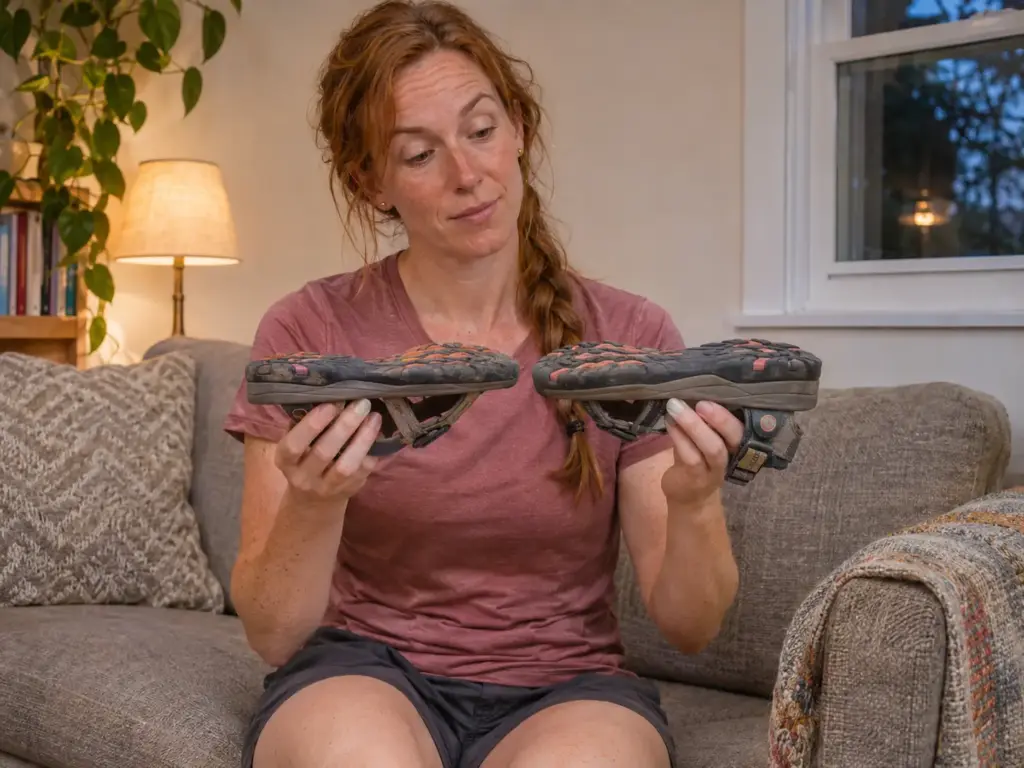
What Heel-to-Toe Drop Means on a Footbed
Heel-to-toe drop is the height difference between the heel and the forefoot on the footbed. Zero drop means both sit at the same height. A sandal’s drop is measured on the footbed itself, so it changes when you swap the insole, a detail the listing never mentions. For how the same number plays out higher up the leg, what heel-to-toe drop does to your knees covers it.
Why Zero-Drop Is a Red Flag for a Sore Heel
A zero-drop sandal loads the calf and the Achilles tendon more than a raised heel does. That is a field observation, not a medical rule, but it explains a fast mistake: jumping straight from a cushioned shoe into zero-drop or minimalist sandals with an inflamed fascia, before the calf is ready for the extra work. The heel hurts, the calf tightens, and the sandal gets blamed for a build-up that never happened. If your heel is sore right now, zero-drop is the one style I would skip, full stop.
Shape Beats the Millimetre
You will see a window of millimetres quoted as the ideal drop. No official source gives one, and this guide will not invent it. What the 2001 cadaver study found is that heel elevation helped only when the platform under the arch was contoured, and plain blocks did nothing. The shape under the arch decides it, and the millimetre figure is secondary.
Feet also vary. Some respond to a raised heel and some do not, which is in the data and not in the marketing.
In practice, look for a footbed that sits higher in the back than the front and is contoured under the arch. A shoe that sits higher in the back than the front is the usual advice for a sore heel, and a near-flat sandal with the right arch can still work. For women who want the question worked through in depth, there is a guide to plantar fasciitis sandals for women and the 10 mm question in depth.
When the sandal is nearly right and the footbed is the weak part, swapping the insole can raise the heel or reshape the arch. That is a different fix from buying a different sandal, and it is worth knowing which one you need before you spend anything.
Why Descents Break Sandals: Straps and Heel Hold
A sandal that feels fine on the flat can fall apart on one steep, loose descent with a loaded pack. The reason is physics, and it is worth understanding before you trust a strap.
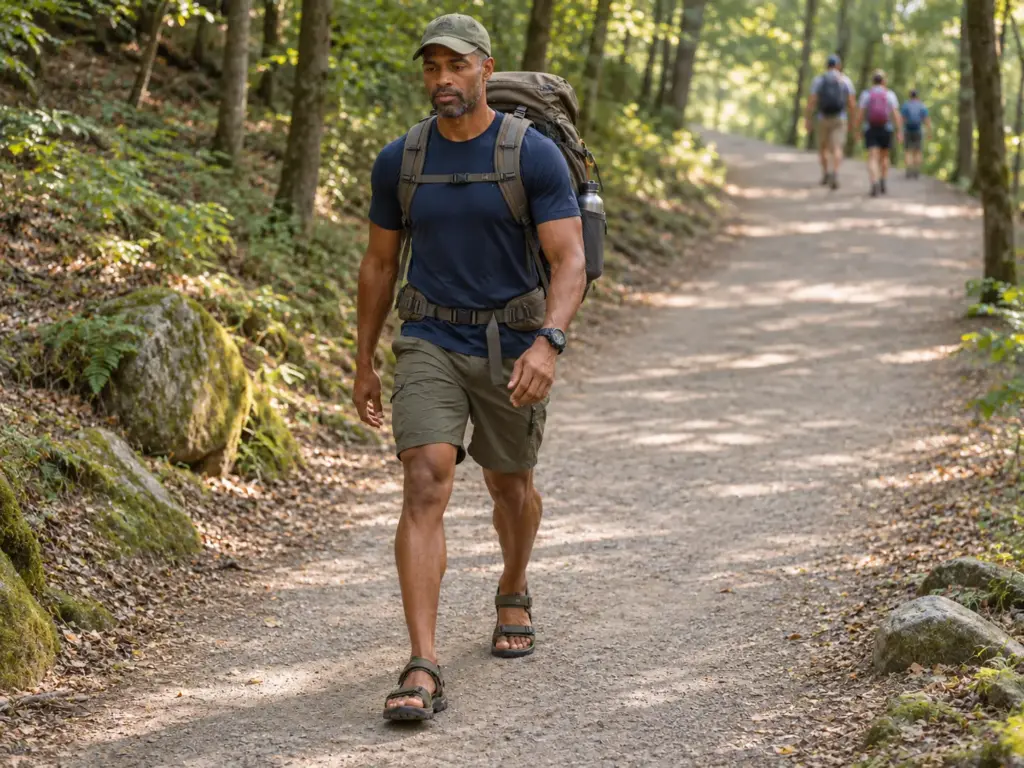
What Happens to the Foot on a Loaded Descent
On the way down, the pack pushes you forward and down. The foot slides toward the toes, the heel lifts out of the cup and the front of the foot jams into the end of the sandal.
Every strap gets tested at the same moment. For plantar fasciitis, that jam is a fresh source of heel pain. For a dragging toe, it is the instant the toes catch.
What fails, in order, is predictable: a loose heel strap, a footbed with no heel cup, a front that lets the toes jam, and a sole with no shank that folds under the load. All of this is a pattern of gear and terrain, not a clinical claim.
Tighten the heel strap before you touch the forefoot strap, every time you start down. Seat the heel first and the foot stays at the back of the sandal while the slope tries to push it forward. Reverse the order and you lock a sliding foot in place.
What Holds the Heel and What Does Not
What holds is a locked heel, either a bungee or a heel strap you can cinch, a deep heel cup and a closed front that stops the slide before it reaches the toes. What does not hold is a slip-on with no heel strap, a flat footbed and an open front. Wet descents add traction to the list: a sole that grips wet rock and roots, and a closed toe that stays on when the foot is soaked. If that sounds like your route, here are sandals that grip wet river rock on the way down.
When a Shoe Is the Better Call
A loaded, steep, loose descent is the one place where I would take a shoe or a boot instead. A sandal can do a lot on a trail, but it is not the right tool for every slope, and a sandal with a sore heel on a long scree descent is a bad bet for any foot.
How to Test a Hiking Sandal Before It Goes on the Trail
The reader on the living-room floor with a new pair is trying to find out in ten minutes what the trail will tell them in six miles. These are four checks this blog uses for that, and together they make a simple fit test. They are field checks, not clinical tests, and no official source publishes them; the only official line is the American Academy of Orthopaedic Surgeons’ advice to avoid unsupportive or worn-out shoes.
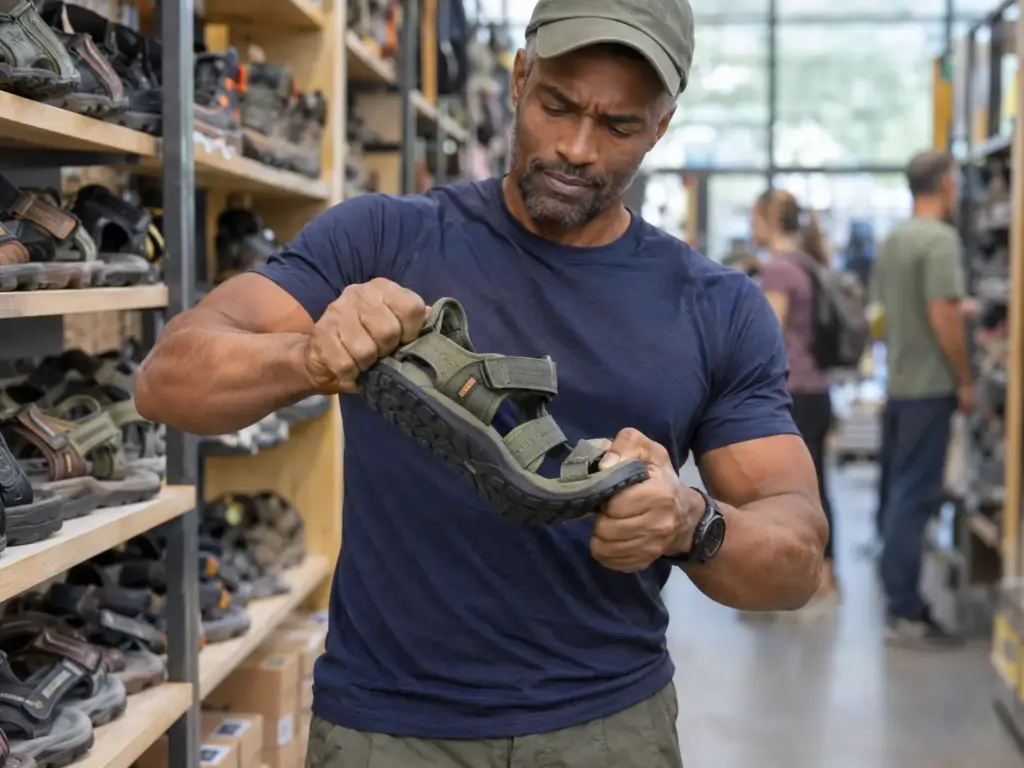
The Twist Test
Hold the sandal by the heel and by the toe and twist it like a wet towel. If the midsole twists easily, it will not hold an arch under a pack.
A shank is what stops the sandal folding in half, and Teva lists a nylon shank on the women’s Hurricane XLT2 Ampsole. A pair that fails the twist test is a camp slipper, not a trail sandal. For what the shank is and why it matters, see what the shank under the arch actually does.
The Heel-Hold and Toe-Clearance Checks
Step in, fasten every strap and try to lift the heel while the forefoot stays planted. If the heel pops out of the cup, the strap is not locking it.
Then, with a loaded pack on, step down off a curb or a stair. The toes should stay behind the bumper or the lip and clear the front edge of the sandal. If they brush it, the fit is wrong for a foot that drags.
The Walking Lap
Walk a few laps indoors and outside on pavement, then a flat mile in the socks you plan to wear. If a strap bites or the heel slides, you know what to change before the trail charges you for it. When any check fails, return the pair or swap the insole instead of hoping the problem breaks in.
Buy the pair early and wear it around the house for a few days before the trip. A new footbed and a stiff strap both behave differently once the foot has shaped them, and you want to find that out on a kitchen floor.
Fit, Swelling and Break-In for Sore or Dragging Feet
The foot that fit the sandal in the shop does not fit it at mile eight. Fit for a sore or dragging foot is a plan, not a size.
Swelling and Strap Adjustment
Feet swell over a long day, so the forefoot strap is the one to loosen at a break while the heel strap stays snug. Adjustable straps that open wide are a feature for a swelling foot, and hook-and-loop straps are the quickest to loosen and re-cinch at a break. Some wearers add socks, and some use open-toe compression sleeves; both are options and nothing more.
At every long break, open the forefoot strap and leave the heel strap alone. Re-cinch the forefoot gently before you start walking again. The heel is what keeps the foot where it belongs; the front is where the swelling lives.
Sizing for Toe Clearance
A toe that drags needs room in front of it, and a sandal sized too tight leaves no clearance at the front. The goal is a foot that sits at the back of the footbed with the toes comfortably short of the edge. The page on when to size up hiking footwear and when not to covers sizing for swelling and clearance without overshooting.
Break-In and Recovery
The break-in period is part of the plan.
A few days of walking around the house, then short outings, lets a stiff footbed adapt gradually, and a firm footbed is friendlier to a foot that gets used to it step by step. After an overloaded day the heel can flare again, so a soft camp shoe that rests the foot is useful. Recovery slides are for camp and the house, never the trail. One more line on care: a footbed that has lost its shape no longer supports the arch, so worn out is a spec, not a style.
Budget or Premium: When the Cheap Supportive Pair Is Enough
Standing in front of three price tiers, most people wonder what the extra money buys. The budget vs premium question has a short answer: less than the label suggests, up to a point.
When the Cheap Supportive Pair Is Enough
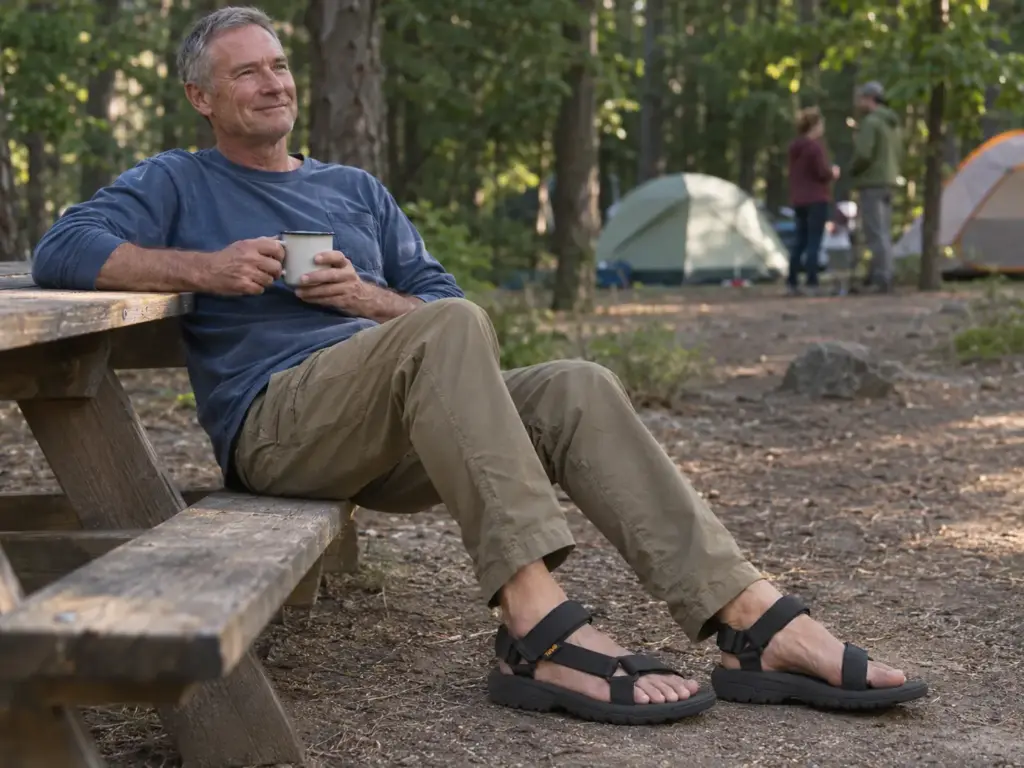
A shank and a molded footbed matter more than the logo, and the Teva Hurricane XLT2 (men’s · women’s) is the budget-friendly pick that has both. Teva lists an EVA footbed, a nylon shank with 30 percent recycled EVA in the midsole on the women’s Ampsole (an EVA midsole that stays light), and a Durabrasion rubber outsole. It is a high-mileage workhorse, and a workhorse with a shank beats a pretty pair with none. For sandals sorted by use and the days to leave them home, the guide to more sandals by use case, and when to leave them at home goes wider.
What the Premium Tier Buys
The ECCO Yucatan (men’s · women’s) is the premium step up. ECCO makes it as a leather sport sandal with a closed toe and a supportive footbed, which gives full coverage of the foot on rougher ground and is the better fit for a foot that needs a covered front and structure underneath. It is sold in both men’s and women’s versions.
Premium is worth paying for when a cheaper pair has failed one of the checks above, or when the foot needs the closed toe and the leather. It is not worth it when the only difference is the label, because the midsole dies before the tread does, and the worn-out footbed is the real cost per season.
Smooth Paths and Camp: Birkenstock Arizona
The Birkenstock Arizona Soft Footbed is the contoured reference for smooth paths, camp and travel. Birkenstock describes a contoured cork-and-latex footbed with a deep heel and a soft footbed layer, so the cork footbed gives the shape and the top layer gives the comfort, which is the kind of contoured shape that study’s platform imitated. It is not for wet roots or loaded descents; this is the sandal for the flat trail, the campground and the airport.
One honest limit sits across every tier above: a sandal is not a substitute for a brace, and no price bracket fixes a diagnosis.
Run the Four Checks Before the Trail Does
A sore heel wants a firm, shaped arch and a deep heel cup. A dragging toe wants a covered front and a heel the strap locks. Neither wants a floppy sole. A sandal is a support, not a brace, and the diagnosis comes before the shopping.
Before the trip, put the pair on with the socks you will actually wear, run the twist, heel-hold and toe-clearance checks at home and walk a flat mile. If your heel is sore on the first steps in the morning, or your toes keep catching, you already know whom to see, a podiatrist or physical therapist, and what to change.
Frequently Asked Questions
01What are the best hiking sandals for plantar fasciitis?
The best hiking sandals for plantar fasciitis have a firm, contoured arch, a deep heel cup and a strap that locks the heel, and they skip flat or floppy soles. The Chaco Z/1 Classic and Orthofeet Venus cover the arch, and the KEEN Newport H2 adds a closed toe.
02Is a high drop shoe good for plantar fasciitis?
A heel that sits higher than the forefoot can ease strain when the footbed is shaped under the arch, as in a 2001 cadaver study. On a flat deck the same raise did nothing. Zero-drop is the one to avoid with a sore heel, and feet vary, so test the pair.
03How do I know if I have plantar fasciitis?
The classic sign is stabbing heel pain on the first steps in the morning that eases as you move and returns after long standing or sitting, according to Mayo Clinic. If it persists, see a healthcare professional instead of diagnosing it from a sandal.
04How do you handle plantar fasciitis if you have flat feet?
Flat feet are a listed risk factor, so the footbed must fit the foot you have: a firm, shaped arch and a deep heel cup, not a generic support claim. Most people improve within months of simple treatment, per the AAOS, and supportive footwear is a reasonable first move.
05Can a hiking sandal replace a brace for foot drop?
No, a hiking sandal cannot replace a brace for foot drop, because Mayo Clinic says the foot may need a brace to hold it in position. Dragging toes are a reason to see a healthcare professional. A closed toe with a bumper protects the toes and a locked heel holds the foot, but neither lifts it.

I've spent more than a decade researching hiking gear and trail technique. I read the specs, the forum threads and the long-term reviews, and every pick here comes with what it gets wrong.
End of the trail
You read every mile of this one. Here's where the trail goes next.