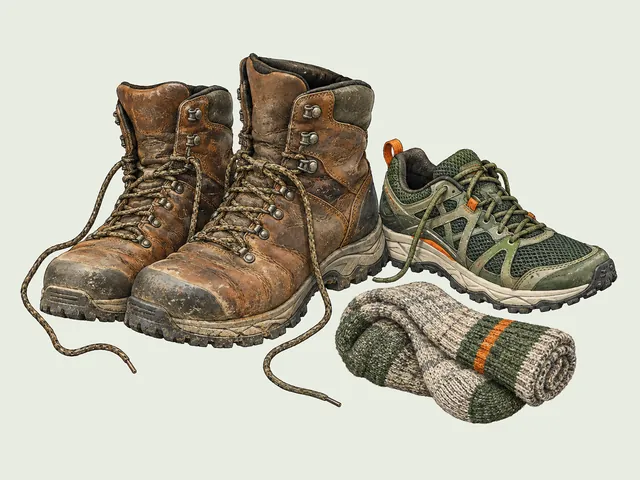









Two shoes sit on the shelf in front of you. Both boxes say EVA midsole. One of them will lose its cushioning before you finish breaking it in, the other will still be protecting your knees four hundred miles later, and nothing printed on either box tells you which is which.
That is the whole problem with hiking shoe technology as it gets sold: the labels name categories, not qualities. Here is what each system in a hiking shoe actually does, what every feature quietly costs you, how the tech underfoot changes the way you walk, and which part dies first while you are still admiring the tread.
What Hiking Shoe Technology Means on the Box vs on the Trail
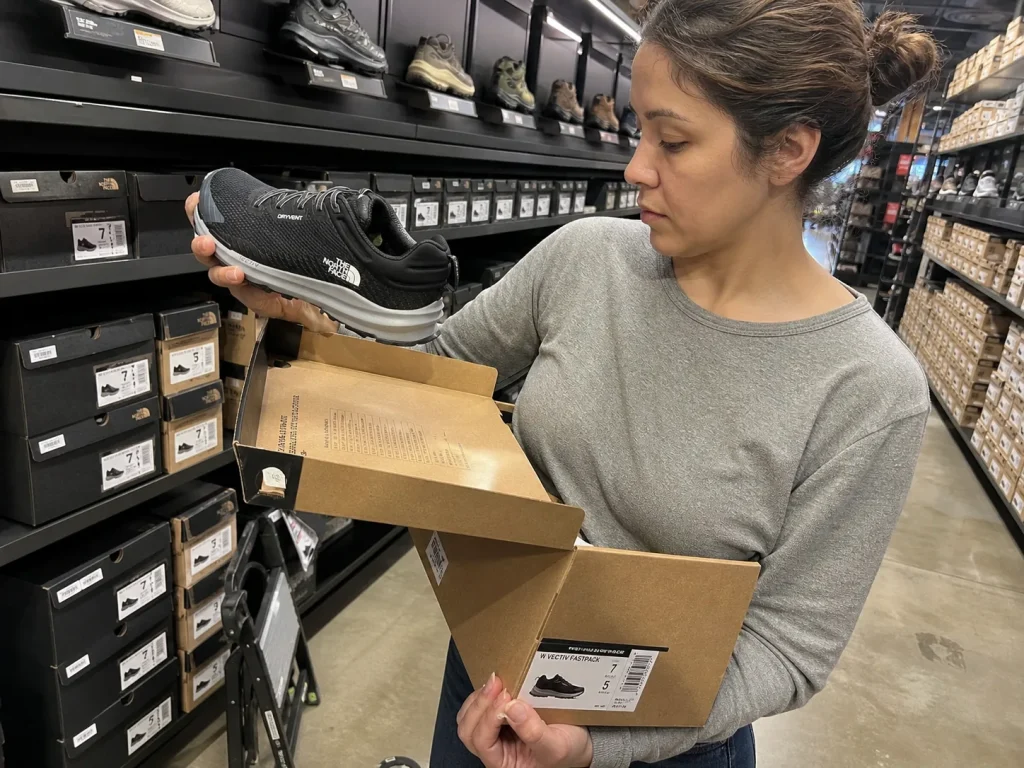
Every shoe wall in every gear shop is a wall of labels. EVA midsole. Vibram outsole. Waterproof. Rock plate. Read across twenty boxes and you will find the same six phrases in different orders, and you will walk out no better informed than you walked in.
Three Words That Cover a 400-Mile Spread
Start with the phrase you will see most: EVA midsole. Budget-tier EVA loses its responsive cushioning in as little as 100 miles. Premium super-critical foam compounds stay protective for 400 to 500. Both boxes say EVA. That is a four-to-fivefold difference in the single thing you are buying the shoe for, hidden behind two identical words.
Labels That Name a Category, Not a Quality
The pattern repeats everywhere on the shoe. Vibram is a licensor, not a compound, and the same brandmark spans roughly 65 to 80 on the Shore A hardness scale, which is the difference between rubber that sticks to wet granite and rubber that skates off it. “Waterproof” names a barrier, not an outcome. “Rock plate” names a part, not a level of protection.
None of those labels are lies. They are just category names, and a category name cannot rank two shoes any more than “car” can tell you which one is faster.
The Handful of Labels Worth Reading
A few are genuinely worth something. A printed heel-to-toe drop number is real data. PU instead of EVA in a midsole is a meaningful signal, for reasons we will get to. And the APMA Seal of Acceptance means a panel actually looked: shoes carrying the APMA Seal of Acceptance have been reviewed by a panel of podiatrists against submitted research on how the shoe affects normal foot function.
The catch is that the seal only works in one direction. Its presence tells you something. Its absence tells you nothing at all, because most shoes were simply never submitted for review. Plenty of excellent hiking shoes have no seal because nobody filled out the paperwork.
The Upper Is Where Fit Technology Actually Lives
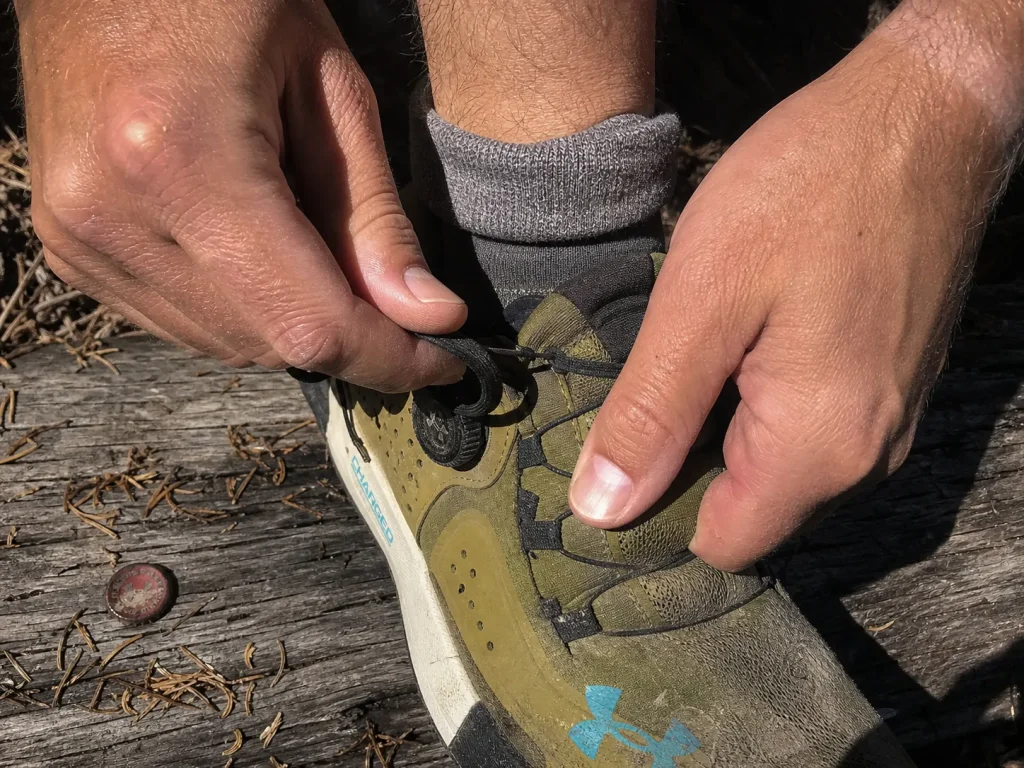
Everyone shops the sole. The upper is the part that decides whether mile 12 is uneventful or whether you are taping your heel at the next switchback, and it is the one system where a lace change can fix what an expensive shoe got wrong.
Mesh, Synthetic Leather, and What Each Trades
An engineered mesh upper breathes and drains fast, and gives up abrasion resistance to do it. Synthetic leather and TPU overlays buy you durability and structure, and charge you airflow and drying time for the privilege. Neither is better. They are opposite answers to the same question, and the right one depends entirely on whether your feet are going to be hot or shredded.
Above those two sit the heavier options that migrated down from boots: nubuck leather and full-grain leather last longest and breathe worst, while microfiber synthetics split the difference at lower weight. Behind whichever one you pick sits an inner lining, and on a waterproof shoe that lining is where the membrane actually lives. Two more parts never make the box copy: the toe cap is the rubber wrap that stands between your toenails and a root you did not see, and a gaiter attachment loop tells you the designers expected scree.
That trade runs deeper than it looks. A mesh upper built to drain and dry is a completely different strategy for wet feet than sealing them in, and for a lot of hiking it is the better one.
Heel Counters and Gusseted Tongues (the Parts Nobody Advertises)
The heel counter is the structured cup molded into the back of the shoe. It is one of the four things podiatrists and pedorthists actually check, because it controls rearfoot motion, and it never appears on a spec sheet. Squeeze the heel of any shoe between thumb and finger. If it collapses, it is doing nothing for you.
The gusseted tongue, stitched to the upper along both sides instead of flapping free, is the other unmarketed detail. It is the difference between grit in your sock and grit staying outside the shoe. It costs the manufacturer a few cents and it never gets a logo.
Lacing and Insoles, the Fit You Can Still Change
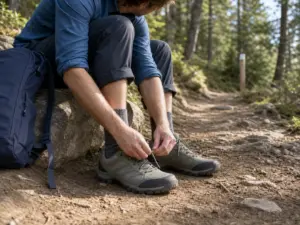
Lacing is the one fit technology you control after the purchase. A heel-lock lacing pattern using the top eyelet changes rearfoot hold more than most people expect, and it costs nothing. A removable insole, another podiatrist criterion, means orthotics fit and worn footbeds get replaced instead of retiring the whole shoe.
The lacing system itself is a design choice, not decoration. Plain eyelets give the most control, D-rings and speed hooks trade precision for speed, and a quick-lace cord or BOA Fit System dial tightens everything evenly in one motion. That last one is genuinely nice until the cord frays in the backcountry and you cannot improvise a fix. Eyelets never strand you.
The Midsole Is the Part That Decides Your Hike
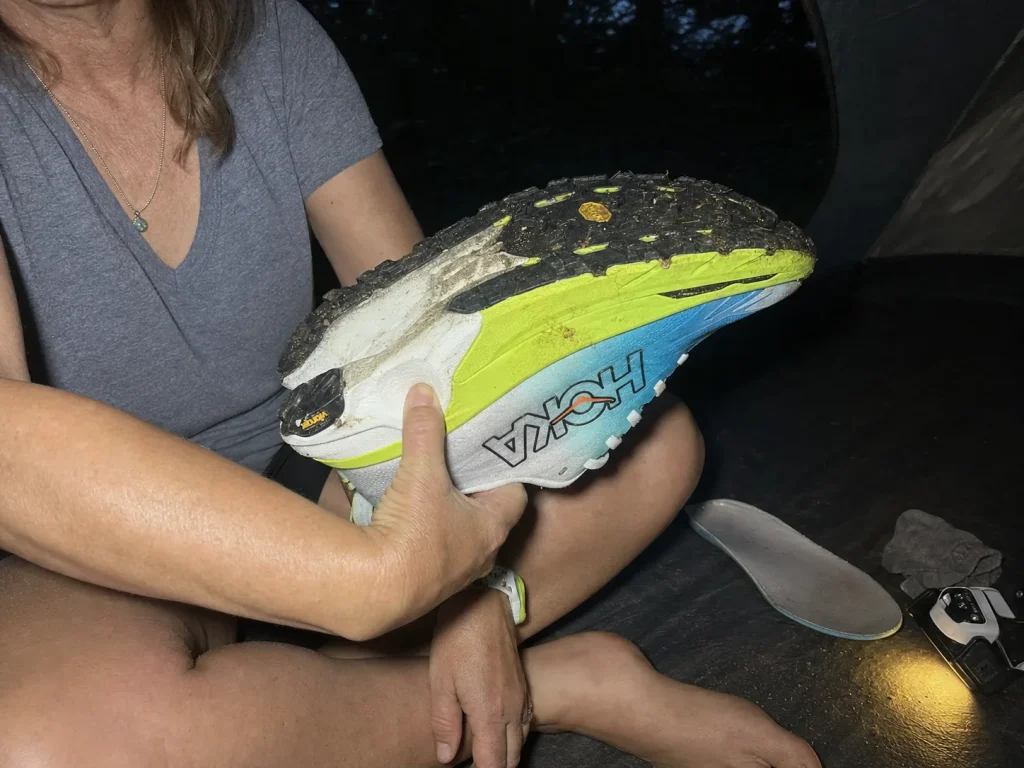
Here is the cruel joke of shoe design. The midsole lives under the insole, sealed between your foot and the outsole. It is the only major system you cannot inspect by looking at the shoe. It is also the part that matters most and dies first.
EVA, PU, and Super-Critical Foam (Three Very Different Foams, One Word)
EVA, short for ethylene-vinyl acetate, compresses roughly 12% by 300 miles, and a typical hiking shoe midsole is functionally dead somewhere between 350 and 500. PU, or polyurethane, compresses only about 6% over that same 300 miles, roughly half the rate. Its compression resistance is simply higher, which is why a shoe advertising a PU midsole survives a loaded pack for so much longer, and it is exactly why soft midsoles bottom out under a loaded pack while firmer ones keep working.
Super-critical foams, along with PEBA blends borrowed from road racing, sit in a third tier entirely: same “foam” on the box, four to five times the useful life of budget EVA. One word, three engineering realities.
Stack Height and What the Extra Foam Costs
Stack height is the total foam under your foot, and it is a real trade rather than a feature. More foam means less fatigue on long smooth miles. More foam also means less ground feel and less stability on uneven terrain, because you are standing further from the trail on a squishier platform.
That loss of proprioception, the felt sense of what the ground is doing under you, is the part nobody prices in. Match stack height to the ground you actually hike, not to whichever shoe felt plushest in the aisle.
Pull the insole out and press your thumb hard into the exposed midsole foam. Healthy foam springs back. Foam that dents and stays dented is structurally compressed, and no amount of tread left will bring it back. Hikers call this packed out, and it is a completely different failure from a worn outsole.
Outsole Rubber, Lugs, and What the Logo Doesn’t Tell You
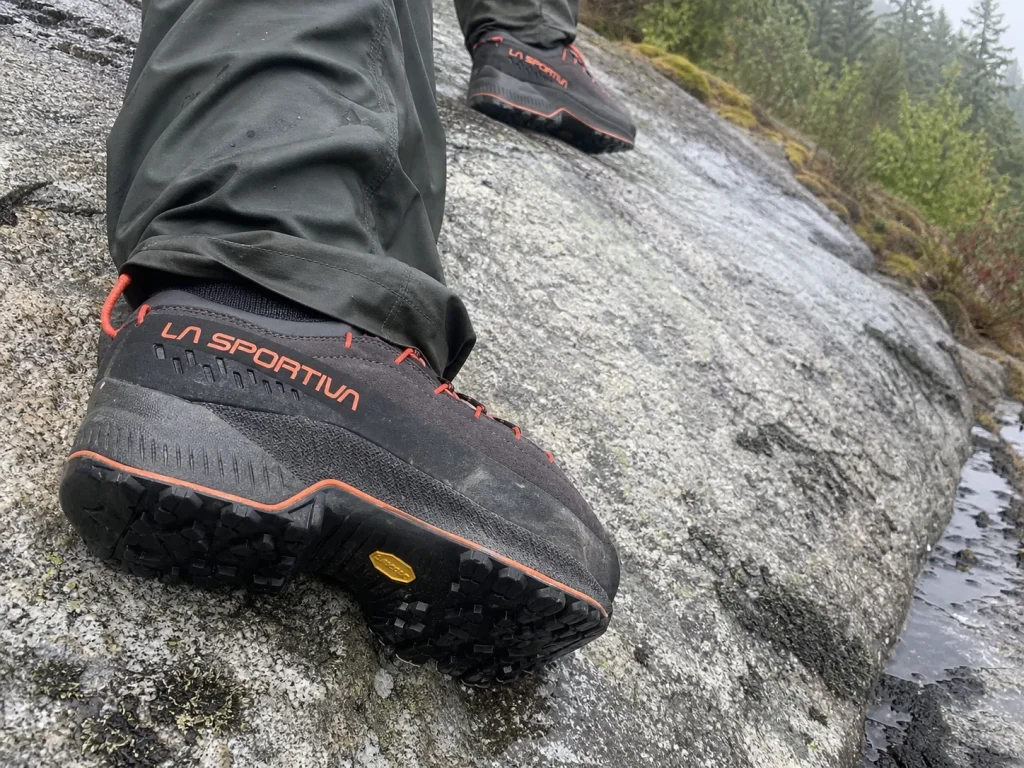
Everyone checks for the Vibram logo like it is a grade. It is a supplier. The number that decides whether you stick to wet granite is a hardness rating almost nobody prints.
Hardness Is the Spec Nobody Prints
Rubber hardness, measured in Shore A durometer, is the actual variable. Softer rubber deforms into the texture of the rock and grabs. Harder rubber lasts longer and grabs less. The mechanism has a name, hysteresis, and it belongs to the compound, not the brandmark stamped beside it.
As the site’s own breakdown puts it, Vibram is a licensor, not a compound, and the same name covers most of the useful hardness range.
Once you know that, the naming game gets easier to read. Vibram Megagrip, Vibram Litebase, and Vibram Arctic Grip are three different products under one logo, aimed at grip, weight, and ice respectively. Salomon puts its own Contragrip name on rubber it specs the same way.
Underneath all of them sit the same base chemistries the industry has always used: natural rubber and SBR blends for grip, harder carbon rubber where wear matters more. The name on the sole tells you who made it. It does not tell you which one you got.
That trade shows up in the field. Vibram Megagrip on the La Sportiva TX4 Evo (men’s · women’s) is about as far toward the sticky end as a hiking shoe goes, and it buys wet-slab confidence with faster wear on gravel. That is the premium end of the dial, and it is a purchase decision, not an upgrade.
Lug Depth vs Lug Spacing (Two Different Jobs)
Lug depth bites into soft ground. Lug spacing lets the mud fall back out. They solve different problems, and a lug pattern with deep lugs packed solid stops working entirely, which is why lug spacing beats lug depth once the mud turns sticky.
There is one more geometry worth knowing by name. The heel brake, the flat aggressive block at the back of the outsole, is what arrests a slide on a steep loaded descent. Hikers talk about it as a safety feature rather than a grip spec, and they are right to.
Rock Plates, Shanks, and the Stiffness You Can’t See
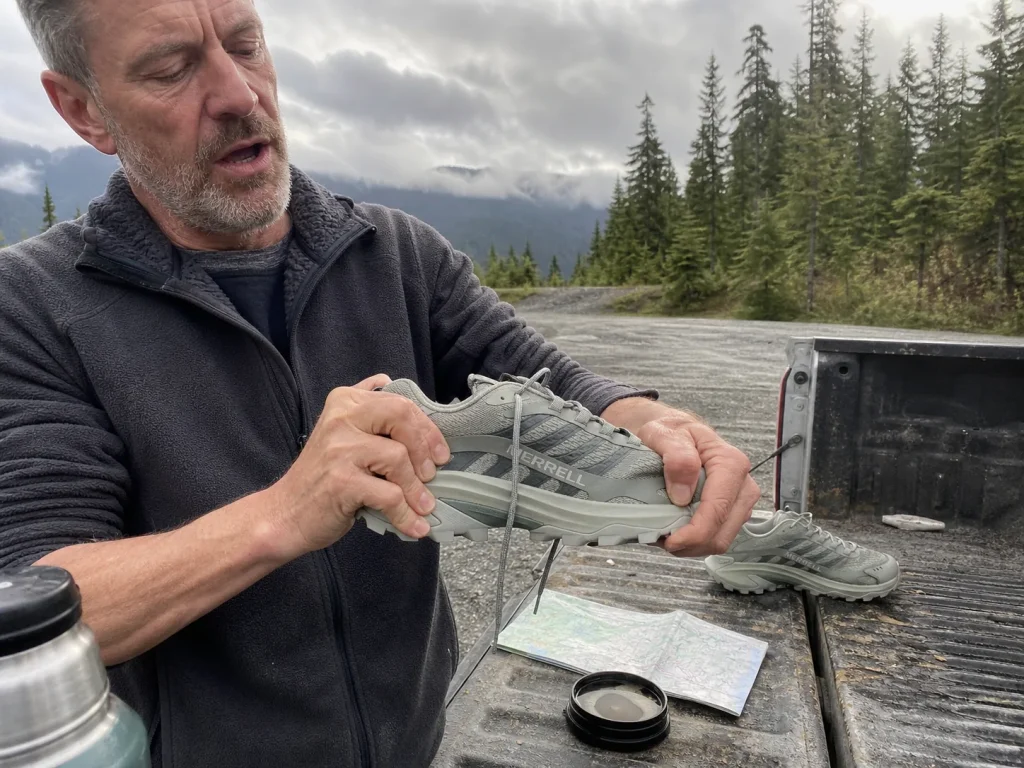
Two shoes feel identical in your hands until you twist them. The stiffness built into a shoe is doing real work, and unlike everything else on this list, you can test for it standing in the aisle in about four seconds.
Rock Plate vs Shank, Not the Same Part
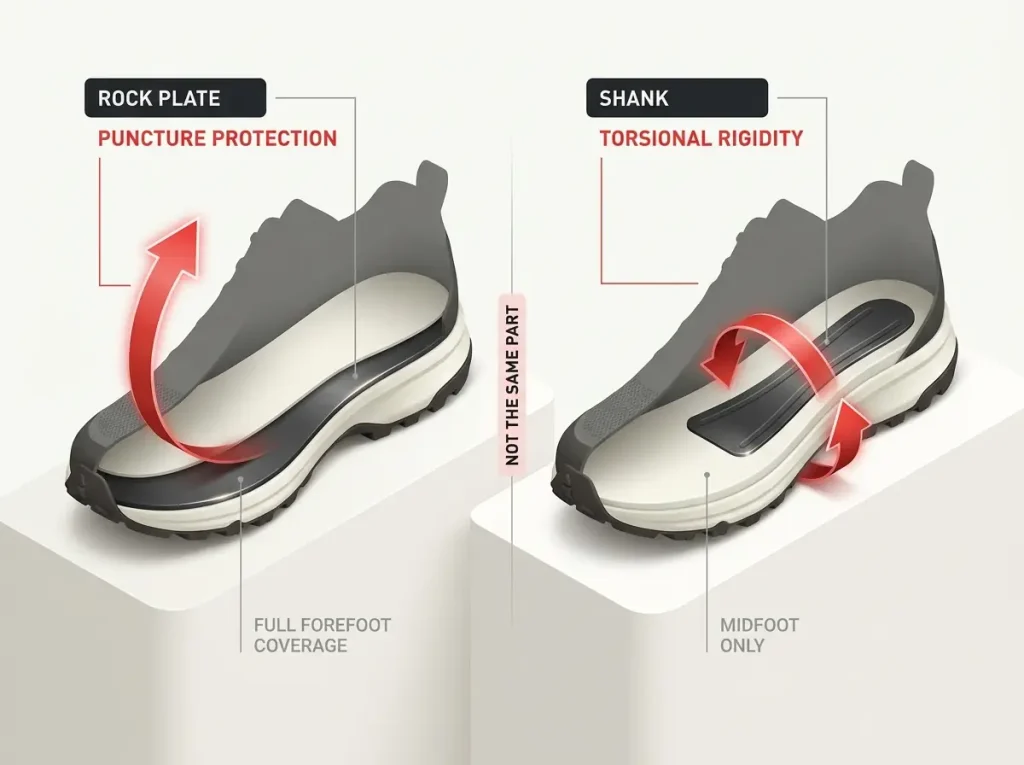
A rock plate is a thin layer, roughly 1 to 2mm of plastic, nylon, or carbon, sandwiched between midsole and outsole. Its whole job is stopping a sharp rock from bruising your foot through the foam. That is all it does, and whether you need a rock plate at all depends entirely on your terrain.
A shank is a different part with a different job. It is a longitudinal stiffener that resists the shoe folding along its length, and it mostly belongs to boots. Confusing the two is the single most common mix-up in this whole topic, and the shank does a different job entirely from puncture protection.
Torsional Rigidity, the Four-Second Test in the Aisle
Torsional rigidity is resistance to twisting along the length of the shoe, and it is one of the four criteria podiatrists check alongside a structured heel counter, forefoot flex grooves, and a removable insole.
Grab the heel in one hand and the forefoot in the other and wring the shoe like a wet rag. A shoe with real midfoot structure resists and stops. A shoe that twists like a dishtowel has no torsional rigidity, and no marketing copy on the box will tell you that. Four seconds, no spec sheet required.
What “Protective” Costs You
Stiffness is never free. A finite element analysis of plate stiffness in footwear links added rigidity to ankle inversion risk on uneven ground, which means the plate protecting your sole from a sharp rock can make a bad ankle roll worse when you catch an edge.
Which brings up the most common mistake in this section: buying a stiff, rock-plated shoe for smooth maintained trail “just in case.” You pay a permanent ground-feel and weight penalty for protection that hike never needed. The Merrell Moab Speed (men’s) and Moab Speed 2 (women’s) sit at the moderate end of that dial, which is exactly why they work for most people on most trails.
Waterproof Membranes Carry the Biggest Hidden Cost
Waterproofing is the only shoe technology marketed as a pure upgrade with no downside. It is not. It is a trade, and the field data on the size of that trade is genuinely startling the first time you see it.
How a Membrane Works (and the MVTR Number Nobody Prints)
A waterproof membrane is a barrier with pores small enough to block liquid water and large enough to pass water vapor, bonded to the lining inside the upper. Gore-Tex is the name everyone knows, but eVent, OutDry, and HyVent are all doing the same job with different construction, and OutDry in particular bonds to the outer shell instead of hiding behind it.
Whether any of them keeps up with your sweat comes down to MVTR, the moisture vapor transmission rate. Active outdoor use is generally reckoned to need 10,000 g/m²/24hr or higher. Look for that number on a shoe box sometime. You will not find it.
One more layer sits on top: a DWR finish, short for durable water repellent, sprayed on the outer fabric so water beads instead of soaking in. It wears off. It also spent decades built on PFAS chemistry, which is why PFC-free DWR is now on half the hangtags in the shop. The reformulated versions work, and they wear off faster.
The Heat and the 24-Hour Dry Time
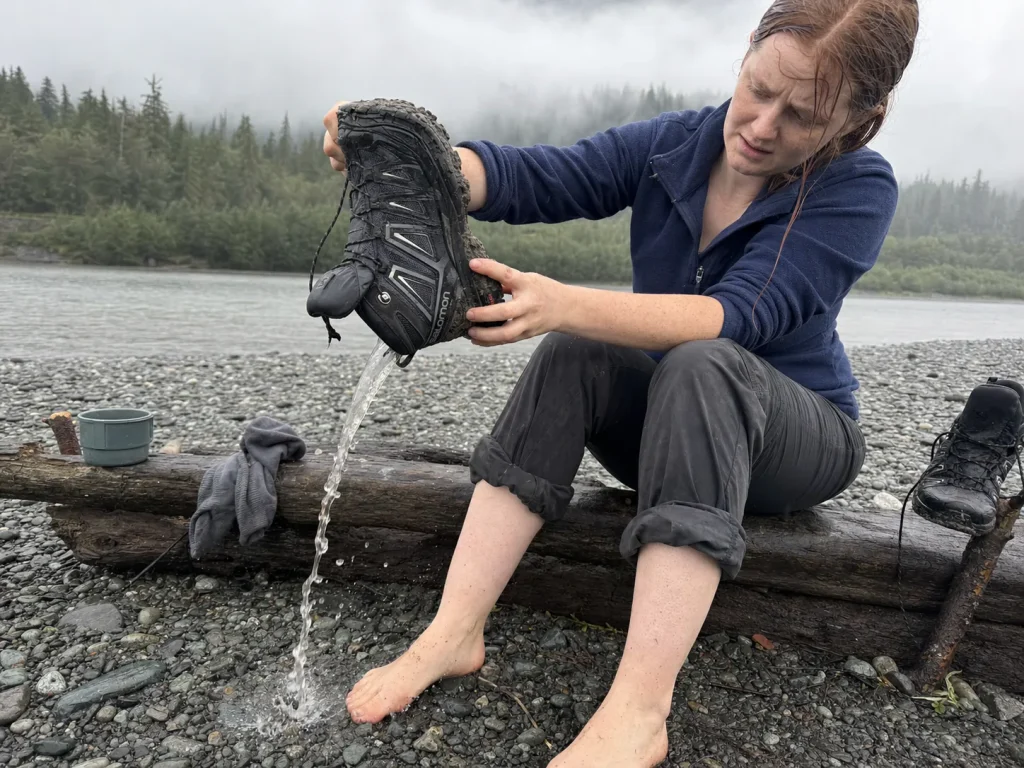
In a documented field comparison by long-distance hiker and guide Andrew Skurka, a Gore-Tex shoe reached internal temperatures in the high 90s°F after three hours of hiking in 70°F weather. His partner’s non-waterproof shoes, deliberately soaked in a creek an hour earlier, stayed near ambient the whole time.
Read that again. The waterproof shoe was not just wetter later. It was hotter the entire time, in dry conditions, for no benefit whatsoever.
The second half is worse. Once water gets inside a sealed shoe there is no airflow path to swap humid interior air for dry exterior air. In that same account, feet were still wet, not damp, a full 24 hours later. It is the same mechanism behind why Gore-Tex shoes still feel wet inside long after the rain stopped.
When Waterproof Actually Earns Its Place
Here is the honest read: a membrane does not make your feet dry. It makes them slow to change state. That is an advantage in cold, wet conditions with short crossings, where staying dry is a warmth problem. It is a liability in heat, in humidity, and anywhere you will be wading, where a mesh shoe that soaks and dries in an hour beats a sealed shoe that stays wet all day.
In hot, dry, or humid country, skip the membrane by default and make waterproofing prove it deserves a spot. Reverse the burden. A shoe that gets soaked and dries by lunch beats a shoe that stays sealed, runs hot all morning, and then holds a swamp against your skin until tomorrow.
How Shoe Technology Changes the Way You Walk
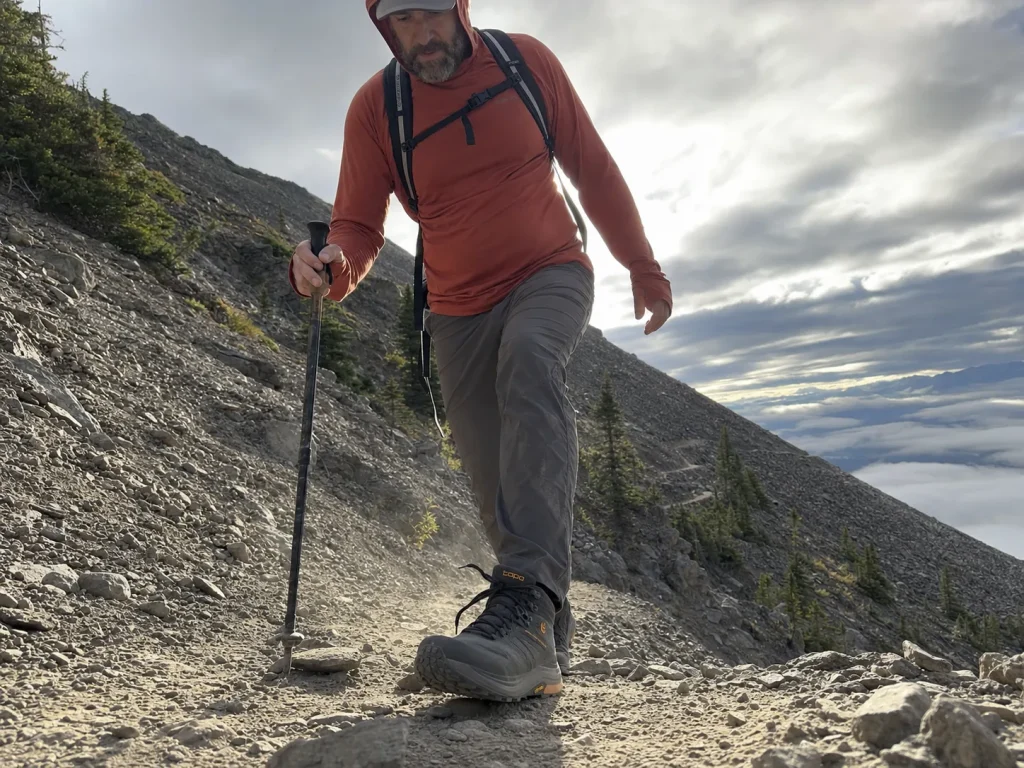
Mile 8 of a long descent, your knees ache and you assume you are just tired or out of shape. Sometimes you are. Sometimes it is the sole under your foot moving load up your leg, and nobody who sold you the shoe ever mentioned that was a thing that happens.
This is the part every competitor skips. They list the features. They never connect a single one of them to what actually happens to your legs.
Heel-to-Toe Drop and Your Stride
Heel-to-toe drop, sometimes just called heel drop, is the height difference between heel and forefoot, and it changes your gait: where your foot lands and how your calf and Achilles load on every single step of a hike. A high-drop shoe nudges you onto your heel. A low-drop shoe asks your calf to do more and your knee to do less.
Topo Athletic builds the Trailventure 2 WP (men’s · women’s) around a 5 to 6mm drop and a wide anatomical toe box for exactly this reason, which makes it a clean illustration of drop as a deliberate design decision instead of a number nobody thought about. If the idea interests you, it goes further: how far you can take the low-drop idea runs all the way to zero.
Stiffness Moves the Load From Ankle to Knee
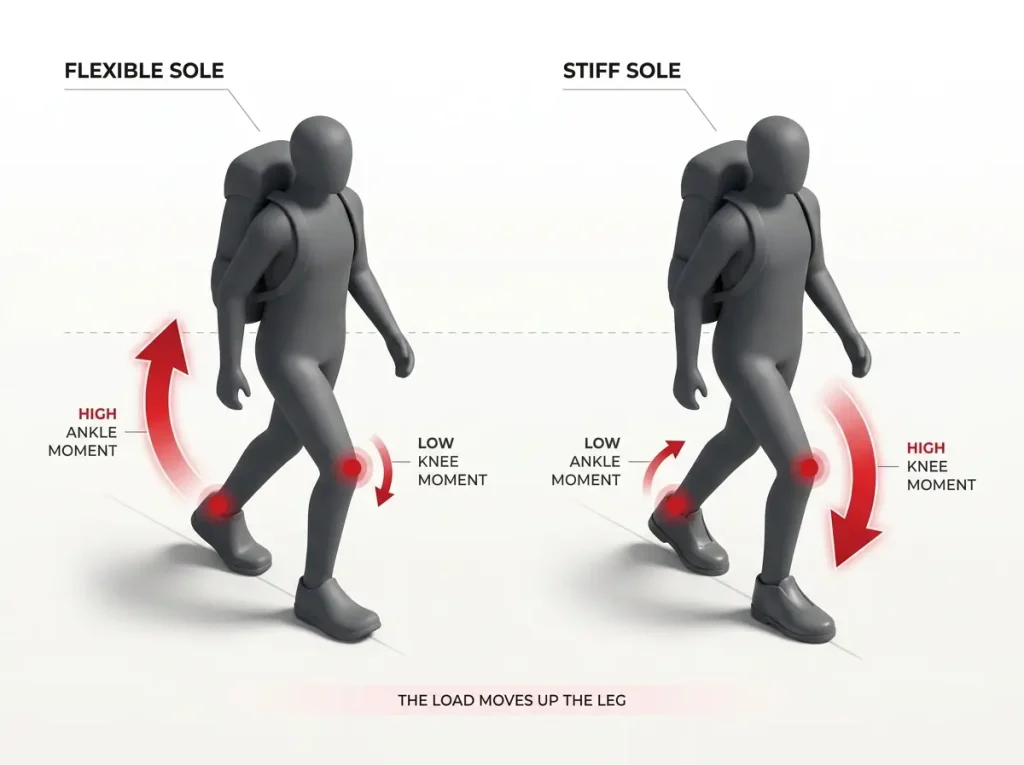
This is where it gets genuinely useful. Building a plated midsole, usually with a stiff carbon fiber or nylon layer, measurably reduces peak ankle dorsiflexion and ankle moment during stance. A peer-reviewed study on carbon-plated footwear found the stiffness trade-off shows up as altered ankle loading, not just better propulsion: more energy return stored in the midsole, less in your own muscles and tendons.
So a stiff shoe does part of your ankle’s job for it. That can feel efficient. It also means your ankle spends the day getting less practice stabilizing itself.
And the work does not vanish. Stiffer soles raise joint moments at the knee. Call it the kinetic chain doing its accounting: the stiffness bill does not disappear when the ankle stops paying it, it just moves up the leg, and it comes due late in the day on the descent, which is precisely when you are least equipped to notice why.
Cushioning vs Stability, You Pick One
The last one is the trade nobody wants to hear. Past a certain stack height, comfort and stability start pulling in opposite directions. More foam absorbs more of the repetitive impact that grinds you down over 15 miles. More foam also raises you off the ground on a deformable platform, and the same research linking sole stiffness to greater ankle inversion magnitude on uneven ground applies here.
The common mistake is chasing maximum cushioning for a long day without pricing in the ankle-roll cost on off-camber, rocky terrain. Both effects are real. They point opposite directions. No box tells you where the line sits for the trail you are actually hiking, and honestly, no one can tell you but your own ankles.
Low-Cut Shoe Tech Isn’t Boot Tech, Shrunk
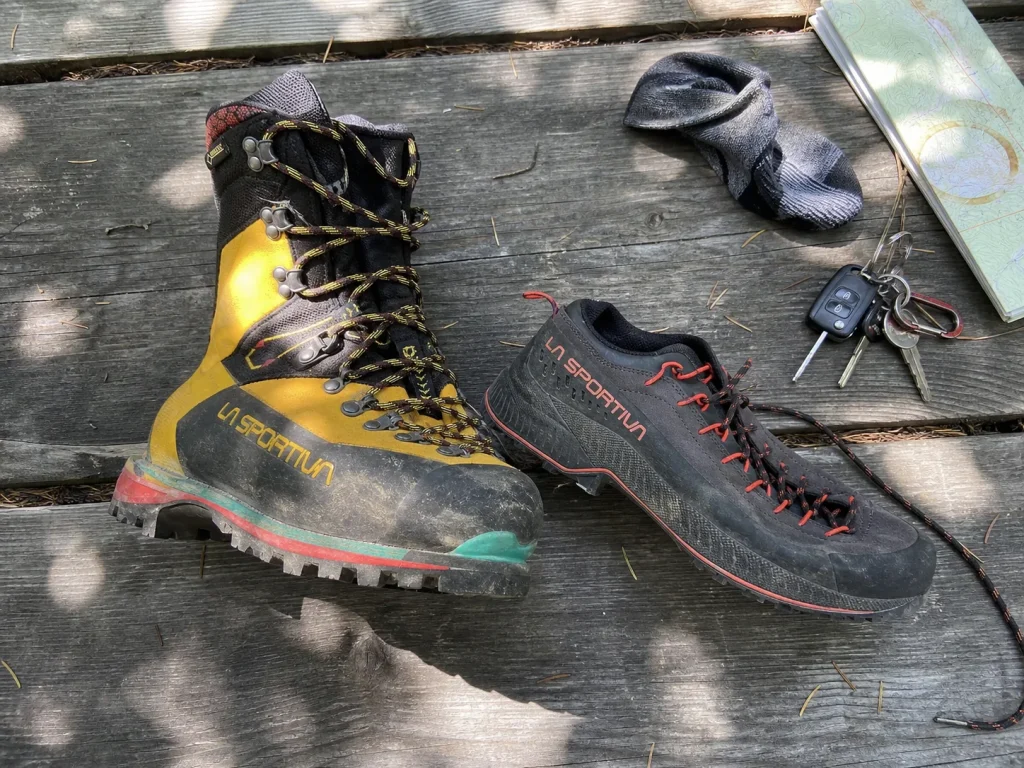
Set a hiking shoe next to its own boot sibling from the same brand and the same line. Same rubber, same logo, same marketing language on both boxes. Twist them and you will feel immediately that they are not the same shoe at all. The engineering diverged on purpose.
Less Shank, More Flex, On Purpose
A hiking boot is engineered to carry load and stay rigid: full or three-quarter shanks, stiffer midsole compounds, heavier stitched-down construction that resists the whole structure folding. Low-cut shoes deliberately give most of that away, and a trail runner gives away more still. The three are points on one line, not three separate categories.
That is not a downgrade, it is a different design target. A shoe that flexes with your foot is doing the exact thing a boot’s shank exists to prevent. If you want to see how the same parts get built into a boot, the contrast makes the point better than any spec sheet.
The Ankle Support Question
This is the assumption every reader arrives with, and it deserves a straight answer rather than a hedge. The marketing implies a tall collar braces your ankle. The research does not support that the way the shelf tag suggests, and the evidence is why low-cut hiking shoes beat boots on most trails for most hikers.
Worth sitting with alongside the biomechanics above: a stiffer, taller shoe that reduces ankle motion is not the same thing as a shoe that makes your ankle stronger. Sometimes it is the opposite.
Lighter Membranes, Faster Drying
Membranes get lighter in shoes, and drain-and-dry designs become genuinely viable, for a structural reason: there is no tall waterproof cuff sitting above your ankle to trap water in the first place. A soaked boot is a bucket. A soaked shoe is a sponge you can wring out.
Pack Weight Is What Actually Tips the Scale
Here is the decision rule nobody hands you, and it has nothing to do with how rugged the trail sounds. What pushes you toward boot territory is load, because load is what the boot’s construction was engineered against.
Run it through the midsole numbers from earlier. Every extra 10 lbs of pack weight adds compressive load that accelerates EVA breakdown. A boot answers that with a firmer compound, often PU, which compresses at roughly half EVA’s rate. So a loaded backpacker in soft EVA is asking a shoe to do the one thing its foam is worst at, and the shoe obliges by dying early and quietly.
That reframes the whole argument. It is not shoes versus boots. It is: how much weight are you putting on the foam, and did anyone build this foam for that? A day-hiker on a rough scramble is almost always better off in a shoe. A hiker under a heavy multi-day pack on smooth trail may genuinely want a boot, and the trail’s reputation had nothing to do with it.
The practical read on all of this: match construction to terrain and load, not to the height of the collar.
What Breaks First and What You’re Actually Paying For
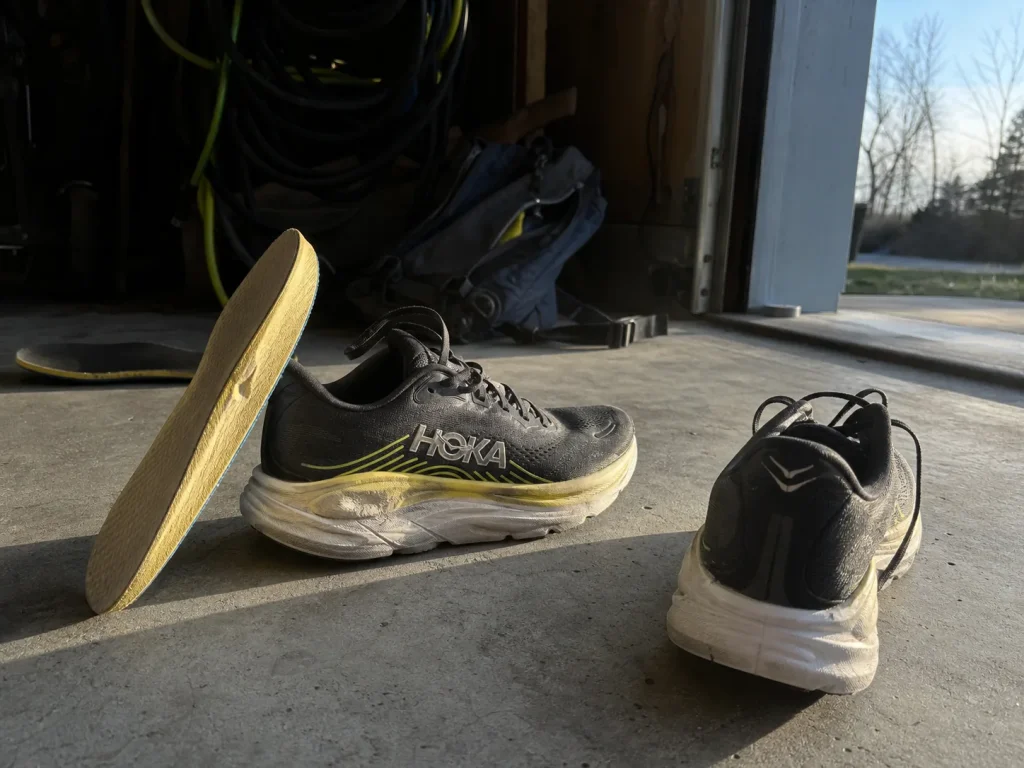
The tread on your shoes looks fine. You have been telling yourself they have another season in them. Meanwhile the part you cannot see has been quietly dying since about mile 100, and your knees have been covering the difference.
The Midsole Dies Before the Tread Does
The numbers are unambiguous. EVA compresses about 12% by 300 miles. The midsole is functionally dead between 350 and 500. And through all of that, the outsole still looks entirely serviceable, lugs sharp, rubber intact. Midsole degradation is the fastest clock on the shoe and the only one with no dial on the outside.
Which makes tread depth the single worst way to judge shoe life, and it is the way almost everybody does it. You are reading the one system that outlives the shoe and ignoring the one that defines it.
Line the systems up and the failure order is remarkably consistent. The midsole goes first, invisibly, somewhere in the middle hundreds. The membrane goes second if the shoe has one, because flex cycles at the crease eventually breach it and nothing announces that either.
The upper goes third, usually at a stitch line or the mesh beside the toe cap. The outsole, the part you have been staring at this whole time, is almost always the last one standing. You will replace the shoe for a reason you cannot see, every time.
Pack Weight Is the Real Odometer
Mileage alone is not the replacement clock. Every extra 10 lbs of pack weight adds compressive load that accelerates EVA breakdown, so 500 loaded backpacking miles are not 500 day-hike miles. Two hikers can retire the same model at wildly different odometer readings and both be right.
Budget vs Premium, Where the Money Actually Goes
Now the question underneath the whole article. Budget EVA loses its bounce in as little as 100 miles. Premium super-critical foam holds protective performance to 400 or 500. That gap is the single biggest thing your money buys, and it is foam chemistry, not features.
Which produces the inversion worth carrying out of this article: a cheap shoe with a firm PU midsole can outlast an expensive shoe stacked with features on soft EVA, because PU compresses at about half EVA’s rate no matter what the rest of the shoe costs. Price correlates with foam quality. It does not guarantee it. The shoe with the longer feature list is not automatically the shoe with the better foam, and the box will never let you tell the difference.
What the money mostly does not buy is the stuff printed on the box. A logo on the outsole. A membrane you may actively not want. A rock plate for terrain you do not hike. Features are cheap to add and easy to market. Foam chemistry is neither, which is exactly why nobody advertises it in a way you can compare.
One honest exception at the top end: a resoleable shoe, built so a cobbler can replace the outsole, actually changes the math, because you are buying a platform instead of a disposable. Very few low-cut hiking shoes qualify. If yours does, that is a real feature you paid for.
Rotate two pairs on multi-day trips or heavy training blocks. EVA partially recovers its cellular structure during rest between wears, which stretches real-world lifespan meaningfully. Pair that habit with the thumb press test every few hundred miles and you are tracking your midsole instead of guessing at it.
The Takeaway
The label names a category, not a quality. EVA midsole and Vibram outsole are supplier names, not grades, and no amount of squinting at a box will turn them into a ranking.
Every feature is a trade. Waterproofing costs you heat and dry time. Stiffness moves load from your ankle to your knee. Cushioning trades stability for comfort. The box only ever prints the upside, and the cost lands on you somewhere around mile 8 of the descent.
The midsole decides your hike and dies first, invisibly, while the tread still looks new. Judge it with your thumb, not your eyes.
So go do that right now. Pull the insole out of the pair sitting by your door and press your thumb into the foam. If it dents and stays dented, you just learned more about your shoes in four seconds than the box ever told you.
Frequently Asked Questions
01What do podiatrists say about hiking footwear?
Podiatrists check four specific things, and none of them are brand names: a structured heel counter, torsional rigidity through the midfoot, forefoot flex grooves, and a removable insole so orthotics fit. The APMA Seal is a real signal when present, but its absence means nothing, since most shoes were never submitted for review.
02What to look for in a good hiking shoe?
Start with the midsole material and the torsional twist test, then work outward. Foam quality decides how long the shoe protects you under load, and the twist test tells you in four seconds whether there is real midfoot structure. Outsole logo, membrane, and upper material are trades you pick by terrain, not rankings.
03Are high-tech hiking shoes good?
Sometimes, and rarely for the reason they are marketed. The technology that reliably justifies a higher price is foam chemistry: premium super-critical midsoles hold their protection roughly four to five times longer than budget EVA. Plates, membranes, and proprietary outsole names are trades, not upgrades, and each costs you something unprinted.
04How long do hiking shoes last before the technology breaks down?
The midsole is functionally dead between 350 and 500 miles, long before the tread looks worn. EVA compresses about 12% by 300 miles, and every extra 10 lbs of pack weight speeds that up, so loaded miles count for more. Pull the insole and press the foam: a dent that stays means the shoe is done.

I've spent more than a decade researching hiking gear and trail technique. I read the specs, the forum threads and the long-term reviews, and every pick here comes with what it gets wrong.
End of the trail
You read every mile of this one. Here's where the trail goes next.