

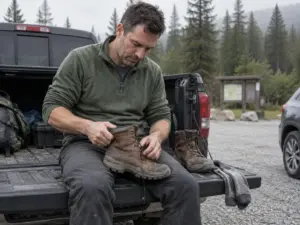














Pick up two hiking boots in a store and bend each one at the arch. One folds almost in half in your hands, the other barely gives, and the reason is a thin strip of material you will never see from the outside: the boot shank.
Hiking and hunting forums keep arguing the same trade-off over it, stiff and protected versus flexible and natural. This explains the shank for a trail, not a work site. You’ll get what a boot shank is, what it’s made of, how to check for one in the store, and whether your hikes and your pack weight call for a stiff one or a flexible one.
What Is a Boot Shank and Where Does It Hide in the Sole?
The shank is the part of a boot that nobody sees and almost every hiker feels. Here is what it is, where it sits and what it does under your arch.
The Layer Between Your Foot and the Trail
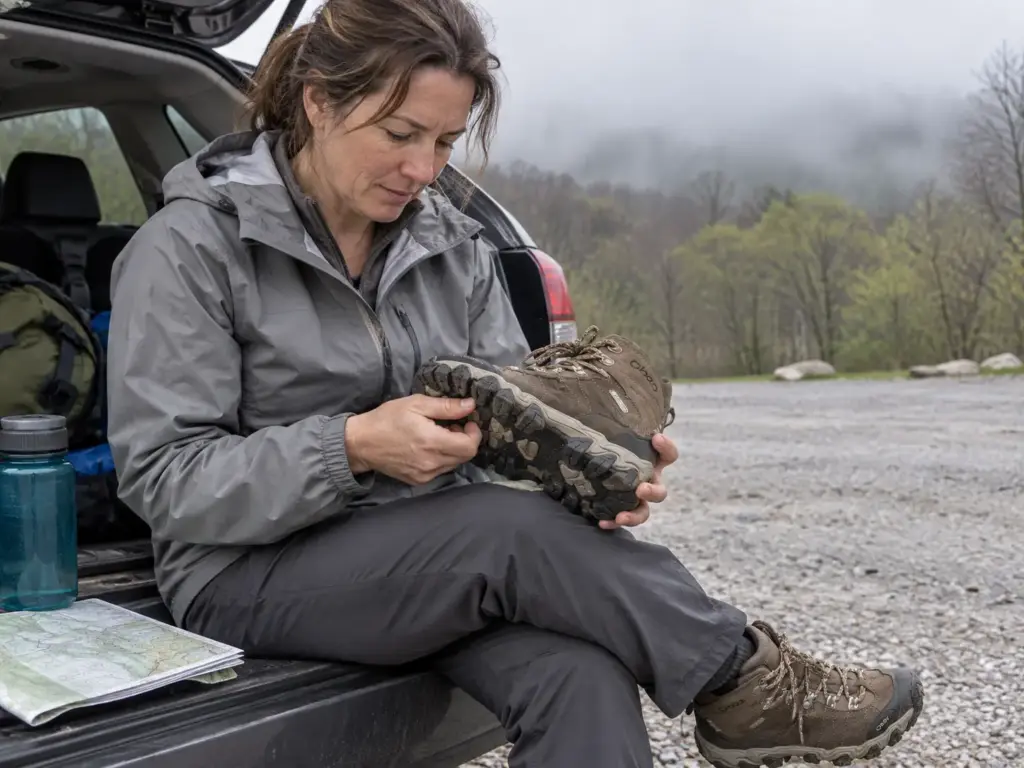
A boot is a stack of layers, and the shank lives in the middle of it. Wikipedia describes a shank as “a long, thin piece of material between the insole and outsole” meant to support the foot and provide structure. That is the whole definition.
It sits under your arch, buried inside the sole stack, which is exactly why most hikers never think to ask about it. You can’t see it, you can’t touch it, and spec sheets rarely mention it.
What you can do is feel what it does. A boot with a stiff shank resists folding under the arch and holds its shape, which makers call shape retention. A boot without one lets the sole bend around whatever is underneath.
Don’t confuse it with the arch support in an insole, which sits on top in the footbed while the shank works inside the sole itself. If you want the layers above and below it too, here is how the rest of the sole stack fits together.
Why a Stiff Strip Under the Arch Saves Your Feet
Think about what a pointed rock does to a flexible sole. The sole wraps around the rock and all of your weight lands on that one spot. A stiff sole spreads the same load across the whole foot instead.
That is the reasoning laid out in a 2018 rokslide thread on sole stiffness, and it is the cleanest explanation of why a shank matters on sharp ground. Boot makers’ own explainers add that it eases foot fatigue over a long day. Wikipedia credits the rigid shank with protection against stone bruises and punctures too, and the last section comes back to why that is only partial protection.
The other end of the scale has its own story. A Mountain Project poster in 2017 wore a crampon boot on a hike and said it felt “like I have 2x 4’s strapped to my feet.” That is what a very stiff shank feels like when you ask it to do a job it wasn’t built for. Somewhere between a boot that folds and a boot that feels like lumber is the one you want.
Steel, Fiberglass or Kevlar: What Boot Shanks Are Made Of
Not every shank is steel. The material and the length are the two things a spec sheet can tell you, so they are worth learning first.
Steel Is the Old Answer, Fiberglass and Kevlar the Modern One
Say steel shank and everybody nods, because it’s the phrase that has been repeated in boot shops for decades. On the trail it is no longer the default. Wikipedia’s entry notes that heavy hiking and construction boots carry far more rigid and durable shanks, and that modern ones are more commonly fiberglass and Kevlar, which conduct less heat than steel. That matters most in cold weather boots and winter hiking.
Boot makers also list a composite shank, a TPU shank, nylon, leather and carbon fiber, along with a thermoplastic shank. Reading a spec, you might see a fiberglass shank, a Kevlar shank, a nylon shank or a carbon fiber shank, and all of them exist. Nobody needs to rank them here, because the only one that matters is the one in the boot you are holding.
So ask what it’s made of before you assume steel. The material changes how the boot feels, and the forums make that obvious: threads about linesman boots on r/Boots argue triple-rib steel against leather shanks for tower climbing. That is work boots country, not trail, but it shows how much the material alone moves the feel underfoot.
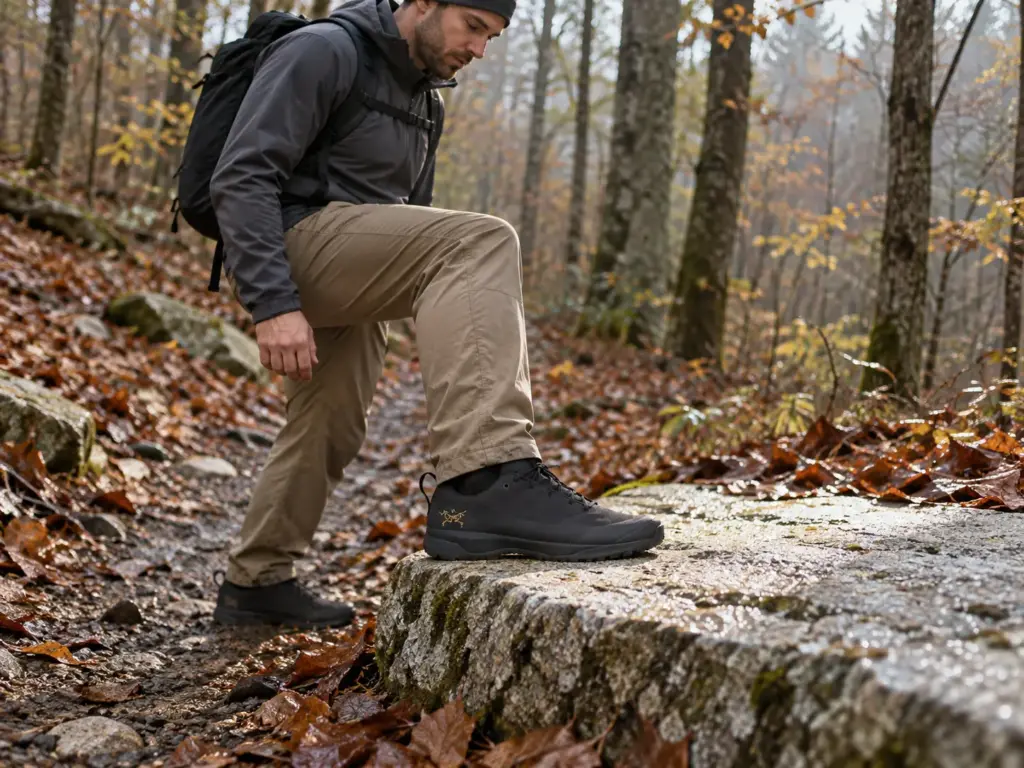
One example from the approach-shoe end. The Arc’teryx Konseal GTX Shoe (men’s) is a shoe, not a boot, and its Amazon listing says a “carbon fibre midsole shank adds stability and stiffness needed to handle heavy loads.” That is the listing’s claim, not something you can verify from a screen, but it is a clear case of a maker naming the shank right in the spec.
Full, Three-Quarter and Shorter Shanks Explained
Shanks also come in different lengths. A full shank runs the length of the foot, a three-quarter shank stops short of the toes, and a half shank covers only about half of it. Forum slang throws both at you: “full shank,” “3/4 shank,” “ridged sole.” They all mean a sole with a stiff spine in it, just at different lengths.
Length changes what the boot is for. In a 2017 Mountain Project thread, a reply said full-shank boots are for kicking steps into steep snow and kicking crampons into solid ice, and are “not intended for all-season hiking.”
A three-quarter shank sits in between, and the trade-off section picks that up. For now, remember that a longer shank is not a better shank. It is a more specialized one.
Length is one half of the build. The other half is how the sole is attached to the boot, whether Goodyear welt or cemented. The shank is part of that build, typically a cemented shank or a laced shank fixed at the insole or midsole, which is worth knowing before you start comparing spec sheets.
When you ask about a boot, ask three things: what is the shank made of, is it full or three-quarter length, and can the maker’s spec confirm it in writing. A salesperson’s guess is not a spec, and a spec that says only “stiff sole” has not answered the question.
How to Tell if Your Boot Has a Shank in the Store
You don’t need a lab to find out whether a boot carries a shank. You need ten seconds and a boot in your hands.
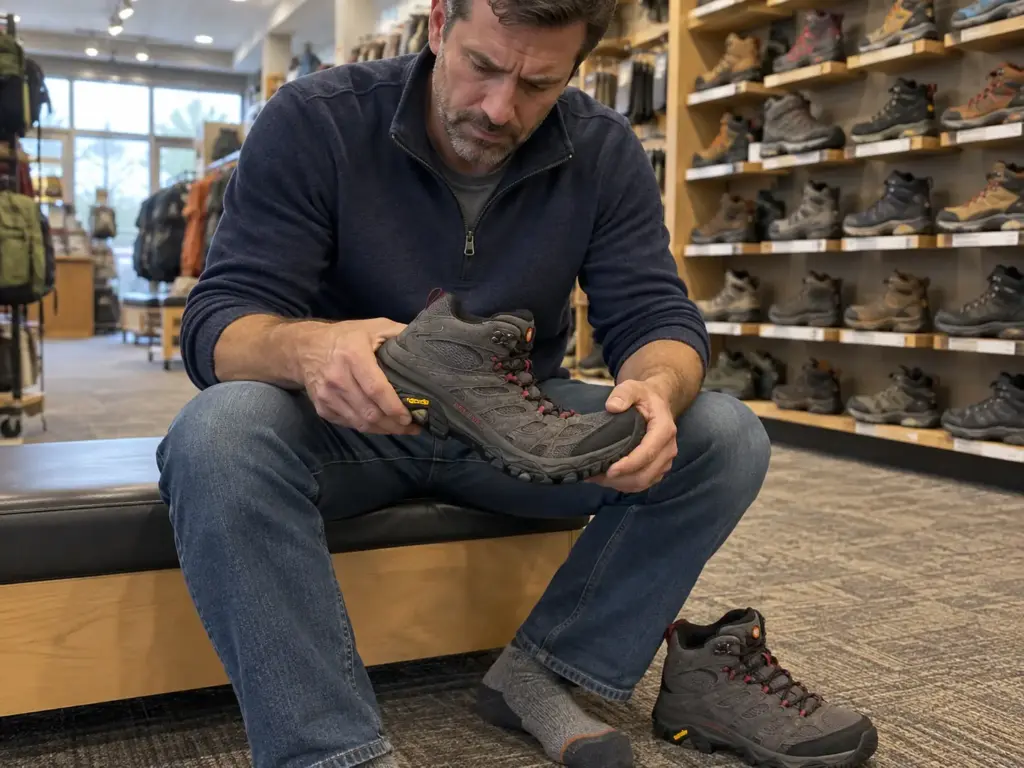
The Flex Check You Can Do in Your Hands
Here is the check, a simple bend test. Hold the boot by the heel and the toe, then press the middle down toward the floor and watch the arch. A boot that folds easily there has little or no shank. One that fights the bend has some stiffness in it, and that boot flex tells you more than the label does.
It is a rough read, not a lab test, but it takes ten seconds and works on any boot on the shelf.
Don’t count on break-in to fix a boot that feels wrong. A Mountain Project poster asked whether a stiff sole loosens up over time, and the answer was that it does not get more flexible. A boot that feels like 2x4s in the store will feel like that on the trail.
Carry your current boots into the store and flex them next to the new pair. Your own boots are the only ruler that counts, because you already know how they feel at the end of a long day.
What the Spec Sheet and the Salesperson May Not Tell You
The check tells you stiffness. It does not tell you material or length, and only the maker’s spec or the retailer can say whether the shank is steel, fiberglass or something else. A stiff boot is also not automatically a shanked boot, since a stiff outsole on its own can feel firm in the hand. Use the flex check as the first question and the spec as the second.
Two popular mid-cut boots to run the check on are the Merrell Moab 3 Mid GTX (men’s · women’s) and the Oboz Bridger Mid B-DRY (men’s · women’s). Neither is a pick for stiffness. They are two common mid-cuts you can put side by side and feel at the arch.
There is one more reason to care about stiffness in the store. A 2015 Mountain Project reply pointed out that most boots “won’t have a solid shank sole,” so an automatic crampon “will just pop off when you flex the boot.” If snow travel is on your list, here is whether your boots can take crampons.
Do Hikers Need a Boot Shank? It Depends on Your Pack and the Ground
Whether you need a stiff shank depends less on the boot than on what you ask of it: the weight on your back and the ground under your feet.

Flat Trails and Light Loads: A Flexible Boot Is Fine
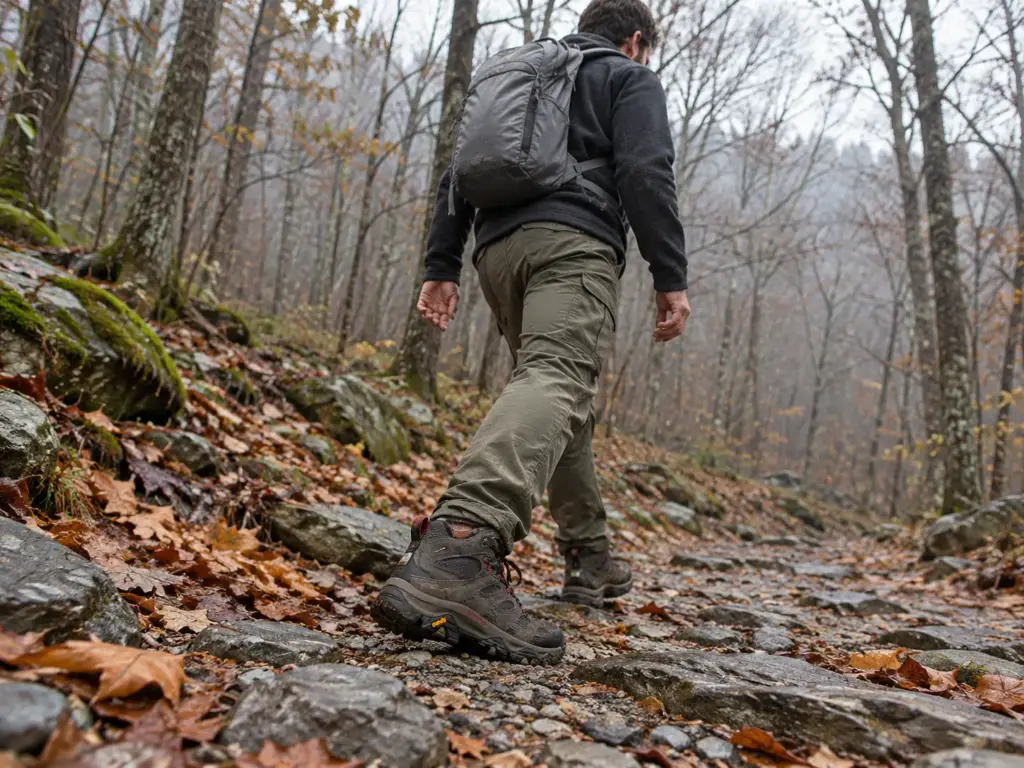
Start with the pack on your back and the ground under your feet, because those two things decide the answer. Picture a loop through a state park: packed dirt, a few roots, a daypack with water, lunch and a rain shell. Your foot rolls through each step the way it was built to, and nothing on that trail pushes back hard enough to need a stiff spine under the arch.
That matches the working rule the 2018 rokslide thread landed on: stiff soles for rough, rocky ground with a heavy load, flexible soles for softer, flatter ground and lighter loads.
For most day hikers on maintained trail, a mid-cut trail boot that bends a little at the arch is enough. The shank question only starts to matter when the pack gets heavy or the trail turns rocky. The American Hiking Society’s boot guide puts a number on the slope: it describes heavy hiking boots, usually with a stiffer midsole, for strenuous climbing and backpacking in difficult terrain with a pack over 40 pounds, and calls them usually not practical for day hikes. That is a boot category, not a shank spec, so read it as a rough marker rather than a switch.
If that is your kind of hiking and you are watching your budget, the URDAR Men’s Lightweight Waterproof Hiking Boots are the kind of budget-friendly boot to run the flex check on before you commit. The shank is only one piece of the decision, though. The bigger picture is how to choose a hiking boot by terrain, height and fit.
Rocky Ground and Heavy Packs: Where a Stiffer Shank Earns Its Place
Now change the picture. The trail turns to loose rock, the pack is loaded for a night out, and you are headed downhill. Every step drops your full weight, plus the pack, onto whatever sits under the ball and arch of your foot.
A flexible sole wraps around a sharp edge and the pressure piles onto one point. A stiff sole with a shank bridges the gap and spreads the load across the foot. That is the same logic as the rokslide poster’s theory, and it is why a stiffer shank earns its place on rough terrain when load carrying gets serious. It is the reason people shopping for backpacking boots end up asking about the shank at all.
Wikipedia offers the one hiking-adjacent data point: in mountaineering boots, the shank reduces the load on the feet and calves over the course of an ascent. That is a statement about climbing, not day hikes, and it deserves to be kept in proportion. The logic carries over, though.
The more weight on your back and the sharper the ground, the more work the sole has to do so your foot doesn’t. If your hiking drifts toward snow and steep terrain, here is how mountaineering boots differ from hiking boots.
Don’t read that as “heavier pack, stiffer boot, end of story.” A hunter on rokslide in 2019 packed out deer and elk wearing a flexible shoe and made it work, and the same poster found a stiff boot less agile on the way up.
Full-shank boots are the wrong tool for an ordinary summer hike, full stop, and that Mountain Project reply put it as “not intended for all-season hiking.” More stiffness is not more boot. It is more of one specific thing, and you pay for it on every step where the trail doesn’t ask for it.
Judge a boot with the weight on. A boot that feels fine with an empty pack can feel different once it is loaded and pointed downhill, so if the shop has an incline ramp or stairs, load your pack and walk both before you decide.
Stiff or Flexible? The Trade-Off Every Trail Boot Makes
Stiffness is not free. Every bit of rigidity you add to a sole is flex you give up, and the trail decides which one you want.

What a Stiff Sole Costs You on Smooth Trail
A stiff boot feels like armor the first time you cross a pile of broken rock. It feels like a tank once the trail smooths out. Both reactions are accurate, and the second one is the cost that never gets printed on the box.
The rokslide poster from 2018 listed that cost plainly: a stiff sole “interferes with the natural flexing of the foot” and gives less grip on uneven ground. The same poster wondered whether stiffer soles raise the chance of rolling an ankle. Treat that as one person’s untested idea, not a finding, since the poster flagged it as possibly unusual too.
A 2019 field report backs up the feel side. A hunter who moved from a light shoe to a stiff boot said it felt “like a tank” over rough ground, with a less natural walking gait and less grip, and he felt slower and “less agile” going uphill. My read is that the cost shows up on smooth trail, where nothing is asking the sole to protect you and everything is asking it to bend. Here is what boot stiffness suits your terrain if you want the rating system behind it.
The Three-Quarter Shank Is the Middle Ground
There is a middle option. In the same 2017 Mountain Project thread that warned off full-shank boots for summer hiking, a reply said a three-quarter shank “works well with crampons and kicking steps in snow slopes, but it also hikes well.” The poster named a specific mountaineering boot as the example, and the name matters less than the idea: a shank doesn’t have to be all or nothing.
The shank question and the crampon question turn out to be the same question. A reply in a 2015 Mountain Project thread said a fully automatic crampon really needs a rigid boot, which is why stiffness and crampon fit get argued together. If crampons are in your future, shop stiffer. If they aren’t, that is one more reason not to overbuy.
Here is my plain verdict, and it is opinion, not a test result. If your hikes are mostly maintained trail and a daypack, buy for fit first and treat stiffness as the second question. A boot that fits badly will cost you more miles than a boot with the wrong shank. In the store, the Lowa Renegade EVO GTX Mid (men’s) is another mid-cut boot to flex next to a lighter one, so you can feel the spread for yourself.
What a Boot Shank Does Not Do: Puncture Plates and Common Mix-Ups
A shank does one job. A lot of the confusion around it comes from the parts it gets mistaken for and the promises it was never built to keep.
A Shank Is Not a Puncture Plate
Two parts get mixed up constantly: the shank and the puncture plate. In r/Boots, commenters in a thread about military jungle boots treat them as separate parts of the same boot.
One says the original boots had both a shank and a steel anti-puncture plate. Another says a puncture-resistant insole can take over the plate’s job and the boot “would still have a shank.” Different jobs, different layers.
Wikipedia credits a rigid shank with some protection against stone bruises and punctures, and that is the honest ceiling: partial protection, not a promise. If puncture resistance is what you are shopping for, you are shopping for a plate or a puncture-resistant layer, and here is whether you need a rock plate.
A Stiff Boot Is Not the Same as a Protected Boot
Stiffness and protection are different things. Another r/Boots thread, this one from lineman work, shows how far the shank type moves the feel. Commenters say triple-rib steel is stiffer and better for climbing but “harder on stairs,” and that single-rib suits uneven ground that involves stairs. That is work, not hiking, but it makes the point that “has a shank” tells you very little until you know which shank.
A shank is also not a steel toe cap, which guards the front of the boot and has nothing to do with the arch.
And here is the limit of everything above. Nobody can tell you what is inside your specific boot from a photo or a product name. The flex check from earlier and the maker’s spec are the only reliable answers. A boot that feels stiff is not guaranteed to carry a shank, and a boot with a shank is not guaranteed to save you from a sharp rock.
Press Your Current Boots at the Arch Before You Buy Anything
Three things to carry out of this.
A boot shank is a thin, stiff layer under the arch that keeps the boot from folding where you need it to hold.
The flex check tells you stiffness in ten seconds, and the maker’s spec tells you the material and the length.
Match stiffness to your pack weight and your ground, because more is not always better.
Before you buy anything, press your current boots at the arch and see where they fold. That tells you what you are replacing, and it gives you a baseline to hold every new pair against.
Frequently Asked Questions
01How do you tell if a boot has a shank?
Hold the boot by the heel and toe and press the middle down; one that resists bending likely has a shank, and one that folds easily likely does not. Only the maker’s spec confirms it.
02What is the purpose of a shank?
A boot shank supports the foot and gives the boot structure, so the sole holds its shape under the arch instead of folding around whatever you step on. A stiffer shank also spreads your weight across the foot on rough ground.
03What is the shank area of a boot?
The shank area is the strip inside the sole between the insole and the outsole, under the arch, running from near the heel to somewhere short of the toes. A full shank runs the length of the foot; a three-quarter shank stops sooner.
04What shoes have a shank?
Heavy hiking, construction and mountaineering boots usually have a shank, and some approach shoes do too, but the maker’s spec sheet is the only reliable way to know. One approach shoe listing names a carbon fibre midsole shank, for example.
05Does a stiff sole break in and get more flexible?
A stiff sole does not become meaningfully more flexible with wear, so a boot that feels like planks in the store will feel the same on the trail. A Mountain Project poster asked this in 2017 and got the same answer.

I've spent more than a decade researching hiking gear and trail technique. I read the specs, the forum threads and the long-term reviews, and every pick here comes with what it gets wrong.
End of the trail
You read every mile of this one. Here's where the trail goes next.