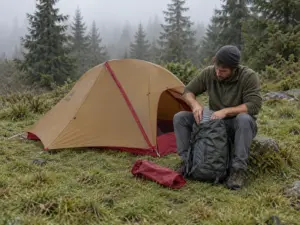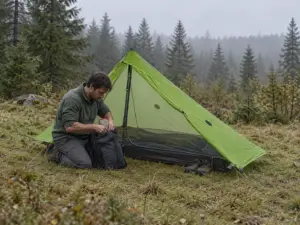

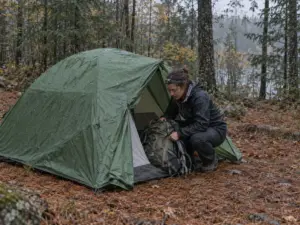












It’s 2 a.m. on a bare ridge, the wind that wasn’t in the forecast gets under the fly, and the pole bends until the tent wall is pressing against your face. That night is common, and it usually ends the same way: somebody stuffing a half-flattened tent into a pack and walking down to tree cover at midnight.
The 3-season vs 4-season tent question comes up constantly, and experienced campers keep giving the same answer: the label on the stuff sack matters far less than the wind and the snow you’ll actually sleep in. Below you’ll find what each label means, why each type fails outside its element, the 3.5-season tier in between, and how to make the tent you already own safer. Here’s the short version, side by side.
| Feature | 3-Season Tent | 4-Season Tent |
|---|---|---|
| Built for | Spring, summer and fall: rain, bugs, light wind | Winter and alpine storms: strong wind, real snow load |
| Frame and fly | Fewer, lighter poles that flex; big mesh panels and a gap under the fly | More poles that cross overhead; mostly solid walls and a fly pulled close to the ground |
| Wind and snow | Rain and light wind, an inch or three of snow | Hard gusts and a foot or more of snow load |
| Warmth | Not insulated | Not insulated either; adds only a few degrees |
| Weight and cost | About 3 to 5 lb; budget to mid-range | About 7 lb and up; premium, several hundred dollars more |
What a 3-Season vs 4-Season Tent Label Really Tells You
Picture the shop counter. The tag says “4-season” and your brain fills in the rest: warmer, tougher, safer, worth the extra money. A friend at the trailhead would tell you to put the tag down and look at the poles, the fabric and the fly instead, because the sticker is marketing shorthand and the hardware is the truth.
The names suggest a calendar, but the calendar is the wrong way to think about it. A 3-season tent is built for spring, summer and fall conditions, which means rain, bugs, light wind and maybe a dusting of snow. A 4-season tent is built for winter conditions, which means strong wind and real snow load, and those can hit a summit camp in July just as easily as a forest in January.
The dividing line is wind plus snow load, once it gets to a foot or more, not the number on the thermometer. An inch or three of fresh snow is fine in a 3-season tent with some extra guyline out. Some campers joke that 4-season tents are miserable the other three seasons, which is about as honest a summary as you’ll find.
What a 3-Season Tent Is Built For
A 3-season tent is built around ventilation, weight and packability. Big mesh panels double as mosquito netting and bug protection while letting your breath and warmth escape, the rainfly (the flysheet) stops short of the ground so air can move underneath, and the poles are light enough that a one-person version disappears into a pack. That airflow is exactly what keeps the inside dry on a muggy August night, and it’s exactly what lets spindrift blow straight through on a February one.
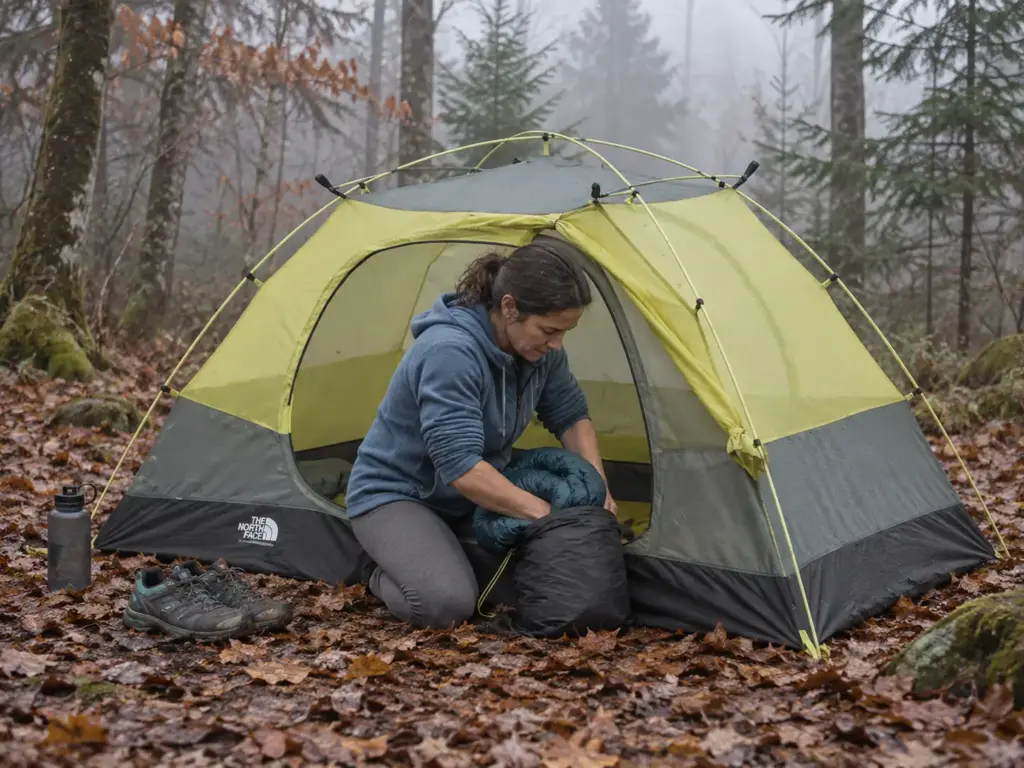
The North Face Stormbreak 2 is a good picture of 3-season done right on a budget. It’s an x-frame freestanding design (the one-person version runs about 3 lb 7 oz), and the crossing poles give it more backbone in a breeze than a simple hoop. Pitched below treeline with a snow wall on the windward side, a tent like this can get you through a calm winter night. Put it on an exposed ridge in a gale and the mesh and the high fly become the problem, no matter how well the frame holds.
What a 4-Season Tent Adds
A 4-season tent adds structure everywhere a 3-season tent saves weight, and the payoff is wind resistance and snow shedding. You get crossing poles that share the load across the whole canopy, thicker fabric on the fly and floor, a double-wall build with mostly solid inner walls, a fly that reaches the snow, more guy-out points and usually a bigger vestibule for boots, stove and frozen gear. Many also come in bright colors so you can find them in a whiteout. Every one of those features costs you weight.
Why the Label Is Not a Standard
Nobody regulates the words “4-season” or “four-season.” There is no agreed definition, and tents sold under the label range from thin-poled, light-fabric builds all the way up to full mountaineering tents. Some tents marketed as 4-season are built like 3-season shelters.
So judge the tent by four things you can verify on the spec sheet. Pole diameter and count, fabric denier on the fly and floor, how close the fly comes to the ground, and how many guy-out points it has. If a “4-season” tent has two thin poles, a fly that stops well above the ground and a mesh inner, it’s a 3-season tent with ambitions.
Poles, Fabric, Mesh and Weight: What Actually Differs
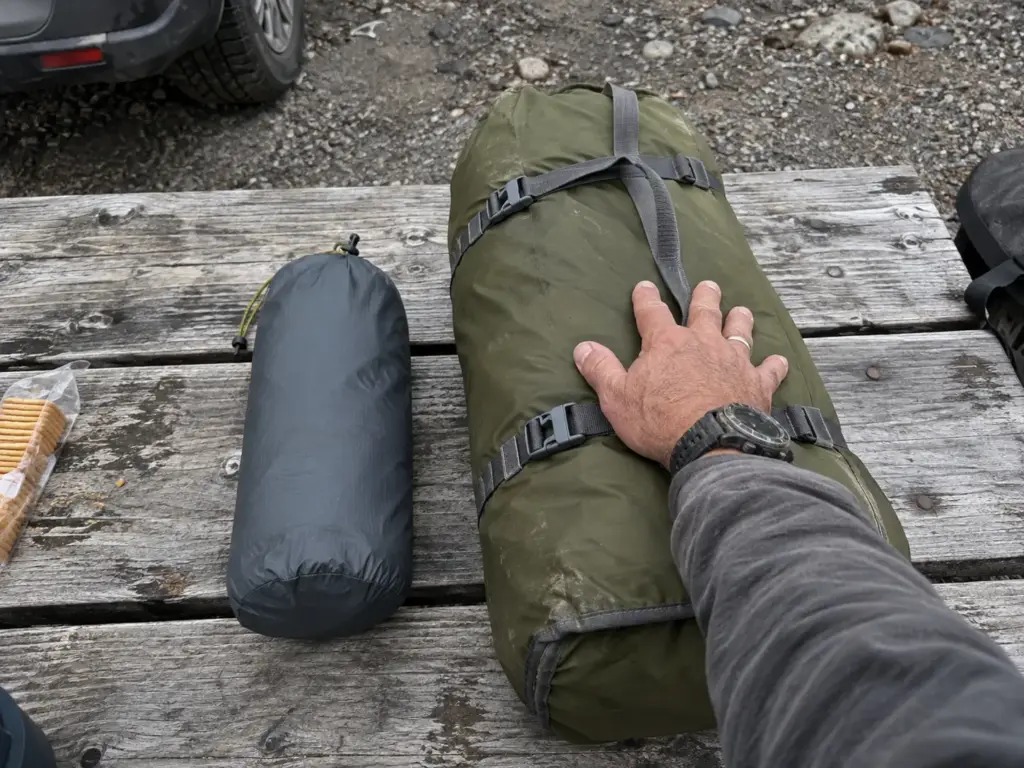
You’re standing in the tent aisle with two stuff sacks in your hands. The 4-season one is the size of a toddler and weighs about as much. The 3-season one fits in the side pocket where your water bottle goes. Four physical differences explain that gap, and once you can read them you never need the label again.
Poles and Pitch: Flex Versus Crossing Poles
A 3-season frame often uses fewer, lighter poles that are designed to bend with a gust and spring back. That flex is a feature in a summer thunderstorm. A 4-season frame uses more poles that cross over the top in an x-frame or geodesic dome pattern, so wind pressure and snow weight get spread across several arcs, instead of loading one or two the way a basic dome tent does.
How the poles attach matters too. Pole sleeves wrap the fabric around the pole along its whole length, which makes a stiffer, stronger shell but a slower pitch with cold fingers. Pole clips pitch fast and leave a gap between pole and canopy that breathes better, but they concentrate load at each clip. If you want the bigger picture on frame design, here’s a breakdown of freestanding frames and how they differ from non-freestanding tents.
Fabric, Mesh and the Gap Under the Fly
Lightweight tents use very thin fly fabric, as thin as 15D in some builds. A 4-season fly can be 70D or more, with a heavier floor to match. Denier measures how thick the yarn is, not how waterproof the fabric is, so a thin fly can shed rain perfectly well and still tear when a snow-loaded pole pushes through it. The coating and the material matter just as much, which is why it’s worth knowing what fails first in silnylon and Dyneema fabrics.
Then there’s the mesh. A 3-season inner is often half mesh or more, and the fly stops well above the ground so air flows in underneath. Wind and spindrift flow in the same way. A 4-season tent closes both doors: solid fabric inner walls with small closable vents, and a fly pulled down to the snow so nothing blows through.
Most tents here are double-wall, with a separate inner and fly; single-wall designs skip the inner tent to save weight, but they leave condensation with nowhere to go.
Weight and Packed Size
The 3-season class covered here runs about 3 to 5 pounds of packed weight for one or two people. A true 4-season starts around 7 pounds and keeps climbing from there, with expedition tents well past that. Every extra pole, every inch of fly skirt and every denier of floor buys you something specific: a pole buys wind resistance, a fly skirt buys a dry sleeping bag in spindrift, a thicker floor buys survival on frozen ground.
Posters on Backpacking Light point to the obvious gap between 3 to 6 pound 3-season tents and 8 to 10 pound 4-season tents, and that gap is where the middle tier lives (more on that below). Published weights are also slippery, so it pays to know what the tent weight specs hide before you compare two numbers on a product page.
How a 3-Season Tent Fails in Winter, and the Numbers That Matter
You wake up and the tent is still standing. Good news, right? Then you notice snow on your quilt, a crust of it along the foot of your bag, and the wall bowing in a few inches from your nose with every gust.
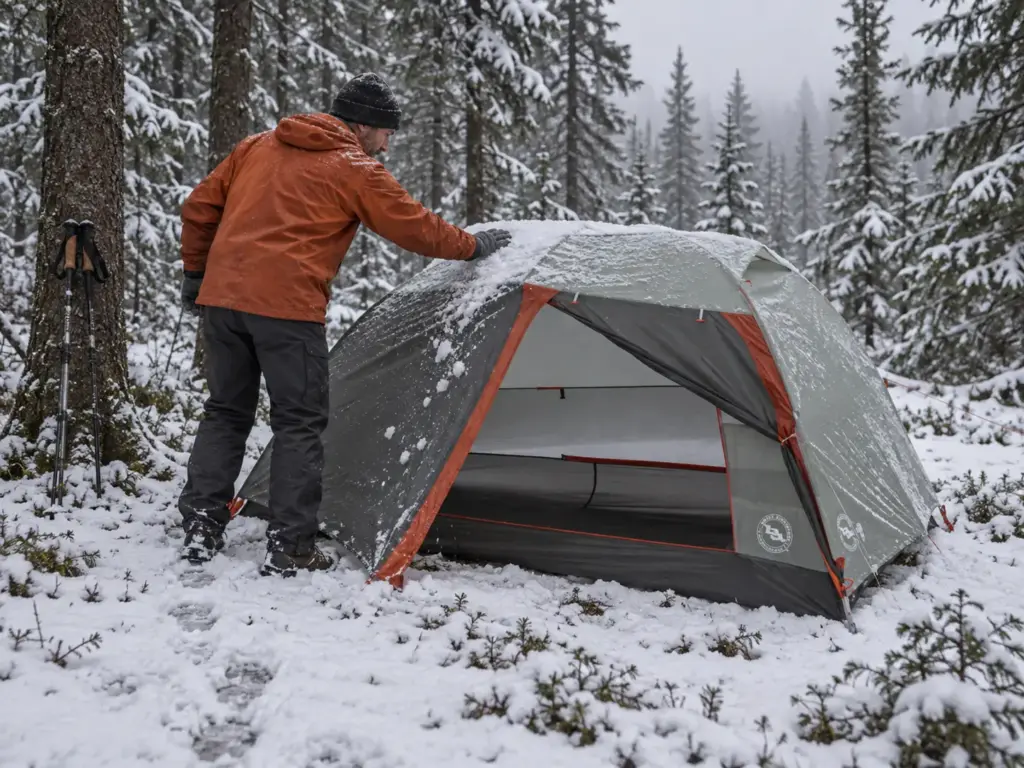
Most people blame themselves for a bad pitch. Usually it isn’t you. It’s the design doing exactly what it was built to do, in conditions it wasn’t built for.
A 3-season tent rarely fails in one dramatic collapse. It fails in four quieter ways: wind pushing the wall onto you, spindrift getting in under the fly and through the mesh, snow load bending the poles, and drifts building inside the fly where you can’t see them. Here are the numbers that tell you which nights to skip.
Wind: The 20 to 25 mph Line
The author of Winter Backpacking, a Pacific Northwest site built around snow camping, gives the clearest number out there: if the forecast is over 20 to 25 mph (or gale force) and you plan to camp on an exposed ridge in a 3-season tent, change plans. That’s sustained wind in the forecast, not a gust you might get. Gusts on an exposed campsite in high winds routinely run well above the forecast figure, and since no standard wind rating comes printed on the stuff sack, a field number like this is the best guide you have.
“Change plans” doesn’t have to mean cancel. It can mean dropping down into the trees, picking a site behind a rock band, or pitching in the lee of a moraine. Learning to pick a campsite that blocks wind and rain is the cheapest wind protection you’ll ever get, and it works with any tent.
Read the wind forecast for your campsite’s elevation, not the trailhead town. A calm valley forecast can mean a very different number on the ridge above it. Mountain point forecasts let you pick the exact spot and height, and that’s the number your tent has to survive.
Snow: Drifts, Spindrift and Load
Snow gets into a 3-season tent long before the tent falls down. Wind drives fine powder, called spindrift, under the gap at the bottom of the fly and straight through the mesh inner. On a night with thin snow cover and no snow wall, drifts can build up inside the fly itself, between fly and inner, until they start pushing the inner wall in on you. You never hear it happening.
Then there’s load. Around 4 to 5 inches of accumulation is where you need to start knocking snow off a 3-season fly, and the true 4-season trigger is a foot or more. Wet snow is the worst of it: a winter tent can have a pole snap and tear the fly under just a couple of inches of heavy wet snow. The trail fix was a twig, some wire and duct tape.
Brushing snow off the tent every hour is no guarantee: a quiet snowstorm can still leave a snapped pole by morning. That’s the part people underestimate. A snowstorm with no wind feels peaceful, and the weight piles up without a sound.
Poles: When Flex Turns Into a Snap
Flex is what lets a light 3-season frame survive gusts. It’s also the reason it eventually breaks.
The same Winter Backpacking author reports that a one-person Big Agnes Copper Spur HV UL1 rode out 20 to 30 mph winds, while the wind snapped the poles on the two-person version twice. Same pole design, bigger canopy, more sail area for the wind to push against. The bigger tent was the weak link.
The Big Agnes Copper Spur HV UL2 mtnGLO is a great backpacking tent for the job it’s built for: three-season trips where every ounce counts. That report doesn’t make it a bad tent. It makes it a 3-season tent, and the lesson is that a bigger version of a light tent catches more wind on the same tubing.
The same author describes a two-person REI Quarter Dome SL taking 15 to 25 mph gusts and spending most of the night flattened on one end. It didn’t break. It just pressed the wall onto whoever slept on that side for hours. That’s the failure you actually live through most often, and it wrecks sleep long before it wrecks gear.
The field rule sums up the risk math: if you can walk out of a failure, go; if the failure is the end of the story, buy the better tent. A snapped pole two miles from the car is an annoying morning. A snapped pole on a ridge two days in, in falling snow, is a very different situation.
Is a 4-Season Tent Overkill? The Warmth Myth and the Summer Penalty
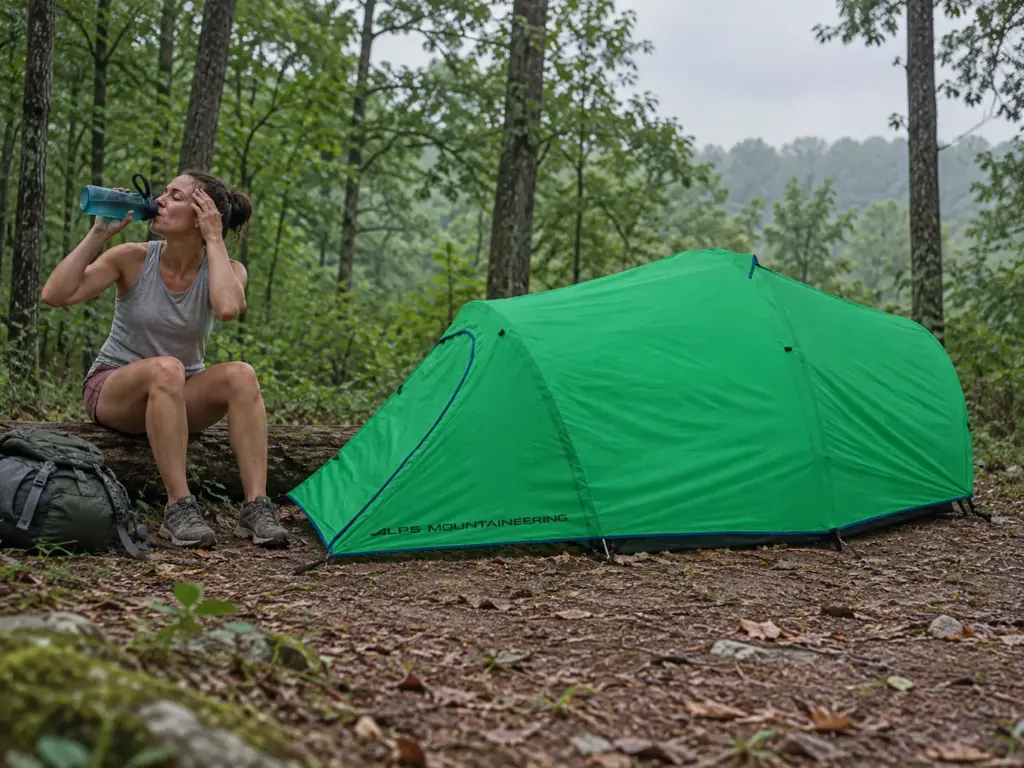
Now flip it around. Plenty of hikers spend big on a 4-season tent “for warmth,” then haul three extra pounds up a July trail and lie awake sweating. The friend at the trailhead has a simple answer for that buyer: the warmth comes from your bag and pad, not the tent. For most people, a 4-season tent is the wrong purchase, and here’s why.
The Warmth Myth in Numbers
A 4-season tent does trap a little heat, but nowhere near as much as people assume. The Winter Backpacking author estimates about 10°F, roughly 25°F outside and 35°F inside. One test inside a mountaineering tent showed it can run warmer than the air outside, but a single test is not a rating.
Treat those numbers as a bonus, never as part of your temperature margin.
Nobody would count on the tent to keep them warm: 4-season tents are about wind handling and snow loading, and you don’t get warmth from the tent. A tent is not insulated. It blocks wind, which is a big deal for wind chill, but your sleeping bag and sleeping pad do the actual warming.
That bit of extra warmth can also backfire. Solid walls trap moisture, and in a slightly warmer tent your breath condenses as liquid that runs down the walls instead of frost that you can brush off in the morning.
A damp bag is how an uncomfortable night turns into a hypothermia risk. Melting snow around and under the tent can soak through if the floor isn’t fully waterproof. Opening the door when the wind allows does more for a dry night than any feature on the spec sheet, and if you want the full explanation, here’s the physics behind a wet tent.
What a True 4-Season Costs in Pounds
A true 4-season tent starts around 7 pounds for two people and goes up from there. Split between two people that’s manageable. Carried solo on a long approach, it’s a real penalty.
The money gap is just as wide. A budget 3-season tent typically lands somewhere around $130 to $330, while a true 4-season or mountaineering tent sits closer to $550 to $950. Budget 4-season options do exist, but they get to that price by adding weight.
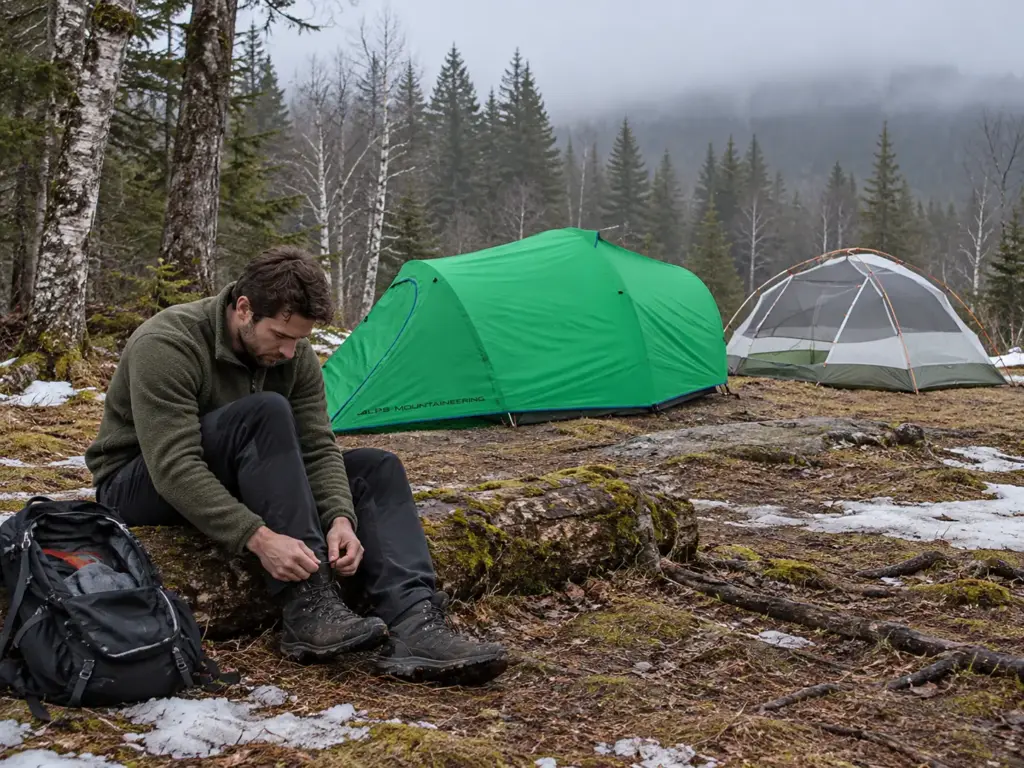
The ALPS Mountaineering Tasmanian 2 is the clearest example of that trade. It’s a freestanding, budget-friendly 4-season tent with a 75-denier fly, and it weighs about 7 lb 10 oz (the Amazon listing says 7.9 lb). Switchback calls it the budget 4-season pick, and it’s a sensible choice for car-camping in snow or a short winter hike-in. For a multi-day trip on foot, you’ll feel every one of those pounds.
Why a 4-Season Tent Is Miserable in Summer
Don’t buy a 4-season tent for summer: it is heavier and less breathable. Solid walls that keep spindrift out also ruin breathability and keep heat and humidity in, and on a warm night below treeline you trade a light breeze for a sauna. Condensation builds fast, the inside gets clammy, and the extra poles take longer to pitch.
Some campers sell a 4-season tent like the North Face Northstar 4 because setup is a hassle and winter trips are rare. That’s the most common 4-season regret: a tent bought for a trip you take once every two years.
Hunters on Rokslide put the line in the right place: a true 4-season means “dual solid walls,” more guy-outs and a stronger frame, and it earns its weight above timberline late in the season. Below timberline, a hot tent with a stove is often the better answer.
Before a winter trip, pitch any new tent in the backyard wearing the gloves you’ll actually use. If you can’t clip the inner, thread the poles and tension the guylines without taking them off, you’ll find out at dusk at 10°F instead of on a Tuesday afternoon.
The 3.5-Season Middle Tier Where Most Hikers Belong
Here’s a hiker who asks “do I need a 4-season?” a lot. She camps near treeline in October. There’s some wind, a skiff of snow overnight, sun by noon, and the next weekend it’s 60°F.
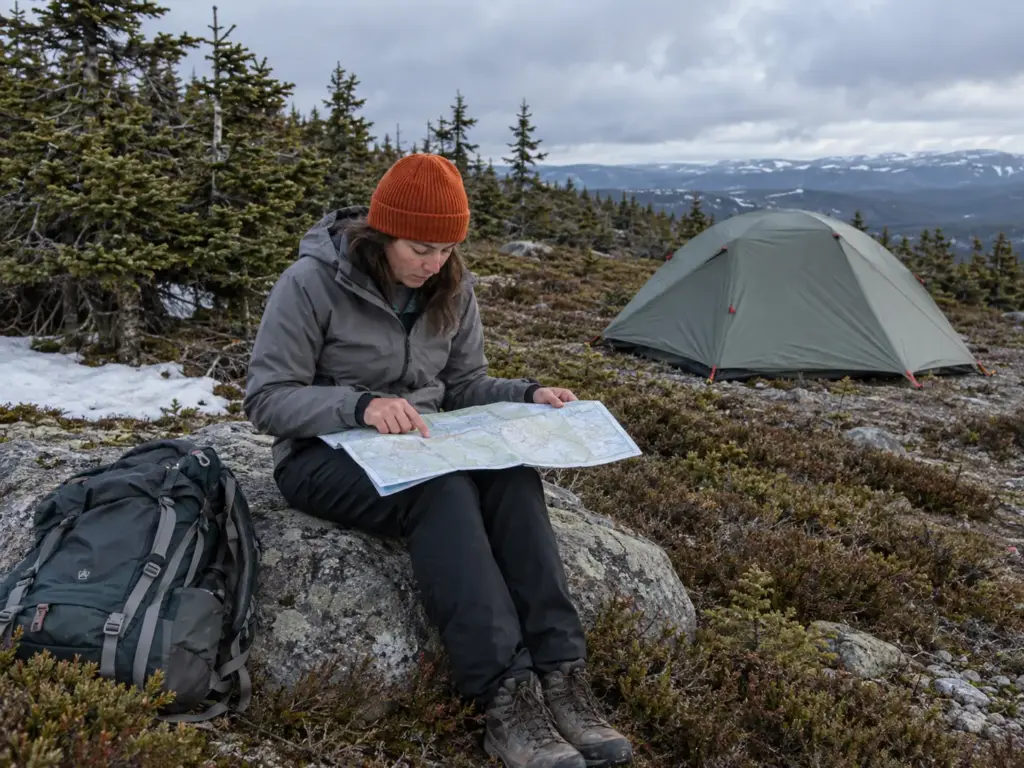
A summer tent feels flimsy up there and a storm tent is overkill. That gap has a name, and it’s the most useful thing to know before you spend money.
What 3.5-Season Means
A 3.5-season tent, also called a treeline tent, is built stronger than a summer shelter but still vented and light enough to carry. Think more and stiffer poles than a 3-season, less mesh, a fly that comes lower, but without the full solid-wall, heavy-floor build of an expedition tent. It’s designed for variable shoulder-season weather at or near treeline, where you can get wind, snow and sun in the same 24 hours.
The MSR Access 2 is the classic example. The manufacturer lists it at about 4 pounds, with limited mesh and stiffer Easton Syclone poles. GearJunkie’s review rated its weather resistance 7 out of 10 and said plainly that it doesn’t meet the highest 4-season standards, and that honesty is exactly the point. It’s a tent for treeline, not for a three-day storm on a summit.
The NEMO Kunai sits in the same slot, built with a heavy-duty sailcloth fabric and summed up in one product description as “not for the height of summer, not for the depths of winter.” Both tents are named here as reference points for the class rather than buy links, since neither has a live listing right now. Use them as a yardstick when you read other spec sheets.
When the Middle Tier Wins
The rule is simple. Pick a 3.5-season tent when you camp near or at treeline, expect wind, snow and sun in the same trip, but don’t expect storms that last days. Three situations fit that rule almost perfectly.
The first is the fall high-route trip, the late-September or October loop where you camp just under the last stunted trees and the forecast says clear but the night brings 20 mph and flurries. The second is spring corn-snow season, when you’re skinning or snowshoeing to a camp at the edge of the trees and the snowpack is firm but the wind is unpredictable. The third is the hiker who wants one tent for nine or ten months of the year and is willing to carry an extra pound for it.
Skip the middle tier in two cases. If you stay below treeline all year, a 3-season tent plus the winter kit in the next section covers you for less money and weight. If you climb, basecamp on glaciers or camp above treeline in real winter, you need a true 4-season, and a 3.5 will feel like a compromise the first time the wind shifts overnight.
The Backpacking Light crowd notes that this tier sits right in the empty space between 3 to 6 pound 3-season tents and 8 to 10 pound 4-season tents. It fills that space at a premium, often close to 4-season money. That’s the one honest downside: you pay a lot for a tent that’s best at being in between.
The Honest Limits of a Treeline Tent
A treeline tent sheds a few inches of snow and handles a windy night with every guyline out. It won’t take a foot of heavy snow without you getting up to clear it, and it won’t take a sustained gale on an exposed col. Treat it like a strong 3-season tent, not a weak 4-season one, and you’ll pick the right campsites with it.
One more comparison matters in snow. A tent, even a light one, has walls that shed snow and leave you an air space. A bivy doesn’t.
The Winter Backpacking author notes that with 20 or more inches of snowfall overnight, a bivy sleeper could end up buried, a real risk known as snow immersion suffocation. If you’re weighing a lighter setup for winter, read up on how a bivy compares with a tent when snow piles up before you leave the tent at home.
A Winter Kit That Makes a 3-Season Tent Safer
You own one good 3-season tent and want one shoulder-season snow trip this year. Before you spend several hundred dollars on a second tent, there’s a short list that changes how that tent behaves in snow. None of it turns a 3-season into a 4-season. All of it widens the window of nights you can safely use it.
Snow Stakes, Extra Cord and a Snow Wall
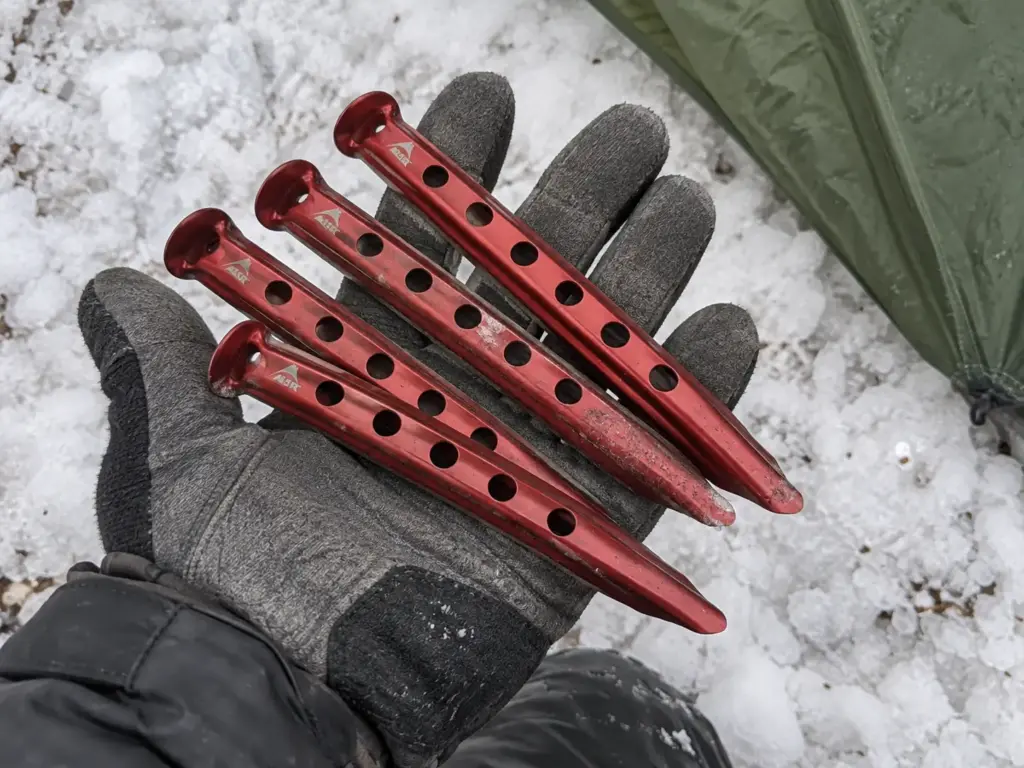
Regular skinny stakes do almost nothing in snow. You need wide stakes that grab a lot of snow, or something buried sideways as a deadman. The MSR Blizzard Stake Kit is built for exactly this: four 9.5-inch, 7000-series aluminum stakes at about 1.12 ounces each, and you can bury them horizontally as a deadman in snow. When stakes won’t hold at all, learn to bury a deadman anchor when stakes will not hold, the same technique works with stuff sacks full of snow.
Bring extra cord and use every guy-out point the tent has. Stake the extra tie-outs on the fly too, not just the ones the tent ships with lines on. Those midpanel points are what keep the wall from pressing onto your face at 2 a.m.
Then build a snow wall. Cut or pack blocks of snow and stack them on the windward side, close to the tent and roughly as high as the fly. It stops spindrift from blowing under the fly gap and keeps drifts from forming inside. A little digging buys you a dry sleeping bag.
Stamp out the tent platform with your boots or snowshoes, then give it some time to set before you pitch. Disturbed snow sets up hard as it rests, and stakes driven into a firm platform hold far better than stakes shoved into fresh powder.
Pitch Low, Vent and Check the Wind Forecast
Camp below treeline with a full-coverage fly. That single choice, the one the Backpacking Light replies keep coming back to, does more than any gear purchase. Trees break the wind, the snow is more sheltered, and you have options if the night goes sideways.
Pile snow against the windward side of the fly or pin the fly edge to the ground with snow to cut the airflow underneath. When the wind drops, open the door or a vent. A 3-season tent breathes well by design, and using that ventilation when you can is what keeps frost and condensation off your bag.
Check the wind forecast for your campsite before you leave and again the night before you pitch. If snow is falling overnight, set an alarm and clear the fly. Scouts camp every month of the year in plain 3-season tents, sometimes under moving blankets, with no collapses, because they tend the tents and pick sheltered sites. If this is your first season of cold-weather nights, start with how to start winter camping as a day hiker.
Spend on the Sleep System Before a Heavier Tent
The most repeated advice for winter on a 3-season tent is about money: put it into the sleep system. A warmer bag and a pad with a higher R-value beat a 4-season tent for warmth every time, and they keep working in any shelter you own.
One cold night in a small 3-season tent makes the case for a warm sleep system. Ventilation was fine and the tent held up. The problem was a single thin foam pad that let the cold through as the snow under the compressed bag reshaped into lumps. Two pads stacked, or a foam pad under an insulated air pad, would have mattered more than any tent upgrade.
Cooking in the Tent: The Carbon Monoxide Rule
This is the part of winter tent use that gets people hurt, and it has nothing to do with wind or snow. Cold, dark and a storm outside make cooking in the tent or vestibule feel reasonable. It isn’t. Stoves, lanterns and charcoal burn oxygen and produce carbon monoxide, which you can’t see or smell.
The CDC reported an annual average of 30 fatal carbon monoxide poisonings inside tents and campers in the US between 1990 and 1994, as covered in the CDC’s report on camping carbon monoxide poisonings. Its guidance is direct: never use those devices inside a tent, and opening a flap or window is not enough to make it safe.
High altitude makes the symptoms easy to misread. In 2018, Denali rangers found a climber having a seizure at the 14,200-foot camp after he’d cooked inside the tent during a storm, and both climbers needed oxygen and hyperbaric treatment. Read Denali rangers’ account of a climber poisoned while cooking in his tent and notice the detail that matters: the symptoms can look a lot like altitude sickness.
Here’s the twist for this article: a 4-season tent seals tighter than a 3-season one. The solid walls and fly to the ground that keep spindrift out also keep fumes in. Cook outside, in a dug-out kitchen or a windbreak, and bring the hot water in.
Which Tent Do You Need? A Decision Path by Conditions
You’re five minutes from clicking “buy.” A friend who has camped in all of these conditions would ask you four questions: where do you camp, when, how high, and what do you already own. The answers sort themselves into four cases.
When a Budget 3-Season Is Plenty
If you camp in summer and shoulder season below treeline, a 3-season tent is the right tool, and a budget one does the job. Rain, bugs and an occasional windy night are exactly what the design handles well. Add a mild winter night below treeline with the kit from the previous section and an inch or three of expected snow, and the same tent still works.
The Marmot Tungsten 1 is a good example of “the budget tent is enough.” It’s a freestanding 3-season tent at about 3 lb 8 oz, with strong ratings and a simple pitch. It won’t be your ridge tent in a gale, and it doesn’t need to be.
Winter, Treeline and Above
The other three cases are easy once you know the thresholds. Near or at treeline in shoulder season, with wind and snow possible but no multi-day storms, the 3.5-season class earns its premium. Above treeline in winter, on exposed ridges, at basecamp or on a mountaineering trip, you need a true 4-season tent, and the extra pounds are the price of a tent that still stands at 3 a.m.
The thresholds stay the same: a 3-season tent stops being enough at around 20 to 25 mph forecast wind on an exposed site, or when the snow load could reach a foot or more. If you already own a 3-season, put money into the sleep system and a snow-stake kit first, then decide whether you still need a second tent. So the four-way rule reads like this: summer and shoulder season below treeline means a 3-season; winter below treeline means a 3-season plus the winter kit; shoulder season at treeline means a 3.5-season; winter above treeline means a 4-season.
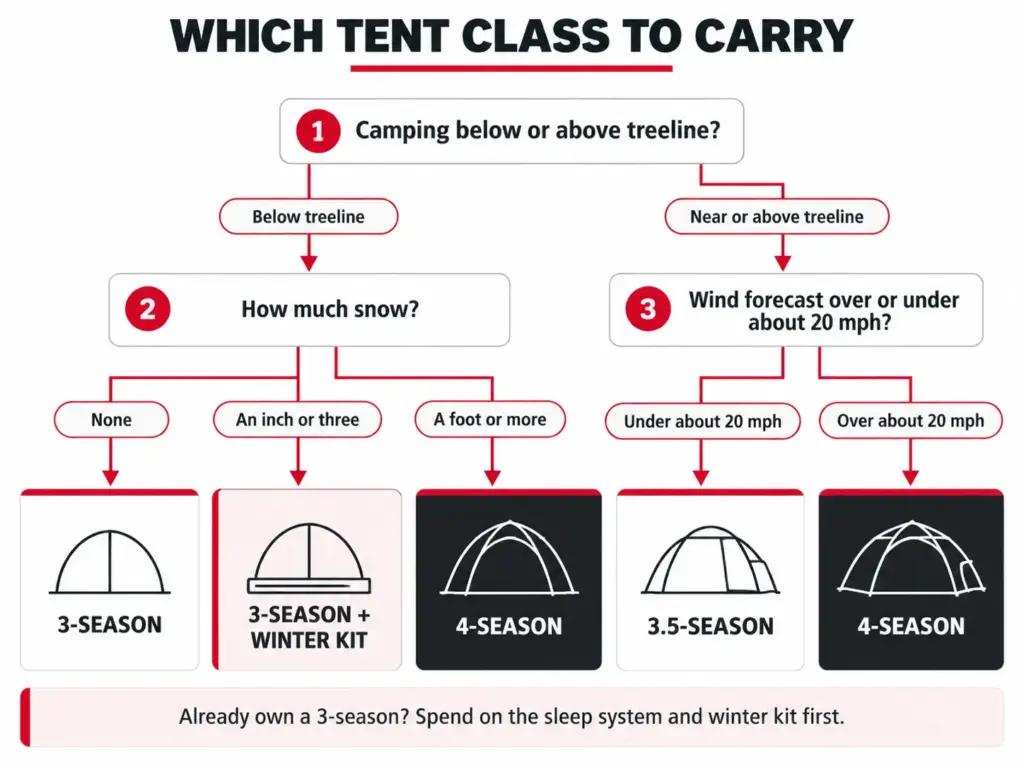
Use the walk-out test on every borderline trip: if you can walk out of a failure, go; if the failure is the end of the story, bring the stronger tent or change the campsite. A snapped pole near the car is an annoying morning. The same pole two days in is a different trip.
If You Are Still Shopping
If the decision path landed you on a 3-season tent for two, the next question is which model, and that comes down to floor space, doors, weight and how it pitches. Our guide to the best two-person backpacking tents compares them on exactly those points, so you can go from “which type” to “which tent” in one sitting.
Read the Ridge Forecast Before You Read the Tag
The label on the stuff sack matters less than the wind and the snow. Around 20 to 25 mph forecast on an exposed ridge, or a foot of snow load, is where a 3-season tent stops being enough.
A 4-season tent is wind and snow protection, not a heater, and it’s miserable in summer. Most hikers belong in a 3-season tent or the 3.5-season middle tier, and only true winter above treeline justifies the extra weight.
If you already own a 3-season tent, snow stakes, a snow wall and a better sleep system beat buying a second tent. And the stove never goes inside, whatever tent you carry.
Before your next shoulder-season trip, pull up the point forecast for the exact spot you plan to sleep, and decide the night before whether you pitch there or drop below treeline.
Frequently Asked Questions
01Should I get a 3-season or 4-season tent?
Pick by conditions, not the calendar: a 3-season tent for rain, bugs and light wind below treeline, a 4-season tent only for gusty winter nights or a foot of snow load. Near treeline in shoulder season, a 3.5-season tent usually fits best.
02Do I really need a 4-season tent?
Most hikers don’t need a 4-season tent, because they rarely camp above treeline in winter or under heavy snow. A 3-season tent with snow stakes and a snow wall, or a 3.5-season tent, covers most trips for less weight and money.
03What temperature is a 3-season tent good for?
A tent has no real temperature rating, because your sleeping bag and sleeping pad do the warming. A 3-season tent works below freezing as long as wind and snow stay low, so plan around the wind forecast and snow load, not the thermometer.
04Are 4-season tents good in summer?
Usually not, because 4-season tents are heavier, less breathable and hotter, and condensation builds quickly inside their solid walls. They make sense for a summer alpine storm high on a mountain, not for a warm July night below treeline.
05Can you use a 3-season tent in winter?
Yes, you can use a 3-season tent in winter below treeline, in light wind, with a full-coverage fly, snow stakes and a snow wall. Change plans above about 20 to 25 mph on an exposed ridge, and knock snow off the fly once a few inches build up.

I've spent more than a decade researching hiking gear and trail technique. I read the specs, the forum threads and the long-term reviews, and every pick here comes with what it gets wrong.
End of the trail
You read every mile of this one. Here's where the trail goes next.