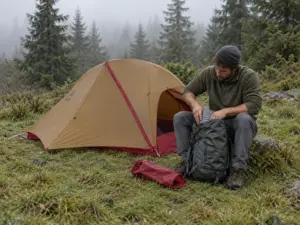
You push the stake in at sunset and it slides home with a satisfying shove. The tent looks tight. Then the first real gust comes off the water and the stake pulls out like a spoon from pudding. Staking a tent in sand with regular stakes fails for a simple reason, and the fix that rangers, field guides and beach-camping forums keep repeating is just as simple: stop driving the anchor and start burying it.
Here’s why stakes let go in sand, how to build a deadman anchor in a few minutes, what to bury when you brought nothing extra, how rocks make it stronger, which stakes and line are worth buying, and where the wind still wins.
Why Staking a Tent in Sand Fails With Regular Stakes
The stake didn’t fail because you pushed it in wrong. It failed because the ground it sits in has almost nothing to hold onto. Understand that and the rest of this guide makes sense.
Loose Sand Has Nothing to Grip
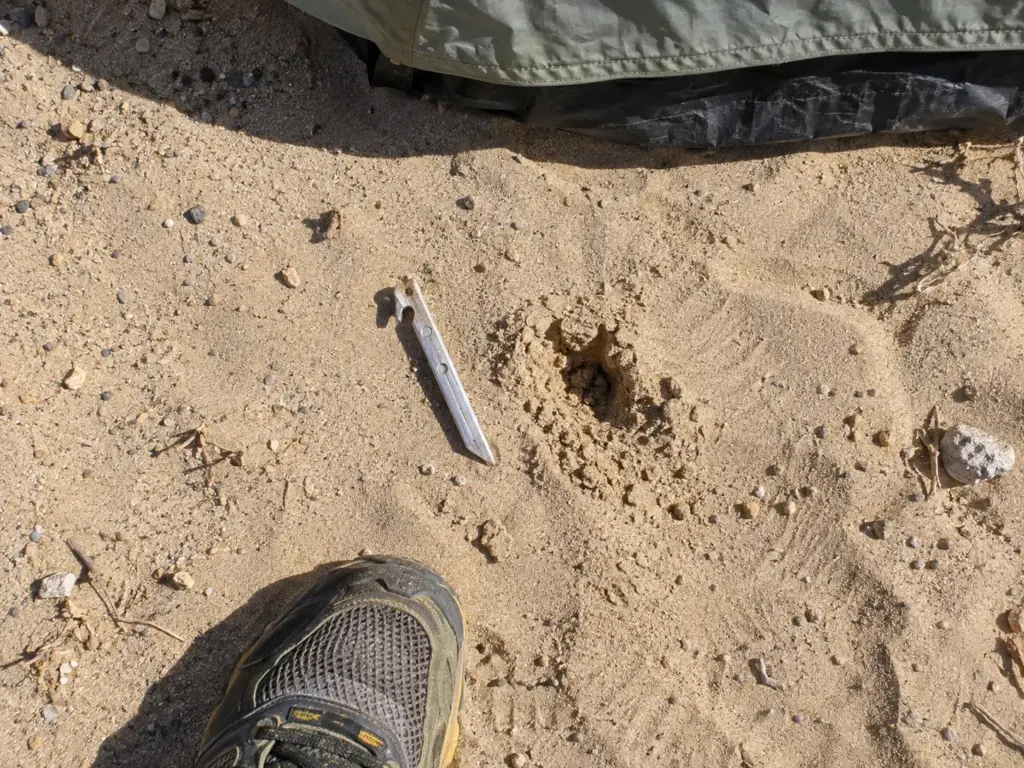
A tent stake holds by friction along its length and by the soil resisting it when the line pulls sideways. Dirt has cohesion: the particles cling to each other, so the soil in front of the stake pushes back as one block. Loose sand has very little of that, what soil engineers call low shear strength. The grains roll past each other, a short narrow stake has only a few square inches of surface to grab them with, and a sideways tug simply plows a small trench until the stake tips out.
Length helps more than clever shape. In pull-out tests Ryan Jordan ran for Backpacking Light, a 9-inch MSR stake in a sandy plot showed roughly two to three times the pull-out resistance of a 6-inch stake: it took that much more force to dislodge. That’s the same stake family, just longer, and the gap was enormous. Federal land managers say the same thing in plain words: Cape Lookout National Seashore advises stakes about one foot long and warns standard stakes may not hold in sand once the wind picks up.
The short 6- or 7-inch stakes that ship with most tents are built for forest dirt. On a beach they’re decoration.
Dry Sand Versus Damp Sand
The top few inches are the worst layer you’ll find. Sun and wind dry them out, and dry sand behaves almost like a liquid: pour it, and it flows. A few inches down, the sand usually holds a little moisture, and damp sand packs tight because the water film between grains acts like a weak glue. That’s the same reason a sandcastle needs wet sand.
So before you drive or bury anything, scrape the dry surface away with your heel or a stake until the color darkens. A paddler on a community forum described doing exactly that before driving long wooden stakes into a barrier-island beach, and the damp layer two or three inches down was where the holding power lived.
Grab a handful of sand from where you plan to anchor and squeeze it. If it holds a shape, you’re in the damp layer and it will compact. If it pours through your fingers, keep digging before you bury anything.
Why a Buried Object Beats a Driven Stake
A driven stake has to resist the pull with its own thin surface. A buried object works on a different principle. For the line to pull it free, the anchor has to drag the whole wedge of sand sitting on top of it up and out of the hole. That’s a lot of sand, and sand is heavy.
This buried bar is the deadman, and once it’s in, the weakness of loose sand stops mattering much, because you’re no longer asking the sand to grip anything. You’re asking it to sit still under its own weight.
How to Build a Deadman Anchor Step by Step
Nobody at the trailhead makes this sound simple, but it is: you dig a hole and you bury something sideways. Do it right and you’ll stop trusting bare stakes in sand for good. Do it sloppy and it holds beautifully on a calm evening, then lets go at 2 a.m.
What to Bury: Pick Your Anchor Object
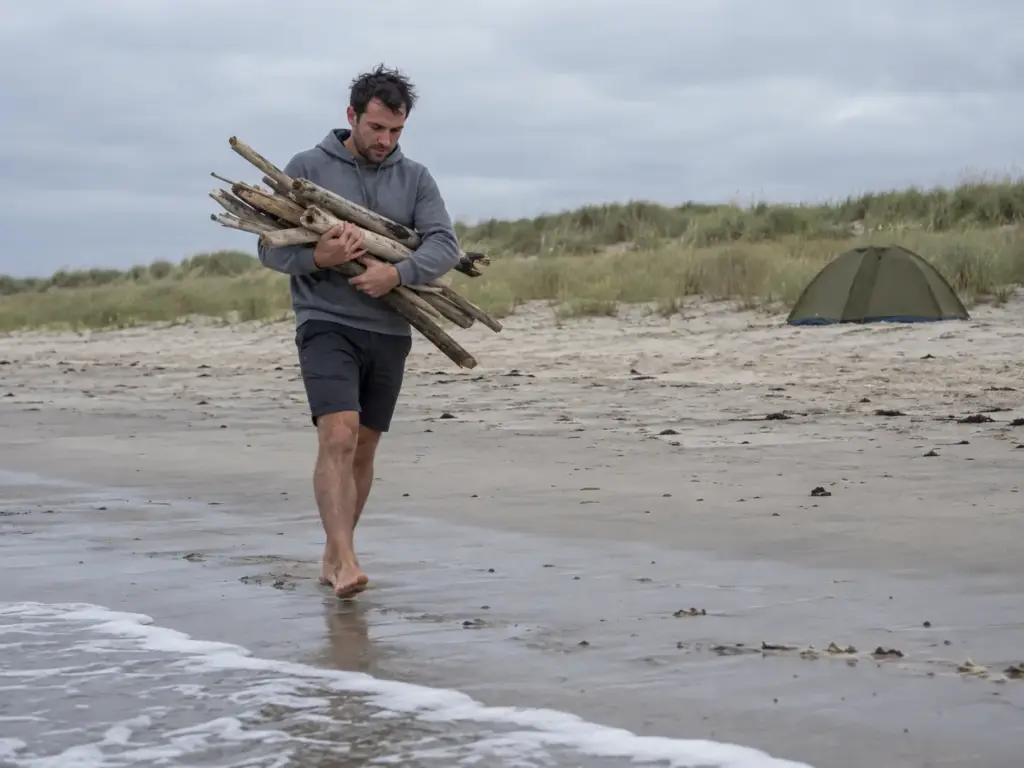
Almost anything solid and wider than it is thick will work. A stick or a piece of driftwood as thick as your thumb or more, a stuff sack packed with sand, a flat rock, or one of your tent stakes laid on its side all qualify. What matters, per Field & Stream’s take on the technique, is the weight and size of the buried object and how firm the ground around it is. Bigger and deeper beats clever knots every time.
Pick for surface area. A long stick spreads the load across more sand than a short one, and a flat rock pulls up more sand than a round cobble that can roll. A thin stake buried sideways works, but it’s the weakest option of the bunch, so give it extra depth.
Dig, Loop, Bury, Compact
Here’s the order, with the reason behind each move. If your shelter needs anchors at every corner because there’s nothing to tie off to, the same steps apply when you’re pitching a tarp where there are no trees to tie to.
- Pick the anchor point. Walk the guyline out so the anchor sits at least three feet from the tent. A longer line gives a lower, flatter pull, and a low pull is what a deadman resists best.
- Dig the hole. Burial depth is the number that matters most. Go at least 12 inches deep. SectionHiker’s author Ben Kilbourne uses about a foot, and beach campers commonly go 12 to 18 inches. In loose, dry sand, go deeper. Every extra inch adds more sand that has to move.
- Lay the anchor across the pull. Bury it horizontally, with the object set at the bottom of the hole at right angles to the guyline. This is the T-deadman: the line forms the stem of the T and the buried bar forms the crossbar. Laid crosswise, it has to shove a wide block of sand to move at all.
- Loop the line around the middle. Wrap the guyline around the center of the object, or girth-hitch a short loop onto it. Don’t cinch a tight knot (more on that below).
- Backfill in layers and compact. Push a few inches of sand back in, stamp it down with your heel, then add more. If you have water to spare, dampen each layer first. Dry sand packs poorly and the hole slumps overnight.
- Keep the running end above ground. The end that goes to the tent should come out of the sand free, so you can still adjust tension with your guyline tensioner or a taut-line hitch.
Pour a little water from a bottle into each hole before the last layer of backfill. You’ll feel the difference under your heel right away: wet sand tamps down hard, dry sand just shifts around.
Tension, Test and Retension
Once the hole is filled, pull the line taut and then lean on it. Really lean. Grab the guyline a foot from the tent and pull hard in the direction the wind will push. If the sand bulges or the line creeps, the anchor is too shallow or the backfill too loose, and five minutes of digging now beats a flapping fly at midnight.
Expect to retension after the first hour. Sand settles around a buried object, especially if it was dry when you backfilled, and that settling shows up as slack.
Snug the line again and move on. It’s the anchor bedding in, not failing.
Loop, Don’t Tie: Getting It Out in the Morning
Here’s the mistake that turns a good anchor into a chore. If you tie the guyline tight to the stick before burying it, two bad things happen. You can’t adjust tension afterward, because the knot is under a foot of sand. And in the morning you have to dig the whole thing up to get your line back.
A loop solves both. With the line simply wrapped around the middle, or girth-hitched on a short sling, you can pull one end and the whole line slides free while the stick stays put.
Then you dig it up anyway. Leaving a stick on a beach is harmless; leaving a buried stuff sack, a lost stake or a tangle of cord is trash someone else finds. Loop for convenience, dig for Leave No Trace.
No Gear to Spare? Improvised Deadman Anchors
Picture the classic beach arrival: the car is parked, the tent is out, and half the stakes are still in a bag in the garage. That’s not a trip-ender. Everything a deadman needs is probably already in your pack.
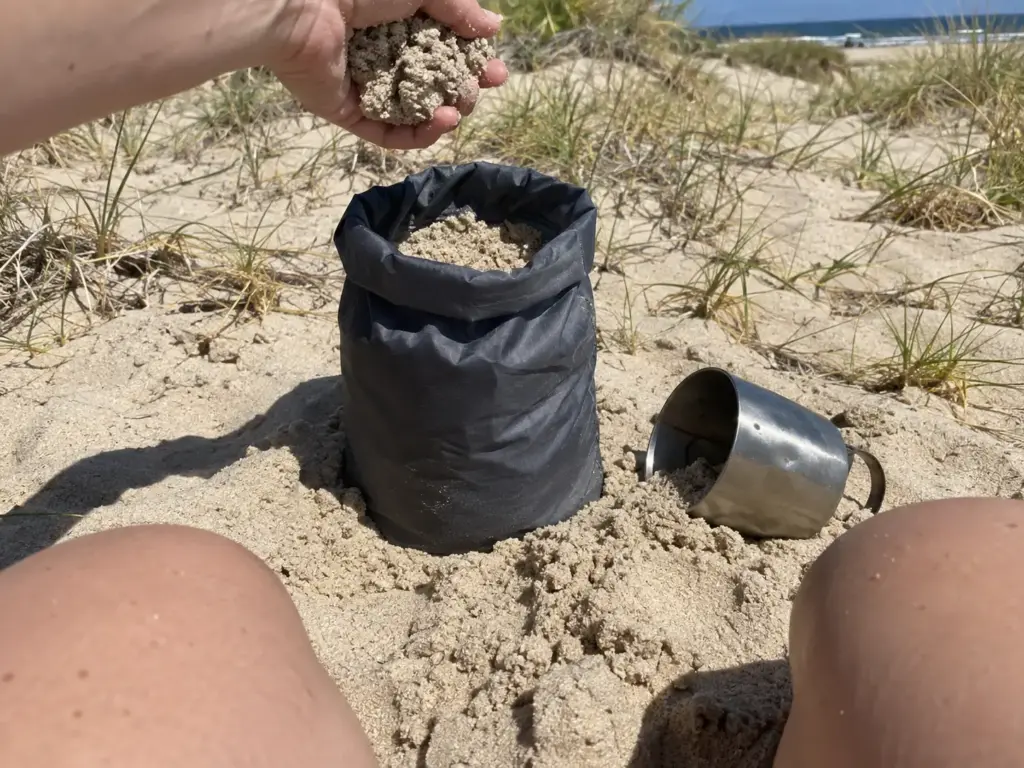
A Stuff Sack Full of Sand
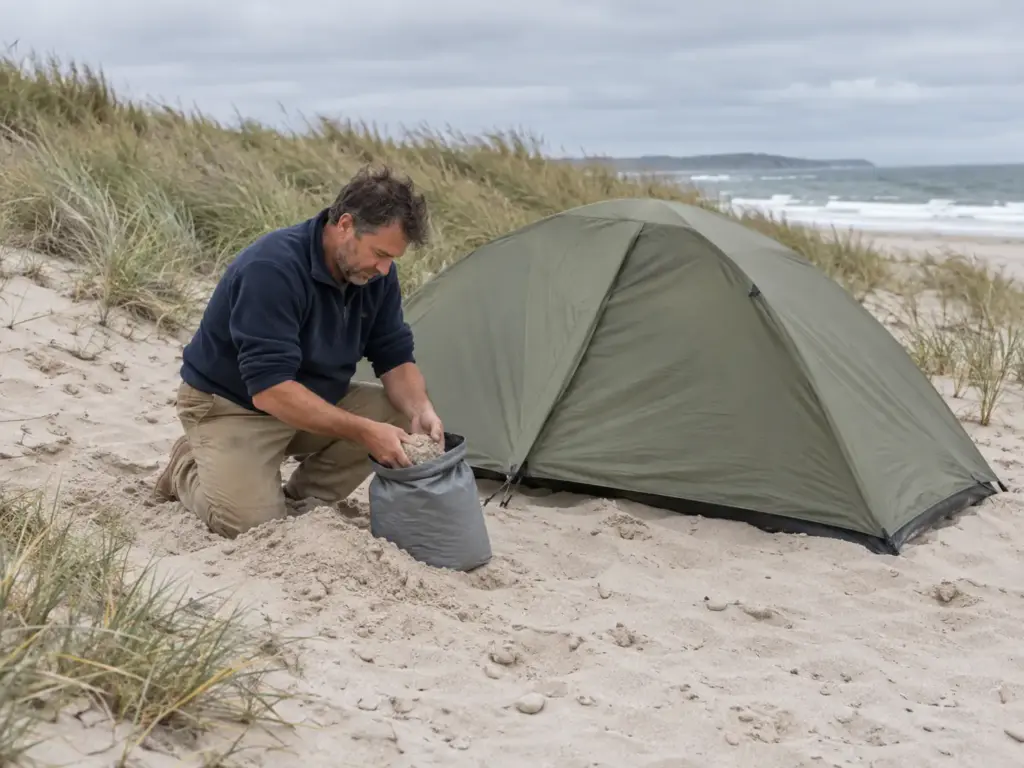
This is the go-to improvised anchor, and Field & Stream and paddling forums both describe the same method. Take a stuff sack, the tent’s pole bag or a ditty bag, fill it with sand, and cinch the drawcord. Bury the bag at least a foot down with only the drawcord loop poking above the surface, then run your guyline to that loop with a trucker’s hitch or a taut-line hitch.
The order matters. Never tie the guyline to the sack before burying it. Bury the sack, then attach the line to the exposed drawcord, so you keep full control of tension. A sand-filled sack weighs almost nothing in your pack and a lot in the ground, and its wide shape grabs more sand than a stick of the same weight.
Doubled plastic grocery bags filled with sand work the same way, a beach method that shows up in community advice. They are heavier than they look once full, so double them, and pack every one back out.
Before a sand trip, throw two or three cheap extra stuff sacks in the pack. They weigh next to nothing, they save your good food bag from becoming an anchor, and you won’t have to empty out your clothes sack at dusk.
Sticks, Driftwood, Rocks and Lumber
Look around the site before you look in the pack. A driftwood anchor, a length of old lumber, a sturdy branch or a flat rock all make good buried bars. Check two things: the piece has to be long enough to span the pull and strong enough not to snap when the line loads it. Rotten driftwood that crumbles in your hands will crumble in the hole too.
A trekking pole or walking stick works as a buried bar, but think before you bury one. If your shelter relies on using trekking poles as tent support, that pole is holding the tent up and can’t also be holding it down. Bury a spare, or bury something else.
When There Is Nothing to Bury
Some beaches are just sand: no rocks, no driftwood, nothing. You still have two options.
The first is long wooden stakes driven into damp sand. A paddler on a community forum described cutting 20- to 22-inch stakes from roughly 3/4-inch by 1 1/2-inch lumber, scraping off the dry surface sand and driving them all the way in. By that account they held through a windy night on a barrier-island beach and wouldn’t pull out the next morning without digging around them. Scrap lumber like that costs pocket change at a hardware store.
The second is weight. Lay sand-filled bags over the top of whatever stakes you have, so the stake can’t tilt out. The same forum thread mentions this with the tent’s own pole bag, and it worked. Pitch low when you’re relying on weight instead of depth, and point the narrow end of the tent into the wind.
Forum posters also mention fabric sand anchors, a sort of parachute-style fabric deadman you fill with sand on site, and note that they weigh almost nothing in the pack.
The honest limit for every improvised anchor: it’s only as strong as the hole around it. Deep and compacted holds. Shallow and loose doesn’t, no matter what you bury.
Rock Stacking and the Deadman-Plus-Rocks Hybrid
Desert camping in a dry wash, or on a rocky beach, changes the game. The sand might be packed hard, there are rocks everywhere, and you have a second tool. Used badly, though, a rock pile on a stake does almost nothing.
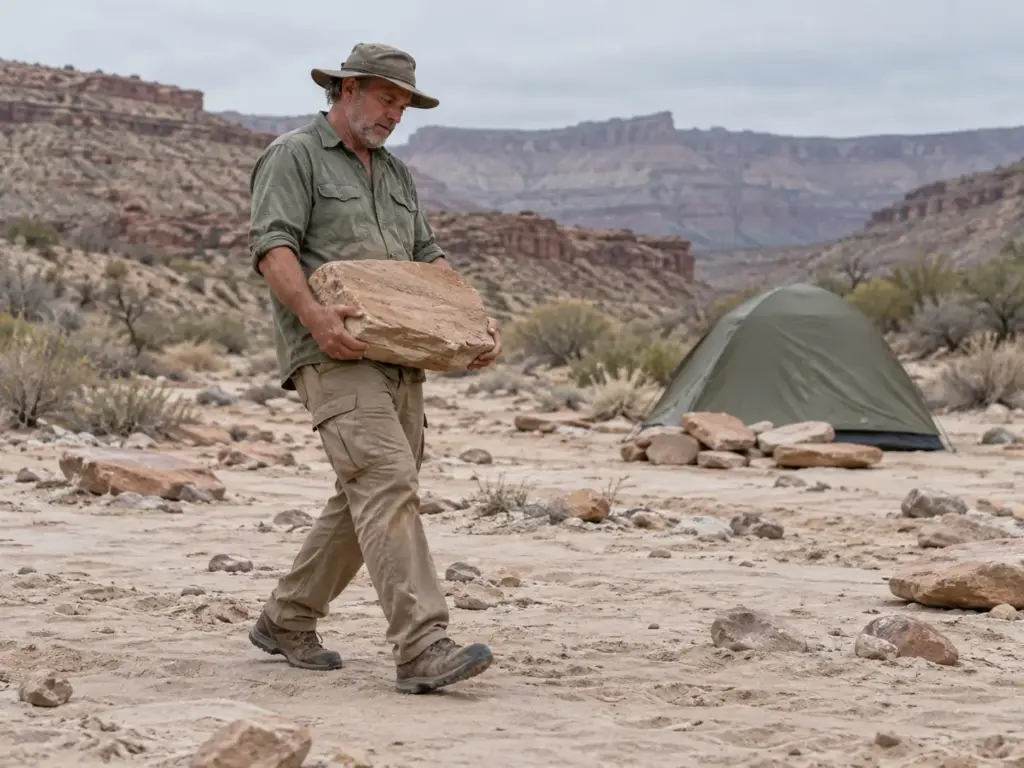
The Foundation Rock Method
SectionHiker lays out the order clearly, and the order is the whole trick.
Put a flat foundation rock on the ground where the anchor goes. Run the guyline over the top of that rock. Drive or set your stake just behind it, on the side away from the tent. Then stack more rocks on top of both the stake and the foundation rock.
Now the line pulls across the flat rock, the rock pins the stake, and the stacked weight pins the rock. Each piece holds the next one. Skip the foundation rock and pile stones on a bare stake with the line running under nothing, and the line just levers the stake up through the pile.
Why the Hybrid Wins When You Have Rocks
SectionHiker’s view is that a deadman alone isn’t as secure as good rock stacking, but a deadman with rocks piled on top “often results in very secure anchors.” That matches the mechanics. The buried object has to lift the sand above it; stack rocks on that patch of sand and you’ve added their weight to the block it has to move.
So when rocks are around, do both. Bury the deadman first, compact the sand, then build a small pile right over the buried spot, with the flattest rock on the bottom. Even this has limits, and on some nights the smarter move is to pack the tent away and go cowboy camping, which means you sleep without a tent.
A word on beaches: rocks are often simply not there. Don’t burn the last half-hour of light walking the tideline for stones. Go straight to the deadman or the stuff-sack method.
Putting the Rocks Back
Carrying rocks is real work and it disturbs the site, so take them from close by and return each one when you leave, roughly where it came from. Don’t leave a ring of stone piles behind for the next camper to read as a campsite, and don’t build cairns that look like trail markers. The site should look the way you found it.
Best Stakes and Guylines for Sand
Most stakes in the gear-shop bin were designed for dirt. For sand stakes, the short list is about length and line, and you may not need to buy much at all.
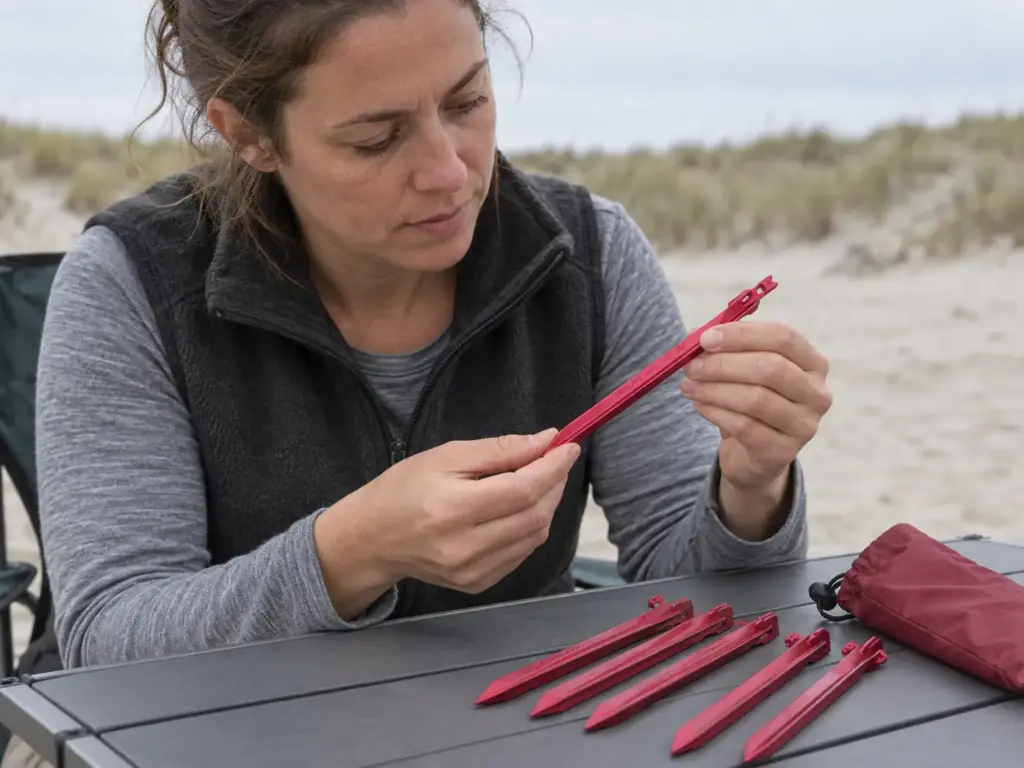
Stakes: Length First, Then Shape
Backpacking Light’s stake research puts it simply: longer, wider stakes are generally better in soft or sandy soils, because more surface area means more friction. Shape comes second. A Y-shaped stake, usually sold as a Y-beam, is lighter than a plain nail and grips better than a skinny rod, and it holds well wedged behind a foundation rock.
The MSR Groundhog stake is the stake SectionHiker sets behind foundation rocks: a 7.5-inch Y-beam in 7000-series aluminum at under half an ounce each. It’s a great all-round stake and it locks well under a rock stack. In dry sand on its own it’s still too short, so pair it with a deadman or rocks rather than trusting it bare.
If you want the longer length that the NPS advice and the pull-out data favor without spending much, Coghlan’s 9-inch aluminum stakes are the budget route. They’re plain and they bend if you pound them into rock, but in damp sand those extra inches of length matter more than any clever profile. A decent set of stakes generally runs $10 to $30 per pack of four to six, so this isn’t where the money goes.
Screw Anchors for Car and Beach Camps
For a car camp or a beach basecamp where weight doesn’t matter, screw-in anchors are worth a look. The Orange Screw ground anchors work as an auger anchor, twisting into the ground so the threads bite a long column of sand instead of a thin sliver. They earn their keep when there are no rocks and you’d rather not dig a dozen holes for a big family tent or a shade canopy.
The honest note: they’re heavy and bulky for a backpack. Nobody carrying their camp a few miles in should haul a set of them. The Eurmax spiral anchors are a cheaper alternative in the same style, with the same weight trade-off.
A Long Guyline Changes the Angle
The guyline matters as much as the anchor. A short line forces the anchor close to the tent and pulls it upward at a steep angle, which is exactly the direction sand resists least. A long line, about 36 inches per SectionHiker, lets the anchor sit far out and pull low and flat. SectionHiker prefers a durable Spectra guyline, a Spectra-core line such as MLD Pro Guyline, for sand and sharp rock.
If you want a cheap, long line you’ll actually see in the dark, ThreeBulls 1.8 mm reflective guyline comes on a spool, so you can cut generous guyline extensions for every corner and still have some left for repairs. The reflective tracer is a small thing that matters at a crowded beach site: nobody trips over a line that lights up in a headlamp.
The anti-sell: a budget set of longer stakes plus a couple of stuff sacks beats an expensive dedicated sand anchor most of the time. If you camp on sand once a year, don’t buy a special kit. Bring sacks, cut some long line and learn the deadman.
Wind, Tide and Freestanding Tents: What Still Goes Wrong
The best anchor ever buried still loses to a bad site and a bad forecast, because the wind loading on a tent climbs fast as gusts build. The real skill on sand is knowing when to move the tent, drop it flat or skip it.
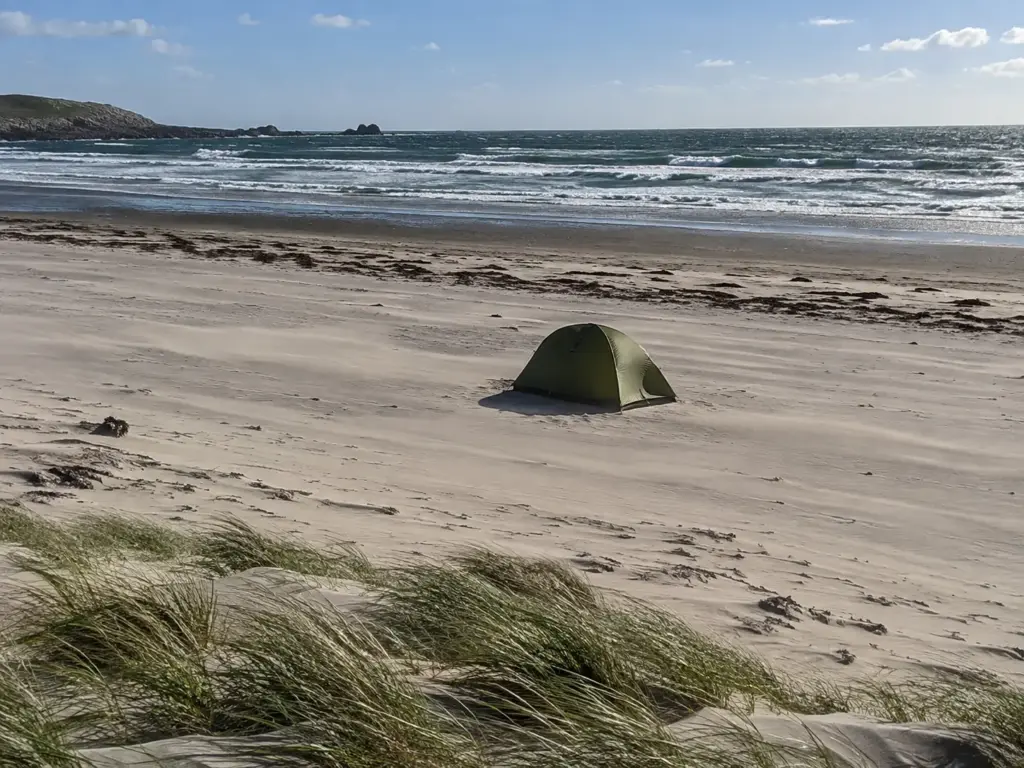
Freestanding Domes Still Roll
Freestanding means the tent stands up without stakes. It doesn’t mean it stays put. SectionHiker’s author puts it bluntly: “I can’t count the dome tents I’ve seen rolling across the desert.”
A dome is a light, round shape with a big surface, which makes it a near-perfect wind toy once you climb out of it. One hiker on a backcountry forum reported a loaded tent lifting off at Lake Powell, so even gear inside isn’t always enough.
Stake a freestanding tent on sand anyway, every corner plus the guyouts. Non-freestanding shelters (tarps, pyramid shelters, trekking-pole tents) need every anchor just to stand, so they get the deadman treatment by default. If you’re still choosing a shelter, it’s worth reading up on freestanding versus non-freestanding tents for different terrain and picking one that suits the ground you actually camp on; our guide to two-person backpacking tents covers the shelters most hikers end up sharing on those trips.
How Much Wind Is Too Much
There’s no single official number. The commonly cited ranges put standard tents at around 20 to 30 mph before they struggle, some sturdier backpacking tents at around 45 mph, and sustained winds of 30 to 40 mph as too strong for comfortable tent camping. Treat those as rough figures, not specs. A lot depends on the tent shape, the pitch and how the wind arrives, steady or in gusts.
My own rule of thumb: if the forecast shows sustained wind of 30 mph or more, plan to bail before you start digging. Anchors don’t help a tent whose poles are being bent flat, and at high wind that is often the failure, not the anchor letting go. If you want to know how far a three-season tent will really go in wind, that’s a question about the tent, and no amount of sand engineering changes it.
Bail-out options, from easiest to hardest: drop the tent flat and weight it with your pack and some sand bags; move it to the lee of a dune or bluff; or pack it and sleep in your bag behind whatever shelter the site offers.
Pick the Spot Before You Pick the Stake
Site choice does more than anchors. Pitch behind a dune, a bluff or a stand of brush so the worst of the wind goes over you, and point the narrow, low end of the tent into the wind. Cape Lookout’s rules ask campers to set up among the dunes, not on top of them, which also keeps you off the most exposed ground.
Then check the tide. Leave No Trace guidance for the beach says to stay above the high tide mark, and the flat, firm, perfect-looking strip of sand is often flat and firm precisely because the sea keeps covering it. Look for the wrack line of dried seaweed and debris, pitch well above it, and read the local tide table before you commit. The same habit pays off on coastal trails where tides matter.
Finally, remember that sand moves overnight. Anchors loosen as the sand settles and as the wind shifts direction. Walk around and retension every line before you crawl in.
Pitch Checklist, Take-Down and Leave No Trace
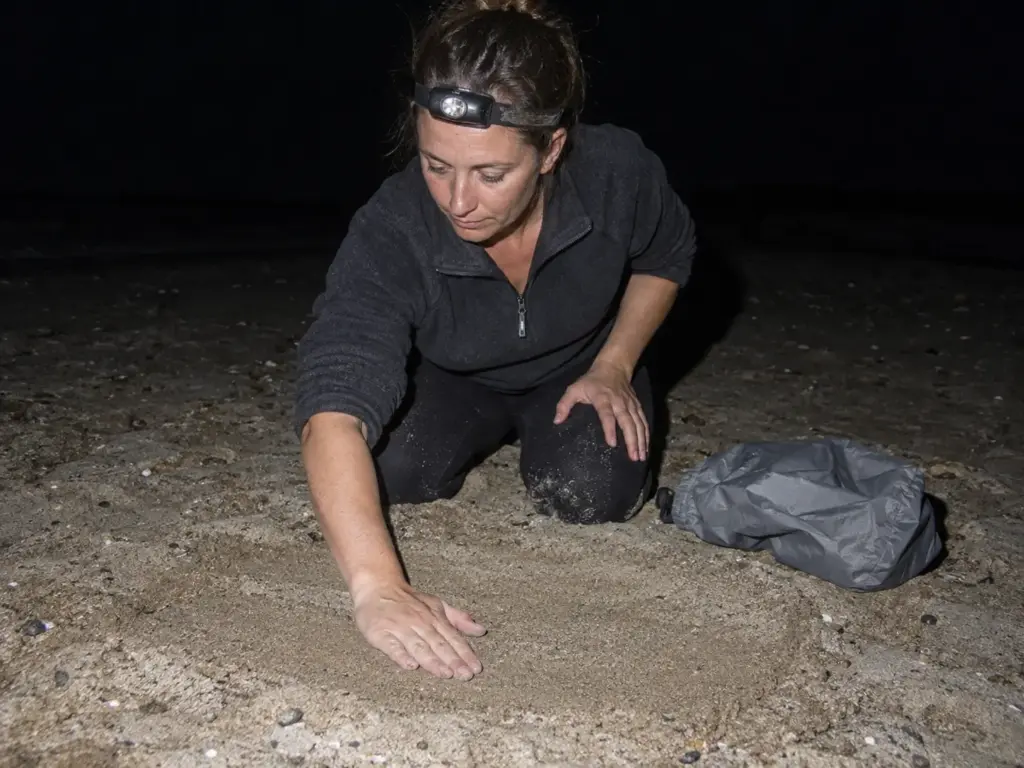
Sand pitching takes longer than dirt, so pitch before dark. Starting in the last twenty minutes of light means burying anchors by headlamp, which is how holes end up shallow.
The Pitch Order That Saves Daylight
SectionHiker warns that gathering rocks, burying deadmen and stacking all take extra time on sand, so start early. Then work in this order:
- Pick the site: lee side, above the tide line, among the dunes, not on them.
- Spread the tent flat and put your pack inside to hold it down while you work.
- Bury the upwind anchors first, since those take the load.
- Do the sides and the downwind anchors next.
- Raise the tent, then tension every line.
Plant something tall, like a trekking pole or a stick, next to each buried anchor before dark. In the morning you’ll know exactly where to dig, and no one walking past at night will catch a toe on a guyline.
Retension After an Hour
Sand settles. Backfill that looked tight at sunset slumps a little as air pockets close and the grains find their place, and that shows up as slack in the line.
Make it a habit: an hour after pitching, walk the perimeter and snug every guyline. If the wind picks up overnight or before breakfast, do it again. A tight line also keeps the fly off the inner tent, which cuts down on flapping and on the sand that blows through.
Pull Everything Out and Fill the Holes
Take-down is the reverse, plus a little digging. Slip each looped line free first. Then retrieve every anchor you buried: the sticks, the stakes, the sacks. Empty the sand out of your stuff sacks well away from the tent and shake them out before they go back in the pack.
Fill every hole, smooth the sand and return the rocks to where you found them. The goal of Leave No Trace principles for camping is that the next person can’t tell anyone stayed there. Last step: count your stakes and sacks. Buried gear is the easiest gear in the world to lose, because it’s already out of sight.
Make the Sand Do the Holding
Three things to take with you to the beach:
- A stake in loose sand slides out. A buried anchor makes the whole block of sand above it resist the pull.
- A deadman only needs a stuff sack, a stick or a flat rock. Bury it sideways at least a foot down, loop the line, compact the sand, and pile rocks on top if you have them.
- Longer stakes, a long guyline and an honest look at the forecast do the rest. When the wind wins, drop the tent or move it.
Before your next beach trip, run the test at home: bury a sand-filled stuff sack a foot deep in the backyard or a sandbox, hang a bucket off the guyline, and keep adding water until it moves. You’ll trust the method a lot more once you’ve seen how much it takes.
Frequently Asked Questions
01How do you stake down a tent in sand?
Dig a hole at least 12 inches deep, loop the guyline around a stick, stuff sack or flat rock, and bury it sideways with the sand compacted on top. Pull the line taut from about three feet out, and stack rocks over the spot if you have them.
02What are the best stakes for sand tents?
The best stakes for sand tents are long and wide, at least 9 inches, in a Y-beam or wooden profile, rather than the short stakes that ship with most tents. A 20- to 22-inch wooden stake driven into damp sand outholds most short specialty stakes, and any stake does better paired with a deadman.
03Do stakes work in sand?
Short standard stakes pushed into dry sand usually pull out in the first strong gust, so a plain stake alone is a poor bet on a beach. Longer stakes driven into the damp layer hold better, and a buried deadman anchor holds far better than any bare stake.
04How do you anchor a canopy in sand?
Anchor a canopy in sand the same way as a tent: bury a deadman for each leg line, or weigh each leg with sand-filled bags. Take it down when the wind rises, because an open canopy catches wind like a sail.
05How deep should a deadman anchor be?
A deadman anchor should sit at least 12 inches deep, and deeper in loose, dry sand, because depth is what makes the block of sand above it heavy. Every extra inch adds sand the line has to lift, and a bigger, flatter buried object holds more than a small one.

I've spent more than a decade researching hiking gear and trail technique. I read the specs, the forum threads and the long-term reviews, and every pick here comes with what it gets wrong.
End of the trail
You read every mile of this one. Here's where the trail goes next.