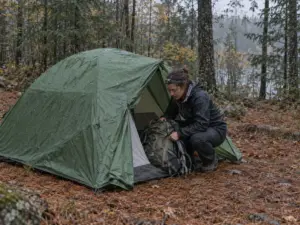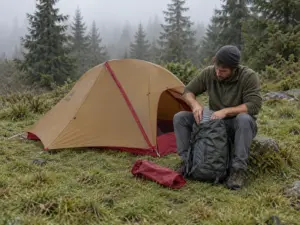






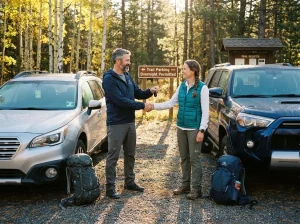
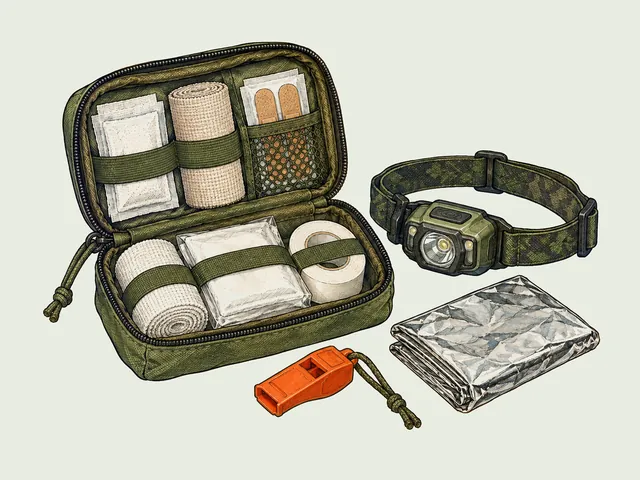


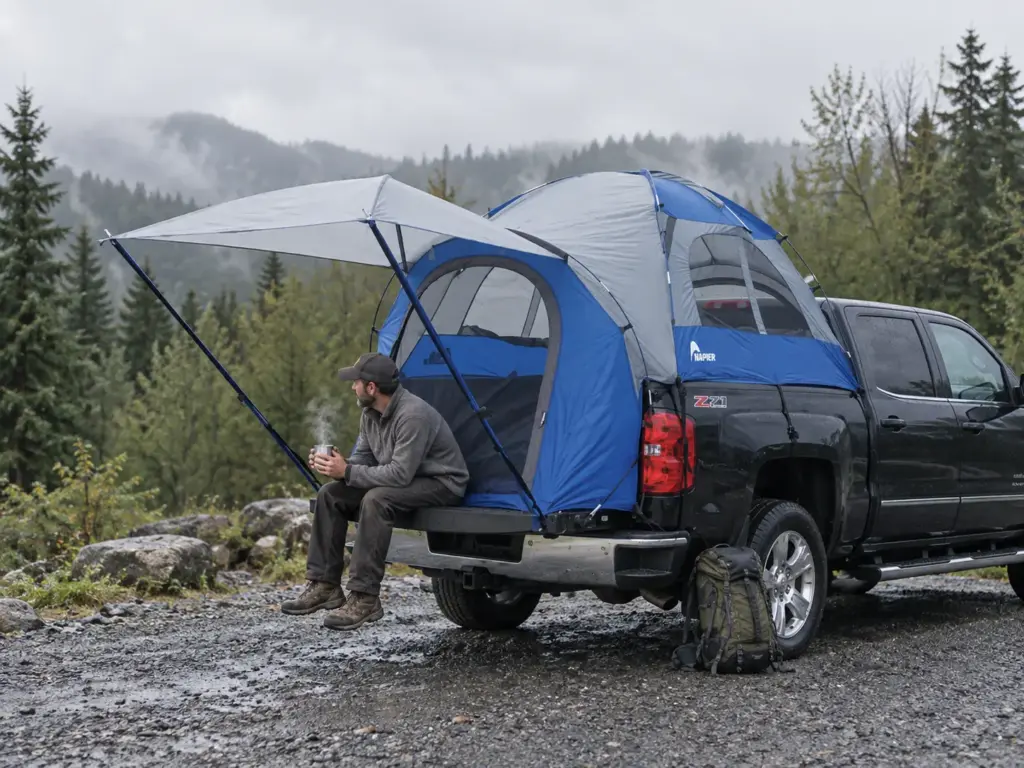
You pull into a gravel pullout below the trailhead at dusk, drop the tailgate, and unroll a tent whose box says full-size, only to find it runs a foot longer than your bed. A truck bed tent brings two lessons that come up again and again: the first setup is slow, and the real regret is tearing the whole thing down every time you want to drive to town. Both problems get settled before you buy, and the first tool you need is a tape measure. Here’s how to match a tent to your bed, what it can and can’t handle, and whether it beats a ground tent for the way you hike.
What a Truck Bed Tent Actually Is (and What It Isn’t)
Pitch a tent in your pickup at a busy trailhead and someone will wander over to ask if you really sleep back there. You do. A truck bed tent (also sold as a box tent or in-bed tent) straps into the pickup bed and uses the bed walls as part of its frame, so the floor of your bed becomes the floor of your bedroom. Most are polyester, sleep two, and go up without tools: shock-corded poles, a handful of straps hooked under the bed rails or around the wheel wells, and the open tailgate as the doorstep.
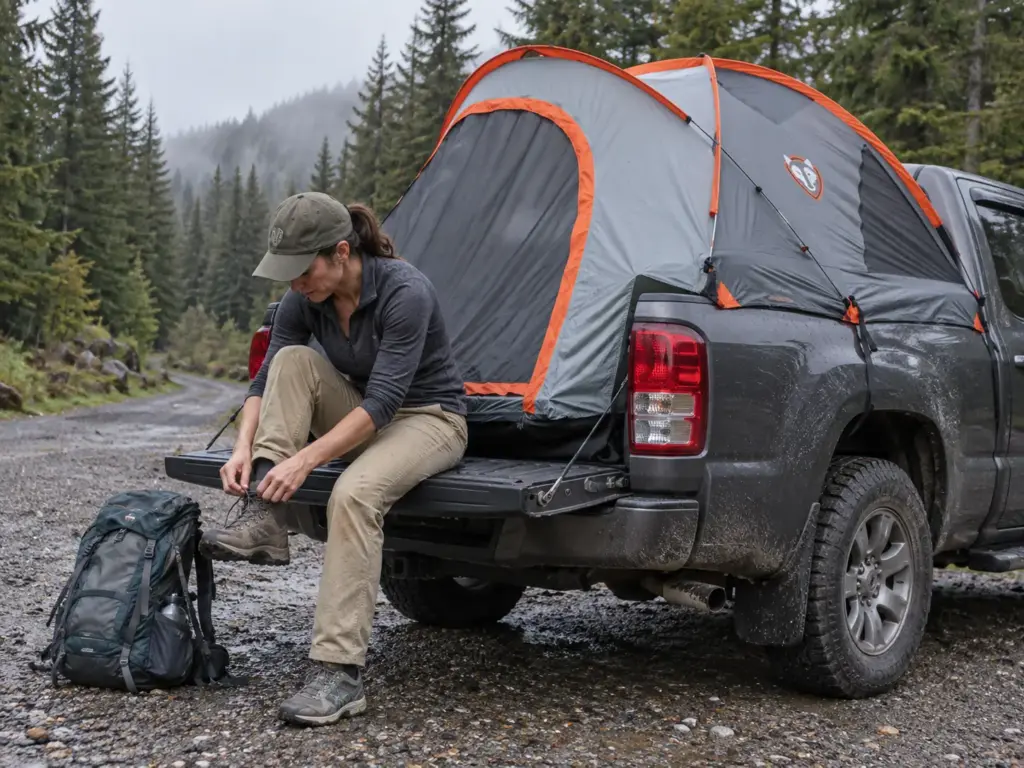
Owners of these tents mostly agree on what they like: elevated sleeping, being off the ground. No mud, no rock under your hip, fewer crawling things finding their way in, and a weirdly secure feeling with the bed walls around you. What drives them nuts is breaking camp every time the truck has to move. Both groups are right, which is why this is a decision and not an automatic upgrade.
Keep one thing straight from the start. This is a car camping shelter. You carry it from the tailgate, not up a ridge, and a tent in the 15-to-16-pound range like the Napier Backroadz would be a strange thing to strap to a pack. Napier rates its Backroadz line three-season and warns against driving with the tent mounted, which tells you most of what you need to know about the category’s limits.
In-Bed Tent vs Rooftop Tent vs Ground Tent
An in-bed tent is the cheapest way to sleep off the ground in a pickup, and the bed walls do part of the structural work. A rooftop tent (RTT) sets up faster and gives you a flat mattress up top, but it costs far more and turns the truck into a parked building until you fold it. It also raises the truck’s center of gravity and has to match your rack’s static load rating and dynamic load rating. A ground tent gives you stand-up room in the bigger models and leaves the truck free for a run to the store, at the price of sleeping on whatever the ground offers that night.
If you want the variations in depth, from floorless designs to bathtub floors, our breakdown of pickup bed tent types and floor options lays them out. This guide sticks to the two questions that come before that: which tent fits your bed, and whether you should own one at all.
Why Hikers Car-Camp This Way
For a hiker, the best use case is the night before a big day. You drive in after work, sleep at a campground or a legal pullout near the trailhead, and you’re walking at first light instead of starting the morning with a three-hour drive. Once you have it dialed, a truck bed tent turns that into a ten-minute routine.
It also earns its keep on sites where a ground tent means a bad night: roots, sharp rock, standing water, a slope you can’t find a flat spot on. The bed doesn’t care what’s under the tires. The trade is that your truck is now your campsite, and that matters more than it sounds.
What Most Stores Don’t Tell You Up Front
Product pages sell setup speed and the view out the back window. They don’t dwell on the ribbed metal floor that pulls heat out of you all night, the wheel wells that eat sleeping width, or the poles that take every gust because the tent rides a couple of feet higher than a ground tent would. Those get their own section further down, because they’re the reasons people sell these tents a season later.
Measure the Bed First: How Bed Length Picks Your Tent
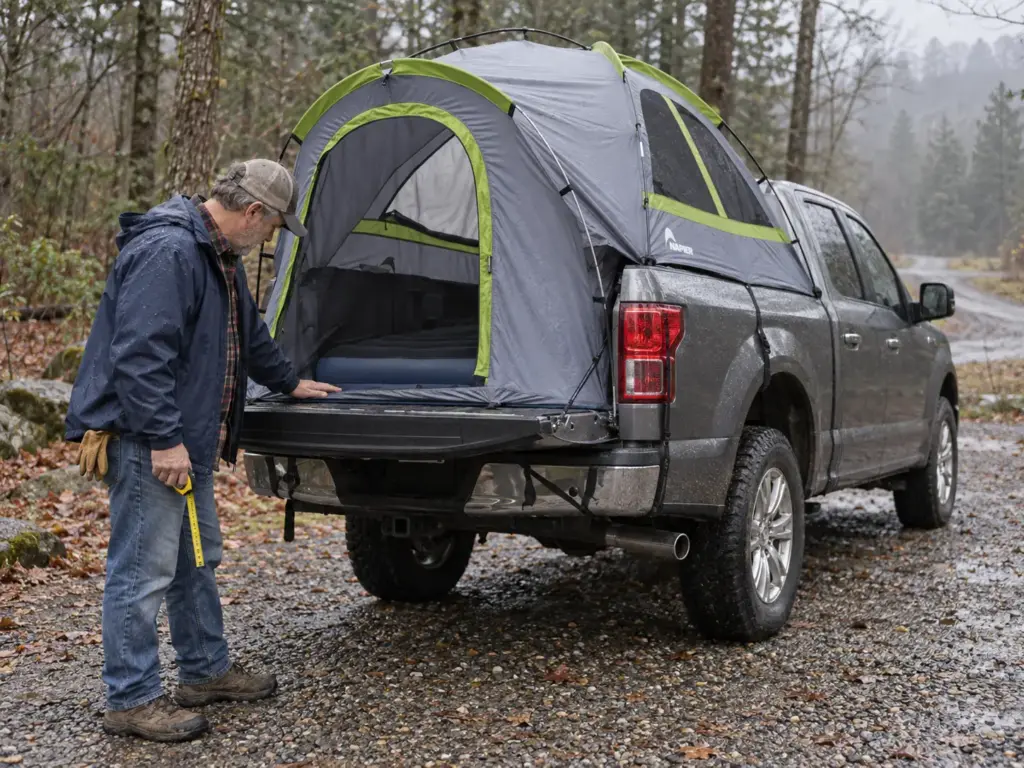
Here’s where people go wrong first: they buy for the truck they drive instead of the bed they have. A full-size badge covers beds from roughly 5.5 feet to 8 feet, and a crew-cab half-ton with a short bed needs a completely different tent than the same truck with a long bed. Measure the bed length inside, from the bulkhead to the inside of the tailgate, with the tailgate closed. That number picks your tent, not the cab or the trim level.
Three buckets cover nearly every pickup on the road. Short beds run roughly 5 to 5.8 feet, the usual setup on most mid-size trucks. Standard beds sit around 6.5 feet. Long beds are about 8 feet, common on work trucks and heavy-duty models.
Odd beds are where buyers get burned. On a Honda Ridgeline, or a 5-foot bed on a Colorado or Tacoma, the advice is the same: buy the exact compact or short model made for that length, and don’t count on a bigger tent cinching down to fit.
Measure twice: once along the floor and once at the top of the bed rails, both with the tailgate shut. Then measure the gap between the wheel wells. Write all three numbers on a strip of tape stuck inside the glovebox lid, and you’ll never have to guess while you’re shopping from your phone at a gas station.
Standard Beds and the Napier Backroadz
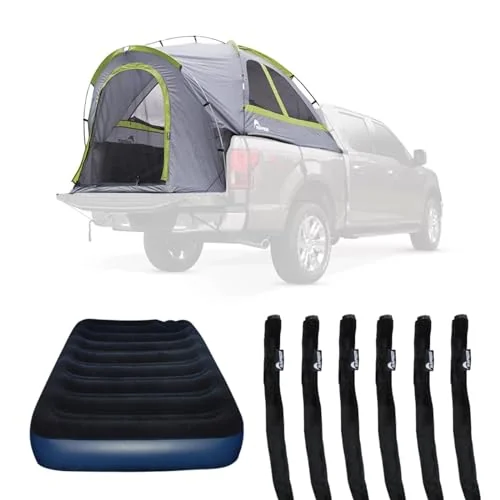
The Napier Backroadz Truck Tent Full Size Regular with Sportz Air Mattress is the tent I’d point a first-timer with a standard bed toward. Napier lists about 5 feet of center height, so you kneel and sit rather than stand, and a sewn-in floor of polyethylene, the bathtub floor design, keeps the bed’s grit and puddles away from your sleeping bag. The bundle matters more than the tent itself: the included air mattress fills the floor between the wheel wells instead of sagging over them.
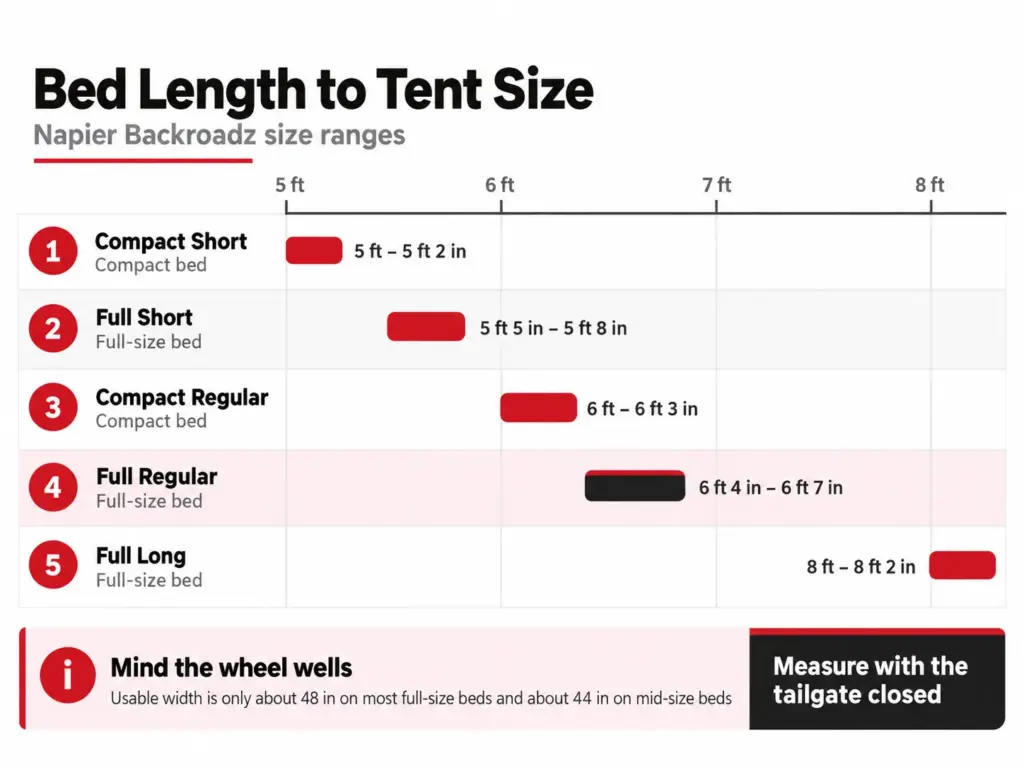
Napier also makes the clearest case for buying by length. Its Backroadz line comes in five sizes: Compact Short for 5 to 5 ft 2 in beds, Compact Regular for 6 to 6 ft 3 in, Full Size Short for 5 ft 5 in to 5 ft 8 in, Full Size Regular for 6 ft 4 in to 6 ft 7 in, and Full Size Long for 8 to 8 ft 2 in. Notice the gaps between ranges. If your tape lands in one of them, check the maker’s vehicle fitment guide for your exact truck instead of rounding up to the bigger tent “to be safe.”
Short Beds and the Rightline Gear 5.5 ft
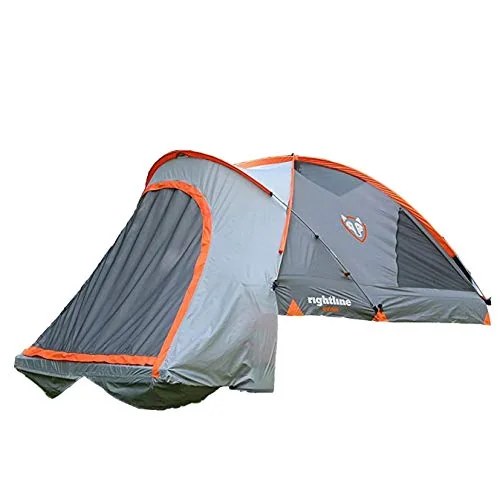
Short beds are where the lightest and cheapest tents live. The Rightline Gear Full-Size Short Truck Bed Tent 5.5 ft is floorless: the tent body wraps the bed and your pad goes straight onto the bed floor or liner. That cuts weight and packing time, and there’s no tent floor to wet out.
It also means whatever is on the bed floor, from gravel to last week’s spilled coffee, is in your bedroom. Sweep first.
Headroom is the real compromise. At around 43 inches, this is a sit-on-your-knees tent, fine for sleeping and changing, cramped for waiting out a long rain. Length, on the other hand, worries short-bed owners more than it should. With the tailgate down, a 5.5-foot bed can still work for a tall sleeper, because the tent’s entrance extends over the open tailgate.
Wheel Wells, Tonneau Covers and Toolboxes
Length gets all the attention, but width decides whether you sleep well. Bed-dimension guides put the space between the wheel wells at about 48 inches on most full-size trucks and about 44 inches on mid-size trucks like the Tacoma and Frontier. A full-size mattress is 54 inches wide, so it won’t lay flat.
That mattress rides up over the humps and leaves both sleepers sliding toward the middle all night. Measure between the wells and shop for a pad that fits that number, or one cut around the wells.
Accessories are the second trap. A tonneau cover can often stay on if it rolls or folds up toward the cab, but compatibility depends on the tent model, so check the maker’s fit notes before you order. A crossbed toolbox shortens the usable bed and can push you down a size. A bed rack may coexist with some tents if the straps can still reach their anchor points.
A camper shell or truck cap is the hard no. No bed tent fits under one. If you already run a cap, you already own a shelter, and the money is better spent on a platform and a real mattress for the space under it.
Put the strap protectors (or a folded shop rag) everywhere a strap crosses a painted bed rail, and snug the straps instead of cranking them. A strap rubbing the same spot every weekend will eventually mark the paint, and overtightening can bend the rail where the strap bites.
Polyester vs Canvas: What Holds Up in Rain, Wind and Bugs
Opinions on wind are split. Some find a bed tent steadier than a ground tent because it’s strapped to the truck, while others give up on the idea because of the wind.
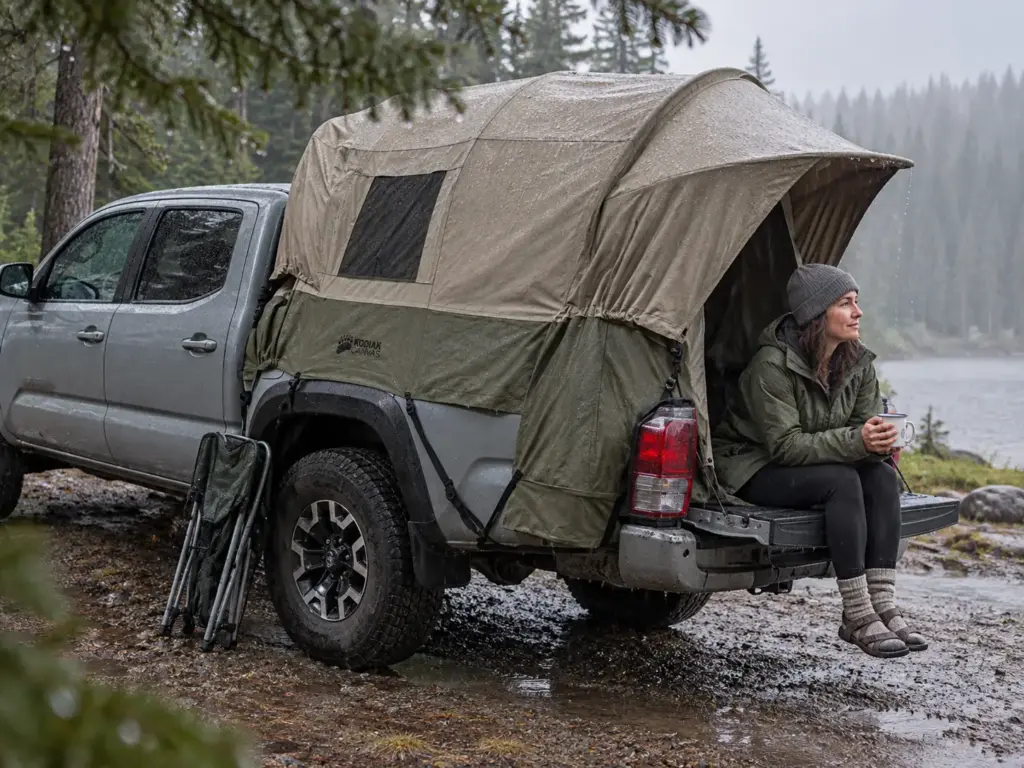
On a Napier, the bed walls block the lower gusts. Every one of them is describing a real tent, and the difference mostly comes down to fabric, pole design and how high the tent rides.
Polyester Tents and the Three-Season Reality
Polyester is the norm for in-bed tents: light, affordable, quick to dry, and fine in spring, summer and fall weather. Napier rates the Backroadz three-season, which is honest labeling. That rating means rain and moderate wind, not snow load or an exposed storm, and if the line feels fuzzy, here’s what a 3-season rating really means. Expect a coated, waterproof rainfly, mesh windows, storm flaps on some models and taped seams, and expect to touch up those seams eventually.
If you want more airflow and a dry porch, the Napier Sportz Truck Tent Full Size Crew Cab is the step up within the same family, with more windows and an awning that shades the tailgate. Stock on that listing can run thin. If it’s gone, the Backroadz is the fallback; just run your bed measurement against its size chart again before you order.
Now the mechanism behind every wind story. A ground tent’s walls start at the dirt, where grass, rocks and brush break up the air. A bed tent starts on a floor already a couple of feet up, and its walls rise above the bed rails into faster, cleaner wind. The fabric acts like a sail tied to an object that won’t move.
The truck doesn’t give, so the poles flex instead, which is why snapped poles, usually the front ones, are the failure to watch for. Setups with stakes and guy lines on top of the bed straps help, but none of that changes the physics. The honest move in high wind is to take down the tent and sleep in the cab.
Canvas: Heavier, Costlier, Tougher
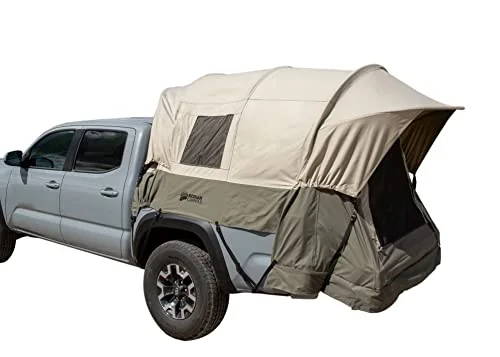
Canvas is the honest premium choice. The Kodiak Canvas Truck Tent Mid-Size fits 5- to 6-foot mid-size beds and costs and weighs considerably more than any polyester tent here. What you get back is fabric that stays quiet and taut in gusts, breathes better than a coated shell, and holds up year after year. The Kodiak is known for being very sturdy and stable in strong wind, and it handles rain and snow.
The trade-offs are real, though. Canvas is heavy to haul out of the garage, slow to dry, and has to be bone-dry before it goes into storage or it mildews. It’s a shelter for people who camp out of the truck a lot, push into the shoulder seasons and don’t mind the weight. For three or four summer trips a year, polyester is the smarter money.
Packed a canvas tent wet on the last morning? Set it back up in the driveway within a day or two and let it dry all the way through, seams and corners included. Mildew is hard to get out of canvas, and it’s how people wreck an expensive tent without ever using it hard.
Venting for Condensation and Bugs
Condensation is what surprises bed-tent owners most. A sleeping adult breathes out a lot of water overnight, and in a small tent it has to land somewhere. In a truck bed it finds two cold surfaces: the tent wall and the metal floor under your pad. A foam pad laid straight on a cold bed can collect a wet film underneath by morning even when the walls look dry.
The fix is airflow top and bottom. Open the high vents or roof windows and crack a low window or the door mesh, so warm, wet air has a way out and drier air has a way in. A barrier between pad and bed (a cheap foam mat, a rubber bed mat, a folded moving blanket) breaks contact with the cold metal and keeps the underside of your pad dry. The same rules that explain the physics behind a wet tent apply here, just with a colder floor.
Bugs come in through gaps, not fabric. The seam where the tent meets the tailgate, or the space under a tonneau rail, is where mosquitoes and ants find their way inside.
Crawling insects can still get in through the gap, and the bed helps but does not seal it. The gap still lets some through.
Tuck the tailgate flap tight, stuff a towel into any gap you can see light through, and keep food out of the bed.
Setup and Sleeping System: What Actually Goes in the Bed
Ask how long setup takes and the answer depends on conditions. Alone, in wind, with six poles and every bed strap, it is a chore. In calm weather it is no big deal. The sleeping side of the equation matters even more than the pitching side.
Realistic Setup Time
Plan on a slow first setup, with the tailgate open and the instructions spread across it. By the third or fourth pitch it gets much quicker, and takedown runs a few minutes. The variable nobody prints on the box is wind: stretching a rainfly or awning over a pickup by yourself while it tries to become a kite is the step that doubles the clock, and some owners never bother with the awning at all.
The tip that comes up again and again is order of operations. Lay the tent out in the bed, attach every strap loosely first, then do the poles. With the straps on, the fabric can’t blow out of the bed while you thread poles, and the frame tensions evenly instead of fighting you. One family leaves the first fiberglass pole sections in the bed between trips and gets roadside setup down to a couple of minutes, though other owners think that saves very little.
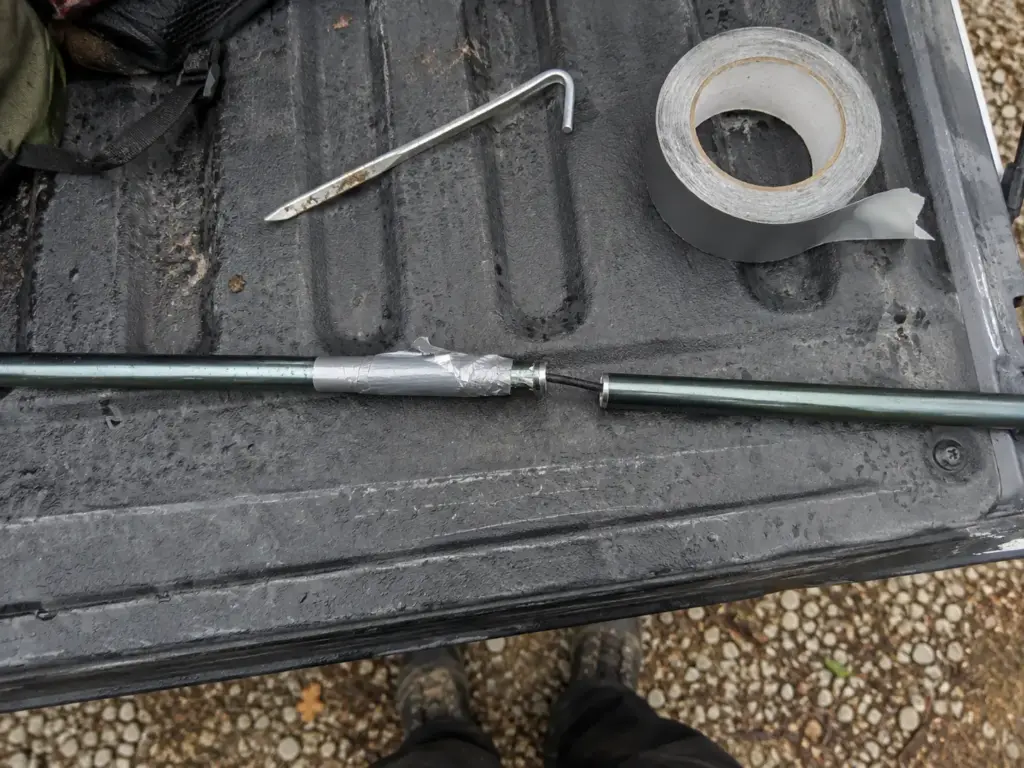
Keep a roll of duct tape and a pole repair sleeve in the door pocket, not in the tent bag. A snapped front pole is the most common failure owners describe, and a splinted pole gets you through the night when the nearest store is an hour of washboard road away.
The Pad Problem on a Ribbed Metal Floor
The bed floor, not the tent, decides how warm you sleep. A pickup bed is ribbed, hard and made of metal or lined metal, and metal is a heat sink. On a cold night it draws warmth through any thin pad for hours. A truck-bed-shaped inflatable mattress can still let the cold come up through it, which is the classic sign of an air mattress with no insulation inside.
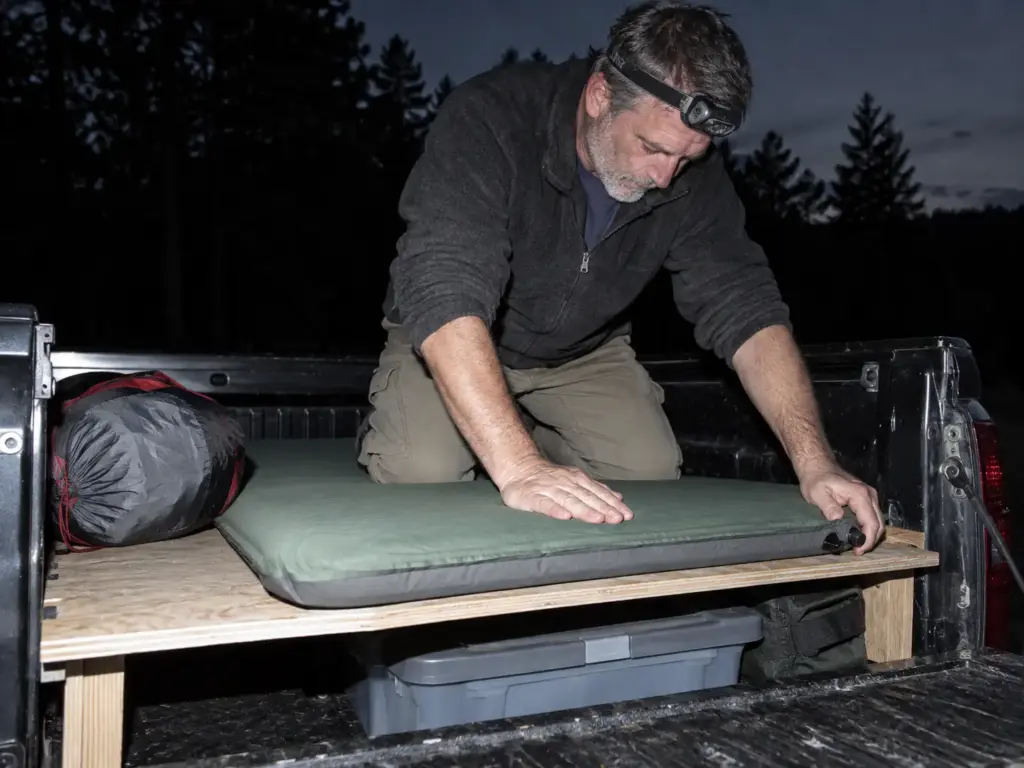
Two numbers fix most of it, whether you use a sleeping pad or a mattress. Thickness handles the ribs: 4 to 6 inches of foam or self-inflating pad is the comfort range most truck campers settle on, because anything thinner lets the ribs print through into your hip.
Insulation handles the cold: for shoulder-season and winter nights, look for an R-value around 7 or higher. A thick self-inflating car-camping pad like the Therm-a-Rest MondoKing 3D (4.25 inches, R-value 7.0) covers both at once. A plain air mattress covers the ribs and does nothing for cold, so slide a foam pad or blanket under it once nights drop toward freezing.
Shape is the third problem. A truck bed mattress cut around the wheel wells uses the whole floor, including the space beside the wells at your feet, which is exactly why the Napier bundle includes one. A queen air mattress fits badly in most beds, and it tends to stay cold. A twin-size pad with a storage bin beside it as a nightstand is the low-budget middle ground.
Liners add one more quirk. A drop-in plastic bed liner is slick, so pads and mattresses creep toward the tailgate if the truck isn’t level, and you wake up with your feet hanging over the edge. Lay a rubber bed mat or rug gripper under the mattress, and the creep mostly stops.
Platform and Storage Builds Worth Considering
Some owners stop fighting the floor and build on top of it. A common design is simple: half-inch plywood on 2×2 supports, about a foot high, with plastic bins slid underneath and a foam mattress cut to fit on top. A basic version is a weekend job with a circular saw and a sheet of plywood.
A platform kills the ribs, puts an air gap between you and the cold metal, and keeps your gear dry and sorted underneath where a rainy night can’t reach it. The catch is headroom. A foot of platform takes a foot out of a tent that may only have 43 inches to start with, so it suits taller tents like the Backroadz better than low floorless ones. Some people also stash daytime gear waist-high in the bed so they aren’t crouching to dig out a headlamp, and a low camp chair inside, plus a vestibule for muddy boots, turns the tent into somewhere you can sit through a rain shower instead of lying down at 7 p.m.
The Honest Downsides Stores Skip
The same complaints come back in the same order. None of them kills the idea on its own. Stack them against the way you actually camp, though, and one of them probably will.
The “Can’t Drive With It” Problem
This is the big one. Napier says not to drive with the tent mounted, and the rule has no workaround: don’t drive with it. If you need the truck, the tent comes down.
Want to run into town for ice, move to a different trailhead, or explore a forest road after you’ve set camp? Pack it up first.
Plenty of people move on to a pop-up instant tent or a ground tent for exactly this reason, and walk-up campsites add a wrinkle since nothing holds your spot once the truck leaves.
It also means emptying the bed before every pitch. Coolers, bikes, firewood, the dog crate, the bin of cook gear: all of it has to go somewhere, usually the cab or the ground. That’s fine on a dry evening and miserable on a wet one, so decide where the cargo goes before the first strap comes out.
Hard Floors, Wheel Wells and Cold Metal
Even with a good pad, a truck bed is a box built for cargo. The ribs, the wheel-well humps and the cold metal from the sleep section are permanent. What owners don’t expect is how small that box feels with two people. On a mid-size truck you’re sharing roughly 44 inches between the wells, about ten inches narrower than a full-size mattress, and the wells press into knees or hips depending on which way you lie.
Then there’s slope. You can drag a ground tent a few feet to find a flat spot. A truck has to sit on level ground, and a bed that tilts even slightly rolls you toward the tailgate or the cab wall all night. Carry a pair of leveling blocks, or check your parking spot with a phone level before you strap anything down.
Wind, Poles and Doors That Fail
Wind is where the high profile bites. The tent catches more air than a ground tent, the truck doesn’t give, and the poles absorb the load. Reports from owners point to a consistent failure pattern: front poles snapping, sometimes as early as the second trip. Some owners taped bent poles together and returned the tent.
With the straps on first and the poles in the right order, the same tent goes up in about 10 minutes even in a storm, though one small front pole can look too tight. Where you park matters as much as what you bought. Point the cab into the prevailing wind so the truck shields the tent, and read up on choosing a campsite when wind and rain are in the forecast before a breezy night.
Doors are the quiet failure. A door that zips along the bottom edge, right where you climb in and out, takes the wear of every entry and looks like the first thing to go. Side-opening doors can be tied back without leaving the whole end open to bugs. The JOYTUTUS is one example with side doors and aluminum poles, and door layout is worth checking on any tent you’re considering.
And then the people problem. Staff at some parks may see a tent on a raised bed as camping in a parking lot rather than at a campsite. Rules on that vary a lot, so check before you park, which is the point of the last section.
Truck Bed Tent vs Ground Tent vs Rooftop Tent: Is It Worth It?
The verdict depends less on the tent than on your truck and how often you’ll use it. A weekend hiker with a pickup, no cap and a trailhead habit is a completely different buyer from someone who’ll sleep in the bed twice a year.
Who Should Buy One
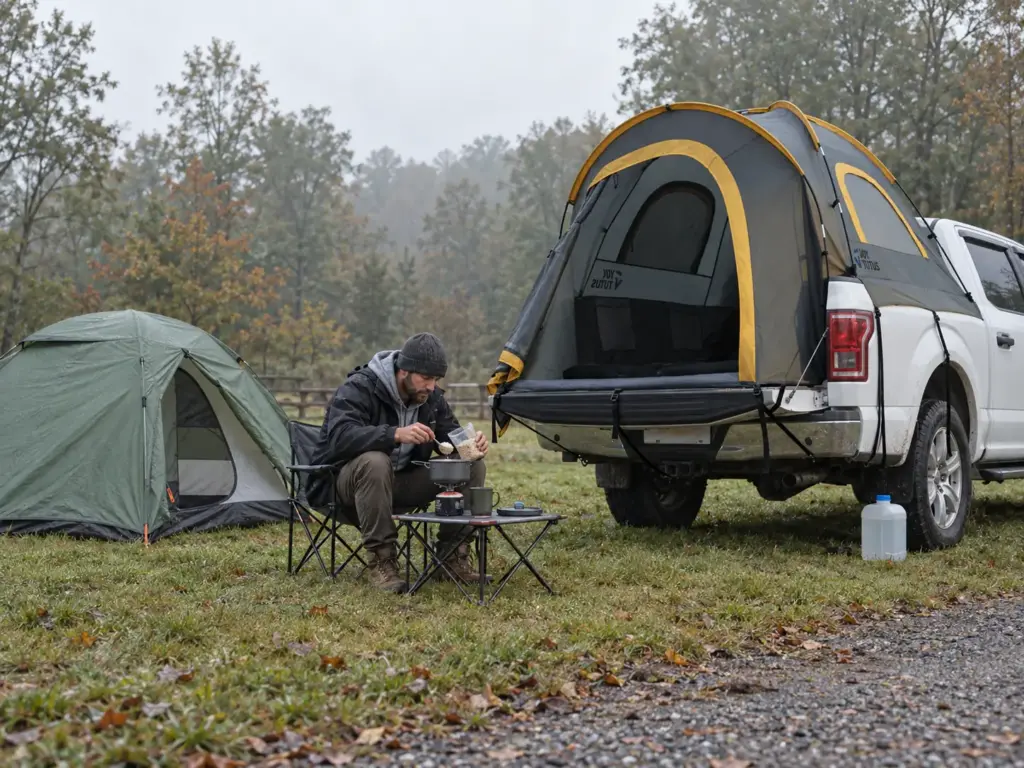
Buy one if you tailgate-camp often, own a pickup without a cap, and want to sleep off the ground without rooftop-tent money. Polyester bed tents mostly land somewhere between $100 and $300, while rooftop tents start around $1,000 and climb well into the thousands. If your nights are mostly spent parked at one campsite or trailhead and you’re walking early, the can’t-drive problem barely touches you. Muddy, rocky or root-tangled sites push the case further, because the bed is the same flat box everywhere you park.
Who Should Skip It for a Ground Tent
Skip it if you drive a lot once camp is set, camp with a partner and want to stand up, or only car-camp a couple of times a year. A ground tent wins on headroom, on weight if it ever goes in a pack, and on leaving the truck free. For a lot of hikers, a solid two-person backpacking tent does double duty: it rides in the truck for trailhead nights and goes on your back for the actual trip, which a bed tent never will.
If you’d rather skip poles and stakes entirely, pop-out tents go up in a few minutes and don’t tie up the truck, though they are weaker in bad weather and wind. A few went the other way, to rooftop tents, and a few kept the bed tent strictly for short trips. And when the trailhead is just the end of the drive, it’s easy to pitch a tent on the ground at the trailhead and leave the bed for the cooler.
The Budget Route
If the Napier is more than you want to spend, the JOYTUTUS Pickup Truck Tent 2.0 is the cheapest credible budget truck tent on this list. It’s a double-layer tent with a PU 2000 mm coating, and the listing linked here is for 5.5- to 5.8-foot beds, so confirm your size before ordering since other lengths exist. Its side doors and aluminum poles are worth a look if door design is on your list of worries.
Here’s the honest budget math, though: a ground tent you already own plus a good pad beats a weak bed tent. If money is tight, spend it on the sleep system first. A cheap bed tent on a thin pad is the worst of both worlds, cold and cramped and tied to the truck.
Where to Park, Camp and Stay Legal
The night before a big hike, the temptation is to sleep right in the trailhead lot. Sometimes that’s allowed. Often it isn’t, and a tent sitting up in a truck bed is about as visible as camping gets, which is the kind of setup that can get you asked to leave a park.
Campgrounds vs Dispersed Sites
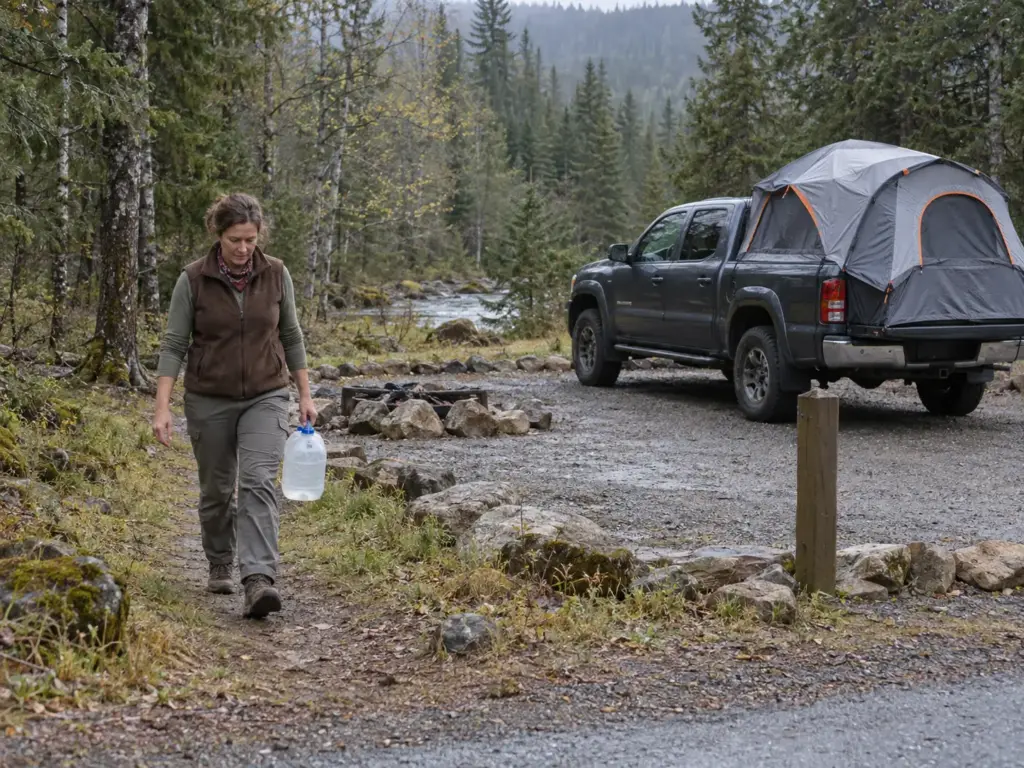
Developed campgrounds are the easy answer. You pay for the site and the truck parks on the pad. Most campgrounds are fine with a tent in a bed.
It’s worth checking whether a particular campground requires tents on a designated tent pad. Dispersed camping on national forest land is where a bed tent really shines, but the rules vary from forest to forest. Many cap stays at around 14 days and ask you to camp well back from streams, so read the specific forest’s page before you pull in.
Whichever you choose, the basics carry over. The National Park Service’s Leave No Trace principles are a quick read and cover most of what a first dispersed night asks of you.
Trailhead Lots and Staying Legal
Trailhead lots are often posted day-use only, and some forests explicitly keep dispersed camping out of developed recreation sites and trailheads. Read the signs, call the ranger district if you can’t tell, and when in doubt, find a legal pullout or a campground a few miles back down the road. Ten extra minutes of driving in the morning beats a knock on the tailgate at midnight.
Weather is the other reason to think hard about where you park. A tall tent on a raised bed in open terrain is a poor place to ride out a thunderstorm. If lightning moves in, get out of the tent and into the truck cab with the doors shut, and learn what to do when lightning moves in before you need it.
Leave No Trace From a Tailgate
A tent strapped to the bed mostly takes the ground out of the equation, which is half the appeal. It doesn’t change the rest. Leave No Trace’s guidance on camping on durable surfaces still applies: park on ground already hardened by use, don’t carve a new pullout by driving onto vegetation, and keep camp at least 200 feet (about 70 adult steps) from lakes and streams. With a truck tent, that’s a parking decision rather than a tent-site decision, so make it before you set the brake.
The rest is habit. Pack out every scrap from the bed, including the pole-bag tags and twist ties that blow out when you drop the tailgate, and keep food and coolers sealed in the cab overnight. For the bigger picture on public land, here’s how Leave No Trace works in practice.
Grab a Tape Measure Before You Open a Product Page
Measure the bed wall to wall with the tailgate closed, and buy by bed length, not by truck badge. Pick your trade-off on purpose: polyester for price, canvas for toughness, a ground tent if you’ll be driving a lot once camp is set. And build the sleep system before you buy the tent, because on a metal floor the pad decides how cold you get, not the fabric overhead.
Your next move takes two minutes. Walk out to the truck, close the tailgate, and write down the inside bed length and the width between the wheel wells. Those two numbers narrow the field faster than any review will.
Frequently Asked Questions
01Are truck bed tents worth it?
Truck bed tents are worth it if you car-camp often, own a pickup without a cap, and want to sleep off the ground for far less than a rooftop tent costs. If you drive a lot after setting camp, a ground tent is usually the better buy.
02Are truck bed tents safe?
Truck bed tents are safe when they’re strapped down properly, the truck is parked level, and the tent comes down before you drive. Take it down in high wind, and move into the closed truck cab if lightning moves in, since the tent sits high in open air.
03What is the best tent for a pickup truck bed?
The best tent for a pickup truck bed is the one sized for your exact bed length. For standard 6.5-foot beds the Napier Backroadz is the safe pick, Rightline Gear covers short beds on a budget, and Kodiak Canvas is the tougher premium option.
04Can you use a truck bed tent with a tonneau cover or a camper shell?
Many truck bed tents work with a roll-up or folding tonneau cover, depending on the model, but none fit under a camper shell or cap. If your truck already has a cap, build a sleeping platform under it instead of buying a tent.
05Can you drive with a truck bed tent still up?
No, you should never drive with a truck bed tent set up. Napier warns that driving with the tent mounted can cause injury and damage, so take it down and pack it away before moving the truck, even for a short run to town.

I've spent more than a decade researching hiking gear and trail technique. I read the specs, the forum threads and the long-term reviews, and every pick here comes with what it gets wrong.
End of the trail
You read every mile of this one. Here's where the trail goes next.