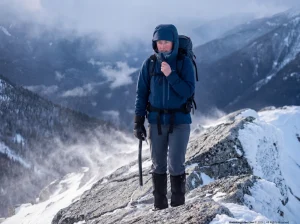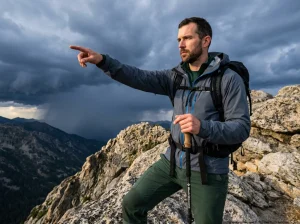


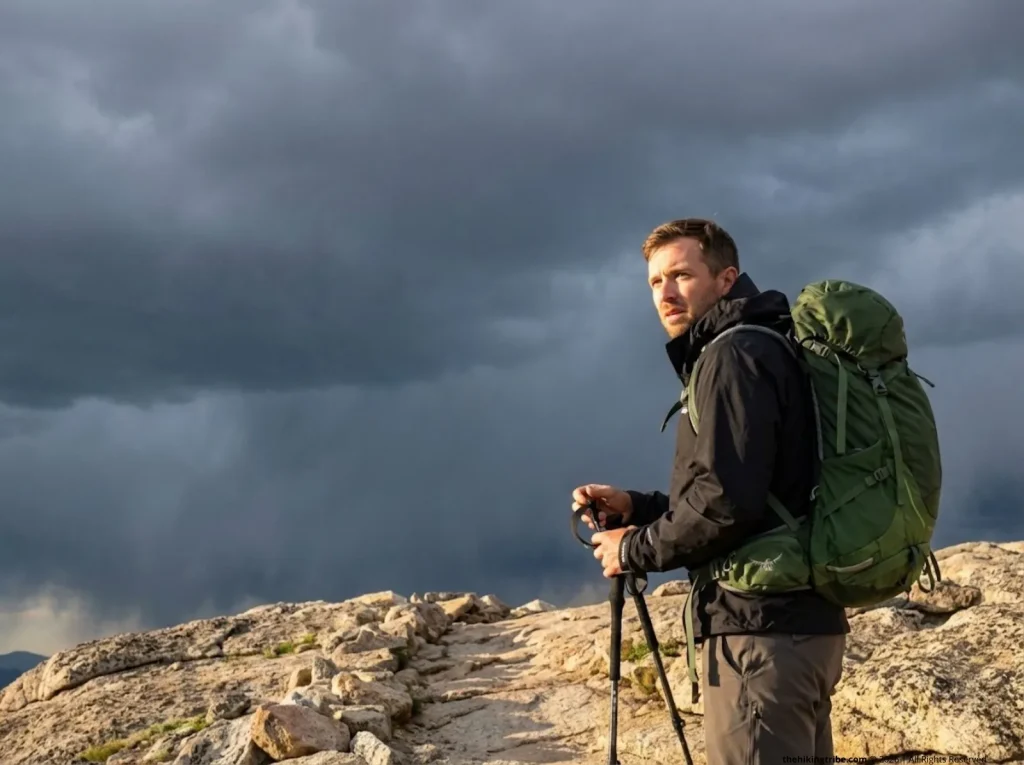
Hair standing straight off your arms. A metallic taste flooding your mouth. The air around you buzzing like a downed power line — and you’re standing on a treeless ridgeline two hours above the nearest forest. Every nerve in your body screams run, but your legs won’t move.
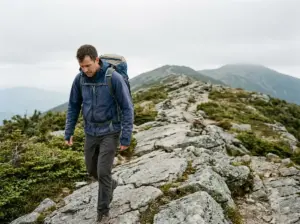
I’ve been in that exact spot on Franconia Ridge in New Hampshire, watching a black wall of cloud roll in from the west while my brain scrambled through half-remembered safety advice. That moment taught me something the hard way: knowing what to do before the hair stands up is the only thing that matters. Panic is the default. Protocol is the override.
This is the complete lightning safety hiking open terrain protocol — from the natural hazard mechanisms that actually kill people to the exact body position that might keep you alive — built on National Weather Service data, NOLS field guidelines, and lessons from real trail incidents where hikers didn’t make it home.
⚡ Quick Answer: If caught in a lightning storm on exposed terrain, immediately descend toward low ground or treeline. Drop trekking poles and metal objects 100 feet away. Spread your group 20–100 feet apart. If you cannot descend, crouch on the balls of your feet with heels together, head down, hands over ears. Wait at least 30 minutes after the last thunder before moving. No outdoor position is truly safe — prevention through timing your hike is your strongest defense.
How Lightning Actually Kills on Open Terrain
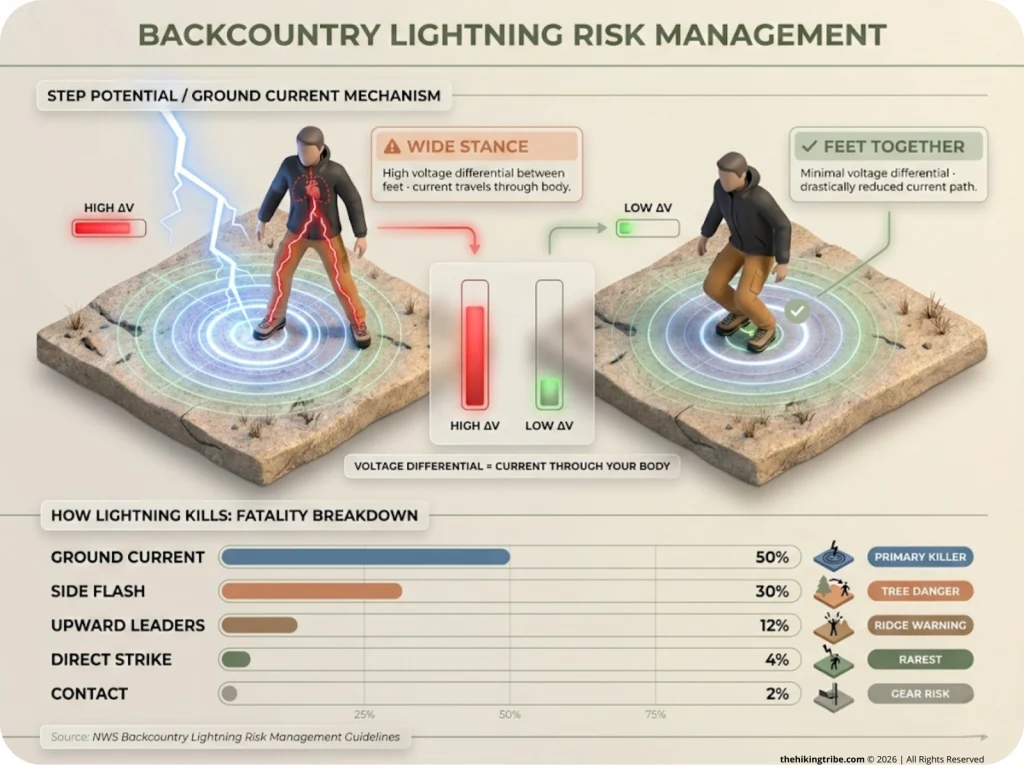
Most hikers picture a bolt from the sky slamming into their skull. That’s a Hollywood version of how lightning strikes work — and it’s the rarest way lightning kills. Direct strikes account for only 3–5% of fatalities. The real killer is beneath your boots.
Ground current — what experts call step potential — causes roughly 50% of all lightning injuries and struck-by-lightning deaths. When a bolt hits the ground, voltage radiates outward like ripples in a pond. That voltage enters one foot, travels up through your body, and exits the other foot. The wider your stance, the higher the voltage difference between your two feet, and the more current rips through your organs.
Side flash accounts for another 30% of fatalities. Lightning hits a nearby object — a tree, a rock face, your buddy’s hiking poles — and jumps to you if you’re within 10–15 feet. This is why sheltering under the tallest tree on a ridge is one of the deadliest decisions a hiker can make.
Then there are upward leaders and streamer currents. These are electrical discharges that reach upward from elevated objects toward the cloud — and those objects include you, standing upright on a ridge. They can injure or kill without a completed strike. The metallic taste, the buzzing hair, the crackling sound — those are warning signs that upward leaders are forming from your body. If you feel them, you have seconds. Not minutes. Seconds.
According to the NWS Backcountry Lightning Risk Management guidelines, ground current is the primary lightning fatality mechanism — and the single best way to reduce your exposure is keeping your feet together. This is why calculating your turnaround time before storms arrive matters more than any in-storm technique. The best defense against ground current, side flash, and upward leaders is never being on that ridge when the thunderstorm arrives.
The NWS 4-Action Hierarchy Every Hiker Needs to Memorize
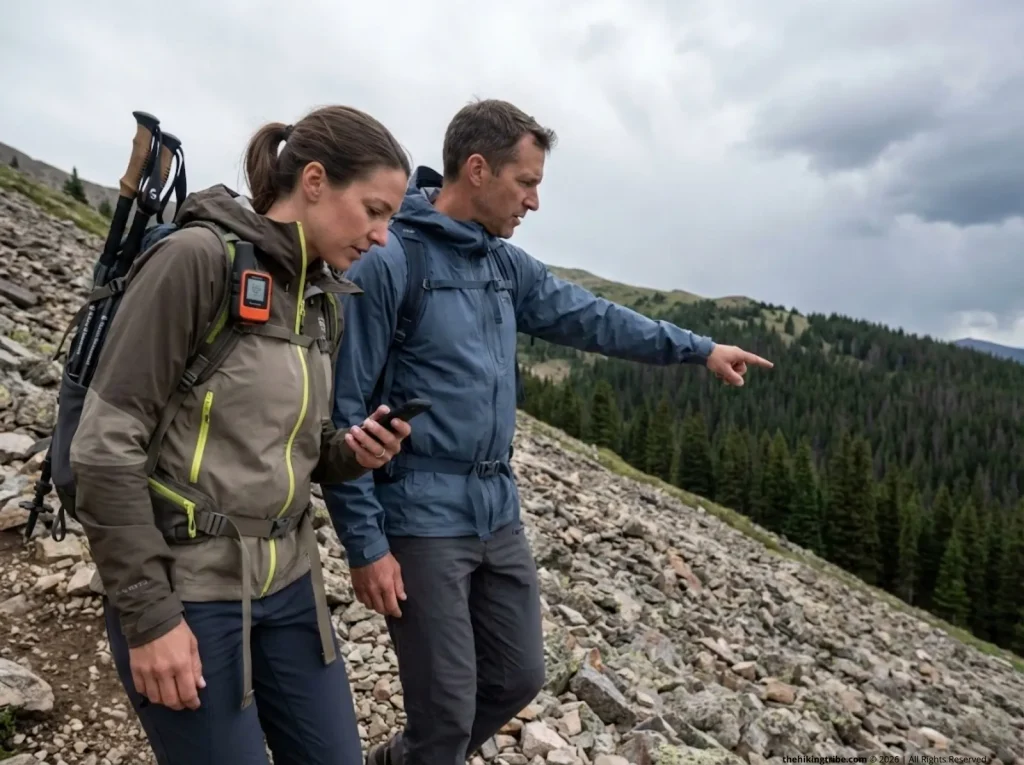
The National Weather Service and NOLS break lightning response into four actions, ranked by effectiveness. Each action is roughly twice as effective as the one below it. That means protection through prevention absolutely dominates everything else — and the lightning crouch position you’ve seen in videos is actually the least effective option, not the first.
Action 1 — Time Your Hike to Avoid the Storm Entirely
Prevention saves more lives than any in-storm technique by a wide margin. John Gookin, NOLS Curriculum and Research Manager and the author behind the NWS backcountry lightning guidelines, puts it bluntly: timing your visit is the single most important action in the hierarchy.
In monsoon country — the Colorado Rockies, Desert Southwest, Rocky Mountain National Park — plan to be below treeline by noon. Afternoon thunderstorms build rapidly after midday solar heating, and they come fast. Check NOAA forecasts and radar before you leave the car. Carry a weather radio or satellite messenger with NOAA emergency weather alerts.
Pro tip: Set a non-negotiable alarm for 11:00 AM on every exposed terrain hike. If you’re not already descending by then, turn around — regardless of how close the summit looks. That summit will be there next weekend. You might not be.
Action 2 — Move to Safer Terrain Immediately
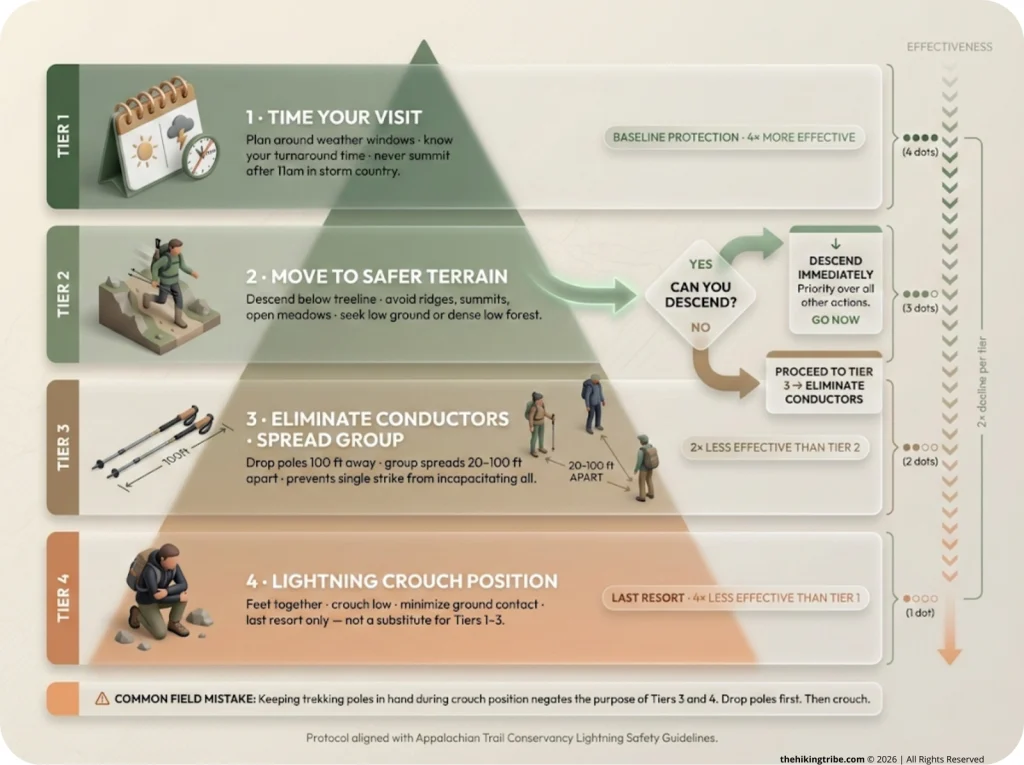
When you hear thunder, lightning is within 10 miles. Immediately move away from open areas, summits and ridgelines, and start descending toward low ground or forest cover. The 30-30 rule for lightning safety gives you a fast calculation: count the seconds between the flash and the bang. If it’s 30 seconds or less, you’re already in the danger zone. Move now.
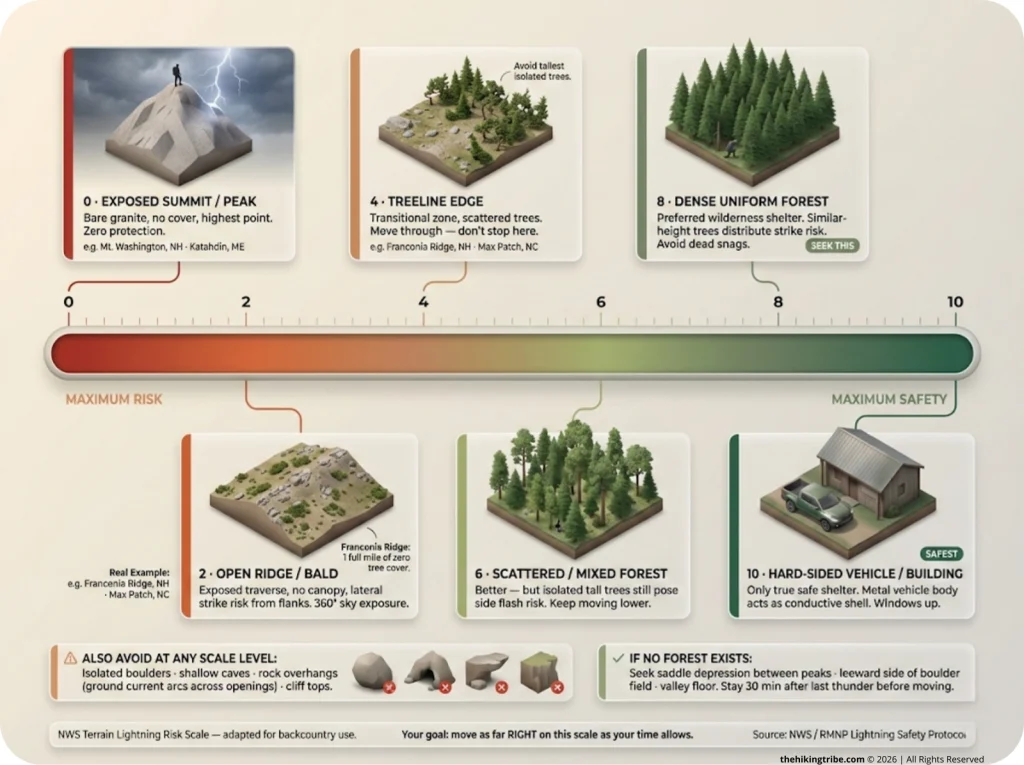
A safer location means below treeline, inside a stand of uniform-height trees — not under the tallest tree — or in a natural depression. Avoid isolated tall trees, water, cliff edges, and shallow rock overhangs. The NWS terrain risk scale developed for Rocky Mountain National Park puts it on a 0-to-10 scale: the tallest peak above treeline is a 0 (worst) and being inside a vehicle or building is a 10 (best).
Action 3 — Eliminate Conductors and Spread the Group
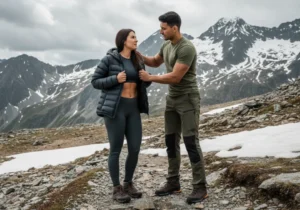
Drop poles 100 ft away — trekking poles, pack frames, anything metal. If you’re hiking with a group, spread group 20-100 ft apart. Ground current from a single strike can incapacitate everyone standing close together. Spreading out means a strike that takes one person down doesn’t take the whole group.
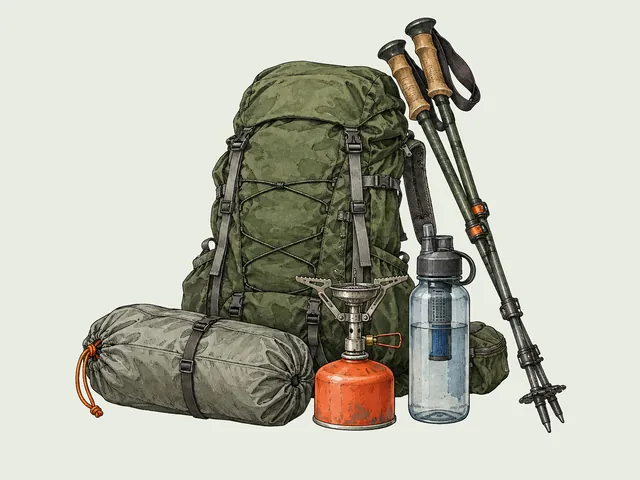
Carbon-fiber poles are slightly less conductive than aluminum, but the height they add to your profile is the real danger — drop them regardless. When you’re the tallest object on a ridge, the material your pole is made of matters far less than the fact that it’s adding two feet to your silhouette. For a deeper look at the tradeoffs, here’s our breakdown of carbon versus aluminum pole conductivity differences.
Pro tip: Common mistake from the field: keeping trekking poles in hand during the crouch. That negates the entire purpose of getting low. Drop them, walk 100 feet away, then assume the position.
The Appalachian Trail Conservancy lightning safety protocols confirm this exact sequence — and they should know. At least four lightning-related deaths have occurred on the A.T., including on Max Patch, Cold Mountain, Franconia Ridge, and Katahdin.
The Lightning Position — What Works, What’s a Myth
The Correct Technique Step by Step
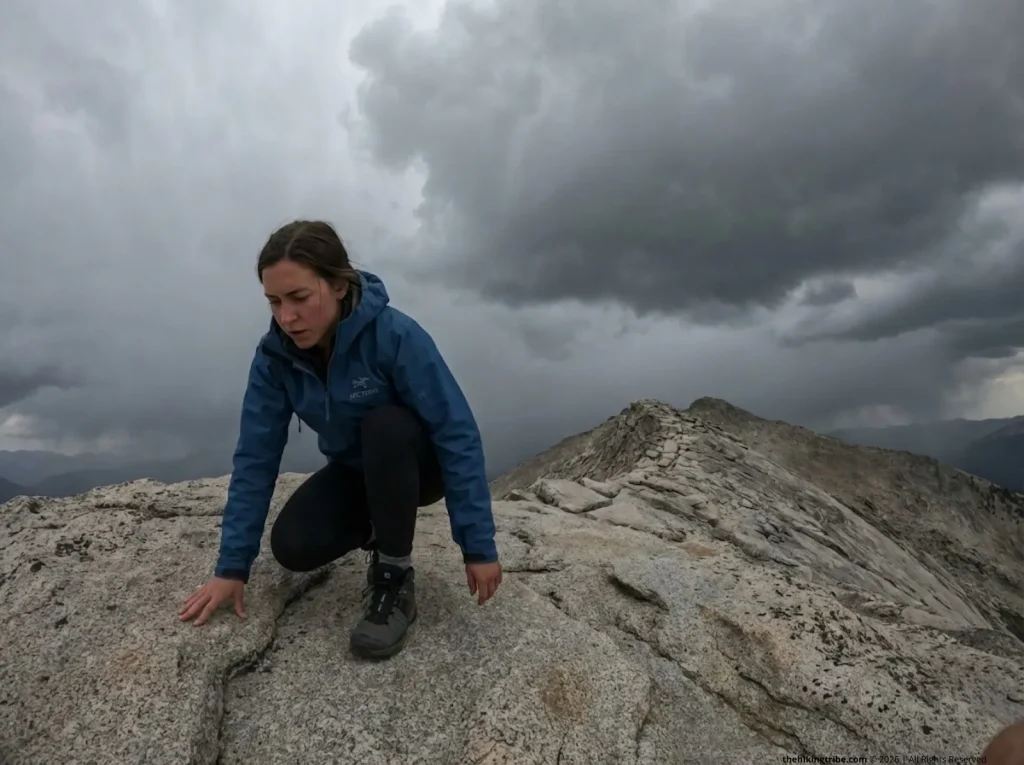
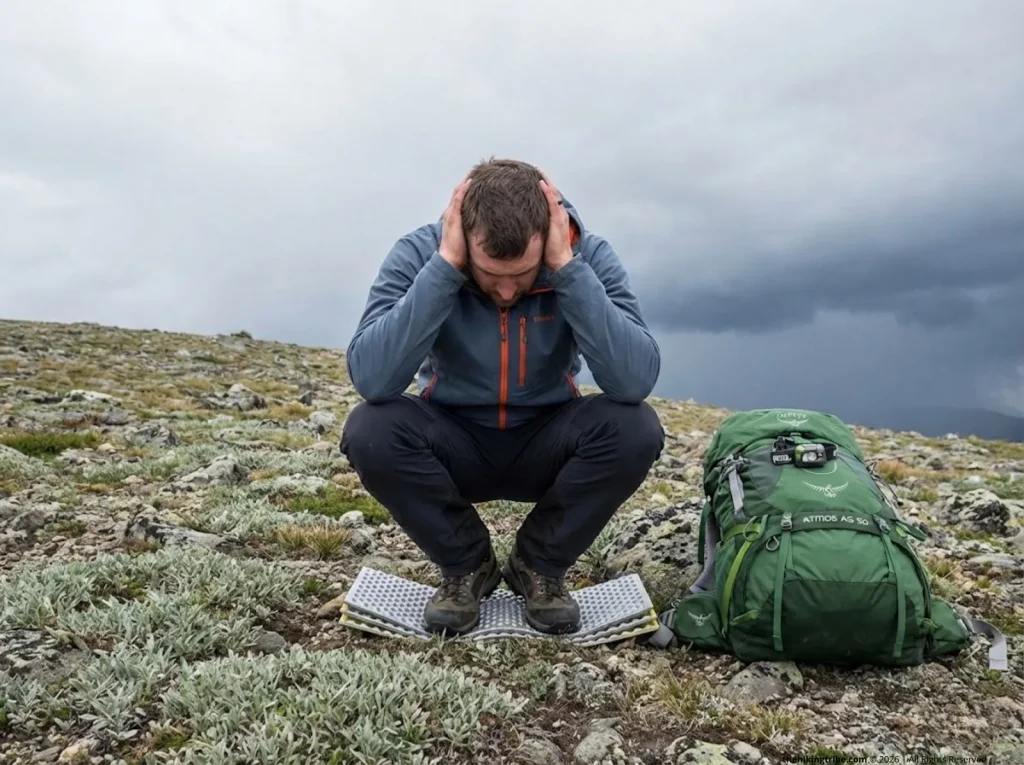
The lightning crouch position is your last resort — what you do when you can’t get off the ridge and can’t reach treeline. Here’s the exact technique:
Crouch on the balls of your feet with your heels together. This is critical — it minimizes ground contact and reduces the voltage difference between your two contact points. Tuck your head down. Place your hands over ears or on your knees. The old phrase “get small” captures it well.
If you have an insulating pad — a closed-cell foam sleeping pad, your pack with the metal frame removed, or even a coiled rope — crouch on it. It won’t save you from a direct strike, but it adds a thin insulation layer against ground current.
Do NOT lie flat. Lying flat massively increases the surface area in contact with the ground and exposes your entire body length to voltage differentials. You become a long conductor. Boots stay on — they provide some insulation.
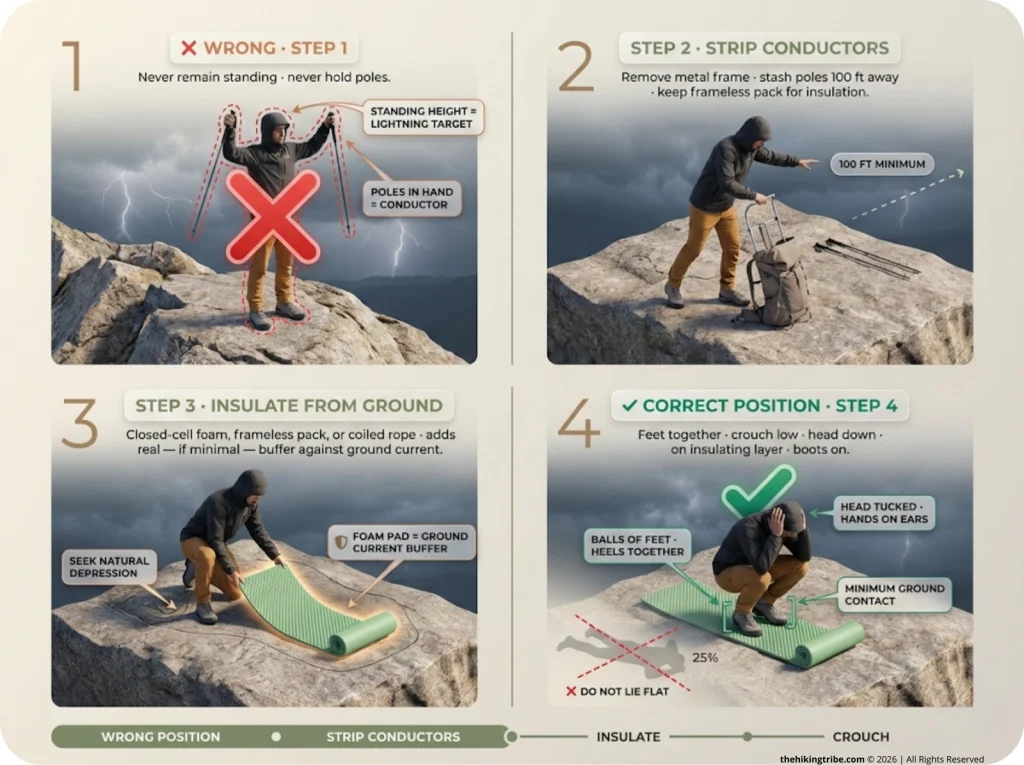
Pro tip: Use your pack as a seat pad, but strip the metal frame first and stash it 100 feet away. The foam and fabric add a minimal but real insulation layer against ground current.
Myths That Will Get You Killed
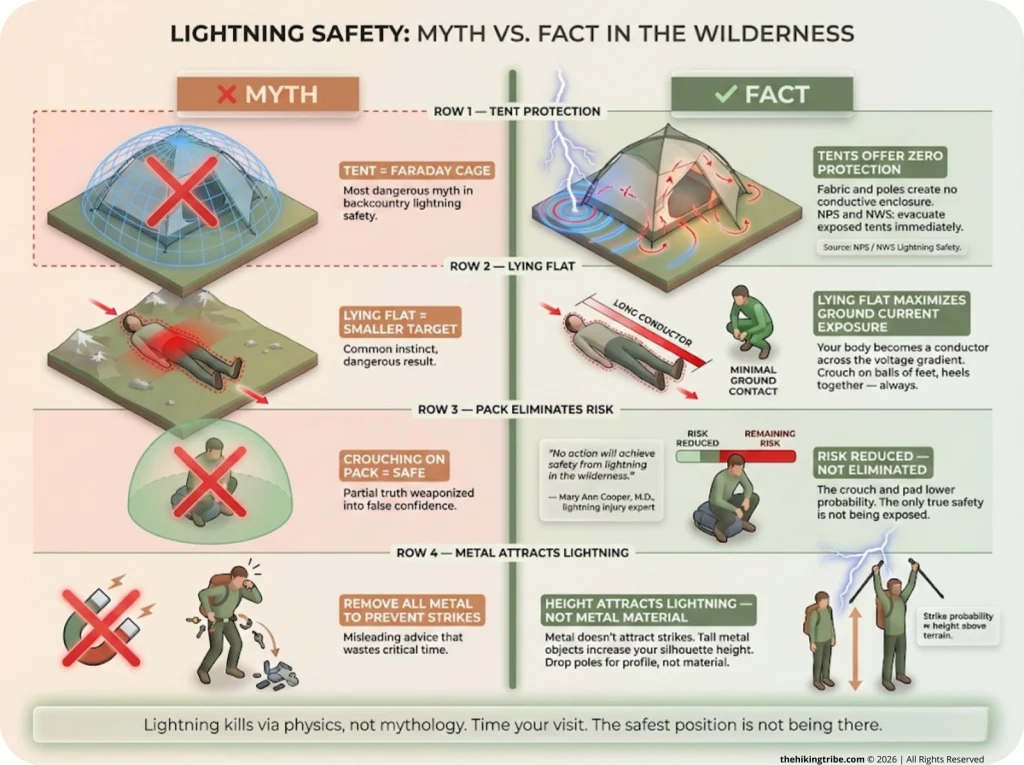
“A tent acts like a Faraday cage.” False. Tents provide zero lightning protection regardless of pole material. The fabric and poles do not create a conductive enclosure. The National Park Service and NWS are explicit: evacuate exposed tents immediately when lightning storms approach. The Faraday cage myth has gotten hikers killed.
“Lying flat makes you a smaller target.” False. Lying flat exposes your entire body to ground current differentials. You become a long conductor stretched across the voltage gradient.
“Crouching on your pack eliminates risk.” Partially false. No position eliminates risk outdoors. The crouch reduces it. The pad adds minimal insulation. Mary Ann Cooper, M.D., one of the world’s foremost lightning injury experts, puts it plainly: “No action will achieve safety from lightning in the wilderness.”
“Remove all metal from your body to prevent strikes.” Misleading. Metal doesn’t attract lightning. But tall metal objects like poles and antennas increase your effective height, which does increase strike probability. The issue is height, not material.
The NOLS analysis of lightning position effectiveness breaks down exactly why this position works — and why it has real limits that every hiker needs to understand.
Trail-Specific Terrain Decisions When You Can’t Get Low
Reading the Terrain Risk Scale in Real Time
Sometimes there’s no treeline. No forest. No low ground. Just open terrain — above-treeline slopes, desert plateau, Appalachian balds — and a thunderstorm bearing down. These are among the most dangerous places to be when lightning flashes start.
Use the NWS terrain risk scale mentally: summit (0) through open ridge (1–2), tree stand edge (4–5), dense uniform forest (7–8), all the way to vehicle or building (10). Your job is to move as far up that scale as possible in the time you have.
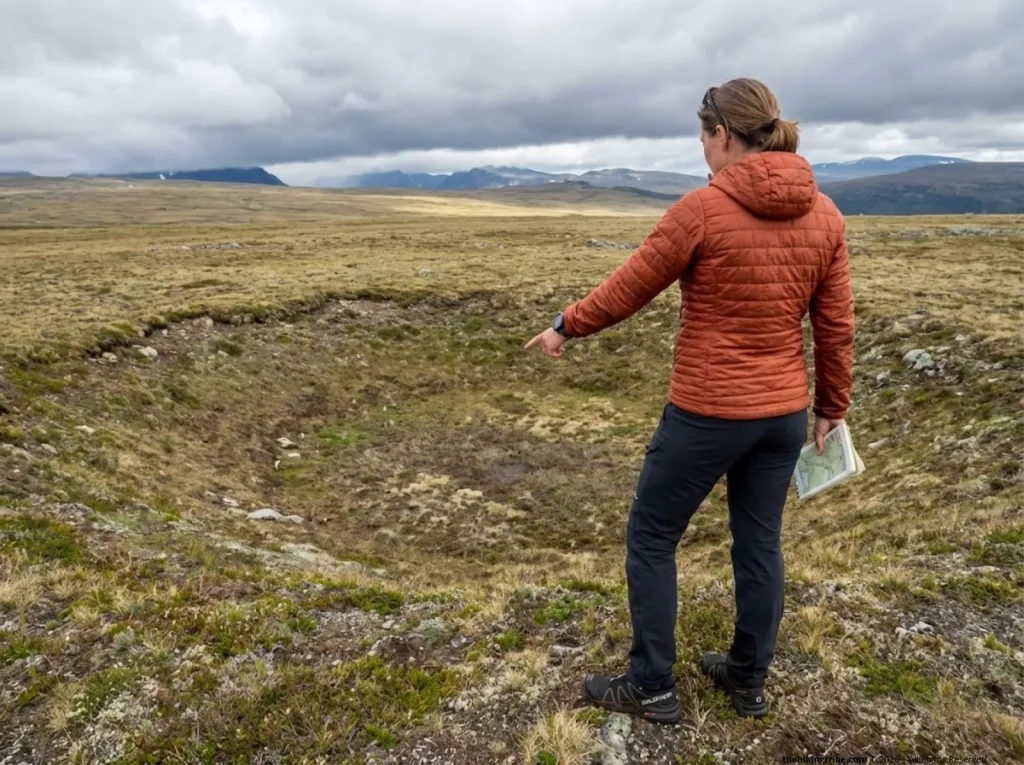
If no forest exists, seek protection in a valley or depression in the terrain — a saddle between peaks, or the leeward side of a boulder field. Avoid isolated boulders the same way you’d avoid isolated trees. Get below a cliff face rather than on top of it — but NOT in a shallow cave or rock overhang, because ground current arcs across the opening.
Real trail example: Franconia Ridge in New Hampshire has a full mile of exposed terrain with zero tree cover. Your only options are to descend toward the Greenleaf Hut trail or hunker in a low spot between rock formations and wait 30 min after last thunder.
Leave No Trace While Sheltering from Lightning
When you choose a natural depression for shelter, you’re still a steward of that land. Avoid trampling fragile alpine vegetation or creating new social trails through the tundra. Cryptobiotic soil crusts in desert terrain are destroyed by a single footstep and take decades to recover — choose mineral soil or rock surfaces instead. Our guide on cryptobiotic soil crusts that take decades to recover explains why this matters so much.
Don’t dig or modify depressions. Use existing natural features. After the storm passes, return to the established trail — don’t shortcut back through fragile ground. Leave No Trace principles don’t pause because you’re scared. Emergency and shelter ethics can coexist.
Post-Strike First Aid and the Reverse Triage Rule
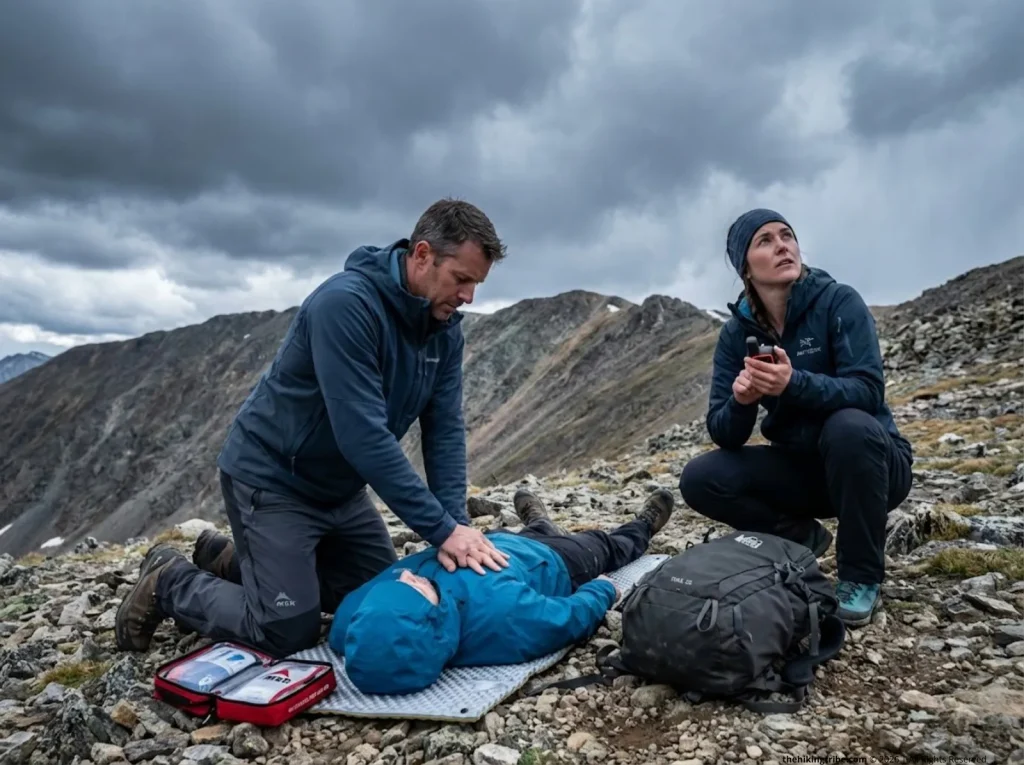
Scene Safety and Immediate Assessment
Lightning can strike the same area twice — assess scene safety and whether the storm has moved before approaching victims. But here’s the critical thing most hikers don’t know: lightning victims carry no electrical charge. They are safe to touch immediately.
Check for pulse and breathing first. Cardiac arrest is the primary killer in lightning strikes. If there’s no pulse, begin CPR immediately. CPR effectiveness after lightning-induced cardiac arrest is remarkable — survival rates approach 90% with immediate treatment. That number drops fast with every minute of delay.
If you have multiple victims, use reverse triage. This is where lightning first aid flips standard mass casualty protocols on its head. In standard triage, you skip cardiac arrest patients because resources are limited. In lightning events, you prioritize them — because most lightning cardiac arrest victims can be resuscitated if treated within minutes. The ones who are breathing and conscious will likely survive without immediate intervention.
When to Call for Evacuation
Activate your satellite messenger SOS — Garmin inReach, SPOT — as soon as scene safety is confirmed. Burns from lightning are typically superficial. The real danger is cardiac arrhythmia and neurological damage that may not show up for hours. Even if someone seems fine after a strike, evacuate for medical evaluation. Delayed cardiac events are well-documented.
If hair stands up or crackling resumes while you’re providing aid, abandon position immediately and assume the lightning crouch position. Scene safety comes first — you can’t help anyone if you become the next casualty. For broader emergency protocols, our wilderness first aid protocols for backcountry emergencies guide covers the full decision tree.
The National Weather Service official lightning safety rules confirm these post-strike first aid priorities and provide additional guidance on prevention and response protocol.
Gear That Helps You Execute the Protocol
Weather Monitoring Tools
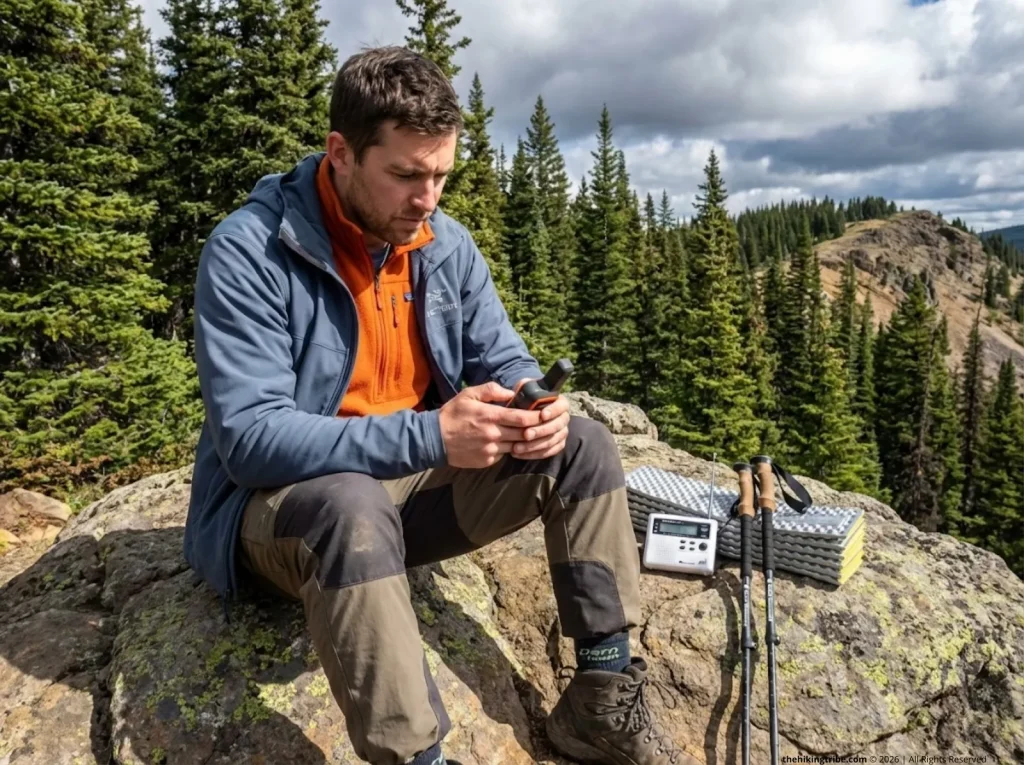
A NOAA weather radio pulls real-time severe thunderstorm warnings with specific county and zone alerts. It weighs 3–5 ounces and runs on batteries. For hikers regularly above treeline, it’s one of the cheapest pieces of insurance you can carry.
The Garmin inReach Mini 2 is the single most important piece of lightning safety tech for exposed terrain. Satellite weather forecasts every four hours, SOS capability, two-way messaging — all independent of cell coverage. When you’re on a ridge in the Pacific Northwest or grinding above treeline in Colorado, your phone is probably a brick. The inReach isn’t. Here’s our detailed comparison of comparing inReach and SPOT satellite messengers for backcountry safety.
Smartphone radar apps like RadarScope work below treeline but lose signal on many ridges. Don’t rely on them as your primary weather source for high elevation hikes.
Pro tip: Set your inReach to auto-pull weather every 2 hours on exposed traverses. It’s saved me from three storms I would not have seen building behind the ridge.
Insulation and Shelter Options
A closed-cell foam pad — Thermarest Z-Lite, RidgeRest — doubles as lightning crouch insulation and sleeping pad for multi-day hike trips. It weighs 9–14 ounces. An emergency bivy or space blanket handles the post-storm hypothermia risk that’s real after crouching wet and cold on exposed terrain for 30-plus minutes.
Campsite Selection and Multi-Day Exposure Planning
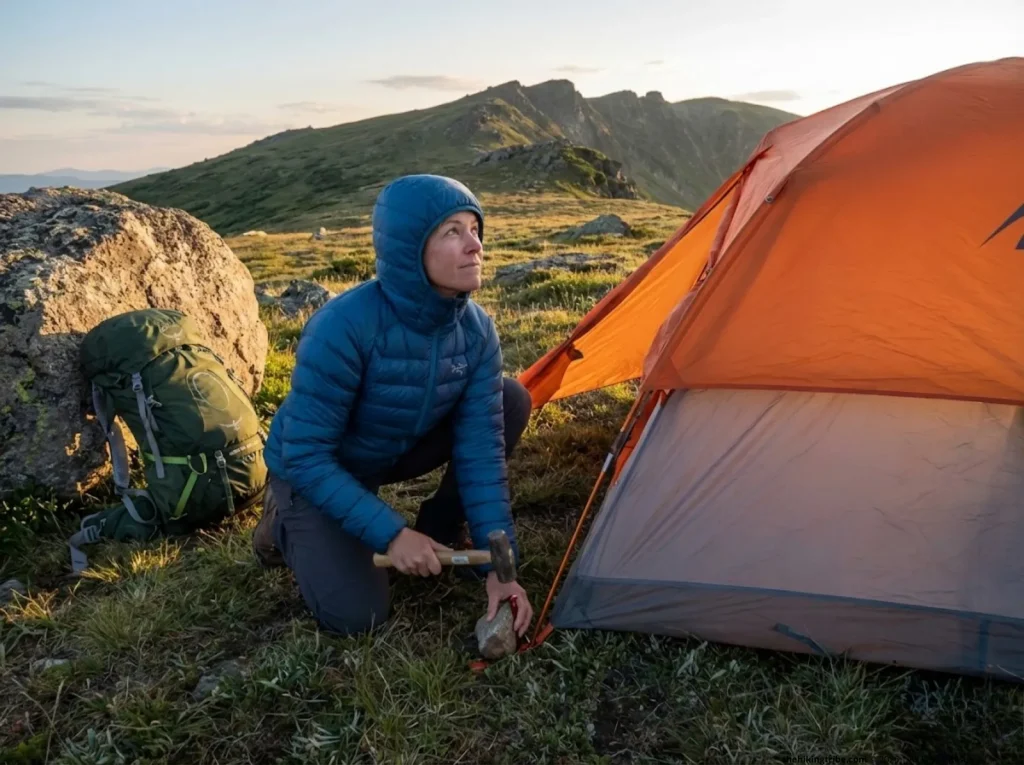
Picking Camp Below the Danger Zone
Never camp at the highest point in an area, near isolated trees, on ridgelines, or next to water. In mountainous areas without tree cover, choose the lowest available terrain — a wide saddle or gentle slope, not a peak or ridge crest. If you’re forced to camp above treeline on a multi-day hike traverse, identify escape routes to lower terrain before you pitch your tent. Stake selection matters too — keep metal stakes in the ground, not sticking up like miniature lightning rods.
Planning “Treeline by Noon” for Multi-Day Routes
In lightning-prone areas — Colorado, New Mexico, Arizona — plan daily mileage so you cross exposed terrain before noon. The summer hiking season in these regions brings predictable afternoon thunderstorms driven by Colorado monsoons moisture and solar heating. If you’re thru-hiking the A.T. Southern Appalachian balds or CDT above-treeline slopes sections, build in buffer days for weather holds. Pushing through afternoon storms to stay on schedule is how people end up as statistics.
The Rocky Mountain National Park lightning terrain risk scale recommends all hikers above treeline descend before early afternoon during summer hiking season. That guidance exists because the park has buried people who ignored it. And if you’ve been crouching in rain for 30 minutes waiting out a storm, recognizing and treating hypothermia after storm exposure becomes your next urgent priority.
Conclusion
Three things to tattoo on your brain before your next ridge hike:
Lightning kills through the ground, not the sky. Keeping your feet together in the crouch addresses the primary lightning fatality mechanism — ground current voltage differential. Fifty percent of struck-by-lightning deaths come from below, not above.
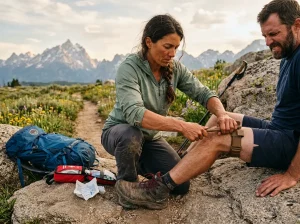
The NWS 4-action hierarchy works in order. Avoid the storm entirely. Move to a safer location. Eliminate conductors and spread the group. Assume the lightning position. Each step matters exponentially less than the one before it. Prevention dominates.
No outdoor position is truly safe. The only reliable prevention and response protocol is planning — treeline by noon, real-time weather monitoring, and the discipline to turn around when thunder speaks from behind the ridge.
Print the protocol. Practice the crouch in your backyard until the muscle memory is automatic. Then test your plan on your next exposed terrain ridge hike with real-time weather data — because lightning won’t wait for you to look it up.
FAQ
What is the lightning position for hikers?
Crouch on the balls of your feet with heels together, head down, hands over ears. Stand on an insulating pad or pack if available. Do NOT lie flat — lying down increases ground current exposure across your entire body by maximizing contact area with the ground.
What is the 30-30 rule for lightning safety?
Count the seconds between a lightning flash and the thunder. If it’s 30 seconds or less — roughly 6 miles — seek protection in a valley or depression in the terrain immediately. Wait 30 min after last thunder before resuming activity. Both 30s matter.
Can lightning strike you inside a tent while hiking?
Yes. Tents provide zero lightning protection regardless of pole material. They do not function as Faraday cages. If a thunderstorm approaches your exposed terrain campsite, evacuate the tent and move to low ground if possible.
How far away is lightning if you hear thunder?
Divide the seconds between flash and bang by 5 to get distance in miles. Thunder at 30 seconds means lightning struck about 6 miles away — close enough to reach you within minutes as the storm moves. At 10 seconds, it’s roughly 2 miles out. Time to move.
What should I do if caught in a thunderstorm on a mountain?
Descend immediately toward treeline or low ground. Drop poles 100 ft away and any metal objects. Spread group 20-100 ft apart. If you cannot descend, get to the lowest available point and assume the lightning crouch position. Wait 30 min after last thunder before resuming your hike. If anyone is struck, begin CPR immediately — lightning cardiac arrest victims have a 90% survival rate with prompt treatment.
I've spent more than a decade researching hiking gear and trail technique. I read the specs, the forum threads and the long-term reviews, and every pick here comes with what it gets wrong.
End of the trail
You read every mile of this one. Here's where the trail goes next.