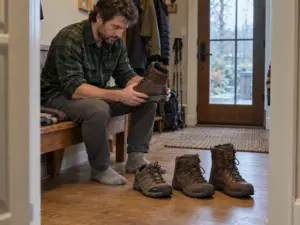

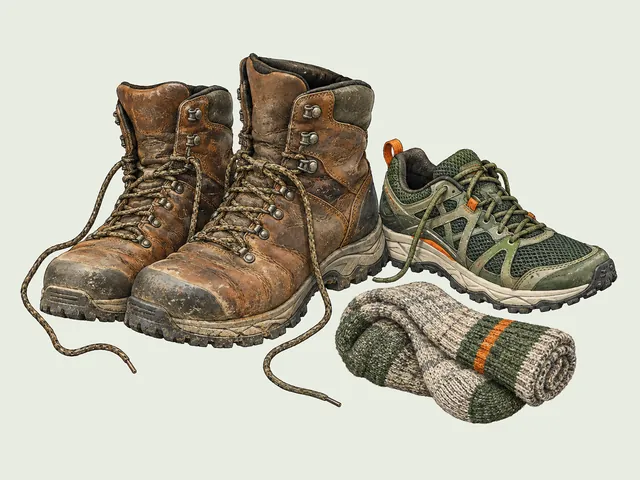

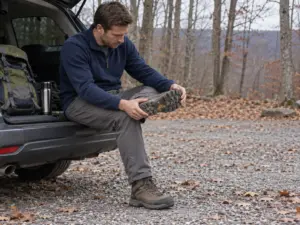
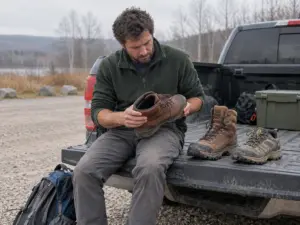






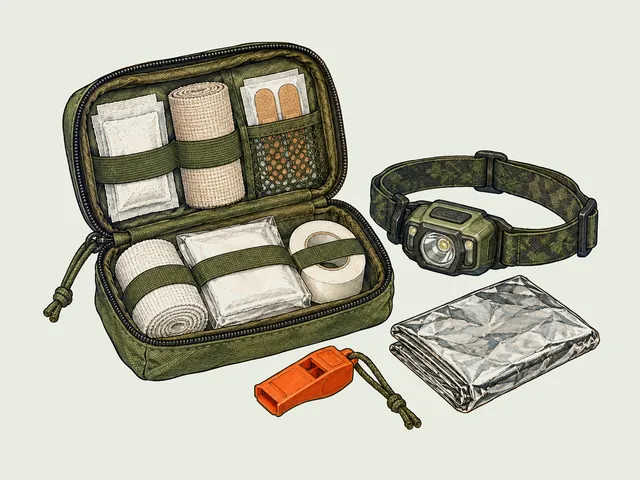



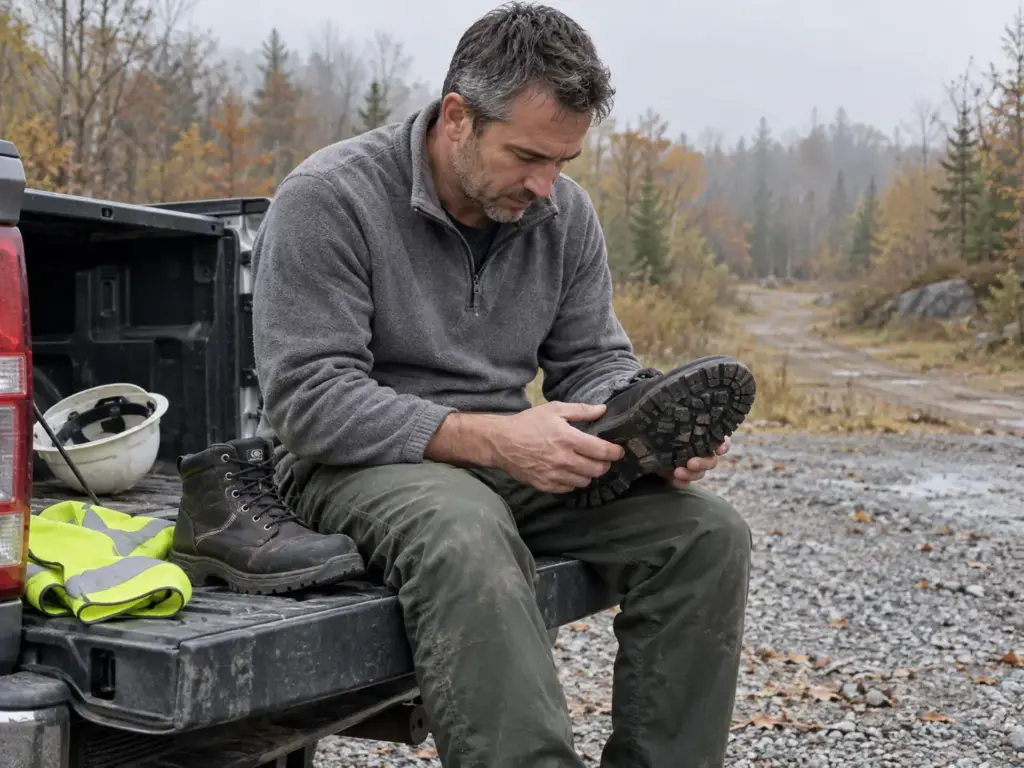
The job notice says steel-toe boots at all times on the project, and the only way in is a trail with roots, a creek crossing, and a couple of miles of climbing before you reach the first stake. That is the real problem behind steel toe hiking boots, and it is the one a hiker laid out on r/hiking: he walks a lot for work, has to wear safety boots, and none of the “safety hikers” he tried have fit right. The boot matters less than the rule behind it, so the first question is whether your job actually requires a safety toe. From there, this guide covers steel versus composite, the label to check, cold, soles, fit, break-in, and three steel-toe boots on Amazon.
Do You Actually Need Steel-Toe Hiking Boots?
Scout Life’s Gear Guy column once got a letter that began, “Is it a good idea to wear steel-toed boots for hiking?” The answer was that they are required on a job site and overkill for the trail. A commenter on r/hiking put the other half of the story in one line: “Have to have steel toe boots at all times on the project.” Both are right, and the difference between them is a document, not a trail.
What the OSHA Rule Actually Triggers
OSHA’s foot protection rule (29 CFR 1910.136) requires protective footwear wherever there is a risk of falling or rolling objects, piercing soles, or an electrical hazard. Read the OSHA foot protection text twice and notice what is missing. It says nothing about miles, elevation, or terrain. The trigger is a hazard at the work, not a feature of the walk.
Who decides whether that hazard exists? Your employer does, in writing. The employer’s written hazard assessment, under 29 CFR 1910.132(d), decides which PPE the job requires, and the employer has to certify that the assessment was done. If a safety toe is on your job’s list, it is there because of that document.
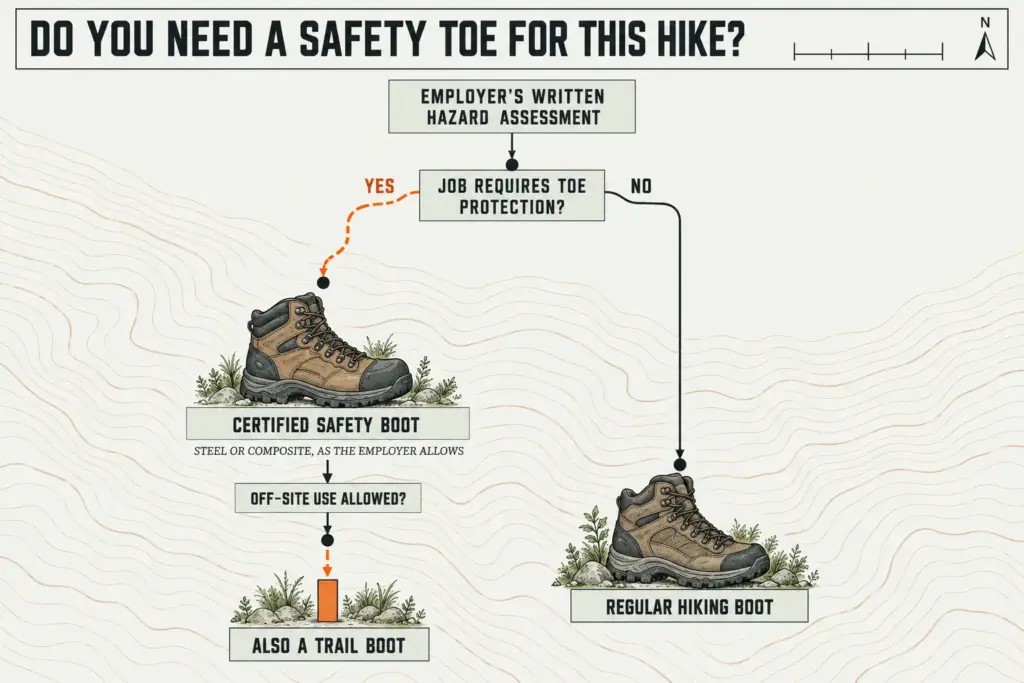
That makes three questions worth asking before you spend anything. Does the assessment for your task list a falling objects hazard that calls for impact or compression protection? Does it add a puncture-resistant sole or an electrical hazard rating? And does it say anything about the walk in, or only about the work itself?
If you have never seen the assessment, a short conversation with a supervisor answers the question faster than any shopping filter. Safety toe boots are sold to everyone, but only the paperwork says who needs them.
When Your Work Boot Can Double as a Trail Boot
The same rule family gives you one useful opening. Under 29 CFR 1910.132(h)(2), an employer does not have to pay for ordinary safety-toe footwear when it lets workers wear that footwear off the job site. In practice that means some employers draw a line between boots that stay on site and boots that go home with you. If yours allows the second kind, the boot you already own can be your approach boot, and you can skip a second purchase.
Permission is not the same as comfort, though. A boot can be allowed on a trail and still punish you on one. One commenter wrote, “Wore steel toes for my first 10 mile hike. Never again,” and that sentence says more about rigid toe caps than most spec sheets do.
When a Regular Hiking Boot Is the Better Call
If the assessment names no foot hazard for your task, a safety toe is dead weight. Nobody checks your toe cap on a Sunday loop, and trail terrain does not trigger the rule by itself. No case turned up where the rule compels steel on a trail, so this is the position of this article rather than a quoted standard.
Then the decision is about terrain, height, and fit, not certification. A pair built for the ground you actually cover will carry you farther with less rubbing. If that sounds like you, start with how to choose a hiking boot by terrain, height and fit and come back only if a job notice changes the answer.
Steel Toe vs Composite Toe on a Real Trail
Trade magazine ISHN lists steel, aluminum, and composite as the common toe cap materials, and a carbon fiber toe or an alloy toe exists too. On a trail the question is not which is stronger on paper. It is which one you can walk in for hours without it becoming the loudest part of your day.
What Steel Does Well
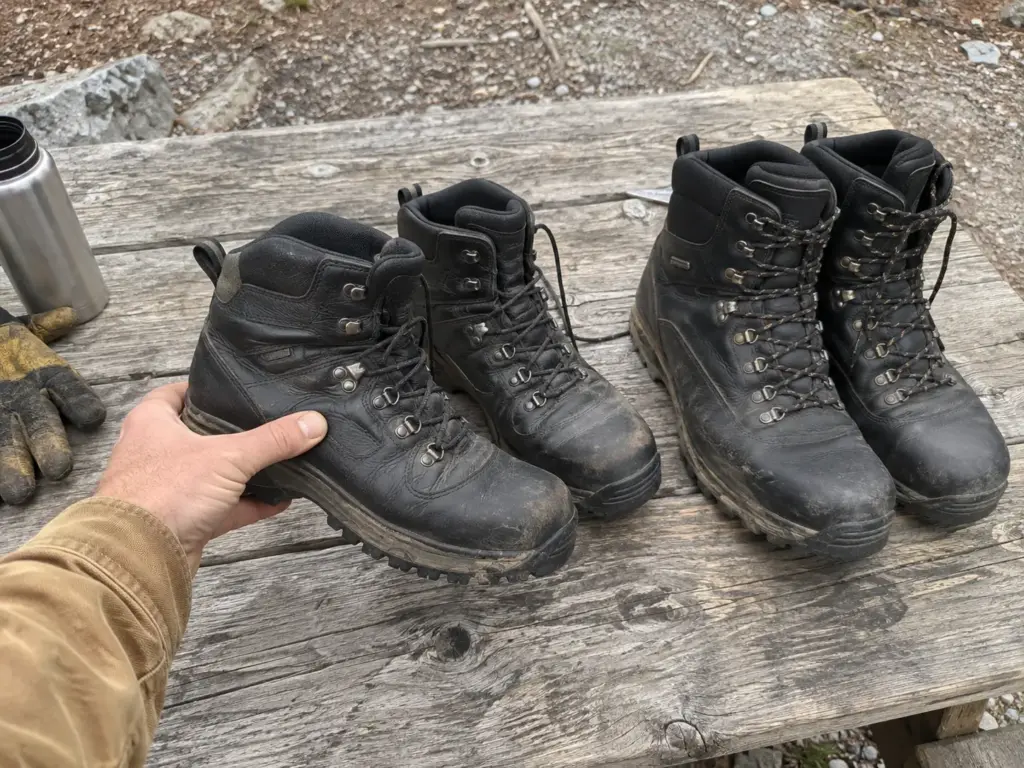
Steel is the traditional safety toe, and plenty of boots that carry it come with a roomy toe box. One r/hiking commenter said the safety toe gives his wide toes lots of room and that he walks 10 km a day at work without discomfort. That is a useful counterweight to the assumption that steel always pinches. It depends on the foot and the last, not only the cap.
Steel also tends to be what a job calls for by name, and a requirement in writing beats a preference every time. If your assessment says steel, that is the end of the debate.
Where Composite Pulls Ahead
The same commenter notes that composite toe hiking boots are lighter and, in his words, popular up in Canada because they are warmer in winter. Another hiker in the thread is blunter: if steel is not a requirement, look for a composite toe. Weight is easier to feel than to measure here, because no verified figure exists for the whole boot, only the report from people who carry it at the end of a long day.
Rigidity is the other piece. A Scout Life commenter said the steel plate does not allow proper toe movement or flexibility. Composite caps are still rigid, so do not expect miracles, but the cold and weight stories both lean the same direction. My read is that composite is the honest default for trail use when the job leaves the material open.
Which One Your Job Will Let You Wear
The material question usually answers itself. Some jobs spell out steel, some accept any certified safety toe, and some leave it to the hazard assessment. Ask which of those you have before you compare anything else.
If the answer is “any certified toe,” the decision tilts toward composite for winter and long days, and toward steel when the foot needs the room. If the answer is steel only, the rest of this guide is about making that boot tolerable.
How to Read the Safety Label Before You Buy
A product title that says “steel toe” tells you about the cap. It does not tell you the cap is certified, and it says nothing about what the cap was tested for. The marking on the boot itself does, and it is worth learning to read in five minutes.
I/75 and C/75, Impact and Compression
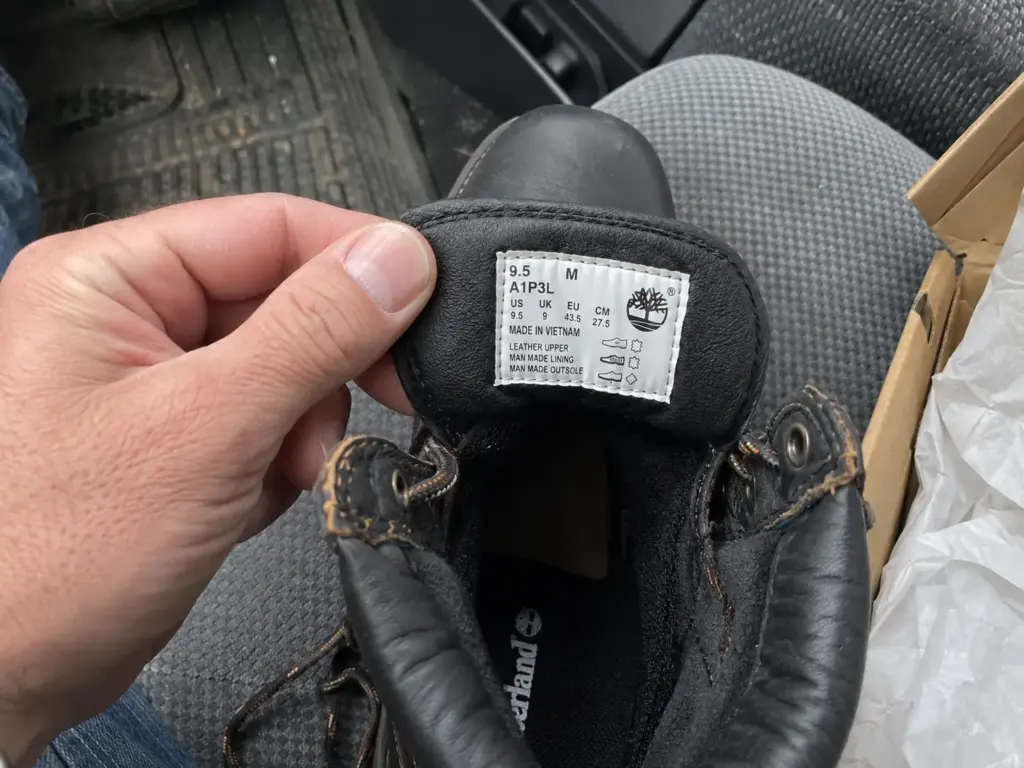
ASTM F2413 is the standard to look for, and the edition you are buying to is printed on the label in the boot, not in the title. A typical line reads M I/75 C/75. The M is for men’s, I/75 is an impact rating of 75 foot-pounds, and C/75 is a compression rating of 2,500 pounds, according to ISHN.
In plain terms, those two numbers are what a heavy object falling on your toes and a heavy object rolling over them look like in a lab. If your job names a rating, match it character for character. A listing that only says “safety toe” has not told you enough.
What EH Does and Does Not Mean
EH stands for electrical hazard. For an electrical hazard boot, the test applies 18,000 volts at 60 hertz for one minute, with leakage current of 1.0 milliamp or less, and it is done dry. That makes EH a secondary protection against contact with live circuits in dry conditions, not a promise that the boot makes you safe around electricity.
A wet boot or a worn sole changes the picture. Treat the mark as one layer in a system your employer has defined, not as a license to take chances.
Mt/75, the Mark Most Hikers Never Look For
Mt/75 is metatarsal protection, the rating behind a metatarsal guard, and it is rated separately from the toe cap. A boot marked only I/75 C/75 EH does not have it. If your hazard assessment mentions protection over the top of the foot, look for Mt on the label and do not assume it.
One more wrinkle: a few commenters from Canada mention CSA approved boots, and CSA is a Canadian marking with its own rules. What counts is what your employer and your jurisdiction require, and one reader’s comment is not a standard.
Store listings and the product page can disagree, so the label that arrives in the box is the source of truth. Photograph it the day the boots show up and send it to whoever signs off on your PPE before you ever wear them to site.
Why a Steel Toe Gets Cold and When It Matters
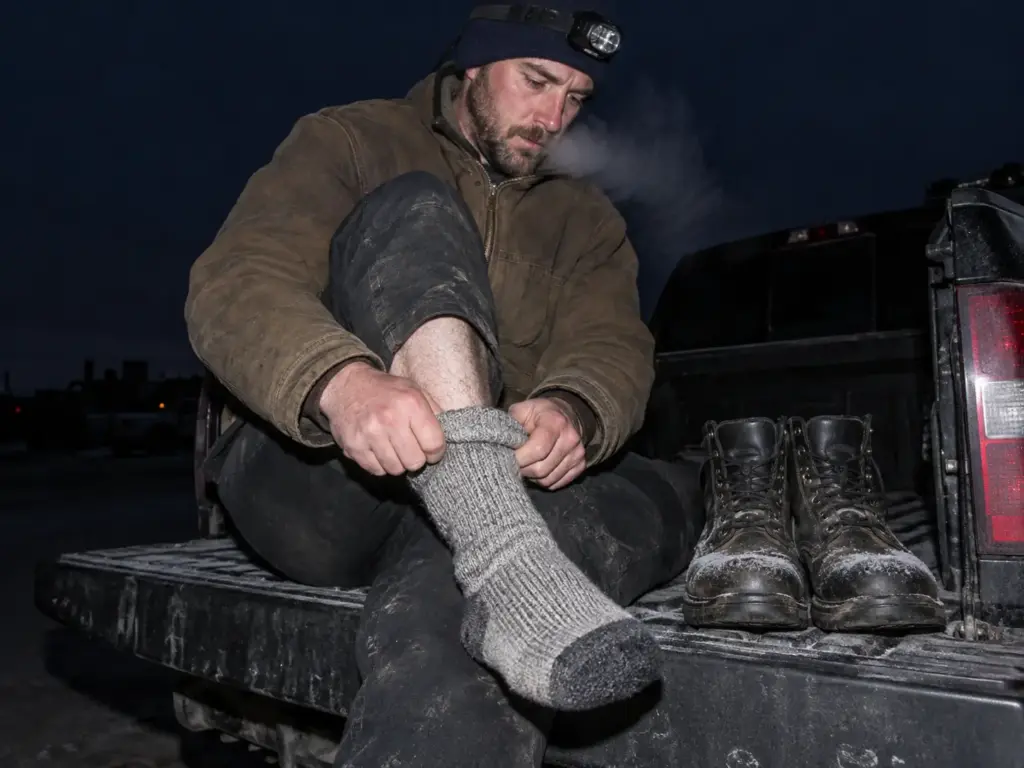
Anyone who has stood on a frosty slope in steel caps knows the feeling: the toes go first, and they stay gone. The cause is simple conduction. Steel has high thermal conductivity, so it moves heat away from your foot far faster than composite materials do, and a metal cap that has cooled acts as a cold sink against your toes. Steel toe cold is the complaint that shows up in both the r/hiking and Scout Life discussions.
How Steel Pulls Heat Out of Your Foot
A Scout Life commenter said it plainly: steel toes “will get colder quicker in cold weather and once cold, they will retain the cold.” Another added that they conduct heat and cold into the foot. Think of the cap as a small piece of metal sitting against your toes, with only a thin lining between them, in the same position as a cold tent pole against bare skin.
The direction of the effect is not in doubt. The size of it is. A Wolverine product executive writing in ISHN argues composite caps do not conduct heat or cold in extreme temperatures, which is the manufacturer’s position and worth reading as one. No standard and no manufacturer spec sheet publishes a temperature below which steel becomes the wrong choice, so any cutoff you see quoted online is somebody’s rule of thumb, not a tested number.
What Crews in Canada Say About Composite
The r/hiking thread keeps returning to Canada, where composite is described as the winter favorite because it stays warmer. That is community experience, not a lab result, and it lines up with the conduction story. It also shows that people who live with the cold for months reach for composite when the choice is theirs.
The honest summary is narrow. If your job allows either material and your season is cold, composite is the lower-risk pick. If steel is required, the problem becomes managing it.
If You Are Stuck With Steel in Winter
Insulation and socks matter at least as much as the cap material, which is my judgment rather than a measured result. Start with a boot that has real insulation around the toes, such as the insulated winter hiking boots worth knowing about. Then fix the interior: a thick wool sock, an insulating insole, and enough volume that nothing compresses your toes, since squeezed toes lose heat faster.
Keep moving, and warm the boots before the first step when you can. A cold steel cap pulled on at a frosty trailhead is the worst start.
Carry the boots inside the cab or the tent vestibule overnight instead of leaving them in the truck bed. A steel cap that starts the morning at room temperature gives you a head start the sock alone cannot.
Waterproofing in a Work Boot
Wet feet at the end of a long approach are a miserable way to start work. ISHN notes that work boots often use GORE-TEX-style membranes, and the trade-off is the one every hiker knows: the membrane keeps water out and holds sweat in. A boot that stays dry in a puddle can still feel clammy by noon.

The name of a listing does not settle the question. The three boots in this guide show why.
One carries “waterproof” in its title, but that is not confirmed on the product page. For another, store listings contradict each other. For the third, workwear.org reports it is not waterproof. Confirm on the manufacturer’s spec sheet, not on the title.
After you buy, upkeep decides how long any treatment lasts. Wax and spray behave differently on leather, and the wax-versus-spray waterproofing methods are worth a read before you treat a pair that has to survive a full season on site.
Work Soles Versus Trail Soles on Wet Rock
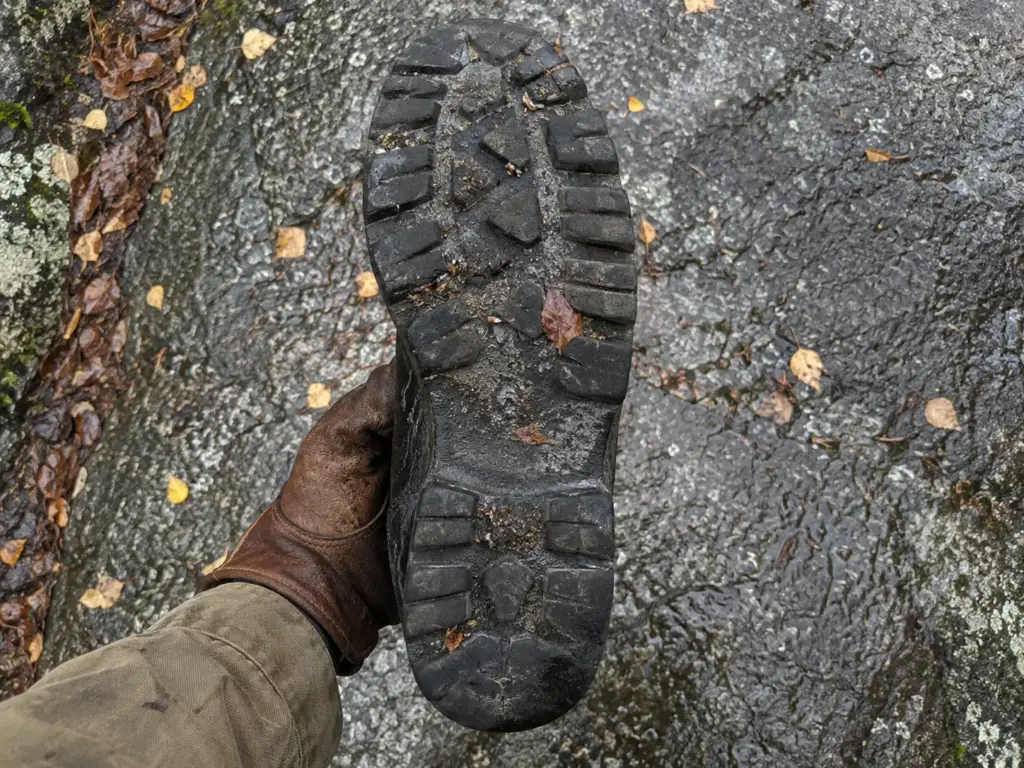
The sole is where a work boot and a trail boot stop being the same thing. A work sole is built for oil, slick floors, and abrasion, and a slip resistant outsole on a work boot is rated for that world. A trail outsole is built to bite into dirt and grip a wet slab, and a boot rarely does both equally well.
What a Work Sole Is Built For
ISHN says genuine rubber outsoles are chosen for abrasion resistance, oil resistance, and slip resistance, which is a job-site spec. Lighter and more flexible options include TPU, polyurethane, and EVA. Those materials and their goals describe the lab, not the hillside.
The poster who started the r/hiking thread said the best fit he found was a cheap pair of safety hikers that wear out fast. Fit and wear are separate questions, so look at how the sole is built, not only at how the boot feels in the store.
Wet Rock and Roots
Here is the gap. The safety label does not say how the lugs hold on wet rock, and no figure is published for tread depth, so this section is observation rather than data.
One r/hiking commenter wrote that the tread on a pair of Red Wings “doesn’t work that great for hiking as they’re pretty slick. Especially in wet rock.” That is one voice, so take it as a warning to look, not a rule.
Look at the lug outsole the way you would at a trail shoe. Are the lugs separated, with room to shed mud? Is the heel defined, or is it a flat block? A sole that works on a poured floor can turn into a disc on a wet root, and a low, tight pattern does that sooner.
Welt Construction and Stiffness
Construction changes how the boot feels over distance. A welted boot is built to be resoled and holds its shape, while a cemented boot is lighter and more flexible. The Goodyear welt versus cemented construction comparison explains the trade-offs in more detail.
Stiffness matters even more with a rigid cap, because the cap already fixes the front of the boot. On uneven ground you want a shank that holds the arch without making the boot a plank. Matching boot stiffness for your terrain is part of the same decision.
Fit, Width and Women’s Sizing
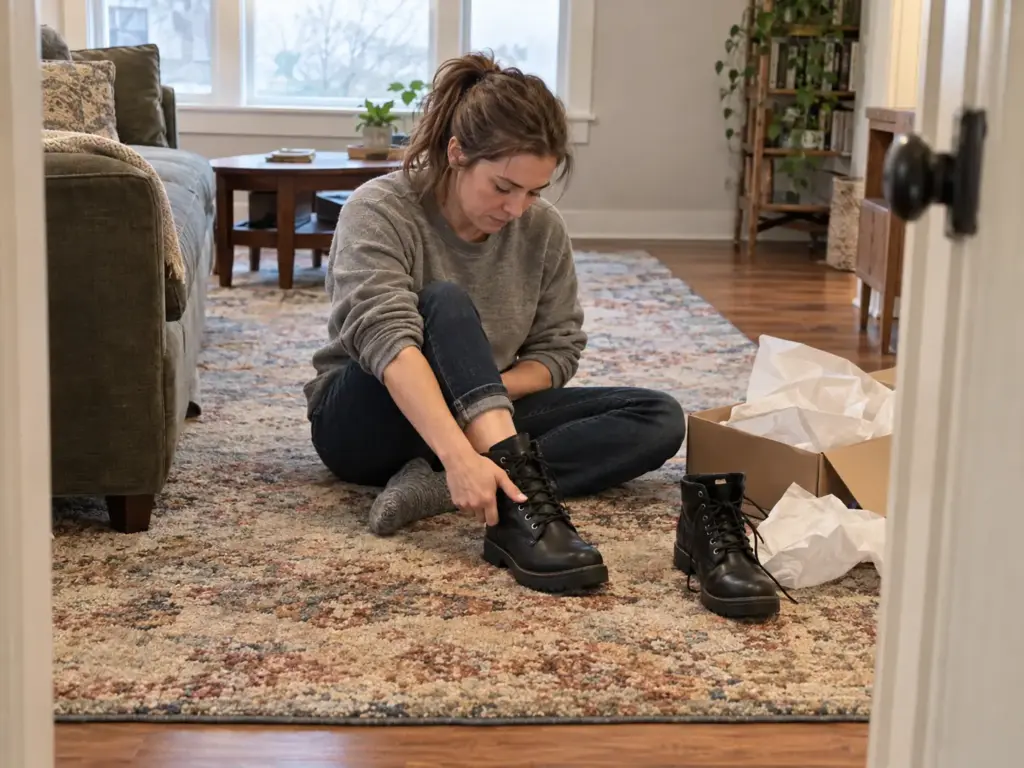
A safety toe changes fit more than people expect, in both directions. The cap takes up volume, and the boot is built around it, so the toe box can feel boxy or generous depending on the model. The only way to know is to try the pair you plan to wear, in the socks you plan to wear.
Toe Room and Wide Feet
For wide feet, safety toes can be a relief. The commenter who walks 10 km a day in a safety toe said the cap gives his wide toes lots of room. If you have wide feet, that is worth knowing before you dismiss steel. For options outside the safety-toe category, see these hiking boots for wide feet.
Time of day changes the answer. Feet swell as the day goes on, so a boot that fits in the morning can pinch by evening. Fit them in the afternoon and walk on an incline if the shop has one.
Women’s Options Are Thin
Women’s steel toe boots and other safety-toe styles in women’s sizes are thin on the ground. The same r/hiking commenter says women’s options are few, and none of the three boots in this guide has a women’s version available on Amazon right now. That is a gap in the market, not a judgment on the boots.
Check availability before you plan around a pair, because stock changes. If a safety toe is not required for your task, women’s water-resistant hiking boots cover a lot of the same ground.
Socks and Lacing Fixes
Reddit’s practical advice is small and effective: change the laces and the sock thickness to adjust volume. A thinner sock frees a tight toe box, and a thicker one takes up slack in a roomy boot. Lace snugly across the instep and looser over the toes so the cap has room to sit without gripping.
Before you decide a boot is too tight, change the sock and relace it. Half of the fit problems people blame on the cap turn out to be a lace that is cranked across the toes.
Breaking In a Toe That Won’t Mold
A leather boot molds to your foot over time. A rigid toe cap does not. That is the mechanical fact behind most of the pain people report, and it explains why a break-in plan for these boots looks different.

Where the Rubbing Starts
The cap keeps its shape, so the leather around it gives instead. That moves the flex point of the boot toward the edge of the cap, and the rubbing starts where the stiff part ends and the soft part begins. A Scout Life commenter called Scoutmaster Bill put it simply: the rigid toe box can cause blisters and bruises.
Expect the first trouble at the front of the foot, where the stiff cap meets the soft leather, and again on downhills when the foot slides forward. No published number tells you how many hours a safety toe needs. One reader said a pair of KEEN Detroit XT boots took a week to break in, which is a single model and not a rule.
Rubbing can also come from outside. A Scout Life commenter says a reinforced toe box helps a hiker who scrapes the front of the boot on rock, and another mentions a replaceable piece you can buy to protect the outside of the cap.
A Sensible First Few Walks
Start short and flat. Wear the boots around the house with the socks you will actually use, then take them on a short, level walk before you ask them to carry a full day on a hill. This is editorial advice, not a measured protocol, so treat it as a place to start.
Use socks that do not compress the toes, and stop at the first hot spot rather than pushing through it.
If the cap presses on your nails after a short walk, that is a fit problem, not a break-in problem. A different sock thickness or half a size more room can help, but no amount of walking will make a steel cap larger. Over several outings, the leather around the cap loosens and the pressure points settle. For a comparison point, see how long a normal hiking boot takes to break in, and remember a rigid cap changes the timeline.
Cover a hot spot the moment you feel it. A small piece of tape over the spot at the first warmth is easier than treating a blister at the end of the day.
Steel-Toe Hiking Boots Worth Shortlisting
Three steel-toe boots made it through an availability check on Amazon at the time of writing. All three are men’s only, and none is composite, so this is a shortlist for the job site hiker whose work calls for steel, not a verdict on the category. Each card says what the boot is, who it suits, and what to confirm on the spec sheet.
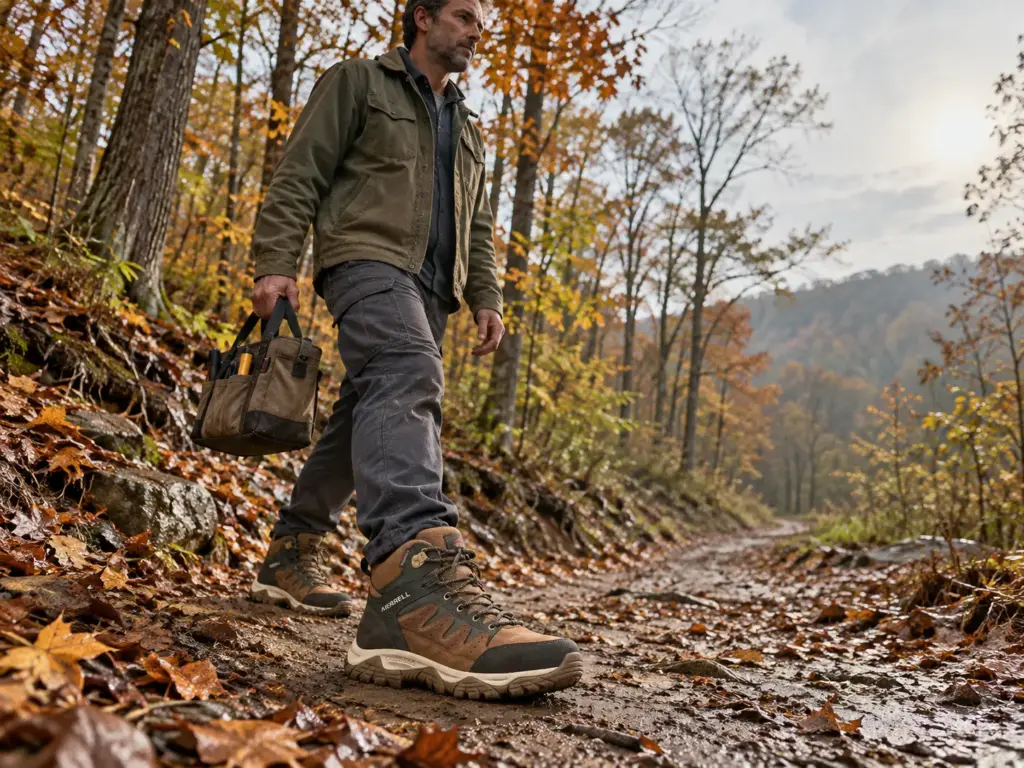
Merrell Windoc Waterproof Steel Toe Mid
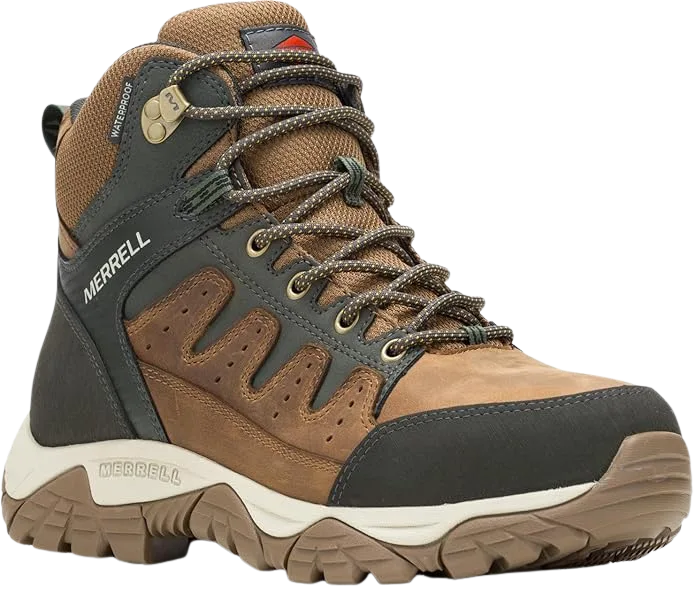
This is the only mid-cut steel-toe with a men’s listing in stock among the three, and it is the closest to a trail boot in shape. A mid-height shaft gives more ankle coverage than a low shoe, which helps on uneven ground. The women’s version has no offer right now, so this one goes in as men’s only.
What to check before you buy: the waterproof claim and the safety markings. The word “Waterproof” sits in the product name, but the spec sheet is where the claim is either confirmed or not. The label inside the boot tells you whether the cap meets the rating your job names.
CAT Footwear Second Shift Steel Toe 6 Inch
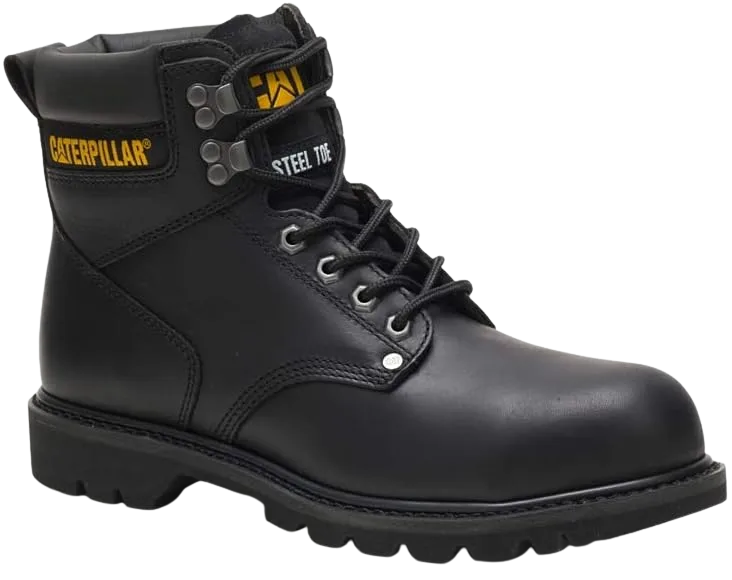
This boot is a useful example of the marking you should look for. Store listings give it an ASTM F2413 rating of I/75 C/75 EH, but those come from retail listings and not the Amazon product page. That is exactly why the label in the box matters more than any listing text.
Waterproofing is the open question. Listings contradict each other, so this guide does not call it waterproof. If your approach crosses wet ground, treat that as something to resolve with the spec sheet or a call to the maker before you rely on it.
Timberland PRO Pit Boss Steel Toe 6 Inch
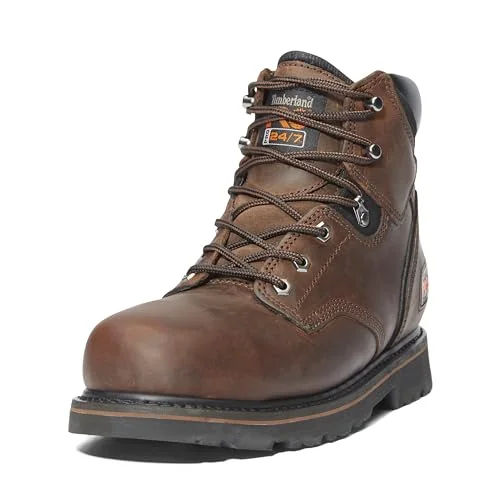
The Pit Boss is a welted work boot with a safety toe, and the wide toe box is the draw for wide feet, per retailers. Two things are not settled. Sources disagree on whether it carries an EH rating, so this guide does not claim one, and workwear.org reports it is not waterproof.
Pick it when the job calls for a sturdy, resoleable platform and the ground is mostly dry. Pick something else if wet crossings are part of your approach.
Before you buy any of the three, hold the label up against the marks in the label section above and against the hazard assessment for your task. If they match, you have a boot. If they do not, you have a listing.
Two Pieces of Paper Settle It Before You Buy
The job decides, not the trail. A safety toe belongs on your feet because a written hazard assessment says so. For everyone else, a regular hiking boot is the better walking tool.
If your employer lets you choose, composite is the better starting point for trail miles and cold, and steel earns its place when the foot needs the room. Whichever you land on, the label, the cold, and the break-in are settled in the box, not in the listing.
Before you order, ask your supervisor to show you the written hazard assessment for your task. When the boots arrive, read the label inside them against that page. Those two pieces of paper decide more than any shopping filter.
Frequently Asked Questions
01Do they make steel toe hiking boots?
Yes, several brands make steel-toe boots shaped like hiking boots, usually sold as safety hikers or work hikers for people who need toe protection on foot. They are work boots first, so check the safety label and the sole.
02Can I use my steel toe boots for hiking?
You can if your employer allows the boots off the job site and the fit works for your feet, but a steel toe is rarely the most comfortable choice on a trail. Expect a stiff toe cap, a work-style sole, and some rubbing until the leather around the cap loosens.
03Are composite toe boots good for hiking?
Composite is the usual starting point for trail use when a safety toe is required and the employer allows it. Users report them lighter and warmer in winter than steel, though the cap is still rigid.
04Do I have to wear steel-toe boots to hike to a job site?
It depends on your employer’s written hazard assessment for the task, not on the trail itself, so the answer is whatever that document says about foot protection. If the assessment calls for protection on the walk in, you wear it. If it does not, ask your supervisor in writing.

I've spent more than a decade researching hiking gear and trail technique. I read the specs, the forum threads and the long-term reviews, and every pick here comes with what it gets wrong.
End of the trail
You read every mile of this one. Here's where the trail goes next.