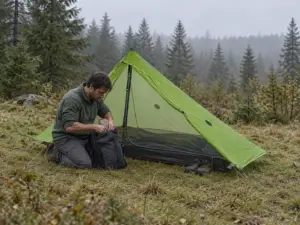
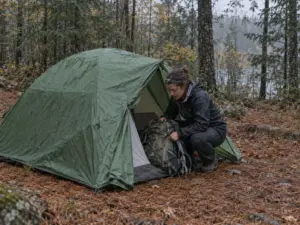
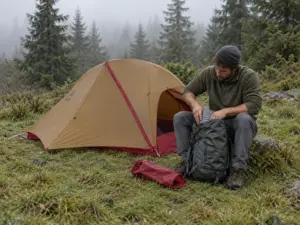









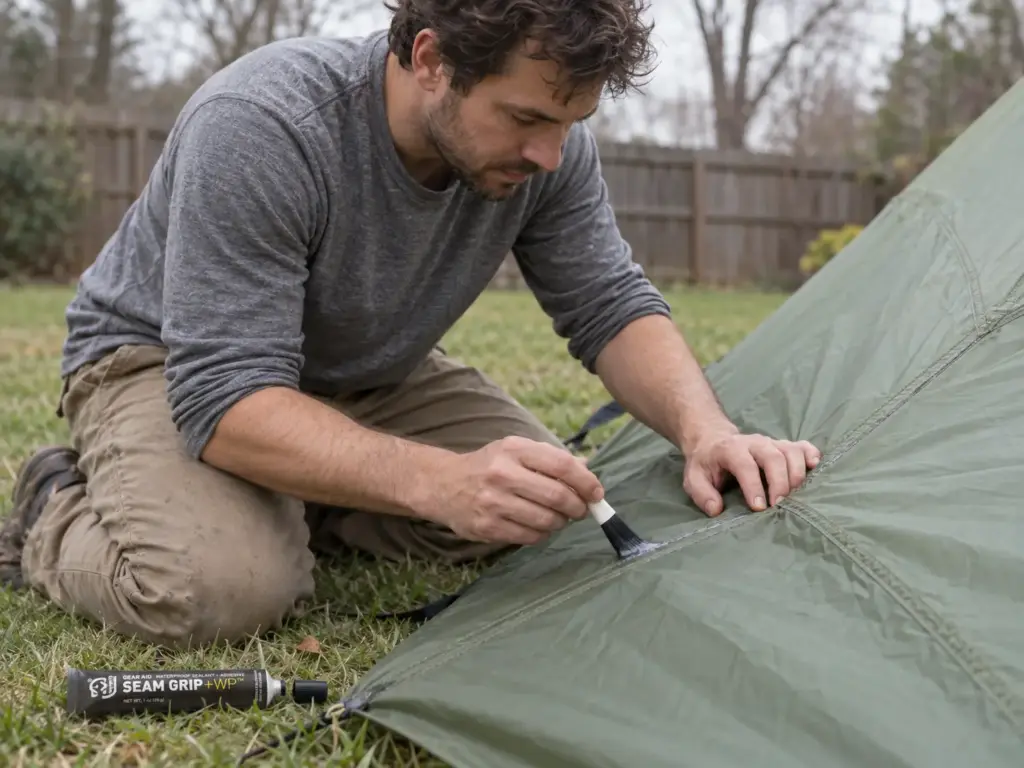
It’s 2 a.m., the tag on your tent says waterproof, and a cold drop lands on your forehead from a seam you never gave a second thought. The story keeps repeating in r/Ultralight: one Lanshan owner skipped sealing, had a dry year of trips, then four days of heavy Hawaii rain found every unsealed stitch at once. Tent seam sealing is cheap tent maintenance, a one-afternoon job, and also the one people skip or botch most often. Here’s whether you need it at all, which sealer matches your fabric, how to apply it, and the five mistakes that make a sealed tent leak anyway.
Do You Need Seam Sealing on Your Tent?
Short answer: probably, and you can tell in about five minutes. Leaky seams rarely look suspicious in the backyard, which is why the tent leaks on night three of a wet trip. Plenty of hikers get a full season out of an unsealed shelter, and then the first long soaking storm finds every needle hole at once. That’s exactly how the Lanshan story played out.
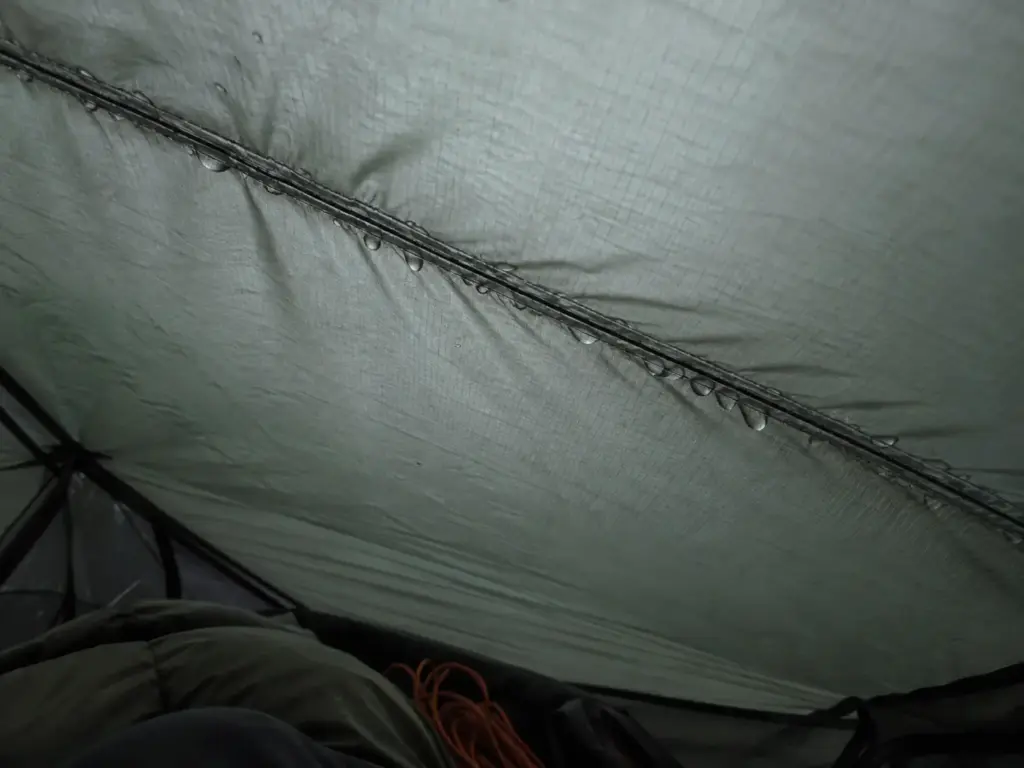
The deciding question is not whether your tent is new. It’s whether anybody ever put sealer or tape on the specific seams that take water, and whether the coating around them is still healthy. Those are two different problems, and only one of them is solved by a tube of seam sealer.
Signs You Should Seal
The most common case is a new tent out of the box that was never sealed. Some cottage ultralight shelters ship that way because sealing by hand eats time and floor space. One r/Ultralight commenter put it bluntly: it “has to be done by hand and takes up substantial floor space.”
So the job lands on you, or you pay the maker to do it. Plenty of ultralight hikers take that second option, and Lanshan sells seam sealing as an add-on.
A tent described as fully taped is not off the hook either. Gear Aid points out that perimeter seams on seam-taped tents are often not factory sealed, and the corner stake-out points are the classic drip spot. If the drop lands near a corner or along a fly seam, start there.
Even premium tents ask for it. MSR’s own support pages say its 2018 to 2019 Hubba tents with Xtreme Shield coating, which use stitched seams instead of tape, should get the rainfly seams sealed with Seam Grip FC or WP before heavy, extended rain. If your plans include a week of shoulder-season weather in a three-season tent, treat sealing as part of the prep, not as an optional extra.
Not sure which camp your tent falls in? Pitch it outside, dry, and run a fine hose mist over the fly while you sit inside with a headlamp.
A spot that weeps along a seam is a spot to seal. If the whole ceiling weeps, the coating is the problem, not the seams. The hose test near the end of this guide walks through the full routine.
Here’s the quick checklist for sealing:
- The tent is new and the maker says the seams are not sealed.
- The seams are taped, but the floor perimeter and corners show bare stitching.
- You’ve seen drips at the corners or along a rainfly seam.
- A long, wet trip is coming and the tent has never seen sustained rain.
Signs Sealing Won’t Help
A sticky, tacky feel when you pull the tent out of the closet is not a seam problem. That’s hydrolysis: the polyurethane coating breaking down with moisture and time. Cascade Designs notes that lightweight coatings are more prone to it, that damp storage and humidity speed it up, and that it can show up even on new or rarely used tents. Sealer on top of a failing coating is like paint on rust.
The same goes for seam tape that’s lifting along every seam at once, or a flaking coating that leaves the fabric delaminating in sheets. Those tents need the coating treatment covered further down (or a hard conversation about retirement), not a seam job.
Before you blame a seam, rule out condensation inside your tent. A wet inner wall after a cold, still night with no rain is your breath and the ground, not a leak. Real leaks show up as drips that follow a line, start during rain, and come back in the same spot.
To tell a leak from condensation, wipe the inside of the fly dry with a bandana in the evening. If the wet patch comes back as a line along a seam during rain, it’s a leak. If it comes back as a uniform mist on a still, clear night, it’s condensation and no sealer will fix it.
Seam Tape vs Seam Sealer: What Factory Tape Actually Does
“My tent says fully taped, so why does it drip?” It’s the most common trailhead question on this topic, and the answer lives in how the two fixes work.
How Factory Seam Tape Works
Every seam on a tent is a row of needle holes. Seam tape is a thin waterproof strip bonded over those holes from the inside, and MSR notes it can only be applied at the factory. It covers the stitch holes like a bandage.
A liquid seam sealant works differently: it soaks into the thread and fills the holes, then cures into a flexible waterproof plug. That’s why sealer is the home and field fix, and tape isn’t.
When tape is in good shape, it works well. The trouble is what happens to it over years of being stuffed wet and stored in a humid garage.
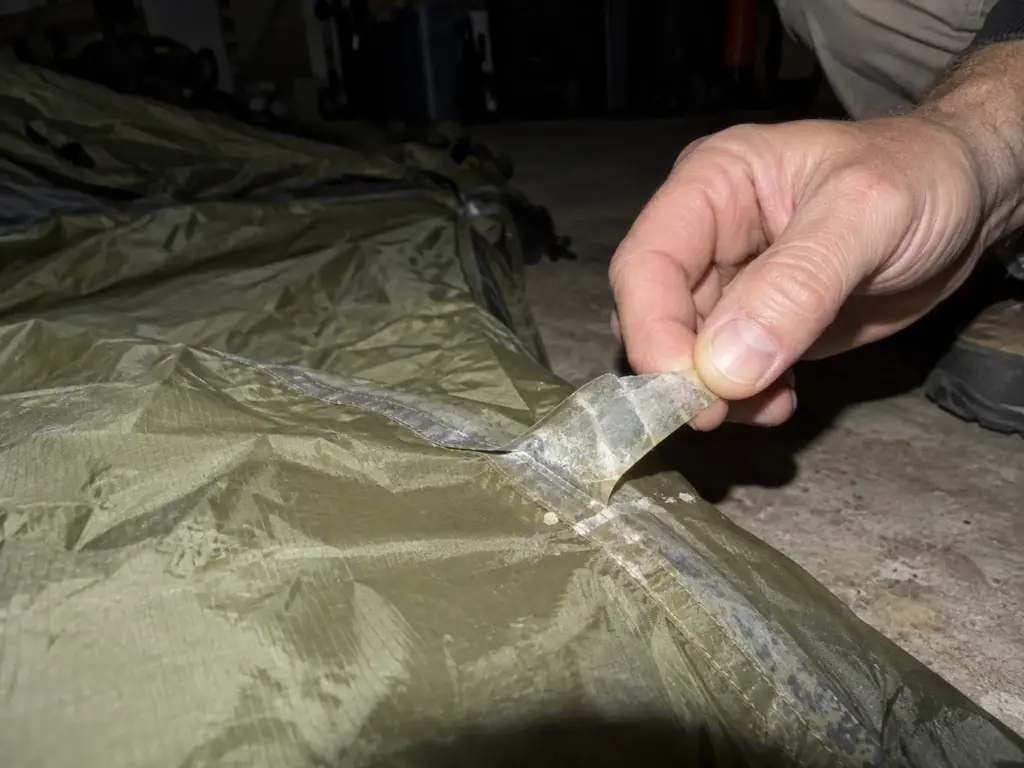
Why Tape Peels
Tape is glued to a coating, so it lives and dies with that coating. Cascade Designs explains that the lightweight coatings on modern tents are more prone to hydrolysis, and as they break down, the tape adheres worse and starts to flake. Humidity and damp storage speed the whole thing up, so basic tent care starts with storing it clean and fully dry, never stuffed wet in a closet, where mold and mildew move in too. The ultralight trend makes this more common, because lighter fabrics trade durability for weight and thinner coatings give tape less to grip.
You’ll usually notice it first as a curled edge at a corner or along a curved seam, where the tape flexes most. That’s the moment to act, before the lift spreads. And keep the two jobs apart in your head: sealer fixes seams, not a coating that’s turning to goo. More on that further down.
PU or Silicone? Identify Your Tent Fabric in 30 Seconds
You’re standing in the shop aisle with two tubes in your hand and an old backpacking tent at home with no tag left on it. One of those tubes will bond to your seams for years. The other one will peel off like a sticker.
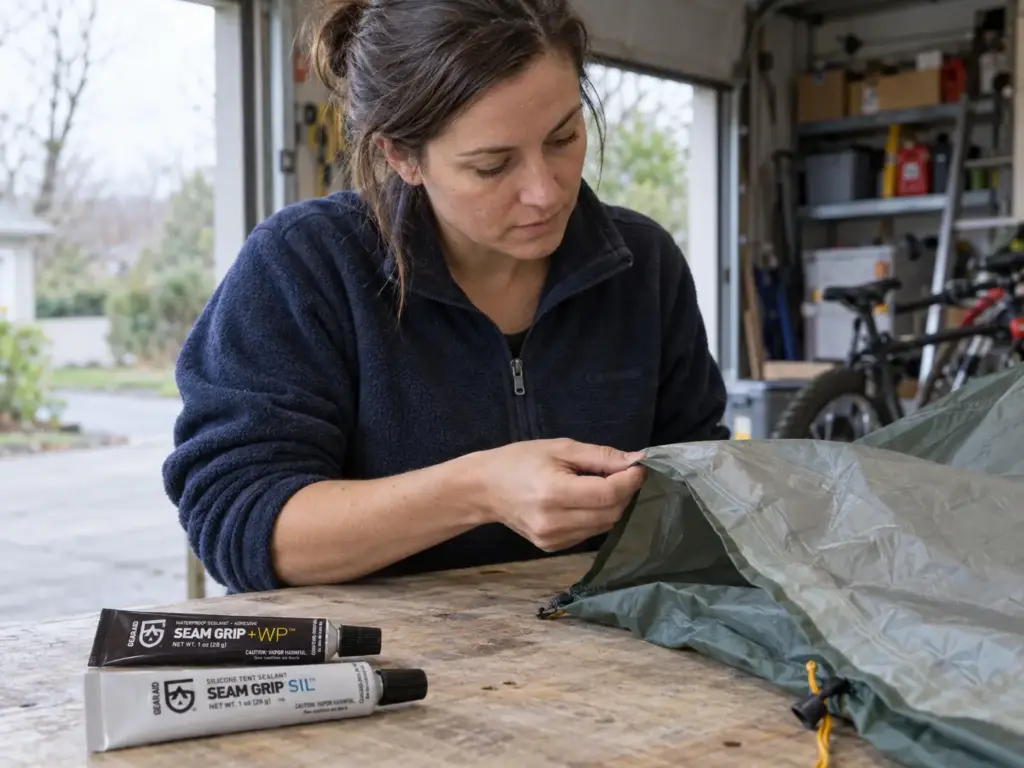
That’s not a figure of speech: Gear Aid says that urethane sealers (WP, FC and TF) bond to PU-coated nylon and polyester, while silicone sealer (SIL) bonds only to silicone-treated fabric like silnylon and silpoly. Use the wrong one and it never grips.
So the fabric decides the sealer, every time. Here’s how to read it.
The 30-Second Fabric Test
Take this as practical, general guidance rather than lab chemistry, and always confirm with the maker when you can. Run your fingers over the fabric. Silnylon and silpoly carry a silicone coating, so they feel slick, almost waxy, and slide off each other when you rub two layers together. Drip a little water on the outer face: on silicone, it beads up tight and rolls off fast.
A PU coating usually sits on one side, the inside of the fly or the top of the floor, and feels slightly tacky or looks shiny and plasticky compared with the outer face. Then look for seam tape. Factory tape usually means a PU-coated side, because tape doesn’t stick to silicone. A silnylon shelter with no tape is the classic sign that the seams were left for you to seal.
What “Silicone-Treated” Really Means
Here’s the trap. Gear Aid points out that many fabrics sold as silicone-treated are silicone on the outside and polyurethane on the inside. That’s why some of them carry factory tape on the inner seams.
On those tents, you seal the PU side with a urethane like Seam Grip WP, working from the inside. Put silicone sealer on that PU inner face and it won’t bond; put urethane on the silicone outer face and you get the same result.
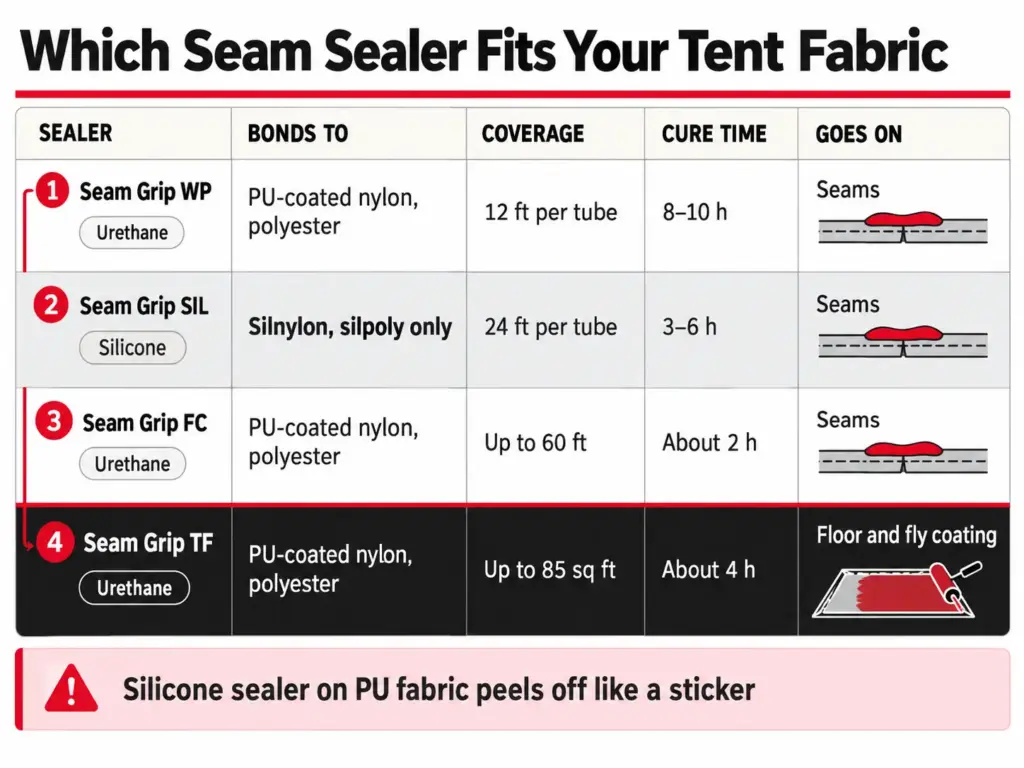
The rule of thumb that saves the most tubes: you’re matching the sealer to the face of the fabric the seam sits on, not to the marketing word on the tag. If the inside is shiny and taped, think urethane. If both sides are slick and nothing is taped, think silicone. Dyneema (DCF) shelters are a different story again, so check the maker’s guidance before you reach for any tube.
Seam Grip WP for PU-Coated Tents
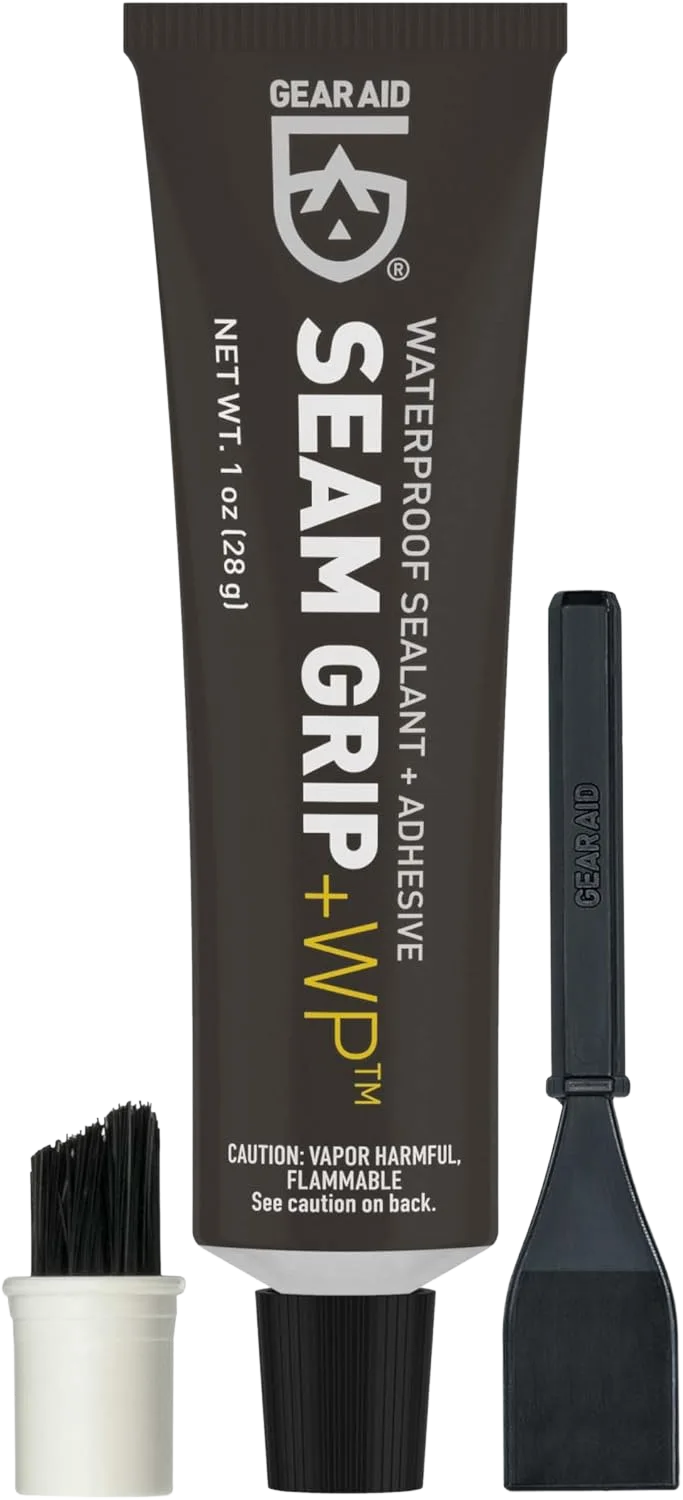
If your tent has a shiny inner coating or factory tape, Gear Aid Seam Grip WP is the tube to grab. Gear Aid rates the 1 oz tube at about 12 feet of seams, which is about one fly or one small tent, not a whole tent plus a tarp. It bonds to nylon, polyester, canvas and vinyl, and it’s the same product Gear Aid tells you to use for gluing down peeling tape, so one tube covers both jobs.
The trade-off is time. WP cures in 8 to 10 hours (Gear Aid’s tips page says plan on overnight), so it’s an evening job, not a morning-of-the-trip job. It’s also the sealer to keep away from any silicone face. On a silnylon fly, it won’t grip for long.
Seam Grip SIL for Silnylon and Silpoly
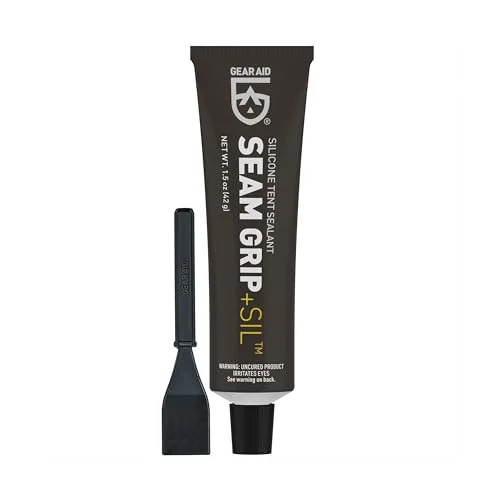
Most ultralight shelters built from silnylon or silpoly ship unsealed, and Gear Aid Seam Grip SIL is the product made for them. Old-timers still call it SilNet, its former name. Gear Aid lists the 1.5 oz tube at about 24 feet of seams, a 3 to 6 hour cure, and an application range of 60 to 100 F. It’s specifically not for PU-coated fabric.
That coverage matters on a silpoly tarp or a pyramid shelter, which run a lot of long seams compared with a small double-wall tent. Check your total seam length before you assume one tube will finish a two-person mid.
How to Seal Tent Seams Step by Step
Pick a dry weekend afternoon, a yard or a garage with the door wide open, and an order of operations you don’t skip. The work itself takes an hour. The cure takes the rest of the day.
Prep and Set Up
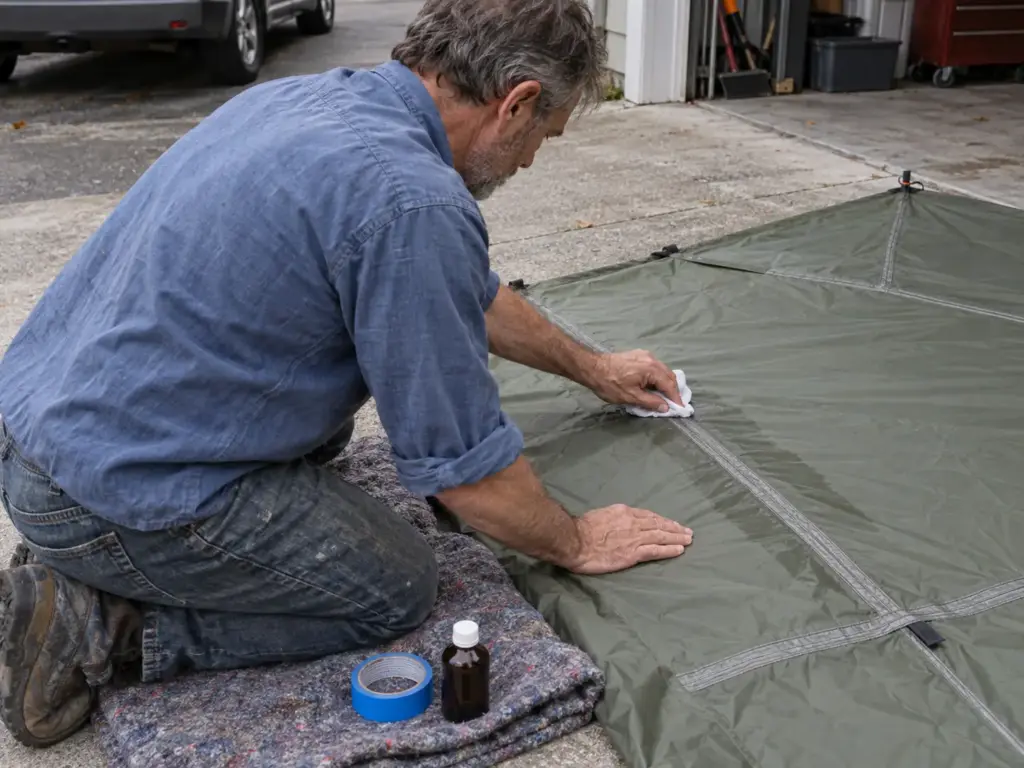
On a used tent, clean the seams first. Gear Aid recommends wiping them with isopropyl alcohol (the stuff sold as rubbing alcohol) to strip dirt, sunscreen and skin oils that keep sealer from bonding. Then wait until the fabric is bone dry. Sealing damp fabric is one of the most repeated mistakes in r/Ultralight threads, and a commenter’s blunt rule says sealer “shouldn’t be done if the fabric is wet.”
Next, pitch the fly inside-out and attached, so the seams are pulled taut. Gear Aid calls for exactly that: stretched seams open the needle holes and expose the thread, which is what the sealer needs to soak into. A slack seam hides its holes in the folds. For a tarp, the same skills you’d use to pitch a tarp shelter in camp apply in the yard: tight ridgeline, even tension on every corner, no sag along the seams you’re about to coat.
Apply One Thin Coat
Gear Aid’s instruction for WP is one thin coat on the inside of the seam, and that’s the whole technique. Use a small acid brush or foam brush, work the sealer into the stitching rather than laying a bead on top, and feather the edges just onto the coated fabric. You want the thread darkened and the holes filled, not a rubbery ridge.
Inside versus outside depends on the tent. PU tents get sealed on the coated underside, where the tape would be. On ultralight silnylon shelters, many owners seal the butt seams and ridgelines from the outside, where the silicone face is. Sources honestly disagree on the finer points here, so treat the outside approach for silnylon as common community practice rather than a hard rule, and follow your maker’s instructions when they exist.
If you’re racing a forecast or sealing a big family tent, Gear Aid Seam Grip FC is the water-based fast cure option. Gear Aid rates it at about 2 hours and up to 60 feet of seams, which makes sense on a large cabin tent. The cost is permanence: Gear Aid notes FC is less durable than WP and solvents can break it down, so expect to touch it up sooner.
Cure Time and Ventilation
Cure times by sealer, per Gear Aid:
- Seam Grip WP: 8 to 10 hours, plan for overnight.
- Seam Grip SIL: 3 to 6 hours.
- Seam Grip FC: about 2 hours.
WP is moisture-cured, so a humid evening speeds it up and a bone-dry desert afternoon slows it down. When rain is coming tonight, Gear Aid lists a shortcut: mix WP with Aquaseal FD Cure Accelerator at 1 part accelerator to 3 or 4 parts WP, and dry time drops to about 2 hours. If the cured seam still feels slightly tacky, that’s normal; dust it with talcum powder or baby powder.
Don’t start packing your tent until the sealer is fully cured. Stuff it early and the panels glue themselves together in the sack.
Then there’s the air you’re breathing. Solvent-based sealers like Seam Grip WP carry a toluene warning and release VOC fumes while they cure, and California’s Prop 65 fact sheet on toluene lists it for reproductive harm and advises adequate ventilation. Occasional household use isn’t considered significant exposure, but the r/Ultralight meme of seam sealing a tent pitched inside a tiny apartment is a meme for a reason. Work outdoors or with windows open, keep the tube away from stoves, heaters and pilot lights, and follow the label.
Wear disposable nitrile gloves. Sealer on bare fingers is the complaint that shows up in every r/Ultralight sealing thread: it’s nearly impossible to wash off and rides along on your hands for days, leaving sticky prints on everything you touch.
Peeling Tape and the Spots Everybody Misses
The drip doesn’t always come from where you think. Sometimes the tape has curled at one corner. Sometimes the water is coming in at a spot that isn’t a long seam at all, and you sealed every seam you could see without touching it.
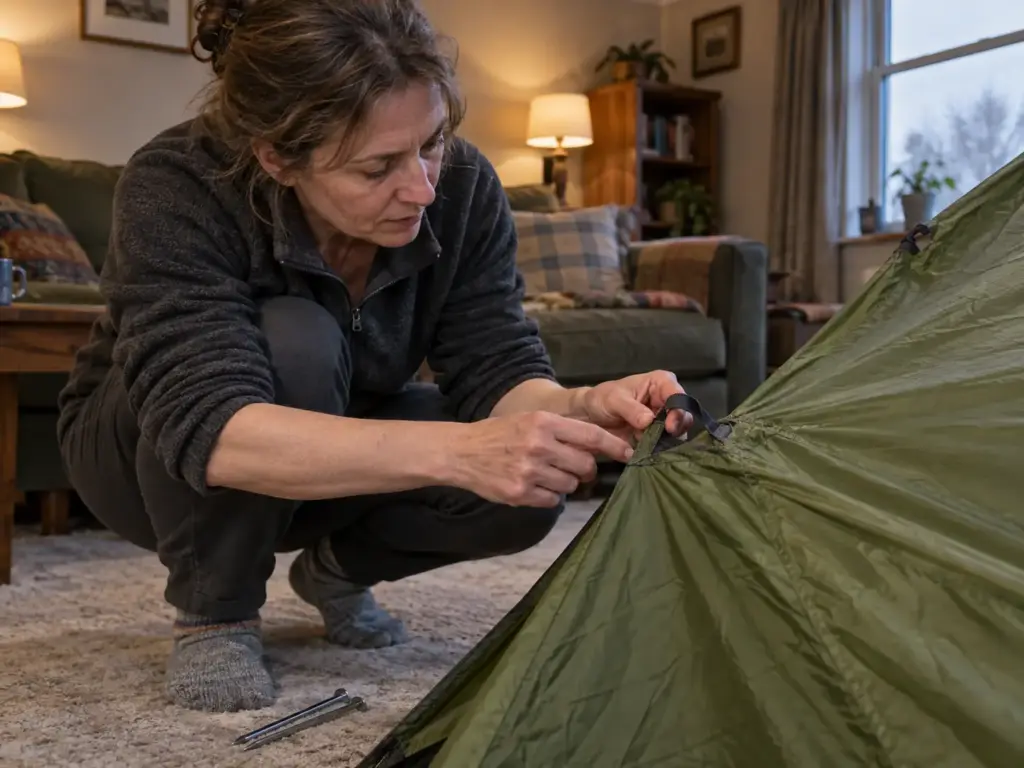
Fixing Peeling Seam Tape
Gear Aid’s rule splits cleanly by how much tape is failing. If a small section is lifting, glue it back down with Seam Grip WP: work a thin layer under the loose edge, press it flat, and let it cure. If the tape is peeling everywhere, stop patching. Remove it, discard it, clean the seam with isopropyl alcohol, and seal the bare seam yourself with WP.
Don’t strip tape that’s still doing its job. REI’s advice is to remove the loose sections and leave the intact ones alone, so tape that’s lifting at one corner doesn’t need to come off the whole tent. The catch, per MSR, is that residual tape disrupts sealing, so trim the loose part back to where the tape is firmly bonded before you apply anything.
The stripping is the tedious part. Peel slowly at a low angle so you don’t pull the coating off with the tape, and roll off any leftover adhesive with your thumb before the alcohol wipe. Residue left on the seam is exactly what keeps fresh sealer from bonding, so be thorough. It’s a slow evening, but a stripped and sealed seam is often more reliable than the tape ever was.
The Leak Spots Most People Skip
Before you reach for the tube, find the drip. Water runs along the underside of the fabric before it lets go, so the drop on your forehead is rarely directly under the hole. Work the hose test one panel at a time, from the top down, and mark each weeping spot with a strip of painter’s tape. That map tells you which of the spots below actually needs sealer, and it keeps you from coating seams that were never the problem.
Everybody coats the long fly seams. The drips that survive a sealing job tend to come from the short, fiddly spots where webbing and hardware are sewn through the fabric. Gear Aid calls out the corner stake-out points specifically, and those reinforced patches sit right where water runs off the fly and pools.
Work through these after the main seams:
- Corner stake-out points, top and bottom of the reinforcement patch.
- The floor perimeter seam on taped tents, especially at corners.
- Guy-out points on the fly, where stitching takes load and opens up.
- Door tiebacks and the small webbing loops sewn into the fly.
- Hang loops on the inner tent ceiling, if they pierce a waterproof layer.
Zipper areas are the exception. Water creeping in at the zip is usually a zipper or storm-flap issue, and sealer won’t help a slider that’s lost its grip; that’s a tent repair job, and you can deal with a failed tent zipper right at camp with the right fix.
When Sealing Won’t Save the Tent
There’s no magic age at which a tent dies. The honest test is the coating. If the PU on the fly or floor is sticky or flakes off in patches across whole panels, seam sealing is a patch on a tent whose waterproof layer is failing. You can restore a coating, as the next section explains, but when it’s flaking everywhere and the tape is falling off in strips, that tent has earned retirement to car-camping duty.
Before you write a tent off, check each layer on its own. A tent can have a healthy fly and a tired floor, or a good floor under a fly that no longer beads water. Each of those has its own fix, and none of them is a bigger tube of seam sealer. Sort out which layer failed first, and you’ll spend money only where it solves something, and you’ll know whether the tent has another season in it or only a few more car-camping weekends.
Clear sealer is invisible once it dries, so you lose track of what you’ve done. Mark each finished seam with a strip of painter’s tape on the fabric next to it (not on the seam) and peel the tape once the whole tent is done.
Floor Coating and DWR: The Other Two Waterproofing Layers
A tent that leaks everywhere isn’t a seam problem. Seams are one of three tent waterproofing layers, and the other two wear out on their own schedule. It’s also why the hydrostatic head ratings printed on the box don’t tell you much about a five-year-old tent: that number describes a fresh coating, and the water still finds the needle holes.
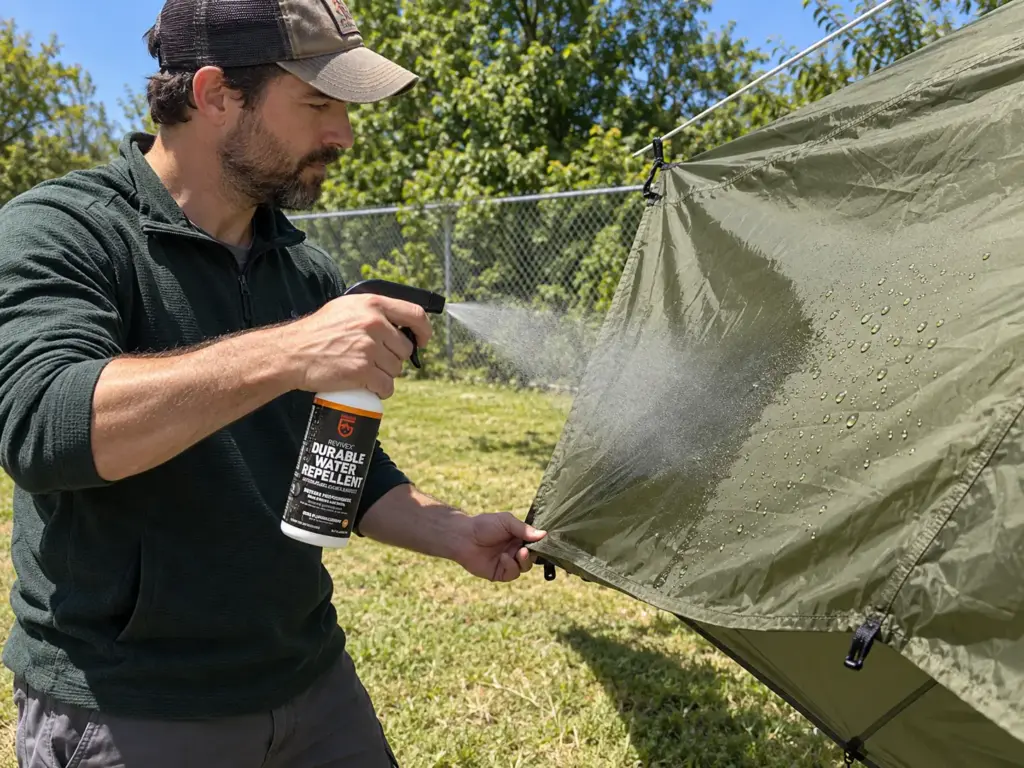
Read a leaky tent in this order. Seams are the leak points. The PU coating on the inner face of the fly and on the floor is the waterproof layer itself. The DWR (durable water repellent) on the outer face of the fly is what makes rain bead and roll off instead of soaking the fabric.
Restoring a Sticky or Flaking PU Floor
A tent floor that feels tacky or sheds flakes has a hydrolysed coating. Gear Aid Seam Grip TF is made for that job: a water-based urethane that treats up to 85 square feet per 4 oz bottle and cures in about 4 hours, restoring aging PU on floors, flies and tarps. It’s not a seam sealer, and like the other urethanes, it doesn’t go on silicone fabric.
Clean the floor first, scrub off any loose flakes, then brush TF on in thin, even coats over the coated side. A tent footprint won’t revive a coating that’s already failed, but under a freshly restored floor it takes the abrasion from grit and roots so the new layer lasts longer.
Refreshing the Rainfly’s DWR
When the fly starts “wetting out,” going dark and heavy instead of beading, the DWR has worn off. That doesn’t mean water is coming through yet, but a soaked fly sags, grows heavier and makes condensation worse inside. Refresh the DWR after the seam sealer has fully cured, never before, so the repellent doesn’t keep the sealer from bonding.
Gear Aid Revivex DWR Spray is a PFAS-free option; Gear Aid rates a can at 2 to 4 jackets, which gives you a sense of how far it stretches. Nikwax TX.Direct Spray-On is the other common pick for tents and flies. Spray the outer face of a clean, pitched fly, and let it dry before packing. The same steps apply to restoring DWR on your rain shell.
Cheap and DIY Seam Sealing Options
Sealer is one of the cheapest fixes in your gear closet. Expect to spend about $9 to $13 for a standard tube of seam sealer, which treats about one fly’s worth of seams. Still, there are ways to stretch the budget, and each has a catch.
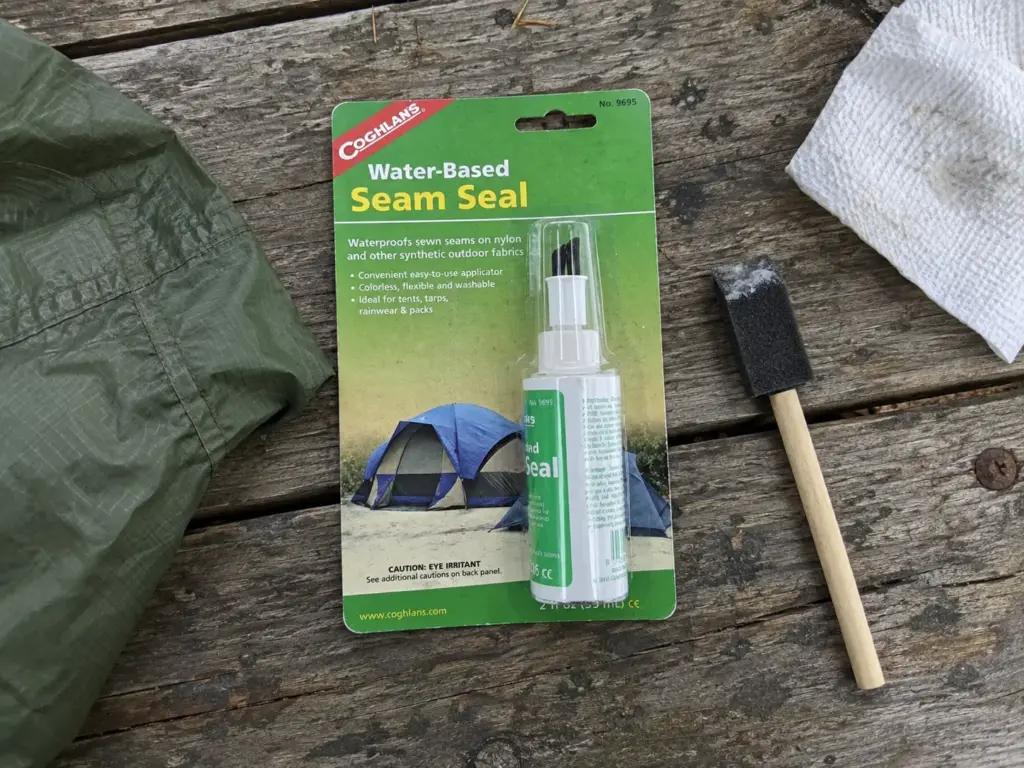
The Budget Urethane Sealer
Coghlan’s Tent Seam Sealer is the budget-friendly option for PU-coated nylon tents. It’s a water-based sealant that cures in about 2 hours, so it’s easy to work with in a garage and quick to pack. It suits a family car-camping tent or an older backpacking tent you’re trying to stretch another season. Like every urethane, it’s not for silnylon.
If you’re still choosing a backpacking tent, factor sealing into the decision. A factory-sealed tent costs more but saves the afternoon; an unsealed cottage shelter is lighter but comes with homework.
DIY Silicone Sealer (Silnylon Only)
Ultralight hikers have long made their own silicone sealer: clear hardware-store silicone caulk thinned with mineral spirits and brushed on with a foam brush. Several r/Ultralight commenters swear by it, and one goes further and says you “MUST dilute” silicone for silnylon seams.
Another points out that SilNet already comes thinned and works fine straight from the tube. One user even dissolves silicone gel in acetone. Opinions differ, so treat this as community practice, not a recipe.
Two hard limits apply. DIY silicone is for silicone fabric only; on a PU tent it won’t bond any better than SIL does. And because nobody publishes a verified mixing ratio, test your batch on a scrap or a stuff-sack seam before you paint your shelter. Thin enough to soak into the thread, not so thin that it runs off.
Storing a Half-Used Tube
A half-used tube cures solid in the cap by next spring. Gear Aid’s fix: squeeze the contents up to the neck to push out the air, seal the tube in a zip bag, and keep it in the freezer. Before using it again, warm it under running water for a minute. It’s the cheapest upgrade in this whole article.
The other budget path is paying someone else. Lanshan sells sealing as an add-on, and some cottage makers will seal a shelter for you for a fee that, to one r/Ultralight commenter, was well worth it. If fiddly jobs drive you up a wall, that’s money well spent.
5 Seam Sealing Mistakes and How to Test Your Work
The sealer’s on, the tent’s drying in the yard, and the next storm is a few days out. Here’s what usually goes wrong, and how to prove the job held before you’re in the backcountry.
Mistake 1 — The Wrong Sealer for Your Fabric
Urethane on silicone, or silicone on PU. It can look fine at first, then peel off in a strip the first time the fly flexes in wind. Go back to the 30-second test and match the sealer to the face of the fabric the seam sits on. If you’ve already done it wrong, peel off what you can, clean with alcohol, and start over with the right tube.
Mistake 2 — Sealing Damp Fabric
Moisture trapped under sealer keeps it from bonding. It’s the r/Ultralight rule for a reason: if the fabric is wet, wait. In the field, a strip of tape over a dripping seam buys you time until you’re home with a dry tent and a dry day.
Mistake 3 — A Thick Bead Instead of a Thin Coat
More sealer feels safer. It isn’t. A thick bead stays tacky, attracts grit, cracks as it flexes, and glues panels together if you pack before it’s fully cured.
Gear Aid calls for one thin coat on the inside of the seam. If you’re already stuck with sticky seams, dust them with talcum powder or baby powder and give them more cure time.
Mistake 4 — Sealing a Slack Seam
Coat a seam while it’s lying in folds and the sealer bridges over the stitch holes instead of filling them. The first time that seam stretches under a wet pitch, the holes open again. Pitch the fly inside-out and taut, as Gear Aid recommends, so the thread is exposed while you work.
Mistake 5 — Skipping the Stake-Out Corners
The long seams get all the attention, and the stake-out corners, guy-outs and tiebacks get none. Those short, reinforced spots are the classic leak points covered earlier. Seal them on purpose, with the same thin coat.
The Hose Test That Proves It
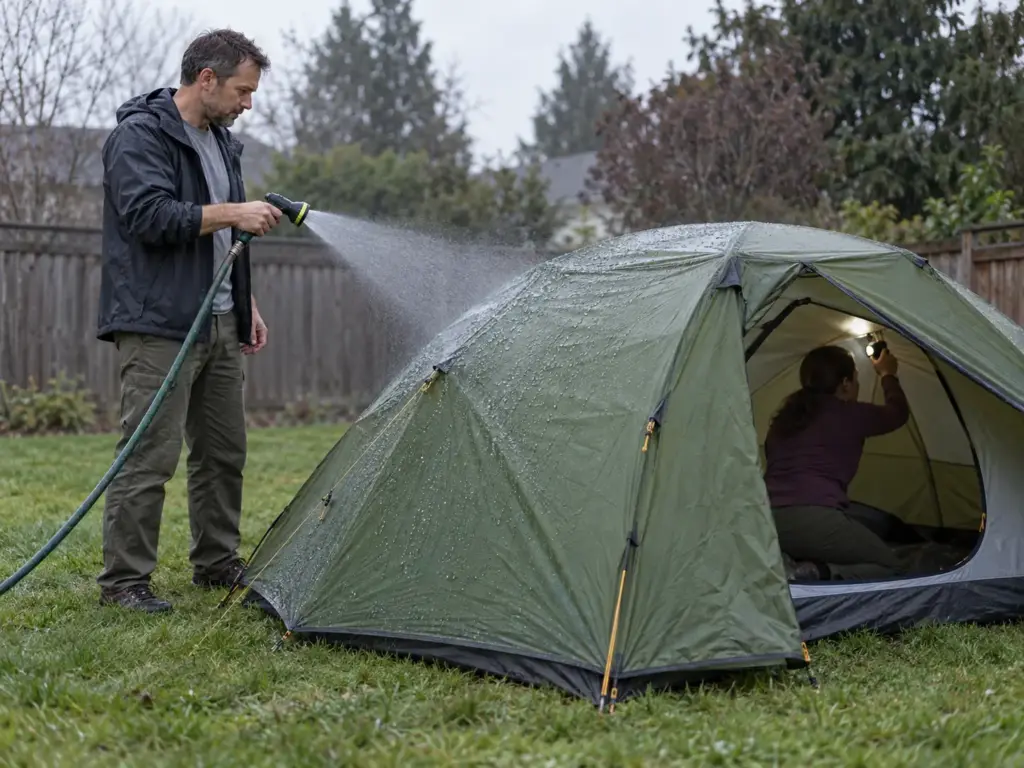
Once the sealer has fully cured, pitch the tent outside, climb inside with a headlamp, and have someone run a garden hose on a fine mist setting over the fly from several angles for a few minutes. This is practical home advice rather than a manufacturer spec, but it beats finding out at 2 a.m. Mark any spot that weeps with tape, let the fly dry, and re-coat just those spots.
Seal and test before the season, on a mild, dry day (Gear Aid’s SIL range is 60 to 100 F), not the night before a wet trip and never in the rain. Then pair the sealed tent with smart campsite choice for wind and rain: a dry tent pitched in a drainage still floods.
Leave the sealer tube at home. The r/Ultralight joke about counting it as consumable weight is funny until you’re trying to seal a wet seam in a downpour, which never works. Seal at home, hose-test, and carry a strip of repair tape for the trail.
Seal It Dry, Hose It Wet, Then Check the Floor
Three things waterproof a tent for real. Match the sealer to the fabric face: urethane on PU, silicone on silnylon and silpoly. Give clean, dry, taut seams one thin coat, including the stake-out corners and guy-outs. And hose-test the whole tent after it cures, before the trip, not during it.
Your next move: pull the tent out this weekend, pitch it in the yard, and run the 30-second fabric test. If the seams need it, seal them that afternoon and hose-test the next morning. Then check the floor and the fly’s DWR, and give your rain gear the same treatment with this guide to waterproofing and DWR for your clothing.
Frequently Asked Questions
01What is the best seam sealer for waterproof fabric?
The best seam sealer is the one that matches your fabric: a urethane sealer for PU-coated nylon or polyester, and a silicone sealer for silnylon or silpoly. The wrong type will not bond, so identify the coated face of the seam before you buy.
02When should you apply seam sealer?
Apply seam sealer before the season on clean, fully dry seams, on a mild day between roughly 60 and 100 F. Never seal in the rain, and leave enough time for the full cure, from about 2 hours to overnight depending on the sealer, before packing.
03Is seam sealer better than silicone?
Neither is better across the board: silicone sealer is the right choice only on silicone-coated fabric, and urethane seam sealer is right for PU coatings. Thinned hardware-store silicone caulk is a common DIY path for silnylon, but it remains community practice without a verified ratio.
04Does tent seam sealer go on the inside or outside?
On PU-coated tents, seam sealer usually goes on the inside, on the coated face where factory tape would sit. On ultralight silnylon shelters, many owners seal butt seams from the outside, where the silicone face is. Follow your maker’s instructions when they exist.
05Can you seal a tent that already has factory tape?
Yes, and the perimeter seams and corner stake-out points on taped tents often need it. Glue down a small peeling section with a urethane sealer; if the tape fails everywhere, strip it, clean the seam with isopropyl alcohol, and seal the bare seam.

I've spent more than a decade researching hiking gear and trail technique. I read the specs, the forum threads and the long-term reviews, and every pick here comes with what it gets wrong.
End of the trail
You read every mile of this one. Here's where the trail goes next.