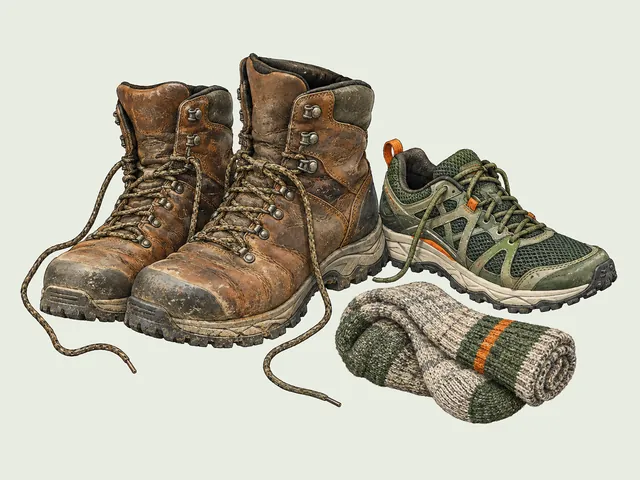










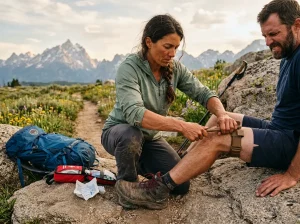

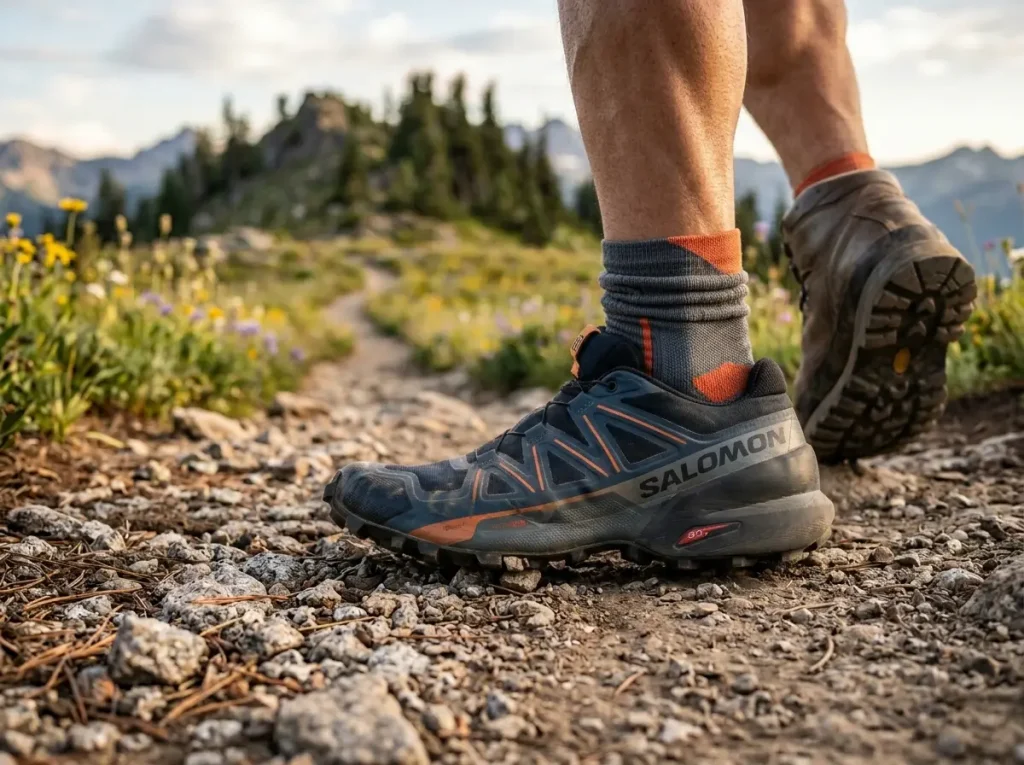
I switched to zero-drop trail runners three years ago because a friend said they’d fix my knee pain. Six weeks later my knees felt great. My Achilles tendons felt like someone had set them on fire. That’s the thing nobody tells you about heel to toe drop — it doesn’t eliminate stress on your body, it redirects it. Understanding where that force goes is the difference between finding the right shoe and creating a new injury.
Here’s the breakdown of what drop actually does to your body on trail, and how to pick the right number for the way you hike.
Quick Answer: Heel to toe drop is the height difference in millimeters between a shoe’s heel cushion and forefoot cushion. Higher drop (8-12mm) reduces Achilles strain but loads knees and hips more. Lower drop (0-4mm) spares knees but demands more from calves and Achilles. Most hikers do well in 6-8mm. Your body, terrain, and existing injuries determine the right number — not marketing.
What Heel to Toe Drop Actually Measures
The Millimeter Number
Heel to toe drop — also called heel drop, offset, or differential — is the difference in thickness between the cushion under your heel and the cushion under the ball of your foot. If a shoe has 30mm of midsole at the heel and 22mm at the forefoot, the drop is 8mm.
That’s it. One measurement. But it changes everything about how your foot interacts with the ground.
What Drop Is Not
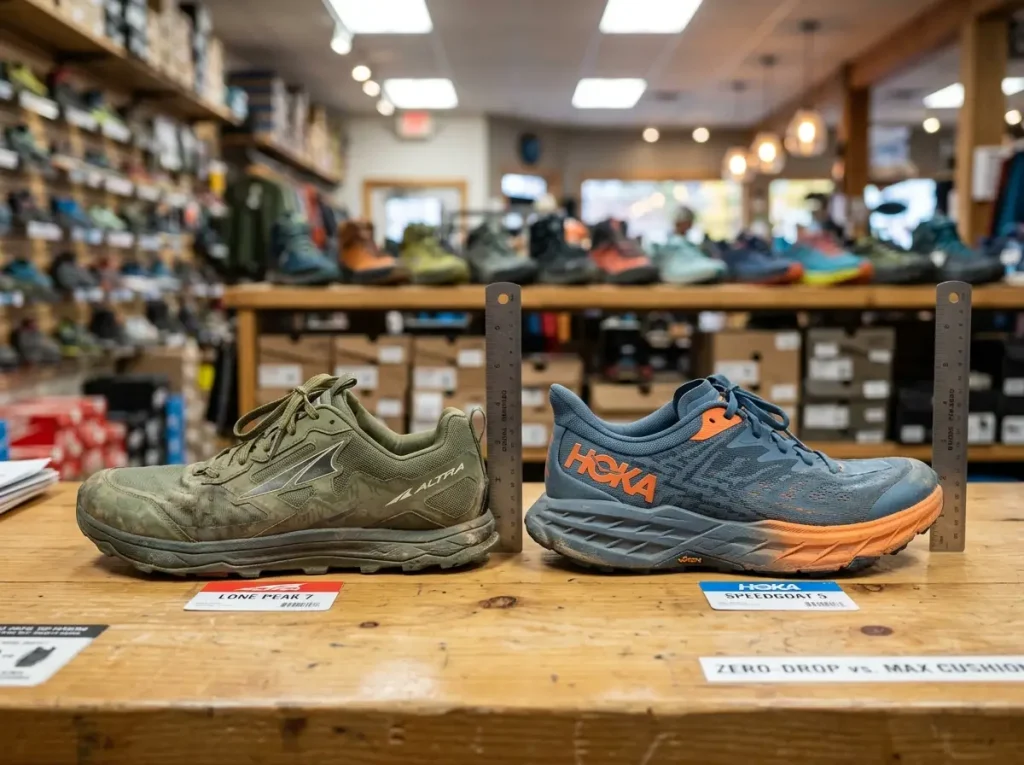
Drop tells you about the angle of your foot inside the shoe. It does not tell you how much total cushion sits between your foot and the trail. That’s stack height — a completely separate spec that matters just as much, but measures something different. A zero-drop shoe can have 25mm of cushion everywhere (like an Altra Lone Peak) or almost none (like an Xero Shoes minimalist). Same drop, wildly different ride.
Most hikers confuse these two numbers and end up making decisions based on the wrong spec. If you want more cushion, look at stack height. If you want to change how your foot strikes the ground, look at drop.
Pro tip: When comparing shoes, always check both numbers together. A 4mm-drop shoe with 30mm of stack height feels nothing like a 4mm-drop shoe with 15mm of stack height, even though the marketing calls both “low drop.”
The Biomechanics — Where the Force Goes
Higher Drop = Less Achilles, More Knees
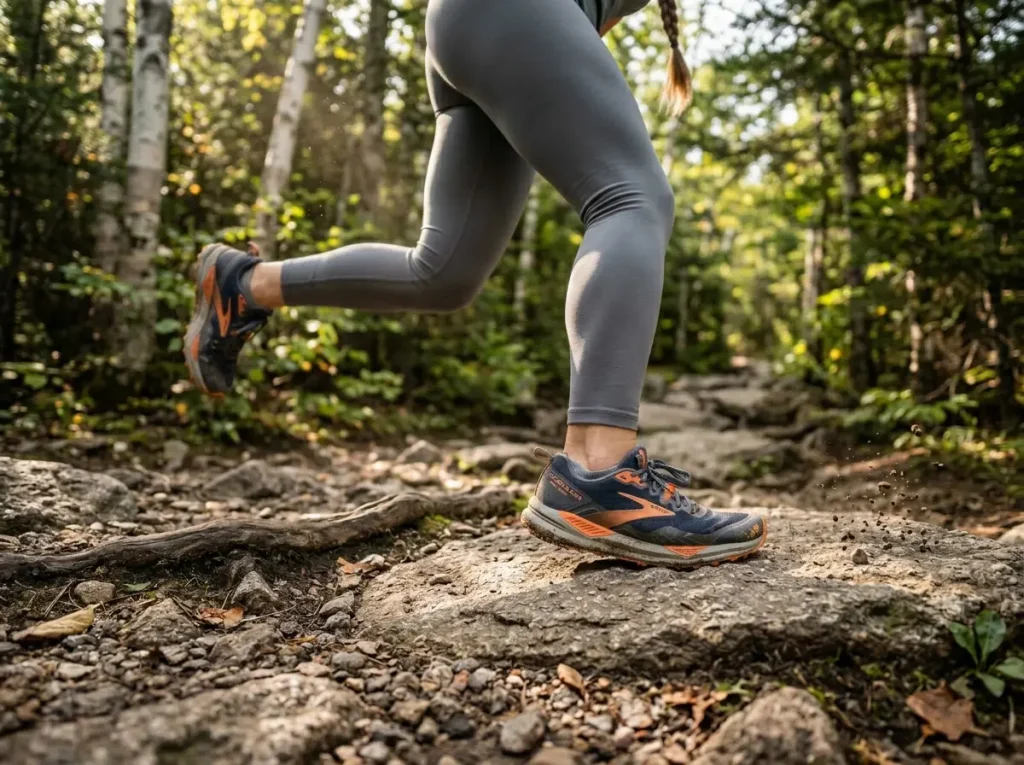
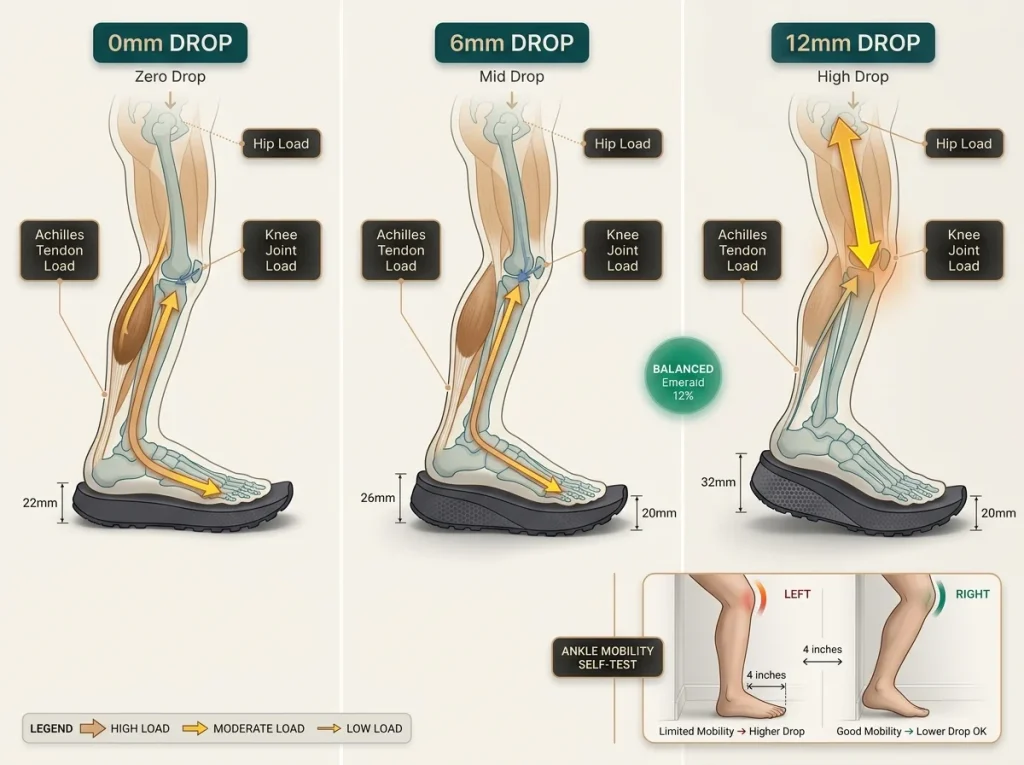
A shoe with 10-12mm of heel drop effectively shortens the range your Achilles tendon has to work through with every step. Your heel lands higher, your calf stretches less, and the impact energy channels upward through your knees and hips instead.
Research published in the American Journal of Sports Medicine tracked three groups using 0mm, 6mm, and 10mm drops over six months. The 10mm group had a 26% rate of knee joint injuries versus 15% in the zero-drop group. The trade-off was real and measurable.
Lower Drop = Less Knees, More Calves
Drop your heel closer to the ground and the force equation flips. Your Achilles tendon now stretches through a longer range with every step, your calf muscles work harder to absorb impact, and your forefoot shares more of the landing load. The result: less compression on your knee cartilage, but significantly more eccentric loading on your posterior chain — calves, Achilles, and plantar fascia.
This is why hikers with chronic knee pain often feel immediate relief in zero-drop shoes. And why those same hikers sometimes develop Achilles tendinopathy two months later if they transition too fast.
The Ankle Mobility Factor
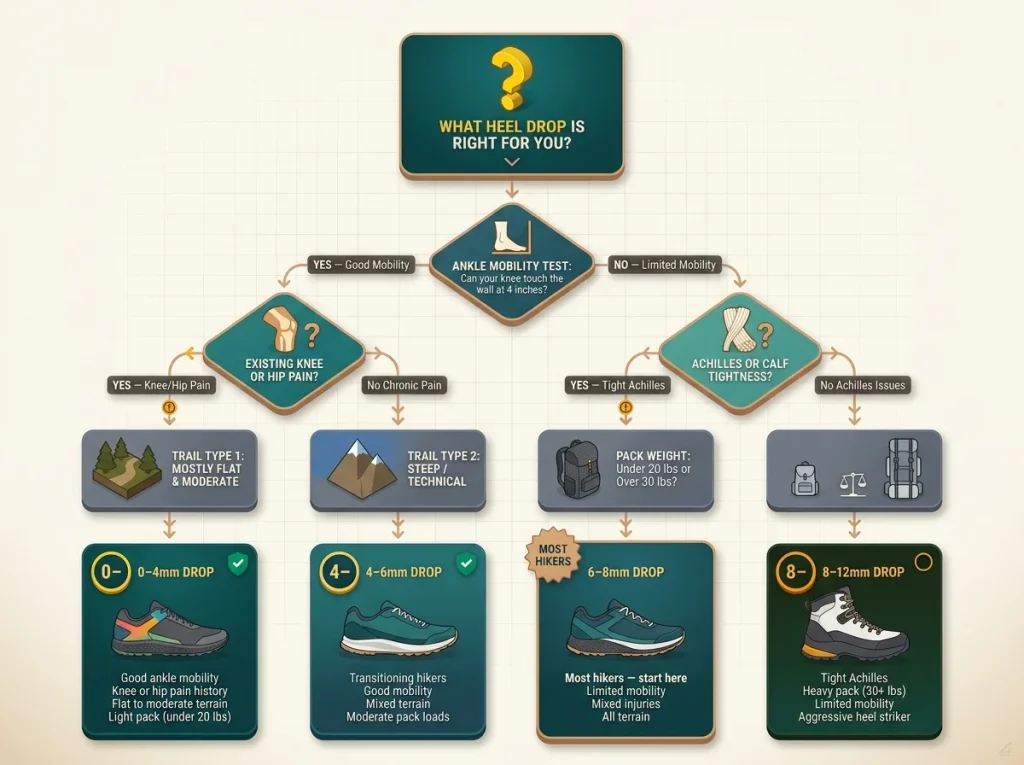
Here’s the variable most articles skip: your ankle dorsiflexion range — how far your knee can travel over your toes — determines which drop works for your body. A simple self-test from physical therapists: stand facing a wall, place your big toe 4 inches from the baseboard, and try to touch your knee to the wall without lifting your heel. If your knee barely clears your toes, your ankle mobility is limited and you’ll likely do better in a higher drop. If it touches the wall easily, your ankles can handle lower drops.
Drop Categories Every Hiker Should Know
The Four Ranges
Not all shoes with the same label feel the same on trail, but these categories give you a starting framework:
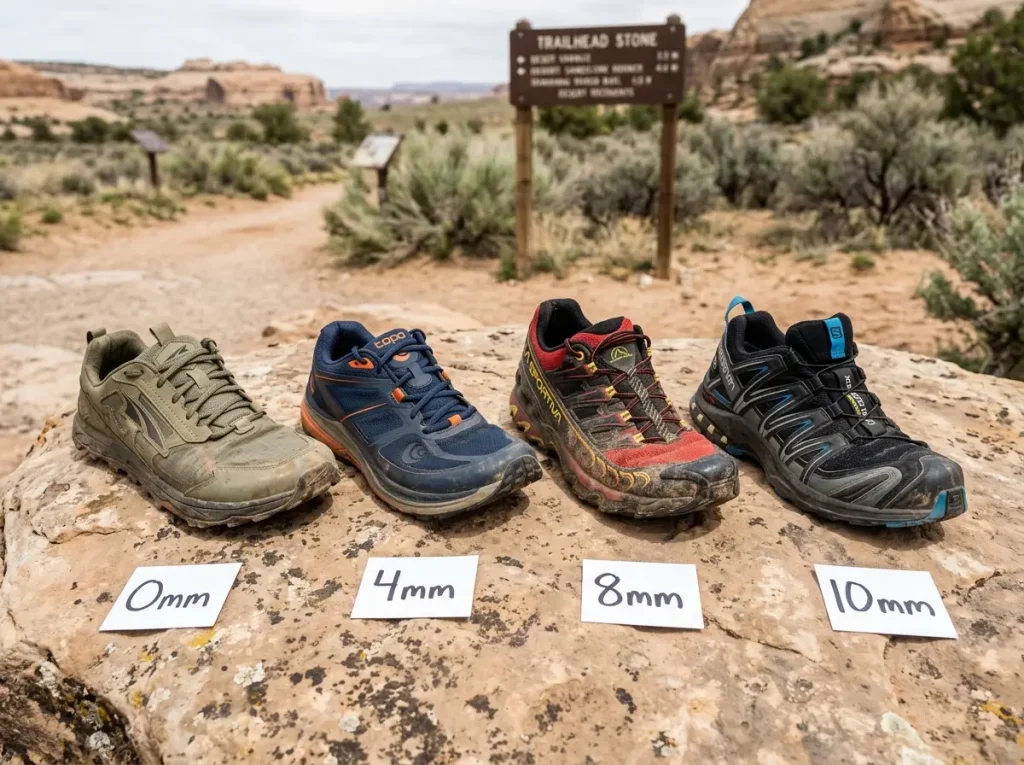
Zero drop (0mm) — foot sits perfectly flat. Altra is the dominant brand here. Your Achilles and calf muscles do the most work. Best for hikers with good ankle mobility, strong calves, and a history of knee or hip issues. Not a starting point for beginners.
Low drop (1-5mm) — subtle forward tilt that most people barely notice. Topo Athletic and some La Sportiva models live here. A good middle ground for hikers moving toward less drop without the full commitment.
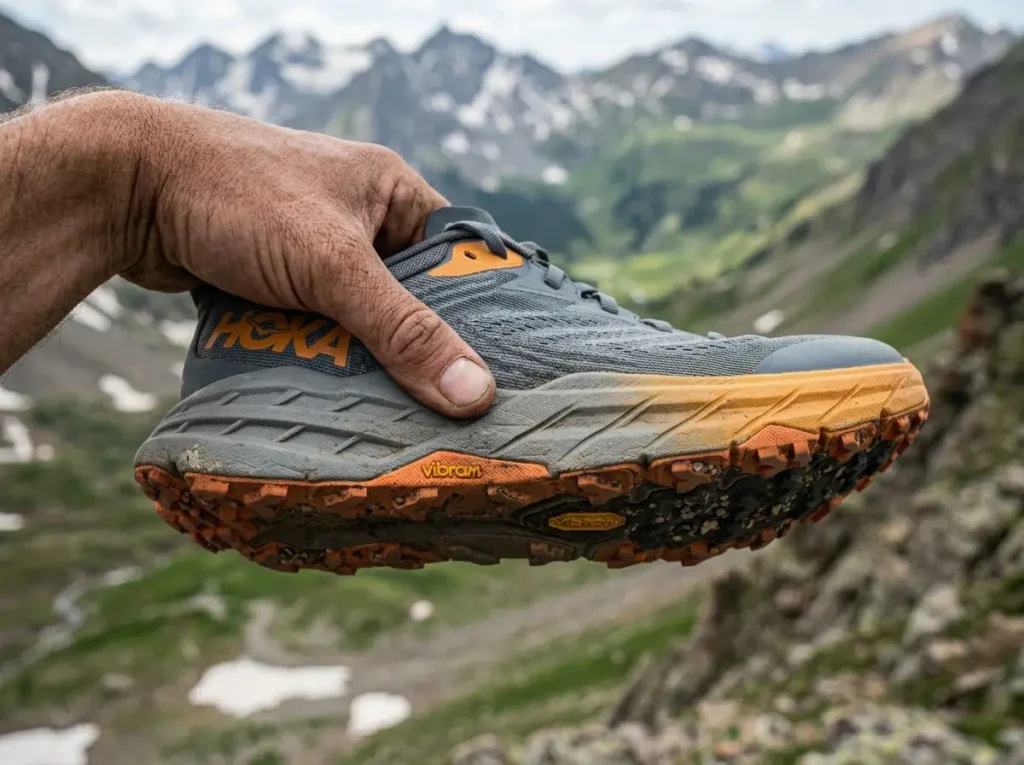
Mid drop (6-8mm) — where most trail runners sit. Hoka Speedgoat (4mm), Brooks Cascadia (8mm), and similar. This range works for the widest variety of hikers and terrains. If you don’t know your ideal drop, start here.
High drop (10-12mm) — traditional hiking boot territory. Salomon XA Pro 3D (10mm) and most leather boots. Easiest on Achilles and calves, hardest on knees. Suits aggressive heel strikers and hikers with tight calves or Achilles issues.
How Common Hiking Shoes Compare
The Altra Lone Peak — the single most popular trail runner on the Appalachian Trail according to the 2018 Trek survey — is zero drop with 25mm of stack height. The Hoka Speedgoat runs 4mm drop with 32mm/28mm stack. The Salomon XA Pro 3D sits at 10mm drop. Knowing where your current shoe falls helps you decide which direction to move.
Terrain Decides — When Drop Matters Most
Steep Downhill
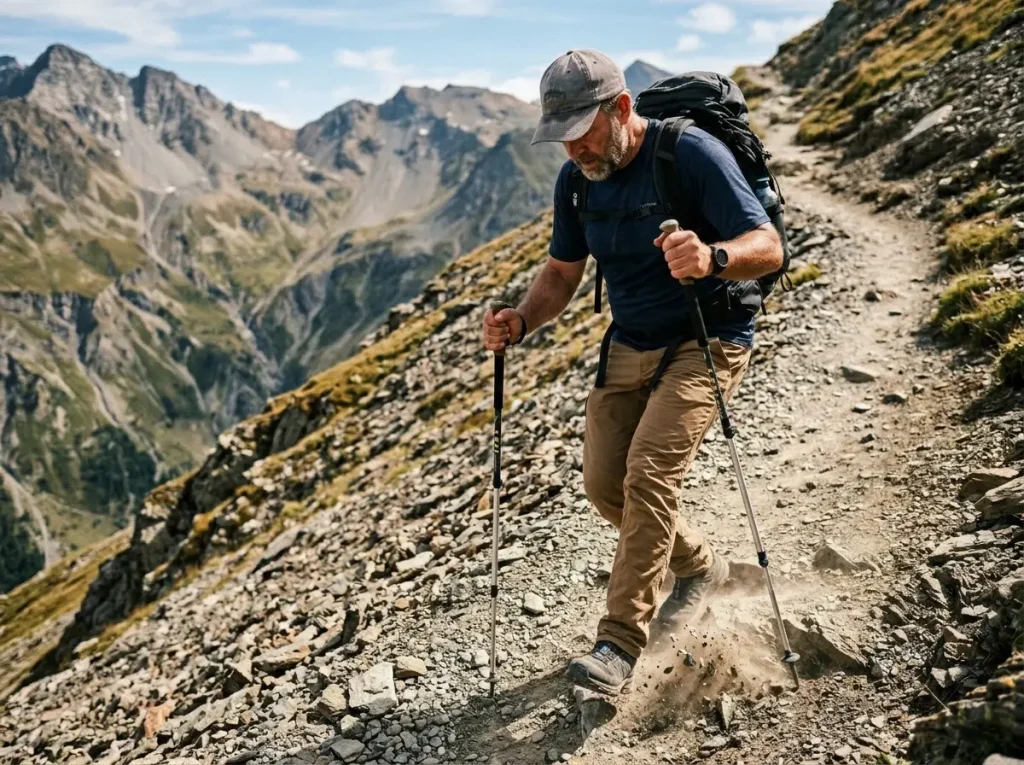
This is where drop has the biggest practical impact. Every millimeter of drop adds to the forward pitch your foot already experiences on a descent. A 10mm-drop shoe on a 20% grade effectively doubles the angle forcing your toes into the front of the shoe — and that’s how you get black toenails and forefoot bruising on long descents.
Zero-drop shoes keep your foot flatter on steep descents, distributing weight more evenly across the sole. But they also demand more from your quads and calves to control the braking. If your legs aren’t conditioned for it, you’ll burn out faster on long downhill sections.
Steep Uphill
Research published in Frontiers in Bioengineering found that increased heel-to-toe drop during uphill walking elevated loads on the knee joint. Higher-drop shoes shift weight forward, which feels easier initially but loads the knee flexors more with each step. Zero-drop shoes on steep uphills force your calves to do more of the lifting — which is harder work but distributes the effort across more muscle groups.
Flat and Moderate Terrain
On groomed trails and moderate terrain, drop matters less than on extremes. Most hikers won’t notice a meaningful difference between 4mm and 8mm on a relatively flat forest path. This is where other factors — toe box width, cushion, grip pattern — outweigh the drop number.
Pro tip: If you hike primarily on moderate terrain, spend less time optimizing your drop and more time getting the right fit for your foot shape. A shoe that fits well at 8mm drop will outperform a shoe that fits poorly at your “ideal” 4mm drop every single time.
The Transition Protocol — How to Switch Safely
The 12-Week Minimum
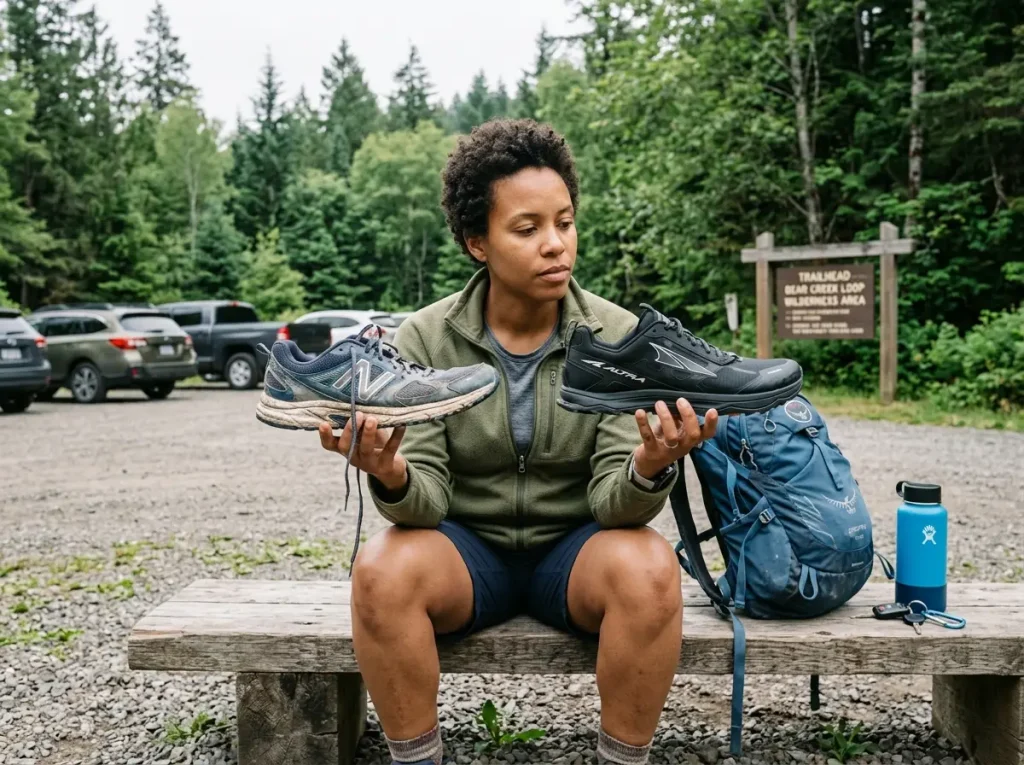
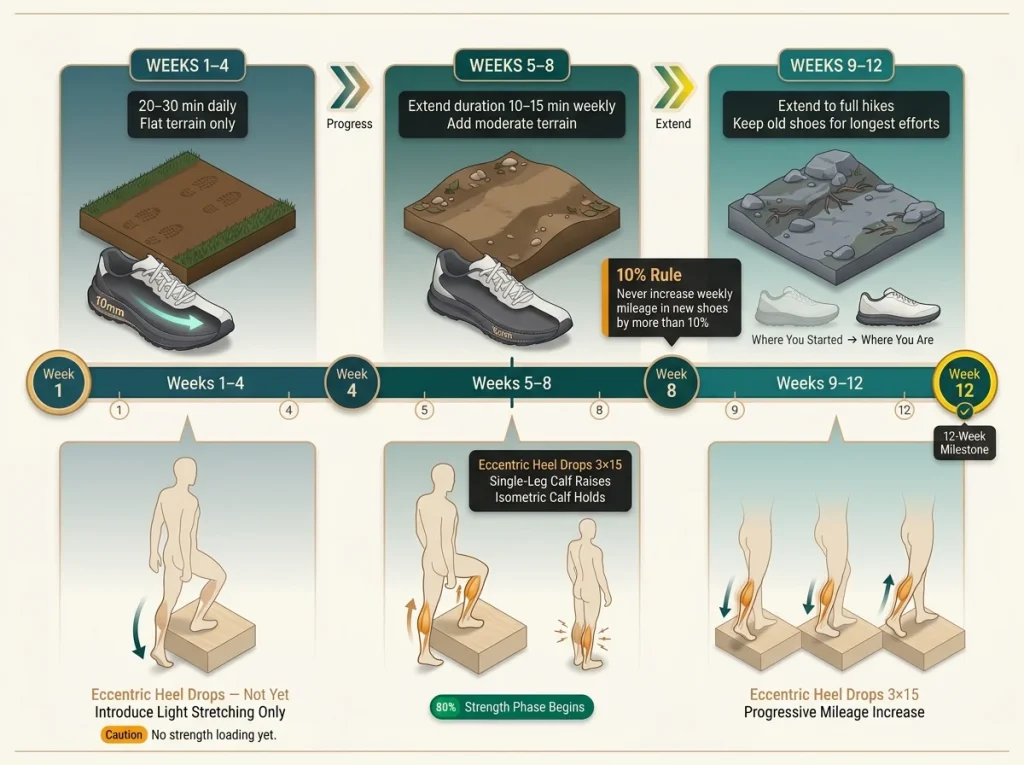
If you’ve been hiking in 10-12mm drop shoes and want to try zero or low drop, expect a minimum 12-week transition. Most people need 6-12 months for a complete switch, and rushing it is the single most common cause of Achilles tendinopathy in hikers who make the change.
Start by wearing low-drop shoes for 20-30 minutes daily on flat terrain. Increase by 10-15 minutes per week. Do not increase your mileage in the new shoes by more than 10% per week — and keep your old shoes for longer hikes during the transition period.
The Strength Work You Can’t Skip
The transition isn’t just about wearing different shoes. Your Achilles tendon needs to build strength in a range it has never worked through before. Twice a week, do eccentric heel drops off a step — 3 sets of 15 reps — plus single-leg calf raises and isometric calf holds. These exercises prepare the tendon for the longer stretch that low-drop shoes demand.
Skip the strength work and your calves will tell you about it around week three. Listen to them.
Pro tip: The smartest transition isn’t from 10mm straight to 0mm. Go from 10mm to 6mm first. Spend a full season there. If your body adapts well and you want to keep going, drop to 4mm the next season. Gradual progression across multiple shoe purchases is safer than any single dramatic switch.
Who Should Stay in High-Drop Shoes
When Lower Isn’t Better
Zero-drop shoes aren’t universally better. That’s marketing from brands that sell them. If you fall into any of these categories, a higher drop (8-12mm) is probably the smarter choice:
Tight Achilles or history of Achilles tendinopathy — lower drop forces your already-tight tendon to work through more range. This is asking for a flare-up. Stay in 8-10mm until you’ve done months of dedicated calf and Achilles strengthening.
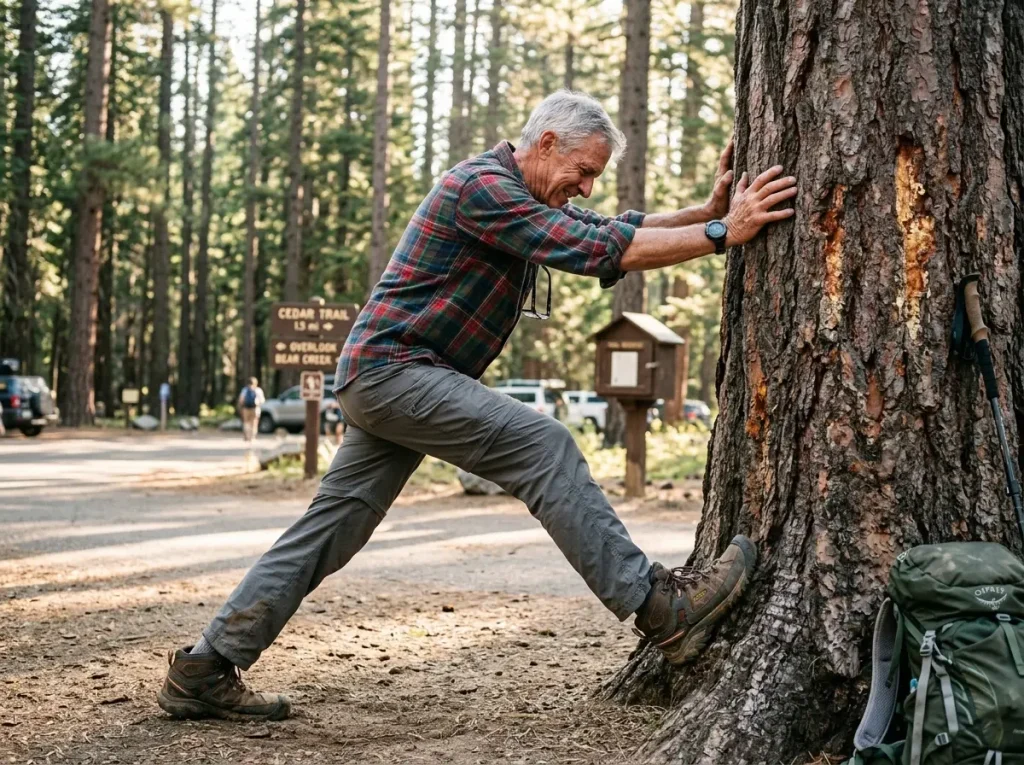
Limited ankle mobility — if you failed the knee-to-wall test from the biomechanics section, your ankles physically can’t handle the demands of zero drop on technical terrain. Work on mobility first, drop later.
Heavy pack weight — every pound on your back amplifies the forces through your feet. A 40-pound pack in zero-drop shoes puts enormous eccentric load on your calves during descents. High-drop boots exist partly because heavy loads change the biomechanical equation.
Flat feet with significant overpronation — zero-drop shoes with minimal structure can worsen pronation issues. If you need arch support, a structured higher-drop shoe with a supportive midsole is the better starting point.
The Wrong Question
Most hikers ask “what’s the best heel drop?” The answer is: the one that matches your ankle mobility, existing injuries, terrain, and pack weight. A hiker with bad knees and mobile ankles needs different footwear than a hiker with tight Achilles and a 35-pound pack. The drop number is a tool, not a philosophy.
Stack Height vs Drop — The Spec Most Hikers Confuse
Two Numbers, Different Jobs
Stack height measures total cushion thickness under your foot. Drop measures the difference between heel and forefoot cushion. You can have high stack with low drop (Altra Olympus: 0mm drop, 33mm stack), low stack with high drop (traditional racing flat: 10mm drop, 18mm stack), or any combination.
The confusion matters because hikers who switch to zero-drop shoes expecting a “natural feel” sometimes pick a max-cushion zero-drop shoe and wonder why they can’t feel the trail. Or they pick a minimal zero-drop shoe and wonder why their feet ache after 8 miles — they needed more stack, not less drop.
What to Check Before Buying
When you’re shopping for hiking footwear, check both numbers on the spec sheet:
For rough, rocky terrain: higher stack height protects your feet from sharp objects regardless of drop. A rock plate helps too.
For smooth, groomed trails: lower stack height gives you better ground feel and proprioception — your feet can read the terrain and react faster.
For long-distance days: higher stack reduces fatigue in the feet and lower legs. This is why max-cushion shoes like the Hoka Speedgoat are popular for thru-hiking — the 4mm drop keeps your foot relatively level while 30mm+ of foam absorbs repetitive impact over 20+ miles.
Pro tip: If you’re testing zero-drop for the first time, start with a shoe that has moderate stack height (20-25mm). It gives you the flat platform without stripping away all the cushion — like training wheels for your Achilles.
Conclusion
Heel to toe drop is a force redirector, not a comfort dial. Higher drop protects your Achilles and calves while loading your knees and hips. Lower drop spares your knees while demanding more from your posterior chain. Neither is universally better — the right drop depends on your ankle mobility, injury history, terrain, and pack weight.
If you’re currently in a standard 8-10mm shoe and hiking comfortably, there’s no reason to change. If you have chronic knee pain and good ankle mobility, experimenting with 4-6mm drop is worth the 12-week transition investment. And if you decide to go zero, do the calf work — your Achilles will thank you around month two.
Check the spec sheet on your current shoes. Know your number. Then decide if it’s working for the way you actually hike.
Q1 What is a good heel to toe drop for hiking shoes?
Most hikers do well in 6-8mm drop, which balances Achilles protection with knee comfort. Zero drop suits hikers with strong calves and knee issues. High drop (10-12mm) suits tight Achilles tendons and heavy pack loads. Your ankle mobility and injury history matter more than any single number.
Q2 Does heel drop matter for hiking?
Yes. Drop redirects impact forces through your lower body. Higher drop loads knees and hips more while sparing the Achilles. Lower drop loads calves and Achilles while sparing knees. On steep terrain the difference becomes pronounced — especially on long descents where drop angle compounds the slope angle.
Q3 What is the difference between heel drop and stack height?
Drop measures the height difference between heel and forefoot cushion. Stack height measures total cushion thickness. A zero-drop shoe can have thick or thin cushion — the foot just sits level. Stack determines cushioning. Drop determines foot angle and gait mechanics. Check both specs when buying.
Q4 Are zero drop shoes good for hiking?
Zero drop works well for hikers with good ankle mobility, strong calves, and knee or hip pain. They redistribute load away from the knees. They require a 12-week minimum transition and regular calf strengthening. They are not ideal for tight Achilles, heavy packs, or flat feet without preparation.
Q5 How do I transition to zero drop hiking shoes?
Start with 20-30 minutes daily on flat terrain. Increase 10-15 minutes weekly. Do eccentric heel drops and calf raises twice per week. Keep your old shoes for longer hikes during the 12-week transition. Consider stepping down gradually — 10mm to 6mm first, then 6mm to 4mm the following season.

I've spent more than a decade researching hiking gear and trail technique. I read the specs, the forum threads and the long-term reviews, and every pick here comes with what it gets wrong.
End of the trail
You read every mile of this one. Here's where the trail goes next.