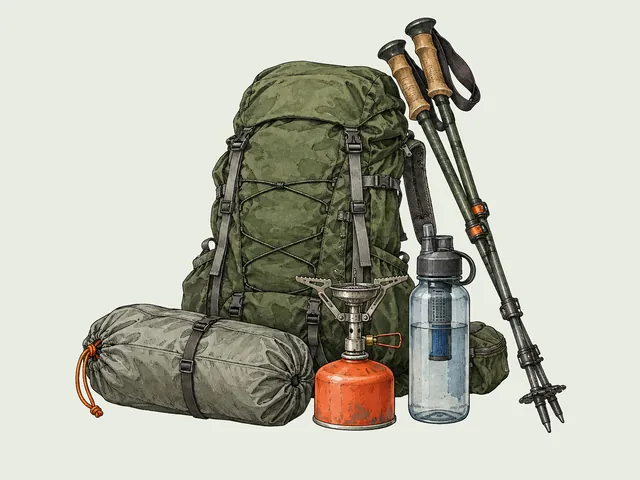
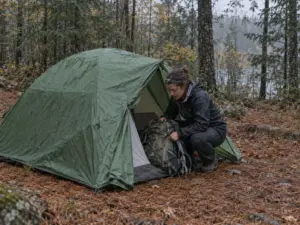






The gust hit at 2 AM. A 60 MPH wall of wind turned my poorly pitched mid into a tumbling mess of DCF and tangled guylines. One pole had collapsed at the twist-lock. The other punched clean through the apex fabric. Somewhere downhill, my rain fly was wrapped around a manzanita bush.
That night taught me what no product manual ever will: a trekking pole tent is not a set-and-forget shelter. It is a structural equation, and every variable has to be solved before the wind solves it for you. After years of field testing across alpine passes, desert sand, and Pacific Northwest mud, I can tell you that the difference between a collapsed tent and a bombproof pitch comes down to geometry, material choice, and surface-specific anchoring.
This guide covers all three. No guesswork. No generic “stake it tight” advice. Just the methods that actually hold.
⚡ Quick Answer: Use trekking poles with flick-lock mechanisms set to 120-130 cm for most shelters. Pitch handle-up to protect fabric, stake your base rectangle square using the 3-4-5 method, and drive all stakes at a 45-degree angle away from the tent. Match your anchoring method to the ground surface: big rock/little rock for granite, deadman anchors for sand, and sintered platforms for snow.
The Physics of Non-Freestanding Shelter Architecture
Here is the single most important thing to understand about a non-freestanding shelter: every component is part of one connected load circuit. Stakes, guylines, fabric panels, and poles all carry part of the load. Pull one stake and the whole thing unravels. I have watched a shelter flatten in under 10 seconds after the first anchor pulled in a 20 MPH crosswind. That is not an exaggeration. It is how tensegrity structures fail.
Unlike a freestanding dome tent that uses the elastic memory of its own poles to hold shape, a trekking pole shelter relies on uninterrupted tension between every anchoring point. The pole itself is a rigid compression member, a vertical column pushing straight up. The guylines pull outward. The fabric stretches between them. Remove any piece and the balance collapses in a cascade failure.
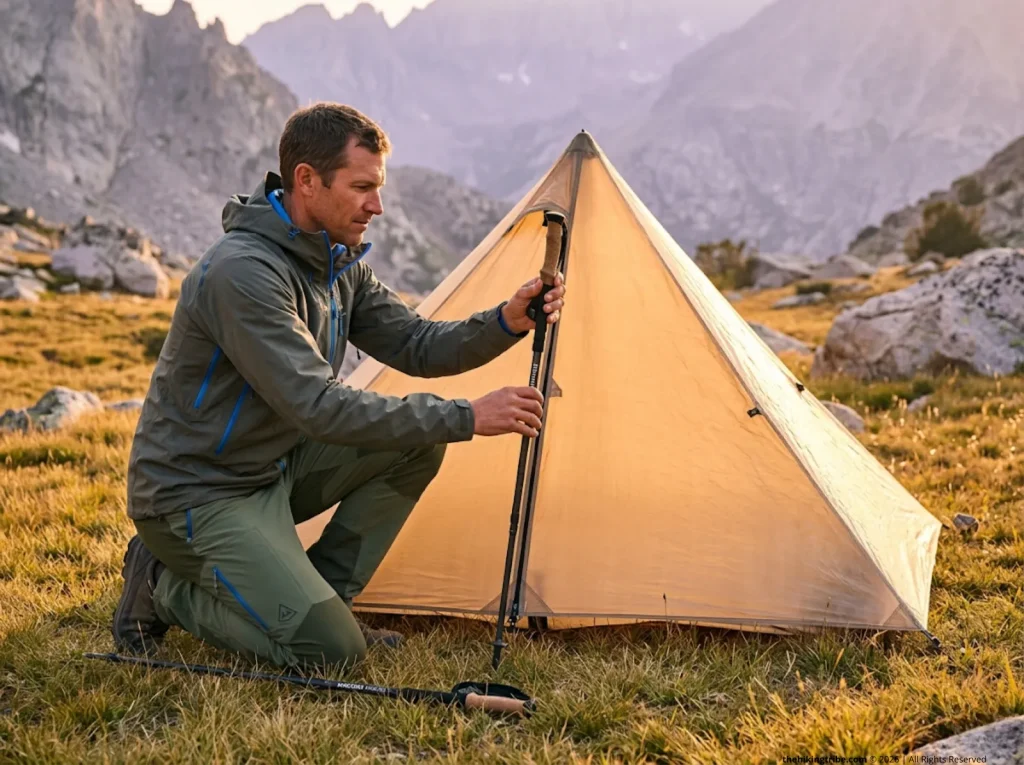
The real hazard is point loading. The force of the entire canopy concentrates where the pole tip or handle meets the apex. If you pitch tip-up without a reinforced grommet, you are pressing all that compression force through a tiny contact area. In a sustained wind event, that concentrated stress exceeds the fabric’s strength and you get a puncture. This is why shelters like the Durston X-Mid Pro specify handle-up orientation, using the broader cork or foam grip to spread compression force across the apex.
Ryan Jordan of Backpacking Light puts it well: “The goal of guylines on a pole-supported tent is to distribute stress to prevent the poles from flexing past their yield point.” Replace your stock 1.8 mm lines with 2.5 mm reflective cord. Easier on the hands, less fraying, and measurably more stable in high winds. That upgrade alone changed every pitch I have made since. If you are weighing the broader decision of choosing between freestanding and non-freestanding tent designs, understanding this tension architecture is where it starts.
Following National Park Service campsite selection and shelter setup protocols will also keep you on the right side of safe shelter practices in backcountry environments.
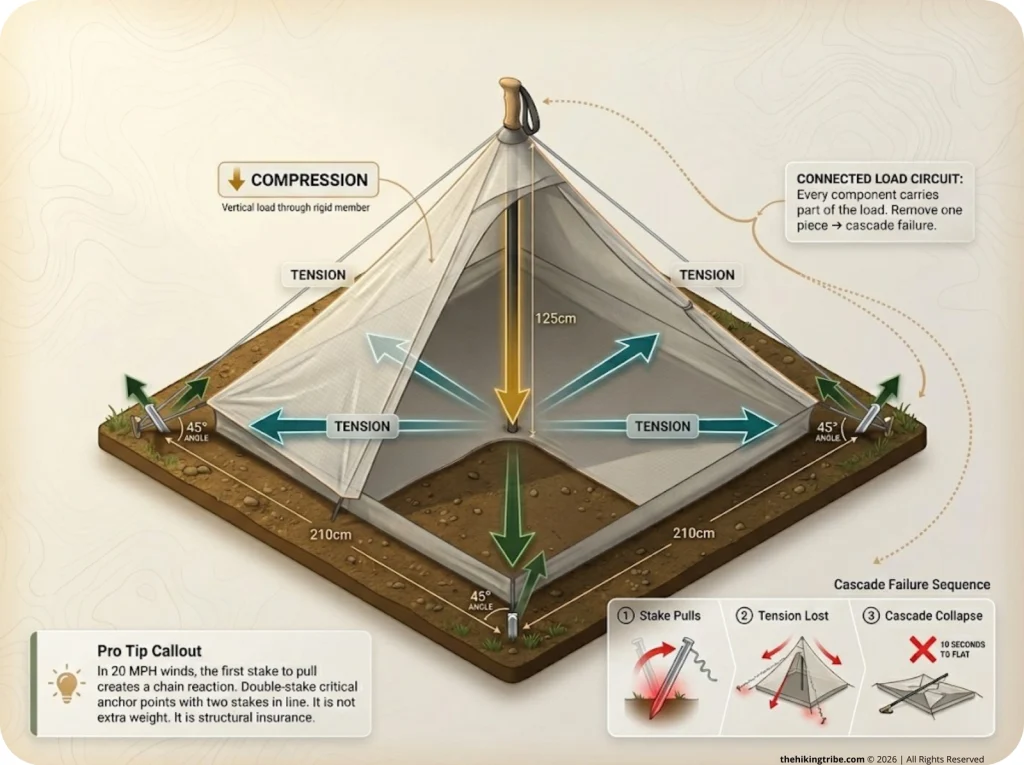
Pro tip: In 20 MPH winds, the first stake to pull creates a chain reaction. Double-stake critical anchor points with two stakes in line. It is not extra weight. It is structural insurance.
Carbon Fiber vs. Aluminum: Choosing Your Compression Member
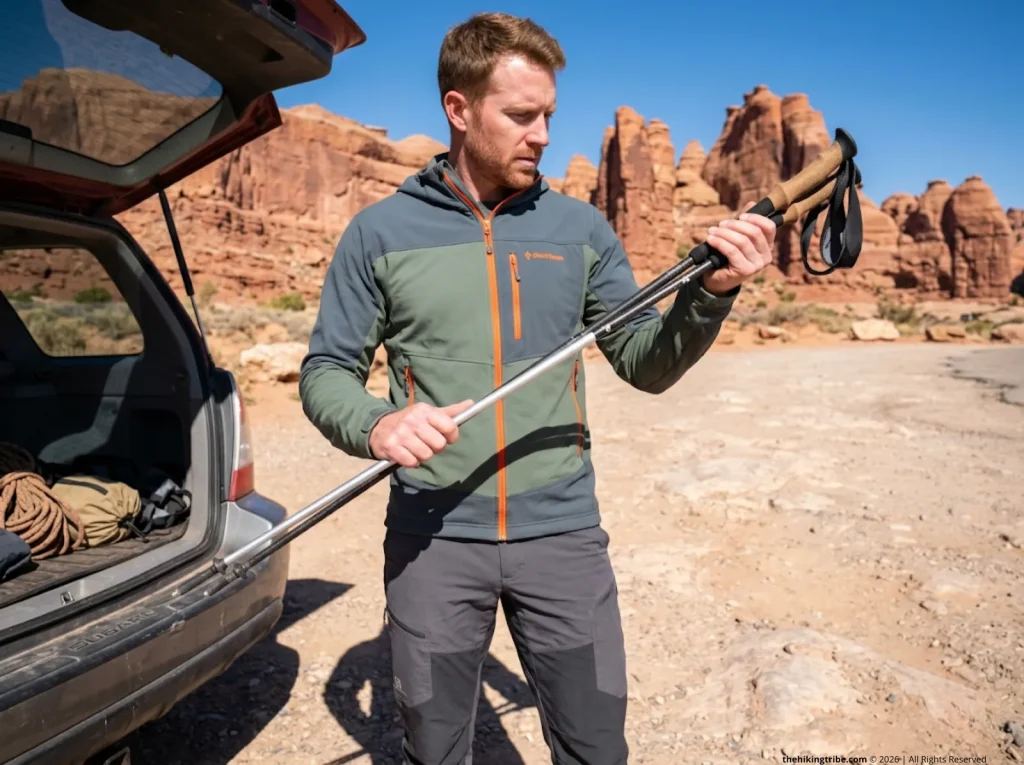
The carbon vs. aluminum debate is not about which is “better.” It is about which failure mode you can survive at 2 AM in a storm.
Carbon fiber poles are stiffer and lighter. The Durston Iceline (18/16/16 mm carbon fiber shaft) scores 8 out of 9 on stiffness. The Black Diamond Alpine Carbon Cork hits 9 out of 9, but at 267 grams per pole versus 185 grams for the Iceline. Carbon fiber trekking poles can weigh as little as 11.2 ounces per set compared to 20.8 ounces for aluminum poles. That stiffness matters because a stiffer pole maintains apex geometry under lateral wind load, reducing that tent “sway” that keeps you awake.
But carbon fails all at once. It does not bend. It shatters along score lines created by rock scratches, and those scratches act as stress risers. One bad scrape against granite and you have a crack waiting to happen. Black Diamond’s QC Lab found this directly: “When we could visually see or feel that something wasn’t right, the results correlated to decreased strength and reduced integrity.”
Aluminum (specifically 7075-T6, often called “aircraft aluminum”) is heavier but ductile. It bends before it breaks. That bending is a survivable failure you can splint in the field. In sub-freezing temperatures, aluminum also maintains its impact resistance while some carbon layups become more brittle. After 400-plus miles, carbon poles show roughly 10 percent more deflection than new poles, a fatigue life that most manufacturers never mention.
For a deeper breakdown of the carbon vs. aluminum trekking pole decision framework, I covered that topic in detail with weight, stiffness, and durability comparisons.
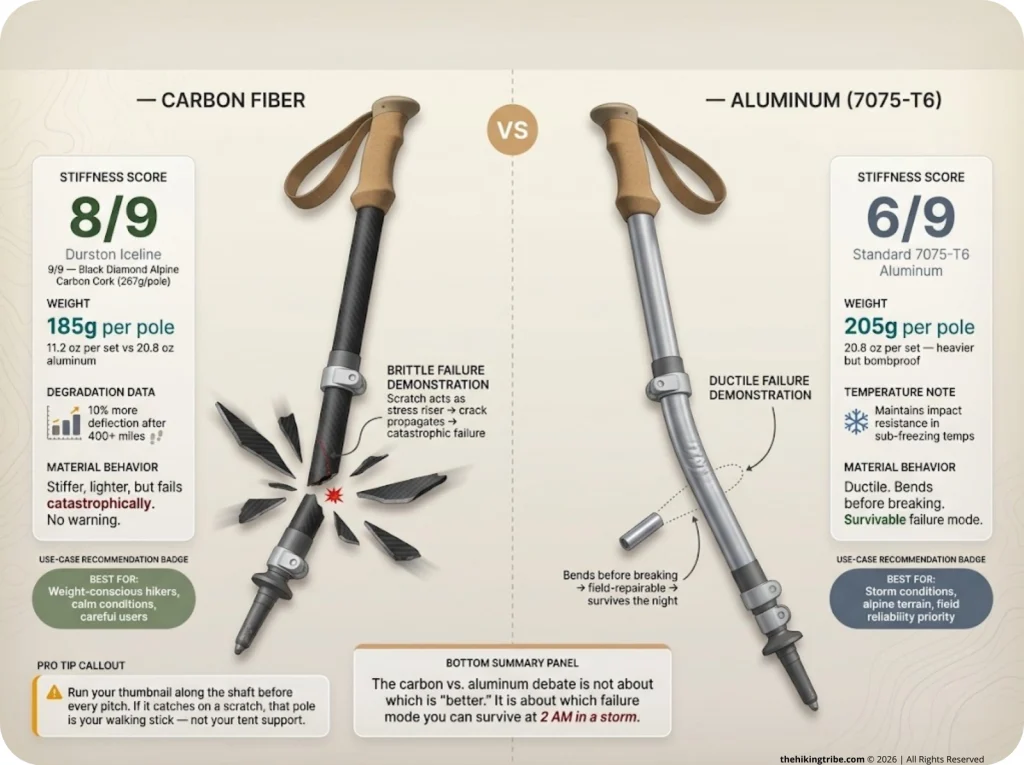
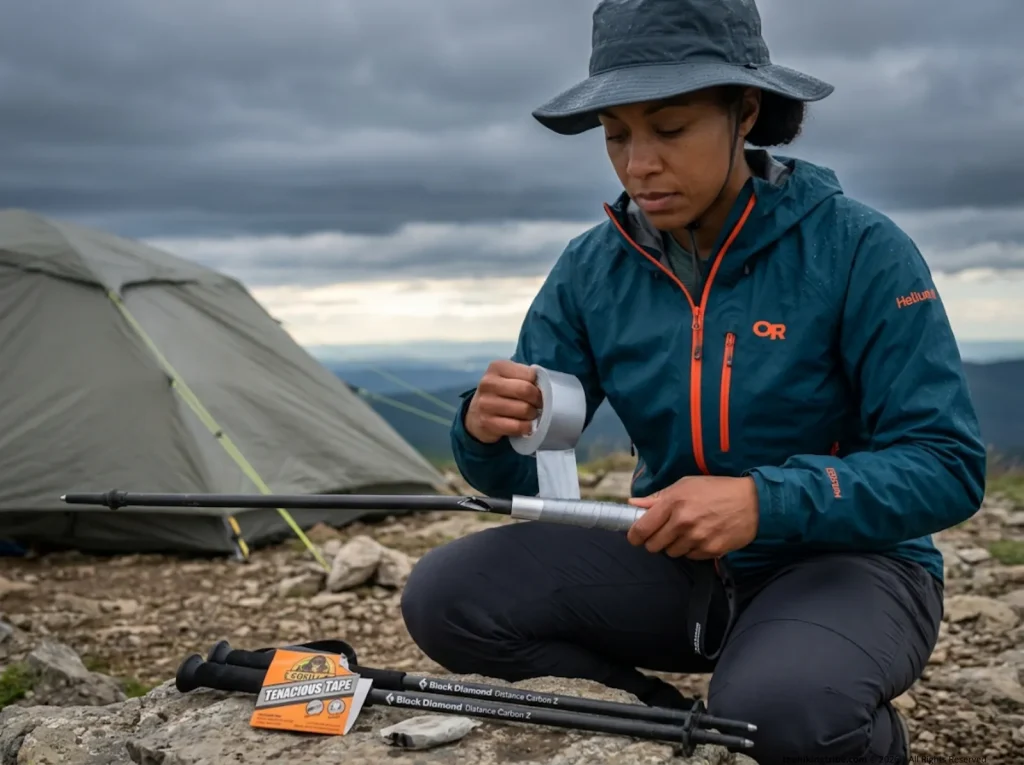
Pro tip: Run your thumbnail along the shaft of any carbon pole before every pitch. If it catches on a scratch or groove, that pole is your walking stick for the rest of the trip, not your tent support. Do not gamble on it.
The Geometry of a Bombproof Pitch: Math That Holds
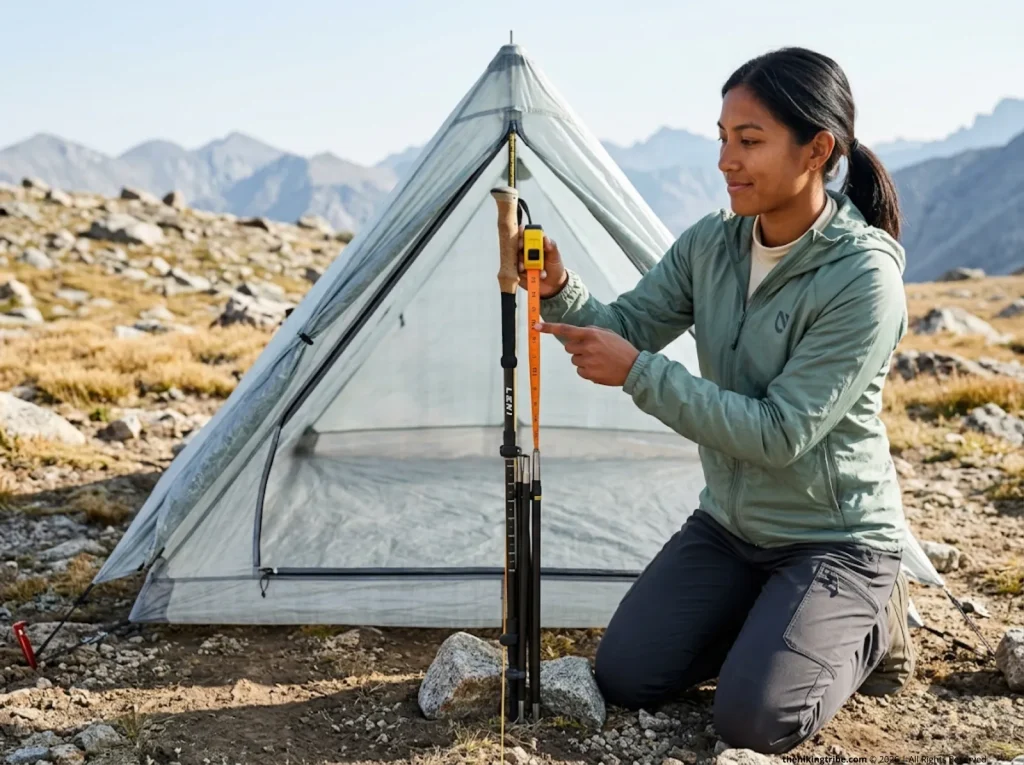
Most hikers struggle with a wonky pitch because they rely on visual estimation. Stop guessing. The tent wall, the vertical pole, and the ground form a right triangle. If your tent seam is 150 cm and you stake 90 cm from the pole base, your pole height must be 120 cm. That is a basic right-triangle relationship: measure two sides, calculate the third. It works every time.
Optimal pole height for most trekking pole tents falls between 120 and 130 cm. The Hyperlite Mid 1 requires 135 cm, give or take 5 cm, for a proper pitch. If your manufacturer does not provide a spec, or you are pitching a custom tarp, this calculation is the only reliable method.
Once you have pole height dialed, square the base. If your corners are not 90 degrees, one diagonal will be drum-tight while the other flaps loose. Wind exploits that imbalance every time. Dan Durston, designer of the X-Mid, says it plainly: “Loose corners allow the poles to over-extend which can prevent tightening the base later. A skewed base makes the tent overly tight on one diagonal but loose on the other.”
The fastest field method to verify right angles is the 3-4-5 rule. Measure 3 units on one side, 4 on the other, and the diagonal must equal 5. For the X-Mid specifically, the 15 cm Rule works: position the rectangle midpoint 15 cm from the peak. That eliminates trial-and-error staking on offset-pole tents.
For handle-up vs. tip-up orientation, handle-up is generally preferred. The broader surface of a cork or foam grip spreads compression force and prevents fabric puncture. Some tent designs do require tip-up with a reinforced grommet, so always check the manufacturer’s instructions. If you are curious about how folding and telescoping poles actually break under sustained load, the failure modes of each locking design are worth understanding before you trust your shelter to one.
A pole jack extends effective pole height by about 10.5 inches (a 12-inch jack with 1.5-2 inches of overlap). Always remove rubber tips before inserting into a pole jack. Forgetting this is one of the most common setup errors out there.
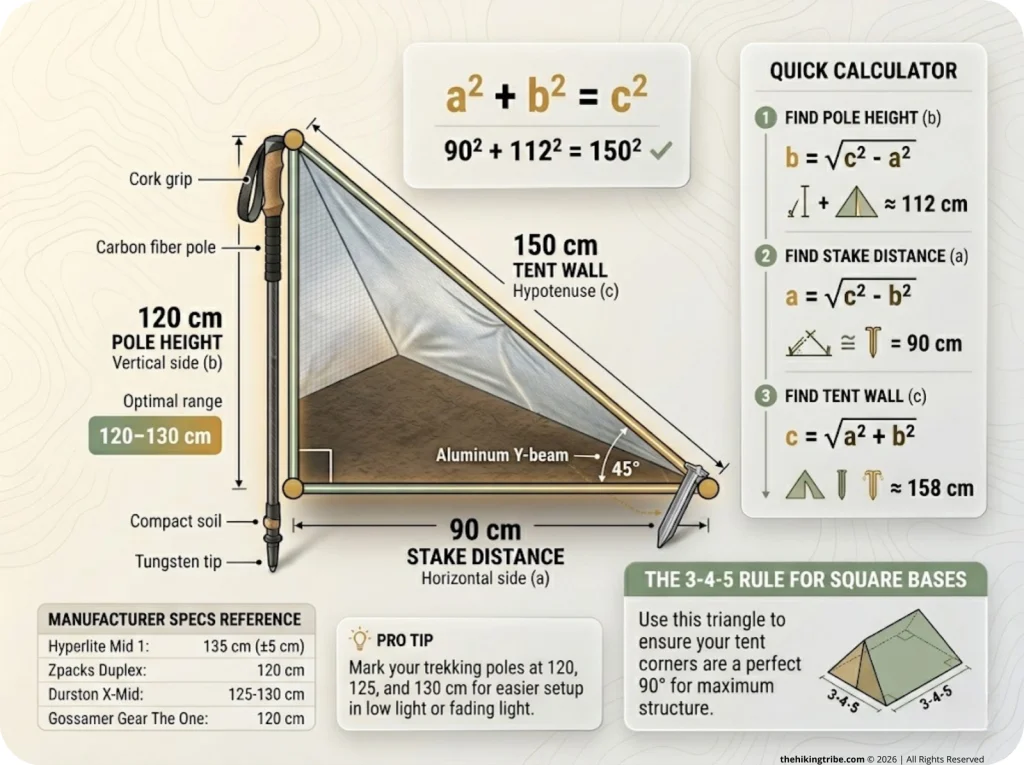
Pro tip: Mark your poles with a strip of tape at 120, 125, and 130 cm. When you are setting up in fading light with cold fingers, those marks eliminate guesswork and shave minutes off your pitch.
The 4-Surface Anchoring Matrix: Rock, Sand, Snow, and Slope
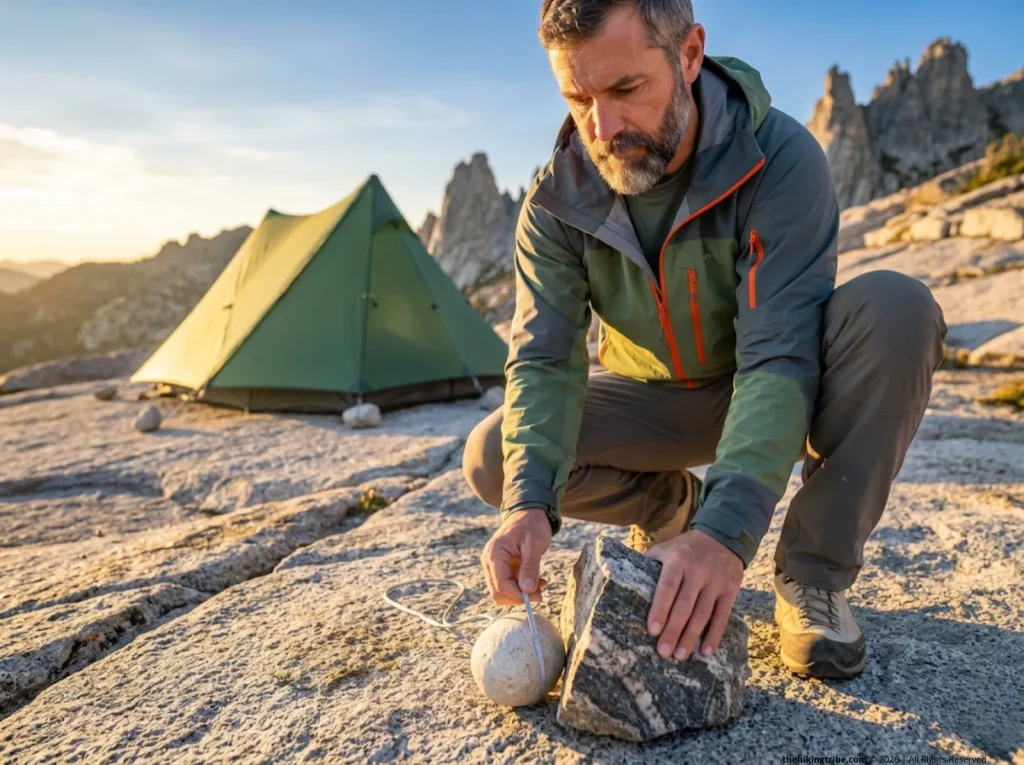
Flat meadow with perfect soil? That is a best-case fantasy. Real backcountry means granite slabs, sugar sand, deep snowpack, and hillsides that have no business holding a tent. Each surface demands a specific anchoring technique. Get it wrong and you wake up inside what seasoned hikers call the “washing machine.”
Rock Slabs: The Big Rock/Little Rock Method
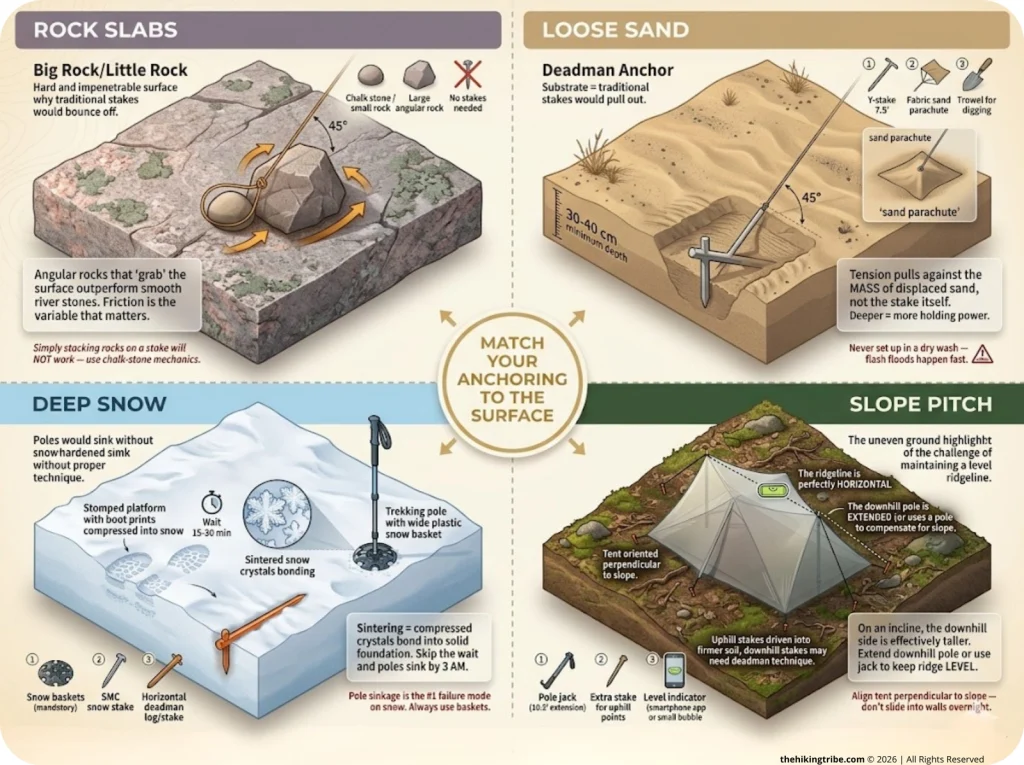
Traditional stakes are useless on granite. The big rock/little rock method is the only anchor that holds. Loop your guyline around a small stone first. Think of it as a “chalk stone” that grabs the line. Then brace it with a larger, angular rock in front. Friction is the variable that matters: angular rocks that “grab” the surface outperform smooth river stones every time. Simply stacking rocks on a stake will not work. Without the chalk-stone mechanics, those anchors walk in wind.
Loose Sand and Desert Terrain: Deadman Anchors
Bury a stake or stick horizontally at a minimum depth of 30 to 40 cm. The tension must pull against the mass of displaced sand, not the stake itself. In “sugar sand,” fabric anchors (sand parachutes) engage a larger volume of material and outperform any metal stake design. 7.5-inch Y-shaped stakes are recommended for critical anchor points in loose or gravelly soil. And never set up in a sandy wash that looks dry. Floods happen fast. Site selection is inseparable from your anchoring method. For a complete breakdown of deadman anchor techniques for staking in sandy soil, I have covered the step-by-step process separately.
Deep Snow: Sintering and Snow Baskets
Pole sinkage is the most common failure on snow. Stomp a platform and then wait. Give it 15 to 30 minutes for the snow to sinter, which means the compressed crystals bond together to form a solid foundation. Skip that wait and your poles will sink by 3 AM. Snow baskets are mandatory to distribute downward compression across a wider surface area. SMC Gear snow stakes and horizontal deadman anchors are the proven methods for deep snowpack.
The Slope Pitch: Leveling the Ridgeline on an Incline
On an incline, the downhill side is effectively taller, creating a tilted ridgeline that throws off your entire tension balance. Extend the downhill pole or use a pole jack to keep the ridge level. Align the tent perpendicular to the slope so you do not slide into the walls overnight, which compromises guyline tension. Most guides say “pitch on flat ground,” but thru-hikers rarely have that luxury. Slope-pitching geometry is a skill that separates comfortable nights from miserable ones.
Exposed ridges also carry lightning risk. The U.S. Forest Service lightning safety and campsite hazard protocols recommend seeking lower ground or forested cover during electrical storms.
The Step-by-Step Pitch Sequence That Eliminates Guesswork
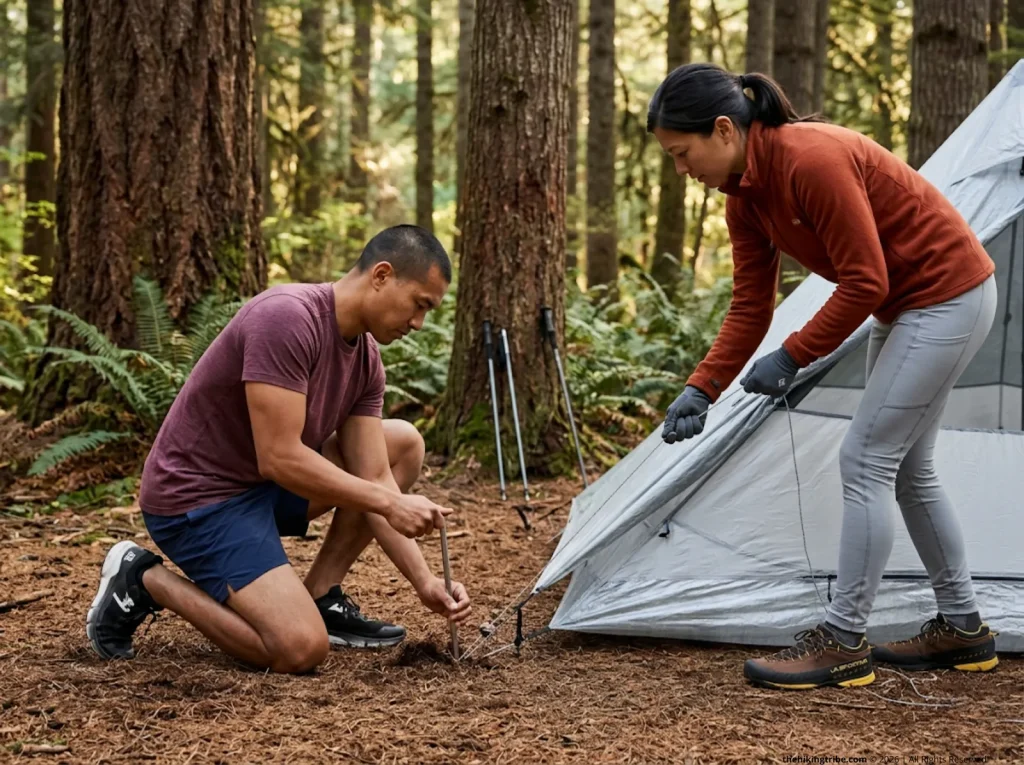
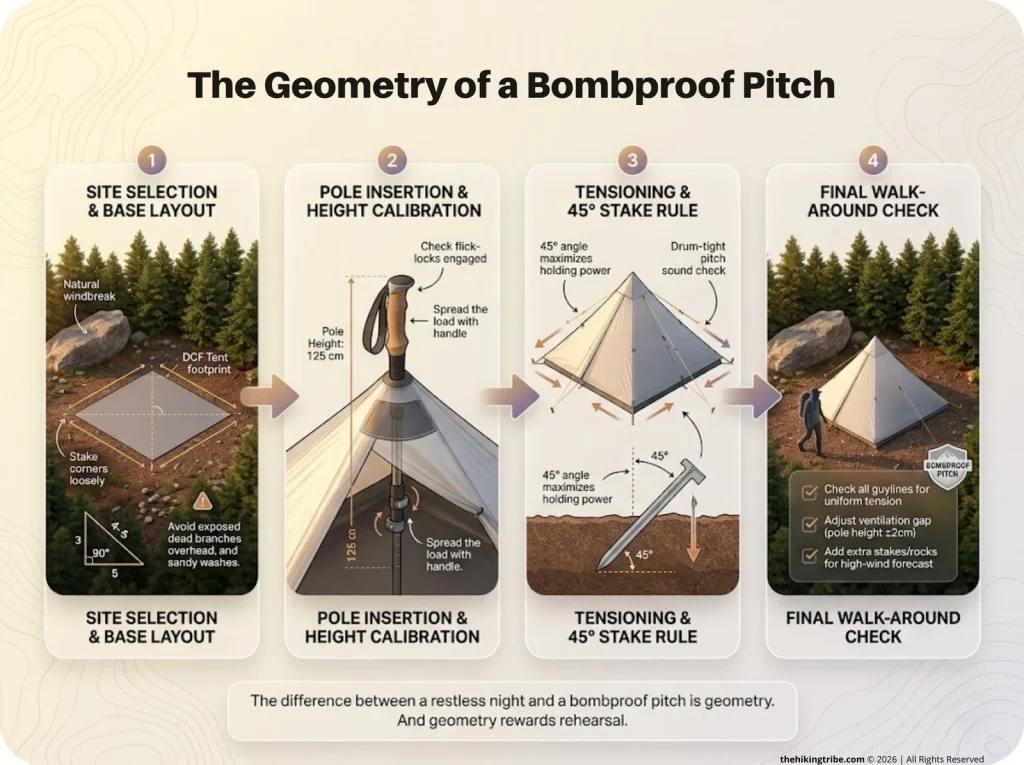
Stop winging it. This is the exact order of operations that produces a stable trekking pole tent pitch, from site selection to the final walk-around.
Step 1: Site Selection and Base Layout
Pick a site with natural wind protection. Avoid exposed ridges and dead branches overhead (a dead limb waiting to fall is called a “Widowmaker” for a reason). Andrew Skurka, one of the most accomplished thru-hikers alive, says it directly: “Campsite selection is at least as important to my sleep quality as my choice of tent, bag, and pad.” He is right. For more detail on optimizing your campsite for wind and rain protection, that process alone can save your shelter before you even touch a pole.
Lay out the tent footprint and stake the base rectangle first, before touching poles. Use the 3-4-5 method to verify 90-degree corners. Stake loosely at first. Over-tightening corners before the poles go in creates “locked tension” that prevents a balanced pitch.
Step 2: Pole Insertion and Height Calibration
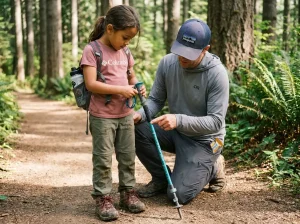
Adjust poles to the manufacturer’s specified height, or calculate it using the method from the geometry section above. Insert poles with the correct orientation. Verify flick-locks are fully engaged. A pole that slips under load in the middle of the night is an emergency, not an inconvenience.
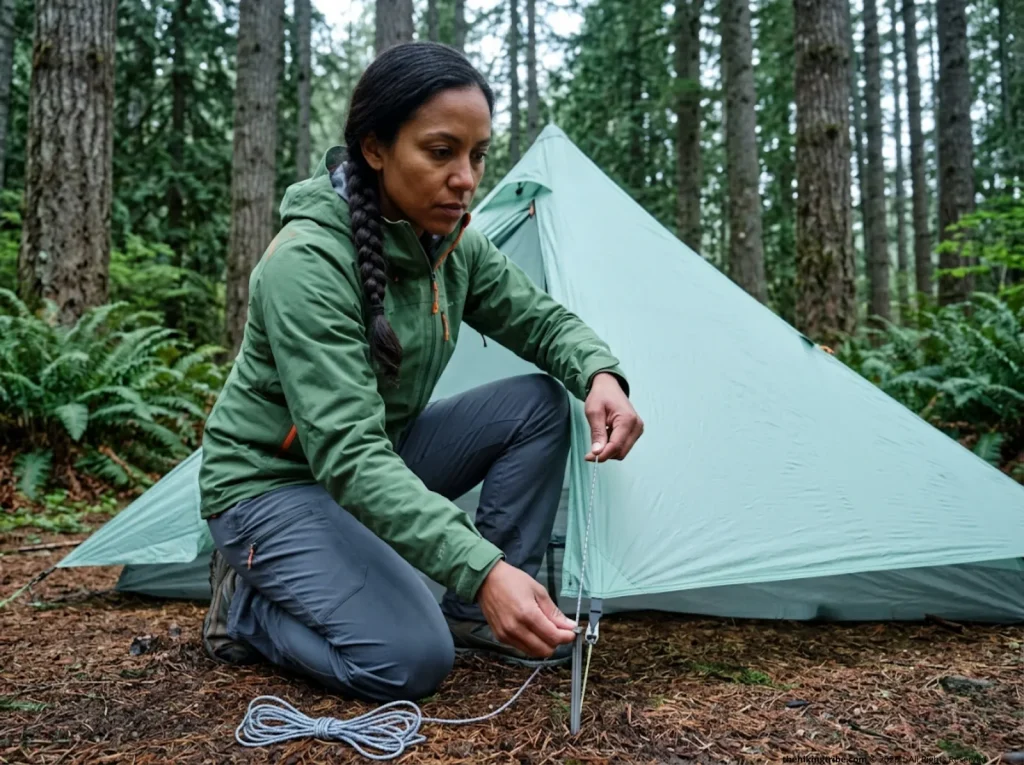
Step 3: Tensioning and the 45-Degree Stake Rule
Drive stakes at 45 degrees away from the tent. This maximizes soil engagement and increases pull-out resistance by up to 50 percent compared to vertical placement. Tension guylines sequentially: opposite corners first, then sides, then fine-tune.
A drum-tight pitch sounds different from a loose one. DCF ridge tension produces a distinct taut hum. Silnylon will always have slightly more droop because it absorbs water. The target state: every panel taut, no flapping, ridgeline level.
Step 4: The Final Walk-Around Check
Circle the tent and push on each guyline. None should have visible slack. Verify ventilation by adjusting pole height slightly to open or close the gap between the fly and ground. In high-wind forecasts, add triple staking at critical anchor points: three stakes in a line connected by a single line.
Following established NPS protocols for backcountry campsite selection adds another layer of safety to this whole process, especially around hazard assessment.
Field Repairs and Failure Recovery
Gear breaks. It is not a question of if, but when. Knowing how to recover at 2 AM with cold hands and bad light is what separates a rough night from a real emergency.
Pole Snap: Splinting a Broken Section
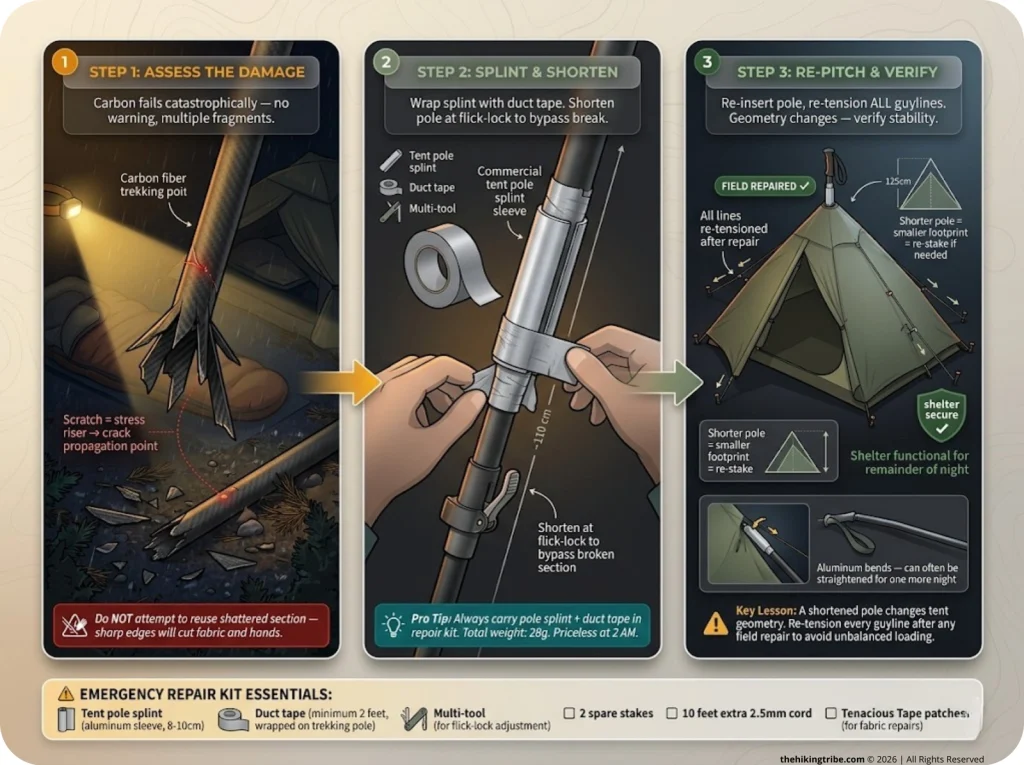
A shattered carbon pole requires a tent pole splint and duct tape. Carry both in your repair kit, always. In a pinch, you can shorten a trekking pole at the flick-lock to bypass the broken section entirely. Aluminum poles that bend can often be straightened enough to last one more night.
A shortened pole changes the tent geometry. Re-tension every guyline after a field repair to avoid unbalanced loading across the canopy.
Apex Puncture: Patching and Preventing
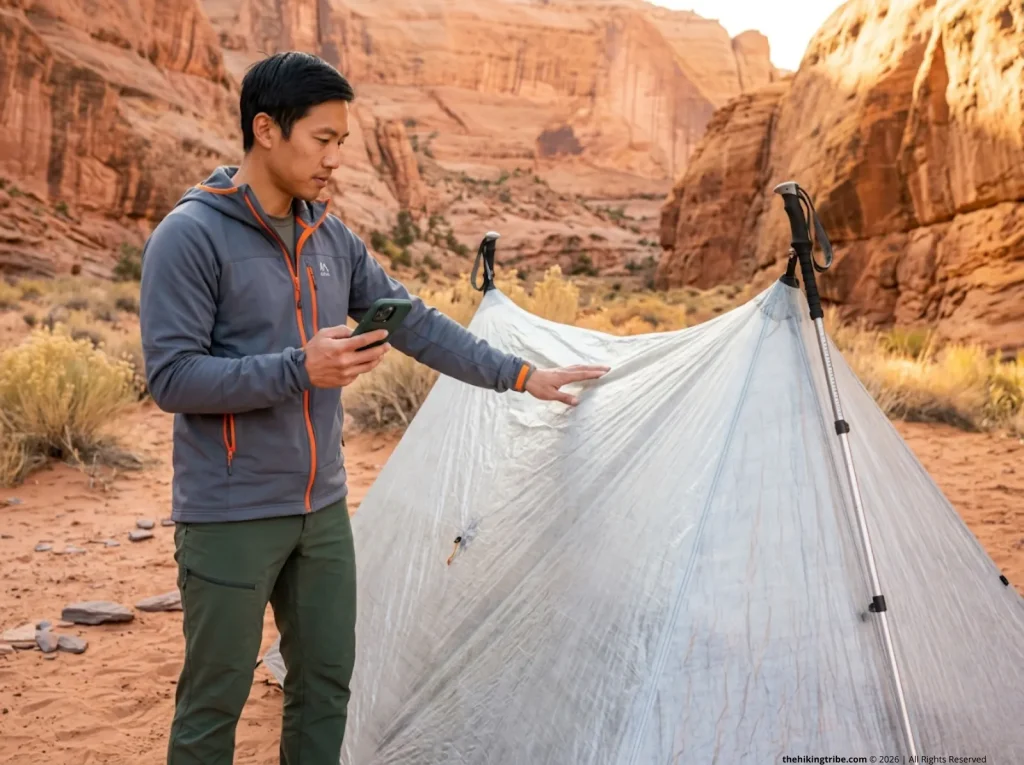
Apex puncture is almost always caused by pitching tip-up without a protective grommet. The fix: apply a DCF or Tenacious Tape patch and reverse to handle-up orientation. Better yet, reinforce the apex with a small patch before your first trip.
Thru-hikers have used metal chopsticks as emergency stakes when the ground was too hard for MSR Groundhogs. Trail improvisation is real, and it works.
Guyline and Stake Failures in Storm Conditions
Carry at least 2 spare stakes and 10 feet of extra 2.5 mm cord in your pack. In sustained high wind, “split guylines” (two lines from a single attachment point, each staked separately) distribute force more effectively than a single line. Always dry trekking poles before storage to prevent corrosion of flick-locks or seizing of telescoping segments. For the full breakdown, the trekking pole cleaning and field repair maintenance guide covers long-term care in detail.
Choosing the Right Trekking Pole Tent for Your Setup
Not all poles work with all tents. Before you buy anything, verify three things: required pole height range, required orientation (handle-up vs. tip-up), and grommet/tip interface compatibility.
Pyramid and mid tents like the Hyperlite and Gossamer Gear The One use a single center pole. Simplest geometry, most wind-resistant shape. A-frame designs like the Zpacks Duplex and Durston X-Mid use two poles and require precise base squaring to pitch correctly. Catenary-cut fabric distributes tension and reduces sagging, which is necessary for a drum-tight pitch with static lines.
A pole jack makes sense when your standard 130 cm poles fall short for taller shelters. The Zpacks pole jack provides a 10.5-inch boost with only 1.5-2 inches of overlap. But nobody talks about the safety margin. At what height does a jacked pole become a lever that risks snapping the trekking pole itself? The answer depends on the pole’s stiffness score and the lateral wind load. If your shelter requires a significant extension beyond 140 cm, consider whether the geometry is actually safe in storm conditions.
Condensation is the other factor nobody warns new trekking pole tent owners about. Adjustable pole height lets you control ventilation: lowering the pole slightly opens the gap between fly and ground, increasing airflow. In high-humidity, low-temperature environments, a “solid inner” tent protects you from condensation dripping off the fly. The trade-off is real: more gap means more airflow but less storm security. For the physics behind tent condensation management and ventilation, I covered why it happens and how pole adjustments control it.
Conclusion
Three things separate a collapsed tent from a shelter that holds through anything the backcountry throws at you.
First, treat your trekking pole tent as a structural equation. Pole height, base geometry, guyline tension, 45-degree angle staking, handle-up orientation. Every variable solved before the wind tests your work.
Second, choose your pole material based on failure mode, not just weight. Carbon fiber gives you the stiffest shelter in calm conditions. Aluminum gives you a shelter that survives when things go wrong.
Third, match your anchoring to the surface. The big rock/little rock method, deadman anchors, and sintered snow platforms are the techniques that hold when generic “stake it down” advice falls apart.
Take your poles and your shelter to the backyard before your next trip. Practice the height calculation. Square your base with the 3-4-5 method. Drive your stakes at 45 degrees. The difference between a restless night and a bombproof pitch is geometry, and geometry rewards rehearsal.
FAQ
Can any trekking pole be used for a tent?
Not reliably. The pole must have adjustable height to match your tent’s required length, a flick-lock mechanism (twist-locks seize in wet or freezing conditions), and enough stiffness to act as a compression member under wind load. Always verify your pole’s height range against your tent manufacturer’s specifications before heading out.
How high should trekking poles be for a tent?
Most trekking pole tents require 120 to 130 cm, though specific models vary. The Hyperlite Mid 1 requires 135 cm, give or take 5 cm. If your manufacturer does not provide a spec, use the right-triangle method: measure your tent wall seam and stake distance, then calculate pole height as the remaining side.
Do trekking pole tents fall over in wind?
A properly pitched tent with a squared base, 45-degree stake angles, 2.5 mm guylines, and surface-appropriate anchoring can withstand sustained high winds. The failures you hear about are almost always caused by skewed base rectangles, twist-lock slippage, or insufficient staking, not design weakness.
Should I use handle-up or tip-up orientation?
Handle-up is generally preferred because the broader cork or foam surface distributes compression force across the apex, reducing puncture risk. Some tent designs require tip-up with a reinforced grommet. Always check your specific tent’s setup instructions. Wrong orientation accelerates fabric wear.
Can you use one trekking pole for a two-person tent?
Some pyramid and mid tents are designed for a single center pole and work well as two-person shelters. But A-frame designs require two poles to create the ridgeline. Using one pole in a two-pole tent creates asymmetric loading that leads to fabric stress and collapsed geometry. Do not improvise on this.

I've spent more than a decade researching hiking gear and trail technique. I read the specs, the forum threads and the long-term reviews, and every pick here comes with what it gets wrong.
End of the trail
You read every mile of this one. Here's where the trail goes next.