In this article
Halfway up a frozen snowfield in Rocky Mountain National Park, the guy ahead of me stopped cold. His crampon was dangling from one strap, the heel clip had popped loose, and he was standing on a 30-degree slope with nothing but polished ice beneath him. His boots were fine for summer trails. They just had no business wearing crampons.
I helped him swap to a pair of Kahtoola MICROspikes I was carrying as backup. He made it down safely. But that scene plays out on winter hiking trails more often than it should, and the cause is almost always the same — a mismatch between boot sole stiffness and crampon binding type that no amount of strap tightening can fix.
This article breaks down the B0–B3 boot rating system, the C1–C3 crampon rating system, and the specific compatibility rules that keep you walking instead of sliding. You will learn how to check your own hiking boots at home, which binding type matches your sole, and when microspikes vs crampons makes microspikes the smarter choice.
⚡ Quick Answer: Most hiking boots (B0 rated, like the Salomon X Ultra or Merrell Moab) are NOT compatible with standard crampons. Only boots with semi-rigid soles (B1 or stiffer) can safely hold strap-on crampons (C1). If your boot sole flexes easily when you twist it, stick with microspikes for packed snow and light ice. For semi-automatic crampons or step-in crampons, you need B2 or B3 boots with heel welts or toe-and-heel welts.
Why Boot Stiffness Decides Everything
The B0–B3 Rating System Explained
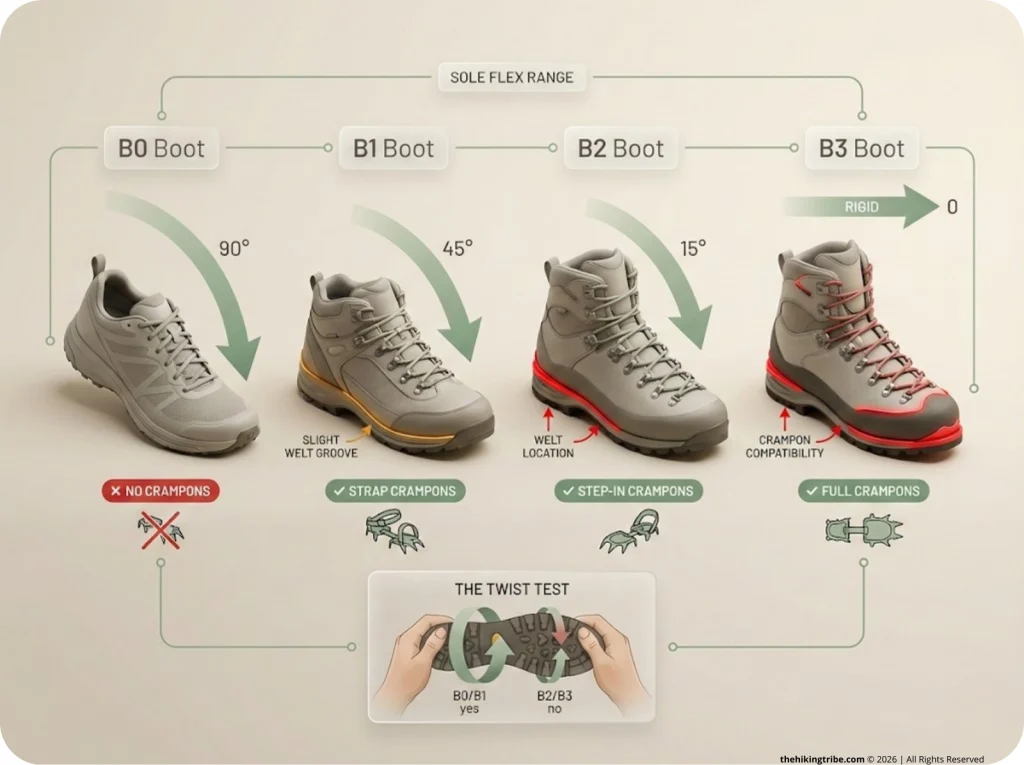
Every hiking boot and mountaineering boot falls somewhere on the B0–B3 stiffness scale, and that number determines exactly which crampons you can safely attach. Skip this step, and you are gambling with your ankles on every frozen slope.
B0 boots are your standard three-season hikers — think Salomon X Ultra, Merrell Moab, or most KEEN models. They have flexible soles, soft uppers, and zero welt structure. Strap a crampon to one of these and the frame will twist, shift, and eventually pop off mid-slope. These boots were built for dirt trails, not ice.
B1 boots are semi-stiff four-season boot designs like the Scarpa Zodiac TRK. They provide enough sole rigidity — meaning the boot resists twisting when you grab the toe and heel — for C1 strap-on crampons on moderate snow and ice. This is the entry point for most serious winter walking hikers who want real traction beyond microspikes.
B2 boots add a heel welt — a protruding lip at the back of the sole, at least 3/8 of an inch — that locks into the heel lever of a semi-automatic crampon. Models like the La Sportiva Trango fit here. B3 boots are fully rigid with both toe welts and heel welts, built for C3 automatic step-in bindings on steep terrain. The Scarpa Phantom series lives in this category.
The boot stiffness rating comes down to one thing — how much your sole resists twisting under load. A flexible-soled boot lets the crampon frame shift side to side under your body weight, especially on side-slopes. Even a small amount of play can break the heel clip engagement and send you sliding.
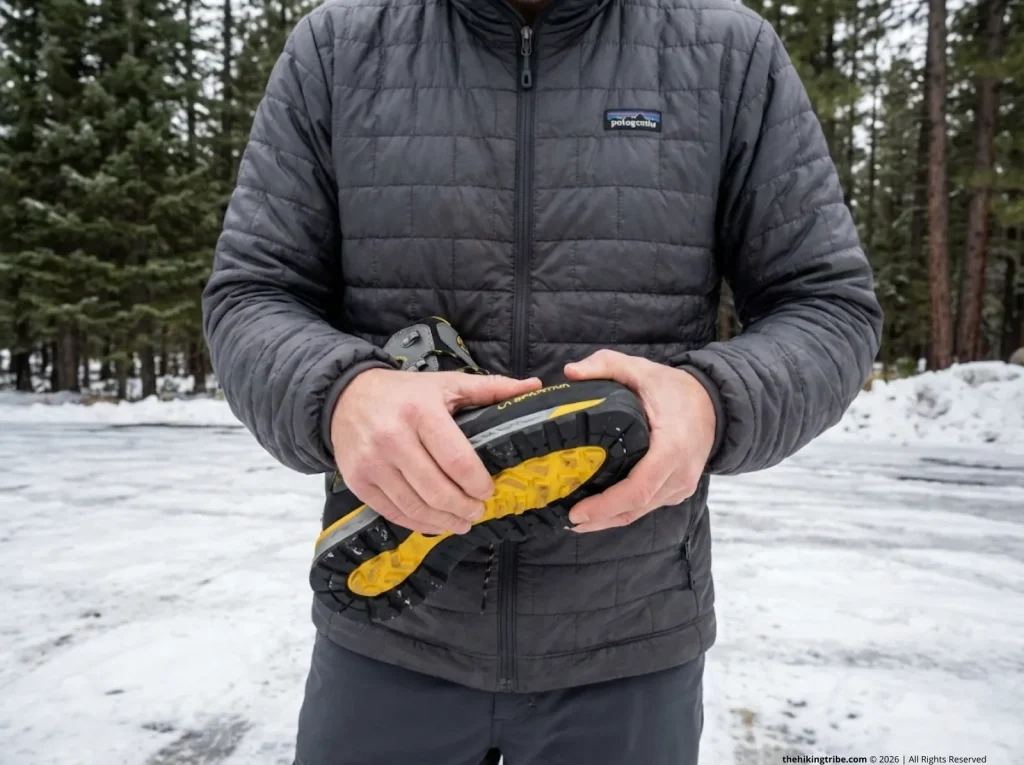
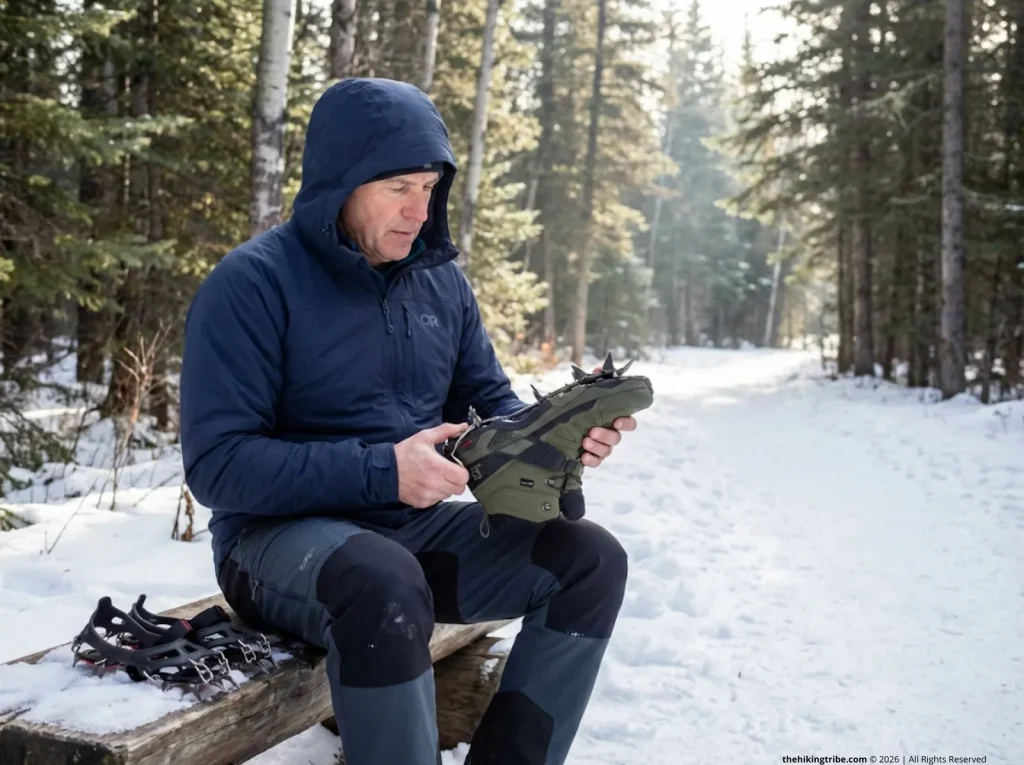
Pro tip: Grab the toe and heel of your boot and twist hard. If the sole moves more than a few degrees, that boot is B0 territory. Stick with microspikes and save yourself the fall.
How to Check Your Boots at Home
You do not need a lab to figure out your boot rating. Start with the twist test described above. Next, flip your boot upside down and look at the heel. If there is a protruding lip or groove running across the back of the sole — roughly 3/8 of an inch — that is a heel welt, and your boot is at least B2. Check the toe for a similar groove. Both toe welts and heel welts mean B3.
Press the sole flat against a table edge. A rigid sole holds straight. A flexible boot drapes over the edge like wet cardboard.
Understanding how boot stiffness ratings match different terrain types adds context to why this matters beyond crampons. The same stiffness that holds a crampon frame also determines your edging ability on steep walking and rocky terrain. The British Mountaineering Council guidelines on minimum B1 for crampons confirm that anything below B1 is off-limits for traditional crampon use.
Strap-On, Semi-Auto, and Step-In Bindings Decoded
C1 Strap-On Bindings
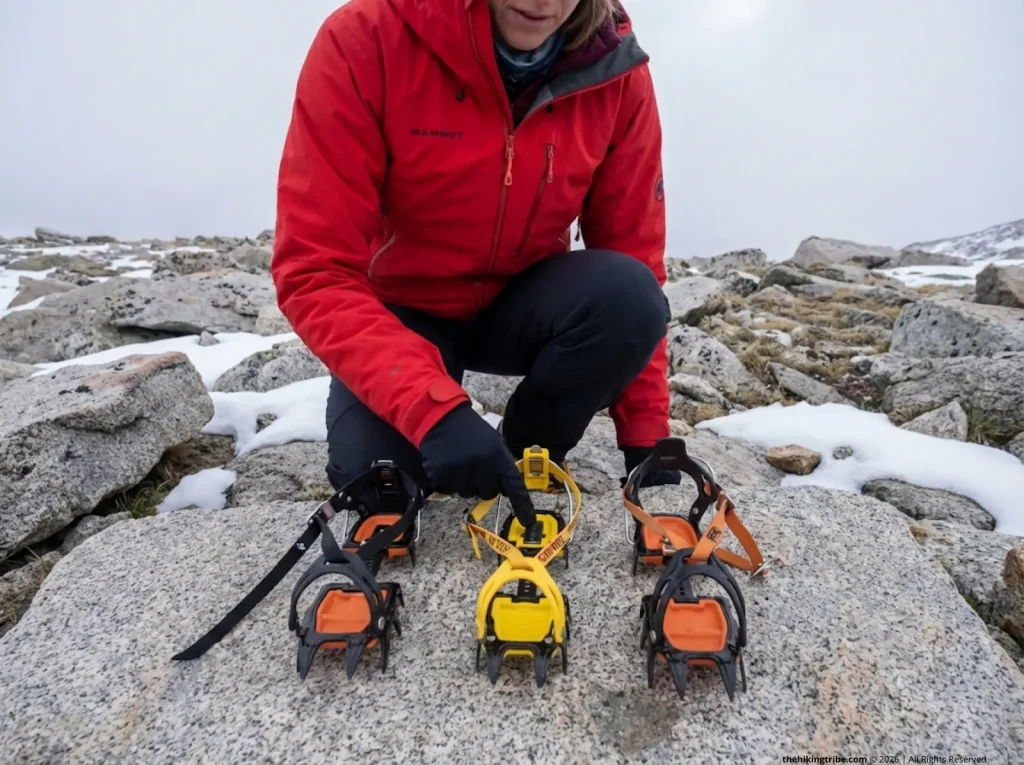
C1 crampons use a flexible plastic cradle that wraps the toe and nylon straps that secure around the boot. No welts needed. They work on any boot with a semi-stiff or rigid sole — B1, B2, B3. Models like the Petzl Irvis, Black Diamond Neve, and Grivel G10 all use this system.
This is the binding type most hikers need. It handles moderate snow on national park snow hikes, multi-day treks in winter terrain, and frozen trail crossings without demanding a specialized mountaineering boot. The tradeoff is slightly less lateral security than clip systems, but for anything below steep ice, that gap barely matters in practice.
C2 Semi-Automatic (Heel Clip + Toe Strap)
Semi-automatic crampons split the difference. A metal bail clips onto the heel welt while a toe strap basket holds the front of the boot. You need a minimum B2 boot to run this setup, because without that protruding heel shelf, the lever has nothing to grab.
The advantage is speed. Clip the heel, tighten the toe strap, and you are set in 30 seconds — faster than wrangling a full strap-on binding. You also get better lateral hold for steeper terrain and moderate mountaineering climbs. Listen for the “clunk” of the heel lever engaging. If the crampon clip is silent or loose, the welt fit is wrong.
C3 Automatic Step-In Bindings
Step-in crampons use metal bails at both toe and heel — snap in, snap out, zero strap adjustment. These demand B3 boots with both welts and full rigidity. Models like the Petzl Lynx live here.
If your plans stay below Class 3 scrambling on snow, you do not need these. They are built for technical climbing, steep couloirs, and alpine climbing where every second of transition time matters. For most hikers progressing into winter mountaineering, the C1/C2 range covers everything you will encounter.
Knowing what a boot shank actually does for sole rigidity helps explain why C2 and C3 bindings fail on softer boots. The shank is the structural backbone that keeps your sole from folding under the crampon frame. That rigidity, as outlined by the International Mountaineering and Climbing Federation in their UIAA safety standards, is non-negotiable for clip-in bindings.
The Compatibility Matrix Every Hiker Needs
The Full B/C Pairing Table
Here is the reality that most gear articles skip — a straight crampon compatibility breakdown mapped to boots hikers actually own, not just mountain boots featured in expedition catalogs.
B0 + any crampon = no. Full stop. Use microspikes or traction cleats only. Kahtoola MICROspikes and Hillsound Trail Crampons are your safe options for packed trails and light ice.
B1 + C1 = yes. This is your go-to combo for winter hiking, snowfield crossings, and national park snow hikes. The strap-on binding wraps securely around the semi-stiff sole, and you get reliable 10-point crampons or 12-point traction on moderate terrain.
B2 + C1 or C2 = yes. The heel welt opens up semi-step crampons binding options. You are not required to use them — C1 strap-on still works perfectly on B2 boots. You are over-speccing the boot, not under-speccing.
B3 + C1, C2, or C3 = yes. Full compatibility. Choose based on your terrain and activity.
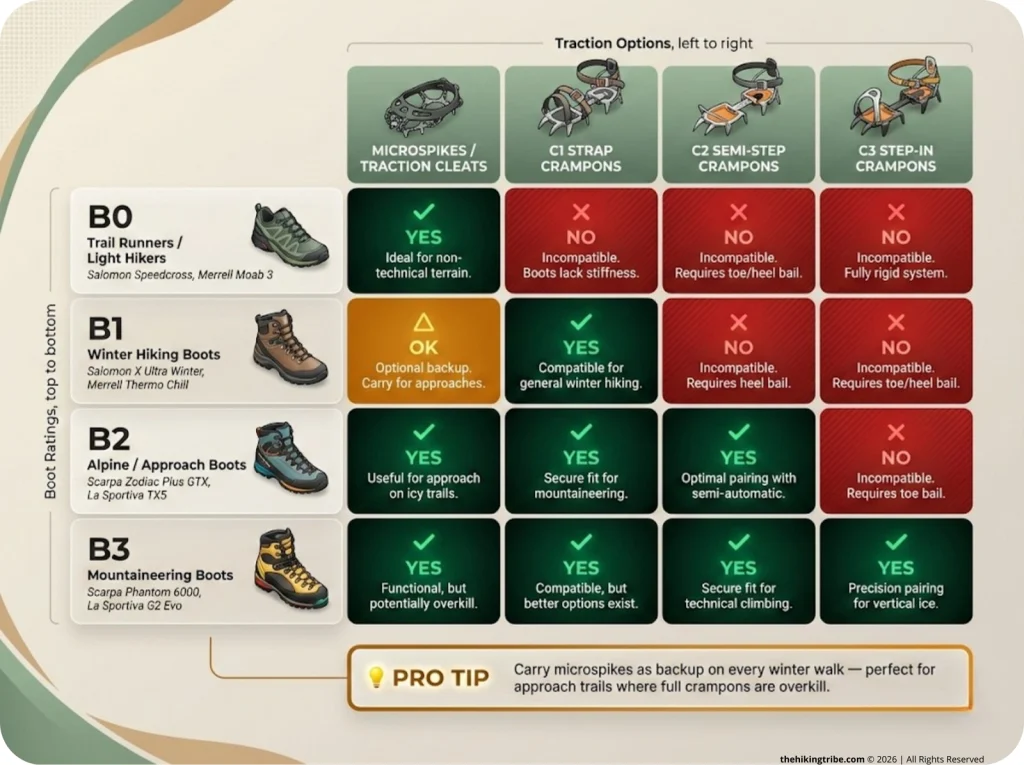
Pro tip: Carry microspikes as backup on every winter walk, even if you are running full crampons. Approach trails and mixed terrain transitions are where strap-on crampons are overkill and microspikes are perfect.
Popular Hiking Boots and Their Real Compatibility
This is the gap every competitor article leaves wide open. If you have ever wondered “are my hiking boots crampon compatible,” here is where common hiking boots actually land on the scale.
Salomon X Ultra 4 — B0. Microspikes only. The sole flexes too easily to hold a crampon frame. Same story for the Merrell Moab 3 and most KEEN Targhee variants. If you own any of these and want crampon fit, you need a stiffer boot, not a “universal” crampon.
Scarpa Zodiac TRK — B1. C1 compatible crampons work here. This is one of the most popular crossover boots for hikers stepping into winter walking territory.
La Sportiva Trango TRK — B2. C1 or C2 compatible. The heel welt is solid, and the sole rigidity handles steeper snow confidently on glacier traverses and mountain climbing adventures.
Scarpa Manta Tech — B2/B3. Full C2 or C3 compatible. This is the boot for hikers progressing toward non-technical climbing and technical mountaineering objectives.
If you are running B0 boots and want to know how Yaktrax and Kahtoola MICROspikes compare on real ice, that comparison breaks down exactly which traction device earns your money. And for context on how safety mismatches create real danger, the American Alpine Club incident reports document crampon failures on incompatible boots as a recurring cause of winter backcountry accidents.
How to Fit Crampons to Your Boots (Step by Step)
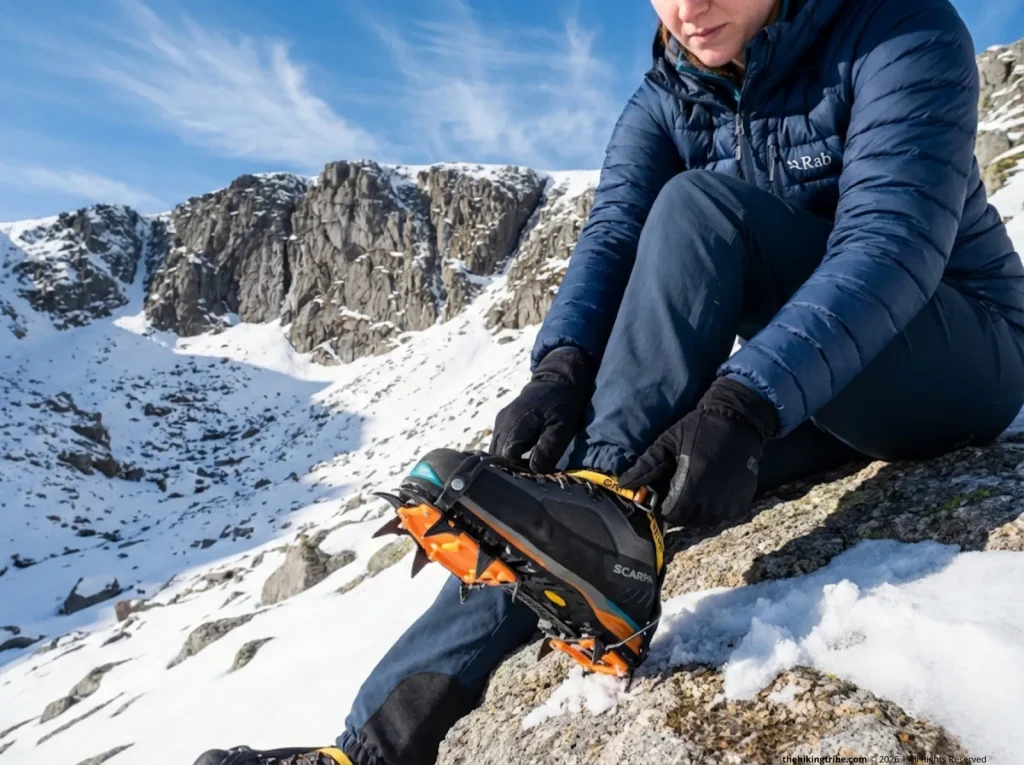
Setting the Center Bar Length
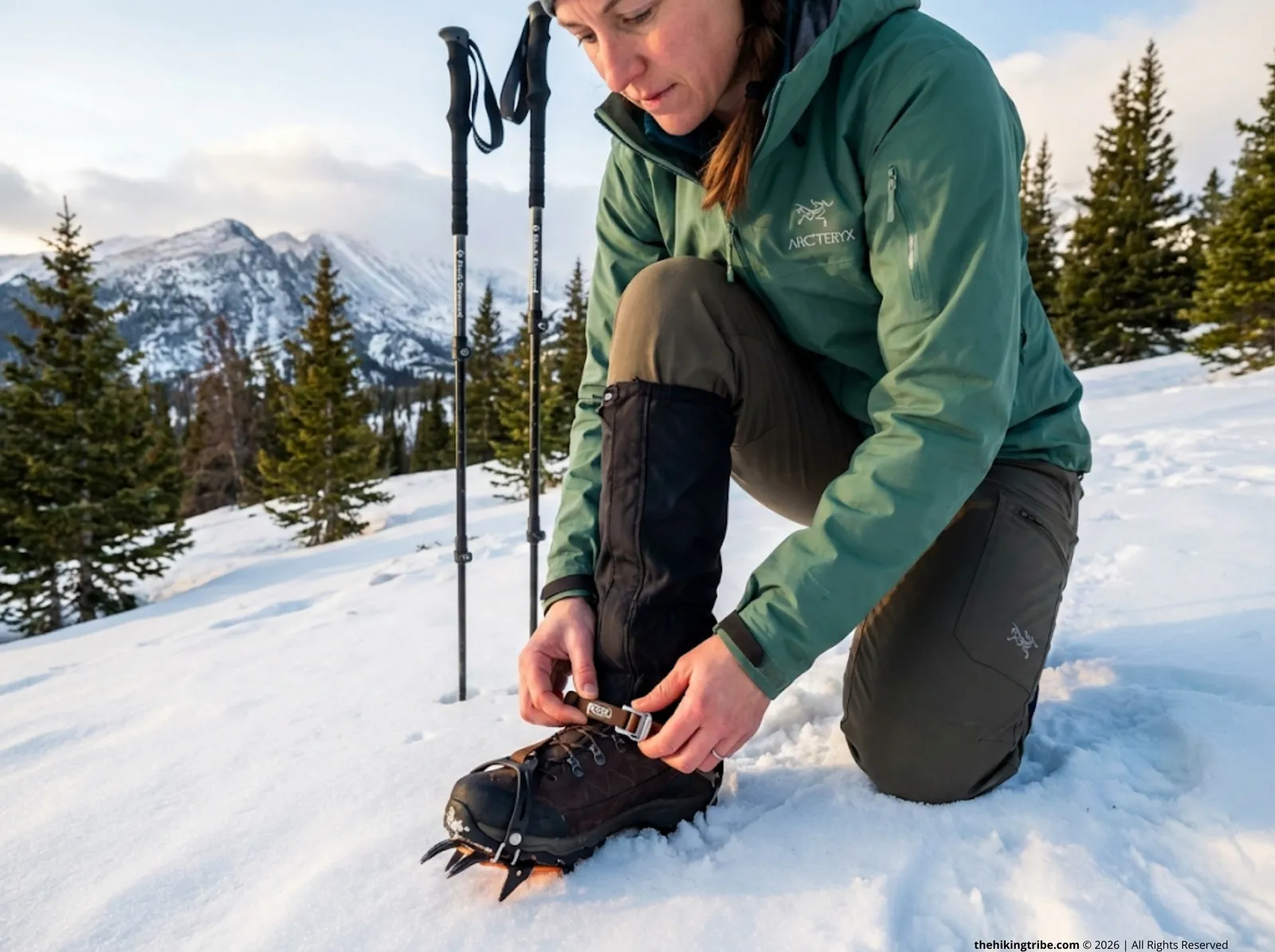
Fitting crampons properly takes five minutes at home and prevents catastrophic failure at 11,000 feet. Start with the center bar — the metal spine connecting the toe and heel pieces.
Loosen the adjustment screw, then slide the bar until the crampon frame matches your boot sole length exactly. The toe basket or front bail should sit flush against your boot toe with zero overhang. The heel piece must contact the boot heel with no forward or backward play. Tighten the screw firmly, then try wiggling the bar by hand. Any movement means it is not tight enough.
The front crampon bar flex match matters more than most people realize. The crampon’s natural curve should follow your boot shapes and sole curve. If the bar lifts away from the sole when you press down on the heel, the geometry is wrong for your footwear.
The No-Gap Check
Place your boot in the crampon and crouch down to eye level. Look for daylight between the boot sole and the crampon frame. Any gap at the toe or heel means wrong size, wrong binding type, or both.
For semi-auto and step-in bindings, press down on the heel and listen. You should hear a clear “clunk” — that is the crampon clip snapping onto the heel shelf. A soft or silent engagement means the welt is too shallow or the lever is misaligned. Walk ten steps indoors and repeat the check. Movement reveals subtle gaps that static fitting misses.
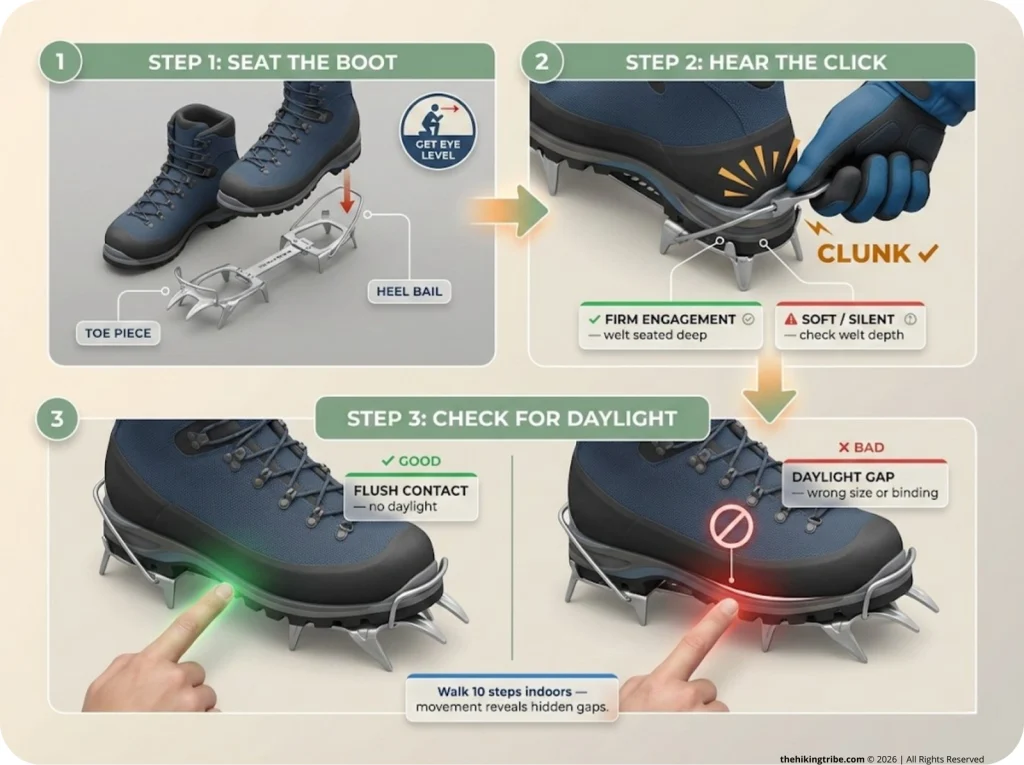
Pro tip: Bring your actual boots to the store. I have watched people buy crampons based on boot size alone, get home, and discover the center bar is maxed out with gaps at both ends. Your sole curvature matters more than any size chart.
Left vs. Right and Final Adjustments
Most crampons are asymmetric — the secondary crampon points angle inward toward the big toe on each foot. Check the L/R markings stamped on the frame. Getting this wrong puts the front points at an angle that reduces your grip on steep slopes.
Tuck excess strap material into a knot or fold instead of leaving it dangling. Loose straps catch on sharp crampon points from the opposite foot, and a trip at speed on ice ends badly. Carry a spare strap and a multi-tool on every winter walk. A stripped buckle at altitude is a problem you can solve in two minutes — if you packed the right repair kit.
Once you are confident in the crampon fit, pair your crampons with proper ice axe technique as the next winter mountaineering safety skill. A crampon gives you grip. An ice axe gives you a way to stop if you lose it.
Walking in Crampons Without Falling
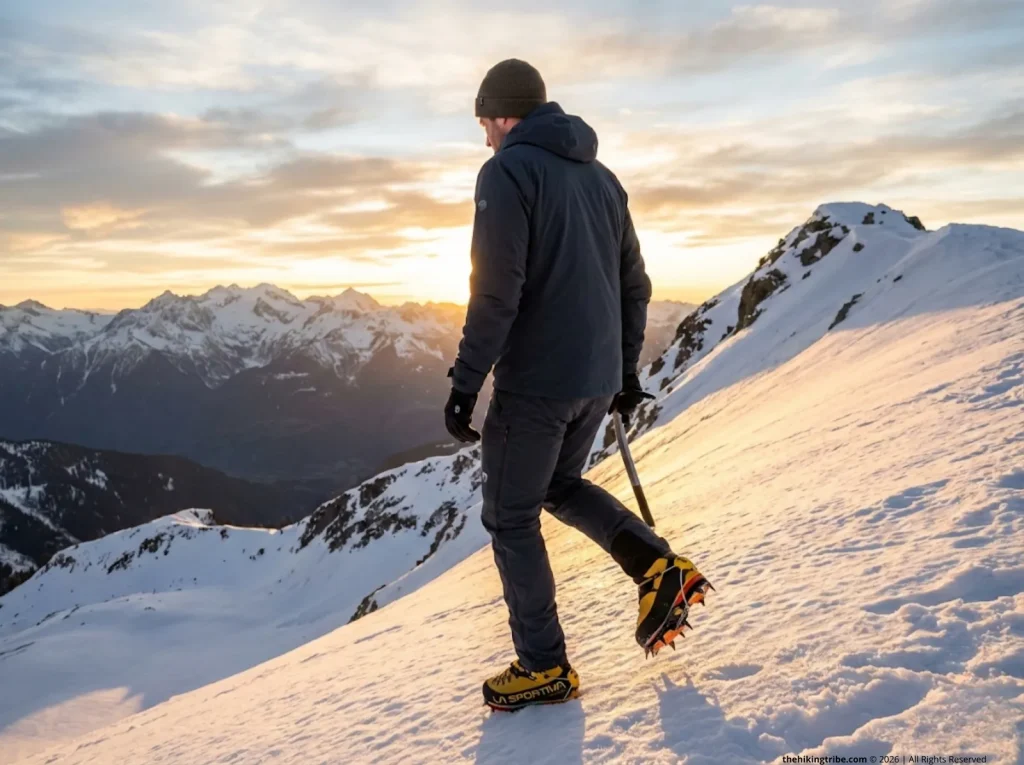
The Wide Stance and High Step
The first time you walk in crampons, your instinct is to walk normally. Fight that instinct. Normal strides put sharp crampon points on one foot directly in the path of your opposite gaiter or pant leg. The result is a rip, a snag, or a face-plant.
Walk with legs apart and lift each foot higher than feels natural. Plant flat — all bottom points hitting the surface at once — instead of heel-striking. On flat terrain, think “duck walk” with feet turned slightly out, deliberate and wide. Much Better Adventures’ Winter Skills handbook describes this as the “walk like John Wayne” technique, and it is the best mental cue for beginners tackling their first crampon waddle.
Ascending and Traversing Techniques
On moderate slopes (up to roughly 25 degrees), angle your feet slightly outward and stomp flat with each step. This is called the French technique, and it puts all your bottom points into the snow simultaneously for maximum surface grip on steep walking terrain.
Above 30 degrees, switch to front pointing — kick the front two points into the slope and stand on them. Your calves will burn, but the grip is solid. On traverses, keep the uphill foot turned slightly into the slope for better edge bite. Always face uphill on steep traverses. Rotating downhill exposes you to a fall with no self-arrest position.
When to Take Crampons Off
Remove crampons on dry rock, dirt, and wooden bridges. Metal points on rock give you zero grip and damage the points. This is also where post holing risks and self-rescue techniques become relevant — when the snowpack turns soft and you are breaking through to your knees, crampons are not the right tool. Snowshoes or a different route are better answers.
Transition zones — snow to rock to snow — are where most people get lazy and fall. Per Leave No Trace principles, remove crampons on fragile alpine terrain like tundra and cryptobiotic soil. Those crampon points scar vegetation that takes decades to recover. Trail damage minimization is part of responsible winter hiking, not an afterthought.

Care, Storage, and When to Replace
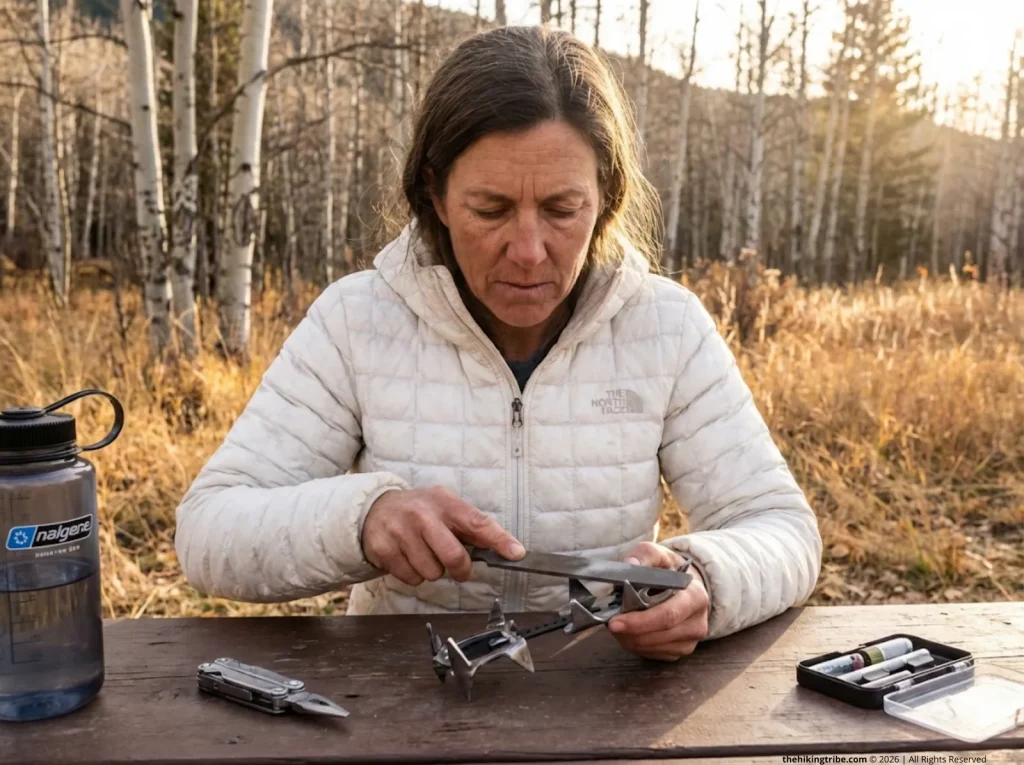
Post-Hike Cleaning and Drying
Steel crampons rust fast when stored damp. Rinse salt, mud, and grit immediately after every use. Dried grit accelerates point dullness, and dull points reduce your grip on hard ice dramatically.
Inspect the anti-balling plates — the rubber or plastic shields on the bottom of the frame that prevent snow from clumping underfoot. The UIAA recommends these on all walking crampons for exactly this reason. A torn or cracked plate means snow builds up between the points, adding weight and killing traction. Check every strap for fraying and every buckle for stripped teeth. Catching a worn strap at home is cheap. Catching it mid-slope is not.
Sharpening Points and Inspecting Hardware
Sharpen crampon points with a flat file, stroking away from your body. Never use a grinder. The heat from grinding weakens the steel temper and makes the points prone to bending or snapping under load.
Check the center bar adjustment screws every season. Loosening over time creates frame play, and frame play leads to detachment. Replace straps and heel levers at the first sign of cracking. A $5 strap is cheaper than a helicopter ride.
Storing for the Off-Season
Store with point protectors on, in a dry space away from moisture and direct sunlight. A light coat of silicone spray or oil on steel components prevents oxidation during summer storage. Aluminum crampons need less rust prevention but are more prone to point bending — check the geometry each season.
Do not stack crampons under heavy gear. The frame can bend, and a bent frame means uneven point contact and compromised security. Learning how to store all your hiking gear to prevent mold and delamination covers the broader storage principles that apply to crampons, boots, and everything else in your winter hiking kit.
Pro tip: At the end of every season, lay your crampons flat on a table and eyeball the point alignment. If any point is visibly bent or shorter than the others, either file it even or replace the pair. Uneven points create uneven grip, and uneven grip creates falls.
Conclusion
Three things decide whether your crampons hold or fail on the mountain. First, your boot’s B-rating and welt configuration must match the crampon’s C-rating and binding type — no exceptions. Second, the fit must show zero gaps at the toe and heel, with the center bar set to your boot’s exact sole length. Third, you walk deliberately — wide stance, high step, flat plant — and you remove crampons the second the terrain changes.
Before your next winter hike, grab your hiking boots and run the twist test. Check for welts. If your boots fall in the B0 category, a pair of Kahtoola MICROspikes will keep you safe on packed trails without risking a crampon detachment. If your boots pass as B1 or stiffer, fit your C1 crampons at home, dial in the center bar, and walk ten steps on carpet before you ever step on ice.
FAQ
Can you use crampons on regular hiking boots?
Only if those boots are rated B1 or stiffer with a semi-rigid sole. Flexible B0 three-season hiking boots like the Salomon X Ultra or Merrell Moab cannot hold crampons securely. For those boots, microspikes are the safe alternative.
How do I know if my boots are crampon compatible?
Do the twist test — grab the toe and heel and twist. If it barely moves, the boot is likely B1+. Then check for welts — a protruding heel lip means B2 (semi-automatic crampons compatible); both toe and heel lips mean B3 (step-in crampons compatible). No welts but moderate stiffness means you can use C1 strap-on crampons.
What does B1, B2, B3 mean for boots?
These are stiffness and boot ratings. B1 equals semi-stiff with no welts (C1 crampons only). B2 equals stiffer with a heel welt (C1 or C2). B3 equals fully rigid with toe and heel welts (any crampon type including C3 step-in). B0 means too flexible for crampons.
What is the difference between strap-on and step-in crampons?
Strap-on crampons (C1) use nylon straps and a plastic cradle to attach to any B1+ boot — no welts required. Step-in crampons (C3) use metal bails that clip into toe welts and heel welts on B3 boots. Semi-automatic crampons (C2) sit between them, with a heel clip and toe strap requiring only a heel welt.
Are microspikes the same as crampons?
No. Microspikes are lightweight traction devices with short steel spikes on a rubber chain harness. They fit any shoe or boot and handle packed snow and light ice. Crampons have longer crampon points including front points, rigid frames, and aggressive traction for steep terrain. Microspikes are the entry point. Crampons are the upgrade for steep winter walking and beyond.
Risk Disclaimer: Hiking, trekking, backpacking, and all related outdoor activities involve inherent
risks which may result in serious injury, illness, or death. The information provided on The Hiking Tribe is for
educational and informational purposes only. While we strive for accuracy, information on trails, gear, techniques,
and safety is not a substitute for your own best judgment and thorough preparation. Trail conditions, weather, and
other environmental factors change rapidly and may differ from what is described on this site. Always check with
official sources like park services for the most current alerts and conditions. Never undertake a hike beyond your
abilities and always be prepared for the unexpected. By using this website, you agree that you are solely
responsible for your own safety. Any reliance you place on our content is strictly at your own risk, and you assume
all liability for your actions and decisions in the outdoors. The Hiking Tribe and its authors will not be held
liable for any injury, damage, or loss sustained in connection with the use of the information herein.
Affiliate Disclosure: We are a participant in the Amazon Services LLC Associates Program, an
affiliate advertising program designed to provide a means for us to earn advertising fees by advertising and linking
to Amazon.com. As an Amazon Associate, we earn from qualifying purchases. We are also an official affiliate partner
of Black Diamond Equipment via the AvantLink network. If you click on a Black Diamond affiliate link and make a
purchase, we may earn a commission at no additional cost to you. We also participate in other affiliate programs and
may receive a commission on products purchased through our links. Additional terms are found in the terms of
service.