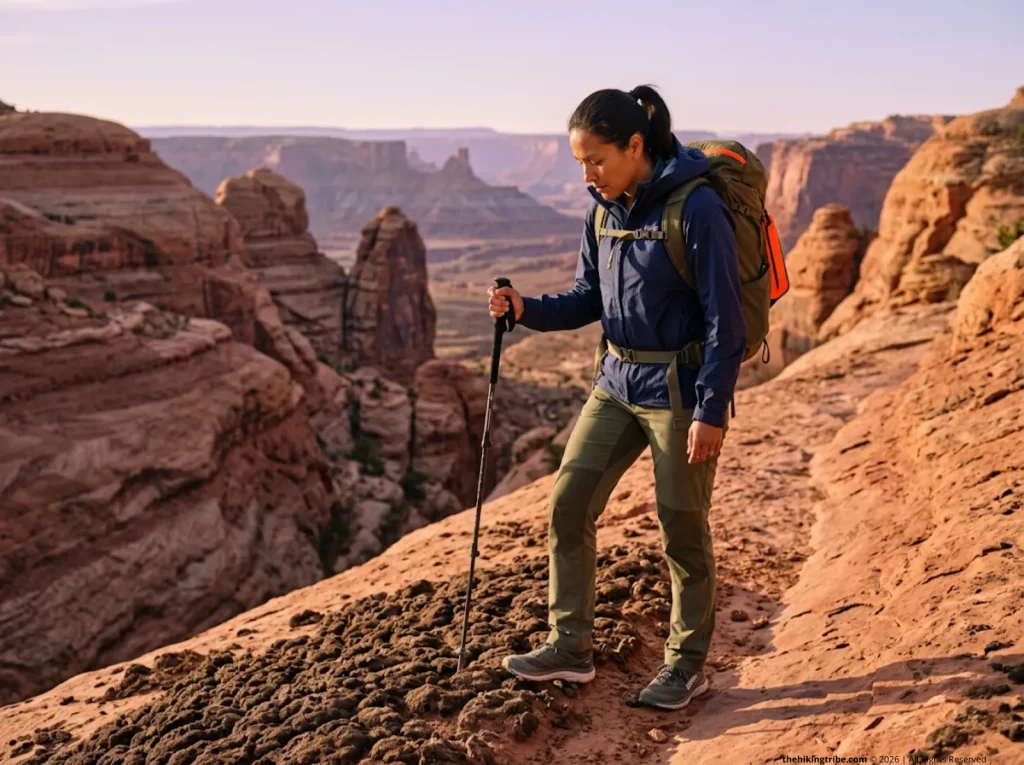
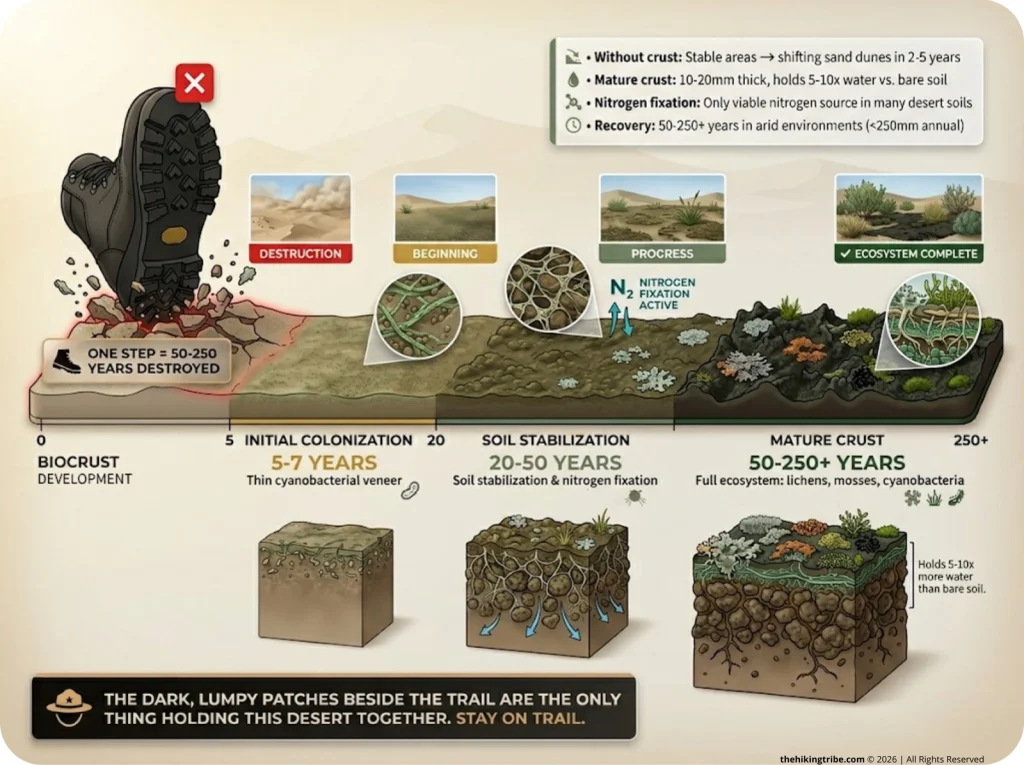
The crunch underfoot was barely audible. A faint, dry snap, like stepping on a potato chip. But what I’d just destroyed on that Canyonlands trail wasn’t trash. It was a knot of cryptobiotic soil crust that had taken roughly 50 years to form. One step. Half a century gone. And I didn’t even realize what I’d done until a park ranger pointed at the dark, lumpy patch beside the trail and said: “That’s the only thing holding this desert together.”
That moment rewired how I think about every step I take on trail. After years of hiking across alpine tundra, high desert, and riparian corridors, I’ve learned that the biggest threats to fragile ecosystems don’t come from malice. They come from ignorance. From well-meaning hikers who don’t understand what’s happening beneath their boots, behind their noise, and inside their gear.
This piece breaks down the specific biological mechanisms that make certain ecosystems catastrophically vulnerable to foot traffic, and delivers field-tested protocols, organized by bioregion, so you can move through alpine zones, desert crusts, and riparian buffers without triggering decades of ecological damage.
⚡ Quick Answer: Most hiking damage in fragile ecosystems is invisible at the moment of impact. A single boot print can destroy 50–250+ years of biocrust growth in deserts, while alpine tundra vegetation needs 100+ years to recover from trampling. Your noise triggers measurable stress hormones in wildlife even from “quiet” hiking, and your gear carries chemicals like PFAS and oxybenzone into watersheds. Prevention comes down to bioregion-specific protocols: stay on trail in established areas, spread out on durable surfaces in trailless desert, pack out waste above treeline, and choose PFAS-free gear.
The Physics of Footfall: How Soil Systems Actually Fail
How Compaction Starves Plant Roots of Water and Air
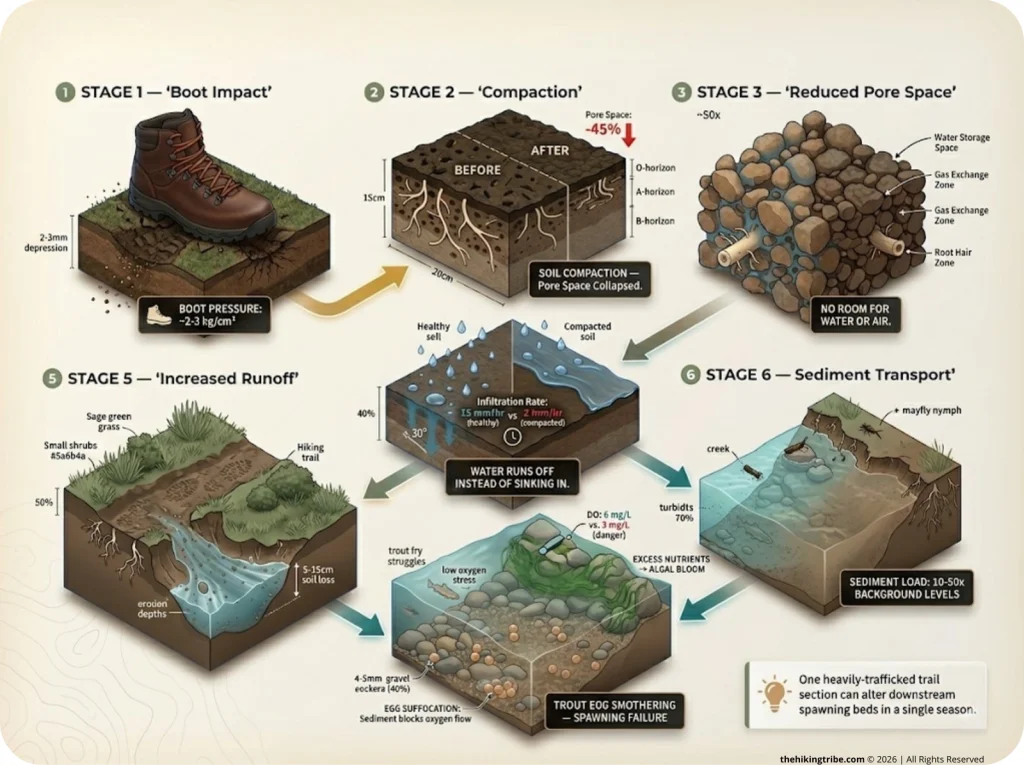
Your hiking boot hits the ground, and the soil beneath it compresses. That compression reduces soil pore space, cutting off the two things plant roots need most: water infiltration and gas exchange. Without those, root growth stalls. The ground slowly stops functioning from the inside.
On flat terrain, the damage spreads sideways. Campsites expand horizontally as hikers seek “clean” ground away from the worn center, increasing the total area of impact. On slopes, the problem flips. The footprint stays smaller, but runoff increases dramatically, carrying sediment, fungus, and bacteria straight into nearby creeks and lakes.
That sediment doesn’t just make water cloudy. It smothers trout eggs on spawning beds, and the phosphorus and nitrogen riding along with it trigger algal blooms that choke dissolved oxygen. One heavily trafficked trail section can alter a downstream spawning bed in a single season.
Pro tip: The relationship between visitor traffic and environmental damage isn’t linear. Concentrating hikers on hardened treads manages impact far better than spreading people across “pristine” ground. Stay on the beaten path. It’s beaten for a reason.
Why “Social Trails” Become Permanent Scars
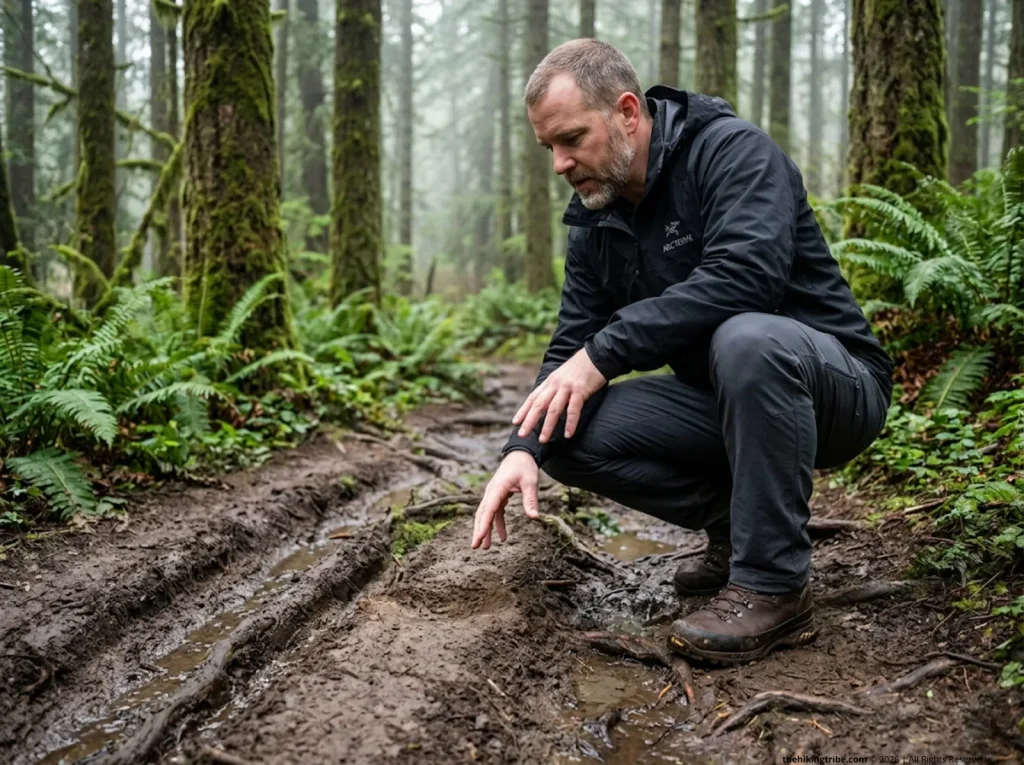
Every time a hiker steps off the main trail to avoid a mud puddle, they trample edge vegetation and kick-start trail widening. Outdoor recreation managers call it trail braiding, and it’s one of the fastest ways to permanently scar a landscape.
These informal social trails strip away the protective organic materials that stabilize soil. Once that layer is gone, wind and water take over. According to USGS research on recreation impacts and soil loss, soil loss is classified as the most significant and long-lasting environmental impact of wilderness recreation.
The counterintuitive rule: walk through the mud to contain impact to the existing tread. Walking around it doubles the damage zone. Dirty boots are a sign you’re doing it right. If you want to understand how walker impact accelerates trail erosion, the mechanics of boot pressure on different soil types makes the stakes even clearer.
Erosion Mechanics on Slopes: Runoff, Sediment, and Aquatic Contamination
Once vegetation is stripped, exposed soil takes the full force of every raindrop, accelerating particle detachment. On slopes, gravity amplifies the transport. Loose particles enter creeks carrying phosphorus and nitrogen that fuel oxygen-depleting algal blooms downstream.
Consider this: if a popular alpine lake trail sees 500 hikers per day with even 5% stepping off-trail on each visit, the cumulative soil erosion over a single season can shift the lake’s turbidity profile measurably. That’s not speculation. That’s what recreation ecologists are documenting in high-traffic parks across the West.
The Desert’s Living Skin: Biocrust You Can’t Afford to Step On
Cyanobacterial Architecture: How the Crust Holds the Desert Together
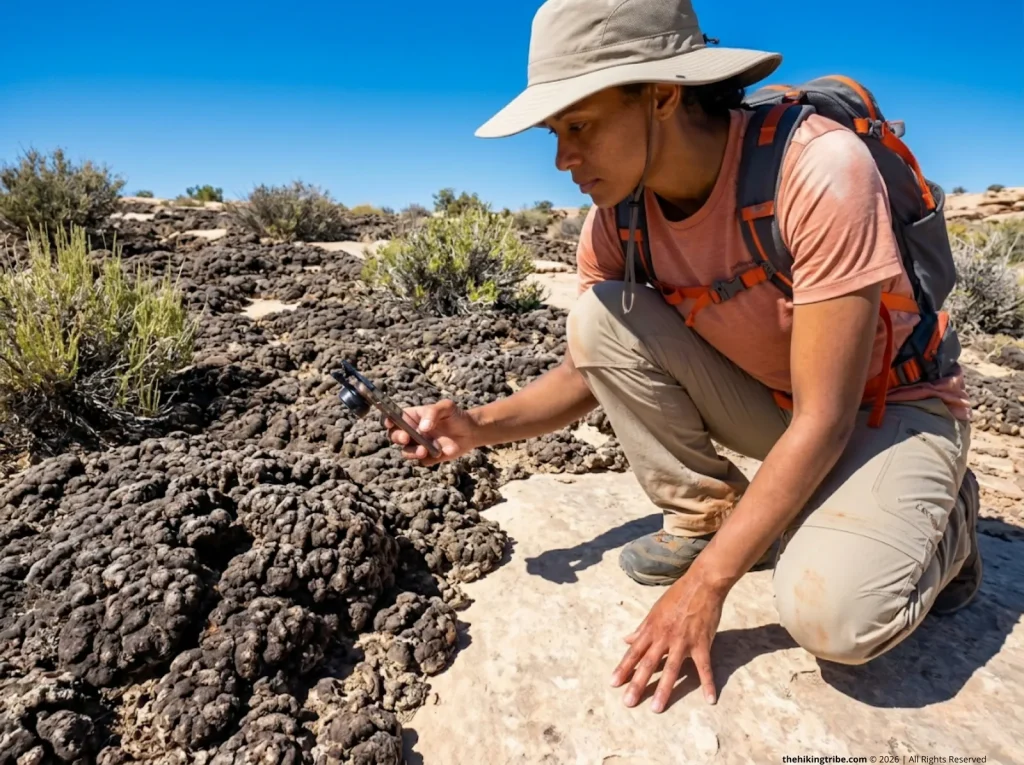
In the high deserts of the Colorado Plateau, the ground between plants is often covered by something alive. Biological soil crust, also called biocrust or cryptobiotic soil, is dominated by cyanobacteria, primarily Microcoleus vaginatus, that move through moistened soil and leave behind sticky fibers forming an intricate sheath network.
Those fibers bind soil particles together so tightly that otherwise unstable sand and silt resist both wind and water erosion. Without the crust, the desert floor is just loose dirt waiting to blow away.
But the crust does more than hold soil in place. Cyanobacteria fix atmospheric nitrogen, enriching nutrient-poor desert soil and creating what is often the only viable germination condition for native plants. The crust also functions as a living sponge, absorbing water and reducing runoff for surrounding grasses and shrubs.
In Canyonlands, the dark, lumpy patches beside the trail are often the only thing preventing the landscape from reverting to shifting sand. One ranger I spoke with described it as “the desert’s immune system.”
Recovery Timelines: Why “It’ll Grow Back” Is a Costly Mistake
Here’s where the numbers get uncomfortable. Initial cyanobacterial colonization takes 5 to 7 years for a thin veneer. Full soil stabilization with extensive sheath material and nitrogen fixation runs 20 to 50 years. A mature crust with lichens and mosses? That’s 50 to 250+ years in very dry environments.
When the crust is dry and brittle, the pressure from a hiking boot pulverizes the fibers, preventing reattachment. Wind scatters the pieces. Without the crust, stable areas can transform into shifting sand dunes within a few years, a cascading effect that threatens every animal species dependent on native vegetation.
The protocol depends on where you are. In trailless desert, the expert advice is to spread out across durable surfaces like rock and gravel to avoid creating social trails on crusted soil. In established-trail areas, stay on the trail always. No exceptions. The NPS field guide to cryptobiotic soil crusts covers the ecological function of these crusts in detail, and if you want a practical field ID guide for cryptobiotic soil, that companion piece walks through what to look for on the ground.
Alpine Tundra: Where a Footprint Lasts a Century
Trampling Tolerance by Growth Form: Which Plants Survive and Which Don’t
Not all alpine plants take the same beating. Scientists classify plants by where their dormant buds sit, and that classification predicts how well they handle foot traffic. Plants with buds at the soil surface (hemicryptophytes) and those with underground storage organs (geophytes) show higher resistance to trampling.
Woody shrubs and tall tussock grasses are the most vulnerable. Physical breakage combined with extremely slow growth rates prevents rapid recovery. In the Western Arthur Range of Tasmania, severely degraded alpine tundra required 100+ years to regenerate. Each pedestrian transit in high-latitude alpine zones creates a direct, measurable impact on vegetation cover.
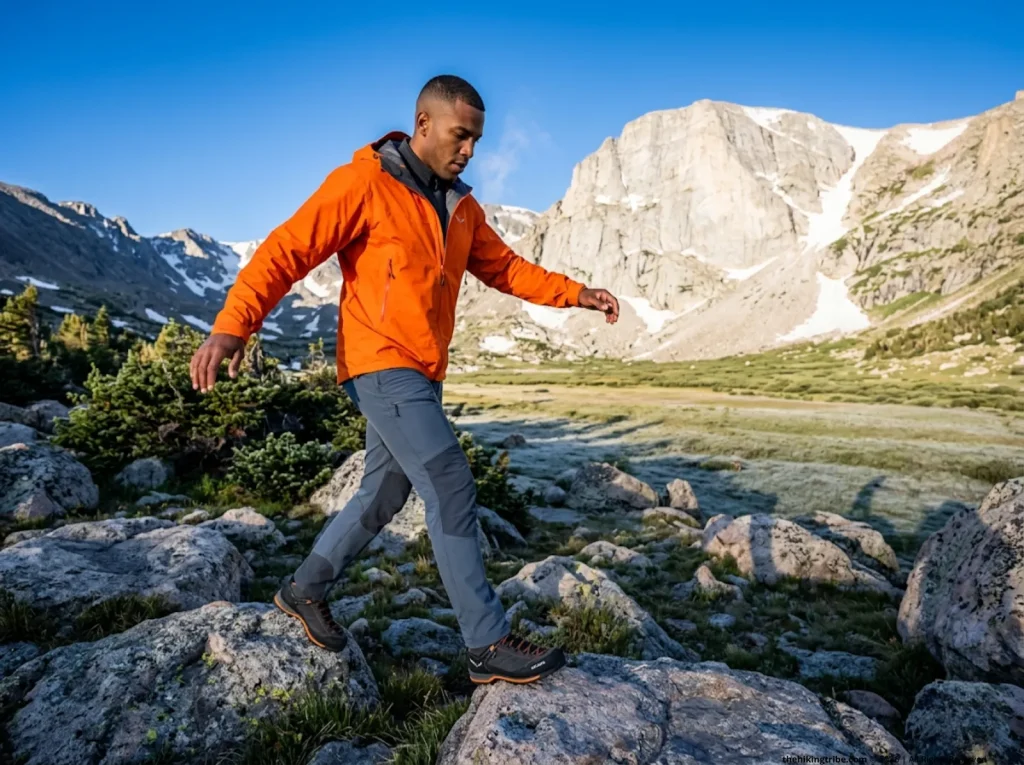
Pro tip: Rock-hopping across exposed boulders instead of cutting through meadow vegetation preserves the plant types with the slowest recovery trajectories. Your ankles might complain, but the tundra won’t.
Understanding how modern trail design protects fragile alpine zones shows why properly engineered trails are the first line of defense in these environments.
The Invisible Casualties: Lichens, Bryophytes, and the Delayed Disappearance
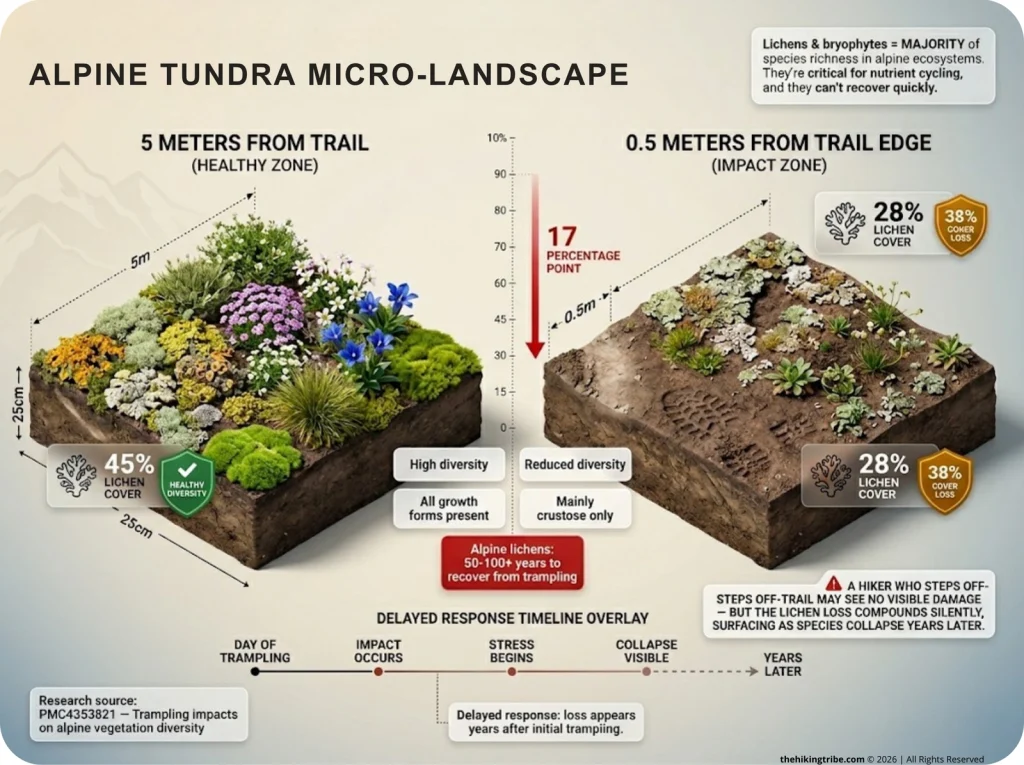
Here’s what most hikers never learn. Non-vascular plants like lichens and bryophytes often make up the majority of species richness in extreme alpine environments and are critical for nutrient cycling. According to peer-reviewed research on trampling impacts to alpine vegetation diversity, proximity to a trail dramatically reduces lichen abundance: from 45% cover at 5 meters away to just 28% within 0.5 meters of the trail edge.
Lichens suspend their metabolism when dry, which lets them survive brutal cold but also makes them brittle and easily crushed by boots. And unlike vascular plants that may show immediate regrowth, lichens exhibit a “delayed response”: they can disappear completely years after the initial trampling event, masking the true scale of damage.
A hiker who steps off-trail in a dry alpine meadow may see no visible damage at all. But the lichen loss compounds silently, surfacing as species collapse years later. The damage is real. You just can’t see it when it happens.
Your Noise Is a Stressor (And Your Food Scraps Are Worse)
Acoustic Footprints: The Stress You Can’t See
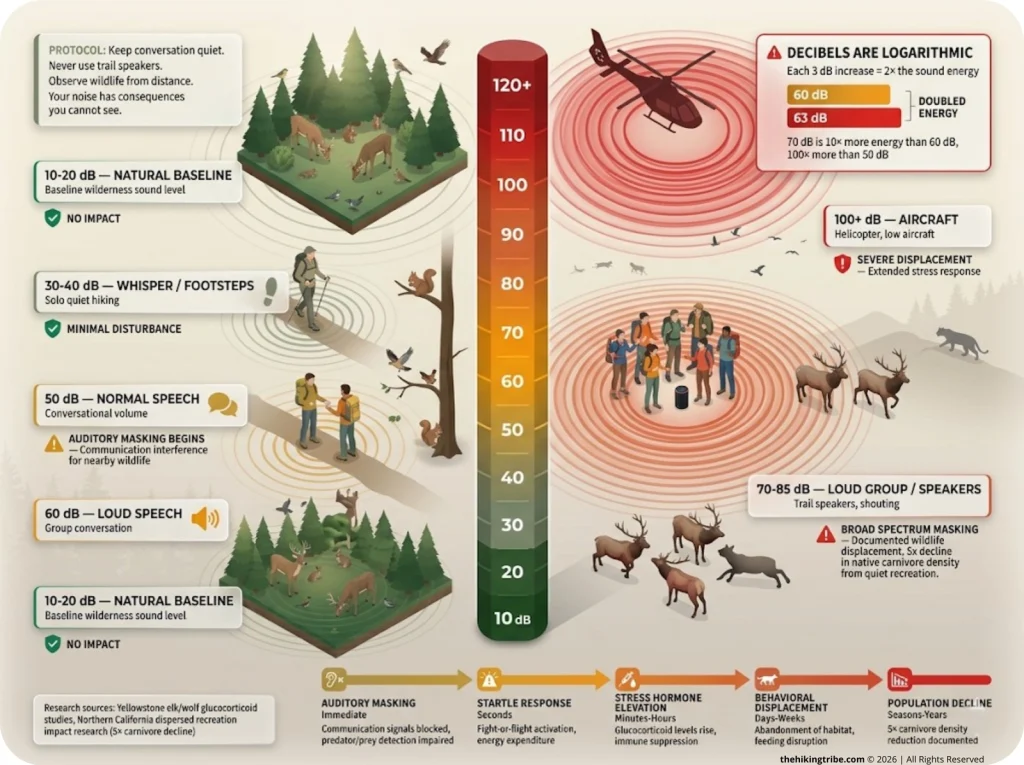
Animals rely on acoustic cues for communication, predator avoidance, and prey detection. Your voice on the trail creates auditory masking that blocks those signals.
Conversational speech registers around 60 dB, enough to interfere with close-range animal communication. A loud group or trail speaker pushes 70 to 85 dB, triggering startle responses and broad-spectrum auditory masking. Keep in mind: the decibel scale is logarithmic. A 3 dB increase doubles the sound energy hitting an animal’s nervous system.
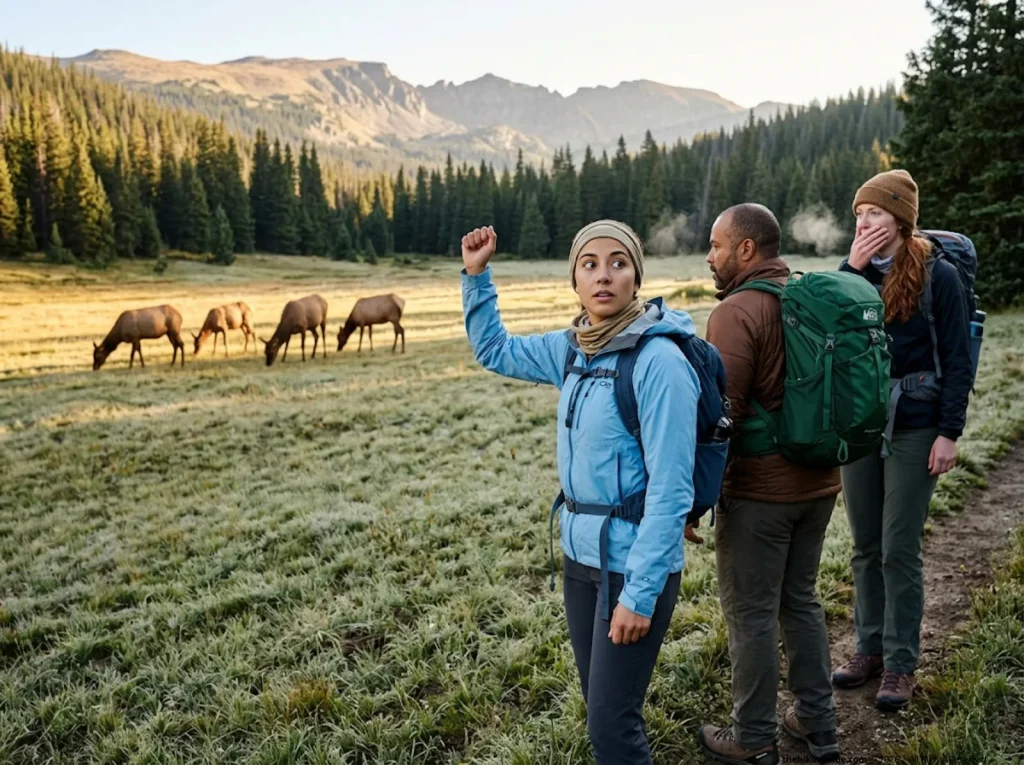
In Yellowstone, glucocorticoid levels (stress hormones) in elk and wolves fluctuate in parallel with human activity, even from “quiet” recreation like hiking. Research in northern California showed something even harder to swallow: dispersed, quiet recreation, including hiking and biking, led to a five-fold decline in native carnivore density.
On a solo dawn patrol through a Colorado basin, I’ve watched a herd of elk visibly relax as the first noisy group of the day crested the ridge 300 yards away. The herd moved. Every dawn. Same ridgeline. Same response. This isn’t anecdote. It’s documented biology. For practical distance protocols, check the wildlife watching distance rules most hikers ignore.
Food Scraps and Subsidized Predators: The Chain Reaction
Leaving fruit peels, nut shells, or crumbs on the trail doesn’t just look bad. It subsidizes opportunistic predators, artificially inflating their populations beyond what the ecosystem can naturally support.
The documented consequences are specific. In Monterey Bay, human-food-subsidized gull populations doubled or quadrupled, consuming up to 30% of juvenile steelhead trout as they migrated to sea. In the Mojave Desert, garbage-fed ravens attack nearly 30% of juvenile desert tortoises. In New Forest National Park, anthropogenic food makes up 14% of fox diets, sustaining higher densities that threaten breeding waders like curlew and lapwing.
Black bears with access to human food can reach 800 to 900 lbs versus a healthy weight of 100 to 250 lbs. They develop obesity, lung problems, and habituation that typically ends in euthanasia. Yale Environment 360’s investigation into food waste and wildlife predation shifts documents these cascading effects in detail.
And here’s the part people miss: orange peels and banana peels don’t decompose quickly in cold or arid environments. Long before they break down, they act as unnatural food subsidies that reshape local predation dynamics. Pack it all out. Every wrapper. Every peel. Every crumb.
The Chemical Footprint: What Your Gear and Sunscreen Leave Behind
PFAS in Waterproof Gear: The “Forever Chemicals” on Your Back
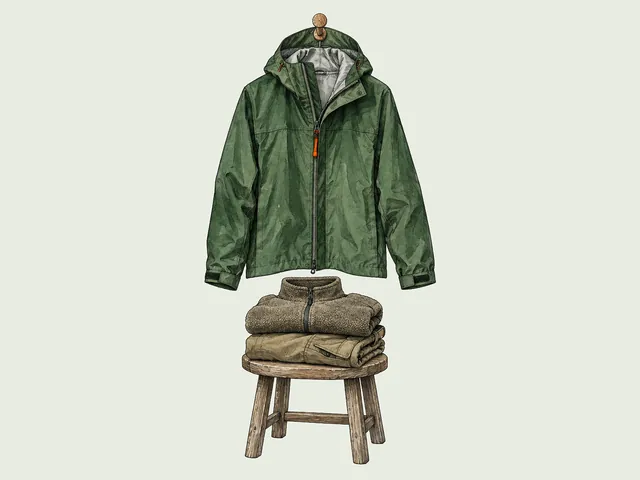
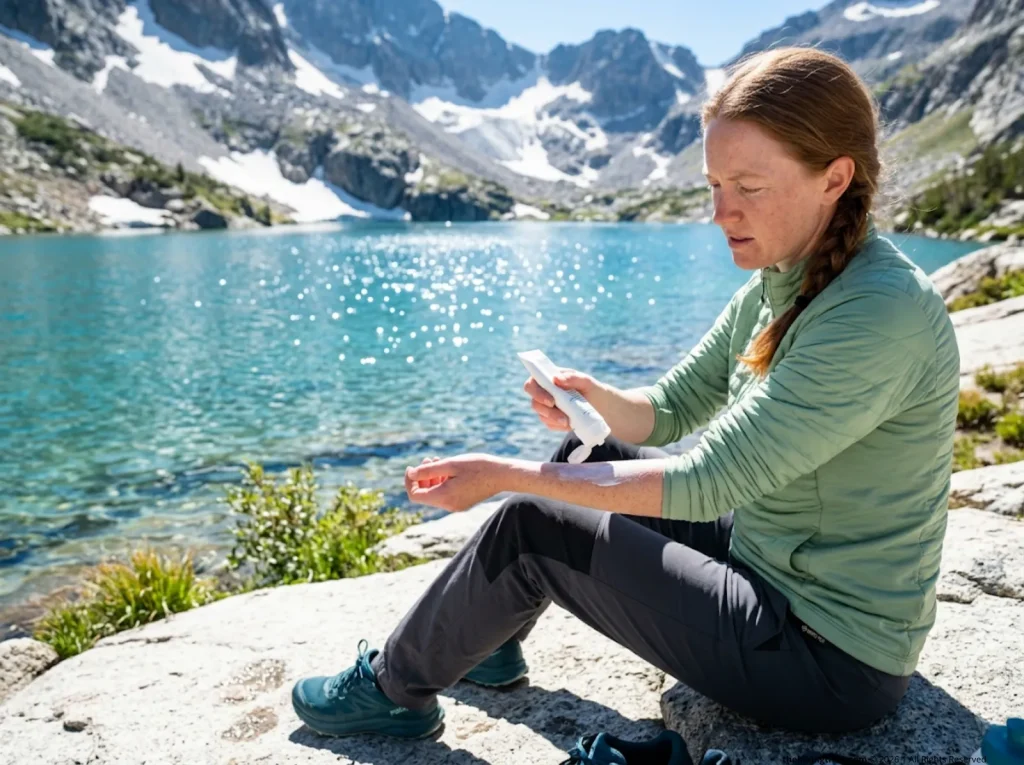
PFAS, per- and polyfluoroalkyl substances, are used in DWR treatments and waterproof membranes across the outdoor industry. They don’t biodegrade. They’ve been detected in remote glaciers and in polar bear tissue. When you hike in a traditional rain shell, micro-quantities of these chemicals transfer into the environments you move through.
The industry shift from C8 to C6 fluorocarbons was marketed as a safer alternative, but C6 chemicals also accumulate in the environment with potentially harmful effects. The good news: PFC-free alternatives now exist. The GORE-TEX ePE membrane and Patagonia’s PFAS-free DWR deliver equivalent or better performance while running lighter and with a lower carbon footprint.
Pro tip: When buying new rain gear, check the label for “PFC-free” or “PFAS-free DWR.” If the brand doesn’t specify, assume it still uses fluorocarbons. A few extra minutes of label-reading keeps forever chemicals out of alpine watersheds.
PFC-free DWR finishes based on wax, silicon, or plant compounds require more frequent reapplication, but the tradeoff is eliminating forever-chemical contamination in the backcountry. If you’re shopping for what PFAS-free waterproofing means for your hiking pants, that breakdown covers the practical gear-buying side.
Sunscreen and DEET in Alpine Lakes: The Invisible Pollution
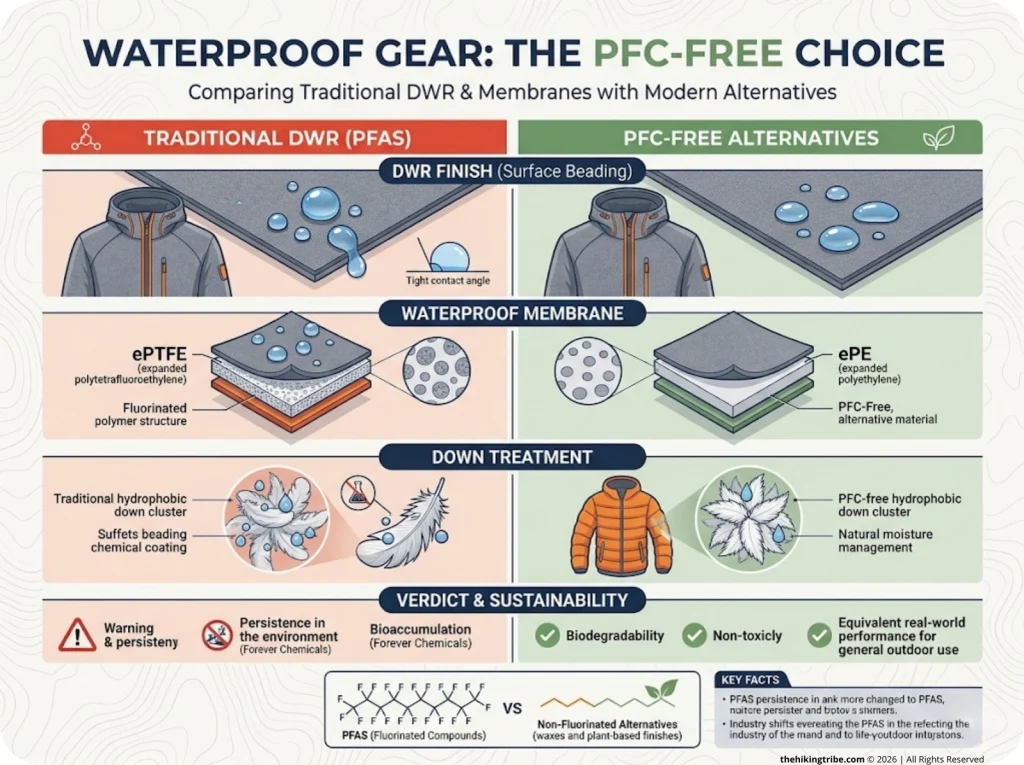
At least 25% of sunscreen washes off during water-based activities. A single lake with 1,000 visitors can receive over 35 kg of chemical deposits per day. Let that number sit for a second.
Oxybenzone (benzophenone-3) is an organic UV filter linked to hormone disruption, coral bleaching, and decreased fish fertility. Scientists classify it as a “pseudo-persistent pollutant” because it’s continuously re-introduced by swimmers and hikers faster than the environment can break it down.
DEET, the common insect repellent, has been detected in surface waters at concentrations up to 32.18 μg/L. While not acutely toxic at those levels, it carries potential for chronic effects on aquatic invertebrates. Peer-reviewed monitoring of DEET’s environmental impact on aquatic ecosystems covers the ecotoxicity data.
What to do instead: use mineral-based sunscreens with zinc oxide or titanium dioxide and apply at least 15 minutes before entering water. Better yet, cover up with UPF clothing before reaching the lake. Your skin stays protected, and the water stays clean.
Waste Management in the Wild: When Catholes Aren’t Enough
Where Catholes Fail: Alpine Tundra, High Desert, and Mandatory Pack-Out Zones
In high-use fragile environments like the Mount Whitney Zone, Mount Shasta, and Denali, the standard cathole method doesn’t cut it. Decomposition rates are too slow for the volume of visitors. Cold, arid, and high-altitude environments lack the microbial activity and moisture needed to break down waste within any reasonable timeframe.
Pack-out mandates exist in these zones because accumulated human waste contaminates water sources with pathogens and loads nutrients into native plant communities that aren’t adapted to handle it. The 200-foot cathole rule still applies in lower-elevation forests, but the moment you move into alpine zones, you need to transition to mandatory pack-out kits.
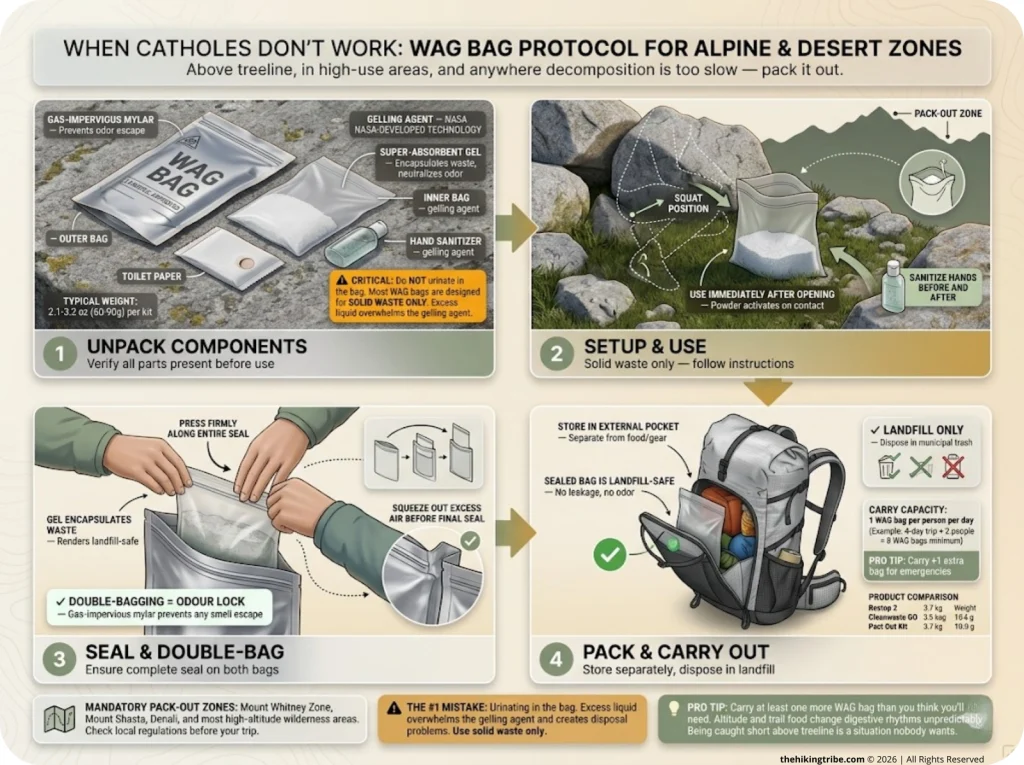
Using WAG Bags: Technical Protocol for the Field
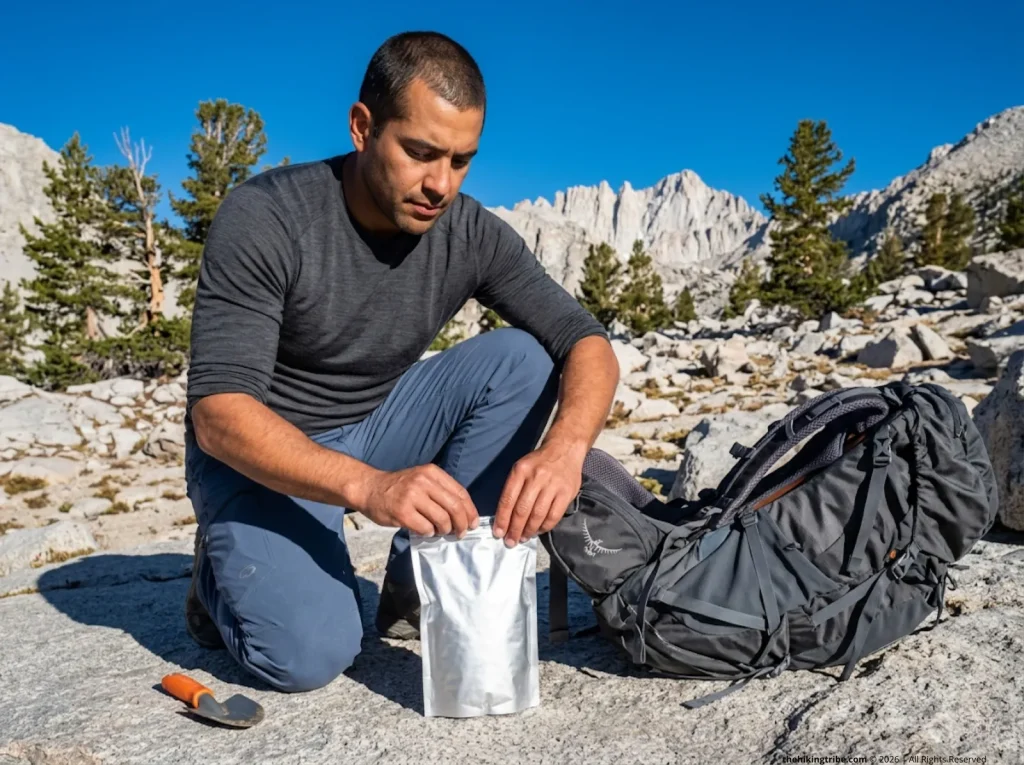
WAG bags use super-absorbent gelling crystals, marketed as “Poo Powder” and originally developed by NASA, that encapsulate waste, neutralize odor, and render it landfill-safe.
The key technical detail most people miss: do NOT urinate in the bag. Most WAG bags are designed for solid waste only. Excess liquid overwhelms the gelling agent and creates problems you don’t want to troubleshoot on a ridgeline.
The system is straightforward. Inner bag handles the business. Heavy-duty outer bag, usually gas-impervious mylar or a puncture-resistant barrier, prevents leaks in your pack. Proper disposal means landfill only. WAG bags with gelling agents are EPA-approved for landfill disposal, but they should never go in pit toilets or compost piles. The Leave No Trace Center’s official WAG bag disposal guidelines spell out the protocol.
For product selection, the weight breakdown runs: Restop 2 at 3.0–3.2 oz, Cleanwaste GO at 2.5 oz, and Pact Out Kit at 2.1 oz. Any of these will get the job done.
Pro tip: Carry at least one more WAG bag than you think you’ll need. Altitude and trail food change digestive rhythms unpredictably. Being caught short above treeline with no pack-out option is a situation nobody wants.
For the full system, including the complete pack-it-in, pack-it-out waste field guide, that companion piece covers the entire waste management workflow from trailhead to disposal.
Conclusion
Three things worth carrying out of this piece.
The damage is invisible at first. Soil compaction, lichen loss, and stress hormone spikes in wildlife don’t produce immediate visual cues. The biological cost compounds over seasons and decades, long after you’ve driven home and washed your boots.
Protocols change by bioregion. Spread out in trailless desert. Stay single-file in alpine zones. Pack out waste above treeline. There is no universal “right way” that covers every sensitive ecosystem. The terrain dictates the rules, and the rules change when you cross an elevation band or a soil type.
Your gear has a chemical footprint. From PFAS in your rain shell to oxybenzone in your sunscreen, every product you carry into the backcountry has a downstream consequence. Choose accordingly.
Before your next trip into sensitive terrain, research the specific ecosystem you’ll be entering. Check whether the area requires WAG bags, whether biocrust is present, and whether noise restrictions apply through agencies like the National Park Service. One hour of planning prevents a century of ecological recovery.
FAQ
How long does it take for cryptobiotic soil to recover after being stepped on?
A thin veneer of cyanobacteria may return in 5 to 7 years, but full recovery with lichens and mosses takes 50 to 250+ years in arid environments. In very dry regions, the crust may never fully recover, leaving the soil permanently vulnerable to wind erosion and nutrient loss.
Is it okay to walk off-trail if the main path is muddy?
No. Walking around mud tramples edge vegetation and causes trail widening, called braiding. Walk through the mud to contain all impact within the existing trail tread, even if it means dirty boots. The trail is designed to handle the traffic. The margins aren’t.
Does quiet hiking still disturb wildlife?
Yes. Research in northern California showed that dispersed, quiet recreation, including hiking or biking, led to a five-fold decline in native carnivore density. Even non-motorized human presence triggers measurable wildlife stress hormone elevation in large ungulates.
What is the most fragile ecosystem type for hikers?
Alpine tundra and desert biocrust systems are among the most fragile. Alpine vegetation can take 100+ years to regenerate after severe trampling, and a single footprint in desert biocrust can undo 50+ years of biological development. Both ecosystems lack the microbial activity and moisture needed for fast recovery.
Are fruit peels and nut shells okay to leave on the trail since they’re biodegradable?
No. In cold and arid environments, organic waste decomposes extremely slowly and acts as an unnatural food subsidy for wildlife. This inflates predator populations and disrupts natural food chains. Documented cases include ravens preying on juvenile desert tortoises and gulls consuming up to 30% of juvenile steelhead trout, both subsidized by human food waste.
I've spent more than a decade researching hiking gear and trail technique. I read the specs, the forum threads and the long-term reviews, and every pick here comes with what it gets wrong.
End of the trail
You read every mile of this one. Here's where the trail goes next.