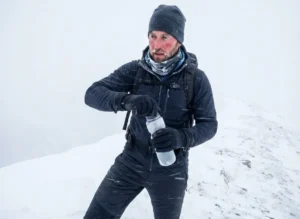
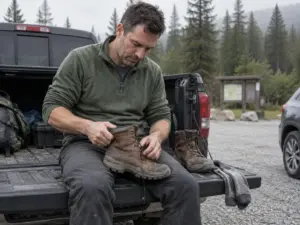
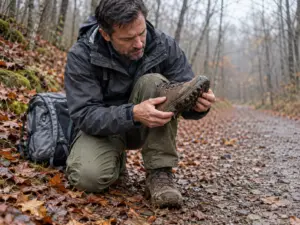

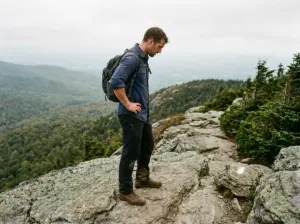
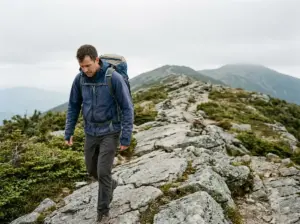
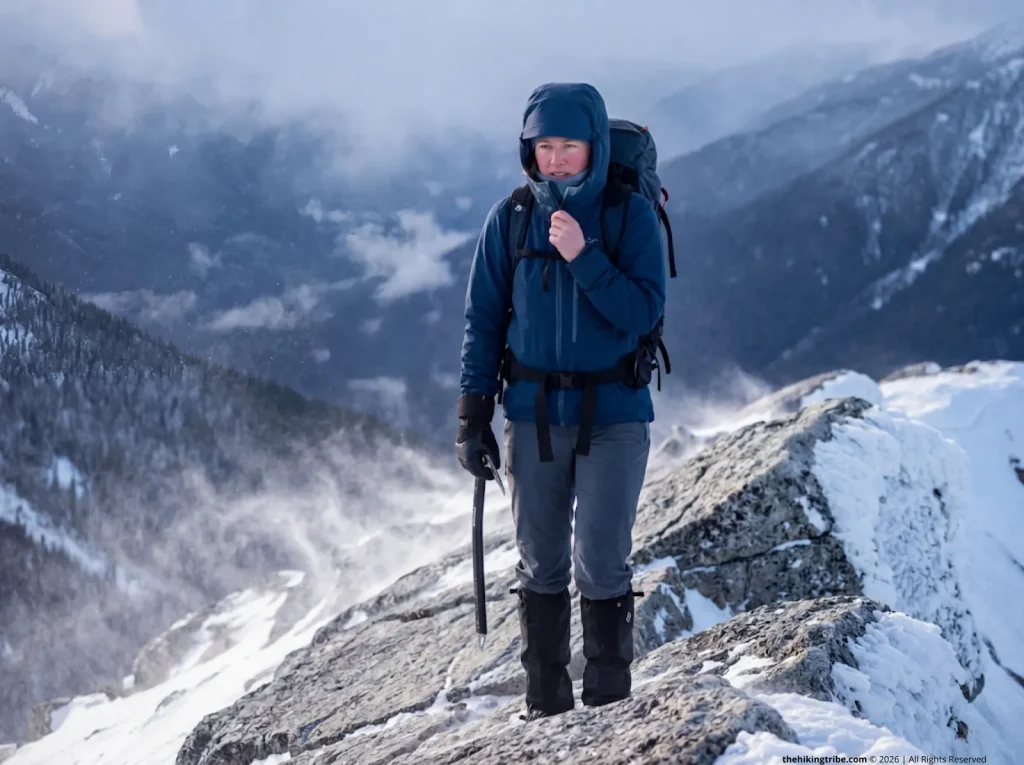
The tip of my right index finger had turned the color of candle wax. I pressed it hard — nothing. No pain, no pulse under the skin, just a cold, blank nothingness. My hands were inside Gore-Tex gloves. I had a balaclava. I had followed every “stay warm” tip I’d ever read. Somewhere on the north ridge at 11,400 feet, I had still managed to hand my tissue over to frostbite.
That’s the thing that gets experienced hikers. Not the rookies who show up in cotton hoodies. The people with the right gear, the ones who’ve done winter hikes before, the ones who thought they understood the problem. The physics of cold-weather tissue loss doesn’t care about your experience. It follows its own rules — and most hikers don’t know what those rules actually are.
This article covers four things that matter when your life depends on it: the thermodynamics of heat loss, the biology of who goes cold first, the gear failures nobody talks about, and the 2024 WMS field protocols for when things go wrong anyway.
⚡ Quick Answer: Frostbite happens when tissue temperature drops below 31°F and the water in your tissue begins to freeze. The biggest risk factors aren’t cold temperatures alone — they’re wind chill, moisture in your insulation, compression in your boots, and vasoconstriction from caffeine, nicotine, or alcohol. Prevent it by starting cold (not overdressed), eating before you’re hungry, running mandatory buddy checks every 15-30 minutes on exposed terrain, and using the NOAA/NWS Wind Chill Chart to make go/no-go decisions before reaching exposed sections.
The Physics of Heat Loss: Why Warmth Is Not What You Think
Here’s where people go wrong first. They think of cold as something that attacks you. It doesn’t. Cold is just the absence of heat, and your body is constantly losing that heat through three vectors — conduction, convection, and evaporation — that most hikers manage poorly or don’t manage at all.
Conductive heat loss through moisture is the sneaky one. Water conducts heat approximately 25 times faster than still air. That number is worth sitting with. A wet sock isn’t insulation anymore — it’s a thermal conductor that drains heat from your toes into the boot sole. When the air pockets in your wool or synthetic fibers fill with sweat, the dead-air space collapses. You’re essentially sanding down your own insulation from the inside.
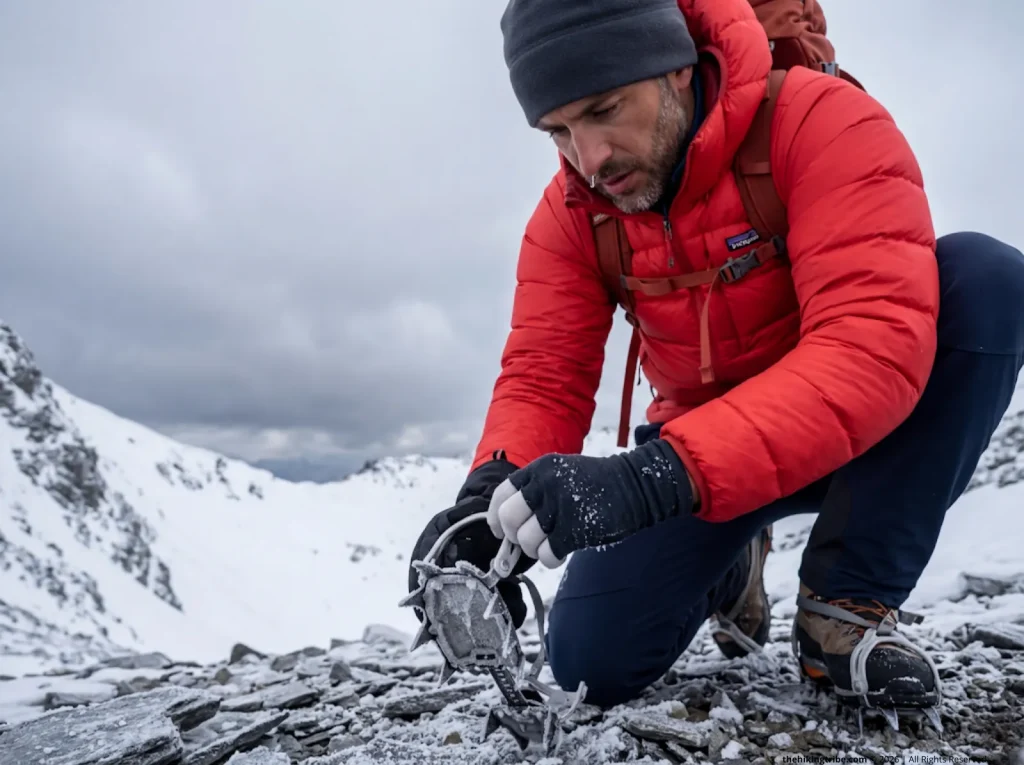
Metal gear makes this worse. Sub-freezing crampons, stove parts, tent stakes — any bare-skin contact in extreme cold can cause what field medics call “flash frostbite.” The moment I unsealed my glove to adjust a crampon strap, the metal bail transmitted cold so fast my fingertip was numb before I refastened the buckle. That’s not an exaggeration. Metal conducts heat away from skin faster than biological tissue can replace it.
Pro tip: A foam sit pad isn’t a comfort item on alpine terrain. The moment you sit on snow or frozen ground, you bypass your boot insulation entirely. Keep it accessible — top of pack, strapped to a strap — not buried. The heat you lose resting on snow is invisible until you stand up and realize your core temp has already dropped.
Conduction: The Ground, Your Gear, and the 25× Rule
When a boot’s insulation lofts are saturated with sweat, the dead-air pockets collapse. The insulation layer stops being a barrier and starts being a bridge — conducting your body heat directly into the frozen ground with every step. This is why sock material matters more than sock thickness. Merino wool manages moisture differently than polypropylene, which manages it differently than cotton (which doesn’t manage it at all).
For extreme cold, modern 3M Thinsulate and PrimaLoft microfibers resist compression better than natural wool or down — which is why technical winter boots use them. But even the best synthetic insulation loses R-value under mechanical load. You are compressing your insulation every single time your foot hits the ground.
Convection: The 2001 Wind Chill Paradigm and What It Means for You
Wind chill is the number that actually kills people, and most hikers read it wrong. The NWS updated its wind chill formula in 2001 specifically because the old 1945 water-container model overestimated chilling effects at low speeds and underestimated them at high exposure. The current formula accounts for human skin heat loss directly.
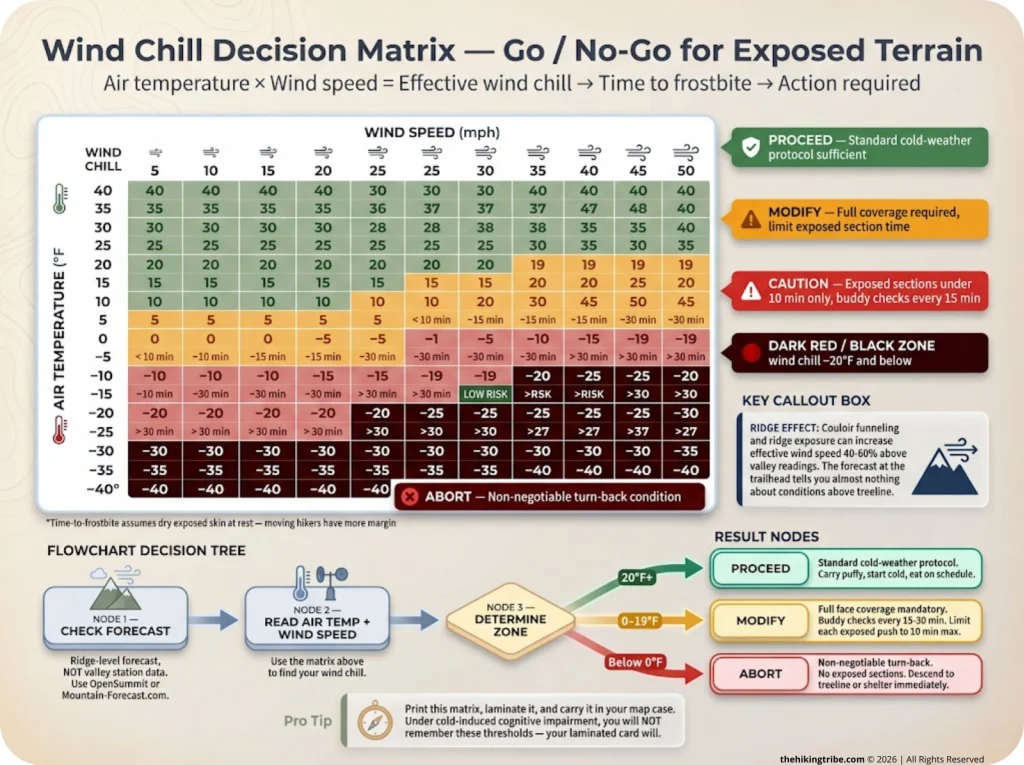
At −10°F with 25 mph wind, effective wind chill hits −37°F. Tissue can freeze in under 10 minutes. At 15°F with 20 mph wind, you’re at −2°F wind chill with more than 30 minutes to frostbite. That’s a massive difference between two scenarios that can feel similar when you’re moving.
What wind chill does is strip the warm boundary layer off your skin — a thin envelope of heated air, about 1-2mm thick, that your body constantly regenerates. Ridge exposure and couloir funneling can increase effective wind speed 40-60% above what valley readings show. The forecast you checked at the trailhead tells you almost nothing about conditions on the exposed face above treeline. Check ridge-level forecasts from OpenSummit or NOAA Alpine Zone — not valley station data. For a deeper look at why convective stripping matters and how wind shirts block it, see convective heat loss and the physics of wind protection.
Evaporation: The “Flash-Off” Chill After You Stop Moving
This is the moment most frostbite actually begins. You stop after a sustained push, sweat-laden layers start to evaporate, and two things happen simultaneously: your metabolic output drops from roughly 800 watts back to around 100 watts, and evaporative cooling begins pulling heat out of your wet layers fast.
The mandatory rule: mid-layer goes on before you stop moving. While still generating heat. Not after you’ve cooled. Most people get this backwards. They stop, they feel hot, they wait a moment, and then by the time the chill hits they’re already past the optimal window for warming.
Perfusion Mechanics: The Biology of Who Goes Cold First
Cold feet are not caused by cold feet. That’s the thing guides have to explain constantly to clients on winter summits. Your toes are cold because your core is cold, and your hypothalamus is cutting circulation to the extremities to protect your kidneys and heart.
The preoptic area of the anterior hypothalamus monitors the temperature of blood returning from the periphery. When it reads cold, it triggers two responses: shivering and peripheral vasoconstriction. Baseline cutaneous blood flow in a loaded hiker is roughly 200-250 mL/min. Under extreme cold stress, it can drop below 50 mL/min — an 80%+ reduction. At that point, your toes aren’t getting enough blood to stay warm regardless of what your socks are doing.
What most trail guides don’t tell clients — and what competitors writing about frostbite consistently miss — is that the body’s self-rescue mechanism for the extremities, the Cold-Induced Vasodilation (CIVD) cycle, requires fuel to work. And it has three failure modes that shut it down entirely.
The CIVD “Hunting Response” works like this: after initial vasoconstriction cuts circulation to the toes, the body periodically dilates those peripheral vessels every 5-10 minutes, sending a burst of warm blood to re-warm the digits. After 8 hours on a summit attempt with no food since 3am, my toes went from cold to numb within 20 minutes of stopping. The Hunting Response needs fuel. I had given it none.
Pro tip: The most effective treatment for cold toes on a moving hiker is not foot stamping — it’s adding a layer to the torso. Core warmth is the prerequisite for extremity warmth. The body doesn’t warm your toes while it’s still in crisis mode for the core.
The Vasoconstriction Threshold: When the Body Sacrifices the Digits
When skin temperature reaches around 59°F, vasoconstriction reaches maximum. At 31°F skin temperature, the water in tissue begins to freeze. The process isn’t a failure — it’s working exactly as designed. The body is choosing fingers and toes over kidneys and heart. Your job is to prevent the thermal conditions that force the choice. Consult the 2024 Wilderness Medical Society Clinical Practice Guidelines for Frostbite for the full vasoconstriction threshold data and field classification standards.
The CIVD Hunting Response and Its Three Failure Modes
Three conditions kill the Hunting Response:
Failure Mode 1 — Metabolic: The CIVD cycle is energetically expensive. A hiker in caloric deficit suppresses it. The body will not waste heat on the periphery if core reserves are low.
Failure Mode 2 — Altitude: Above roughly 12,000 ft, reduced blood oxygen impairs vascular smooth muscle dilation capacity. Peak baggers are physiologically more vulnerable on the same temperature day as lowland hikers. This connects directly to altitude’s compounding effect on peripheral circulation — it’s not just about breathing, it’s about whether your blood vessels can respond.
Failure Mode 3 — Prior Injury: Even one prior frostbite episode can permanently destroy the micro-vascular nerve endings that trigger CIVD. The C-fiber nerves that mediate the response can be damaged while the overlying skin heals to a visually normal appearance. A hiker looks healed. Biologically, they’re more fragile than before.
Caloric Fuel as a Survival Variable
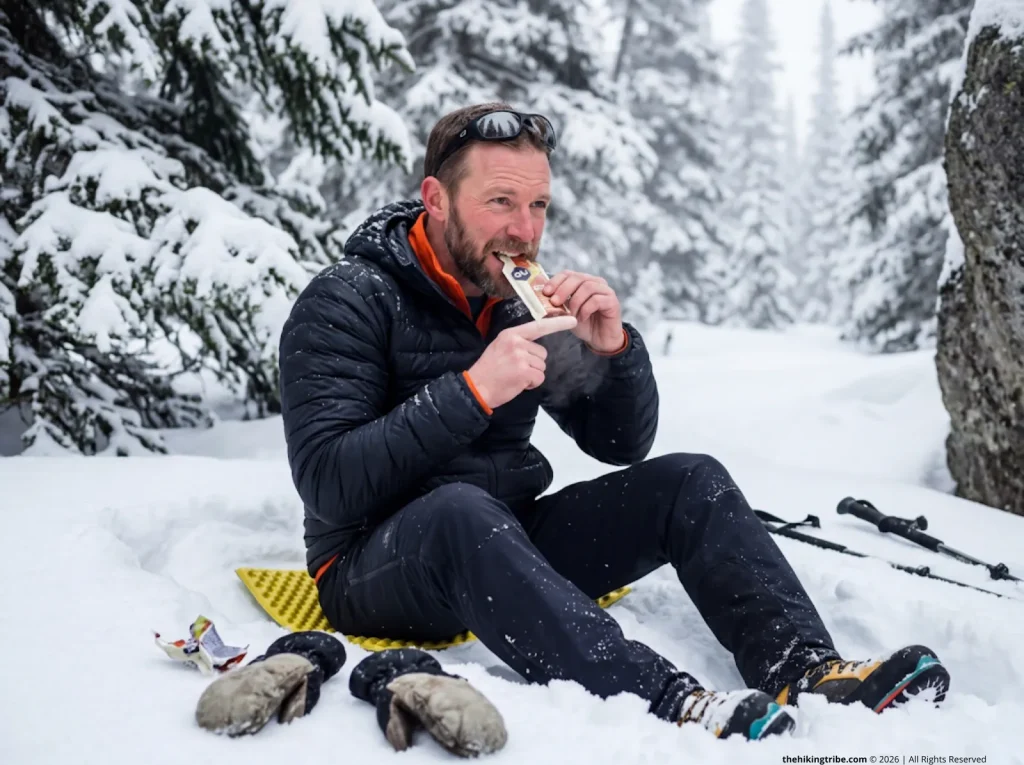
Maintaining metabolic output under cold-stress conditions requires roughly 250-350 calories per hour. Shivering thermogenesis can burn up to 700 calories per hour but is unsustainable without carbohydrate input. Hunger signals are dulled by vasoconstriction — your body in an emergency doesn’t always tell you it needs food. You have to eat on a schedule, not on demand.
High-glycemic fast-fuel: dates, gels, blocks, every 45-60 minutes. Not when you’re hungry. Not at the summit. Throughout. For a complete fueling strategy to sustain core thermogenesis across cold-stress conditions, the backpacking nutrition guide covers macronutrient ratios and caloric density for winter trips.
Gear System Failures: The Compression Penalty, the Emollient Myth, and Vapor Barriers
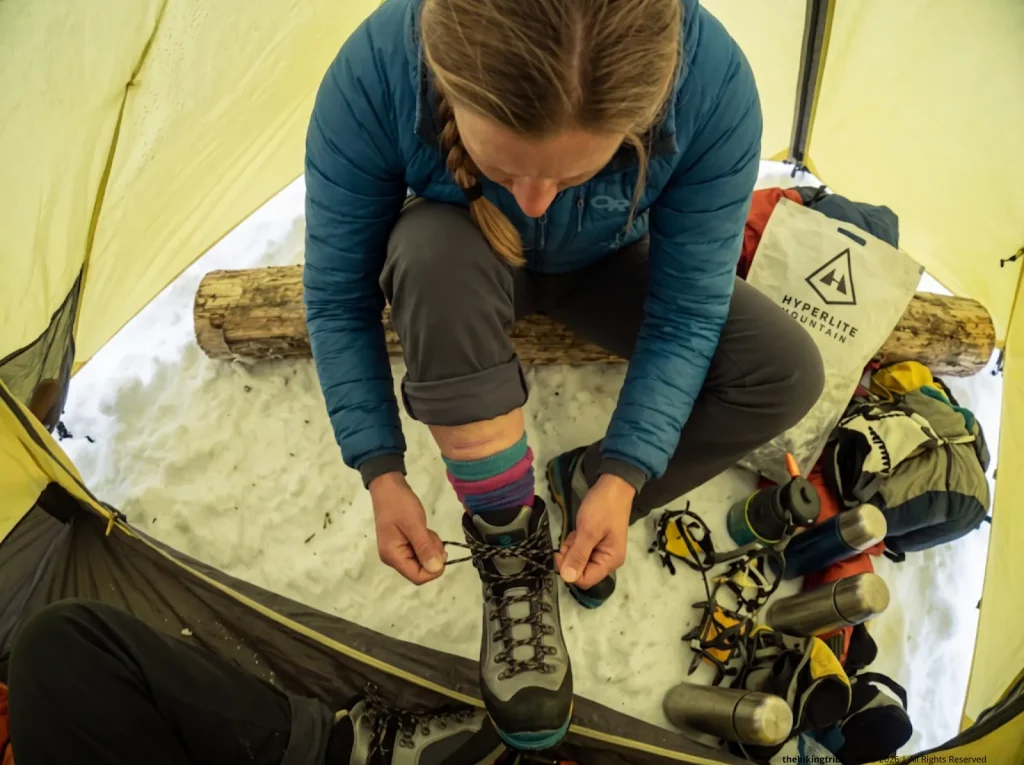
Feet account for nearly half of all clinical frostbite cases. The reasons are almost all gear-related — and almost all avoidable. Three specific misconceptions cause frostbite in hikers who thought they were fully equipped.
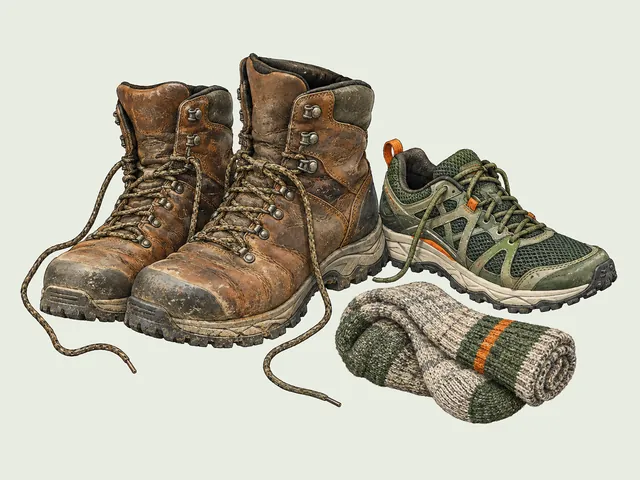
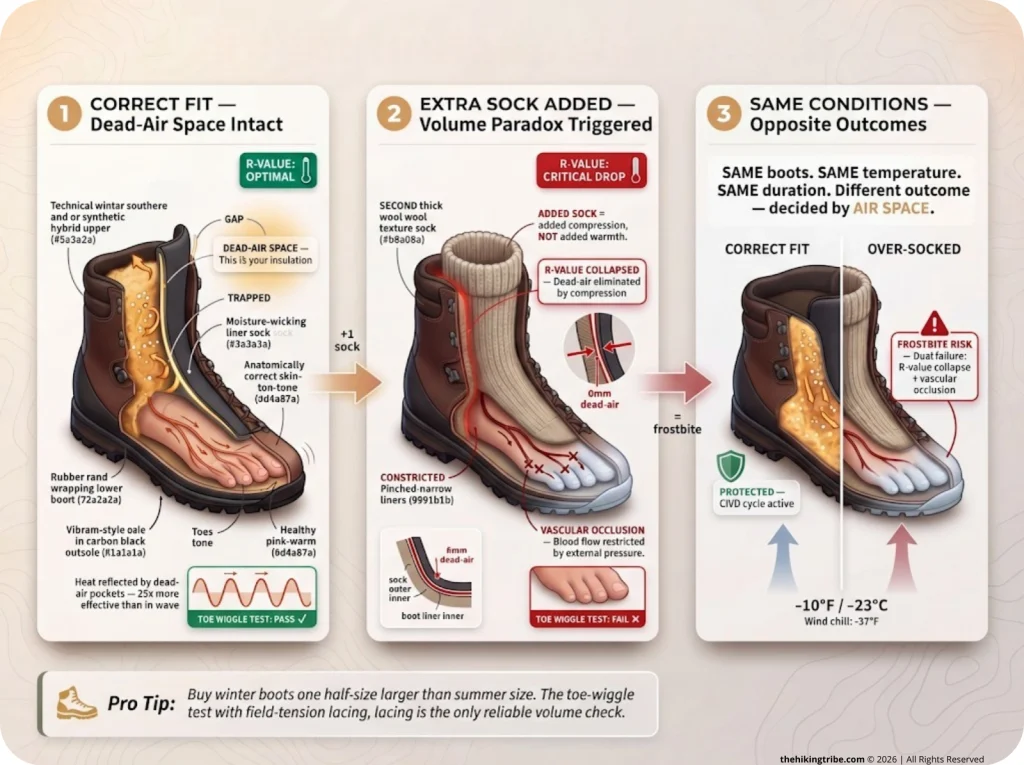
Three pairs of socks and my toes were completely numb by mile 2. My laces had been tied to the same tension as summer. The boot was so tight I couldn’t wiggle a single toe. That’s the Volume Paradox, and it takes toes every winter across every mountain range in the Northern Hemisphere.
The Volume Paradox: Why “More Socks” Kills Toes
Adding a sock when your boot is already at maximum internal volume doesn’t add warmth. It compresses the existing insulation, collapses the dead-air space (which is where the actual R-value lives), and restricts blood flow to your toes simultaneously. Two independent failure modes triggered by one well-intentioned mistake.
At altitude, gas expansion in footwear and sock fibers further increases internal pressure in a tight-fitting boot. The standard toe-wiggle test: with the boot tied to field tension, you should be able to wiggle all five toes freely. If you can’t, the volume is wrong for that sock combination.
Pro tip: Buy winter boots one half-size larger than your summer size. Foot volume increases slightly from cold-induced vasoconstriction and from the added thickness of thermal socks. A boot that fits perfectly at the store will feel significantly tighter on trail in January. For more on vapor barrier liner performance in extreme cold footwear systems, the pac boot crossover article tests this in field conditions.
For −20°F or colder, double mountaineering boots with removable liners are the only sound option. The liners go in the sleeping bag at night to reset their thermal performance.
The Emollient Fallacy: What the Finnish Military Found
The Finnish Conscript Study — a prospective study of 913 cold injuries from the Research Institute of Military Medicine, Finnish Defence Forces — is the most important data set most hikers have never heard of. The results were unambiguous. Applying “protective” ointments to the face was associated, per the Finnish military study linking emollient use to increased frostbite incidence, with a 5.6× higher risk of nasal frostbite, 4.5× higher risk of ear frostbite, and 3.3× higher risk of general facial frostbite.
The mechanism runs two ways. Physically, many creams contain water that can freeze on the skin’s surface, or they replace the insulating air layer with a conductive semi-liquid film. White petrolatum creates a subjective warmth sensation that isn’t supported by surface thermometry — the feeling of warmth is the hazard. Behaviorally, hikers who apply cream report feeling protected and then neglect balaclava adjustment and buddy-check monitoring.
The only valid facial protection: dry windproof fabric covering all exposed skin, combined with mandatory group visual inspection every 15-30 minutes.
Vapor Barriers and the Dew Point Breach in Layering Systems
The standard three-layer system fails in extreme cold at a point most hikers don’t know exists: the dew point breach. In sub-freezing conditions, sweat vapor condenses into liquid within the insulation layer or on the inner hardshell surface. When that happens, loft collapses. Down and synthetic lose their ability to trap air. You’ve turned your insulation into a wet sponge.
Vapor Barrier Liners (VBL) solve this by stopping insensible perspiration at the source. Worn next to the skin or over a thin liner sock, a VBL creates a 100% humidity environment that signals the body to stop producing vapor. Your insulation layers stay bone-dry, full R-value maintained across the entire trip. Temperature guidelines: VBL gloves below 40°F; full foot/body VBLs below 20°F.
Budget solution: high-density polyethylene bread bags used as sock liners. Functionally equivalent to commercial VBL sock systems. For the full framework on building a moisture-managing layering system that doesn’t collapse in extreme cold, the layering science guide covers base layer, mid layer, and shell layer integration.
Chemical Risk Factors: Caffeine, Nicotine, and the Alcohol Radiator Fallacy
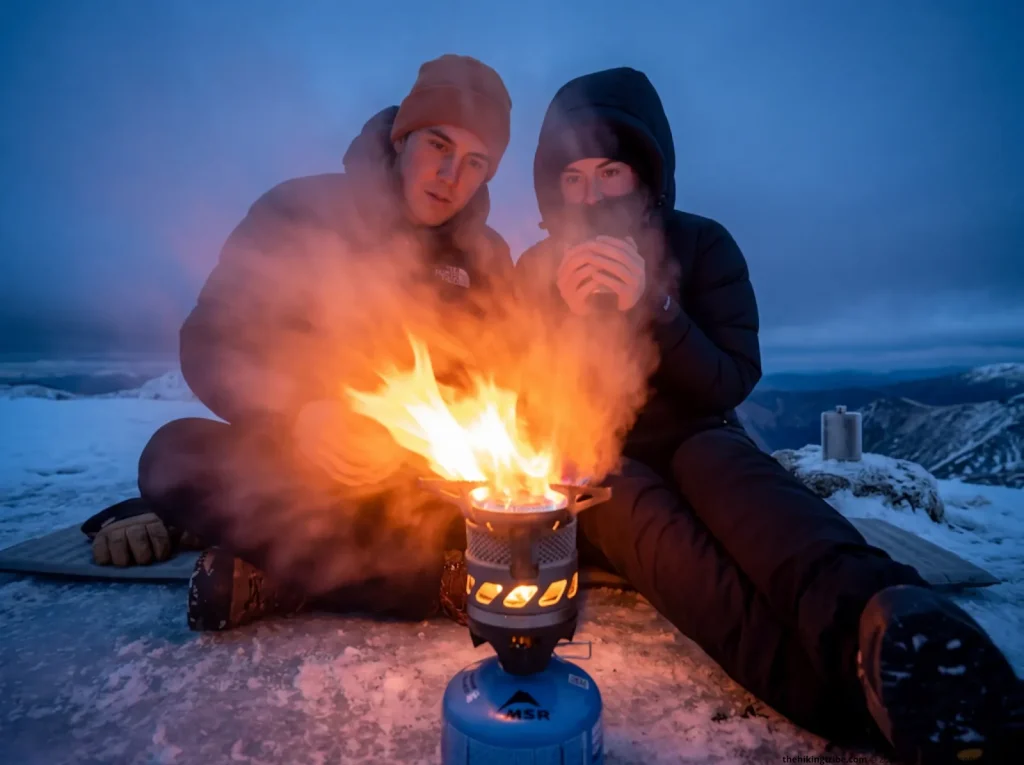
Summit whiskey is a trail ceremony, not a thermal strategy. I’ve watched groups pour celebratory shots at 13,000 feet and pull out emergency bivy sacks an hour later on the descent. The math is brutal. This section covers three substances that function as physiological force multipliers for frostbite — and explains why, at a level that competitors writing about cold-weather safety consistently skip.
The Stimulant Handicap: Caffeine and Nicotine
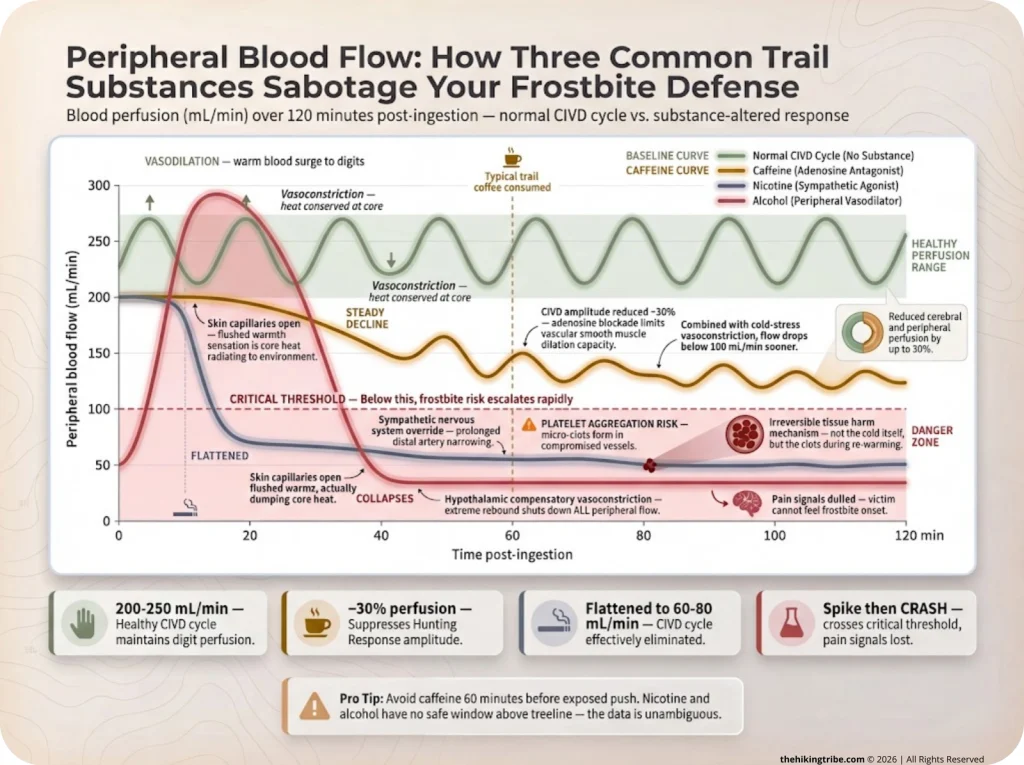
Caffeine is an adenosine receptor antagonist. At standard recreational doses, it reduces cerebral and peripheral blood perfusion by up to 30%. That number is from NIH clinical research on caffeine’s vasoconstrictive and diuretic mechanisms. Combined with the cold-stress vasoconstriction your hypothalamus is already running, caffeine can push peripheral flow below the critical 50 mL/min threshold sooner and at higher ambient temperatures than it would otherwise reach.
Caffeine also dehydrates. Denser, more viscous blood is harder for the heart to pump through already-constricted distal vessels.
Nicotine triggers a massive sympathetic nervous system response — prolonged narrowing of the distal arteries AND increased platelet aggregation, which raises the risk of micro-clots. Those tiny clots are the primary mechanism of irreversible tissue harm in deep frostbite. Not the cold itself. The clots that form when compromised vessels try to cope with re-warming.
Practical protocol for exposed sections below 15°F or at high altitude: avoid caffeine for 60 minutes before the push. For a practical winter hydration strategy that doesn’t compromise circulation, the hydration guide covers fluid management when caffeine’s diuretic effect is already working against you.
The Alcohol Radiator Fallacy
Alcohol is a peripheral vasodilator. Opening those skin capillaries in a cold environment creates a flushed sensation of warmth while simultaneously dumping core heat into the environment through the now-open “radiator” of the skin. As core temperature drops, the hypothalamus fires compensatory vasoconstriction — more intense than baseline — leaving the extremities in deep ischemia.
Alcohol also kills the early warning system. Tingling, pins and needles, the first sensation of frostbite — dulled or gone. The combination of vasodilation + core heat loss + pain impairment + judgment impairment is the single highest-risk scenario for severe frostbite in recreational hikers.
The Operational Prevention System: What to Do Before Mile One
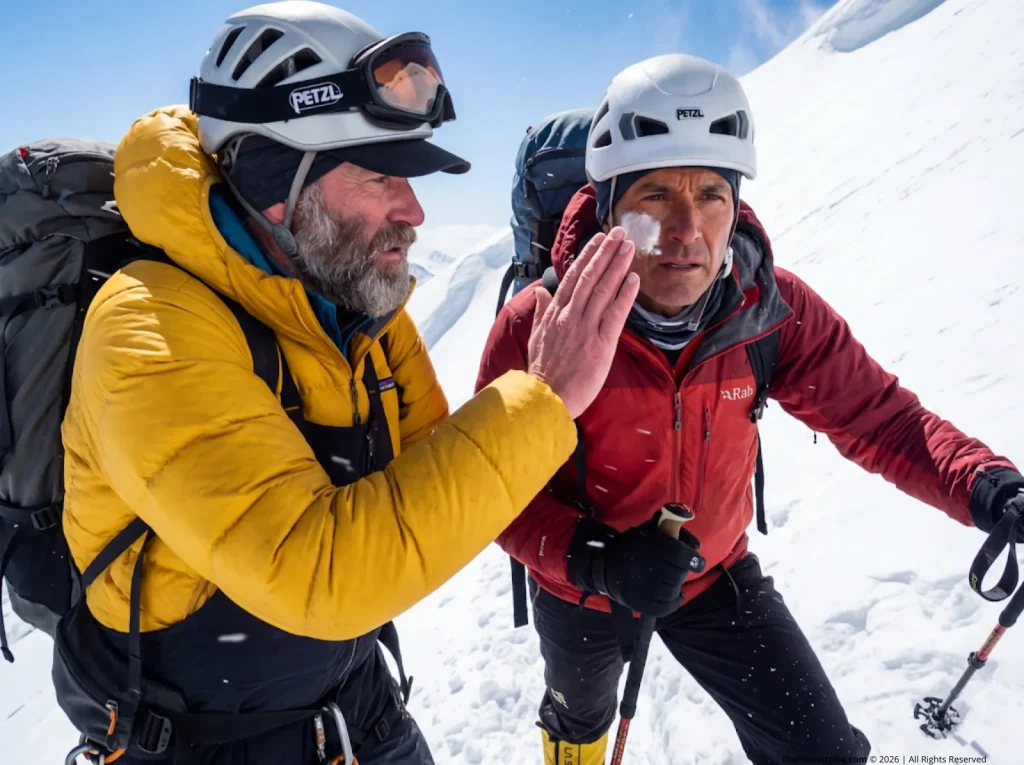
Prevention begins at the trailhead, not on the ridge. By the time you feel cold, the system has already started to fail.
The “Start Cold” Protocol and the 10-Layer-Regret Trap
Beginning a winter hike overdressed is the single most common behavioral error leading to moisture management failure. Starting warm triggers early perspiration. By mile 2 in above-zero conditions, your base layer is moisture-saturated — and you’ve compromised the entire insulation system before reaching the technical section of the route.
Target pre-movement layering: slightly chilled while stationary, thermally neutral within 10-15 minutes of hiking pace. Metabolic output climbs from roughly 100 watts at rest to 800 watts under Class 2-3 terrain. That’s your heat source. Don’t compromise it with sweat before you reach the ridge.
Carry the puffy — don’t wear it. The insulation layer goes on before body temperature drops at a stop, not after. For the full framework on the start cold principle and the sweat management layering system, the shoulder-season layering guide covers dynamic temperature regulation in detail.
The Mandatory Buddy System: Visual Frostnip Detection
This one is non-negotiable. Peripheral nerves supplying the face transmit temperature before pain — numbness precedes structural damage by 15-30 minutes. But numbness is indistinguishable from “just cold” without someone else looking at your face. You cannot self-diagnose the transition from numb to frozen.
The buddy check saved a partner’s ear on a Colorado fourteener. He felt nothing — which was the entire problem. Twenty minutes of skin-to-skin warming and a route modification back into the trees prevented a trip to the reconstructive surgeon.
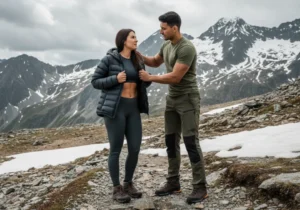
Inspection frequency: every 15-30 minutes below 20°F or in high wind. Face-to-face check of nose bridge, cheek highlights, earlobes. Indicators: waxy sheen, unusual pallor, white patches. Treatment: warm, bare hand held firmly against the affected area. No rubbing. Rubbing damages the compromised cellular matrix.
Designate one person per group as the sweep — their specific job is initiating buddy checks. Do not rely on individuals to self-report symptoms.
The Go/No-Go Wind Chill Decision Matrix
Decision thresholds from NOAA data:
- Wind chill −20°F or below with exposed sections: non-negotiable turn-back condition.
- Wind chill −10 to −20°F: exposed sections permitted only with full face coverage and exposure under 10 minutes per push.
- Wind chill 0 to −10°F: standard cold-weather hiking protocol sufficient.
Check ridge-level forecasts from OpenSummit or Mountain-Forecast.com — not valley-level NOAA station data. The “Time to Frostbite” data assumes dry skin at rest. Moving generates heat; wind chill strips it. A hiker moving through exposed terrain has more margin than the chart suggests — but still faces a meaningful frostbite window on many routes. For a complete pre-trip weather and terrain intelligence protocol, the trail research framework covers ranger calls, bailout points, and microclimate analysis.
Field Classification and the 2024 WMS Treatment Protocols
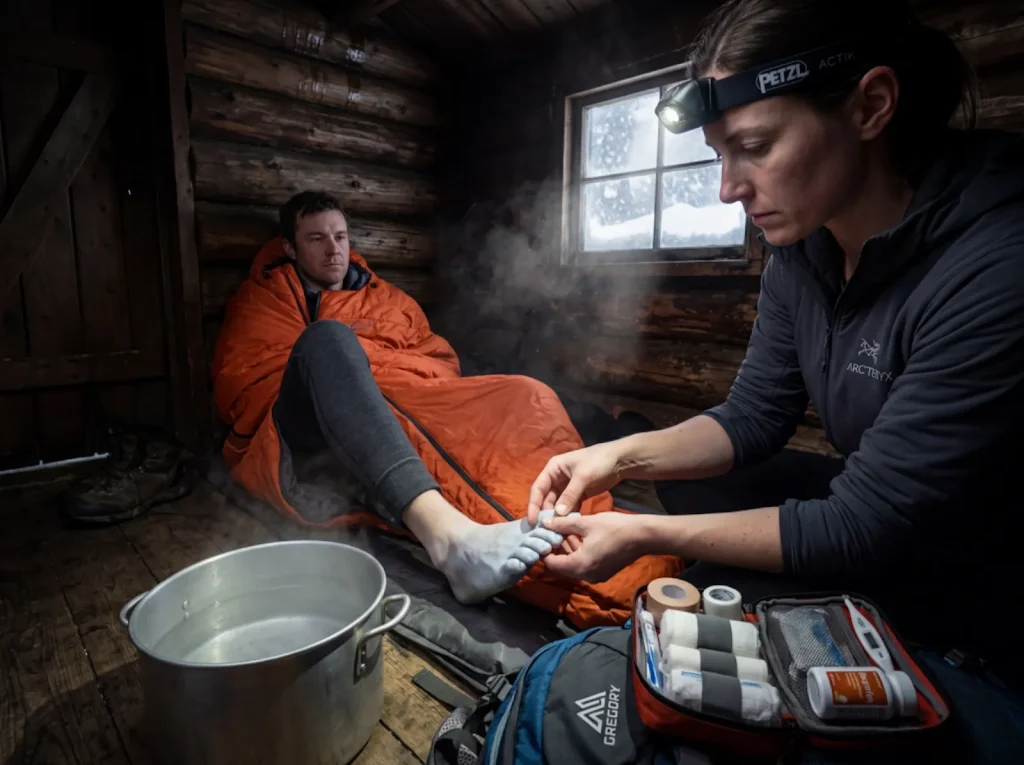
The decision to thaw or not is the hardest call a backcountry leader faces. Thaw in the tent, storm forecasted for six more hours, no evac helicopter available — and the toe refreezes on the walk out. The outcome is catastrophic.
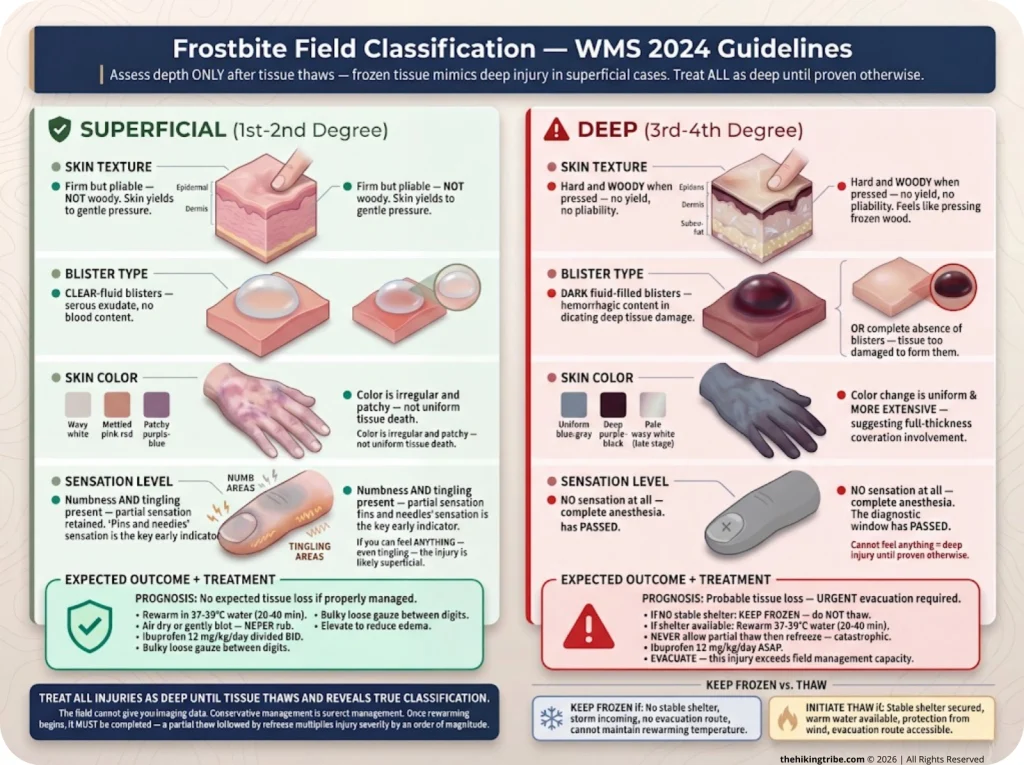
The Wilderness Medical Society frostbite clinical guidelines simplified field classification to a 2-tier model in 2024 because deep injuries cannot be reliably assessed while tissue is still frozen. Frozen tissue mimics deep injury in superficial cases. Assess depth only after the tissue thaws.
The 2-Tier Field Classification System
Superficial (1st-2nd degree): Skin firm but without woody texture. Numbness or tingling. Clear-fluid blisters. Prognosis: no expected tissue loss if properly managed.
Deep (3rd-4th degree): Skin hard and woody when pressed. No sensation at all. Dark fluid-filled blisters or complete absence of blisters. Prognosis: probable tissue loss, urgent evacuation required.
Treat all injuries as deep until the tissue thaws and reveals its true classification. The field cannot give you imaging data. Conservative management is correct management.
The Thaw/Refreeze Decision Matrix
The cardinal rule: once rewarming begins, it must be completed. A partial thaw followed by refreezing causes ice crystals to grow larger in already-damaged tissue, multiplying injury severity by an order of magnitude.
Keep frozen: If stable shelter and continuous rewarming cannot be guaranteed, do not initiate thawing. Hikers can walk on frozen feet. Walking on thawed, edematous, fragile tissue risks permanent loss far worse than the walk out on frozen tissue.
Initiate thawing: Only when the party has reached stable shelter with maintaining capacity — warm water, protection from wind, access to evacuation route.
Rapid field rewarming: water at 37-39°C (98.6-102.2°F). Verify temperature with a caregiver’s uninjured hand for 30 seconds — should feel like a comfortable hot tub. Rewarm until tissue is soft, pliable, and red/purple — typically 20-40 minutes. Air dry or gently blot after. Never rub. Bulky loose dry gauze between digits.
For a broader wilderness first aid decision framework for backcountry emergencies, the first-aid preparedness guide covers complete patient assessment and evacuation protocols.
Field Pharmacology: Ibuprofen as a Vascular Agent
Ibuprofen’s primary field role in frostbite is not pain management. It blocks the inflammatory cascade that harms tissue after rewarming begins — specifically the inflammatory mediators responsible for the vascular sludging and late tissue-damage phases.
Dosage: 12 mg/kg/day, divided into twice-daily doses, maximum 2,400 mg/day. Take with food or water to prevent gastric irritation under field conditions. Dose as early as possible after injury is identified — pre-hospital Ibuprofen delivery improves tissue outcomes.
One more thing: Aspirin is not a valid substitute. Aspirin promotes irreversible platelet inhibition and lacks the prostaglandin-blocking mechanism that targets the late-ischemic cascade. Carry Ibuprofen. Label it. Know where it is.
Three Things That Have Actually Changed How I Think About This
Frostbite is a physics-and-biology problem, not a toughness problem. The body will sacrifice fingers and toes to protect the core — your only job is to prevent the thermal conditions that trigger that sacrifice.
The three most hazardous trail myths — emollient creams protect your face, more socks mean warmer feet, a shot of whiskey warms you up — are now gone. Each one is backed by clinical data showing the opposite. Discard them.
Prevention is operational. Start cold, eat before you’re hungry, run buddy checks every 20 minutes on exposed terrain, know the thaw/refreeze rule before you need it. On your next winter mountaineering push above 10,000 feet, designate a sweep. Run it at every break. The people who summit more amputate less — and the margin between those outcomes is almost always a decision made before mile one.
FAQ
How cold does it have to be to get frostbite while hiking?
Frostbite can occur at exactly 32°F (0°C), but almost never does at that temperature without significant wind. The real driver is wind chill calculations: at 5°F with 30 mph wind, effective wind chill is −19°F, creating a 30-minute frostbite window. Monitor wind chill, not air temperature. Valley thermometers tell you almost nothing about conditions on an exposed ridge.
Can you get frostbite through gloves?
Yes, through two distinct mechanisms. First, moisture — sweat or ingested water — within the glove replaces the insulating air layer with a conductive medium, allowing heat to drain from the fingers. Second, direct conductive heat loss through metal gear can happen even through a glove liner if there’s no insulating barrier layer between the skin and the contact point. A thin synthetic glove liner worn under heavier mitts solves both.
What are the first signs of frostbite you can actually feel?
The early reliable warning is a pins and needles tingling, followed by numbness. The critical problem: symptoms of frostbite progress to complete anesthesia before tissue damage becomes irreversible. Once you feel nothing, the diagnostic window has passed. This is exactly why the buddy visual-check system exists — because you cannot reliably self-diagnose the transition from numb to frozen.
What should you NOT do when treating frostbite in the field?
Never rub the affected area — rubbing causes mechanical rupture of cell membranes in tissue that’s already structurally compromised. Never use dry heat — fires or heat packs placed against bare skin will burn anesthetized tissue that cannot register the damage. Never allow partial thaw followed by refreezing — categorically worse than keeping tissue frozen. Never apply emollient creams to a thawing area.
Does prior frostbite make you more likely to get it again?
Yes, significantly. A single prior episode can permanently damage the C-fiber nerves that control Cold-Induced Vasodilation. Future cold exposures reach the frostbite threshold faster, at higher ambient temperatures, with less external stimulus required. If you’ve had frostbite before, you operate on more conservative go or no-go thresholds than the person next to you — even if you look and feel fully healed.
I've spent more than a decade researching hiking gear and trail technique. I read the specs, the forum threads and the long-term reviews, and every pick here comes with what it gets wrong.
End of the trail
You read every mile of this one. Here's where the trail goes next.