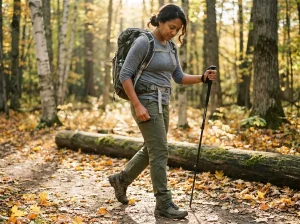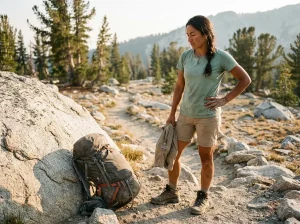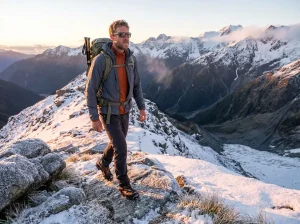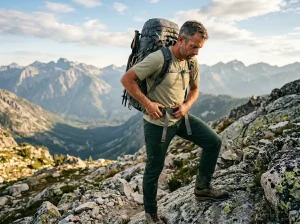
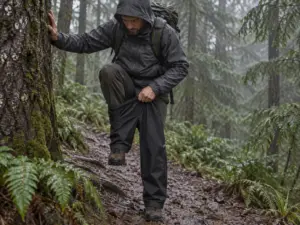
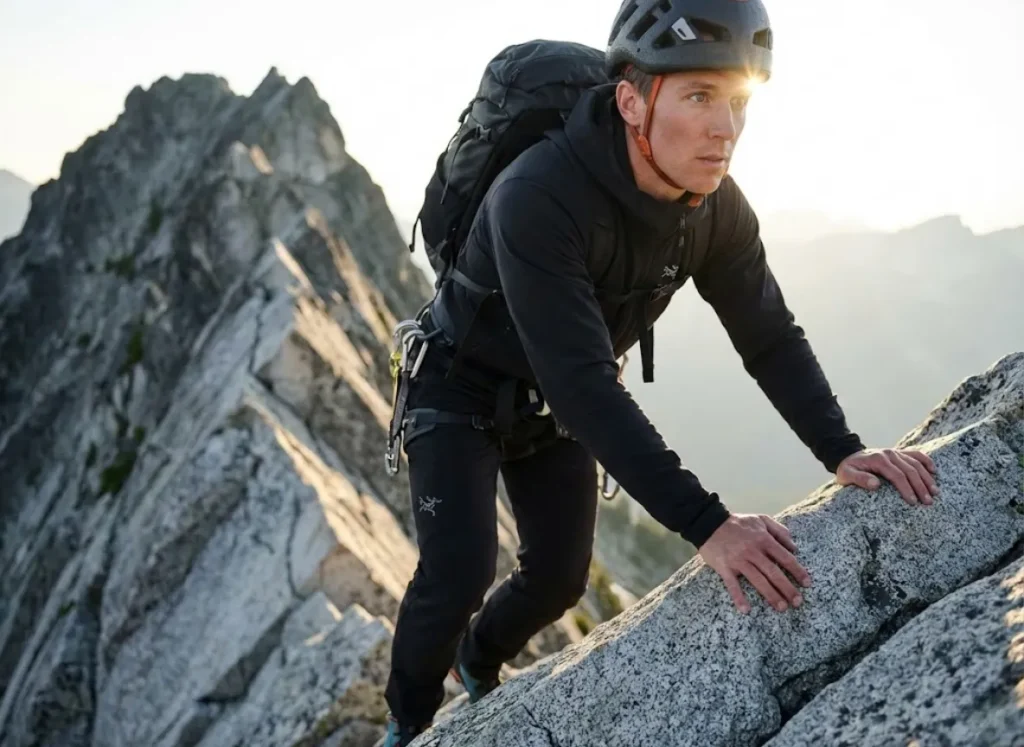
You are halfway up a steep rocky section, engaging in technical scrambling, your boot jammed into a crack. You drive your knee upward to step onto a high ledge, but your hiking pants fight back. The fabric tightens across your thigh, creating a feeling of resistance that burns precious energy with every step. This isn’t just uncomfortable; it is a failure of hiking ergonomics that drains your stamina.
As an outdoor instructor, I have watched countless capable students struggle on technical terrain. Often, it wasn’t a lack of fitness holding them back, but their technical gear working against them.
Outdoor apparel is about more than just covering your body. It is about wearing a second skin that moves exactly how your skeleton moves, respecting your hiking biomechanics. Articulated knees are the difference between fighting your gear and flowing through the terrain.
In this guide, we will look at why standard pants restrict you. We will break down how smart textile engineering turns fabric into a tool for saving energy, and I will teach you the exact DIY mobility test to perform in the dressing room so you never buy restrictive gear again.
What is the “Invisible Anchor” slowing you down on the trail?
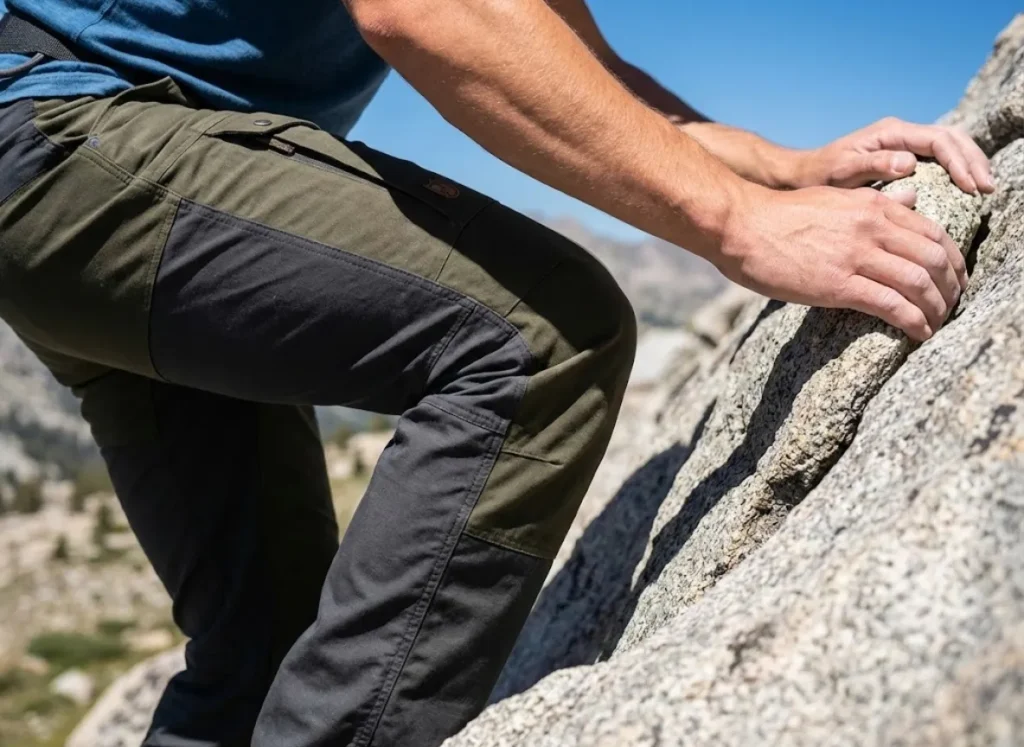
Most hikers accept a certain level of stiffness in their clothing. They think it’s just the price you pay for durable hiking pants. However, that restriction acts like a brake system on your muscles. To understand why you feel tired faster on steep hills, we have to look at how your leg moves—specifically your range of motion (ROM)—versus how your pants are made.
Why do standard pants restrict movement during high-output activities?
Standard “straight-leg” pants are designed for standing still or walking on flat ground (0 to 65 degrees of flexion). This works perfectly fine for gentle trails. The problem starts when your knee flexion goes past 90 degrees—a movement you do constantly during stair climbing or steep ascents.
When you bend your knee, the distance from your hip to your shin effectively gets longer across the anterior femur (front of your leg). In a standard tube-shaped pant leg, there isn’t enough fabric to handle this length. The material pulls tight against your thigh and patella (kneecap).
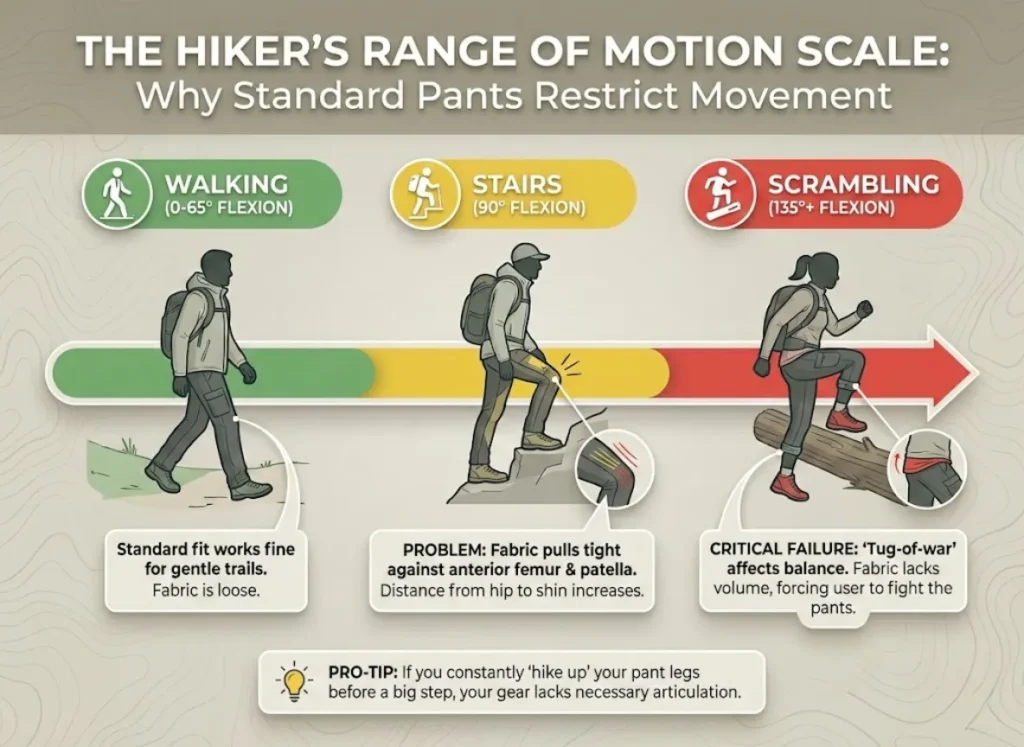
This issue becomes critical when navigating complex scrambling terrain. Scrambling and alpine climbing require you to lift your knees very high, often toward your chest, pushing 120–150 degrees flexion for actions like climbing over fallen trees. If the pants don’t have extra room built into the knee area via anatomic shaping, the fabric has to come from somewhere else.
Usually, it pulls from the waist, dragging your pants down. Or, it pulls from the bottom, yanking the cuff up over your boot. This “tug-of-war” messes with your balance and forces you to work harder just to overcome the stiffness of the pants. Scientific studies on motion capture confirm that knee angles change drastically on inclines, proving that gear designed for walking is often wrong for climbing.
Pro-Tip: If you find yourself constantly hiking up your pant legs before a big step, your gear lacks the necessary articulation. That “hike up” is your body instinctively trying to create the fabric volume the manufacturer failed to provide.
How does clothing restriction affect your energy levels?
The physical sensation of tight pants is annoying, but the cost to your body is real. This is often called the “Hobbling Effect.” It happens when tight clothing fights against your leg muscles, creating artificial muscle tightness.
Your body has to use extra muscle power not just to lift your weight, but to stretch the tight fabric with every step. Research into the effects of protective clothing on energy consumption shows that fighting against stiff or tight clothing can increase your energy burn by up to 20%.
Over the course of a 10-mile hike with significant elevation gain, this small resistance adds up to major fatigue. It is like carrying a heavier pack without realizing it. Bad pants act as “phantom weight.”
By switching to articulated gear, you remove this friction. This allows all your energy to go toward moving you forward, which is a key part of mastering efficient hiking pacing. Efficiency is not just about speed; it is about safety. Tired muscles are more likely to stumble and get injured late in the day.
How does mechanical articulation engineer mobility?
To stop wasting energy, we need to look at how the pants are built. True articulated cut isn’t just about stretchy fabric. It is about cutting and sewing the material to create a 3D shape that matches your body through 3D tailoring.
What is the function of the knee dart?
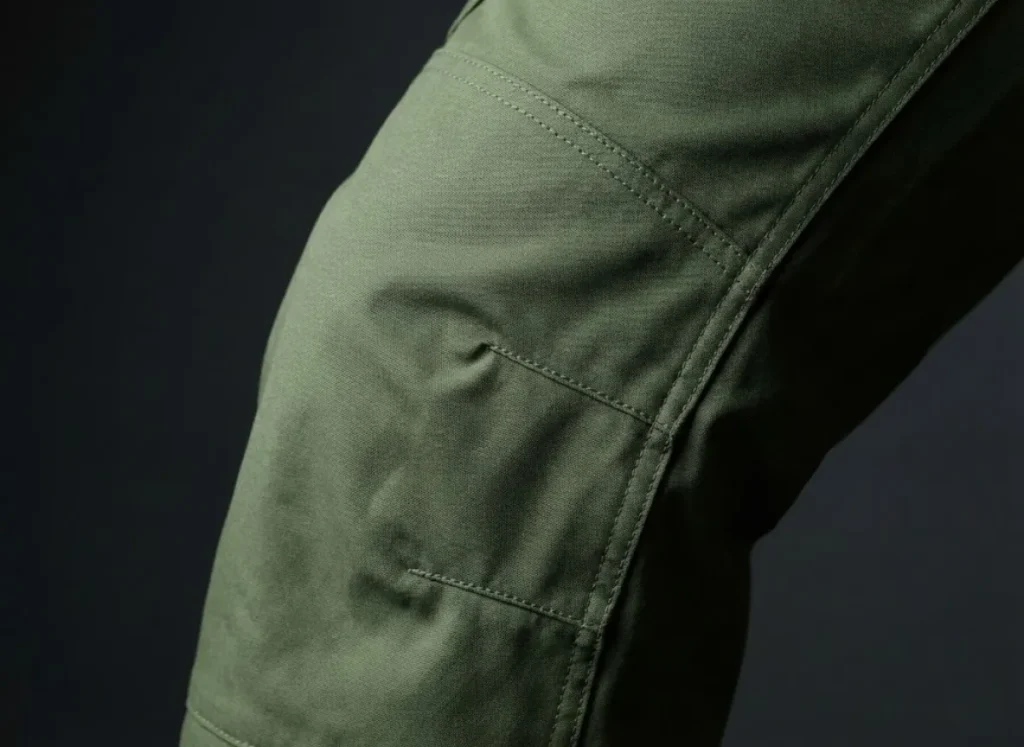
Mechanical Knee Articulation means the pants are pre-shaped to be bent using stitching patterns. The main tool for this is the sewn-in dart. A dart is a small, triangular fold of fabric stitched into the seams or across the knee.
By folding and stitching the fabric in specific spots, the designer makes the back of the pant leg shorter while leaving the front longer. This forces the pant leg to rest naturally in a bent position. It mimics the shape of a leg in motion, rather than a leg standing at attention.
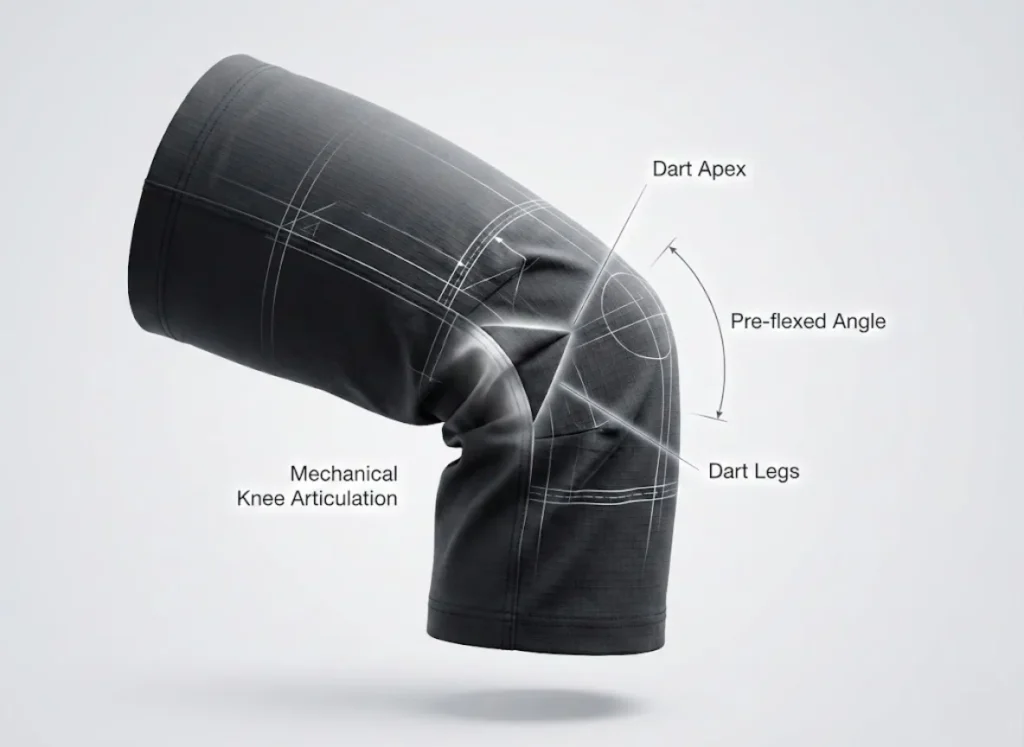
The point of the dart is crucial. It must point directly toward the center of your kneecap to create a “cup” of space exactly where your knee bone sticks out. High-end technical pants often use multiple darts to handle the complex movement of the knee joint.
This pre-shaped knees design ensures that when you bend your knee, you are moving into empty space provided by the garment, rather than stretching the fabric tight. Loughborough University research details how the cut of clothing dictates your freedom of movement.
You can spot this easily in the store when selecting top-tier men’s hiking trousers. Properly articulated pants will look “crumpled” or bent at the knee on the hanger. They won’t lie flat on a table.
How does the gusseted crotch support the articulated knee?
The knee does not work alone. True mobility requires freedom at the hip so you can lift your leg high (hip flexion). The gusseted crotch is the partner to articulated knees. Without it, your movement is still limited by tightness at the hips.
A gusset is a diamond or triangular piece of fabric sewn into the crotch area. It replaces the standard “four-way cross” seam found in jeans. This insert separates the front and back panels, allowing you to spread your legs apart or step high without the pants binding up.
It spreads out the tension that would usually focus on one weak point. This prevents seam failure during deep squats. In scrambling situations, you often need to bridge between rocks or step onto a high ledge.
The gusset provides the necessary “slack” in the pants, ensuring the waistband stays in place while your leg moves freely. CDC/NIOSH studies highlight how hip restriction forces you to move your spine incorrectly, which increases injury risk.
Combined with articulated knees, this creates a full system of mobility. When checking gear, always look for this feature first. Understanding what a gusseted crotch is is fundamental to choosing pants that won’t fail you on the climb.
Which mobility system fits your hiking style?
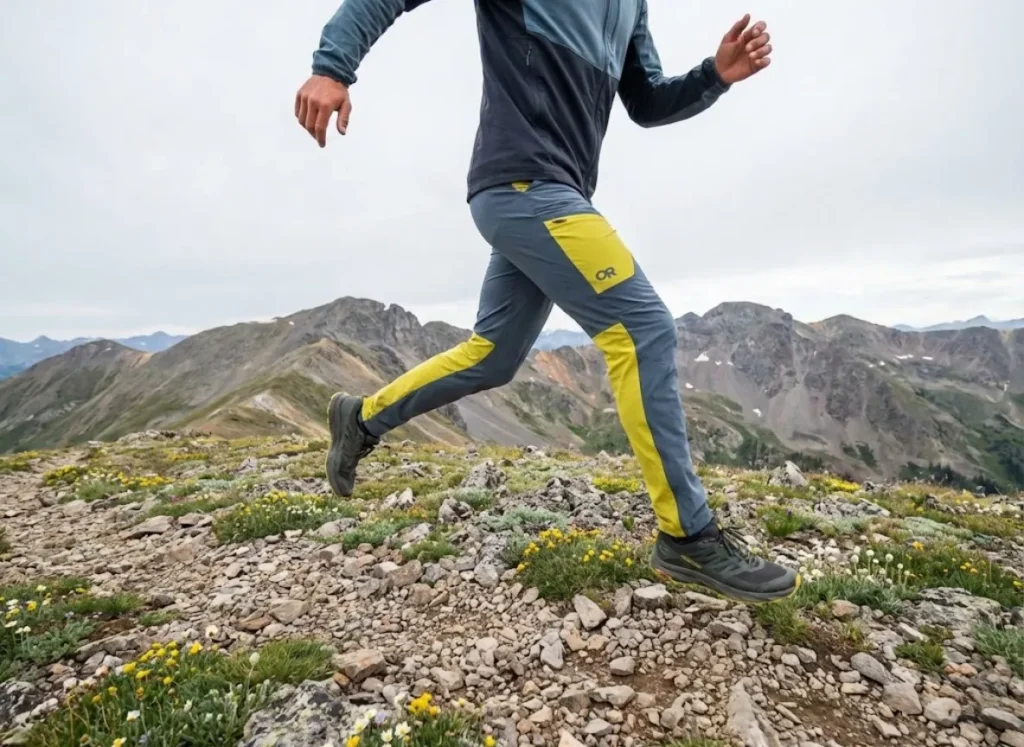
Not all pants achieve mobility in the same way. There are two main approaches in outdoor clothing: Smart Sewing (Articulation) vs. Stretchy Fabric.
How does mechanical articulation compare to stretchy fabric?
4-way stretch relies on mixing fibers like Spandex or Elastane into the weave. This allows the fabric to stretch when you pull on it. Mechanical Articulation relies on the shape of the fabric (the cut and sew) to provide room for movement without needing the fabric itself to stretch.
The trade-off is weight vs durability. High-stretch fabrics are generally thinner. They are more prone to snagging, and they wear out over time as the tiny elastic rubber bands inside break. On the other hand, rigid fabrics like G-1000 (found in the Fjallraven Keb) or heavy Cordura are tough enough to handle thorns and rocks, but they require aggressive articulation to be comfortable.
| Durability vs. Mobility Source Comparison | ||
|---|---|---|
| Durability (Y-Axis) | Mobility Source: Mechanical Articulation (Geometry) | Mobility Source: Chemical Stretch (Chemistry) |
| High Durability (Protective / Rigid) |
“The Fortress” (Type A) Allows rigid fabrics to move without resistance. Entity: Fjallraven Keb (G-1000: 65% Poly / 35% Cotton). Mechanism: Aggressive patterning (darts/panels) creates 3D volume in 2D rigid fabric. Use Case: Bushwhacking, sharp rock, heavy work. Note: Mandatory for durability; prevents “Hobbling Effect” in non-stretch gear. |
“The Alpinist” (Type C) Hybrid approach balancing toughness and flex. Entity: Arc’teryx Gamma (Softshell). Mechanism: Durable weave combined with elastomeric fibers and articulated patterning. Use Case: Technical climbing, alpine scrambling, cold weather. Note: “The Alpinist” sits at the intersection of high articulation and high stretch. |
| Low / Medium Durability (Lightweight / Soft) |
Standard Hiking Pants Basic shaping for general walking. Entity: Patagonia Quandary (Lightweight Nylon). Mechanism: Standard fit with minor knee articulation. Use Case: Trail walking (65° flexion). Note: Lacks the “armor” of canvas but offers sufficient mobility for low-angle terrain. |
“The Gymnast” (Type B) Relies on fabric degradation to permit movement. Entity: Outdoor Research Ferrosi (14% Spandex) / Yoga Tights. Mechanism: High elastane content forces fabric to stretch under tension. Use Case: Hot weather, trail running, unrestricted comfort. Note: “Chemical Articulation” offers high comfort but lower tear resistance. |
For hot weather and fast hiking, stretchy fabric is great because it offers high breathability. Lighter options like the Outdoor Research Ferrosi, Patagonia Quandary, or REI Co-op Sahara excel here. Research from the NIH indicates that lighter materials are better for performance in the heat.
However, for deep woods, climbing over rocks, or multi-day trips in rough terrain, Mechanical Articulation is the pro choice. You need the pants to offer abrasion resistance, and the shape allows you to move despite the tough fabric. To learn more about the materials, review the science of 4-way stretch fabric.
How can you identify true articulation in the dressing room?
Do not rely on the marketing tags. You must perform a DIY mobility test using standardized movement-specific testing. If the pants fail these tests in the store, they will be a nightmare on the trail.
Test 1: The High Step
Find a bench or stool roughly knee height. Place one foot up on it (mimicking high-step mobility). If you feel the pant leg tugging at your thigh or the bottom cuff lifting way up, the articulation is bad.
Test 2: The Deep Squat
Drop into a full squat with your heels flat on the floor. If the waistband pulls down at the back (exposing skin) or the crotch seam cuts into you, the fit is wrong.
Test 3: The Trail Lunge
Step forward into a deep lunge. The “floating knee” panel should remain centered over your patella. It should not slide up onto your thigh.
Check the “Dead Space.” When standing straight, there should be a little extra fabric at the knee. This isn’t a bad fit; it is “potential energy” waiting for you to bend your leg. The clinical basis for movement screening supports testing your range of motion.
Prioritize fit over features like boot hooks or zippered vents. A cheap pair of pants like the REI Co-op Trailmade that passes these tests is better than an expensive pair that restricts you. This applies equally when choosing women’s hiking pants, where the fit around hips and waist is even more specific.
Pro-Tip: Wear your hiking boots to the store. A pant leg that falls perfectly over a sneaker might bunch up or pull tight when draped over the higher collar of a trekking boot.
Final Thoughts
The difference between a hike that feels smooth and one that feels like a struggle often comes down to the friction in your system. Restrictive pants are a hidden energy drain. They increase the effort of every step, taking away the energy you need to reach the top.
By understanding the geometric solution—using darts and gussets to create volume—you can pick gear that handles high steps and steep climbs. Whether you choose the tough durability of articulated canvas (like the Kuhl Renegade or Kuhl Silencr) or the lightweight freedom of mechanical stretch, the goal is the same: a second skin that moves with you.
Next time you gear up, don’t just put on your pants—test them. Perform the High Step and Deep Squat. Make sure your gear is helping you, not holding you back.
FAQ – Frequently Asked Questions
What is the difference between articulated knees and 4-way stretch?
Articulated knees use the shape of the fabric (folds and cuts) to create permanent room for movement. 4-way stretch uses elastic rubber-like fibers (spandex or elastane) to temporarily stretch out. Articulation is usually more durable, while stretch offers a tighter, lighter fit.
Do I really need articulated knees for casual hiking?
For flat trails, standard pants (like the basic Columbia Silver Ridge) are usually fine since walking doesn’t require bending your knee very far. However, for any trail with steep stairs, rock scrambling, or climbing over logs, articulation makes a huge difference in comfort and energy.
Can I alter my existing hiking pants to have articulated knees?
It is technically possible for a skilled tailor to add darts, but it is very hard. Articulation requires extra fabric length that standard pants just don’t have. It is usually better to buy pants designed with this feature from the start.
Which brands are best known for articulated hiking pants?
Brands that focus on alpine climbing usually do this best. Arc’teryx (Gamma series), Fjallraven (Keb or Vidda Pro), Mammut, Haglöfs, and Black Diamond are widely known for making excellent articulated pants. Brands like Cotopaxi (e.g., the Cotopaxi Coraje) are also entering this space with great designs.
I've spent more than a decade researching hiking gear and trail technique. I read the specs, the forum threads and the long-term reviews, and every pick here comes with what it gets wrong.
End of the trail
You read every mile of this one. Here's where the trail goes next.