


The helicopter blade’s rhythmic thwomp echoing off the canyon walls is the sound of a $12,000 mistake. The barb of panic sets in when you realize the generic app rating you trusted betrayed you. After two decades of guiding backcountry routes and participating in high-stakes recoveries, I’ve seen that exact scenario play out on repeat. Most hikers don’t get hurt because they lack fitness; they get hurt because they lack a multi-source verification method for their routes. Here is exactly how to handle your pre-trip intelligence—no panic, no unwanted rescue flights necessary.
⚡ Quick Answer: Proper trail research means ditching static app ratings and actively cross-referencing topographic maps for slope angles. You must calculate altitude-specific micro-climates using the Environmental Lapse Rate, rather than relying on trailhead weather forecasts. Finally, verify on-the-ground reality through direct calls to park rangers and scanning recent social media geo-tags for visual proof of conditions.
| SAR Statistics | ||
|---|---|---|
| SAR Trigger | Percentage | Average Cost |
| Lost Hiker (Navigation Error) | 41% | $3,500 – $12,000+ |
| Poor Planning / Fatigue | 22% | $2,000 – $5,000 |
| Traumatic Falls (Class 3/4) | 15% | $15,000+ (Medevac) |
Phase I: Geospatial Intelligence and Topographic Modeling
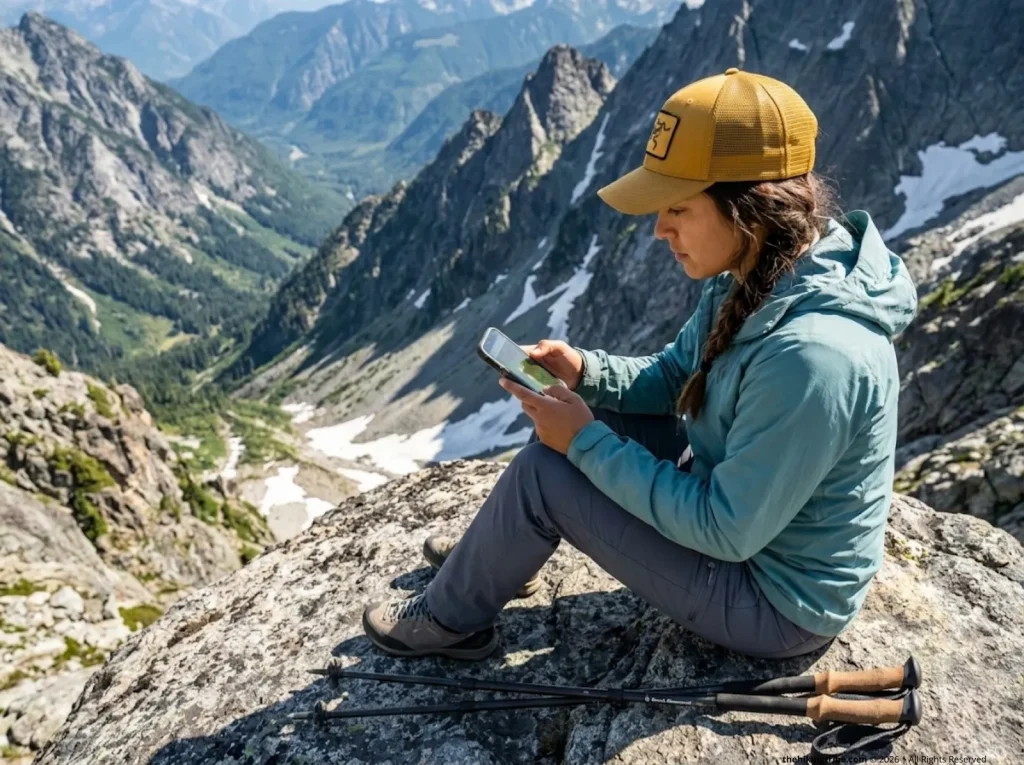
Relying on a single source when you want to find hiking trails near me is a gamble. When evaluating the best apps for trail conditions, remember that a subjective “moderate” rating on AllTrails or in an REI guidebook completely obscures the technical difficulty waiting at higher elevations. To stay safe, you need to master topographic map reading and recognize what those contour lines actually mean for your legs. When you bypass understanding subjective trail difficulty ratings, you invite serious danger.
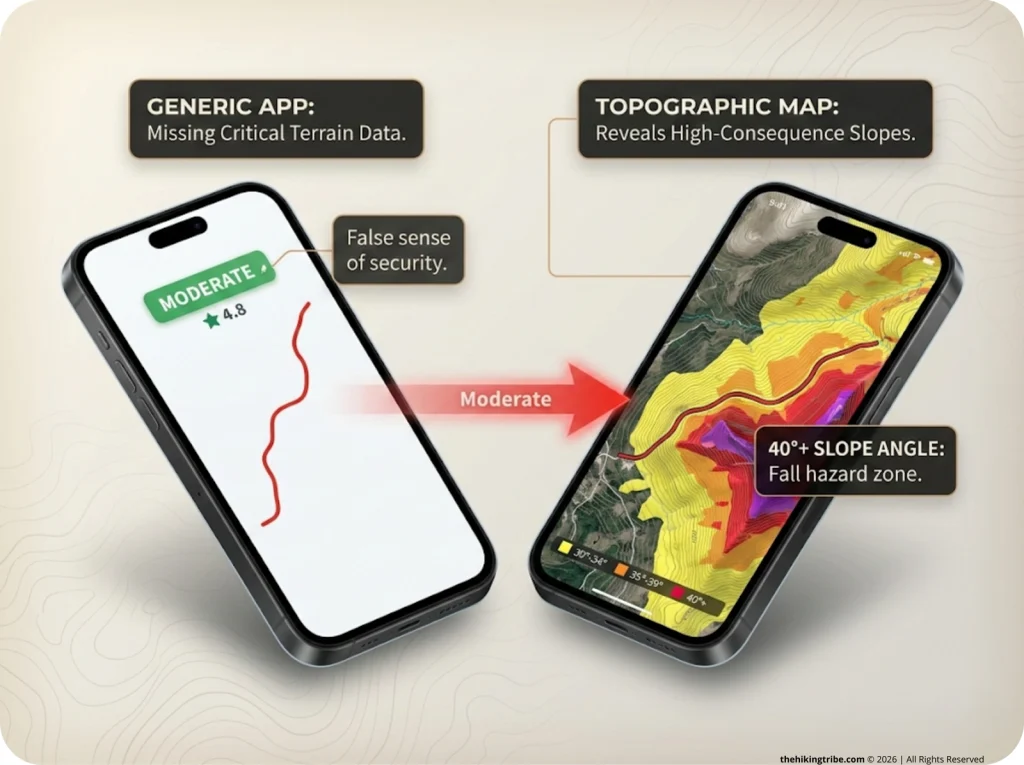
Escaping the “Average Rating” Trap
A staggering 41% of search and rescue missions happen simply because hikers lose the route. Staring at a single red line on your phone isn’t enough. You need to cross-reference crowdsourced data with serious mapping tools like Gaia GPS for raw topographic detail and OnX Backcountry to verify complicated public land boundaries.
Pro tip: Always identify specific exit strategies or “bailout points” before you leave home. If a route lacks safe early exits, its true risk profile is much higher than the mileage suggests.
Never trust a downloaded GPX file blindly. You must verify those contours against recent satellite imagery to avoid seasonal washouts. You also want to check the basic stats: exact mileage, total elevation gain, and the specific trail type—knowing whether it is a simple loop trail or a demanding out-and-back trail.
Slope Angle Shading and Technical Scrambles
The real physical threat lives in the steepness of the terrain. Use CalTopo and its topographic shading feature to highlight paths exceeding a 30-degree angle. This shading separates a casual Class 1 walk from a sustained, high-consequence Class 3 rock scramble.
According to Deaths in National Parks statistics, traumatic injuries—specifically to the head—account for a massive chunk of fatalities. These tragedies often happen when hikers stumble into rocky terrain they didn’t anticipate. Terrain steepness dictates the physics of a fall, making a rigorous trail difficulty assessment mandatory before you step out of the truck.
The Magnetic Declination Variable
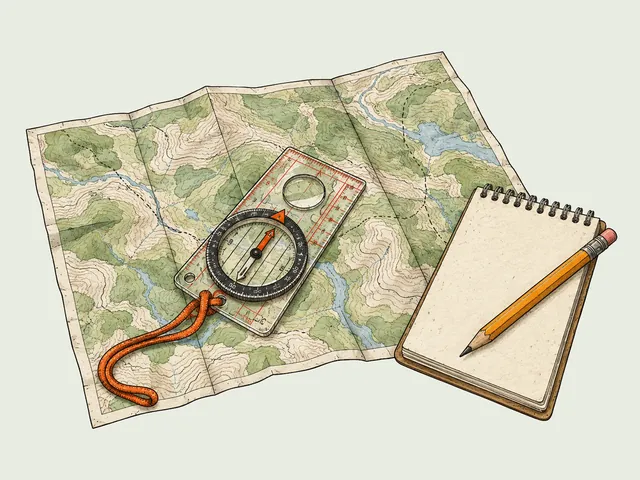
Navigating strictly by old paper maps carries a hidden risk called magnetic declination. The difference between true north and magnetic north shifts up to a full degree every three years in highly magnetic zones. A single degree of uncorrected drift can force you into irreversible “cliff-out” terrain over a shockingly short distance.
Update your compass for the current year’s declination before every trip. Relying on the legend printed on a ten-year-old map will pull you off course. Treat old maps as backup references, not primary navigation constants.
Phase II: Environmental Forensics and Micro-Meteorology
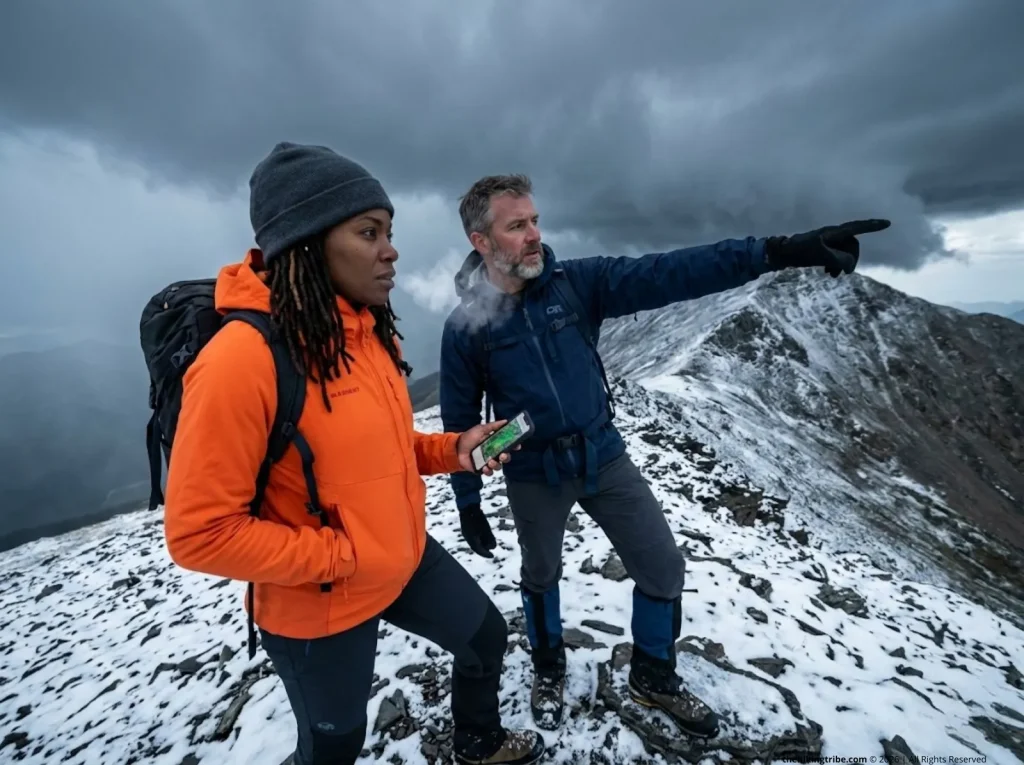
Your standard phone app uses generic global forecasting models that completely ignore mountain terrain. The weather rolling over the peaks creates highly localized micro-climates that can freeze you while the parking lot swelters. Anticipating how unpredictable shoulder season weather demands precise calculation dictates the specific layers you pack.
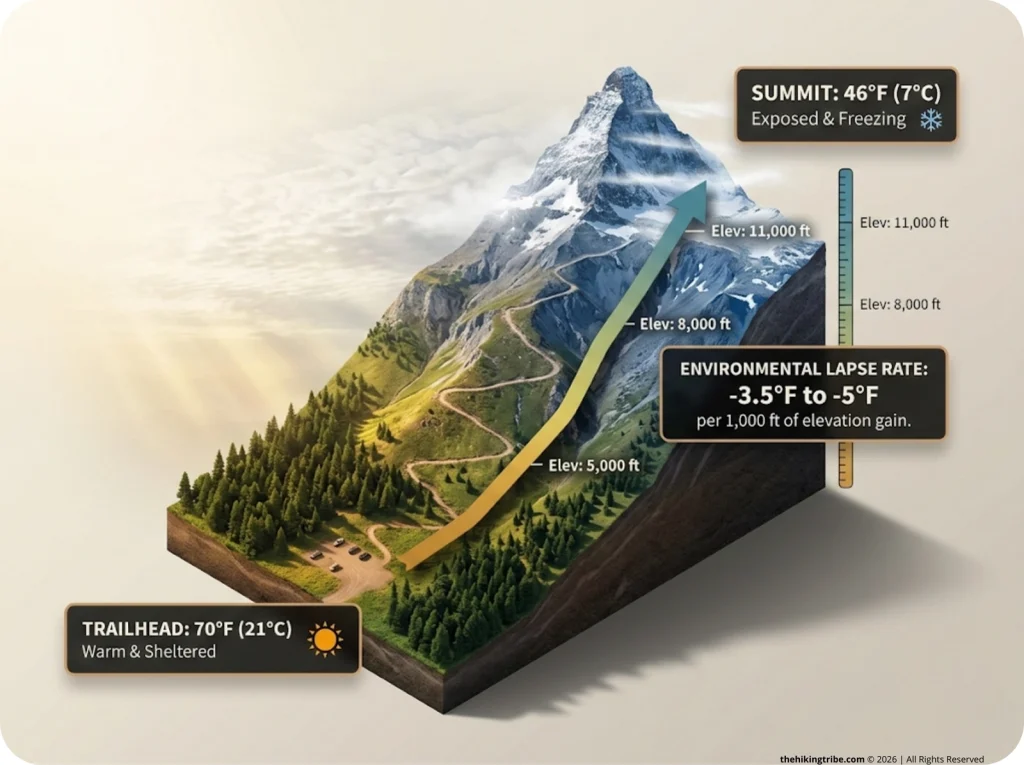
The Environmental Lapse Rate Calculation
The Environmental Lapse Rate means temperatures drop roughly three to five degrees for every thousand feet you climb, depending on humidity. Failing to calculate this summit temperature gap is the leading cause of exposure among otherwise fit hikers. A 14,000-foot summit can easily sit twenty degrees colder than your starting point, long before wind chill rips through your shell jacket.
Pro tip: Calculate your target elevation’s temperature manually instead of trusting the daily forecast for the nearest valley town. It forces you to pack the right insulation.
Advanced Point Forecasting with NOAA
You need to get familiar with NOAA weather tools to verify the current weather at exact coordinates. Use NOAA’s pinpoint planner to identify narrow lightning windows, which typically build by late afternoon in alpine zones. This data helps you set an absolute turn-around time, forcing you off exposed ridges before the sky opens up.
Reviewing NOAA’s localized forecasting tools also reveals the cloud ceiling altitude. If the clouds sit lower than your target peak, you are hiking straight into a dangerous white-out where visual landmarks vanish.
Snowpack Physics and SNOTEL Data
Early season hikes require more than casual optimism; they demand cross-referencing weather sources with hard data. Federal SNOTEL stations provide actual, real-time snow depth readings for high-elevation zones from May through July. Plunging waist-deep into softening snow, an exhausting mistake known as post-holing, spikes your metabolic burn rate and destroys your knees.
If SNOTEL sensors show a heavy water equivalent up high, swap your light trail runners for proper flotation gear or pick a different objective. Ignoring deep snow data turns a casual day hike into a grueling survival march.
Phase III: Ground-Truth Verification and Social Intelligence
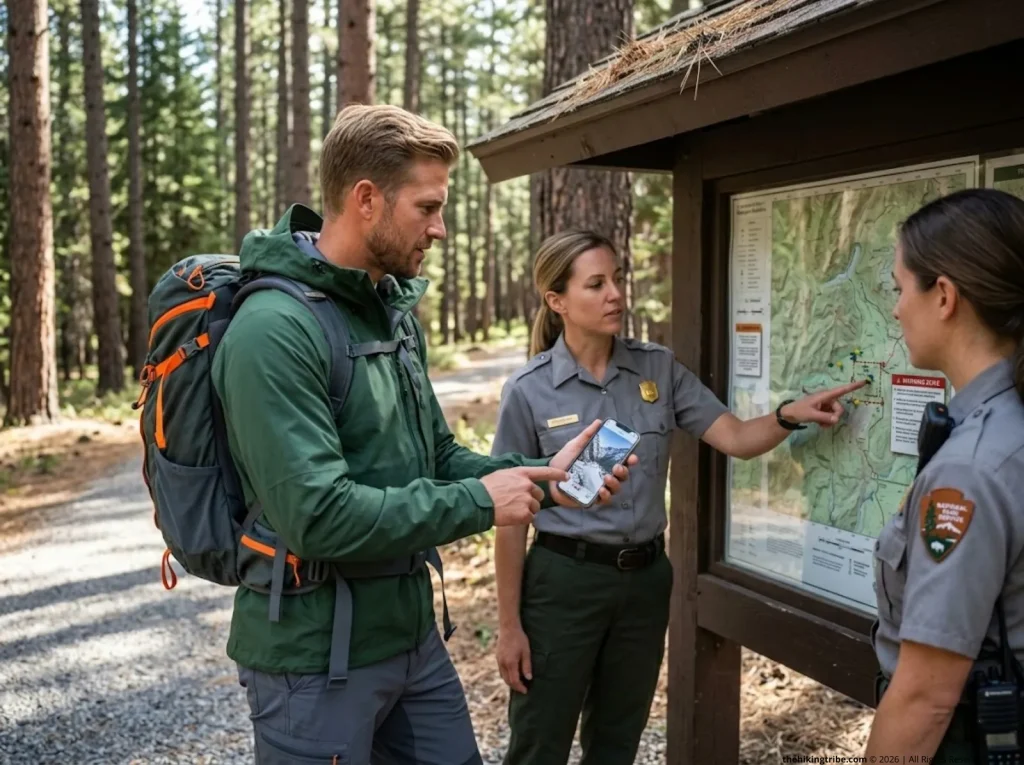
Digital apps provide delayed, subjective opinions. While excellent resources like the Washington Trail Association, Peakbagger, and expert outlets like SectionHiker, Bearfoot Theory, AdventureAlan, and CleverHiker offer phenomenal deep-dive reviews, you still must triangulate administrative facts with raw social proof verification. This dual-layer approach reveals fresh wildfire closures, aggressive bear activity, and washed-out bridges.
The “Ranger Call” Strategic Script
A sharp five-minute ranger call pulls more accurate intelligence than hours of scrolling through outdated recent trip reports. Contact the local National Park Service or USDA Forest Service office that manages the land. Instead of asking if the trail is safe—a subjective question—ask specific, quantifiable questions.
Verify the exact permit requirements, the status of the driving directions, and the water source reliability. Confirm standard restrictions like dog-friendliness or active bear canister mandates. Checking official ranger safety advisories confirms the baseline, but the ranger desk gives you the immediate, unmapped reality.
Pro tip: Always ask land managers about parking overflows and vehicle break-in trends at the starting point. Sometimes the biggest risk happens before you even lace up your boots.
Mining Metadata from Social GeoTags
Look past the influencers and use social media geo-tags as a raw intelligence feed. Search platforms like Instagram or TikTok for your destination and filter exclusively by “Recent.” A photo uploaded yesterday gives you undeniable, visual proof of the trail’s condition.
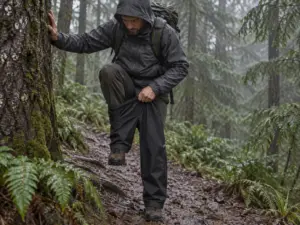
If you see hikers trudging through thick muck, you need to prepare for slow miles, intense trail erosion and widening mud traps, and destroyed footwear. Look closely at the gear people are wearing in those recent shots. If everyone tagging the summit is wearing microspikes, you better put yours in the pack.
Technical Logistics: Aligning Gear with Trail Physics
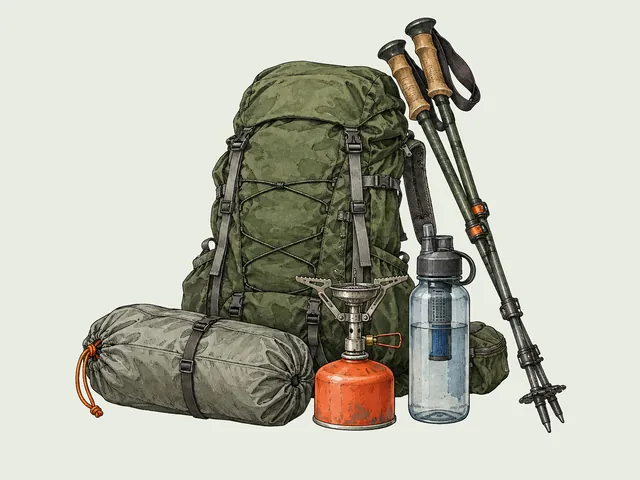
Your gear choices must answer directly to the severe physics of the backcountry. High-altitude scrambles demand a rigorous physical budget, tearing through hundreds of calories an hour. Everything you carry, from your sleeping bag to your stove, acts as a compounding metabolic weight you have to drag up the mountain.
Micron Filtration Based on Terrain Hydrology
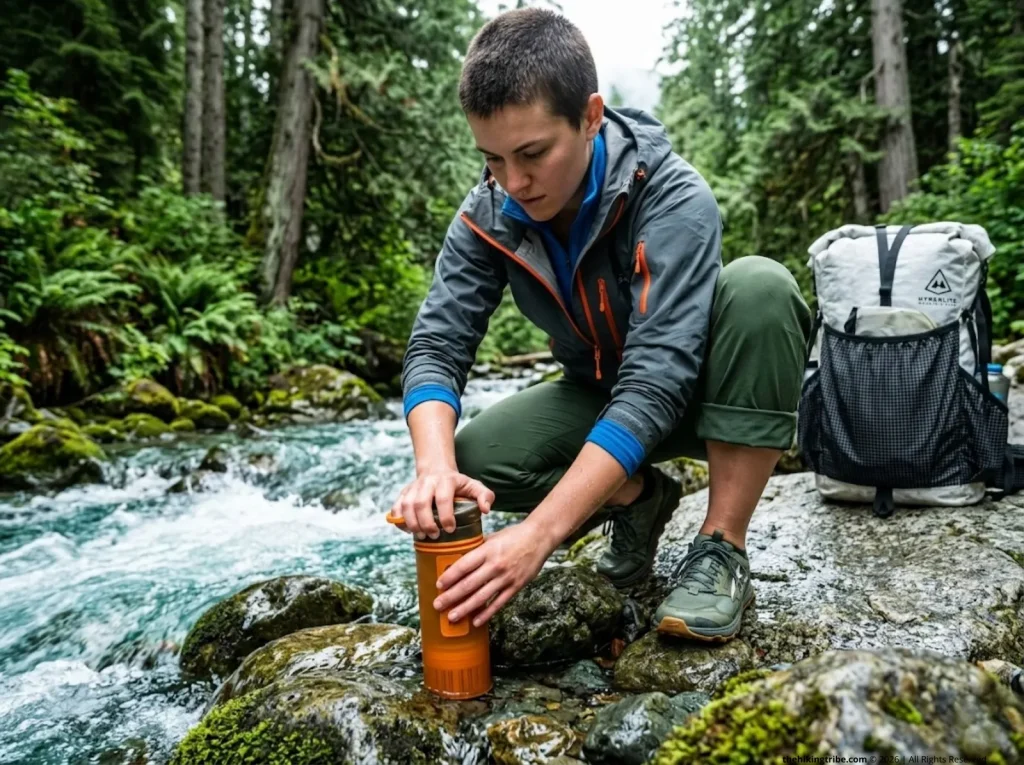
Water dictates your survival, but assuming every clear stream is safe is a massive mistake. Evaluating water source reliability means knowing exactly what contaminants exist upstream. Nasty protozoa require a 0.1-micron filter, while smaller bacteria need 0.01-micron defense.
If your route crosses heavy agricultural runoff or massive grazing allotments, you face viral threats. Knowing the truth about filter pore sizes and virus protection prevents you from relying on a standard squeeze filter when you actually need a heavy-duty purifier.
Pack Weight as a Metabolic Cost
Carrying too much weight breaks down your body mechanics. A heavy pack shifts your center of gravity, burning excessive calories and increasing the risk of lower-leg injuries on descent. Analyze the sun exposure percentages of your route; a south-facing slope bakes in the afternoon, heavily spiking your sweat rate and heat stroke probability.
On those exposed, sun-blasted trails, strip out the heavy fleece layers and replace that weight with extra water capacity. The mountain doesn’t care about the brand name on your jacket; it only cares about the physical cost of hauling it uphill.
The “Last Mile” Protocol: The Fail-Safe Trip Plan
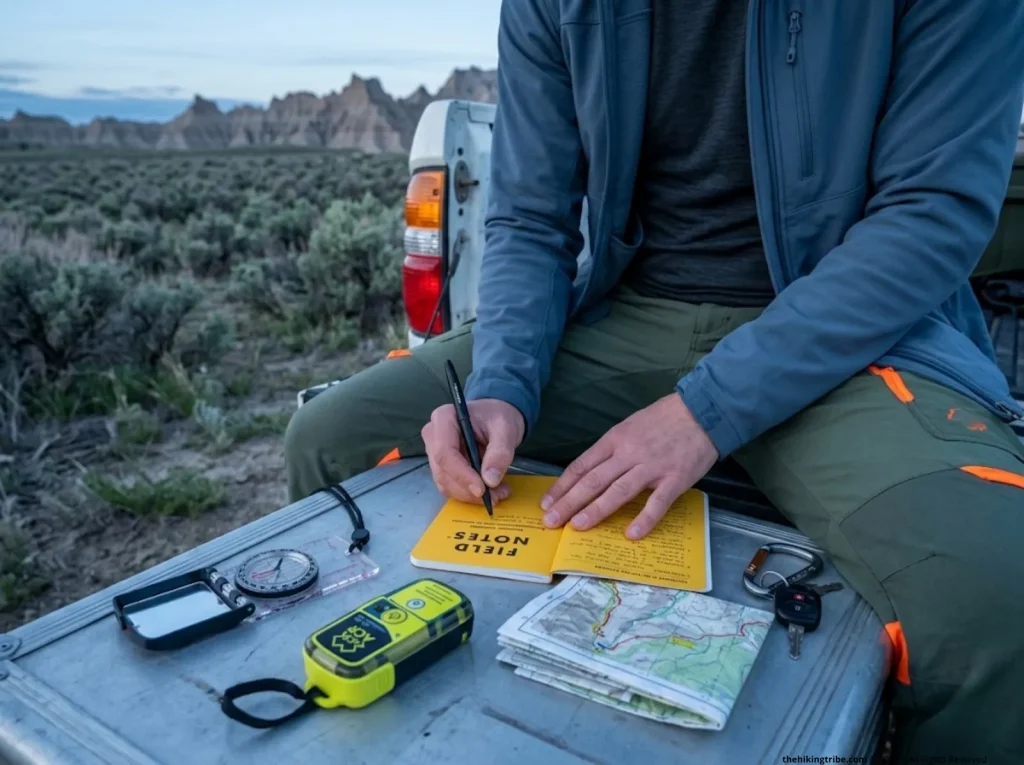
All the topographical research and weather calculations mean nothing if nobody knows where you are. Up to a third of hikers never leave a detailed itinerary, turning a simple localized rescue into a massive, multi-county grid search. Establishing a rigid offline plan within a trail research log is the ultimate defense against the unforgiving wilderness.
According to a field survey of wilderness preparedness, poor communication creates deadly delays for rescue operations. Writing out a thorough trip plan template guarantees that if you fail to return, the cavalry knows exactly where to start looking.
The Anatomy of a High-Authority Trip Plan
A proper trip log must include your exact trailhead, intended route, vehicle license plate, and any preexisting medical conditions in your group. Note the cell service availability dead zones so your contacts don’t panic if you miss a midday text. You are creating a roadmap for a search team.
Pro tip: Leave a physical copy of your written itinerary under your driver’s side seat. If your emergency contact forgets to call it in, a patrolling ranger will find it when they check the abandoned vehicle.
Defining the Search Initiation Time
The absolute cornerstone of the trip plan protocol SAR teams demand is the search initiation time. This is the precise, non-negotiable hour you instruct your emergency contact to dial 911 if they have not heard from you.
Setting a hard deadline shrinks the search grid from hundreds of square miles down to specific trail segments and bailout points. Make sure to account for long driving times out of no-service areas before setting that cut-off hour. Giving searchers a tight timeframe saves lives.
Conclusion
Stop trusting crowdsourced star ratings and start mapping your routes like a professional. Treating your pre-hike preparation as a systematic intelligence gathering operation physically keeps you out of dangerous terrain. When you combine raw topographical data, pinpoint weather calculations, and visual ground-truth verification, you stack the odds heavily in your favor. Next time you pack the truck, run through this protocol and hit the dirt knowing exactly what you are walking into.
FAQ
How do you research trail conditions?
Use a multi-source verification method combining NOAA localized weather, topographic software like CalTopo, and direct calls to the local ranger district. Never rely solely on a single crowdsourced app for current status.
How do I calculate the temperature at the summit of my hike?
Apply the Environmental Lapse Rate, subtracting three to five degrees Fahrenheit for every 1,000 feet of elevation gained. Cross-reference this simple math with high-altitude wind chill models to get an accurate gear assessment.
Are crowdsourced hiking apps reliable for navigation?
They are useful for finding popular routes but notoriously bad for technical safety and granular terrain slopes. You must cross-reference their generalized tracks with professional-grade topographic maps and recent satellite layers.
What is a Search Initiation Time?
It is the exact hour your emergency contact is strictly instructed to call emergency services if you fail to check in. Establishing this hard deadline is the single most important element of any backcountry trip plan.

I've spent more than a decade researching hiking gear and trail technique. I read the specs, the forum threads and the long-term reviews, and every pick here comes with what it gets wrong.
End of the trail
You read every mile of this one. Here's where the trail goes next.