In this article
The first fat drops hit your forearms twenty minutes from the car, and the only rain protection in your pack is one of those clear emergency ponchos that tears the moment you pull it over your head. You already know it won’t last the afternoon. The honest truth about rain jacket vs poncho for hiking is that the argument has never been settled anywhere the average hiker can find it, which is why two of Google’s top five results for this question are raw Reddit and Facebook threads where people talk past each other for forty comments. Here’s the version those threads never produce: nine criteria head to head, then a decision tree by trip type, plus the combo answer a lot of long-distance hikers quietly land on instead of picking a side.
Here’s the short version, then why each line of it is true.
| Criterion | Rain Jacket | Poncho | Edge |
|---|---|---|---|
| Ventilation | Membrane only; sweat builds on climbs | Open sides and hem, constant airflow | Poncho |
| Coverage | Torso only; pack needs its own cover | You and the pack under one panel | Poncho |
| Wind | Seals at hood, waist, both cuffs | Seals nowhere unless you belt it | Jacket |
| Weight | Roughly 10 to 16 oz by tier | Quality silnylon under 9 oz | Poncho |
| Price tier | Entry to premium, wide spread | Emergency-grade to quality, narrow spread | Poncho |
| Multi-use | One job, done well | Rain layer, pack cover, tarp, groundsheet | Poncho |
| Best for | Exposed alpine, wind, brush, cold rain | Warm rain below treeline, small packs | Trip decides |
Rain Jacket vs Poncho for Hiking Comes Down to Four Questions
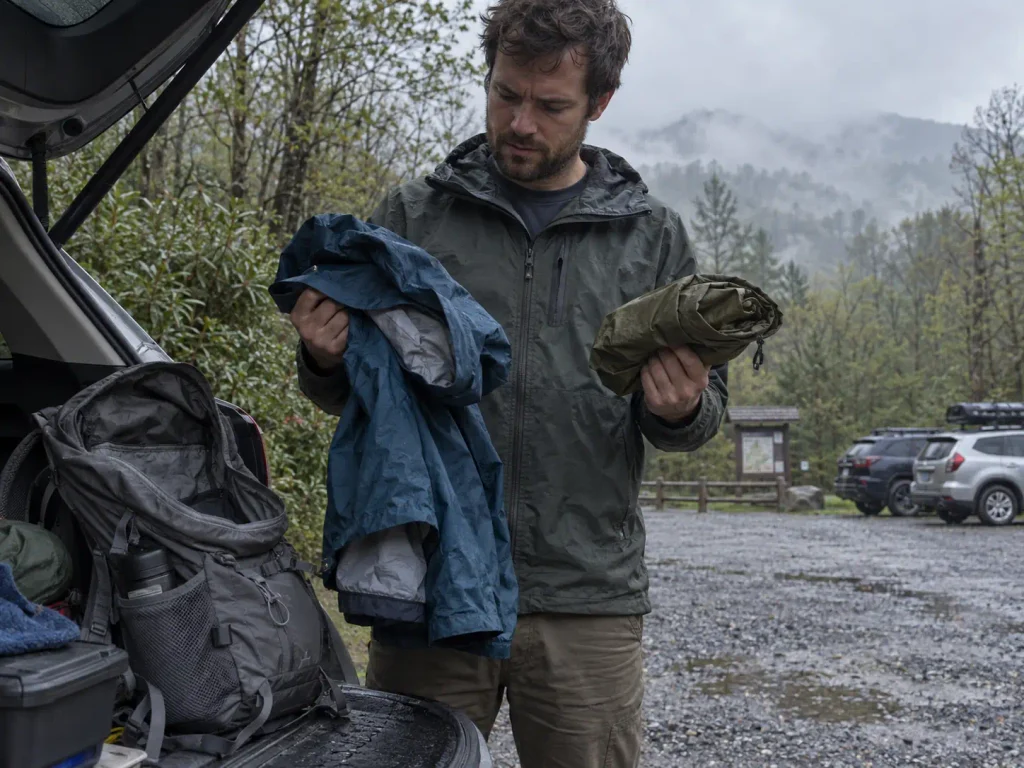
Nobody at a trailhead asks which one is better. They ask where you’re going, how big your pack is, how long you’re out, and how exposed it gets. The answer falls out of those four.
Pack size decides whether you need a second item: a framed pack needs its own cover, a small daypack sits under a poncho panel with nothing extra to buy. Exposure overrides everything else, since below treeline the trees do half the work of blocking wind and above it nothing does. Trip length matters because a day hike forgives a mediocre choice and a five-day trip does not.
Sweat output is the one people underestimate, because how hard you’re working decides whether a sealed shell keeps you dry or just moves the water to the inside. Price is the fifth variable and the least interesting, since both categories have a usable entry tier. If you’re missing more than a top layer, the full rain gear system covers what else belongs in the pack.
One thing worth naming first: a large share of the “ponchos are useless” verdicts online come from people who tried one stock, beltless version once, in wind, and never went back. That’s a fixable design gap being read as a flaw in the whole category.
How a Rain Jacket Actually Performs on Trail
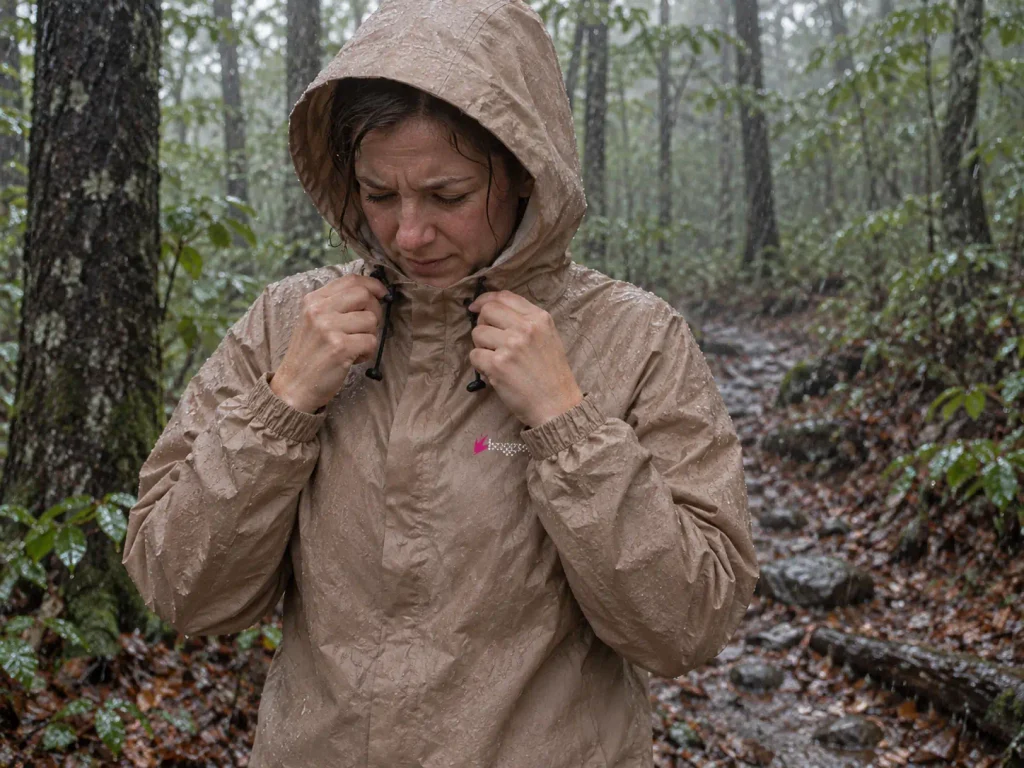
A jacket’s trade is simple and almost nobody says it plainly: you’re buying a sealed system and you pay for it in sweat. If you’ve ever finished a 55°F climb soaked under a shell that never leaked a drop, you’ve met the bill.
What the Four-Point Seal Buys You
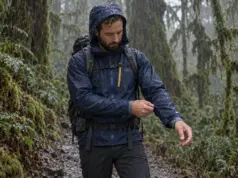
A rain jacket closes at four places: hood, waist or hem, and both cuffs. That’s the whole mechanical argument for the category, and it’s worth more than the fabric spec on the tag. Wind and side-driven rain need an opening, and a cinched shell doesn’t give them one.
That closure also traps a thin layer of warm air against you so wind cannot strip it away, which is the warmth people credit to insulation. A shell that isn’t cinched down is just a poncho with sleeves. Durability is the other quiet advantage, and a shell sized to fit over your layers moves with you instead of binding at the shoulders.
Where Every Jacket Still Loses (Sweat)
A waterproof-breathable membrane moves a fixed amount of moisture per hour, and a hiker working uphill with a pack produces more than that. Every time. Money doesn’t solve it; a premium membrane shifts the ceiling, it doesn’t remove it.
What you feel as a leak is usually condensation on the inside of the shell, and the rest of your layering system decides how bad it gets: a synthetic base layer keeps moving sweat outward, while a heavy mid layer under a sealed shell just holds it against you. Pit zips help, but open them before the climb rather than after you notice you’re damp.
Feel the inside of your sleeve before you blame the jacket. Cold and slick means water came through from outside. Warm and clammy means it’s yours, and no amount of waterproofing was going to stop it. Two problems, two different fixes.
The Waterproof Rating That Actually Matters
Hydrostatic head is the number on the tag, and it isn’t marketing fluff. Roughly 1,000mm handles light rain, around 1,500mm holds up to sustained mountain rain, and 10,000mm is the working minimum for a shell you’d trust on a full trail day. Worth understanding what hydrostatic head ratings really measure before paying for a bigger number than you need.
The part that trips up more hikers than any rating: waterproof is a coating, not a permanent property. DWR wears off with dirt, skin oils and strap friction, and then the face fabric soaks up water instead of beading it. The community word is wetting out, and a jacket soaking through at the shoulders is almost always a maintenance failure, not a worn-out membrane.
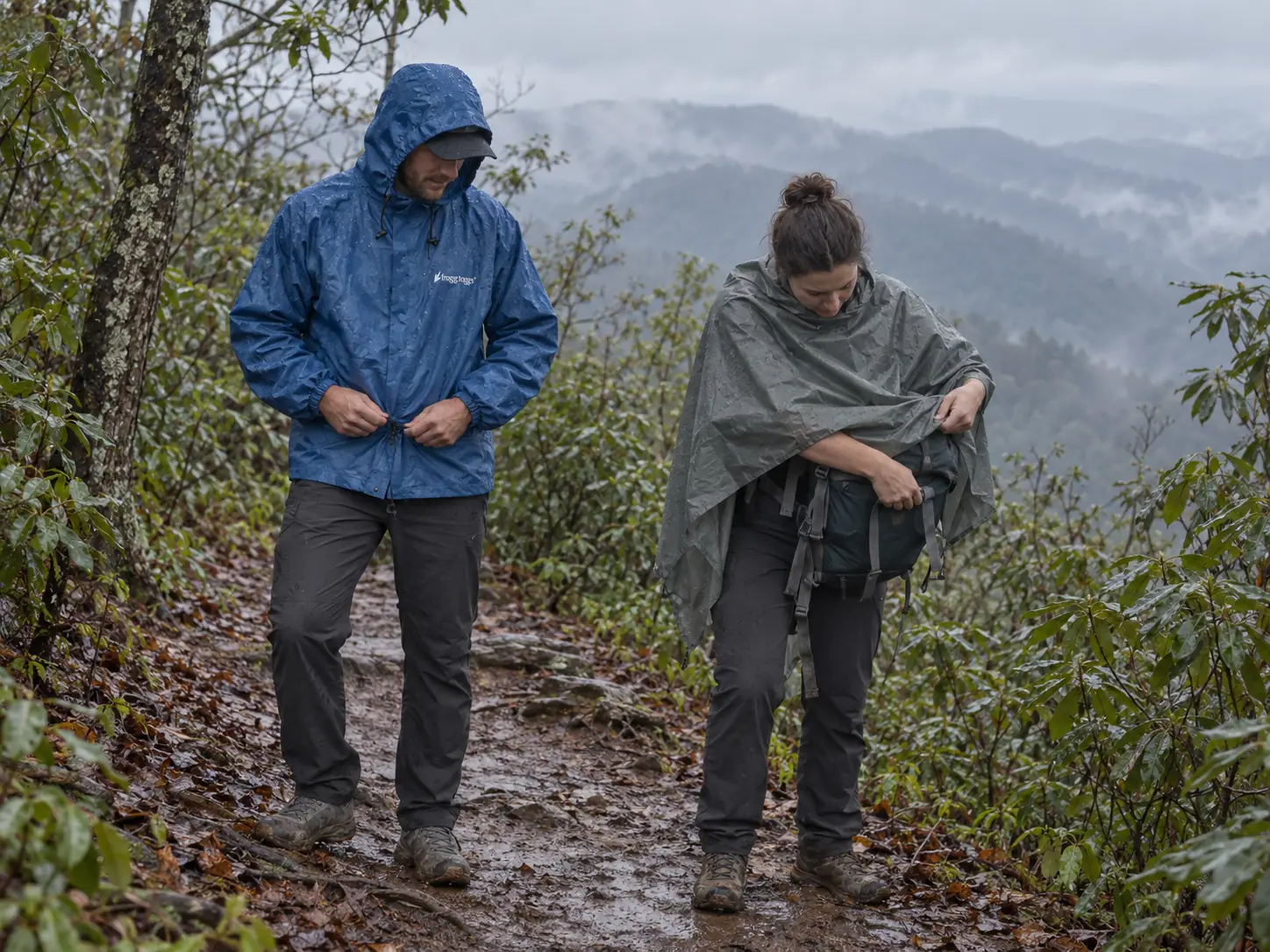
For the entry tier, the FROGG TOGGS Ultra-Lite2 Rain Jacket (men’s · women’s) is honest proof you don’t need premium money for a real sealed shell: about 10.5 oz of nonwoven polypropylene, welded seams, cinchable hood, elastic cuffs, and it does the four-point job. The trade is plain, since that material buys its price by giving up durability and tears on granite and thorny brush where a woven shell shrugs. A fine backup or first rain layer, a poor bushwhacking shell season after season.
How a Poncho Actually Performs on Trail
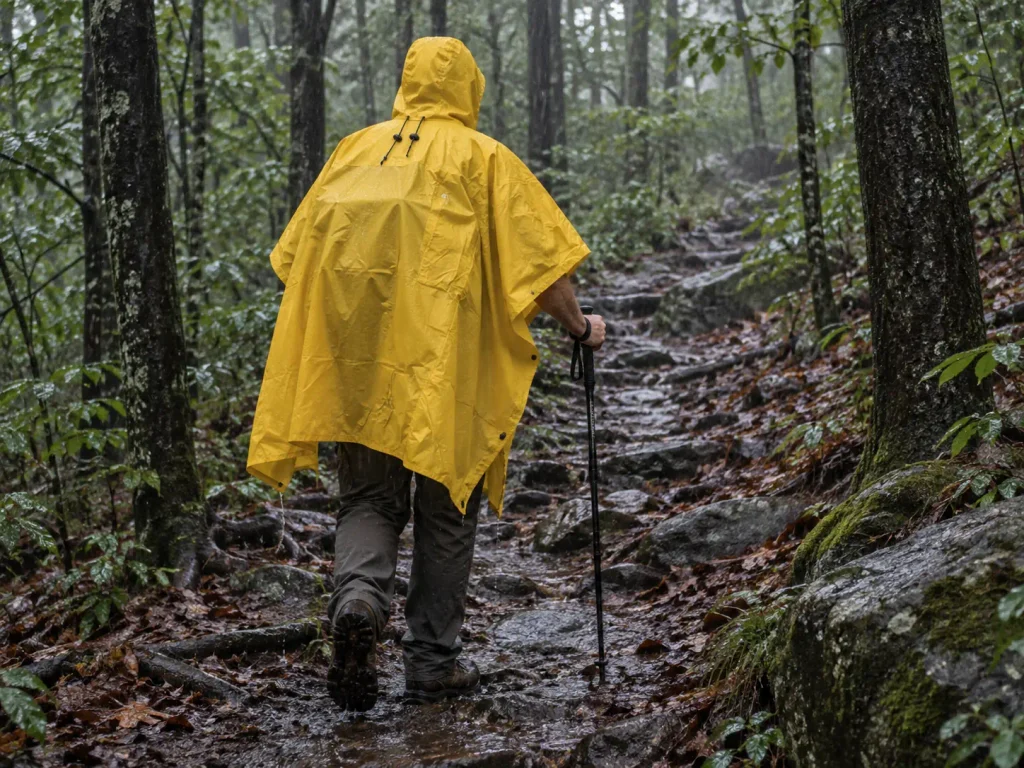
A poncho is the only rain layer that ventilates properly, and it manages that because it isn’t sealed. That sentence is also its weakness, which is why this argument never resolves.
Why Ventilation Is the Poncho’s Real Argument
Open sides and an open hem mean air moves constantly under the panel, with no membrane rationing your sweat vapor. Picture a 60°F drizzle with a steady climb in it: under a shell you top out wet from the inside and cooling fast the moment you stop, while under a poncho you arrive damp at the edges and dry down the middle. Hikers who prefer ponchos name this first, never the weight.
One Layer Covers You and the Pack
The second structural win is coverage. One panel handles torso, arms and the entire pack, so there’s no separate pack cover to buy, carry, or lose to a gust in a parking lot. Neither category makes what’s inside the pack waterproof, which is what a dry sack or a pack liner is for.
Ponchos also get dismissed as lesser waterproofing, and the fabric data doesn’t support it: quality silnylon lands around a 3,000mm hydrostatic head at under 9 oz, comparable to a mid-tier shell at a fraction of the weight. The panel is not the weak link.
The FROGG TOGGS Ultra-Lite2 Poncho (check it here) is the same brand and material family as the jacket above, which makes this a real apples-to-apples budget comparison. Around 9 oz packed with its own stuff sack, same nonwoven polypropylene, same welded seams. One manufacturer, one price tier, and you see exactly what the open design gives and takes.
The Seam Problem Nobody Mentions
Silnylon seams can’t be taped, because the silicone coating is too slippery for seam tape to bond to. Manufacturers use a bound seam instead, water-resistant rather than waterproof, or they leave the sealing to you. So on budget and DIY ponchos the seams leak well before the fabric does, and hikers who buy on price alone then get slow drips down their shoulders blame the category for what is really an unfinished product. A tube of silicone seam sealer and an evening at the kitchen table fixes it permanently.
Test a new poncho with a hose before it goes in the pack. Run water over the shoulder seams for two minutes and look underneath. Beading along the stitch line means seal it at home. Finding that out on day two of a trip is how people decide ponchos don’t work.
Wind Is Where the Poncho Loses, and Here’s the Mechanism
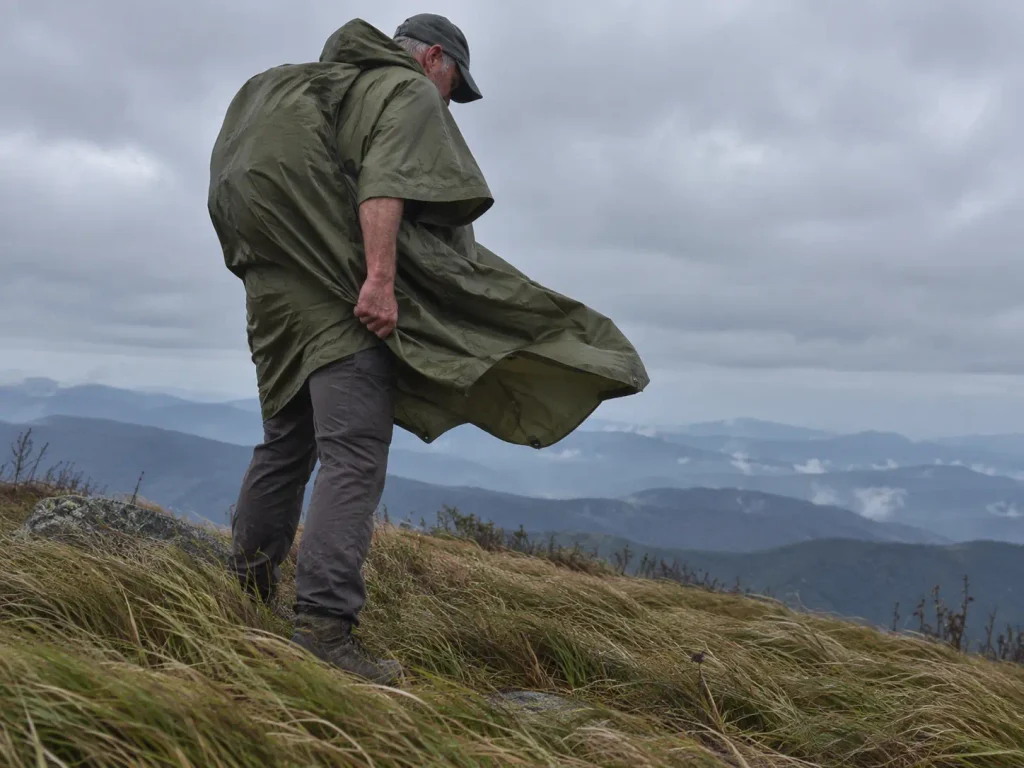
Everyone repeats that ponchos fail in wind. Almost nobody explains why, which means almost nobody realizes it’s a closure problem with a two-dollar fix rather than a flaw baked into the category.
The Sail Effect, Explained
Count the seal points. A jacket has four. A stock poncho has zero: no cinch anywhere between the panel and you, so the hem hangs free and the sides hang open, and loose fabric with free edges is the definition of a sail. The community calls it exactly that.
The flapping is the annoying part. The heat loss is the part that matters. NOAA’s wind chill data shows how quickly wind speeds up heat loss once skin is exposed: at 0°F in still air, exposed skin takes more than half an hour to freeze, but add a 15 mph wind and the effective temperature drops to -19°F, with freezing possible in minutes.
Those are winter numbers, and the mechanism is identical at trail temperatures. A layer that lets wind-driven rain through the open sides isn’t just less warm than a shell. It’s actively pulling heat off you while you walk.
Build a Poncho Belt for About Two Dollars
The fix costs less than a coffee and takes five minutes. Roughly six feet of 3mm shock cord and one cord lock. That’s the entire parts list.
Wear it at the hips, underneath the pack, cinched over the poncho so the panel’s base is held tight against your waist. Thread the cord around your waist over the poncho, run both ends through the cord lock, pull it snug and tuck the tails so they don’t catch. Under the hip belt rather than over it matters, because over the belt it slides up every time the pack shifts.
What it does and doesn’t do deserves honesty. Per the guidance circulating in the ultralight backpacking community, a belt cuts flapping to a genuinely tolerable degree, and it does not eliminate it.
Silnylon is slick enough that the belt works loose and needs readjusting as the pack moves. Treat it as a maintenance item on trail, not a permanent seal.
Tie the shock cord into a closed loop at home and leave it in the poncho’s stuff sack permanently. A belt you have to go looking for in a squall is a belt you won’t use, and the moment you need it is never the moment to be digging through a pack with wet hands.
What a Fixed Poncho Can Actually Handle
There’s real counter-evidence worth stating. A hiker posting on the Backpacking Light forums described modifying a Zpacks-style poncho with simple sewn-in arms, pairing it with rain pants, and taking it through winds around 25 mph with only modestly more wind resistance than a shell. His read was that the flapping complaints are overstated for a setup like that.
Read what that says. The failure mode is specific: loose fabric, no arms, no waist cinch. Fix those three and the poncho performs in conditions the internet insists it can’t.
The honest verdict still favors the shell where it counts. Above treeline, in sustained wind with nothing to break it, a jacket wins and the fixes only narrow the gap. Below treeline, with a belt and rain pants, the gap gets small enough that the poncho’s other advantages start outweighing it.
Coverage, Mobility and the Trekking Pole Problem
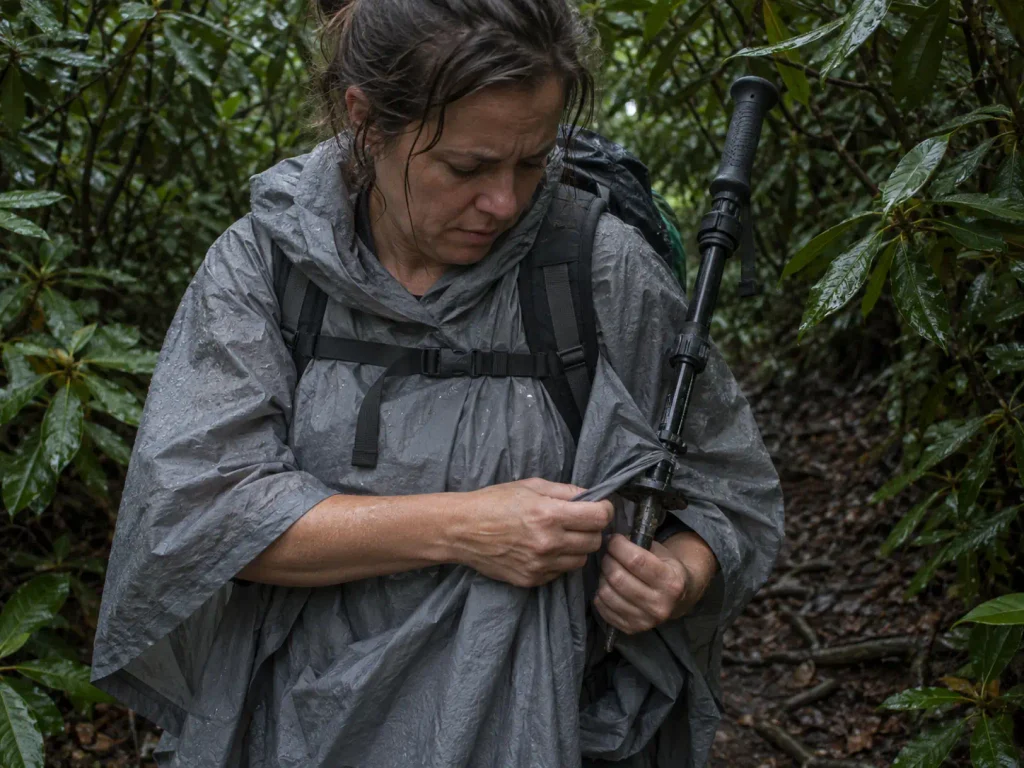
This is the stuff you only learn by wearing the thing for six hours. A jacket disappears. A poncho is always slightly present.
What Each One Feels Like After Six Hours
A well-fitted shell stops registering after the first mile. The contoured fit keeps your arms free, nothing catches on brush, and the hood moves with your head instead of against it. The trade sits behind you, since your pack is uncovered and needs a cover of its own.
A poncho never quite disappears. Your arms move inside a loose-fitting panel, roomy and vague at once, and reaching for a hip-belt pocket means going under the hem. Some hikers stop noticing that friction after a few trips. Others never do, and that’s a legitimate reason to pick a jacket.
Poles, Hems and Snagging
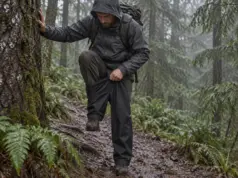
Trekking poles and poncho hems catch each other, because the fabric drapes into exactly the space where a pole basket swings. The workaround is unglamorous and it works: keep poles collapsed or z-folded whenever you aren’t using them, rather than dangling them from a wrist strap where they swing into the hem. In dense brush you’ll still be un-snagging the panel, and there’s no fix beyond accepting it or wearing a shell.
Covering Your Legs Either Way
Side-driven rain gets up under a poncho. That’s the structural gap the belt doesn’t close, and the answer is rain pants or a rain kilt underneath, which also solves the soaked-legs problem both categories share. Add gaiters if the trail is overgrown and the runoff is going straight into your boots. A jacket’s coverage stops at the hip belt too, so this is a rain-gear tax either way, not a poncho tax.
Bushwhacking is the clearest split in this comparison. Thin poncho fabric and dense brush are a bad pairing, and every branch is a chance to open a tear you’ll be taping in the field. If your trails involve pushing through anything, that decides it.
Weight, Packability and What Each One Costs
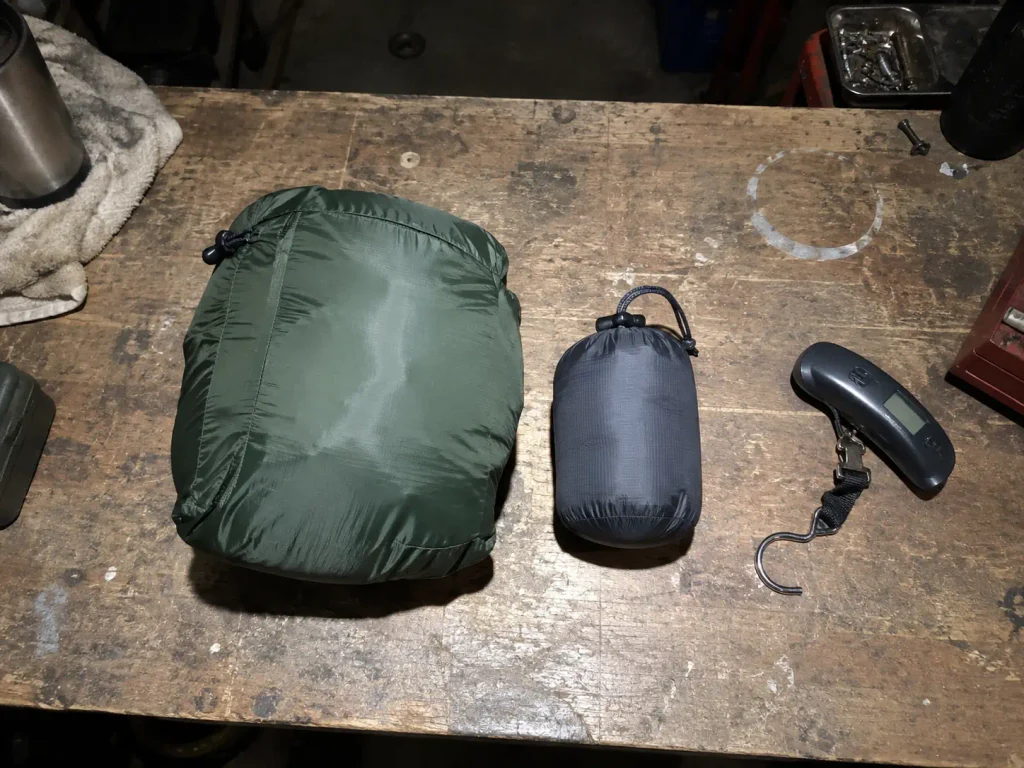
“Ponchos are cheaper and lighter” is technically true and practically useless. The interesting part is where the tiers sit, because a beginner has no sense of the bands at all.
What Each One Actually Weighs
Real numbers. A quality silnylon poncho lands under 9 oz, an entry nonwoven jacket around 10.5 oz, a mid-tier shell roughly 12 to 16 oz. That’s a gap, and a smaller one than the poncho’s ultralight reputation suggests.
The poncho’s weight win doesn’t come from the panel. It comes from what the panel replaces. Subtract a dedicated pack cover from the jacket column, possibly a groundsheet too, and the arithmetic stops being close. Anyone running the numbers should understand how it lands in your base weight, because a replaced item counts differently from a saved ounce.
The Price Bands, Honestly
Stated as category ranges, because a price attached to a specific model goes stale and misleads. Entry-level rain jackets sit in the low tens of dollars and genuinely work, mid-tier shells land in the low hundreds, and premium membrane shells run several times that. Most of what you pay for above mid-tier is weight, packed size and durability rather than waterproofing.
Ponchos have a narrower spread. Emergency-grade plastic costs a few dollars and behaves accordingly; quality silnylon lands in the mid tens of dollars. That narrow band is part of the poncho’s argument, because the gap between the worst poncho worth owning and the best one is small enough that there’s little reason to buy the bottom of it.
Where the Cheapest Option Bites You
Every category’s cheapest option has a specific failure attached, and knowing which one is the actual skill. Buy the cheapest jacket and you get a nonwoven shell that seals properly and tears on brush. Buy the cheapest poncho and you get unsealed bound seams that leak down your shoulders before the fabric shows any sign of wetting through.
Neither is a surprise if you know it’s coming. The mistake is assuming the cheap version fails at the headline job, when it usually fails at the thing nobody listed on the box.
Both categories compress small, the poncho usually smaller, and a jacket’s packed size varies more by construction than by price, which is why packable and ultralight are not the same thing. The summary nobody puts in a comparison table: durability per dollar favors the jacket across seasons, versatility per dollar favors the poncho. Pick the axis that matches how you actually hike.
The Poncho’s Real Edge Is Everything Else It Does
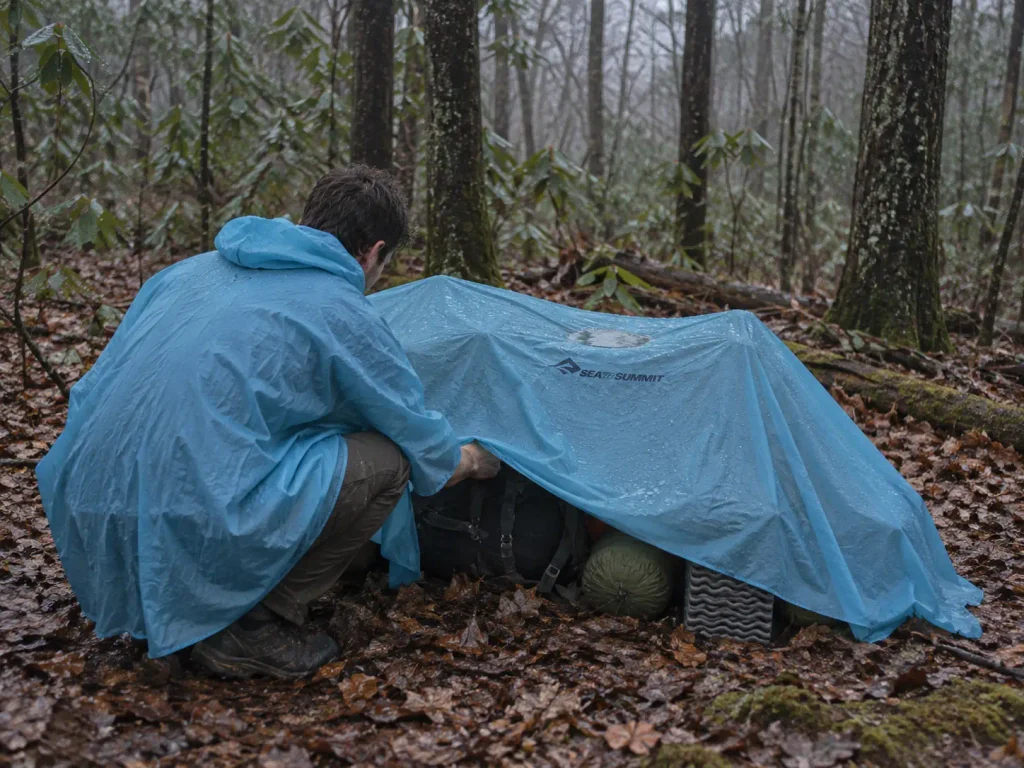
A jacket does one job. A poncho does that job slightly less well and three other jobs for free, and whether that’s a good trade depends on what’s already in your pack.
Rain Layer and Pack Cover in One
A poncho is simultaneously your rain layer and your pack cover. A jacket plus a pack cover is two items, two purchases, and two things to find when the sky opens.
The deployment difference is bigger than the ounces. Pulling a poncho over yourself and the pack is one motion, done standing, in about fifteen seconds. Pack cover plus jacket means dropping the pack, wrestling the cover on, getting the jacket on, and hoisting a now-wet pack back up. Do that four times in a squally afternoon and the single-motion version stops looking like a compromise.
The Sea to Summit Ultra-SIL Nano Poncho Raincoat and Pack Cover (check it here) is the clean anchor for this argument. One panel of roughly 15D Ultra-Sil nylon, around 5.5 to 8 oz depending on version, doing rain layer and pack cover duty and standing in as an emergency shelter or groundsheet. It sits in the mid tier rather than the entry tier, and the fabric is why: 15D silnylon is what makes the weight and the multi-use case possible at once. It is light fabric, so treat it accordingly around brush and sharp rock.
Poncho-Tarping and Groundsheet Duty
With guylines at the corners, a poncho becomes a minimal shelter. This is poncho-tarping, a core tarp camping technique and the single biggest reason the category survives in a community obsessed with cutting grams. The same panel is your rain layer while walking and your roof at night.
It also works flat as a ground cloth under a bivy or a quilt, a far more common and lower-commitment use than full shelter duty. For an unplanned night out, a panel you’re already carrying beats a shelter you left at home.
What Multi-Use Actually Costs You
The bill comes due in two places. A poncho doing shelter duty isn’t on you, so if rain starts while you’re packing up camp, you’re choosing. And a poncho sized for tarping is bigger than one sized for walking, which means more fabric hanging loose, more flap, more snag. The tarp-capable poncho is the worse walking poncho: hikers who care most about shelter accept a flappier rain layer, and hikers who only want rain protection and a pack cover should buy the smaller panel and skip the guyline points.
Where this genuinely tips the decision is smaller, enclosed packs on moderate-exposure trail. There the pack-cover function is worth more than the wind performance you give up, and the multi-use math is doing real work rather than sounding clever on a spec sheet.
Why Experienced Hikers Often Carry Both
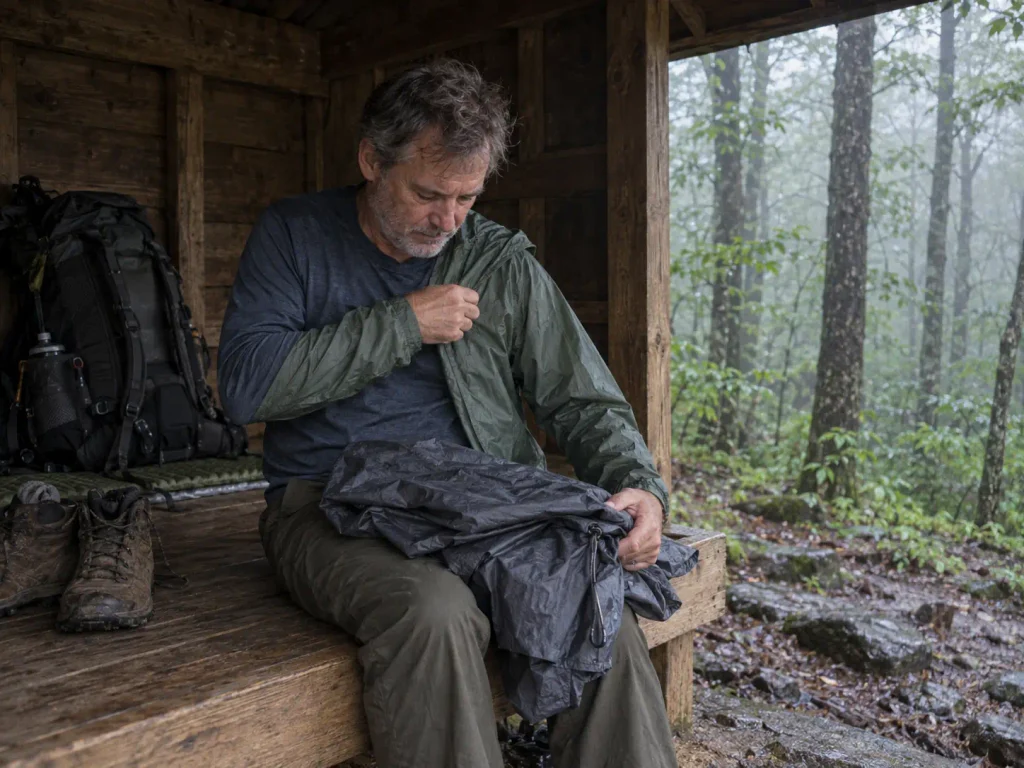
Ask a room full of long-distance hikers and a surprising number won’t pick a side. They carry a wind shirt and a poncho, and between them the two cover more conditions than either does alone.
The Wind Shirt and Poncho Pairing
Each piece supplies exactly what the other lacks. A wind shirt, sometimes sold as a windbreaker, is a tightly woven, uncoated layer weighing roughly 3 to 4 oz that blocks wind and breathes freely but offers no real waterproofing. A poncho is fully waterproof and blocks no wind at all. Worn together, the shirt provides the closure the poncho is missing and the poncho provides the waterproofing the shirt is missing.
Wind strips heat off you by convection, pulling away the warm boundary layer of air you work to maintain, and a wind shirt does more than its weight suggests for exactly that reason. It attacks that loss right at the skin, which is why it outperforms much heavier insulation in wet-and-windy conditions.
The Weight Math Against One Jacket
Run the numbers. A wind shirt at 3 to 4 oz plus a quality poncho at 5 to 9 oz puts you at roughly 8 to 13 oz total. A mid-tier rain jacket runs 12 to 16 oz by itself, and it still needs a pack cover.
So the combo often lands lighter than the single-jacket system while covering a wider band of conditions.
It also gives you configurations: poncho only in warm rain, wind shirt only when it’s cold and blowing but dry, both on when it’s both. One jacket has exactly one setting, and it’s the wrong one on a warm drizzly climb.
When the Combo Is the Wrong Call
The honest cost is complexity. Two items instead of one, and a system that asks you to think about which layer goes on. Simplicity is a real feature and this gives it up. When you’re cold and tired and the weather turns, “put on the jacket” beats a decision tree every time.
Who it’s for: shoulder season hikers in variable conditions, long trips where the weather changes across days, and anyone who already owns a wind shirt and is only adding one piece. If that’s you, shoulder season layering sorts out the rest of the system. Who it isn’t for: anyone buying their first rain layer. Buy one thing that works, learn where it fails, and add the second piece when you can name the condition that made you want it.
Pick Yours by Trip Type
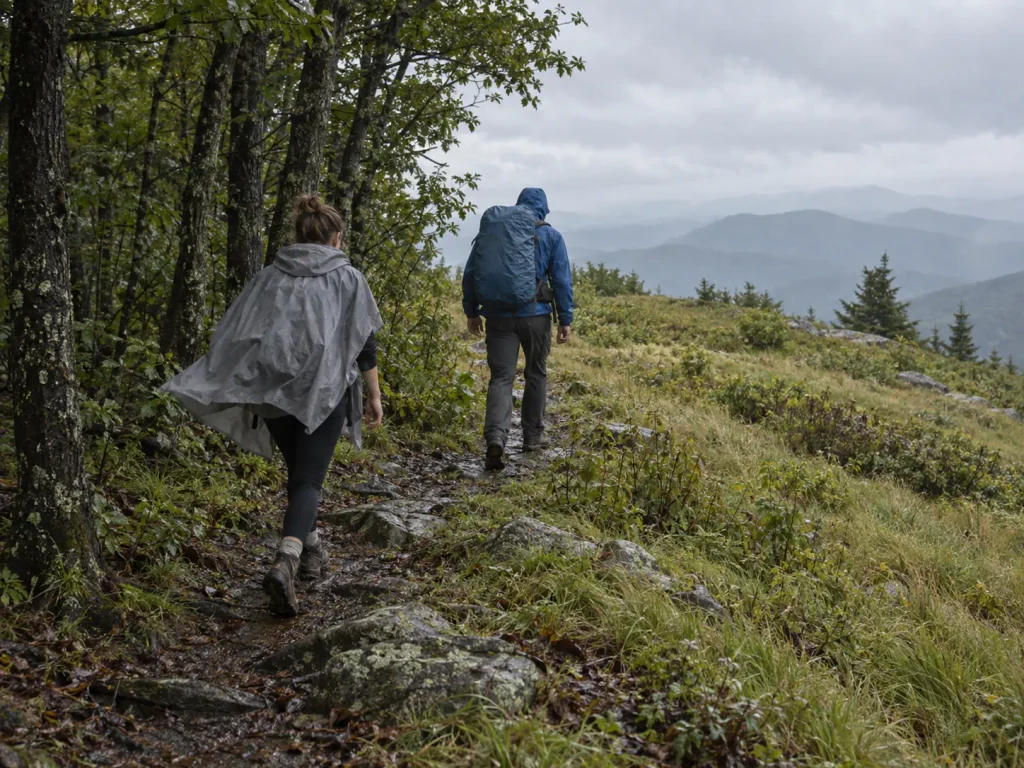
Four trip profiles, four recommendations, each with the reason attached. This is the answer the forum threads never produce, because the format won’t let them.
Day Hikes and Warm Rain
Poncho, with no real hesitation. Below treeline, on a warm or moderate rain day with a small pack, ventilation is worth more than closure, the pack cover comes free, and the wind exposure that would punish the open design mostly isn’t there. Six hours is also short enough that the hem friction never becomes a grievance, and if wind does come up, you’re under trees already breaking it.
Above Treeline and Exposed Routes
Jacket, and it isn’t close. Sustained wind with nothing to block it is precisely the condition a poncho’s open design can’t answer, belted or not, and above treeline you’re also getting the sideways rain that goes straight under a panel. Exposed alpine terrain is colder than the trailhead was, too, and the four-point seal that traps warm air is doing safety work up there, not comfort work. If that’s most of your hiking and you’re ready to shop for a model, which rain jacket fits the job narrows it down by use case.
Multi-Day Trips and Mixed Conditions
Depends on the season, and this is where the combo earns its keep. Warm and wet leans poncho, because you’ll be sweating through anything sealed and you want the pack covered anyway. Cold and windy leans jacket, because the closure becomes the point. Mixed conditions across several days is the strongest case for carrying both and configuring by the morning’s weather.
Brush, Scrambling and Rough Trail
Jacket. Thin panels and dense brush don’t mix, and a hem catching on rock while you’re using your hands is a handling problem, not an inconvenience. Scrambling in a poncho puts the panel between your arms and the rock at the exact moment you want neither.
One safety line outranks all four profiles. Once you’re wet and it’s windy, hypothermia is possible at temperatures most people would call mild, and the CDC notes hypothermia can set in at temperatures as mild as 60°F once you’re wet, because water pulls heat away from you roughly 25 times faster than air does. Shivering and fumbling hands degrade the exact judgment you need to fix the problem, which is why knowing what to do if it starts going that direction belongs in your head before the trip. Whichever category you pick, the one that fails you is the one still folded in your pack.
If you’re a beginner and this feels like a decision being demanded of you, the honest answer is to buy one thing that works and learn its limits. Three rainy hikes will tell you what you actually need, and that beats optimizing a system before you’ve used one.
Check Your Rain Layer Before the Next Forecast
Neither category wins in the abstract. Pack size, exposure and sweat output decide it, and they decide it differently for different trips, which is why the online arguments never end.
The poncho’s wind problem is a closure problem, and six feet of shock cord narrows it considerably. Its real edge was never rain performance anyway; it’s everything else the panel does. Above treeline the jacket wins and it isn’t close. Everywhere below it, the answer is genuinely open, and anyone who tells you otherwise is describing their own trails rather than yours.
Before the next trip with rain in the forecast, pull out whatever rain layer you own and check the one thing that’s easiest to fix. If it’s a jacket, run water over the shoulders and watch whether it beads or soaks in. If it’s a poncho, check whether anything holds the hem down and whether the seams are sealed. Both failures cost almost nothing to solve at the kitchen table and a miserable afternoon to discover on trail.
Frequently Asked Questions
01Which is better for hiking, a raincoat or a poncho?
Neither is better across the board, because wind exposure and pack size decide it. Jackets win above treeline and in sustained wind since they seal at the hood, waist and both cuffs. Ponchos win on warm, sheltered trails because they ventilate and cover the pack in one piece.
02Is a rain poncho good for hiking?
Yes, for the right conditions: below treeline, in warm or moderate rain, with a smaller pack. A poncho ventilates better than any sealed shell and doubles as a pack cover. It needs a waist cinch to behave in wind, and its seams are the first place a budget model leaks.
03What is the best jacket for hiking in rain?
The one rated at least 10,000mm hydrostatic head that fits over your layers and that you will actually maintain. Waterproofing is a coating that wears off, so a mid-tier shell you re-treat beats a premium shell you never wash. See the jacket picks by use case.
04What are the disadvantages of using a rain poncho?
Three real ones: it catches wind like a sail because nothing cinches it to your waist, side-driven rain gets up underneath, and its seams are usually bound rather than taped, so they leak before the fabric does. The first two have fixes, a shock-cord belt and rain pants. The third is a buying decision.
05Is it better to hike with a poncho or a rain jacket?
Match it to the trip rather than picking a favorite. Day hikes in warm rain with a small pack favor the poncho. Exposed alpine terrain, sustained wind and brushy trail favor the jacket. Long trips with mixed weather often favor a light wind shirt under a poncho instead of either one alone.
Risk Disclaimer: Hiking, trekking, backpacking, and all related outdoor activities involve inherent
risks which may result in serious injury, illness, or death. The information provided on The Hiking Tribe is for
educational and informational purposes only. While we strive for accuracy, information on trails, gear, techniques,
and safety is not a substitute for your own best judgment and thorough preparation. Trail conditions, weather, and
other environmental factors change rapidly and may differ from what is described on this site. Always check with
official sources like park services for the most current alerts and conditions. Never undertake a hike beyond your
abilities and always be prepared for the unexpected. By using this website, you agree that you are solely
responsible for your own safety. Any reliance you place on our content is strictly at your own risk, and you assume
all liability for your actions and decisions in the outdoors. The Hiking Tribe and its authors will not be held
liable for any injury, damage, or loss sustained in connection with the use of the information herein.
Affiliate Disclosure: We are a participant in the Amazon Services LLC Associates Program, an
affiliate advertising program designed to provide a means for us to earn advertising fees by advertising and linking
to Amazon.com. As an Amazon Associate, we earn from qualifying purchases. We are also an official affiliate partner
of Black Diamond Equipment via the AvantLink network. If you click on a Black Diamond affiliate link and make a
purchase, we may earn a commission at no additional cost to you. We also participate in other affiliate programs and
may receive a commission on products purchased through our links. Additional terms are found in the terms of
service.