In this article
The October morning read 38°F at the trailhead. I knew it would warm up, so I wore my heaviest down jacket from the start. By mile two I was soaked through, the jacket’s baffles saturated with sweat, and by the time clouds rolled in near the summit ridge the wind turned that wet insulation into exactly what I didn’t want — a refrigerator strapped to my chest. I spent the last four miles cold, damp, and wondering how I’d gotten this so wrong after years on the trail.
Turns out, the problem wasn’t the gear. It was the system. Shoulder season layering is its own discipline, and most hikers either overpack, underdress, or wear layers that can’t adapt fast enough for conditions that shift from sunny to stormy in under an hour.
After rebuilding my approach from the ground up — and racking up a lot more cold, sweaty miles in the transitional seasons — here’s what I learned about building a good layering system that actually works from the Rockies to the Appalachians.
⚡ Quick Answer: Start with a moisture-wicking base layer (synthetic or merino, never cotton) and pack a midweight insulating layer plus a lightweight wind-blocking shell. Begin your hike feeling slightly cool — your body warms up fast. Add or remove layers at the first sign of sweating or shivering, not after. This three-layer system handles temperature swings from 25°F to 60°F across any shoulder season trail.
The Shoulder Season Problem — And Why Your Current System Fails
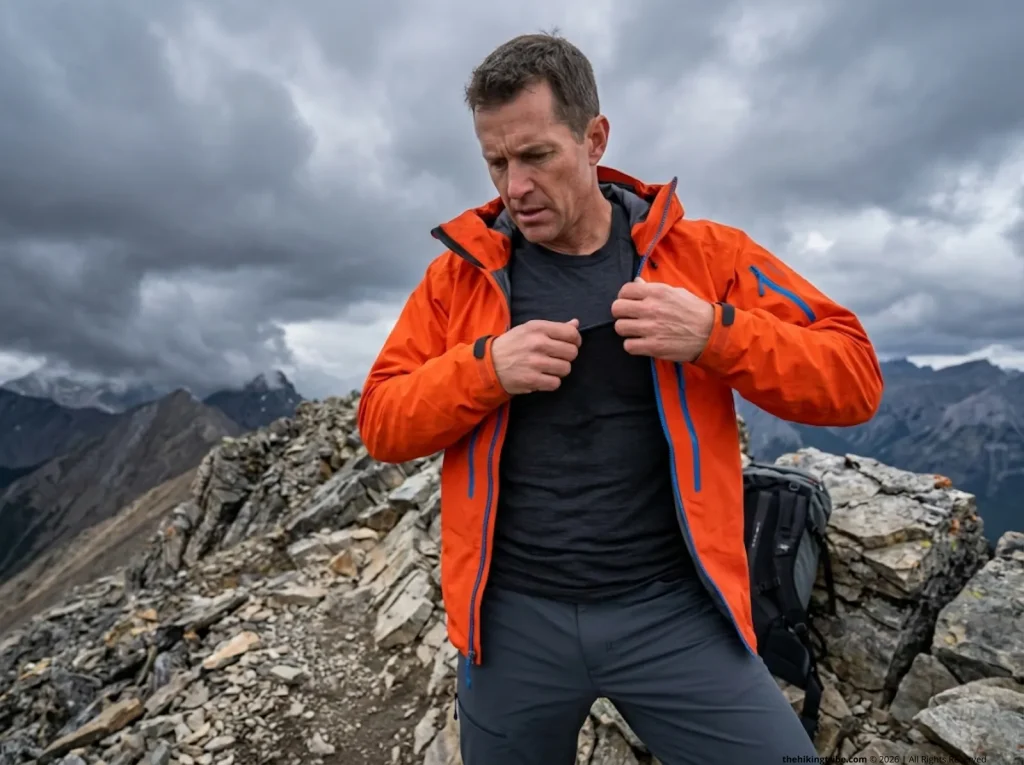
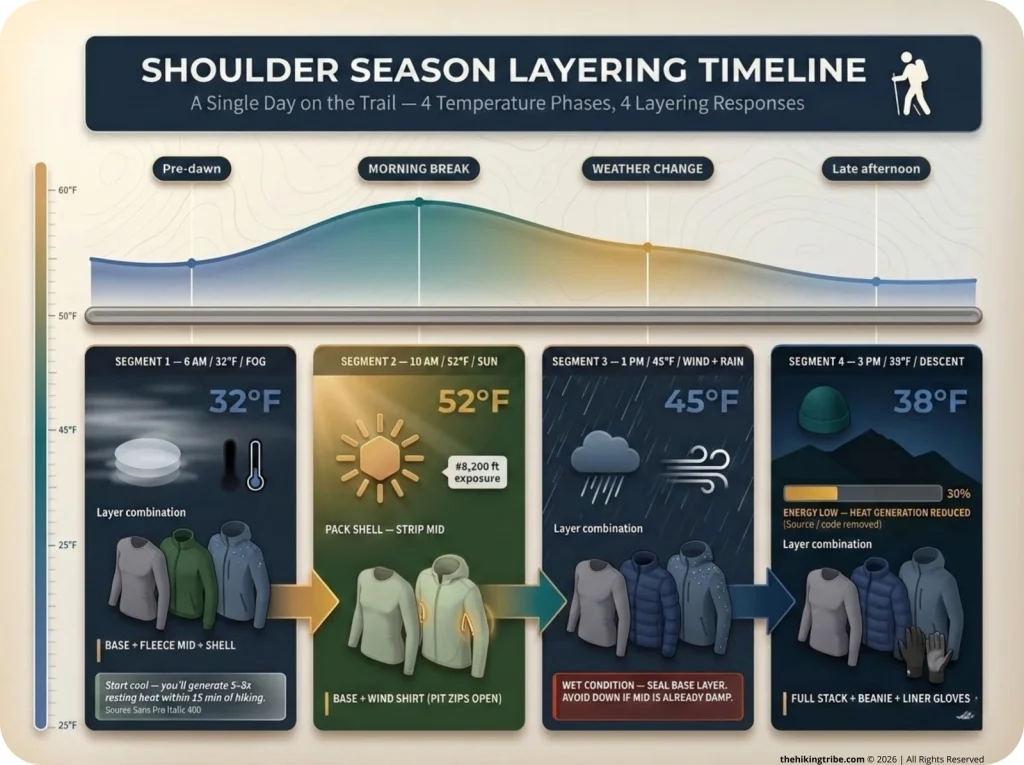
Shoulder season isn’t summer with cooler nights or deep winter with softer conditions. It’s genuinely its own beast. In the Appalachians or at elevations across the Rockies, you can start a hike in fog and 32°F air, hit a sunny exposed ridge at 55°F by mid-morning, catch a rain squall at 1 PM, and descend into shadow at 38°F just as your energy flags. All in the same day.
Temperature swings of 20–30°F within a single hike are normal, not exceptional. Add 5–8°F of temperature drop for every 1,000 feet of elevation gain and a single summit push can put you in genuinely dangerous territory if your layering system doesn’t adapt.
The bigger threat isn’t the cold air itself — it’s the sweat your body produces during high-output activity. Cotton absorbs moisture and holds it against your skin, which is why the outdoor community’s golden rule — “wet clothing is cold clothing” — is not a cliché. It’s physics. Down insulation loses roughly half its warming ability when wet. Even a quality jacket becomes deadweight once it’s soaked through from the inside.
You can read the full story on the physics of why wet cotton kills body heat — the numbers are sobering. According to the CDC’s hypothermia prevention guidelines, around 1,300 hypothermia deaths occur annually in the US. A survey of Appalachian Trail hikers found 5% reported hypothermia — most triggered when variable weather turned on people already caught with the wrong layers.
The Start Cold Principle — The Counterintuitive Rule That Changes Everything
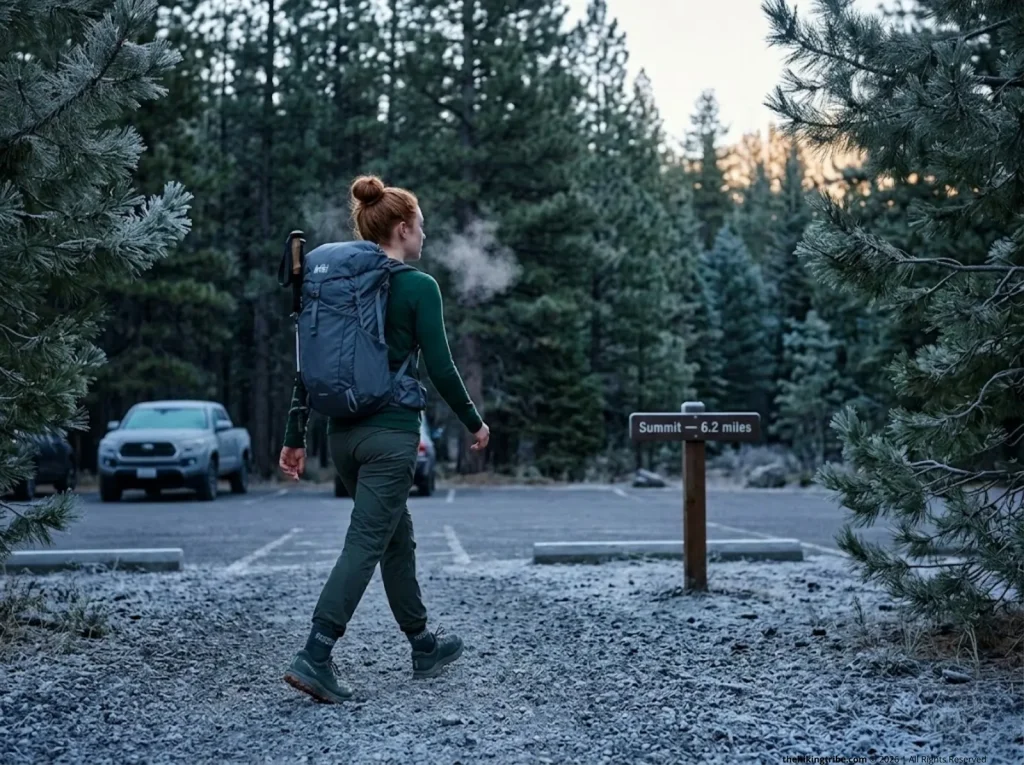
Here’s the thing most hikers resist: you should feel uncomfortable at the trailhead. Not dangerously cold, but that slightly chilly feeling where your instinct is to zip everything up — that’s exactly right.
Your body generates significant heat within the first ten to fifteen minutes of active movement. If you’re comfortable standing at the car, you’ll be overheating by mile one. Sweat that saturates your base layer early in a hike is almost impossible to recover from once temperatures drop later in the day. The outdoor community puts it plainly: start out feeling slightly cool, because you will warm up.
This is where learning to read your body matters. The first signal that you’re overdressed isn’t dramatic shivering or sweating — it’s a faint warmth at your lower back or a slowly dampening collar. Those are your cues to act. Don’t wait until you’re soaked.
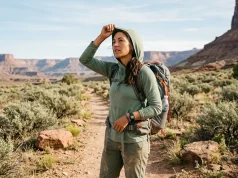
One practical trick: instead of stripping a full layer mid-stride, try opening pit zips to dump excess heat without stopping. Good shells and softshells have pit zips specifically for thermoregulation during uphill sections. Use them early and often to regulate your core temperature without the full stop-and-strip routine.
Pro tip: Stop and remove a layer at the FIRST sign of warmth, not after you’re already sweating. A two-minute break at mile one saves you from riding out the whole hike in cold, wet gear.
Base Layer: Your Sweat Management Foundation
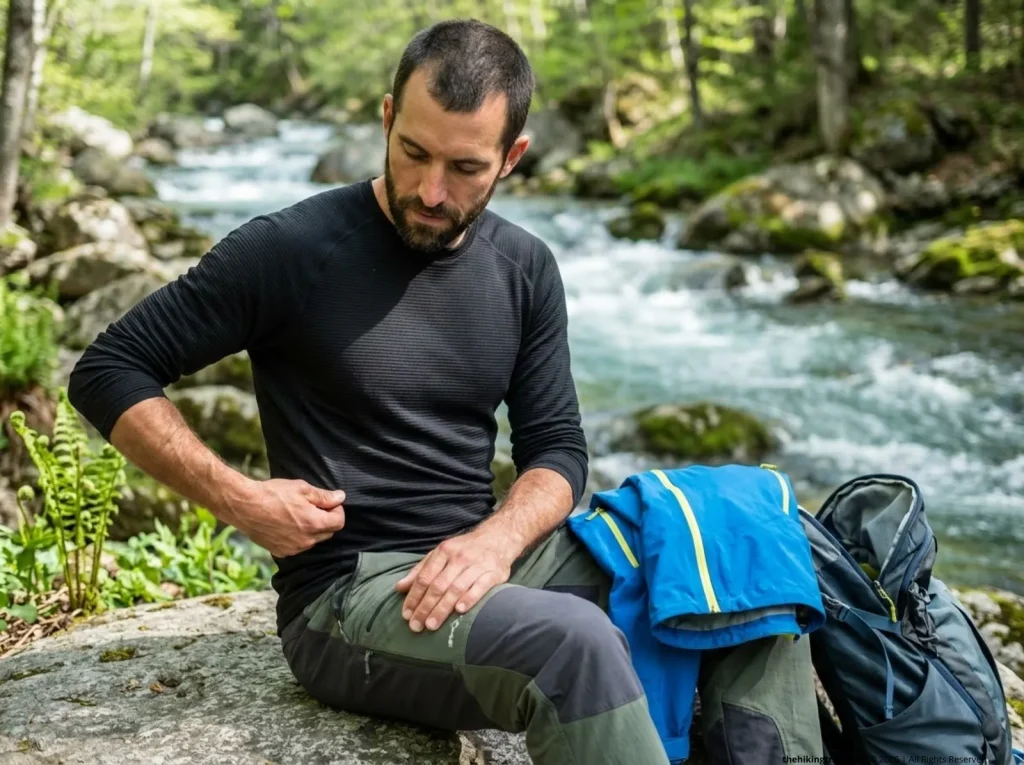
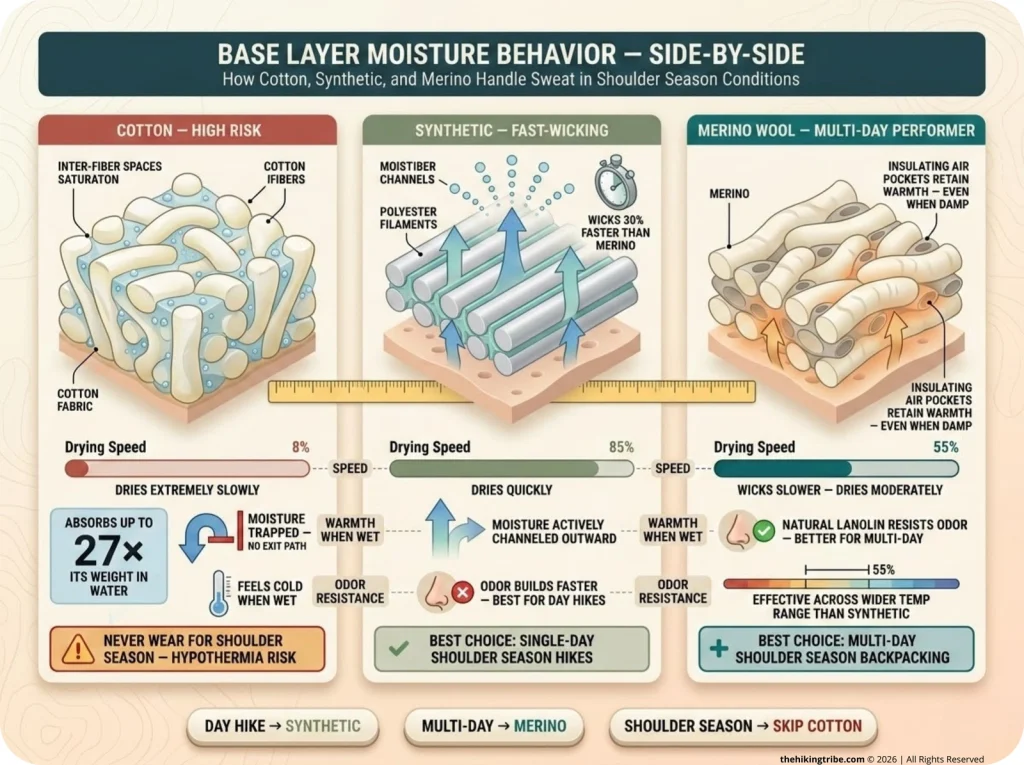
Your base layer is the most important piece in the system, and it’s the one most hikers get wrong first. The rule is simple: no cotton base layers. Ever. In shoulder season, cotton’s water-retention turns it from clothing into a liability.
Moisture-wicking synthetic fabrics like polyester wick roughly 30% faster than merino wool in controlled tests — they move sweat away from skin quickly, dry fast, and feel less cold when damp. The REI Co-op Lightweight Baselayer and the Outdoor Research Echo Hoodie are both solid synthetic options. The tradeoff: synthetics smell faster, which matters on multi-day shoulder season backpacking trips.
Merino wool — the Smartwool 250 series, Patagonia Capilene Air, and Icebreaker options — wicks more slowly but manages temperature across a wider range and resists odor significantly better. For a single-day hike, synthetic wins. For two or more days in the mountains without facilities, merino earns its price tag.
Fit is where most people overcorrect. A base layer should be snug but not restrictive — the wicking action that pulls moisture from skin requires consistent contact with the fabric. If it hangs loose at the torso, it’s functioning as a middle layer, not a next-to-skin layer. Our 200-mile base layer fit test results cover this in detail, but the short version: close contact beats slightly more comfortable.
One rare attribute worth knowing: body-mapped construction uses varying fabric density across the garment — heavier mesh at moisture zones like the armpits and lower back, lighter open-weave at less active areas. The Brynje Super Thermo Mesh takes this further with a fishnet structure that creates an air gap between skin and fabric, dramatically reducing the wet-cling problem during intense climbs.
Pro tip: When you’re trying on base layers in a store, reach both arms overhead and twist at the torso. If the hem pulls out of your waistband, it’s going to pull out on the trail every time you reach for a trekking pole grip. Size down or try a different cut.
Mid Layer and Shell: Building the Adaptable Stack
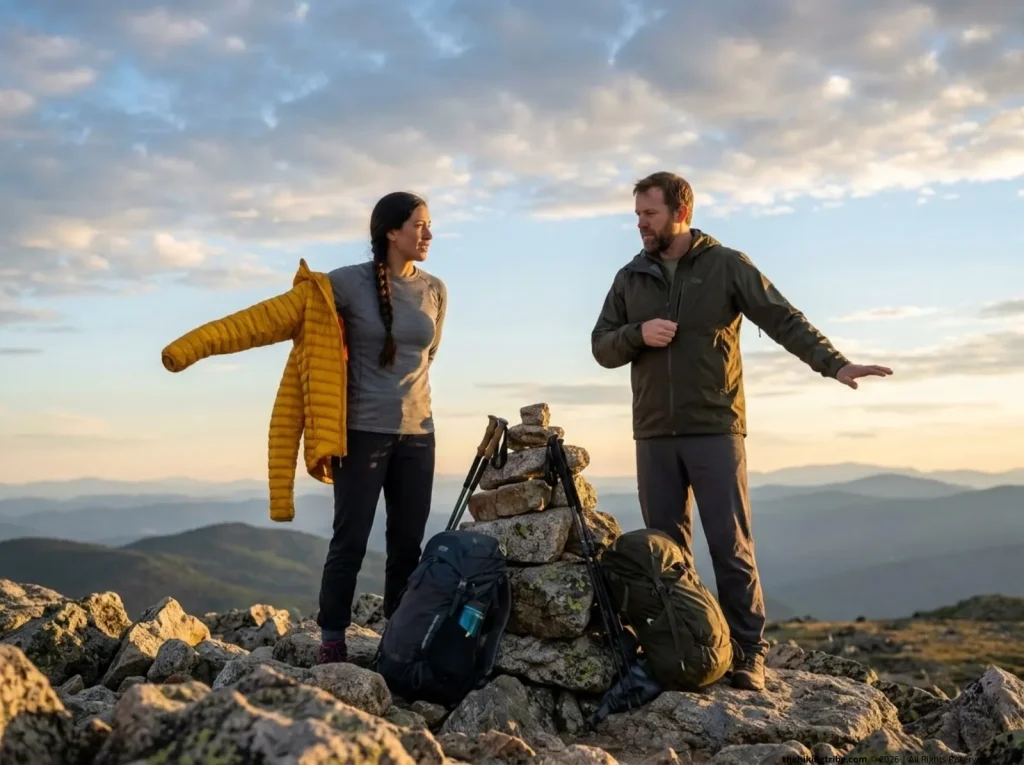
Once your moisture management foundation is right, the mid and shell layer build on top of it — but the key word for shoulder season is independent-piece adaptability. Each layer has to work alone or in any combination. You might hike in shell plus base only (warm rain), or mid plus base only (cold and dry), or all three together (cold, windy, and wet). None of those scenarios should require you to dig through your pack.
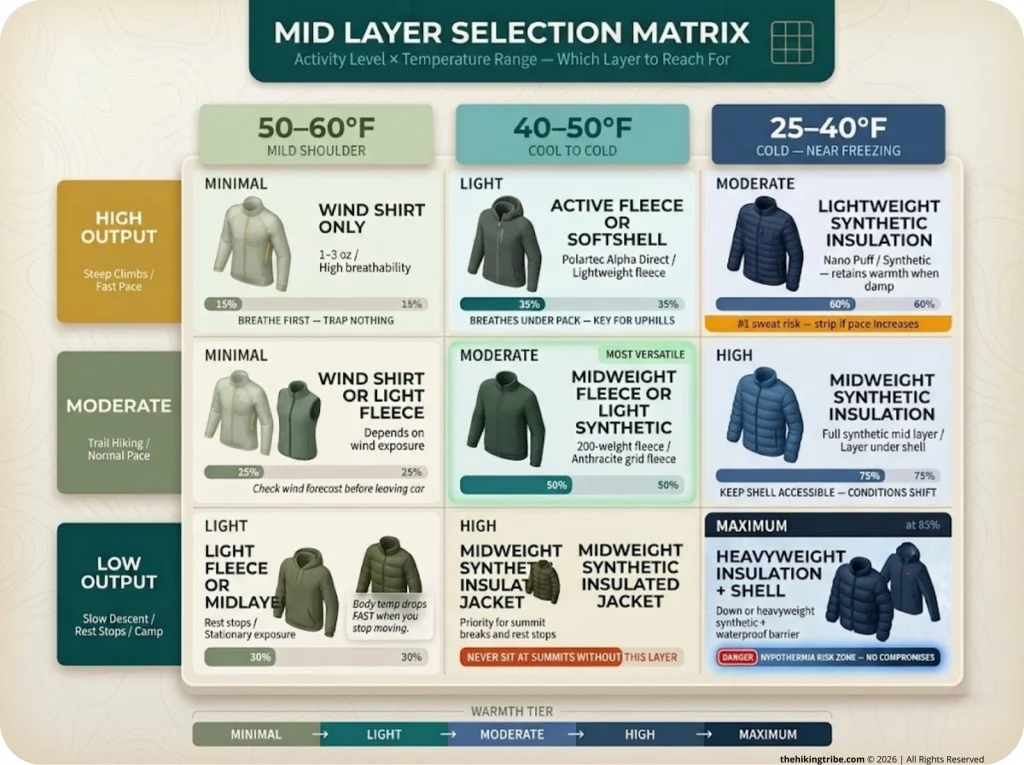
Polartec Alpha Direct hoodies — found in several brands now — represent one of the biggest shifts in active insulation. They’re 40–60% lighter than traditional fleece while offering comparable warmth, and they breathe dramatically better during high-output movement. This matters because on steep terrain, your real enemy is trapping heat and soaking your base layer from the outside in.
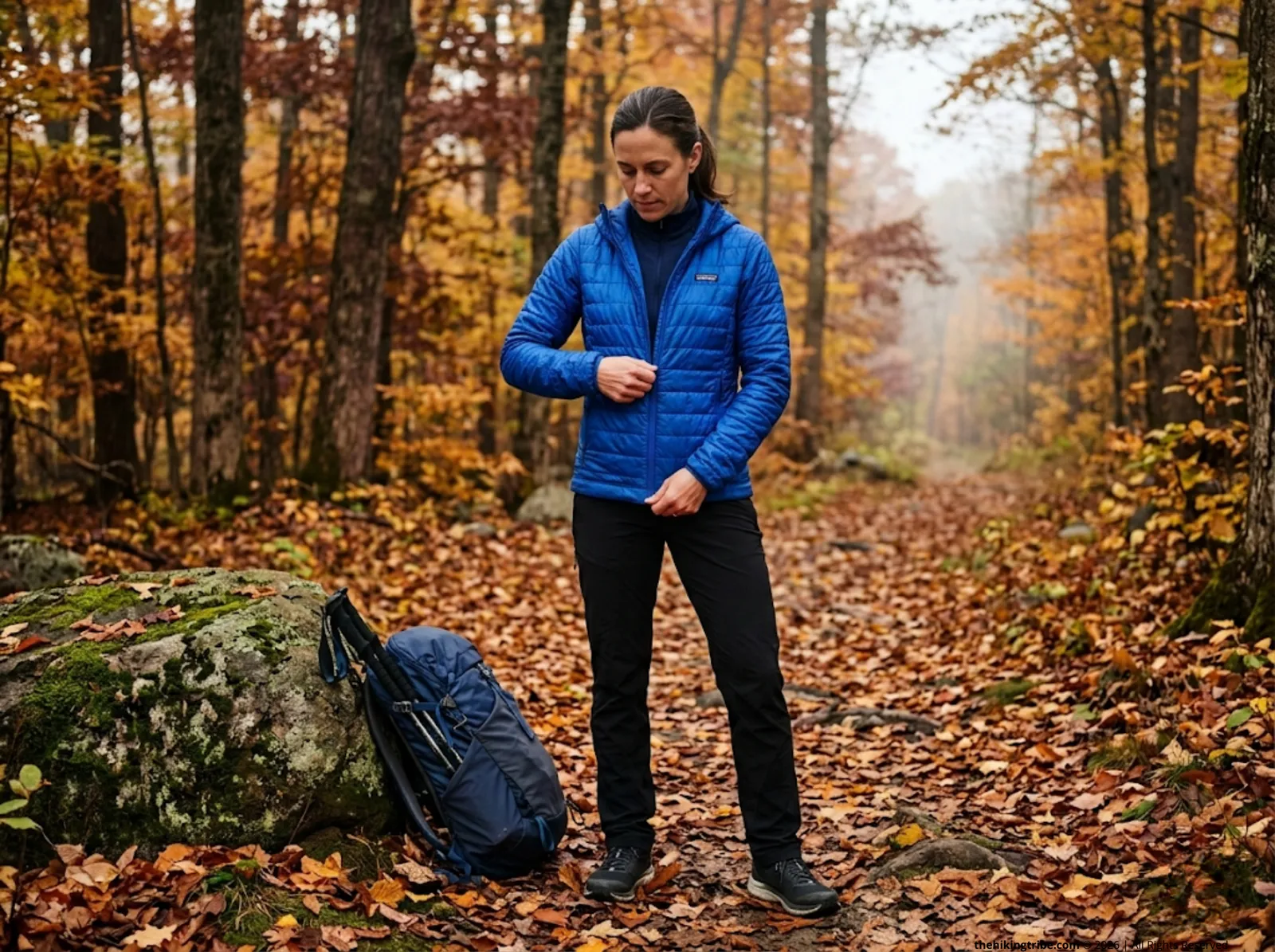
Traditional down offers the highest weight-to-warmth ratio — the Mountain Hardwear Ghost Whisperer is a benchmark here — but loses roughly half its insulation when wet, which is a real shoulder season risk if your shell fails or if you start sweating hard. Synthetic packable insulation like the Nano Puff retains warmth even when damp and dries faster. For most hikers who aren’t ultralight obsessives, a lightweight synthetic insulated jacket is the more forgiving choice.
For the shell layer, a lightweight wind-blocking shell or wind shirt (often 1–3 oz) blocks the majority of convective heat loss on exposed ridgelines without trapping heat. They pack small and weigh almost nothing. For heavier rain, you need a hardshell — but don’t wear it all day if conditions allow. You can read the full trade-off on our full fleece vs down comparison for hiking if you’re still deciding on which mid layer to anchor your system.
Don’t Forget Your Extremities — Where Most Layering Systems Fail
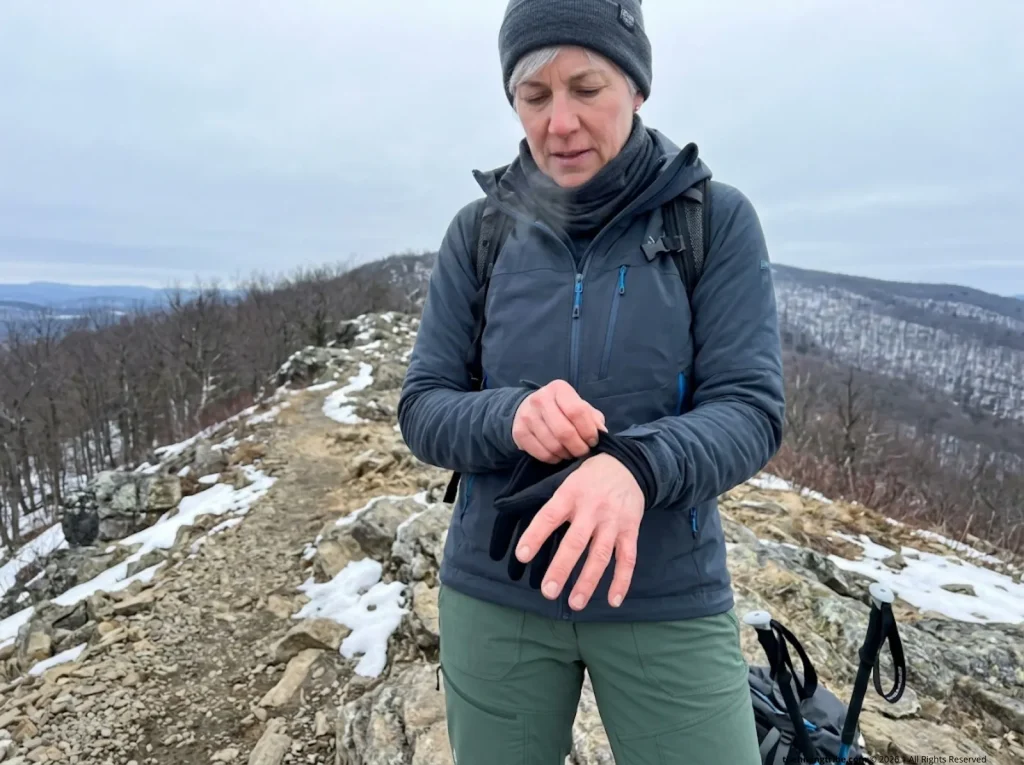
You can have a perfect three-layer system on your torso and still be miserable if your hands are numb and your feet are cold and soaked. Your extremities lose heat fastest — your body restricts blood flow to hands, feet, and head first when core temperature drops, which is why fingers lose dexterity before you feel cold anywhere else.
A lightweight merino beanie and a set of thin liner gloves together weigh under three ounces. A thin beanie and light gloves can pack small in your pocket or hip belt. The Seirus Heatwave liners use a reflective inner lining that bounces your own body heat back toward your hands — it sounds like marketing copy, but the warmth difference in sub-40°F wind is real. At 38°F with a 15 mph ridge wind, bare hands lose safe dexterity in well under 20 minutes. That’s enough to fumble buckles, drop a trekking pole, or fail to read your compass.
Sock layering is the shoulder season secret nobody talks about loud enough. A thin Injinji liner sock paired with a mid-weight Darn Tough merino outer layer sock creates a two-layer moisture management system for your feet. The sock liner wicks moisture outward; the merino sock insulates and cushions. Our 1,000-mile toe sock testing results go deep on why properly managing inter-sock friction matters for long days.
The practical rule: always carry more gear than I wear — at least one dry pair of socks sealed in a plastic bag. Cold, wet feet accelerate full-body cooling faster than almost any other single factor on the trail. Your feet can sweat heavily on a long uphill and then freeze during a long, shaded descent — plan for both phases.
Pro tip: On shoulder season hikes where temperatures are borderline, put your mid-layer and spare socks inside your pack’s brain or top compartment before you leave the trailhead. Accessible gear gets used. Buried gear stays buried.
On-Trail Transitions: The Decision Tree Nobody Gives You
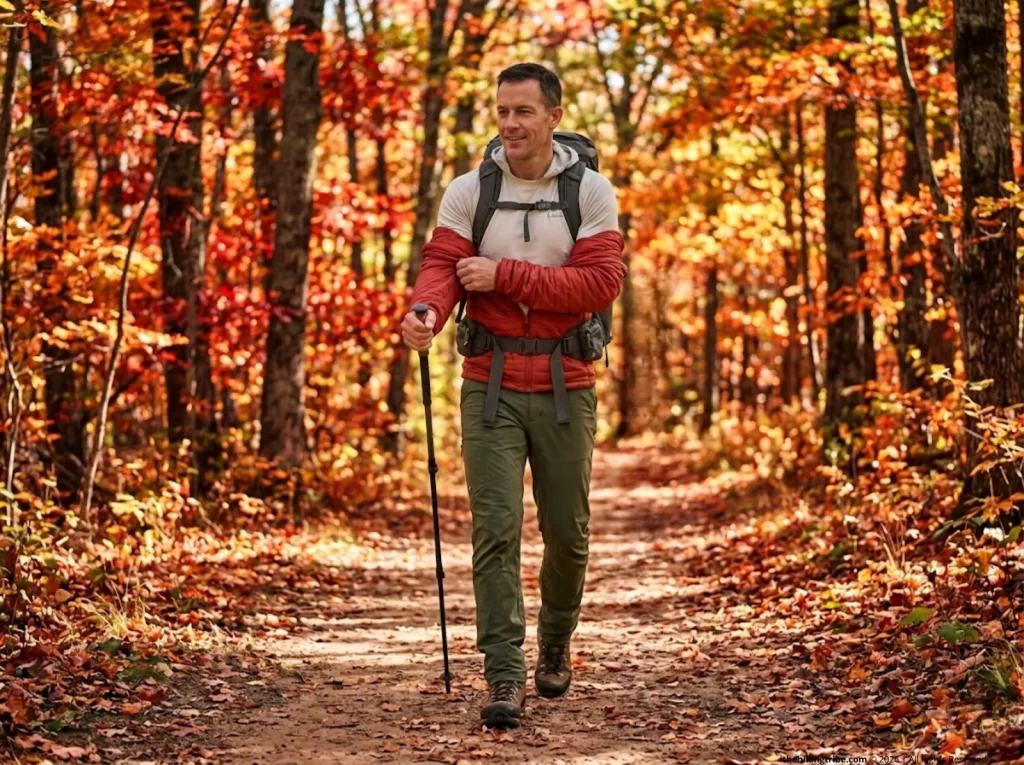
Every guide on shoulder season layering says the same thing: “adjust as needed.” What none of them give you is a framework for making that call in the moment when you’re tired, slightly overheated, and carrying a pack.
Here’s a practical shoulder season layering decision tree that fits in your head. At any point during the hike, ask four questions in order. Are you sweating? Remove a layer immediately. Are you shivering? Add one immediately, even if it means stopping. Has the wind shifted or picked up? Add your wind shirt proactively — before you cool down, not after. Is precipitation starting? Shell on, but open pit zips if you’re still warm from moving.
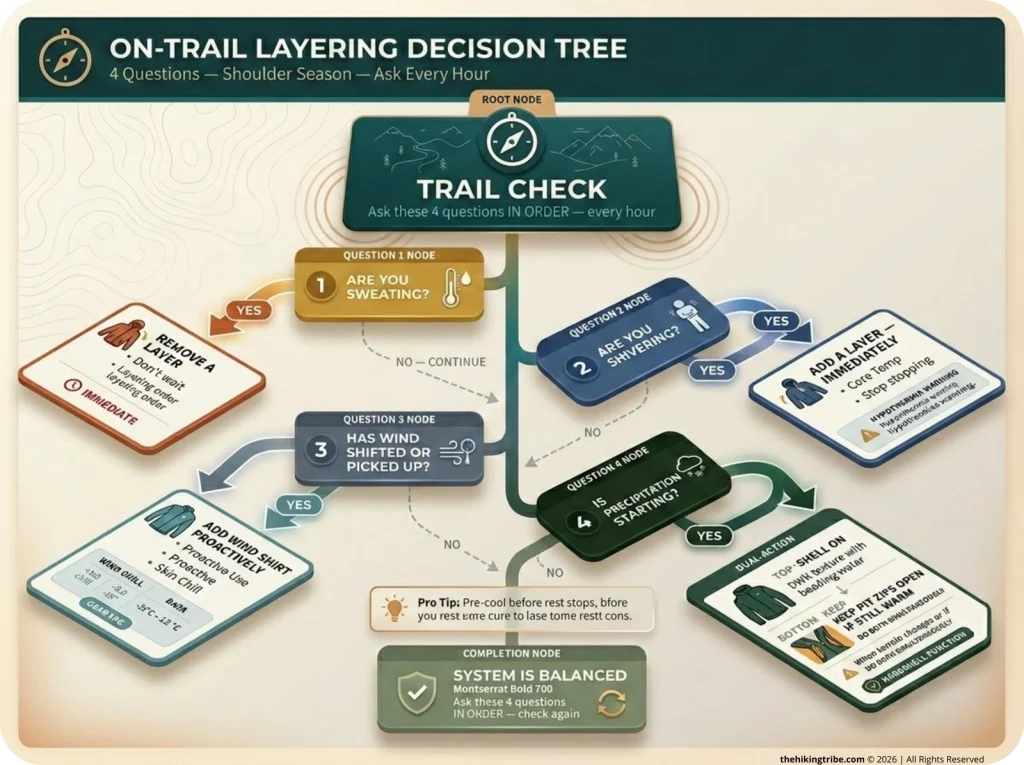
The other adjustment most hikers skip: pre-cooling before rest stops, not during them. On a long uphill push, crack your shell open or strip your mid layer a few hundred meters before the summit. By the time you stop, your body temperature has already started descending to a manageable level instead of spiking right as you sit still. This is the “take the time to transition” principle — but the timing of that transition matters as much as doing it at all.
On steep climbs, strip to base layer even when the air temperature is cold. Your body generates enough heat to stay warm with minimal insulation. Keeping heavy layers on during a hard climb is how you arrive at the summit soaked in sweat with wind chill directly ahead. The U.S. Forest Service recommends getting adequate rest and wearing proper layers before cold-weather outings — but their advice is even more critical mid-hike, when most hikers fail to adjust.
You can read more about how shoulder season weather patterns shift on the trail — specifically how ridge exposure and lapse rate changes affect the timing of these on-trail transitions.
Conclusion
Getting shoulder season layering right comes down to three things. First, start cold and trust that your body will warm up — fighting that instinct is where most hikers go wrong on day one. Second, build your system out of independent pieces that each work alone or combined — no layer should require another layer to function. Third, make adjustments proactively, at the first signal, not after you’re already soaked or already shivering.
Before your next shoulder season hike, lay out your layers and ask one question for each piece: does this work alone, does it work with one other layer, and does it work with everything stacked? If the answer is yes for all three, you have a real system. If not, swap it out before the trail teaches you the lesson the cold and wet way.
FAQ
What is shoulder season for hiking?
Shoulder season is the transitional window between summer and winter — typically March through June in spring and September through December in fall. It is defined by rapidly changing conditions: temperature swings of 20–30°F within hours, variable weather that shifts from sun to rain to snow in a single day, and unpredictable winds at elevation.
Can I wear cotton base layers for fall hiking?
No. Cotton absorbs up to 27 times its weight in water and loses all insulating ability when wet. In shoulder season conditions where sweat and rain are both factors, a cotton base layer becomes a hypothermia risk. Use moisture-wicking synthetic polyester or merino wool instead.
How many layers should I carry for shoulder season?
At minimum, three layers: a moisture-wicking base layer, a packable mid layer for insulation, and a lightweight wind-blocking shell. Add a beanie and liner gloves. Some hikers carry a fourth piece — a wind shirt — which weighs 1–3 oz and blocks most convective heat loss on exposed ridges without adding bulk.
What temperature range should my layering system handle?
A well-built shoulder season system should manage 25–60°F with provisions for wind, rain, and direct sun exposure. That means a base layer that stays dry under exertion, a mid layer you can pack away when moving hard, and a shell that won’t trap heat during sustained uphill climbs.
Is merino wool or synthetic better for a base layer?
It depends on trip length. Moisture-wicking synthetic wicks faster and dries quicker — the right call for single-day hikes. Merino wool manages temperature across a wider range and resists odor longer — the better option for multi-day shoulder season backpacking trips. Blends offer a workable middle ground for hikers who do both.
Risk Disclaimer: Hiking, trekking, backpacking, and all related outdoor activities involve inherent
risks which may result in serious injury, illness, or death. The information provided on The Hiking Tribe is for
educational and informational purposes only. While we strive for accuracy, information on trails, gear, techniques,
and safety is not a substitute for your own best judgment and thorough preparation. Trail conditions, weather, and
other environmental factors change rapidly and may differ from what is described on this site. Always check with
official sources like park services for the most current alerts and conditions. Never undertake a hike beyond your
abilities and always be prepared for the unexpected. By using this website, you agree that you are solely
responsible for your own safety. Any reliance you place on our content is strictly at your own risk, and you assume
all liability for your actions and decisions in the outdoors. The Hiking Tribe and its authors will not be held
liable for any injury, damage, or loss sustained in connection with the use of the information herein.
Affiliate Disclosure: We are a participant in the Amazon Services LLC Associates Program, an
affiliate advertising program designed to provide a means for us to earn advertising fees by advertising and linking
to Amazon.com. As an Amazon Associate, we earn from qualifying purchases. We are also an official affiliate partner
of Black Diamond Equipment via the AvantLink network. If you click on a Black Diamond affiliate link and make a
purchase, we may earn a commission at no additional cost to you. We also participate in other affiliate programs and
may receive a commission on products purchased through our links. Additional terms are found in the terms of
service.