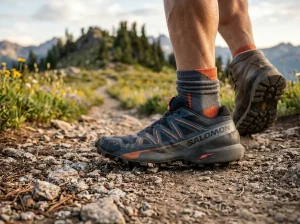
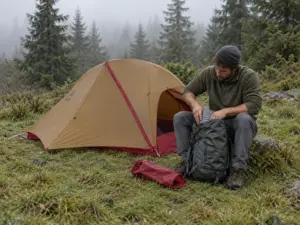
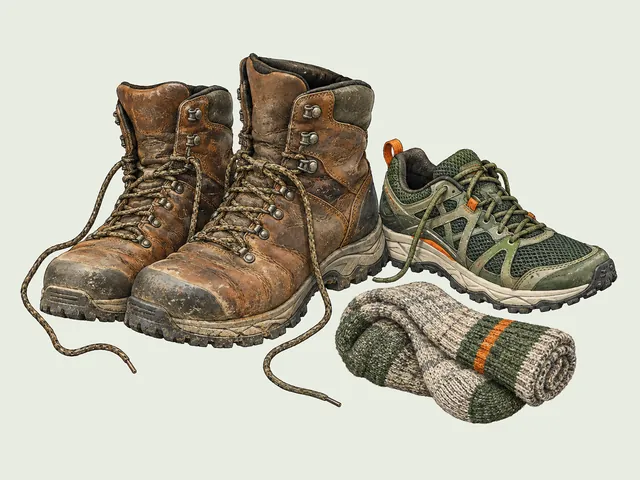
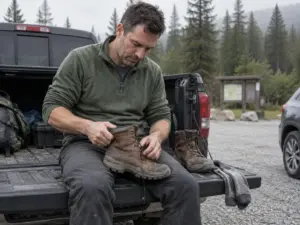



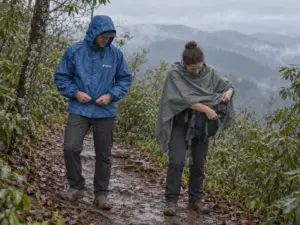




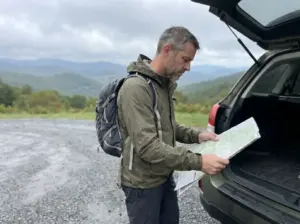







I was 14 miles into a 22-mile loop in the White Mountains, my right heel burning through every downhill step, my left knee starting to rotate inward by the time I hit any real descent. The boots were broken in. The fit was right. I’d spent $320 on them and done everything correctly. Two weeks later, a podiatrist held up the factory insert I’d been walking on and said, “$0.50. That’s what came between your foot and the ground.” It was a flat, grey slab of open-cell foam, 4mm thick, as rigid as a wet paper towel. It flexed in half when she poked it with two fingers.
After years guiding groups through technical terrain, I’ve had this same conversation dozens of times. The boot gets blamed, the socks get blamed, the trail gets blamed. The culprit almost always sits right under the foot, going unexamined.
This article breaks down why that foam fails, what happens to your foot when it does, and exactly when a $50 aftermarket insole is worth every cent — and when it isn’t.
⚡ Quick Answer: Factory insoles in even expensive hiking boots are thin, flat foam designed for showroom comfort, not trail performance. Aftermarket insoles with rigid arch support and a deep heel cup reduce peak foot pressure by 30–75%, prevent arch collapse during the critical afternoon Fatigue Peak (12–6 PM), and last 500–700 miles in PU/carbon fiber variants. Match insole volume to your boot’s heel pocket, lace with a surgeon’s knot, and treat insoles as consumables — not a one-time upgrade.
Why Your $300 Boot Came With a $0.50 Insole
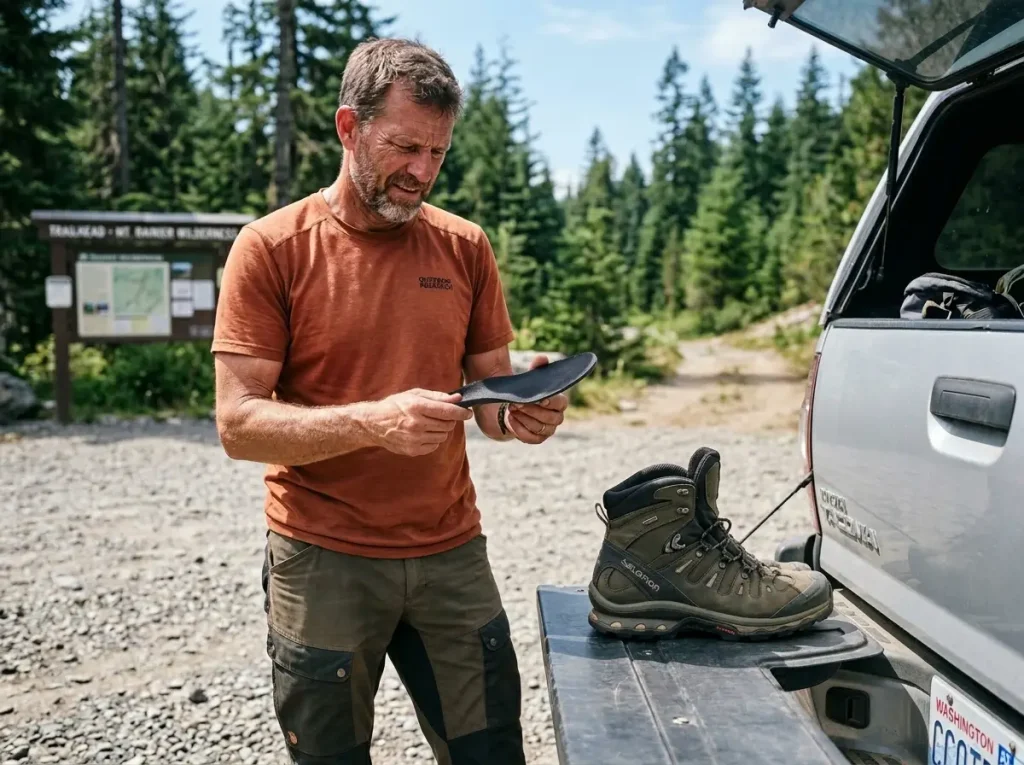
Pull the factory insert out of your boot right now and hold it flat. Push the arch zone with two fingers. If it bends in half without resistance, it will bottom out before mile eight under a 35-pound pack. I’ve never seen a stock insert that passes this test.
This isn’t a manufacturing mistake. It’s a deliberate economic decision. Boot companies invest in the midsole stack your boot was actually engineered around — the Vibram outsole, the Gore-Tex liner, the leather upper — and they assume the serious buyer will replace the factory foam insert. The insert is a placeholder. It costs almost nothing to produce and it fills the void between your foot and the midsole just long enough for you to like the boot in the store.
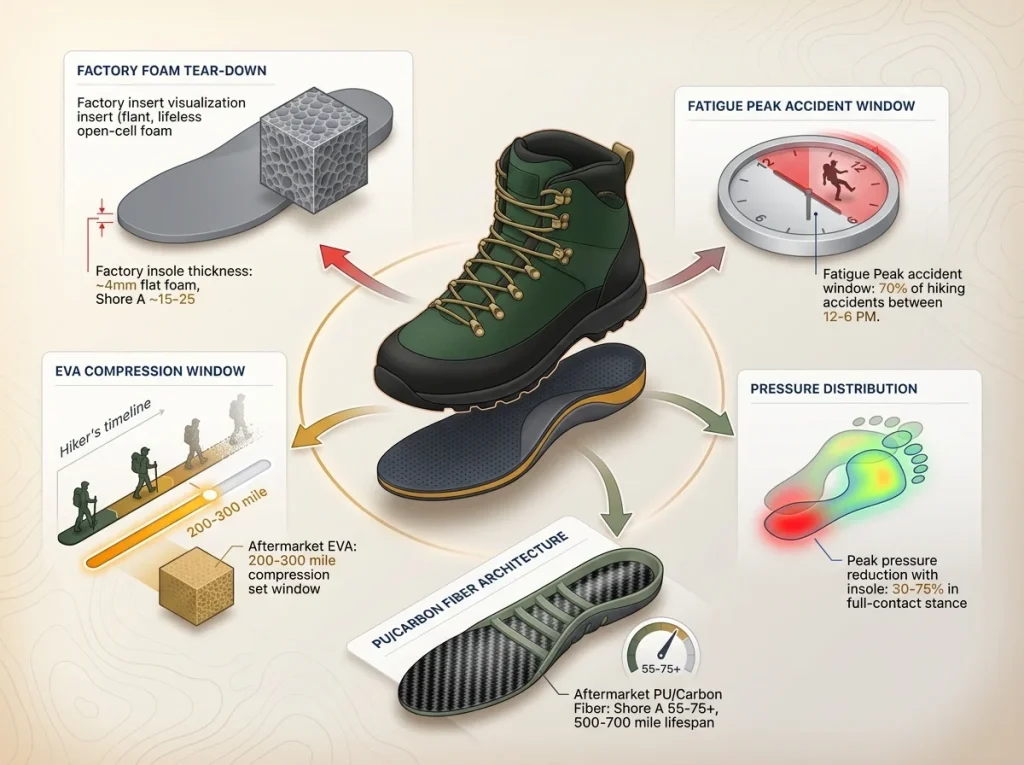
Stock inserts run Shore A 15–25 — the hardness of soft modeling clay. They’re 4–6mm of open-cell foam, flat as a table, with no meaningful heel cup. A $300 boot is a chassis system. Superior in every external direction. But the foot inside is allowed to splay, the arch is allowed to collapse, and no part of that chassis can fix it. The performance potential you paid for sits locked behind a $0.50 foam rectangle.
The investment argument is straightforward: a $50 aftermarket footbed addresses the only structural gap the manufacturer left open. Research on gait patterns and arch stabilization under load confirms that calcaneal stabilization — holding the heel bone in a controlled position during the loading phase — requires mechanical support the factory foam cannot provide. The $50 is not a luxury. It’s the completion of a system that was shipped unfinished.
The Physics of Foot Load — Why Softness Is the Enemy

Pressure Distribution and the Contact Area Formula
Here’s the thing most gear reviewers miss: soft doesn’t mean comfortable over distance. Soft means concentrated pressure. A flat factory insole has low contact area. That forces your body weight onto the heel and the ball of the foot — two small zones carrying everything. A contoured aftermarket insole with a proper arch and deep heel cup spreads that same load across the entire plantar surface, reducing peak pressure by 30–75% in full contact stance.
Without that distribution, rearfoot pressure runs 9.6–17% higher than with a proper orthotic insert. That’s the site of heel spurs. That’s where calcaneal stress fractures begin. Think of it like an ergonomic office chair versus a leather sofa. The sofa wins for 10 minutes. After 10 hours you can’t stand up straight. The insole question is identical.
For hikers carrying packs over 35 lbs, the math changes fast. Force increases, contact area stays the same, peak pressure climbs. Factory foam does not scale with load. It just fails sooner.
Pro tip: The two-finger flex test works on any insole. If you can fold it in half with moderate pressure from two fingers, it will bottom out before the Fatigue Peak hits. Do this test before you ever lace up.
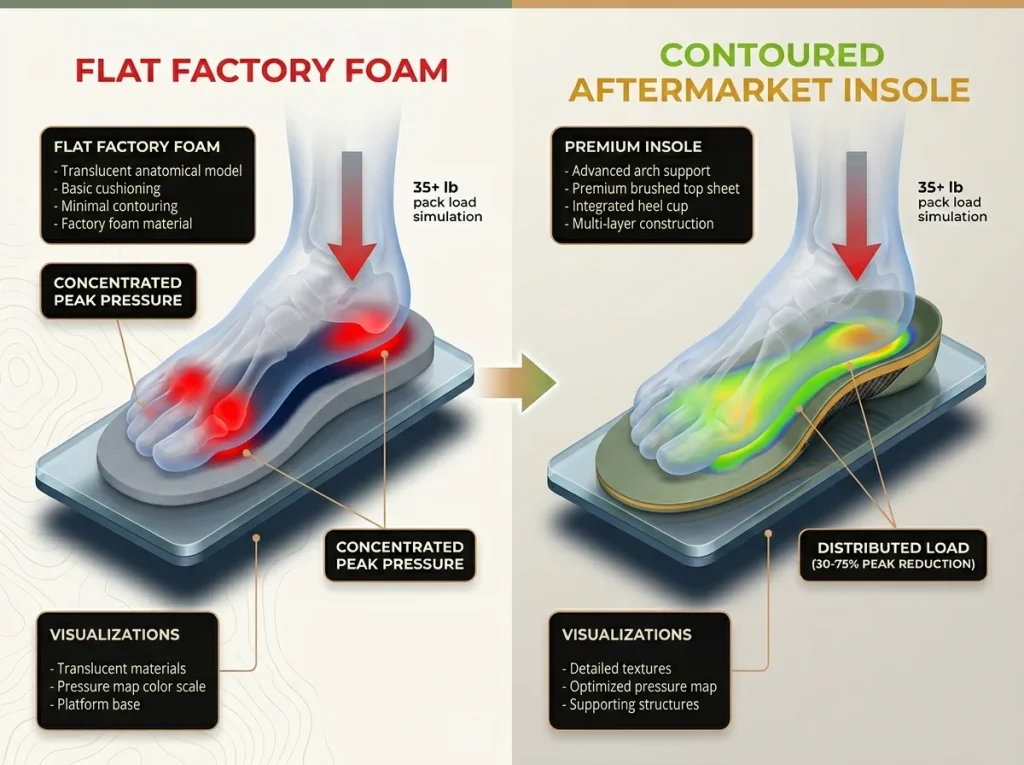
According to plantar pressure and orthotic insole research, the difference between a flat foam insert and a contoured orthotic footbed isn’t subtle. It shows up immediately in plantar contact data and compounds across mileage.
The Fatigue Peak — When Arches Fail and Accidents Happen
The falls I’ve witnessed on trail — mine included — almost always happen in the afternoon. It’s not bad luck. It’s mechanics.
Seventy percent of hiking accidents occur between 12 PM and 6 PM. That window is called the Fatigue Peak for a reason. The intrinsic muscles of the foot exhaust under repeated load. The Medial Longitudinal Arch begins to collapse. The foot elongates by up to 1 cm, the ankle rolls inward into overpronation, and the knee loses alignment above the toes. Slips and trips account for 50% of all outdoor injuries — and this mechanics failure is a primary driver.
Insoles don’t eliminate muscle fatigue. EMG data is clear on that. What they do is provide a structural skeleton that maintains safe gait mechanics after the muscles are already depleted. You can’t think your way out of fatigued foot muscles. But you can build a rigid mechanical stop into the base of your foot that keeps the arch from collapsing even when the soft tissue gives up. That’s exactly what a properly rated aftermarket footbed does.
If you’re feeling the afternoon crash in your feet, why your feet take the longest to recover after big days has more on what’s actually happening in the tissue.
For flat-footed hikers the risk compounds further. The arch already operates with less natural elasticity, which means dorsiflexion problems at the toe joints come on earlier in technical terrain. But even neutral-arch hikers show arch compression patterns on 15+ mile days under heavy pack. This isn’t a flat-foot problem. It’s a mileage-and-load problem.
EVA vs. Polyurethane — The Compression Set Problem
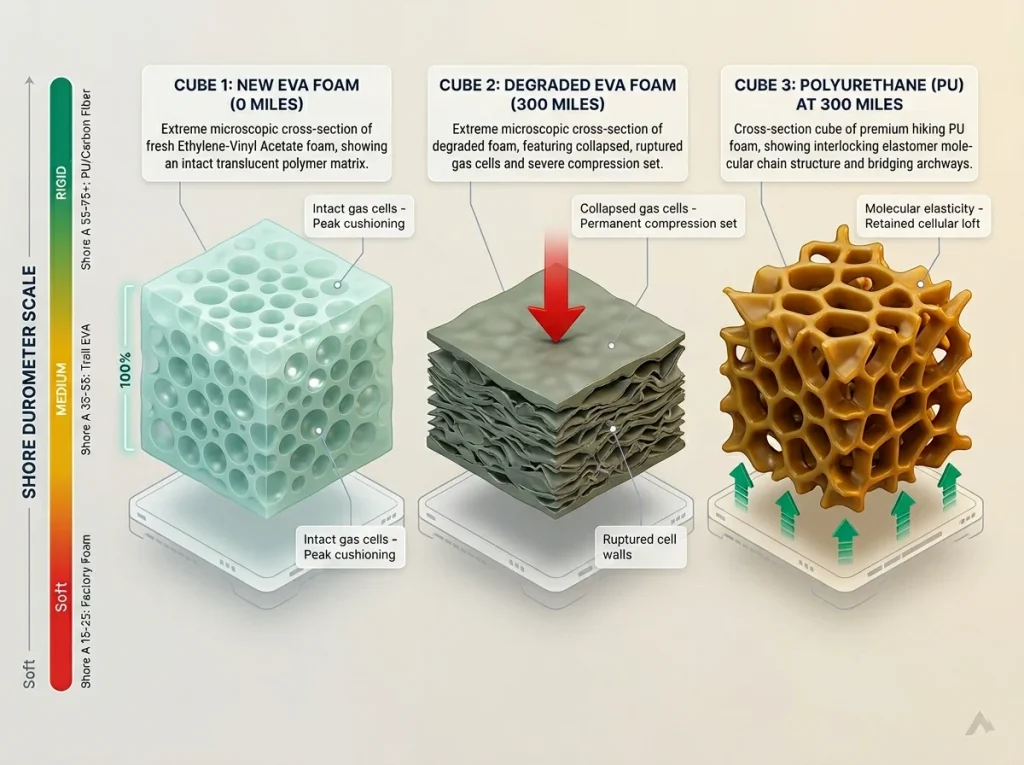
EVA foam is made of microscopic gas-filled bubbles. On compression, gas migrates out. On rebound, it partially returns. After 200–300 miles under a heavy pack, the gas bubbles collapse permanently — this is compression set. The insole looks intact. The foam still exists. But the arch profile has flattened to within a few millimeters of the factory insert you replaced. I pulled a 200-mile EVA insole apart once and found the heel zone had gone from foam to something between cardboard and ash.
Polyurethane (PU) uses molecular chain elasticity instead of gas bubbles. It rebounds consistently to original form — what manufacturers describe as “millionth step comfort.” It’s slightly heavier than EVA, but for heavy backpacking and technical terrain, the durability difference makes EVA look like a budget compromise.
Shore Durometer ratings tell the full story: soft EVA runs 15–25 Shore A; quality trail-insole EVA sits at 35–55; rigid PU or carbon fiber hits 55–75+. Below Shore A 35, an insole under pack weight is not providing structural support — it’s providing surface comfort and nothing else.
EVA compression in your shoe’s midsole follows the same physics — which is why rotating footwear and tracking insole mileage should happen together, not separately.
For thru-hikers: insole lifespan should coincide with midsole degradation, both typically failing between 500–700 miles. Nitrogen-infused foam — a proprietary variant that resists standard compression-set timelines — is worth looking for in any insole above $65. Brands that use it will say so directly.
The Stack Height Trap — More Cushion, More Blisters

The Geometry of Heel Lock and the Quarter-Inch Rule
Here’s where experienced hikers still get burned. More cushion sounds like more comfort. It’s not always true. Insole stack height determines whether your upgrade prevents blisters or manufactures them.
Hiking boots are engineered with a specific heel pocket depth. The factory insert is thin because the boot was designed around that volume. Swap in a high-volume aftermarket insole — one that’s 10mm instead of 4mm — and you raise your foot’s resting position inside the boot. The heel lifts out of the pocket on every stride. Even a quarter inch of repeated vertical movement creates the heat and friction combination required for blister formation.
I’ve watched experienced hikers blame their socks, blame the boot, even blame their hiking technique — when it was a $60 insole sitting 8mm too tall in a boot with a low heel pocket. They came back insisting aftermarket insoles don’t work. They work fine. The volume was wrong.
The trim-to-fit function on most aftermarket insoles adjusts width. But the critical variable is volume — total stack — and there’s no trim for that.
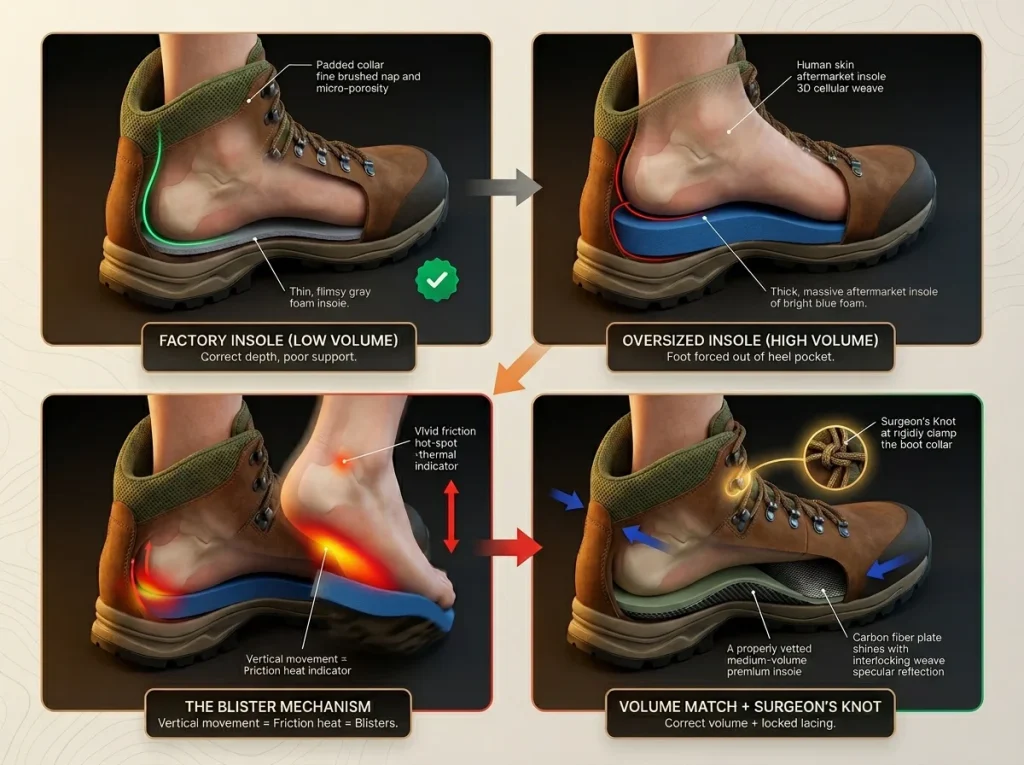
Pro tip: After installing any new insole, stand in the boot and strike the heel firmly on a hard surface. If you feel the heel lift even slightly on impact, the insole is too thick for that boot. Return it before you get on trail.
Volume Mapping by Foot Type and Activity
High-volume insoles — deep heel cup, elevated arch profile — work for high-arched feet in boots with excess interior space. If your factory insole slid around and felt loosely seated, you’re probably in the right boot for a high-volume footbed.
Medium-volume insoles with a standard profile fit neutral arches in most technical trekking boots. This is the most common correct choice.
Low-volume or “SL” slim-profile insoles are built for flat and low arches in trail runners and approach shoes. The 2025 Thru-Hiker Footwear Survey found that 87% of long-distance hikers now use trail runners for the majority of their hike. That’s a massive shift — and it creates a specific insole problem. Trail runners with wide toe boxes, like the Altra Lone Peak or Topo Traverse, accommodate Day-30 foot swelling but sacrifice heel lock. A low-volume insole with silicone heel grips — the Currex HikePro is built exactly for this — prevents the subtle internal sliding that generates friction blisters before you even feel the heel lift.
How stack height changes the mechanics of your stride covers the broader picture for trail runner users who need to understand what they’re trading when they go lighter.
When in doubt about volume, go one size down in insole profile. You can compensate for insufficient cushion with an extra sock layer. You cannot fix a blown heel pocket.
The Lacing Variable — Compensating for Stack Height Changes
Every time I swap insoles into a new boot, the first thing I do before walking is re-lace. It takes 30 seconds. It has saved more blisters than any sock combination I’ve tried.
The Heel Lock lacing pattern — also called the Surgeon’s Knot — creates a loop at the second-to-last eyelet, then threads the lace through it before continuing. The mechanical effect is to pinch the boot collar directly against the heel counter, reducing the forward movement and slippage that cause friction. Adding an aftermarket insole changes the internal geometry of the boot, even when the volume is correct. The surgeon’s knot calibrates for that change.
The heel lock lacing pattern every insole upgrade requires is worth bookmarking before you head out.
Choosing the Right Insole — The Diagnostic Framework
Support vs. Cushion — The Core Decision
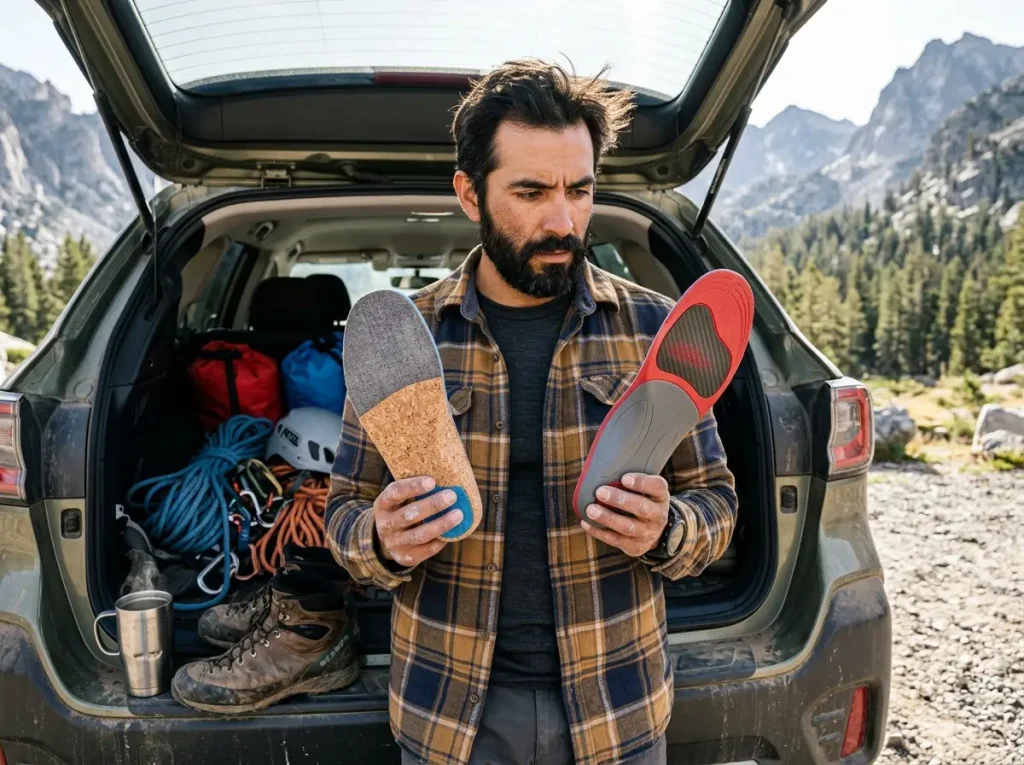
I’ve tested both back-to-back on the same trail. The cushion insole felt better at mile 2. The support insole felt better at mile 10. Long miles are won in support.
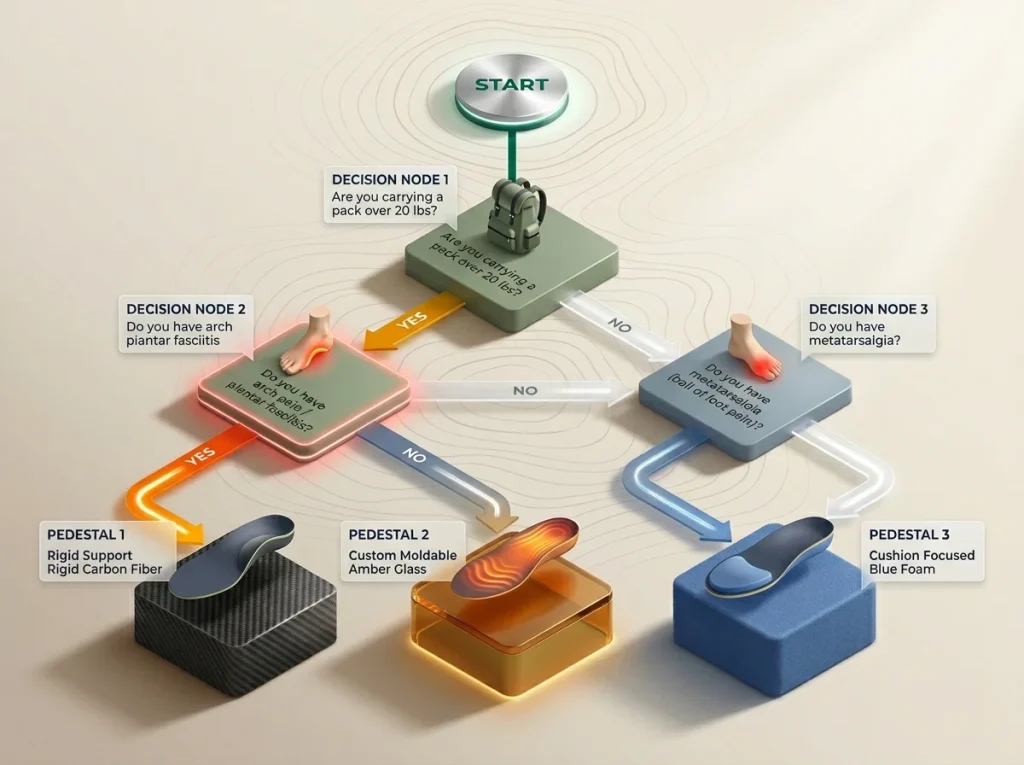
Support-oriented insoles use a rigid architecture and high Shore Durometer rating to prevent arch collapse. They’re the right call for hikers with plantar fasciitis, overpronation, or any day over 10 miles on technical terrain. If the insole can be bent easily in the middle with two hands, it will fail under pack load. That’s the test that matters — not how it feels in the store.
Cushion-oriented insoles absorb impact rather than redirect it. They’re the right call for hikers with metatarsalgia — ball-of-foot pain — or for short technical days where shock absorption matters more than structural stabilization.
Heat-moldable insoles like the SOLE Active bridge both worlds. They soften under body heat, conform to your individual plantar surface, then cool into a semi-custom shape. Custom orthotic performance, fraction of the cost. The Superfeet EVOLyte uses a carbon fiber cap to provide rigid stabilization without the stack height penalty of full foam — a good solution for hikers managing volume constraints in a tight boot.
Check our field-tested insole recommendations by foot condition if you’re ready to match a specific model to your foot type.
Aftermarket vs. Custom Orthotics — The $50 vs. $500 Question
Custom orthotics are bespoke. A podiatrist maps your specific mechanics — limb length, arch geometry, subtle pronation patterns — and fabricates something no one else will ever use. For severe structural problems, they’re the right tool. For the general hiking population, they’re usually unnecessary.
I sent a client with foot pain to a podiatrist. She came back with a $480 bill and a pair that fit beautifully. I also gave her a $58 Superfeet Hike Support for the other foot. By mile 5, she couldn’t tell which was which.
Aftermarket insoles at $50–$75 deliver roughly 80–90% of the mechanical support at 10% of the cost for hikers without diagnosed structural misalignments. The one thing to avoid: soft, drugstore-style inserts. Dr. Scholl’s and generic gel inserts don’t survive the physics of a 35-pound pack. They provide surface comfort and zero structural stabilization. Podiatrists who work with trail athletes are unanimous on this.
Start with a premium aftermarket footbed. If you try two or three and still have structural pain, that’s the point to see a specialist.
Moisture, Temperature, and the Insole Nobody Tests

Moisture Saturation Weight — The Stream Crossing Tax
Most insole reviews are written by people who tested the product on pavement. Nobody writes about what happens after a stream crossing.
Open-cell foam and textile-covered insoles absorb water like sponges. After a single wet crossing, the insole weight increases, adding energetic cost to every step for the rest of the day. Six hours after a crossing, a wet insole inside a sealed Gore-Tex boot becomes a swamp floor. The worst blisters I’ve ever seen on a guided trip weren’t from poor fit. They were from a soaked insole pressed against healthy skin for an afternoon.
EVA foam, by contrast, is closed-cell. It shakes dry in minutes after a crossing. On wet routes — the Olympic Peninsula, the high Sierra, any shoulder-season trail with active snowmelt — this single material property can matter more than arch profile. Meanwhile, textile insole effects on foot skin humidity and thermal comfort research shows that textile covers reduce heel skin humidity by 24.41% in dry conditions — meaningful blister reduction through sweat management — but that advantage reverses completely the moment the insole gets submerged.
Moisture saturation weight is a real selection criterion that OutdoorGearLab, CleverHiker, and REI’s buying guides all ignore. For wet-environment itineraries, EVA base is the answer. Textile cover only in dry, high-sweat conditions.
How your shoe manages water after a crossing connects to the same problem set — insole moisture behavior is just one piece of a full waterlogged-foot scenario.
Pro tip: If your route has multiple daily water crossings, pull the insole out at lunch and wring it. If it drips, the rest of your day is compromised. Stick an EVA-base insole in a dry bag with your camp shoes for the afternoon swap.
Thermal Regulation — The Desert Hiker’s Variable
I pulled my insole out at a desert camp after 18 miles in Arizona and held the bottom against my palm. It was hot enough to be uncomfortable. The foam had been trapping heat with nowhere to go.
Thermal imaging data shows EVA foam insoles can increase foot temperature by up to 2.73°C during high-intensity activity. For desert hiking, that’s the baseline friction-heat equation that drives hot spot formation: moisture plus elevated foot temperature plus repetitive shear equals a blister cascade. According to thermal characteristics of orthotic lining materials research, Polyethylene copolymer foams exhibit lower overall thermal conductivity — better for desert conditions where overheating matters.
For cold conditions, EVA’s heat retention flips from liability to asset. Same material, different environment, different value.
Perforated designs with passive air circulation channels help in the transition zone — hot days, cold nights. If your desert route pushes over 90°F on the surface, low-density PU or PE copolymer over EVA is worth the inquiry before you buy.
The Replacement Cycle — When Your Insole Is the Problem
The 200–500 Mile Audit Protocol
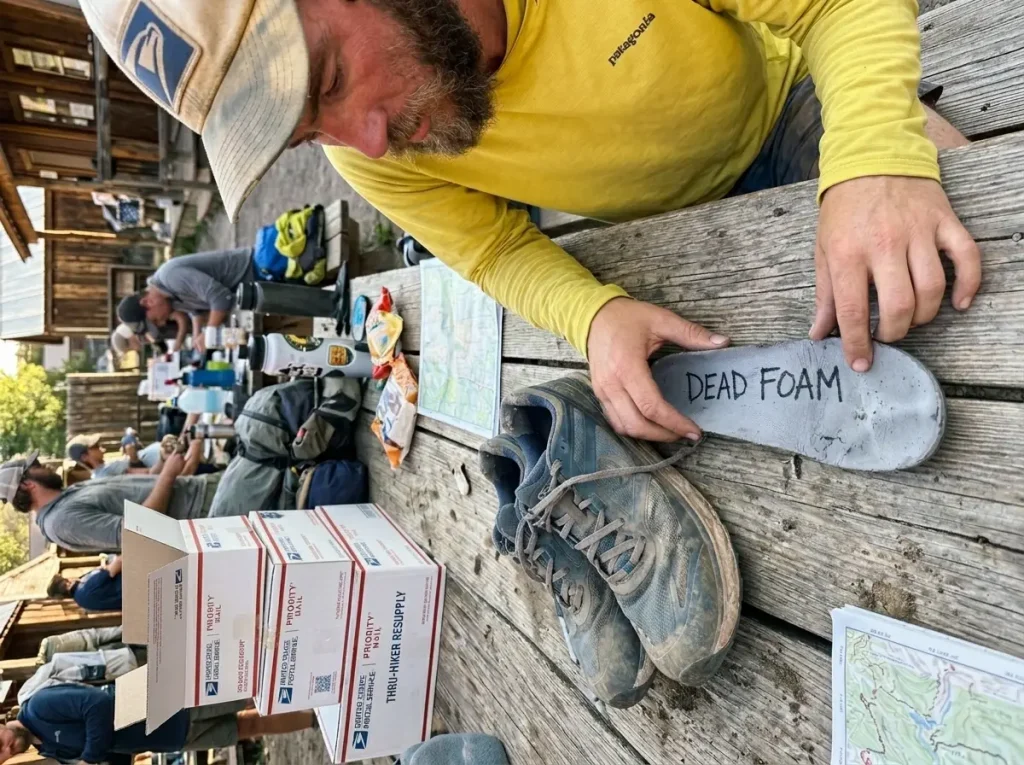
At the 400-mile point of any long route, I pull both insoles and press my thumb firmly into the arch zone. If the indentation doesn’t rebound within 30 seconds, they’re done. That test alone has saved two resupply boxes worth of foot pain.
EVA foam insoles show visible compression set at 200–300 miles under heavy pack. The signs: the arch profile has flattened, the heel cup has lost its concave geometry, horizontal crease lines run across the surface. Pull the insole flat and compare the arch zone against a flat surface. If there’s no visible daylight between the insole silhouette and the table — if it just lies flat — the structural support has already failed, even if the insole looks intact.
PU and carbon fiber insoles typically survive 500–700 miles before functional degradation, coinciding with the midsole wear cycle. The same midsole press test works for your insoles — both diagnostics run in parallel.
Thru-hikers should budget for one to two insole replacements per major route — PCT, AT, CDT. Treating them as consumables, not investments, is the correct mindset. A fresh insole at Mile 400 on the AT is cheaper than the medical consult on the other end.
Anisotropic Insoles and the Next Generation
The insole category is moving faster than most hikers track. The current frontier is anisotropic design — 3D-printed insole structures that offer different rigidity across different planes of the footbed. Rigid laterally in the arch zone. More flexible at the forefoot to allow natural toe splay. Instead of a uniform foam block behaving identically in every direction, the structure responds to the direction and magnitude of the load.
This is mostly in specialty brands and medical-grade orthotic labs now. Within two to three years, expect it in trail-grade aftermarket insoles. The research on anisotropic insole design and custom-fit footbed engineering lays out where the technology is heading.
For now, nitrogen-infused foam is the accessible version of this thinking — a proprietary cellular structure that resists standard EVA compression-set timelines more effectively than regular EVA. If you’re buying an insole above $65, check whether nitrogen-infused foam is specified. Brands that use it say so. Brands that use standard EVA dress it up with “resilience” and “energy return” language.
Insoles belong on the same replacement checklist as your midsole — but almost nobody treats them that way.
The Three Things You Walk Away With
The factory foam was never meant to last. It was never meant to perform. Pull it out, pass the two-finger flex test, and you’ll have your answer in about three seconds.
More cushion isn’t more support. Stack height determines heel lock. Match insole volume to your boot’s heel pocket, lace a surgeon’s knot on top of it, and test before mile one. The blister problem most hikers blame on their boot is an insole volume problem.
EVA fails at 200–300 miles, PU and carbon fiber at 500–700. Press the arch zone at your next resupply. No rebound in 30 seconds means you’re hiking on dead foam, and the afternoon is only going to get worse.
Before your next long day, pull out your current insole and set it flat on a table. If it lies perfectly flat — no arch, no heel cup — there’s your answer. The $50 is the structural difference between mile 15 and a hobbled camp arrival.
FAQ
Do I need to remove the original insole before adding an aftermarket one?
Yes — always remove the factory insert before installing an aftermarket insole. Stacking adds excessive stack height that lifts your heel out of the boot’s designed heel pocket, which causes heel slip and blisters. Pull the factory insert first, then size the new insole by tracing it against the original template if needed.
How long do hiking insoles last?
EVA foam insoles typically show functional compression set at 200–300 miles under pack load. Polyurethane or carbon fiber models last 500–700 miles. The diagnostic: press your thumb firmly into the arch zone — if the indentation doesn’t rebound within 30 seconds, structural support has failed. Thru-hikers should budget for one to two replacements per major route.
What is the best insole for plantar fasciitis on the trail?
A rigid-arch insole with a deep heel cup is the right prescription. The Superfeet Hike Support and Currex HikePro are the field-tested benchmarks. The arch must be firm enough to resist bending with two hands — if it flexes easily, it won’t prevent the fascial strain that plantar fasciitis requires stabilization to control. Soft cushion insoles feel better initially and worsen the condition over distance.
Can I use hiking insoles in trail runners?
Yes, but volume matching is critical. Trail runners have lower internal volume than traditional boots, so only low-volume or SL slim-profile insoles fit without disrupting heel lock. Standard-volume insoles in trail runners raise the heel, generating friction blisters most people attribute to the shoe. Superfeet and Currex both offer low-profile versions built specifically for trail runners and approach shoes.
Are insoles worth it if I only do day hikes under 10 miles?
Below 8 miles on non-technical terrain with no pack, factory insoles are often adequate for neutral-arch hikers. The practical threshold: if you’re carrying a pack over 20 lbs, hiking more than 8 miles, or experiencing afternoon heel or arch pain, the mechanical case for aftermarket insoles is clear. Pain is not a normal part of hiking. It’s a structural signal that the foot-boot interface has failed.

I've spent more than a decade researching hiking gear and trail technique. I read the specs, the forum threads and the long-term reviews, and every pick here comes with what it gets wrong.
End of the trail
You read every mile of this one. Here's where the trail goes next.