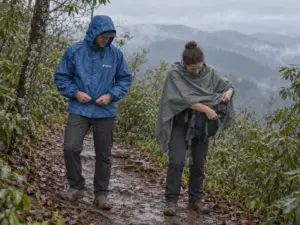
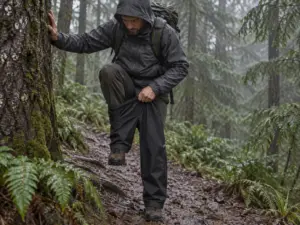







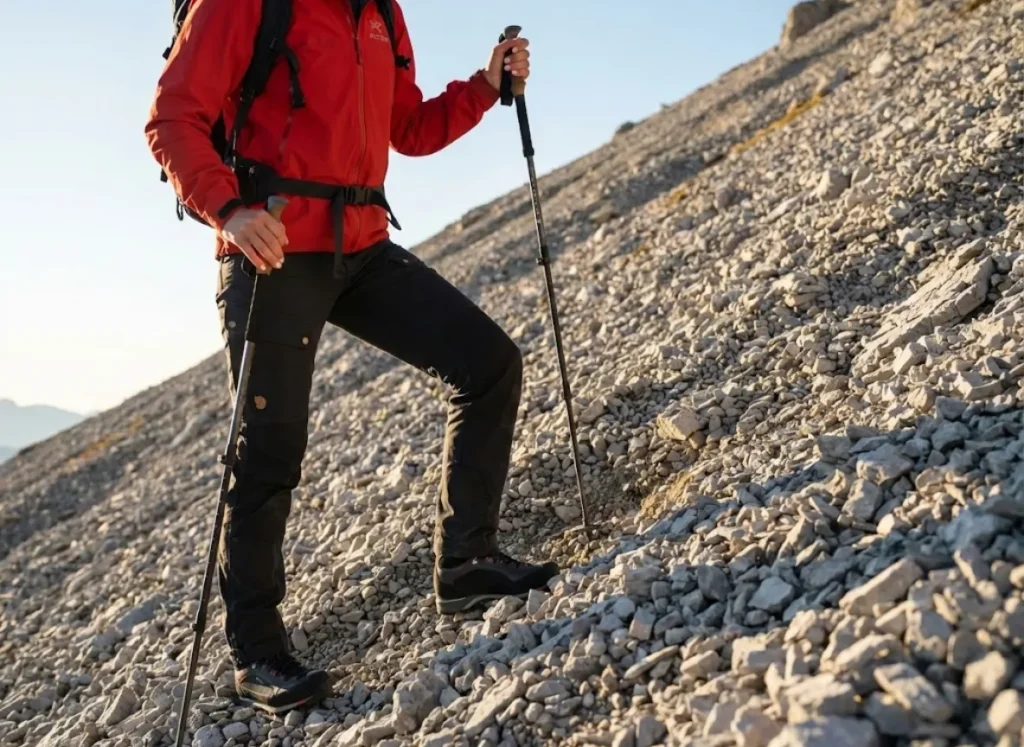
The sickening crunch of a rolling ankle on loose rock is a sound that can end a trip instantly. One moment, you are finding your rhythm on the descent; the next, your foot shifts too far, and your ankle gives way under the weight of your pack.
I have spent two decades guiding groups through rough terrain, and I’ve seen this happen more times than I care to count. For a hiker, relying only on your muscles to catch you every single time is a risky bet against fatigue and gravity. Whether you have a history of chronic ankle injuries or just fear weak ankles on technical trails, preparation is key.
Ankle taping isn’t just for fixing an injury that already happened; it is a pillar of outdoor trail safety. It is about building a safety net through mechanical stabilization. In this guide, we will look at how to turn a simple roll of tape into a sturdy tool, giving you the confidence to handle technical terrain without fear of painful ankle sprains.
Why is the ankle so vulnerable on unstable terrain?
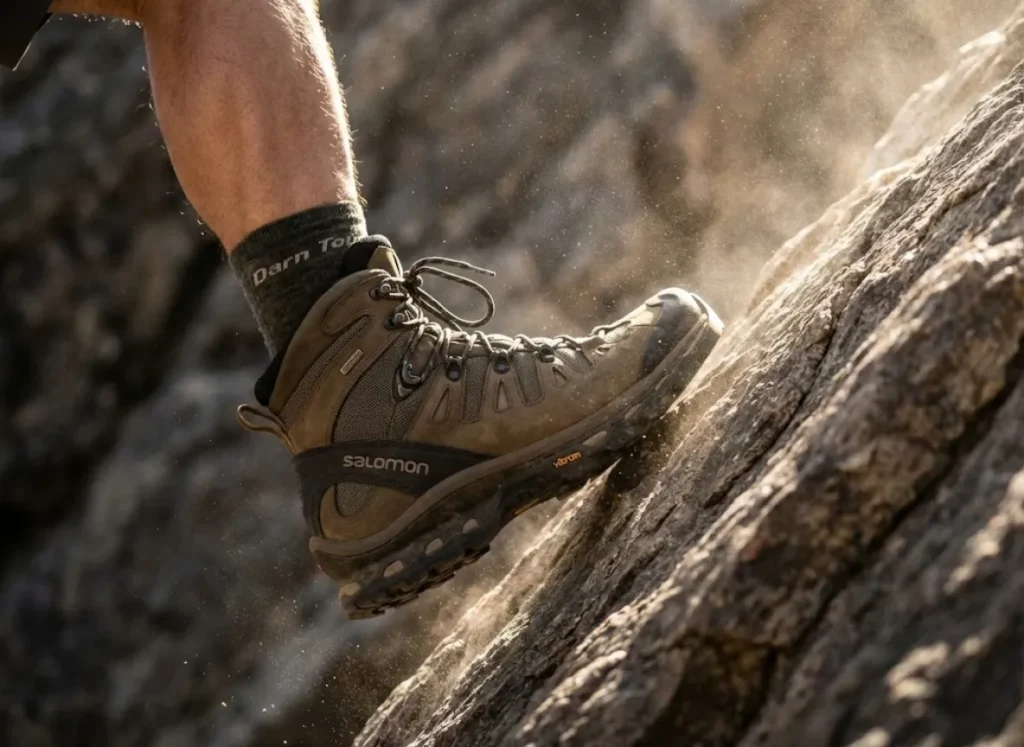
The ankle joint is built to move, which is great for walking but risky on uneven ground. To prevent injury, we first need to look at orthopedics to understand why the ankle ligaments fail and why our bodies sometimes aren’t fast enough to stop it.
How does the “Rollover” happen?
The “rollover” moment—clinically known as a lateral ankle sprain—happens when you step on a slanted rock or root. Your heel tilts inward (inversion), and your foot twists underneath your lower leg. This almost always happens when your toes are pointed down, like when you are stepping down a steep hill or pushing off loose gravel.
In this position, the main ligament on the outside of your ankle stretches tight like a rubber band. Unfortunately, a biomechanical analysis of ankle ligaments confirms this is also the weakest link in the chain. The forces twist the talus and calcaneus (heel bone) beyond their limits, stressing the lateral malleolus (outer ankle bone).
On unstable ground, the time it takes for your brain to sense the roll and tell your muscles to “catch” yourself is often too slow. The danger gets worse with a heavy backpack. By the time you realize you are rolling, gravity has already won. This means our tape needs to act as a biomechanical restriction, physically blocking that motion rather than just squeezing the ankle bone. This concept connects closely to managing fatigue through smart pacing, because tired muscles are much slower to react.
Can tape really stop a sprain?
Yes, it can. Studies in sports medicine show that taping your ankle restricts the dangerous rolling motion by about 15 degrees. Think of it like a seatbelt. It allows joint range of motion (ROM) within a safe zone, but it locks up and stops you before you go too far.
Even though tape loosens up a little bit as you walk, that residual restriction reduces angular velocity—meaning it stays strong enough to prevent the worst tears to the ligamentous structures.
Beyond just holding your bones in place, tape also improves your body awareness. This is called “proprioception.” As you hike, the tape pulls against your skin every time your foot moves. This creates a sensation that acts as an early warning system for your brain, improving trail proprioception. It wakes up your stabilizing muscles milliseconds faster than normal. This is huge when you are tired and getting sloppy with your footwork. Because of this double benefit, a good ankle taping kit is a must-have when stocking your DIY emergency kit.
What is the best tape for preventing sprains while hiking?
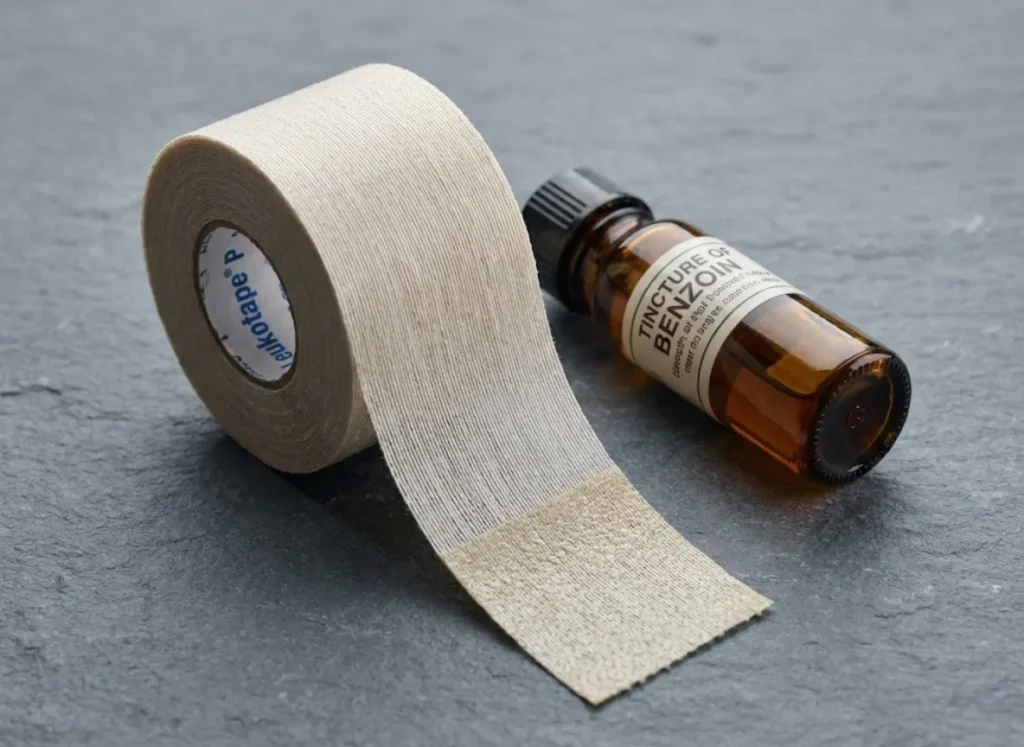
Not all sports tape is the same. The cheap white cotton hand-tearable tape you buy at the drugstore will fall apart in the woods. To build a support system that actually works, you need materials that possess high tensile strength, hate water, and refuse to stretch.
Why rigid Zinc Oxide tape (Leukotape) is better than elastic tape
Standard cotton athletic tape soaks up water like a sponge. It also stretches when you put weight on it. In wet or sweaty conditions, it becomes useless very quickly.
Leukotape P (a rigid tape) is different. It uses a super-strong Rayon fabric backing and a sticky rubber-based glue (Zinc Oxide tape). It has almost zero elasticity. This rigidity creates the “exoskeleton” you need to physically block a sprain. A systematic review of taping efficacy highlights that kinesiology tape (like KT Tape) or an elastic adhesive bandage (EAB) are often too stretchy to stop your ankle from rolling under a heavy load.
Sports Tapes Comparison
A technical analysis of mechanical properties, elasticity, and durability across common athletic tapes.
Tensile Strength
Very High (Rigid); Rayon backing is resistant to stretching under load.
Elasticity %
< 1% (Minimal stretch). Provides maximum mechanical restriction.
Water Resistance
Excellent; Hydrophobic adhesive maintains integrity even when wet.
Duration of Wear
Extreme (Days/Weeks); Zinc oxide adhesive stays in place for extended periods.
Tensile Strength
Low (Elastic); Lacks strong properties for mechanical joint restriction.
Elasticity %
140-180% (High stretch); Specifically designed to mimic skin and muscle properties.
Water Resistance
Excellent (Synthetic fibers); Dries rapidly and maintains elasticity when wet.
Duration of Wear
High (Days); Designed to stay on during intense activity for multiple days.
Tensile Strength
Moderate; Strength lowers significantly when the substrate becomes wet.
Elasticity %
Low; Non-elastic cotton fibers provide initial support but lack flexibility.
Water Resistance
Poor (Absorbent); Cotton substrate absorbs water and becomes soggy quickly.
Duration of Wear
Low (Hours); Loosens significantly with exercise (approx. 2 hours).
Kinesiology taping is designed to move with you to help blood flow or reduce swelling. In the wilderness, you want something that stops movement in specific directions. Rayon-backed non-elastic tape is also water-resistant. It offers superior moisture resistance during stream crossings where cotton tapes would get soggy and peel off. You should definitely add this to your core gear system if you plan on hiking off-trail.
How Tincture of Benzoin acts as “Super Glue”
Compound Tincture of Benzoin (often called Friar’s Balsam) is a sticky liquid that provides dermatological protection and boosts adhesion. You paint it on your skin and let it dry until it feels tacky, much like Tuf-Skin or adhesive spray used in clinics.
It forms a sticky layer that bonds chemically with the tape’s glue. This step is mandatory for multi-day trips, people with sweaty feet, or muddy trails. Before applying, clean the skin with rubbing alcohol (isopropyl alcohol) if possible to remove oils.
Benzoin also acts as a shield against friction and skin irritation. It plays a huge role in preventing maceration in wounds and sensitive skin by waterproofing the area under the tape. If you try to put tape on damp skin without benzoin, it will slide right off. While many hikers know Benzoin for preventing friction blisters, here it acts as a structural anchor for adhesive management. Without it, your added ankle support will likely slide off by lunch.
Pro-Tip: Transfer Benzoin into small, single-use glass ampoules or a tiny dropper bottle. The standard medical bottles are heavy and often leak in a backpack lid.
What is the most effective taping technique for hikers?
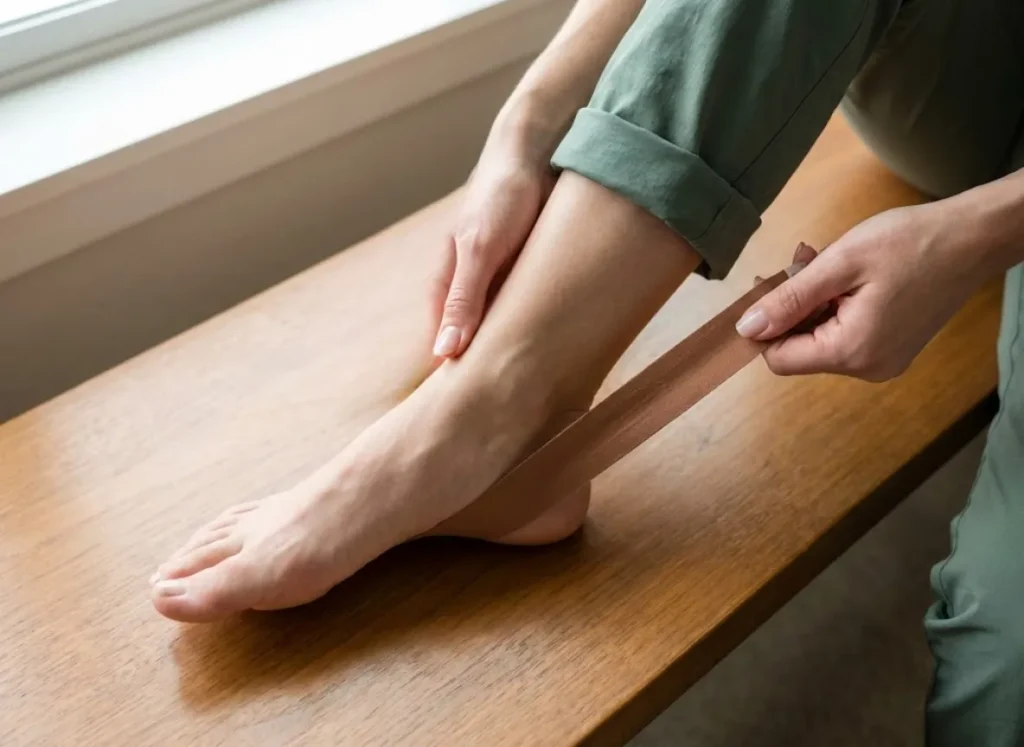
Athletic trainers usually tape ankles to fit inside low-top sneakers. Hikers need something different. We need a streamlined shape that fits inside footwear like Gore-Tex hiking boots without creating painful pressure points or tape cuts. Here is the best step-by-step guide for the trail.
How “Stirrup Strips” block the roll
The “Stirrup” is the main support piece. It runs vertically from the inside of your ankle, under your heel, and up the outside of your ankle.
The direction of pull is the most important part: you must pull from inside to outside (medial to lateral). By pulling up on the outside of your ankle, you are actively fighting the direction of the sprain. Apply three of these stirrup strips, overlapping them slightly to cover the ankle bone. Be careful not to compress the base of the 5th metatarsal too tightly.
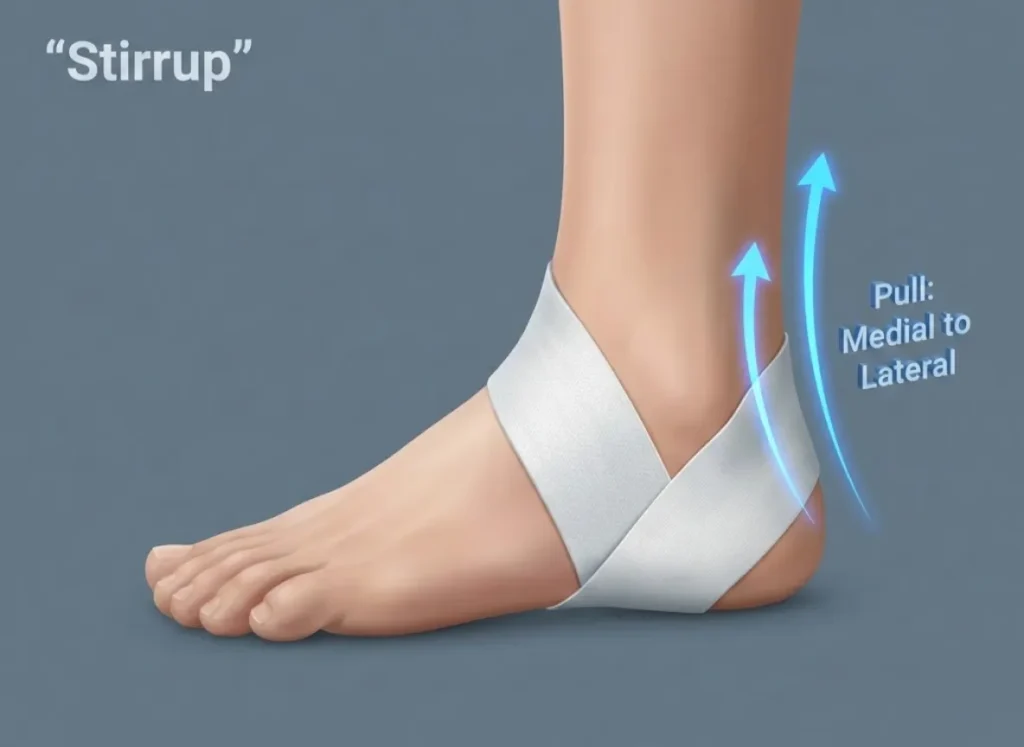
Make sure you hold your foot in a neutral position at a 90-degree angle (toes pulled up) while you do this. Research on ankle biomechanics during landing tasks supports keeping the joint in this neutral position to ensure stability upon impact. If you tape your foot while your toes are pointed down, the tape will be too short. It might cut off circulation or snap the moment you take a step. This vertical strip acts like an external ligament. It works together with the heel of your boot—a key part of understanding hiking boot anatomy—to lock your foot in place.
Why the “Figure-Eight” pattern is best for boots
Many sports use a bulky “Basketweave” or complicated figure-6s, but that takes up too much room in a hiking boot. The “Figure-Eight pattern” is thinner and smarter.
It is a continuous loop. Start at the top of your foot (dorsum of the foot), go under the arch of the foot, cross back over the top, wrap around the back of the heel over the Achilles tendon, and return to the start. This creates a heel lock that holds the ankle steady without wrapping your whole foot in a cast.
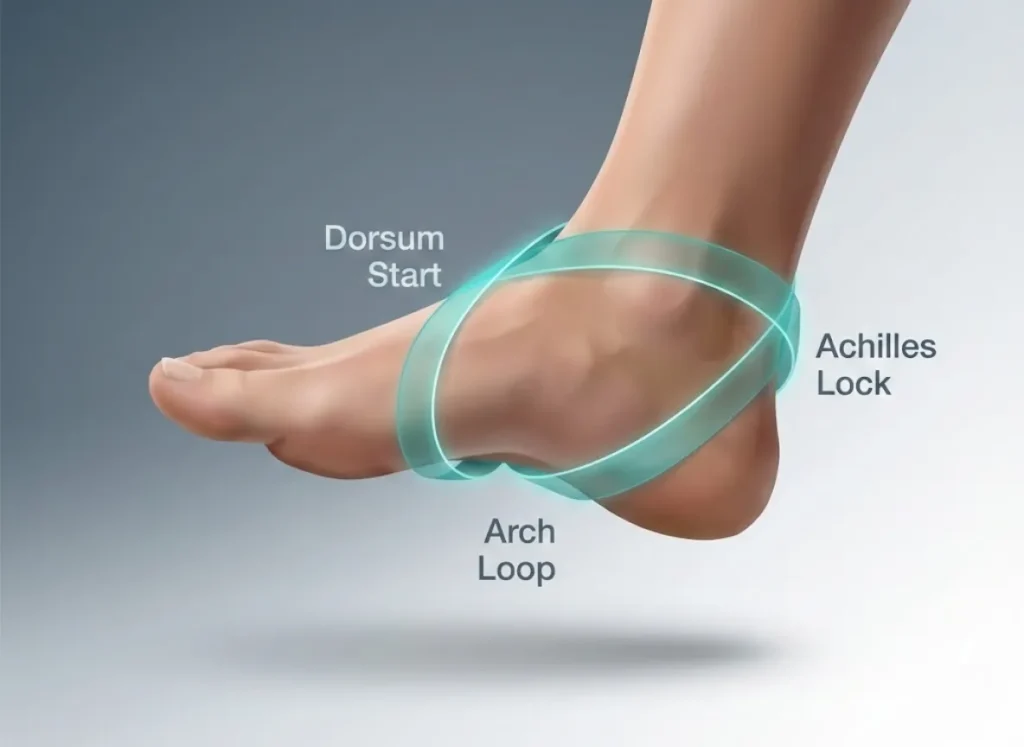
The open-heel design lets your heel breathe. This is crucial for avoiding medical adhesive related skin injuries caused by trapping too much moisture against the skin. It also lets you flex your foot up and down for climbing hills, while stopping it from rolling side-to-side. Apply two or three Figure-Eights to lock everything down. Unlike bulky tape jobs that cause boot-tongue pressure, this lies flat. To keep the sticky edges from grabbing your sock, I strongly recommend wearing Merino wool socks or liner socks over the finished tape job.
Field Management: Durability and Removal
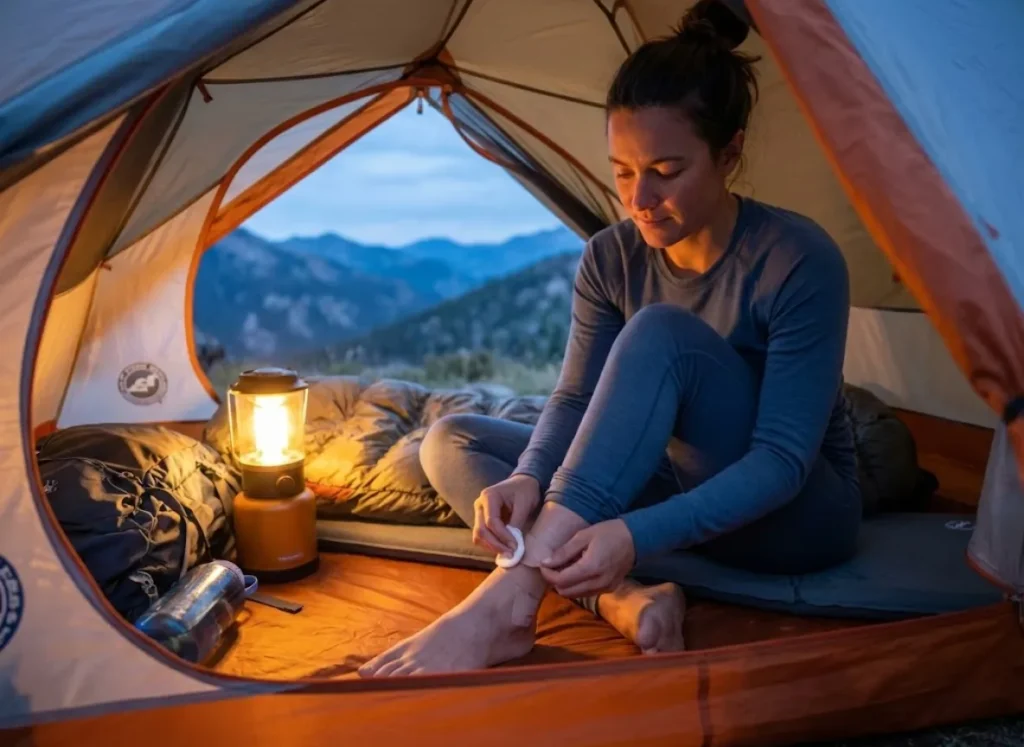
Putting the tape on is only step one. Keeping it on for 20 miles without ruining your skin requires a friction & moisture audit.
The risks of wet skin
“Maceration” is the fancy word for what happens when your skin stays wet for too long—it gets white and pruney. If you leave waterproof tape on a wet foot for days, bacteria and fungus can start to grow.
If the tape gets soaked and the skin underneath gets soft, the skin becomes weaker than the glue. This is a common cause of understanding skin tears upon removal.
To stop this, try to remove the tape at night to let your skin dry out, unless you have an acute injury or are running low on supplies. Using the breathable Figure-Eight pattern helps sweat resistance. If the weather is terrible, consider waterproof socks to keep the rain and mud away from your tape entirely.
How to remove tape safely
Never rip rigid tape off like a band-aid. Leukotape has such high adhesion that it can peel the top layer of skin right off your leg.
Use the “Low and Slow” method. Peel the tape back flat against itself, not pulling up and away. Use one hand to peel the tape and the other hand to press your skin down.
Pro-Tip: If you have trauma shears (blunt-nosed scissors), carefully cut the tape off the leg first. This releases the tension and makes peeling much safer.
In the woods, you probably won’t have adhesive remover. You can use oil instead. Olive oil, baby oil, or even cooking oil from your food bag will dissolve the glue. Soak the tape in oil and let it sit for 5 to 10 minutes. This makes the tape slide off much easier. Patience is key here; rushing is the number one cause of skin damage. This gentle approach aligns with clinical best practices for the treatment and prevention of adhesive injury.
Wrapping Up
Real outdoor skill is about turning knowledge into action. By understanding how ankle issues happen and why your muscles sometimes miss the cue, you can see why mechanical support is so valuable.
Use Leukotape P for its strength and waterproofing. Use Tincture of Benzoin to make sure it sticks through mud and sweat. Master the Stirrup and Figure-Eight patterns to block rolls without fighting your boot. Finally, take care of your skin by managing moisture and removing the tape slowly with oil.
Before your next big trip, practice these techniques at home. Build the muscle memory now so that when you are on a rocky ridge, you can tape up with total confidence.
FAQ – Frequently Asked Questions about Ankle Taping for Hiking
Does taping your ankles weaken them over time?
There is no evidence that taping for short periods weakens your ankles. Think of it as a safety tool for high-risk days or technical terrain. However, you should still do strengthening exercises at home for long-term ankle stability.
Can I use duct tape if I don’t have athletic tape?
Avoid it if possible. Duct tape doesn’t breathe at all, which traps sweat immediately and leads to blisters and raw skin. It also has the wrong kind of glue for skin. Only use it over a sock or Mueller pre-wrap (underwrap) in an absolute emergency.
Should I shave my legs before taping?
Yes. Shaving the ankle and lower calf 12 to 24 hours before your trip helps the tape stick better and hurts much less when you take it off. Don’t shave right before you hike, though, as tiny cuts can get infected under the tape.
What about sensitive spots or tendonitis?
If you have sensitive skin or Achilles tendonitis, use Heel & lace pads (or non-adhesive pads) coated in a little lubricant under the tape where it crosses the tendon. This prevents the tape from rubbing against inflamed tendons.
How long can I leave the tape on?
If you use Benzoin, the tape can stay on for 3 to 5 days, spanning the hiking duration gap. However, check your skin every day. If it itches, burns, or feels too wet, take the tape off immediately to prevent infection or further injury.
I've spent more than a decade researching hiking gear and trail technique. I read the specs, the forum threads and the long-term reviews, and every pick here comes with what it gets wrong.
End of the trail
You read every mile of this one. Here's where the trail goes next.