In this article
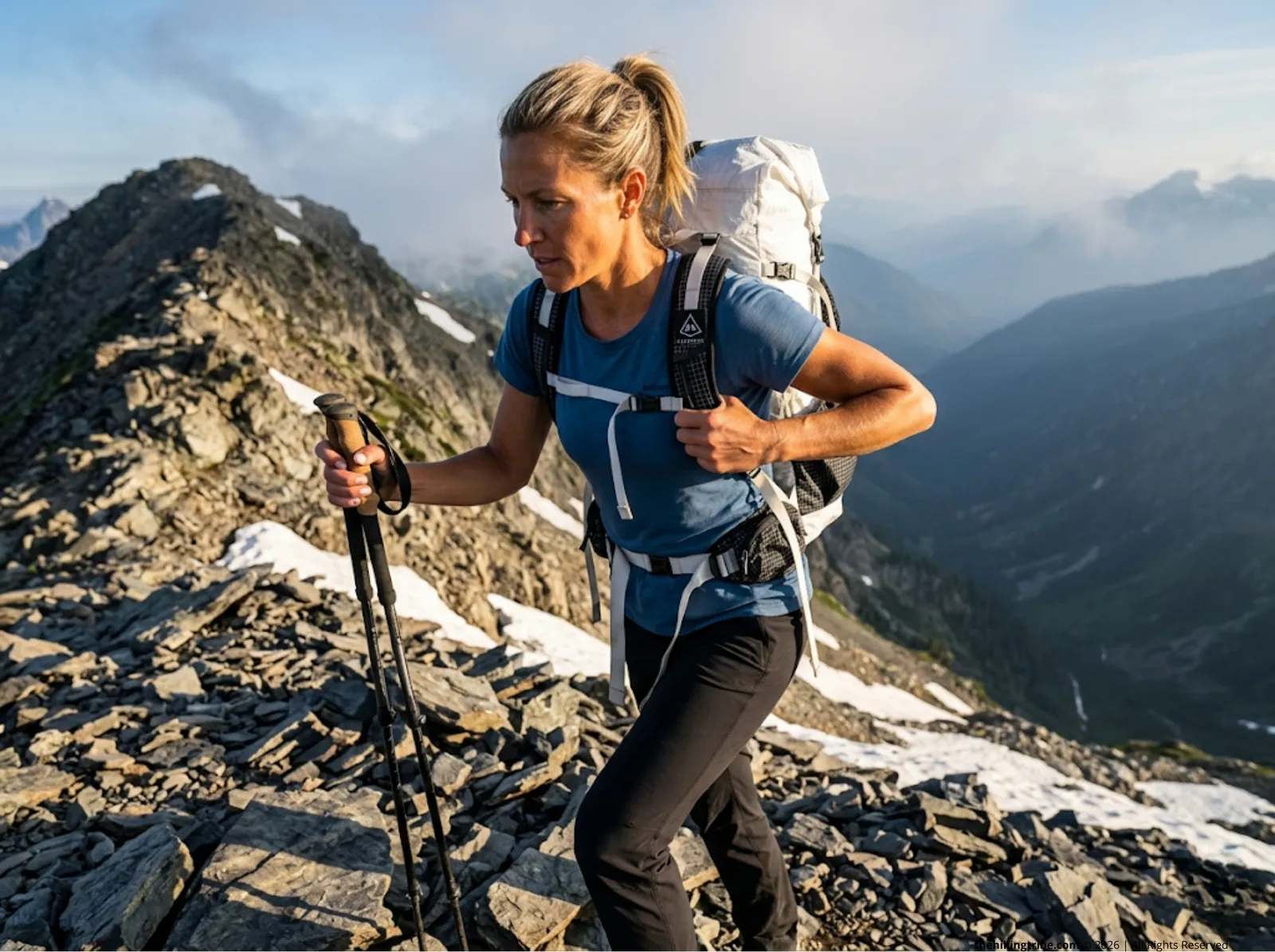
Day 5. The Cascades ridge is iced over. My frameless DCF pack — the one I’d been bragging about at the trailhead — has lost its shape entirely after two days of hammering scree. It’s pulling my torso backward at a 15-degree lean. Every step on the Class 3 ledge ahead is a small negotiation between forward momentum and the pack trying to peel me off the rock. The pack weighs 9.4 lbs. It is also the wrong tool for this job.
I’d been hiking for 20 years when that happened. I still got it wrong. What I had was an ultralight philosophy applied to a mission that required something different: a 7-day technical route where the variables aren’t just weight — they’re spinal compression, pack stability, shelter durability, and what your body has left on Day 6 when the margin for error is smallest.
This guide dismantles the false binary between “go light” and “stay comfortable.” Using field data, load carriage research, and material science, you’ll build the 12–15 lb Precision Setup that survives a 7-day technical route and still leaves you functional at the end of it.
⚡ Quick Answer: For a 7-day technical route, target a base pack weight (BPW) of 12–15 lbs — excluding food, water, and fuel. Start by optimizing footwear: switching from leather boots to trail runners delivers the metabolic equivalent of pulling 10 lbs from your pack. Then audit your Big Three (pack, shelter, sleep system), which hold 60–75% of your base weight. A framed pack, silpoly shelter, and 3.0+ R-value sleep pad form the Precision Setup that outperforms both ultralight and traditional kits on multi-day technical terrain.
5 Key Data Points Before You Read Further
1. 20% Body Weight Rule: The maximum loaded pack weight — not a target
2. 5:1 Foot-to-Pack Ratio: 1 lb on your feet = 5 lbs on your back, metabolically
3. Precision Setup Target: 12–15 lb Base Pack Weight for technical 7-day routes
4. Minimum R-Value: 3.0 for sleep quality and nighttime recovery
5. L5-S1 Disc Compression: Up to 16% anterior reduction at just 10% body weight load
The Physics of Carrying a Load — Why Your Body Keeps Score

Here’s where most hikers get the 20% rule wrong. They treat it as a target. It’s a ceiling — and a soft one at that.
The U.S. Army Research Institute developed the Pandolf Equation to model metabolic cost during loaded walking. It accounts for body mass, external load, velocity, grade, and terrain factor. What it shows isn’t flattering: a 170-lb hiker carrying 25 lbs burns roughly 400–500 calories per hour. Push that load to 30% of body weight, and burn rate can triple. The increase stays roughly linear up to 40% body weight — then it breaks down fast. Beyond 60%, the body’s compensatory mechanisms fail entirely.
But here’s what no one talks about: the 7-day threshold. After Day 5, glycogen recovery is incomplete. Your muscles aren’t recovering overnight anymore — they’re degrading. By Day 6, the limiting factor isn’t your cardio, your legs, or your willpower. It’s your lumbar spine.
Upright MRI studies on spinal disc compression under backpack loads confirm it: at just 10% body weight loaded, the L4-L5 disc compresses by about 10%. The L5-S1 disc loses 16% of its anterior height. That forward pinch is a direct result of the trunk flexion you adopt to balance a posterior load. Add 15%+ body weight and you get head flexion, lumbosacral flattening, and trapezius strain that compounds across a 7-day window. On Day 5, I could time exactly how long my lower back took to stop hurting after each rest break. By Day 6, it never fully cleared.
Lower base weight reduces joint impact — this isn’t a marketing claim, it’s load physics. Before any optimization is possible, start by calculating your true base weight — most hikers are surprised by what they find when they strip out food, water, and fuel.
Pro tip: On a 7-day route, your lower back is the early warning system, not your legs. When soreness stops clearing during breaks, you’ve crossed into cumulative fatigue territory. That’s the signal to lighten the next day’s carry, not push through.
The 5:1 Rule — Why Your Boots Are the Most Expensive Weight You Carry
If you can only fix one thing before your next multi-day trip, fix your footwear. Nothing else comes close to this return.
Weight on your feet equals five times the same weight on your back, in terms of metabolic cost. Your foot is at the end of a long lever — your leg — and it moves through a much larger arc than a pack riding on your torso. Every stride, you accelerate that mass forward and decelerate it on contact. That energy is lost — pure metabolic expense, every step, for however many steps a 7-day route requires.
The numbers are concrete. Traditional leather boots average 3.5 lbs per pair — that’s a 17.5 lb metabolic equivalent. Mid-weight hikers at 2.2 lbs run 11.0 lb equivalent. Trail runners at 1.4 lbs drop to 7.0 lb equivalent. Switching from leather boots to trail runners is the metabolic equivalent of pulling ~10 lbs from your pack, without removing a single item. Vest-style load distribution reduces metabolic demand by about 9% compared to traditional posterior packs — also useful, but secondary to footwear.
Pro tip: I didn’t believe the 5:1 ratio until I ran the math on my leather boots: 3.5 lbs of boot = 17.5 lbs on my back. I was carrying a ghost pack and didn’t know it.
Trail Runners vs. Mid-Weight Hikers — The Decision Threshold
Trail runners dominate on Class 1–2 terrain and maintained trails where metabolic cost of footwear compounds over high-mileage days. Mid-weight hikers are the right call for technical off-trail terrain where ankle protection and torsional stiffness become risk tools.
Stack height matters in ways most hikers don’t consider. Lower stack heights increase ground feel and proprioception on talus — you can actually sense whether you’re on solid rock or a loose flake. Higher stacks cushion high-mileage days but reduce stability on uneven surfaces. Do the press test: thumb on the midsole, push until it compresses 50%. If it compresses past that under thumb pressure alone, the cushioning is gone. Doesn’t matter how new the shoe looks.
For a field-tested breakdown of boots vs. trail runners by terrain type, the decision matrix is more nuanced than most gear guides let on.
Boot Stiffness, Crampon Compatibility, and When Footwear Weight Is Non-Negotiable
On routes requiring C1 crampons or microspikes, footwear weight stops being the optimization target. B-rating compatibility takes over. The “twist test” — grab the heel and forefoot and torque — shows you whether a boot will roll under lateral load on icy terrain. A stiff shank prevents the lever effect on scree where your forefoot catches a rock edge and your heel keeps rotating. On mixed terrain routes (Class 1 approach, Class 3 summit), the optimal setup is often a lightweight framed pack over trail runners — not a frameless pack over heavy boots. The metabolic savings compound in the right direction.
The Big Three — Where the Real Weight Lives (and How to Cut It Surgically)
Most optimization conversations start with the wrong gear. Shaving grams from your cook kit while your pack, shelter, and sleep system run heavy is rearranging deck chairs. The Big Three typically account for 60–75% of base weight. That’s where the work is.
The Precision Setup breakdown for a 7-day technical route:
- Pack: Traditional internal frame = 4–5 lbs. Frameless = 1 lb. Lightweight frame (Precision Setup) = 2.5 lbs. The 1.5-lb penalty of the lightweight frame pays for itself in load-transfer efficiency and dynamic stability on Class 2+ terrain.
- Shelter: Double-wall tent = 4 lbs. DCF tarp = 1 lb. Silpoly single-wall (Precision Setup) = 2 lbs. Silpoly retains 85% UV strength at 500 hours versus DCF’s 50% — that delta matters on exposed alpine routes.
- Sleep system: Heavy air pad = 2 lbs. 1/8-inch foam (UL) = 6 oz. Insulated air pad (Precision Setup) = 1.2 lbs.
Total Precision BPW with clothing and safety system: 12–15 lbs. This is not a compromise position — it’s the gear configuration that actually outperforms both ends of the spectrum on this specific mission.
Pack Architecture — Framed vs. Frameless and the Load Transfer Question
Frameless packs rely on a “virtual frame” of tightly packed gear. This works at the trailhead. After a water crossing, after a stumble, after two days of scree — the virtual frame shifts. The pack’s center of gravity migrates outward and downward. Suddenly you’re carrying a 30-lb weight on shoulder straps designed to transfer load to hips that aren’t receiving it.
The 1:3 Safety Heuristic: a 30-lb pack exerts nearly 90 lbs of force on shoulder straps during sudden deceleration — jumping a stream, catching a stumble, recovering from a lateral slip on a ledge. A framed pack transfers this to the hip belt. A frameless pack concentrates it at the shoulder contact points. Over 7 days, ultralight packs increase cumulative fatigue on shoulders and neck by roughly 15%, which can negate the weight savings entirely. Research on postural deviations and muscular strain at increasing load percentages of body weight confirms what field experience shows: framed packs are the correct tool for multi-day loaded carriage.
For the full decision — including specific model recommendations by total pack weight and hiker profile — the complete decision matrix for choosing between framed and frameless packs is worth building around before you gear up.
Fabric Selection — DCF, Silpoly, and the UV/Abrasion Matrix
DCF (Dyneema Composite Fabric): immune to stretching, inherently waterproof, UV retention only 50% at 500 hours, rated 150–250 nights before delamination. The correct choice for FKT attempts where weight is the only variable.
Silpoly (silicone-coated polyester): 85% UV retention at 500 hours, hydrophobic so it won’t sag when wet, and 20D silpoly achieves roughly 98% of 30D silnylon strength at 20% less weight. The correct choice for high-altitude, high-UV, multi-day missions.
Silnylon absorbs water and sags — which means re-tensioning guylines in the dark on a wet ridge. For backpack floors and tent floors in scree country, 210D Robic nylon over DCF every time. DCF puncture-propagates catastrophically from a sharp rock point. The first DCF tent floor holes show up within 30–50 nights on rocky ground. That’s not a lab result — that’s what happens.
Sleep System — The R-Value as a Safety Parameter, Not a Comfort Preference
An R-value of 3.0 is the minimum to prevent ground-conduction heat loss during a typical alpine night at 5–10°C ambient, ground temperature near 0°C. This is a metabolic requirement. Cold ground conduction forces your body to burn calories for thermoregulation that should be spent on tissue repair.
Hikers who switch from 1/8-inch foam pads to 3-inch insulated air pads consistently report better mileage on subsequent days — not because they feel better, but because they actually slept. REM sleep is when muscle tissue repairs. Without it, the fatigue debt compounds. Carry a 4-oz foam sit pad as redundancy for the insulated air pad — it doubles as an emergency bivouac layer if the valve fails on a cold night.
Pro tip: I track R-value the same way I track pack weight. Subzero ground will steal your recovery hours faster than any blisters ever will. The 3.0 floor is non-negotiable on alpine routes.
Technical Terrain Changes Everything — Pack Stability on Class 3-4 Routes
Understanding how the Yosemite Decimal System defines risk at each scrambling grade is the starting point before any gear decisions on technical terrain. The risk stakes define the gear requirements.
According to Sierra Club scrambling classification definitions for Class 3 and Class 4 terrain, Class 3 means handholds are required and a fall causes serious injury. Class 4 means handholds are mandatory, falls are often fatal, and ropes are frequently used. At that level, the UL marketing narrative collapses. The 9 oz you saved on a tent means nothing if an unstable pack pulls you off a slab.
On Class 4, the rule is: keep the center of gravity close to the rock. A frameless pack with 30 lbs and an external hanging item can shift the CoG 6–8 inches rearward on steep slabs. That’s the difference between a body over the feet and a body on its way off the ledge.
The Pendulum Effect: when you commit to a move on Class 3-4 terrain, the pack keeps moving after you stop. That continued momentum is the peel-off moment — exactly when three-point contact matters most. The 1:3 Safety Heuristic applies again: 30 lbs dynamic becomes 90 lbs of force on shoulder straps. Only an internal frame pack with load lifters at 45° transfers this predictably.
High CoG Packing Strategy for Scrambling Stability
Heaviest items — tent, food bag, water reservoir — go high and close to the spine, between the shoulder blades. Not at mid-back. High CoG keeps mass over your feet during vertical movement, reducing the forward-lean torque that causes stumbles on steep ascents. Cinch the pack body before committing to any Class 3+ move. Loose pockets and hanging items are dynamic load multipliers. The load lifters go to approximately 45° — this transfers load from shoulders to hip belt and reduces upper body fatigue on long technical sections.
Three Points of Contact — What Your Pack Cannot Interrupt
Two hands and one foot, or two feet and one hand. That rule is the mechanical foundation of scrambling safety. A pack that shifts mid-move forces a limb compensation — breaking the three-point rule at maximum exposure.
Hip belt fully tightened before scrambling sections. Sternum strap engaged. All external attachments stowed internally. Before committing bodyweight to any Class 4 move: do the pack lean test on a safe ledge, feel where the load sits.
Pro tip: I always do a “pack lean test” on any exposed section — lean 30° backward and feel whether the pack pulls. If it does, repack before you move. This takes two minutes and it’s saved me from at least two sketchy situations.
Footwear for Technical Terrain — When Trail Runners Stop Being Enough
Approach shoes (La Sportiva TX4 Evo, Scarpa Crux) are the precision tool for Class 3-4. Vibram Megagrip outsole, stiff midsole, lower stack height for ground feel, narrow toe box for edge precision.
Trail runners with high stack heights lose ground feel on small ledges. You can’t feel whether you’re standing on solid rock or a loose flake — a distinction that matters at elevation. The smearing technique on slabby terrain requires maximum rubber-to-rock contact. Trail runners with aggressive lug patterns reduce that contact area on smooth granite. Softer compounds like VJ Butyl (~55 Shore A) conform to micro-texture for friction; harder compounds like Vibram Megagrip (~65 Shore A) resist abrasion and maintain edge-hold over 500+ miles. Neither makes up for the wrong footwear on the wrong terrain.
Common Mistakes That Blow Up Multi-Day Trips (And the Physics Behind Each One)
The most expensive lesson in backpacking is paid during the trip, not at the gear shop. These are the patterns that show up on Day 5 and 6 when there’s no easy exit.
Going too heavy, too fast is the beginner failure mode. Joints, tendons, and bone density adapt to load stress over weeks — not overnight. Showing up at the trailhead undertrained for the weight you’re carrying compounds fatigue into injury. The correct model: start at 10–15% body weight for 20–30 minutes on flat terrain, work up to 25% BW on mixed trails over 4 weeks. This isn’t optional prep. It’s the work that makes the trip work.
Ultralight fever is the intermediate failure mode. Choosing a frameless DCF tarp and 1/8-inch foam pad because LighterPack returns a low total — then discovering your shelter fails in a ridge storm and your sleep system is stealing your recovery on night three. The ultralight philosophy optimizes for speed on non-technical terrain. It does not optimize for 7-day alpine routes.
Treating comfort as a luxury is the compounding failure — the one that turns a hard day into a hazardous one. Sleep pad R-value, pack fit, and hip belt alignment aren’t comfort variables. They’re physiological recovery requirements. Cut them and you’re taking on a performance debt that peaks on Day 5-6.
Packing for base camp, not the summit: heavy items at the pack bottom — bear canister, heavy water carry — lower the CoG and increase strain on technical terrain. Every gear placement decision on a Class 3 route needs to account for what the pack does when you’re moving vertically.
The “Swapping Weight” Principle — Spending Weight Wisely
The Backpacking Light model: every gram you save in one system can be spent in another. Switching to a DCF tarp saves 2 lbs that can go toward a thicker sleep pad. This is Biomechanical ROI in practice — every gram saved provides a metabolic return, but only if the removal doesn’t create a larger physiological cost elsewhere.
The decision chain: frameless pack saves 1.5 lbs but costs 15% more cumulative shoulder fatigue over 7 days. Not a good trade. Silpoly shelter over silnylon saves 0.3 lbs and adds 85% UV retention on high-altitude exposed routes. Excellent trade. The framework: treat gear optimization as a budget problem with assets and liabilities. Priority stack for 7-day technical missions: (1) footwear weight, (2) sleep system R-value, (3) pack frame type, (4) shelter fabric, (5) everything else.
Load Progression — Training the Body to Carry Before the Big Trip
Two overnight shakedowns at 85% of your target trip weight before any 7-day route. The data from your own body on those shakedowns — what hurts, what shifts, what fails — is worth more than any gear review.
The 4-week rucking protocol builds bone density response, tendon adaptation, and joint habituation. “Parking garage rucking” — ascending stairs with a loaded pack in an urban setting — works as a legitimate simulation for hikers without local elevation. For the full framework, including sport-specific periodization and eccentric loading drills, the complete load progression training plan for building hiking endurance covers the specifics.
Pro tip: The rental economy of your joints is paid in shakedowns, not suffering. Arrive at the trailhead with an adapted musculoskeletal system, not a fresh one.
Building Your Precision Setup — The 12-15 lb Decision Matrix
The Precision Setup isn’t a category compromise. It’s a precision instrument for a specific mission: 7-day technical alpine hiking. This is the configuration that outperforms both ends of the spectrum on this mission profile.
Target BPW breakdown: Pack 2.5 lbs (lightweight frame) + Shelter 2.0 lbs (silpoly single-wall) + Sleep Pad 1.2 lbs (insulated air, 3.0+ R) + Sleep System 1.5 lbs (850-fill quilt) + Clothing and safety system 3–5 lbs = 10.2–13.2 lbs base. Fabric final rules: silpoly for high-UV/high-humidity, DCF for FKT/speed objectives, 210D Robic for technical scrambling primary contact surfaces.
The Gear Selection Checklist — Eight Questions Before Every Load Out
- Q1: What is the highest terrain class on this route? If Class 3+, a framed pack is required.
- Q2: What is the UV exposure index and precipitation probability? High UV: silpoly. Rain-heavy: silnylon.
- Q3: What is the lowest overnight temperature? Below 5°C: 3.0 R-value minimum.
- Q4: What is the route’s approach footwear demand? Class 2 or below: trail runners. Class 3+: approach shoes.
- Q5: What are my footwear weights and metabolic equivalents using the 5:1 ratio?
- Q6: Have I done a shakedown at 80%+ of this load? If not: mandatory before departure.
- Q7: Is my pack CoG set high and close to my spine? Verify with the “pack lean test.” For the technique behind how to properly distribute pack weight around your center of gravity, this step is worth doing before every technical section, not just at the trailhead.
- Q8: Is there redundancy for critical comfort systems? Insulated air pad + foam sit pad. Primary shelter + emergency bivy.
Using LighterPack Without Letting It Use You
LighterPack calculates total weight accurately. It cannot assign mission-specific values to individual items. The hazard: optimizing in LighterPack produces the lightest possible loadout, not the most appropriate one for terrain class and duration.
Use it correctly: build the Precision Setup first — based on terrain, duration, and weather — then use LighterPack to identify redundancies and non-critical excess. Cuts happen within the surplus, not the structural systems. One of the most common errors is excluding footwear from the base weight calculation, which hides the largest single metabolic cost variable in the entire system. If your LighterPack doesn’t include shoes, you’re optimizing a fiction.
The Bottom Line After 7 Days Out
Three things hold up when everything else gets complicated by elevation and fatigue.
The 5:1 Foot Rule is your highest-leverage move. Switching from leather boots to trail runners or approach shoes delivers the metabolic equivalent of pulling 10 lbs from your pack — without removing anything. Do this first, before touching anything else in your kit.
The Precision Setup at 12–15 lbs BPW outperforms both ends of the spectrum on 7-day technical routes. The ultralight setup optimizes for speed on non-technical terrain. The Precision Setup optimizes for functional survival across a 7-day kinetic window where cumulative fatigue is the primary risk, not pack weight.
Comfort is a recovery parameter, not a luxury. A 3.0 R-value sleep pad and a high-CoG framed pack are requirements for your body’s ability to repair overnight. Removing them creates performance debt that peaks on Day 5-6 when the margin for error is lowest and the terrain doesn’t care.
Before your next multi-day route, build your kit in LighterPack with the Precision Setup framework, then run it through the 8-question checklist above. Take it on a 2-night shakedown at 85% of target load. What your body tells you on that overnight is more reliable than any gear review — including this one.
FAQ
What is a good base weight for backpacking?
For a 7-day technical route, target 12–15 lbs base pack weight — gear excluding food, water, and fuel. Below 10 lbs works for short, non-technical missions where weight is the only variable. Above 20 lbs creates a metabolic overhead that compounds into injury risk on multi-day routes. The 20% of body weight rule applies to the fully loaded pack, not BPW.
How can I reduce my pack weight for free?
Apply the 5:1 Foot Rule first. Switch to trail runners or lightweight approach shoes and you gain the metabolic benefit of removing ~10 lbs without spending anything. Beyond footwear, audit your Big Three (pack, shelter, sleep system) — these three categories typically hold 60–75% of base weight. Everything else is second-order optimization.
Is ultralight gear worth the money?
On technical terrain (Class 3-4) or routes longer than 5 days: a frameless ultralight pack saves 1.5 lbs but may add 15% cumulative shoulder fatigue from poor load transfer. DCF shelters save 1–2 lbs but have 150–250 night lifespans and poor UV and abrasion resistance. The ROI calculation requires terrain class, trip duration, and weather exposure. Ultralight is correctly priced for its intended mission — fast, light, short. It is the wrong tool for 7-day alpine.
How do I balance my backpack for comfort?
Heaviest items go high and close to the spine — between shoulder blades, not at mid-back. Load lifter straps set to approximately 45°. Hip belt tightened so 70–80% of the load rides on hips and legs. On Class 3+ terrain, engage the sternum strap and verify CoG with the pack lean test before any exposed move.
What is the static vs. dynamic load problem with ultralight packs?
A frameless pack holds 30 lbs without issue while standing still. During dynamic moves — jumping a creek, catching a stumble, making a quick lateral move on a Class 3 ledge — the momentum can exert three times the stationary load on shoulder straps and your spine. That is the 1:3 Safety Heuristic. An internal frame transfers this force to the hip belt. A frameless pack concentrates it at the shoulder contact points — which is a rapid-onset fatigue and injury mechanism on multi-day technical routes.
Risk Disclaimer: Hiking, trekking, backpacking, and all related outdoor activities involve inherent
risks which may result in serious injury, illness, or death. The information provided on The Hiking Tribe is for
educational and informational purposes only. While we strive for accuracy, information on trails, gear, techniques,
and safety is not a substitute for your own best judgment and thorough preparation. Trail conditions, weather, and
other environmental factors change rapidly and may differ from what is described on this site. Always check with
official sources like park services for the most current alerts and conditions. Never undertake a hike beyond your
abilities and always be prepared for the unexpected. By using this website, you agree that you are solely
responsible for your own safety. Any reliance you place on our content is strictly at your own risk, and you assume
all liability for your actions and decisions in the outdoors. The Hiking Tribe and its authors will not be held
liable for any injury, damage, or loss sustained in connection with the use of the information herein.
Affiliate Disclosure: We are a participant in the Amazon Services LLC Associates Program, an
affiliate advertising program designed to provide a means for us to earn advertising fees by advertising and linking
to Amazon.com. As an Amazon Associate, we earn from qualifying purchases. We are also an official affiliate partner
of Black Diamond Equipment via the AvantLink network. If you click on a Black Diamond affiliate link and make a
purchase, we may earn a commission at no additional cost to you. We also participate in other affiliate programs and
may receive a commission on products purchased through our links. Additional terms are found in the terms of
service.