In this article
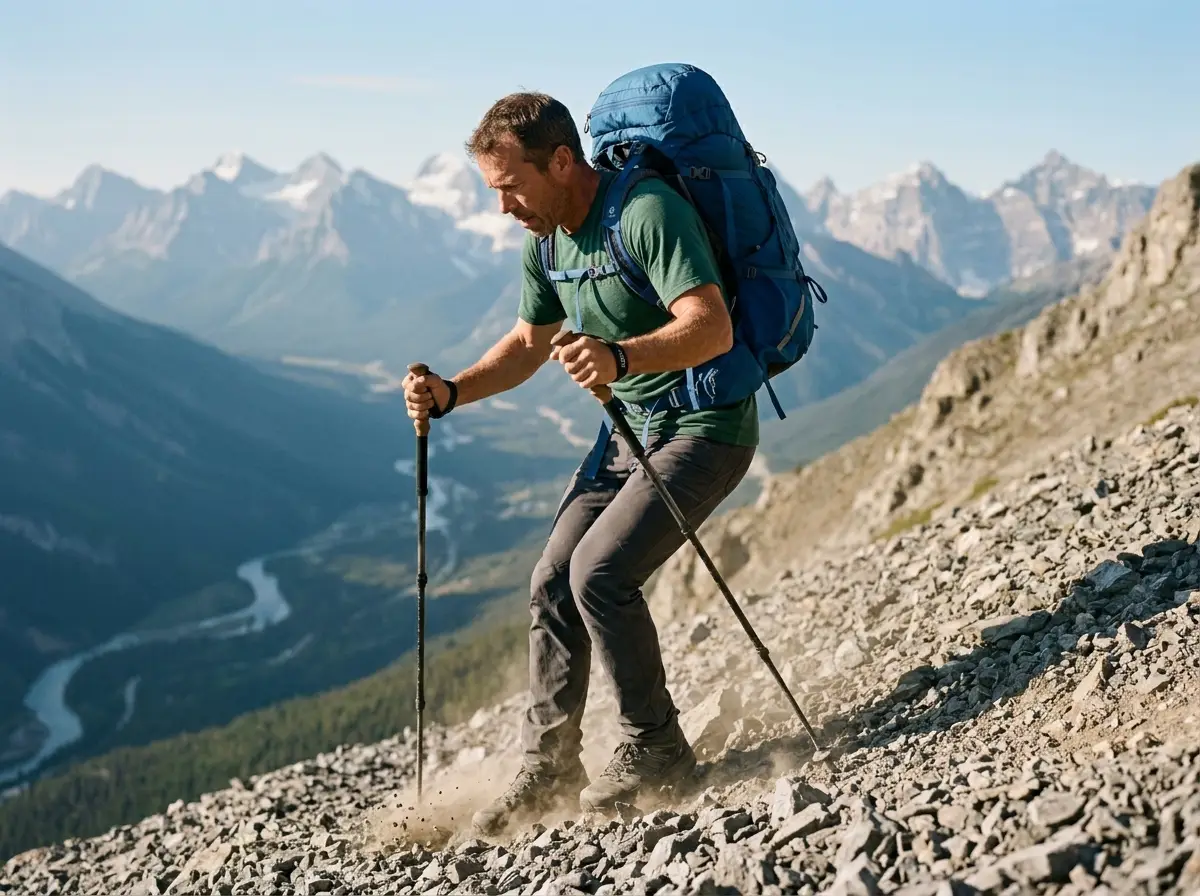
Three days into a 40-mile loop in the Sierra, I hit the wall. Not the cardio kind. The real kind — that railroad-spike sensation behind the kneecap every time my boot hit loose scree on the way down. I still had 3,000 feet of descent staring at me. My patellofemoral joint was broadcasting on a very clear channel, and the message wasn’t good.
That trip is where I finally stopped treating my poles like fancy walking sticks and started using them the way they’re designed to work. The difference over the next two days was not subtle. I’d done plenty of multi-day treks before. I’d never moved that efficiently on a beat-up knee.
What follows is what I’ve learned — from that trip, from the training for hiking protocols I’ve tested over dozens of approaches, and from the research that backs up why your poles can do so much more than you’re asking of them.
⚡ Quick Answer: Trekking poles reduce knee joint compression by up to 25% on descents by shifting load to your upper body through strap loading. To train effectively, run a 5-exercise circuit: pole-assisted pistol squats, clockwork reach balance drills, scapular retraction presses, strap-loaded lunges, and an anti-rotation plank. Adjust your pole length 5–10cm shorter for climbs and longer for descents to maintain the 90-degree elbow angle. On Class 3 terrain, collapse and stow the poles completely.
The Physics of Force Redistribution
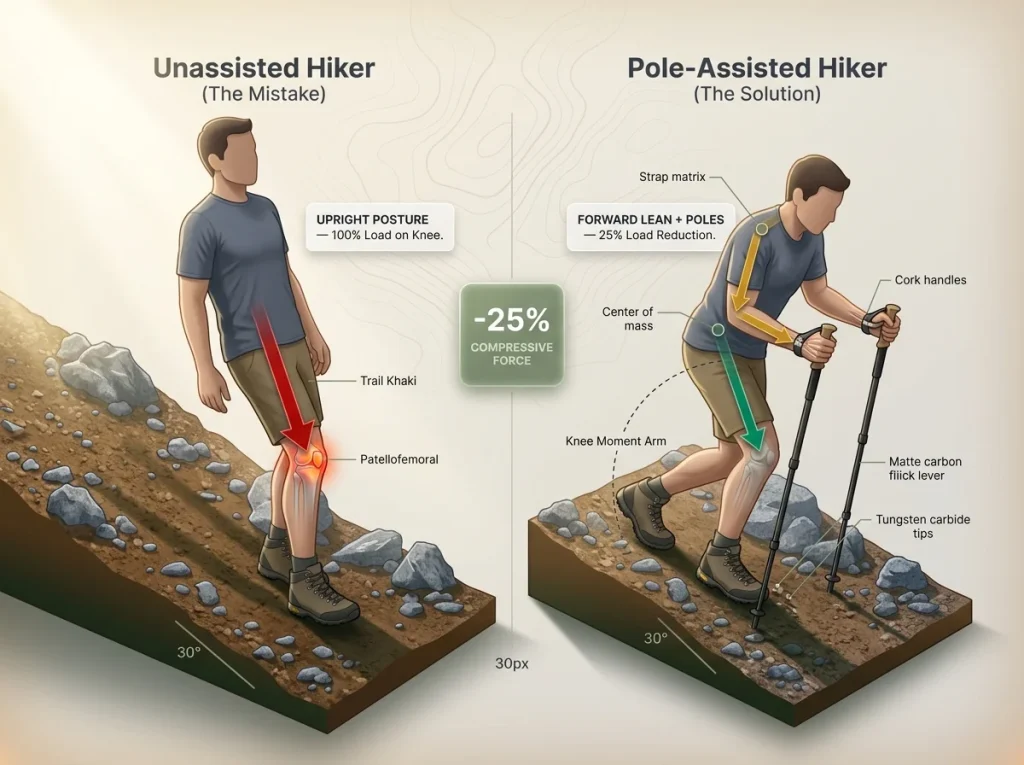
Here’s the number that changed how I think about descents: on an unassisted downhill step, your knee absorbs roughly three times your body weight. Every step. For a 180-pound hiker with a 30-pound pack, this adds up to something that should concern any orthopedic surgeon — and it does.
According to a Review of Biomechanical and Physiological Effects of trekking pole use, poles reduce tibiofemoral compressive and shear forces by 12% to 25%. That’s not a marketing number. It happens through a specific postural shift: you lean your upper body slightly forward, which decreases the knee moment arm and transfers the braking impulse to your triceps, pectorals, and lats. Your quads aren’t doing it alone anymore.
There’s another number worth knowing: cartilage oligomeric matrix protein, or COMP. It’s a biomarker for joint tissue damage that rises predictably during harder descents without pole support. With poles, COMP levels stay lower. That’s not soreness we’re talking about — that’s actual cartilage wear rate. The American Hiking Society confirms that true joint protection requires two poles, not one walking stick — the symmetrical support is what drives the load transfer across your whole upper body.
I’ve seen hikers abandon thru-hikes because they ignored this math. Every pole plant offsets tons of cumulative weight over a 15-mile day. The physics here are unforgiving.
Unweighting the Knee on Technical Descents
The mistake most people make on steep downhill is standing too upright. It feels stable. It isn’t. When you stay vertical, you lose most of the force transfer advantage the poles give you. The braking impulse stays in your legs. Your patellar tendon pays for it by mile eight.
Lean forward into the poles. Make them work. Your eccentric contraction and knee health on steep descents depends entirely on this forward-loaded posture. When your poles are planted and you’re driving weight into the straps instead of locking your grip on the handles, the load shifts to your skeletal structure rather than your exhausted forearm muscles.
Watch for varus movement — that inward-bowing of the knee that happens when your pole plant is too far out or your weight distribution is uneven. It can amplify existing knee problems rather than reduce them. Plant the poles closer to your body’s center line, directly beside your hip rather than out to the side.
Pro tip: Lean aggressively forward on technical descents — not just slightly. Your center of mass should feel like it’s ahead of your hips, not above them. Standing upright is the reflex; defeating that reflex is the work.
The 90 Percent Muscle Engagement Threshold
Normal walking engages around 35% of your body’s musculature. Systematic pole use bumps that to approximately 90%. Your triceps, pectorals, and lats are now active participants instead of passengers. This matters for caloric burn — you’ll burn more — but the surprising part is your Rating of Perceived Exertion often stays flat or drops.
That’s the paradox worth understanding: you’re doing more physical work, but distributed across a much larger muscle volume, so you feel like you’re doing less. This allows you to move faster on sustained climbs and preserve your leg glycogen for when you actually need it. I’ve used this deliberately on long alpine routes — the poles let me spin up a 3,000-foot gain without the quads giving out an hour before the summit.
The Mechanics of Proper Pole Setup
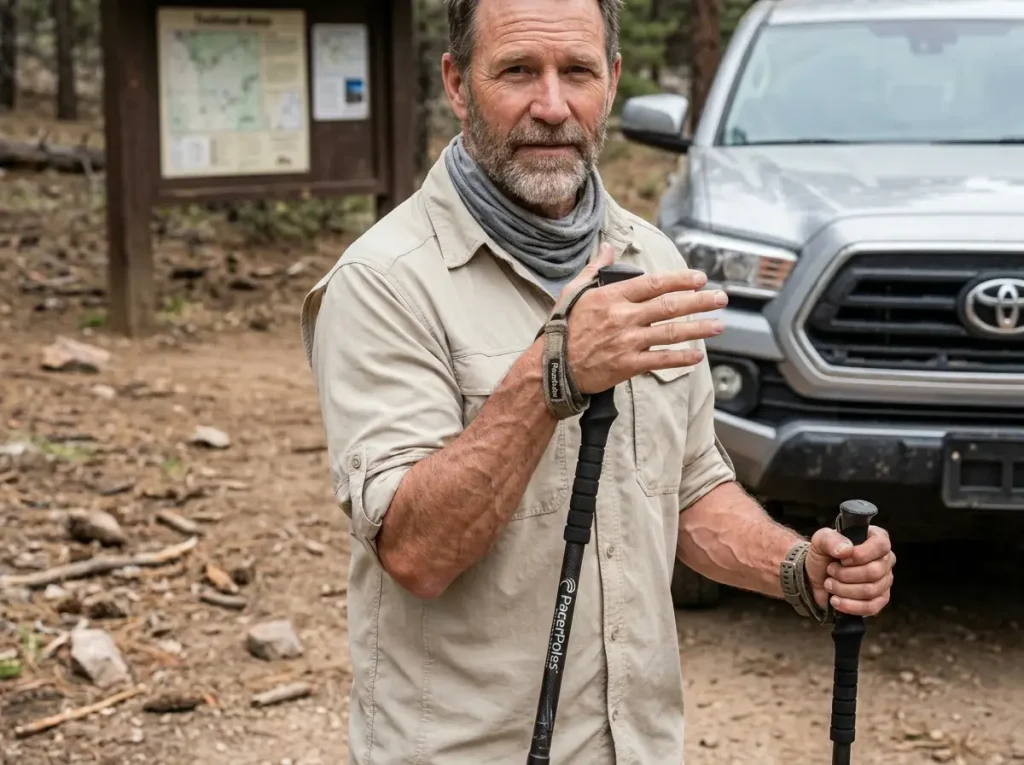
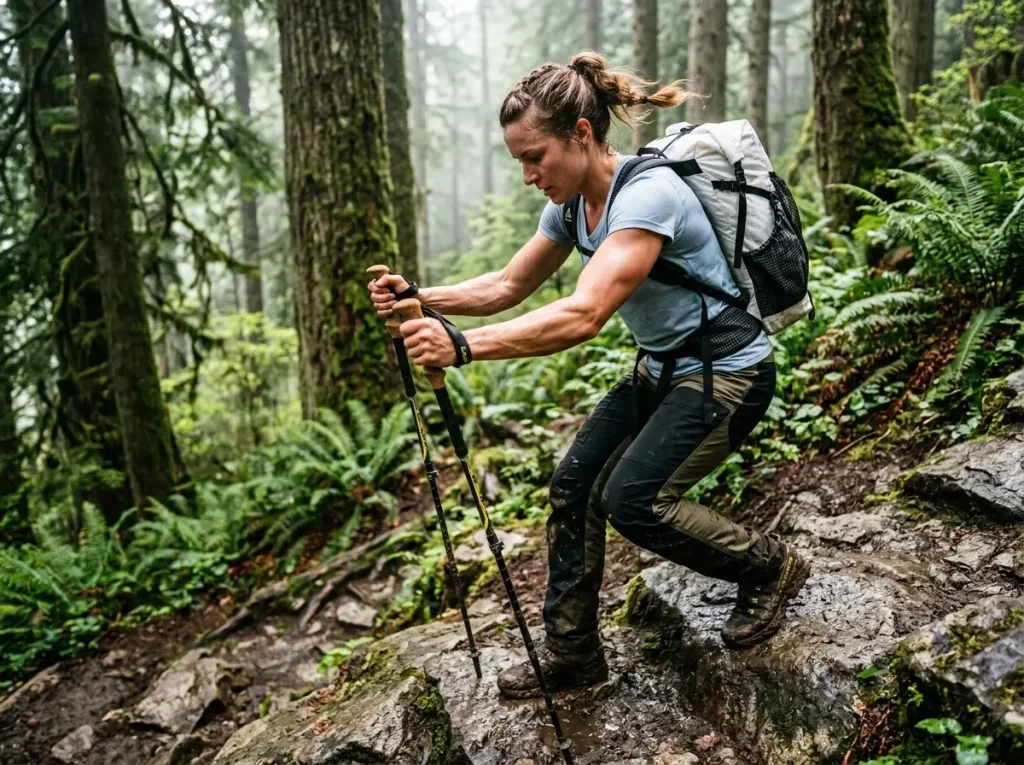
Get the setup wrong, and none of the above matters. I’ve hiked with people who had expensive carbon poles and used them like two crutches. They got forearm cramps by noon and wondered why their poles weren’t helping their knees. The answer was in their hands.
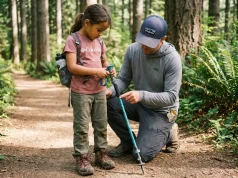
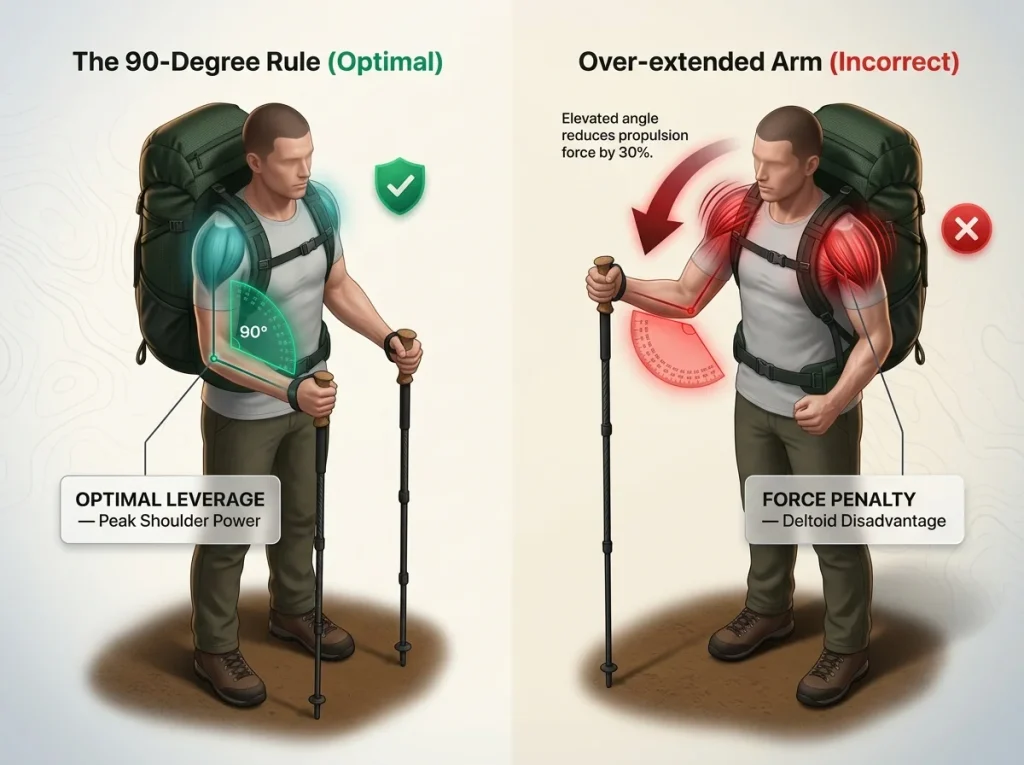
The foundation of everything is the 90-degree elbow rule: on flat terrain, your pole grip should sit at a height where your elbow bends to a right angle. That’s your baseline. From there, adjusting pole length for uphill power and downhill braking means shortening 5–10cm for sustained climbs and lengthening 5–10cm for descents.
Shorter poles on climbs keep your arms driving behind your hips instead of pushing you sideways. Longer poles on descents let you plant further out and forward, absorbing impact before it reaches your knees. It sounds simple. Most people never bother adjusting them at all — and then they wonder why the poles feel awkward.
The other non-negotiable: flick-locks over twist-locks. Twist-lock systems back out under real load. On a steep scree slope with 40 pounds on your back, a pole that suddenly collapses under you will get your attention fast and badly. Use flick-locks, check them before each descent.
On dirt, rock, and ice, carbide tips are mandatory. The flat rubber “transport” tips that poles ship with ruin traction on anything that isn’t a paved road. Carbide bites. Rubber bounces. You’ll feel the difference on the first granite slab.
Mastering the Strap-Loading Protocol
This is where most intermediate hikers are losing the biggest gains. The strap-loading mechanism isn’t decoration. It’s how the pole actually transfers your weight through bone structure instead of muscle.
Insert your hand up through the bottom of the strap loop. The strap should bind across the lower part of your hand and the meat of your palm. Now lean your full weight into it. That downward pressure should bypass your hand muscles entirely and transfer through your wrist’s bone structure. You’re not gripping. You’re resting.
A tight grip on the handle is a rookie mistake that will fry your forearms by lunchtime. If your forearms cramp or your hands swell mid-hike, your strap insertion is wrong. Go back to basics. Research on how studies decrease maximum isometric shoulder torque with incorrect pole length shows this in clinical detail — proper length and strap use make the whole system work.
The first 20 times you hike with correct strap technique, you’ll feel like you’re doing it wrong because your hands aren’t exhausted. That’s correct. That feeling is the system working.
The Physics of the Lever Arm
Pole length changes how much torque your shoulder produces. A pole set too long raises your arm’s elevation angle, which actually reduces the force your shoulder can generate. Your deltoids stop working in their strongest mechanical range. This is why long poles don’t feel more powerful — they feel worse.
The 90-degree stance keeps your shoulder operating in its peak zone. This isn’t about comfort. It’s about the geometry of force transfer. Tall hikers frequently run poles that are too short; shorter hikers often run them too long. Neither group is getting the full advantage of the system.
The 5-Exercise Backcountry Training Circuit
I run this twice a week with a loaded pack when I’m prepping for a big trip. Training empty is a mistake — your stabilizer muscles need to feel the real load. Targeted Training Techniques to Correct Functional Deficits backs this up: eccentric control and postural stability training under load builds the specific strength that matters on trail.
This circuit is what transitions you from bipedal hiking to what I call four-wheel drive trail movement — where your poles are integrated into your gait as a genuine propulsion and stabilization system. Run it as a circuit, no rest between exercises, twice through. You can complete it in a backyard, a driveway, or a hotel parking lot. That’s the whole point.
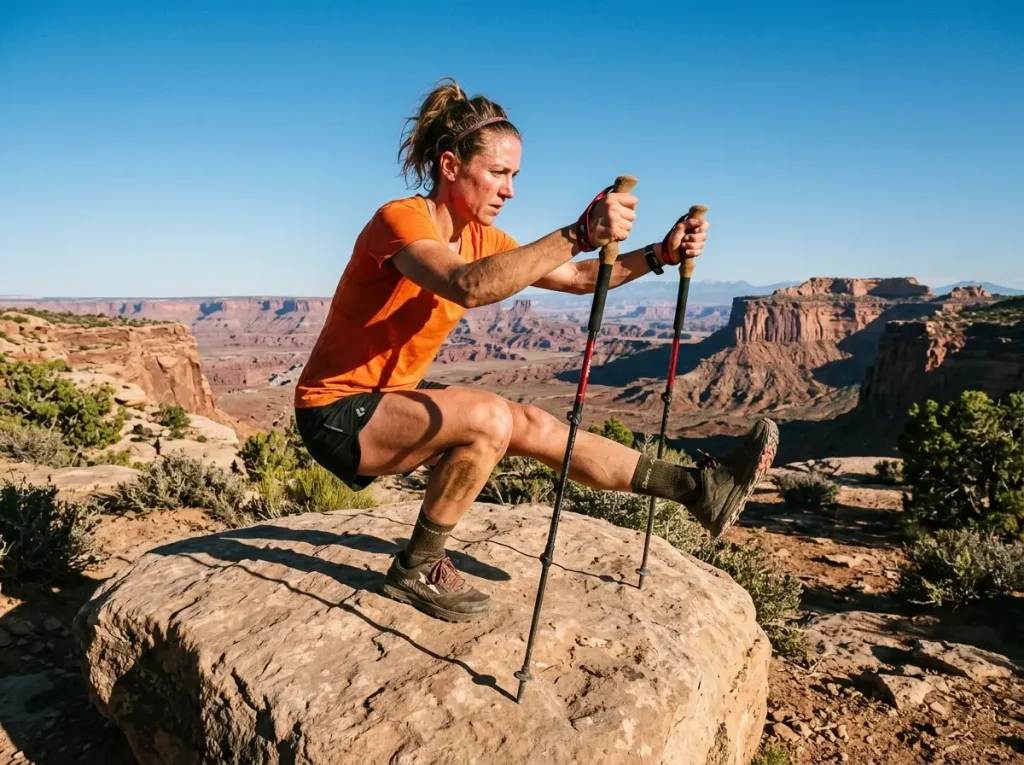
Exercise 1: Pole-Assisted Pistol Squats (Eccentric Control)
This one targets your quads and glutes while using the poles as lateral outriggers to minimize postural sway. Stand on one leg, hold the poles at 90-degree height on either side. Lower down slow — reach back like you’re searching for a chair behind you. The poles aren’t there to push you back up. They’re there so you don’t tip sideways on the way down.
This directly simulates the deep step-down required on large waterbars and technical scree drops. That moment when you lower yourself off a boulder onto unstable ground? This is that, without the boulder. The technical cue — “outriggers, not crutches” — is the whole thing. If you’re using the poles to lever yourself back up, you’re doing a different exercise. Three sets of eight per leg is where to start; add weight when single sets feel trivial.
Exercise 2: Clockwork Reach (Proprioceptive Mapping)
Proprioception is your ankle’s internal GPS — the system that lets it react to an unexpected roll without you having to consciously think about it. On roots and rocks, it’s what keeps you upright when a foot placement goes slightly wrong.
Balance on one foot. Use a pole or your hand to tap the ground at 12, 3, 6, and 9 o’clock positions without letting the raised foot touch down. Freeze completely at each tap. Your ankle is being forced to make micro-adjustments without visual confirmation. That’s the drill.
Trail runners do versions of this for ankle sprain prevention. The principle is identical for trail conditioning: the first 20 times through this, you’re just building the proprioceptive feedback loops that eventually become unconscious trail navigation. After six weeks of this drill twice weekly, you’ll notice a difference on rooted singletrack — less conscious thought about foot placement, faster recovery when a step goes wrong.
Pro tip: Do the clockwork reach on an uneven surface — a yoga mat folded over, a patch of gravel, or a slight slope. Flat ground makes it too easy and trains the wrong adaptive response.
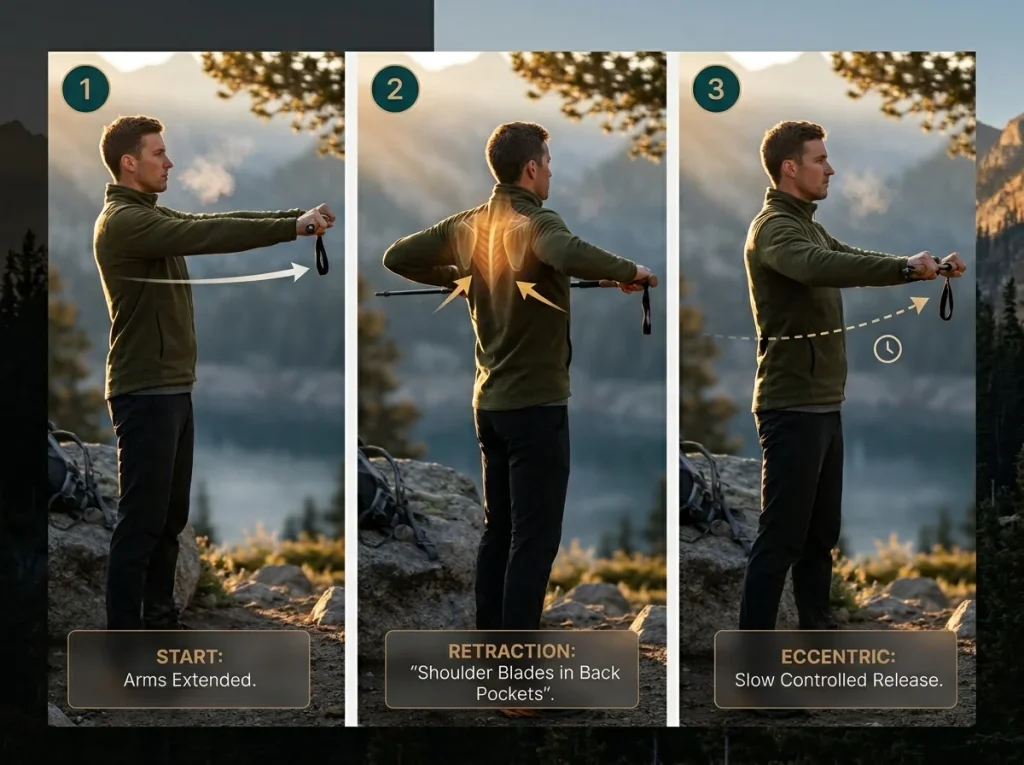
Exercise 3: Scapular Retraction and Horizontal Press
Pack slump is real, and it ruins more than your posture. When your shoulders round forward under a heavy pack, your chest closes. Your lungs can’t fully expand. You’re hiking at reduced oxygen capacity without realizing why you’re tiring early.
Hold the pole horizontally with both hands at a wide grip. Drive it toward your chest while squeezing your shoulder blades together hard. Coaches cue this as “tuck your shoulder blades into your back pockets.” Your trapezius and rhomboids are doing the work — the muscles that hold your spine upright when your pack is trying to fold you forward.
This exercise directly corrects the scapular-pelvis connection that breaks down over long miles with a heavy load. One week of consistent reps and you’ll feel the difference when you strap on a 40-pound pack — your spine stays long instead of collapsing forward by hour two.
Exercises 4 & 5: Strap-Loaded Lunges and Anti-Rotation Plank
The strap-loaded dynamic lunge builds the diagonal couplet gait that efficient pole hiking depends on — opposite arm and leg working together. Step forward into a lunge, plant the pole on the opposite side simultaneously, and drive downward force through the strap to assist the upward return. The cue is “elbow to back pocket.” If your elbow isn’t driving back and down, you’re lunging but not training pole integration.
For the triangulated anti-rotation plank: hold plank position with your hands on the pole grips, tips on a non-slip surface. The instability demands your external obliques work constantly to prevent rotation. Stack your ribs directly over your pelvis. Don’t let your hips sag. This protects your lower back on asymmetric loads — the kind you get when your pack shifts on a side-hill traverse or when you wade a creek with one pole higher than the other.
Pro tip: Load both exercises with a weighted vest or small daypack once they feel easy unloaded. The stabilizer muscles don’t adapt to real trail conditions if you only train bodyweight.
Advanced Gait Coordination and Terrain Adjustments
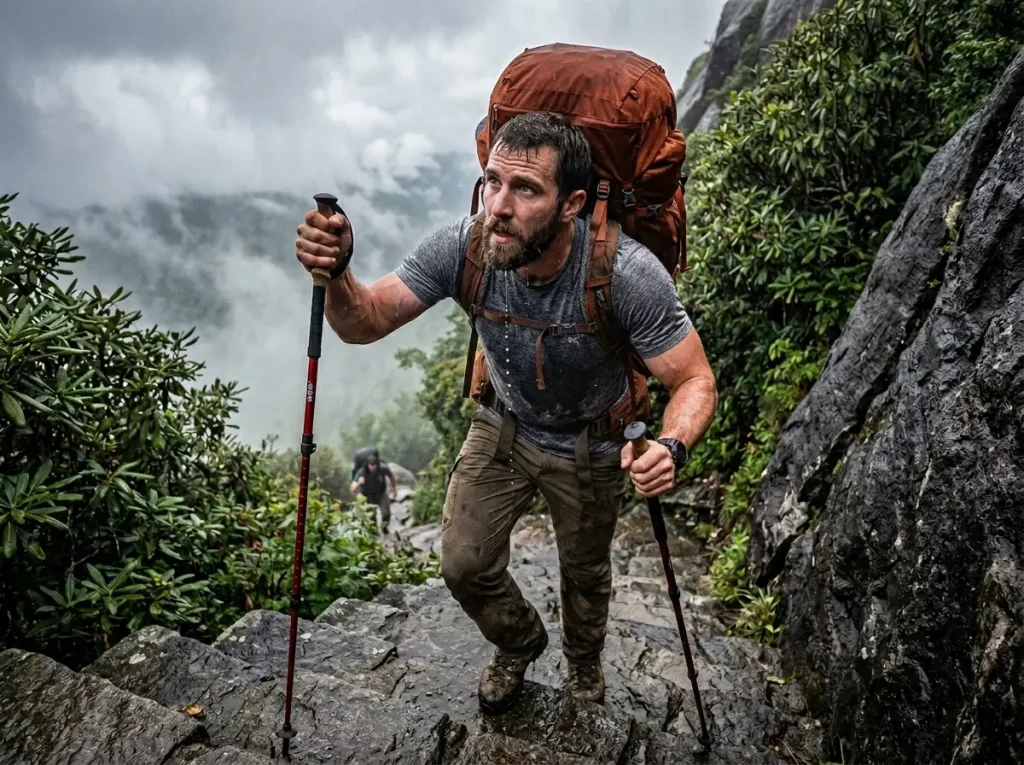
Pole technique isn’t one thing. It changes based on what the terrain is asking. Getting this wrong means you’re carrying two pounds of aluminum and not using it right.
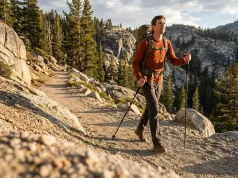
On flat ground and gentle climbs, the diagonal couplet gait is your baseline: right pole, left foot; left pole, right foot. It maintains natural momentum and matches the cross-lateral pattern your body already uses when walking. This is Adaptive gait transition in trekking pole-assisted hiking in its simplest form — what researchers call the natural quadrupedal coordination pattern.
On steep ascents or rock staircases, switch to the double poling method: plant both poles simultaneously, then hoist your weight forward and up using your lats and triceps. This is maximum power output for gaining elevation. It’s the difference between grinding uphill and actually climbing. Your legs appreciate the assist; your upper body is strong enough to provide it if you’ve done the training circuit.
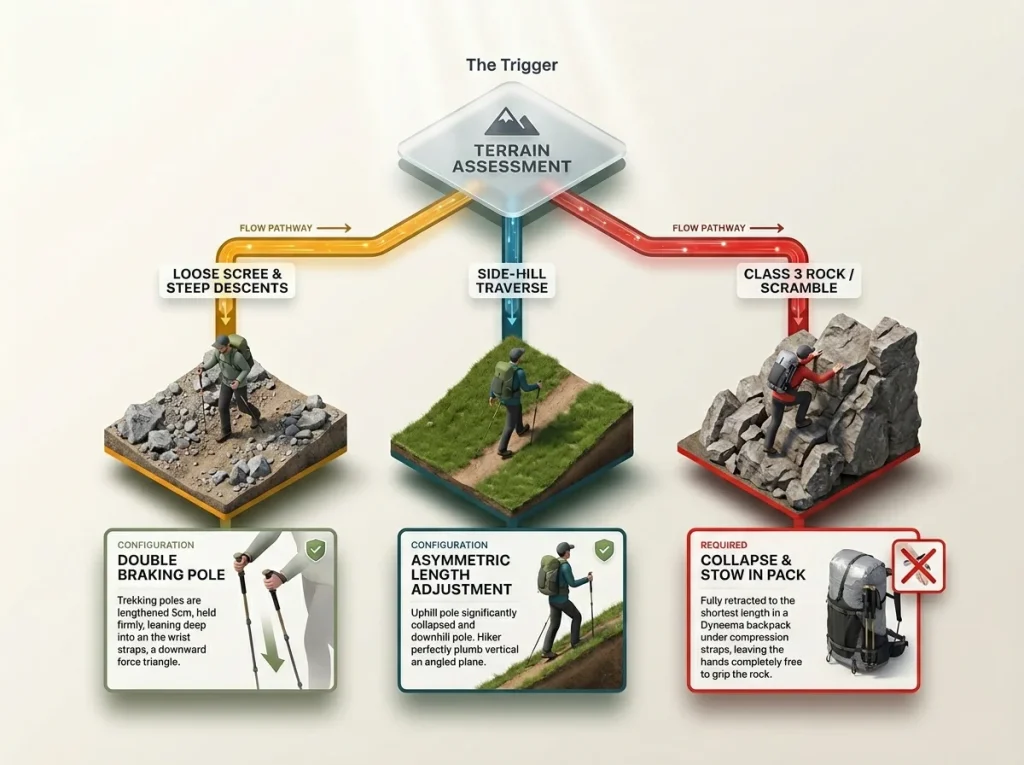
For side-hill traverses, make the uphill pole shorter and the downhill pole longer. This keeps your spine vertical instead of leaning into the slope. A hiker with asymmetric poles on a traverse looks immediately different from one without — they’re vertical, moving efficiently, not tilting into the hill and loading the downhill hip.
The “Double Poling” Propulsion Method
Both poles go forward simultaneously on steep sections. You plant them, then use your lats and triceps to physically drag yourself up the terrain. This sounds simple. Executing it on sustained 30-degree grades with a heavy pack, in ski mountaineering mode, is a completely different skill.
The failure mode here is misplanting on uneven ground. If the terrain angle shifts while you’re mid-hoist and a pole slips, you go backward with full pack weight. Solid tip placement — carbide tips biting, not skidding — is the difference between controlled movement and a bad fall. I check my flick-locks before every technical descent and every double-poling section. Two seconds of prevention.
Traversing and The Metronome Effect
A study in Gait & Posture showed that pole use helps hikers maintain consistent stride length, which delays fatigue. The rhythm itself — the metronome effect — also regulates breathing. On long ascents above 10,000 feet, a steady pole cadence can measurably reduce respiratory muscle fatigue by synchronizing breath with stride.
I hum in 4/4 time on the really grinding climbs. It sounds strange and works completely. Pole plant on the beat, breath on the beat. For dialing in your trekking pole rhythm and cadence, the metronome isn’t a trick — it’s a tool for managing oxygen intake on extended effort.
Failing to adjust asymmetry on a traverse forces a lateral spinal lean that worsens hip flexor strain. You feel it as low-back fatigue after an hour. The fix takes five seconds with flick-locks.
Safety Matrices and High-Consequence Terrain
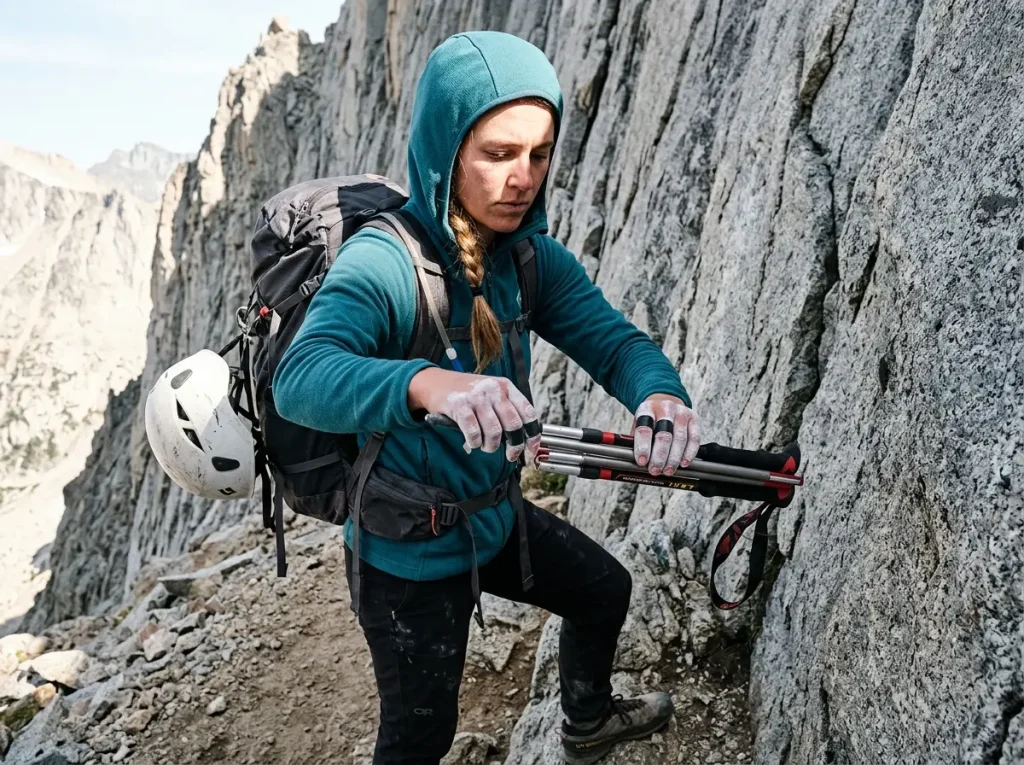
Here’s where poles stop being a mechanical asset and become a genuine liability if you’re not paying attention. The 25% joint compression reduction means nothing on terrain where you need both hands on rock.
Poles pose entanglement hazards in dense brush. On Class 3 terrain — where you’re using your hands for upward progression — carrying them in-hand guarantees you can’t catch yourself in a fall. A wrist strap connected to a pole during a sudden slip turns a scramble recovery into a potential wrist fracture. I’ve watched this happen. The ego that says “I’ll just hold them loosely” doesn’t fix a broken radius.
The rule is simple: when the terrain requires hand-to-rock contact, stow the poles. Completely collapsed, secured in your pack’s side loops or lash points. Not dangling from your wrist. Stowed.
For understanding where that line is, evaluating Class 3 and 4 terrain gives you the specific classification markers. If the route description says “exposed scramble” or “hands required” in any section, plan your stowage before you get there, not during.
The “Class 3” Stowage Rule
Class 3 scrambling is the threshold. Below it — on steep hiking grades, loose scree, exposed trails — poles in hand are active safety tools. At Class 3 and above, they’re a hazard. Dangling them from wrist straps on a technical section will snag a rock outcropping and throw your balance when you can least afford it.
Some experienced mountaineers remove their hands from straps entirely on very steep descents. If you fall, you can discard the poles and arrest with both hands instead of having a rigid pole attached to your wrist. That’s a judgment call based on consequence. On a 50-degree snow slope, it matters more than on a rocky trail.
Managing “Hotspots” and Biological Signals
Sharp patellar pain is different from muscle soreness. Soreness is expected and fine. Sharp pain mid-descent means something’s mechanically wrong — check your varus knee alignment when that happens. Bad pole form can sometimes worsen existing misalignment instead of correcting it.
Hand swelling mid-hike is often from walking with hands below heart level for extended periods. The rhythmic pumping action of proper pole use improves circulation and usually solves this. If your hands are swelling, your strap may be too tight, or you may be gripping instead of resting your palm weight into the strap.
Pro tip: If you feel sharp knee torque coming through the poles rather than load relief, your poles may be too long for the current gradient. Stop and shorten them by 5cm before the next steep section. A two-second adjustment prevents a week of recovery.
Conclusion
Trekking poles aren’t walking sticks. They’re a mechanical system that, used correctly, removes tons of cumulative load from your knees over the course of a long day. The physics are clear: strap loading transfers force through your skeletal structure, the 90-degree elbow rule keeps your shoulder joints in their strongest position, and the five-exercise circuit builds the upper body strength and ankle proprioception you need to make all of it work under a heavy pack.
Three things to take from this: master the strap-loading protocol before anything else, run the training circuit twice a week with weight on your back, and know exactly when to stow the poles before the terrain makes that decision for you.
Take your poles and a loaded pack out to a local hill this weekend. Dial in that strap technique. Feel the difference when you lean into it instead of gripping. Trail training for your knees starts before the trailhead.
FAQ
Do trekking poles really help with bad knees?
Yes — clinical data consistently shows poles reduce compressive forces on the knee joint by up to 25% on descents. By transferring the braking impulse to your upper body through proper strap loading, they shift tons of cumulative weight off your patellar tendon during steep downhill movement.
What exercises can I do with trekking poles at home?
Pole-assisted pistol squats, the clockwork reach balance drill, and strap-loaded dynamic lunges all work in a backyard or living room. These build the eccentric leg strength and proprioceptive trail training capacity needed for technical terrain without requiring a gym. The scapular retraction press works in any space with a few square feet.
Should I use the wrist straps on trekking poles?
Absolutely, provided you insert correctly from the bottom up. Proper strap use transfers your body weight directly through your wrist’s bone structure, eliminating the need for a grinding grip on the handle. If your forearms cramp after an hour of hiking, your strap insertion is wrong.
How do you use hiking poles on steep hills?
On very steep ascents or large rock staircases, switch to double poling: plant both poles forward simultaneously and use your lats and triceps to hoist your weight upward. On steep descents, lengthen the poles 5–10cm and plant them out ahead of your feet, leaning forward into the strap so your upper body handles the braking impulse.
Risk Disclaimer: Hiking, trekking, backpacking, and all related outdoor activities involve inherent
risks which may result in serious injury, illness, or death. The information provided on The Hiking Tribe is for
educational and informational purposes only. While we strive for accuracy, information on trails, gear, techniques,
and safety is not a substitute for your own best judgment and thorough preparation. Trail conditions, weather, and
other environmental factors change rapidly and may differ from what is described on this site. Always check with
official sources like park services for the most current alerts and conditions. Never undertake a hike beyond your
abilities and always be prepared for the unexpected. By using this website, you agree that you are solely
responsible for your own safety. Any reliance you place on our content is strictly at your own risk, and you assume
all liability for your actions and decisions in the outdoors. The Hiking Tribe and its authors will not be held
liable for any injury, damage, or loss sustained in connection with the use of the information herein.
Affiliate Disclosure: We are a participant in the Amazon Services LLC Associates Program, an
affiliate advertising program designed to provide a means for us to earn advertising fees by advertising and linking
to Amazon.com. As an Amazon Associate, we earn from qualifying purchases. We are also an official affiliate partner
of Black Diamond Equipment via the AvantLink network. If you click on a Black Diamond affiliate link and make a
purchase, we may earn a commission at no additional cost to you. We also participate in other affiliate programs and
may receive a commission on products purchased through our links. Additional terms are found in the terms of
service.