In this article
You laced them tight on the store carpet, walked a lap past the sock display, and they felt right. Then on mile six of a real descent your third toenail started going dark, and you knew before you reached the car that the pair was going back. Ask around at any fitting counter and you get that same story on repeat, because a women’s hiking shoe is built on a different last, not a different colorway, and a different last is not automatically the better fit for your foot. Below are nine women’s low-cut hiking shoes with the caveats left in, plus the fit mechanics that decide whether any of them will work on the foot you actually have.
If you just want the short version, here’s which shoe wins which job.
| Best For | Shoe | Why It Wins |
|---|---|---|
| Best overall | Salomon X Ultra 360 Leather GTX | Precise heel hold and the steadiest ride on descents |
| Best budget | Columbia Crestwood Waterproof | Real traction, wide option, lightest of the cheap picks |
| Most comfortable | HOKA Anacapa 2 Low GTX | Max cushion for hard-packed miles, still grips wet rock |
| Waterproof pick | La Sportiva Spire GTX | Stiffest platform here, still supports under a loaded pack |
| Breathable pick | Merrell Moab 3 (mesh) | Drains and dries by the next ridge, wide sizes available |
| Wide forefoot | Altra Lone Peak 9 Waterproof Low | Genuinely wide toe box, zero-drop, StoneGuard rock plate |
| Backpacking loads | Oboz Sawtooth X Low B-DRY | Firm midsole and the best stock insole in this group |
| Light with protection | Merrell Moab Speed 2 | Rock plate under 20 oz per pair, but it runs large |
| Lightest pick | HOKA Speedgoat 7 | Just over a pound per pair with deep Megagrip lugs |
Why Women’s Hiking Shoes Fit Differently (and When They Don’t)
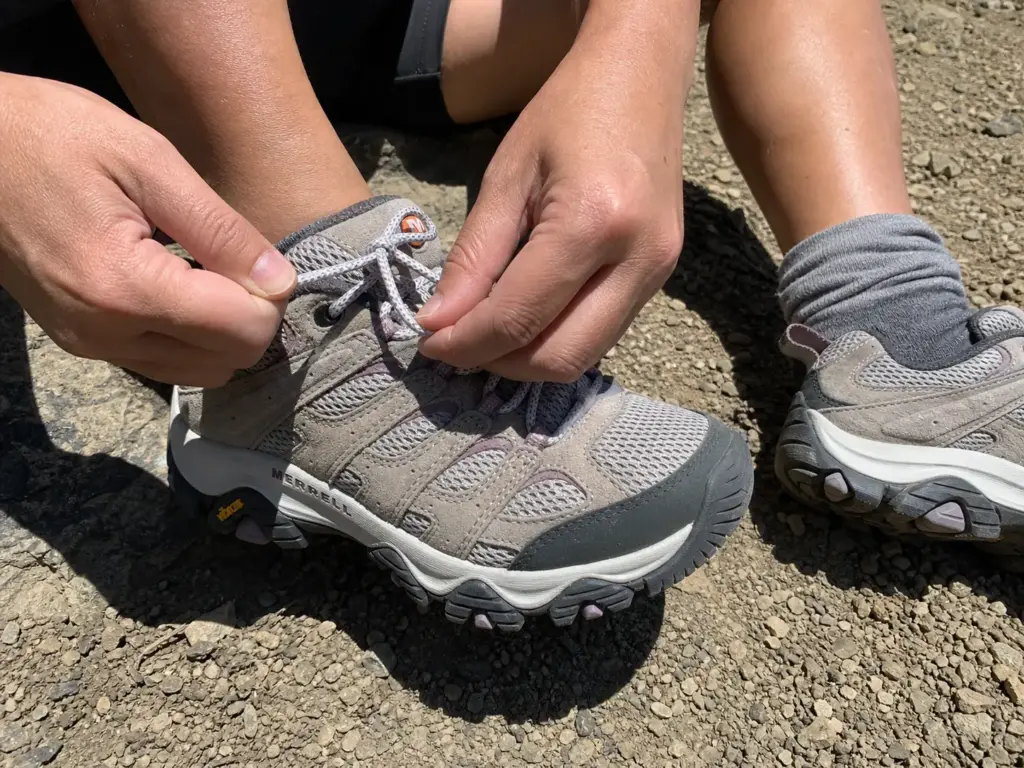
The letter W on a shoebox is not a marketing flourish, and it is also not a promise. It means the shoe was built around a different last, the three-dimensional foot-shaped mold that every upper and midsole gets assembled over. A gender-specific last is the whole substance of the claim. Change the last and you change the shape of the space your foot has to live in for eight hours.
Three measurable things separate a women’s last from a men’s one at the same foot length. The heel is narrower relative to forefoot width. The instep sits higher, so there is less volume through the midfoot. And the forefoot is proportionally shorter.
A men’s last simply scaled down misses all three at once, which produces the sensation nobody in the footwear aisle has words for: the shoe feels too big and too small at the same time. The heel lifts on every step while the ball of your foot is being squeezed. That is not a fussy foot. That is a mold shaped for a different ratio.
Then there is the load side, which matters more than the fit side and gets discussed far less. Wider hip geometry produces a larger Q-angle, the angle between the quadriceps and the patellar tendon. A bigger Q-angle means more knee valgus and a foot-strike trajectory shifted slightly inboard.
On pavement that is invisible. On a loose, off-camber descent it means less margin before the ankle rolls, because your foot is already landing a few degrees away from where the outsole’s widest support sits. This clinical breakdown of how women’s foot structure and Q-angle differ from men’s walks through the geometry if you want the anatomical version.
Here is the part that should change what you shop for. If your ankle has less margin on off-camber ground, the fix is a wider outsole platform and more torsional stiffness, not a taller collar. Collar height is what gets marketed.
Platform width and torsional stiffness are what actually resist a roll, which is the whole reason a low-cut shoe with a broad base can outperform a mid-height boot on the same descent. That logic is also why this site argues that a low-cut shoe beats a boot for most hikes rather than treating height as a proxy for safety.
The same Q-angle geometry correlates with higher female rates of patellofemoral pain, plantar fasciitis, shin splints and IT band syndrome. The shoe under you is one link in that chain, not a comfort preference you can shrug off. A midsole that has compressed unevenly toward the inside edge stops supporting a foot-strike that already tracks inboard, and the knee registers the change before the foot complains about anything.
Now the honest half, and the reason this article exists at all. The most expensive assumption in the footwear aisle is that the women’s version is automatically the right buy for a woman. The women’s last assumes a narrow heel paired with a relatively wide forefoot. If your heel is also wide, or your forefoot-to-heel ratio is flatter than the female average, that last pinches you across the ball before the heel is ever secure.
You will feel like you are failing at shoe shopping. You are not. You are being handed the wrong ratio in nine boxes out of ten.
The decision rule is simple enough to use in a store. Lace the shoe with a heel-lock finish through the top eyelets. If the heel now holds but the forefoot is still tight at the correct length, you have a width and volume problem, not a size problem. From there you have two options: try the men’s or unisex version of the same model sized down roughly 1.5 US sizes, which is the standard conversion, or find a women’s wide if the model offers one.
Width codes are worth learning so you can shop by spec instead of by adjective: B is women’s standard, D is a women’s wide, and 2E or 4E is extra-wide.
Be clear-eyed about what the men’s version costs you, though. It usually has a lower instep and a firmer midsole calibrated for a heavier average frame, so you trade forefoot room for midfoot hold and a stiffer ride. That is a trade, not a free upgrade. It is still the right trade for a lot of feet, and the fitting counters that keep a men’s size run in stock for exactly this reason will tell you so.
The story that comes up again and again is the hiker who returned three pairs of women’s shoes, got handed the men’s version of one of them by a fitter who had seen it before, and walked out without a fourth return.
I’ll say plainly what I think, since this is opinion and not a claim about anything I’ve measured: “buy the women’s version” is the single most costly piece of received wisdom in hiking footwear. It is right often enough to sound like a rule and wrong often enough to cost people three returns and a season of sore feet. The useful version of the advice is that the W is information about a shape, and your job is to find out whether that shape is yours.
Best Overall: Salomon X Ultra 360 Leather GTX
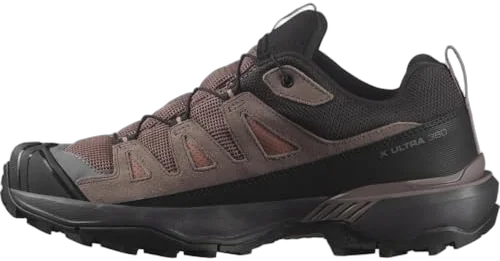
This is the pick you hand someone at the trailhead without asking a follow-up question. The X Ultra platform has earned that position across test teams for one reason above the rest: it holds the heel and stays stable when the grade turns downhill, which is exactly the moment a larger Q-angle costs you margin. Aggressive Contagrip lugs and a stiff-enough chassis mean the shoe tracks where you point it instead of squirming underneath you on loose gravel.
The specs that matter here are the Gore-Tex membrane, the leather upper and the low collar. Leather buys abrasion resistance and a snug, supportive wrap once it relaxes, and the Salomon X Ultra 360 Leather GTX is the current live women’s version of that chassis in a low cut. If your hiking is mostly maintained trail with a day pack and some rocky, off-camber sections, this covers the range without asking you to think about it again.
Leather on hiking footwear comes in two forms worth telling apart on a spec sheet. Full-grain leather keeps the outer hide intact, which is what buys the abrasion resistance and the long service life, at the cost of stiffness out of the box. Nubuck leather is the same hide sanded to a soft nap, so it feels broken in sooner and scuffs more visibly. Either way you are buying a material that gets better over the first fifty miles and worse if you dry it next to a fire.
Two honest caveats. The X Ultra family runs on the narrow side and favors a lower-volume foot, so a wide forefoot will feel the pinch across the ball no matter how well the heel behaves. And leather needs a few outings before it stops feeling like a shell, which is a real cost if your next hike is a big one rather than a shakedown walk. If you are between widths, read the wide-feet section further down before you commit.
The Gore-Tex liner deserves one more sentence of honesty. On a shoe whose collar sits about three inches off the ground, a membrane is a limited promise: it stops rain and wet grass, and it becomes a container the moment water tops the collar. That is not a flaw specific to this shoe. It is physics that applies to every waterproof low-cut in this roundup, and the waterproof section covers what to do about it.
One last thing worth internalizing: fit direction is model-specific, not brand-specific. “Salomon runs narrow” happens to be true for this model and is folklore when applied to a logo. Two shoes from the same brand can fit oppositely, and you will see exactly that happen twice in this article.
Best Budget: Columbia Crestwood Waterproof
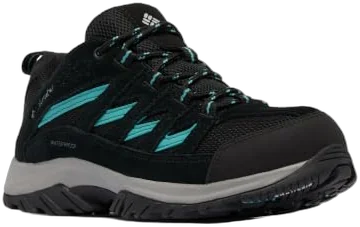
If you are buying your first pair, spend less than you think you need to. On maintained trail with a day pack, the two things you are actually paying for are fit and traction. Exotic foam, carbon plates and premium membranes solve problems you do not have yet. The Columbia Crestwood Waterproof covers both basics at roughly 1.50 lb per pair, which makes it lighter than several shoes that cost twice as much.
The wide option is the quiet reason this one earns its spot rather than the price alone. Width availability collapses fast at the bottom of the market, and a budget shoe in a D width will outperform a premium shoe in a B that squeezes your forefoot every step. Traction comes from Omni-Grip, which is honest rubber for dirt, packed gravel and wet roots, without pretending to be a wet-slab specialist.
The caveat is the midsole, and it is worth stating precisely. Cheaper EVA is softer and less resilient, which puts this pair at the low end of the 300 to 500 mile window that the durability section covers, and it means the shoe bottoms out sooner once you add pack weight. For day hikes that is a non-issue. For a loaded overnight it is the wrong tool, and the backpacking section names a better one.
There is a broader point buried in this section. Buying the cheapest shoe that genuinely fits beats buying the best-reviewed shoe that mostly fits, every time. Fit is iterative, returns are part of the process, and starting cheap while you learn your own foot shape is the smarter sequence rather than the compromise it feels like.
Most Comfortable: HOKA Anacapa 2 Low GTX
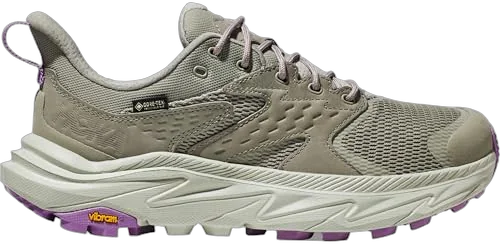
Separate two words that get used interchangeably in shoe reviews: comfortable and cushy. Cushy is a sensation in the store. Comfortable is how your hips feel at the car after 14 miles of hard-packed trail and gravel road. The HOKA Anacapa 2 Low GTX is built for the second one, and the MetaRocker geometry does part of that work by rolling you through the stride instead of asking your calf to lift a stiff shoe off the ground each step.
Who should buy this: anyone whose limiting factor is joint fatigue rather than fit or traction. Long approaches, rail-trail miles, forest-road walk-ins, thru-hike road sections, recovery hiking after an injury. Vibram Megagrip matters more here than it would on a firmer shoe, because cushioning and grip usually pull against each other, and a soft shoe with cheap rubber becomes a liability the first time you cross a wet slab.
The caveat is geometry, not quality. A tall soft stack raises your foot further off the ground and reduces ground feel, which is exactly the wrong trait on off-camber sidehill and loose technical terrain. Read that alongside the Q-angle discussion above: high stack plus less lateral margin is a combination worth thinking about before you buy this pair for scree and talus.
This is also the right place to learn the term bottoming out. When soft foam compresses past its useful range under load, it stops behaving like cushioning and starts behaving like a hinge. You feel individual rocks through the forefoot, and the shoe gets less stable at the same moment it gets less comfortable. The Anacapa has enough foam to resist that on a day pack and not enough to resist it under 35 lb, which is why the backpacking pick further down is a different animal entirely.
Waterproof or Breathable: Two Shoes, One Decision
Every roundup lists waterproofing as a feature. It is closer to a fork in the road, and picking the wrong branch is the most common way women end up disappointed with a shoe that is otherwise correct for them.
Start with the physics. A membrane works by blocking liquid water from the outside while letting some vapor out, and that vapor exchange is slow compared to how fast your foot produces sweat on a climb.
On a low-cut shoe the collar sits roughly three inches off the ground, so it takes one ankle-deep creek crossing to fill the shoe from above. Now the membrane that was keeping water out is keeping it in. That is the bathtub effect, and no amount of membrane quality fixes it, because the failure is geometric rather than material.
Mesh fails differently and more gracefully. It lets water in immediately and lets it out just as fast, so a soaked mesh shoe is often dry again within a ridge or two of walking. What it will not do is keep cold rain or dawn wet grass off your skin for more than a few minutes. There is a fuller treatment of the breathability cost you pay for a Gore-Tex hiking shoe if you want the numbers behind the trade.
Two more words on the spec sheet decide how long either version keeps working. DWR is the durable water repellent finish sprayed on the outer fabric, and it is the part that actually wears out first: when rain stops beading and starts soaking into the upper, the face fabric wets out and vapor stops leaving even though the membrane underneath is intact. That is why a two-year-old Gore-Tex shoe feels clammier than it did new. A wash and a reproofing spray restores most of it, and almost nobody does it.
The second word is PFAS-free. The chemistry that made the best DWR finishes and some membrane laminates has been getting phased out across the industry, which is a genuine gain on the sustainability side and a small step backward on wet-weather performance in the first generation of replacements. Brands leaning on recycled materials for mesh, laces and linings are doing something similar: real environmental progress, occasionally a slightly different feel underfoot. Both trends are worth supporting with clear eyes rather than marketing eyes.
Here is the rule I would print on the box. If the water on your route is falling, take the membrane: cold rain, wet snow, snowmelt slush, mud season in spring. If the water is on the ground or the air is hot, take the mesh: summer creek crossings, humid forest, anything where sweat will out-produce the drainage.
The Waterproof Pick: La Sportiva Spire GTX
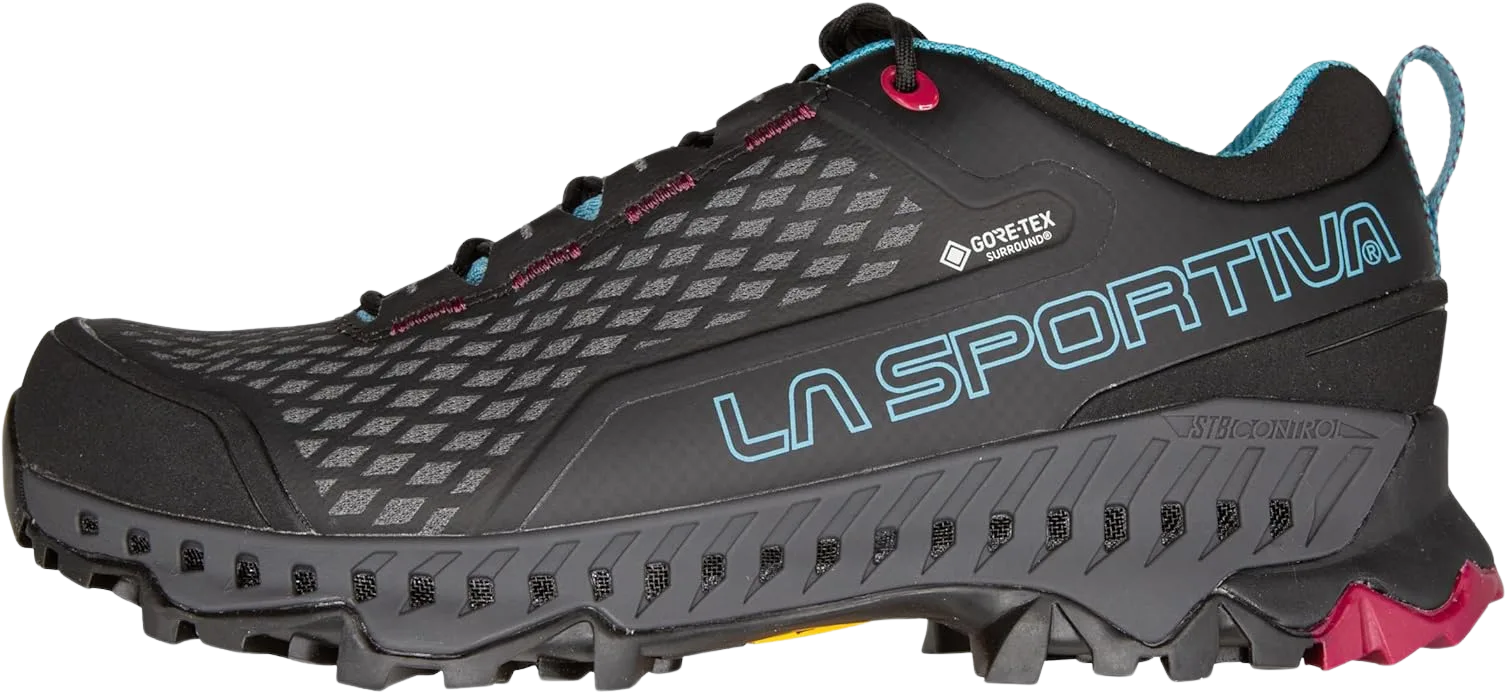
The La Sportiva Spire GTX is the shoe for cold and wet days when you also have weight on your back. Torsional stiffness is the spec doing the work: twist a soft shoe by the toe and heel and it wrings out like a towel, and that flex is what lets a rock roll your foot sideways under load. The Spire resists that, which is why testers who carry weight keep ranking it first while day hikers sometimes find it stiff and unnecessary.
Vibram XS Trek is a climbing-adjacent compound, so it holds on wet rock and smeared slab better than most hiking rubber. Combined with the stiff platform, that makes this the pick for shoulder-season scrambly terrain where you want a shoe rather than a boot but you do not want a soft one.
The caveats are real and specific. The toe box is narrow, so a wide forefoot should look elsewhere in this article. The heel cup runs loose on some feet, which is fixable with heel-lock lacing but is worth knowing before you order. And it needs a genuine break-in, so this is not the pair you order the week before a trip and expect to love on day one.
The Breathable Pick: Merrell Moab 3
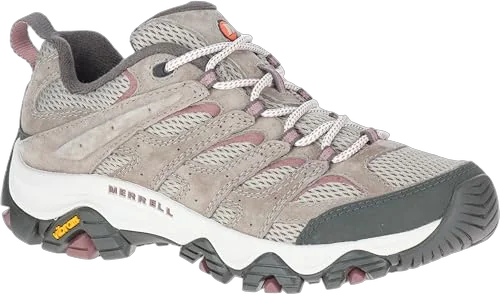
The mesh Merrell Moab 3 is the default recommendation for hot, dry and mixed trail, and the version people should reach for more often than they do. Vibram TC5+ is a durable all-round compound, the fit runs true, and width availability is better than almost anything else in this article. Cross a creek at noon in these and they are damp by the next switchback instead of squelching until dinner.
The honest limitation is the same trait stated backwards. Dawn wet grass will soak through in a few minutes. Cold rain will too, and once your foot is wet and the temperature is in the 40s, that is genuinely unpleasant rather than just inconvenient. Nothing about a mesh upper pretends otherwise.
Run the two-pair strategy instead of hunting for one shoe that does everything. A mesh pair for summer and dry trail, a membrane pair for cold-and-wet shoulder season, and you stop compromising on both ends of the year. It also doubles as your rotation for the mileage math in the durability section, so the second pair pays for itself twice.
Best for Wide Feet: Altra Lone Peak 9 Waterproof Low
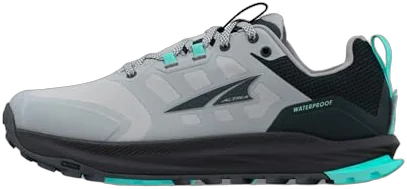
This is the most caveated card in the article, and it should read that way. The Altra Lone Peak 9 Waterproof Low solves one problem loudly and creates two quieter ones, so it earns a recommendation with conditions attached rather than a clean win.
The problem it solves: a FootShape last with real forefoot volume, which is not the same claim as a shoe sold in a wide. Most brands widen a standard last a few millimeters and call it a wide. Altra builds the toe box around toe splay from the start, so your forefoot spreads on impact instead of being held in a taper. If your complaint is that every shoe pinches across the ball at correct length, this is the design answer.
That design is also why the Lone Peak has a following among thru-hiking crowds that borders on religious. Feet spread and stay spread over a few hundred consecutive miles, and a last built for splay handles that better than one that only tolerates it. Altra’s own MaxTrac outsole is tuned for grip on dirt and rock rather than for mud clearing, which suits long trail miles and is less convincing on a wet clay sidehill.
The first quiet problem is the one that loops straight back to fit mechanics. That wide forefoot sits on a heel that is narrow by comparison, which is the exact ratio a women’s last already assumes. If your foot is wide at the front and wide at the back, the Lone Peak gives you room where you needed it and still lets the heel slip.
Heel-lock lacing helps. It does not change the shape of the heel cup.
The second is heel-to-toe drop, and it deserves more respect than it usually gets. Zero-drop means no heel lift at all, so dropping from a typical 8 to 10 mm drop moves load off the knee and onto the calf and Achilles. That is a real transition with a real timeline, and doing it for the first time on a loaded descent is how people end up nursing a sore Achilles for a month.
Build into it on short, flat walks first. If you want the full picture before you commit, the analysis of what zero-drop shoes actually change about your stride covers the adaptation period properly.
While you are here, learn the width codes so you can shop by spec instead of by adjective. B is women’s standard, D is a women’s wide, and a 2E width or 4E is extra-wide. A shoe listed only in B is telling you something useful about who it was designed for, and no amount of lacing rescues a last that is 6 mm too narrow across the metatarsals.
Best for Backpacking Loads: Oboz Sawtooth X Low B-DRY
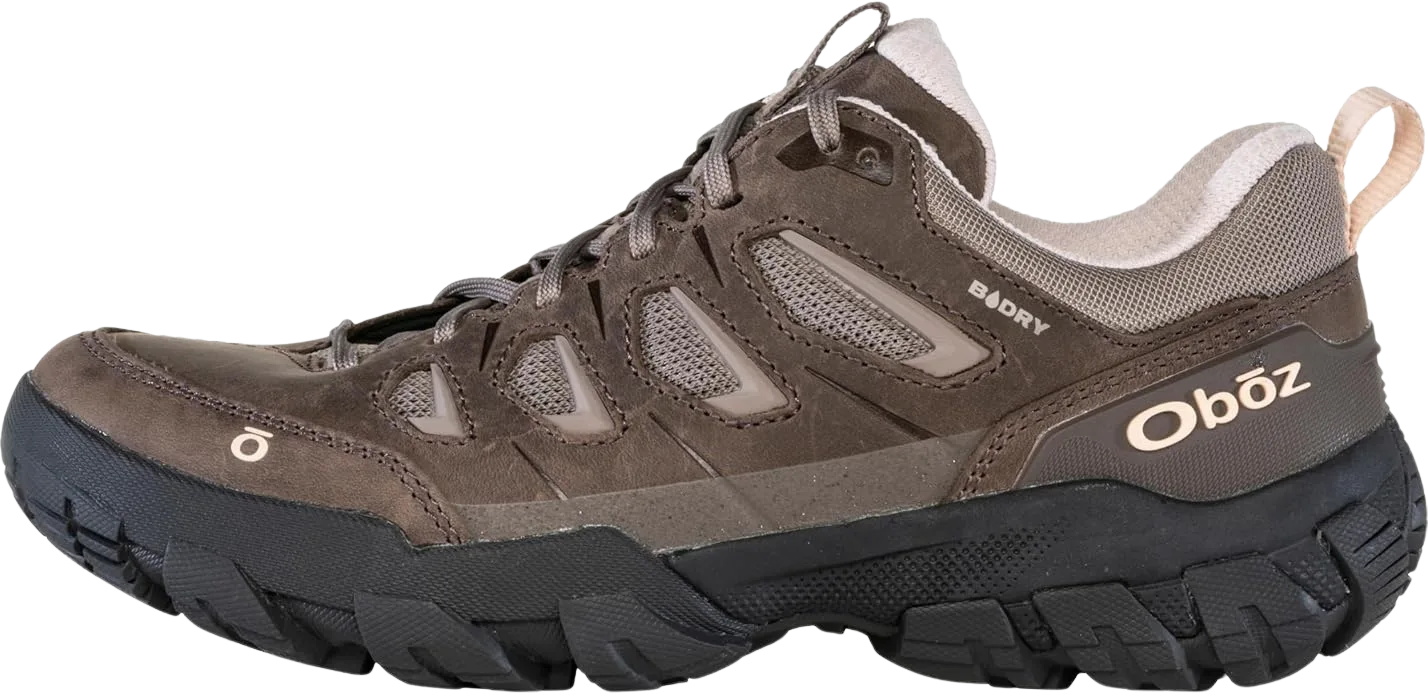
The pack changes the physics, and the soft-and-light logic that governs the rest of this roundup inverts once it does. Add 30 lb above your hips and every step compresses the midsole further into its travel. Soft high-stack foam runs out of range and bottoms out, and the moment it does you lose cushioning and torsional stability together, which is a worse combination than losing either one alone.
Firmness is the spec that matters under load. Not stack height, not collar height, not lug depth. A firm midsole resists that extra compression and keeps the platform behaving like a platform, which is why the Oboz Sawtooth X Low B-DRY sits on the other side of the pack-weight line from the cushioned picks above. If you are moving camp rather than hiking to a viewpoint, this is the shoe in this article built for it, and the deeper comparison of backpacking shoes that hold up under a loaded pack covers the rest of that category.
The caveat is straightforward. It is heavier and stiffer than the featherweights further down, and on a fast day hike with a light pack you will feel that as work with no return. It is also a membrane shoe, running Oboz’s own B-DRY membrane instead of a licensed Gore-Tex laminate, so the bathtub logic from the waterproof section applies exactly as written. Firm and waterproof is the correct combination for shoulder-season backpacking and the wrong one for August creek walking.
Count the insole into the price before you compare two shoes. Most hiking shoes ship with a flimsy foam sheet that gets replaced within a month, and the aftermarket footbed people quietly buy afterward adds another $50 that never shows up in any review. Oboz is the outlier here because its stock O FIT insole is already supportive, so the shoe that looks mid-priced can end up cheaper than the one that looks like a deal.
The Two Lightweight Picks
Weight on your foot is the cheapest performance available in hiking, and the math is unusually generous. Weight carried on the foot costs roughly four to six times the energy of the same weight in your pack, because you accelerate your foot forward and lift it thousands of times per mile while the pack just rides along. That ratio turns small numbers into real ones.
Measured women’s-size weights across this category span roughly 16 oz to 33 oz per pair. Apply the four-to-six-times rule to that spread and the gap between the lightest and heaviest options in a shoe store is like adding four to seven pounds to your pack, every mile, all day. That is a bigger swing than most gear upgrades people agonize over, and it costs nothing extra to choose well.
Light splits into two real use cases, though, and they are not interchangeable. One is a light shoe that still protects the sole of your foot from rock. The other is the lightest thing you can reasonably hike in. Here is one of each.
The Rock-Plate Featherweight: Merrell Moab Speed 2
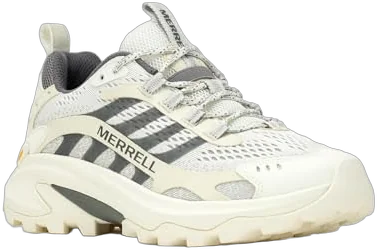
A rock plate is a thin stiff layer between the midsole and the outsole, and it does a job cushioning cannot: it spreads point pressure so a single embedded stone does not drive straight into your metatarsals. Light shoes usually skip it to save grams, which is why so many trail-runner-style hikers feel harsh on chunky ground by mile ten. The Merrell Moab Speed 2 keeps it at about 1 lb 3.4 oz per pair, which is the interesting part of the whole spec sheet.
The fit note here matters more than any spec: this shoe runs large, so size down about half a size instead of following the standard size-up advice. That inversion is the single most useful sentence in this section, because getting it wrong costs you a return and a week of waiting.
It also proves the earlier point in a way no argument can. The Moab 3 fits true to size. The Moab Speed 2 runs large. Same brand, same product family, opposite instruction.
Underfoot it runs Vibram TC5+, a compound formulated for Merrell, on 4 mm lugs with small biting teeth along the edges. That is a real spec rather than a marketing one: measured outsole hardness sits around 84 HC, which is mid-range for a hiking shoe and the sensible place to be. Softer grips better and wears out faster, harder lasts longer and skates on wet rock, and mid-range is what you want on a shoe you will put a few hundred miles on.
The Trail-Runner Crossover: HOKA Speedgoat 7
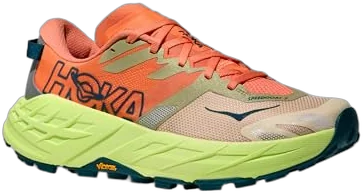
At roughly 1 lb 0.6 oz per pair, the HOKA Speedgoat 7 is the shoe that makes the weight math visible. Swap from a 33 oz hiker into this and you have effectively taken four to seven pounds out of your pack for the same effort, which you will notice in the last two miles of a long day rather than the first two. Deep Megagrip lugs also make it the best mud and wet-rock shoe in the group, which is not the usual pairing with lightweight.
Two caveats, and they point in different directions. It runs small and narrow, so order the wide if you are between widths or if your standard size feels snug in HOKA. And the soft midsole is exactly what the backpacking section warns about: this is a day-pack shoe, full stop. Put 35 lb on top of it and you get the bottoming-out failure right on schedule.
Neither of these two is a loaded-pack shoe. The next section gives you the number that decides which side of the line you are on.
Trail Runner or Hiking Shoe? Your Pack Weight Answers That
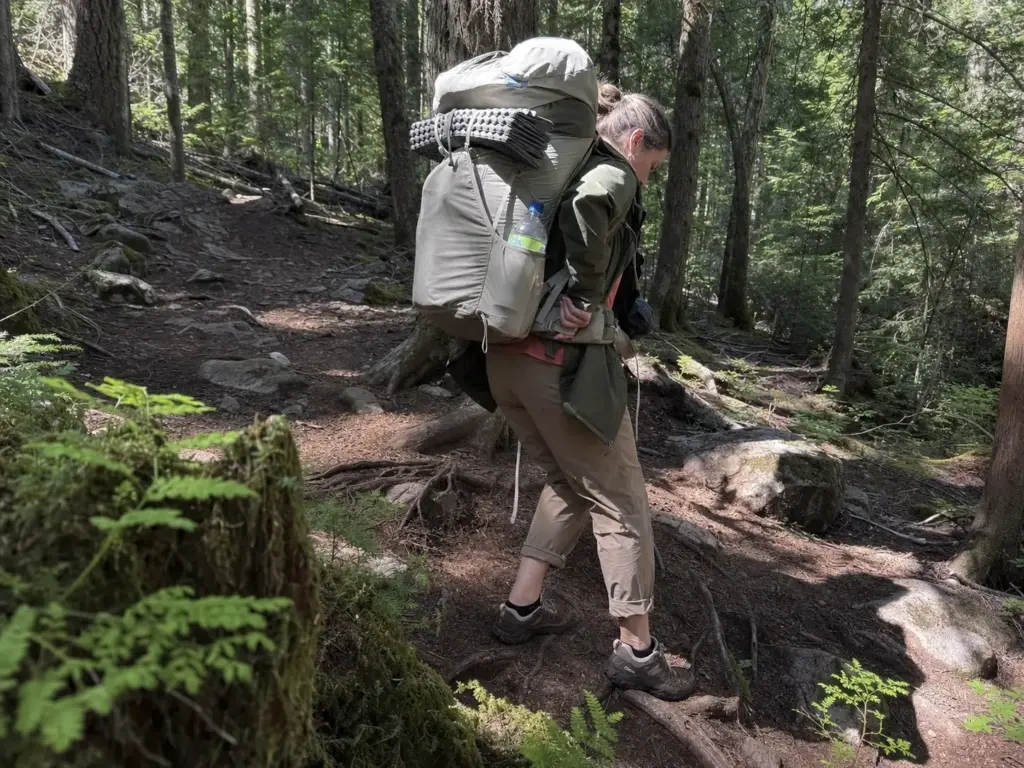
Most articles resolve this argument with a shrug: some people prefer trail runners, some prefer hiking shoes, know yourself. That is not a decision rule, it is an exit. There is a usable threshold, and it lives in your pack rather than your preferences.
Day pack under roughly 20 lb: a trail-runner-style shoe is the better buy. Loaded multi-day pack: a firm midsole with real torsional stiffness. The variable that decides it is midsole firmness and platform width, not collar height and not the category name on the box.
Take the case for light first, because it is stronger than most hikers assume. The four-to-six-times rule means every ounce off your foot is worth four to six ounces off your back, and the measured spread within women’s hiking shoes is more than double from lightest to heaviest. Beyond the raw energy cost, a light shoe changes your stride less over a long day. Heavy footwear shortens stride and lifts less cleanly as you tire, which is how a shoe that felt supportive at mile two becomes the thing tripping you at mile fifteen.
Now the case against, which is entirely about what happens to foam under load. Soft high-stack midsoles are tuned for the compression a runner generates without a pack. Add 30 to 40 lb and the foam sits deeper in its travel all the time, so it has less range left to absorb the next impact. Push past that and you bottom out, and the shoe loses cushioning and lateral stability in the same instant, on the same step.
That is precisely why the Spire GTX and the Sawtooth X exist in this roundup instead of nine variations on light and soft.
The part that deserves more attention from women specifically is what ankle height does and does not buy. A taller collar restricts some ankle motion and adds weight high on the foot, but the resistance to an actual roll comes mostly from how wide the outsole platform is and how much the shoe resists twisting along its length. Given the Q-angle geometry from the first section, platform width and torsional stiffness are the levers worth pulling. There is a fuller case for that in the argument that ankle support in boots is largely a myth, and the peer-reviewed research on female-specific midsole geometry and lower-limb loading points the same way on how load travels up the chain.
Which sets up the mistake worth naming. Buying a mid-height boot for ankle support often means buying a heavier shoe with a narrower platform than the low-cut you rejected. You paid weight for a feeling of security and gave up the geometry that actually resists the roll. That is a downgrade on two axes at once, sold as an upgrade on one.
Practical version, if you want to skip the reasoning. Day hikes and light overnights with a small pack: go light, go soft, enjoy it. Multi-day loads, technical sidehill, early-season snow travel: go firm and wide, accept the extra ounces, and let the pack-weight number make the call instead of the marketing category.
How to Fit a Foot That Changes Size Every Month
Every roundup tells you feet swell on trail from heat, altitude and mileage. All true. There is a fourth variable that applies to a lot of women, moves size by a comparable amount, and does not appear in a single competing article on this topic.
Roughly 65% of women with PMS report swelling. The mechanism is estrogen-driven fluid retention producing cyclical edema: mild to moderate, bilateral, concentrated in the feet and ankles, and usually resolving once menstruation begins. Treat it exactly the way you already treat heat and altitude, as a sizing variable rather than anything more complicated. It stacks on top of the trail swelling everyone mentions, which means your effective shoe size moves across the month.
The practical consequence is specific. Fit a pair during a low-fluid week and hike it during a high-fluid week and you have engineered your own fit failure, with a shoe that measured correctly on the day you bought it. A pair that feels perfect on day 20 can want a looser forefoot lacing on day 26. Knowing that is the difference between adjusting your laces and returning a shoe that was never the problem.
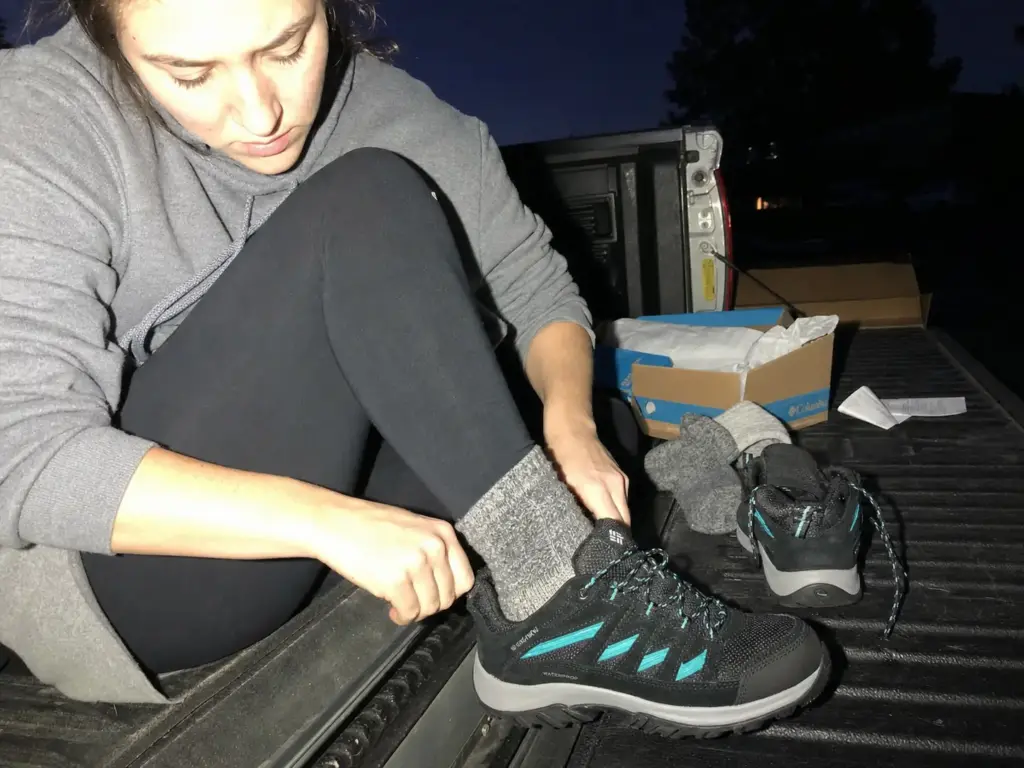
So build the fitting session to catch the widest version of your foot rather than the narrowest. Shop in the evening, because feet are measurably larger at the end of the day than at 10 a.m. Wear the socks you actually hike in, not the thin display pair by the register. And walk in the store before you decide, because the American Hiking Society’s fitting advice, shop in the evening in your hiking socks, makes the point that arches which feel slightly odd after a brief lap will feel considerably worse after several miles.
Size up half to a full size over your street size. That headroom serves two purposes at once: room for your toes to slide forward on descents, and slack for all-day swelling from every source above.
Then test the part that actually breaks shoes. Do not judge fit on a flat store floor. Find a ramp or a staircase and walk down it.
If your toe touches the front on the descent, the shoe is out, and no lacing trick or thinner sock will rescue it. That is how toe bang and a black toenail happen, and it always happens on the way down.
Heel-lock lacing, sometimes called a runner’s loop, is the standard fix for heel lift: run the lace up through the top two eyelets to form a loop on each side, cross the ends through the opposite loops, and pull down and back. It pins the heel into the cup without cranking the forefoot. Doing that takes two minutes and beats a return in most cases. If you want it demonstrated properly, the walkthrough on the lacing fix for downhill heel slippage covers the variations.
The diagnostic hiding in that fix is the part worth remembering. If heel-lock lacing still cannot hold your heel, the shoe is too short rather than too loose. A foot that is being pushed forward by insufficient length will keep lifting at the back no matter what you do with the top eyelets. The related question of when to size up hiking footwear and when not to is worth reading if you are between sizes and cannot tell which failure you are looking at.
The mistake this replaces is nearly universal. Heel slips, so you yank the laces tighter across the forefoot, which trades a loose heel for a numb forefoot and does not fix the heel anyway. You have compressed the part of your foot that needed room while leaving the part that needed containment exactly as loose as before.
Note where you are in your cycle when you try shoes on, and write it on the box with the date. Two pairs that both felt right on different weeks will tell you something a size chart cannot, and if a shoe only feels tight during one week of the month you have a lacing problem rather than a sizing problem. That one line of information saves a lot of second-guessing at the return counter.
If I had to trade every spec sheet in this article for one thing, I’d keep the fitting ritual. Evening, real socks, a staircase, laced the way you will actually lace them. It is unglamorous and it is worth more than any midsole compound comparison, because the best-engineered shoe in the world is a bad shoe on the wrong foot, and the cheapest shoe that fits your foot will outperform it every mile of the way.
How to Tell When the Shoe Is Dead Before Your Knees Do
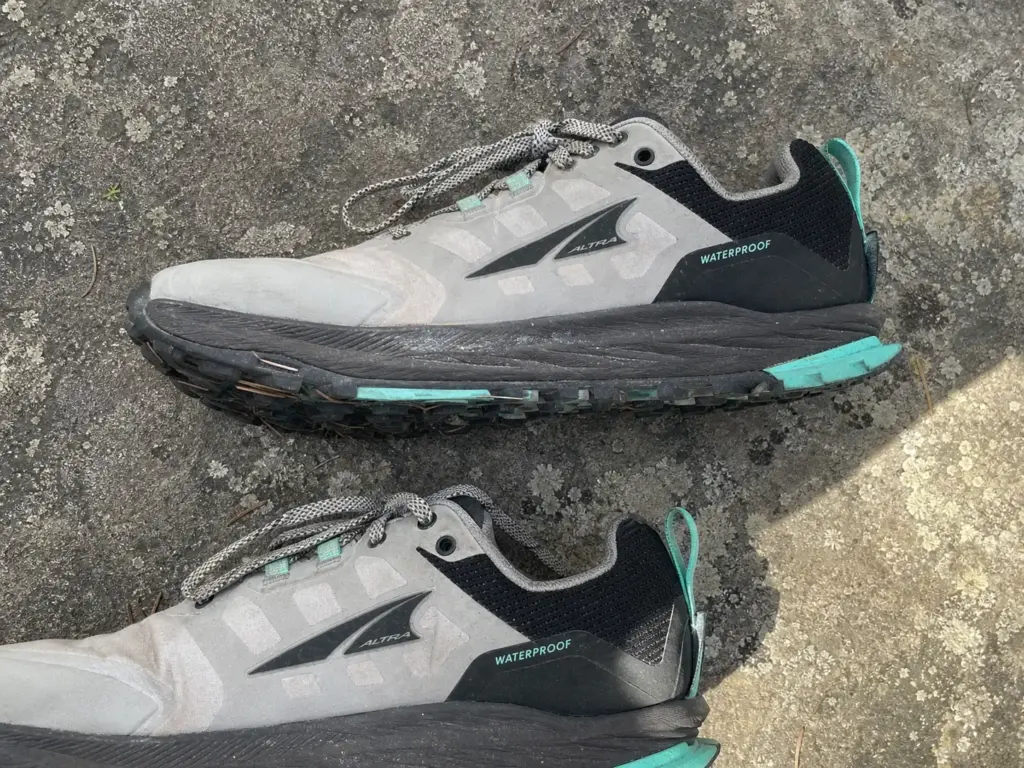
The tread is a liar. Lugs are made of rubber engineered to resist abrasion, and they keep looking serviceable long after the part that actually does the work has quit. The part that quits is the midsole, and you cannot see it.
EVA midsoles last roughly 300 to 500 miles. Polyurethane versions can run about twice that, which is part of why some heavier shoes justify their weight over a long ownership. Either way, the number is mileage, not appearance, and it runs out quietly. EVA foam loses resilience by getting compressed a few million times, not by wearing through.
It helps to know which foam you bought, because the spec sheet uses three names for two very different things. Compression-molded EVA is the workhorse: heated and pressed into shape, denser, firmer, and slower to pack out, which is what you want under a pack. Supercritical foam, the newer process that injects gas into the polymer under pressure, is lighter and livelier underfoot and generally gives up some of that longevity in exchange. Plain injection-molded EVA sits at the cheap end and packs out fastest of the three.
There is also no rescue at the end of that timeline. Traditional leather boots can be rebuilt because the outsole is stitched or cemented to a replaceable midsole, but resoling is not an option on a glued low-cut hiking shoe: the midsole is the part that failed, and it is bonded into the whole assembly. That is a real cost worth pricing in when you compare a shoe against a boot you might keep for a decade.
Which makes the most expensive mistake in this whole article a passive one: judging a shoe by whether the lugs are still there. By the time the tread looks bald, the cushioning has usually been finished for a hundred miles, and you spent those miles absorbing impact with your joints instead of with foam. Nobody returns a shoe for that because nobody notices the handoff happening.
What dead actually feels like is worth learning as a symptom. You start feeling individual rocks through the forefoot on ground that never used to register. Descents get harsher than the grade justifies. The shoe feels flatter and slappier, and you find yourself blaming the trail, your legs, or your age.
That is bottoming out arriving permanently instead of temporarily, and the press test for telling when hiking shoes are worn out gives you a way to check it with your thumb rather than waiting for the symptom.
This matters more with a larger Q-angle, and the reason connects back to the first section. Midsoles rarely compress evenly. They collapse first where the load concentrates, which for most hikers is the medial side. A midsole that has flattened along its inside edge stops supporting a foot-strike that already tracks inboard, so the shoe quietly amplifies the exact motion your knee least wants.
If you already have some overpronation, a packed-out medial edge does not just fail to correct it, it actively feeds it.
The foot may never complain. The knee will, and it will feel like a knee problem rather than a footwear problem.
Practical handling of all this is unromantic. Track mileage roughly, by season or by app, and replace on the number rather than the look. If you hike enough for it to matter, rotate two pairs, which spreads the miles, lets foam recover between outings, and gives you the mesh-plus-membrane coverage from the waterproof section as a free side effect. The two-pair strategy is a durability move as much as a weather move.
For what it’s worth, I find mileage-based replacement genuinely annoying. Throwing out a shoe that looks fine feels wasteful, and I understand every reader who ignores this advice for another season. I still think it’s the right call, because the alternative is not saving money on shoes, it’s spending it on knees.
If Your Real Question Is Narrower Than This
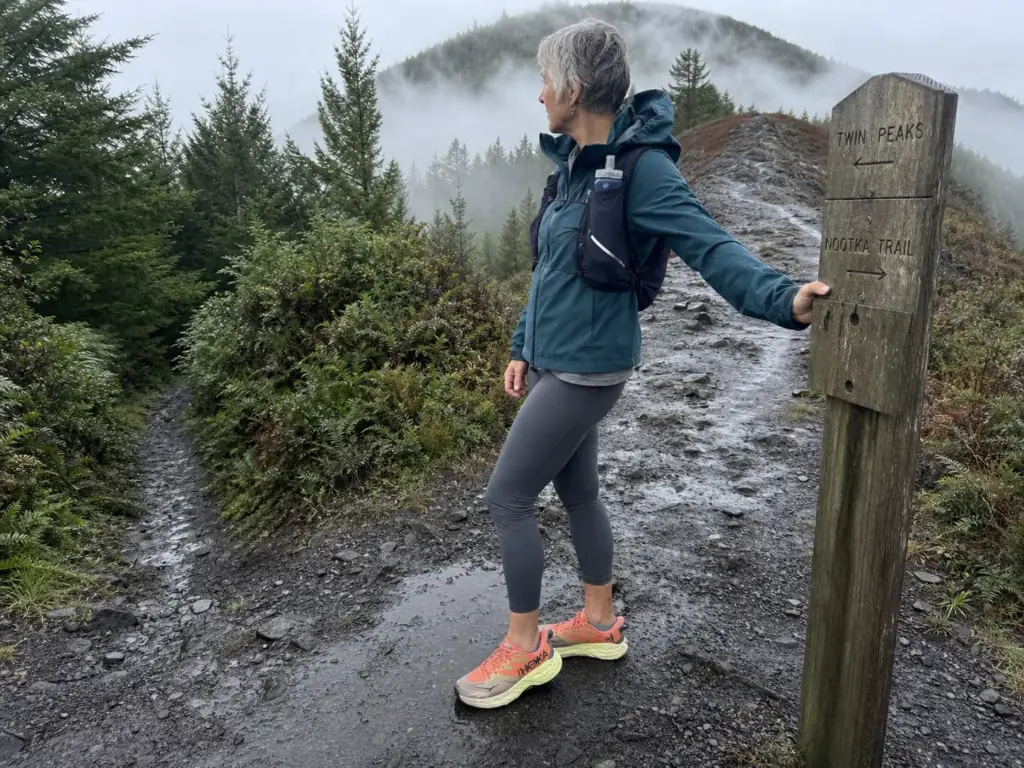
A roundup like this one is built for people who want the general answer. If you arrived with a specific problem instead, you deserve the specific page rather than one compressed paragraph squeezed in here.
Genuinely wide feet. The Altra card above is the honest wide pick within a general roundup, and its narrow heel is the compromise you accept for that forefoot room. If width is the entire reason you are shopping, the fit mechanics and the shoes that solve them deserve more space than a card, which is what the guide to hiking shoes for wide feet when roomy isn’t enough is for.
Waterproof is non-negotiable for your conditions. The short answer is that a membrane is worth it when the water falls from the sky and a liability when it comes over the collar, so choose by weather pattern rather than by season. If that is your whole search, the field-tested guide to women’s waterproof shoes compares the lineup properly.
Flat feet, fallen arches or plantar fasciitis. The short version will sound backwards: you generally want stiff rather than soft. A soft, deeply cushioned shoe lets the arch collapse further through the stride, which is the opposite of what comfortable means in a store aisle. Real arch support comes from a firm platform and a supportive footbed working together, not from plush foam under the midfoot. The full reasoning and the shoes that follow it are in the piece on why hiking shoes for flat feet should be stiff, not soft.
You are still deciding between a shoe and a boot. The pack-weight threshold above answers most of it: under roughly 20 lb, a low-cut shoe wins on weight and stride. Boots earn their place with heavy loads, early-season snow and long stretches of loose sidehill. The complete framework, including the cases where the boot genuinely wins, sits in the shoe versus boot comparison.
Two picks cover most readers of this article. If you want one shoe for general trail and a day pack, the Salomon X Ultra 360 Leather GTX is the default, provided your forefoot is not wide. If you are buying a first pair and would rather learn your own foot before spending real money, the Columbia Crestwood Waterproof does the job and comes in a wide.
Everything else in this article resolves to three ideas. The women’s label describes a shape, so treat it as information rather than a guarantee, and be willing to try the men’s version if heel-lock lacing holds your heel while the forefoot still pinches. Fit is model-specific rather than brand-specific, which is why two Merrells in the same family fit oppositely and why the logo on the box predicts almost nothing. And the midsole dies before the tread does, so replace on mileage instead of appearance and your knees will get the benefit before your feet notice the change.
Check the return policy before you check the fit. Every reliable source on hiking footwear lands in the same place: fit is model-specific, so buying is iterative and free returns are the actual feature you are shopping for. Order two sizes of the same shoe, keep both boxes intact, walk the staircase in each one indoors, and send back the loser.
So the next move is concrete rather than inspirational. Measure your feet in the evening, in your hiking socks. Order two sizes of one model from a seller with free returns. Walk a staircase in both, lace the promising pair with a heel-lock finish, and keep the one that leaves your toenails alone on the way down.
Frequently Asked Questions
01What are the top 5 hiking shoes?
For women, five shoes cover almost every job: the Salomon X Ultra 360 Leather GTX for general trail, the Columbia Crestwood Waterproof on a budget, the HOKA Anacapa 2 Low GTX for cushion, the Oboz Sawtooth X Low B-DRY under a loaded pack, and the HOKA Speedgoat 7 for fast, light days.
02Which shoe is better, HOKA or Merrell?
Neither brand wins, because fit and ride are model questions rather than logo questions. HOKA leans toward max cushion and rocker geometry, so the Anacapa 2 suits hard-packed miles and tired joints. Merrell leans toward durability and width availability, so the Moab 3 suits hot trail and wider feet.
03What are the best shoes to wear for hiking?
A low-cut hiking shoe with grippy outsole rubber and a firm-enough midsole handles most day hiking better than a boot. Pack weight sets the limit: under roughly 20 lb, lighter and softer wins. Above that, choose a firm midsole and a wide outsole platform instead.
04Which brand makes the best hiking shoes?
No brand wins across the board, because fit direction is model-specific rather than brand-specific. Salomon runs narrow in the X Ultra line, and Merrell runs large in the Moab Speed 2 while running true in the Moab 3. Shop the model, not the logo on the box.
05How much should you spend on a good pair of women’s hiking shoes?
Plan on roughly $100 to $180 for the quality band, where width options, better outsole rubber and a longer-lasting midsole live. Credible budget shoes run about $70 to $100, and premium waterproof models reach $180 to $220. Spend the difference on fit rather than features.
Risk Disclaimer: Hiking, trekking, backpacking, and all related outdoor activities involve inherent
risks which may result in serious injury, illness, or death. The information provided on The Hiking Tribe is for
educational and informational purposes only. While we strive for accuracy, information on trails, gear, techniques,
and safety is not a substitute for your own best judgment and thorough preparation. Trail conditions, weather, and
other environmental factors change rapidly and may differ from what is described on this site. Always check with
official sources like park services for the most current alerts and conditions. Never undertake a hike beyond your
abilities and always be prepared for the unexpected. By using this website, you agree that you are solely
responsible for your own safety. Any reliance you place on our content is strictly at your own risk, and you assume
all liability for your actions and decisions in the outdoors. The Hiking Tribe and its authors will not be held
liable for any injury, damage, or loss sustained in connection with the use of the information herein.
Affiliate Disclosure: We are a participant in the Amazon Services LLC Associates Program, an
affiliate advertising program designed to provide a means for us to earn advertising fees by advertising and linking
to Amazon.com. As an Amazon Associate, we earn from qualifying purchases. We are also an official affiliate partner
of Black Diamond Equipment via the AvantLink network. If you click on a Black Diamond affiliate link and make a
purchase, we may earn a commission at no additional cost to you. We also participate in other affiliate programs and
may receive a commission on products purchased through our links. Additional terms are found in the terms of
service.