In this article
If you’ve ever stood at the trailhead wondering why a “quick” four-mile hike left you hobbling to your car like you just ran a marathon, you’ve probably fallen victim to the map’s biggest lie. I used to think the climb was the hard part and the descent was free time, until a relentless 3,000-foot downhill in the Cascades taught me that going down is actually what systematically shreds your joints. True trail longevity doesn’t come from heavy boots; it comes from knowing how to read a topo map to avoid those kneecap-crushing plunges before you ever leave the house. Here is exactly how to stop guessing and start planning routes that keep your body intact.
⚡ Quick Answer: Save your joints by using contour lines to map the path of least resistance before leaving home. Aim for saddles and avoid tightly clustered lines that signal brutal descents. Catching these punishing grades early keeps you hiking longer, but most people misinterpret their topo apps and accidentally plan their own misery.
| Knee Stress and Grade Analysis | ||
|---|---|---|
| Grade Range | Knee Stress Level | Map Indicator |
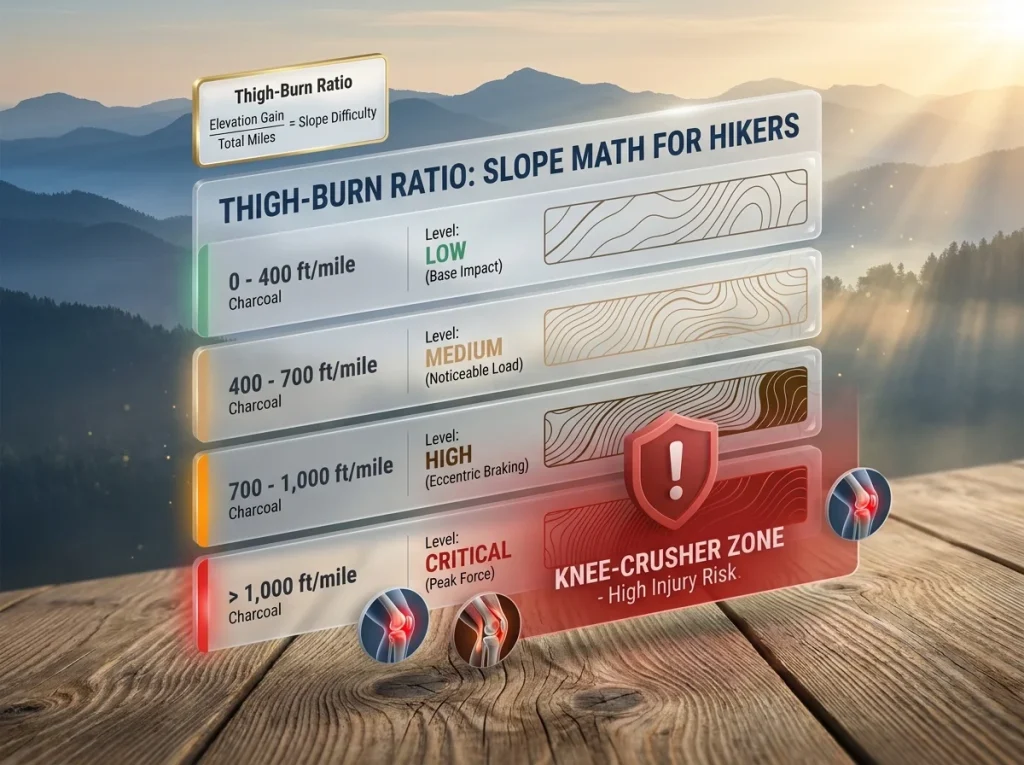
| 0 – 8% (0-400 ft/mile) | Low (Base impact) | Widely spaced lines |
| 9 – 12% (400-700 ft/mile) | Medium (Noticeable load) | Evenly spaced lines |
| 13 – 18% (700-1,000 ft/mile) | High (Eccentric braking) | Tight grouping |
| > 18% (1,000+ ft/mile) | Critical (Peak force) | Lines nearly touching |
The Physics of “The Knee Pinch” (And Why Your Route Matters)
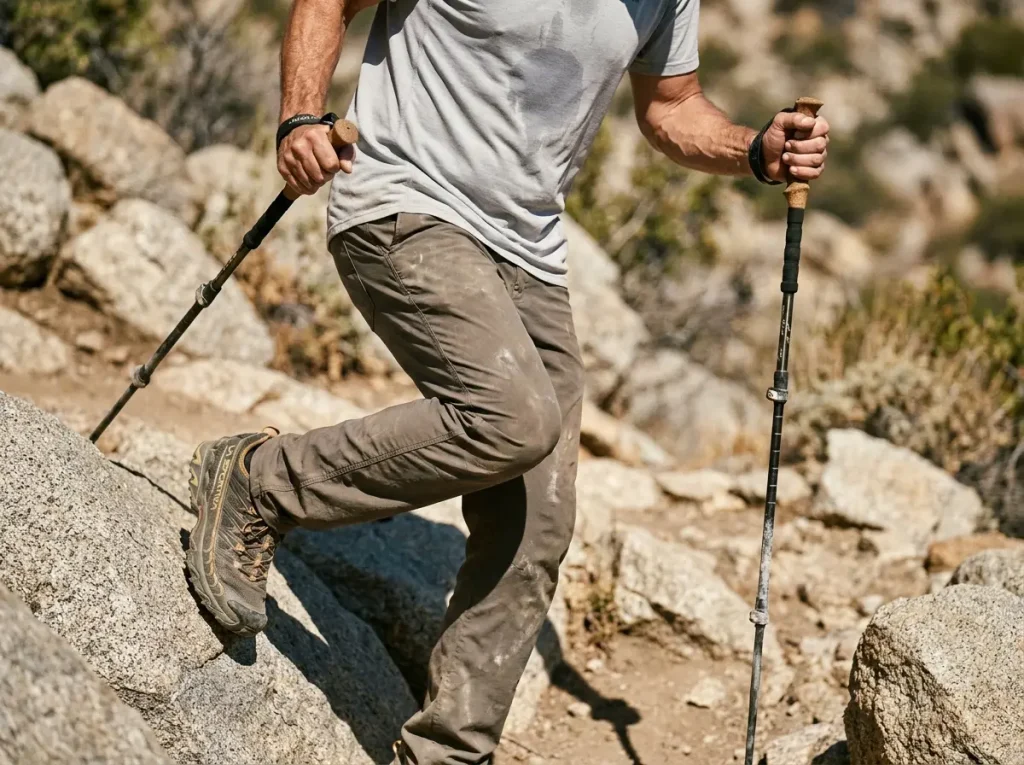
Every seasoned backpacker has a story about the descent that broke them. You reach the summit, snap a photo, and tell yourself the hard work is over. Then you start dropping. The reality is that the exact moment you start walking downhill on steep slopes, you put your body in a mechanical vice grip. The climb burns your lungs, but the descent demands your joints act like heavy-duty shock absorbers.
What Goes Wrong During a Steep Downhill
When you walk downhill, gravity yanks you forward. Your legs have to constantly fight to hold you back so you don’t faceplant. That means your quadriceps are stretching out while bearing weight. They act like brake pads, and just like brakes on a heavy truck, they burn out fast. Once the quads tire out, your kneecap takes the hit.
If you’ve ever felt a sharp, stabbing bite behind your kneecap after an hour of dropping elevation, you know exactly what this mechanical failure feels like. Your cartilage is grinding because the muscles stopped holding the joint tight. The data on the biomechanical demands of uphill and downhill movement show that walking down a steep slope generates forces up to seven times your body weight per step. It’s like putting six clones of yourself in your pack and jumping off a box repeatedly.
The “Wait and See” Mistake on Trail Difficulty
Hikers get into trouble when they blindly follow a colored GPS line on an app without looking at the underlying topography. By the time they realize they are staring down a punishing 20-percent grade, turning back feels like failure. So they push through, almost guaranteeing an eventual injury.
Instead, look at the map first and treat steep trails as hazards. If a harsh drop is unavoidable, utilize trekking poles on the descent to absorb up to a quarter of that load. Lean hard into those poles and change your pace. I use the 120-Step method: shorten your stride and take fast, baby steps. It feels agonizingly slow at first, but keeping your center of gravity under control saves your meniscus. You have to train for this, too. Doing slow step-downs off a curb at home builds the exact stabilizer muscles your knees desperately need. That specific preparation gives you the strength to handle the topography you’re about to read on the map.
Reading the Map Like a Hiker (Core Rules of the Contour Line)
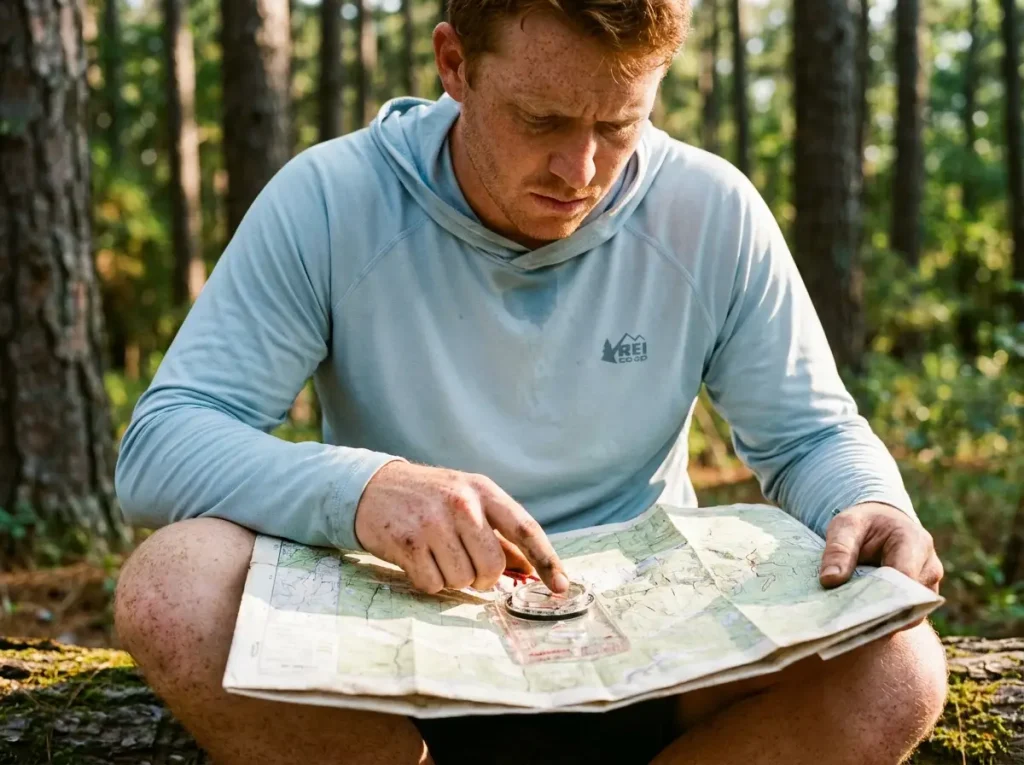
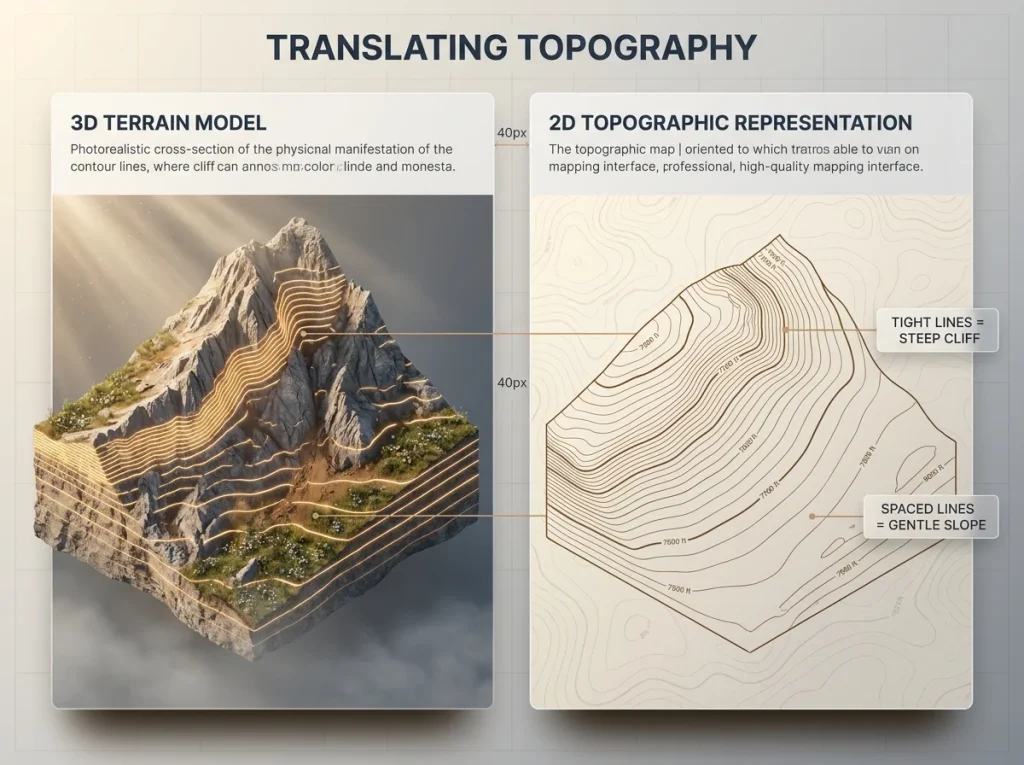
Translating flat brown squiggles into a 3D mental model of the terrain changes everything. The lines tell a completely different story than a simple mileage measurement. Two miles across perfectly flat ground is an easy stroll. Two miles crossing tightly packed contour lines is a stair-climbing workout that destroys your knees on the way back down.
The Contour Interval: Your “Step Height”
A contour line is a continuous line drawn on a map that connects ground of equal elevation. If you walked perfectly along one of these lines, you would never go up or down; you’d just wrap around the side of the mountain on a flat bench. When you first open a map, your very first move is checking the legend for the contour interval.
This interval is the vertical distance between each line. Depending on the map type, this could be 40 feet, standard for USGS maps, or 100 feet in highly rugged regions. Think of the contour interval as your step height. Every time your trail crosses a new line, you just climbed the equivalent of a four-story building. If you plan a route that cuts straight across twenty lines over a short distance, you plotted a massive climb that will inevitably become a knee-knocking descent later.
Reading the Index Lines When You’re Too Tired to Count
When you’re exhausted and daylight is fading, you don’t want to meticulously count fifty incredibly thin brown lines. You just want to know how much suffering is left until camp. This is exactly where index contours save your sanity.
Every fifth contour line on a proper topo map is printed bolder and usually has the exact elevation stamped on it. These are your heavy checkpoints. Skip counting the thin lines and just scan for the bold ones. If you are standing on a bold line marked 8,000 feet, and the ridge above you shows another bold line marked 8,400 feet, you instantly know you have 400 feet of climbing left. You skip the math and focus entirely on the trail.
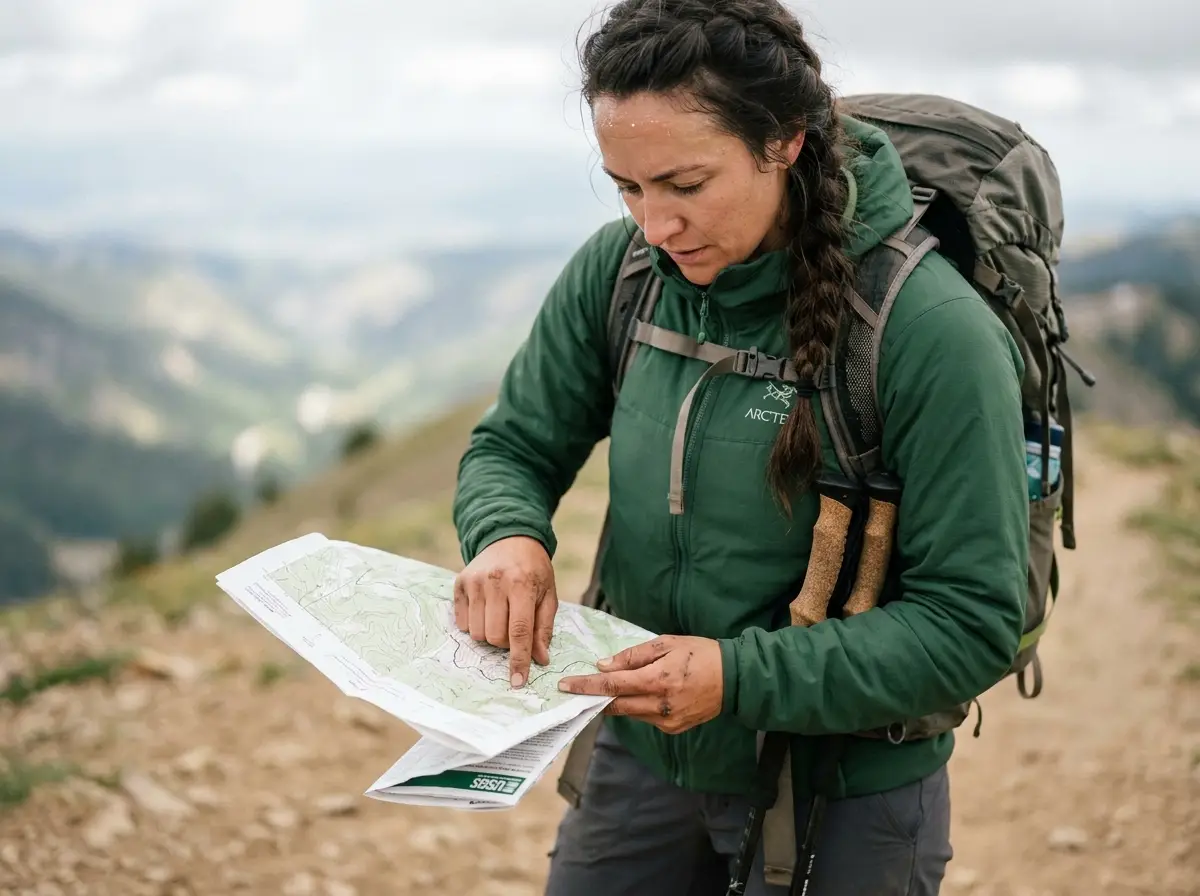
Reading contours and relief can be tricky on a phone screen. The smartphone smokescreen happens when you zoom out too far. The software automatically hides the lines so the display looks clean, making a monstrous elevation gain look like a gentle ripple. You end up walking right into a physical trap. This is why veterans still rely on paper maps, or they view mapping software on a large desktop monitor where they can read the topographic symbols correctly before packing their bags.
Pro-Tip: Check the specific Standard USGS topographic symbols and colors chart if you are heading into a new region. Boulder fields and scree might not change the elevation much, but they force you into high-impact jumps that shred your knees faster than any downhill.
Understanding these basic map symbols is just the foundation; next, we need to translate those symbols into a tactical plan that actually keeps our joints intact over long miles.
The “Hiker’s Eye” 3-Step Route Strategy
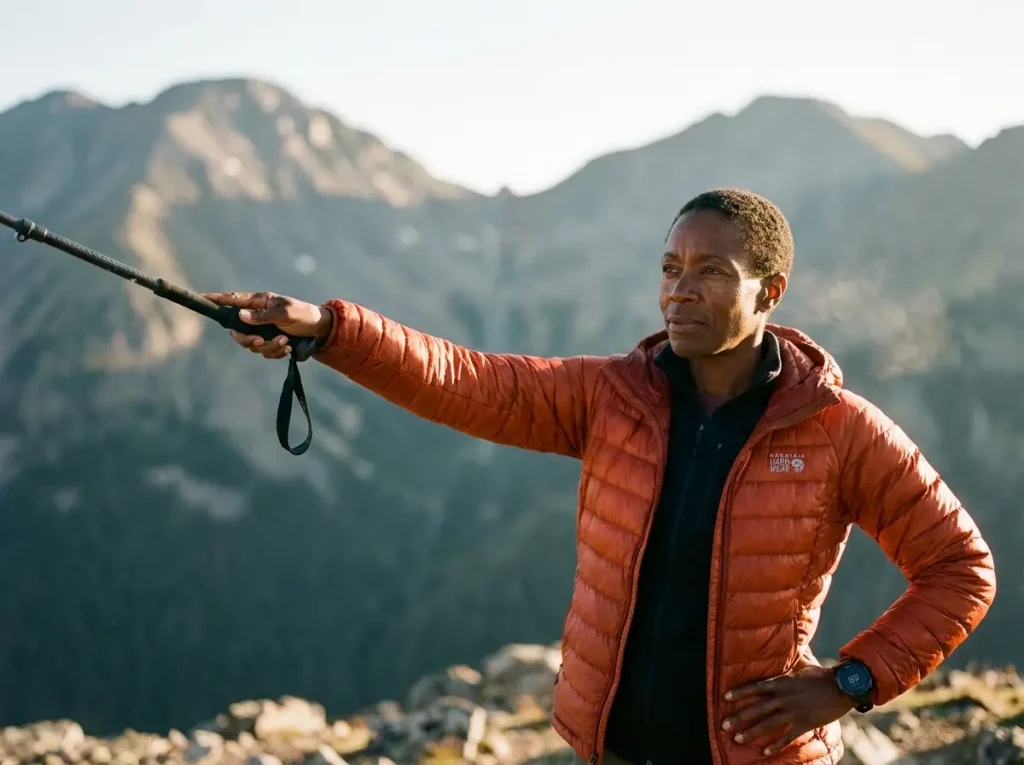
Transitioning from reading numbers to interpreting the land navigation changes your entire outdoor experience. A novice looks at the map and draws a straight line to the lake. A veteran maps out a curving route that hugs the gentle slopes, happily trading raw distance for physical comfort.
Step 1: Identify the “No-Go” Zones (Cliffs and Squeezed Lines)
Your first route planning task is finding exactly where the mountain will try to break you. Look for contour crowding. When lines squeeze together so tightly they form a solid dark band, that indicates a massive drop-off, sheer cliffs, or an aggressively steep slope.
If your trail runs straight into one of these dark bands without showing zigzagging switchbacks, you are looking at a fall-line trail. It blasts straight up the grade. Going up will fry your lungs, and coming down will shred your joints. If you spot this on the map, look for a secondary trail immediately. Never commit to squashed lines unless you have the trekking poles, time, and pain tolerance to survive a rough drop.
Step 2: Choose Your “Handrails” (Ridges Over Draws)
To keep your footing secure, learn to spot handrails. A handrail is a linear feature on the map, like a long ridge or a creek bed, that you can casually follow to stay on track. However, not all handrails treat your joints the same.
When identifying key terrain features, start by deliberately looking for spurs. These are fingers of high ground pointing directly downhill. On a map, they look like U-shapes pointing away from the summit. Spurs and ridges naturally shed water down their sides, which means the ground stays firmer and the rocks are far more stable.
Conversely, novice hikers often fall for the re-entrant trap. Re-entrants, or draws, look like V-shaped lines pointing uphill toward the peak. They look like a direct, cozy path up the mountain right through the valleys. But water aggressively funnels right down these drainages. You will be walking up a hidden staircase of loose, ankle-rolling scree, slippery wet roots, and deep mud. You will slip backward with almost every step, forcing your knees into dangerous twists. Take the ridge over the draw every single time.
This logical approach of following firm terrain features naturally leads to finding paths that not only avoid the worst slopes but actively hunt down the most efficient shortcuts the mountain has to offer.
Step 3: Aim for the “Shortcuts” (Saddles and Gentle Spurs)
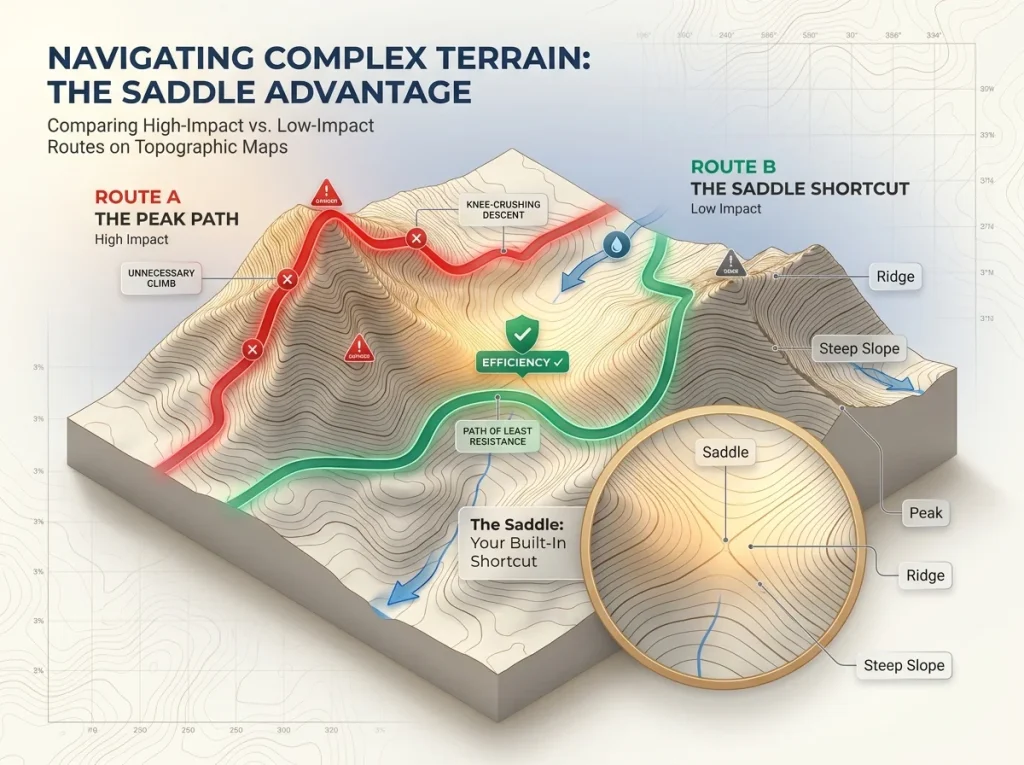
The absolutely most elegant move in route planning is connecting the saddles. A saddle is the low, dipping point sitting gracefully between two higher mountain peaks. On your topo map, it looks exactly like an hourglass shape where the lines pinch in from both sides but leave an open, empty space in the middle.
Saddles are nature’s built-in shortcuts. If you need to cross a mountain range, you never want to climb all the way over the highest summit just to drop down the other side. By aiming for the saddle, you trim hundreds of feet of unnecessary climbing off your day. You save massive energy on the way up, and more importantly, you completely eliminate the high-impact downhill penalty on the other side. Do your joints a favor and follow the path of least resistance. That strategy ensures your pacing stays consistent and your legs survive for the next big section of terrain.
The “Thigh-Burn Ratio”: Slope Math for the Rest of Us
You cannot manage what you refuse to measure. A hike that gains 2,000 feet over ten miles is a relaxing weekend stroll. A hike that gains 2,000 feet in under two miles is a miserable, joint-crushing ordeal. You absolutely need to do a little bit of slope math before you pack your bag.
The 1,000-Foot Rule for Joint Safety
Experienced hikers rely on the thigh-burn ratio to calculate exactly how bad the terrain will hurt. To calculate the slope, simply take the total elevation gain of your planned route and divide it by the total mileage of that specific section.
If your route climbs 500 feet per mile, you’ll barely notice the ascent. At 700 feet per mile, you’re going to sweat, and your calves will know they’re working. But if the math hits 1,000 feet per mile, you’ve crossed into true thigh-burner territory. You’ll be taking high, exaggerated lunges hauling your entire body weight straight up. On the way back, a descent angle this severe maximizes the massive braking forces on your patella. If you hit an average over 1,000 feet per mile, you must rethink your pack weight and expected timing.
The “Vertical Penalty” and the “Descent Tax”
Map distances lie. Looking at flat paper makes a three-mile section seem like it should take a little over an hour at a relaxed walking pace. But gravity demands a toll. For every 1,000 feet of absolute vertical gain, you have to add a 30-minute vertical penalty to your moving time. You aren’t just walking comfortably forward; you are hauling a loaded pack up a skyscraper dirt staircase.
Similarly, there is a massive descent tax. Most people assume they’ll just fly down the mountain once the climbing is finally over. If the hill is steep, rocky, or covered in roots, you actually have to slow way down to place your feet precisely. A steep, treacherous descent takes almost as much time as the climb. Rushing downhill to beat the fading sunset is exactly how people blow out their knees or snap an ankle. When you estimate your total hiking time, bake in an extra ten to twenty percent time buffer just for carefully picking your way down unpredictable slopes.
If this math feels overwhelming to handle by hand at the trailhead, you can rely on modern navigation technology to handle the heavy lifting for you before you ever leave the house.
Digital Tools That Do the Hard Math For You
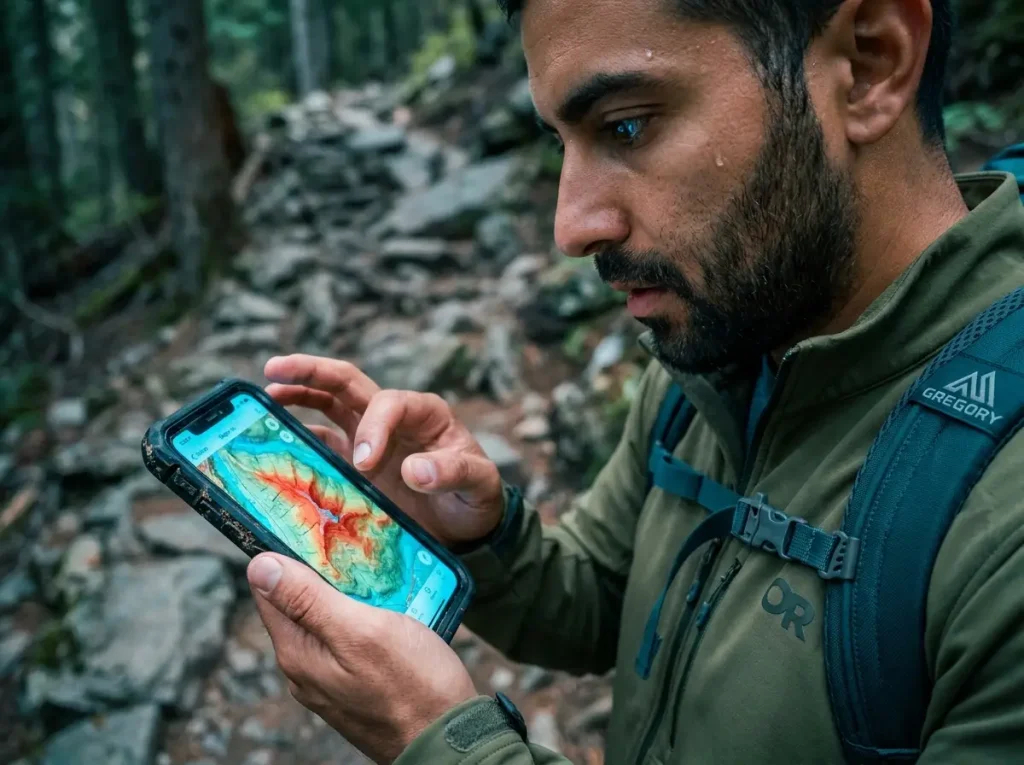
You should know how to count the printed lines manually, but you don’t always have to do it the hard way. Modern digital platforms have completely changed how we evaluate terrain steepness by color-coding the misery. Tools like Caltopo, Gaia GPS, and Ordnance Survey software are incredibly reliable.
By turning on features like slope angle shading, your map lights up in colors from yellow to dark purple. You instantly see the slope limit without making a single calculation. You can highlight any section over 25 degrees and actively trace your line right around it. These platforms show the clean elevation profile as a neat graph at the bottom of the screen. If you see a massive spike on that graph, you know exactly where the knee-crusher zone lives. You can cross-reference the guides on calculating hiking difficulty based on elevation and distance provided directly by parks to predict your day perfectly.
Pro-Tip: Even if you use a premium digital app to plot your route and thoroughly check the shading, always print a physical copy of the topographic map. Batteries die in the cold, screens crack on rocks, and apps crash. When you are seven miles deep in an unfamiliar drainage, paper never fails.
Understanding the math and using the right apps gives you an incredible edge, but even the best digital tools won’t expose all the nasty surprises waiting out on the trail.
Hidden Hazards on the Map: What the Lines Don’t Tell You
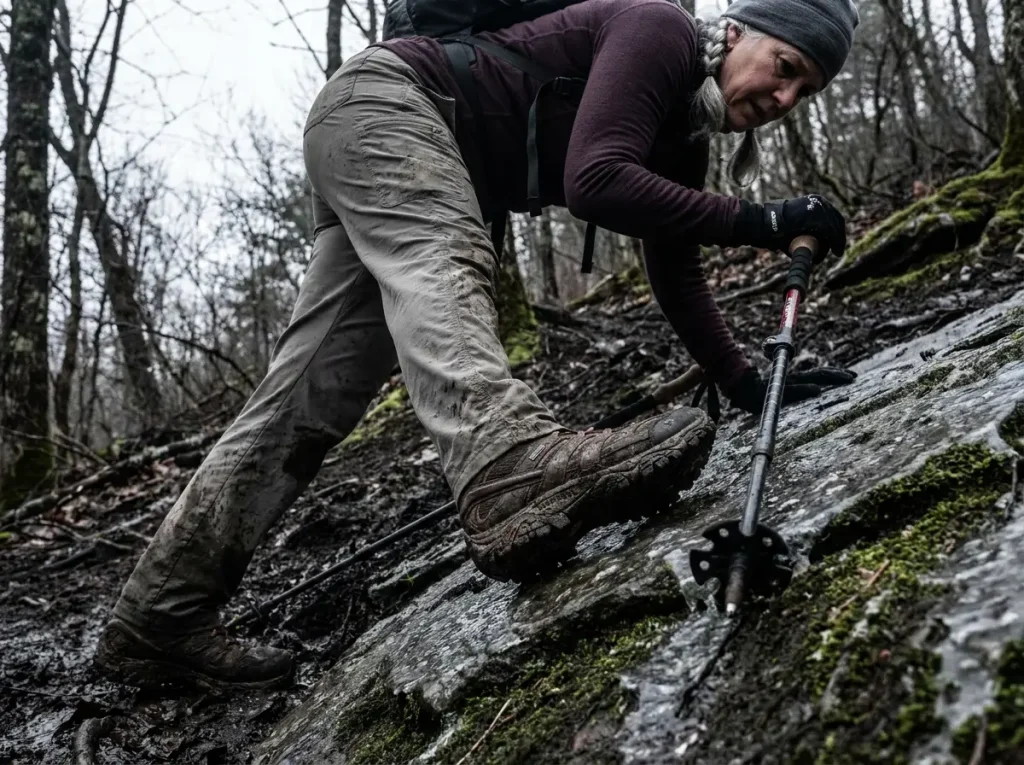
Topographical map lines present a smoothed-out, mathematically perfect version of the earth. A map shows you the general shape, but it completely strips away the physical texture of the ground. Two steep slopes might have the exact same gradient, but one is a soft dirt path and the other is a jarring nightmare of boulders. You have to learn how to read between the lines.
The Aspect Trap: Mud, Ice, and Sun Exposure
Map lines don’t explicitly tell you if a trail is a slick mudslide, but they give a massive clue called aspect. Aspect represents the compass direction a specific slope faces. In the northern hemisphere, a south-facing slope gets baked by the sun almost all day. A north-facing slope stubbornly lives in the cold shadows.
If you are hiking in late fall or early spring, aspect changes the entire game. You might see a gentle 10-percent slope on your map and think it will be a breeze. If it faces north, it might be holding stubborn ice layers or slick, freezing mud. Mud forces your tired legs to slip laterally, forcing your small stabilizer muscles to work brutal overtime. One bad slide with a heavy pack will torque your knee ligaments in agonizing ways. If you are planning extreme micro-climates into your day hike, boldly trace your route and identify the shaded northern bowls. On high-risk days, alter your line to stick to the sun-baked southern ridges where the ground stays firm and predictably safe.
Spotting the “False Summit” Before It Breaks Your Spirit
Nothing breaks your pacing and shatters your morale faster than a false summit. You hike for hours, stare at what looks like the true top, dragging yourself over the rocky crest, only to discover a small shelf. The real peak sits another thousand vertical feet away.
You can spot false summits entirely from the map before you leave your driveway. Look at the specific summit area. If you realistically see the contour lines steadily spread out to indicate a flat bench, only to suddenly bunch up tight again directly before the actual peak, you have confidently found a false summit. Knowing this feature exists keeps your head firmly in the game. You pull back your fast pace early, knowing you have a second major push waiting for you.
Anticipating a false summit prevents you from burning all your energy too soon, which gives you the physical strength to tackle the final obstacle: the rough micro-terrain hiding plain sight.
Map Blindspots: Micro-Terrain and Vegetation Realities
Cartographers make visual compromises to fit a massive mountain onto a manageable sheet of paper. Those compromises swallow up dangerous micro-terrain. A map with an 80-foot interval will completely hide a jagged 60-foot rock wall. The map visually shows an evenly spaced grade, completely ignoring the fact that you’ll be boulder-hopping for an exhausting hour.
This is exactly why looking for vegetation vs elevation changes is absolutely critical. Scan the map for the green tinted areas that indicate heavy brush, or the blue lines indicating water drainages. Crossing a tight grouping of contour lines is tough; crossing them directly through a thicket of wet willow branches or over slick creek stones drastically multiplies the joint stress. A trail moving securely through open rock runs completely differently than a trail blindly slashing through a swamp. Use catching features—clear landmarks like a sharp bend in a river—to confirm you haven’t blindly wandered into a terrible map blindspot.
Pro-Tip: A blue creek line drawn cleanly across steep contour intervals almost always means you will have to deal with wet, slippery rocks right on the hardest section of the terrain. Factor in a heavy slip hazard and actively plan to slow down significantly.
Conclusion
The trail doesn’t have to be a brutal battle against your own cartilage. The severe friction, swelling, and sharp pains that sideline so many people are rarely caused by a single bad step; they are the result of thousands of steps down steep slopes you never should have attacked. By learning to decode the contour interval, avoiding deceptive re-entrant traps, and doing a little quick thigh-burn math before you leave your driveway, you ensure your body lasts as long as your willpower. Pull out a topo map for the trail you struggled with the most last season, match up the thigh-burning descents to the tightest lines, and use that insight to scout a smarter route for your very next trip. Map it right, step smoothly, and keep hiking.
FAQ
How do you read contour lines for dummies?
Think of contour lines exactly like the rising rings on a giant wedding cake; each line represents a specific height slice of the mountain. When the lines sit closely together, the mountain drops sharply. When they stretch far apart, it is a relaxing gentle walk.
What do V-shaped contour lines represent?
V-shapes mean two completely different things depending on exactly where they point. If the V points sharply uphill toward the mountaintop, it is a valley or a creek draw. If it points solidly downhill, it represents a firm ridge or a spur.
How do I calculate the slope from contour lines?
Find your total elevation gain by counting the lines and multiplying by your contour interval, then divide that resulting number by your hike s total mileage. If that number climbs closer to 1,000 vertical feet per mile, you are dealing with a brutally steep slope.
How do you tell if a contour is going up or down?
Always look for the bold line bearing a clearly printed number—the Index Contour. Find two clearly marked Index Contours near each other, and you ll instantly see if the numbers are increasing heavily on the climb or smoothly decreasing heavily on the descent.
Risk Disclaimer: Hiking, trekking, backpacking, and all related outdoor activities involve inherent
risks which may result in serious injury, illness, or death. The information provided on The Hiking Tribe is for
educational and informational purposes only. While we strive for accuracy, information on trails, gear, techniques,
and safety is not a substitute for your own best judgment and thorough preparation. Trail conditions, weather, and
other environmental factors change rapidly and may differ from what is described on this site. Always check with
official sources like park services for the most current alerts and conditions. Never undertake a hike beyond your
abilities and always be prepared for the unexpected. By using this website, you agree that you are solely
responsible for your own safety. Any reliance you place on our content is strictly at your own risk, and you assume
all liability for your actions and decisions in the outdoors. The Hiking Tribe and its authors will not be held
liable for any injury, damage, or loss sustained in connection with the use of the information herein.
Affiliate Disclosure: We are a participant in the Amazon Services LLC Associates Program, an
affiliate advertising program designed to provide a means for us to earn advertising fees by advertising and linking
to Amazon.com. As an Amazon Associate, we earn from qualifying purchases. We are also an official affiliate partner
of Black Diamond Equipment via the AvantLink network. If you click on a Black Diamond affiliate link and make a
purchase, we may earn a commission at no additional cost to you. We also participate in other affiliate programs and
may receive a commission on products purchased through our links. Additional terms are found in the terms of
service.