In this article
You’re 14 miles into a waterless stretch, the temperature just crossed 95°F, and your bottles are getting light. That math you did at the trailhead — the math that said you’d have plenty — suddenly feels optimistic. I’ve been in that spot more than once across desert sections of the PCT and Oregon Desert Trail, and the thing that kept those moments from becoming emergencies was a water cache strategy I’d built before I ever left the pavement.
This is that system. It covers the actual water math adjusted for heat (not the flat rate every other guide gives you), the logistics of placing caches solo, containers that survive weeks in 110°F sun, where caching is legal, and the backup plan for when you show up and your water isn’t there.
Quick Answer: Here’s the core water cache strategy for desert thru hiking:
- Calculate consumption at 1L per 5 miles, then add 20% for every 10°F above 70°F
- Map dry gaps using FarOut and water reports — cache where reliable sources are 15+ miles apart
- Use heavy-duty 1-gallon jugs inside a 5-gallon bucket, buried and GPS-marked
- Place caches 1-3 weeks before your hike via drive-and-drop day trips
- Check legality with the local BLM or USFS field office for your specific area
- Always carry a bail plan and satellite messenger on cache-dependent sections
How Desert Water Math Actually Works
Baseline Consumption and the Variables That Change It
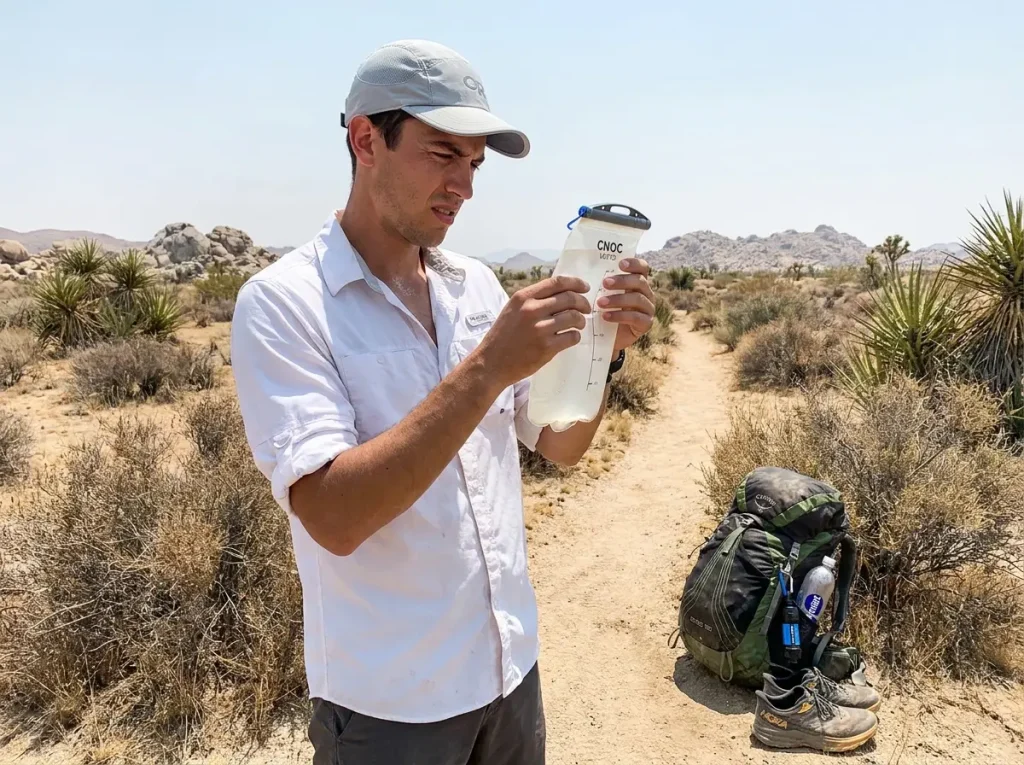
The number you’ll find everywhere is 1 liter per 5 miles. That’s a starting point, not a plan. It works when the air is 65°F, the trail is flat, and your pack weighs 20 pounds. Change any of those variables and the math breaks.
Your body loses water through sweat, respiration, and simple metabolic function. In cool conditions on moderate terrain, most hikers burn through about 200ml per mile. But desert thru hiking throws three multipliers at you simultaneously: heat, sun exposure, and often significant elevation changes.
The Temperature Multiplier Nobody Publishes
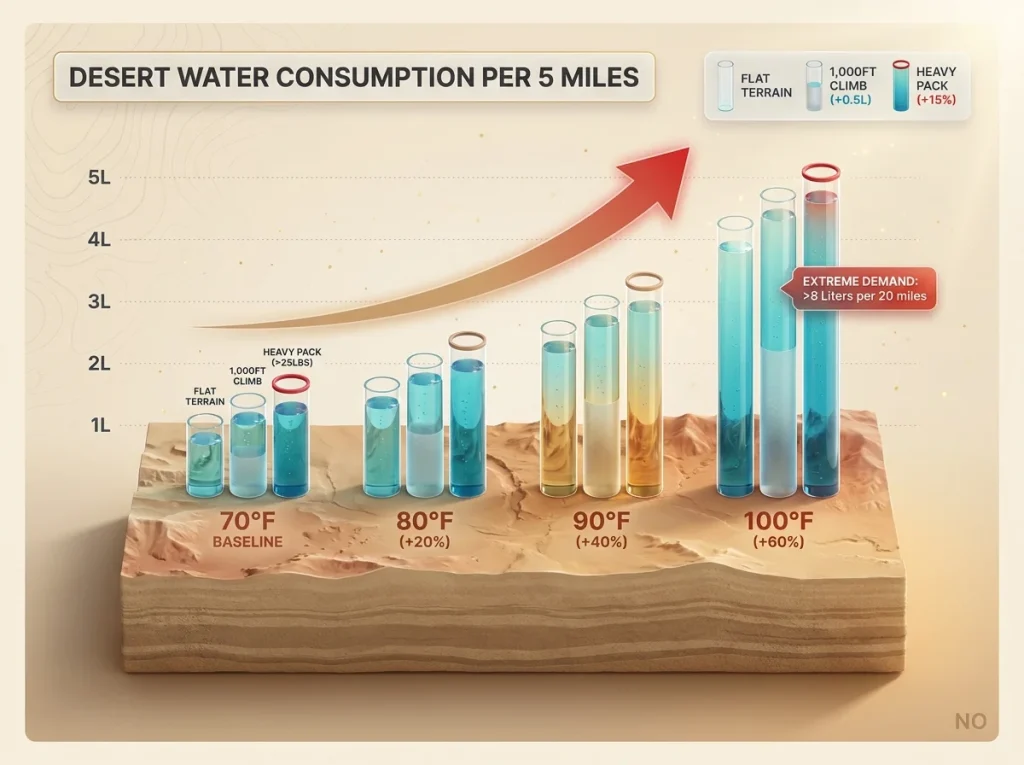
Here’s what the flat “1L per 5 miles” doesn’t tell you. For every 10°F increase above 70°F, bump your water consumption by roughly 20%. The NPS recommends up to 1 liter per hour in extreme heat, which translates to dramatically more than baseline on a slow desert climb.
At 80°F on flat ground, you’re looking at about 1.2L per 5 miles. At 90°F, that climbs to 1.4L. At 100°F — and you’ll see triple digits on exposed desert stretches in June — you’re consuming 1.6L per 5 miles or more. Add a 1,000-foot climb and tack on another half-liter. Carry a pack over 25 pounds and add 10-15% on top of that.
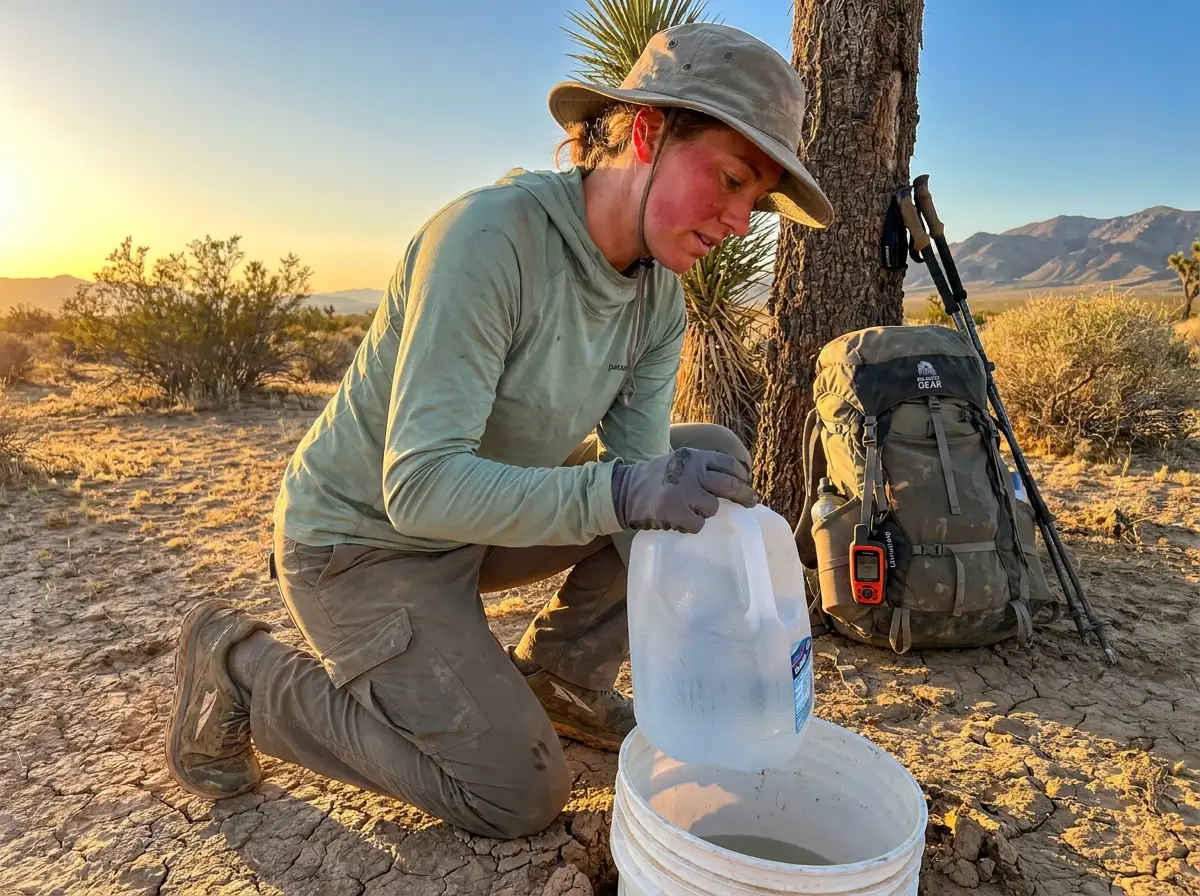
Pro tip: A wide-brim hat does more for your water math than any other single piece of gear. Sun beating directly on your head and neck accelerates fluid loss faster than most hikers realize. If you’re not wearing one, a sun hoodie is the next best thing for managing heat.
Running the Numbers for a Real Desert Section
Say you’re looking at a 22-mile waterless stretch in the Mojave with a 1,500-foot climb in the middle. Temperature forecast: 92°F.
Baseline: 22 miles × 0.2L/mile = 4.4L. Temperature adjustment at 92°F (roughly +40%): 6.2L. Climb adjustment: +0.75L. Rounded up with a safety margin: you need at least 7 liters to cross that stretch safely. That’s 15.4 pounds of water on your back — or one well-placed cache cutting your carry in half.
Our hydration calculator breaks it down by temperature and pack weight if you want to run your own numbers for a specific section.
Planning Your Cache Locations
Mapping Reliable vs. Seasonal Water Sources
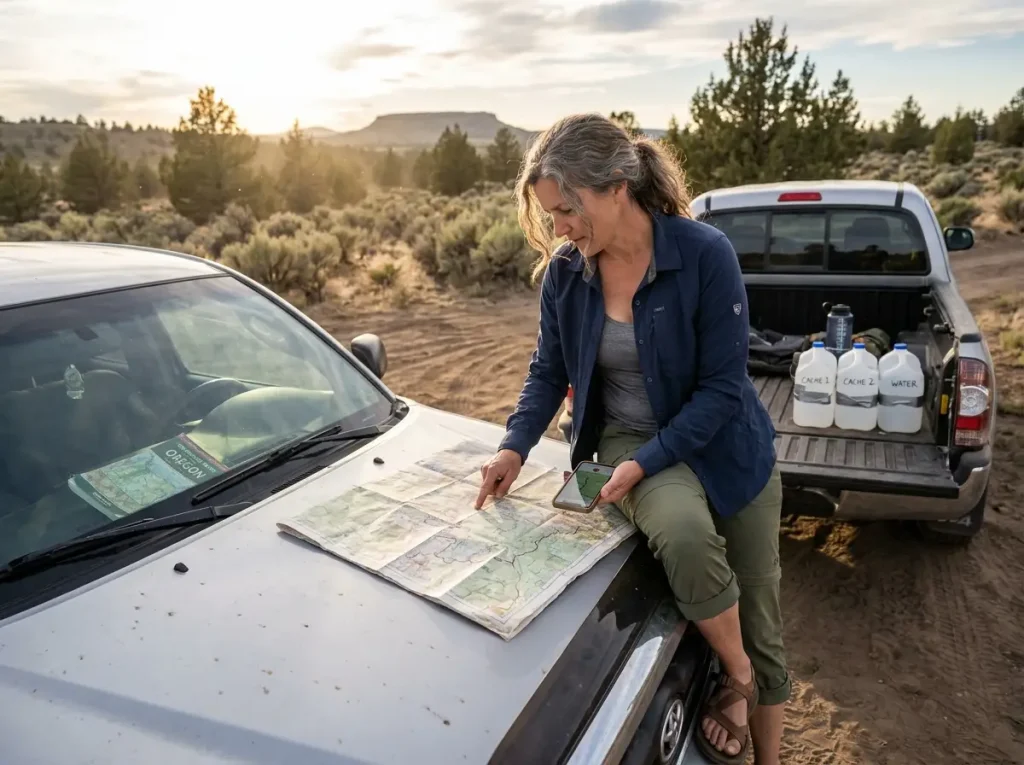
Before you buy a single jug, you need to know where the dry gaps are. Pull up your route on FarOut (formerly Guthook) or Gaia GPS and identify every water source along your desert sections. Then sort them: reliable year-round sources (springs with consistent flow, maintained tanks), seasonal sources (snowmelt creeks, seasonal washes), and caches maintained by trail angels.
Check the comment dates on FarOut. A comment saying “flowing strong” from two weeks ago in a drought year means something different than the same comment from yesterday. Seasonal sources can disappear between the time someone reports them and the time you arrive.
Calculating Cache Spacing Based on Your Carry Capacity
Most hikers carry 4-6 liters comfortably and can manage 8 liters when they need to. Once you know your adjusted consumption rate and your carry capacity, the gaps that need caching become obvious. Any stretch where the water demand exceeds what you can comfortably carry is a cache candidate.
The first time I planned caches, I spaced them evenly. That’s the wrong approach. You space them based on where the dry gaps actually are, not where the math looks clean on a map. One 25-mile gap might need two caches. Three consecutive 8-mile gaps between reliable springs need zero.
Access Points and Road Logistics
Your cache has to go somewhere you can actually reach — and reach with water jugs, not just a daypack. Look for road crossings, trailhead parking areas, or accessible washes near your route. A cache placed 3 miles from the nearest road sounds close until you’re hauling 16 pounds of water to it in the heat.
Pro tip: Google Earth’s satellite view plus a BLM surface management map will show you which roads are maintained versus which ones require serious 4WD. Many desert access roads wash out seasonally.
Containers and Storage That Survive the Desert
Container Types and Their Failure Modes
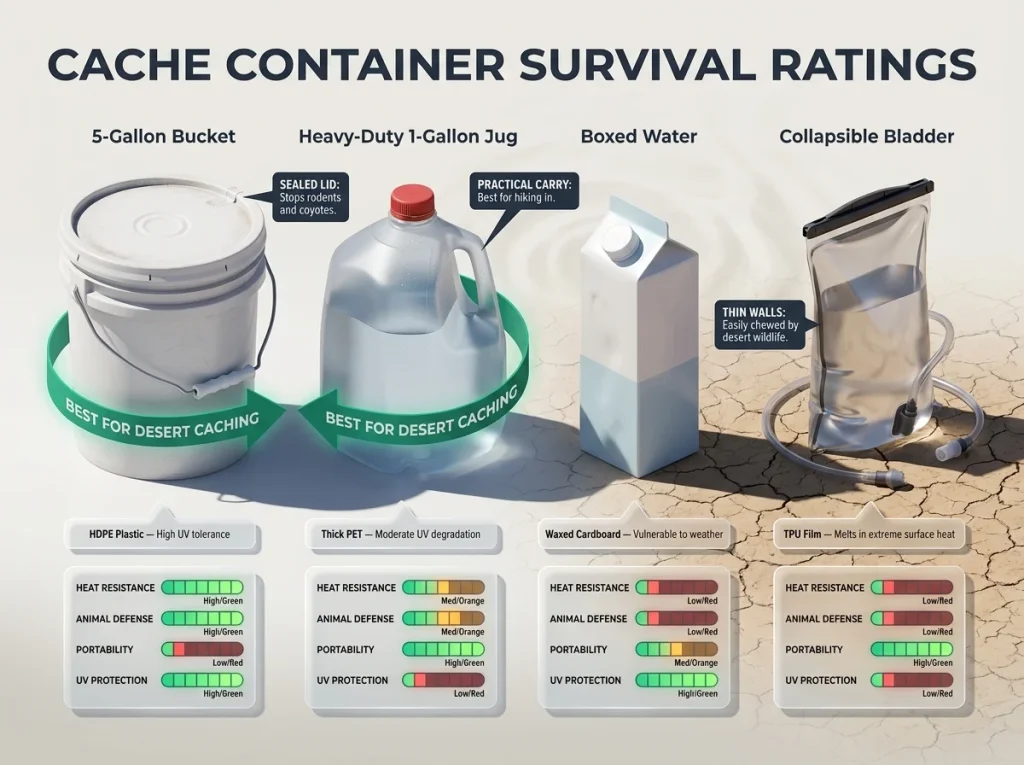
Not all containers survive desert conditions. I’ve found cracked jugs, sun-bleached plastic, and one cache where a coyote chewed through a thin-walled grocery store gallon. Here’s what works and what doesn’t.
Heavy-duty 1-gallon jugs with handles are the most portable option for carrying to cache sites. They’re more puncture-resistant than boxed water and easier to pack out when empty. Look for the thick-walled type, not the flimsy ones from the grocery store.
5-gallon buckets with sealed lids offer the best protection from animals and UV. They’re heavy to carry to the cache site but worth it for caches you’re placing more than a week out. The ONDA recommends this method for Oregon Desert Trail caches, and it works anywhere.
Collapsible water bottles are lighter but less reliable — fine for carrying water on trail, not ideal for leaving buried in desert heat for weeks.
UV and Heat Protection for Cached Water
PET plastic bottles degrade in 3-6 months of direct sun exposure. UV radiation breaks down polymer chains, making the plastic brittle and increasing chemical leaching into the water. At ground-surface temperatures that can exceed 150°F in direct desert sun, the degradation accelerates significantly.
This doesn’t mean your cached water becomes toxic overnight. But water stored in thin plastic under direct sun for more than 2-3 weeks starts entering questionable territory. Burial is the simplest solution — underground temperatures stay dramatically cooler even in extreme heat.
Burial and Concealment Methods
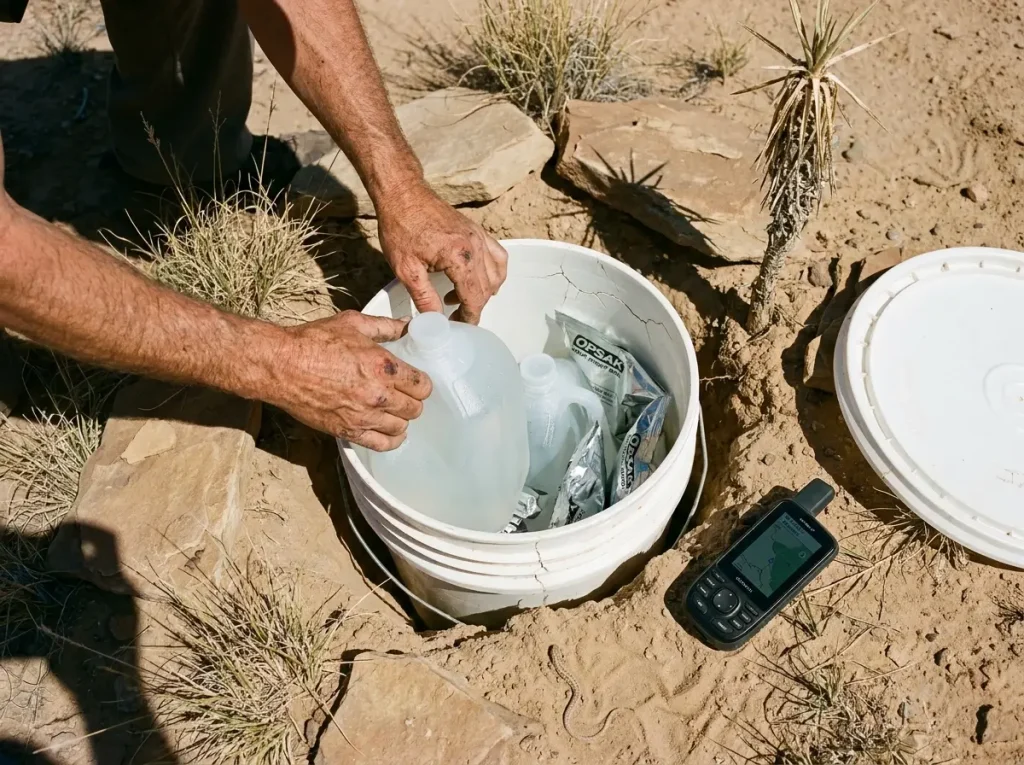
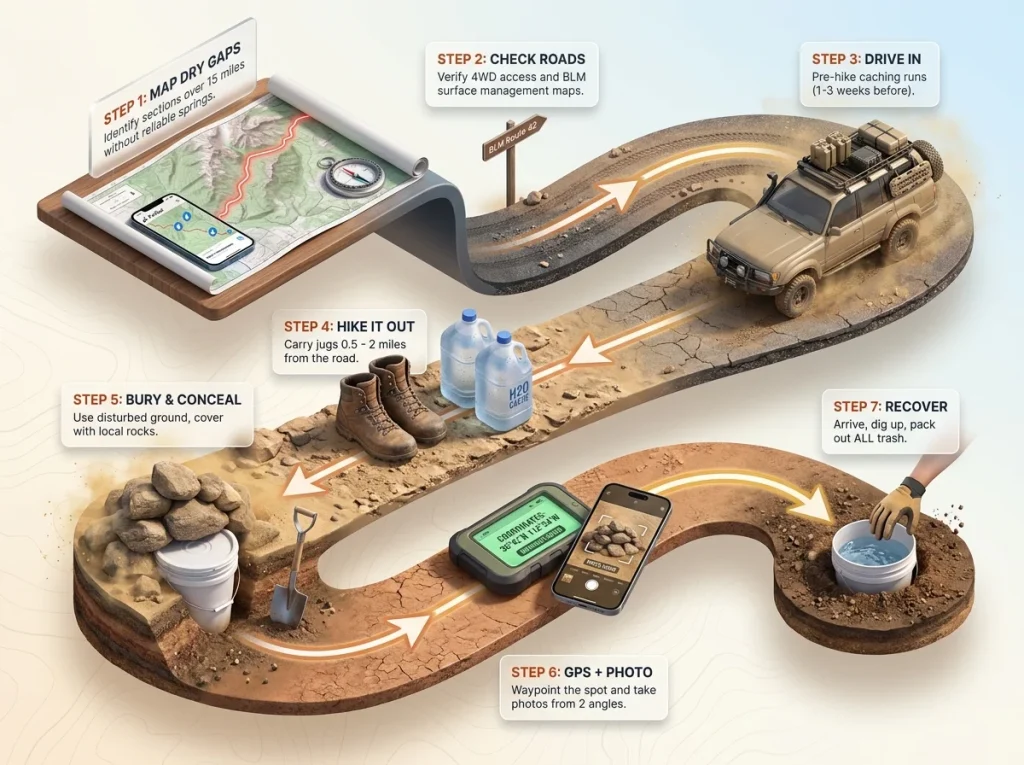
Bury your cache inside a 5-gallon bucket on previously disturbed ground only — desert soils and cryptobiotic crust can take decades to recover from digging. Cover with the removed soil and flat rocks. GPS waypoint the location, take photos from two angles, and note the distance and direction from the nearest permanent landmark.
Use OPSAK odor-proof barrier bags inside the bucket if you’re caching food alongside water. Animals will investigate anything with a scent, and desert rodents are surprisingly persistent.
The Drive-and-Drop Sequence for Solo Hikers
Building a Cache Run Itinerary
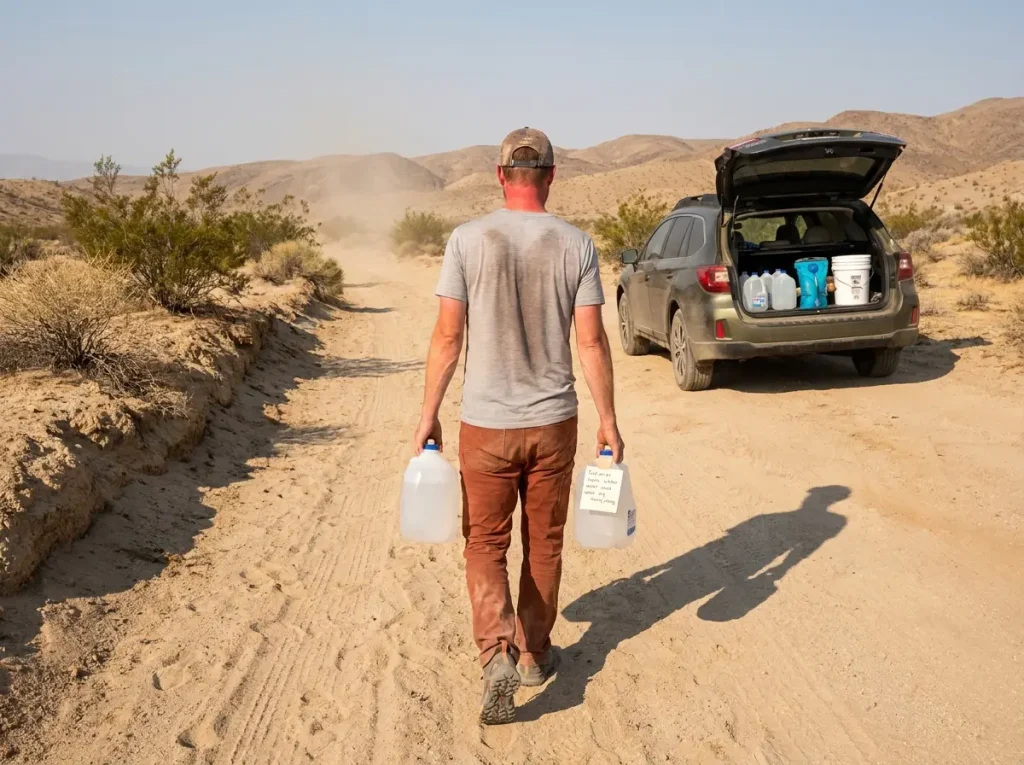
Plan your cache runs as separate day trips 1-3 weeks before your hike. This gives you time for a second run if you discover a road is washed out or a location doesn’t work. Most desert thru-hikers need 2-4 caches per long section, which means 1-2 days of driving and short out-and-back hikes to placement sites.
Start with the cache farthest from civilization and work your way back. If your day runs long, the closer caches are easier to hit on a follow-up trip.
Vehicle Access and Road Requirements
A high-clearance 4WD vehicle is recommended for most desert backcountry roads. Check conditions with the local BLM or USFS office before driving — in fire season, primitive road access may be restricted entirely. Keep all vehicle travel on existing roads. Desert soils don’t forgive off-road tracks.
Labeling, GPS, and Documentation
Label every container with your name, phone number, and expected retrieval date using Sharpie on duct tape (Sharpie alone fades in UV). GPS waypoint the exact cache location using your phone or a dedicated device. Take a photo of the spot from two angles — one showing the cache itself, one showing the cache location from 20 feet away with landmarks visible.
Write a text description too: “Cache is 15 feet north of the large split boulder, 2 feet east of the wash bank, buried 8 inches deep.” A three-year-old cache in Joshua Tree was found by accident because the original placer relied on memory alone — and got lucky.
Waterproof your backup cache maps if you’re carrying paper as a GPS backup. Sweat and dust destroy unprotected paper in the desert.
Where Caching Is Legal (and Where It’s Not)
Federal Land Rules by Agency
The regulations around water caching are a patchwork, and getting a straight answer sometimes requires phone calls to field offices that may not have dealt with the question before.
BLM land generally allows temporary storage of personal property for up to 10 days. Some districts set different limits, and enforcement varies. This covers most open desert sections of long trails like the PCT and ODT.
National Wildlife Refuges prohibit caching entirely. National Forests vary by forest — some prohibit it, others tolerate it in practice without formal policy. National Parks (Joshua Tree, Death Valley, Grand Canyon) typically prohibit unattended property without a permit, and permits for water caching are rarely granted.
Trail-Specific Regulations
The PCTA explicitly discourages reliance on water caches along the Pacific Crest Trail. Some established cache sites like Scissors Crossing are tolerated because they’ve become fixtures, but they’re not officially sanctioned and there’s ongoing debate about their environmental impact.
The ethics of trail magic and caching overlap in complicated ways. A personal cache you place and retrieve is different from a community cache that generates waste from hundreds of hikers.
How to Check Before You Cache
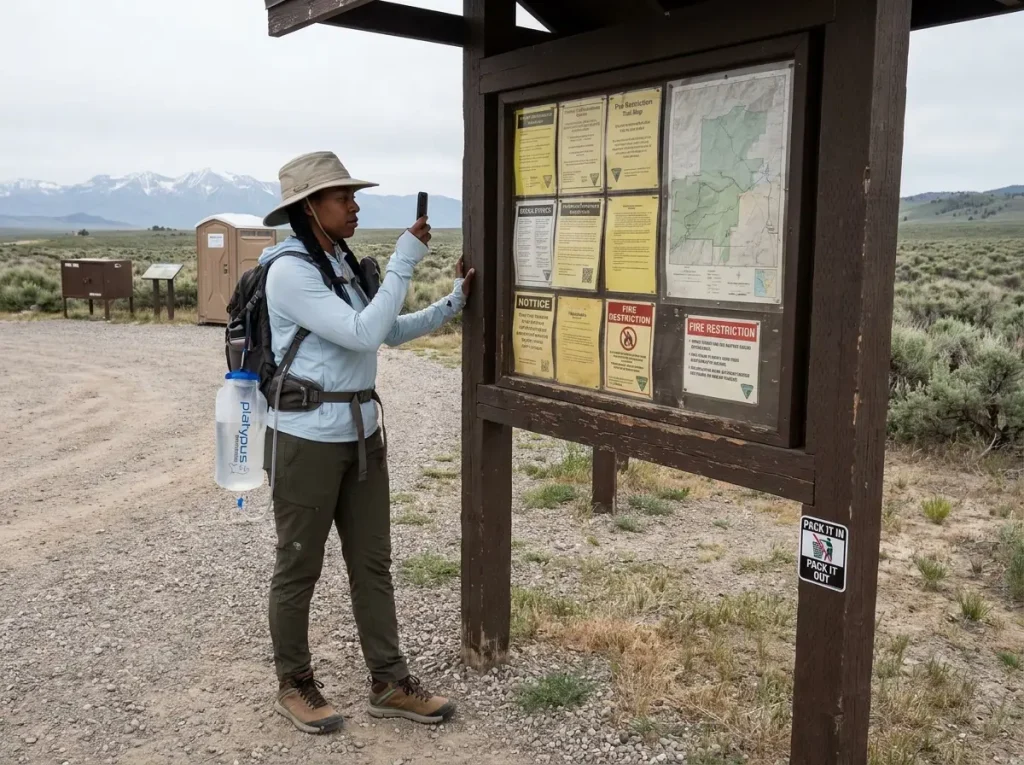
Call the specific local field office for the land your cache will sit on. Ask about “temporary food and water storage for backcountry travel” — staff may not know the term “water cache.” Get the answer in writing or note the name and date of whoever you spoke with.
Pro tip: BLM field offices are often more helpful than national-level phone lines. The district ranger or recreation specialist usually knows the local policy even when the website doesn’t spell it out.
Trail Angel Caches vs. Your Own — The Reliability Gap
How Community Caches Work (and Fail)
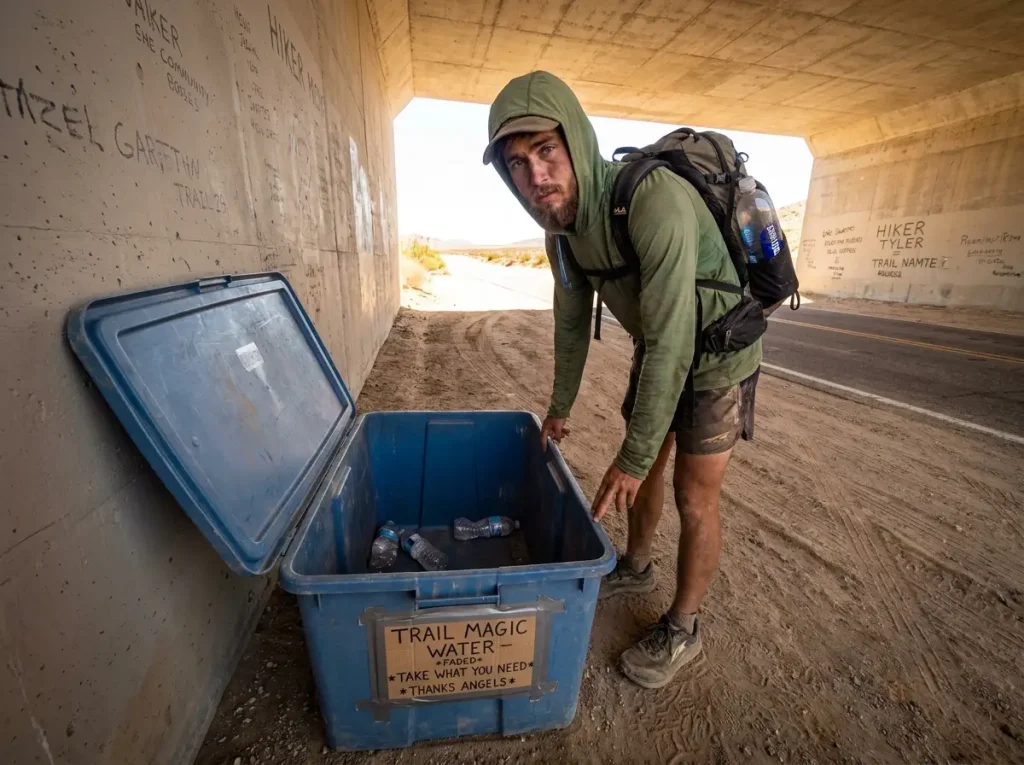
Trail angel caches are gifts from volunteers who haul water to remote locations for thru-hikers. They’re generous, often life-sustaining, and completely unreliable as a planning tool. The volunteer gets sick, their truck breaks down, or 50 thru-hikers hit the cache before the next resupply run — and your guaranteed water evaporates.
The Math Problem With Shared Caches
Consider the PCT’s Southern California section. The PCTA issues 50 northbound permits per day during the March-May window. If each hiker takes 5 liters from a cache, that’s 250 liters per day — roughly 66 gallons. Over three months of peak season, a single popular cache needs nearly 6,000 gallons of water delivered by volunteers. The logistics are staggering, and any gap in the supply chain leaves hikers stranded.
Assessing water source reliability is a survival skill, and community caches are among the least reliable sources on any trail.
When Personal Caching Makes More Sense
If your hike depends on water at a specific location on a specific day, place it yourself. Personal caches remove the reliability variable entirely. You know what’s there because you put it there, you know when you put it there, and you know exactly where it is.
Section hikers have a natural advantage here — section hiking gives you flexibility to drive cache runs between segments. Thru-hikers covering the full trail may need to arrange cache placement with a trusted friend or accept the risk of relying on community caches for some stretches.
Your Backup Plan When the Cache Is Empty
Pre-Hike Backup Planning
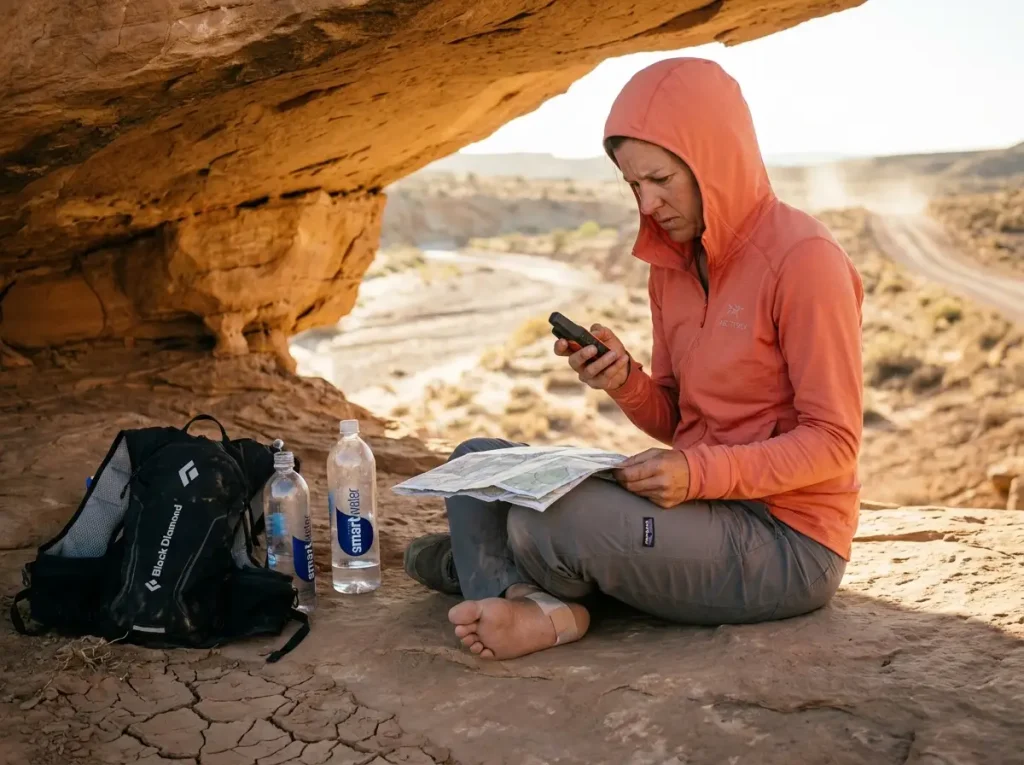
Before you leave the trailhead, you should already know the answer to this question: what do I do if my cache isn’t there?
Identify bail points for every cache-dependent section — the nearest road crossing, trailhead, or maintained trail junction where you could exit and reach help or a vehicle. Mark them on your map and in your GPS. Know the distance from each cache point to the nearest bail point in both directions.
Carry a satellite messenger — a Garmin inReach or similar device — on any section where your plan depends on cached water. This isn’t optional. In a genuine emergency, it’s the difference between a bad day and a search-and-rescue situation.
Test your full water carry system before you’re in the desert relying on it. Leaking bladders and failed seals have turned manageable carries into crises.
The Decision Tree at an Empty Cache
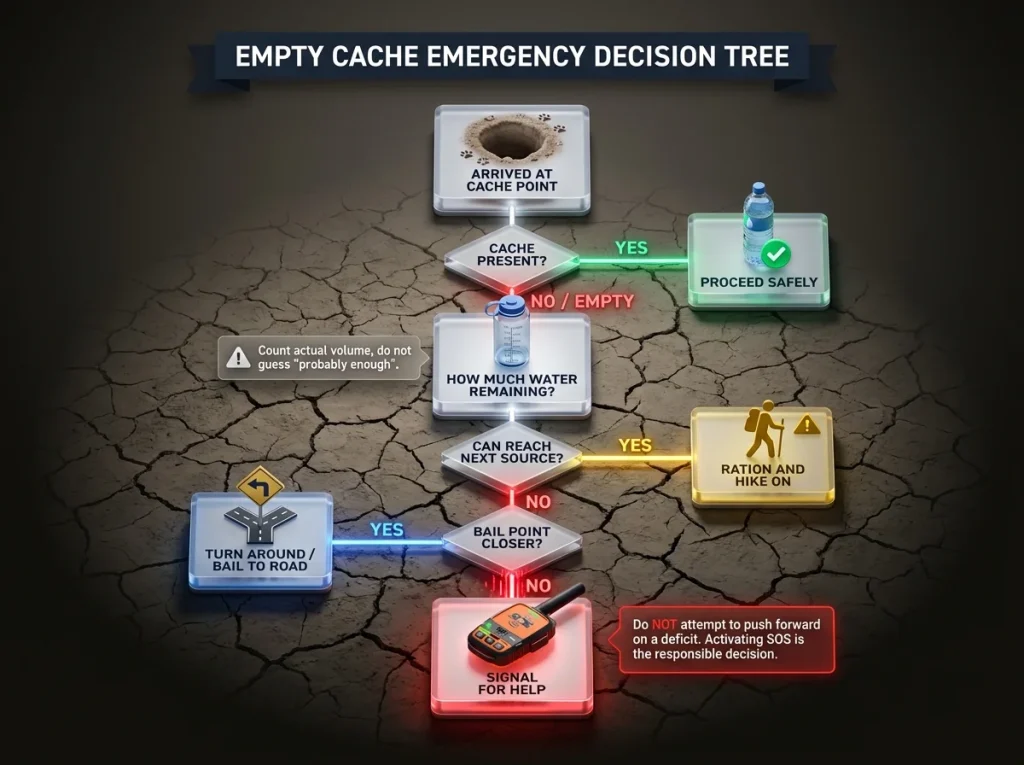
You arrive at your cache point and the water isn’t there. Here’s the framework.
Step 1: How much water do you have? Count it honestly — not “probably enough” but actual volume in milliliters.
Step 2: Can you reach the next reliable water source? Run the adjusted math for the remaining distance and current temperature. If the answer is marginal, it’s not yes — it’s no.
Step 3: Is a bail point closer? If turning back to the nearest road or known water is shorter than pushing forward, that’s your move.
Step 4: Can you signal for help? If your water situation is genuinely unsafe, activate your satellite messenger. This isn’t weakness — it’s the responsible decision.
Emergency Protocols and Bail Points
In true emergencies, know that cattle troughs, windmill tanks, and seasonal seeps exist throughout desert rangelands. They’re not on most trail apps. Always filter water from these sources — livestock water can carry pathogens you don’t want.
Pro tip: Carry at least 1 liter more than your math says you need on any cache-dependent carry. That extra liter weighs 2.2 pounds. It’s the cheapest insurance policy you’ll ever carry.
Conclusion
Three things separate a solid desert water cache strategy from a gamble.
Do the real water math — temperature-adjusted, elevation-adjusted, not the generic 1L-per-5-miles that works fine in October and fails you in June. Cache your own water when possible — trail angel caches are gifts, not guarantees, and the math on shared caches doesn’t add up during peak season. And build your bail plan before you step off pavement — know your turnaround points, carry a satellite messenger, and never let “probably enough” replace actual numbers.
Run the consumption math for your next desert section tonight. Scout your cache points on a map this weekend. The strategy that keeps you safe in the desert is the one you built before you needed it.
Q1 How much water should you cache per person per day in the desert?
Plan for 2 gallons (7.6 liters) per cache location per person. In temperatures above 90°F, increase to 2.5-3 gallons to account for higher consumption rates and provide a safety margin against unexpected delays.
Q2 Is it legal to cache water on public land?
It depends on the land management agency. BLM allows temporary property storage up to 10 days in most districts. National Wildlife Refuges and many National Forests prohibit it. National Parks rarely allow it without a permit. Always contact the local field office before placing any cache.
Q3 How long does cached water last in the desert heat?
Water itself stays safe indefinitely, but plastic containers degrade in 3-6 months of direct sun. UV and heat accelerate chemical leaching from PET plastic. Bury caches or use UV-resistant containers and retrieve within 2-3 weeks for the safest results.
Q4 What containers are best for caching water in hot climates?
Heavy-duty 1-gallon jugs with handles are the most portable. For longer storage, a 5-gallon bucket with a sealed lid protects from animals and UV. Avoid thin grocery-store gallon jugs — temperature swings between desert days and cold nights crack them.
Q5 How do you find your water cache after hiding it?
GPS waypoint the exact location using a phone or dedicated device. Take photos from two angles showing the cache relative to landmarks. Write a text description with distance and direction from a permanent feature. Memory alone fails — even experienced cachers have lost caches for years.
Risk Disclaimer: Hiking, trekking, backpacking, and all related outdoor activities involve inherent
risks which may result in serious injury, illness, or death. The information provided on The Hiking Tribe is for
educational and informational purposes only. While we strive for accuracy, information on trails, gear, techniques,
and safety is not a substitute for your own best judgment and thorough preparation. Trail conditions, weather, and
other environmental factors change rapidly and may differ from what is described on this site. Always check with
official sources like park services for the most current alerts and conditions. Never undertake a hike beyond your
abilities and always be prepared for the unexpected. By using this website, you agree that you are solely
responsible for your own safety. Any reliance you place on our content is strictly at your own risk, and you assume
all liability for your actions and decisions in the outdoors. The Hiking Tribe and its authors will not be held
liable for any injury, damage, or loss sustained in connection with the use of the information herein.
Affiliate Disclosure: We are a participant in the Amazon Services LLC Associates Program, an
affiliate advertising program designed to provide a means for us to earn advertising fees by advertising and linking
to Amazon.com. As an Amazon Associate, we earn from qualifying purchases. We are also an official affiliate partner
of Black Diamond Equipment via the AvantLink network. If you click on a Black Diamond affiliate link and make a
purchase, we may earn a commission at no additional cost to you. We also participate in other affiliate programs and
may receive a commission on products purchased through our links. Additional terms are found in the terms of
service.