In this article
You’re standing on a narrow ledge 400 feet above a valley floor, both hands on a steel cable bolted into limestone, and the next anchor point is eight feet away. Your hiking legs feel fine. Your forearms are on fire. That’s the moment every hiker discovers that via ferrata isn’t just hiking with hardware — it’s a different sport wearing familiar boots. I’ve clipped into steel cables on routes across Colorado and the Dolomites, and the mistakes I see beginners make are the same ones I made on my first route. This guide covers what hiking skills transfer, what doesn’t, and the gear and technique basics that keep you moving instead of freezing on the wall.
Quick Answer: Via ferrata (“iron way”) bridges the gap between hiking and rock climbing using fixed steel cables, metal rungs, and anchor points bolted into cliff faces. You clip in with a Y-lanyard attached to your climbing harness and move along the route, transferring your carabiners at each anchor. Hikers need a harness, a certified via ferrata set with energy absorber, a helmet, gloves, and stiff-soled boots — most can be rented at popular routes. Start with a K1 or K2 rated route and expect your grip to give out before your legs do.
What Via Ferrata Actually Is (and Why Hikers Love It)
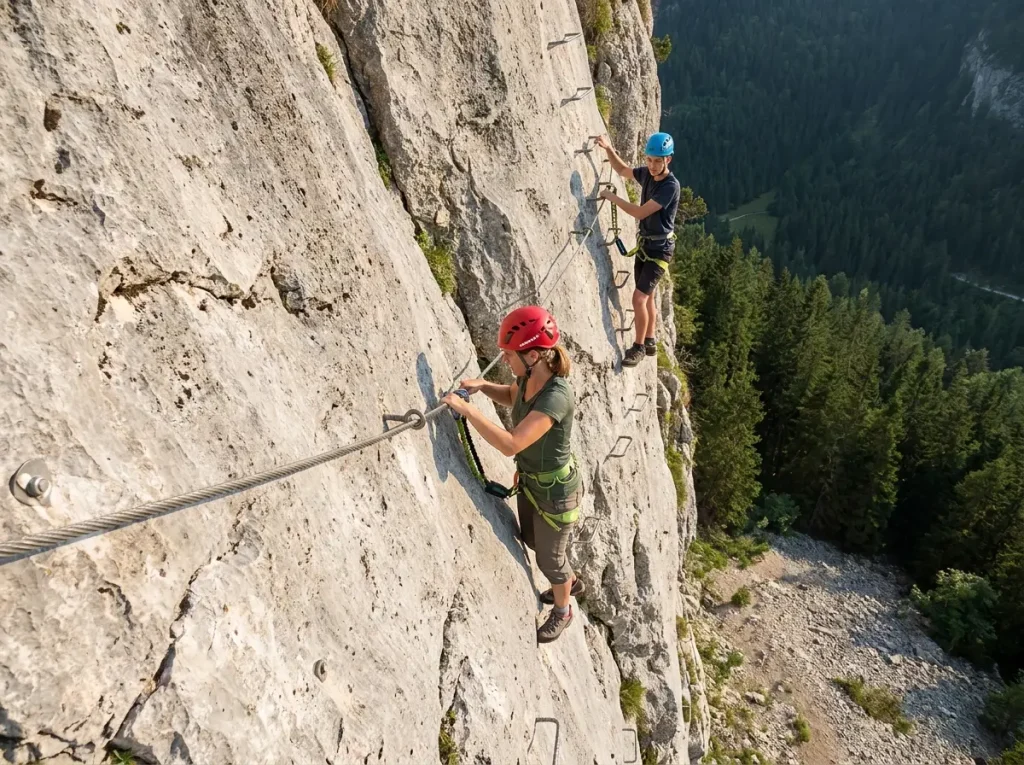
The name translates from Italian as “iron way,” and that’s exactly what it is — a path up a cliff face made possible by steel infrastructure permanently fixed to the rock. Klettersteig is the German equivalent, and you’ll see both terms used interchangeably depending on whether the route is in the Dolomites or the Austrian Alps.
The Hardware on the Mountain
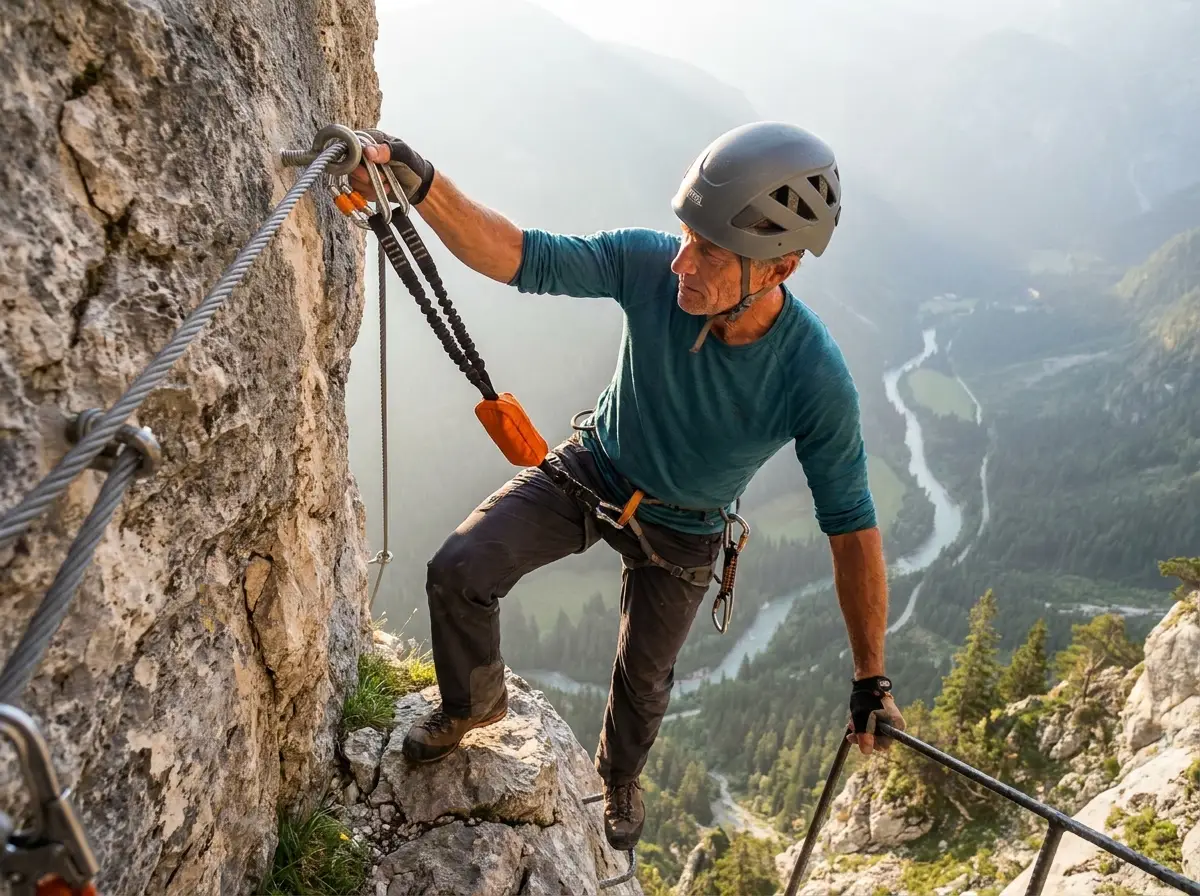
A via ferrata route consists of a continuous steel cable bolted to the rock face at regular intervals, running along ledges, up vertical walls, and across exposed traverses. At each bolt point, the cable passes through an anchor bracket — these are the points where you transfer your carabiners from one cable section to the next.
Many routes also include metal rungs (called stemples) bolted into the rock as footholds and handholds on vertical sections, iron ladders for steep pitches, and sometimes carved or widened ledges on traverses. The infrastructure turns terrain that would require full rock climbing gear and skills into routes that hikers can navigate with a single safety system.
Where It Sits Between Hiking and Climbing
Via ferrata occupies the space between Class 3 scrambling and technical rock climbing. You’re on vertical or near-vertical terrain, but the fixed protection does the work that ropes and placements do in climbing. You don’t need to know how to lead, build anchors, or manage a belay — the mountain already has all of that installed. If you’re comfortable on exposed rock and know when to turn back on a scramble, you already have the mental framework for via ferrata. The physical demands are different, but the risk assessment is similar.
A Brief History That Explains the Culture
The first via ferratas were built in the Dolomites during World War I, allowing Italian and Austro-Hungarian troops to move soldiers and supplies across vertical limestone terrain. After the war, alpine clubs maintained and expanded the routes for civilian mountaineers. Today, the Dolomites remain the spiritual home of via ferrata, with hundreds of routes ranging from easy traverses to multi-pitch vertical climbs. The sport has spread worldwide — Colorado alone has more than half a dozen established routes, and new ones appear every year.
Pro tip: European via ferrata culture assumes more self-sufficiency than the guided experiences common in the US. If you learn the basics on a guided route in Colorado and then head to the Dolomites expecting the same hand-holding, you’ll be surprised. European routes are longer, more remote, and often have no staff.
The Gear You Need (and What You Can Rent)
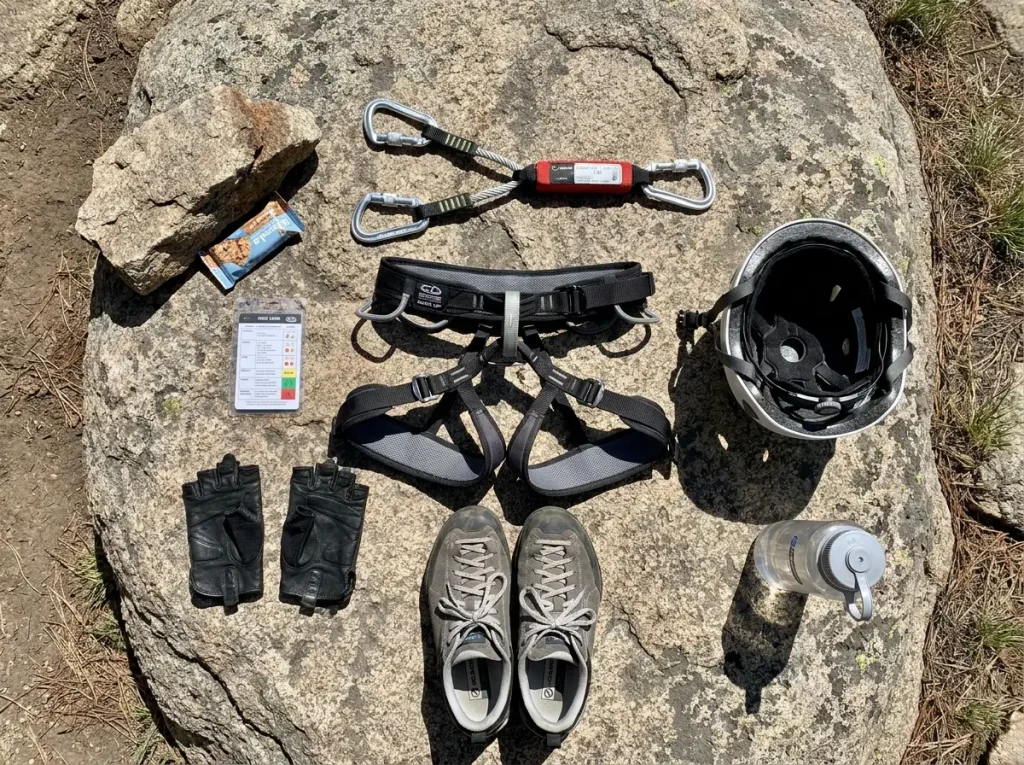
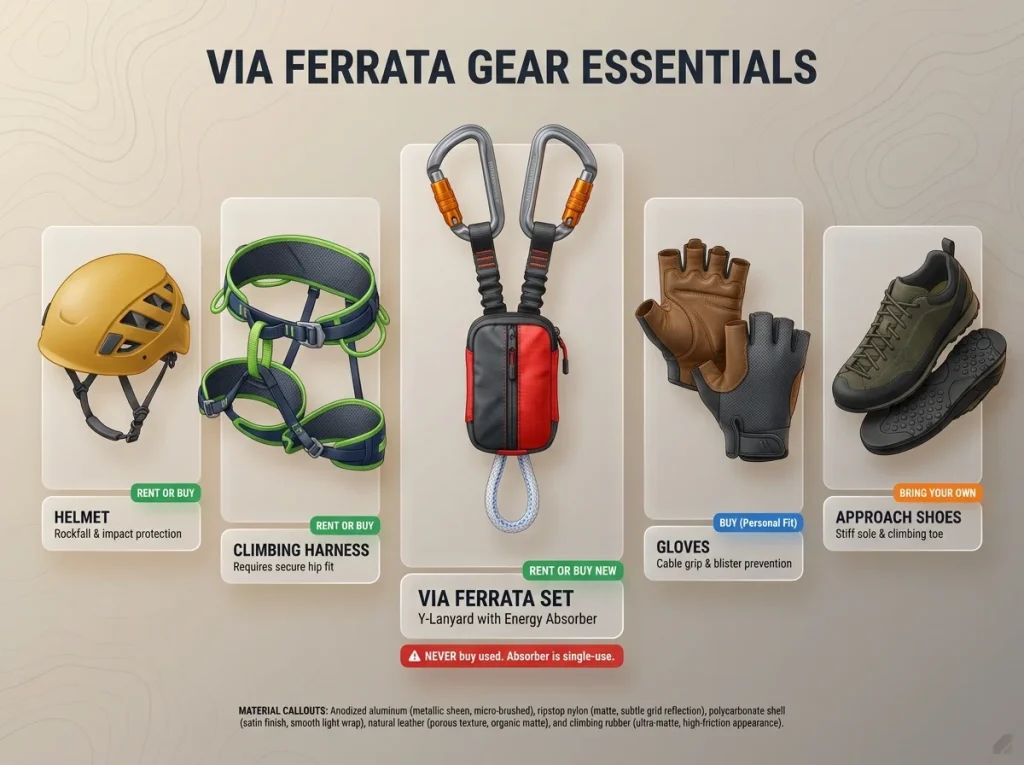
You need five things on a via ferrata. Three of them are non-negotiable safety equipment, and two make the difference between finishing the route and wishing you hadn’t started.
Via Ferrata Set (the Y-Lanyard)
This is the piece that connects you to the mountain. A via ferrata set consists of two carabiners attached to elastic lanyards that form a Y-shape, connected at the base by an energy absorber. The energy absorber is the part that saves your life — if you fall, it tears apart in a controlled way, absorbing the fall energy and reducing the impact force on your harness and spine.
The set attaches to your climbing harness via a girth hitch through the tie-in loop. Both carabiners clip onto the steel cable, and you move them one at a time past each anchor point so you’re always connected. This is the piece you absolutely should not buy used — more on that below.
Climbing Harness
Any climbing harness that fits properly works for via ferrata. The waist belt should sit above your hip bones, and the leg loops should be snug enough that you can’t slide a full fist between the loop and your thigh. Most rental operations carry adjustable harnesses from Petzl, Black Diamond, or Mammut that fit a wide range of sizes. If you’re buying, a basic sport climbing harness with four gear loops is more than enough. Choosing a helmet that actually fits your head properly matters here too — both pieces need to be comfortable for hours.
Helmet
Non-negotiable. Via ferrata routes are on rock faces where loose rubble, dropped equipment from climbers above, and your own head banging into an overhang are all real possibilities. A certified climbing helmet weighing 200 to 300 grams makes the difference between a minor annoyance and a serious head injury. Rental helmets at guided operations are typically in decent shape — check that the foam isn’t cracked and the adjustment system actually locks.
Gloves and Footwear
Via ferrata gloves protect your palms from the steel cable. Pushing carabiners along a braided steel cable for two hours without gloves means blisters by the midpoint and raw skin by the end. Thin leather gloves with reinforced palms and exposed fingertips give you protection without killing your dexterity.
For footwear, you need a stiff sole and ankle stability. Approach shoes built for scrambling are the sweet spot — stiffer than trail runners, lighter than mountaineering boots, with a climbing zone at the toe for edging on small holds. Regular hiking boots work if they have a rigid sole, but soft trail runners will leave your feet aching on the metal rungs.
Rent or Buy?
For your first via ferrata, rent everything. Most US routes with guided operations offer full gear packages — harness, via ferrata set, and helmet — for $30 to $60. This lets you try the sport without a $200+ investment. If you do three or more routes, buying your own set starts making sense. One rule is absolute: never buy a used via ferrata set. The energy absorber is a one-use component — once it’s been loaded in a fall, it’s finished, and there’s no way to tell by looking whether it’s been activated. Buy EN 958 certified sets from authorized retailers.
Understanding Via Ferrata Grades Before You Book
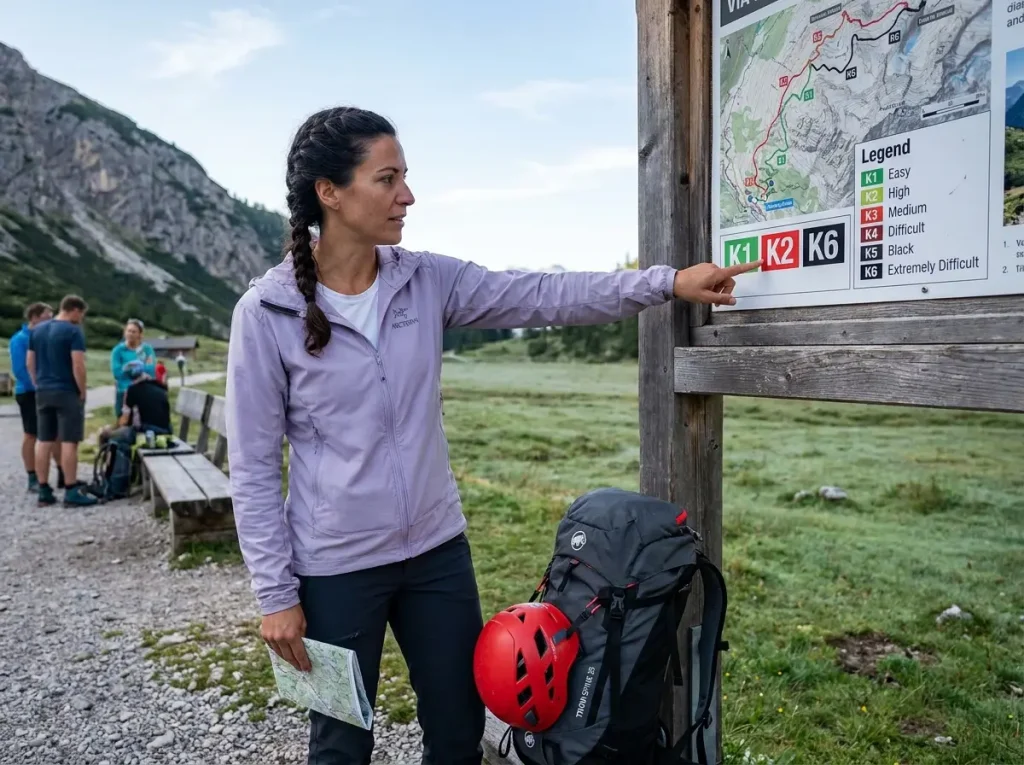
Via ferrata grading systems are less standardized than climbing or hiking grades, and that inconsistency trips up beginners who assume a number means the same thing everywhere.
The K-Scale (Hüsler Scale)
The most widely used system runs from K1 (easy) through K6 (extremely difficult). K comes from Klettersteig, the German word for via ferrata. K1 routes are secured hiking paths — the cable serves mainly as a handrail, with no vertical sections and minimal exposure. K2 adds steeper terrain with some short exposed steps where you’ll actually weight the cable. K3 is where most “moderate” via ferratas sit — sustained vertical sections, real exposure, and sections where your arms do serious work.
For beginners: start at K1 or K2. A K3 route as your first via ferrata is how 54% of all via ferrata rescues happen — blockages where climbers freeze, unable to go up or down. That statistic comes from Austrian mountain rescue data spanning a decade, and the cause is almost always overambitious route selection.
How Grades Compare to Hiking Difficulty
A K1 via ferrata is roughly equivalent to Class 3 scrambling with a safety cable added. A K2 is closer to what climbers would call 5.0-5.3 terrain, but with fixed protection. A K3 enters territory that would be 5.4-5.6 climbing without the hardware. The difference is that via ferrata grades don’t account for length, approach difficulty, or weather exposure — a short K3 near a parking lot is a fundamentally different experience than a long K3 in the Dolomites with a two-hour approach and no escape routes for the first hour.
Pro tip: Look at route descriptions, not just grades. A “K2 with sustained exposure” can feel harder than a “K3 with short crux” depending on your comfort with heights. The grade tells you the hardest move. The route description tells you how much of that move there is.
The Italian and French Systems
In the Dolomites, you’ll see grades from F (facile/easy) through ED (extremement difficile/extremely difficult). In France, routes use a similar letter scale. A rough conversion: F = K1, PD = K2, AD = K3, D = K4, TD = K5, ED = K6. These aren’t exact equivalents — local grading culture matters, and Italian routes tend to feel a touch harder at the same grade than Austrian ones.
How to Clip — The Anchor Point Sequence That Keeps You Alive
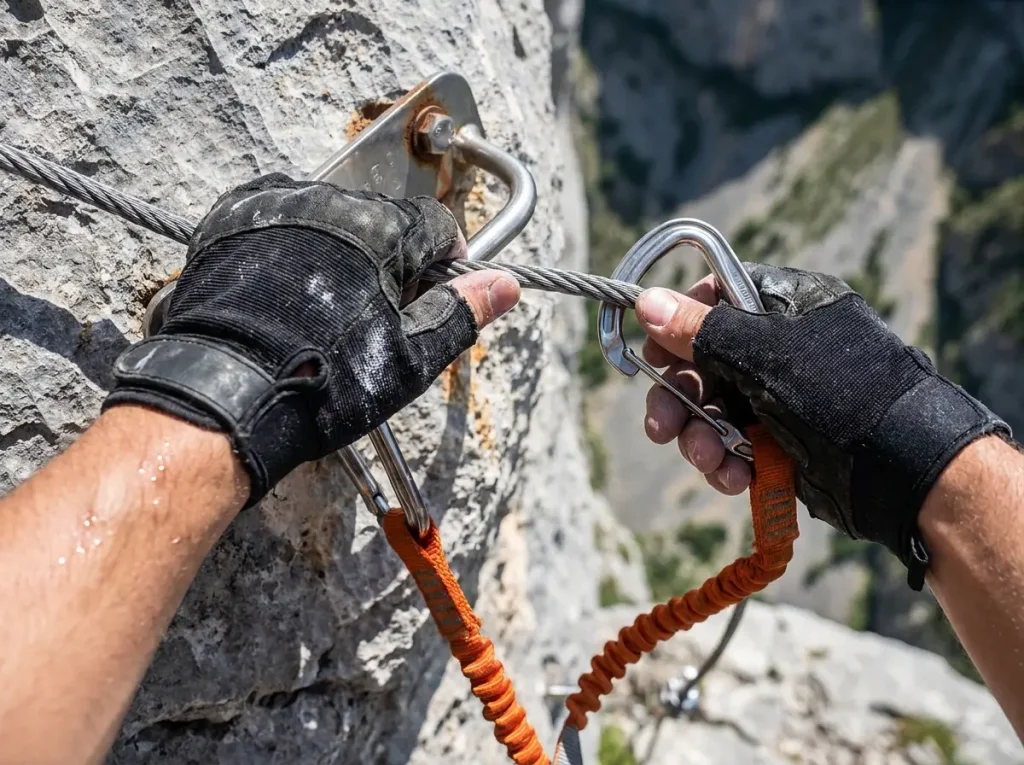
This is the single most important technical skill on a via ferrata, and it’s the one beginners practice least before getting on the route.
Y-Lanyard Basics
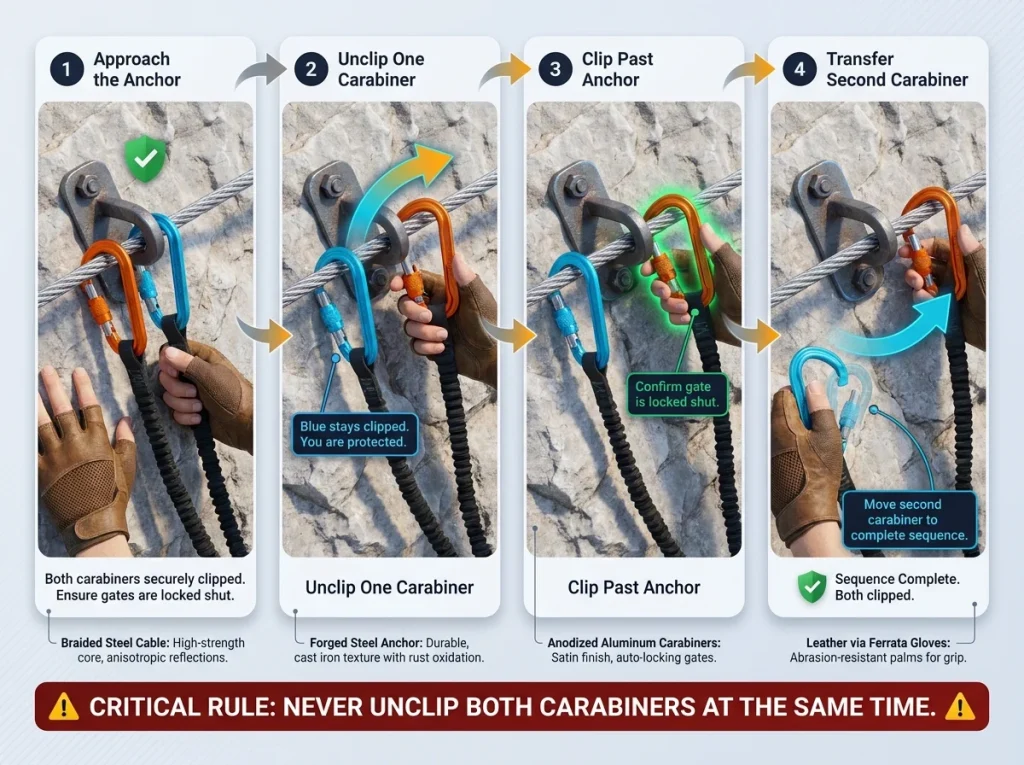
Your Y-lanyard has two arms, each ending in a carabiner. Both carabiners should be clipped to the steel cable whenever you’re moving between anchors. When you reach an anchor bracket — the point where one cable section ends and the next begins — you transfer one carabiner at a time to the new section.
The sequence: reach the anchor → unclip the forward carabiner → clip it to the cable on the far side of the anchor → then unclip the rear carabiner → clip it next to the first one on the new section. You are always connected to the cable by at least one carabiner. Breaking this rule — even for a second — means an unprotected fall if you slip.
The Critical Difference Between Y and V Lanyards
Most modern via ferrata sets use Y-lanyards: both arms clip independently to the cable, and either one can catch a fall through the shared energy absorber. Some older or simpler systems use V-lanyards, where only one carabiner should be on the cable during normal travel (the second clips only during anchor transitions). The reason matters — on a V-lanyard, if both carabiners are clipped during a fall, the energy absorber may not activate properly, leaving you with a static catch and far higher impact forces.
Check your set before you leave the ground. If it’s a Y-system (two separate arms merging into one absorber), clip both. If it’s a V-system (one arm splitting into two), clip one and transfer at anchors. If you’re renting and don’t know which type you have, ask the guide or rental shop. Getting this wrong defeats the entire purpose of the safety system.
Common Clipping Mistakes
The most common error: unclipping both carabiners simultaneously to “save time” at anchors. It takes five extra seconds to transfer one at a time. A fall while both are unclipped is an unprotected fall — and on via ferrata terrain, that’s typically measured in hundreds of feet. The cables on fixed rope traverses follow similar principles, and the transition technique transfers directly.
Second most common: not checking that the carabiner gate is fully closed after clipping. Spring-lock carabiners on via ferrata sets should snap shut automatically, but grit, rust, or a rushed clip can leave the gate open. Pull down on the carabiner after each clip to confirm it’s locked.
The Fitness Gap Between Hiking and Via Ferrata
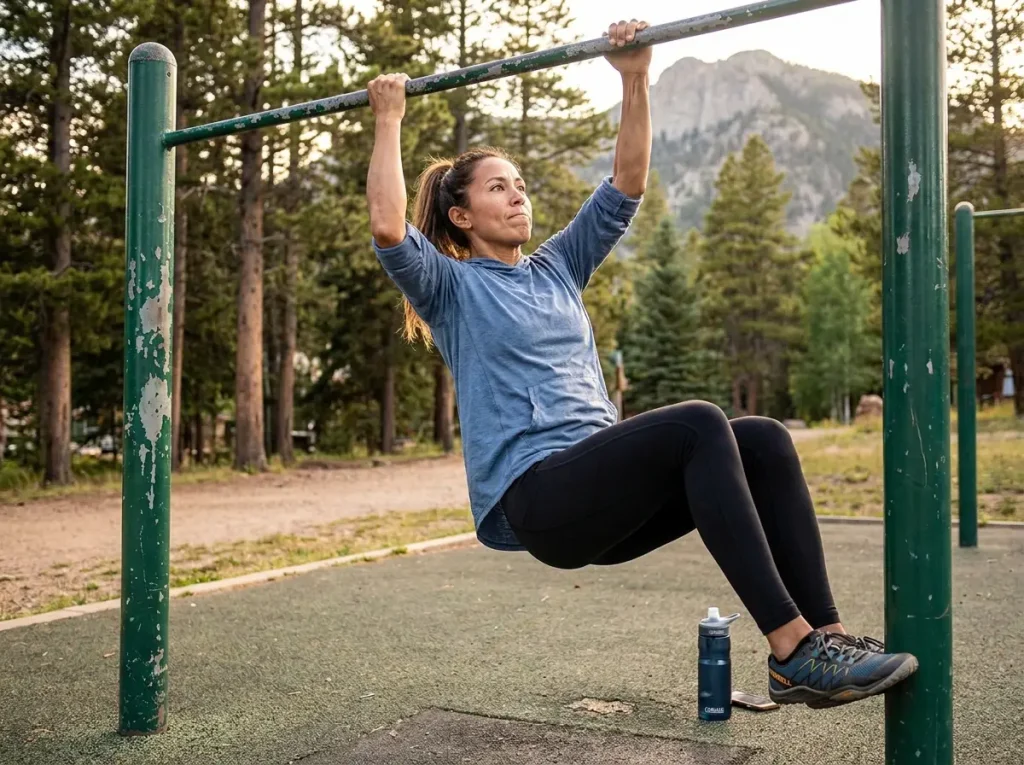
Your hiking fitness gets you to the trailhead. It doesn’t get you up the wall. Via ferrata exposes three fitness gaps that surprise every hiker on their first route.
Grip Endurance Is the First Thing to Fail
Hiking builds legs, lungs, and trail endurance. Via ferrata taxes your grip strength and forearm endurance in ways that no amount of trail miles prepares you for. Holding onto metal rungs, squeezing carabiners, and gripping the cable on traverses — your forearms pump out long before your legs get tired. The burning, swelling feeling in your forearms is called “being pumped,” and it’s the reason most beginners need to rest every 10 to 15 minutes on moderate routes.
Train for this before your first route. Dead hangs from a pull-up bar — start with 20 seconds and work up to 60 — build the baseline grip endurance you need. Farmer’s carries with heavy dumbbells train the same muscles under load. The scrambling fitness exercises that build ankle stability and lock-off strength also transfer directly to via ferrata.
Exposure Tolerance Isn’t Just Mental
Exposure — the sense of height and consequence below you — is a physical experience, not just a psychological one. Your muscles tighten, your grip overcompensates, and your movement becomes stiff and inefficient. Hikers who are comfortable on exposed ridgelines still freeze on via ferrata because the terrain is vertical instead of horizontal. Your brain processes a 500-foot cliff beneath your feet differently than a 500-foot dropoff beside your boots.
Build exposure tolerance gradually. Start with a short K1 route. Then a longer K1. Then a short K2. Jumping straight to a K3 because “I’ve hiked exposed ridges before” is how people end up needing rescue. There’s no shame in backing off a route — the turnaround decision framework applies to vertical terrain just as much as horizontal.
Pro tip: Climb with your legs, not your arms. This is the number one technique tip for via ferrata and the hardest habit for beginners to build. Use the cable and rungs for balance, but push upward with your legs. Your legs can work all day. Your forearms can’t.
Vertical Movement Patterns
Hiking is forward. Via ferrata is up. The movement patterns are fundamentally different. Three points of contact — two hands and one foot, or two feet and one hand — should be maintained whenever possible. Move one limb at a time. Look for footholds on the natural rock in addition to the metal rungs — the route infrastructure supplements the rock, it doesn’t replace it. Learning to test handholds for stability before committing your weight is a scrambling skill that pays dividends on via ferrata.
Where to Try Your First Via Ferrata in the US
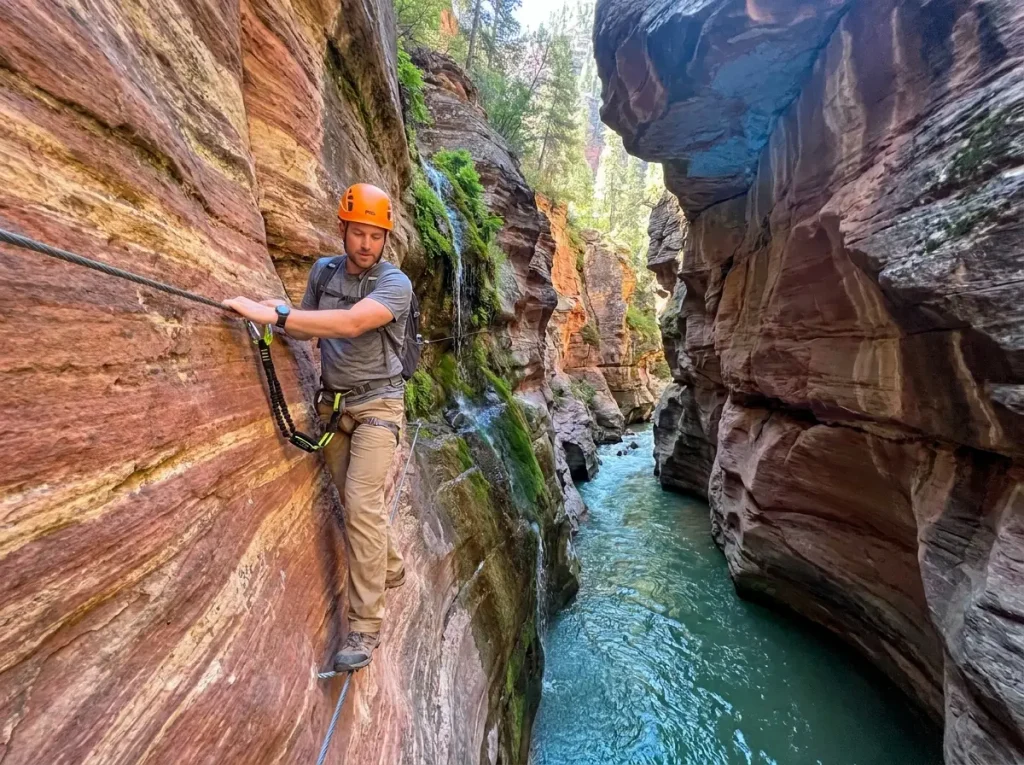
The US via ferrata scene is growing fast. A decade ago, you had to fly to Europe. Now Colorado alone has enough beginner-friendly routes to fill a week of vacation.
Beginner-Friendly US Routes
Ouray Via Ferrata (Colorado) — The downstream route is the most approachable in the country. Short sections of exposure, easy access, and the Uncompahgre Gorge scenery makes it feel far more dramatic than the difficulty warrants. The upstream route steps up the intensity if you want more after finishing the first.
Telluride Via Ferrata (Colorado) — Free and open to the public, maintained by the Telluride Mountain Club. Rated 2B (moderate), it follows a ledge system on the canyon wall below Ajax Peak. The exposure is real but the moves are straightforward. Bring your own gear or rent from local outfitters.
Cave of the Winds (Manitou Springs, Colorado) — A guided commercial operation with zip lines and rappels added to the via ferrata sections. More theme-park than alpine, but a zero-pressure introduction for people who aren’t sure they’ll like heights.
Taos Ski Valley (New Mexico) — Via ferrata routes through sub-alpine forest terrain. Less exposure than the Colorado canyon routes, with guided options available.
Guided vs Self-Guided
For your first route: go guided. A certified mountain guide teaches you the clipping sequence, corrects your foot placement in real time, manages your pace, and knows exactly where the hard sections are. Most guided via ferrata experiences cost $100 to $250 per person including gear rental. After one or two guided routes, you’ll have the technique and confidence to go self-guided on K1 and K2 routes.
If you’ve done canyoneering and understand rope-based vertical movement, you may be comfortable going self-guided earlier. The clipping technique is simpler than canyoneering systems, but the exposure management is similar.
Pro tip: Book morning slots. Afternoon thunderstorms are a real hazard on exposed mountain routes in Colorado and the Rockies. Lightning on a via ferrata — where you’re clipped to a steel cable on the highest point of a cliff face — is as bad as it sounds.
What to Do When You Freeze on the Wall
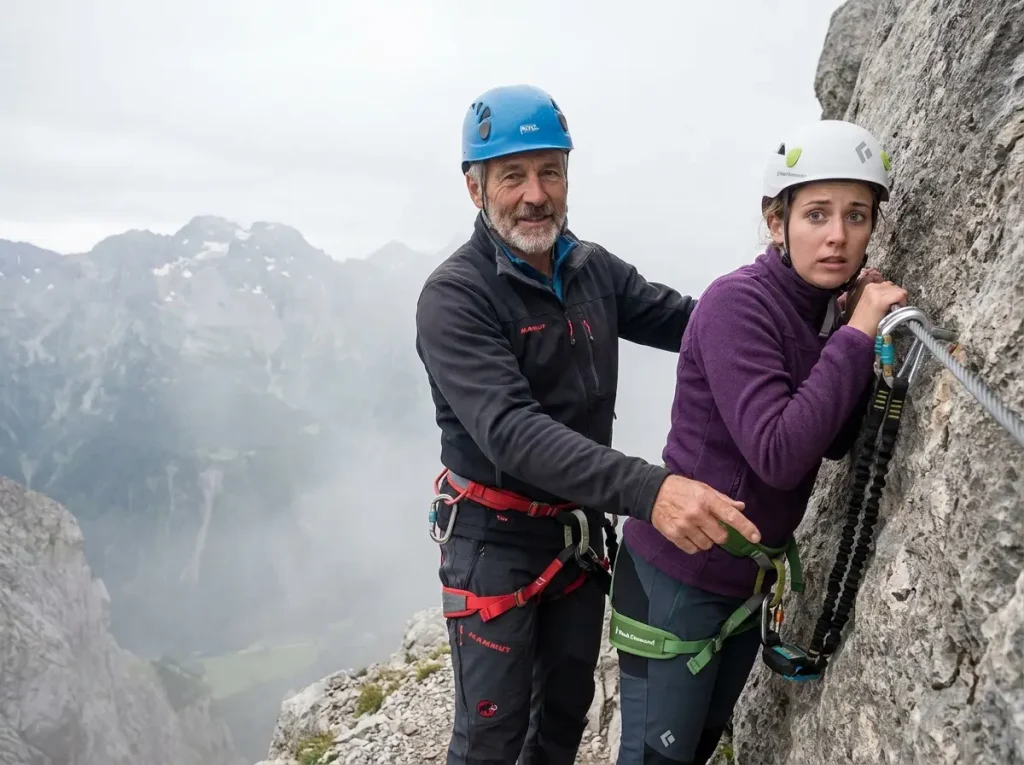
It happens. You’re mid-route, the exposure hits differently than it looked from below, and your legs stop moving. You’re not the first and you won’t be the last — 54% of via ferrata rescues in Austria over a decade were blockage events, not falls.
The Freeze Response and How to Break It
When you freeze, your grip tightens, your breathing shallows, and your field of vision narrows to the rock directly in front of your face. You stop looking at footholds. You stop looking at the route. You just hold on.
Break the cycle in order: first, breathe. Three deep breaths through your nose. Second, look at your feet — where are they, and is the foothold solid? Third, look at the next anchor point — how far is it? Usually the answer is “closer than it feels.” Fourth, move one foot. Just one. The rest follows.
When Freezing Means You Should Turn Back
There’s a difference between “I need a minute” and “I cannot continue.” If three attempts to move forward fail, if your arms are so pumped you can’t hold the cable securely, or if you’re hyperventilating despite the breathing technique — those are signals to retreat, not push through. Via ferrata isn’t summiting. There’s no trophy for finishing a route that was too hard for you today.
Tell your guide or partner you need to go back. They’ve seen it before. Retreat on a via ferrata means downclimbing to the last escape route junction or to the start, clipping backwards through the anchor points. It’s slower and less elegant than going forward, but it’s the right call when the route is winning.
Escape Routes and the Pre-Trip Plan
Most established via ferrata routes have marked escape routes — junctions where you can exit the cable route and descend via a hiking trail back to the base. These are marked with signs (often “Notweg” in German-speaking areas or red arrows on the rock). Before you start, identify where the escape routes are. If the route has no escape options for the first 45 minutes, know that going in.
Having a pre-trip plan — what to do if weather turns, if someone freezes, if fatigue hits earlier than expected — is the same planning mindset that keeps hikers safe on any technical terrain. The cable doesn’t change the planning. It just changes the terrain.
Pro tip: If you’re going unguided, carry a phone with the local mountain rescue number saved and a whistle. Cell service is spotty on cliff faces, but text messages often get through when calls don’t. An emergency PLB or satellite communicator is worth carrying on any route longer than an hour.
Emergency Bail-Out — How to Retreat When the Route Wins
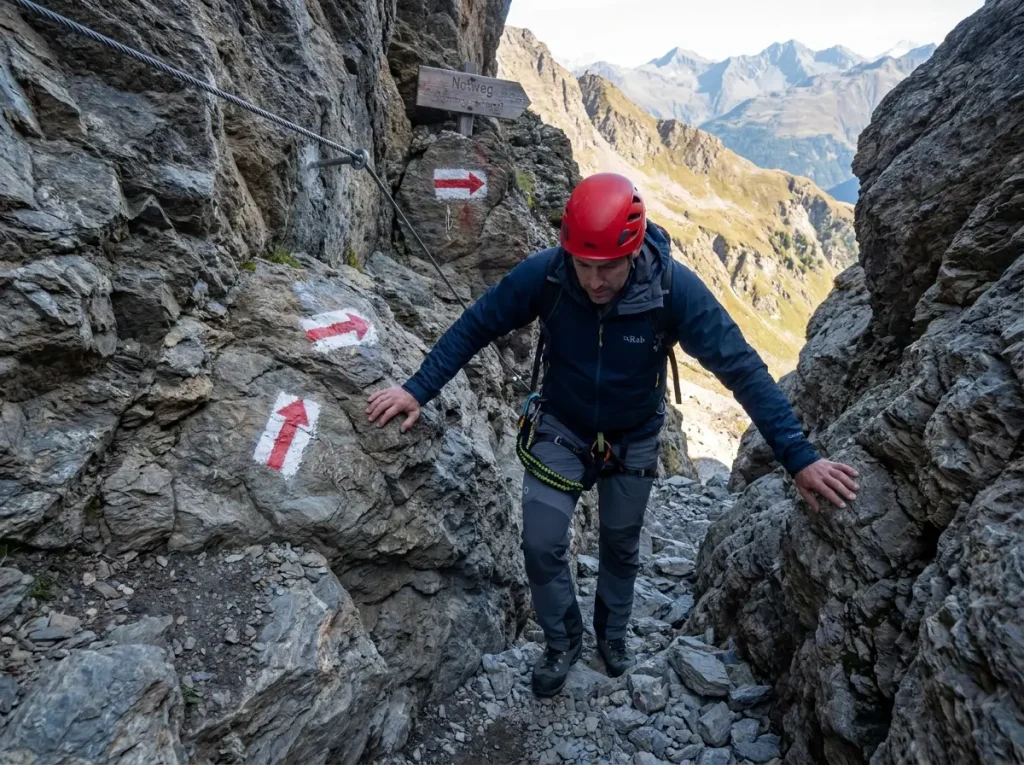
The cable route only goes one direction by design. When you need to go back, the logistics get complicated.
Downclimbing on a Via Ferrata
Retreating means downclimbing the sections you already ascended — with the cable below you instead of above you. The clipping sequence reverses: unclip the lower carabiner, move it past the anchor and re-clip below, then unclip the upper one. Keep your weight on your feet and use the cable for balance, not to lower yourself hand-over-hand. Your forearms are already tired from the ascent — arm-lowering burns them out faster than anything.
EN 958 Certification — Why Your Gear Needs to Be Current
EN 958 is the European safety standard for via ferrata sets. It specifies maximum impact force limits, energy absorber performance, and carabiner gate strength. The UIAA has issued recalls on sets that failed these standards — including one recall triggered by a fatal accident in Austria where both lanyard arms broke during a fall. Certified sets from Petzl, Edelrid, Black Diamond, Climbing Technology, and Mammut are tested to survive the forces a via ferrata fall generates. Uncertified sets, homemade lanyards, and old sets with degraded absorbers are where fatalities happen.
Check the manufacture date on your set. Most manufacturers recommend retiring via ferrata sets after 10 years maximum, regardless of use. If the webbing shows UV damage, fraying, or stiffness, replace it.
When to Call Mountain Rescue
If someone in your group cannot retreat unassisted — arms too pumped to hold the cable, freezing that won’t break, or an injury — activate your emergency plan. In the US, call 911. In the Alps, the standard mountain rescue number varies by country (140 in Austria, 112 in Italy). Give your location relative to the last anchor number or escape route junction. Stay clipped in, stay calm, and wait.
Via ferrata rescue teams are trained for this specific terrain. They’ll reach you faster if you can describe your position precisely. Some routes number their anchor points — note the numbers as you pass them.
Conclusion
Three things separate hikers who love their first via ferrata from those who end up in a rescue report. First, start easier than you think you should — a K1 or K2 route teaches you the clipping sequence, the movement patterns, and your exposure tolerance without putting you in over your head. Second, train your grip before you go, because your forearms will fail before anything else. Third, know where the escape routes are and have a plan for retreat before you clip into the first cable.
Via ferrata is the best way for hikers to experience vertical terrain without learning to rock climb. The infrastructure handles the protection. You handle the movement, the fitness, and the decision-making. Start with a guided route, learn the anchor sequence until it’s automatic, and build from there. The Dolomites will still be there when you’re ready for K4.
Q1 What is via ferrata and how does it work?
Via ferrata means iron way — it’s a climbing route equipped with permanent steel cables, metal rungs, and anchors bolted to the rock. You clip a Y-lanyard from your harness to the cable and move along the route, transferring carabiners at each anchor point to stay continuously connected.
Q2 Do you need climbing experience for via ferrata?
No climbing experience is required for beginner routes (K1-K2). You need reasonable fitness, sure footing, and comfort with heights. The fixed protection handles the safety system that ropes manage in climbing. A guided first experience teaches you the technique in a few hours.
Q3 What gear do I need for via ferrata?
Five things: a climbing harness, a certified via ferrata set (Y-lanyard with energy absorber), a helmet, gloves, and stiff-soled boots or approach shoes. Most guided operations rent all of it. If buying, prioritize the via ferrata set — get EN 958 certified, never used.
Q4 How hard is via ferrata for beginners?
K1 routes feel like secured hiking — minimal vertical, cable as handrail. K2 adds short steep sections and real exposure. Most beginners handle K1-K2 comfortably with basic fitness. The challenge isn’t the moves — it’s grip endurance and exposure tolerance, both of which improve fast with practice.
Q5 Can you do via ferrata alone?
Technically yes on unguided public routes, but it’s not recommended for beginners. A partner provides assistance if you freeze or get injured, and carries emergency communication gear. For your first several routes, go with a guide or experienced partner who knows the clipping sequence and escape routes.
Risk Disclaimer: Hiking, trekking, backpacking, and all related outdoor activities involve inherent
risks which may result in serious injury, illness, or death. The information provided on The Hiking Tribe is for
educational and informational purposes only. While we strive for accuracy, information on trails, gear, techniques,
and safety is not a substitute for your own best judgment and thorough preparation. Trail conditions, weather, and
other environmental factors change rapidly and may differ from what is described on this site. Always check with
official sources like park services for the most current alerts and conditions. Never undertake a hike beyond your
abilities and always be prepared for the unexpected. By using this website, you agree that you are solely
responsible for your own safety. Any reliance you place on our content is strictly at your own risk, and you assume
all liability for your actions and decisions in the outdoors. The Hiking Tribe and its authors will not be held
liable for any injury, damage, or loss sustained in connection with the use of the information herein.
Affiliate Disclosure: We are a participant in the Amazon Services LLC Associates Program, an
affiliate advertising program designed to provide a means for us to earn advertising fees by advertising and linking
to Amazon.com. As an Amazon Associate, we earn from qualifying purchases. We are also an official affiliate partner
of Black Diamond Equipment via the AvantLink network. If you click on a Black Diamond affiliate link and make a
purchase, we may earn a commission at no additional cost to you. We also participate in other affiliate programs and
may receive a commission on products purchased through our links. Additional terms are found in the terms of
service.