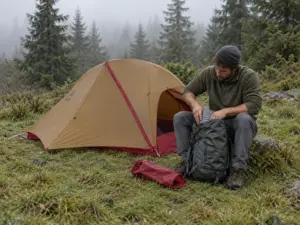




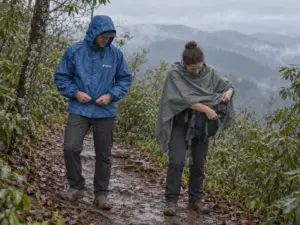




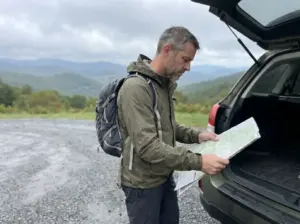






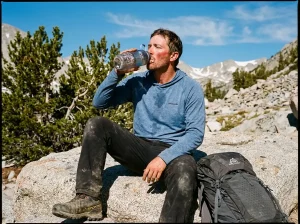

It’s 5:47 PM. The green tunnel has gone grey. You’ve walked 22 miles, your poles are damp from condensation, and you haven’t said a word out loud since you thanked a day-hiker at mile 8. The silence is no longer peaceful — it’s loud. Your brain is running loops on whether your girlfriend is okay, whether you’re wasting your life walking in circles, whether there’s any point to the next shelter. You’re not exhausted. You’re dissolving. This is not the hike you planned. This is Mile 147.
After years of watching hikers come apart in the Virginia section of the AT — not from blisters, not from bad weather, but from thirty consecutive days inside their own head — I’ll tell you what nobody in the gear guides will: loneliness is a technical risk factor, not a personality flaw. It has a biological mechanism. It can be measured. And it can be managed with the same precision you’d apply to water treatment or blister prevention.
Roughly 75% of people who start the AT don’t finish it. The gear community talks about this like it’s a footwear problem. It isn’t. In physically fit individuals, success on a thru-hike is primarily psychological — and the specific psychological variable that drops most people isn’t willpower or grit. It’s the Solitude Load.
This guide treats that load as a performance variable and gives you the framework to maintain psychological integrity across 2,000-plus miles.
⚡ Quick Answer: Thru-hike loneliness is a measurable biological stress response — not a sign you’re the wrong person for the trail. The HPA axis activates under social isolation the same way it does under physical threat, which is why loneliness feels like exhaustion. To counter it: schedule mid-day social contact (even five minutes with a day-hiker counts), deploy human voice audio (audiobooks, not music) through the danger hours, and build a camp setup ritual before the dusk window opens at 6:00 PM. If you’re walking stretches with no memory of the last mile, that’s not fatigue — that’s disassociation, and it requires an immediate trail exit.
The Biology of Loneliness on Trail (Why It Hits So Hard)

Most hikers frame quitting as a gear problem or a fitness problem. The data says otherwise. In physically fit individuals, thru-hike success is primarily psychological — and the biological mechanism behind that is the HPA axis.
The hypothalamic-pituitary-adrenocortical axis is how your body processes stress. Under sustained isolation, it interprets the absence of social connection as a threat, triggering hormonal cascades — dopamine and acetylcholine in the prefrontal cortex — the same way it would if you spotted a rattlesnake on the trail. The difference is that the rattlesnake eventually leaves. The isolation doesn’t.
The result, after weeks on trail, is what researchers call glucocorticoid resistance — your body stops translating those stress hormones into anti-inflammatory recovery signals. You feel physically off for no clear reason. Your legs aren’t that tired. Your pace is fine. But something is wrong, and you can’t name it. That’s the neuroendocrine mechanisms of social isolation at work, running your biology without your input.
The good news is that the brain can be trained to tolerate higher Solitude Loads before the first blaze. Start with the training plan that builds mental calluses alongside physical ones — these skills transfer directly to trail.
The HPA Axis and What Cortisol Actually Does to Your Decision-Making
A cortisol-flooded brain doesn’t just feel bad — it makes decisions differently. After 20 miles of route-following, weather reading, and landmark tracking, your prefrontal cortex is running on fumes. Add isolation stress and you get decision fatigue stacked on decision fatigue.
The hiker who takes an unfamiliar shortcut in bad weather, skips water treatment “just this once,” or pushes 4 extra miles into a deteriorating afternoon — that hiker isn’t reckless. They’re operating with a compromised stress-management system. The cortisol spikes of sustained isolation narrow cognitive bandwidth in measurable ways.
Pro-Tip: If you’re making decisions that a rested version of you would veto, your HPA axis is managing you. Eat, hydrate, stop moving, and put on an audiobook before you decide anything.
Polyvagal Theory — The Three States of the Thru-Hiker’s Nervous System
Dr. Stephen Porges’ Polyvagal Theory gives us the most useful map of what’s actually happening in a hiker’s nervous system across a 5-month trip.
The ventral vagal state is where you want to be: social engagement, low stress, good decision-making. You’re here when your Tramily is around, when town day is tomorrow, when the first miles are clear and cool. The sympathetic state is fight-or-flight — useful for acute emergencies, not sustainable. And then there’s the state nobody talks about in gear reviews: dorsal vagal shutdown.
Dorsal shutdown is the nervous system’s last resort under overwhelming load. It manifests not as panic — that would at least be actionable — but as emotional numbness. You keep walking. You stop registering the trail. You forget to drink water. You don’t care about the next shelter and you can’t explain why you don’t care. The transition from ventral to dorsal is not dramatic. It creeps. Most hikers don’t recognize it until they’re already in it.
What pulls you out? Vocalization. Humming, singing, talking to yourself. Not metaphorically — the auricular branch of the vagus nerve responds to the human voice frequency range (0.5–4.0 kHz) and physically shifts your autonomic state. This is also why the trail has produced, independently across every generation of hikers, the same coping behavior: talking to yourself in the woods.
The 100-Mile Crash — When the Honeymoon Ends
The AT will show you exactly where most people break: the Georgia–North Carolina section, in the first 100 miles. The 100-Mile Crash is when novelty depletes. The brain stops producing dopamine rewards for new scenery. Rain that felt like an adventure at Springer now just feels like rain. The early-trail blues arrive not because anything has gone wrong, but because the romantic version of long-distance trekking your brain was running has expired.
Some hikers romanticize the solitude from the start — a monk-like ideal of clean silence and deep thought. They discover within the first week that the silence of the woods is not peaceful the way they expected. It’s monotonous. Then it’s loud. That gap between expectation and experience is exactly what the 100-Mile Crash exploits.
This is not a signal to quit. It is a phase — a recognizable, documented phase — and the hikers who understand it as such survive it. The crash is not information. It’s a transition.
Pro-Tip: Never make a quit decision during the crash. Use the One More Resupply Rule — commit to walking to the next town before finalizing any decision. The crash typically breaks within a week. Most hikes that get abandoned at this stage would have completed if the hiker had walked two more days.
The Attrition Map — Where Loneliness Strikes Hardest
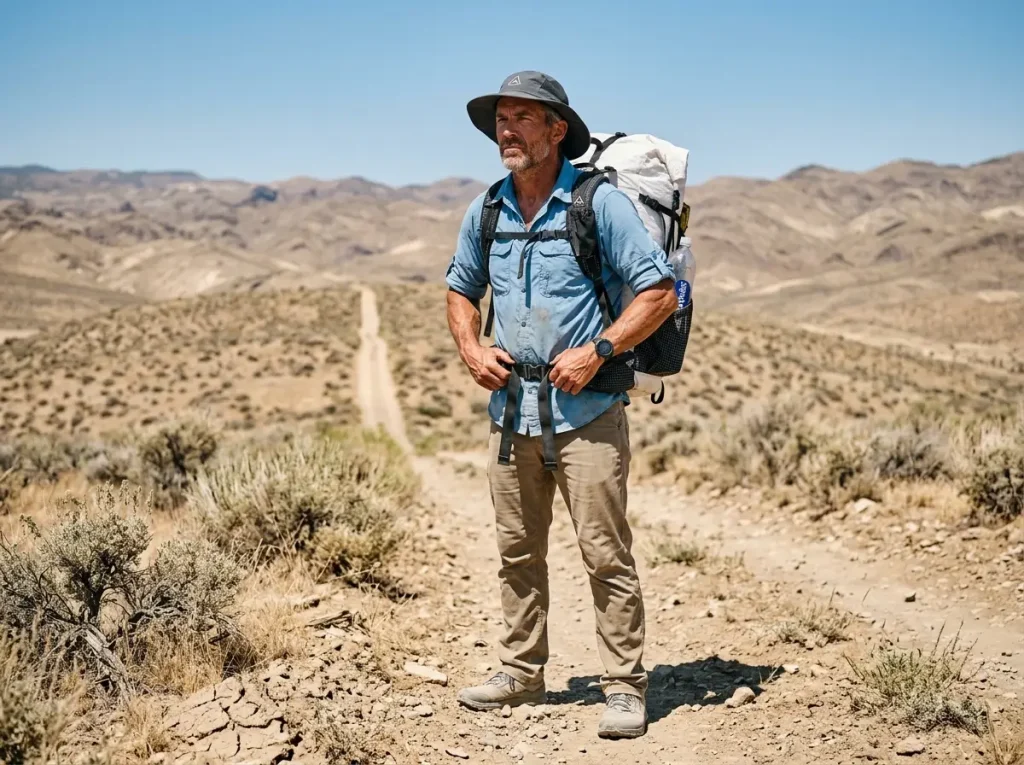
According to the official 2,000-miler completion statistics, the 2024 NOBO completion rate on the AT was 30%. SOBO was 14%. That gap isn’t random — it maps directly to where and when isolation hits hardest.
The geographic reality is that the AT is not one uniform experience. It’s three distinct psychological environments, each with its own attrition pattern and its own solitude anxiety profile. PCT hikers face a different but equally punishing gradient — an average of 34 nights alone across the trail versus 3 for AT hikers. Those are not comparable psychological environments.
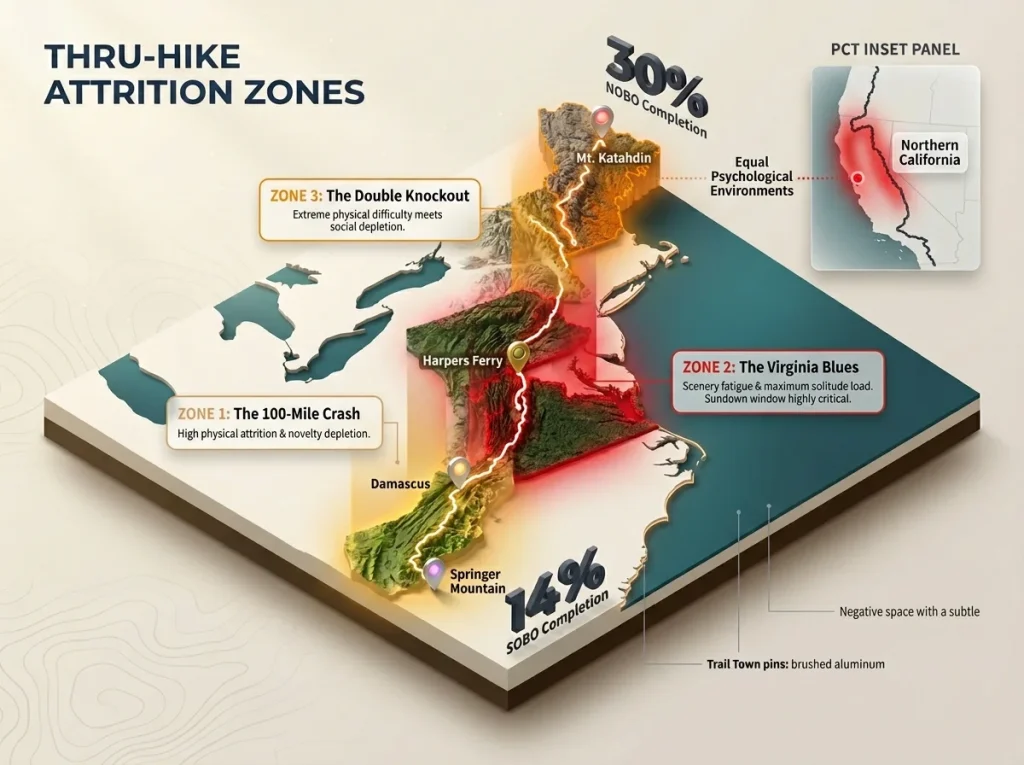
The AT’s Three Attrition Zones (and What Triggers Them)
Zone 1 runs roughly from Springer Mountain to Damascus — about 500 miles. This is where injury and early-disillusionment dropouts happen. The body is adapting, the gear is being tested, and people who romanticized the solo hike are meeting the actual version.
Zone 2 is Virginia. 550 miles. For most hikers, this is a full month of what feels like the same forest. The green tunnel goes from atmospheric to monotonous to genuinely disorienting. Scenery fatigue becomes the primary threat, not physical difficulty. Social bubbles from the Georgia start have disaggregated by pace — you may find yourself suddenly alone after weeks of social density. The mental calluses required to survive this section aren’t built on trail — they’re built before you ever hit Springer.
Zone 3 is New Hampshire and Maine. The last 500 miles. The physical difficulty spikes sharply, but many hikers are surprised to find it’s the social depletion — combined with the body being genuinely worn down — that creates the double-knockout. The bubble has thinned. Days go by without another northbounder visible.
Each zone requires different protocols. What works in Georgia doesn’t work in Vermont. This is a detail that most thru-hike guides skip entirely.
The PCT’s Solitude Gradient — Northern California and the Desert Mind
The PCT moves faster — 22.5 miles/day average versus the AT’s 15.2. More miles per day means less time in town, fewer social resets, and a bubble that moves quickly away from you if your pace drops for any reason.
Northern California is the PCT’s equivalent of Virginia — the section nobody adequately warns you about. At roughly mile 1,700, when mental fatigue and physical depletion are peaking simultaneously, the trail enters a long, exposed, socially sparse corridor that breaks hikers who made it through the desert with their heads together.
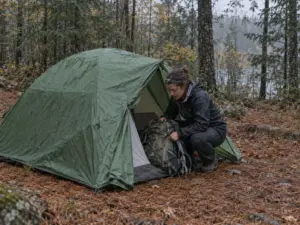
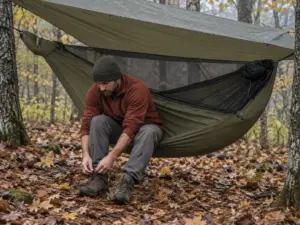
Cowboy camping — sleeping without a tent — increases vulnerability on a physiological level. Environmental exposure awareness goes up, and nocturnal anxiety follows it. If you’re hitting Northern California solo, the tent matters more for psychological regulation than weather protection. The psychological architecture of enclosure — walls between you and a dark and unfamiliar environment — is underrated gear.
The Harpers Ferry Crash — What the Data Shows
Harpers Ferry is the official psychological halfway point of the AT at mile 1,033. The ATC registers hikers there. That act of registration triggers something real — a brief, genuine euphoria. “I’m halfway there.”
Then the math arrives. You’ve walked 1,033 miles. You have another 1,100 to go. The brain expected to feel nearly finished; instead it’s facing a visual that looks like the start line.
Pro-Tip: Pre-compute Harpers Ferry before your hike. Look at the number while you’re at home, eat dinner, and go to bed. Normalize the emotional math before you arrive, so the crash has no shock component when it comes.
The Sundowning Effect — Why Dusk Is the Danger Hour
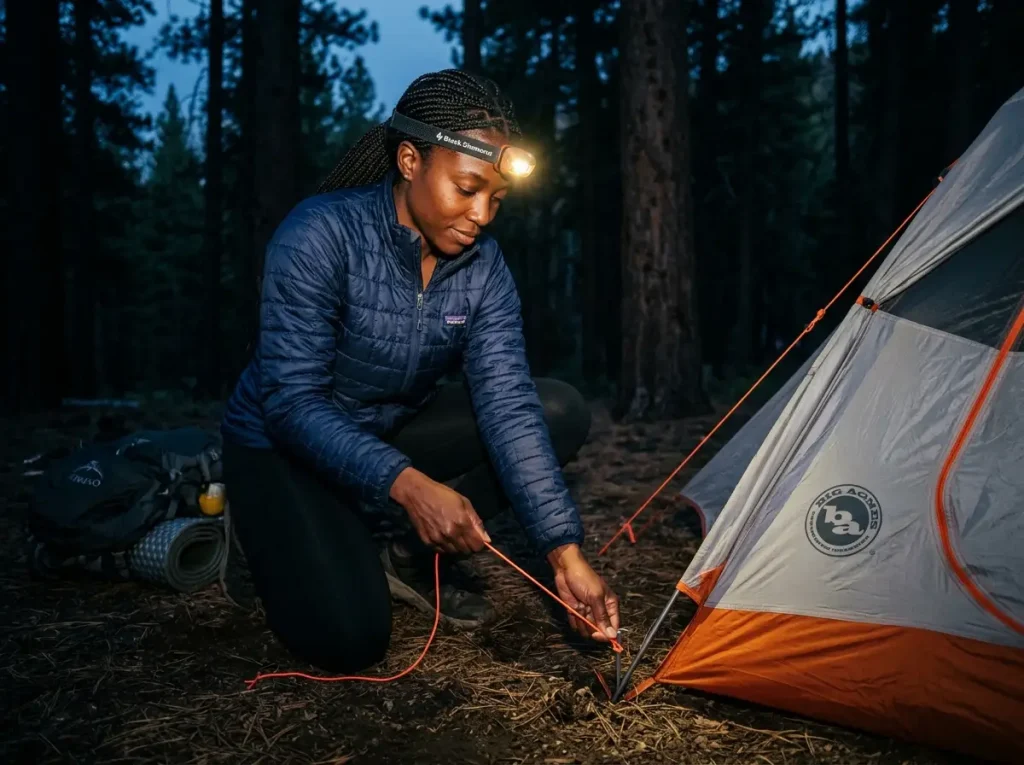
Every hiker I’ve talked to who quit mid-Virginia mentioned the same time window: sitting in their tent at six in the evening. That’s not a coincidence. That’s circadian biology hitting a predictable target.
Sundowning is a clinical term for the increase in confusion, anxiety, and agitation that occurs as daylight fades. It’s typically associated with dementia, but the same environmental triggers apply to thru-hikers via different mechanisms. For help understanding the clinical picture behind it, Mayo Clinic’s resource on managing the sundowning phenomenon is worth reading — the biological triggers map directly to trail conditions.
The 6:00–8:00 PM window is statistically the loneliest time on trail. The distractions end. The camp is set. The silence starts. That’s when the thought loops begin, and if you’re not already running a protocol, you’re responding to a problem instead of preventing one.
The Four Environmental Triggers of Trail Sundowning
Four things are hitting simultaneously as the sun drops:
First, low lighting. Evening shadows in dense Virginia forest increase visual uncertainty, and a stress-primed amygdala reads shadows as potential threats. Second, circadian disruption — irregular sleep-wake cycles and 12-hour days of sun exposure disrupt the suprachiasmatic nucleus within 2–3 weeks on trail, which is roughly when most hikers reach Virginia.
Third, cognitive fatigue. After navigating terrain, reading weather, and tracking landmarks for 8+ hours, the prefrontal cortex has very little left for emotional regulation. Fourth, unmet physical needs — hiker hunger peaks in late afternoon, and chronic inflammation from repetitive loading contributes to an agitated baseline state.
These four triggers don’t add up. They multiply. A hiker who is hungry, cognitively depleted, and in low light is not three times more vulnerable than baseline. They’re in a qualitatively different psychological state.
The Dusk Anxiety Cycle and How It Compounds
As the sun sets, the internal clock misfires. The hiker sits in the tent with nothing to distract them and the thought loops start: home, relationships, whether this decision was a mistake, whether they’re “the kind of person who finishes.”
The more you try to suppress those loops, the louder they get. Suppression amplifies. If this cycle repeats for three to five consecutive evenings without intervention, a hiker begins to dread camp arrival — making the last miles of each day psychologically aversive even before the dusk window opens.
Pro-Tip: Build a camp arrival ritual that you execute the moment you stop moving — tent, water filter, food, audio on. The moment you stop moving without a plan is when the spiral begins. Structure is the protocol.
The Human Voice Protocol — The Physics of Sound as a Loneliness Fix

Here is what competitors completely miss: audiobooks are not comfort food. They are a physiological intervention.
The Safe and Sound Protocol developed by Dr. Stephen Porges demonstrates that the nervous system has evolved to detect social safety signals specifically through voice frequencies in the 0.5–4.0 kHz range. These frequencies stimulate the auricular branch of the vagus nerve — mechanically shifting the body from dorsal vagal shutdown toward ventral vagal engagement. The research on this mechanism is documented in the neuroendocrine mechanisms of social isolation literature.
This is categorically different from music. Music activates the auditory cortex and emotional centers but doesn’t consistently fire the vagal safety response. The human voice carries a specific frequency signature that the nervous system interprets as “social proximity = safety.” The thousands of AT and PCT hikers who report that an audiobook narrator “saved their hike” through Virginia and Northern California are describing a real physiological event.
For the sections where even recorded voices aren’t enough, virtual hiking communities can bridge the gap during zero and nero days — the forums, apps, and live chats where the trail stays social even when the miles don’t.
Why Audiobooks Work (And Music Doesn’t Do the Same Job)
A single, warm-toned narrator creates what you might call a social proxy. The brain partially registers the voice as social presence, reducing the perceived threat of isolation. Two voices in a conversational podcast work even better — they simulate social dynamics the nervous system is already calibrated to read.
The ranking, from most to least effective for vagal regulation: narrative audiobooks with a single narrator, then conversational podcasts with two or more voices, then music, then silence. On the wrong end of that scale: harsh-toned voices, news or conflict-heavy content (which triggers the sympathetic response), and electronic music without vocal elements.
Pro-Tip: Download 40+ hours of audiobooks before the Virginia section specifically — enough to carry you through the entire stretch if needed. Treat this the same way you’d treat your water filter: weigh it, carry it, use it every single day.
Humming, Singing, and Talking to Yourself — The Free Vagal Protocol
You don’t need a narrator. You can be your own intervention.
Vocalization stimulates the vagal nerve from the inside, via the larynx. A 10-minute hum while making camp is not a quirky coping mechanism — it’s a vagal reset with no gear weight. Even low-frequency humming activates the auricular branch sufficiently to shift autonomic state. Hikers often feel self-conscious about talking to themselves in the woods — especially around other people. The data says it’s one of the most effective free tools available, and anyone who judges you for it has never spent 30 solo days in the Virginia green tunnel.
This is also why trail names, trail games, and narrating your own hike out loud emerge organically across every generation of AT and PCT hikers. They’re not eccentricities. They’re self-regulation, discovered independently by people who needed it.
The Tramily System — Social Architecture as Safety Infrastructure
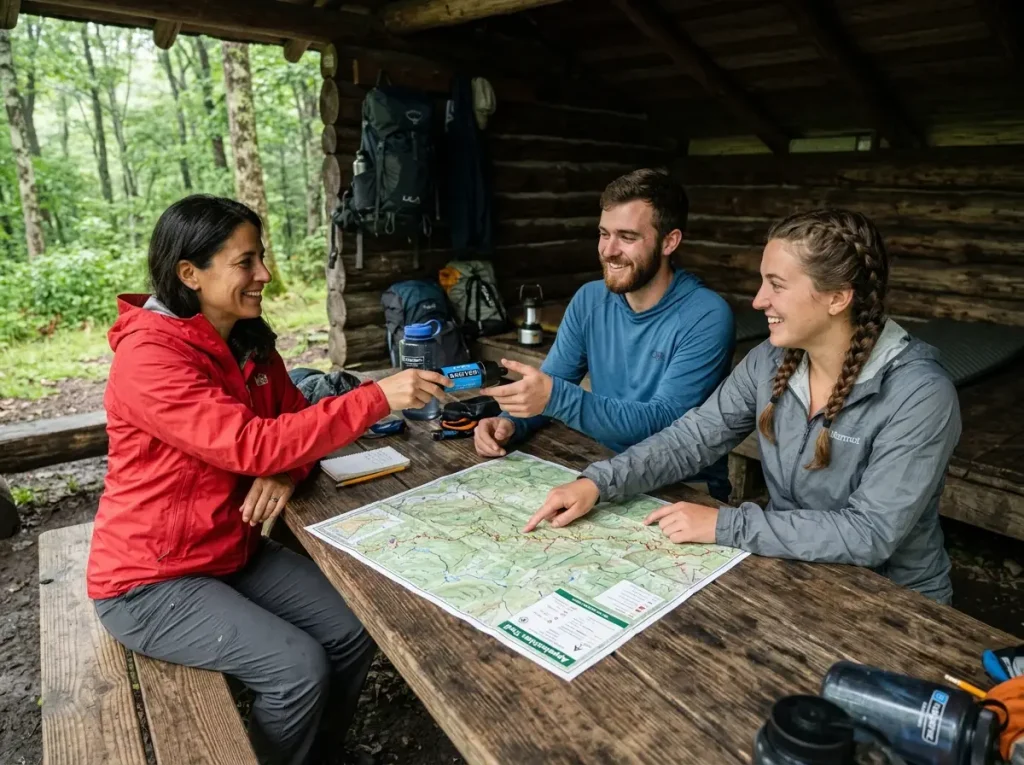
A Tramily — trail family — is not a social bonus. It is a safety system. Proximity to other humans signals the nervous system that the environment is not a threat. You don’t even need to be talking. Shared physical space in camp, another tent visible through the trees, the sound of another stove — these are sufficient input for the ventral vagal system to dial back the isolation response.
For solo hiker safety frameworks, the backcountry risk assessment protocols from the PCTA are worth studying — they make clear that solo hiking is a measurably higher-risk environment than group travel, and not just for navigation reasons.
But here’s where most hikers misconstruct the Tramily: they treat it as a social outcome rather than a structure they can build intentionally. And when the group dissolves — which it almost always does, because someone always quits or outpaces you — they have no backup plan.
The trail angel network functions as an emergency social reset when the trail runs dry of contact. Trail community resources — like using volunteering and trail maintenance opportunities to meet people with shared values — offer a guaranteed warm interaction with people who actively want to see you succeed.
How to Build a Tramily Without Forcing It
The fastest Tramily formation method: camp at the same shelter for two consecutive nights with the same people. Shared adversity bonds faster than easy miles. Rain, cold, and a hard approach build more social cement in 48 hours than a sunny week.
Pace is the primary Tramily killer. A one-mile-per-day pace differential, compounded over weeks, turns a tight group into a spread-out string. Establish pace compatibility in the first conversation — not halfway through the week when you’re already attached.
The healthiest Tramilies are loose: 3–4 shared days, then independent miles, then reunion at town stops. This allows autonomous pace and social safety without the group dynamics that grind tight-lock clusters apart in Virginia.
The Solo Integrity Protocol — Surviving Without a Tramily
You cannot, and should not, plan your hike around a Tramily existing. The solo hiker must also be able to function.
Three tools: scheduled social contact (a voice call, not text, at every zero day), the Human Voice Protocol running continuously through the afternoon and evening, and a Daily Micro-Goal System — small route targets that give a solo brain forward momentum when big mileage goals feel abstract.
The “Don’t Pack Your Fears” principle applies here too. Over-packing physical gear is a documented proxy for psychological anxiety. Heavy packs slow hiking, increase fatigue, and increase solitude anxiety vulnerability. Go light in every measurable sense.
When a Tramily Breaks Apart — The Emergency Protocol
Someone always quits or speeds ahead. Group dissolution is the statistical norm on both the AT and PCT — plan for it.
The emotional response to Tramily loss mirrors real relationship loss, because the brain uses the same neural circuitry for social pain and physical pain. The acute mistake is making pace decisions in that emotional state — sprinting to catch them, or slowing to avoid passing them. Hold your pace.
Practical steps: contact the virtual community (AT/PCT Facebook and Reddit groups) to identify incoming hikers at your pace, plan a reset nero at the next town, and immediately queue the audio. Don’t wait until you’re in the spiral.
Pro-Tip: Before your primary group forms, build “backup Tramily awareness” — know who’s 1–2 days behind you that you’d hike with again. Trail names help. A mental list of candidates is an actual safety resource.
The Anti-Loneliness Daily Protocol (A Maintenance Schedule)

This is not a suggestion list. It is a maintenance schedule, like seam-sealing your tent or backflushing your filter. Skip it for a week and you pay for it.
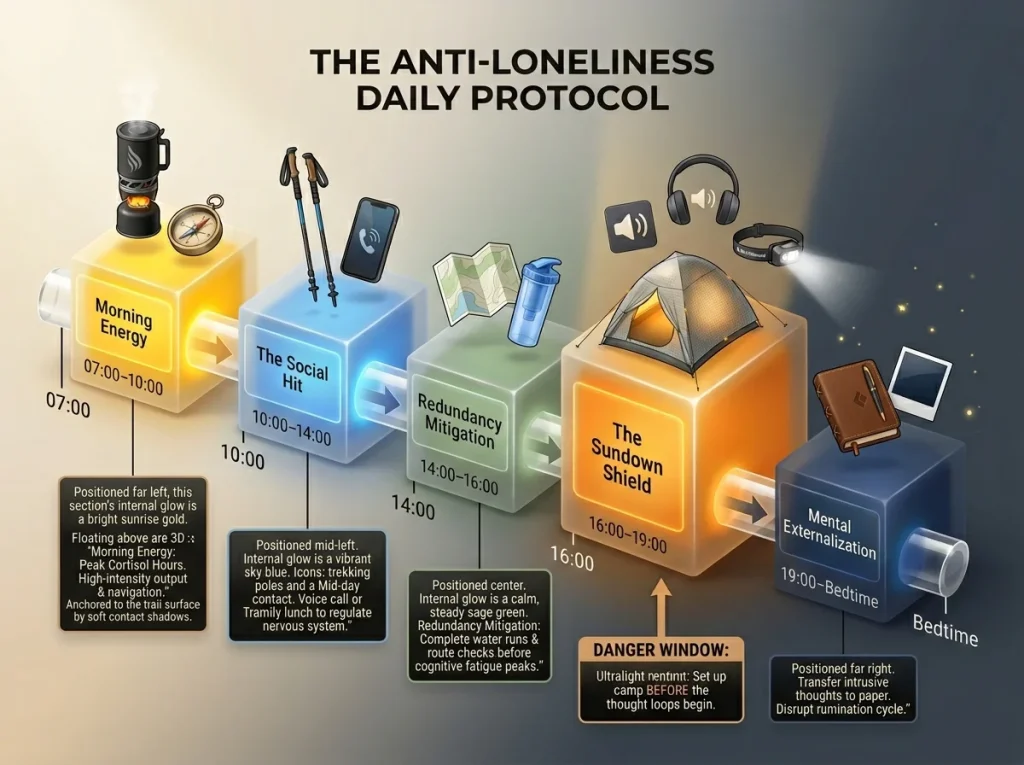
The protocol runs on the same circadian rhythm the trail is going to disrupt. It capitalizes on peak cortisol hours in the morning, schedules social contact at midday, deploys the Acoustic Protocol through the afternoon, and builds the Sundown Shield before the danger window opens. Strategic zero days and nero days aren’t laziness — they are the zero day planning guide for strategic recovery executed correctly: biological necessity, mental reset, community re-engagement. The best thru-hikers I’ve watched maintain a daily rhythm so disciplined they look robotic. They’re not boring — they’re well-regulated. The ones running purely on spontaneity usually quit in Virginia.
The five protocol blocks: Morning Energy (07:00–10:00), The Social Hit (10:00–14:00), Redundancy Mitigation (14:00–16:00), The Sundown Shield (16:00–19:00), Mental Externalization (19:00–Bedtime). Each block addresses a specific biological vulnerability. The sequence is not arbitrary.
The Morning Block — Capitalizing on Peak Cortisol Hours (07:00–10:00)
Cortisol is naturally highest in the morning — the cortisol awakening response is a measured biological phenomenon. This is your daily peak for high-intensity physical and cognitive output. Use it for maximum mileage and active navigation. The brain’s executive function resources haven’t been depleted yet, which means this is also the right time for any logistical planning: reading maps, identifying water sources, recalibrating shelter options.
This is not the window for philosophical questions about whether you’re doing the right thing with your life. That’s not a dig — it’s a protocol rule. The same stress-management system that handles navigation also handles existential loops, and you only have so much of it per day. Protect the morning block. Set a mileage number before leaving camp. Concrete forward targets give your brain a track to run on. Eat before you start — the cortisol peak runs on glucose, and “first miles on an empty stomach” is a misery protocol with no upside.
The Sundown Shield — Building a Camp Arrival Ritual (16:00–19:00)
Start looking for camp at 4:00 PM, regardless of whether you’ve hit your mileage target. The Sundown Shield requires you to be set up and functional before the dusk window opens.
The protocol sequence matters: tent → light → food → audio → journaling. Start the high-output headlamp before the shadows accumulate — understanding headlamp lumens and how lighting physics work will help you choose the right tool for counteracting the low-light trigger. Queue the audiobook before you eat. Eat before you journal. Reversing the order — writing in the dark before eating — amplifies anxiety rather than reducing it.
After the meal: journaling and looking at photos from home. These are not sentimental indulgences. Moving intrusive thoughts from internal loops to external paper disrupts the rumination cycle. Photographs regulate oxytocin.
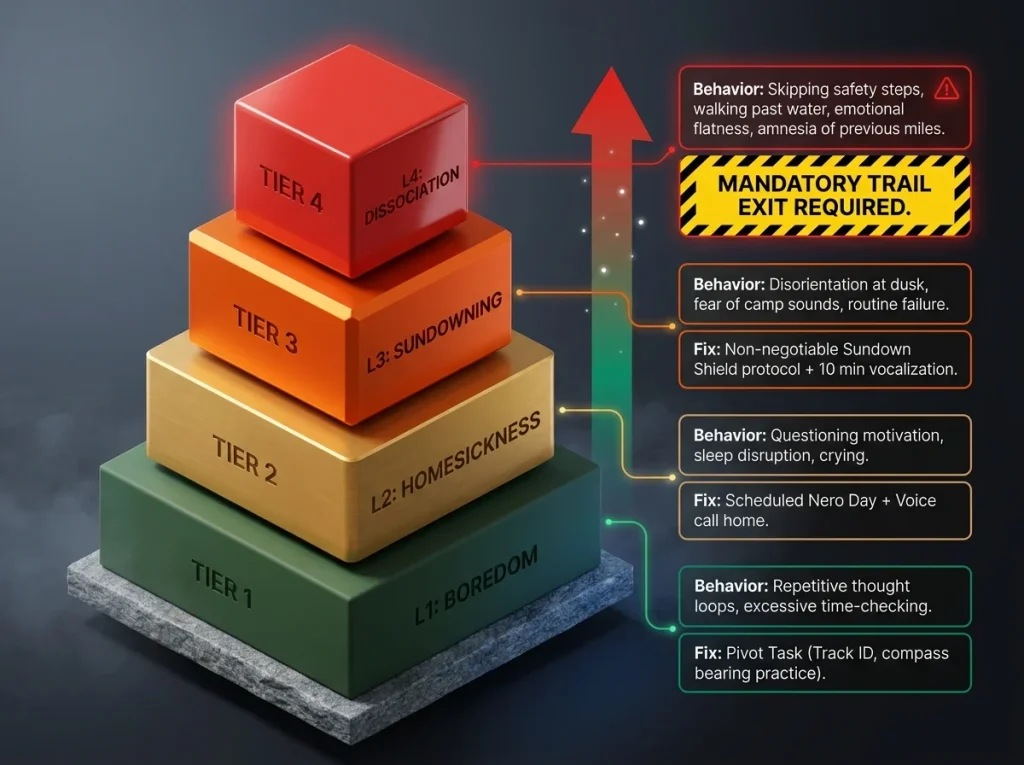
The Disassociation Risk Matrix — When Loneliness Becomes Hazardous

There is a clinical threshold between “lonely” and “dissociated.” On the trail, disassociation is a safety emergency — it impairs navigation, fire safety, water treatment judgment, and emergency response. This is not weakness. It is a neurological state documented in the neuroendocrine mechanisms of social isolation research, and it requires the same response as any other medical emergency.
Levels 1–2 — Boredom and Homesickness (Self-Managed)
Level 1 — Boredom: Repetitive thought loops, excessive time-checking, inability to engage with the environment. Acceptable for 1–2 days. Beyond that, intervention required.
The fix is a Pivot Task — consciously reassign attention to a specific environmental observation task. Track ID. Plant photography. Compass bearing practice. Anything that forces the prefrontal cortex to engage with the external world instead of internal loops.
Level 2 — Homesickness: Persistent longing for home, questioning trip motivation, reduced appetite, sleep disruption. The fix is a Nero Day — not a zero, a nero (5–10 miles, then town stop). Voice call home — voice, not text. Big meal. Human contact in-person. Return to trail the next morning.
Pro-Tip: Build nero days into your itinerary before you leave home, specifically through Virginia. Scheduled contact points reduce the psychological weight of uncertain isolation. A planned nero feels like a reward. An emergency nero feels like failure.
Level 3 — Sundowning (Routine-Dependent)
Level 3 markers: confusion or disorientation as light fades, fear response to normal camp sounds after dark, pacing or inability to settle, failure to complete routine tasks (tent, filter, cook).
At this level, the full Sundown Shield protocol is non-negotiable, and arriving after dark removes your most powerful intervention. If you’re at Level 3, add the vocal protocol — sing or hum for 10 minutes after camp setup before you do anything else. Not optional. It’s a vagal reset that costs nothing and works.
If Level 3 persists for 3+ consecutive evenings without improvement, move to a nero or zero. Don’t push through. Pushing through Level 3 is how you arrive at Level 4.
Level 4 — Disassociation (Mandatory Bail Required)
Level 4 is identifiable by specific behavioral markers: walking past planned landmarks without registering them, skipping safety steps (water treatment, tent anchoring, fire management), inability to recall the last 20–30 minutes of hiking, emotional flatness that extends to an inability to feel concern about risky behavior.
I’ve watched a dissociated hiker walk right past a water source they had been specifically looking for — just kept moving. They weren’t tired. They weren’t lost. Their brain had stopped logging new information. That state ends hikes. Sometimes it ends lives.
This requires immediate action: notify a hiking partner or trail contact. Exit to town. Zero for a minimum of three days. Voice contact with home. Consider consulting a physician. If you reach Level 4 and the wilderness first aid protocols for backcountry psychological emergencies apply, use them — Level 4 is in that territory.
The “Why Whiteboard” method: write your reasons for hiking on paper. At Level 2–3, reading them is maintenance. If reading them at Level 4 produces no emotional response, that’s a diagnostic — you need the rest before the whiteboard will work.
Conclusion
Three things you need to carry out of here:
Loneliness is a technical risk factor. The HPA axis doesn’t respond to willpower. It responds to structured intervention: social contact, human voice frequency, circadian management. Treat it the same way you’d treat blister prevention — before it happens, on a schedule, every day.
The dusk window is the most hazardous daily interval. Build your Sundown Shield before 4:00 PM. Tent up, lights on, audio running, food in hand. This is the protocol. The order matters.
Know your level. The four-stage Disassociation Risk Matrix is your diagnostic. Levels 1–3 are manageable on trail with the right responses. Level 4 is a mandatory exit, and there is no version of toughness that overrides that.
Pick one block from the daily anti-loneliness protocol and run it on your next overnight. Not the full system — just one block. The Morning Block is easiest to start with. Build from there.
FAQ
How do I not get lonely on a solo thru-hike?
You will get lonely — that’s biological, not a failure. The goal is managing solitude anxiety with a structured daily protocol: scheduled social contact at midday, continuous audio (human voice frequencies, not music) through the afternoon, and a Sundown Shield ritual at camp setup. Treating loneliness as a technical variable the same way you’d treat hydration or caloric balance is the correct frame.
Is it weird to talk to yourself while hiking?
No — and it’s more useful than most hikers realize. Vocalization (talking, humming, singing) stimulates the auricular branch of the vagus nerve, which can physically shift your nervous system out of a stress or shutdown state. It’s not a quirk; it’s a free vagal protocol with zero gear weight.
How long does it take to find a trail family on the AT?
Most Tramilies form within the first 100 miles, but early groups form around pace proximity, not values compatibility. Plan for 2–3 weeks before a genuine, pace-matched Tramily solidifies. Don’t force it in the first week. Loose clusters — shared shelter nights, independent miles, town reunions — are more sustainable than tight-lock groups.
How do thru-hikers deal with homesickness?
The most effective intervention is a voice call (not text) to someone at home during the mid-day Social Hit window. Voice activates the ventral vagal response; text does not. Keep calls to 15–20 minutes — long calls can destabilize emotional equilibrium for the rest of the day. Also: don’t call from your tent during the dusk window. That’s the worst timing biologically.
What is the Virginia Blues and how serious is it?
The Virginia Blues is the documented psychological crash that occurs during the AT’s 550-mile Virginia section — the primary attrition zone on trail after the initial early-mile drop-off. It’s caused by scenery fatigue, routine sameness, and social bubble disaggregation — not physical inability. Serious enough that it accounts for a disproportionate share of mid-trail quits. Treatable with pre-planned nero days, the 100-Mile Crash reframe, and the daily anti-loneliness protocol described above.
I've spent more than a decade researching hiking gear and trail technique. I read the specs, the forum threads and the long-term reviews, and every pick here comes with what it gets wrong.
End of the trail
You read every mile of this one. Here's where the trail goes next.