
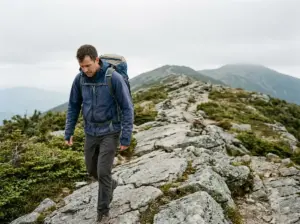
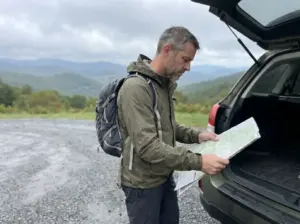
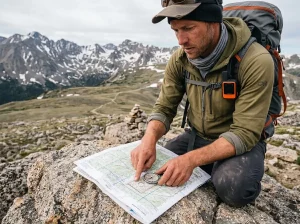

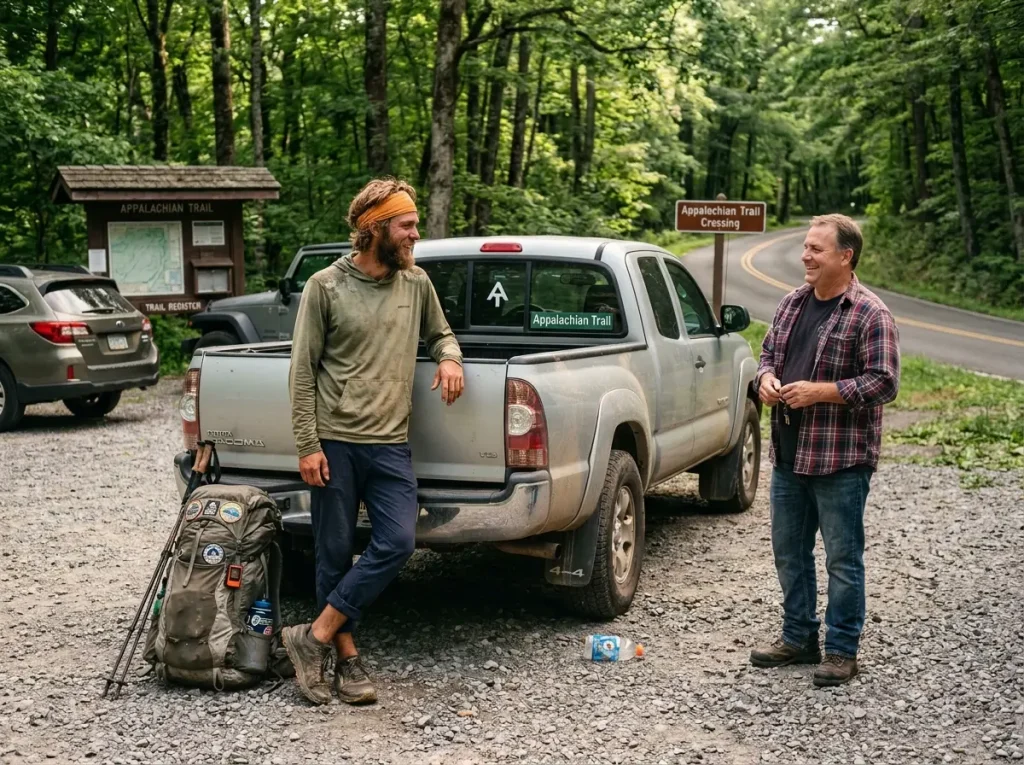
Standing at a road crossing in rural Virginia with your thumb out, watching cars blow past at 55 mph while exhaust fumes mix with your hiker funk — that’s the version of hitchhiking most people picture. I did it that way for my first 500 miles on the AT and got maybe one ride for every 45 minutes of standing there. Then a thru-hiker with 3,000 miles under her belt showed me the approach that actually works, gets you picked up faster, and is dramatically safer. Turns out the roadside thumb is the least effective and most hazardous way to get a ride on trail.
Quick Answer: The safest way to hitchhike on a thru-hike is to skip the roadside thumb entirely. Instead:
- Approach people directly in parking lots, gas stations, and trailhead areas
- Chat them up face-to-face before asking for a ride
- Text a photo of the license plate to your emergency contact before getting in
- Keep your phone, ID, satellite messenger, and pepper spray on your person — not in your pack
- Hitch with a partner whenever possible, especially as a solo woman
- Time your town stops to coincide with the hiker bubble for maximum trail-community support
Why Thru-Hikers Hitchhike (And Why It’s Not Optional)
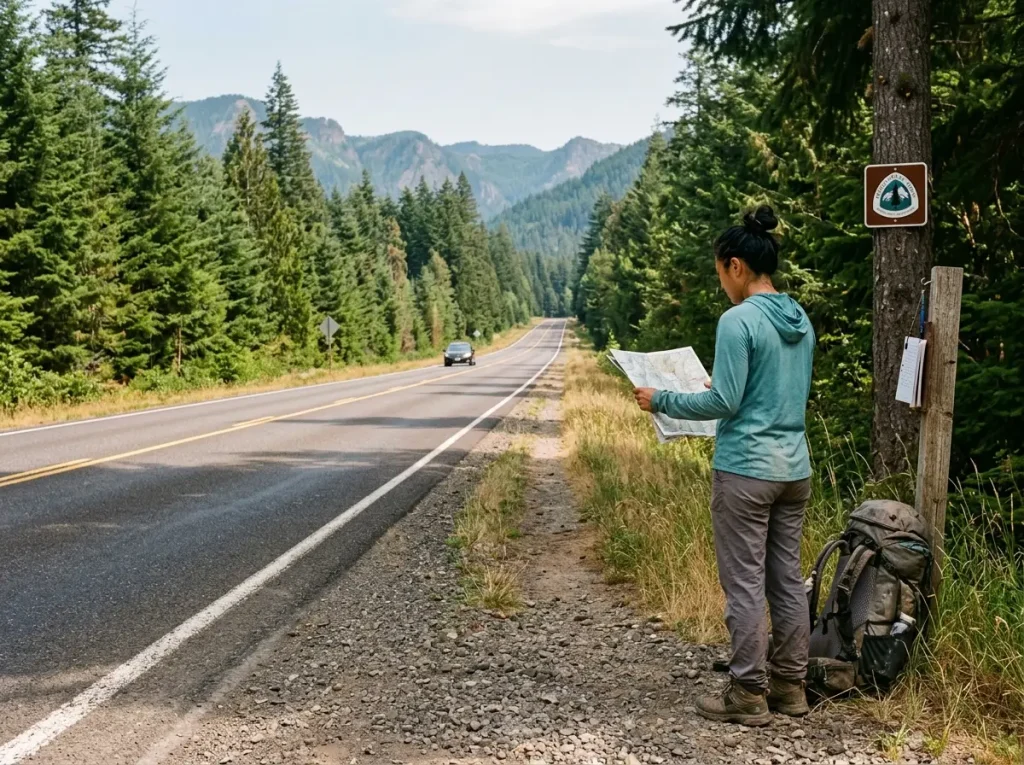
If you’ve never thru-hiked, the hitchhiking part sounds optional. It’s not. The Appalachian Trail crosses roads roughly every 20-30 miles, and the nearest grocery store, post office, or outfitter might be 5-15 miles down the highway from that crossing. The Pacific Crest Trail is worse — some resupply points require rides of 20+ miles on roads with zero cell service.
You need food every 3-5 days. You need to pick up mail drops. You need to replace worn gear, restock first aid supplies, and occasionally get to a laundromat before your tramily votes you off the trail. Walking an extra 10-30 miles on pavement — with a pack, on legs that just covered 25 trail miles — isn’t practical. It’s a recipe for injury.
Pro tip: Budget for 15-25 hitches over a full AT thru-hike and 10-15 on the PCT. That number goes up if you skip expensive shuttle services and down if you plan your resupply strategy around towns accessible on foot. Knowing the number in advance keeps you from being surprised when the first road crossing comes.
Some hikers plan hitchhike-free thru-hikes by pre-arranging shuttles, using trail angel networks, and choosing resupply strategies that keep them near walkable towns. It’s possible on the AT. It’s nearly impossible on the PCT and CDT without a serious budget for shuttles. For most thru-hikers, hitchhiking isn’t a lifestyle choice — it’s infrastructure.
The Parking Lot Approach vs. the Roadside Thumb
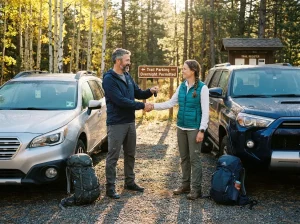
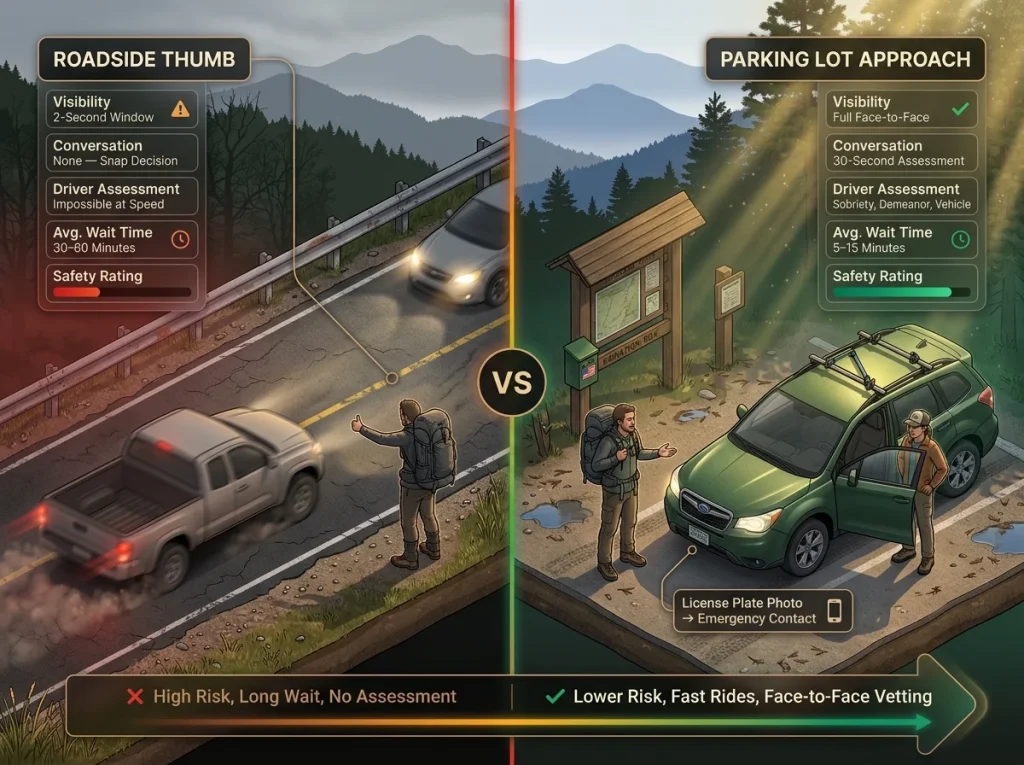
Here’s the strategy that changed everything: stop standing by the road. Go to where people are already stopped.
Why Face-to-Face Beats the Thumb
When you stick your thumb out on a highway, drivers have about two seconds to decide whether to stop for a stranger. They’re moving at speed, they can’t see your face clearly, and stopping means pulling over on a narrow shoulder with traffic behind them. Most people drive past not because they don’t want to help, but because the whole setup feels sketchy and inconvenient.
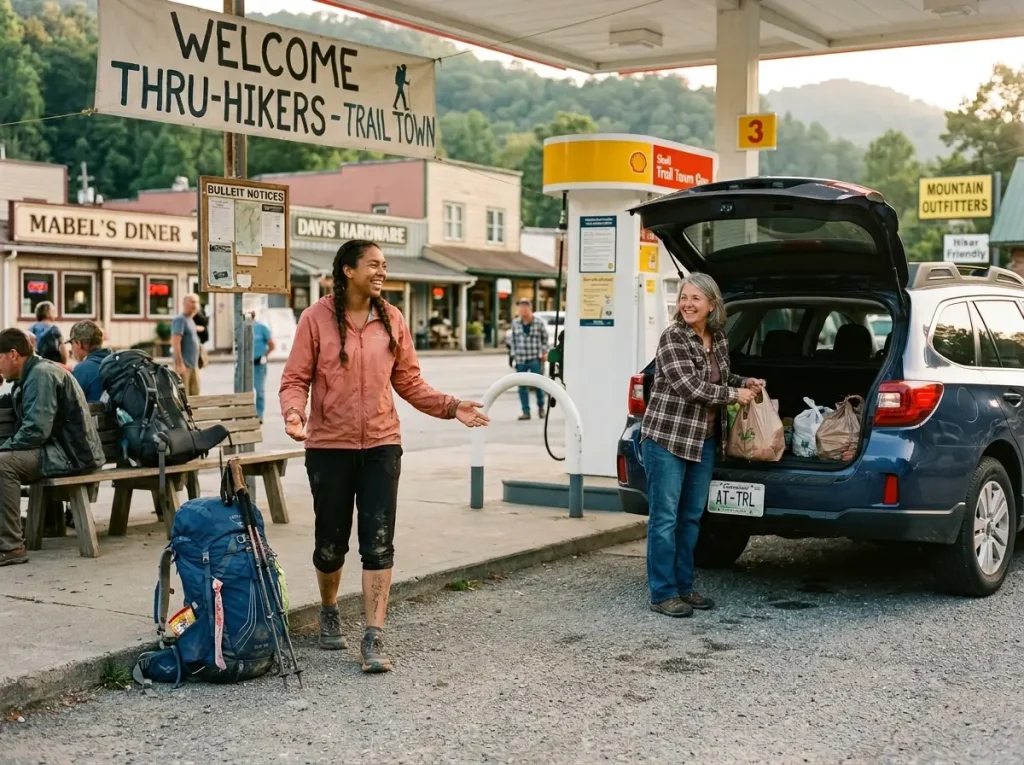
At a parking lot — trailhead, gas station, general store, outfitter — everything changes. The driver is stationary. They can see your face, your pack, your trail-worn appearance. You can introduce yourself, explain where you’re going, and have a 30-second conversation that lets both of you assess the situation. It’s harder to say no to a polite, smiling hiker standing three feet away than to a silhouette by the road.
Where to Make Your Approach
Trailhead parking lots are the best option. People parked at a trailhead are already outdoor people — they understand hikers, they’ve probably picked one up before, and many actively look for the chance. Gas stations within 5 miles of a trail crossing are second best. General stores in trail towns are third.
Outfitters are a special category. Walk in, ask if anyone is heading toward the trailhead or town, and the staff will often connect you or offer a ride themselves. These stores exist because of hikers — they want you to succeed.
Pro tip: When approaching someone in a parking lot, remove your sunglasses and make eye contact first. Lead with your trail name and what you’re hiking: “Hey, I’m Switchback — I’m thru-hiking the AT and I’m trying to get to Damascus. Any chance you’re heading that way?” The trail context immediately frames you as a hiker, not a random stranger.
The Approach Script That Works
Keep it simple and honest. Introduce yourself. Name the trail. Name the town. Smile. If they say no, thank them and try the next person. Most thru-hikers report that the parking lot approach gets a ride in 5-15 minutes compared to 30-60 minutes roadside — and the rides tend to be friendlier because the driver chose you after a conversation, not a snap decision at 50 mph.
Before You Accept the Ride
Getting a ride is only half the equation. The other half is making sure the ride is a good idea before your pack goes in the trunk.
The 30-Second Assessment
Exchange a few words with the driver before committing. You’re checking for three things: sobriety (slurred speech, bloodshot eyes, open containers), demeanor (friendly and conversational vs. evasive or aggressive), and vehicle condition (is this a functioning car with working door handles, or something that looks like it shouldn’t be on the road).
None of this needs to be dramatic or obvious. A normal “Hey, thanks for offering — where are you headed?” conversation gives you 30 seconds of data. If anything feels off — anything at all — decline. A simple “Thanks, but I think I’ll wait for the next one” is enough.
The License Plate Protocol
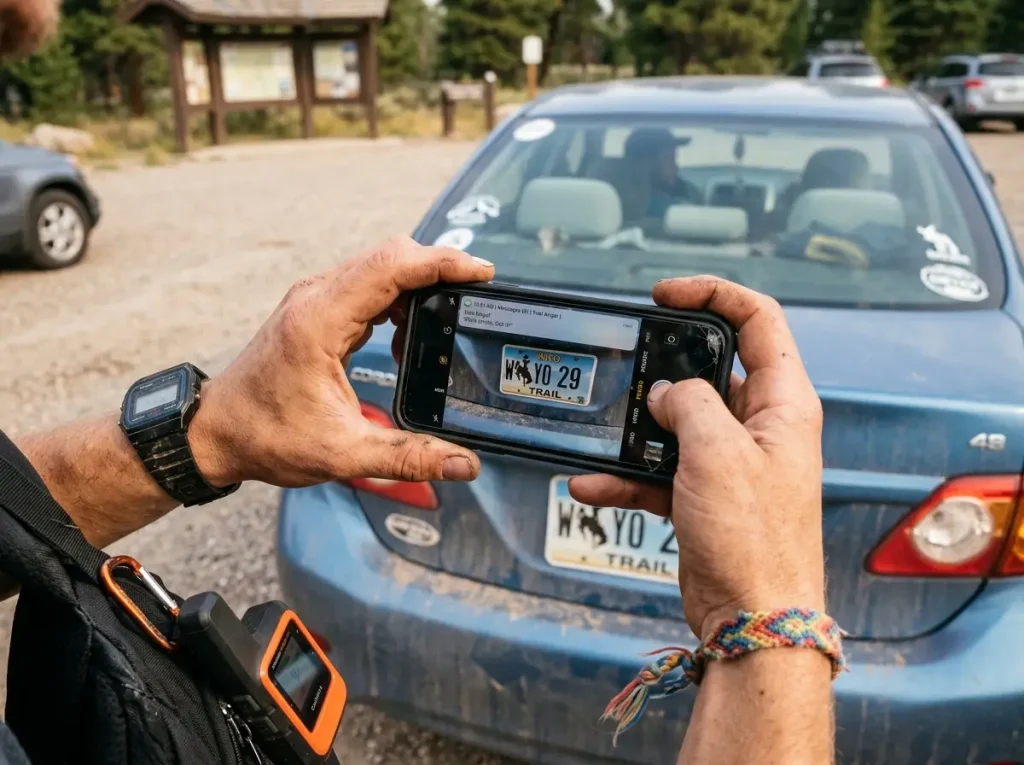
Before you get in, snap a photo of the license plate with your phone. Text it to your emergency contact — a parent, partner, or trail friend who’s expecting it. No explanation needed. They know the system because you set it up before your hike.
If the driver sees you doing this and reacts badly, that’s your answer. A normal person doesn’t care. Someone with bad intentions does. This one action is the single most effective safety measure in hitchhiking and most thru-hikers skip it because it feels awkward. Do it anyway.
Trust Your Gut — And Have an Exit Line
If the driver seems fine but something in your gut says no, listen to it. Your subconscious processes social cues faster than your conscious mind. “Actually, I just realized my buddy is catching up — I’m going to wait for them” is an exit line that works every time.
The flip side: most rides are genuinely kind people. Locals near trail corridors know thru-hikers. They’ve been picking up hikers for years. Some will buy you a meal, tell you about their own hiking days, or go miles out of their way to drop you at a hostel. The vast majority of hitchhiking interactions on the AT and PCT are positive — but the safety protocols exist for the small percentage that aren’t.
Internal link context: managing the anxiety around hitchhiking is its own skill. If the whole concept makes you nervous, practical strategies for managing backcountry anxiety apply to road crossings as much as they do to trail situations.
What to Keep on You (Not in Your Pack)
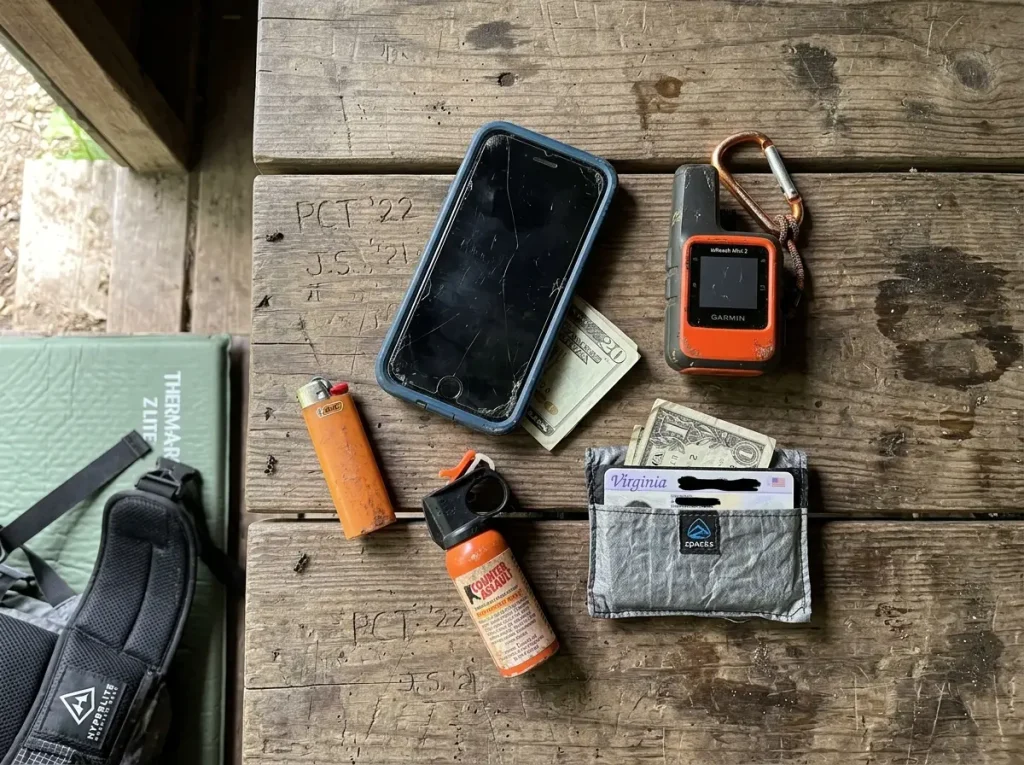
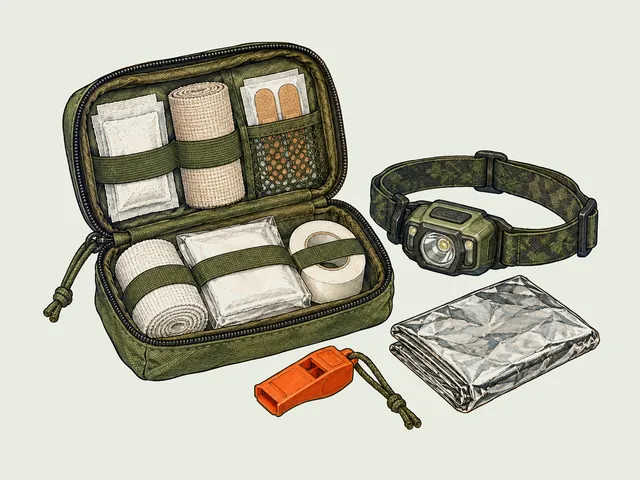
Your pack goes in the trunk or the truck bed. You sit up front. Everything you might need in an emergency stays in your pockets or on your lap — not zipped inside 60 liters of gear you can’t reach.
The Pocket Kit
Four items. Always on your person during every ride:
Your phone (charged, with location sharing active). Your ID (license or passport card — if something goes wrong, you want to be identifiable). Your satellite messenger — a Garmin inReach or comparable PLB that works without cell service. And pepper spray with the safety engaged, in a pocket you can reach with your seatbelt on.
Pro tip: Before your thru-hike, test that you can actually operate your pepper spray canister with one hand while seated. A surprising number of hikers carry pepper spray they’ve never practiced deploying. The parking lot at your starting trailhead is a good place to figure out the safety mechanism.
Phone Battery Strategy
Your phone is your primary safety tool during a hitch. If it’s at 8% when you reach the road crossing, you’ve got no camera for the license plate, no texting capability, and no GPS tracking. Carry a small power bank in your hip belt pocket and plug in during the last mile before road crossings.
Understanding how to keep your GPS running all day without draining the battery means arriving at road crossings with enough charge to handle the safety checklist.
Location Sharing Setup
Most smartphones have built-in location sharing (Google Maps, Apple Find My, WhatsApp live location). Turn it on before your hike and keep it active for your emergency contact. During a hitch, your contact can see where you are in real time without you doing anything.
If you’re in an area with no cell service — common on the PCT and parts of the CDT — your satellite messenger becomes the backup. A Garmin inReach sends GPS coordinates via satellite regardless of cell coverage. Set up an automated tracking interval before your hike so your position updates every 10 minutes.
Solo Hitchhiking and Women-Specific Safety
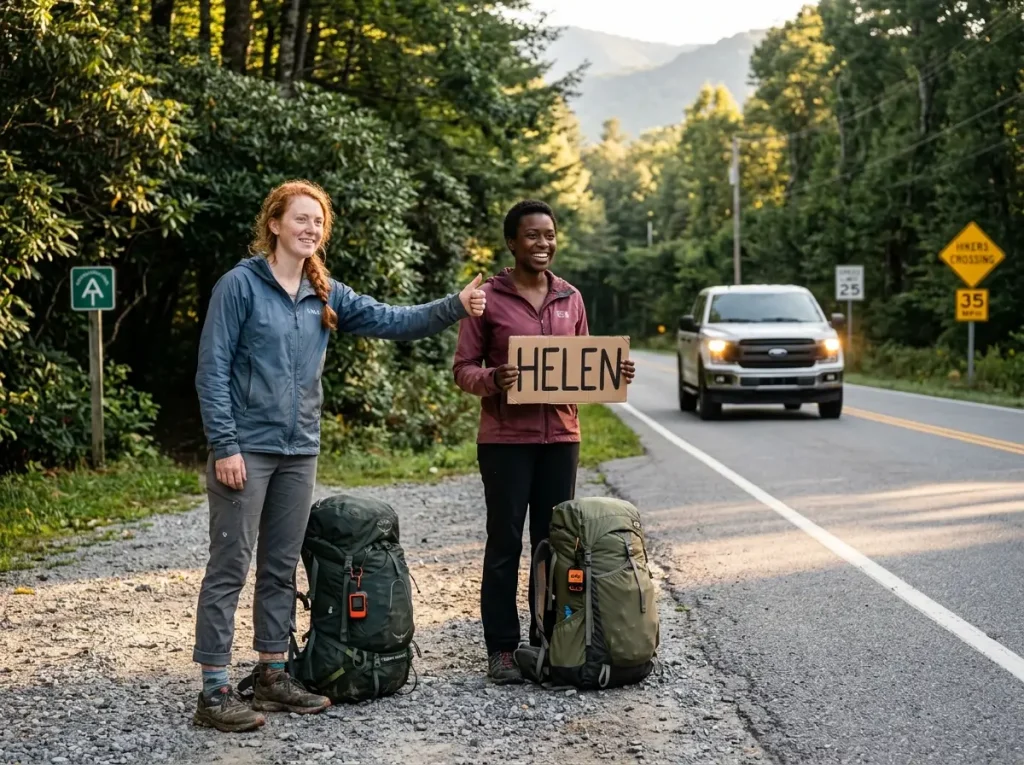
Solo hitchhiking is riskier than hitching with a partner. That’s not fear-mongering — it’s math. Two people in a vehicle create accountability that one person doesn’t. This applies to every hiker, but it matters more for women, who face additional considerations that male hikers rarely think about.
The Buddy System on Thru-Hikes
If you arrive at a road crossing alone, wait. Other hikers are usually 15-30 minutes behind you during bubble season. That wait is worth it. Two hikers standing at a trailhead get picked up faster than one — and the ride is safer for both of you.
When you can’t wait — because you’re ahead of the bubble, or hiking a less-traveled section, or it’s getting dark — the parking lot approach becomes even more important. A face-to-face conversation at a gas station gives you more assessment time than a roadside thumb where you’re making a snap decision about a car that just pulled over.
Protocols From Women With Thousands of Trail Miles
Experienced female thru-hikers who’ve hitched hundreds of rides share consistent advice. Always hitch with at least one other person when possible — even waiting an hour is worth it. If you must hitch solo, approach women drivers or families first. Keep pepper spray in your dominant hand during the ride, not in a pocket. Sit behind the driver, not in the front passenger seat, if you’re riding solo — it’s harder for the driver to reach you and easier for you to reach the door.
Pro tip: Before accepting a solo ride, know the general route to town and roughly how long the drive should take. If the driver takes a turn that doesn’t match, you have immediate grounds to ask them to stop. “Hey, isn’t the town that way?” said early and clearly is better than sitting quietly and hoping.
Tell the driver someone is expecting you. “My trail family already got a ride — they’re waiting for me at the hostel.” Whether it’s true or not, it establishes that people know where you are and are waiting.
What the Data Actually Says
Hitchhiking on trail corridors is statistically much safer than hitchhiking in general. Trail communities know hikers, drivers near trail crossings often pick up hikers regularly, and the hiker network creates a web of witnesses and communication that doesn’t exist in random roadside hitching. That doesn’t make it risk-free — but the risk profile of thumbing a ride near a well-known trailhead in Virginia is fundamentally different from hitchhiking on a random interstate exit.
The Appalachian Trail Conservancy tracks safety incidents on the AT and recommends hikers avoid hitchhiking alone when possible. Their guidance confirms what the thru-hiker community already practices: hitch with partners, assess drivers, share ride information, and budget for shuttles when the alternative feels wrong.
The Hiker Bubble Timing Advantage
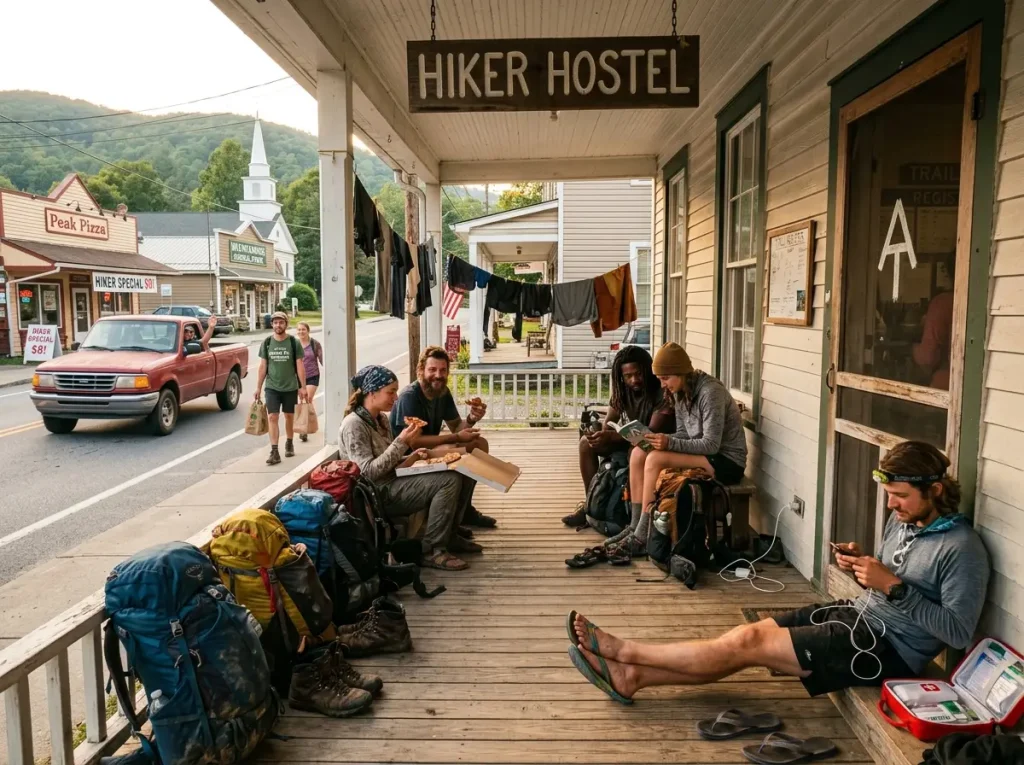
Nobody talks about this as a safety strategy, but timing your thru-hike to travel with the bubble — the wave of hikers moving through the trail at roughly the same pace — makes hitchhiking dramatically safer and easier.
Why the Bubble Matters for Hitching
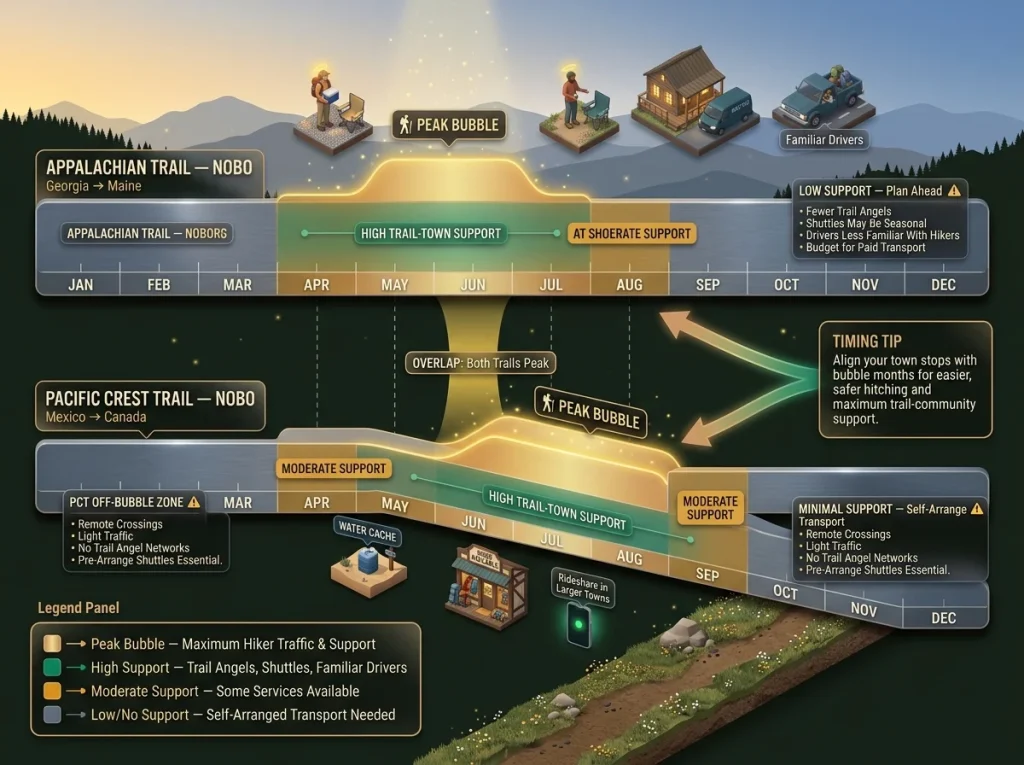
During peak bubble months (April-June for AT NOBO, June-August for PCT NOBO), trail towns are full of hikers. Local drivers recognize the annual migration. Gas stations and outfitters expect hikers asking for rides. The social infrastructure of trail towns activates: hostels offer shuttles, trail angels set up at road crossings, and bulletin boards list ride-share options.
When you hitch during the bubble, you’re operating in a community that knows you exist. The driver who picks you up probably picked up three other hikers last week. The gas station attendant has seen 200 hikers this month. You’re not a random stranger — you’re part of a recognized seasonal phenomenon that these towns depend on economically.
Understanding how trail towns and local economies depend on hiker spending puts the relationship in context. These communities welcome hikers because hikers spend money. That mutual benefit creates a safety net that doesn’t exist when you’re hitching outside the bubble.
Off-Bubble Hitchhiking Is Different
If you’re hiking significantly ahead of or behind the bubble — an early start, a late finish, a section hike in October — the dynamic shifts. Trail towns are quieter. Drivers aren’t expecting hikers. The social infrastructure is dormant. Your hitching strategy needs to adjust: rely more on pre-arranged shuttles, call ahead to hostels for ride coordination, and budget more time and money for the transition between trail and town.
Alternatives to Hitchhiking by Trail Corridor
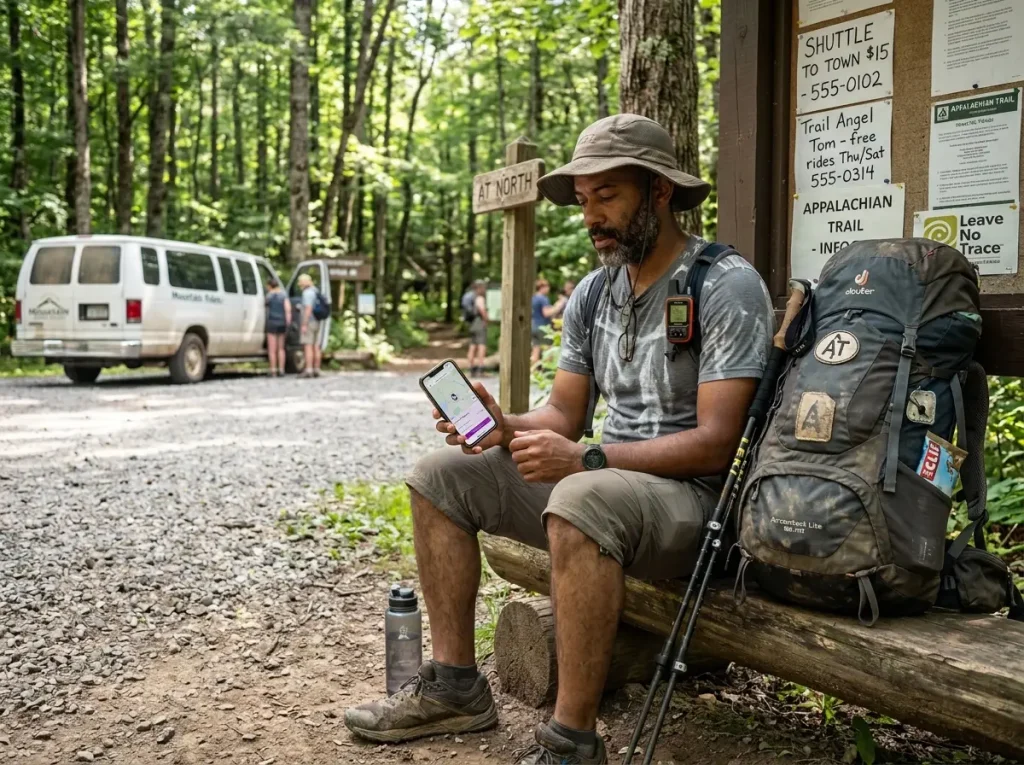
Not every hiker wants to hitchhike. That’s fine. Some sections of every long trail can be resupplied without sticking your thumb out — but it requires planning.
Shuttle Services and Trail Angels
Most well-trafficked trail corridors have shuttle services run by hostels, outfitters, or independent operators. Costs range from $10-40 per ride depending on distance. Some are formal businesses; others are semi-official operations run by retired hikers or trail angels.
Trail angel networks — volunteers who offer free rides at specific road crossings — are active during bubble months on the AT and PCT. Check hostel bulletin boards, FarOut app comments, and trail-specific Facebook groups for current angel availability. Don’t count on angels as your only plan — they’re volunteers, not a taxi service.
When you’re stuck at a crossing with no signal, no angels, and no other hikers, the parking lot approach still works. But having a backup plan — a shuttle number saved in your phone, a hostel that offers pickup — means you’re never truly dependent on a stranger’s willingness to stop.
Keeping your trip on schedule and avoiding unnecessary town vortex days is part of the logistics planning that makes resupply smoother whether you hitch or use shuttles.
The Walkable Resupply Strategy
On the AT specifically, a surprising number of resupply points are walkable from the trail — within 1-2 miles of the crossing on a paved road with a shoulder. Damascus, Hot Springs, Daleville, and Harpers Ferry are either on the trail or within a mile. Planning your resupply around these towns eliminates the need for hitching at those stops.
The section hiking vs. thru-hiking comparison discusses resupply logistics in depth — section hikers have the advantage of car-supported resupply, while thru-hikers need to build the hitchhiking protocol into their planning.
Rideshare Apps in Trail Corridors
Uber and Lyft coverage near trail corridors is spotty but expanding. Towns like Big Bear (PCT), Gatlinburg (AT), and Leadville (CDT) have reliable rideshare service. Smaller trail towns usually don’t. Check coverage before you count on it — and remember that you need cell service for the app to work, which many trail crossings don’t have.
Know the Law Before You Stick Your Thumb Out
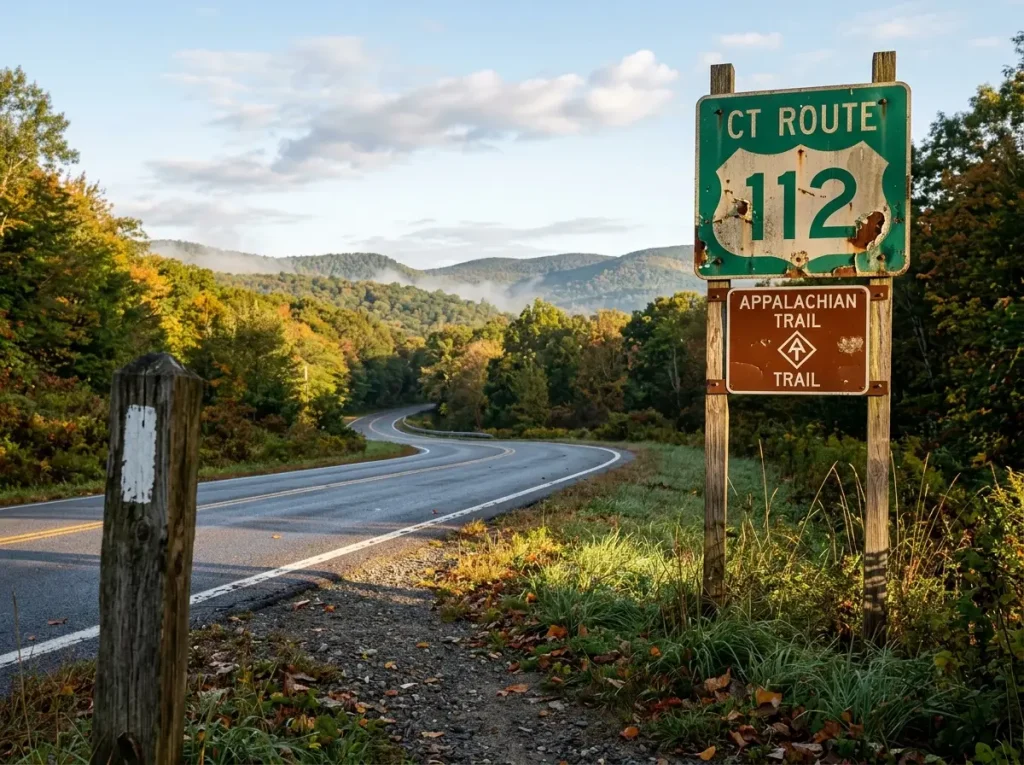
Hitchhiking is legal in 44 of the 50 US states, with important restrictions. The six states where it’s prohibited — Wyoming, Nevada, Utah, New York, Pennsylvania, and New Jersey — include two states that the AT passes through directly (Pennsylvania and New Jersey). If you’re doing a NOBO thru-hike, you’ll walk through both of these states.
What “Legal” Actually Means
In states where hitchhiking is legal, you must stand on the shoulder or sidewalk — not in the travel lane. Blocking traffic is a separate offense everywhere. Hitchhiking on interstate highways is federally prohibited regardless of state law. Hitching on on-ramps varies by state — some allow it, some don’t.
Federal Land Complications
National Parks and National Forests have their own rules. The Department of the Interior prohibits hitchhiking on federal lands “except in designated areas.” In practice, rangers on the AT and PCT generally tolerate trailhead hitching because they understand the necessity. But technically, you could be cited for soliciting a ride inside a National Park boundary.
Pro tip: If you need a hitch from inside a National Park (like the Shenandoah section of the AT or Yosemite on the PCT), walk to the park boundary or the nearest parking area outside it. Rangers are less likely to intervene, and the legality is clearer.
Trail-Specific Norms
On the AT, hitching is so embedded in thru-hiker culture that even law enforcement in trail towns generally ignores it. In Pennsylvania and New Jersey, where it’s technically prohibited, hikers still hitch — but with more discretion, using the parking lot approach at gas stations rather than standing visibly on road shoulders.
On the PCT, hitching is less frequent but longer-distance. The culture is similar but the wait times are longer because road crossings are more remote and traffic is lighter. CDT hitchhiking is the most challenging — remote crossings, minimal traffic, and fewer trail-aware communities.
Conclusion
The roadside thumb is the worst version of hitchhiking — slow, exposed to traffic, and it forces snap decisions from both you and the driver. The parking lot approach is faster, safer, and leads to better rides because both people get to assess the situation face-to-face before committing.
Keep four things in your pockets during every ride: phone, ID, satellite messenger, pepper spray. Send the license plate to someone who knows the system. Hitch with a partner when you can, and time your town stops to align with the bubble when you have the choice.
The thru-hiking community has been hitchhiking safely for decades. The hikers who do it best aren’t fearless — they’re methodical. Copy their system and the rides become one of the best parts of your hike, not the part that keeps you up at night.
Q1 Is it safe to hitchhike on the Appalachian Trail?
The AT corridor is one of the safer places to hitch in the US because trail-town communities know and expect thru-hikers. Most rides are with locals who regularly pick up hikers. Standard precautions — partner hitching, license plate photos, the parking lot approach — reduce risk further.
Q2 Is hitchhiking legal for hikers in the US?
It’s legal in 44 states with restrictions. Stand on the shoulder, never in the road. Pennsylvania and New Jersey prohibit it, which matters for AT hikers. Interstate on-ramps are off-limits everywhere. Use the parking lot approach in restrictive states.
Q3 How do thru-hikers get to town for resupply?
Most hitch rides from road crossings to trail towns 5-15 miles away. Alternatives include hostel shuttles ($10-40), trail angel networks during bubble months, rideshare apps in larger towns, and walkable resupply points on the AT.
Q4 Should women hitchhike alone on a thru-hike?
Waiting for a buddy is always the safer call. When solo hitching is necessary, experienced female hikers recommend the parking lot approach, approaching women or families first, keeping pepper spray in hand, sitting behind the driver, and telling the driver someone is expecting you at the destination.
Q5 What do you do if a ride feels unsafe?
Ask the driver to stop. “I need to get out here” is enough. If the route doesn’t match what you expected, say so immediately. Having your phone with location sharing active and a satellite messenger sending tracking pings means someone knows where you are even if you can’t call.

I've spent more than a decade researching hiking gear and trail technique. I read the specs, the forum threads and the long-term reviews, and every pick here comes with what it gets wrong.
End of the trail
You read every mile of this one. Here's where the trail goes next.