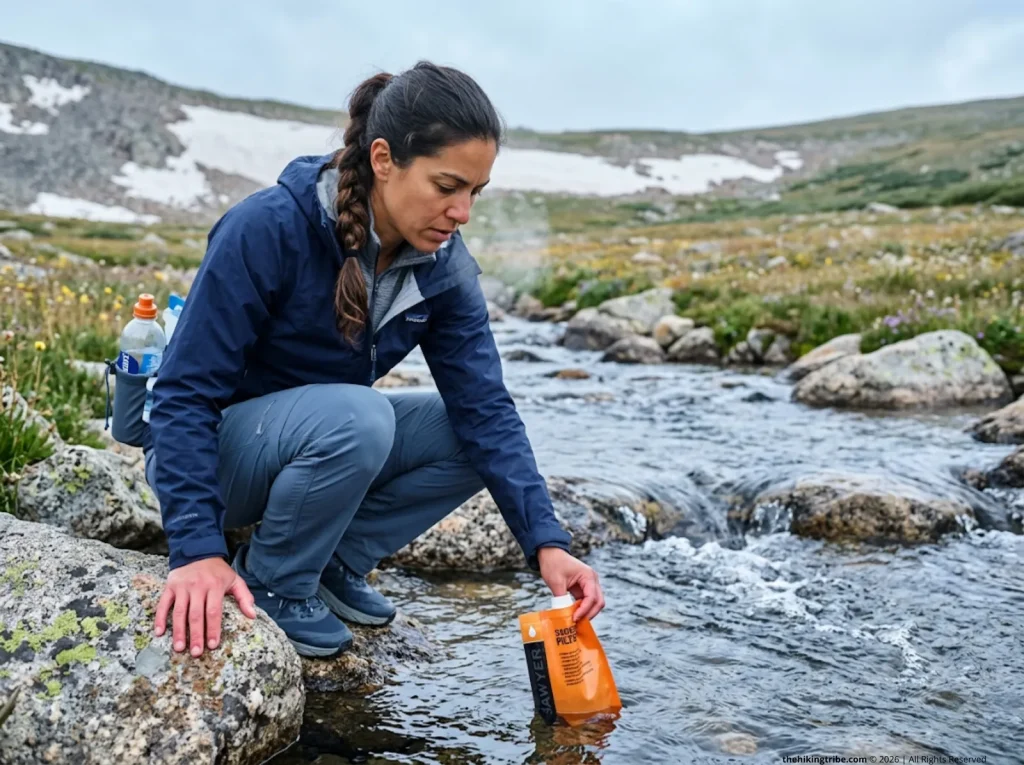
The mountain stream looked perfect. Fast-moving, ice-cold, running straight off the snowpack above 10,000 feet. I filled my bottle, took three long pulls, and felt grateful. Seventy-two hours later, I was doubled over behind a boulder at mile 43, losing fluids from both ends. The culprit wasn’t murky swamp water. It was the cleanest-looking source I’d found all week.
After years of assessing backcountry water sources across dozens of trails, I’ve learned one thing the hard way: your eyes are the worst water quality tool you own. This guide explains why clear water still makes hikers sick and gives you a field-ready triage system to evaluate any source before a drop hits your bottle.
⚡ Quick Answer: Clear water can harbor Giardia, Cryptosporidium, E. coli, and viruses that are completely invisible to the naked eye. No amount of visual inspection can confirm safety. A proper water source risk assessment requires three layers: cartographic intelligence (checking what’s upstream on the map), field assessment (evaluating flow, surroundings, and seasonal conditions), and treatment matched to the specific threat profile. Always treat backcountry water, even when it looks pristine.
The “Clear Water Bias” That Sends Hikers to the ER
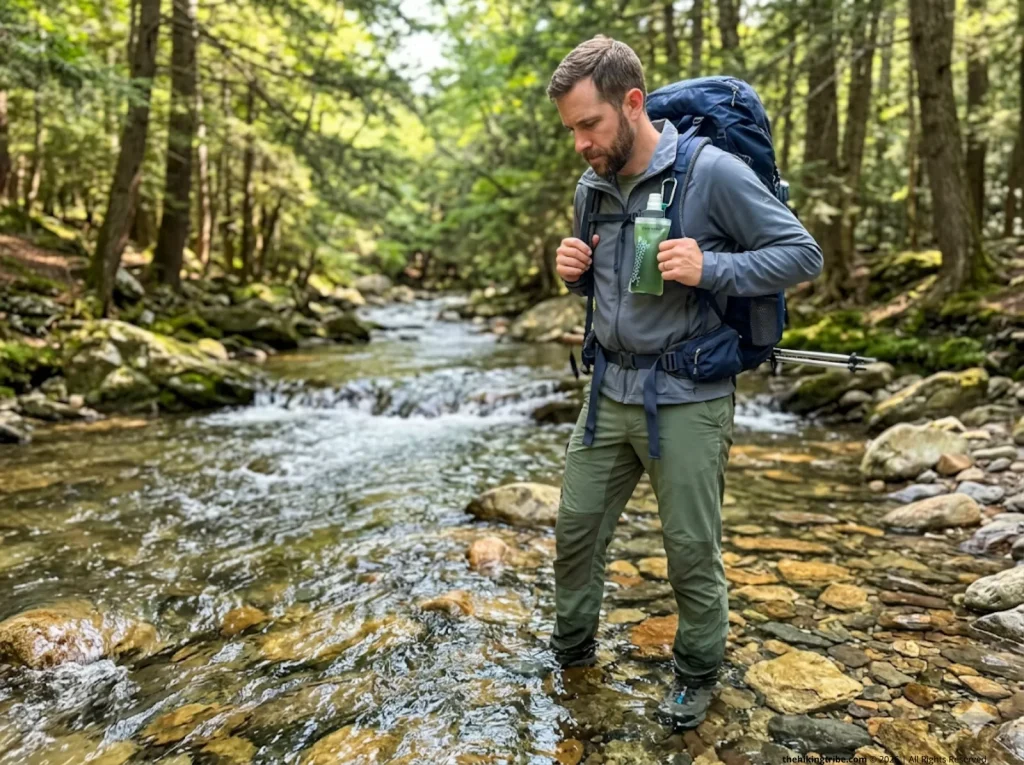
Here’s the uncomfortable truth: the CDC and the Wilderness Medical Society both agree that aesthetic markers like clarity, odor, and flow speed are unreliable indicators of microbiological safety. Yet most hikers still make the same mistake. They see crystal-clear water tumbling over rocks and assume it’s safe.
That assumption has a name in wilderness medicine: clear water bias.
Why Your Eyes Lie: The Science of Invisible Contamination
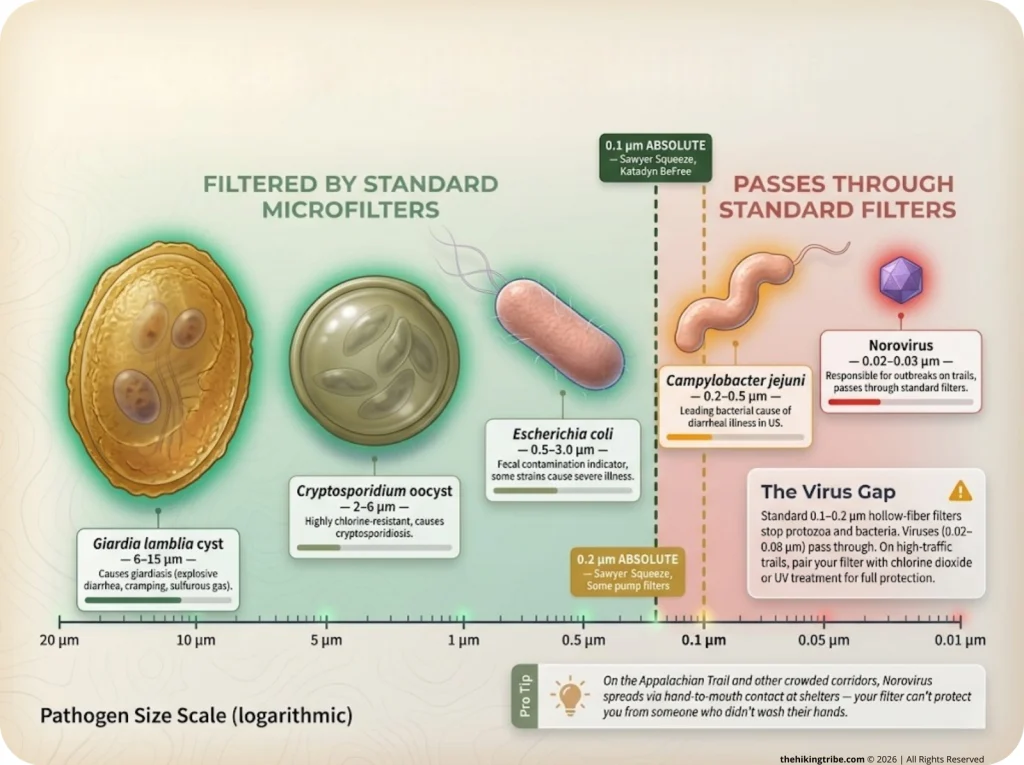
Giardia cysts measure 6 to 15 micrometers. Cryptosporidium oocysts are even smaller at 2 to 6 micrometers. Both invisible to the naked eye. The infective dose for Giardia? As few as 10 cysts.
Even Andrew Skurka, one of the most experienced long-distance hikers alive, treats water quality assessment as a continuum of risk, never a binary safe-or-unsafe judgment. If a guy with tens of thousands of trail miles doesn’t trust his eyes, neither should you.
The Pathogen Lineup: What Lives in “Pristine” Streams
The biological hazards in wilderness water fall into three groups, and each one requires a different defense.
Protozoa are the primary backcountry threat. Giardia and Cryptosporidium both form protective shells (cysts and oocysts) that resist environmental stress and chemical disinfection. Once you swallow them, the symptoms are brutal: explosive diarrhea, cramping, and sulfurous gas that’ll clear a three-person tent.
Bacteria like Campylobacter jejuni — the leading bacterial cause of diarrheal illness in the US — are frequently isolated from “pristine” mountain streams. E. coli signals recent fecal contamination. Salmonella and Shigella show up in high-traffic trail corridors where too many hikers overwhelm natural decomposition.
Then there are viruses, and this is where most hikers’ confidence in their gear falls apart. Norovirus measures 0.02 to 0.03 micrometers. Standard hollow-fiber microfilters like the Sawyer Squeeze or Katadyn BeFree use 0.1 to 0.2 micrometer pores. Do the math. Viruses sail straight through.
On high-traffic thru-hiking trails like the Appalachian Trail, Norovirus outbreaks spread not from the water itself but from hand-to-mouth contamination at shelters. Your filter can’t protect you from someone who didn’t wash their hands before touching the trail register pen.
If you know what to look for, you can recognize the early warning signs of Giardia infection before it derails your trip entirely.
Pro tip: The biggest filtration misunderstanding among hikers is assuming a 0.1 micrometer filter makes water “safe.” It removes protozoa and bacteria. It does nothing against viruses. On busy trails, pair your filter with chlorine dioxide or UV treatment for full coverage.
The Seasonal Wildcard: When “Safe” Sources Turn High-Risk Overnight
A 12-year longitudinal study found that parasitic hospitalizations increase 9% per standard-deviation rise in precipitation. Campylobacter hospitalizations spike 11% per standard-deviation rise in runoff. A water source you rated “low risk” in July can become high risk after an August thunderstorm.
Post-storm runoff flushes oocysts from manure and soil directly into surface water networks. Biofilm-forming bacteria like Legionella and Pseudomonas spike 124% following significant increases in soil moisture. And rural areas, where most hikers recreate, carry a 16% higher baseline risk for bacterial pathogens compared to urban settings.
The Wilderness Medical Society’s clinical practice guidelines on water disinfection lay out the evidence-based framework behind these risk categories.
Map Triage: Reading Water Quality Before You Leave the Trailhead
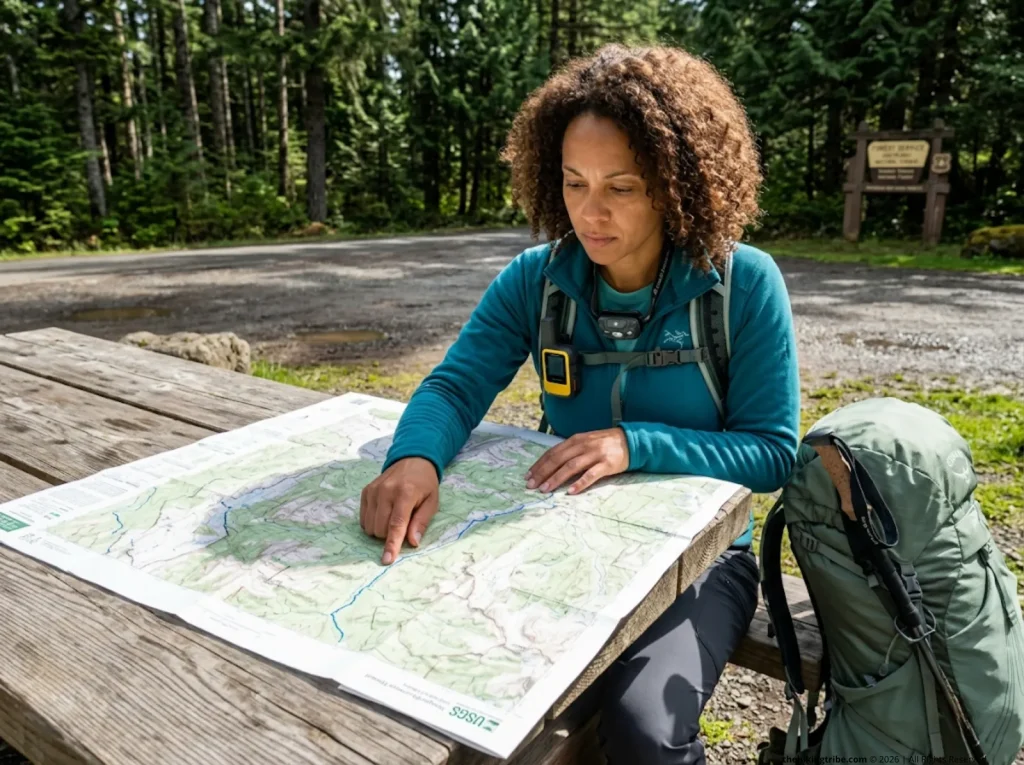
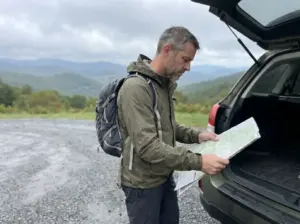
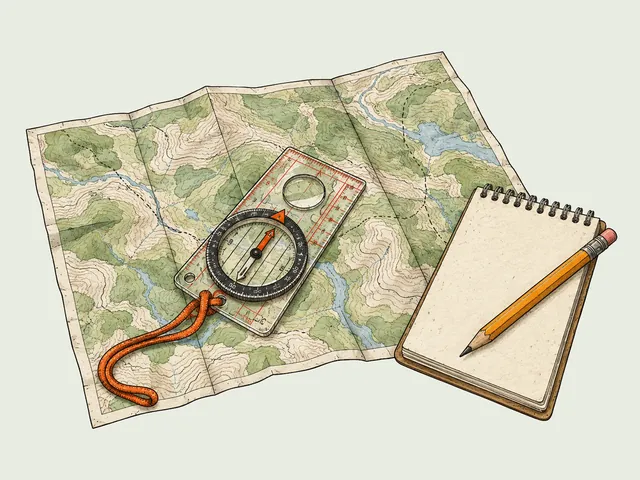
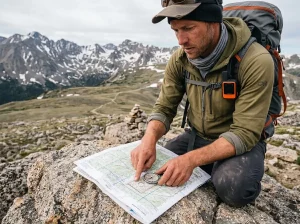
The most effective water source risk assessment starts before you even lace up your boots. A USGS topographic map tells you more about a water source’s safety than any amount of staring at the stream once you get there.
Topographic Symbols That Signal Contaminated Catchments
Standard 1:24,000 scale topo maps encode specific visual clues about upstream land use and hydrography. Learning to read them is the first real skill in backcountry water triage.
Black squares mean buildings. Gray or red tints mean dense development. Labels like “Campground” signal elevated viral and bacterial contamination risk. Fences, cattle guards, and water tanks indicate livestock contamination zones. Grazing allotments on Forest Service maps are high-risk indicators for Cryptosporidium and Giardia.
The crossed-shovel symbol marks a mine. Upstream mines introduce chemical and heavy metal contamination that standard portable filters cannot remove. Period.
Perennial streams (solid blue lines) generally carry lower pathogenic microorganism loads than intermittent streams (dashed blue lines), because intermittent sources have lower dilution factors and can form stagnant pools where bacteria multiply.
Following the Drainage Uphill: The “V” Method
V-shaped contours pointing uphill indicate valleys and drainages where water concentrates. By tracing a drainage upstream on a map, you can spot hidden hazards — a farm, a large campground, or a mine one to two miles above your position that you’d never see from the trail.
This map-reading technique pairs directly with the skills covered in our complete topographic map reading guide for hikers, and it’s the single most underused skill in long-distance trekking.
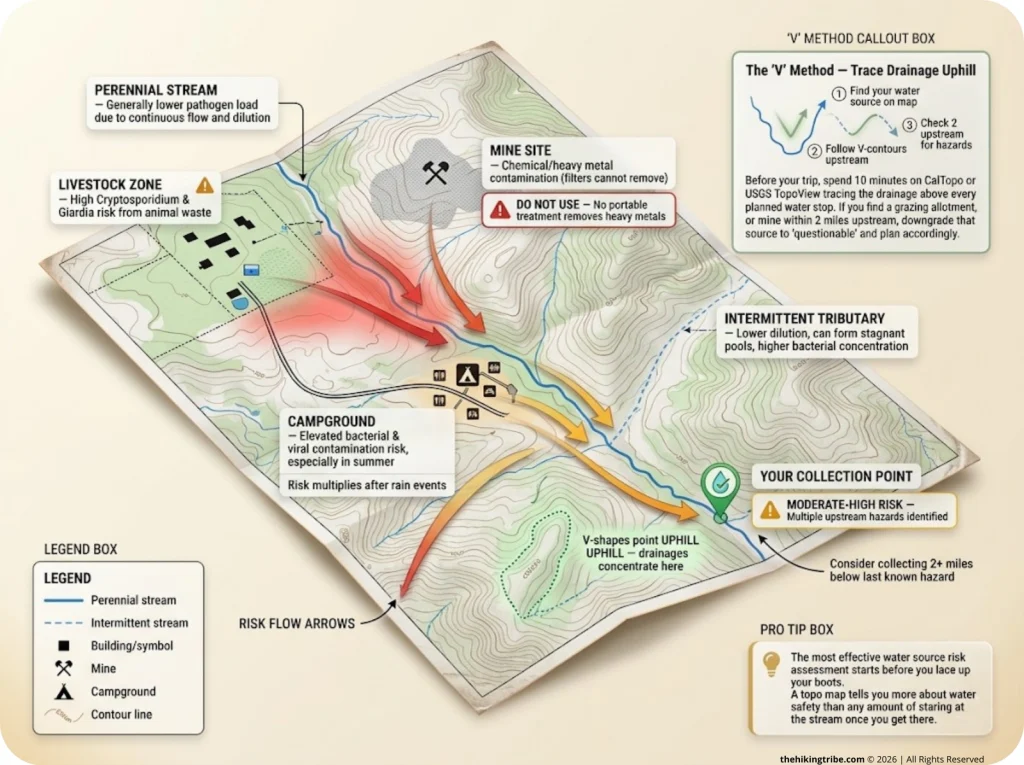
Pro tip: Before your trip, spend 10 minutes on CalTopo or USGS TopoView tracing the drainage above every planned water stop. If you find a building symbol, grazing allotment, or mine within 2 miles upstream, downgrade that source to “questionable” and plan accordingly.
The Field Assessment: Visual and Sensory Cues at the Source
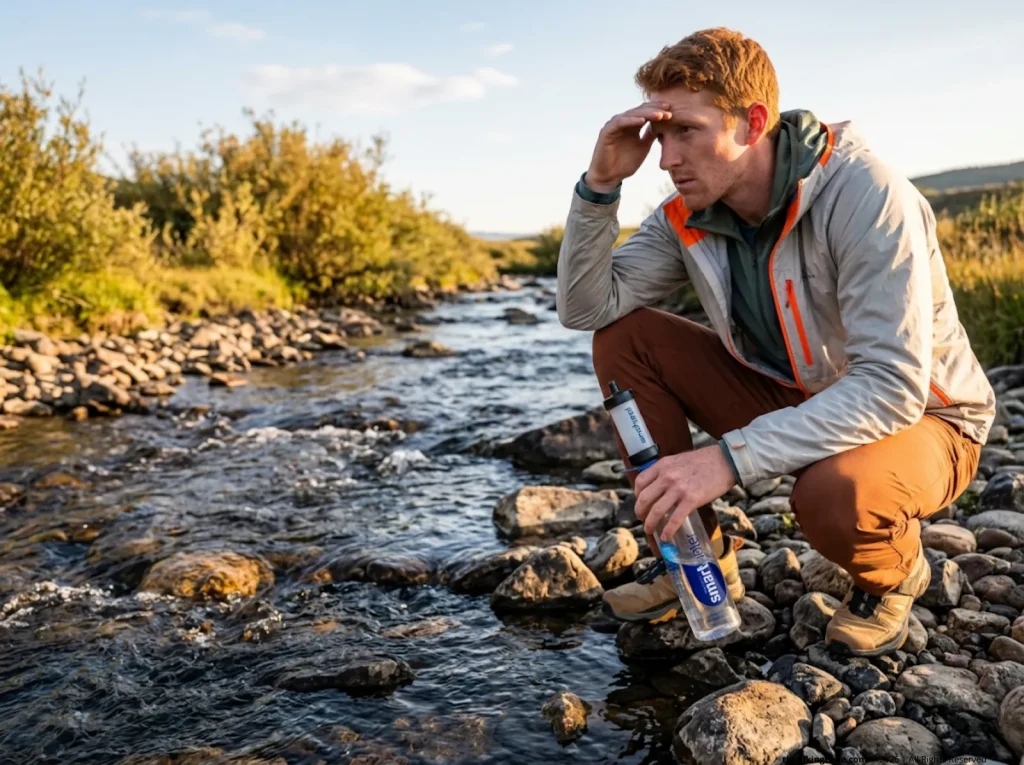
You’ve checked the map. Now you’re standing at the water source. Here’s what to evaluate before you fill your bottle.
Flow, Clarity, and the Upstream Scan
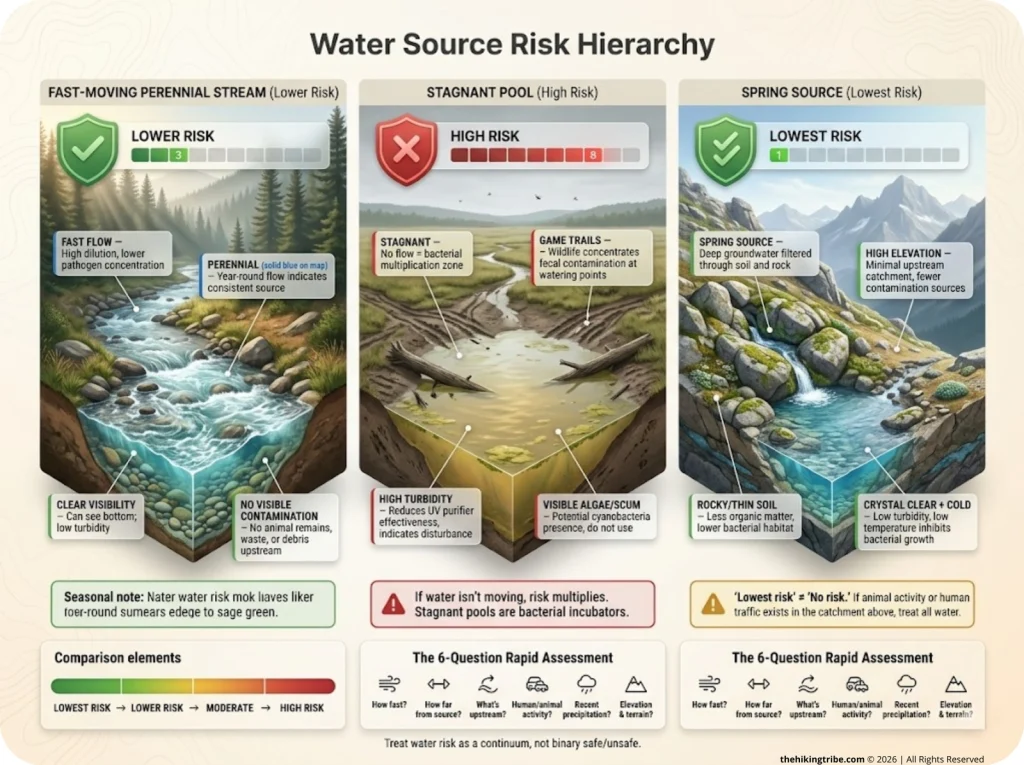
Not all water sources carry equal risk. The hierarchy goes: fast-moving perennial streams over slow-moving streams over stagnant pools. Higher flow means higher dilution and lower pathogen concentration, but never zero.
Spring sources fed by deep groundwater, especially at high elevations, generally carry the lowest microbial risks because soil acts as a natural filter. But “lowest risk” isn’t “no risk.” If the catchment area above the spring includes animal activity or human traffic, treat the water.
Turbidity is a warning sign. Even slightly cloudy water reduces UV purifier effectiveness and can indicate upstream disturbance. Look for game trails converging on the source — wildlife concentrates fecal contamination at watering points.
Before filling, walk 100 yards upstream. Look for animal remains, human waste, camp debris, or livestock.
The 6-Question Rapid Assessment
Adapted from Andrew Skurka’s field methodology, treat water risk as a continuum, not a binary yes/no. Ask these six questions every time:
- How fast is it flowing?
- How far from the source or spring?
- What’s upstream?
- How much human or animal traffic is nearby?
- What’s the recent weather been?
- What elevation and terrain am I at?
At high altitude with thin alpine soil, snowmelt can flush animal waste directly into streams. Elevation alone doesn’t guarantee safety. And stagnant pools, even ones where you can see the bottom, are bacterial multipliers. If the water isn’t moving, the risk multiplies.
Knowing how to locate reliable water sources using terrain and bio-indicators is just as important as knowing how to assess the ones you find.
Pro tip: On the PCT, experienced thru-hikers know that water sources below cattle grazing allotments in the Sierra are consistently higher risk mid-summer. Check with the PCTA water report before drinking unfiltered from any lowland source, regardless of how clear it looks.
The Invisible Threat: Benthic Cyanobacteria in Clear Water
This is the contamination type that defeats every standard backcountry treatment method. And most hikers have never heard of it.
Why Your Filter, Chemicals, and Boiling All Fail
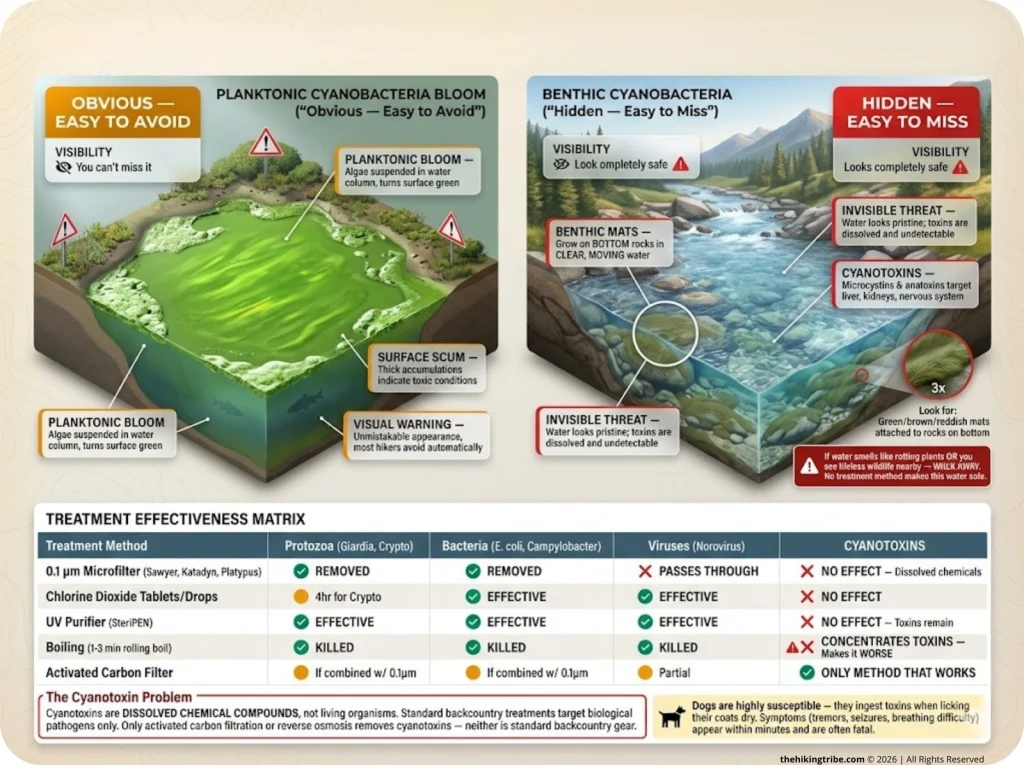
Benthic cyanobacteria grow on rocks and sand at the bottom of clear, moving water. Unlike planktonic blooms that turn water into green “pea soup,” these organisms hide in plain sight. They produce cyanotoxins — microcystins and anatoxins — that target the liver, kidneys, and nervous system.
Here’s the problem: cyanotoxins are dissolved chemical compounds, not living organisms. Standard 0.1 to 0.2 micrometer microfilters won’t catch them. Chlorine dioxide won’t neutralize them. Iodine doesn’t work.
And boiling? Boiling water contaminated with cyanotoxins actually concentrates them as water volume is lost to steam. It makes the problem worse.
Only activated carbon filtration or reverse osmosis removes cyanotoxins. Neither is standard backcountry equipment.
Visual ID and the Dog Safety Rule
Look for mats — green, blue-green, or brownish-red — attached to rocks on the bottom of otherwise clear waterbodies. If the water smells like rotting plant material, or if you see lifeless wildlife near the shore, walk away. No treatment method will make that water safe.
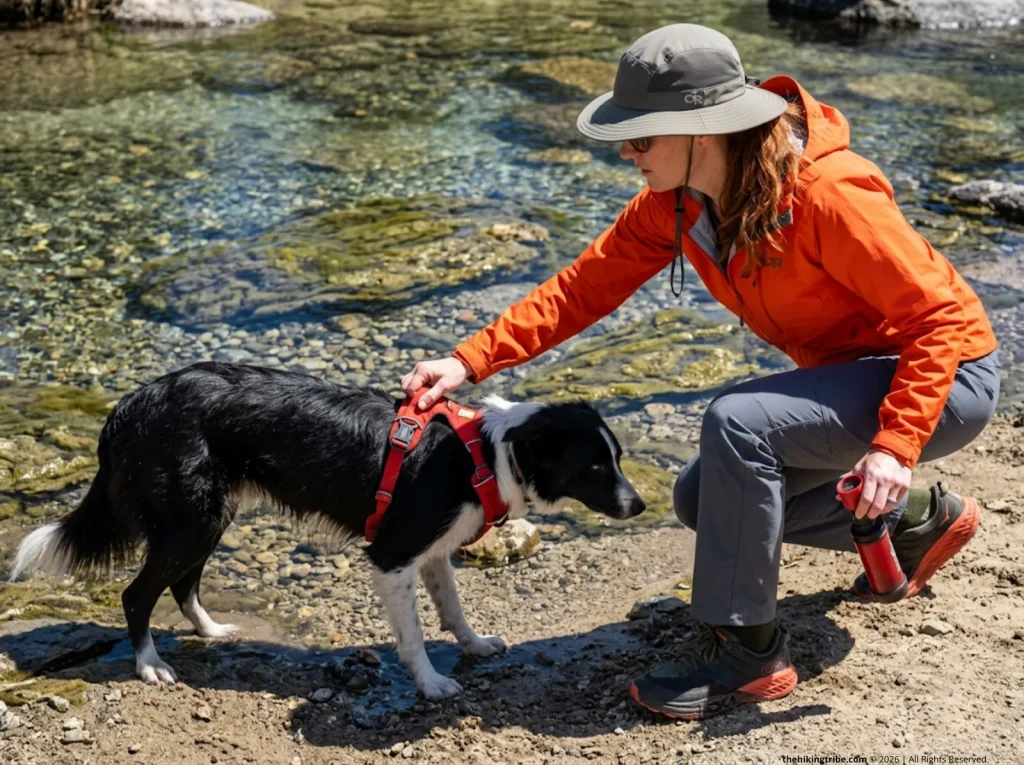
This is especially critical for hikers with dogs. Canines are highly susceptible to cyanotoxins because they ingest scum attached to their coats when they lick themselves dry. Symptoms — tremors, seizures, difficulty breathing — can appear within minutes. They’re often fatal.
If you hike with your dog regularly, the protocols in keeping your dog safe on the trail should be part of your pre-trip planning, not an afterthought.
Matching Treatment to Threat: The Water Triage Matrix
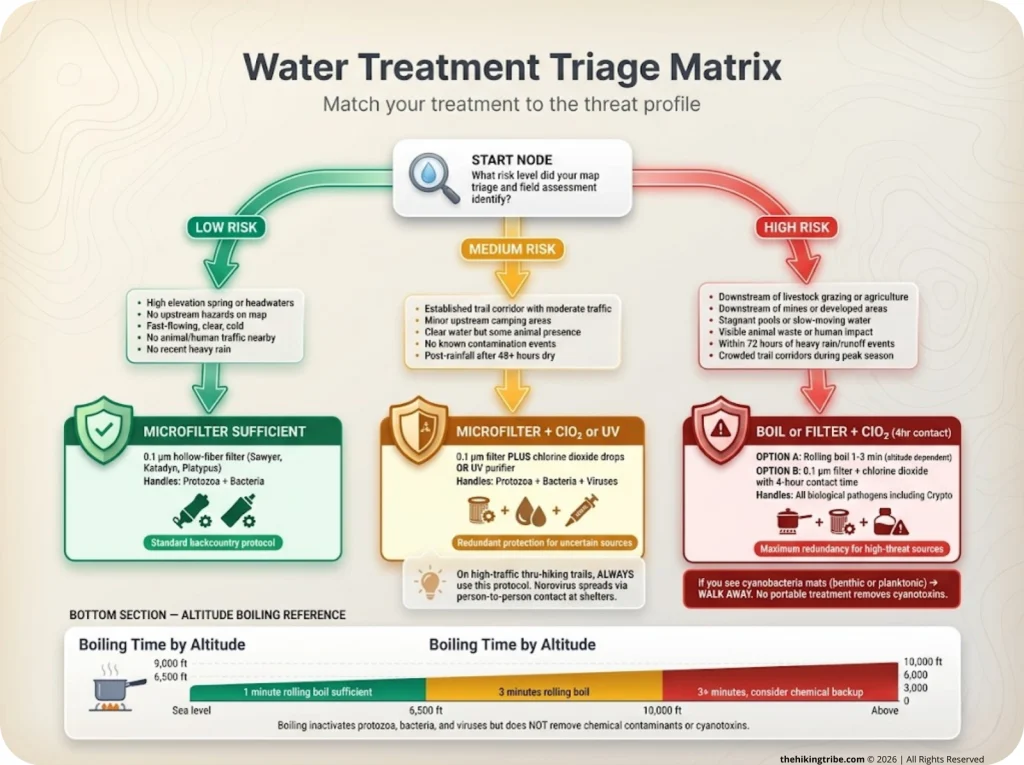
You’ve assessed the risk. Now which treatment do you use?
Thermal Disinfection and the Altitude Adjustment
Boiling is the most reliable single-method disinfection recognized by medical authorities. A rolling boil inactivates protozoa, bacteria, and viruses. At sea level through 6,500 feet, one minute at a rolling boil is sufficient. Above 6,500 feet, where the boiling point drops to roughly 93°C (200°F), extend to three minutes.
The limitation: boiling doesn’t remove chemical contaminants or cyanotoxins, and it burns through fuel.
Mechanical Filtration: What 0.1 Microns Actually Stops
Hollow-fiber filters dominate the backcountry market, and understanding the critical difference between water filters and purifiers is the first step toward the right gear choice.
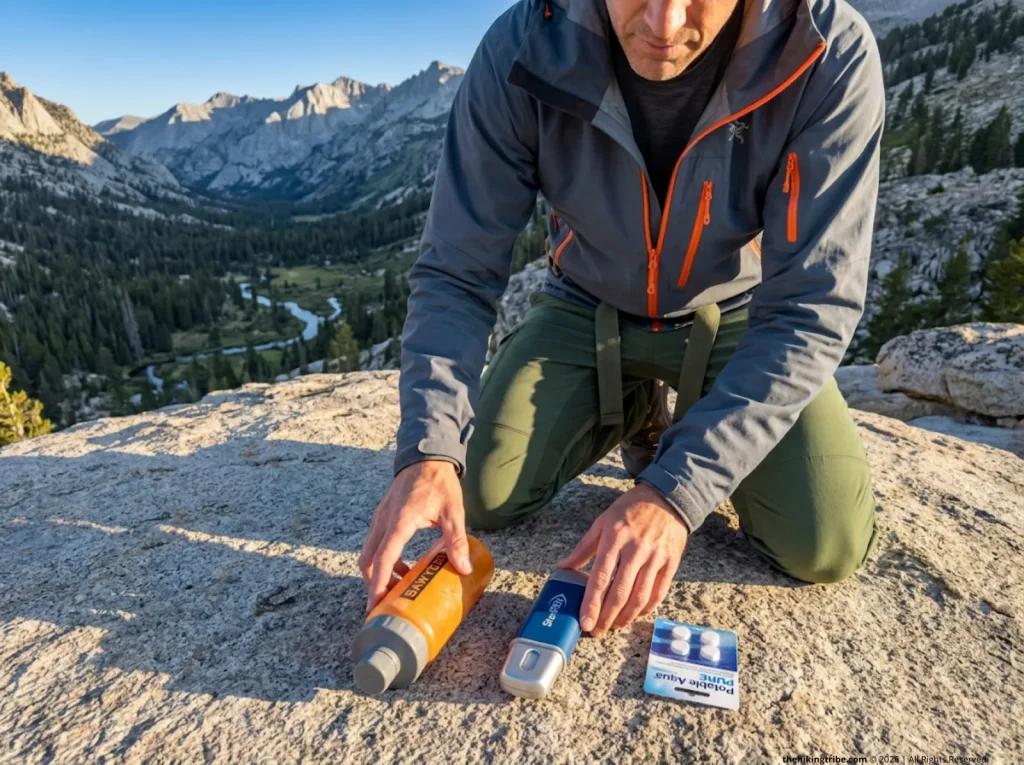
The Sawyer Squeeze (3.0 oz, 0.1 micrometer absolute, 28mm threads) is the thru-hiker standard — “absolute” means nothing larger than 0.1 micrometers passes through. The Katadyn BeFree (1.2 oz, 0.1 micrometer nominal, 42mm proprietary thread) is faster but uses a “nominal” rating, meaning pore size is an average. The Platypus Quickdraw (2.9 oz, 28mm threads) includes a built-in integrity test for post-freeze verification.
All three handle protozoa and most bacteria. None remove viruses.
One critical warning: if water inside hollow fibers freezes, it ruptures the membrane microscopically. The filter keeps flowing and looks fine, but it no longer blocks pathogens. In sub-freezing conditions, sleep with your filter inside your bag.
Chemical and UV: Closing the Virus Gap
Chlorine dioxide is the superior chemical treatment. It handles bacteria, viruses, and Giardia. It’s “somewhat effective” against Cryptosporidium with a four-hour contact time in cold or turbid water. Iodine and chlorine bleach handle bacteria and viruses but fall short against protozoa.
UV purifiers like the SteriPEN disrupt pathogen DNA but require clear, low-turbidity water. In an emergency, SODIS (solar disinfection) works by exposing clear plastic bottles to direct sunlight for four to six hours.
In high-risk areas like agricultural zones, post-storm corridors, or crowded trail sections, the redundancy principle applies: pair a 0.1 micrometer microfilter with chlorine dioxide or UV. That combination covers protozoa, bacteria, and viruses. The CDC’s water treatment guidelines for hikers and travelers confirm this layered approach as the recommended protocol.
The Human Factor: Hygiene Failures That Your Filter Can’t Fix
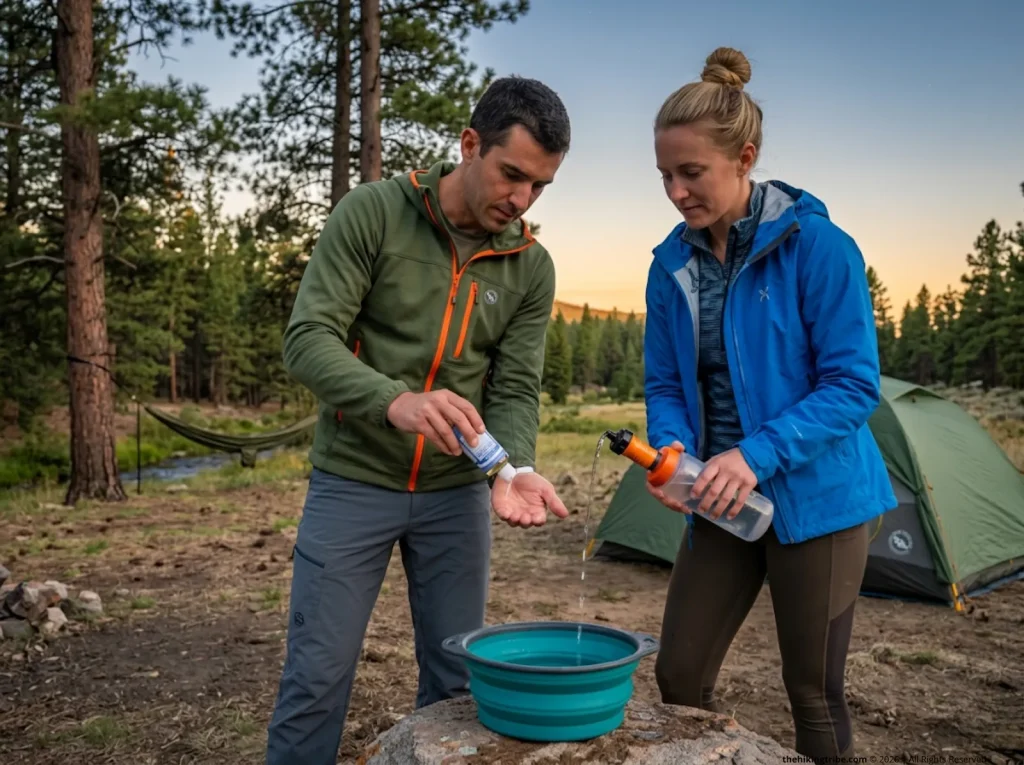
Your filter can be perfect. Your water source can be low risk. And you can still get sick. Here’s why.
The Handwashing Defense and Trail Hygiene
The two most significant factors in preventing gastrointestinal illness in the backcountry are regularity of water disinfection and handwashing. Not one or the other. Both.
Hand sanitizers with 60% or more alcohol work against most bacteria, but they’re notoriously poor at inactivating Cryptosporidium oocysts and Norovirus. Proper handwashing with soap and water — done at least 100 yards from the water source — is the gold standard.
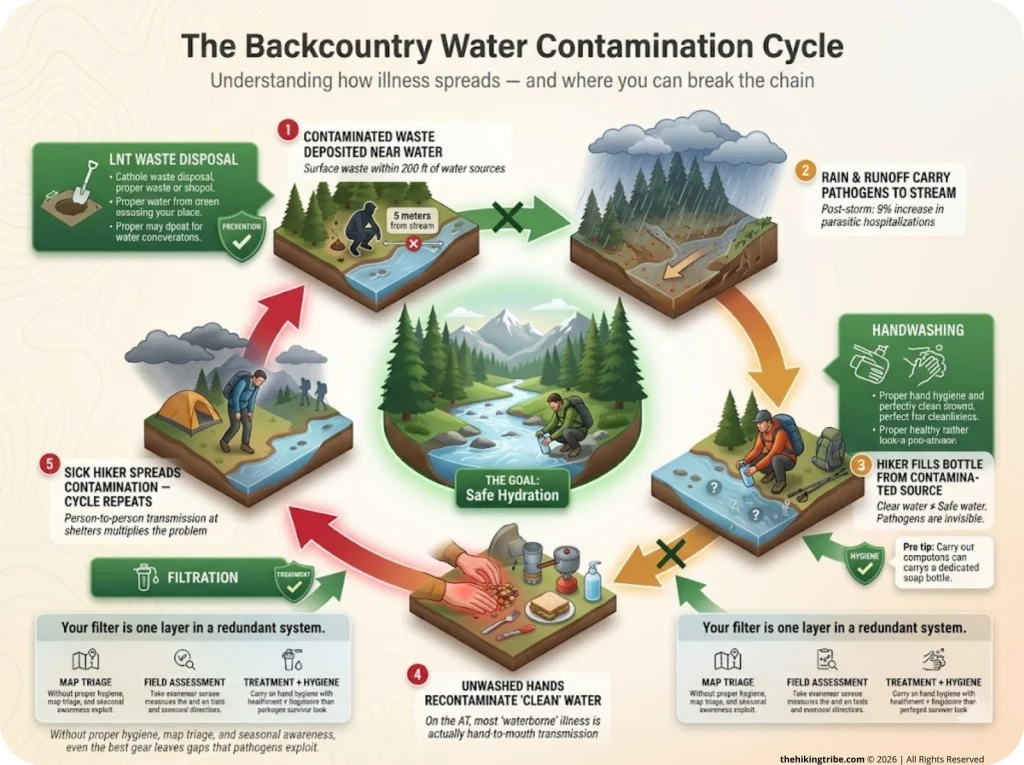
On the Appalachian Trail, many “waterborne” illnesses are actually person-to-person transmission at shelters, privies, and shared cooking areas. The water gets blamed, but dirty hands are the real culprit.
Pro tip: Carry a dedicated 250ml squeeze bottle of soapy water for handwashing at meal times. It weighs almost nothing and closes the biggest hygiene gap most hikers ignore.
Leave No Trace and the Waste-Water Cycle
Surface-deposited human waste and bathing directly in streams introduce pathogens into the very backcountry water sources hikers depend on. On the AT, hikers have reported finding feces within one meter of trails and directly adjacent to streams.
The 200-foot buffer for waste disposal isn’t just an ethical guideline — it’s a public health intervention. Catholes should be 6 to 8 inches deep in organic soil. In alpine zones above treeline, pack out all human waste with WAG bags. For the full protocol, see our Leave No Trace guide to backcountry waste disposal.
Filter Maintenance: The Freezing and Backflush Protocol
More trail illnesses come from contaminated filter housings and failure to backflush than from the water source itself. Backflush Sawyer filters with the provided syringe after every use in silty water. BeFree filters need the “shake and swish” routine.
And remember the freezing risk: microscopic membrane ruptures from frozen water are invisible. The filter flows normally but passes pathogens. If there’s any chance your filter froze overnight, replace it. No field test exists to verify membrane integrity — unless you carry the Platypus Quickdraw with its built-in integrity test.
Conclusion
Clear water is an aesthetic assessment, not a safety assessment. The pathogenic microorganisms that hospitalize hikers are microscopic, invisible, and thrive in the most “pristine” looking sources.
A water source’s safety comes down to three layers: cartographic intelligence (knowing what’s upstream on the map), field assessment (what you observe at the source), and technical treatment matched to the threat profile. Your filter is one layer in a redundant system. Without proper hygiene, map triage, and seasonal awareness, even the best gear leaves gaps that Norovirus, Cryptosporidium, and cyanotoxins can exploit.
On your next trip, pull up the topo map for your planned water sources and trace the drainage upstream. That ten-minute exercise will tell you more about water safety than any amount of staring at the water once you get there.
FAQ
Can you get sick from drinking clear mountain stream water?
Yes — clear water can harbor Giardia, Cryptosporidium, E. coli, and viruses that are completely invisible to the naked eye. The CDC and Wilderness Medical Society classify all untreated surface water as potentially contaminated regardless of visual clarity, flow rate, or elevation.
Is it safe to drink from a spring without filtering?
Springs fed by deep groundwater at high elevation carry the lowest risk of any natural source, but lowest risk is not no risk. If animal activity, human traffic, or agricultural runoff exists anywhere in the catchment above the spring, pathogens can be present. Filter or treat all backcountry water.
Do water filters remove viruses?
Standard hollow-fiber microfilters with 0.1 to 0.2 micrometer pore sizes do not remove viruses, which measure 0.02 to 0.08 micrometers. Removing viruses requires a purifier — either UV treatment, chlorine dioxide, boiling, or an ultrafilter rated below 0.01 micrometers.
How do I know if a water source has harmful algae?
Look for green, blue-green, or brownish-red mats attached to rocks on the bottom of the water. An odor of rotting plant material is another warning sign. Unlike planktonic blooms that turn water green, benthic cyanobacteria grow in clear, cold, moving water. If you see mats or detect the odor, do not use that source — no standard backcountry treatment removes cyanotoxins.
What should I do if my water filter freezes?
Replace it. When water inside hollow fiber membranes freezes, it expands and creates microscopic ruptures that allow pathogens to pass through. The filter will still flow and appear functional, but it is compromised. The only exception is the Platypus Quickdraw, which has a built-in integrity test for post-freeze verification.
I've spent more than a decade researching hiking gear and trail technique. I read the specs, the forum threads and the long-term reviews, and every pick here comes with what it gets wrong.
End of the trail
You read every mile of this one. Here's where the trail goes next.